Wednesday, May 04, 2022

PROFITEERING = INFLATION
Steak Prices Will Keep Rising, Major U.S. Meatpacker Says

Tatiana Freitas
Wed, May 4, 2022,


(Bloomberg) -- Beef will be getting even more expensive at U.S.
 grocery stores in the months ahead, according to one of the country’s biggest meatpackers.

National Beef Co., controlled by the Brazilian giant Marfrig Global Foods, sees relatively stable margins in the next two quarters, according to Tim Klein, who heads Marfrig’s U.S. operations. That means even though their costs to buy cattle are increasing, the company will ultimately be able to pass that on to consumers in the form of pricier steaks and burgers.

“Cattle prices will go up, and beef prices will go up with them,” Klein said during an earnings interview.

The cost of meat has been a focus as consumers grapple with the fastest inflation in four decades. The average price for ground beef in America grocery stores has jumped 18% from a year ago, according to the government data. American shoppers may adapt to inflation by switching to less expensive cuts, according to Klein.

Marfrig beat analysts’ estimates for earnings before items and revenue, posting a record for a first quarter. U.S. operations drove the gains, while South America’s unit started a recovery amid booming Chinese demand and improving cattle supply in Brazil, according to Miguel Gularte, who heads operations in the region. Marfrig’s slaughterings in Brazil rose 20% in the quarter, the double compared with the industry average, Gularte said.

Net income fell 61% from a year ago due to a non-cash loss on the mark-to-market of its stake in the food giant BRF SA. Starting next quarter, Marfrig will add BRF earnings to its balance sheet, according to Chief Financial Officer Tang David. Last month, Marfrig’s founder, Marcos Molina dos Santos, was elected BRF chairman.
GREEN CAPITALI$M

Jumbo Green Deal Wakes Up ESG Market

Priscila Azevedo Rocha and Jacqueline Poh
Tue, May 3, 2022


(Bloomberg) -- The green bond market is roaring back to life with the biggest-ever corporate sale, pulling in investors starved of ethical debt during this year’s market turmoil.

Dutch power company TenneT Holding BV sold 3.85 billion euros ($4.06 billion) of green debt across four maturities Tuesday, to fund greener electricity grids across Europe. It’s the largest deal for the environmental debt from a company, topping previous efforts from Honda Motor Co. and Engie SA, according to data compiled by Bloomberg.

“This is a company that is at the heart of the energy transition in Europe,” said Arthur Krebbers, NatWest Markets Plc’s head of corporate climate & ESG capital markets. “It is amongst the players helping the German and Dutch economy transition to green, which has never been more topical.”

Investors jumped on the sale, placing more than 8 billion euros of bids, after a dearth of green corporate issuance in Europe following Russia’s invasion of Ukraine. Sales in the region through April are 23% down on last year, as issuers step back from raising new debt amid ongoing bouts of global volatility.

TenneT offered notes ranging from 4.5 years to 20 years, according to a person familiar with the sale, who asked not to be identified. Proceeds will fund infrastructure to boost the distribution of renewable energy, with the firm aligning its projects to both United Nations development goals and proposed European Union green bond rules.

“TenneT has a large capex budget to fund, including for energy transition,” said Scott Freedman, a fund manager at Newton Investment Management. “I think there will likely be a lot more to come from the sector in general.”

The ethical bond has exploded in recent years to be worth over $4 trillion as governments and companies fund projects to cut greenhouse gas emissions, while funds are under regulatory and investor pressure to put their money toward a more sustainable future. European policy makers are also pushing to reduce their energy dependence on Russia.

This year, power firms including E.On SE and Iberdrola SA have sold about 11.37 billion euros of green notes in Europe through the end of April. TenneT is already a regular visitor to the ethical market, with two offerings last year including a 1.8 billion euros three-parter in May.

The investor demand enabled the firm to trim pricing on the 20-year notes to 110 basis points over mid-swaps, inside initial marketing at about 130 basis points, according to the person familar with the deal. That’s still much higher than the 67 basis-point spread it paid a year ago, following the global rise in rates.

A TenneT spokesperson wasn’t immediately available to comment. ABN Amro Bank NV, BNP Paribas SA, Commerzbank AG, NatWest Markets, Banco Santander SA and UniCredit SpA were the bookrunners on the deal.

Starbucks announces $1 billion investment in US employees as unionization efforts spread


·Reporter, Booking Producer

Starbucks interim CEO Howard Schultz announced a $1 billion investment in U.S. partners (what the company calls it employees) and stores for fiscal year 2022 during the company's Q2 earnings call.

The investment — which will go toward increased pay, additional training, and store innovation — comes as more than 240 Starbucks stores in 32 states have filed for union elections as of Monday.

The announcement includes an update to the company's previously announced wage increase for all U.S. hourly earners to at least $15 per an hour (up from $12), going into effect on August 1. All partners hired on or before May 2 will get either a 3% raise or $15/hour, whichever is higher.

Beyond baristas, Starbucks will also up pay for store managers, assistant store managers and shift managers hired on or before May 2. These investments are one-time investments in base pay in addition to planned fiscal year 2023 raises this fall.

The company also announced plans to reward length of service. Partners with between 2-5 years of service will receive at least a 5% increase or move to 5% above the market start rate, whichever is higher. Partners with 5+ years of service will receive at least a 7% increase or move to 10% above the market start rate, whichever is higher.

NEW YORK, NEW YORK - APRIL 14: People hold signs while protesting in front of Starbucks on April 14, 2022 in New York City. Activists gathered to protest Starbucks' CEO Howard Schultz anti-unionization efforts and demand the reinstatement of workers fired for trying to unionize. (Photo by Michael M. Santiago/Getty Images)

On top of the pay bump, the company plans to double the amount of training time for baristas and store managers. It's also bringing back its Coffee Master and Black Apron training programs this summer. Partners who complete the Coffee Mastery program will then have the chance to be selected to participate in the Leadership in Origin program at Hacienda Alsacia, a Starbucks coffee farm in Costa Rica.

In August, the company will launch a new partner app to stay connected and better communicate with all U.S. employees.

Since his return to CEO on April 4, Schultz and other executives have been visiting retail and roasting locations around the country to hear firsthand how employees' lives have been impacted over the last two years.

As the result of employee feedback, the company plans to provide opportunities to increase sick time, implement a new "financial stability toolkit benefit," and introduce new tools to help partners refinance student loans.

Priorities for upcoming investments include the introduction of credit card/debit card tipping by late 2022, equipment and tech upgrades, plus a new employee recognition program/career mobility program.

Shares of Starbucks are down roughly more than 35% compared to a year ago.

Putin abandons the term 'de-Nazification': Russians do not understand what it is - researchers


ukrpravda@gmail.com (Ukrayinska Pravda)
ROMAN PETRENKO - WEDNESDAY, 4 MAY 2022

The Kremlin has sharply reduced the use of the term "de-Nazification", a term mentioned by the aggressor country's president Vladimir Putin along with "demilitarisation" as the reason for starting the war in Ukraine.

 Source: "Proekt" investigative journalists, quoting sources in the Kremlin Details: "Proekt" notes that in his speech on 24 February, Vladimir Putin referred to the goals of the so-called "special operation" as being the "demilitarisation" and "de-Nazification" of Ukraine.

 As the statement was prepared in secrecy, experts were not given time to examine these terms in detail. And Russian propagandists had to repeat the term "de-Nazification" endlessly. 

Almost immediately, it became clear that the term was an unfortunate one. About a week after the war began, the Kremlin asked its sociologists to conduct closed-circuit telephone interviews, including a question about Russians' attitudes to the main propaganda messages. 

Four sources - a high-ranking media manager, a sociologist and two political strategists close to the Kremlin - claim that respondents were unable to explain what "de-Nazification" meant. In addition, people found it difficult even to pronounce the word, says one of the sources. 

The source complained to journalists that after this, they [the Kremlin -ed.] made a mess of things -
 "Every week they were looking for new words, but nothing good came out of their mouths. As a result, the authorities have decided to sharply reduce the use of the word "de-Nazification" on air, but it was impossible to abandon it altogether - " you can't just forget the president's stated aim".

 "Proekt" reported that this was evident in the broadcasts of the Kremlin's chief propagandist, Dmitriy Kiselev. In the first broadcast after the start of the war, he spent no less than seven minutes explaining the meaning of "de-Nazification". But since the April broadcasts he has either not used the term at all, or only once during the whole broadcast.
Chinese hackers took trillions in intellectual property


Nicole Sganga
Tue, May 3, 2022

A years long malicious cyber operation spearheaded by the notorious Chinese state actor, APT 41, has siphoned off an estimated trillions in intellectual property theft from approximately 30 multinational companies within the manufacturing, energy and pharmaceutical sectors.

A new report by Boston-based cybersecurity firm, Cybereason, has unearthed a malicious campaign — dubbed Operation CuckooBees — exfiltrating hundreds of gigabytes of intellectual property and sensitive data, including blueprints, diagrams, formulas, and manufacturing-related proprietary data from multiple intrusions, spanning technology and manufacturing companies in North America, Europe, and Asia.

"We're talking about Blueprint diagrams of fighter jets, helicopters, and missiles," Cybereason CEO Lior Div told CBS News. In pharmaceuticals, "we saw them stealing IP of drugs around diabetes, obesity, depression." The campaign has not yet been stopped.

Cybercriminals were focused on obtaining blueprints for cutting-edge technologies, the majority of which were not yet patented, Div said.

The intrusion also exfiltrated data from the energy industry – including designs of solar panel and edge vacuum system technology. "This is not [technology] that you have at home," Div noted. "It's what you need for large-scale manufacturing plants."

The report doesn't disclose a list of affected companies, but researchers found the cyber espionage campaign — which had been operating undetected since at least early 2019 — collected information that could be used for future cyberattacks or for potential extortion campaigns — details about companies' business units, network architecture, user accounts and credentials, employee emails and customer data.

Cybereason first caught wind of the operation in April of 2021, after a company flagged a potential intrusion during a business pitch meeting with the cybersecurity firm. Analysts reverse engineered the attack to uncover every step malicious actors took inside the environment, discovering APT 41 "maintained full access to everything in the network in order for them to pick and choose the right information that they needed to collect."

That full access enabled cybercriminals to exfiltrate tedious amounts of information required to duplicate complicated engineering, including rocket propelled weapons. "For example, to rebuild a missile there are hundreds of pieces of information that you need to steal in a specific way in order to be able to recreate and rebuild that technology," Div said.

APT 41 or "Winnti" – which also goes by affiliate names BARIUM and Blackfly – remains one of the most prolific and successful a Chinese state-sponsored threat groups, with a history of launching CCP backed espionage activity and financially motivated attacks on U.S. and other international targets, routinely aligned with China's Five-Year economic development plans.

In May 2021, the Justice Department charged four Chinese nationals connected to APT 41 for their participation in a global computer intrusion campaign targeting intellectual property and sensitive business information.

The FBI estimated in its report that the annual cost to the U.S. economy of counterfeit goods, pirated software, and theft of trade secrets is between $225 billion and $600 billion.

But researchers from Cybereason say it is hard to estimate the exact economic impact of Operation CuckooBees due to the complexity, stealth and sophistication of the attacks, as well as the long-term impact of robbing multi-national companies of research and development building blocks.

"It's important to account for the full supply chain – basically selling a developed product in the future, and all the derivatives that you're gonna get out of it," Div said.

"In our assessment, we believe that we're talking about trillions, not billions," Div added. "The real impact is something we're going to see in five years from now, ten years for now, when we think that we have the upper hand on pharmaceutical, energy, and defense technologies. And we're going to look at China and say, how did they bridge the gap so quickly without the engineers and resources?"

Cybersecurity firms including Eset Research have previously detailed supply chain attacks carried out by APT 41. In August 2019, Mandiant released a report detailing the evolution of the group's tactics, and techniques, as well as descriptions of individual criminal actors.

According to Cybereason's report, the APT group leveraged both known and previously undocumented malware exploits, using "digitally signed kernel-level rootkits as well as an elaborate multi-stage infection chain," comprising six parts. That clandestine playbook helped criminals gain unauthorized control of computer systems while remaining undetected for years.

The FBI has consistently warned that China poses the largest counterintelligence threat to the U.S.

"[China has] a bigger hacking program than that of every other major nation combined. And their biggest target is, of course, the United States," FBI Director Christopher Wray said Friday, during a public forum at the McCain Institute.

The CCP continues to increase its theft of U.S. technology and intellectual property by conducting illicit economic activities, according to the latest annual survey by the Office of the U.S. Trade Representative.

Wray says the FBI opens a new China counterintelligence investigation every12 hours. Last year, the U.S. government attributed a massive attack targeting Microsoft Exchange servers to the Chinese state actors.

"Across the Chinese state, in pretty much every major city, they have thousands of either Chinese government or Chinese government-contracted hackers who spend all day – with a lot of funding and very sophisticated tools – trying to figure out how to hack into companies networks… to try to steal their trade secrets," Wray noted.
Russia Produces a Third of the World's Diamonds. Now They're Coming Under Scrutiny

Lisa Abend/Antwerp
Tue, May 3, 2022

Pedestrians pass window shoppers browsing the Orsini Diamonds store in the Diamond Quarter of Antwerp, Belgium, on April 28.
 Credit - Nathan Laine—Bloomberg/Getty Images


No one would ever call the atmosphere on Antwerp’s Hoveniersstraat relaxed. Each day, millions of euros worth of diamonds pass through the export offices and exchanges that line its 300 barricaded meters, and the traders who move along its length, clutching innocuous-looking plastic bags laden with gems, tend to eye outsiders with suspicion. But ever since the war in Ukraine began, Hoveniersstraat has been even more tense than usual. As the world’s oldest and largest hub for the trade, it—and Antwerp as a whole—has held its breath each time the European Union has announced a new set of sanctions against Russia. And now, with a sixth round imminent, traders in Belgium’s second largest city are again worried that their luck may soon run out.

Russia produces about 30% of the world’s supply of diamonds. And one company, Alrosa, is responsible for mining roughly 90% of those. Partially owned by the Russian government, Alrosa has ties to Russia’s military and nuclear industries, and is run by the son of a close Putin ally. Because of those connections, the U.S. and more recently the U.K., have put sanctions on Alrosa’s chief executive, Sergey S. Ivanov, and banned imports of the country’s diamonds as part of their efforts to punish Russia for its invasion of Ukraine. But the European Union, headquartered in a country that is home to the oldest and largest diamond trading hub in the world, thus far has not.

Read More: How to Buy an Ethical Diamond

“Peace is more valuable than diamonds,” Ukrainian president Volodymyr Zelensky told the Belgian parliament when, speaking by video conference in late March, he urged the country to cut off imports. There is little doubt that a significant proportion of the Belgian trade goes to the Putin regime, which owns 33% of the company outright (regional governments control roughly another third). Alrosa puts a third of its production on the market through Antwerp, and 20 of its 58 clients are based there. Of the $4.2 billion that the company earned in 2021, $1.8 billion came from Belgian sales. Although that number is much smaller than the $104 billion Russia earned in energy sales to Europe that year, it is higher than other Russian products the E.U. has already banned (like vodka, which generates $52 million).

Diamonds make up 5% of Belgium’s exports, and generate about 30,000 jobs in Antwerp, which helps explain—along with some reported industry lobbying—why, after some initial exploratory discussions around the time the war started about, the European Union has yet to table a motion on their inclusion. “In [the European] parliament we discussed it, and I myself was quite vocal about it because of the military connections,” says Kathleen van Brempt, Belgian member of the European parliament for the Socialist party which, like the Greens, is in favor of the sanctions. But in the executive bodies where any embargo would be decided, she says, “it has never to my knowledge been on the table so that they need to discuss and take a decision on it. And that, of course, is peculiar.”

Antwerp, a small port city with a population of half a million, has been closely associated with the gems since the 1500s. And although its importance as a hub for cutting and polishing diamonds long ago passed to other places–most notably India–it continued to control nearly all the world’s trade until the 1980s. Today, 86% of all diamonds still pass through the city at least once in their journey from rough stone through cutting and polishing to final setting in a necklace or engagement ring. But as a trading center, the city now faces increasing competition, primarily from Mumbai and Dubai.

Belgian prime minister Alexander de Croo has repeatedly said his country has not and will not block sanctions on the diamond trade if the European Commission decides to include the measure in one of its packages. The fact that it has not, say two sources within the Belgian government, is because members are convinced that those measures would be more damaging to Europe than to Russia.

Read More: The Vital Missing Link in the U.S. Sanctions Against Russia

That refrain—that it should hurt Russia more than it hurts Europe—has been repeated by leaders from Greece to Germany as an explanation for their opposition to oil and gas embargoes (which, nonetheless, appear to be the focus of the next round, which may arrive this week.week). Although she disagrees with that argument, van Brempt notes that there’s a certain impact of an oil and gas ban that does not apply to luxury goods. “Energy at least affects everyone: consumers, family, industry,” she says. “But diamonds?”

Yet when it comes to the gemstones, says Tom Neys, spokesman for the Antwerp World Diamond Center (AWDC), sanctions may not hurt Russia at all. “Some politicians say, ‘we need to bleed ourselves to make the other bleed.’ But in this case, it’s like you’re not even cutting the other side,” he says. “Russia does not suffer from this sanction, it will be able to earn the exact $1.8 billion somewhere else. Dubai has already stated that very clearly.” And unlike gas, which requires massive infrastructure to transport and thus cannot be readily diverted to other buyers, diamonds are easily moved. “All diamonds of five carats and above, from a whole year’s production, you could fit in a basketball,” Neys says.

And where those diamonds will end up, he adds, undermines decades of work to clean up the industry.

About 20 years ago, the diamond trade responded to concerns that rebel groups in Africa were using the sale of rough diamonds mined there to finance conflicts that undermined legitimate governments by creating a regulatory trade scheme called the Kimberley Process (KP). Supported by a broad coalition of governments (including the E.U., the U.S., South Africa, Zimbabwe, China and Russia), civil actors, and the diamond industry the KP has been largely successful in meeting its immediate goal of eliminating conflict or ‘blood’ diamonds, and helped spur a transition in traditionally secretive Antwerp toward greater transparency and due diligence regarding the conditions in which diamonds are produced.

Read More: Blood Diamonds

Sanctions, according to the AWDC, threaten all that. If the diamonds Russia would normally sell to Europe now go instead to other diamond hubs, says Neys, it will cause the loss not only of 10,000 jobs but those ethical gains as well. “If 30% of the market goes to Dubai, then you have thrown away 20 years of transparency and compliance and due diligence into the garbage can and you have no control anymore. We are opening the door to money laundering. We are opening the door to financing terrorism in large volumes.”

Hans Merket, a researcher at the International Peace Information Service in Antwerp, acknowledges that Belgium does a better job than other hubs of ensuring ethical diamond production. “It’s true that the controls in Antwerp are unrivaled, and that there’s no other trading center that has this level of control,” he says. But in a study published at the beginning of April, he draws a direct line between Alrosa and the Russian military, noting that in 1997 the company sponsored a submarine, and paid to maintain it in “combat-ready” position. The submarine was later used in the 2014 annexation of Crimea.

Noting that the Kimberley Process, which includes the Russian Federation, has repeatedly rejected past attempts to expand its definition of conflict diamonds, Merket said in an interview with TIME that it was highly unlikely the organization would now restrict gems whose sale was funding a state-sponsored war.

Instead, he says, Belgium should again assume the leadership role and not only propose E.U. sanctions, but, together with the U.S., persuade other countries to also cease trading Russian diamonds. “There are only four big players today,” he says. “And two of them, the E.U. and the U.S., could coordinate and put pressure on the other two, India and the UAE. Belgian politicians and the sector say they only want sanctions if they’re internationally coordinated. But then they need to start to coordinate them, rather than hiding and waiting to see what’s going to happen.”

One important step, Merket points out, would be to devise a mechanism to make the origin of any diamond readily traceable. While large, extremely valuable stones often come with a certificate of origin, the rest, or roughly 90% of jewelry-quality diamonds, are traded in large parcels where stones from any number of places are mixed. When certificates of origin do exist, they only apply to rough diamonds; once a stone is cut or polished or otherwise “substantially transformed,” as the US customs department puts it, it becomes the export of the country where the process took place.

That’s why even companies like Tiffany’s or Pandora, which have said they will stop buying Russian rough diamonds, cannot assure customers that the gems weren’t mined there. Two laOne trade organization in the US, Jewelers of America, has urged its 8,000 members to go beyond current sanctions until sovereignty is restored to Ukraine. “Due to the complexities of the ethical and legal issues attendant to conducting business with Russian counterparties, JA is advising its members to cease the purchase of goods used in jewelry that have emanated from Russia and benefit the Russian government, regardless of where they are cut and/or manufactured,” association president and CEO, David Bonaparte said in a statement to TIME.

From an office on the upper floor of the AWDC’s headquarters, Neys acknowledges that opposition to Russian sanctions is, given the horrors in Ukraine,”not a sympathetic story. But it is a realistic one,” he says. “It’s very easy to break something down, but building something is much harder. That’s what we’ve done during the last 20 years, built something that makes sure that in the end, the customer gets a product that is correct.”

Still, the definition of correct may be changing. In the blocks surrounding Hoveniersstraat, the importers and wholesalers give way to dozens of jewelry stores, some of them plush and intimidatingly formal; others bare and dark enough that they could pass for shoe repair stalls. Not far from the train station, José María Montero and his wife Lidia González stood outside the glittering shop window of one. The Spanish couple had come to Antwerp for the art, but had stopped to admire the jewelry. “I would definitely want to know where they come from, because I don’t want to buy diamonds from Russia,” Montero said. “In my country, we feel a lot of solidarity with Ukraine.”


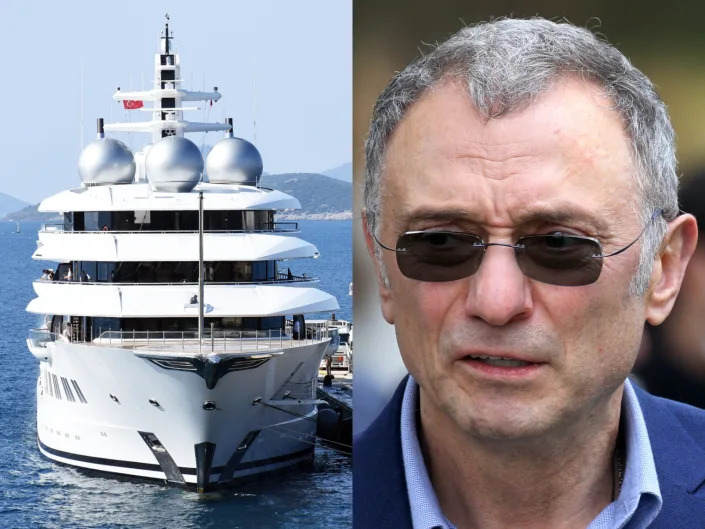
Fiji says the US can seize a sanctioned Russian oligarch's superyacht

The yacht Amadea; the Russian oligarch Suleyman Kerimov
US authorities say the Amadea is beneficially owned by Suleyman Kerimov.Osman Uras/Anadolu Agency via Getty Images, Mikhail Svetlov/Getty Images
  • The US can seize a sanctioned Russian oligarch's superyacht, a high court in Fiji ruled Tuesday.

  • US authorities say the Amadea is owned by gold tycoon Suleyman Kerimov.

  • Fiji had already temporarily barred the vessel from leaving its waters.

The US can seize a superyacht it says belongs to a sanctioned Russian oligarch, a high court in Fiji has ruled.

US authorities say the superyacht, the Amadea, is beneficially owned by sanctioned Russian oligarch Suleyman Kerimov, a spokesperson for Fiji's director of public prosecutions (DPP) previously told Insider. Suleyman has been sanctioned by the UK, European Union and the US.

The High Court in Suva, Fiji's capital, on Tuesday "granted the order to seize the superyacht Amadea after an application was made last month by the Director of Public Prosecutions to register the US warrant to seize the yacht," the DPP's office said in a statement.

The Amadea arrived in Fiji from Mexico on April 12. A week later, it was barred from leaving Fiji's waters "until the finalization of an application to register a warrant to seize the property" under a restraining order granted by the country's high court.

If the yacht is seized, it would be the second vessel seized by the US under sanctions aimed at putting pressure on Russian President Vladimir Putin to stop his invasion of Ukraine.

When asked about the application to seize the Amadea, the US Embassy in Suva told Insider that the US would act with partners across the world to impose costs on the Kremlin "if it continues its war of choice."

"We continue to ratchet up the pressure on Putin's oligarchs and we are working with allies and partners to go after corrupt gains from some of the individuals closest to Putin, no matter where they are held around the world," the Embassy said.

Defense lawyers, however, have disputed the claim that Kerimov owns the vessel and say it's actually owned by Eduard Khudainatov, former chairman and CEO of Kremlin-controlled energy giant Rosneft, per AP.

The vessel is registered in the Cayman Islands and, according to AP, is owned by Cayman Islands-based Millemarin Investments, whose lawyers say the company is the vessel's legal owner. The lawyers claim Khudainatov, who hasn't been sanctioned, is linked to the company and is the vessel's beneficial owner, per AP.

Kerimov is one of Putin's 'inner circle of oligarchs'

Kerimov, a member of the Russian Federation Council, was sanctioned by the EU and UK on March 15. The EU said that Kerimov is "a member of the inner circle of oligarchs" close to Putin and that he was part of a group who met with the Russian president at the Kremlin in late February to discuss Western sanctions.

Kerimov had already been sanctioned by the US in 2018 for "being an official of the Government of the Russian Federation." Kerimov was arrested by French police in 2017 in connection with a tax evasion investigation.

Kerimov is worth around $14.4 billion, per Bloomberg estimates. He owns Nafta Moscow, a financial and industrial group in Russia, and his family owns a controlling stake in Polyus Gold, which claims to be Russia's biggest gold producer.

The Amadea, built by German yacht makers Lürssen, is close to 350 feet long and has lodgings for 16 guests across eight cabins. Amenities on board include a gym, beauty salon, bar, and glass elevator. It also has an infinity pool, another pool on the owner's private terrace, a jacuzzi, and a helipad.

On April 4, the US seized Tango, a $90 million superyacht which it said belonged to sanctioned Russian oligarch Viktor Vekselberg. The vessel was seized in Palma De Mallorca, Spain, by Spain's Civil Guard and officials tied to the Department of Justice's KleptoCapture task force.

China-reliant Gabon finds oil-free, green future in its forests

Tue, May 3, 2022

Most countries sent their finance ministers and central bank governors to the IMF's spring meetings in Washington, but Gabon - the tiny country on the west coast of Central Africa - sent its environment minister.

"They said this has never happened before. Gabon is just different," said Lee White, whose portfolio includes forests, oceans and climate change, after the meetings. "We spent a lot of time talking about climate financing."

With more than 60 per cent of its revenues coming from oil and manganese ore, Gabon is hoping to replace its petroleum income by strategically positioning its forests, which cover more than 80 per cent of the country.

Do you have questions about the biggest topics and trends from around the world? Get the answers with SCMP Knowledge, our new platform of curated content with explainers, FAQs, analyses and infographics brought to you by our award-winning team.

In 2019, more than 60 per cent of Gabon's US$6.43 billion in exports went to China, followed by Singapore, South Korea, Malaysia and India. Crude petroleum made up about 66.9 per cent, followed by manganese ore at 20 per cent. Sawn wood and veneer sheets accounted for just 8 per cent of overseas trade.

When Covid-19 struck in 2020, Gabon's exports fell to US$4.34 billion, according to the Observatory of Economic Complexity. China remained the country's biggest destination for its crude petroleum, minerals and wood products.

Gabon's former president Omar Bongo Ondimba predicted a future without oil and implemented drastic measures to strike "a balance between conservation and exploitation of timber".

These included laws creating 13 national parks, which led to the cancellation of more than a million hectares of forest concessions.

When Ondimba, the country's second president who took office in 1967, died in 2009 his son Ali Bongo was elected. His first act was to ban the export of timber logs, from January 2010.

"When he banned logs, everybody said he was mad," White said.

Then French president Nicolas Sarkozy flew to Libreville to protest against the ban, which led to the closure of many French-owned companies in Gabon.


It was not until White joined the ministry in 2019 that the export ban was rescinded, but with a requirement that companies process the wood before exports. The intention was to shift Gabon from a source of cheap raw materials to a supplier of finished products.


Former president of Gabon Omar Bongo Ondimba implemented drastic protection measures for the country's forests, including 13 national parks. 
Photo: EPA 

White said cutting trees to export them as logs would take forestry to just 8 per cent of the economy. However, 92 per cent of the forest economy lies in the transformation of timber into furniture, tables, doors, plywood, and veneer sheets.

"The way we do it is to create a balance between conservation and sustainable development. Currently 22 per cent of our land is protected while 27 per cent of our ocean is protected," he said.

"This way we made the forest more precious."

White said earnings from Gabon's forest economy had quadrupled since the requirement was introduced - from US$250 million a year to US$1 billion a year.

Gabon, with a population of about 2 million people, is in a small league of six or seven countries that absorb more carbon dioxide than they emit, making them "carbon sinks". Also in the club are Guyana, Suriname, the Republic of Congo, Bhutan and Papua New Guinea.


Since it is helping to curb the worst effects of climate change, Gabon believes high emitters such as the United States, China and many European countries should offset their carbon emissions by paying it to keep its forests intact.

Last year, the Norwegian fund Central African Forest Initiative (CAFI) paid Gabon US$17 million to do just that, in the first tranche of a US$150 million deal with the UN-backed fund.

Libreville also passed a law last year allowing Gabon to trade carbon credits. The country estimates its rainforest sequesters roughly 140 million tonnes annually, making it a net absorber of more than 100 million tonnes of carbon each year.


Gabon is a "carbon sink", absorbing more carbon dioxide than it emits. 
Photo: Jevans Nyabiage

Gabon has recently started wooing tourists to its national parks, building eco-tourism villages and promising visitors forest elephants, gorillas and buffalo in one area called the "Last Eden".

The country is home to several threatened animal species, including forest elephants, leopards, buffalo and giant pangolins. It also has the Kevazingo tree, said to provide the hardest and most expensive wood, which is protected from logging and exports. The Okuome tree, on the other hand, is widely used for making plywood.

At the centre of Gabon's forest economy are a dozen Chinese companies that own forest concessions and more than 30 others that process the wood. They tend to control the whole supply chain - felling trees from their concessions which they then transform into timber products.

The Chinese companies, operating more than 6 million hectares (14.8 million acres), account for more than half of Gabon's commercial logging areas, controlling about 40 per cent of concessions.

"A lot of the time Chinese companies have bought forest concession rights from Gabonese companies," White said.

To accelerate investments in timber processing industries, Gabon has set up special economic zones in partnership with Arise Group, offering several tax incentives for investors.

The Nkok special economic zone - about 30km (18 miles) east of Libreville - houses 88 companies, out of 115 registered to do business there. One third are Chinese-owned, while others have investors from India, Turkey and Malaysia.

Indian companies, which are the second-biggest group of investors in wood processing at the Nkok zone, do not log or own forest concessions but instead buy their timber from other firms.

In contrast, European companies concentrate on logging and sell their wood to other companies for processing.

Mohit Agrawal, deputy director general at Gabon Special Economic Zones, said the next major focus was to make furniture for export through its Akiba brand.

Agrawal said the zone was wooing companies, including Chinese firms, to set up furniture factories for export. So far, businesses in the zone had invested between US$700 million and US$1 billion, while the developer had invested US$500 million, he said.

While China is Gabon's biggest market for wood, it also exports to Europe. Shuang Sheng Wood, one of the Chinese companies operating from Nkok, processes veneer sheets for India, Europe and the US.

Zedd Xu, manager at Shuang Sheng Wood factory, says his operation in Gabon employs hundreds of workers.
 Photo: Jevans Nyabiage 

Shareholder and manager Zedd Xu said the company had invested US$20 million in the factory, which started operations in 2020 and has 300 workers. Gabon's abundant Ukuome tree logs "is good for the wood business," he said.

"We used to import wood to China from Guinea and Equatorial Guinea but since restrictions on exports were imposed, we decided to set up a company in Gabon near where we can get raw materials."

Xu and his fellow investors have two other companies within the Nkok special processing zone and are building another timber factory - known as African Elephant - which they say will be Gabon's biggest plywood factory, able to process 40,000 cubic metres (1.4 cubic feet) of logs.

"We plan to buy forest concessions to supply our factories," Xu said.

This article originally appeared in the South China Morning Post (SCMP), the most authoritative voice reporting on China and Asia for more than a century. For more SCMP stories, please explore the SCMP app or visit the SCMP's Facebook and Twitter pages. Copyright © 2022 South China Morning Post Publishers Ltd. All rights reserved.

Copyright (c) 2022. South China Morning Post Publishers Ltd. All rights reserved.
In a ‘sundown town’ in Texas, white vigilantes forced Black residents to leave home

Bud Kennedy
Tue, May 3, 2022, 3:45 PM·3 min read

It’s time to talk about what some folks would rather forget.

The sign’s language was blunt. There was never any question about its message, or its target.

The first word was a racist slur.

Then: “Don’t Let the Sun Set on Your Head in This Town.”

Originally, the “sundown sign” went up at the train station. Then, it was moved to the middle of the main street.

It happened more than a century ago. In Texas.

De Leon, Texas.

It wasn’t the only sign like that in Texas. I’ve met people who claimed they personally saw signs in Bowie, Glen Rose and Grand Saline.

Don’t get me wrong. I’m not picking on Texas or even the South.

In a Web search, I found similar racist signs mentioned in towns in California, Washington, Nebraska and Indiana. One town in British Columbia even had a sign warning Chinese to stay out.

But we know for sure that De Leon, 95 miles southwest of Fort Worth, had one of those signs for years.

The late historian James W. Loewen, author of “Sundown Towns,’’ said he found evidence of more than 150 sundown signs in 31 states. He defined “sundown towns” as “towns that were all white on purpose.”


It went up more than a century ago, in 1886, in the bitter decade after Reconstruction.

That was so long ago that the nice folks in that quiet peanut farming town might rather forget it.

I happened to find it because two historians have written about it.

The De Leon sign is actually part of a more shameful story in 19th-century Texas.

White vigilantes threatened the Black residents of Comanche County and forced them to move out.

In the 1880s, Comanche County was a growing cattle and cotton market. The towns of Comanche, De Leon and Gustine and the surrounding county were home to 8,608 people, including 79 Black residents.

Those were troubled times in Texas, both for race relations and the justice system. According to The New Handbook of Texas, white lynch mobs had begun to undermine the entire justice system in 1885, abducting and killing 23 white men, 19 Black men and one white woman.

The next year, what became known as “the Comanche County exodus” began with the killing of a white woman, Sallie Stephens.

According to historian B.B. Lightfoot’s 1953 account in Southwestern Historical Quarterly, a Black suspect named Tom McNeal was lynched. After the sign went up at the De Leon train station, armed white vigilantes went door-to-door and told every Black resident to pack up and get out of Comanche County.

One by one, every Black family moved away, mostly to Waco or Dallas. They abandoned family homes, churches, farms and the land of lifelong memories.

By the 1890 census, the only Black residents were two orphaned children who lived with white families.

Later, the Texas Central Railroad asked to move the De Leon sign. The train porters were being threatened.

So it was moved to the town well in the middle of Texas Avenue between the peanut mill and a tractor dealer, according to an updated 1996 report in a local magazine, the Messenger.

The earlier account deadpanned: “Because it has no Negro population, Comanche County is one of the few places in the South that has no apparent race problem.”

Comanche County did not have one Black resident in 1940, according to the New Handbook. By 1970, the census counted two.

The 2000 census found 62 Black residents in Comanche County, still fewer than in 1880.

Neither report says when the De Leon sign was taken down.

I HAD NOT HEARD OF SUNDOWN TOWNS TILL WATCHING LOVECRAFT COUNTRY


  • https://www.hbo.com/lovecraft-country

    Based on Matt Ruff's novel, this series follows Korean war vet Atticus Freeman, his friend Letitia and his Uncle George on a journey across 1950s Jim Crow America. What follows is a struggle to survive

  •  against the racist terrors of white America 

  • https://en.wikipedia.org/wiki/Lovecraft_Country

    Lovecraft Country is a term coined for the New England setting used by H. P. Lovecraft in many of his weird fiction stories, which combines real and fictitious locations. This setting has since been elaborated on by other writers working in the Cthulhu Mythos. The phrase was not in use during Lovecraft's own lifetime. Instead the phrase Lovecraft Country was coined by Keith Herber for the Love…

    Wikipedia · Text under 
  • Rep. Marjorie Taylor Greene (R-Ga.) struggled on Monday to back away from one of her most widely derided conspiracy theories suggesting that the Rothschilds, a Jewish banking family, were connected to the wildfires in California in 2018.

    A reporter in Georgia questioned Greene about the theory after she voted early in the Republican primary. The lawmaker indicated she couldn’t clearly remember her 2018 Facebook post floating the idea, and also said she was largely ignorant about such issues then.

    She said she wasn’t aware that attacks on the Rothschilds are often coded anti-Semitism.

    During the confrontation, Greene initially adopted the persona she presented when she was questioned in court last month about her role in last year’s Jan. 6 insurrection: Forgetful, confused, patient, smiling. Then she wasn’t so much.

    “This is your post under your name,” the reporter said. “You’re talking about the Rothschild family, which has been at the center of anti-Semitic conspiracies since the 19th century.”

    “I did not know that,” Greene replied. “I have no idea. I’m telling you.”

    Greene insisted she was just a “regular American” when she wrote that post. “Never been in politics. Could not even have told you most people back in politics or families’ names, don’t know their background.”

    Nevertheless, she was confident enough to link the Rothschilds to a bonkers plot to set wildfires in California using space lasers to make way for high-speed rail.

    “Now that you’ve been told … anti-Semitism is on the rise at an alarming rate,” the reporter told Greene.

    “I’m fully against anti-Semitism,” she replied, appearing to be increasingly annoyed. “You’re mixing two things together. You’re accusing me of something I did not do, and then you’re trying to blame me for anti-Semitism. You are such a liar. You need to stop.”

    She added: “I’m a Christian. I support Israel.”

    Greene, who spoke in February at a white nationalist conference, has often been accused of making anti-Semitic remarks. The House voted last year to strip her of her committee assignments for embracing QAnon and racist conspiracy theories and liking posts about Democrats being executed.

    Asked who she planned to vote for governor in Georgia, she snapped: “We have privacy laws. I’m keeping my vote private.” No privacy law prohibits people from revealing who they plan to vote for.

    This article originally appeared on HuffPost and has been updated.