What Happens to a Sanctioned Oil Tanker?
- Following one ship, the Mikati, can demonstrate how EU sanctions disrupt operations but often fail to fully remove vessels from service.
- Ownership changes, flag switching, and ship-to-ship transfers remain central tools for sanctions evasion.
- U.S. sanctions appear significantly more effective than EU measures in reducing tanker productivity and trade flows.
A 58,000-ton oil tanker called the Mikati was ploughing through the waters of the Indian Ocean one day when it got some bad news from faraway Brussels: it had been added to a list of sanctioned vessels in Russia’s shadow fleet.
The story of the Mikati, currently passing through the English Channel, illustrates the strengths and weaknesses of the European Union sanctions regime that now includes some 600 ships.
The EU listed the Mikati in July, following a similar decision by Britain in November last year. Built in 2003, its advanced age makes it a typical shadow fleet vessel -- as does the behavior that preceded its designation.
Suspicious Behavior
According to data provided to RFE/RL by Windward, a maritime intelligence company, the Mikati went through a series of name changes, was sold to an anonymous owner, and repeatedly turned off its AIS location transponders in the period before it was sanctioned.
This latter is regarded as a dangerous shipping practice by the International Maritime Organization (IMO) and is only permitted under special circumstances. The Mikati also changed the flag it was registered under, switching to Sierra Leone.
“Sierra Leone's government outsourced management of its ship registry to a private company based in Cyprus,” Windward analyst Michelle Bockmann told RFE/RL, adding that the country was “the flag registry of choice” for shadow vessels.
Taken together, these indicators were evidence enough to get the Mikati blacklisted. The EU included the Mikati in its 18th sanctions package against Russia on July 18. It had an immediate impact.
Two days later the ship arrived in waters off Kochi, home to one of India’s largest oil refineries. But it did not unload the full cargo it had picked up in Russia’s Barents Sea port of Murmansk a month earlier.
The Mikati pauses off the coast of India on July 29. "The EU has now the ability to sanction ports in third countries for what they call the frustration of EU restrictive measures," said economist Benjamin Hilgenstock.
It’s not clear if there was a hitch or if the Mikati was following pre-arranged plans.
“Sometimes ships are sanctioned when they're already under way, so someone will have to give the buyer a call and ask if the deal is still on,” Benjamin Hilgenstock, a senior economist at the Kyiv-based KSE institute, told RFE/RL.
“They may be told ‘we need to figure this out first, so maybe wait a bit’ -- or ‘we’ll take your oil but only if you give it to us for a little less money,’” he added.
The Samoan Connection
In any case, something was stirring behind the scenes.
On July 25, the Mikati changed its registered owner and commercial manager, moving from Azerbaijan to Samoa, a nation of some 200,000 people in the South Pacific not known for having a thriving shipping industry.
The company listed, Alga Oceanic Ventures, appears to have no Internet presence.
Its address is a business complex called La Sanalele, where its neighbors have included another shipping manager, Faleola Nexus Ltd, operator of an oil tanker named Orion -- sanctioned by Britain and Ukraine for illicit trading in Russian crude.
Another neighbor was a Taiwanese company called Pro-Gain Group Corporation that was sanctioned by the United States in 2018 in connection with illegal dealings in North Korean coal and oil.
The Mikati’s sudden ownership switch was followed by a new voyage, north along the coast to Mangalore. There, on August 3, it signaled that it had unloaded.
“The 11-day delay was probably related to its sanctions and having to get new insurance,” Bockmann said. “That's a really good example of how EU sanctions are disruptive. But they have very little teeth.”
Indeed, despite sanctions, the Mikati unloaded its oil and stayed in service. Sanctioned vessels can’t visit EU ports or get Western insurance and have trouble finding professional crew. But they maintain the “right of innocent passage” through international waters.
An October study by kpler, a trade analytics company, found that “Russia has sustained its crude exports despite the logistical challenges posed by the recent escalation of sanctions targeting shadow fleet tonnage.”
EU vs US Sanctions
Sanctions imposed by the US Treasury’s Office of Foreign Assets Control (OFAC) were deemed considerably more effective than by the EU.
“This data set shows that India is OK with accepting European- and UK-sanctioned vessels, but they don't want to accept the OFAC-sanctioned vessels. And probably this shows that India is a bit more reluctant to find themselves in prospects of secondary sanctions by the US,” kpler analyst Panagiotis Krontiras told RFE/RL.
The kpler data details reductions in productivity, measured by the fall in kilometers traveled and tons of cargo carried, for ships under each sanction regime. For the US, there was a 70 percent average decline, for the EU -- 30 percent.
EU Sanctions Envoy David O’Sullivan told RFE/RL that “sanctions are always a bit leaky” and it was always possible to find “examples of a vessel that has nonetheless continued” to operate.
But, he added, “our figures show that once a vessel is sanctioned, it drops its ability to carry Russian oil by about 73 percent.”
Furthermore, while O’Sullivan estimates the EU has now sanctioned two-thirds of Russia’s shadow fleet, OFAC has hit around 40 percent, according to kpler data. While the EU has repeatedly added new vessels this year, OFAC has not added any since January.
The US Treasury did not respond to a request for comment.
In any case, while the Mikati has continued sailing, it has not been very productive. Windward data shows that after unloading in Mangalore, it sailed through the Suez Canal and anchored at Port Said for a week in August -- where it picked up oil in a ship-to-ship (STS) transfer from another blacklisted tanker, the Noctis. Such transfers are not illegal but are a frequent practice for evading sanctions.
The Mikati engages in a ship-to-ship oil transfer with another sanctioned vessel, the Nocturnis, off the coast of Egypt on August 22.
'Loitering' Off China
The Mikati took the oil to Ningbo, China, arriving on September 29, but didn’t discharge it until October 15. Again, the reason for the delay isn’t clear. Bockmann noted that it “remained loitering around the port area for a protracted period of time,” part of a pattern of “highly uneconomic behavior.”
Again, this is typical of sanctioned vessels.
“Once you're sanctioned, you have two choices: either go Russia-India or Russia-China. And that's why there is this huge productivity drop,” said kpler analyst Krontiras.
An unsanctioned vessel would seek to pick up new cargo somewhere rather than traveling home empty on what’s known as a “ballast leg.”
“But now they don't have this option...they have to go back to Russia, pick up another cargo, and this is a very long ballast leg,” said Krontiras.
The Mikati did just that. Windward data also shows it once again switched off its transponders between December 10-12, near Russia’s main Baltic crude export port, Uts-Luga. On December 18, it was heading southwest through the English Channel.
“Destination likely India or China, or even STS. No indication,” noted Bockmann.
By RFE/RL
U.S. Sanctions 29 Shadow Tankers to Further Pressure Iran and Venezuela
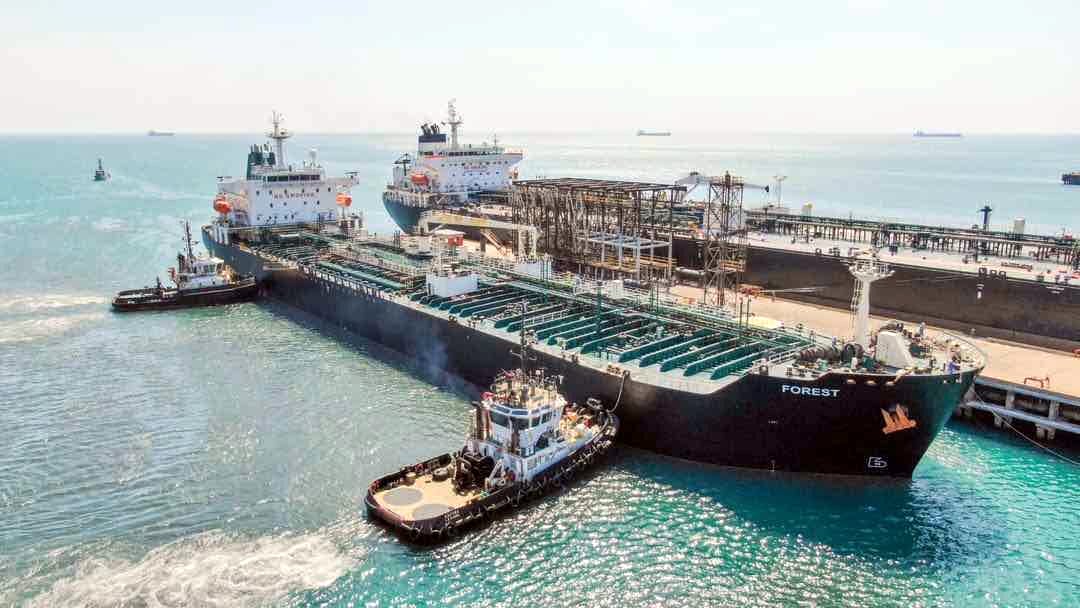
The Trump administration is exerting more pressure on Iran after adding a total of 29 shadow fleet tankers to its sanction list. They asserted that the move is expected to deprive Tehran of petroleum revenue that is being used to fund its military and weapons programs. The exports are also being sent to Venezuela to help maintain its oil production.
The Treasury’s Office of Foreign Assets Control (OFAC) asserts that the Iranian regime has increasingly been depending on shadow fleet tankers to export petroleum and petroleum products through deceptive shipping practices. In a further move to rein in Iran, OFAC designated 29 sanction-evading vessels and their management firms, adding to a growing list of vessels that have been sanctioned by the Trump administration as part of a broader “maximum economic pressure” campaign.
Also targeted is Egyptian businessman Hatem Elsaid Farid Ibrahim Sakr, whose companies are said to be facilitating the illicit exports, and who is associated with seven of the 29 shadow fleet vessels. The businessman allegedly owns and operates multiple companies that have been responsible for transporting large quantities of Iranian petroleum products in the Persian Gulf region, often in coordination with Iran’s Ministry of Defense.
“As President Trump has said repeatedly, the United States will not allow Iran to have a nuclear weapon,” said John K. Hurley, Treasury Under Secretary for Terrorism and Financial Intelligence. “Treasury will continue to deprive the regime of the petroleum revenue it uses to fund its military and weapons programs.”
OFAC highlights that the new designations are part of the Trump administration’s systematic actions against the shadow fleets, which Iran has been relying on to evade sanctions and transport petroleum to end users mostly in Asia. Since taking over in January, the administration has sanctioned more than 180 vessels responsible for shipping Iranian petroleum and petroleum products, in the process driving up costs for Iranian oil exporters and reducing the revenues that Tehran receives for each barrel of oil sold.
Notably, the vessels included in the new sanctions are crude tankers sailing under the flags of Palau, Panama, the Cook Islands, Barbados, and Jamaica.
The Trump administration has also threatened to stop any sanctioned tanker involved in Venezuela’s oil trade. Iran, earlier this year, was sending large ships to Venezuela, which is used as distillates to keep Venezuela’s operations functioning. The distillates are a critical component for Venezuela's production and to meet domestic energy needs due to the poor state of Venezuela’s domestic refineries.
Ukraine Hits Russian Shadow Tanker in Mediterranean for First Time
Ukraine has hit an empty oil tanker of Russia’s shadow fleet in the Mediterranean in the first such drone attack in this sea in another escalation of the Ukrainian strikes on Russian vessels.
The Qendil tanker, flying the flag of Oman, was targeted and hit by drones, Ukraine said on Friday.
The vessel was empty, and its blow-up does not pose an environmental threat, sources with knowledge of the matter told Bloomberg.
Ukraine has stepped up drone attacks on empty vessels of the Russian shadow fleet in recent weeks.
As a result of this, oil tankers carrying Russian oil appear to be avoiding the fastest Black Sea route to the Turkish straits and travel along the Georgian and Turkish coasts to avoid drone attacks from Ukraine, according to ship-tracking data compiled by Bloomberg.
At least two tankers that have loaded oil from Novorossiysk, the Russian port on the Black Sea, have recently traveled along the Georgian and Turkish coasts instead of taking the shortest route to the Bosphorus Strait, according to the data compiled by Bloomberg.
The detour along the Georgian and Turkish coasts would add about 350 miles, or 70%, to the journey of an oil tanker from the port of Novorossiysk to the Turkish straits.
Crude oil exports from the Russian terminals on the Black Sea were much lower in November than originally planned as bad weather and Ukrainian attacks on infrastructure have delayed loadings and departures.
Ukrainian attacks have also crippled Russia’s fuel exports from the Black Sea ports in recent weeks.
Ukrainian forces have increasingly targeted Russian oil-refining, storage, and export infrastructure using drones and missiles. The campaign has gained intensity in recent months, with the Center for European Policy Analysis noting a shift in strategy “from smaller-scale strikes on storage tanks to targeting hard-to-replace refinery equipment, like cracking units, much of it western-made and subject to sanctions.”
By Charles Kennedy for Oilprice.com
Ukraine strikes Russian shadow fleet tanker in Mediterranean
By Alexei Doval & Euronews
Published on 19/12/2025
Ukraine hit Russian-linked tanker Qendil with drones in the Mediterranean on Friday, marking the first shadow fleet strike outside Black Sea.
Ukraine struck a Russian-linked oil tanker in the Mediterranean Sea on Friday, marking the first time it has targeted vessels from Russia's shadow fleet outside the Black Sea, an official from Ukraine's security service SBU said.
The Oman-flagged tanker Qendil was hit by aerial drones more than 2,000 kilometres from Ukrainian territory in what an SBU source described as "an unprecedented special operation". The vessel sustained critical damage and can no longer be used, the source said.
The attack occurred in international waters in the eastern Mediterranean. Ship tracking data showed the Qendil's last position on Friday morning was off the coast of Crete, sailing parallel to Libya's coast.
The vessel was empty at the time of the strike and posed no environmental threat, according to the SBU source, who spoke on condition of anonymity. Video provided by the SBU showed several explosions on the tanker's deck.
What is known so far?
The Qendil departed from Sikka in India and was bound for the Russian Baltic port of Ust-Luga, according to ship tracking data from MarineTraffic.
Satellite images analysed by AFP showed the vessel made a U-turn overnight on Friday, when it was more than 250 kilometres from the coasts of Greece and Libya.
The tanker is not currently on the United States Treasury's sanctions list for Russian shadow fleet vessels, though maritime intelligence firms have identified it as carrying high sanctions risk.
"Russia used this tanker to circumvent sanctions and earn money that went to the war against Ukraine," the SBU source said. "From the point of view of international law and the laws and customs of war, this is an absolutely legitimate target."
The strike represents a major expansion of Ukraine's campaign against Russian energy infrastructure, which previously focused on land-based targets such as refineries and oil rigs. In recent weeks, Ukraine has widened its operations to maritime targets across multiple seas.
In late November, Ukraine struck two tankers from Russia's shadow fleet — the Kairos and Virat — with Sea Baby naval drones in the Black Sea near Turkey's coast.
Both vessels were empty and heading to Russia's Novorossiysk oil terminal to load crude oil. The Kairos caught fire and was later stranded off Bulgaria's coast, whilst the Virat sustained damage in two separate strikes.
Ukraine also struck oil platforms in the Caspian Sea in December, marking another geographic expansion of its deep-strike operations.
Putin pledges 'response'
Russian President Vladimir Putin said during his annual press conference on Friday that attacks on oil tankers would not disrupt supplies or achieve their intended results.
"Right now news is coming in: another of our tankers in the Mediterranean Sea has been attacked," Putin said. "There will always be a response from our side."
Turkey has not yet commented on the Mediterranean attack, after Turkish President Recep Tayyip Erdoğan warned in early December that the war was threatening navigational safety in the Black Sea.
The shadow fleet consists of tankers that use opaque ownership structures, flags of convenience and irregular shipping practices to transport Russian oil despite Western sanctions.
The fleet of hundreds of often ageing vessels has been crucial to Russia's ability to continue exporting oil and funding its war effort.


No comments:
Post a Comment