Wednesday, June 08, 2022

US to ban single-use plastics on public lands by 2032

Wed, June 8, 2022


The United States will phase out single-use plastics in national parks and other public lands over the next decade, President Joe Biden's administration announced Wednesday as part of actions on World Oceans Day.

This will include the sale and distribution of plastic bags and bottles as well as food wrappers, beverage cups and other tableware, according to an order by the interior secretary Deb Haaland.

Government departments have one year to develop plans to switch over to alternatives, such as biodegradable and compostable materials, and then have until 2032 to complete the transition.

"As the steward of the nation's public lands, including national parks and national wildlife refuges, and as the agency responsible for the conservation and management of fish, wildlife, plants and their habitats, we are uniquely positioned to do better for our Earth," Haaland said in a statement.

Plastic waste is devastating for fish and other wildlife, with oceans bearing the brunt of the impact since they are downstream of all pollution sources.

Of the more than 300 million tons of plastic produced every year, at least 14 million tons end up in the ocean, the interior department said.

While the plastics industry has attempted to portray the problem as something that can be overcome through recycling, only nine percent of all the plastic the world has ever made has been recycled, and recycling rates are stagnant.

Christy Leavitt, plastics campaign director for non-profit Oceana, welcomed the administration's announcement.

"The Biden administration is taking a big step to protecting our oceans from single use plastic," Leavitt told AFP.

Oceana and 300 other nonprofits, organizations, and businesses had sought the action in a letter to the Biden administration last year.

The order will cover the nation's 423 national parks but also wildlife refuges and other lands and waters managed by the interior department: in total 20 percent of the United States' land, which hosts some 400 million visitors annually.

"Ten years is a long time, but we are hopeful that they will take steps along the way to reach that end goal," said Leavitt.

A number of larger national parks have already moved toward eating areas with reusable tableware and refillable water stations, she added.

"We are hopeful that ultimately not just our national parks and other public lands but cities and counties and states around the country can move towards those reusable and refillable systems."

The White House also announced a new national marine sanctuary to preserve the Hudson Canyon, an ecological hotspot located approximately 100 miles off the coast of New York and reaches depths of 2.5 miles, as well as the start of efforts to create an Ocean Climate Action Plan.

ia/wd
Scientists Stress Water Imbalance in The 'Third Pole'

A view of the Qinghai-Tibet Plateau, 2022.
 | Photo: Twitter/ @China_Up_Close

Published 8 June 2022 
by teleSUR/MS

With the largest global store of frozen water after the Antarctic and Arctic, the Third Pole region, located in the Qinghai-Tibet Plateau, is home to headwaters of over ten major Asian rivers.

Rapid climate warming has caused water imbalances in the Third Pole region, leading to greater water demand in densely populated downstream countries, according to a new study.


RELATED:

With the largest global store of frozen water after the Antarctic and Arctic, the Third Pole region, located in the Qinghai-Tibet Plateau, is home to headwaters of over ten major Asian rivers. It has been known as the "Asian Water Tower" for providing a reliable water supply to almost 2 billion people.

But an article published this week in the journal Nature Reviews Earth & Environment says that the region has gotten out of balance between solid water in glaciers and liquid water in lakes and rivers under the global climate change impact.

The rise in temperatures with changes in the westerlies and the Indian monsoon led to glacier retreat and more precipitation in the region's northern part and less in the southern. The spatial imbalance will alleviate water scarcity in the Yellow and Yangtze River basins while increasing scarcity in the further-south Indus basins.

"Such imbalance will likely pose a great challenge to the supply-demand balancing of water resources in downstream regions," said Yao Tandong, lead author of the study and an academician at the Chinese Academy of Sciences.


The highest water demand is projected to be in the Indus basin, said Walter Immerzeel, co-author of the study and a researcher at Utrecht University in the Netherlands. He stressed that this demand would affect irrigation, accounting for more than 90 percent of water use across the area.

"Since this north-south disparity is expected to be amplified by climate warming in the future, adaptation policies for sustainable water resource management are greatly needed in downstream countries," said co-author Piao Shilong, also a researcher at Peking University.

The scientists in the study said they still need more information to help the public respond to the changes, such as comprehensive monitoring stations in data-scarce areas. They also call for collaboration between upstream and downstream countries.
Simone Biles, other former gymnasts seek $1 billion from FBI for mishandling Larry Nassar sex abuse case


The Associated Press
Wed, June 8, 2022

DETROIT (AP) — Former Olympic gymnasts, including gold medalist Simone Biles, are among dozens of assault victims who are seeking more than $1 billion from the FBI for failing to stop sports doctor Larry Nassar, lawyers said Wednesday.

There’s no dispute that FBI agents in 2015 knew that Nassar was accused of molesting gymnasts, but they failed to act, leaving him free to continue to target young women and girls for more than a year.

“It is time for the FBI to be held accountable,” said Maggie Nichols, a national champion gymnast at Oklahoma in 2017-19.

Hear from victims: Victims share what Larry Nassar did to them under the guise of medical treatment


Under federal law, a government agency has six months to respond to the tort claim. Lawsuits could follow, depending on the FBI’s response. The Justice Department said in May that it would not pursue criminal charges against former FBI agents who failed to quickly open an investigation.

The approximately 90 claimants include Biles, Aly Raisman and McKayla Maroney, all Olympic gold medalists, according to Manly, Stewart & Finaldi, a California law firm.

More: Former special agents will not face charges in FBI's botched investigation of Larry Nassar

More: Women abused by Larry Nassar file negligence claims against FBI over botched investigation


“If the FBI had simply done its job, Nassar would have been stopped before he ever had the chance to abuse hundreds of girls, including me,” said former University of Michigan gymnast Samantha Roy.

Indianapolis-based USA Gymnastics told local FBI agents in 2015 that three gymnasts said they were assaulted by Nassar, a team doctor. But the FBI did not open a formal investigation or inform federal or state authorities in Michigan, according to the Justice Department’s inspector general, an internal watchdog.

Los Angeles FBI agents in 2016 began a sexual tourism investigation against Nassar and interviewed several victims but also didn’t alert Michigan authorities, the inspector general said.

Nassar wasn’t arrested until fall 2016 during an investigation by Michigan State University police. He was a doctor at Michigan State.

The Michigan attorney general’s office ultimately handled the assault charges against Nassar, while federal prosecutors in Grand Rapids, Michigan, filed a child pornography case. He is serving decades in prison.

The FBI declined to comment in April when a smaller batch of claims was filed, referring instead to Director Christopher Wray’s remarks to Congress in 2021.

More: Indianapolis FBI leader eyed head USA Gymnastics job after sitting on Nassar allegations


“I’m especially sorry that there were people at the FBI who had their own chance to stop this monster back in 2015 and failed. And that’s inexcusable,” Wray told victims at a Senate hearing.

Michigan State University, which was also accused of missing chances over many years to stop Nassar, agreed to pay $500 million to more than 300 women and girls who were assaulted. USA Gymnastics and the U.S. Olympic and Paralympic Committee made a $380 million settlement.


Campaigners launch court bid to prevent UK-Rwanda asylum flights

Wed, June 8, 2022


Campaigners on Wednesday launched a court bid to block UK government's plans to send asylum seekers to Rwanda as it attempts to stop migrant boat crossings from France.

The government in London said last month that it intends to fly a first planeload of asylum-seekers to Rwanda on June 14.

But the Public and Commercial Services Union (PCS), Care4Calais and Detention Action have now issued judicial review proceedings in the High Court against what they call an "unlawful policy".

James Wilson, deputy director of Detention Action, said interior minister Priti Patel had "overstepped her authority".

"By rushing through what we say is an unlawful policy, she is turning a blind eye to the many clear dangers and human rights violations that it would inflict on people seeking asylum," he said.

"It's vital that new government policies respect and uphold the laws that we all, as a society, have agreed to follow. That's why we're seeking an injunction to keep this plane to Rwanda from leaving the runway," he added.

The one-way flights are intended to deter others from entering Britain, especially via dangerous crossings of the Channel.

More than 10,000 migrants have made the journey so far this year.

Confirming the target date for the first time, Patel acknowledged the new policy was set to face challenges in the courts.

In a statement, she said: "I will not be deterred and remain fully committed to delivering what the British public expect."


The Home Office has sent out the first notices to asylum claimants who are earmarked for removal to Rwanda, under a partnership worth £120 million ($151 million) to Kigali.

Clare Moseley, founder of Care4Calais, said most of those being detained pending their removal are "overwhelmed by total shock and despair".

"Many came to the UK believing it to be a good place that would treat them more fairly than the places from which they escaped," she said.

"We say that the Rwanda plan is unlawful. We hope the courts will agree with us."

jwp/phz/cdw
Belgian king reiterates regrets for colonial past in Congo but no apology

By Benoit Nyemba

© Reuters/JUSTIN MAKANGARA
Belgian king returns mask to Congo in symbolic gesture of restitution

KINSHASA (Reuters) -Belgium's King Philippe reaffirmed his deepest regrets on Wednesday for the exploitation, racism and acts of violence during his country's colonisation of the Democratic Republic of Congo, but again stopped short of formally apologising.

Philippe became the first Belgian official two years ago to express regret for colonisation, and some Congolese hoped he would issue a formal apology during his first visit to Congo since taking the throne in 2013.


© Reuters/JUSTIN MAKANGARA

"Even though many Belgians invested themselves sincerely, loving Congo and its people deeply, the colonial regime itself was based on exploitation and domination," he told a joint session of parliament in the capital Kinshasa.


© Reuters/JUSTIN MAKANGARABelgium's royal couple visits Kinshasa

"This regime was one of unequal relations, unjustifiable in itself, marked by paternalism, discrimination and racism," he said.

"It led to violent acts and humiliations. On the occasion of my first trip to Congo, right here, in front of the Congolese people and those who still suffer today, I wish to reaffirm my deepest regrets for those wounds of the past."


© Reuters/JUSTIN MAKANGARA
Belgium's royal couple visits Kinshasa

Congo President Felix Tshisekedi and many politicians have enthusiastically welcomed Philippe's visit. Large numbers of ruling party supporters waved Belgian flags, and a banner hanging from parliament read: "A common history."


© Reuters/JUSTIN MAKANGARA
Belgian king returns mask to Congo in symbolic gesture of restitution

But others were disappointed by the absence of an apology.

By some estimates, killings, famine and disease caused the deaths of up to 10 million Congolese during just the first 23 years of Belgium's rule from 1885 to 1960, when King Leopold II ruled the Congo Free State as a personal fiefdom.

Villages that missed rubber collection quotas were notoriously made to provide severed hands instead.


"I salute the speech by the Belgian king. However, in the face of the crimes committed by Belgium, regrets are not enough," Congolese opposition Senator Francine Muyumba Nkanga wrote on Twitter.

Belgian king reiterates regrets for colonial past in Congo but does not apologise

"We expect an apology and a promise of reparations from him. That is the price to definitively turn the page," she said.

Nadia Nsayi, a political scientist specialised in Congo, said she sensed "a lot of nervousness in Belgium regarding a formal apology as Congo might use it to demand financial reparations".


MASK RETURN


Philippe arrived on Tuesday with his wife, Queen Mathilde, and Prime Minister Alexander De Croo for a week-long visit.

Tshisekedi said during a brief news conference with De Croo that he was focused on boosting cooperation with Belgium to attract investment and improve health care in Congo.

Relations had soured under Tshisekedi's predecessor, Joseph Kabila, whom Brussels criticised for suppressing dissent and extending his time in power beyond legal limits.

"We have not dwelled on the past, which is the past and which is not to be reconsidered, but we need to look to the future," Tshisekedi said.

Some Kinshasa residents also said they hoped the visit would bring investments. "Despite what the Belgians did to us during colonisation, we are ready to forgive," said Antoine Mubidiki.

Philippe earlier offered a traditional mask of the Suku people to Congo's national museum as an "indefinite loan". The mask has been held for decades by Belgium's Royal Museum for Central Africa.

Belgium has traditionally said little about colonialism, and the subject has not been extensively taught in Belgian schools.

By contrast, Germany last year apologised to Namibia for its role in the slaughter of Herero and Nama tribespeople more than a century ago, officially described it as genocide for the first time and agreed to fund projects worth over a billion euros.

There have been the beginnings of a historical reckoning in Belgium in recent years. During anti-racism protests sparked in 2020 by the police killing in the United States of George Floyd, demonstrators targeted statues of King Leopold II.

Belgium's parliament established a commission soon after to examine the historical record. It will issue its final report this year.

Belgium will also hand over a tooth, suspected to be the only remains of Congo's first prime minister Patrice Lumumba, to his family this month.

The Belgian government took partial responsibility in 2002 for the death of Lumumba, who was assassinated by Belgian-backed secessionists in 1961.

(Reporting by Benoit Nyemba and Nellie Peyton; Writing by Aaron Ross; Editing by Alison Williams)

Belgian king regrets colonial 'humiliation' in landmark DR Congo trip

King Philippe of Belgium, in a historic visit to DR Congo, said on Wednesday that his country's rule over the vast central African country had inflicted pain and humiliation through a mixture of "paternalism, discrimination and racism." FRANCE 24's Clément Bonnerot reports from Kinshasa, DR Congo.


'He did not apologise': Belgian king reaffirms regrets for colonial past in Congo

Belgium's King Philippe said he reaffirmed his "profound regrets" for his country's brutal colonial past in Democratic Republic of Congo on his first trip to the central African nation.“I will not try to hide that I am a bit disappointed,” expert on Central Africa Kris Berwouts told France 24. “A lot of us were hoping for apologies.”


Belgian king arrives in DR Congo for key visit

Arsene Mpiana
Tue, June 7, 2022


Belgium's King Philippe landed in the Democratic Republic of Congo on Tuesday, in a historic visit to the central African country his ancestor once ruled brutally as his personal fief.

The monarch will undertake a six-day trip billed as a chance for reconciliation after atrocities committed under Belgian colonial rule.

The visit comes two years after Philippe wrote to Congolese President Felix Tshisekedi to express his "deepest regrets" for the "wounds of the past."

Tshisekedi and his wife greeted King Philippe and Queen Mathilde on a red carpet rolled out on the tarmac of the international airport of the capital Kinshasa, a sprawling city of about 15 million people.

On Monday, Congolese government spokesman Patrick Muyaya told reporters that Belgium and the Democratic Republic of Congo (DRC) were starting a "new partnership."

"We are not forgetting the past, we are looking to the future," he added.

Belgian Prime Minister Alexander De Croo, who is visiting the impoverished nation of 90 million people alongside the king, echoed the sentiment.

"It's a historic moment," he told a Belgian national broadcaster Tuesday, hailing the opportunity to forge future closer ties.

Belgium's colonisation of the Congo was one of the harshest imposed by the European powers that ruled most of Africa in the late 19th and 20th centuries.

King Leopold II, the brother of Philippe's great great grandfather, oversaw the conquest of what is now DRC, governing the territory as his personal property between 1885 and 1908 before it became a Belgian colony.
- Brutal rule -

Historians say that millions of people were killed, mutilated or died of disease as they were forced to collect rubber under his rule. The land was also pillaged for its mineral wealth, timber and ivory.

The visit is King Philippe's first to DRC since ascending the throne in 2013. His father, King Albert II, visited the country in 2010.

Belgium is preparing to return to Kinshasa a tooth -- the last remains of Patrice Lumumba -- a hero of the anti-colonial struggle and short-lived first prime minister of the independent Congo.


Lumumba was murdered by Congolese separatists and Belgian mercenaries in 1961, and his body dissolved in acid, but the tooth was kept as a trophy by one of his killers, a Belgian police officer.

According to Belgium's royal palace, the king is also due to discuss the question of returning artworks looted during the colonial era.

Philippe is due to hold a ceremony with Tshisekedi at the Congolese parliament in Kinshasa on Wednesday and then on Friday deliver a speech to university students in the southern city of Lubumbashi.

On Sunday, the Belgian sovereign will visit the clinic of gynaecologist Denis Mukwege, co-winner of the 2018 Nobel Peace Prize for his fight against sexual violence, in the eastern city of Bukavu.

The trip comes at a time of heightened tension between Kinshasa and neighbouring Rwanda over rebel activity in the conflict-torn eastern DRC.

DRC's government has accused Rwanda of backing the resurgent M23 militia, an accusation which Rwanda has denied.

jk-am/eml/ri

Belgian king visits DRC: Trip seen as chance for reconciliation after colonial past

Belgium's King Philippe landed in the Democratic Republic of Congo on Tuesday, in a historic visit to the central African country his ancestor once ruled brutally as his personal fief. The monarch will undertake a six-day trip billed as a chance for reconciliation after atrocities committed under Belgian colonial rule. FRANCE 24's Clément Bonnerot reports from Kinshasa, DRC.


Belgian king arrives in DR Congo for historic visit

Belgium's King Philippe landed in the Democratic Republic of Congo on Tuesday, in a historic visit to the central African country his ancestor once ruled brutally as his personal fief.


Presumed innocent but detained for months pretrial in Germany and EU

One in five people jailed in the European Union hasn't been convicted of a crime — including 12,000 in Germany alone. Studies suggest that pretrial detention is unnecessary in most cases.

A person sits behind the barred windows of the prison in Heilbronn. As in many EU countries,

 a large share of people incarcerated in Germany have not yet been convicted of crimes.

The 19-year-old brought before a Berlin district court in April 2021 was accused of stealing two bottles of La Vie est Belle perfume from Lancome. At the time of his arrest, he was dealing with an addiction to crystal meth and sleeping in train stations throughout Berlin. Because of his homelessness and substance abuse, the magistrate ordered that he be kept in jail until his trial — to ensure that the court would know where to find him.

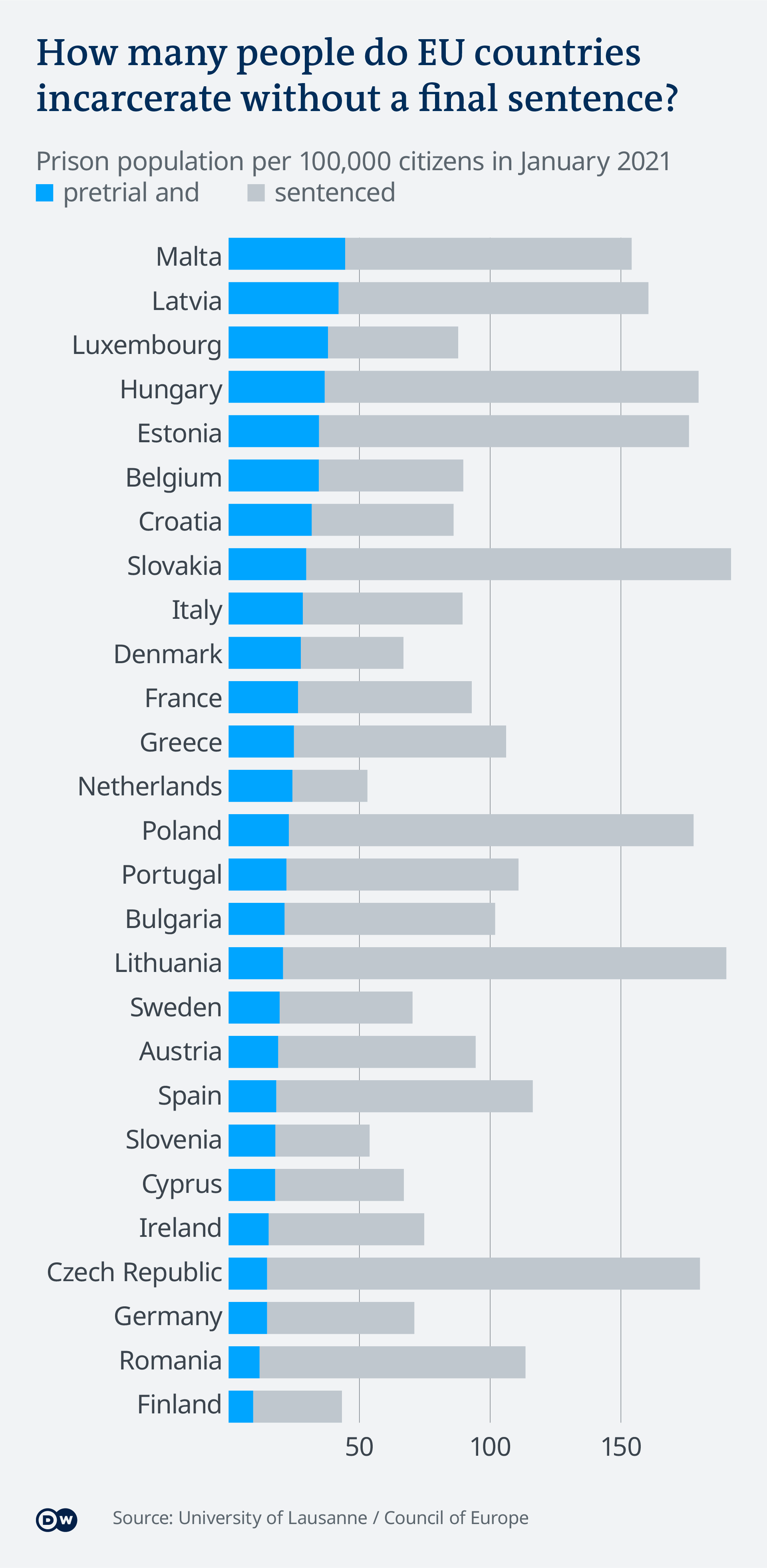
Variations of this case, as described by the lawyer and journalist Ronen Steinke in his book "Vor dem Gesetz sind nicht alle gleich" (All Are Not Equal Before the Law), happen thousands of times per year in Germany. About 27,500 people were detained pretrial in Germany in 2020, roughly 3% of all people charged with crimes. That meant that in January 2021, for example, 12,000 of the 60,000 people in German prisons were not serving a final sentence, effectively locked up while presumed innocent.

In many EU countries, the proportion of people in prisons and jails before trial is even higher than in Germany. Across the European Union, about 100,000 people are currently being held in pretrial detention, which can range on average from a few months to over a year depending on the country.
Most in pretrial detention accused of minor crimes

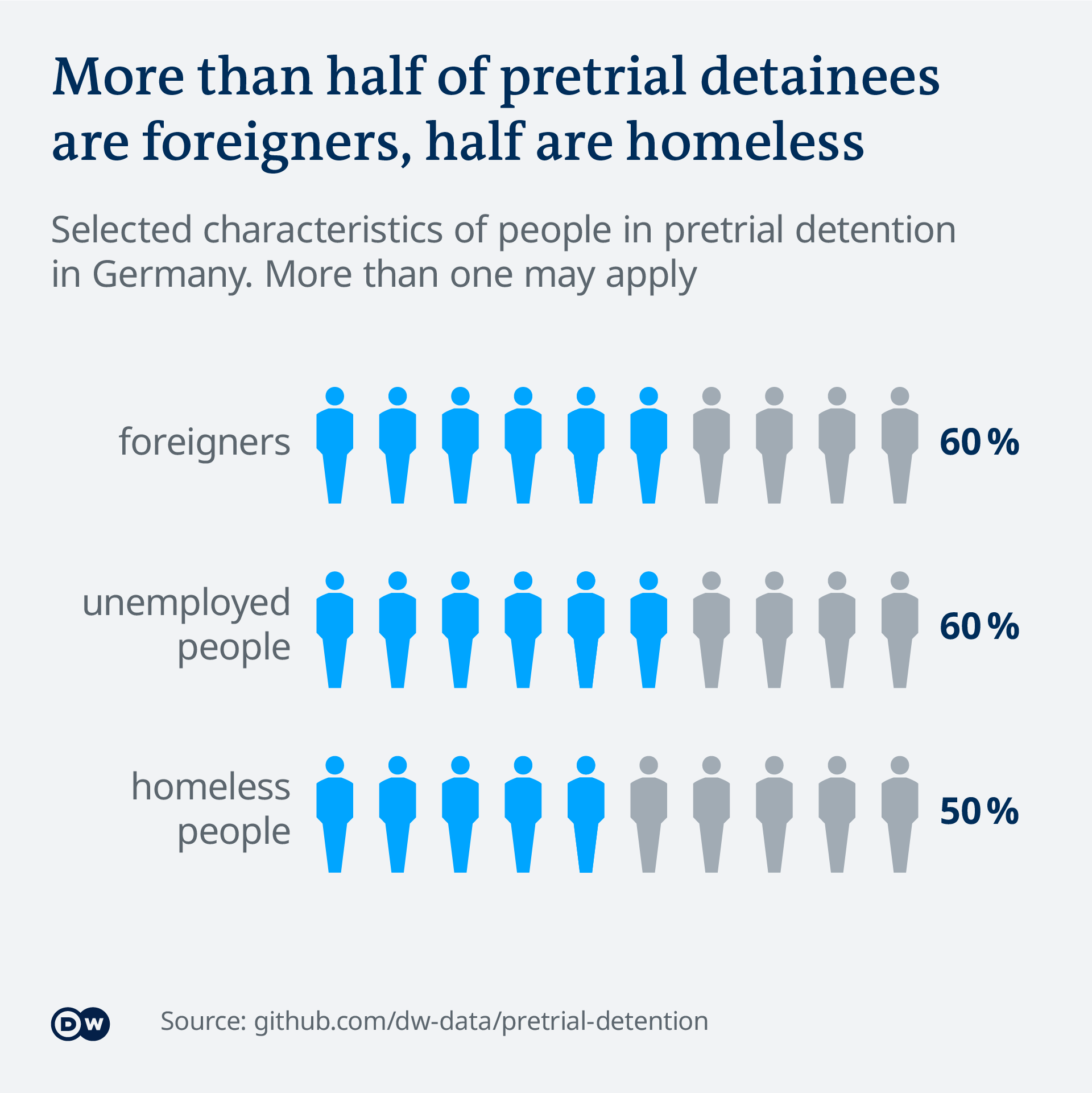
There is often a clear pattern to who gets locked up before trial. Though foreign nationals make up just 12% of the general prison population in Germany, according to federal statistics, they represent 60% of people held in pretrial detention. Most people in remand custody are unemployed, and about half were experiencing homelessness at the time of their arrest, one study found.

Over one-third of people held in pretrial detention across Germany are accused of minor crimes such as petty theft or shoplifting. "Usually, they'll steal some combination of a bottle of booze, coffee or an energy drink, and meat salad or sardines," said Christine Morgenstern, a professor of criminal law and gender studies at the Free University of Berlin, who wrote her postdoctoral thesis on pretrial detention in Europe.
Though data is sparse, research suggests that this isn't just a German issue. "We've found a similar pattern in other European countries we studied," Morgenstern said, "even ones with more liberal policies."

In deciding whether to detain people ahead of trials, judges must assess whether the person might tamper with evidence, intimidate witnesses or, most importantly, flee prosecution if released. In 95% of cases in Germany in which pretrial detention was ordered, judges cited flight risk as the main reason.

In theory, judges should make this decision based on the concrete evidence in each individual case. The reality is often different, criminal defense lawyer Lara Wolf said: "We're locking up people based on feelings, assumptions, personal theories." Her doctoral thesis — one of the few empirical studies into flight risk in Germany and the European Union — investigates which individual factors might determine whether someone flees prosecution.

Judges more likely to lock up marginalized people

In the absence of evidence, Wolf's thesis finds, judges form their own theories based on personal experiences and preconceptions. Legal reference works and interviews with judges show that contacts abroad, for example, are generally deemed a factor for increased flight risk, as are homelessness, unemployment and a lack of formal education. A steady job, good education and personal ties are interpreted as decreasing flight risk. Into the late 1980s, some judges advised that homosexual relationships didn't decrease flight risk in the way that heterosexual ones did, as they were considered less committed. The result is that people from marginalized groups are much more likely to be detained before trial.

Wolf analyzed 169 cases throughout Germany in which judges assumed flight risk but the defendant was released for procedural reasons. "I was surprised just how clear the results were," she said. In all but 14 cases, defendants showed up for trial. A lawyer attempting to repeat the research in his own district found that only one defendant of 65 fled. "At this point, something is going so systematically wrong that the whole practice is simply unlawful," Wolf said. "I still find it shocking, the idea that we're locking people up based on feelings, on false assumptions that no one has ever checked."

Both the German Judges' Association and the Berlin Senate Department for Justice, Diversity and Anti-Discrimination declined to comment on the study's findings.

Pretrial detention is often harsher than prison sentences: People get locked up for 23 hours a day and have little contact with the outside world and little to pass the time. Reintegration measures such as paid prison labor and social programs aren't available to people presumed innocent, Morgenstern said. And that is in addition to the jarring experience of being ripped from one's life without a clear idea of what comes next. "It's a very uncomfortable, unstable, frightening personal situation," Morgenstern said.

Almost half the cases of people detained pretrial end without prison sentences

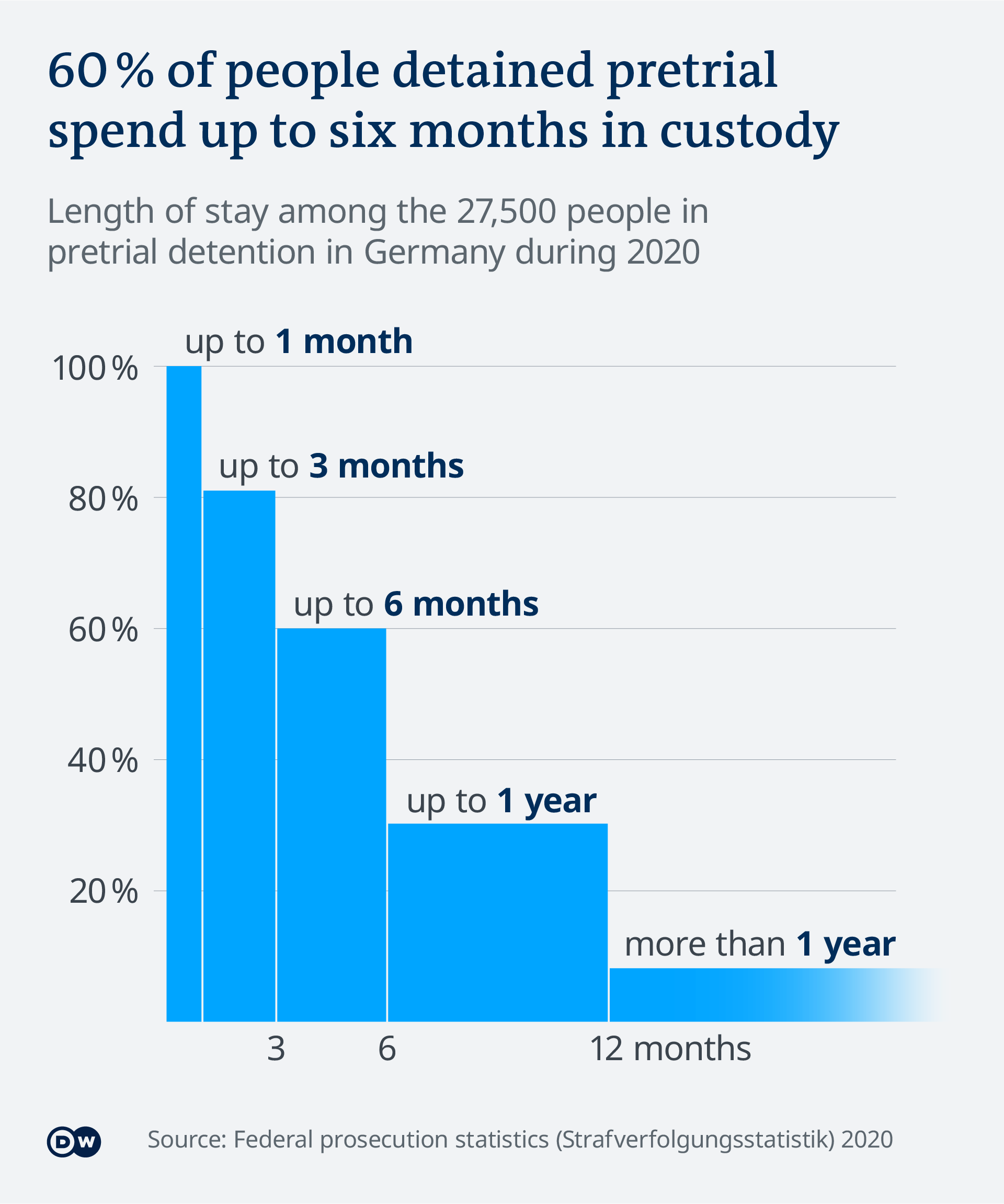
Pretrial detention is a situation that can drag on. About 80% of people held in remand spend more than three months locked up.
German law explicitly states that the time spent in detention before trial must be proportionate to the potential sentence. Time in custody also gets deducted from the final sentence.

But, in almost half of the cases, the trial ends without any prison time. Prosecution statistics show that about 30% of people in pretrial detention have their eventual prison sentences suspended for probation. Ten percent receive only fines, and another 7% are acquitted, sentenced to community service or rehabilitation programs, or have their charges dropped.

There are alternative measures that courts could take. EU legal systems already work together to try defendants in their home countries or extradite them for prosecution rather than locking them up on the spot, but, Morgenstern said, "those options are barely used."

Instead of pretrial detention, some advocate for electronic monitoring of defendants in their homes when possible, a practice common in Italy and Belgium. But Morgenstern said house arrest had not reduced the number of people within the carceral system. "In Belgium, for example, they use these alternatives quite a lot, but then still detain the same number of people," she said. "We call that net widening. When that happens, not much is won in terms of freedom rights."

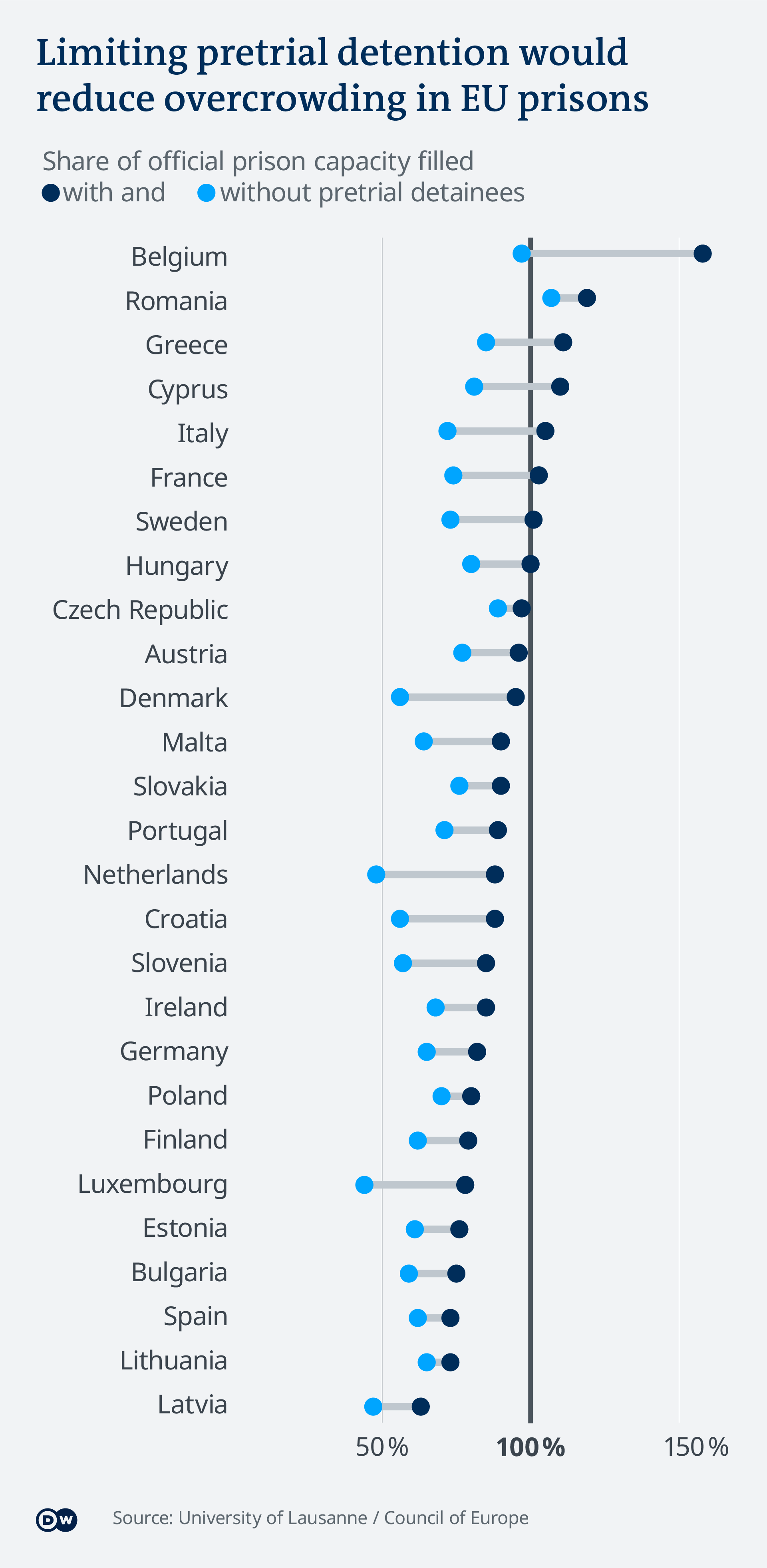
Reducing pretrial detention could reduce overcrowding

With high numbers of people locked up, pretrial detention also contributes massively to prison overcrowding. Nearly one in three EU countries have more people incarcerated than their official prison capacities allow. This is particularly problematic during the pandemic: Cramped quarters and poor hygiene conditions make prisons an ideal breeding ground for illnesses such as the coronavirus, a DW investigation showed.

If all pretrial detainees were released, almost all EU countries would solve their overcrowding problem instantly. And, though pretrial detention may remain necessary in some cases, reducing the practice would provide some relief to overburdened prisons — and the people incarcerated within them.
Edited by: Milan Gagnon and Gianna GrĂĽn

The project is part of a collaboration within the European Data Journalism Network.

Project lead: Civio

Collaborators: Deutsche Welle, Divergente, El Confidencial, EUrologus, OBCT, VoxEurop

BACKGROUNDER

Monroe Doctrine's Shadow Outshines the Summit of the Americas


President Joe Biden, Washington, D.C., U.S., 2022. | Photo: Twitter/ @RobertSeghi

Published 1 June 2022
by teleSUR/MS

As Friday June 6 approaches, President Biden's foreign policy is also coming toward a major failure as a result of its refusal to invite Cuba, Nicaragua, and Venezuela.

For months now, Mexico's President Andres Manuel Lopez Obrador, Bolivia's President Luis Arce, Saint Vincent & the Grenadines Prime Minister Ralph Gonsalves and other Latin American leaders have expressed dissatisfaction regarding the 2022 Summit of the Americas in Los Angeles if the U.S. insists on excluding Cuba, Nicaragua, and Venezuela.


RELATED:
PM Gonsalves Urges CARICOM States Not To Attend US-Led Summit

Their stance reflects regional opposition to keeping those countries out of the summit, but this is not the first time Washington has tried to impose its will on the entire American continent. In the nearly 200 years since the United States adopted the so-called Monroe Doctrine in 1823, U.S. atrocities in Latin America have overshadowed bilateral relations.

MILITARY AGGRESSION


The history of the U.S. development is also a story of Latin American resistance marked with blood and tears. After its founding, which entailed dispossessing North American Indians of their own land, the U.S. embarked on a policy of expansion against Mexico.

Through war, the United States appropriated half of Mexico's territory, including all or part of California, Nevada, Utah, New Mexico, Texas, Arizona, Colorado, and Wyoming. Mexico lost significant mineral resources, impacting its economic development.

At the end of the 19th century, the U.S. launched another offensive, taking possession of Puerto Rico in the Caribbean Sea through the Spanish-American War, and occupying Cuba.

At the turn of the 20th century, frequent U.S. military aggressions in Latin America gradually brought regional countries into its sphere of influence. In 1903, the U.S. forcibly leased Guantanamo, turning it into the first U.S. military base abroad. To this day, Washington refuses to return this port to Cuba.

In 1915, Washington sent troops to occupy Haiti under the guise of "protecting the diaspora" from local unrest. It did not withdraw until 1934. The United States occupied the Dominican Republic from 1916 to 1924 to collect debts contracted by Dominican governments. U.S. troops again swarmed the island in 1965, when civil war in the Dominican Republic toppled the pro-American government, and Washington sent some 40,000 soldiers to "restore order."

In 1989, the U.S. sent elite troops to invade Panama under the guise of "protecting the lives and property of American citizens," overthrowing the military government and attempting to attain permanent control of the Panama Canal.


ECONOMIC EXPLOITATION

In 1904, American writer O. Henry used his experience in Honduras to write his novel "Cabbages and Kings," in which he exposed the ruthless plunder of U.S. monopolies in Central America and the Caribbean, and coined the term "banana republic," referring to countries under the control of Washington, and whose economies invariably depended on a single crop.

By 1930, the United Fruit Company controlled around 1.4 million hectares of land in Costa Rica, Guatemala, Honduras, and Panama and over 2,400 kilometers of railways, as well as the countries' customs, telecommunications and other essential services.

In 1947 alone, U.S. business accounted for as much as 38 percent of gross domestic product (GDP) in Honduras, 22.7 percent in Guatemala, 16.5 percent in Costa Rica, and 12.3 percent in Panama. Exploited and looted by Washington, these countries have become its economic vassals as suppliers of raw materials and dumping grounds for U.S.-made basic goods, with economies that lag far behind.

In addition, Washington imposed and continues to impose indiscriminate sanctions and tariffs on several Latin American countries, further restricting the region's economic development. In 1962, the U.S. launched a trade embargo against Cuba that grew into a full-on blockade of the island nation, leading to over US$150 billion in economic losses as of mid-2021.

"The blockade suffocates our economy, causes shortages, hinders development and constitutes the greatest violation of Cubans' rights," said the island's Foreign Minister Bruno Rodriguez.

Venezuela has also suffered from the impact of over 430 sanctions imposed since 2015 by the United States and its allies, with losses to its economy of more than US$130 billion. The sanctions have caused a 99 percent drop in Venezuela's revenues, and negatively impacted all social, and economic spheres.


IN SHADOW OF MONROE DOCTRINE


Entering the 21st century, as Latin American countries recovered from recurring political and economic crises, their relationship with Washington began to be characterized by contradictions and conflicts.

In 2011, the region's 33 countries established the Community of Latin American and Caribbean States (CELAC), the first regional organization in the Americas to forgo the participation of the U.S. and Canada. Faced with the continuing decline of its influence, the United States was forced to adjust its policy towards Latin America.

"The era of the Monroe Doctrine is over," then Secretary of State John Kerry declared in 2013 at the headquarters of the Organization of American States (OAS), announcing the dawn of a new era of "common interests and values" between the United States and the region.

But that doesn't paint a true picture. Uncle Sam's shadow still lurks behind many Latin American political developments, said Adalberto Santana of the Center for Research on Latin America and the Caribbean at Mexico's National Autonomous University.

Washington's fingerprints are all over the 2009 military coup in Honduras, the ouster of Paraguay's Fernando Lugo in 2012 and Brazil's Dilma Rousseff in 2016, and the forced resignation of Bolivia's Evo Morales in 2019.

"For the last 200 years our country has operated under the Monroe Doctrine, embracing the premise that as the dominant power in the Western hemisphere, the United States has the right to intervene in any country that might threaten our alleged interests. Under this doctrine we have undermined and overthrown at least a dozen governments," said Democratic Senator Bernie Sanders in February.

At the onset of the COVID-19 outbreak, the United States, then the global epicenter of the pandemic, summarily deported undocumented Central American migrants without the usual safeguards, increasing the risk of spreading disease in countries with fragile healthcare systems.

What's more, in response to Latin American countries' reasonable demands for help to tackle the pandemic, the United States chose to ignore them or even block their cooperation with countries outside the region, falsely alleging "debt traps" or "neocolonialism," politicizing a healthcare issue and forcing them to take sides at the expense of their own development.

The United States fails to see that Latin America and the Caribbean have changed and the Monroe Doctrine can no longer be reinstated, said Cuban President Miguel Diaz-Canel.
As Biden heads to Summit of the Americas, focus shines on leaders who won't be there


President Joe Biden departs the White House in Washington, D.C., on Wednesday to travel to Los Angeles, Calif., for the Summit of the Americas. Photo by Yuri Gripas/UPI | License Photo

June 8 (UPI) -- President Joe Biden headed west to California on Wednesday to open the Summit of the Americas -- an event that officials hoped would be a shot in the arm for the administration on the international stage, but may instead turn out to be a pain in the neck.

The summit was intended to include leaders from South America to Canada and produce meaningful actions on various concerns, such as COVID-19, immigration and climate change.

Biden left Washington, D.C., just before noon EDT and was scheduled to arrive in Los Angeles roughly five hours later. After arrival, he's scheduled to meet with delegation heads from other countries and will speak at the summit's inaugural ceremony at 8:15 p.m. EDT.

Vice President Kamala Harris, a former Senator from California, will also attend the summit and speak Wednesday evening.

As Biden went to Los Angeles on Wednesday, however, much of the focus so far has been on leaders who have said they won't be there.

Mexican President Andres Manuel Lopez Obrador, who's said to be a fan of former President Donald Trump, says he's not going because Biden's White House did not invite some leaders of the 35-nation Organization of American States.

Leaders from Cuba, Venezuela and Nicaragua were not invited to the summit, which is being hosted this year by the United States. Biden's administration has previously said that it would only invite countries that are committed to democracy and human rights. Cuba, Venezuela and Nicaragua have been criticized for their records on those issues.

"Looking at the current situation in Cuba, in particular with trials of civil society leaders and similar situations in Nicaragua and Venezuela, we felt that the most appropriate decision was to maintain our own commitment to democracy and human rights in our hemisphere," Assistant U.S. Secretary of State Brian Nichols said according to NPR.

Other nations that won't attend the summit in Los Angeles include Honduras, El Salvador and Guatemala.


President Biden did not invite leaders from Cuba, Nicaragua and Venezuela (pictured) to attend the summit in Los Angeles, due primarily to their past records on issues like democracy and human rights, White House officials said.
File Photo by Miguel Gutiérrez/EPA-EFE

The White House said in a statement on Tuesday partners at the summit plan to "push back against the threats to our democracies by fortifying democratic institutions, investing in civil society, strengthening independent media, and following through on a regional digital transformation that is transparent and equitable."

According to administration officials, $477 million has been dedicated so far to implementing the Inter-American Action Plan on Democratic Governance -- which aims to fortify democracy and human rights, fight corruption and support the rule of law in the Western Hemisphere.

Working with Congress, the administration said $75 million will be invested over three years to help empower 300 locally based, community-led civil society organizations.

Another piece of Biden's "democratic renewal agenda" at the summit will be the launch of the Voices Initiative, which intends to promote digital democracy and counter digital authoritarianism, promote freedom of expression and strengthen independent media.

Biden also supports the Global Partnership for Action on Gender-Based Online Harassment and Abuse, and Canada and Chile are expected to join the United States in the effort.

At the summit, which runs through Friday, Biden is expected to announce key investments in Central America, explore problems related to immigration and cooperate on continued recovery from the COVID-19 pandemic.

The Summit of the Americas is held every three years and is hosted by various nations in the OAS. The last summit was held in Peru in 2018. The Los Angeles summit was originally scheduled for last year, but was postponed by the COVID-19 pandemic.
Biden’s Summit of the Americas Is Unfruitful - Evo Morales

Bolivia's Former President denounced the exclusion of Latin American countries from the Summit of the Americas. Jun. 7, 2022. | Photo: Twitter/@ejutvPrevious
Next
Published 7 June 2022
by teleSUR/MS

Former Bolivian President Evo Morales said that the IX Summit of the Americas was "stillborn" due to the decision of the Biden Administration not to invite everyone to the meeting.

RELATED:

"The latest version of the misnamed Summit of the Americas is born dead by the absence of several brother presidents who reject the arbitrary and unilateral exclusion of Cuba, Venezuela, and Nicaragua by the United States," Morales posted on his Twitter account Tuesday.

On the other hand, the Andean leader has praised the decision of some presidents of the region not to attend the summit, which began on Monday in Los Angeles. According to international media reports, at least eight presidents would not participate in the event in protest against the U.S. exclusion policy, among them Mexican President Andres Manuel Lopez Obrador and the actual Bolivian President Luis Arce.

Morales has also accused the current U.S. administration of charging him with provoking division instead of promoting integration. This Tuesday, Joe Biden's Administration confirmed that it had not invited any political representative from Cuba, Nicaragua, or Venezuela to the summit.


The IX Summit of the Americas, which takes place in the U.S., was stillborn. U.S. President Joe Biden dividing instead of integrating the region's countries denounced former Bolivian President Evo Morales (2006 -2019) on his official Twitter account.

After the United States, host of the IX Summit of the Americas, announced in early May its initial decision regarding the exclusion of Cuba, Nicaragua, and Venezuela, countries it accuses of not respecting "democracy," the Mexican president was the first to threaten to boycott the event, should any member be excluded. Other Latin American leaders joined LĂłpez Obrador's step.

On Monday, LĂłpez Obrador, in addition to refusing to attend the Summit of the Americas, blamed U.S. authorities for the failure of the meeting for having "a policy of closed-mindedness and not openness."Despite Biden's attempts to avoid the summit's failure, experts predict that the event could become an embarrassment for the U.S. president due to the high-impact boycott.

Regarding the agenda of the event, detractors and strategists have questioned what progress can be made at the summit - in which migration will be a central issue - if Mexico and some of the Central American countries are the source of most of the irregular migration to the U.S. are absent.


The Summit of the Americas Displays Imperialist Exclusion: Cuba


A woman protests against the exclusion of Cuba from the Summit of the Americas in Los Angeles, U.S., June 7, 2022.
| Photo: Twitter/ @PeoplesSummit22

Published 7 June 2022


Behind the U.S. decision to exclude Cuba, Nicaragua, and Venezuela from the Summit of the Americas lies arrogance and fear of inconvenient truths being expressed.


From June 6 to 10, the 'Summit of the Americas' is taking place in Los Angeles, California. President Joe Biden's administration did not invite Cuba, Nicaragua, and Venezuela to this meeting, despite the fact that several Latin American leaders requested to avoid any form of ideological discrimination. The statement that Cuba issued regarding the Los Angeles meeting is reproduced below.

RELATED:

The U.S. government, abusing its privilege of being the host country, decided at a very early stage to exclude Cuba, Venezuela and Nicaragua from the 9th Summit of the Americas to be held in the city of Los Angeles this month of June. It has refused to attend to the just claims of many governments to change that discriminatory and unacceptable stand.

There is no single reason that justifies the anti-democratic and arbitrary exclusion of any country of the hemisphere from this continental meeting, as warned by the Latin American and Caribbean nations at the 6th Summit held in Cartagena de Indias in 2012.

President Miguel Diaz-Canel BermĂşdez announced last May 25 that he would not attend the meeting. This was Cuba’s final decision if all countries of the hemisphere were not convened on an equal footing.

Arrogance, fear of inconvenient truths being voiced, determination to prevent the meeting from discussing the most pressing and complex issues in the hemisphere, and the contradictions of its own feeble and polarized political system are behind the U.S. decision to once again resort to exclusion in order to hold a meeting with no concrete contributions yet beneficial for imperialism’s image.


It is a well-known fact that the U.S. government has engaged in intensive high-level efforts with governments of the region seeking to reverse the intention of many of not attending the meeting unless all countries are invited. Such efforts included immoral pressure, blackmail, threats and dirty deceptive maneuvers. These are all common practices that reflect imperialism’s traditional disdain for our countries and deserve the strongest rejection.

Cuba appreciates and respects the honorable, brave and legitimate stand of many governments in defense of the full and equal participation of all countries.

The leadership of Mexican president Andres Manuel Lopez Obrador deserves special recognition. We highlight the clear stand of CARICOM member countries from the outset against such exclusions, as well as the firm stance of Bolivian president Luis Arce Catacora and of the president of Honduras Xiomara Castro. The position of Argentine as chairman of CELAC expresses the majority view of the region against a selective Summit, as expressed, both publicly and in private, by many governments of South and Central America.

Such genuine and spontaneous solidarity in reaction to this U.S. discriminatory action against countries of the region reflects the sentiment of the peoples of Our America. The United States underestimated the support Cuba enjoys in the region, when it attempted to impose its unilateral and universally rejected hostile policy towards Cuba as a consensus regional position, however, the debate on the invitation process proved them wrong.

The 21st ALBA Summit held in Havana last May 27, showed the unequivocal repudiation of exclusions and discriminatory and selective treatment.

Such exclusions confirm that the United States conceived and uses this high-level dialogue mechanism as an instrument to further its hegemonic system in the hemisphere, just like the Organization of American States (OAS), the Inter-American Treaty of Reciprocal Assistance (TIAR) and other bodies established in the 20th century to curb independence, limit the sovereignty of nations in the region and thwart Latin American and Caribbean unity and integration aspirations.


They are part of the efforts to implement the Monroe Doctrine and promote exclusion as a dividing strategy for clear political, electoral and domination purposes. One cannot speak of “The Americas” without including all the countries of the hemisphere. Our region demands cooperation, not exclusion; solidarity, not meanness; respect, not arrogance; sovereignty and self-determination, not subordination.

It is known that the documents to be adopted at Los Angeles are completely divorced from the real problems facing the region and that beyond the effort to grant the OAS supranational prerogatives to decide upon the legitimacy of electoral processes and to compel Latin American and Caribbean governments to impose repressive, discriminatory and excluding actions against migrants, these documents are useless and vague.

We know that, like in the past, the voice of Latin America and the Caribbean will resound during those days in Los Angeles with the admirable and principled absence of relevant leaders who enjoy political and moral authority and the recognition of their people and the world.

We are also fully confident that the leaders of the region, who choose to attend, will argue with dignity that the United States cannot treat our peoples as they used to in the 20th century. Cuba supports the genuine efforts to promote integration throughout the hemisphere based on civilized coexistence, peace, respect for diversity and solidarity.

Cuba has a widely acknowledged record of unreserved support and contribution to all legitimate proposals for actual and concrete solutions to the most pressing problems faced by our peoples. The reality we are presented with today is far from such aspirations.


Saint Vincent & the Grenadines Not to Be in the Americas Summit


Saint Vincent & the Grenadines Prime Minister Ralph Gonsalves, June, 2022. 
| Photo: Twitter/ @EmbaCuba_Pol
Published 3 June 2022
by teleSUR/MS


"I'm not going to go because I don't see what is to be gained from it... Our friendship has to be grounded in elemental respect and, truth be told, our U.S. friends have failed us," PM Golsalves said.


Saint Vincent & the Grenadines Prime Minister Ralph Gonsalves confirmed that his country will not send representation to the Summit of the Americas to be held in Los Angeles from June 6 to 10.

"I'm not going to go because I don't see what is to be gained from it," Gonsalves said and explained his stance by recalling that U.S. President Joe Biden did not invite Cuba, Venezuela, and Nicaragua to the meeting, alleging that these countries are not "democratic." Washington's decision to exclude those nations has also been questioned by the governments of Mexico, Bolivia, Guatemala, Argentina, Honduras, Chile, and Panama.

"Our friendship has to be grounded in elemental respect and, truth be told, our U.S. friends have failed us. Besides, they profoundly ignored that matter," stressed Gonsalves, who is one of the longest-serving leaders of the 15-member group. of The Caribbean Community (CARICOM).

He maintained that although the representatives of the countries of this intergovernmental organization will be present at the Los Angeles summit, they will show their disagreement with Washington's veto of Cuba, Venezuela and Nicaragua.


"You can't have a Summit of the Americas with just a few people. You must include everyone," Gonsalves insisted, adding that the hemisphere is slipping backwards in its search for consensus. In this regard, he recalled that Cuba was invited to the 2015 Summit of the Americas, where Barack Obama and Raul Castro very respectfully shared the same space.

"Why are we fighting these 20th century battles in the third decade of the 21st century? Our U.S. friends are wrong on this matter. I respect President Biden very much, but I cannot agree with his administration on this issue," Gonsalves said, adding that his country's relations with Washington remain at an excellent level as always.

Last week, CARICOM leaders held a virtual meeting to discuss their attendance at the U.S.-convened meeting in Los Angeles, but were unable to reach a consensus on the matter.


Amazon's indigenous leaders make plea at Americas summit

Wed, June 8, 2022,


The custodians of the primal forests that stretch across eight Latin American countries said national leaders gathering in Los Angeles this week had to listen to them if they wanted to save the Amazon.

Indigenous leaders from across South America are in the United States for the Summit of the Americas, a semi-regular gathering of heads of state from the Western Hemisphere.

But, they say, many are not being allowed into the meetings where the land their people have called home for centuries is being discussed.

"In these important events, where there are governments in power, we should be hearing from indigenous people from different countries," said Domingo Peas, from the Achuar community in the Ecuadorian Amazon.

Peas, a member of the Confederation of Indigenous Nations of the Ecuadoran Amazon, traveled by boat, car, bus and plane over more than two days to get from his remote community of some 100 families to Los Angeles.

But when he arrived, he was told he would not be able to participate in the event, despite its having climate change as a major topic.

"Indigenous voices are not being heard at the summit, indigenous delegates are being denied entry," said Atossa Soltani, founder and president of the NGO Amazon Watch.

Not hearing what they have to say would be a huge mistake, she told AFP.

"Indigenous peoples not only have the solutions to our climate and biodiversity crisis, they are the original inhabitants.

"The reason we have these incredibly intact forests in Latin America, is because indigenous peoples for centuries and millennia have been taking care of the forests.

"They need to be at the table. They have something to teach the modern world."

The Summit of the Americas is being held in the United States for the first time since its inaugural edition in 1994.

The gathering, which was intended to showcase US President Joe Biden's engagement with the vast continent to the south, has floundered because a number of significant figures are not here.

Most conspicuously, Mexico's President Andres Manuel Lopez Obrador, whose co-operation is key if the Biden administration wants to get a handle on immigration, said he would stay away because leaders from Venezuela, Nicaragua and Cuba had not been invited.

Brazil's President Jair Bolsonaro, however, is expected to attend.

Soltani said Bolsonaro, whose country contains the lion's share of the Amazon needs to rein in the rampant commercial exploitation of the forest.

"The fate of the Amazon is in the hands of these world leaders who are gathering here this week. That is the fate of all of us. This is the future for our children, it's the future for life on this planet," she said.

pr-hg/st