Wednesday, June 08, 2022

Will anti-abortionists use ‘uterus surveillance’ against women in the US?

If, as is expected, Roe v Wade is overturned by the US supreme court, 26 states are certain or likely to ban abortion – and data tracking could mean there’s nowhere for women to hide
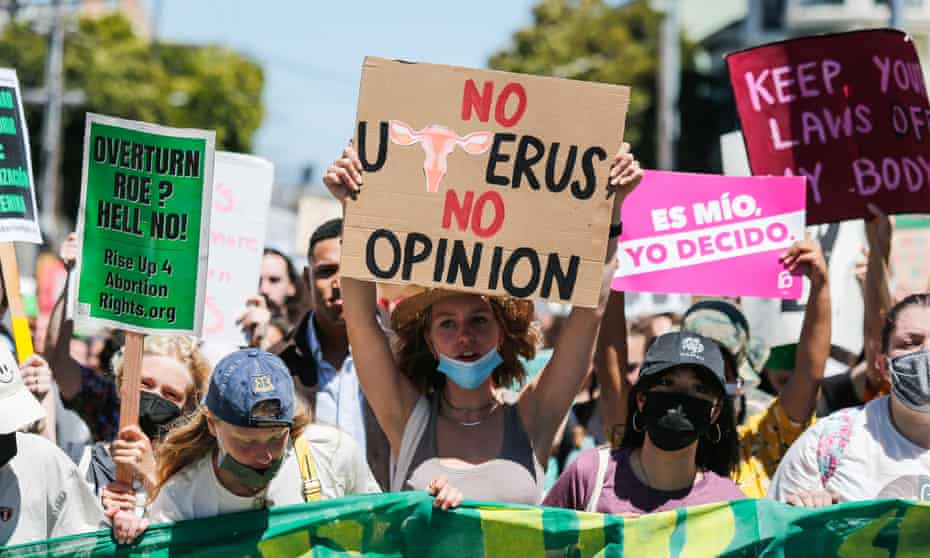
Protesters at the Defend Roe v Wade Emergency March in San Francisco, US, last month. 
Photograph: Michael Ho Wai Lee/Sopa Images/Rex/Shutterstock

THE GUARDIAN
Tue 7 Jun 2022 

If you are looking for a cheerful column that will make you giggle and distract you from everything that is wrong with the world, click away now. This week I have nothing but doom, gloom and data trackers for you. If you are hoping to sink into a well of existential despair, maybe let out a few screams into the void, then you’ve come to the right place.

Here goes: the US supreme court, as you are no doubt aware, is expected to overturn Roe v Wade and the federal right to an abortion very soon. At least 13 Republican-led states have “trigger laws” in place, which means that the moment Roe is overruled, abortion will be fully or partly banned. Other states will follow suit. According to the Guttmacher Institute, a pro-choice research organisation, 26 states are certain or likely to ban abortion when Roe falls.


Perhaps you are the glass half-full sort. Perhaps you are thinking: “Well, at least people can travel to a state where abortion is legal.” Unfortunately, it’s not that simple. There are the obvious logistical and financial constraints, for one thing. Then there’s the fact that we live in a world of mass surveillance: pretty much everything we do these days leaves a digital footprint – one that anti-abortion extremists will not hesitate to weaponise. One Democratic senator has described the potential of new technology to track down and punish anyone who might even be thinking of having an abortion as “uterus surveillance”. Expect to see a big rise in this, not least because some anti-abortion states are providing financial incentives to snitch on your fellow citizens. Texas, for example, has passed “bounty hunter” laws promising at least $10,000 to individuals who help enforce the abortion ban by successfully suing an abortion provider.

To be fair, there’s nothing new about uterus surveillance. Anti-abortion activists may be stuck in the past when it comes to reproductive rights, but they have always been adept at using modern technology to further their goals. One tactic they’ve used for decades is standing outside clinics and recording the licence plates of anyone who enters. As far back as 1993, extremists were tracing the people connected to those licence plates, obtaining their phone numbers, then calling up to harass them. Years ago tracing someone took a bit of time and effort. Nowadays, you can look up someone’s personal information with the click of a button and a small fee.

The wonders of the modern world mean there are a mind-boggling number of ways in which you can now identify anyone who might be thinking about an abortion. To begin with, there’s location data. Vice media recently reported that a data location company is selling information related to Planned Parenthood facilities (many of which provide abortions). The data shows where groups of people visiting the locations came from, how long they stayed and where they went afterwards. That data is aggregated so it doesn’t provide the names of individuals; however, de-anonymising this sort of information is not very difficult. There is plenty of evidence that location data is almost never anonymous.

Period-tracking apps, which are used by millions of people, are also a worrying source of potentially incriminating information in a post-Roe world. Experts have warned that rightwing organisations could buy data from these apps and use it to prove that someone was pregnant then had an abortion. Your text messages could also be used against you, as could your browser history. Indeed, authorities in Mississippi have already used a woman’s online search for abortion pills to indict her for second-degree murder after she miscarried. That happened in 2018; imagine what is going to happen in a post-Roe world. Speaking of which, I’ve just realised I Googled the word “abortion” 100 times while researching this. I’m off to scrub my search history.

Arwa Mahdawi is a Guardian columnist
Only cultural change will free America from its gun problem


The movement to protect innocent lives from gun violence is a multi-generational struggle akin to that which won African Americans civil rights or gay Americans the right to marry


‘The pleasure derived from guns, the sense of participation in America’s deepest myths about itself which they might foster, come at the expense of tens of thousands of lives a year.’ 
Photograph: Nuri Vallbona/Reuters

THE GUARDIAN
Tue 7 Jun 2022 

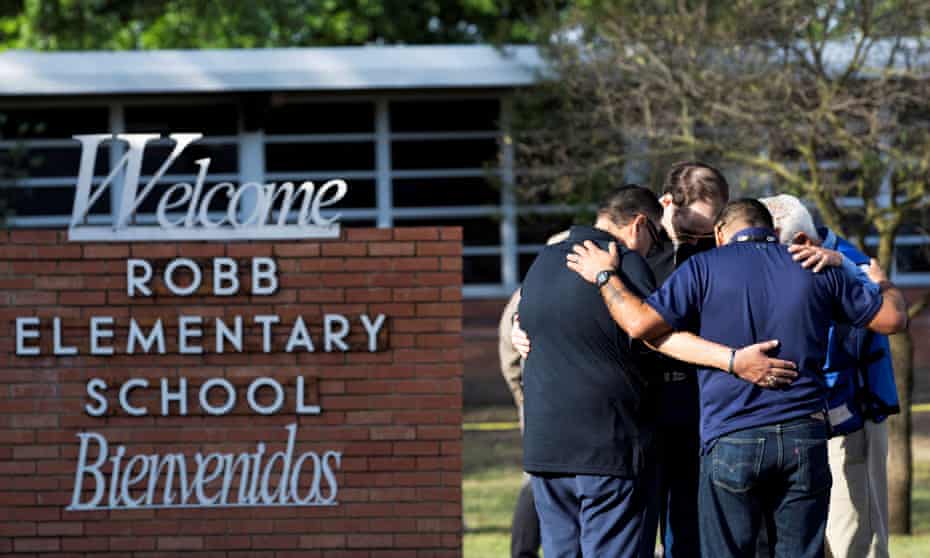
Some days it feels like guns are such a foundational part of American identity that the country would have to cease to be itself before it would give them up. When a gunman murdered dozens of elementary-age schoolchildren, leaving their bodies in such a state that parents had to give up DNA samples for them to be identified, it was one such day. What cultural value, what material interest, could be worth this? It must be something that its defenders consider supremely important.

Guns – that’s what. Critics of the sickness which is America’s obsession with guns often focus their fire on the second amendment, or the perverse political influence of the National Rifle Association. But neither of these things really get to the root of the pathology. It’s true that gun-rights advocates rely on a surely mistaken reading of the constitution to justify arming themselves to the teeth. And it’s also true that the NRA is a malign force in American politics. But the constitution can be changed or reinterpreted, and special interest groups can be vanquished. What is at issue here is something more foundational, and more difficult to change: American culture itself.

The gun is the great symbol, and poisonous offshoot, of American individualism. The country has long valorized masculine heroes – the cowboy, the frontiersman, the patriotic soldier – who impose their will on the community’s enemies with violence. It’s no coincidence that whenever a horrific mass shooting occurs, those in favor of guns respond by claiming that the solution to the guns of the bad guys is more guns in the hands of the good guys. Such reasoning responds to a deep-seated American historical myth, and allows the speaker to imagine themselves as the hero.

But they are not heroes – far from it. Mass shooters may be, as the writer John Ganz put it, the “nightmare obverse” of the ideal of the lone frontiersman. But everyone else who defends their own right to possess a gun, who lauds guns as the bringers of peace and order, is guilty too. Their choices make society less safe, not more. The pleasure derived from guns, the sense of participation in America’s deepest myths about itself which they might foster, come at the expense of tens of thousands of lives a year. Sometimes, they are the lives of small children, innocent to the ways of a world which has allowed them to die.

Gun culture reveals the centrality of violence to American conceptions of manhood – a violence which ultimately harms rather than protects


Men own guns at nearly twice the rate of women, and within all of this there is something deeply pathetic about the state of American manhood. American gun culture treats ownership of weapons of war as a sign of masculinity and virility, something that makes you more of a man. Almost anywhere else in the western world, a man seeking to demonstrate his masculinity in this way would be treated as an absurd and tragic poser. No doubt many gun owners tell themselves that they are better equipped to protect the innocent. But they are wrong. Rather, gun culture reveals the centrality of violence to American conceptions of manhood – a violence which ultimately harms rather than protects.

But cultural change is not impossible. It has happened in recent decades on very important issues


If the problem is cultural, then what is the solution? There is no easy one. By now, the grooves of the debate are well-worn, and even a shocking event like the Uvalde massacre will not shake us out of it for long. Proposals to change the law or the constitution will be bitterly criticized, and gun-rights proponents will present the shooter as an anomaly who holds no lessons for “responsible” gun-owners. The supreme court is expected soon to loosen rather than tighten the law around carrying guns in public. Republicans will angrily decry attempts to “politicize” the massacre, as if the fact that innocent children are being brutally murdered due to the policies those very same Republicans support was not already a political issue of the highest order.


But cultural change is not impossible. It has happened in recent decades on very important issues. America also contains within itself the will to self-improvement, and citizens who will give their all to achieve it. Sometimes it comes before political or legal change, and sometimes it comes after it. The only way to avoid despair is to see the struggle to protect innocent lives against the ravages of gun violence as a multi-generational struggle akin to that which won African Americans the right to vote, or that which won the right to gay marriage. Each of these required Americans in the grip of myths and pathologies to relinquish them, and each at one time seemed impossible. But change did eventually come.

The path ahead will not be easy – and, as the supreme court’s expected ruling on Roe v Wade has shown, there will be setbacks along the way. Those who embody a pathological understanding of what America should be are currently ascendant, and there will be no easy victory over them. But despair would be surrender. That’s why for now there is the need to mourn the tiny lives which were extinguished. Remember them, and in doing so remember something else: America’s genius is that it can be changed, never quickly enough, but always in the end. It’s a slim hope to grasp onto in this moment of rage and sorrow, but it may be all that we have left.

Andrew Gawthorpe is a historian of the United States and the host of the podcast America Explained

Canada unveils carbon emissions offset market

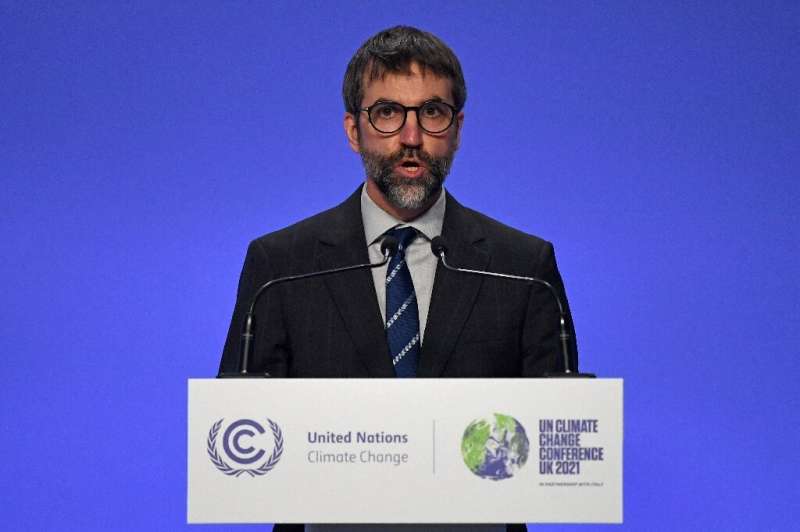
Canada's Environment Minister Steven Guilbeault, pictured here at a UN climate conference in November 2021, unveiled Wednesday a
Canada's Environment Minister Steven Guilbeault, pictured here at a UN climate
 conference in November 2021, unveiled Wednesday a national carbon emissions market.

Canada unveiled Wednesday a national carbon emissions market to help it meet its climate goals by allowing cities, farmers and others to sell credits for CO2 reductions to heavier polluters.

Under the system, registered participants can generate one credit for each tonne of emissions they reduce or remove from the atmosphere.

Credits can then be sold to others in Canada to help them meet compliance obligations or emissions reductions goals.

"This system gives foresters, farmers, Indigenous communities, municipalities and others an opportunity to earn revenues by cutting pollution," Environment Minister Stephen Guilbeault told a news conference.

Some , however, called it a step backwards in the fight against .

"Offsets don't stop carbon from entering the atmosphere and warming the planet, but on paper they make the big polluters look good," Greenpeace's Salome Sane said in a statement.

Ottawa has pledged to reduce Canada's  by up to 45 percent below 2005 levels by 2030.

But several independent reports have said the government is not doing enough to reach that target, and is lagging behind its G7 counterparts in slashing emissions.

Its new offset credit system, which allows credits to be generated from projects started after January 1, 2017, would allow landfills to sell credits for captured methane, for example.

Farmers could generate credits by sequestering more carbon in their soil by alternating fields in which they plant crops, or using feed for livestock that produces less burped gasses, while forestry firms could do the same by thinning diseased trees and managing brush to reduce wildfires.

"You can't just go out and plant a tree in your front yard and get a credit," an official told a briefing.

The emissions cuts must be new, verifiable, and permanent to qualify under the program, which will also include direct carbon capture from the air once those details are hammered out.

The federal system also prohibits trading of duplicate credits. The province of Quebec, for example, is already part of the US state of California's cap and trade system known as the Western Climate Initiative.Carbon farming in WA

© 2022 AFP


Brookings places retired general on leave amid FBI probe

By ALAN SUDERMAN and JIM MUSTIAN
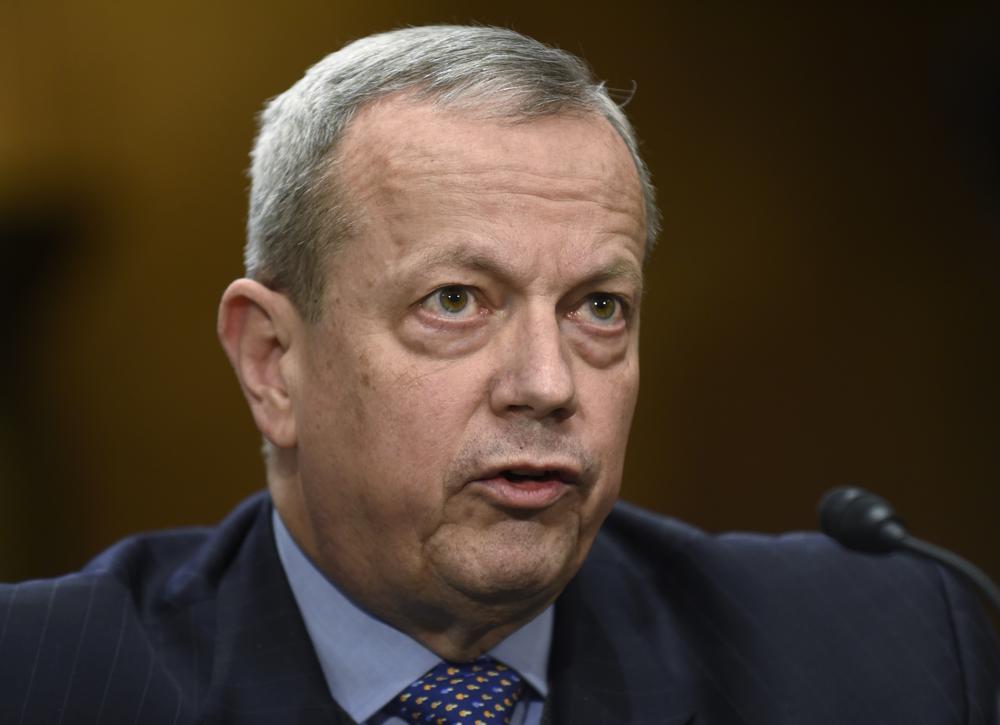
On Wednesday, June 8, 2022, the prestigious Brookings Institution placed Allen, its president, on administrative leave amid a federal investigation into his foreign lobbying.
 (AP Photo/Susan Walsh, File)

TODAY PM

The prestigious Brookings Institution placed its president, retired four-star Marine Gen. John Allen, on administrative leave Wednesday amid a federal investigation into Allen’s foreign lobbying.

Brookings’ announcement came a day after The Associated Press reported on new court filings that show the FBI recently seized Allen’s electronic data as part of an investigation into his role in an illegal foreign lobbying campaign on behalf of the wealthy Persian Gulf nation of Qatar.

An FBI agent said in an affidavit in support of a search warrant there was “substantial evidence” that Allen had knowingly broken a foreign lobbying law. Allen had made false statements and withheld “incriminating” documents, the FBI agent’s affidavit said.

Allen has not been charged with any crimes and previously denied any wrongdoing.

Brookings told staffers Wednesday that the institute itself is not under federal investigation. The think tank’s executive vice president, Ted Gayer, will serve as acting president.

“Brookings has strong policies in place to prohibit donors from directing research activities,” the email said. “We have every confidence in the Brookings team’s ability to remain focused on delivering quality, independence, and impact.”

The federal investigation involving Allen has already ensnared Richard G. Olson, a former ambassador to the United Arab Emirates and Pakistan who pleaded guilty to federal charges last week, and Imaad Zuberi, a prolific political donor now serving a 12-year prison sentence on corruption charges. Several members of Congress have been interviewed as part of the investigation.

The new court filings detail Allen’s behind-the scenes efforts to help Qatar influence U.S. policy in 2017 when a diplomatic crisis erupted between the gas-rich Persian Gulf monarchy and its neighbors.

Allen’s alleged work for Qatar involved traveling to Qatar and met with the country’s top officials to offer them advice on how to influence U.S. policy, as well as promoting Qatar’s point of view to top White House officials and members of Congress, the FBI’s affidavit says.

Brookings is one of the most prestigious think thanks in the U.S.

Allen, who was a senior fellow at the Brookings Institution prior to becoming president in late 2017, used his official email account at the think tank for some of his Qatar-related communications, the affidavit says.

Qatar has long been one of Brookings’ biggest financial backers, though the institution says it has recently stopped taking Qatari funding.


FBI seizes retired general’s data related to Qatar lobbying

By ALAN SUDERMAN and JIM MUSTIAN

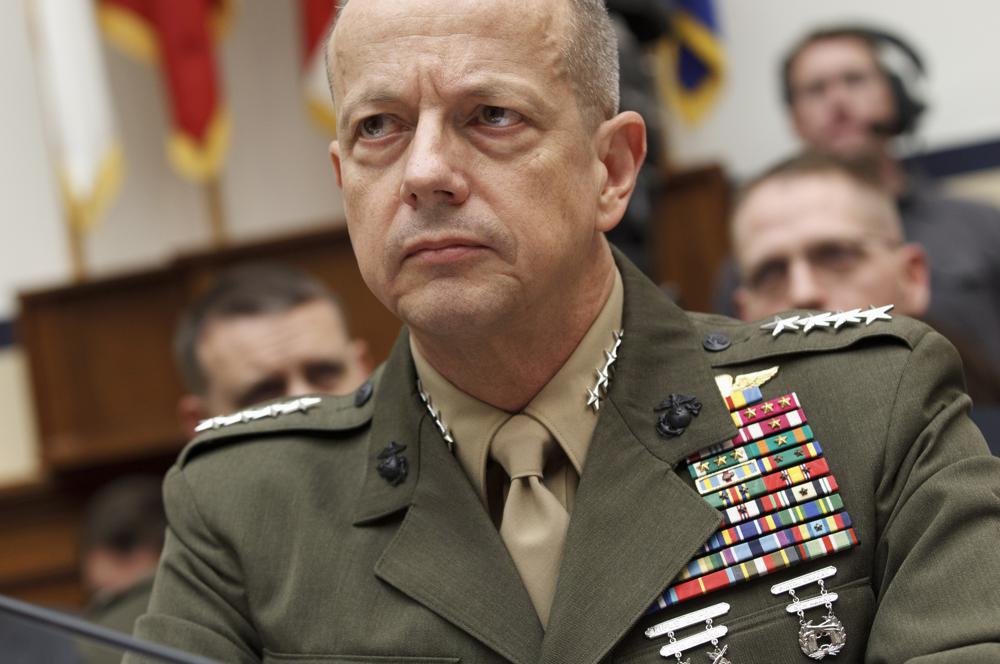
Marine Gen. John Allen, the top U.S. commander in Afghanistan testifies on Capitol Hill in Washington on March 20, 2012. A former ambassador facing charges of illegal lobbying on behalf of Qatar has pushed federal prosecutors to explain why Allen, who worked with him on the effort. Allen is currently the president of the influential Brookings Institution think tank.
 (AP Photo/J. Scott Applewhite, File)

TODAY AM

The FBI has seized the electronic data of a retired four-star general who authorities say made false statements and withheld “incriminating” documents about his role in an illegal foreign lobbying campaign on behalf of the wealthy Persian Gulf nation of Qatar.

New federal court filings obtained Tuesday outlined a potential criminal case against former Marine Gen. John R. Allen, who led U.S. and NATO forces in Afghanistan before being tapped in 2017 to lead the influential Brookings Institution think tank.

It’s part of an expanding investigation that has ensnared Richard G. Olson, a former ambassador to the United Arab Emirates and Pakistan who pleaded guilty to federal charges last week, and Imaad Zuberi, a prolific political donor now serving a 12-year prison sentence on corruption charges. Several members of Congress have been interviewed as part of the investigation.

The court filings detail Allen’s behind-the scenes efforts to help Qatar influence U.S. policy in 2017 when a diplomatic crisis erupted between the gas-rich Persian Gulf monarchy and its neighbors.

“There is substantial evidence that these FARA violations were willful,” FBI agent Babak Adib wrote in a search warrant application, referring to the Foreign Agents Registration Act.

Allen also misrepresented his role in the lobbying campaign to U.S. officials, Adib wrote, and failed to disclose “that he was simultaneously pursuing multimillion-dollar business deals with the government of Qatar.”

The FBI says Allen gave a “false version of events” about his work for Qatar during a 2020 interview with law enforcement officials and failed to produce relevant email messages in response to an earlier grand jury subpoena.

The 77-page search warrant application appears to have been filed in error and was removed from the docket Tuesday after The Associated Press reached out to federal authorities about its contents.

Allen declined to comment on the new filings. He has previously denied ever working as a Qatari agent and said his efforts on Qatar in 2017 were motivated to prevent a war from breaking out in the Gulf that would put U.S. troops at risk.

Allen spokesperson Beau Phillips told AP last week that Allen “voluntarily cooperated with the government’s investigation into this matter.”

Allen, who was a senior fellow at the Brookings Institution prior to becoming president, used his official email account at the think tank for some of his Qatar-related communications, the affidavit says.

Brookings did not immediately respond to a request for comment. Qatar has long been one of Brookings’ biggest financial backers, though the institution says it has recently stopped taking Qatari funding.

Olson was working with Zuberi on another matter involving Qatar in mid-2017 when Saudi Arabia, the United Arab Emirates and other Gulf countries announced a blockade of Qatar over its alleged ties to terror groups and other issues.

Shortly after the blockade was announced, then-President Donald Trump appeared to side against Qatar.

The court papers say Allen played an important role in shifting the U.S.’s response. Specifically, authorities say Allen lobbied then-National Security Advisor H.R. McMaster to have the Trump administration adopt more Qatar-friendly tone.

In an email to McMaster, Allen said the Qataris wanted the White House or State Department to issue a statement with language calling on all sides of the Gulf diplomatic crisis to “act with restraint.”

Federal law enforcement officials say then-Secretary of State Rex Tillerson did just that two days later, issuing a statement that called on other Gulf countries to “ease the blockade against Qatar” and asked “that there be no further escalation by the parties in the region.”

The Qatar Embassy did not immediately respond to a request for comment.

As part of the lobbying campaign, federal law enforcement authorities say, Olson and Allen traveled to Qatar to meet with the country’s ruling emir and other top officials.

At the meeting, Allen provided advice on how to influence U.S. policy and said the Qataris should “use the full spectrum” of information operations, including “black and white” operations, the affidavit says. “Black” operations are typically covert and sometimes illegal. Qatar has been accused of orchestrating hack-and-leak operations of its critics and rivals during the diplomatic crisis, including one targeting a UAE ambassador. Qatar has denied any wrongdoing.

Before they went to Doha, Allen wanted to “have a chat” with Olson and Zuberi about his compensation, the affidavit said. Allen suggested in an email that he be paid a $20,000 “speaker’s fee” for the weekend trip — even though he wasn’t giving a speech — and then later “work out a fuller arrangement of a longer-term relationship,” the affidavit says.

Zuberi paid Allen’s first-class airfare to Qatar, the affidavit said, but there’s no indication the speaker’s fee was paid. Allen’s spokesman said previously the general was never paid a fee. It’s unclear why. Some of Zuberi’s past business associates have accused him of not honoring his financial commitments.

Allen also had other financial incentives for helping the Qataris and maintaining strong ties to its top leaders, the FBI said.

“At the same time he was lobbying U.S. government officials on behalf of Qatar, Allen pursued at least one multimillion-dollar business deal with the Qatari government on behalf of a company on whose board of directors he served,” the affidavit says.

After returning from their trip to Qatar, Allen and Olson lobbied members of Congress, particularly those who supported a House resolution linking Qatar to terror financing, the FBI said.

Among them was Rep. Ted Lieu, a California Democrat who told law enforcement officials he didn’t recall exactly what Allen said but that his impression was he was there “to support the Qatari officials and their position.”
__

Contact AP’s global investigative team at Investigative@ap.org or https://www.ap.org/tips/

__

Suderman reported from Richmond, Virginia, Mustian from New Orleans.


Bertrand Russell - Message To Future Generations (1959)


THE 'NO SHARPIE' GUY
Ex-National Hurricane Center chief to lead National Weather Service

By Marianne Mizera, Accuweather.com

A veteran meteorologist who helped lead Hurricane Katrina recovery efforts and oversaw the National Hurricane Center during an onslaught of record-breaking storm activity in 2020 will take the helm of the National Weather Service.

Ken Graham, the four-year director of the National Hurricane Center, will begin his tenure as NWS director effective immediately, the agency announced Tuesday.

"Ken has the scientific integrity, trusted leadership and communication prowess," Rick Spinrad, head of the NWS's parent agency, the National Oceanic and Atmospheric Administration, said in announcing Graham's appointment during a press conference in Washington.

"I have full confidence that [Graham] will help create a more weather-and-climate-ready nation amid more extreme weather fueled by our changing climate."

Graham, a 27-year weather veteran, succeeds winter storm expert Louis Uccellini, who retired Jan. 1 after leading the NWS for eight years.

The NWS noted that Graham brings "a vast amount of operational field experience" to the administrative role.


Ken Graham was named the 17th director of the National Weather Service on Tuesday.

Graham, a native of Phoenix, worked his way up through the ranks at NWS, starting as an intern meteorologist in 1994 at the New Orleans/Baton Rouge weather forecast office, where he eventually became the meteorologist in charge, a role he assumed for 10 years.

Later, as the systems operational chief at the NWS office in Fort Worth, Texas, he led recovery efforts in the aftermath of Hurricane Katrina. Graham also has headed NWS offices in Silver Spring, Md., Birmingham, Ala., and Corpus Christi, Texas. He also was a television meteorologist in Mississippi.

His last two years, in particular, as national hurricane director have been daunting, with powerful storms.

"I hate to say the word routine, but they became so frequent that we just sprung back into action," Graham said in a May interview. "Almost 28 years in the weather service, I've seen a lot of damage. A lot of people lose everything, a lot of loss of life."

Weather, climate and water disasters cause about 650 deaths a year and about $15 billion in damage annually, according to NOAA.

Graham told AccuWeather on Tuesday that some of his main priorities will include making weather information more accessible to vulnerable populations and addressing climate change in an urgent, honest manner.

"It's me giving a briefing, not of 20 slides and science. It's about the trust. I can spend 3 minutes talking about 'This is going to be rough. Here's what the impacts are going to be. Here's the timing, here's when it's going to be here, here's when everyone's going to be out,'" he said.

The weather service has about 4,900 employees and 144 offices.

Graham is a "fantastic choice" to lead the agency, Neil Jacobs, who served as NOAA's acting administrator under former President Donald Trump, told The Washington Post. "From working as a forecaster in the field to advancing [the Hurricane Center's] mission over multiple challenging seasons, Ken has the perfect balance of leadership skills, operational experience, and support of the Emergency Management community."

In a statement Tuesday, Graham said he was "humbled" and "honored" for the opportunity.

During Graham's tenure as hurricane center chief, there have been more named Atlantic storms, 101, than in any other four-year period since 1851, according to Colorado State University records.


Graham also navigated the hurricane center during the political storm that became known as SharpieGate during Trump's time in office. The episode involved a controversial map that the former president used to show Alabama incorrectly in the path of Hurricane Dorian in 2019.

At an infamous Oval Office briefing, Trump held up the map -- an official NOAA hurricane trajectory chart -- that had been altered with a black Sharpie marker, apparently to support his false claim that the hurricane would extend to Alabama.

NOAA, facing political pressure from White House, released an unsigned statement backing the president and contradicting the forecast by the Weather Service office in Birmingham that the storm posed no danger. The backlash reached the National Hurricane Center, which received numerous angry emails from the public. In response, Graham pleaded with NWS leaders to craft a response signaling that federal officials' scientific warnings would not be compromised.

Jamie Rhome, deputy director of the National Hurricane Center, has been named acting director of the NHC until a permanent administrator is appointed, according to NWS officials.


"Don't need a weatherman to know which way the wind blows."


Bob Dylan - Subterranean Homesick Blues (Official HD Video)


Paradise by the Patchogue Ferry: A Hundred Years on Fire Island

Jack Parlett’s “Fire Island” is a sweeping, meditative history of the queer summer mecca.

W.H. Auden and James Stern on the beach at Fire Island in the summer of 1946.
Credit...Bridgeman Images


By Wayne Koestenbaum
NEW YORK TIMES
June 7, 2022

FIRE ISLAND: A Century in the Life of an American Paradise, by Jack Parlett

The few times that I — bespectacled and pale — visited Fire Island, I felt out of place. The poet Jack Parlett, who describes himself as an “‘otter,’ or maybe a ‘bear’ in training,” and who has mixed feelings, too, about paradise, hugs his ambivalence and makes good literature out of it. His concise, meticulously researched, century-spanning chronicle of queer life on Fire Island captures, with a plain-spoken yet lyric touch, the locale’s power to stun and shame, to give pleasure and symbolize evanescence.

Fire Island, a 9.6-mile barrier island off Long Island’s south shore, less than two hours from Manhattan, can claim centuries of indigenous habitation and “around seventeen different vacation communities,” including Cherry Grove and the Pines, where the queer plot thickens. “Wallflower sensibility” authorizes Parlett to be a skeptical yet definitive narrator of Fire Island’s carnival, a diorama he embellishes with autobiographical asides: “Ever since I came to know myself as a gay man, I made the unconscious assumption that my own heavy drinking habits were linked to my sexuality.” Quick personal vistas turn his book into a hybrid act, a place-based memoir sketching the evolution of a community animated by sexual arrangements.

Parlett is no more sanguine than I am about the possibilities of community, much as we long for it, yet the book’s most practical aperçu arrives when he recounts a therapist’s advice: “When you walk past another gay person on the street, give them a smile.” Parlett explains: “The queer community has been historically adept at sustaining itself on such passing looks.” To honor cruising’s perpetual afterlife, smile today at a stranger. Extend your gaze for an extra three seconds. See what next transpires.

Parlett entertains us with a grocery list of walk-ons, cameo players in a sword-and-sandal psycho-epic. Walt Whitman saw a “wild sea-storm” on Fire Island. Claude Lévi-Strauss called it a place of “gay farcicality.” James Baldwin (who once wrote, “I do not like bohemia, or bohemians, I do not like people whose principal aim is pleasure”) worked on a draft of “Another Country” on Fire Island, where Janet Flanner, Patricia Highsmith and Carson McCullers held louche court. Andy Warhol filmed “My Hustler” on the beach, where Derek Jarman later made a moody, prismatic Super 8 film. Liza Minnelli paid a “papal visit” to Fire Island in 2012. I wish I’d ferried there to receive unction.

James Dean stayed there as a “professional house guest.” After his untimely death, the poet Frank O’Hara wrote the star’s name as a funeral gesture in Fire Island sand. O’Hara himself died there (at age 40) after being hit by a dune buggy. His death burnished the island’s status as a haunted necropolis: “The fact that he died on the beach at Fire Island continues to bear, in all its randomness, some kind of mythical weight. That night provides a point at which O’Hara’s own legacy, as a beloved gay poet, meets with the history of a place that would become synonymous with a new kind of sexual citizenship.” AIDS devastated the island; elegiacally, Parlett has put poets (from Whitman and O’Hara to Melvin Dixon, Reginald Shepherd and Assotto Saint) at the center of Fire Island’s paradoxical story, a knotted skein of plague and paradise.

Parlett is sharp-minded about gentrification, class, racism and the “structural privilege” built into Fire Island’s style, a hegemonic strand. The vanguard 1970s journal Fag Rag forbade Fire Island to be mentioned “in poems submitted to the publication,” yet Parlett reminds us not to stereotype Fire Island, which contains diverse milieus: “It’s worth noting that when people use ‘Fire Island’ as a shorthand for bad gays, they’re usually talking about the Pines, rather than the more mixed and relaxed Cherry Grove.” He pays filial attention to archives and to the table talk of queer elders; intergenerational wisdom lends his tale its crepuscular bite. Belatedness and regret tinge any P.O.V. shot onto this oasis: “Fire Island still makes me think of Balbec,” he acknowledges, referring to Proust’s own brand of seaside Elysium. Toward such lost destinations, we look with moon-drunk longing: “I felt the pull of paradise thinking.”

At its best, this book enacts a glancing yet trenchant meditation on community, “ecological precarity” and the fugitive links between place and sexuality. The island evolves, its tired fixities metamorphosing into bold new stances: Recently, radical art projects (sponsored by the arts organization BOFFO) have brought such writers, artists and performers as Sam Ashby, Leilah Babirye, Kia LaBeija and Jeremy O. Harris to this sandbar, a place described eloquently by Andrew Holleran as “slim as a parenthesis.” Expand the slim addendum — perhaps that’s the book’s moral. Extend the parenthesis of paradise to accommodate more of your messy heart. Parlett’s prose is never messy; its well-timed pulsations bring beach light onto the page.

Wayne Koestenbaum’s most recent book is “Ultramarine,” the third volume of his trance poem trilogy.

FIRE ISLAND: A Century in the Life of an American Paradise, by Jack Parlett | Illustrated | 269 pp. | Hanover Square Press | $27.99
Ms Marvel review – a glorious debut for the MCU’s first Muslim superhero

*****


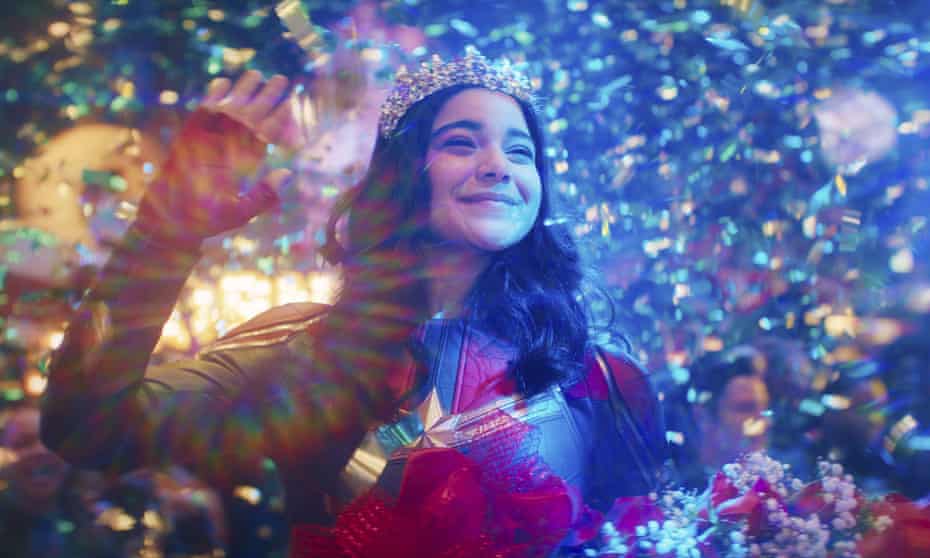
Superpowered … Iman Vellani as Kamala Khan, AKA Ms Marvel. 
Photograph: AP

Instant stardom awaits the new girl in the Marvel universe. She’s funny, charming and effortlessly bats off preconceptions in this joyful coming-of-age tale. Let the geek girls inherit the Earth!


Lucy Mangan
THE GUARDIAN
Wed 8 Jun 2022 

A superhero – and a star – is born in Ms Marvel (Disney+) , the latest small-screen foray into the MCU. The superhero is Pakistani-American teenager Kamala Khan, Marvel’s first Muslim headliner, whose solo comic book series made its debut in 2014. The miniseries tells her origin story, deviating somewhat from the source material and somehow humanising it further.

The star is Iman Vellani, in – incredibly, given her charisma, comic timing and dramatic chops in every scene – her first acting role. Her second will be in the next Marvel film outing, The Marvels (I hope you’re clear about us being in a Marvel universe for the duration of this piece), a sequel to Captain Marvel and focusing on the adventures of Carole Danvers/Captain Marvel and our Ms. Normally, you would fear for a young actor, but Vellani seems so born to the purple that you almost have to shrug and say, as an elder might to a nascent superhero in – oh, I don’t know, the MCU perhaps – that it is her destiny.

The series itself? Only two episodes have been released for review, but they are glorious. The plot so far is slight. At the moment it is as much a real-life coming of age as a superhero origin story. Sixteen-year-old Kamala is an artist, vlogger and diehard devotee of the Avengers generally, and Captain Marvel specifically. We meet her enthusiastically narrating her latest animated story about them.

Most of the first episode features her trying to persuade her parents to let her go to the Avengers comic convention a bus ride away, refine her Ms Marvel costume and placate the school principal when she is hauled into his office for her constant “doodling” and daydreaming. Although it will probably get swallowed up in the deeper joy and wider significance of seeing a Muslim character come to life, I just want to note how absolutely wonderful it is to see an accurate, loving and untrammelled depiction of passionate female fandom, so often derided or ignored while boy geeks get to inherit the world.

Eventually, and with the help of her best friend, Bruno, (Matt Lintz) – who is also, handily, a tech genius – Cinderella gets to the cosplay ball. When she adds an old family bangle to her costume at the last minute, she becomes invested with the ability to shoot energy beams that take on sort-of-solid form and allow her to step on to platforms she can make ahead of herself in the air, as an alternative to flight or superspeed.

The bangle allows her powers to be tied to Kamala’s Pakistani heritage and the trauma of Partition in particular. It belonged to her great-grandmother, one of the many who went missing during that time and who appears to be backchannelling towards Kamala through her powers.

There’s a nice twist by the end of the second episode that promises a satisfying development of this element, but it is the domestic scenes and familial relationships that are the greatest strength of the opening instalments. Kamala’s culture and religion are depicted unapologetically and unfussily, in big ways (we see her and her friend Nakia, played by Yasmeen Fletcher, at prayer in the mosque – and complaining about the state of the women’s side compared with the men’s) and small (Kamala was scared of the Djinn in the dark when young, not ghosts).

Some might see Kamala’s efforts to escape her family’s strictures as another unwanted/unwarranted portrayal of Islam’s repressive attitudes towards women, but I suspect that to most it will come across as Bisha K Ali, the series’ creator and head writer, surely intended – a simple acknowledgment that parents of all creeds and colours gonna parent and provide grist to any teen angst mill.

The Khans are an ordinary family – although mother Muneeba (Zenobia Shroff) has a gift for deadpan sarcasm many might long to have in their own parental arsenal – that exist in the bickering, teasing, loving, forgiving round, not as a bolt-on in the service of some mad notion of 2022 “wokeness”, whatever some are doubtless already limbering up to claim.

The whole thing is full of charm (love the graffiti that animates as Kamala and her ever-active imagination walk past), wit, warmth, brio and truth. It’s just – yes, I’m afraid I’m going to – it’s just Marvel-ous.

Ms Marvel, review: Marvel's first Muslim superhero breaks barriers, if not the mould

Marianka Swain 
TELEGRAPH
Wed 8 Jun 2022

“It’s not really the brown girls from Jersey City who save the world.” So laments Kamala Khan, the Pakistani-American teenage lead of Marvel’s latest Disney+ series – until, of course, she too becomes a superhero. It’s one of many achingly self-referential lines in this likeable but overly meta paean to diverse fandom.

© Disney+ Iman Vellani as Kamala Khan/Ms Marvel - Disney+

Khan, aka Ms Marvel, was the first Muslim character to headline a Marvel comic book, though she’s made in a familiar mould. She’s an overlooked outsider who grapples with adolescent problems alongside battling evil – and figuring out who she really is. Think John Hughes with superpowers.

Where those comics, and this TV adaptation by British comedian Bisha K Ali, differ is that they are steeped in the Muslim immigrant experience. High school student Khan debates Bollywood movies, attends mosque and Eid celebrations (where she labels the different cliques, Mean Girls-style), and struggles to reconcile her parents’ expectations with her passion for caped crusaders.

Yet those latter two handily combine: when she adds her grandmother’s traditional bangles to her Captain Marvel costume, Khan is suddenly able to manipulate cosmic energy. It’s all connected to a trauma from her family’s past, during the Partition of India – a clever way of anchoring the MacGuffin to their specific, and affecting, heritage.

That’s a significant change from the source material, in which Khan could shape-shift and “embiggen” her body. Instead, she shoots out blueish-purple light that hardens into solid blocks, allowing her to create mini-platforms in mid-air to jump upon. Occasionally different body parts light up: she has to make a fast exit from class when her nose starts to glow.

The SFX is decent in these opening two episodes, and this version of her abilities offers promising versatility action-wise, plus it connects Khan to her similarly energy-harnessing idol. In fact, Captain Marvel (played on the big screen by Brie Larson) began life as Ms Marvel, and the pair will join forces in the 2023 blockbuster sequel The Marvels.
© Provided by The Telegraph (L-R): Mohan Kapur as Yusuf, Vellani as Kamala, Saagar Shaikh as Aamir, and Nimra Bucha as Najma - Disney+

I apologise – it’s impossible to avoid using the “M” word. And that’s the downside here. Since Khan is a superfan of the super-crew (just like Kate Bishop in Hawkeye), the entertainment juggernaut can use this as a six-episode commercial for other Marvel properties, while enticing a new generation of ticket-buyers via its young-audience-skewing hi-jinks.

Khan longs to attend AvengerCon, a fictional fan convention which, Marvel Studios president Kevin Feige recently suggested, might actually become a reality. Spider-Man star Tom Holland even popped over to the AvengerCon set to worship at the altar of Marvel. Surely that’s the ultimate ouroboros? It also muddles the identity of a show which is, ironically, about believing in yourself.

Thankfully, luminous newcomer Vellani transcends this brand synergy. She makes Khan a warm, funny, awkward, brilliantly relatable heroine who faces bullies, slurps slushies and frets about college applications – and the future generally. It’s an endearing coming-of-age portrait, where change is both scary and thrilling.


This dreamer is inspired by legendary heroes and expresses herself through art, and the show follows suit with delightfully jaunty visual flourishes. Like Netflix’s Heartstopper, the live action is peppered with colourful animation – so sketches pop up on the sides of buildings, Khan’s crush, Kamran, is surrounded by little flames, and text messages appear in the stars on her bedroom ceiling. Imagination fuels her new powers too: she describes them as feeling like “an idea come to life.”

An eclectic soundtrack reflects this cultural fusion, bouncing from The Weeknd’s Blinding Light to Pakistani pop song Ko Ko Korina. However, there’s also some blunt commentary, particularly from Khan’s friend, Nakia, who monologues on her hijab-wearing and, fed up with their school syllabus, complains that history is “written by the oppressors.” It’s also frustrating that Islam is, on the whole, portrayed as repressive and in conflict with contemporary Western values – an oft-told and narrow story.

Still, after Ewan McGregor was forced to defend his Obi-Wan Kenobi castmate Moses Ingram from racist attacks last week – sadly an ongoing problem in Star Wars and many other fandoms – it’s heartening to see Marvel put its might behind this much-needed representation. Even if it’s a cynical move to keep expanding the MCU fandom, at least this charming series welcomes everyone in.


Ms Marvel is on Disney+ now


OUT OF AFRICA
Monkeypox outbreak tops 1,000 cases, WHO warns of 'real' risk

AFP
Wed, June 8, 2022


The risk of monkeypox becoming established in non-endemic nations is real, the WHO warned Wednesday, with more than a thousand cases now confirmed in such countries.

World Health Organization chief Tedros Adhanom Ghebreyesus said the UN health agency was not recommending mass vaccination against the virus, and added that no deaths had been reported so far from the outbreaks.

"The risk of monkeypox becoming established in non-endemic countries is real," Tedros told a press conference.

The zoonotic disease is endemic in humans in nine African countries but outbreaks have been reported in the past month in several other states -- mostly in Europe, and notably in Britain, Spain and Portugal.

"More than 1,000 confirmed cases of monkeypox have now been reported to WHO from 29 countries that are not endemic for the disease," Tedros said.

"So far, no deaths have been reported in these countries. Cases have been reported mainly, but not only, among men who have sex with men.

"Some countries are now beginning to report cases of apparent community transmission, including some cases in women."

The initial symptoms include a high fever, swollen lymph nodes and a blistery chickenpox-like rash.

Tedros said he was particularly concerned about the risk the virus poses to vulnerable groups, including pregnant women and children.

He said the sudden and unexpected appearance of monkeypox outside endemic countries suggested that there might have been undetected transmission for some time, but it was not known for how long.

One case of monkeypox in a non-endemic country is considered an outbreak.

Tedros said that while this was "clearly concerning", the virus had been circulating and killing in Africa for decades, with more than 1,400 suspected cases and 66 deaths so far this year.

"The communities that live with the threat of this virus every day deserve the same concern, the same care and the same access to tools to protect themselves," he said.
- Vaccines -

In the few places where vaccines are available, they are being used to protect those who may be exposed, such as healthcare workers.

He added that post-exposure vaccination, ideally within four days, could be considered for higher-risk close contacts, such as sexual partners or household members.

Tedros said the WHO would issue guidance in the coming days on clinical care, infection prevention and control, vaccination and community protection.

He said people with symptoms should isolate at home and consult a health worker, while people in the same household should avoid close contact.

Few hospitalisations have been reported, apart from patients being isolated, the WHO said at the weekend.

Sylvie Briand, the WHO's epidemic and pandemic preparedness and prevention director, said the smallpox vaccine could be used against monkeypox, a fellow orthopoxvirus, with a high degree of efficacy.

The WHO is trying to determine how many doses are currently available and to find out from manufacturers what their production and distribution capacities are.

rjm/nl/kjm
Scientists use food puzzles to show how otters learn from each other

Experts hope study can help with reintroducing captive otters into wild to aid conservation efforts

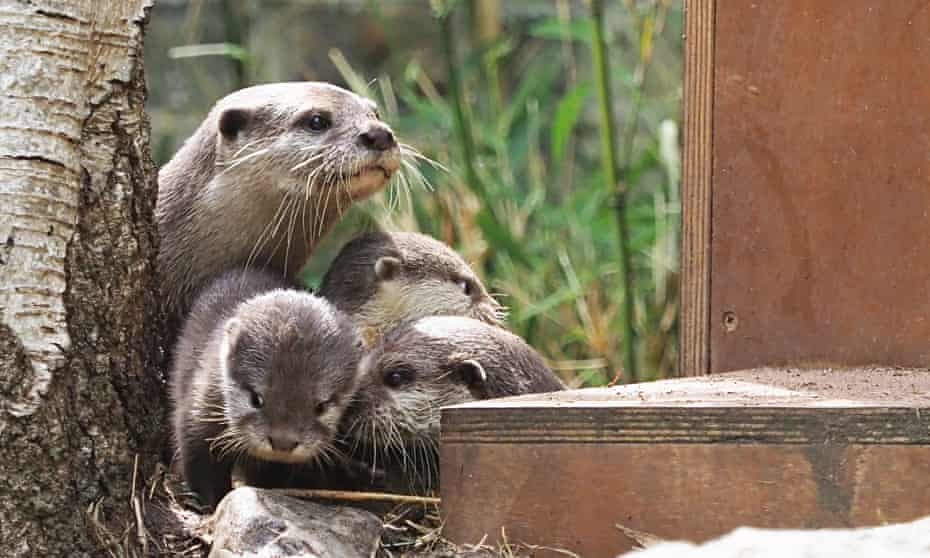
Asian short-clawed otter and pups. Photograph: ZSL/PA

Helena Horton 
Environment reporter
THE GUARDIAN
Wed 8 Jun 2022 

Otters are able to learn from each other – but still prefer to solve some puzzles on their own, scientists have found.

The semi-aquatic mammals are known to be very social and intelligent creatures, but a study by the University of Exeter has given new insight into their intellect.

Researchers gave otters “puzzle boxes”, some of which contained familiar food, while others held unfamiliar natural prey – shore crab and blue mussels, which are protected by hard outer shells.

For the familiar food – meatballs, a favourite with the Asian short-clawed otters in the study – the scientists had five different types of boxes, and the method to extract the food changed in each version, for example pulling a tab or opening a flap.

The unfamiliar food presented additional problems because the otters did not know if the crab and mussels were safe to eat and had no experience of getting them out of their shells.

In order to decide whether food was safe and desirable to eat, the otters, which live at Newquay zoo and the Tamar Otter and Wildlife Centre, watched intently as their companions inspected what was in the boxes and copied if the other otters sampled the treats.

However, they spent more time trying to figure out how to remove the meat from the shells on their own and relied less on the actions of their companions. Of the 20 otters in the study, 11 managed to extract the meat from all three types of natural prey.

“Much of the research into the extractive foraging and learning capabilities of otters has focused on artificial food puzzles,” said the lead author, Alex Saliveros, of the Centre for Ecology and Conservation on Exeter’s Penryn campus in Cornwall.

“Here, we were interested in investigating such skills in the context of unfamiliar natural prey, as well as in relation to artificial food puzzles.”

Before the test, the team studied the otters’ social groups, meaning they knew how well they knew each other. They then measured social learning by seeing whether close associates learned quickly from one another.

Other animals employ social learning to decide what is safe to eat; rats, for example, prefer novel food types that they have smelled on the breath of other rats.

Scientists hope that understanding how otters cope with unfamiliar foraged food in their natural environment can help them train the animals to survive in the wild, if captive-bred otters are to be released to help with conservation programmes.

“The captive otters in this study initially struggled with natural prey, but they showed they can learn how to extract the food,” said Saliveros. “Our findings suggest that if you give one otter pre-release training, it can pass some of that information on to others.”