REST IN POWER
‘She is dancing among the greats’: the dangerously honest, richly ambiguous Paula Rego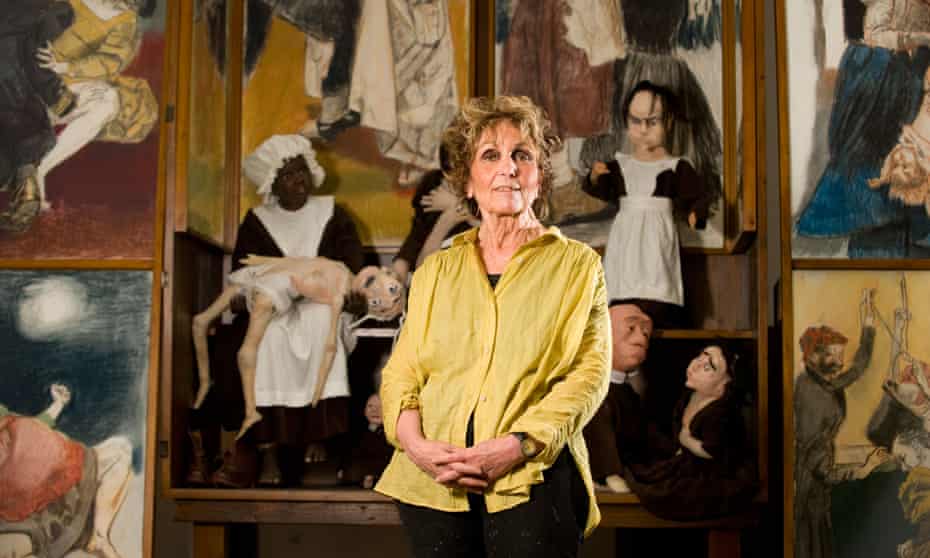
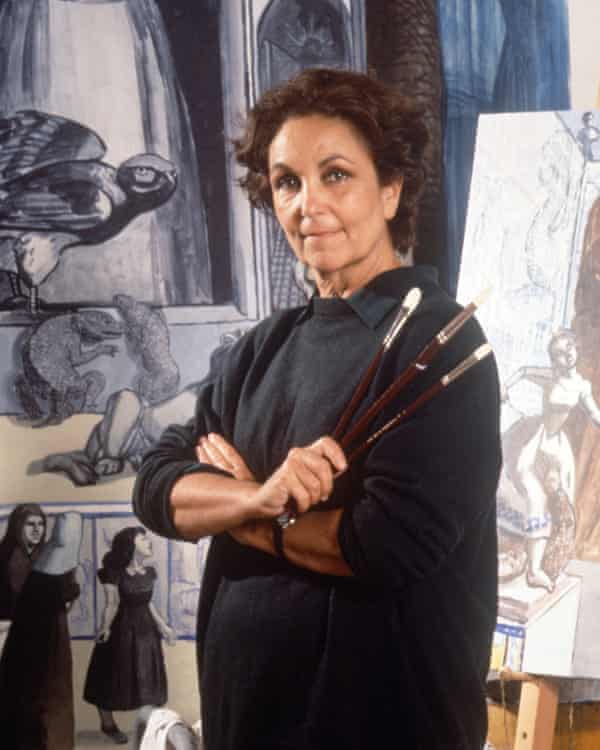
Paula Rego, pictured in her London studio in 2009. Photograph: Shutterstock
Art’s great storyteller has died at the age of 87. Our critic celebrates a woman of courage and freakish imagination
Jonathan Jones
Art’s great storyteller has died at the age of 87. Our critic celebrates a woman of courage and freakish imagination
Jonathan Jones
Wed 8 Jun 2022
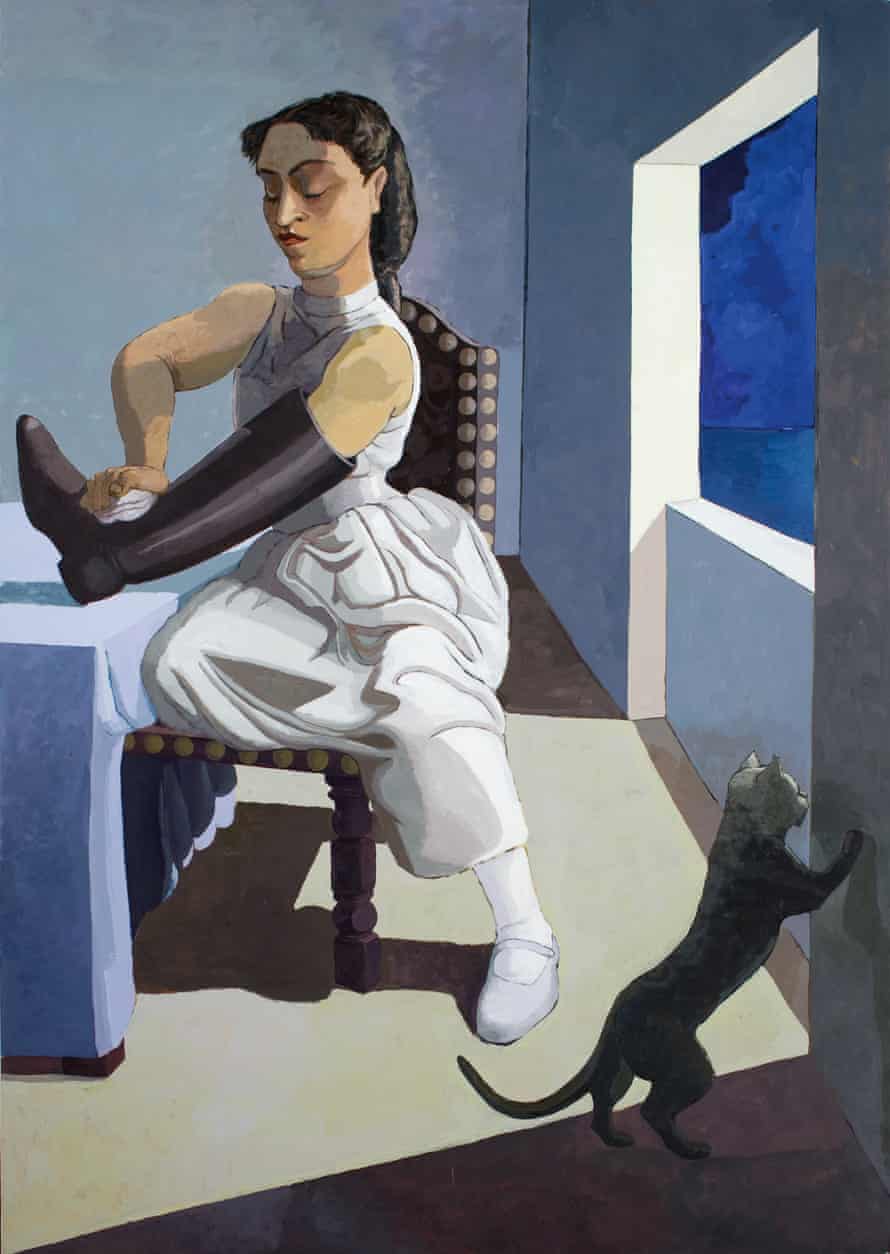
The wickedness of Paula Rego’s imagination shines like patent leather in her 1987 painting The Policeman’s Daughter. A young woman is polishing, as the title tells us, her father’s jackboot. He is nowhere to be seen, but the spectre of a man we take to be an authoritarian bully haunts the fetish object that is his boot. His daughter has her arm sunk into it, right down to the sole, as if she is being swallowed, or willingly immersing herself in a dubious sensual communion with an image of brutality. It is a painting of compromise, corruption and the squalor of power.
Rego refused to waste her life like this woman, lost in the dusty perversions of an authoritarian regime, or in the more polite claustrophobia of the English middle-class family.
Born in Portugal in 1935, she was encouraged by her parents to escape António de Oliveira Salazar’s dictatorship by going to finishing school in Britain. She went on to study fine art at the Slade in the 1950s and started a relationship there with the Egyptian-born artist Victor Willing, whom she married. British figurative painting was in a golden age. Artists as diverse as Michael Andrews, Frank Auerbach and David Hockney were interpreting the fragile, mortal stuff of human bodies and faces in daring, radical, enduring ways. Rego was to add a completely different and original dimension to this “school of London”, as some called it, by mixing a pummelling, unforgiving yet erotic eye for the physical with storytelling that was bigger, more free and more cinematic than her British realist contemporaries. And she has a distinct perspective on the games of power she paints: she is the daughter, not the policeman.
The wickedness of Paula Rego’s imagination shines like patent leather in her 1987 painting The Policeman’s Daughter. A young woman is polishing, as the title tells us, her father’s jackboot. He is nowhere to be seen, but the spectre of a man we take to be an authoritarian bully haunts the fetish object that is his boot. His daughter has her arm sunk into it, right down to the sole, as if she is being swallowed, or willingly immersing herself in a dubious sensual communion with an image of brutality. It is a painting of compromise, corruption and the squalor of power.
Rego refused to waste her life like this woman, lost in the dusty perversions of an authoritarian regime, or in the more polite claustrophobia of the English middle-class family.
Born in Portugal in 1935, she was encouraged by her parents to escape António de Oliveira Salazar’s dictatorship by going to finishing school in Britain. She went on to study fine art at the Slade in the 1950s and started a relationship there with the Egyptian-born artist Victor Willing, whom she married. British figurative painting was in a golden age. Artists as diverse as Michael Andrews, Frank Auerbach and David Hockney were interpreting the fragile, mortal stuff of human bodies and faces in daring, radical, enduring ways. Rego was to add a completely different and original dimension to this “school of London”, as some called it, by mixing a pummelling, unforgiving yet erotic eye for the physical with storytelling that was bigger, more free and more cinematic than her British realist contemporaries. And she has a distinct perspective on the games of power she paints: she is the daughter, not the policeman.
The Policeman’s Daughter, 1987.
Photograph: _/Courtesy the artist and Victoria Miro
By the time Rego painted mature masterpieces such as The Policeman’s Daughter, Salazar was dead. It is not a realist depiction of the Portugal of her childhood, although Rego had kept a foot in her homeland, living between the two countries for many years. The Policeman’s Daughter looks to me like a surrealist film that has been turned into a painting. It also has a lot in common with the magic realist fiction of the late 20th century, from Gabriel García Márquez’s Autumn of the Patriarch to Angela Carter’s The Bloody Chamber.
Rego is a magic realist to the letter, mixing fact and fantasy, a connoisseur of fairytales. The cat in The Policeman’s Daughter seems to know something we don’t. In other paintings and prints Rego gives forceful life to classic stories, often with very harsh twists: in her 1995 painting Snow White and her Stepmother, a gawky, inelegant adolescent has her knickers forcefully pulled down by her stiletto-wearing custodian to check if she is a virgin who can be married to a prince.
By the time Rego painted mature masterpieces such as The Policeman’s Daughter, Salazar was dead. It is not a realist depiction of the Portugal of her childhood, although Rego had kept a foot in her homeland, living between the two countries for many years. The Policeman’s Daughter looks to me like a surrealist film that has been turned into a painting. It also has a lot in common with the magic realist fiction of the late 20th century, from Gabriel García Márquez’s Autumn of the Patriarch to Angela Carter’s The Bloody Chamber.
Rego is a magic realist to the letter, mixing fact and fantasy, a connoisseur of fairytales. The cat in The Policeman’s Daughter seems to know something we don’t. In other paintings and prints Rego gives forceful life to classic stories, often with very harsh twists: in her 1995 painting Snow White and her Stepmother, a gawky, inelegant adolescent has her knickers forcefully pulled down by her stiletto-wearing custodian to check if she is a virgin who can be married to a prince.
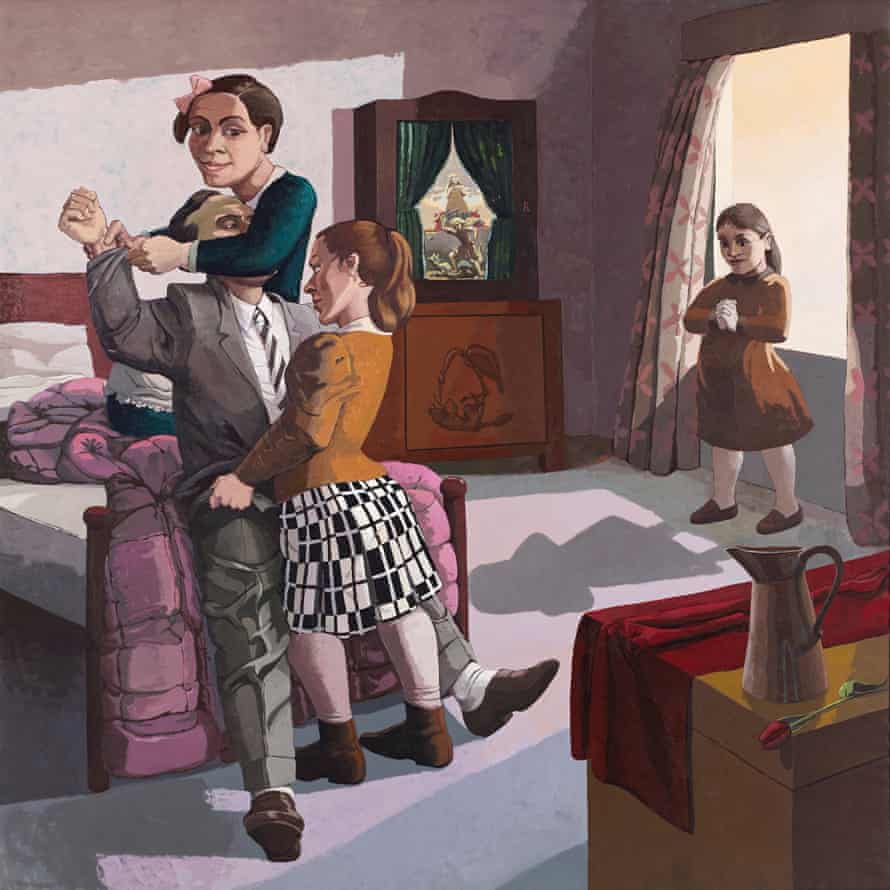
The Family, 1988. Photograph: © Paula Rego
We are in a Neverland of time and place, somewhere between the present day, the repressive Portugal into which Rego was born and pure imagination. A world, anyway, where stepmothers scrutinise the sexuality of stepdaughters. And that strangeness seemed to surround Rego wherever she was, even in the most intimate moments of her own life. The first time I stood, stunned, before her 1988 painting The Family, I thought I was seeing a long overdue feminist revenge. The man of the family flops helplessly in the hands of his wife and daughter, who may be either dressing him or undressing him. The girl manhandles the creases in his trousers while his wife looks away dreamily, doing her cruel work absentmindedly. Because she does it every day.
I had no idea then of Rego’s personal history. In the year this and other powerfully timeless paintings of sex and power were first shown at the Serpentine Gallery, her husband, Willing, died after being ill for years with multiple sclerosis. So there is a reason the man in The Family appears so helpless: far from assailing him in a righteous gender rebellion, the Rego figure and her daughters are dressing someone with MS.
But of course, that doesn’t settle it. The sense of rage is real. It is the honestly confessed frustration of a woman who finds herself the helper of a paralysed husband. A straightforward portrayal of patriarchy under attack would be so much easier to explain. But like her peers, Lucian Freud and Francis Bacon, Rego is obsessively and dangerously honest. Her feminism comes with a true artist’s courage to show what shouldn’t be shown. She shares, in The Family, the complex and for most people unutterable feelings you may have in this awful situation. We know what the wife is thinking as her eyes drift off. She is thinking, despite herself: when will this be over?
I don’t think such a brave and searching artist can be summed up, as she was by some fans in her last years, including the curators of her 2021 Tate retrospective, as a political warrior pure and simple. That would make her a much narrower artist than she is. And before she is anything else, she is a painter who mixed the British eye for sharp reality with a sense of fantasy and theatre that reflects her Catholic heritage. She has a raw appetite for the human body, muscled and powerful (I am speaking of the women), that has much in common with Freud. But unlike him, she loves a good story. She is a narrative artist or “history painter” in the tradition of Hogarth and Goya.
In her 1999 painting The Betrothal, she reworks Hogarth’s Marriage à la Mode in her own uneasily timeless setting, which seems to be simultaneously north London and Portugal, where a woman with a massive shiny hairstyle, a resting dog, a hair salon and the deposition of Christ are among the normal and abnormal things all strangely juxtaposed. One of the questions that fascinate Rego as a painter is how a picture tells a story, how it differs from a film or novel. In a painting you can see a sequence of events all at the same time, by glancing through the panels of a series or maybe seeing them all compressed in one canvas. Cinema cannot do that, or a novel, or video art. But a painting can abolish time, or turn it into a multi-directional flow, or just leave a tale unfinished. This is why Rego’s storytelling is so ambiguous and rich.
We are in a Neverland of time and place, somewhere between the present day, the repressive Portugal into which Rego was born and pure imagination. A world, anyway, where stepmothers scrutinise the sexuality of stepdaughters. And that strangeness seemed to surround Rego wherever she was, even in the most intimate moments of her own life. The first time I stood, stunned, before her 1988 painting The Family, I thought I was seeing a long overdue feminist revenge. The man of the family flops helplessly in the hands of his wife and daughter, who may be either dressing him or undressing him. The girl manhandles the creases in his trousers while his wife looks away dreamily, doing her cruel work absentmindedly. Because she does it every day.
I had no idea then of Rego’s personal history. In the year this and other powerfully timeless paintings of sex and power were first shown at the Serpentine Gallery, her husband, Willing, died after being ill for years with multiple sclerosis. So there is a reason the man in The Family appears so helpless: far from assailing him in a righteous gender rebellion, the Rego figure and her daughters are dressing someone with MS.
But of course, that doesn’t settle it. The sense of rage is real. It is the honestly confessed frustration of a woman who finds herself the helper of a paralysed husband. A straightforward portrayal of patriarchy under attack would be so much easier to explain. But like her peers, Lucian Freud and Francis Bacon, Rego is obsessively and dangerously honest. Her feminism comes with a true artist’s courage to show what shouldn’t be shown. She shares, in The Family, the complex and for most people unutterable feelings you may have in this awful situation. We know what the wife is thinking as her eyes drift off. She is thinking, despite herself: when will this be over?
I don’t think such a brave and searching artist can be summed up, as she was by some fans in her last years, including the curators of her 2021 Tate retrospective, as a political warrior pure and simple. That would make her a much narrower artist than she is. And before she is anything else, she is a painter who mixed the British eye for sharp reality with a sense of fantasy and theatre that reflects her Catholic heritage. She has a raw appetite for the human body, muscled and powerful (I am speaking of the women), that has much in common with Freud. But unlike him, she loves a good story. She is a narrative artist or “history painter” in the tradition of Hogarth and Goya.
In her 1999 painting The Betrothal, she reworks Hogarth’s Marriage à la Mode in her own uneasily timeless setting, which seems to be simultaneously north London and Portugal, where a woman with a massive shiny hairstyle, a resting dog, a hair salon and the deposition of Christ are among the normal and abnormal things all strangely juxtaposed. One of the questions that fascinate Rego as a painter is how a picture tells a story, how it differs from a film or novel. In a painting you can see a sequence of events all at the same time, by glancing through the panels of a series or maybe seeing them all compressed in one canvas. Cinema cannot do that, or a novel, or video art. But a painting can abolish time, or turn it into a multi-directional flow, or just leave a tale unfinished. This is why Rego’s storytelling is so ambiguous and rich.
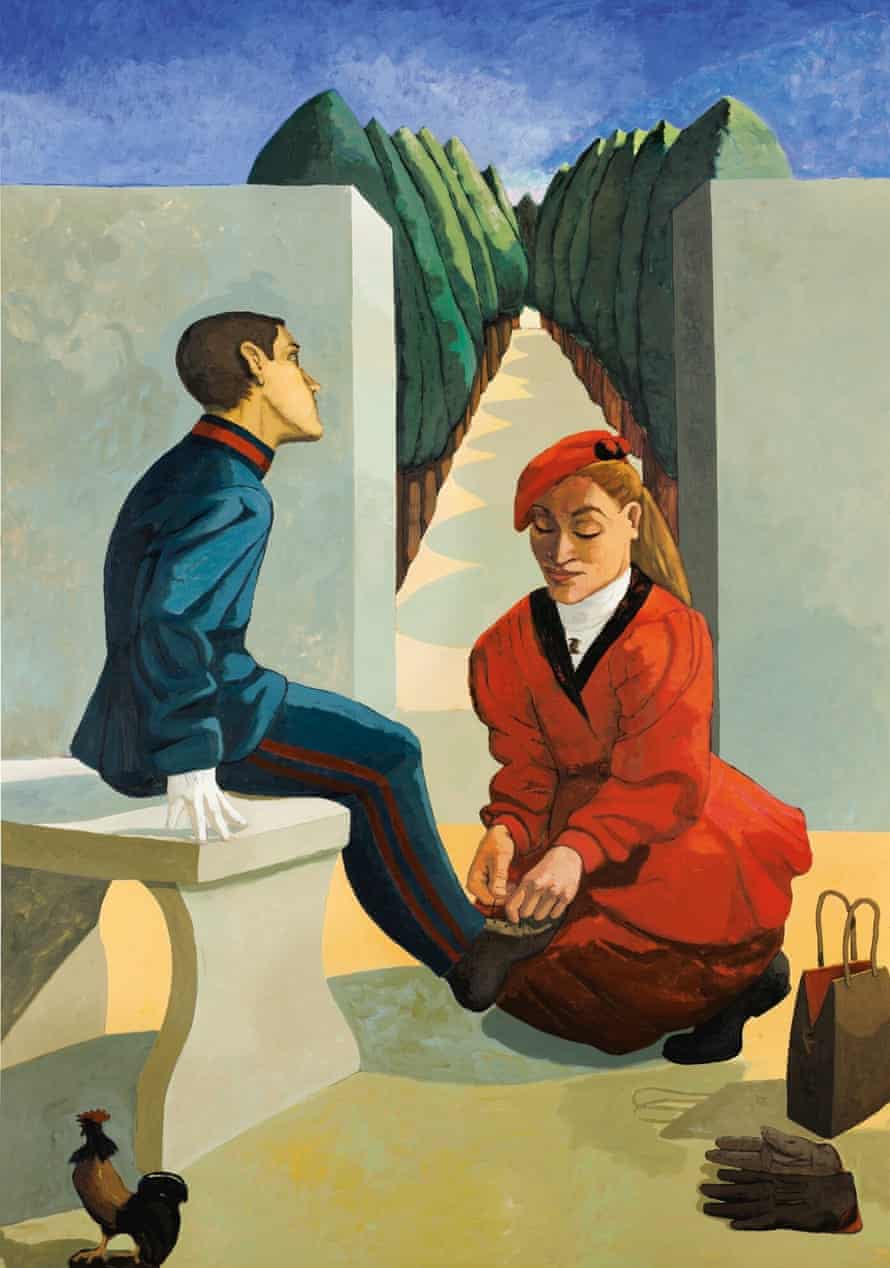
The Cadet and His Sister, 1988.
Photograph: © Paula Rego
The freakishness of her imagination had no limits. Her style may match Freud’s but she had read a lot more of his grandfather Sigmund. The Cadet and his Sister (1988) is another grand monument to the unjust and the perverse. In a park straight out of the cold surreal scenes of Giorgio de Chirico, a young woman kneels to do up her brother’s shoe. The severity of his uniform is matched by the repressed formality of her clothes and the kinky objects beside her: a cathedral-shaped handbag and gloves. This is a Freudian nightmare in which repressed emotions flow in the most perverse channels imaginable. Is Rego angry? Or is she amused by the antics of human sexuality? It makes Alfred Hitchcock’s Marnie seem conventional.
When Rego painted her tragicomic, unsettling histories of power and violence in the 1980s, there was a vogue for big, bold paintings. But that vanished overnight. The cool way to tell stories in art became photography or video. Rego was in the wrong place at the wrong time: London was sold in the 1990s on the slightly naive belief that painting, which had lasted since the stone age, was suddenly “dead”.
The freakishness of her imagination had no limits. Her style may match Freud’s but she had read a lot more of his grandfather Sigmund. The Cadet and his Sister (1988) is another grand monument to the unjust and the perverse. In a park straight out of the cold surreal scenes of Giorgio de Chirico, a young woman kneels to do up her brother’s shoe. The severity of his uniform is matched by the repressed formality of her clothes and the kinky objects beside her: a cathedral-shaped handbag and gloves. This is a Freudian nightmare in which repressed emotions flow in the most perverse channels imaginable. Is Rego angry? Or is she amused by the antics of human sexuality? It makes Alfred Hitchcock’s Marnie seem conventional.
When Rego painted her tragicomic, unsettling histories of power and violence in the 1980s, there was a vogue for big, bold paintings. But that vanished overnight. The cool way to tell stories in art became photography or video. Rego was in the wrong place at the wrong time: London was sold in the 1990s on the slightly naive belief that painting, which had lasted since the stone age, was suddenly “dead”.
Dog Woman, 1994.
Photograph: Courtesy the artist and Victoria Miro
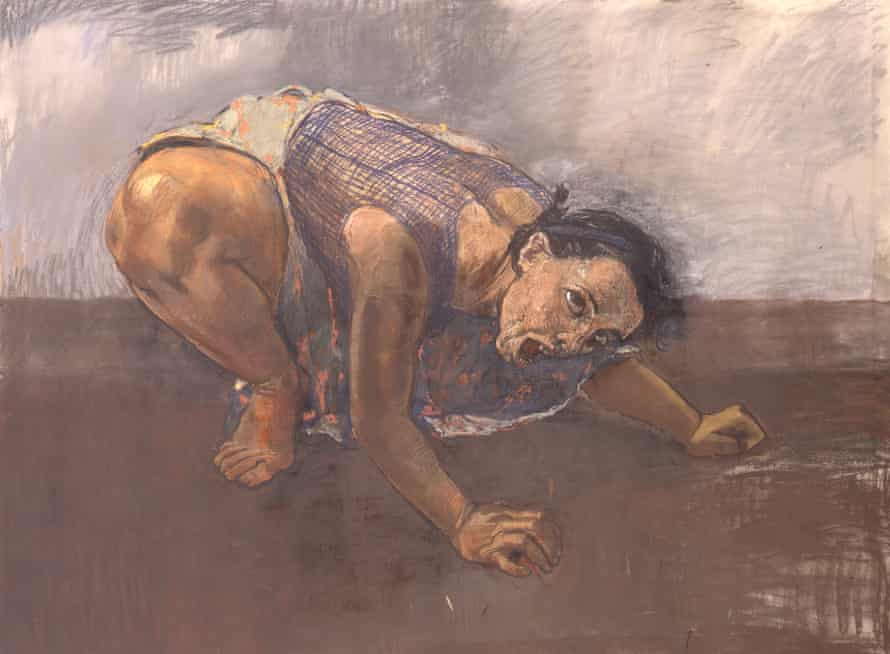
Rego drifted out of the mainstream, but perhaps she always belonged in a musty, mysterious world of her own between past and present. Her later works have a caustic power. Taking up the medium of pastels, the oil crayons previously used by Degas, she depicted her enigmatic scenarios more intensely and sensually than ever. In her 1994 picture Dog Woman, a woman has been made to go down on all fours. She scrunches her face, as if barking. Who forced her to do this? It may be a policeman in a fascist regime. Or it may just be a man demanding sadomasochist thrills.
It is an image of oppression but also an artistic exploration of the body as a vehicle of emotion. This and the other mighty pastels in the same series all feature models adopting extreme, expressive poses. This is not a crude scream of a picture. It is a master’s exploration of the nude that consciously echoes the suffering bodies of Michelangelo’s prisoners or the classical Niobids. Does that seem a stretch? Rego was deeply aware of the history of art: one of her ambitious paintings is the mural she created in the National Gallery in 1990, full of erudite jokes on paintings in its collection. Her politics is always poetic, her art always literate.
Rego will, above all, be remembered as a brave artist. Even now, I sense there is a background of private stories, suffering and, yes, jokes in her art that we have yet to digest and understand. There is surely a great biography to be written. There is plenty of material to tease out. Knowing more of the relationships between her childhood and emigration, marriage and love life will change how we see her enigmatic art.
For now she is in her own painted world, somewhere in the Bay of Biscay, between cultures and times in an anachronistic magic reality. In her 1988 painting The Dance, people dressed in 1950s suits and folk skirts dance by moonlight on her beach. The faces include her husband and son. There is a fortress on the skyline but no soldiers are coming: the dancers are safe for now, in their formal, stately gentleness. No one is being tortured. No one is dying. This is where Rego must be dancing now, among the greats.
Rego drifted out of the mainstream, but perhaps she always belonged in a musty, mysterious world of her own between past and present. Her later works have a caustic power. Taking up the medium of pastels, the oil crayons previously used by Degas, she depicted her enigmatic scenarios more intensely and sensually than ever. In her 1994 picture Dog Woman, a woman has been made to go down on all fours. She scrunches her face, as if barking. Who forced her to do this? It may be a policeman in a fascist regime. Or it may just be a man demanding sadomasochist thrills.
It is an image of oppression but also an artistic exploration of the body as a vehicle of emotion. This and the other mighty pastels in the same series all feature models adopting extreme, expressive poses. This is not a crude scream of a picture. It is a master’s exploration of the nude that consciously echoes the suffering bodies of Michelangelo’s prisoners or the classical Niobids. Does that seem a stretch? Rego was deeply aware of the history of art: one of her ambitious paintings is the mural she created in the National Gallery in 1990, full of erudite jokes on paintings in its collection. Her politics is always poetic, her art always literate.
Rego will, above all, be remembered as a brave artist. Even now, I sense there is a background of private stories, suffering and, yes, jokes in her art that we have yet to digest and understand. There is surely a great biography to be written. There is plenty of material to tease out. Knowing more of the relationships between her childhood and emigration, marriage and love life will change how we see her enigmatic art.
For now she is in her own painted world, somewhere in the Bay of Biscay, between cultures and times in an anachronistic magic reality. In her 1988 painting The Dance, people dressed in 1950s suits and folk skirts dance by moonlight on her beach. The faces include her husband and son. There is a fortress on the skyline but no soldiers are coming: the dancers are safe for now, in their formal, stately gentleness. No one is being tortured. No one is dying. This is where Rego must be dancing now, among the greats.
Dame Paula Rego obituary
Painter whose powerful images of women disrupted the male gaze
Michael McNay
Rego was born in Lisbon under the fascist Salazar dictatorship, which, with Roman Catholicism stirred into the mix, was an unholy brew. Women were expected to be seen and not heard. The Regos were middle class and anglophile.
Paula’s father, José, was an electrical engineer who worked for Marconi; her mother, Maria, ran the home, which had maids and a cook. When Paula was 18 months old her parents moved to London for a year for her father’s work, and she was looked after by her grandparents and an ageing aunt. After her parents’ return, Paula, aged three, was diagnosed with tuberculosis, and the family moved to the seaside town of Estoril, spending summers in the fishing village of Ericeira, for her health.
She attended St Julian’s school, an English foundation in Carcavelos, near Lisbon, then was sent to Britain to a finishing school, the Grove, in Kent. In 1952 she went to the Slade School of Fine Art, London, to study painting.
In 1954, Under Milk Wood was first broadcast on BBC radio, and it became as popular a talking point in offices and pubs as television’s EastEnders might now (which, incidentally, was one of the few things that regularly drew her away from the studio in later years).
The infection spread to the Slade, where the 19-year-old Rego made her own version of the play in oils on canvas. She brilliantly translated Dylan Thomas’s characters from the imaginary Welsh village into a Portuguese idiom of sunbaked peasants. With this painting she came joint first for the Slade summer composition prize. And then, full stop.
While at the Slade, Rego had met Willing, who was married, seven years older than her, and reckoned by many to be the best painter of his generation. In 1956, Rego’s final year at college, she became pregnant and went home to Portugal to have the baby. Willing left his wife, joined Rego in Portugal, and in 1959 they married, and went on to have two more children. He encouraged her to continue drawing to cope with depression, but though she had now developed a powerful line, effectively she disappeared from public view, even though she often visited and kept a studio in Charlotte Street, central London.
In 1966 Willing developed multiple sclerosis and 10 years later the family went back to London permanently. Apart from a couple of shows in Lisbon in the 1970s, Rego dropped out of sight. In 1981, at the age of 46, virtually out of nowhere, she had an eye-opening first London show, at the AIR Gallery, but – paralleling the career of Jackson Pollock’s wife, Lee Krasner, and who knows how many more – not until Willing died in 1988 did she feel fully able to compete in public.
Tate Liverpool hung a Rego retrospective in 1996. Other major national and international shows followed, including two more retrospectives at Tate Britain, in 2004 and 2021. In 2005 she was commissioned by Royal Mail to create a set of postage stamps in celebration of Charlotte Brontë’s Jane Eyre.
Her son, Nick, directed a BBC documentary on his mother, Paula Rego: Secrets and Stories, in 2017. In 2010, she was made a dame, a curiously antique award for such a powerfully feminist artist.
For the last quarter of a century the writer and translator Anthony Rudolf was Rego’s companion and principal male model.
She is survived by her children, Nick, Caroline and Victoria.
Maria Paula Figueiroa Rego, artist, born 26 January 1935; died 8 June 2022
Most of Paula Rego’s late and best work was done in pastel, such as this piece, Love, 1995. Photograph: Courtesy the artist and Victoria Miro
Painter whose powerful images of women disrupted the male gaze
Michael McNay
Wed 8 Jun 2022
The artist Paula Rego, who has died aged 87, once said that she liked “to work on the edge”, and her many series of paintings and drawings, about the subjugation of women, abortion and the marriage market, cut across social perceptions of the role of women, and disrupted the male view of women and their sexuality.
The anger that built up in her years of subjection to the men in her life – even her husband, Victor Willing, who took up years of her life as she nursed him – enabled her to deploy her art as a political weapon. One of her most famous paintings, The Policeman’s Daughter (1987), needs no interpretation: in it, a scowling young woman cleans her father’s jackboot with one hand while she shoves the other arm up inside it.
The anger that built up in her years of subjection to the men in her life – even her husband, Victor Willing, who took up years of her life as she nursed him – enabled her to deploy her art as a political weapon. One of her most famous paintings, The Policeman’s Daughter (1987), needs no interpretation: in it, a scowling young woman cleans her father’s jackboot with one hand while she shoves the other arm up inside it.
Paula Rego in 1987, just six years after her first London show, at the AIR gallery.
Photograph: ITV/Rex/Shutterstock
Rego was remorselessly described as a storyteller, which was true, and which cuts across the thrust of the art of the past century (with the exception of surrealism). She claimed her favourite painting was Max Ernst’s depiction of the Virgin Mary spanking the child Jesus. And it helps to know what she thought she was about (her stories changed with each telling), but no more than it helps looking at certain Titians or Picassos to know the myths in Ovid’s Metamorphoses. The bottom line was the sheer visual power of her work, in painting, in fluently wonderful drawings, and in etching and aquatints, carried by a magnificent technique.
When the post-revolution Portuguese – of which Rego was one – ducked out of legalising abortion by simply not turning out to vote in the referendum, she created a series of paintings that exploded like a powder keg in her home country and in Spain. Her masterpiece in this series is the triptych of 1998 showing sordid back-street abortion parlours in rooms sparsely equipped with a bed and a plastic stacking chair, or an armchair with its cover worn into holes. In one canvas, a woman is curled up in foetal misery; in the second, a woman draws her legs up and braces herself as she grasps her thighs; in the third, a schoolgirl still wearing her blouse and tie draws up her skirt and straddles a plastic bucket as she glares out at the viewer.
A 1995 series of female ballet dancers of almost brutal appearance, utterly subverting the tradition of Pavlova and Sylvie Guillem, is curiously reminiscent of Degas. This is not merely because of the subject, nor because Degas, too, took a backstage view of dancers, though through the keyhole of male fascination rather than Rego’s gutsy and head-on truth-telling; but because by this time Rego too was working in pastel, an urgent medium that combines the swiftness of drawing with the completeness of painting.
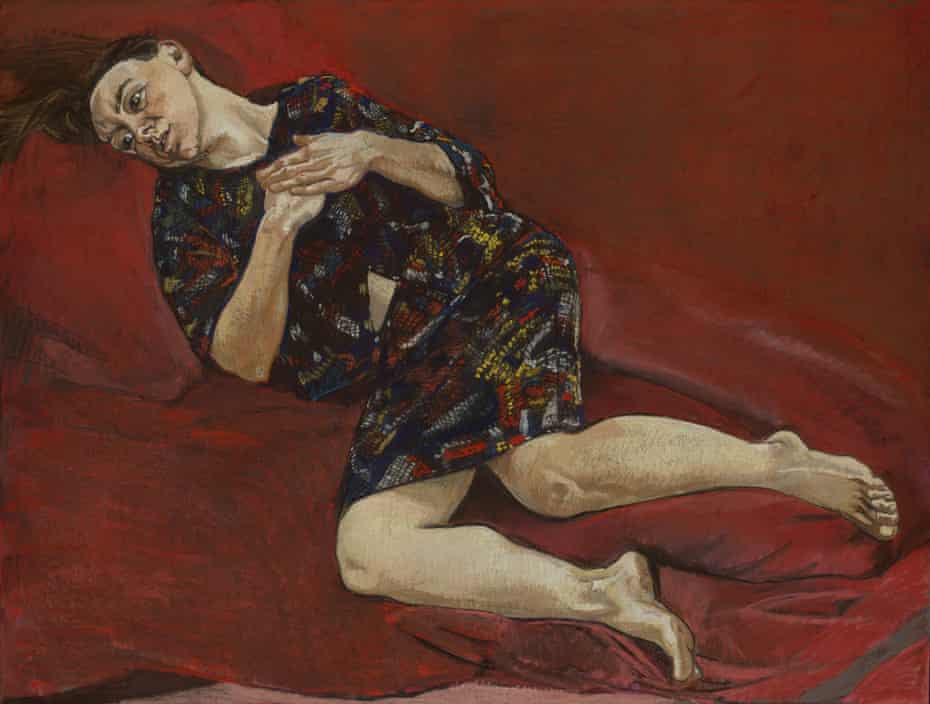
Most of her late and best work was done in pastel, including the Buñuel-esque take on a bride in a white silk dress and veil lying submissively on her back (1994), and the series of the same year of women behaving like dogs, scavenging or ingratiating themselves, cowed but utterly aware of their own sexuality. There is nothing else in art like them.
Rego was remorselessly described as a storyteller, which was true, and which cuts across the thrust of the art of the past century (with the exception of surrealism). She claimed her favourite painting was Max Ernst’s depiction of the Virgin Mary spanking the child Jesus. And it helps to know what she thought she was about (her stories changed with each telling), but no more than it helps looking at certain Titians or Picassos to know the myths in Ovid’s Metamorphoses. The bottom line was the sheer visual power of her work, in painting, in fluently wonderful drawings, and in etching and aquatints, carried by a magnificent technique.
When the post-revolution Portuguese – of which Rego was one – ducked out of legalising abortion by simply not turning out to vote in the referendum, she created a series of paintings that exploded like a powder keg in her home country and in Spain. Her masterpiece in this series is the triptych of 1998 showing sordid back-street abortion parlours in rooms sparsely equipped with a bed and a plastic stacking chair, or an armchair with its cover worn into holes. In one canvas, a woman is curled up in foetal misery; in the second, a woman draws her legs up and braces herself as she grasps her thighs; in the third, a schoolgirl still wearing her blouse and tie draws up her skirt and straddles a plastic bucket as she glares out at the viewer.
A 1995 series of female ballet dancers of almost brutal appearance, utterly subverting the tradition of Pavlova and Sylvie Guillem, is curiously reminiscent of Degas. This is not merely because of the subject, nor because Degas, too, took a backstage view of dancers, though through the keyhole of male fascination rather than Rego’s gutsy and head-on truth-telling; but because by this time Rego too was working in pastel, an urgent medium that combines the swiftness of drawing with the completeness of painting.
Most of her late and best work was done in pastel, including the Buñuel-esque take on a bride in a white silk dress and veil lying submissively on her back (1994), and the series of the same year of women behaving like dogs, scavenging or ingratiating themselves, cowed but utterly aware of their own sexuality. There is nothing else in art like them.
Rego was born in Lisbon under the fascist Salazar dictatorship, which, with Roman Catholicism stirred into the mix, was an unholy brew. Women were expected to be seen and not heard. The Regos were middle class and anglophile.
Paula’s father, José, was an electrical engineer who worked for Marconi; her mother, Maria, ran the home, which had maids and a cook. When Paula was 18 months old her parents moved to London for a year for her father’s work, and she was looked after by her grandparents and an ageing aunt. After her parents’ return, Paula, aged three, was diagnosed with tuberculosis, and the family moved to the seaside town of Estoril, spending summers in the fishing village of Ericeira, for her health.
She attended St Julian’s school, an English foundation in Carcavelos, near Lisbon, then was sent to Britain to a finishing school, the Grove, in Kent. In 1952 she went to the Slade School of Fine Art, London, to study painting.
In 1954, Under Milk Wood was first broadcast on BBC radio, and it became as popular a talking point in offices and pubs as television’s EastEnders might now (which, incidentally, was one of the few things that regularly drew her away from the studio in later years).
The infection spread to the Slade, where the 19-year-old Rego made her own version of the play in oils on canvas. She brilliantly translated Dylan Thomas’s characters from the imaginary Welsh village into a Portuguese idiom of sunbaked peasants. With this painting she came joint first for the Slade summer composition prize. And then, full stop.
While at the Slade, Rego had met Willing, who was married, seven years older than her, and reckoned by many to be the best painter of his generation. In 1956, Rego’s final year at college, she became pregnant and went home to Portugal to have the baby. Willing left his wife, joined Rego in Portugal, and in 1959 they married, and went on to have two more children. He encouraged her to continue drawing to cope with depression, but though she had now developed a powerful line, effectively she disappeared from public view, even though she often visited and kept a studio in Charlotte Street, central London.
In 1966 Willing developed multiple sclerosis and 10 years later the family went back to London permanently. Apart from a couple of shows in Lisbon in the 1970s, Rego dropped out of sight. In 1981, at the age of 46, virtually out of nowhere, she had an eye-opening first London show, at the AIR Gallery, but – paralleling the career of Jackson Pollock’s wife, Lee Krasner, and who knows how many more – not until Willing died in 1988 did she feel fully able to compete in public.
Salazar Vomiting the Homeland, 1960, by Paula Rego.
Photograph: Courtesy the artist and Victoria Miro
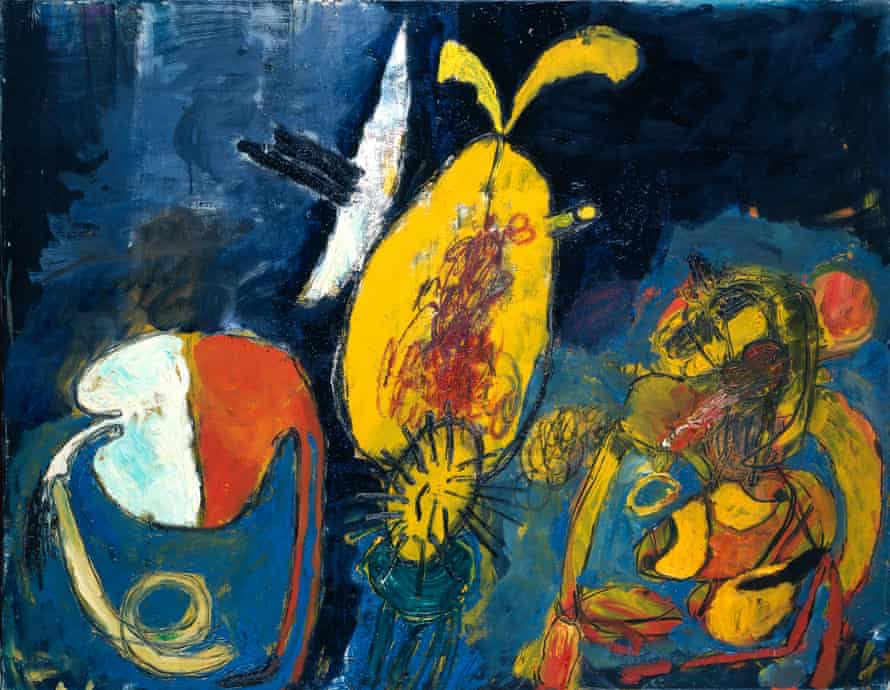
Rego once said that she tried abstraction but was no good at it. On the contrary, her early work, abstract expressionist for want of a better term, was as disruptive as her later figuration: Birth (1959) or Salazar Vomiting the Homeland (1960), which, like most of her paintings of that period, fetched up in Portuguese collections, already had a disconcertingly raw power driven by anger.
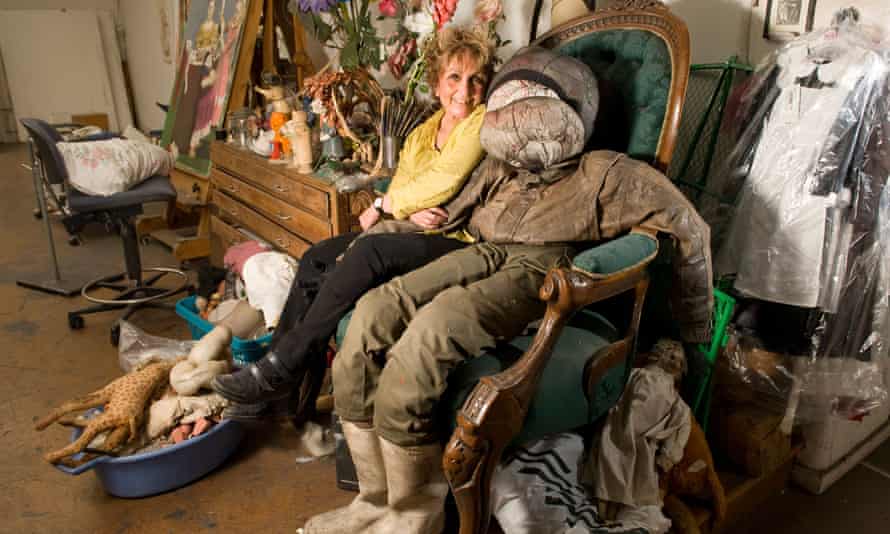
Later, Willing told her that when he was a child his toys were rag dolls of animals from which he made a theatre. She took up this notion and created a theatre of her own, on canvas, of bears and red monkeys, not winsome bedroom teddies, but mutated and vicious human-like creatures: in one painting, the red monkey’s wife cuts his tail off while he vomits. Willing knew what was going on in this symbolism, and encouraged her. He was always her best critic and his writings are still the best authority on her work.
Early in the 90s Rego became the first artist-in-residence at the National Gallery in London, and while there she carried out a commission to paint a huge mural for the restaurant in the Sainsbury wing. She took her title, Crivelli’s Garden, from a portion of the background to a painting by the 15th-century Venetian Carlo Crivelli and, suppressing the acerbic aspect of her work, set down a gathering of female saints, all of whom figured in paintings in the gallery, all of them at humble daily tasks, all survivors, in an affecting homage to womankind.
Rego once said that she tried abstraction but was no good at it. On the contrary, her early work, abstract expressionist for want of a better term, was as disruptive as her later figuration: Birth (1959) or Salazar Vomiting the Homeland (1960), which, like most of her paintings of that period, fetched up in Portuguese collections, already had a disconcertingly raw power driven by anger.
Later, Willing told her that when he was a child his toys were rag dolls of animals from which he made a theatre. She took up this notion and created a theatre of her own, on canvas, of bears and red monkeys, not winsome bedroom teddies, but mutated and vicious human-like creatures: in one painting, the red monkey’s wife cuts his tail off while he vomits. Willing knew what was going on in this symbolism, and encouraged her. He was always her best critic and his writings are still the best authority on her work.
Early in the 90s Rego became the first artist-in-residence at the National Gallery in London, and while there she carried out a commission to paint a huge mural for the restaurant in the Sainsbury wing. She took her title, Crivelli’s Garden, from a portion of the background to a painting by the 15th-century Venetian Carlo Crivelli and, suppressing the acerbic aspect of her work, set down a gathering of female saints, all of whom figured in paintings in the gallery, all of them at humble daily tasks, all survivors, in an affecting homage to womankind.
Paula Rego in her London studio with some of her stuffed ‘mutated and human-like’ creatures. Photograph: Rex/Shutterstock
Tate Liverpool hung a Rego retrospective in 1996. Other major national and international shows followed, including two more retrospectives at Tate Britain, in 2004 and 2021. In 2005 she was commissioned by Royal Mail to create a set of postage stamps in celebration of Charlotte Brontë’s Jane Eyre.
Her son, Nick, directed a BBC documentary on his mother, Paula Rego: Secrets and Stories, in 2017. In 2010, she was made a dame, a curiously antique award for such a powerfully feminist artist.
For the last quarter of a century the writer and translator Anthony Rudolf was Rego’s companion and principal male model.
She is survived by her children, Nick, Caroline and Victoria.
Maria Paula Figueiroa Rego, artist, born 26 January 1935; died 8 June 2022