Sunday, November 20, 2022

The Milky Way's mysterious filaments have 'older, distant cousins'
The Milky Way's mysterious filaments have 'older, distant cousins'
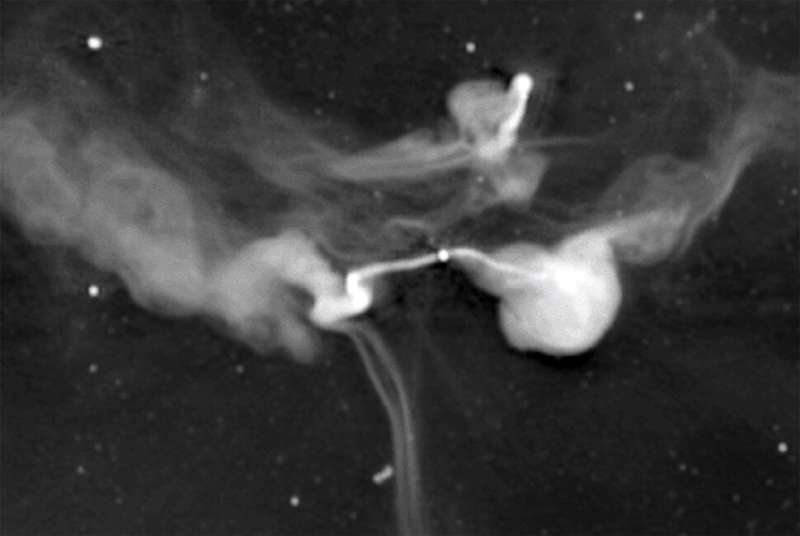
Large-scale magnetic filaments spill downward from a black hole's jet, located in a distant 
cluster galaxy. Credit: Rudnick and collaborators, 2022

Northwestern University astrophysicist Farhad Zadeh has been fascinated and puzzled by a family of large-scale, highly organized magnetic filaments dangling in the center of the Milky Way ever since he first discovered them in the early 1980s.

Now, 40 years later, Zadeh remains just as fascinated—but perhaps slightly less puzzled.

With a new discovery of similar filaments located in other , Zadeh and his collaborators have, for the first time, introduced two possible explanations for the filaments' unknown origins. In a new paper, published earlier this month in The Astrophysical Journal Letters, Zadeh and his co-authors propose the filaments might result from an interaction between large-scale wind and clouds or could arise from turbulence inside a weak magnetic field.

"We know a lot about the filaments in our own Galactic Center, and now filaments in outside galaxies are beginning to show up as a new population of extragalactic filaments," Zadeh said. "The underlying physical mechanisms for both populations of filaments are similar despite the vastly different environments. The objects are part of the same family, but the filaments outside the Milky Way are older, distant cousins—and I mean very distant (in time and space) cousins."

An expert in , Zadeh is a professor of physics and astronomy in Northwestern's Weinberg College of Arts and Sciences and a member of the Center for Interdisciplinary Exploration and Research in Astrophysics (CIERA).

'Something universal is happening'

The first filaments that Zadeh discovered stretched up to 150  long, towering near the Milky Way's central supermassive black hole. Earlier this year, Zadeh added nearly 1,000 more filaments to his collection of observations. In that batch, the one-dimensional filaments appear in pairs and clusters, often stacked equally spaced, side by side like strings on a harp or spilling sideways like individual ripples in a waterfall.

Using observations from , Zadeh discovered the mystifying filaments comprise cosmic ray electrons gyrating along a magnetic field at close to the speed of light. Although he is putting together the puzzle of what the filaments are made of, Zadeh still wondered where they came from. When astronomers discovered a new population outside our own galaxy, it offered new opportunities to investigate the physical processes in the space surrounding the filaments.

The newly discovered filaments reside inside a , a concentrated tangle of thousands of galaxies located one billion light-years from Earth. Some of the galaxies within the cluster are active radio galaxies, which appear to be breeding grounds for the for formation of large-scale magnetic filaments. When Zadeh saw these newly uncovered filaments for the first time, he was amazed.

"After studying filaments in our own Galactic Center for all these years, I was extremely excited to see these tremendously beautiful structures," he said. "Because we found these filaments elsewhere in the universe, it hints that something universal is happening."
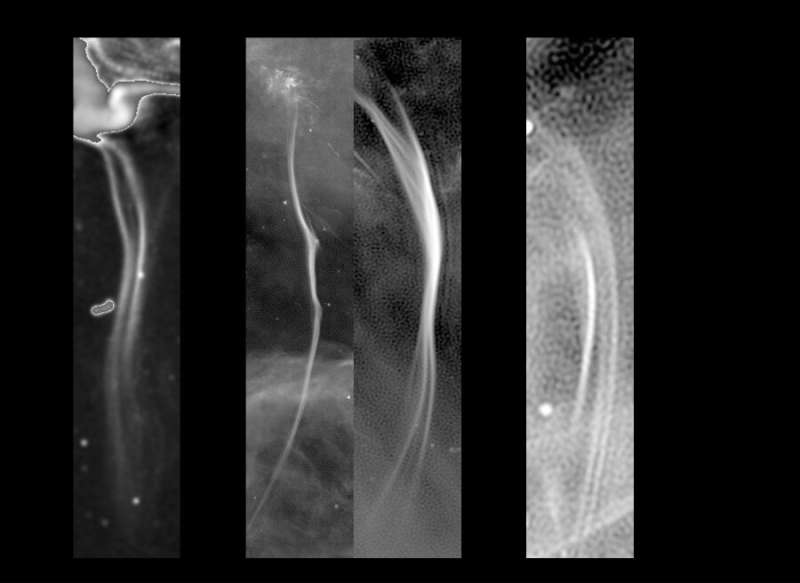

Close-up radio images of the magnetic filaments. The filament at the far left is from an 
outside galaxy. At 100 kiloparsecs in length, it towers over the three other filaments from 
the Milky Way galaxy, which measure 28 parsecs, 12 parsecs and 6 parsecs in length.
 Credit: Rudnick and collaborators, 2022

Galactic giants

Although the new population of filaments looks similar to those in our Milky Way, there are some key differences. The filaments outside the Milky Way, for example, are much bigger—between 100 to 10,000 times longer. They also are much older, and their magnetic fields are weaker. Most of them curiously hang—at a 90-degree angle—from a black hole's jets into the vast nothingness of the intracluster medium, or the space wedged between the galaxies within the cluster.

But the newly discovered population has the same length-to-width ratio as the Milky Way's filaments. And both populations appear to transport energy through the same mechanisms. Closer to the jet, the filaments' electrons are more energetic, but they lose energy as they travel farther down the . Although the black hole's jet might provide the seed particles needed to create a filament, something unknown must be accelerating these particles along astonishing lengths.

"Some of them have amazing length, up to 200 kiloparsecs," Zadeh said. "That is about four or five times bigger than the size of our entire Milky Way. What's remarkable is that their electrons stay together on such a long scale. If an electron traveled at the speed of light along the filament's length, it would take it 700,000 years. And they don't travel at the speed of light."

Promising possibilities

In the new paper, Zadeh and his collaborators hypothesize that the filaments' origins could be a simple interaction between galactic wind and an obstacle, such as a cloud. As the wind wraps around the obstacle, it creates a comet-like tail behind it.

"Wind comes from the motion of the galaxy itself as it rotates," Zadeh explained. "It's like when you stick your hand out of a window from a moving car. There's no wind outside, but you feel the air moving. When the galaxy moves, it creates wind that could be pushing through places where the cosmic ray particles are fairly loose. It sweeps the material and creates a filamentary structure. "

Simulations, however, offer another viable possibility. When researchers simulated an active, turbulent medium, long, filamentary structures materialized. As radio galaxies move around, Zadeh explained, gravity can affect the medium and stir it. The medium then forms spots of swirling eddies. After the weak magnetic field wraps around these eddies, it can get stretched, folded and amplified—eventually becoming elongated filaments with strong magnetic field.

Although many questions remain, Zadeh still marvels at the new discoveries.

"All of these filaments outside our galaxy are very old," he said. "They are almost from a different era of our universe and yet signaling the Milky Way inhabitants that a common origin exists for the formation of the filaments. I think this is remarkable."

More information: F. Yusef-Zadeh et al, Populations of Magnetized Filaments in the Intracluster Medium and the Galactic Center, The Astrophysical Journal Letters (2022). DOI: 10.3847/2041-8213/ac982a

Flushing toilets aren't the solution to South Africa's sanitation problem

Flushing toilets aren't the solution to South Africa's sanitation problem
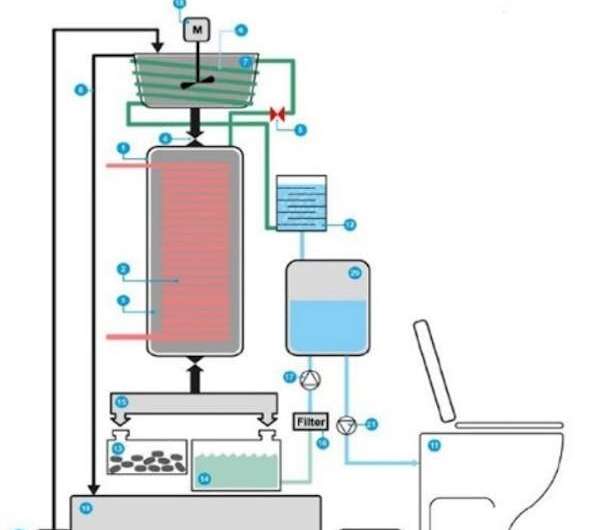
HTClean Hydrothermal carbonisation unit: Class 1 non-sewered sanitation 
system (for a single household) developed by Helbling and funded through the 
Bill and Melinda Gates Foundation’s Reinvented Toilet Challenge. Credit: ANSI

Many households in some of South Africa's biggest cities have been facing water restrictions in recent times—sometimes lasting for days at a time. People have had to make tough choices. For example, if you have a bottle of water in your house, are you going to drink it or use it for flushing the toilet?

Sanitation scientist Dr. Preyan Arumugam-Nanoolal argues that, even without , it simply doesn't make sense to keep flushing drinkable  down the toilet. She and her colleagues have been evaluating alternative sanitation technologies. Ina Skosana had a conversation with her about this research and innovations surrounding it.

Describe South Africa's sanitation landscape

Around 65% of South Africa's population have access to waterborne sanitation such as flushing toilets connected to a sewer network, septic tank or conservancy tank. Another 19% have ventilated improved , while 13% have pit toilets with no ventilation pipes. The remaining population either have pour flush toilets, chemical toilets or composting toilets, or they use buckets. Unfortunately, about 1% of the population still practice open defecation because they have no access to any sort of toilet facility.

South Africa is a water scarce country that has faced extreme weather events in recent years. For example in 2018 Cape Town faced severe drought and the possibility of running out of water. More recently, the east coast city of Durban was hit by floods which damaged bulk water and sanitation infrastructure. With the country's challenges around water management and availability, it's just not feasible and viable to continue with waterborne sanitation.

Conventional flushing toilets use around nine to 12 liters of water per flush. And that is potable water.

Moreover, according to South Africa's latest Green Drop report, the performance of current conventional wastewater treatment works is alarming. Only 23 out of the 995 wastewater treatment works evaluated achieved Green Drop status by scoring above 90%.

It seems practical for us to transition towards the adoption of non-sewered sanitation technologies.

What are non-sewered sanitation systems?

Non-sewered sanitation technologies collect, convey and fully treat the acceptable input onsite.

Instead of your waste going from your toilet via a sewer to a treatment works offsite, this technology treats your waste onsite and allows the treated outputs to be safely reused or disposed of.

Flushing toilets aren't the solution to South Africa's sanitation problem
HTClean (sideview)

These technologies can be installed in the household and larger systems can be implemented for schools or communities. They consist of a front end, which is your  facility, and a back end, which is the treatment facility.

Pictured here is one of the reinvented toilets funded by the Gates Foundation. The HTClean, developed for a single household, uses a vacuum flush evacuation mechanism thus. This reduces the water required to 0.2-0.9 liters per flush. The urine and fecal matter are mechanically separated at the back end and treated by high temperature and high pressure processing. The treated liquid output is reused for flushing.

What are the benefits of this toilet technology?

Non-sewered sanitation is less dependent on water. It uses conventional flush (less than 6 liters), pour flush, dry toilets or novel evacuation mechanisms that use mechanical forces with little to no water. And its treated output can be reused.

Non-sewered sanitation fully treats feces and urine. The treated solid output can be used as fertilizer while the treated liquid output can be used for flushing or crop irrigation. Our fecal and urine matter is a valuable resource.

How close is this to being a reality in South Africa?

I am involved in the training and awareness around a global standard called ISO 30500, which has been adopted in South Africa as SANS 30500. This standard provides guidance for the design, performance and safety requirements of non-sewered sanitation systems. It also considers the sustainability of these systems over a functional life-span.

We at the University of KwaZulu-Natal, on behalf of the Water Research Commission, are coordinating the development of a certification scheme which will allow these technologies to be certified against the standard and enter the market.

Two technologies which were developed through the Reinvented Toilet Challenge funded by the Bill and Melinda Gates Foundation have been licensed by two South African companies to be manufactured in South Africa. These technologies are being tested in the field through the South African Sanitation Technology Enterprise Program. The program provides a platform for sanitation innovators and commercial partners to take their technologies from the prototype development phase to commercialisation.

The Department of Water and Sanitation has already identified the benefits of non-sewered sanitation and recently launched the Sanitation Technology Technical Coordinating Committee. The committee's function is to help develop a process to assess and validate appropriate sanitation technologies, get them certified and accredited, and guide their adoption and commercialization. However, while the regulator can make recommendations, it's really the municipalities that make the decisions.

I believe that  through certification will provide users and water service authorities and municipalities with peace of mind that these technologies are safe and reliable. While the cost of developing, testing and certifying non-sewered  technologies may appear high now, it all boils down to the economics of scale. Over time, a higher demand will make these systems cheaper to manufacture and affordable for households.

Provided by The Conversation 

This article is republished from The Conversation under a Creative Commons license. Read the original article.The Conversation

Amazon CEO says layoffs will extend into next year

Amazon CEO says layoffs will extend into next year 
On Thursday, Nov. 17, 2022, Amazon CEO Andy Jassy said the mass layoffs 
that began at the company this week will continue into the following year. 
Credit: AP Photo/Michel Spingler, File

The mass layoffs that began in Amazon's corporate ranks this week will extend into next year, CEO Andy Jassy said Thursday.

In a note sent to employees, Jassy said the  told workers in its devices and books divisions about layoffs on Wednesday. He said it also offered some other  a voluntary buyout offer.

"I've been in this role now for about a year and a half, and without a doubt, this is the most difficult decision we've made during that time (and, we've had to make some very tough calls over the past couple of years, particularly during the heart of the pandemic)," Jassy wrote in the memo.

Seattle-based Amazon, which has been cutting costs in various areas of its business in the past few months, is undergoing an annual review process to figure out where it can save more money. Jassy said this year's review is "more difficult" due to the economic landscape and the company's rapid hiring in the last several years.

Other tech companies—many of which had gone on hiring binges in the past few years—have also been trimming their workforce amid concerns about an . Among others, Facebook parent Meta said last week it would lay off 11,000 people, about 13% of its workforce. And Elon Musk, the new Twitter CEO, has slashed the company's workforce in half this month.

On Tuesday, Amazon notified authorities in California that it would lay off about 260 corporate workers at various facilities in the state. The company has not publicly disclosed how many employees it laid off this week across its entire corporate workforce, though some based in Seattle said they've also been let go.

Jassy said the company hasn't concluded how many other jobs will be impacted. He noted there will be reductions in certain divisions as the company goes through the annual review process, which will continue into next year. As they weigh , he said leaders at the company will prioritize what matters most to customers and the long-term health of the company.

Amazon is offering severance packages for employees who leave the company. But—unlike Meta, for example—it hasn't publicly provided details of the package.

The company employs more than 1.5 million workers globally, primarily made up of hourly workers.

© 2022 The Associated Press. All rights reserved. This material may not be published, broadcast, rewritten or redistributed without permission.

Amazon begins mass layoffs among its corporate workforce

Rice turns asphaltene into graphene for composites

‘Flashed’ byproduct of crude oil could bolster materials, polymer inks

Peer-Reviewed Publication

RICE UNIVERSITY

ASPHALTENE 1 

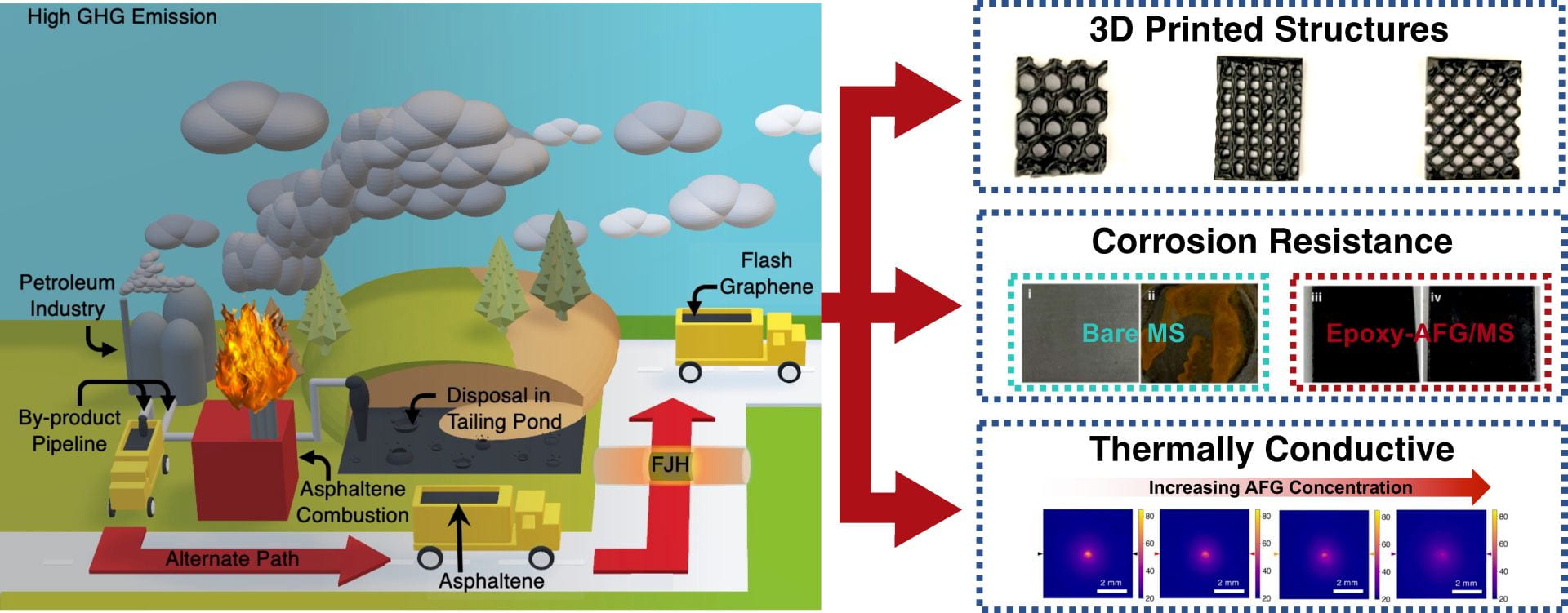
IMAGE: RESEARCHERS AT RICE UNIVERSITY ARE PURSUING THE “SUSTAINABLE VALORIZATION” OF ASPHALTENE BY TURNING IT INTO GRAPHENE USEFUL FOR COMPOSITE MATERIALS. view more 

CREDIT: ILLUSTRATION BY M.A.S.R. SAADI/RICE UNIVERSITY 

HOUSTON – (Nov. 18, 2022) – Asphaltenes, a byproduct of crude oil production, are a waste material with potential. Rice University scientists are determined to find it by converting the carbon-rich resource into useful graphene. 

Muhammad Rahman, an assistant research professor of materials science and nanoengineering, is employing Rice’s unique flash Joule heating process to convert asphaltenes instantly into turbostratic (loosely aligned) graphene and mix it into composites for thermal, anti-corrosion and 3D-printing applications.

The process makes good use of material otherwise burned for reuse as fuel or discarded into tailing ponds and landfills. Using at least some of the world’s reserve of more than 1 trillion barrels of asphaltene as a feedstock for graphene would be good for the environment as well.

“Asphaltene is a big headache for the oil industry, and I think there will be a lot of interest in this,” said Rahman, who characterized the process as both a scalable and sustainable way to reduce carbon emissions from burning asphaltene.

Rahman is a lead corresponding author of the paper in Science Advances co-led by Rice chemist James Tour, whose lab developed flash Joule heating, materials scientist Pulickel Ajayan and Md Golam Kibria, an assistant professor of chemical and petroleum engineering at the University of Calgary, Canada.

Asphaltenes are 70% to 80% carbon already. The Rice lab combines it with about 20% of carbon black to add conductivity and flashes it with a jolt of electricity, turning it into graphene in less than a second. Other elements in the feedstock, including hydrogen, nitrogen, oxygen and sulfur, are vented away as gases.

“We try to keep the carbon black content as low as possible because we want to maximize the utilization of asphaltene,” Rahman said.

“The government has been putting pressure on the petroleum industries to take care of this,” said Rice graduate student and co-lead author M.A.S.R. Saadi. “There are billions of barrels of asphaltene available, so we began working on this project primarily to see if we could make carbon fiber. That led us to think maybe we should try making graphene with flash Joule heating.”

Assured that Tour’s process worked as well on asphaltene as it did on various other feedstocks, including plasticelectronic wastetirescoal fly ash and even car parts, the researchers set about making things with their graphene. 

Saadi, who works with Rahman and Ajayan, mixed the graphene into composites, and then into polymer inks bound for 3D printers. “We’ve optimized the ink rheology to show that it is printable,” he said, noting the inks have no more than 10% of graphene mixed in. Mechanical testing of printed objects is forthcoming, he said.

Rice graduate student Paul Advincula, a member of the Tour lab, is co-lead author of the paper. Co-authors are Rice graduate students Md Shajedul Hoque Thakur, Ali Khater, Jacob Beckham and Minghe Lou, undergraduate Aasha Zinke and postdoctoral researcher Soumyabrata Roy; research fellow Shabab Saad, alumnus Ali Shayesteh Zeraati, graduate student Shariful Kibria Nabil and postdoctoral associate Md Abdullah Al Bari of the University of Calgary; graduate student Sravani Bheemasetti and Venkataramana Gadhamshetty, an associate professor, at the South Dakota School of Mines and Technology and its 2D Materials of Biofilm Engineering Science and Technology Center; and research assistant Yiwen Zheng and Aniruddh Vashisth, an assistant professor of mechanical engineering, of the University of Washington.

The research was funded by the Alberta Innovates for Carbon Fiber Grand Challenge programs, the Air Force Office of Scientific Research (FA9550-19-1-0296), the U.S. Army Corps of Engineers (W912HZ-21-2-0050) and the National Science Foundation (1849206, 1920954).  

-30-

Read the abstract at www.doi.org/10.1126/sciadv.add3555.

This news release can be found online at https://news.rice.edu/news/2022/rice-turns-asphaltene-graphene-composites.

Follow Rice News and Media Relations via Twitter @RiceUNews.

Related materials:

Rice lab turns trash into valuable graphene in a flash: https://news.rice.edu/news/2020/rice-lab-turns-trash-valuable-graphene-flash

Ajayan Research Group: https://ajayan.rice.edu

Tour Group: https://www.jmtour.com

Images for download:


https://news-network.rice.edu/news/files/2022/11/1107_FLASH-1-WEB.jpg

Researchers at Rice University are pursuing the “sustainable valorization” of asphaltene by turning it into graphene useful for composite materials. (Illustration by M.A.S.R. Saadi/Rice University)


https://news-network.rice.edu/news/files/2022/10/1107_FLASH-2-WEB.jpg

CAPTION: Muhammad Rahman, left, and M.A.S.R. Saadi. (Credit: Photo by Jeff Fitlow/Rice University)

Located on a 300-acre forested campus in Houston, Rice University is consistently ranked among the nation’s top 20 universities by U.S. News & World Report. Rice has highly respected schools of Architecture, Business, Continuing Studies, Engineering, Humanities, Music, Natural Sciences and Social Sciences and is home to the Baker Institute for Public Policy. With 4,240 undergraduates and 3,972 graduate students, Rice’s undergraduate student-to-faculty ratio is just under 6-to-1. Its residential college system builds close-knit communities and lifelong friendships, just one reason why Rice is ranked No. 1 for lots of race/class interaction and No. 1 for quality of life by the Princeton Review. Rice is also rated as a best value among private universities by Kiplinger’s Personal Finance.

‘Butterfly bot’ is fastest swimming soft robot yet

Peer-Reviewed Publication

NORTH CAROLINA STATE UNIVERSITY

‘Butterfly Bot’ is Fastest Swimming Soft Robot Yet 

IMAGE: INSPIRED BY THE BIOMECHANICS OF THE MANTA RAY, RESEARCHERS AT NORTH CAROLINA STATE UNIVERSITY HAVE DEVELOPED AN ENERGY-EFFICIENT SOFT ROBOT THAT CAN SWIM MORE THAN FOUR TIMES FASTER THAN PREVIOUS SWIMMING SOFT ROBOTS. THE ROBOTS ARE CALLED “BUTTERFLY BOTS,” BECAUSE THEIR SWIMMING MOTION RESEMBLES THE WAY A PERSON’S ARMS MOVE WHEN THEY ARE SWIMMING THE BUTTERFLY STROKE. view more 

CREDIT: JIE YIN, NC STATE UNIVERSITY

Inspired by the biomechanics of the manta ray, researchers at North Carolina State University have developed an energy-efficient soft robot that can swim more than four times faster than previous swimming soft robots. The robots are called “butterfly bots,” because their swimming motion resembles the way a person’s arms move when they are swimming the butterfly stroke.

“To date, swimming soft robots have not been able to swim faster than one body length per second, but marine animals – such as manta rays – are able to swim much faster, and much more efficiently,” says Jie Yin, corresponding author of a paper on the work and an associate professor of mechanical and aerospace engineering at NC State. “We wanted to draw on the biomechanics of these animals to see if we could develop faster, more energy-efficient soft robots. The prototypes we’ve developed work exceptionally well.”

The researchers developed two types of butterfly bots. One was built specifically for speed, and was able to reach average speeds of 3.74 body lengths per second. A second was designed to be highly maneuverable, capable of making sharp turns to the right or left. This maneuverable prototype was able to reach speeds of 1.7 body lengths per second.

“Researchers who study aerodynamics and biomechanics use something called a Strouhal number to assess the energy efficiency of flying and swimming animals,” says Yinding Chi, first author of the paper and a recent Ph.D. graduate of NC State. “Peak propulsive efficiency occurs when an animal swims or flies with a Strouhal number of between 0.2 and 0.4. Both of our butterfly bots had Strouhal numbers in this range.”

The butterfly bots derive their swimming power from their wings, which are “bistable,” meaning the wings have two stable states. The wing is similar to a snap hair clip. A hair clip is stable until you apply a certain amount of energy (by bending it). When the amount of energy reaches critical point, the hair clip snaps into a different shape – which is also stable. Video of the butterfly bots can be found at https://youtu.be/Pi-2pPDWC1w.

In the butterfly bots, the hair clip-inspired bistable wings are attached to a soft, silicone body. Users control the switch between the two stable states in the wings by pumping air into chambers inside the soft body. As those chambers inflate and deflate, the body bends up and down – forcing the wings to snap back and forth with it.

“Most previous attempts to develop flapping robots have focused on using motors to provide power directly to the wings,” Yin says. “Our approach uses bistable wings that are passively driven by moving the central body. This is an important distinction, because it allows for a simplified design, which lowers the weight.”

The faster butterfly bot has only one “drive unit” – the soft body – which controls both of its wings. This makes it very fast, but difficult to turn left or right. The maneuverable butterfly bot essentially has two drive units, which are connected side by side. This design allows users to manipulate the wings on both sides, or to “flap” only one wing, which is what enables it to make sharp turns.

“This work is an exciting proof of concept, but it has limitations,” Yin says. “Most obviously, the current prototypes are tethered by slender tubing, which is what we use to pump air into the central bodies. We’re currently working to develop an untethered, autonomous version.”

The paper, “Snapping for high-speed and high-efficient, butterfly stroke-like soft swimmer,” will be published Nov. 18 in the open-access journal Science Advances. The paper was co-authored by Yaoye Hong, a Ph.D. student at NC State; and by Yao Zhao and Yanbin Li, who are postdoctoral researchers at NC State. The work was done with support from the National Science Foundation under grants CMMI-2005374 and CMMI-2126072.

FSU researchers: Rapid fluctuations in oxygen levels coincided with Earth’s first mass extinction


Peer-Reviewed Publication

FLORIDA STATE UNIVERSITY

Fieldwork 

IMAGE: NEVIN KOZIK, A FORMER FSU DOCTORAL STUDENT AND NOW A VISITING ASSISTANT PROFESSOR AT OCCIDENTAL COLLEGE, DURING FIELDWORK TO INVESTIGATE HOW RAPID CHANGES IN MARINE OXYGEN LEVELS MAY HAVE PLAYED A SIGNIFICANT ROLE IN DRIVING EARTH’S FIRST MASS EXTINCTION. view more 

CREDIT: COURTESY OF NEVIN KOZIK

Rapid changes in marine oxygen levels may have played a significant role in driving Earth’s first mass extinction, according to a new study led by Florida State University researchers.

About 443 million years ago, life on Earth was undergoing the Late Ordovician mass extinction, or LOME, which eliminated about 85% of marine species. Scientists have long studied this mass extinction and continue to investigate its possible causes, such as reduced habitat loss in a rapidly cooling world or persistent low-oxygen conditions in the oceans.

By measuring isotopes of the element thallium — which shows special sensitivity to changes in oxygen in the ancient marine environment — the research team found that previously documented patterns of this mass extinction coincided with an initial rapid decrease in marine oxygen levels followed by a rapid increase in oxygen. Their work is published online in the journal Science Advances.

“Paleontologists have noted that there were several groups of organisms, such as graptolites and brachiopods, that started to decline very early in this mass extinction interval, but we didn’t really have any good evidence of an environmental or climate signature to tie that early decline of these groups to a particular mechanism,” said co-author Seth Young, an associate professor in the Department of Earth, Ocean and Atmospheric Science. “This paper can directly link that early phase of extinction to changes in oxygen. We see a marked change in thallium isotopes at the same time these organisms start their steady decline into the main phase of the mass extinction event.”

That decrease in oxygen was immediately followed by an increase. This rapid shift in oxygen coincided with the traditional first die-off of mass extinction and major ice sheet growth over the ancient South Pole.

“Turbulence in oxygen levels in oceanic waters is really what seems to have been pretty problematic for organisms that were living in the Late Ordovician at that time, which might have been adapted to cope with low oxygen conditions initially or vice versa,” Young said. “The fact that oxygen levels in the oceans next to the continents switching back and forth over short geologic time scales (a few hundred thousand years) really did seem to play havoc with these marine ecosystems.”

The Late Ordovician extinction was one of five major mass extinctions in Earth’s history and the only one scientists are confident took place in what are called “icehouse” conditions, in which widespread ice sheets are present on Earth’s surface. Earth is currently experiencing icehouse conditions and loss of biodiversity, which makes this ancient mass extinction an important analog for present-day conditions, along with trying to understand Earth’s future as our climate continues to warm and ice sheets recede.

Previous research into environmental conditions surrounding the LOME used evidence found in limestones from more oxygenated settings, but this study used shales that were deposited in deeper, oxygen-poor water, which record different geochemical signatures, allowing the researchers to make conclusions about global marine conditions, rather than for local conditions.

“The discovery of the initial expansion of low-oxygen conditions on a global level and the coincidence with the early phases of decline in marine animals helps paint a clearer picture of what was happening with this extinction event,” said lead author Nevin Kozik, a visiting assistant professor at Occidental College and former FSU doctoral student.

Co-authors on this paper were doctoral student Sean Newby and associate professor Jeremy Owens of FSU; former FSU postdoctoral scholar and current assistant professor at the College of Charleston Theodore Them; Mu Liu and Daizhao Chen of the Chinese Academy of Sciences; Emma Hammarlund of Lund University; and David Bond of the University of Hull.

This research was supported by the National Science Foundation, the American Chemical Society, the Sloan Research Foundation and the Geological Society of America.

Finding equity in climate mitigation finance

Peer-Reviewed Publication

INTERNATIONAL INSTITUTE FOR APPLIED SYSTEMS ANALYSI

Considerations of equity in directing global financial flows for regional climate mitigation investments are critically important. A new study helps inform the current negotiations at COP27 while keeping fairness at the forefront.

It is clear that we need to invest in climate mitigation now rather than later. The sixth assessment report (AR6) of the Intergovernmental Panel on Climate Change (IPCC) showed that mitigation investment pathways could reach global climate goals in a cost-effective manner, however, who should finance those investments are subject of continued debate at the recent COPs.

In a new IIASA-led study published in Science, an international team of researchers explored how global investments could be divided among the countries in the world. The team applied a systematic approach with different equity and fairness considerations and estimated the “fair” financial flows between regions.

The study draws on emerging principles of climate equity and focuses on mitigation investment needs to be deployed near-term to 2030.

“We find that US$100 billion pledged for mitigation and adaptation from the developed to the developing countries is insufficient to leverage the scale of financing required to meet the long-term temperature target fairly. Even under the most favorable fairness assumptions for the rich countries, the global finance flows to the developing countries needs to be scaled up to US$250 to 550 billion per year,” says IIASA Energy, Climate, and Environment Program Director Keywan Riahi, one of the coauthors of the study.

“Previous work has focused on fair global carbon budget–sharing schemes, but few focus on equity considerations in the financing of mitigation investments,” says Shonali Pachauri, IIASA Transformative Institutional and Social Solutions Research Group Leader and study lead author.

Investing in mitigation actions in low-income regions is not only important from an ethical point of view, but as the authors explain, it can be a productive use of capital. 

"We are in the acceleration phase of a range of mitigation technologies. If we are to deploy them at the speed required for our climate targets, we have to make sure that they also happen at scale in poorer regions of the world," says Christoph Bertram, a researcher at the Potsdam Institute for Climate Impact Research and a study coauthor.

The researchers found that flows from North America and Europe to other regions would have to increase substantially relative to present levels to meet the Paris Agreement goals under most equity considerations. They estimated that the financial flow required under the selected equity considerations ranges between US $250 billion and $1.5 trillion annually (see accompanying webtool).

According to the authors, the new collectively quantified goal is one of the most important points of negotiation at COP27.

“This is a crucial opportunity for governments to signal to one another and to the private financial sector the magnitude and direction of the necessary financial flows,” notes Setu Pelz, a study coauthor and researcher in the IIASA Transformative Institutional and Social Solutions Research Group.

“Agreement on how to redirect international and domestic finance towards urgent near-term mitigation investments will be critical to the success of negotiations at COP27. Progress here will serve as a clear signal to governments, industry, and non-government actors, and will be crucial for building the necessary momentum in regions where finance is scarce,” Pachauri concludes.

Reference

Pachauri, S., Pelz, S., Bertram, C., Kreibiehl, S., Rao, D.R., Sokona, Y., Riahi, K. (2022) Fairness considerations in global mitigation investments. Science DOI: 10.1126/science.adf0067


About IIASA:

The International Institute for Applied Systems Analysis (IIASA) is an international scientific institute that conducts research into the critical issues of global environmental, economic, technological, and social change that we face in the twenty-first century. Our findings provide valuable options to policymakers to shape the future of our changing world. IIASA is independent and funded by prestigious research funding agencies in Africa, the Americas, Asia, and Europe. www.iiasa.ac.at

Imaging cells: New method enables clear, precise look inside

Researchers at the Beckman Institute can now ‘see’ the fine structure and chemical composition of a human cell with unmatched clarity and precision

Peer-Reviewed Publication

BECKMAN INSTITUTE FOR ADVANCED SCIENCE AND TECHNOLOGY

Bhargava Lab Group 

IMAGE: RESEARCHERS AT THE BECKMAN INSTITUTE FOR ADVANCED SCIENCE AND TECHNOLOGY LED BY BIOENGINEERING PROFESSOR ROHIT BHARGAVA DEVELOPED AN INNOVATIVE WAY TO ‘SEE’ THE FINE STRUCTURE AND CHEMICAL COMPOSITION OF A HUMAN CELL WITH UNMATCHED CLARITY AND PRECISION. THEIR TECHNIQUE TAKES A CREATIVE — AND COUNTERINTUITIVE — APPROACH TO SIGNAL DETECTION. view more 

CREDIT: BECKMAN INSTITUTE FOR ADVANCED SCIENCE AND TECHNOLOGY OFFICE OF COMMUNICATION.

It’s why Jaws swam out of sight for more than an hour and hints at the glamour of giftwrap. In movie theaters, living rooms, and even labs, the thrill of the unseen can be counted on to keep us guessing. But when it comes to the hidden chemical world of cells, scientists need no longer wonder.

Inspired by this same thrill, researchers at the Beckman Institute for Advanced Science and Technology developed an innovative way to ‘see’ the fine structure and chemical composition of a human cell with unmatched clarity and precision. Their technique, which appeared in PNAS earlier this week, takes a creative — and counterintuitive — approach to signal detection.

“Biology is one of the most exciting sciences of our time because there has always been a divide between what we can see and what we cannot see,” said Rohit Bhargava, a professor of bioengineering at the University of Illinois Urbana-Champaign who led the study.

As the smallest functional units in our bodies, cells have long commanded the attention of researchers interested in determining what they’re made of and where each element resides. Together, the “what” and the “where” form an all-purpose cellular blueprint that can be used to study biology, chemistry, materials, and more.

Before this study, obtaining a high-resolution copy of that blueprint ranked among the impossible.

“Now, we can see inside cells in a much finer resolution and with significant chemical detail more easily than ever,” Bhargava said. “This work opens a range of possibilities, including a new way to examine the combined chemical and physical aspects that govern human development and disease.”

The researchers’ work builds on prior strides in the field of chemical imaging.

Whereas optical microscopy uses visible light to illuminate surface-level features like color and structure, chemical imaging uses invisible infrared light to reveal a sample's inner workings.

When a cell is exposed to IR light, its temperature rises, and it expands. We know from night vision goggles that no two objects absorb IR wavelengths in exactly the same way; comparing a poodle to a park bench is evidence enough that warmer objects emit stronger IR signatures than cooler ones. The same is true inside a cell, where each type of molecule absorbs IR light at a subtly different wavelength and emits a unique chemical signature. Examining the absorption patterns — a method called spectroscopy — allows researchers to pinpoint the whereabouts of each.

Unlike night vision goggles, the researchers do not analyze the absorption patterns as a color spectrum. Instead, they interpret the IR waves with a signal detector: a minute beam fastened to the microscope on one end, with a fine tip that scrapes the cell’s surface like the nanoscale needle of a record player.

Innovations in spectroscopy over the last decade have focused on steadily increasing the strength of the initial IR wavelengths.

“It’s an intuitive approach because we are conditioned to think of larger signals as being better. We think, ‘The stronger the IR signal, the higher a cell’s temperature becomes, the more it expands, and the easier it will be to see,’” Bhargava said.

A sizeable setback is hidden within this approach. As the cell expands, the motion of the signal detector becomes more exaggerated and generates “noise”: so-called static that impedes accurate chemical measurements.

“It’s like turning up the dial on a staticky radio station — the music gets louder, but so does the static,” said Seth Kenkel, a postdoctoral researcher in Professor Bhargava’s lab and the study’s lead author.

In other words, no matter how powerful the IR signal became, the quality of the chemical imaging could not advance.

“We needed a solution to stop the noise from increasing alongside the signal,” Kenkel said.

The researchers' remedy to noisy cellular imaging works by divorcing the IR signal from the detector's movement, allowing for amplification without the added noise.

Instead of focusing their energies on the strongest possible IR signal, the researchers began by experimenting with the smallest signal they could manage, ensuring that they could effectively implement their solution before upping the strength. Though “counterintuitive,” according to Kenkel, starting small allowed the researchers to honor a decade of spectroscopy research and lay critical groundwork for the future of the field.

Bhargava likens the approach to a road trip gone awry.

“Imagine that spectroscopy researchers were in a car, headed to the Grand Canyon. Of course, everyone would think that the faster the car moves, the faster they’ll reach the destination. But the problem is that the car is headed east from Urbana,” he said.

Increasing the hypothetical car’s speed is analogous to strengthening the IR signal.

“We pulled over, looked at a map, and pointed the car in the correct direction. Now, the increased speed — the increased signal — can effectively move the field forward.”

The researchers’ “map” enables high-resolution chemical and structural imaging of cells at the nanoscale — a scale 100,000 times smaller than a strand of hair. Notably, this technique is free of fluorescent labeling, or dyeing molecules to increase their visibility under a microscope.

While the facilities in Beckman’s Microscopy Suite were critical to the study’s experimental stage, the idea itself arose not from sophisticated technology, but from a culture that supported curiosity, unconventional problem-solving, and diverse perspectives.

“This is why the Beckman Institute is an amazing place,” Bhargava said. “This project needed ideas from spectroscopy, from mechanical engineering, from signal processing, and of course biology. You can’t combine these fields seamlessly anywhere other than Beckman. This study is a classic example of Beckman’s blend of interdisciplinary science at the cutting edge of advanced science and technology.”


The article titled "Chemical imaging of cellular ultrastructure by null-deflection infrared spectroscopic measurements" can be accessed at: https://doi.org/10.1073/pnas.2210516119 

For full author information, please consult the publication.

The authors declare no competing interest.

Research reported in this press release was supported in part by the National Institute of Biomedical Imaging and Bioengineering of the National Institutes of Health under award numbers T32EB019944 and R01EB009745, as well as the National Science Foundation under award number 2153032. This content is solely the responsibility of the authors and does not necessarily represent the official views of the NIH.

Media contact: Jenna Kurtzweil, kurtzwe2@illinois.edu