Wednesday, January 25, 2023

The AP Interview: Pope Francis: Homosexuality not a crime


NICOLE WINFIELD
Wed, January 25, 2023 

VATICAN CITY (AP) — Pope Francis criticized laws that criminalize homosexuality as “unjust,” saying God loves all his children just as they are and called on Catholic bishops who support the laws to welcome LGBTQ people into the church.

“Being homosexual isn’t a crime,” Francis said during an interview Tuesday with The Associated Press.

Francis acknowledged that Catholic bishops in some parts of the world support laws that criminalize homosexuality or discriminate against the LGBTQ community, and he himself referred to the issue in terms of “sin.” But he attributed such attitudes to cultural backgrounds, and said bishops in particular need to undergo a process of change to recognize the dignity of everyone.

“These bishops have to have a process of conversion,” he said, adding that they should apply “tenderness, please, as God has for each one of us."

Some 67 countries or jurisdictions worldwide criminalize consensual same-sex sexual activity, 11 of which can or do impose the death penalty, according to The Human Dignity Trust, which works to end such laws. Experts say even where the laws are not enforced, they contribute to harassment, stigmatization and violence against LGBTQ people.

In the U.S., more than a dozen states still have anti-sodomy laws on the books, despite a 2003 Supreme Court ruling declaring them unconstitutional. Gay rights advocates say the antiquated laws are used to harass homosexuals, and point to new legislation, such as the “Don’t say gay” law in Florida, which forbids instruction on sexual orientation and gender identity in kindergarten through third grade, as evidence of continued efforts to marginalize LGBTQ people.

The United Nations has repeatedly called for an end to laws criminalizing homosexuality outright, saying they violate rights to privacy and freedom from discrimination and are a breach of countries’ obligations under international law to protect the human rights of all people, regardless of their sexual orientation or gender identity.

Declaring such laws “unjust,” Francis said the Catholic Church can and should work to put an end to them. “It must do this. It must do this,” he said.

Francis quoted the Catechism of the Catholic Church in saying gay people must be welcomed and respected, and should not be marginalized or discriminated against.

“We are all children of God, and God loves us as we are and for the strength that each of us fights for our dignity,” Francis said, speaking to the AP in the Vatican hotel where he lives.

Such laws are common in Africa and the Middle East and date from British colonial times or are inspired by Islamic law. Some Catholic bishops have strongly upheld them as consistent with Vatican teaching that considers homosexual activity “intrinsically disordered,” while others have called for them to be overturned as a violation of basic human dignity.

In 2019, Francis had been expected to issue a statement opposing criminalization of homosexuality during a meeting with human rights groups that conducted research into the effects of such laws and so-called “conversion therapies.”

In the end, the pope did not meet with the groups, which instead met with the Vatican No. 2, who reaffirmed “the dignity of every human person and against every form of violence.”

On Tuesday, Francis said there needed to be a distinction between a crime and a sin with regard to homosexuality.

“Being homosexual is not a crime," he said. "It's not a crime. Yes, but it's a sin. Fine, but first let's distinguish between a sin and a crime."

"It's also a sin to lack charity with one another," he added.


Catholic teaching holds that while gay people must be treated with respect, homosexual acts are “intrinsically disordered.” Francis has not changed that teaching, but he has made reaching out to the LGBTQ community a hallmark of his papacy.

Starting with his famous 2013 declaration, “Who am I to judge?” when he was asked about a purportedly gay priest, Francis has gone on to minister repeatedly and publicly to the gay and trans community. As archbishop of Buenos Aires, he favored granting legal protections to same-sex couples as an alternative to endorsing gay marriage, which Catholic doctrine forbids.

Despite such outreach, Francis was criticized by the Catholic LGBTQ community for a 2021 decree from the Vatican’s doctrine office that the church cannot bless same-sex unions “because God cannot bless sin.”

The Vatican in 2008 declined to sign onto a U.N. declaration that called for the decriminalization of homosexuality, complaining the text went beyond the original scope and also included language about “sexual orientation” and “gender identity” it found problematic. In a statement at the time, the Vatican urged countries to avoid “unjust discrimination” against gay people and end penalties against them.


Vatican The AP Interview Pope Francis LGBTQ
 - A rainbow shines over St.Peter's Square at the Vatican, on Jan. 31, 2021. In an interview with The Associated Press at The Vatican, Tuesday, Jan. 24, 2023, Pope Francis acknowledged that Catholic bishops in some parts of the world support laws that criminalize homosexuality or discriminate against the LGBTQ community, and he himself referred to homosexuality in terms of "sin." But he attributed attitudes to cultural backgrounds and said bishops in particular need to undergo a process of change to recognize the dignity of everyone. (AP Photo/Alessandra Tarantino, file)

Cuba begins London court battle over unpaid Castro-era debt


Mon, January 23, 2023 

By Marc Jones

LONDON (Reuters) - Cuba began a high-stakes legal battle in London's High Court on Monday over unpaid Fidel Castro-era government debt now held by one of the communist-run country's creditors.

The 8-day case will be closely watched by other creditors who between them have struggled to recoup an estimated $7 billion of defaulted loan from Havana.

CRF I Ltd, the investment firm that brought Monday's case, says it is owed 72 million euros ($78.18 million) on two loans that were originally granted to Cuba by European banks in the 1980s and denominated in German Deutschmarks.

Cuba's authorities have labelled CRF a "vulture fund" and said in their legal argument ahead of the case that the English Court had "no jurisdication" to try CRF's claims.

CRF originally launched the claim almost three years ago after Havana refused a debt relief offer made by CRF and some other bond holders back in 2018.

"We are still ready to talk to the other side - even at this late stage," CRF Chairman, David Charters, told Reuters.

The communist-run island has seen its finances deteriorate badly recent years, made worse by the coronavirus pandemic and restrictions put in place by former U.S. President Donald Trump.

In 2015, Havana reached a deal with members of the Paris Club of creditor nations that saw roughly three-quarters of that debt written off. But having not dealt with its commercial creditors in the so-called London Club the country remains shut out of international capital markets.

"The BNC and Cuba have never ignored their debts and have always maintained their interest in negotiating with their legitimate creditors," the Cuban central bank said in statement ahead of the case earlier this month.

Other Latin American nations, most notably Argentina, have also fought prolonged court and political battles for years to settle with international funds that bought up defaulted-debt cheaply and then pursued legal claims.

($1 = 0.9210 euros)

(Reporting by Marc Jones and Sam Tobin; Editing by Frank Jack Daniel)

Granholm ecstatic at red state surge in renewable energy: 'That is fantastic'

Green energy projects have spiked in Republican-led states like Texas since the passage of the Inflation Reduction Act.

At a White House press briefing on Monday, Energy Secretary Jennifer Granholm was asked by Yahoo News to weigh in on the sharp rise in renewable energy projects in Republican-led states like Texas since the passage of the Inflation Reduction Act.

According to data from the U.S. Energy Information Administration, Texas is poised to overtake California in terms of solar power capacity, and aggressively pursued the construction of new wind, solar and battery storage projects in the second half of 2022.

“With respect to Texas, what an opportunity for every state to be able to produce clean energy. And, in fact, a Politico story this morning suggested that there was an abundance of announcements coming out of red states. Great! That is fantastic,” Granholm said. “We want to be able to see energy, clean energy produced in every pocket of the country — blue states, red states — really, it helps to save people money, so it’s really all about green.”

In August, President Biden signed the Inflation Reduction Act into law. Since then, companies have announced tens of billions of dollars in renewable energy projects nationwide, Politico reported Monday, including a large percentage in Republican-led states where lawmakers voted against the legislation.

While many Republican lawmakers and governors have shied away from supporting laws that would start to address rising global temperatures caused by the burning of fossil fuels, they are less resistant to the boom in renewable energy jobs that has resulted from the Inflation Reduction Act.

“Just because you vote against a bill doesn’t mean the entire bill is a bad bill,” Rep. Garret Graves, R-La., told Politico. “I go out there and advocate for our district to try and get transportation funds, to try and get energy funds. That’s my job. I am not embarrassed about it. I don’t think it’s inconsistent with my vote.”

An oil derrick and wind turbines on the plains near Amarillo, Texas. (Lucas Jackson/Reuters)

The new law’s $369 billion in climate-related spending over 10 years targets five areas: consumer clean energy costs, decarbonizing various sectors of the economy, domestic clean energy manufacturing, environmental justice and land use. But it is the law’s robust tax credits that experts say have supercharged a manufacturing and jobs boom.

“I’m really excited to see, especially in the next year as companies really start to digest the IRA and determine what it means for their bottom line, to see all of the growth in the manufacturing facilities that might come as a result of the IRA,” Robbie Orvis, senior director of modeling and analysis at Energy Innovation Policy & Technology, told Morning Consult.

While the overriding goal of the new law is to spur a transition to renewable energy sources and cut greenhouse gas emissions by 40% by 2030, the creation of new green jobs has long been touted by Democrats in their proposals to address climate change.

In 2019, when Rep. Alexandria Ocasio-Cortez, D-N.Y., introduced her resolution for the Green New Deal in the House, Republicans responded by attacking it as a “jobs killer” that would result in dramatic tax increases.

But an October analysis by the BlueGreen Alliance and the Political Economy Research Institute at the University of Massachusetts Amherst found that the Inflation Reduction Act would create 9 million jobs by 2032.

On the growth of the renewable economy in the U.S., Granholm said Monday that “it’s helpful to the planet, but it’s also helpful for jobs and it’s also helpful for us to be energy-independent, which is exactly what the president would like to see — homegrown, clean energy, independent, so that we are strong and resilient.”


Big winners from Biden's climate law: Republicans who voted against it


Godofredo A. Vásquez/AP Photo


Kelsey Tamborrino and Josh Siegel
Mon, January 23, 2023

They didn't vote for it, they don't like it and they're working to undermine it — but Republicans are reaping the benefits of Democrats' climate law.

In the five months since the Inflation Reduction Act became law, companies have announced tens of billions of dollars in renewable energy, battery and electric vehicle projects that will benefit from incentives in President Joe Biden's signature law, aimed at expanding domestic manufacturing in clean energy and reducing dependence on Chinese imports.

In fact, roughly two-thirds of the major projects are in districts whose Republican lawmakers opposed the Inflation Reduction Act, according to a POLITICO analysis of major green energy manufacturing announcements made since the bill's enactment.

The dynamic has prompted a tricky balancing act for the GOP: Tout the jobs and economic benefits coming to their states and districts, but not the bill that helped create them. The results are also potentially awkward for Democrats who expended political capital and more than a year of wrangling to enact the bill, only to see Republican lawmakers and governors sharing in the jobs and positive headlines it's creating — although Democrats say they also see longer-term benefits for the nation in building GOP support for alternatives to fossil fuels.

Republicans insist their positions on the bill and the jobs are not in conflict.

"Just because you vote against a bill doesn't mean the entire bill is a bad bill," said Rep. Garret Graves (R-La.), who was the top GOP member of Democrats' Select Climate Crisis Committee in the last Congress. "I go out there and advocate for our district to try and get transportation funds, to try and get energy funds. That's my job. I am not embarrassed about it. I don't think it's inconsistent with my vote."

To Democrats, the slate of new investments stand as proof that they were correct that the Inflation Reduction Act, H.R. 5376 (117), would expand the reach of clean power to rural and conservative areas — a promise that failed to sway a single Republican vote to support the bill.

"It's hard not to point out the hypocrisy for people who fought tooth and nail against the bill, those very incentives that are now creating opportunities in their [Republican] districts they are now leading," said Sen. Tina Smith (D-Minn.). "We just have to point out, thanks for your kind words, but this didn't just happen. It happened despite your best efforts."

Smith attended an October ribbon-cutting in her state for Canadian solar panel maker Heliene's expansion of its manufacturing facility — an effort that was started prior to the Inflation Reduction Act's passage and that has drawn praise from Rep. Pete Stauber (R-Minn.), whose district is home to the plant that will be one of the largest panel makers in the country.

Energy Secretary Jennifer Granholm welcomed the news that Republican districts were drawing the investments.

"Great, that is fantastic," she told reporters at the Monday White House briefing. "We want to be able to see energy — clean energy — produced in every pocket of the country. Blue states, red states, really it helps to save people money, so it's all about green."

Democrats' climate law includes billions of dollars to spur green energy technologies and cut greenhouse gas emissions, including a new tax credit for manufacturing the components crucial for solar, wind and electric vehicles, as well as additional incentives for using domestic content in projects.

Republicans, though, have moved to slash funding of the Internal Revenue Service, the central agency charged with implementing the climate law's incentives, over concerns that Democrats have expanded its mandate. And Friday, former President Donald Trump urged GOP lawmakers to target "billions being spent on climate extremism" in their fight over the debt limit.

Supporters of the Inflation Reduction Act say its success is due in part to the way it provides long-term certainty for companies looking to place a footprint in the U.S.

The bill is a "fundamental element" of the recent spate of manufacturing announcements, said Abigail Ross Hopper, the president and CEO of the Solar Energy Industries Association. "There certainly were a number of plans being evaluated and discussed [prior to the bill]. But I think the vast majority were contingent upon the passage of the IRA."

In the three months after Biden signed the Inflation Reduction Act in August, companies announced more than $40 billion of new clean energy investments, according to a December report from the American Clean Power Association, an industry trade group. POLITICO's analysis of the law's early results includes those projects as well as separate news reports and company announcements of manufacturing expansions and plans, and additional announcements on electric vehicle plants.

Out of 33 projects examined, 21 are expected to be located in Republican-held congressional districts, compared with 12 in Democratic districts. POLITICO's analysis did not reflect every announcement made and does not include facilities where a specific congressional district could not be found.


Just this month, South Korean solar company Hanwha Q Cells announced it would invest $2.5 billion in Georgia to expand its solar panel manufacturing plant and construct another facility in the state.

That expansion is occurring partially in the district of conservative firebrand Rep. Marjorie Taylor Greene — who has described climate change as "actually healthy for us" and has blasted Democrats' bill. Greene, however, recently told POLITICO that she's "excited to have jobs" in her district that will come from the Q Cells announcement, though she gave credit to Georgia's GOP Gov. Brian Kemp, who has courted clean energy and electric vehicle manufacturing investments through state-level subsidies and tax incentives.

Federal and state incentives alike are playing a role in the companies' decisions, said J.C. Bradbury, an economics professor at Kennesaw State University in Georgia.

"They are coming to Georgia for one reason — we are paying them to come here with subsidies," Bradbury said in an interview, referring to the combination of federal and state tax credits. "These projects are being pitched as economic development projects 100 percent."

But while manufacturing proponents point to factors including geography, economic development plans and states' anti-union laws as factors drawing investment to deep-red districts, they also say the announcements are directly tied to the federal subsidies provided under Democrats' bill.

"It's not random," said Jason Walsh, executive director of the BlueGreen Alliance, which includes labor unions and environmental organizations. "It's because specific policies have been put in place and passed by the U.S. Congress to actually incentivize exactly the kind of activity that we're seeing."

And the investments are only expected to grow. Solar manufacturer and Bill Gates-backed CubicPV, for one, is planning a 10-gigawatt facility in the United States, but has not yet chosen a location, while Enel North America, a unit of an Italian energy company, is evaluating sites to build a new solar panel and cell manufacturing plant. Battery manufacturing facilities are also expected to come online in the years ahead across several states, including Michigan, Tennessee, Arizona and Georgia.

Companies aren't necessarily looking at which lawmaker represents the district when they invest, said Scott Paul, president of Alliance for American Manufacturing. They're looking instead at where the supply chains exist and where they can leverage the tax benefits and capital provided by lawmakers.

"Red state-blue state [is] not really a factor," Paul said, adding, "This isn't one of those things that looks like an electoral map at all."

Republicans express no regret about opposing the IRA despite previously supporting individual pieces of the bill, such as tax incentives for carbon capture, nuclear and hydrogen projects. GOP members argued that the bill would pump too much money into the economy and worsen inflation, and they've criticized Democrats for using the partisan reconciliation process that allowed them to pass it with a simple majority in the Senate.

"The overall process, the overall bill, particularly the spending, really frustrates Republicans — not necessarily every specific in the bill," said Rep. John Curtis (R-Utah).

But the GOP is likely to find itself in an uncomfortable position as funding from the Inflation Reduction Act plays a growing role in Republicans home states and districts.

Former Virginia Democratic Rep. Tom Perriello, who lost his reelection bid in 2010 after voting for the Affordable Care Act, said those dynamics put Republicans in a tricky spot once voters see the jobs stemming from Democrats' agenda.

"Biden has driven his agenda right down Main Street with a big 'Made in America' banner on the back of an electric truck, and people's only choices are to get on board with the parade or seem to be against making things in America again," he said. "I think of those two choices, Republican hypocrisy makes a lot more sense than standing in the way of jobs and American competitiveness."


He called it "squirrely" for lawmakers to argue to voters that they like certain parts of the bill, but not others.

"That's just not how legislating works. That's not how things pass," he said.

House Republicans have promised robust oversight of the climate law, pledging to seek out wasteful spending in search of would-be scandals such as the failed Solyndra loan guarantee of the Obama administration — even if the overall program is a success.

"I don't think it complicates the oversight," a House GOP leadership aide told POLITICO, who asked for anonymity to speak candidly. "Oversight is an important function. There could be 20 great projects [supported by IRA], but if one is bad, it's our job to understand why."

Republicans also criticized the Biden administration's rush to embrace greener energy while the country still relies on China for technology components, and they've been critical of government support that has helped companies with manufacturing in China.

Virginia Gov. Glenn Youngkin, a Republican, said he rejected Ford Motors' efforts to consider locating a battery plant in his state over concerns about China and national security.

Democrats, though, hope the trend of clean energy boosting the economic prospects of red states helps shift the rhetoric of Republicans and enables more bipartisan cooperation on narrow interests benefiting the climate.

"Over time, I anticipate their [Republican] talking points will change as their neighbors become a part of the clean energy economy," said former House climate committee Chair Kathy Castor (D-Fla.).
Humanitarian crises could worsen in Haiti, Venezuela, says aid group


Tue, January 24, 2023 
By Kylie Madry

MEXICO CITY (Reuters) - The humanitarian crises in Haiti and Venezuela that have subjected millions to hunger, violence and disease could worsen this year without more aid, the International Rescue Committee (IRC) said on Tuesday.

An estimated 4.7 million Haitians and 12.3 million Venezuelans face food insecurity.

"The crises in Haiti and Venezuela are protracted challenges that are shaking the whole region but, as conflict escalates around the world, competing priorities are draining the attention they get," the IRC's Regional Vice President Julio Rank Wright said.

Haiti ranked No. 9 on the IRC's 2023 emergency watchlist, below South Sudan and Burkina Faso and a notch above Ukraine.

The IRC estimated at least 5.2 million Haitians need humanitarian aid, with some 40% of the country having to skip meals.

Gangs have become de facto authorities in parts of Haiti's capital Port-au-Prince since the 2021 assassination of President Jovenel Moise.

The violence has displaced over 155,000 Haitians within the country alone, the IRC said.

Cholera, meanwhile, has made a resurgence, with more than 22,000 suspected cases registered in January.

The IRC said it is preparing a response with local partners to combat cholera, provide health services and support survivors of gender-based violence.

Meanwhile in Venezuela, the IRC said health services are strained and medicine inaccessible for some 9.3 million people after years of sky-high inflation and political crises.

An estimated 7 million Venezuelans have fled in recent years.

The IRC also said climate change had displaced nearly 1.3 million people across northern parts of Central America, fueling poverty and hunger.

The organization also expressed concern for Mexico, which received nearly 250,000 asylum requests over the last two years and continues to support migrants expelled from the United States.

Mexico is the only country in the region mentioned by the IRC Tuesday without a humanitarian response plan under U.N. guidelines, hampering humanitarian action and coordination.

(Reporting by Kylie Madry; Editing by Sarah Morland and Lisa Shumaker)


U.S. says it will propose new Haiti targets for U.N. sanctions
AND THAT HELPS THE PEOPLE HOW?!

US Ambassador Wood attends a session at the United Nations in Geneva

Tue, January 24, 2023 
By Michelle Nichols

UNITED NATIONS (Reuters) - The United States said on Tuesday it will propose further targets in Haiti for U.N. sanctions, a move broadly backed by China as the Caribbean country battles cholera and severe food shortages compounded by widespread violence from criminal gangs.

The 15-member U.N. Security Council agreed in October to impose an asset freeze, travel ban and arms embargo on anyone who threatens the peace or stability of Haiti, naming the country's most powerful gangster as its first target.

U.N. Secretary-General Antonio Guterres has also proposed that "a rapid action force" be sent to Haiti to help police combat gangs - a move also requested by Haiti's government.

"This has yet to materialize," the U.N. special envoy to Haiti, Helen La Lime, told the Security Council.

"Haitians overwhelmingly want this assistance so they can go about their daily lives in peace," she said. "Gang-related violence has reached levels not seen in decades. Murders and kidnappings increased for a fourth consecutive year."

The deputy U.S. ambassador to the United Nations, Robert Wood, said that Washington was encouraged that U.N. sanctions had "deterred those who would carry out and finance the violence causing Haiti's instability."

"The United States is identifying additional targets involved in the unrest in Haiti to nominate at the United Nations," he said. Such proposals are made to the council's Haiti sanctions committee, which makes decisions by consensus.

China's U.N. Ambassador Zhang Jun called for U.N. Haiti sanctions to be urgently reviewed and updated and for the full implementation of the measures "in order to create the necessary deterrent to gang violence."

Russia's Deputy U.N. Ambassador Dmitry Polyanskiy said the council's Haiti sanctions committee should intensify its work to find "the true sources of funding of the gangs in Haiti and the routes of illegal weapons supplies to the island."

(Reporting by Michelle Nichols)

IMF approves $105 million to fight food shortages in Haiti

Mon, January 23, 2023 

MEXICO CITY (Reuters) -The International Monetary Fund's (IMF) executive board approved $105 million to help Haiti address severe food insecurity, the institution said on Monday, as the Caribbean country faces widespread shortages amid a humanitarian crisis.

The payment, under the IMF's Food Shock Window program, is set to address "urgent balance of payment needs related to the global food crisis", the fund said in a statement.

"Record price inflation ... worsened Haiti's fragility and compounded the suffering of Haiti's population already affected by a severe malnutrition," said deputy managing director Antoinette Sayeh, pointing to "spillovers" from Russia's invasion of Ukraine early last year.

It said funds would be allocated to those most affected by food price increases through feeding programs, cash and in-kind transfers to vulnerable households and other measures.

Authorities should carefully control, track, record and publish all spending related to the emergency response, it added, to ensure it is used appropriately.

The $105 million - 0.5% of Haiti's gross domestic product - corresponds to an expected financing gap in 2023 as the country battles a cholera crisis and severe food shortages, compounded by widespread violence from criminal gangs in parts of the capital, Port-au-Prince.

(Reporting by Carolina Pulice; Editing by Sarah Morland)


A nod to Palestinian equality

Christian Science Monitor's Editorial Board
Tue, January 24, 2023 

In prolonged conflicts, small breakthroughs toward peace can sometimes herald larger shifts. One such step forward may have just happened in Jerusalem. On Sunday, a young Palestinian woman became the first female Christian pastor in Israel and the Palestinian territories. Christians make up a tiny portion of the Palestinian population, just 1% in the West Bank and Gaza Strip. But the investiture of the Rev. Sally Azar in the Evangelical Lutheran Church in Jordan and the Holy Land could send a wide ripple. It is an important marker for gender equality and social justice at a time when Palestinians are poised for a generational shift in political leadership – a shift in which women expect to have an influential role.

“It’s strange that we still have to argue that women can teach the Bible or perform the sacraments,” the Rev. Dr. Munther Isaac, a Lutheran pastor in Bethlehem, told the BBC. “This tells me that despite the progress we’ve made as Palestinians, when it comes to empowering women and women’s rights, that there is still work to be done.”

The formation last month of the most conservative Israeli government in history has deepened international concerns over the prospects of a future Palestinian state. But the more pressing issue for Palestinians is the future of their own leadership. The last presidential election was in 2005, the last parliamentary election in 2006. Those ballots set up an enduring political divide.

The Palestinian Authority under President Mahmoud Abbas presides in much of the West Bank. The Islamic fundamentalist party Hamas, meanwhile, controls the Gaza Strip. In 2007, Mr. Abbas sidelined Parliament and has ruled by presidential decree ever since. Five unity agreements between Fatah, the party of Mr. Abbas, and Hamas have dissolved.

Both factions are deeply unpopular. A December poll conducted by the Palestinian Center for Policy and Survey Research in Ramallah found that 81% of Palestinians in the West Bank and Gaza Strip say the institutions run by the Palestinian Authority are corrupt. Some 69% said the same of Hamas-led institutions.

That disenchantment, along with Mr. Abbas’ long tenure in office, is fueling anticipation of change. Separated by emigration, exile, and the physical barriers of the Israeli occupation, women and young Palestinians are uniting through social media. Civil society groups are training young men and women for roles in peace negotiations with Israel and internal Palestinian reconciliation. Their work recognizes that women, in particular, bear the brunt of conflict and are therefore instrumental to peace.

“The way we live is difficult – Palestinians, Arabs, Muslims, Israelis, and Jews – all living together as we all try to find our ways to adjust together,” Ms. Azar said in a 2019 interview with the Lutheran World Federation. “We are struggling with the empowerment of women in our society due to attitudes in our culture. ... The commitment to the empowerment of youth and women, I found this really important.”

Generational pivots in leadership are an opportunity to reset values. For Palestinians, an upwelling demand for equality is evidence of their readiness and right for self-governance.
Gaza fisherman gets new outboard engine after a decade's wait, as Israel relaxes curbs


Palestinians repair a fishing boat at the seaport in Gaza City


Wed, January 25, 2023
By Nidal al-Mughrabi

GAZA (Reuters) - Marooned for a decade by engine failure, Palestinian fisherman Falah Abu Reyala will finally be able to return to sea with a new outboard motor for his boat after Israel eased curbs on the supply of parts to Gaza it feared could be used to make weapons.

After the Islamist group Hamas seized control of Gaza in 2007, Israel and Egypt clamped down on its borders, citing security concerns. The measures deepened poverty in the cramped enclave, over two-thirds of whose residents depend on aid.

But the curbs have been under review for months given arguments that improving the Gaza economy helps stave off conflict.

In November, Israel allowed in enough fibreglass for the repair of 10 fishing boats and, last week, permitted the import of 12 outboard engines, said the United Nations.

All the goods are paid for by the fisherman. Israel had previously barred their entry based on concern they could prove "dual use" - helping Hamas fighters with their military build-up.

"I received an engine I have waited 10 years to get," said Abu Reyala, a father of seven, gazing at the newly rigged Benzine-powered propeller.

"Now I will be able to resume my work."


Repairs are taking place at an U.N.-supervised workshop on the beach, near the so-called "Boat Graveyard" where dozens of rusty vessels have been piled up, abandoned after breakdowns.

"We are very happy about the entry of these materials and we hope it continues so that all boats can be repaired," said Manal Al-Najar, project coordinator on behalf of the United Nations.

"It will help fishermen pursue their work and help hundreds of families who work in the fishing sector to secure income."

Some 700 fishing boats still required repairs, she said.


COGAT, an Israeli coordination unit, confirmed it had allowed the first entry in 15 years of dual-use materials such as epoxy glue, polyester, fibreglass and boat engines.

“This process was carried out as part of an effort COGAT is making to bolster the fishing industry in the Gaza Strip," it said in a written response to Reuters.

The current allotment will enable the repair of 35 fishing boats - with more possible "if the newly crafted mechanism meets the agreed security and economic parameters", COGAT said.

Even if seaworthy, Gaza's fishing boats are limited to waters delineated by Israel and Egypt, reducing the size of the catch and in some cases discouraging them from even going out.

(Reporting by Nidal al-Mughrabi in Gaza and Dan Williams in Jerusalem; Writing by Nidal al-Mughrabi; Editing by Nick Macfie)
Exxon halts routine gas flaring in the Permian, wants others to follow

Company to launch satellite to monitor and curb leaks

Exxon seeks tougher regulations to 'level the playing field'


By Sabrina Valle
Wed, January 25, 2023 

HOUSTON, Jan 24 (Reuters) - Exxon Mobil Corp said it has stopped routine flaring of natural gas from production in the top U.S. shale basin and will press for stronger regulations for rivals to do the same, company officials said in an interview.

The largest U.S. oil producer is battling lawsuits that accuse it and other oil companies of contributing to global warming and rising sea levels. At the same time, it has moved to cut its own emissions and supported government efforts to crack down on oil and gas operators to find and fix gas leaks.


Exxon said its embrace of tighter methane regulation is designed to put oil and gas producers on equal footing. Methane, the main component of natural gas, is a potent greenhouse gas.

"It levels the playing field," Exxon's chief environmental scientist Matt Kolesar said in an interview. "We need strong regulations so it doesn't matter who owns the facility" or where they operate around the world.

LOW HANGING FRUIT

Burning less gas during production is an easy way to curb greenhouse gas emissions and increase gas production, according to consultants Rystad Energy.

Still, Exxon remains opposed to making oil companies responsible for emissions from the use of products sold to consumers. Some oil companies such as Europeans Shell and BP have included emissions by customers in their 2050 net-zero targets.

Exxon counters that focusing on methane, which can be up to 80 times more potent a greenhouse gas than carbon dioxide, is a better route to slowing climate change.

"It is by far the most cost effective" decarbonization strategy available in the industry, Kolesar said.

As a next step, Exxon plans to launch a satellite to begin track greenhouse gas emissions in the Permian by year-end -the first of 24 satellites to be deployed globally in the next three years in association with climate monitoring firm Scepter Inc, said David Scott, Exxon's general manager in the basin.

Some changes to its production in the Permian have been minor, such as adding a small compressor to push natural gas to a pipeline. Those costs are more than offset by the value of the gas sold, Scott said.

Exxon is allocating $17 billion through 2027 to lower its greenhouse gas emissions globally. The money will primarily go toward reducing emissions from oil, gas and chemicals production, including burying CO2 underground.

Environmentalists say coupling emissions cuts with increased oil and gas production is short-sighted. "Companies need to reduce their oil production, not only emissions," says Robin Schneider, executive director with environmental group Texas Campaign for the Environment.

European oil companies that are moving to develop solar and wind power are offering a better approach to apply today's high oil prices to accelerate their transition to renewable fuels, Schneider said.

PERMIAN FIRST


Exxon is starting with 700 sites in the U.S. Permian basin to end routine flaring globally by 2030. It installed acoustic sensors, optical gas imaging cameras, additional pipelines and is expanding technology to quickly shut down operations remotely if needed.

Most of its U.S. shale operations are in New Mexico, one of the few states which already limits gas flaring. Exxon reached a flaring intensity of 0.4% at the end of 2022 in the Permian, still behind rivals like Norway's Equinor and Brazil's Petrobras, which face stricter local regulations.

Exxon's goal of halting all flaring by 2030 is shared by Chevron and BP. London-based Shell, which sold the bulk of its U.S. shale assets, aim to halt most of its global routine flaring by 2025.

The amount of gas flared globally is almost equivalent to all the natural gas Europe was importing annually from Russia before sanctions against Moscow last year, according to the International Energy Agency (IEA).

At last year's peak U.S. price of $10 per million British thermal units (mmBtu), the waste gas amounted to $55 billion sent into the atmosphere, the IEA said.

(Reporting by Sabrina Valle; Editing by David Gregorio)
Peru protesters tear-gassed after president calls for truce


1 / 17

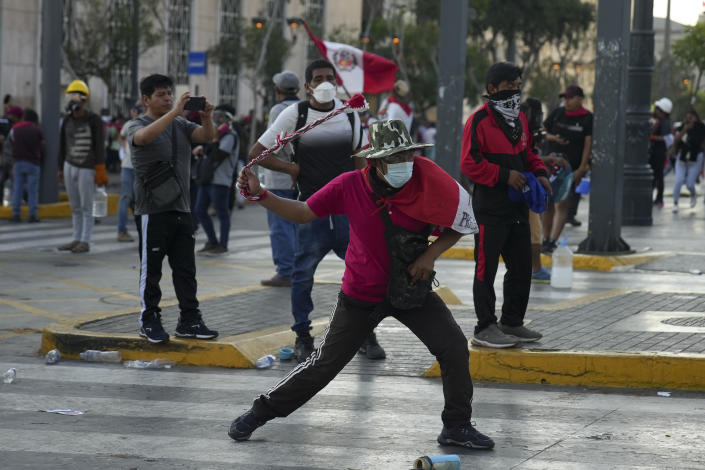
Anti-government protesters clash with police in Lima, Peru, Tuesday, Jan. 24, 2023. Protesters are seeking the resignation of President Dina Boluarte, the release from prison of ousted President Pedro Castillo, immediate elections and justice for demonstrators killed in clashes with police.
 (AP Photo/Guadalupe Pardo)

DANIEL POLITI
Tue, January 24, 2023 

LIMA, Peru (AP) — Thousands of protesters took to the streets of Peru's capital and were met with volleys of tear gas and pellets amid clashes with security forces just hours after President Dina Boluarte called for a “truce” in almost two months of protests.

The antigovernment protest Tuesday was the largest – and most violent — since last Thursday, when large groups of people, many from remote Andean regions, descended on the capital to demand Boluarte’s resignation, immediate elections and the dissolution of Congress.

“We can’t have a truce when she doesn’t’ tell the truth,” Blanca España Mesa, 48, said of Peru's president. Even though her eyes were watering from the tear gas, España Mesa said she was “happy because a lot of people came today. It’s as if people have woken up.”

Before last week, most of the large antigovernment protests that followed the ouster of President Pedro Castillo took place in remote regions of Peru, largely in the country’s south, exposing deep division between residents of the capital and the long-neglected countryside.

The crisis that has sparked Peru’s worst political violence in more than two decades began when Castillo, Peru’s first leader from a rural Andean background, tried to short-circuit the third impeachment proceeding of his young administration by ordering Congress dissolved on Dec. 7. Lawmakers impeached him instead, the national police arrested him before he could find sanctuary and Boluarte, who was his vice president, was sworn in.

Since then, 56 people have died amid the unrest involving Castillo's supporters, 45 of whom died in direct clashes with security forces, according to Peru’s ombudsman. None of the deaths have been in Lima.

On Tuesday, police fired round after round of tear gas as they blocked the passage of protesters, who seemed more organized than before. The smell of tear gas permeated the air and could be felt even a block away as people leaving work suddenly had to cover their faces to try to diminish the sting.

“Murderers,” yelled the protesters, some of whom threw rocks at the police.

Even after most of the protesters had left, police continued firing tear gas to disperse small groups of people in a plaza in front of the country’s Supreme Court.

“I have a right to protest in this country,” Emiliano Merino, 60, said as he was being treated by volunteer paramedics after pellets grazed each of his arms.

Boluarte had earlier called for a truce and blamed protesters for the political violence that has engulfed the country, claiming in a news conference that illegal miners, drug traffickers and smugglers formed a “paramilitary force” to seek chaos for political gain. She said numerous road blockades across the country and damage to infrastructure have cost the country more than $1 billion in lost production.

She suggested that the protesters who died with bullet wounds were shot by other demonstrators, claiming investigations will show their injuries are incompatible with the weapons officers carry. And meanwhile, some 90 police officers are hospitalized with bruises, she said: “What about their human rights?” the president asked.

The government has not presented evidence that any of the injured officers were struck by gunfire.

Human rights advocates say they are dismayed by the lack of international outcry from the regional and global community and are calling for condemnation of the state violence unleashed since Castillo’s impeachment.

Jennie Dador, executive secretary of Peru’s National Human Rights Coordinator, said the lack of international response makes it feel like “we’re alone.”

“None of the states in the region have done anything concrete,” she said.

Boluarte was notably absent from a meeting of regional leaders Tuesday in Argentina’s capital, where most avoided mention of the civilian deaths in Peru.

Human rights activists have acknowledged acts of violence by some protesters — including efforts to take over airports and burn police stations — but say the demonstrations have largely been peaceful.

Some of the leaders at the summit of the Community of Latin American and Caribbean States did blame Peru’s government for the violence.

Chile’s President Gabriel Boric said there’s “an urgent need for a change in Peru because the result of the path of violence and repression is unacceptable.” Mexico’s president, Andrés Manuel López Obrador, a staunch supporter of Castillo, demanded an “end to the repression.”

During the summit’s closing ceremony, Argentina’s President Alberto Fernández called for an end to “street violence and institutional violence that has taken the lives of so many people” in Peru.

“The international community has expressed concern, but really I think it could be more forceful,” said César Muñoz, associate director of the Americas division at Human Rights Watch.

After some feverish closed-door negotiations in Buenos Aires in the afternoon, the situation in Peru was left out of the summit’s closing documents. “Peru is a prickly issue,” but pressure from some leaders had led to last-minute negotiations, said an official in Argentina’s Foreign Ministry, speaking on condition of anonymity for lack of authority to discuss policy.

“Peru has managed to fly under the radar,” said Marina Navarro, executive director of Amnesty International Peru. “Given the gravity of the situation, with this number of people who have died, we don’t see as much said about it as there could be.”

___

Associated Press writers Franklin Briceño in Lima and Almudena Calatrava in Buenos Aires, Argentina, contributed to this report.

Rights groups dismayed at lack of criticism for Peru abuses


1 / 17

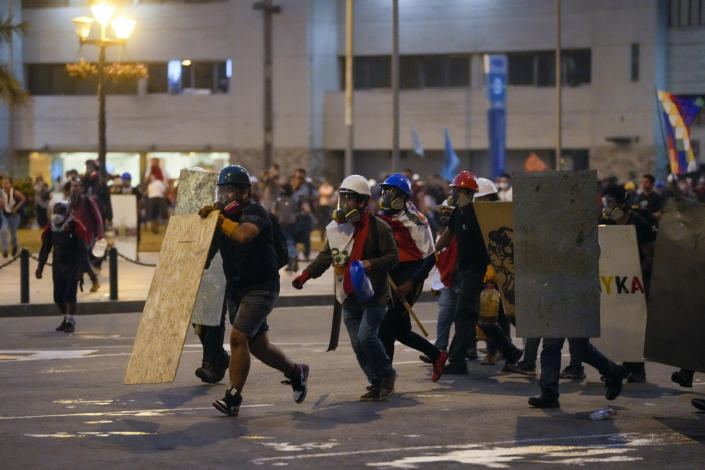
APTOPIX Peru Unrest Police fire tear gas at anti-government protesters in Lima, Peru, Tuesday, Jan. 24, 2023. Protesters are seeking the resignation of President Dina Boluarte, the release from prison of ousted President Pedro Castillo, immediate elections and justice for demonstrators killed in clashes with police. 
(AP Photo/Martin Mejia)

DANIEL POLITI
Tue, January 24, 2023 at 9:30 AM MST


LIMA, Peru (AP) — More than 50 people have died in ongoing street protests in the weeks since Peru's elected leader was jailed, mostly demonstrators at the hands of police officers, but only a few international voices of concern have emerged.

The relative silence of much of the regional and global community has dismayed human rights advocates, who are calling for condemnation of the state violence unleashed since Pedro Castillo was impeached and imprisoned for trying to dissolve Congress.

Tuesday was another day of fury in Peru's capital as thousands of protesters took to downtown Lima and were almost immediately met with volleys of tears gas amid clashes with security forces that often blocked their passage. It was the largest antigovernment protest since Thursday, when large groups of people, many from remote Andean regions, descended on the capital to demand Boluarte’s resignation, immediate elections and the dissolution of Congress.

Previously, most of the large antigovernment protests were in remote regions of Peru, exposing deep divisions between residents of the capital and the long-neglected countryside.

On Tuesday, police often fired round after round of tear gas as the protesters seemed more organized than before and small groups of people tossed canisters back at police although that was not enough to stop their advance. The smell of tear gas permeated the air.

Jennie Dador, executive secretary of Peru’s National Human Rights Coordinator, said the lack of international response makes it feel like “we're alone.”

“None of the states in the region have done anything concrete,” she said.

Peru's new President Dina Boluarte was notably absent from a meeting of regional leaders Tuesday in Argentina's capital, where most avoided mention of the civilian deaths in Peru.

In a defiant news conference on Tuesday, Boluarte called for a “national truce.” She blamed protesters for the political violence that has engulfed the country, claiming illegal miners, drug traffickers and smugglers formed a “paramilitary force” to seek chaos for political gain. She said numerous road blockades across the country and damage to infrastructure have cost the country more than $1 billion in lost production.

She suggested that the protesters who died with bullet wounds were shot by other demonstrators, claiming investigations will show their injuries are incompatible with the weapons officers carry. And meanwhile, some 90 police officers are hospitalized with bruises, she said: “What about their human rights?” the president asked.

The government has not presented evidence that any of the injured officers were struck by gunfire.

Human rights activists have acknowledged acts of violence by some protesters — including efforts to take over airports and burn police stations — but say the demonstrations have largely been peaceful.

Some of the leaders at the summit of the Community of Latin American and Caribbean States did blame Peru's government for the violence.

Chile’s President Gabriel Boric said there's “an urgent need for a change in Peru because the result of the path of violence and repression is unacceptable.” Mexico's president, Andrés Manuel López Obrador, a staunch supporter of Castillo, demanded an “end to the repression.”

During the summit's closing ceremony, Argentina's President Alberto Fernández said his country “is also worried about what is happening in Peru” and called for and end to “street violence and institutional violence that has taken the lives of so many people.”

Activists say this attention is far less than what they would expect considering 56 people have died since Castillo's vice-president was sworn in to replace him on Dec. 7. Forty-five died in direct clashes with security forces, according to Peru’s ombudsman.

“The international community has expressed concern, but really I think it could be more forceful,” said César Muñoz, associate director of the Americas division at Human Rights Watch. Regional leaders could emphasize “that the rule of law means there must be independent investigations of all the deaths.”

The crisis that has sparked Peru's worst political violence in more than two decades began when Castillo, Peru’s first leader from a rural Andean background, tried to short-circuit the third impeachment proceeding of his young administration by ordering Congress dissolved. Lawmakers impeached him instead, and the national police arrested him before he could find sanctuary.

After some feverish closed-door negotiations in Buenos Aires in the afternoon, the current situation in Peru was left out of the summit’s closing documents. “Peru is a prickly issue,” but pressure from some leaders has led to last-minute negotiations, said an official in Argentina’s Foreign Ministry, speaking on condition of anonymity for lack of authority to discuss policy.

“Peru has managed to fly under the radar,” said Marina Navarro, executive director of Amnesty International Peru. “Given the gravity of the situation, with this number of people who have died, we don’t see as much said about it as there could be.”

Boluarte said Tuesday that Castillo had only himself to blame for trying to avoid the numerous corruption investigations he was facing, and suggested that he was trying "to make himself into a victim of a coup when he was the perpetrator of his own coup.”

Questions about Boluarte's sudden rise to power should not impede criticism over police abuses, human rights organizations say.

“There must be international pressure for this government to cease all types of repressive attitudes and that has nothing to do with emitting an opinion about the government’s legitimacy,” said Manuel Tufró, who leads the justice and security division at the Center for Legal and Social Studies, an Argentine human rights organization.

Boluarte’s government has made clear it won’t take any criticism lightly. After law enforcement raided a university in Lima where some of the protesters were taking shelter on Saturday, Colombian President Gustavo Petro tweeted that the Organization of American States must “examine Peru’s case.”

Prime Minister Alberto Otarola fired back, telling Petro to “worry about your own affairs.” Peru’s Foreign Ministry issued formal notes of protest against Petro and Bolivian President Luis Arce, who expressed support for the protests.

The European Union made one of the strongest statements, saying Monday that it “deplores the very large number of casualties since the start of the protests” and reiterates “its condemnation of the widespread acts of violence as well as the disproportionate use of force by security forces.”

The U.S. ambassador in Lima, Lisa Kenna, also surprised many observers earlier this month when she said it is “fundamental for law enforcement to respect human rights, the right to protest and protect the citizenry.”

Some analysts said the tepid regional response points to how Peru has lost prominence due to its political crises, with six presidents over the past six years.

“Peru as a country has lost presence,” said Oscar Vidarte, an international relations professor at the Catholic University of Peru. “It’s a chaotic country, a country that has become ungovernable, questioned in terms of democracy and respect for human life."

"Countries in the region have clearly turned their backs,” Vidarte said.

___

Associated Press writer Almudena Calatrava in Buenos Aires, Argentina, contributed to this report.


Scottish teachers at halfway point in rolling programme of strikes


Katrine Bussey, PA Scotland Political Editor
Tue, 24 January 2023 

Striking teachers will gather outside the cottage where Robert Burns was born as a rolling programme of regional action reaches its halfway point.

As Scots mark the anniversary of Burns’ birth, members of the EIS will be gathering outside Burns Cottage in Alloway in Ayrshire.

Teachers in both South Ayrshire and Edinburgh are taking strike action on Wednesday – as the 16-day programme of strike action being staged by the union reaches its halfway point.

As well as gathering at the famous cottage, educators will take part in a rally in the Scottish capital, to be addressed by EIS general secretary Andrea Bradley.

It comes amid an increasingly entrenched dispute over pay, with unions claiming that the Scottish Government and councils “have little or no interest” in finding the funding required to resolve the matter.

The current offer on the table would see most teachers receive a 5% pay increase, though some lower paid members of staff would get a 6.85% rise.

Teachers have rejected this, with the EIS demanding a 10% rise. However, Scottish First Minister Nicola Sturgeon has insisted there is a “gap” between what teachers are demanding and “what is affordable”.

Ms Bradley, however, said that there “continues to be miscalculation in Scotland of the strength of our members’ resolve” as well as a “misjudgement about the moral and financial unacceptability of another real-terms pay cut for education staff”.

With the EIS having written to the National Education Union to express solidarity with teachers in England and Wales who have voted to take strike action, Ms Bradley said: “It is testament to the strength of feeling of teachers about what is increasingly perceived as Governments’ real contempt for them, dressed up in warm words and sophistry, that in spite of the deliberately restrictive anti-trade union legislation that remains in force, that our respective unions were able to beat the ballot thresholds and achieve industrial action mandates.”

She advised politicians south of the border against “seeking to divide teachers and support staff” in schools on the issue of pay, as she said that “the Scottish Government, for all its claims about its trade union-friendly credentials, is shamefully seeking to do this”.

Scottish Education Secretary Shirley-Anne Somerville said: “Strikes in our schools are in no one’s interest – including for pupils, parents and carers who have already had to deal with significant disruption over the past three years.

“I continue to urge teaching unions to reconsider current industrial action while talks are ongoing.”

She said that four offers had been made to teachers via the Scottish Negotiating Committee for Teachers (SNCT) – which brings together the Scottish Government, local authority leaders in Cosla and trades unions – but these had been rejected.

However Ms Somerville said that the latest offer, if accepted, “would have meant a 21.8% cumulative increase in teacher pay since 2018”.

She insisted: “The union demands for a 10% increase for all teachers – even the highest paid – is not affordable within the Scottish Government’s fixed budget and a more pragmatic approach is needed before we can reach a compromise.

“The Scottish Government values the hard work that our teaching workforce put in for our learners and we remain absolutely committed to ensuring they receive a fair pay deal.

“We remain in talks with unions and hope that these will continue to progress towards a compromise to ensure a sustainable deal for all involved.”
Telefonica raises Spanish workers' wages by 7.8% in 2023


The logo of Spanish Telecom company Telefonica is seen in Madrid


Wed, 25 January 2023 


MADRID (Reuters) - Telefonica has agreed with its main unions to raise 2023 wages for almost 13,000 workers in Spain by 7.8% amid high inflation, the telecoms operator said on Wednesday.

The pay rise includes 6.3% to offset the impact of inflation between 2019 and 2022 and 1.5% in anticipation of consumer price increases in 2023, Telefonica said in a document sent to employees. The pay increase is effective from Jan. 1.

Additionally, workers will get a 300-euro one-off payment in October.

The UGT union confirmed the agreement in a statement.

Telefonica's Spanish unit employs about 16,000 workers. Further negotiations will take place later this year for workers whose contracts are not covered by the agreement, a spokesperson said.

An additional 5,000 employees who work at the company's headquarters in Spain are not part of the pay increase agreement, the spokesperson added.

Spain's inflation rate in 2021 and 2022 hit 6.5% and 5.7% respectively, the highest levels since the early 1990s. That prompted unions to press sometimes reluctant employers for pay raises, resulting in strikes and protests.

In many industries, such as banking and retail, companies have granted significant pay raises.

(Reporting by Inti Landauro; editing by Mark Potter and Jason Neely)