Friday, February 17, 2023

New technology revolutionizes the analysis of old ice

Thanks to a new method developed by researchers at the University of Bern and Empa, greenhouse gas concentrations in 1.5 million year old ice can be measured even more accurately

Peer-Reviewed Publication

UNIVERSITY OF BERN

Drone Footage of the Beyond EPICA Reasearch Camp 

Drone Footage of the Beyond EP [VIDEO] | EurekAlert! Science News Releases

CREDIT: © PNRA/IPEV

Ice cores are a unique climate archive. Thanks to a new method developed by researchers at the University of Bern and Empa, greenhouse gas concentrations in 1.5 million year old ice can be measured even more accurately. The EU project “Beyond EPICA” with the participation of the University of Bern aims to recover such old ice in Antarctica.

The search for the oldest ice on earth has taken an important step forward. The Beyond EPICA – Oldest Ice project, a European consortium that includes the University of Bern, completed its second field season at the end of January. The drilling reached a depth of 808 meters. The project objective is to look back 1.5 million years into the past and obtain data on the development of temperature, the composition of the atmosphere and the carbon cycle. A depth of around 2700 meters must be reached in the Antarctic ice sheet and an ice core recovered. If everything goes as planned, this should be the case in 2025. Only then will the complex analysis of the oldest ice in this core follow, which new methods are currently being developed for.

The University of Bern plays a crucial role in the development of the new analysis technologies. The team led by Hubertus Fischer, professor of experimental climate physics and member of the Oeschger Center for Climate Change Research has succeeded, in collaboration with Empa, in developing a new technique to jointly measure the greenhouse gases carbon dioxide (CO2), methane (CH4) and nitrous oxide (N2O) as well as the carbon isotope composition of CO2. The ice sample needed for this is with a thickness of just one centimeter very small, yet the highest accuracy is possible in the measurement. “These are important prerequisites,” explains Hubertus Fischer, “for obtaining high-precision, high-resolution records from the oldest ice in Beyond EPICA.” In the 1.5 million year old ice, 15,000 to 20,000 years of climate history are compressed into just one meter of ice core, which places completely new demands on ice core analyzes. Ice cores are an extremely important climate archive because only they contain the air of the past to directly measure past greenhouse gas concentrations.

Perfect recycling of precious ice samples

The new method has just been published in the journal Atmospheric Measurement Techniques. The Bern Group worked closely with Empa researchers on the technical development for this. The team led by Lukas Emmenegger, head of Empa’s “Air Pollutants/Environmental Technology” department, developed a new laser spectrometer that can measure greenhouse gases on a sample of just 1.5 milliliters of air. "Achieving this high precision in such small samples was hardly imaginable for a long time. We are proud that this makes it possible to study the valuable ice cores," says Emmenegger. At the University of Bern, in turn, the new sublimation extraction system was devised and built that makes it possible to obtain such small air samples continuously and without contamination from an ice core. Thanks to this pioneering work, says Hubertus Fischer, it will be possible to take greenhouse gas measurements with the necessary precision and temporal resolution in such old ice.

Using the sublimation technique developed in Bern, an ice core sample can be slowly transformed from the top to the bottom from the solid to gaseous state. Individual samples are collected at centimeter resolution by freezing the air at -258°C during the continuous sublimation process. This technique ensures one hundred percent extraction efficiency. Another advantage of the method: the air extracted from the ice samples is not lost during the measurement in the laser spectrometer, instead it can be used for further analyzes afterwards. Hubertus Fischer speaks of “perfect recycling” and says: “The huge amount of work we have to put into the analysis would never be justifiable for an ordinary ice core.” It is for the 1.5 million year old ice though, as this the amount of old ice is extremely limited. Hubertus Fischer received a grant for cutting-edge research from the European Research Council (“ERC Advanced Grant”) as well as project funding from the Swiss National Science Foundation to realize these groundbreaking developments.

Drilling campaign under extreme climatic conditions

Hubertus Fischer is one of the main players in the Beyond EPICA – Oldest Ice project. An analysis of the Beyond EPICA ice core should contribute to a better understanding of the alternation between warm periods and the ice ages. Around a million years ago, there was a dramatic change in this back and forth – as shown by studies of marine sediments. In the time before around 900,000 years ago, ice ages and warm phases alternated every 40,000 years, afterwards only every 100,000 years. Why this change occurred is a mystery, but climate researchers suspect that greenhouse gases, among other things, played a crucial role. This assumption is now to be investigated by the ice core drilling in Antarctica, which goes back almost twice as far as the oldest Antarctic ice core analyzed so far.

In the project’s second drilling season, which has just ended, the international team worked for two months under extreme conditions. There were unforeseen setbacks such as repairs to the drilling system and delays due to poor weather conditions. Drilling was carried out in two shifts in 16-hour operation. The Little Dome C drilling site is located 34 kilometers from the French-Italian Concordia research station. At this expedition base station, the two Bernese researchers Markus Grimmer and Florian Krauss were tasked with cutting the ice cores into transportable pieces using a special saw developed by the University of Bern.

Information about the publication: 

Lars Mächler, Daniel Baggenstos, Florian Krauss, Jochen Schmitt, Bernhard Bereiter, Remo Walther, Christoph Reinhard, Béla Tuzson, Lukas Emmenegger, and Hubertus Fischer, Atmospheric Measurement Techniques: Laser-induced sublimation extraction for centimeter-resolution multi-species greenhouse gas analysis on ice cores, 16, 355-372, 2023,

DOI: 10.5194/amt-16-355-2023

Oeschger Center for Climate Change Research

The Oeschger Center for Climate Change Research (OCCR) is one of the strategic centers of the University of Bern. It brings together researchers from 14 institutes and four faculties. The OCCR conducts interdisciplinary research at the cutting edge of climate change research. The Oeschger Center was founded in 2007 and bears the name of Hans Oeschger (1927-1998), a pioneer of modern climate research, who worked in Bern.

Further information: www.oeschger.unibe.ch

A freshly drilled ice core is measured.

The ice cores cut into pieces are ready for transport to Europe.


CREDIT

© PNRA/IPEV

Sublimation extraction of ice samples, here with the vacuum vessel open. The technique developed at the University of Bern makes it possible to obtain the tiniest air samples continuously and without contamination from an ice core. This will make it possible to take greenhouse gas measurements with the necessary precision and temporal resolution in 1.5 million year old ice.

Prof. Dr. Hubertus Fischer, Physics Institute, Climate and Environmental Physics, and Oeschger Centre for Climate Change Research OCCR, University of Bern

CREDIT

© KUP, Universität Bern


CBD shows promise for reducing cigarette smoking

Peer-Reviewed Publication

WASHINGTON STATE UNIVERSITY

SPOKANE, Wash. – Cannabidiol or CBD, a non-psychoactive component of cannabis, inhibits the metabolism of nicotine, new research has found, meaning it could help tobacco users curb the urge for that next cigarette.

A team led by Washington State University researchers tested the effects of CBD and its major metabolite on human liver tissue and cell samples, showing that it inhibited a key enzyme for nicotine metabolism. For the nicotine-addicted, slowing metabolism of the drug could allow them to wait before feeling the need to inhale more of it along with all the other harmful things found in cigarette smoke.

More research is needed to confirm these effects in humans and determine dosage levels, but these findings show promise, said Philip Lazarus, WSU professor of pharmaceutical sciences.

“The whole mission is to decrease harm from smoking, which is not from the nicotine per se, but all the carcinogens and other chemicals that are in tobacco smoke,” said Lazarus, senior author on the study published in the journal Chemical Research in Toxicology. “If we can minimize that harm, it would be a great thing for human health.”

Cigarette smoking is still a major health problem with one in five people in the U.S. dying every year from smoking-related causes. While often seen as less harmful, many other nicotine delivery methods including vaping, snuff and chew also contain chemicals that can cause cancer and other illnesses.

In this study, the researchers tested CBD and its major metabolite, meaning what it converts to in the body, 7-hyroxycannabidiol, on microsomes from human liver tissue as well as on microsomes from specialized cell lines that allowed them to focus on individual enzymes related to nicotine metabolism.

They found that CBD inhibited several of these enzymes, including the major one for nicotine metabolism, identified as CYP2A6. Other research has found that more than 70% of nicotine is metabolized by this enzyme in the majority of tobacco users. The impact of CBD on this particular enzyme appeared quite strong, inhibiting its activity by 50% at relatively low CBD concentrations.

“In other words, it appears that you don't need much CBD to see the effect,” said Lazarus.

Lazarus’ team is currently developing a clinical study to examine the effects of CBD on nicotine levels in smokers, measuring nicotine levels in their blood versus smokers taking a placebo over the course of six to eight hours. Then, they hope to do a much larger study looking at CBD and nicotine addiction.

In addition to Lazarus, co-authors on the current study include first author Shamema Nasrin, Shelby Coates, Keti Bardhi and Christy Watson of WSU College of Pharmacy and Pharmaceutical Sciences as well as Joshua Muscat of Penn State Cancer Institute. This research was supported by a National Institutes of Health grant.

Tsunami in a water glass

Chemistry

Peer-Reviewed Publication

RUHR-UNIVERSITY BOCHUM

Fabio Novelli, Martina Havenith and Claudius Hoberg 

IMAGE: FABIO NOVELLI, MARTINA HAVENITH AND CLAUDIUS HOBERG (FROM LEFT) WERE ABLE TO OBSERVE THE BIRTH OF AN ELECTRON DISSOLVED IN WATER LIVE IN RESOLV. view more 

CREDIT: © RUB, MARQUARD

So-called hydrated electrons play a major role in many physical, chemical and biological processes. They are not bound to an atom or molecule and are free in the solution. Since they are only ever created as an intermediate product, they are extremely short-lived. The team from the Cluster of Excellence Ruhr Explores Solvation RESOLV at Ruhr University Bochum was able to observe for the first time in a novel experiment how the hydrated electron affects the solution during its lifetime. The researchers led by Professor Martina Havenith-Newen report in the journal Proceedings of the National Academy of Sciences of 15 February 2023.

The simplest anion

"As the simplest anion, hydrated electrons represent a model system that is relevant in a multitude of radical chemical processes", says Martina Havenith-Newen, describing the importance of the study object. "For example, it plays an important role in energy transfer during photo- and electrochemical phenomena, in atmospheric chemistry, in radiation damage of biological substances and in medical therapy." This has earned the hydrated electron the ongoing attention of experimental and theoretical groups for several decades.

RESOLV researchers have set up a novel experiment to follow the formation and temporal evolution of the hydrated electron from the perspective of the solvent: "Immediately after its generation by means of an intense laser beam, we were able to observe a delocalised electron", Martina Havenith-Newen describes. The charge distribution extends over 20 angstroms. Within 500 femtoseconds, the charge is localised and a surprisingly stable localised electron emerges, whose fingerprint in the water network the researchers were able to observe for the first time due to the sensitivity of the experiment in the terahertz range.

"In addition, we could observe a water quake or a tsunami", says Martina Havenith-Newen. The team was able to demonstrate that this phenomenon is caused by the sudden charge separation during the formation of the hydrated electron. In contrast to atomic, negatively charged ions, the water network in the immediate vicinity is looser and not more stable. This means that the individual water molecules in the immediate vicinity of the electron can move more freely than in the water. "This smallest anion therefore takes on a special role", sums up Martina Havenith-Newen.

Cooperation partners

The work was carried out in collaboration with Prof. Dr Teresa Head-Gordon from Berkeley, whose group carried out the molecular dynamics simulations.

Dog puppies spontaneously match human actions, while kittens and wolf pups …not so much…

Puppies - but not kittens and wolf pups - tend to spontaneously imitate human actions, even when they are not rewarded with food (or toys).

Peer-Reviewed Publication

EÖTVÖS LORÁND UNIVERSITY (ELTE), FACULTY OF SCIENCE

Dog nose action matching trial 

IMAGE: THE RESEARCHERS OF THE DEPARTMENT OF ETHOLOGY AT EÖTVÖS LORÁND UNIVERSITY, BUDAPEST, INVESTIGATED WHETHER YOUNG PUPPIES, KITTENS AND WOLF PUPS HAVE DIFFERENT TENDENCIES TO OBSERVE AND IMITATE WHAT A PERSON DID, WITHOUT ANY PRE-TRAINING AND FOOD REWARD. view more 

CREDIT: PHOTO: CLAUDIA FUGAZZA

According to a new study published in Scientific Reports puppies - but not kittens and wolf pups - tend to spontaneously imitate human actions, even when they are not rewarded with food (or toys). The researchers of the Department of Ethology at Eötvös Loránd University (ELTE), Budapest, investigated whether young puppies, kittens and wolf pups have different tendencies to observe and imitate what a person did, without any pre-training and food reward.

Doing what others do in a new situation is a convenient way for young individuals to learn about the world. The tendency to copy the behaviour of others is not only useful to learn new skills or new information, but is also a way of promoting belonging to a social group.

Dogs, cats and wolves differ in their domestication histories and innate sociality,

which may influence their tendency to observe humans and learn socially from them.

The scientists first checked how 42 puppies, 39 kittens and 8 wolf pups, all socialized and living in human families, acted with a novel object placed in a room (e.g., touching it with the nose or paw). Next, while the owner was holding the subject, the experimenter demonstrated a different action on the object. For example, if the subject previously touched the object with its nose, then the experimenter touched it with her hand. Then the researchers observed whether the subject eventually performed the same action on the object.

“Since paying attention to the demonstration is a fundamental requisite for social learning, we first assessed whether the puppies, kittens and wolf pups looked at us when we performed the demonstration”, explains Claudia Fugazza, lead researcher of the group.

“While typically the puppies looked at us almost immediately, it took four-five times longer to get the attention of wolf pups and kittens”.

Puppies and wolf pups replicated the demonstrated actions in ca. 70% of the trials, twice as often as kittens, but only the puppies tended to imitate the action with a body part homologue to the human experimenter (e.g., paw – hand), even if that action differed from the action they performed when they had not observed a demonstration.

“Typically, most subjects touched the object with their nose, when they had not observed a demonstration. However, after observing the experimenter touching the object with her hand, the puppies tended to touch it using their paw”, reports Stefania Uccheddu, co-author of the study. Kittens and wolf pups did not copy the action.

The results seem to support the effect of both investigated factors - inherent sociality and domestication history: “While dogs’ and wolves’ ancestor was a group-living, social animal, with intense within-group cooperation for survival, cats’ ancestor was a solitary hunter”, explains Andrea Temesi, co-author of the study.

“Both, dogs and cats are domesticated species that today live in human families, but the dog was domesticated much earlier than the cat

(between 20000-40000 years vs. 10000 years ago) and dogs were selected for several forms of cooperation with humans. Cats had a different domestication process; they hunted mice and rats in the human environment, but did not have to cooperate or communicate with humans”, continues Márta Gácsi, co-author of the study.

Thus, it is not surprising that only puppies have developed the tendency to pay close attention to people and imitate their actions, even if there is no specific reason for doing so, such as getting food.

These results are intriguing, not only from a theoretical perspective, but also from an applied point of view:

“We believe that our findings can form the basis for the development of novel training methods

that rely on the tendency of puppies to learn by observation and to imitate human actions. This way, dog training can be less dependent on the use of food rewards and more able to take advantage of dogs’ natural propensity for social learning”, concludes Ákos Pogány.


The researchers of the Department of Ethology at Eötvös Loránd University, Budapest, investigated whether young puppies, kittens and wolf pups have different tendencies to observe and imitate what a person did, without any pre-training and food reward.

The researchers of the Department of Ethology at Eötvös Loránd University, Budapest, investigated whether young puppies, kittens and wolf pups have different tendencies to observe and imitate what a person did, without any pre-training and food reward.

CREDIT

Photo: Claudia Fugazza

New UC San Diego model predicts housing prices to fall as much as 18% this year

Study finds internet search data can be used as an early indicator of where the market is going

Peer-Reviewed Publication

UNIVERSITY OF CALIFORNIA - SAN DIEGO

National Housing Price Predictions 

IMAGE: NATIONAL HOUSING PRICE PREDICTIONS view more 

CREDIT: UC SAN DIEGO RADY SCHOOL OF MANAGEMENT

A new model of forecasting home prices based on consumer demand predicts that prices for housing will decrease by 5% nationally and 12% in San Diego County by the end of this year. The model, which highlights online search activity, was recently published in a new study from the University of California San Diego’s Rady School of Management.

The model’s predictions have proved to have accuracy rate of up to 70% and are unique to other price predictors — such as Zillow, Goldman Sachs and Redfin —because those consider a variety of factors like interest rates, wage growth, unemployment and housing supply. Whereas the housing search index created by Allan Timmermann of the Rady School and collaborators at Arhus University in Denmark, focuses on consumer demand by tracking the rate at which prospective buyers use the internet to search for homes.

 “It is one of the purest measures of potential demand that you can get because the first thing you do when you're looking for a house or interested in buying a house, is to go to the internet and look at what is available,” said Timmermann, a distinguished professor of finance at the Rady School. “Those in the market for a home leave a big footprint with their online search activity because of the time it takes – often several months – to find something that is the right fit.”

Cities like San Diego have housing prices dropping more than the national average because it’s where the market overheated the most during the pandemic, Timmermann said.

“What you saw following the lockdowns in March 2020 was that sunshine and suburbs became a big thing,” Timmermann said. “People were shifting to working from home, so they wouldn't have to be located close to the job and then they might cut out of their area altogether, choosing to live somewhere with more space and better weather. San Diego has plenty of suburbs and desirable weather, of course.”

These traits plus limited supply caused prices to skyrocket across the county, but the market has cooled by 2.5% since May of 2022 when prices peaked.

“Many households got priced out of the market so now we are seeing levels adjust,” Timmermann said.

But home prices in other cities are expected to fall even more. Phoenix, AZ, is predicted to have the biggest drop at 18%. Other metropolitan areas where prices are predicted to be on the decline include Stockton-Lodi, CA (down 13%), Las Vegas, NV (down 13%), followed by San Diego and Tucson, AZ. The cities with the most price stability include the metropolitan area of Scranton-Wilkes-Barre-Hazleton, PA and Kansas City, MO both predicted to rise by 2%. Other cities with forecasts of stable prices include Hartford, CT, Harrisburg, PA and Omaha, NE.

Timmermann added that the predictive power of internet searches tends to be a reliable indicator of where the market is going over the short-to-medium term as fluctuations in demand matter more than changes in supply, which tends to be quite stable over shorter horizons.

One major difference between the UC San Diego model for forecasting home prices and other, commercial price predictors is that the data underlying in the housing search index isn’t proprietary. The methodology is fully transparent and replicable as the study, published in Management Science, is public, so anyone can see how it works.

The formula starts with tracking key words such as “buying a house” and related search terms in Google Trends--a free website that analyzes the popularity of top search queries in Google Search. These data are compared to data on home tours and written offers, which allows the researchers to forecast prices in the short and long term.

“The cost of your time and the intensity with which you search and the number of people searching really does reflect the underlying interest in home buying,” Timmermann said. “At the end of the day, the higher the demand, the higher home prices will typically be.”

Coauthors of the Management Science paper include Stig Møller, Thomas Pedersen and Christian Schütte of at Arhus University.

The read the full paper, "Search and Predictability of Prices in the Housing Market," go to this link.  


U$A
Georgia nuclear plant again delayed at cost of $200M more

A nuclear reactor and two cooling towers are shown at Georgia Power's Plant Vogtle nuclear power plant Friday, Jan. 20, 2023, in Waynesboro, Ga. Georgia Power Co. is again delaying the projected startup for two new units at its Vogtle nuclear power plant near Augusta, saying its share of the costs will rise by a projected additional $200 million. (AP Photo/John Bazemore)

ATLANTA (AP) — Georgia Power Co. has again delayed the projected startup for two new units at its Vogtle nuclear power plant near Augusta, saying its share of the costs will rise by an additional $200 million.

Southern Co., the utility’s Atlanta-based parent, announced the delays and higher costs on Thursday as it announced its yearly corporate earnings for 2022.

Georgia Power says Unit 3 could now begin commercial operation in May or June, pushing back from the most recent deadline of the end of April. The company also now says Unit 4 will begin commercial operation sometime between this November and March 2024. The company previously has promised commercial operation of Unit 4 by the end of 2023 at the latest. When complete, the two units will be the first entirely new U.S. reactors in decades.

Georgia Power wrote off $201 million in additional costs on its earning statement, reflecting increased costs.

Despite the Vogtle delays, Southern Co. still announced strong revenue and profits. The company reported profits of $3.5 billion for the year, or $3.28 per share.

The total cost of the project to build a third and fourth reactor at Vogtle will cost all its owners more than $30 billion. Georgia Power owns 45.7% of the project, while Oglethorpe Power Corp. owns 30%, the Municipal Electric Authority of Georgia owns 22.7% and the city of Dalton owns 1.6%.

Georgia Power had already pushed back the startup of Unit 3 by a month after it discovered that a pipe that is part of a critical backup cooling system was vibrating during startup testing. Construction workers had failed to install supports called for on blueprints. Those supports have now been installed, the company said Thursday, but Southern Co. Chairman and CEO Tom Fanning told investors that “we found a few additional issues to address.”

“We will continue to take the time to get it right and will not sacrifice safety or quality to meet the schedule,” Fanning told investors on a conference call Thursday.

Fanning told investors that other issues causing delays included a slowly dripping valve that required a now-completed repair, as well as a problem involving the flow through the reactor coolant pumps that hasn’t been pinpointed.

The utility said the Unit 3 reactor is now likely to reach a self-sustaining nuclear reaction, a stage called criticality, in March or April. That’s the last major waypoint before commercial operation.

The company said it was also pushing back its completion dates for Unit 4, citing slower-than-planned testing.

Georgia Power says it will now spend a projected $10.6 billion on construction costs, not counting some financing costs. That’s projected to include $407 million in costs that Georgia Power has assumed from the other owners, after all three sued to force the company to honor a cost-sharing agreement. Georgia Power has settled its lawsuit with MEAG, but the suits with Oglethorpe and Dalton are still ongoing. The company warned it could have to pay those two co-owners another $345 million in the dispute.

Ratepayers at Georgia Power and some cooperatives served by Oglethorpe are already paying for Vogtle, and most electric customers in Georgia, as well as in parts of Alabama and Florida, will eventually be charged.

The effects of the further delay on ratepayers are unclear. Georgia Power has signaled it may not request to be repaid for more than $7.3 billion in capital costs and about $400 million in financing, but could ask for more. The Georgia Public Service Commission, a five-member e
SAVE THE WHALES
NJ uses new law to bypass local OK for offshore wind project

BY WAYNE PARRY

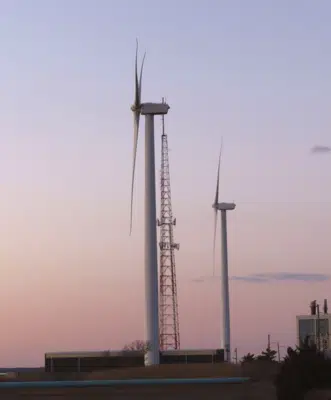
Land-based wind turbines generate power for a sewage treatment plant in Atlantic City, N.J. on Feb. 10, 2022. On Feb. 17, 2023, the New Jersey Board of Public Utilities used a provision of state law to supersede local authorities and grant approvals toward several easements and environmental permits to an offshore wind power project to be built off the coast of southern New Jersey. (AP Photo/Wayne Parry)

OCEAN CITY, N.J. (AP) — New Jersey utility regulators used a controversial law Friday enabling them to bypass local authorities and grant approvals needed for an offshore wind project to proceed.

The state Board of Public Utilities granted Orsted, the Danish wind energy developer, approvals toward several easements and permits that authorities in Cape May County had refused to grant the company.

They used an amendment to New Jersey’s offshore wind law passed in 2021 and signed into law by Democratic Gov. Phil Murphy removing most local control over where offshore wind projects come ashore. The law enables an offshore wind developer to apply to the utilities board for an order superseding local control over such projects.

“I just want to assure the public that we don’t take these kinds of actions lightly,” said Joseph Fiordaliso, the board’s president. “There has to be a definite public need for the board to even consider this kind of action. This is something that the majority of us believes will benefit the citizens of New Jersey.”

Fiordaliso said the route of the proposed transmission line will not harm Ocean City or Cape May County aesthetically or economically. The power cable will run from wind turbines that the company says will be located 15 miles offshore and come ashore in Ocean City, where it will run underground along existing roadways and connect to the electrical grid at the site of the former B.L. England power plant in Upper Township.

NJ groups fight power plants, wait for environmental law


The vote marked the second time the board acted under the amended law to grant approvals to Orsted when local officials had refused to do so. In Sept. 2022, the board granted the company an order superseding the authority of Ocean City in granting numerous wetlands and other environmental approvals for the same project.

Commissioner Dianne Solomon voted against the measure Friday, calling it “clearly a contentious matter,” adding she believes the board erred in overriding Ocean City’s authority in September.

“We should be seeking more information, not less,” she said.

In its petition to the board, Ocean Wind said it had tried numerous times to obtain approvals directly from Cape May County officials.

“After all the discussions, meetings, and letters exchanged by Ocean Wind and Cape May County, there has been no indication that the county will voluntarily provide Ocean Wind with any of the necessary approvals or consents for environmental permitting, or the required easements,” the applicants wrote.

The project, one of three approved so far for the waters off southern New Jersey, still needs numerous additional state and federal approvals.

The law angered many Jersey Shore communities and residents who objected to their leverage over offshore wind projects being taken away. But state lawmakers defended the law as necessary to ensure that such projects can be completed and help New Jersey move away from the burning of fossil fuels to generate energy.

Officials with Cape May County and Orsted did not immediately respond to requests for comment Friday.

The most commonly voiced objections from opponents include the unknown effect hundreds or even thousands of wind turbines might have on the ocean, fears of higher electric bills as costs are passed on to consumers, and a sense that the entire undertaking is being rushed through with little understanding of what the consequences might be.

Recently, offshore wind opponents have seized on the deaths of ten whales that have washed ashore in New Jersey and New York since December to demand investigations into whether ocean floor preparation work for offshore wind projects caused the animals’ deaths. The most recent death came Friday in New York’s Rockaway Beach.

Two Republican Congressmen from New Jersey said Friday they are introducing legislation to pause work on all current offshore wind projects, prohibit future ones, and investigate the environmental approval process for such projects.

But the National Oceanic and Atmospheric Administration and the and the Bureau of Ocean Energy Management said last month there is no evidence that offshore wind projects have had anything to do with the whale deaths.

“I want to be unambiguous: There is no information supporting that any of the equipment used in support of offshore wind development could directly lead to the death of a whale,” Benjamin Laws, deputy chief for permits and conservation with NOAA Fisheries Office of Protected Resources, said during a Jan. 18 media briefing. “There are no known connections between any offshore wind activities and any whale strandings.”

___

Follow Wayne Parry on Twitter at www.twitter.com/WayneParryAC
BUSH CHENEY PHONY WAR
Tikrit: 20 years since the US invasion, what has become of Saddam Hussein’s birthplace?

• FRANCE 24
US Sanitation firm fined $1.5mn for illegally hiring children

Issued on: 17/02/2023 - 18:56

Washington (AFP) – A sanitation company in the United States has paid $1.5 million in penalties for hiring over 100 children in "hazardous occupations" and having them work at meat processing facilities, the Department of Labor said Friday.

Officials found that the food sanitation contractor, Packers Sanitation Services, had employed at least 102 children aged between 13 and 17, and had them working overnight shifts at 13 facilities in eight states.

"Children were working with hazardous chemicals and cleaning meat processing equipment including back saws, brisket saws and head splitters," said the Labor Department in a statement.

At least three minors had sustained injuries while working for the company, the statement added.

The facilities are run by major meat-processing companies, including Tyson, JBS Foods and Cargill, according to investigations.

These companies were not fined.


The penalties followed an investigation that started in August 2022.

"The child labor violations in this case were systemic... and clearly indicate a corporate-wide failure," said Labor Department official Jessica Looman.

She told reporters that officials have seen about a 50 percent increase in child labor violations since 2018.

"These children should never have been employed in meat packing plants and this can only happen when employers do not take responsibility to prevent child labor violations from occurring in the first place," she added.

The fines come as some states are looking to ease child labor protections to help companies with a labor crunch find more workers, with bills introduced in Iowa and Minnesota.

© 2023 AFP
NASA, Boeing target April for manned Starliner test flight

By Clyde Hughes

A Boeing Starliner spacecraft sits on top of the United Launch Alliance Atlas V rocket as it is prepared for launch from Complex 41 at the Cape Canaveral Space Force Station in Florida on May 18. Its first manned flight is expected in April. 
Photo by Joe Marino/UPI | License Photo

Feb. 17 (UPI) -- NASA and Boeing said Friday they aim to launch the first manned test flight mission of the CST-100 Starliner to the International Space Station in April.

The long-awaited Starliner, described as the "next generation" spacecraft has been highly anticipated to add a needed transportation option to the orbiting laboratory, along with other missions. The launch had been planned for February after being pushed back from last fall.

Steve Stich, manager, of NASA's Commercial Crew Program, acknowledged at a joint news conference that several things will have to fall into place to keep that time frame.

Two dockings are scheduled to take place at the space station ahead of the Starliner, he said. Anticipating those go well, there are still Earth-bound challenges such as the weather.

RELATED James Webb Telescope gives scientists unprecedented view of nearby galaxies

"We still have a pretty good plan [for launch] and we're sticking to it," said Mark Nappi, vice president and program manager at Boeing. "We look at five different areas to judge our progress and measure ourselves."

He said those areas include hardware, software, mission operation and engineering products. He said many of the areas are in their final stages.

"We have a line of sight to get to our mission time frame and get through our reviews," Nappi said. "We're looking really good."


Jeff Arend, manager of the systems and engineering and integration office for NASA's International Space Station Program, said the mission is critical from a certification standpoint and gets more flights going to and from the space station.

The Starliner is expected to launch from Cape Canaveral Space Force Station in Florida and return eight days later in White Sands, N.M.

NASA astronaut test pilots Barry "Butch" Wilmore and Suni Williams will fly the Starliner and test the end-to-end capabilities of the Starliner system. In Williams, the launch will also mark the first time in history that a woman will be a crewmember of the first crewed orbital flight of a new spacecraft type
.
RELATED SpaceX wins another $1.4 billion from NASA to fly missions to Int'l Space Station

Stich said Wilmore and Williams are "excited" about the mission and are going though simulations to continue to prepare for the test flight. He said they have had dressing rehearsals for docking and landing.


TEST BOT ROSIE ROCKETEER

"Butch and Suni are very excited about flying this mission," he said, adding they will be reviewing how cargo gets stored.

If successful, the Starliner will start the final certification process for it to be making regular flights to the ISS.

During the uncrewed orbital launch last May, Nappi said there was an issue with thrusters being "deselected" by sensors. He said some minimal tweaks were done to correct that issue, and NASA believes some debris caused the sensor issue but it's unknown what the debris was.