Tuesday, October 17, 2023


Enhancing the safety and efficacy of drone flights in polar regions
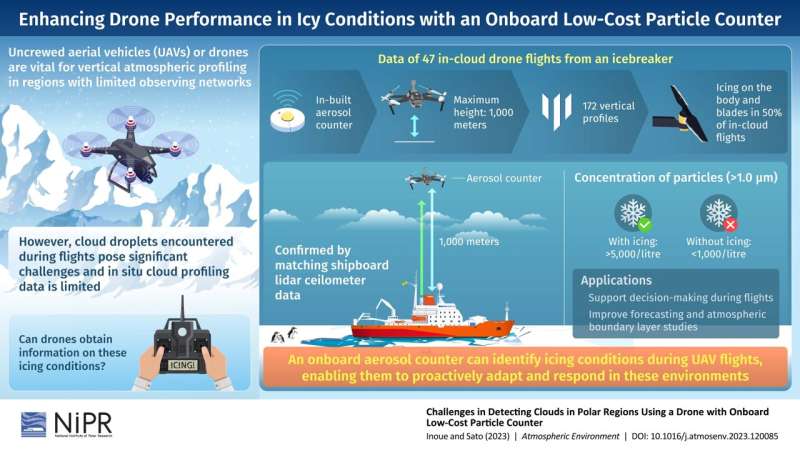

Scientists devise onboard particle counters that enable real-time detection of icing conditions by drones


Peer-Reviewed Publication

RESEARCH ORGANIZATION OF INFORMATION AND SYSTEMS

Enhancing drone performance in icy conditions with an onboard low-cost particle counter 

IMAGE: 

AN ONBOARD AEROSOL COUNTER CAN IDENTIFY ICING CONDITIONS DURING DRONE FLIGHTS, ENABLING THEM TO ADAPT AND RESPOND IN THESE EXTREME ENVIRONMENTS

view more 

CREDIT: @ JUN INOUE FROM NATIONAL INSTITUTE OF POLAR RESEARCH, JAPAN


Collecting accurate weather data in remote and challenging environments like the polar regions and mountains can be extremely difficult. These areas often lack the infrastructure and resources needed for traditional weather stations, and the harsh weather conditions can make it dangerous for humans to access and maintain these stations.

Drones can navigate these challenging terrains, gather data, and transmit it to researchers, making them an indispensable tool for addressing these data gaps. Unfortunately, in-cloud flights still pose a challenge, with icing from supercooled cloud droplets that can damage vital drone components, rendering them inoperable.

To solve this problem, Drs. Jun Inoue and Kazutoshi Sato from the National Institute of Polar Research, Japan, came together to devise a creative solution: they integrated onboard aerosol counters into a group of drones used during the Japanese Antarctic Research Expedition of 2022/2023. The study was made available online on 16 September 2023 and is set to be published in Volume 314 of Atmospheric Environment on 1 December 2023.The scientists used the aerosol counters, which are typically used to measure the concentration of particles in the air, to detect the presence of clouds during drone flights.

"Under usual conditions in our expedition, we typically observe concentrations of fewer than a thousand particles per liter," explained Dr. Jun Inoue. "However, when we encounter icing conditions, we see concentrations of 5,000 particles per liter or even higher." This change enables the drones to promptly detect and respond to hazardous conditions in real-time.

During meteorological vertical profiling, which involves the information of atmospheric conditions at different altitudes, the drones do not need to travel far horizontally, making it easier to decide when to descend in icing conditions. The aerosol counter plays a pivotal role in this scenario, as it empowers drone operators to make informed decisions promptly. 

To further confirm the reliability of this method, the scientists compared the counters’ observations with data collected from a shipboard lidar ceilometer. The ceilometer provides critical information about cloud properties, such as their height and whether they consist of water or ice. The authors examined the attenuated backscatter coefficient, which indicates how light bounces off the clouds, and were able to establish a clear connection between the increased particle counts detected by the aerosol counter based on 47 in-cloud flights and the presence of supercooled liquid clouds.

The counters successfully detect icing conditions among half of the in-cloud flights, which reached heights of approximately 1,000 meters above the sea level. This information helped the drones avoid flying through dangerous icing conditions.

Drones can be a valuable tool for studying the atmosphere, especially in places like the polar regions, and these findings can improve our understanding of clouds and weather. “With continued innovation and collaboration, drones can revolutionize meteorological research, ultimately benefiting our comprehension of clouds, weather, and their broader implications," Dr. Inoue concludes.


###

About National Institute of Polar Research, Japan

Founded in 1973, the National Institute of Polar Research (NIPR) is an inter-university research institute that conducts comprehensive scientific research and observations in the polar regions. NIPR is one of the four institutes constituting the Research Organization of Information and Systems (ROIS) and engages in comprehensive research via observation stations in the Arctic and Antarctica. It strives to promote polar science by soliciting collaboration research projects publicly, as well as by providing samples, materials, and information. NIPR plays a special role as the only institute in Japan that comprehensively pursues observations and research efforts in both the Antarctic and Arctic regions.

Website: https://www.nipr.ac.jp/english/index.html


About Associate Professor Jun Inoue from National Institute of Polar Research, Japan

Dr. Jun Inoue obtained his master’s and PhD degrees from Hokkaido University, Japan, in 1999 and 2001, respectively. He currently serves as an Associate Professor at the National Institute of Polar Research. His research interests lie in the fields of atmospheric and hydrosphere science, particularly in the Arctic and Antarctic regions. He has published over 100 papers on these topics and has received awards from the Japan Meteorological Society on three occasions.


About the Research Organization of Information and Systems (ROIS)

ROIS is a parent organization of four national institutes (National Institute of Polar Research, National Institute of Informatics, the Institute of Statistical Mathematics and National Institute of Genetics) and the Joint Support-Center for Data Science Research. It is ROIS's mission to promote integrated, cutting-edge research that goes beyond the barriers of these institutions, in addition to facilitating their research activities, as members of inter-university research institutes.


Climate network analysis helps pinpoint regions at higher risk of extreme weather


Tracking climate behavior could connect the dots between major weather events and help with forecasting on a global scale


Peer-Reviewed Publication

AMERICAN INSTITUTE OF PHYSICS

Structure of teleconnections as depicted within the climate network 

IMAGE: 

THE STRUCTURE OF TELECONNECTIONS AS DEPICTED WITHIN THE CLIMATE NETWORK.

view more 

CREDIT: SHANG WANG, JUN MENG, AND JINGFANG FAN


WASHINGTON, Oct. 17, 2023 – Climate change and the rapid increase in frequency of extreme weather events around the globe – such as wildfires and floods – reinforces the reality that these events are not only not random but, rather, interconnected. Interlinked climate behavior, or teleconnections, isn’t a well understood field but will be necessary to fully comprehend how our climate system works.

In Chaos, from AIP Publishing, a team of researchers affiliated with Beijing Normal University and Beijing University of Posts and Telecommunications in China and the Potsdam Institute for Climate Impact Research in Germany describes a climate network analysis method to explore the intensity, distribution, and evolution of teleconnections.

“Teleconnections describe how climate events in one part of the world can affect weather thousands of kilometers away,” said co-author Jingfang Fan of Beijing Normal University and the Potsdam Institute for Climate Impact Research. “Think of it as a domino effect on a global scale.”

And then there’s global warming – the Earth is becoming hotter. “Within just five years, we may see temperatures rising to levels that global scientists have been warning us about,” said Fan. “It’s like the planet is running a fever that’s steadily getting worse.”

Climate networks are akin to maps where data points are marked as locations, and the connections between them reveal similarities.

The researchers’ climate network analysis method combines the directions and distribution patterns of teleconnections to evaluate their intensity and to identify sensitive regions using global daily surface air temperature data. Their method relies on advanced data processing and mathematical algorithms to find meaningful insights.

“Our work uncovered patterns in climate events driven mainly by atmospheric Rossby waves, which are large inertial planetary waves that naturally occur in rotating fluids and cause movement within the atmosphere,” said Fan.

The team identified areas significantly affected by these interconnected events, within regions like southeastern Australia and South Africa, which are particularly sensitive. One fascinating discovery they made is that these interconnections are becoming stronger over time, from 1948 to 2021, possibly due to a mix of climate change, human activities, and other factors. The extent and intensity of the impact of teleconnections has increased more prominently in the Southern Hemisphere during the past 37 years.

This work provides a new way to measure and explore climate teleconnections. The researchers plan to use this knowledge to pinpoint which regions may be at a higher risk in the future and to devise strategies to address these challenges.

“The next step is like weather forecasting – but on steroids,” said Fan. “Using what we’ve learned, we plan to predict how climate events will unfold and connect. We’re diving deep to explore why these events happen and how various climate ‘tipping points’ within our climate system might be linked.”

###

The article “Exploring the intensity, distribution, and evolution of teleconnections using climate network analysis” is authored by Shang Wang, Jun Meng, and Jingfang Fan. It will appear in Chaos on Oct. 17, 2023 (DOI: 10.1063/5.0153677). After that date, it can be accessed at https://doi.org/10.1063/5.0153677.

ABOUT THE JOURNAL

Chaos is devoted to increasing the understanding of nonlinear phenomena in all areas of science and engineering and describing their manifestations in a manner comprehensible to researchers from a broad spectrum of disciplines. See https://pubs.aip.org/aip/cha.

###


Study reveals our European ancestors ate seaweed and freshwater plants


For many people seaweed holds a reputation as a superfood, heralded for its health benefits and sustainability, but it appears our European ancestors were ahead of the game and were consuming the nutrient-rich plant for thousands of years.

Peer-Reviewed Publication

UNIVERSITY OF YORK

Tomb of the Eagles 

IMAGE: 

THE STONE BUILDING IS ISBISTER IN ORKNEY, ALSO KNOWN AS TOMB OF THE EAGLES WHERE SOME OF THE SEAWEED SAMPLES ANALYSED IN THE STUDY CAME FROM.

view more 

CREDIT: PROFESSOR KAREN HARDY


For many people seaweed holds a reputation as a superfood, heralded for its health benefits and sustainability, but it appears our European ancestors were ahead of the game and were consuming the nutrient-rich plant for thousands of years.

Researchers say they have found “definitive” archaeological evidence that seaweeds and other local freshwater plants were eaten in the mesolithic, through the Neolithic transition to farming and into the Early Middle Ages, suggesting that these resources, now rarely eaten in Europe, only became marginal much more recently.

The study, published in Nature Communications, reveals that while aquatic resources were exploited, the archaeological evidence for seaweed is only rarely recorded and is almost always considered in terms of non-edible uses like fuel, food wrappings or fertilisers.

Historical accounts report laws related to collection of seaweed in Iceland, Brittany and Ireland dating to the 10th Century, while sea kale is mentioned by Pliny as a sailor’s anti-scurvy remedy.

By the 18th Century seaweed was considered as famine food, and although seaweed and freshwater aquatic plants continue to be economically important in parts of Asia, both nutritionally and medicinally, there is little consumption in Europe.

The team, led by archaeologists from the universities of Glasgow and York, examined biomarkers extracted from dental calculus from 74 individuals from 28 archaeological sites across Europe, from north Scotland to southern Spain, which revealed “direct evidence for widespread consumption of seaweed and submerged aquatic and freshwater plants.”

Samples where biomolecular evidence survived revealed consumption of red, green or brown seaweeds, or freshwater aquatic plants, with one sample from Orkney also containing evidence for a Brassica, most likely sea kale. 

There are approximately 10,000 different species of seaweeds in the world, however only 145 species are eaten today, principally in Asia. 

The researchers hope that their study will highlight the potential for including more seaweeds and other local freshwater plants in our diets today - helping Europeans to become healthier and more sustainable.

Karen Hardy,  Professor of Prehistoric Archaeology at the University of Glasgow and Principal Investigator of the Powerful Plants project, said: “Today, seaweed and freshwater aquatic plants are virtually absent from traditional, western diets and their marginalisation as they gradually changed from food to famine resources and animal fodder, probably occurred over a long period of time, as has also been detected elsewhere with some plants.  

“Our study also highlights the potential for rediscovery of alternative, local, sustainable food resources that may contribute to addressing the negative health and environmental effects of over-dependence on a small number of mass-produced agricultural products that is a dominant feature of much of today’s western diet, and indeed the global long-distance food supply more generally.”

“It is very exciting to be able to show definitively that seaweeds and other local freshwater plants were eaten across a long period in our European past.”

Co author on the paper, Dr Stephen Buckley, from the Department of Archaeology at the University of York, said “The biomolecular evidence in this study is over three thousand years earlier than historical evidence in the Far East. 

“Not only does this new evidence show that seaweed was being consumed in Europe during the Mesolithic Period around 8,000 years ago when marine resources were known to have been exploited, but that it continued into the Neolithic when it is usually assumed that the introduction of farming led to the abandonment of marine dietary resources. 

“This strongly suggests that the nutritional benefits of seaweed were sufficiently well understood by these ancient populations that they maintained their dietary link with the sea.”


BIRDS NEST SOUP

Mimicking a bird’s sticky spit to create cellulose gels


Peer-Reviewed Publication

NORTH CAROLINA STATE UNIVERSITY


Using a small bird’s nest-making process as a model, researchers from North Carolina State University have developed a nontoxic process for making cellulose gels. The freeze-thaw process is simple, cost-effective, and can create cellulose gels that are useful in a number of applications, including tunable gels for timed drug delivery. The process also works with bamboo and potentially other lignin-containing plant fibers.

Cellulose is a wonderful material for making hydrogels – which are used in applications ranging from contact lenses to wound care and drug delivery. But creating hydrogels from cellulose is tricky, and often the processes used to create the hydrogels are themselves toxic.

“Normally, you have to first dissolve the cellulose and then induce it to crosslink or form the structure of interest, which often requires the use of difficult to handle, unstable, or toxic solvents,” says Lucian Lucia, professor of forest biomaterials and chemistry at NC State and co-corresponding author of the work.

Enter the Swift family of birds – small birds who use their saliva to hold twigs in place when building their nests.

“My then Ph.D. student Zhen Zhang noted that when birds do this, the saliva acts like a natural resin that holds the nest together and encourages the fibers within the nest to interconnect or crosslink,” Lucia says. “Which is exactly what we want the dissolved cellulose to do when making hydrogels. So we asked ourselves, ‘what if we mimic the birds?’”

Zhang, currently a postdoc at Texas Tech University, is a co-corresponding author.

The researchers added a water soluble cellulose called carboxymethyl cellulose (CMC) to an acid solution and dissolved the CMC. Then they added powdered cellulose fiber to the solution and subjected it to four rounds of freezing and thawing. The result was cellulose gel.

“Think of it as adding a thickener to water, like you would a pie filling,” Lucia says. “By changing the pH of the CMC, the water essentially becomes sticky. Freezing and thawing the solution causes the cellulose to compact and interweave itself into the sticky network, giving you a more organized structure, just as Swifts do when they create their nests. Only we don’t have to use beaks and saliva to do it.”

Freeze drying the gels resulted in cellulose foam. The researchers repeated the process with bamboo fibers as well, which suggests that it could be useful with many other lignin and cellulose containing fibers.

“The cellulose gels are robust, stable at room temperature and can be tuned to degrade on a schedule, so would be useful in drug delivery applications, among others,” Lucia says. “This opens a promising new window for using biomimicry to process these insoluble cellulosic materials in a greener way.”

The work appears in Advanced Composites and Hybrid Materials. Noureddine Abidi of Texas Tech University is a co-corresponding author of the work.

-peake-

Note to editors: An abstract follows.

“A ‘bird nest’ bioinspired strategy deployed for inducing cellulose gelation without concomitant dissolution”

DOI: 10.1007/s42114-023-00745-x

Authors: Zhen Zhang, North Carolina State University and Texas Tech University; Noureddine Abidi, Texas Tech University; Lucian A. Lucia, North Carolina State University; Siyi Yu, University of New Mexico, Albuquerque
Published: Sept. 29, 2023 in Advanced Composites and Hybrid Materials

Abstract:
Albeit the abundance, renewability, and biodegradability of the polymer known as cellulose, the insolubility and poor dispersibility in most common organic solvents make it incredibly difficult to facilitate conversion into hydrogels without concomitant dissolution. It is known that Swift family birds construct strong and sturdy nests with saliva that acts to bind fibers and twigs. Inspired by this charming hierarchical architecture, protonated carboxymethyl cellulose and cellulose were exploited as “saliva” and “twigs,” respectively, and by a combination of freeze–thaw treatments, cellulose hydrogels can be successfully induced without pre-dissolution representing a striking advancement over what is currently known or predicted. The gel materials displayed considerable increases in storage modulus, viscoelastic behaviors, and thermal stability as the cellulose content increases and exhibited unique omniphilic behaviors. Moreover, this bioinspired strategy is much more universal than originally surmised as found by the gelation of bamboo fibers (additionally containing lignin and hemicellulose), illustrative of the versatility. As a bio-inspired strategy, the current work is the first report on a straightforward, simple, green, yet effective gelation protocol to prepare cellulose-based soft materials.


AI models identify biodiversity from animal sounds in tropical rainforests


Peer-Reviewed Publication

UNIVERSITY OF WÜRZBURG

Ecuador Rainforest Birds 

IMAGE: 

THE BANDED GROUND COCOO (NEOMORPHUS RADIOLOSUS, LEFT) AND THE PURPLE CHESTED HUMMINGBIRD (POLYERATA ROSENBERGI) ARE AMONG THE BIRDS RECORDED IN TROPICAL REFORESTATION PLOTS IN ECUADOR.

view more 

CREDIT: JOHN ROGERS / MARTIN SCHAEFER


Tropical forests are among the most important habitats on our planet. They are characterised by extremely high species diversity and play an eminent role in the global carbon cycle and the world climate. However, many tropical forest areas have been deforested and overexploitation continues day by day.

Reforested areas in the tropics are therefore becoming increasingly important for the climate and biodiversity. How well biodiversity develops on such areas can be monitored very well with an automated analysis of animal sounds. This was reported by researchers in the journal Nature Communications.

Recordings on Former Cocoa Plantations and Pastures

As part of the DFG research group Reassembly, the team worked in northern Ecuador on abandoned pastures and former cacao plantations where forest is gradually reestablishing itself. There, they investigated whether autonomous sound recorders and artificial intelligence (AI) can be used to automatically recognise how the species communities of birds, amphibians and mammals are composed.

"The research results show that the sound data reflect excellently the return of biodiversity in abandoned agricultural areas," Professor Jörg Müller is pleased to say. The head of the Ecological Station Fabrikschleichach at Julius-Maximilians-Universität (JMU) Würzburg and his colleague Oliver Mitesser were in charge of the study.

Overall it is particularly the communities of vocalizing species that mirrors the recolonisation very well – because the communities follow strictly the recovery gradients. A preliminary set of 70 AI bird models was able to describe the entire species communities of birds, amphibians and some calling mammals. Even the changes in nocturnal insects could be meaningfully correlated with them.

AI Models are Being Further Refined

The team is currently working on further improving the AI models used and expanding the set of models. The goal is to be able to automatically record even more species. The models are also to be established in other protected areas in Ecuador, the Sailershausen JMU Forest and in Germany's oldest national park in the Bavarian Forest.

"Our AI models can be the basis for a very universal tool for monitoring biodiversity in reforested areas," says Jörg Müller. The Würzburg professor sees possible applications, for example, in the context of certifications or biodiversity credits. Biodiversity credits function similarly to carbon dioxide emissions trading. They are issued by projects that protect or improve biodiversity. They are purchased by companies or organisations that want to compensate for negative impacts of their activities.

Sponsors and Participants

The study was realised within the framework of the research group Reassembly, which is funded by the German Research Foundation (DFG).

In addition to the JMU researchers, the ornithologist Dr. Martin Schaefer, managing director of the nature conservation foundation Jocotoco, and Professor Nico Blüthgen from the Technical University of Darmstadt – who is the spokesperson of the DFG research group and a JMU alumnus – were also involved. Sound expert Professor Zuzana Burivalova from the University of Madison (USA) and the company Rainforest Connection, which specialises in AI models for tropical bird detection, also contributed.

The research areas of the sound study are located in the north of Ecuador.

CREDIT

Constance Tremlett


Orchid without bumblebee on island finds wasp, loses self


Peer-Reviewed Publication

KOBE UNIVERSITY

Orchid evolution visual abstract 

IMAGE: 

THE RELATIONSHIP BETWEEN ORCHIDS AND THEIR POLLINATORS IS OFTEN HIGHLY EXCLUSIVE BECAUSE THEIR PHYSICAL FEATURES CLOSELY MATCH EACH OTHER. ON MAINLAND JAPAN, ONLY A SPECIFIC BUMBLEBEE CAN POLLINATE GOODYERA HENRYI’S LONG FLOWER TUBE WITH ITS LONG MOUTHPARTS (TOP RIGHT). ITS CLOSE RELATIVE GOODYERA SIMILIS HAS A SHORT FLOWER TUBE AND IS POLLINATED BY A WASP WITH SHORTER MOUTHPARTS (MIDDLE RIGHT). ON A REMOTE ISLAND, WHERE ONLY WASPS BUT NO BUMBLEBEES EXIST (MAP, HIGHLIGHTED IN RED), BOTH FLOWERS ARE POLLINATED BY THE WASP (BOTTOM RIGHT). HOWEVER, FOR GOODYERA HENRYI THIS CAME AT THE COST OF HYBRIDIZATION WITH GOODYERA SIMILIS AND THUS IT LOST SOME OF ITS SPECIES IDENTITY.

view more 

CREDIT: ANSAI SHUN


Because the bumblebee that an orchid relies on for pollination does not exist on a remote island, the plant gets pollinated by an island wasp. Kobe University researchers found that this came at the cost of being hybridized with another orchid species adapted to being pollinated by the wasp. The finding showcases how plants in ecological relationships adapt to changing circumstances.
 
Remote islands have been exciting study grounds for biologists since at least the days of Darwin. When studying ecological relationships between different species, the differences between mainland and island can hint at how such relationships evolve and what this means for the participating species. This is what piqued plant scientists’ curiosity when they discovered Goodyera henryi, an orchid which on mainland Japan is pollinated exclusively by a very specific bumblebee, on remote Japanese Kozu Island where the bumblebee doesn’t exist.

For Kobe University Professor SUETSUGU Kenji this fit perfectly into his long-term effort to understand the dynamics of island biology and evolutionary processes. The orchid specialist says: “The combination of our expertise, access to the location, and our interdisciplinary methodology puts us in a special position to study the impact of bumblebee absence on orchid evolution in this context.” With his team he studied the pollination of the orchids both on mainland Japan and on Kozu Island, and also employed genetic analysis to learn about the relationship patterns between the different populations of the plants.

The results, now published in the journal New Phytologist, came with a surprise. The researchers first noticed that, on Kozu Island, Goodyera henryi is pollinated by the same scoliid wasp as the closely related orchid Goodyera similis, also found on the island. While in orchids the length of the flower tube closely matches the length of the pollinating insect mouthparts, the island wasp has much shorter mouthparts than the bumblebee that pollinates Goodyera henryi on the mainland. The researchers also noticed that the orchid’s flower tube was shorter on the island than the mainland. The surprise came when they compared the genetic makeup of the orchids. Suetsugu explains: “All specimens initially categorized as Goodyera henryi on Kozu Island are hybrids, leading to the absence of the pure species on the island.”

The research team speculate that, when Goodyera henryi first arrived on the island, it must have been visited by a wasp by chance, or precisely because the plant was not being visited by the bumblebee. While the wasp’s mouthparts are shorter than the bumblebee’s and therefore unable to carry Goodyera henryi pollen from one flower to another, if the insect had just before visited its usual orchid, Goodyera simils, pollen from that plant might have ended up on the new arrival, hybridizing it. This changed the appearance of the orchid such that it was now able to attach pollen to its substitute pollinator and thus establish itself on the island in its new hybridized form. “The most exciting aspect of this result is probably the implication for our understanding of how plants can adapt and evolve in response to changing ecological conditions, particularly in the context of declining pollinator populations,” says the Kobe University researcher.

Suetsugu says that this has implications beyond the academic study of evolutionary dynamics. Bumblebee species are on a global decline, but because bee removal experiments are unethical and impractical, it has been difficult to predict the ecological consequences. Explaining what the newly published results mean he says, “Even if bumblebee-dependent plants successfully engage substitute pollinators amidst the global decline of long-tongued bumblebees, the maintenance of plants’ species boundaries could be compromised due to the sharing of pollinators via hybrid formation.”

This study was financially supported by the Japan Science and Technology Agency (PRESTO JPMJPR21D6), by the Ministry of Environment, Japan (Environment Research and Technology Development Fund #4-2001), by the Ichimura Foundation for New Technology (26-01 and 27-7), and by the MEXT Promotion of Distinctive Joint Research Center Program (JPMXP0622716984). It was conducted in collaboration with researchers from Tohoku University, the Forestry and Forest Products Research Institute, the Museum of Natural and Environmental History Shizuoka, Kokubunji High School and from the Kozu Island village.

Goodyera simils on mainland Japan.

A bumblebee on Goodyera henryi on mainland Japan with pollen clusters attached to the long mouthparts. Corresponding to the mouthparts, the pollen cluster is also long.

Goodyera simils on Kozu Island.

"Goodyera henryi" on Kozu Island. The leaf morphology and color are almost indistinguishable from those of mainland Goodyera henryi, but the flower tube is shorter.

A scoliid wasp visiting "Goodyera henryi" on Kozu Island, with pollen clusters attached to the short mouthparts. Corresponding to the mouthparts, the pollen clusters are also short.

CREDIT

SHITARA Takuto

Kobe University is a national university with roots dating back to the Kobe Commercial School founded in 1902. It is now one of Japan's leading comprehensive research universities with nearly 16,000 students and nearly 1,700 faculty in 10 faculties and schools and 15 graduate schools. Combining the social and natural sciences to cultivate leaders with an interdisciplinary perspective, Kobe University creates knowledge and fosters innovation to address society’s challenges.