Thursday, December 07, 2023


The Virtual Watch Tower: A Public Good
Lind Watch Tower
(Illustration: Sandra Haraldson)

PUBLISHED DEC 3, 2023 7:31 PM BY MIKAEL LIND ET AL.


[By: Abhinayan Basu Bal, Trisha Rajput, Wolfgang Lehmacher, and Mikael Lind]

Building the new economy revolves around data, internet-of-things (IoT), artificial intelligence (AI), cloud and federated computing. The shipper-driven, terminal-centric Virtual Watch Tower / VWT (www.virtualwatchtower.org) is a federated computing initiative, created around fourth-generation logistics control towers of operational end-to-end logistics and supply chain monitoring (VWTnet). This results in an ecosystem that allows collaboration between global supply chain actors (VWT Community) to smartly share private data, enriched by public data. The collaboration allows enhanced visibility, analysis of data, and mitigation of risks such as disruptions or dealing with complex requirements like greenhouse gas (GHG) emissions calculations. Federated computing is chosen over centralized digital systems, where control is situated with the collaborating actors. In the new economy, the emphasis is on ‘collaboration’, and this article is about ‘governing’ collaboration in VWT. 

1.    VWT – an ecosystem of supply chain actors

As described above, the different watch towers form a digital network, which is about technology; and the actors using the network form an ecosystem, which is about interorganisational relations. VWT aims to provide situational awareness of vital transport and logistics assets, such as cargo and containers, and to facilitate collaborative decision-making between actors based on data insights, e.g., through the VWT virtual pop-up situation room. Both public and private data streams are aggregated to improve accuracy and reliability. 

The success of VWT is dependent on the balance between actors through governance. The most important element of VWT governance is control of data because visibility and analysis are directly related to the creation and use of data brought about by technologies such as blockchain, AI, cloud and IoT. The key is to place control of data in the hands of the VWT Community. This is achieved by making VWT a ‘public good’. 

2.    VWT as public good

The governance of VWT reflects ‘public good’ thinking, as proposed by the American scholar J.F. Moore, and envisages an ecosystem where actors co-envision and co-manage ‘co-evolution’ among themselves. Co-evolution means that each actor of the ecosystem ultimately shares the fate of the network as a whole, regardless of the individual actor’s strength or power. 

So far, VWT has followed the co-evolution approach to build consensus among its actors through living labs and working groups. In the coming phase of VWT, technology providers will co-create digital solutions responding to the needs of cargo owners, and transport and terminal operators. The actor focus is crucial as it resolves the paradox to hold back data, and the sense of community takes precedence to garner trust. In addition, the notion of ‘public good’ can be assumed to be ingrained in VWT as funding support came from governmental agencies in Sweden and Singapore to foster digital innovation and create economic and societal value.

Public good is ‘non-rivalrous’, i.e., an individual’s consumption of the good does not influence what is available for others; and ‘non-excludable’, i.e., no one can be excluded from consumption of the good. Typical example of a public good is a lighthouse where one ship’s use of the beacon does not prevent other ships from using the same. 

For VWT to become a public good, VWT as a ‘legal entity’ needs to act as a fiduciary for its community members, i.e., someone who manages the asset for the benefit of another. VWT is poised to do that as a non-profit entity. Then VWT as the ecosystem orchestrator has control of data collection and data use, where the community members can influence the orchestration rules, and VWT in its role as fiduciary assures that data use follows those rules, which means that it is difficult to centralize control by a specific actor. 

The cooperative nature of VWT necessitates establishment of a governance model comprising rules that guide the interaction of the actors, decide what behaviors are encouraged or discouraged, and choose how to enforce them. This governance model is a critical design choice for VWT because it replaces the hierarchical direct forms of control found in traditional vertical supply chains with indirect forms of control.

2.1 How the VWT balances actors through governance

Governance is important because it ‘encourages lots of innovation and allows complementors as well as users to benefit in a sustainable manner’ (Gawer, 2022). As explained above, VWT is an open network of economic actors that self-organize in their quest for exchange of information, where no specific actor is in control. Centralised control is avoided because that contradicts with the self-organizing nature of VWT. The governance model of VWT is established through various means, including the Project Agreement, Power of Attorney, other ecosystem orchestration rules, software tools, open-source licenses, etc. 

VWT’s governance model is designed with the following considerations in mind. 

(i) Foster co-opetition - In VWT, competitors cooperate to achieve a common goal. This is known as co-opetition, which is a mix of the words cooperation and competition. When competing actors join VWT to cooperate, they have already analyzed their position and decided to share their ‘special sauce’ with other actors. VWT fosters co-opetition through governance rules by striking a balance between openness and control so that actors can share their special sauce without giving away the recipe.     

(ii) Balance openness and control – VWT as ecosystem orchestrator strikes the delicate balance between openness and control. On the one hand, with openness, VWT transfers design capabilities and attracts contributions from third parties through APIs that grant access to the platform. On the other hand, with control, VWT secures and protects the compatibility of the platform through governance. For example, using openness, VWT may create the possibility for cargo owners to access data from multiple transport operators through APIs. Then, through control, it would provide governance for the data-sharing process between various actors in the VWT Community.

(iii) Balance value creation and value capture - VWT creates value through network effects, a business principle where the service becomes more valuable as more actors use it. The governance rules ensure that there is the possibility for actors to capture the value created through cooperation in an equitable manner.

2.2 Societal aspects through KPI-triangle

VWT views value to be both societal and economic. In VWT, societal aspects include sustainability, which goes together with economic considerations of participating actors. Sustainability represents one corner of the key performance indicator (KPI)-triangle through environmental impact, which is balanced with two other corners, namely, operational cost and delivery precision. The KPI-triangle is an essential part of analytical services. Thus, one of VWT’s objectives is to ensure that value capture is not only for actors in the VWT Community but also for the society at large. This objective aligns with emerging solutions for non-financial reporting, such as WEF stakeholder value principles that create ways to measure sustainable value creation.


Figure 1: VWT KPI-triangle

KPIs are quantifiable measures of performance over time for specific objectives that assist organizations in their decision-making. In VWT, KPIs present the possibility to allow businesses to partake in responsible decision-making through increased visibility, so that they can manifest themselves as ethical businesses fulfilling their Environmental, Social, and Governance (ESG) obligations. Conversely, it may be argued that the KPIs of VWT provide an acceptable approach to navigate through the complexities of sustainability actions in supply chains.  

The discussions in the VWT Community at living labs reflect that the actors are mindful about the pressures of emerging sustainability regulations. For the actors, the ‘environmental impact’ corner of the KPI-triangle may act as an ‘ecosystem binder’. For example, GHG emissions calculation is a feature under the ‘environmental impact’ corner and balancing that with the operational cost and the delivery precision corners is of common and mutual interest to the actors of the Community. Such common and mutual interests bind the actors together.

VWT orchestrates and promotes ‘collective decision-making’ that requires input from several actors with competing interests by optimizing their KPIs collectively. This aligns with Moore’s view, where he describes an ecosystem to provide ‘a vision and proof of concept that multiple contributors with differing interests can join in common cause’, making it a ‘public good’, which as an intangible asset subsists as an idea ‘in the mind of the possessors’ (Moore, 2006). 

Based on the ‘ecosystem binder’ and ‘collective decision-making’ arguments, VWT, as a ‘public good’ creates a sense of community and mutual trust amongst actors, which propels them to share their business data and participate in the digital transformation process ‘responsibly’ to balance societal concerns with economic gains. 

3.    Thinking ahead - VWT dynamics  

Conceptually, the ‘sense of responsibility’ is embedded in the design of VWT through a mix of internal governance, external regulation, and feedback loops. If the actors are not mindful of their ‘sense of responsibility’ towards the VWT Community, that creates misalignment resulting in ecosystem tensions. The ‘sense of responsibility’ is represented by generativity, which is the interaction of social and technical elements that enables digital transformation. Generativity acts as a force that creates various feedback loops and maintains the long-term stability of the ecosystem (Basu Bal, 2023). Generativity results in continued emergence through the formation of complex wholes from parts which comprises the dynamic relationship between people, technology, and organizations during the ongoing cycles of design, appropriation, and use of information systems (Basu Bal, 2023). This emergence phenomenon is referred to as VWT dynamics, that balances economic value creation and sustainability. 

VWT dynamics may be compared to the sight of hundreds of birds moving across the sky in giant swathes, as a single entity. They twist and swoop and change direction in split seconds and ensure the safety and protection of the whole flock. Scientists believe that large flocks do not have a social hierarchy, but they still move and change direction in perfect unison because each bird reacts to the changing dynamics by observing their neighbors. The above phenomenon is known as murmuration and is an example of emergence, which in this article is referred to as VWT dynamics.

Returning to the conceptual construct, the governance of VWT is envisaged as listening to endogenous feedback of the actors and being responsive to exogenous feedback from external regulations. The emergence phenomenon of the VWT dynamics is presented in the figure below.


Figure 2: Conceptual framework of VWT dynamics (adapted from Basu Bal, 2023).

The figure depicts VWT through the rectangle on the left and the tensions explained in section 2.1 above through the cloud. Any quest for seeking greater control of the VWT ecosystem by one actor would cause misalignment as shown by the arrow leading to tensions. This would trigger the rules of governance to resolve the tension internally within VWT as shown by the arrow marked endogenous feedback. 

VWT should not be understood as an isolated island. If VWT leaves a tension unresolved, that may lead to a societal concern and attract the attention of lawmakers, resulting in external regulation (law/ regulation/ guideline) mandating VWT to address the concern. In the above figure, societal concern is represented by the arrow leading from the tensions cloud to the grey rectangle of external regulation, which then feeds into the VWT rectangle through the arrow marked exogenous feedback. 

The grey rectangle is shown in gradient because, in some instances, an external regulation could be shaped by a larger societal concern in general, which does not arise from the tensions of VWT, such as climate change. In that case, the lawmakers may decide to promulgate external regulation and inject that directly into VWT for resolution. This could particularly be the case when lawmakers impose regulatory strictures that could be channeled through VWT, to use digital transformation as a tool to promote sustainability. The recent IMO and EU initiatives to decarbonize shipping may eventually take that course to use digitalization as a tool to promote sustainability. In that case, the KPI-triangle of VWT, which is currently geared to cater to CO2 measurement of shipments, could be that specific tool to combat climate change and act as an ‘ecosystem binder’.

4.    Conclusion – VWT: trusted ecosystem orchestrator 

This article highlights the importance of VWT to have a balanced governance framework for digital transformation and sustainability to go hand in hand and reinforce each other in international trade and transport. The analysis demonstrates that - (i) VWT as a ‘public good’ in conjunction with the ‘co-evolution’ approach develops a sense of community that enables actors to repose trust on each other; and (ii) VWT as an ecosystem orchestrator enables policy goals such as decarbonization which may serve as ‘ecosystem binder’. Overall, the article concludes that the value creation of VWT is embedded with societal concerns, which would lead to the long-term stability of the ecosystem and thus protract value capture.

Acknowledgments
We acknowledge and appreciate inputs received from Jan Bergstrand from Swedish Transport Administration, Markus Ekwall from Dania Connect, Fu Xiuju, Yin Xiao Feng, and Zhou Rong from A*Star/IHPC, Margi van Gogh from World Economic Forum, Kenneth Lind from RISE, Anders Rystedt from Alleima, Janne Swinnen from Scania, Stefan Väre from Stora Enso, and Phanthian Zuesongdham from Hamburg Port Authority.

About the authors

Abhinayan Basu Bal is a Senior Lecturer at the School of Business, Economics and Law at University of Gothenburg. He lectures and researches in commercial and maritime laws with emphasis on digitalization and sustainability. Since 2013, he has been the accredited Swedish observer to UNCITRAL Working Group-IV on E-Commerce.

Trisha Rajput is a Researcher at the School of Business, Economics and Law at University of Gothenburg. Her current research focuses on platforms that facilitate trade; and enhance the visibility, efficiency and predictability of global value chains. Her work on single window interoperability has been presented at UNCITRAL.

Wolfgang Lehmacher is partner at Anchor Group and advisor at Topan AG. The former director at the World Economic Forum, and CEO Emeritus of GeoPost Intercontinental, is Advisory Board Member of The Logistics and Supply Chain Management Society, Ambassador F&L, Advisor GlobalSF, Advisor RISE, and member of the think tanks Logistikweisen and NEXST.

Mikael Lind is the world’s first (adjunct) Professor of Maritime Informatics engaged at Chalmers, and Research Institutes of Sweden (RISE). He is an expert contributor at World Economic Forum, Europe’s Digital Transport Logistic Forum (DTLF), and UN/CEFACT. He is co-editor of the first two books on maritime informatics, and is co-author of Practical Playbook for Maritime Decarbonisation. 

References

Basu Bal, A., (2023). The generative carriage of goods. Journal of International Maritime Law, 29(2), 92-118.

Gawer, A. (2022). Digital platforms and ecosystems: remarks on the dominant organizational forms of the digital age. Innovation: Organization and Management, 24(1), 110-124, https://doi.org/10.1080/14479338.2021.1965888

Moore, J. F. (2006). Business ecosystems and the view from the firm. The Antitrust Bulletin, 51(1), 31-75.

Thomas, L. D. W., & Tee, R. (2022). Generativity: A systematic review and conceptual framework. International Journal of Management Reviews, 24(2), 255-278. https://doi.org/10.1111/ijmr.12277
 

The opinions expressed herein are the author's and not necessarily those of The Maritime Executive.

 

NTSB: Dragged Anchor Caused San Pedro Bay Oil Spill

anchor
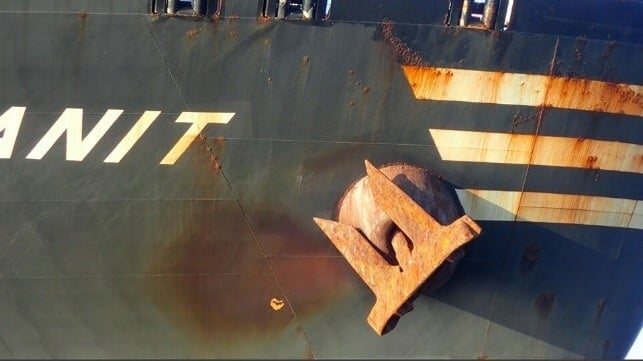
MSC Danit's anchor (NTSB)

PUBLISHED DEC 5, 2023 11:20 PM BY THE MARITIME EXECUTIVE


The National Transportation Safety Board (NTSB) has called for new VTS safety measures after the anchor-drag incident that caused an oil spill off the coast of California in October 2021.

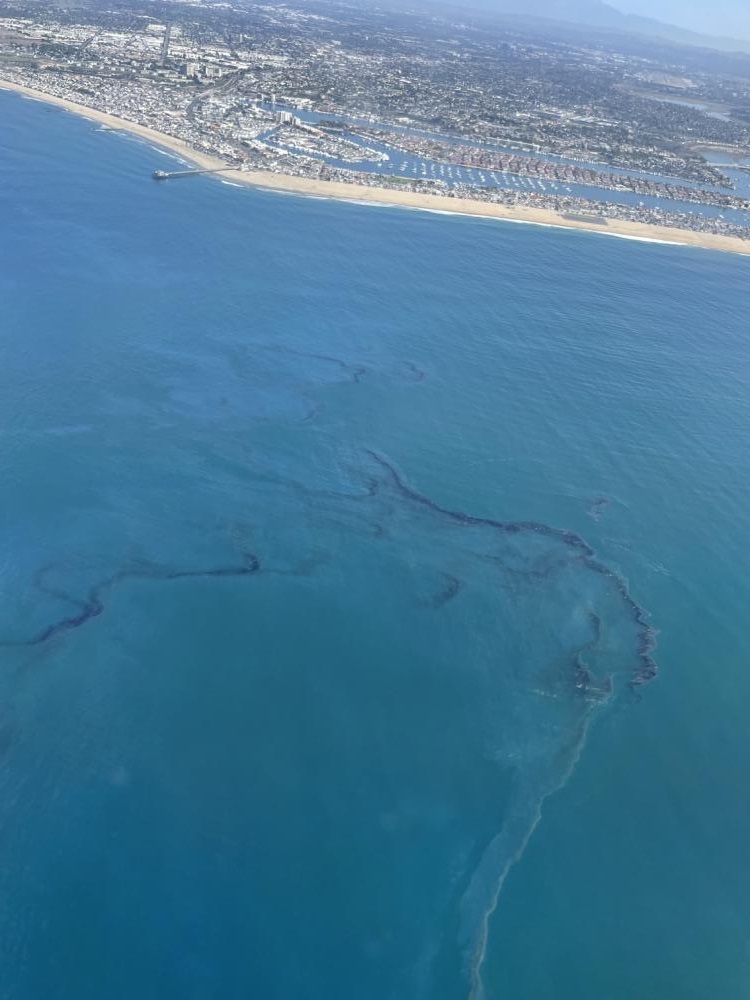
The spill released around 588 barrels of crude oil into San Pedro Bay and caused about $160 million in damage, including cleanup costs. It was initiated when a container ship dragged anchor over an underwater pipeline in a storm eight months earlier. NTSB determined that the MSC Danit's anchor contacted and damaged the pipeline during a high wind event earlier in the year, and that stress fractures caused by the impact grew until the leak finally occurred. 

Image courtesy USCG

Contributing factors included insufficient training for pipeline controllers and an inappropriate response to leak alarms, NTSB said. The agency found that there had been eight total leak alarms before the pipeline operators in the control room shut down and isolated the line. For 14 hours, the leak continued, and the release would have been smaller if the employees had been trained to respond appropriately, NTSB said. 

The NTSB also found that the location of the anchorage allowed too little time for ships' crews to respond to an anchor-dragging incident before hitting the pipeline. The board recommended that the U.S. Coast Guard move the boundary of the anchorage farther away for safety.

The agency also called for new audible and visual alarms at Vessel Traffic Services (VTS) when an anchored ship gets close to a pipeline, along with procedures for VTS to notify pipeline operators of potential damage. The line was not marked on the VTS operators' charts, and they were not aware of the danger when MSC Danit dragged anchor over the area. 

“Anchorages need to be designed to account for the size of vessels using them and the time it takes for these ships’ crews to react when anchor dragging occurs,” NTSB Chair Jennifer Homendy said. “Potential damage to a pipeline needs to be reported immediately because the consequences of a pipeline leak are so great."


Chinese Bulker Hits Moored Fishing Boat off the Philippines

Ruel J
Courtesy PCG

PUBLISHED DEC 7, 2023 12:21 PM BY THE MARITIME EXECUTIVE


The Philippine Coast Guard has reported an allision involving a Chinese bulker and a moored fishing boat off the coast of Occidental Mindorodo. Five survivors were rescued by good samaritan fishing vessels. 

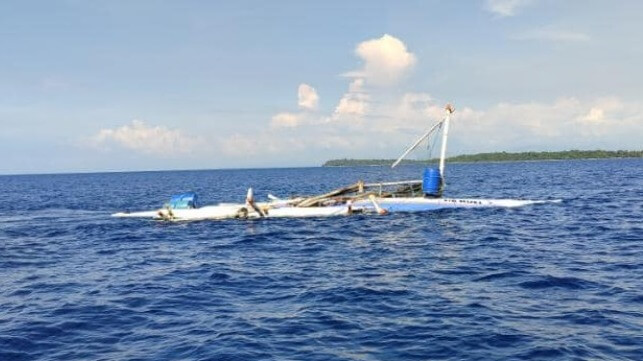
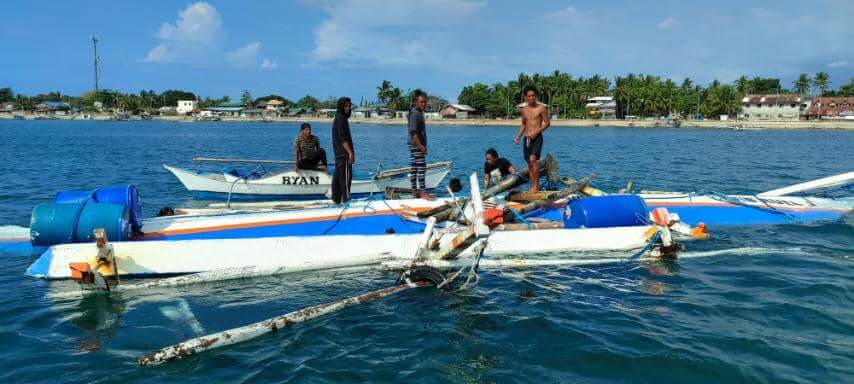
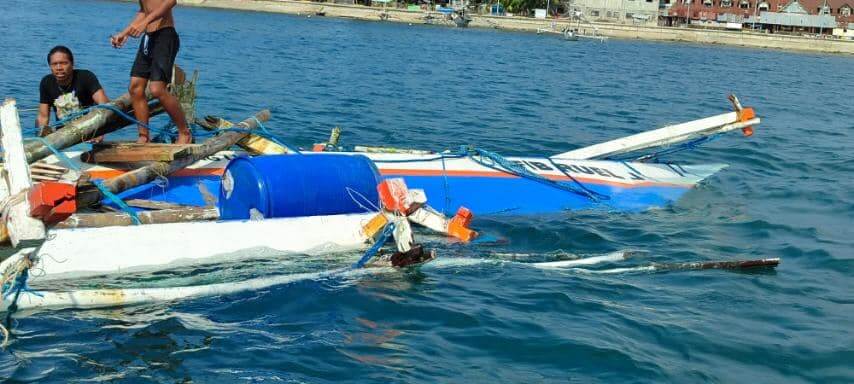
According to the PCG, the fishing boat Ruel J was moored to a fish aggregating device off the northwestern tip of Occidental Mindoro on December 5. At about 1600, the bulker Tai Hang 8 struck the Ruel J, and the fishing boat's crew alleged that the ship continued on its voyage without stopping. Ruel J was left adrift. 

Images courtesy PCG

Three other fishing vessels - the Joker, Precious Heart and Jaschene - rescued the five crewmembers and towed their damaged vessel back to shore at Sablayan. The PCG checked on the survivors' condition, interviewed them and provided them with basic supplies. Two local agencies also said that they would provide additional assistance. 

The agency identified the Ruel J's crewmembers as Junrey Sardan, Ryan Jay Daus, Bryan Pangatungam, Cristian Arizala, and Joshua Barbas.

The PCG plans to report the incident to Tai Hang 8's flag state, China, and will ask for investigative assistance from port state control in the ship's next port of call. It has also reached out to the shipowner, a midsize firm based in China's Hebei province. 

AIS data provided by Pole Star confirms that the bulker passed the western side of Occidental Mindoro on the afternoon of December 5, the reported timeframe of the accident. The vessel's AIS signal was last received later the same day. 


Huge Chinese Flotilla Swarms Whitsun Reef

A line of Chinese maritime militia trawlers moored at Whitsun Reef (PCG)
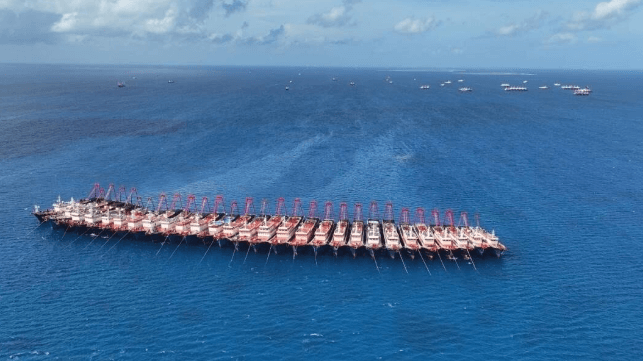
A line of Chinese maritime militia trawlers moored at Whitsun Reef (PCG / Jay Tarriela)

PUBLISHED DEC 4, 2023 5:47 PM BY THE MARITIME EXECUTIVE


The Philippine Coast Guard has released video evidence of a vast swarm of Chinese vessels at Whitsun Reef, a low-lying feature in the Spratly Islands. 

As a low-tide elevation, Whitsun Reef is not an island for legal purposes, but it is within the Philippine Exclusive Economic Zone and the Philippines would have governance over its development. Like Chinese-occupied Fiery Cross Reef and Mischief Reef, which have both been covered in sand to create full-scale military bases, Whitsun Reef would be long enough to support a strategic runway if developed. It lies about 50 nm to the west of the nearest Chinese island airbase.

On November 13, the Philippine Coast Guard (PCG) spotted no fewer than 111 Chinese maritime militia trawlers occupying the waters near  Whitsun Reef, replicating a pattern last seen in 2021

The number has now increased to 135 vessels, according to the Armed Forces of the Philippines. Aerial footage of a line of anchored trawlers shows that all had spotless decks and topsides, without the wear and tear of a hard-working fishing vessel, and none had fishing gear or nets visible (below). 

China's maritime militia force operates large, well-equipped trawlers used for "gray zone" operations, like harassing Philippine supply convoys and maintaining a mass presence at geopolitically sensitive locations. While nominally civilian in appearance, these trawlers typically receive military training and heavy government subsidies.

In response to this concerning development, Philippine National Security Adviser Eduardo Año has asked the PCG to conduct a patrol to challenge the "illegal" presence of the Chinese force at the reef. The PCG has dispatched two patrol vessels, BRP Sindangan and BRP Cabra, to visit Whitsun Reef and investigate. 

"It is justified and lawful for Chinese fishing boats to operate or shelter from wind in the area, and the Philippines is in no position to make irresponsible remarks," responded Chinese Foreign Ministry Spokesperson Wang Wenbin at a press conference Monday.

China claims about 90 percent of the South China Sea as its own, and has ignored an unfavorable ruling from the Permanent Court of Arbitration in the Hague issued in 2016. Beijing considers all of the Paracel Islands and Spratly Islands to be its own "inherent territory," despite competing claims from Vietnam, the Philippines, Taiwan and Malaysia. 

U.S. Navy sends warship past Second Thomas Shoal

The U.S. Navy regularly challenges extralegal maritime claims, including China's sweeping assertions of control in the South China Sea. In the latest of these actions, the littoral combat ship USS Gabrielle Giffords transited past Second Thomas Shoal, a frequent flash point for confrontation between Philippine and Chinese forces. 

“The United States has deliberately disrupted the South China Sea, seriously violated China’s sovereignty and security, severely undermined regional peace and stability, and seriously violated international law and basic norms governing international relations,”  said PLA spokesman Col. Tian Junli on Monday. “China has indisputable sovereignty over the South China Sea Islands and adjacent waters.”

U.S. 7th Fleet said in a statement Monday that the Gabrielle Giffords "was conducting routine operations in international waters in the South China Sea, consistent with international law."

New Chinese Naval Base in Cambodia Receives First PLA Navy Warships

PLA Nav
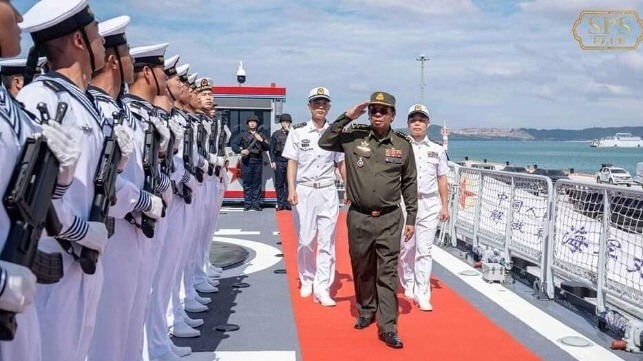
Former Cambodian defense minister Tea Banh reviews Chinese sailors aboard a PLA Navy warship at Ream, Dec. 3 (Cambodian Ministry of Defense) Courtesy Cambodian Minisdtry of Defense

PUBLISHED DEC 5, 2023 1:49 PM BY THE MARITIME EXECUTIVE


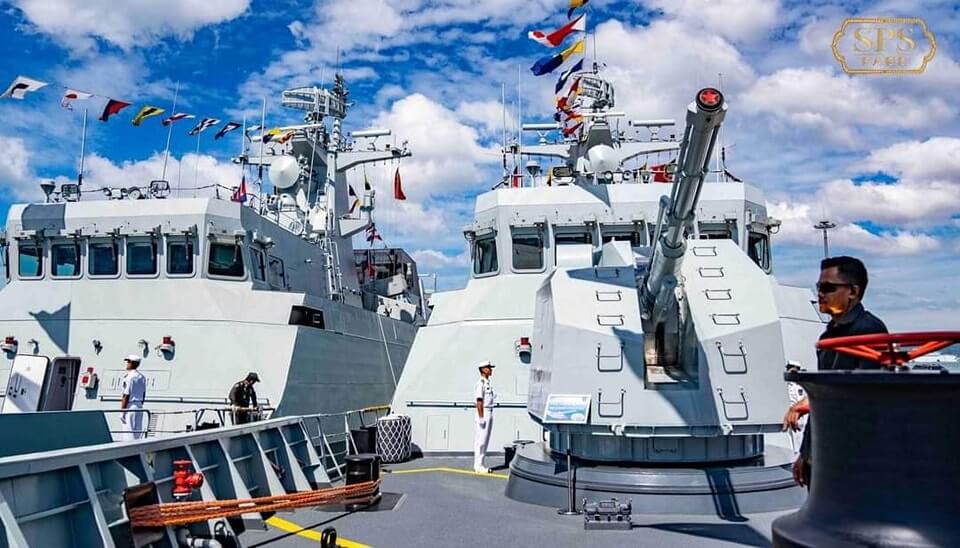
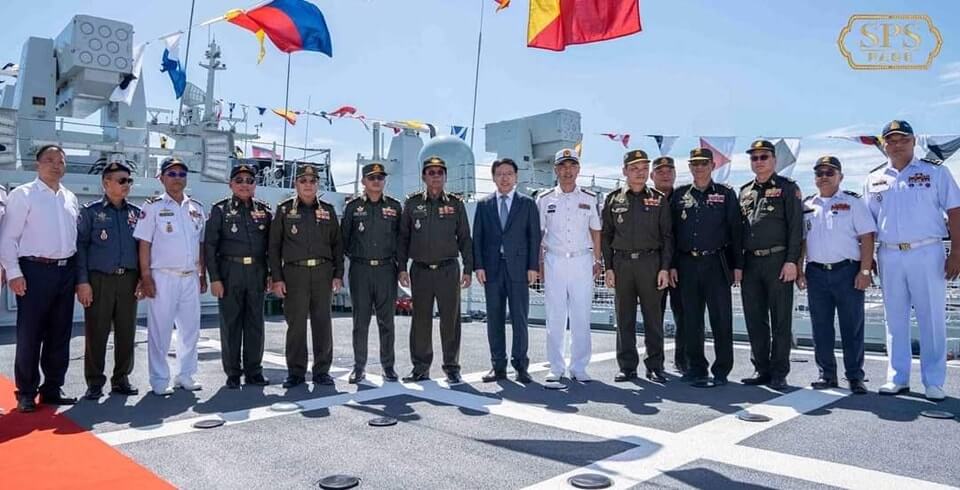
The newly-built Chinese naval base at Ream, Cambodia, has welcomed its first PLA Navy warships, the Cambodian ministry of defense has confirmed. 

Satellite imagery shows several ships alongside the brand new finger pier that Chinese contractors have installed at Ream, where the Cambodian military has leased the north half of an existing naval base to Chinese forces. It appears to be the first time that the pier has received ships (other than construction barges and dredgers related to the project). Imagery obtained by Planet Labs for Radio Free Asia shows two surface combatants alongside the pier. Open-source intelligence analysts have confirmed the find (below). 

In a post on Facebook, Cambodian minister of defense Tea Seiha said that several Chinese PLA Navy warships have arrived at Ream in order to support training for the Cambodian Navy. He visited the base to greet them, accompanied by his predecessor (and father), the influential Cambodian politician Tea Banh. 

Cambodian Ministry of Defense

The U.S. military has long warned of Chinese plans to build a base at Ream. In 2020, U.S. officials told the Wall Street Journal that they had an early draft of an agreement between Cambodia and China on the future use of the site. The deal would allow Chinese forces to use the northern half of the site for a period of 30 years, with automatic renewal thereafter. Cambodia's constitution forbids permanent foreign military bases, but Western analysts view the quasi-hereditary Cambodian regime as a client of Beijing.

In 2022, contractors began building a large finger pier and a drydock at Ream. Both are far larger than needed for any vessel in the Cambodian Navy's small fleet. Tom Shugart, Adjunct Senior Fellow with the Defense Program at the Center for a New American Security, told RFA that the new pier's dimensions would be long enough for a Chinese carrier. The pier was completed in November.

On the same day as the inaugural port call in Ream, Cambodian ruler Hun Manet - son of longtime prime minister Hun Sen - welcomed General He Weidong, Vice Chairman of the Central Military Commission of the Communist Party of China, the top Chinese defense command. Manet held a reception to "meet and discuss work" at the presidential palace in Phnom Penh. 

Gen. He Weidong (left) joins Hun Manet in Phnom Penh, Dec. 3 (Courtesy Prime Minister of Cambodia)


British Research Vessel Visits World's Largest Iceberg

Edge of A23a, 1 December 2023 (Theresa Gossman, Matthew Gascoyne, Christopher Grey)
Edge of A23a, December 2023 (Theresa Gossman, Matthew Gascoyne, Christopher Grey)

PUBLISHED DEC 4, 2023 8:32 PM BY THE MARITIME EXECUTIVE


A British research vessel has succeeded in collecting samples of water next to the world's largest iceberg, A23a, which recently drifted off into the Weddell Sea after four decades spent aground. 

RRS Sir David Attenborough (best known as the subject of the "Boaty McBoatface" naming contest) happened to pass near the newly-drifting iceberg last week at a position just off the Antarctic Peninsula. 

“It is incredibly lucky that the iceberg’s route out of the Weddell Sea sat directly across our planned path, and that we had the right team aboard to take advantage of this opportunity. We’re fortunate that navigating A23a hasn’t had an impact on the tight timings for our science mission," said Dr. Andrew Meijers, the chief scientist aboard the research vessel. 

A23a is about 1,500 square miles in size, or roughly 70 times the size of Manhattan. It was once part of the Antarctic ice shelf and  even hosted a Soviet research base for years - until 1986, when it split off and promptly drifted aground in the Weddell Sea. There it stayed until this November, when it refloated and began to slowly depart the region. High winds, strong currents and a thinning base likely contributed to the resumption of its voyage. 

Scientists say that A23a is now likely to be swept along by currents into "iceberg alley," the route that many icebergs take on their way to the remote island of South Georgia. Sir Ernest Shackleton famously made use of the same route to evacuate his crew after the sinking of his ship, the Endurance, back in 1916. 

There is some concern that if A23a arrives off South Georgia and runs aground again, its sheer size could disrupt the feeding routes used by the penguins and seals that inhabit the island. An even larger iceberg, A68, came close to grounding off South Georgia in 2017; luckily for the penguin colonies, A68 broke up before arrival.  


Oldendorff Will Fit First Rotors on a Bulker Used to Haul Coal from Canada

bulker with wind rotors
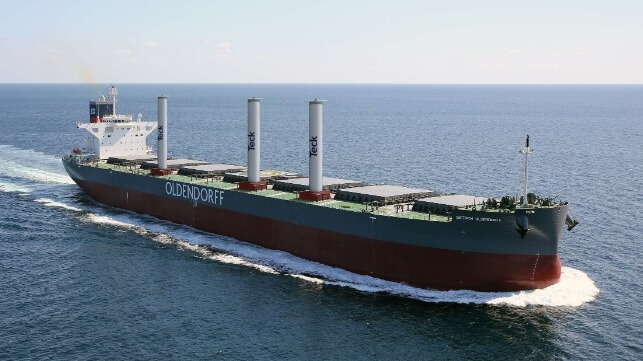
Post Panamax bulker Dietrich Oldendorff will be fitted with rotors by mid-2024 (Oldendorff)

PUBLISHED DEC 7, 2023 8:17 PM BY THE MARITIME EXECUTIVE


Oldendorff Carriers, one of the leading operators of bulk carriers, is joining the growing ranks of shipping companies adopting wind rotors on bulkers to improve operating efficiency and reduce emissions. The company has participated in several studies looking at the potential of wind-assisted propulsion and the use of rotors and now has ordered its first installation.

They report by mid-2024 one of its post Panamax vessels will be fitted with a rotor system. The rotors will be manufactured by Norsepower and the companies highlight that they will be constructed in part with recycled materials. Norsepower will include material from approximately 342,000 plastic bottles for the three rotors.

The project is being undertaken in collaboration with Teck Resources, one of Canada’s leading mining companies. Teck’s operations are focused on copper, zinc, and steelmaking coal. Oldendorff which owns a fleet of 130 bulkers and currently has a total of 724 in operations counting charters, has been working with Teck since November 2021 in an effort to reduce supply chain emissions. They estimate the efforts have already saved approximately 115,000 tonnes of CO2 emissions.

The vessel that was selected for the installation is the Dietrich Oldendorff, which carries shipments of Teck’s steelmaking coal from Vancouver across the Pacific. They report that they have analyzed forty years of weather data which confirms that the trade between the Pacific Northwest and Asia is one of the best trade lanes for producing reliable wind energy.

Built in 2020, the vessel is 100,449 dwt with a length of 770 feet (235 meters). The rendering shows the vessel outfitted with three rotors offset on the starboard side between the six hatches so as not to interfere was cargo operations. 

The addition of the rotors along with other emission savings measures, is expected to reduce emissions by 55 percent the companies said in the announcement. Annually, they expect this will provide a reduction of over 17,000 tonnes of CEO emissions.

Oldendorff reports that over the last decade, it has built 100 eco-friendly new bulkers as part of its efforts to reduce emissions from its fleet. Teck and Oldendoff are also currently plotting their use of biofuel on another bulk carrier in another effort to lower emissions.

Another mining company, Vale, began in 2021 testing the use of rotors on large bulk carriers. Vale recently announced that it would be expanding its efforts with rotors on additional vessels while both Tufton and CSSC this year reported fitting rotors to bulkers. Other bulker operators are testing rigid sail or wind wing concepts while Japan’s K Line is due to start a prototype test using a kite system launched while the vessel is in the ocean.


Bilge Discharge off Australian Coast Lands Bulker in Hot Water

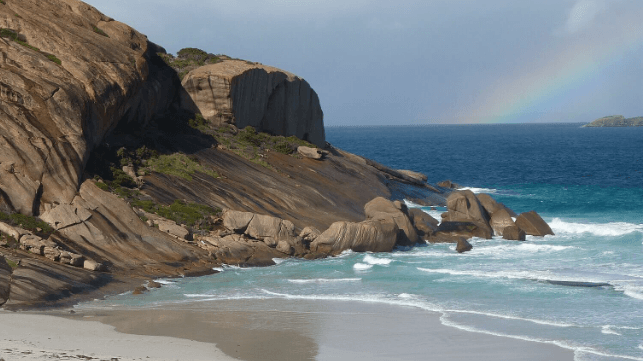
Headland on Esperance's wild coastline (Fctdolas / CC BY SA 4.0)

PUBLISHED DEC 7, 2023 10:28 PM BY THE MARITIME EXECUTIVE


An ill-timed discharge of bilgewater has gotten the owner and master of a Chinese bulker in trouble with the authorities in Western Australia. 

The trouble started when the chief mate of the bulker TS Golf decided to pump out sulfur-contaminated bilge water from a cargo hold. The vessel was transiting off the town of Esperance and was 15 nautical miles offshore, outside of the 12-mile line - but this was not far enough to prevent problems with the law. A commercial helicopter pilot noticed a green discharge coming from the ship and alerted the local harbormaster, who launched an investigation with the Australian Maritime Safety Authority (AMSA). 

During the inquiry, the chief mate told AMSA that he had been "absent-minded" when he began the discharge, and that it was not intentional. The ship's master said that he had understood the seriousness of the incident and called a safety meeting to discuss the matter shortly after it happened. 

At a hearing at the Kalgoorie Magistrate Court this week, Magistrate Janie Gibbs said that while the captain of the ship was still liable for his chief mate's error, he had shown remorse and had apologized.  She classified the degree of harm from the discharge as "medium or low," and scheduled sentencing for January 19. 

Under Australian law, the shipowner -  Minsheng Haike (Tianjin) Shipping Leasing Company - is liable for a fine of up to a maximum of US$145,000. The master could be fined as much as US$29,000. 

The authorities are taking the release seriously in part because of its location. Esperance's wild coastline is home to multiple national parks and pristine beaches, and it is an iconic tourist destination for Western Australia. Magistrate Gibbs noted that "even minor pollution" could have an effect in such an idyllic region. 

Top image: Headland on Esperance's coastline (Fctdolas / CC BY SA 4.0)


Hackers Claim to Have Stolen Data From Naval Shipyard Austal USA

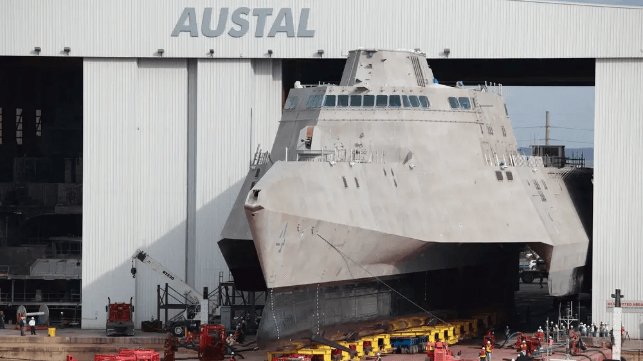
File image courtesy USN

PUBLISHED DEC 5, 2023 8:44 PM BY THE MARITIME EXECUTIVE


Australian-owned defense shipbuilder Austal USA has had an up-and-down year, and has already had to contend with a criminal prosecution, a money-losing tug bid, and turnover in the C-suite. This week, the cyber threat group Hunters International claimed that it hacked Austal and stole unspecified data, a claim which has been widely reported in the cybersecurity trade press but could not be immediately verified. 

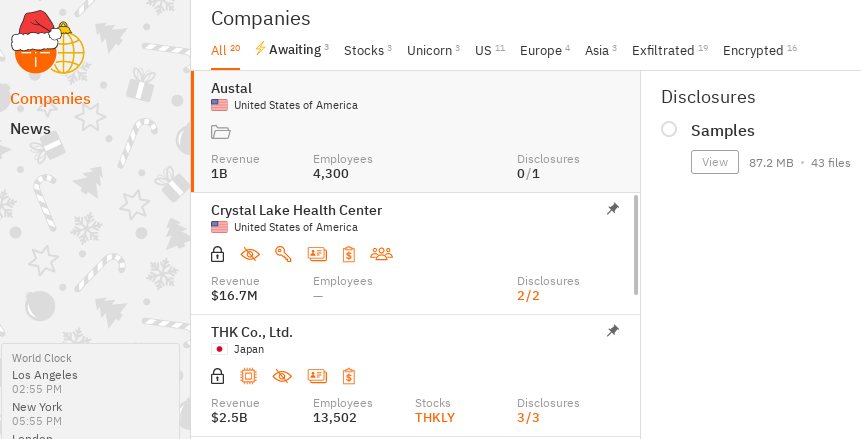
In a list of new victims posted on its Dark Web site, Hunters International said that it has data from Austal's U.S. operation and will release up to 43 samples soon. If published or sold, Austal's proprietary data might have considerable value to a competing shipyard or a foreign nation. The firm holds multiple U.S. Navy orders, including a supply contract to build section modules for new nuclear submarines. (Austal did not immediately respond to a request for comment after hours.)

New victim claims on the threat group's online dashboard (Hunters International)

If accurate, the claim would be Austal's second run-in with hackers since 2018, and it comes at a sensitive moment. Austal is said to be in talks with three different investors about a potential sale, according to the Financial Review. 

Most commercial cyberattackers use malware to encrypt victims' files, and demand a ransom in exchange for the decryption key. Hunters International is of a different breed. The group focuses on stealing data, then using it to blackmail or pressure the victim. It is not afraid of causing collateral damage in order to get paid: earlier this year, the group hacked a Beverly Hills plastic surgery clinic and released confidential photos of several patients - and noted that it had another 250,000 files from the same business.

Its custom malware appears to descend from code used by the now-defunct Hive group, according to security researchers. Hive, a notorious malware organization with more than 1,300 victims and $100 million in ransom payouts, was disrupted and disbanded by law enforcement earlier this year. In a statement in October, Hunters International denied a direct connection with Hive, and said that it had only bought Hive's code and improved upon it. 


Danish and Norwegian Dockworkers to Join Swedish Strike Against Tesla

cars on dock with car carrier
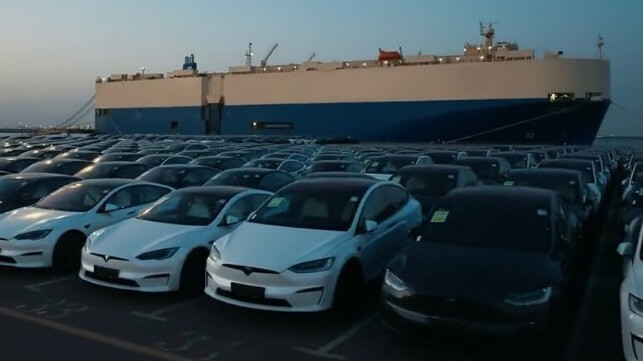
Dockworkers and transport drivers in Denmark and Norway will begin boycotting Tesla cars bound for Sweden (Tesla file photo)

PUBLISHED DEC 6, 2023 4:53 PM BY THE MARITIME EXECUTIVE


The unions representing dockworkers in Danish and Norwegian ports as well as the workers who transport cars plan to refuse to handle Tesla automobiles bound for Sweden in sympathy strikes supporting the ongoing action in Sweden. The two unions severed strike notices yesterday and today in response to reports that Tesla might be seeking to divert cars bound for Sweden into neighboring countries and drive them across the border after Sweden unions closed all the country’s ports to the manufacturer's auto imports.

What began as a small strike in Sweden seeking an enterprise agreement for about 120 to 130 mechanics who work in Tesla’s maintenance operations is quickly becoming a regional issue with both sides deeply entrenched. Sweden's powerful union IF Metall, which says it has over 300,000 members in the manufacturing, chemical, mining, and automotive industries, launched the strike on October 27 after prolonged attempts at negotiations with Tesla.

IF Metall contends that more than 90 percent of Sweden’s workers are covered by enterprise agreements, noting “Collective agreements are the basis of the Swedish labor market. They argue they are fighting for “decent and safe working conditions,” with the agreements covering wages, form of employment, occupational pension, working hours, vacations, and periods of notice. They note with these agreements in place, there is an obligation to maintain labor peace noting there are very few labor market conflicts in Sweden.

Tesla’s flamboyant CEO Elon Musk is an outspoken critic of unions. Speaking with The New York Times he recently said “I disagree with the idea of unions. I think unions naturally try to create negativity in a company.”

After launching the strike, IF Metall appealed to its peers for support. The union representing Sweden’s dockworkers initially said it would not handle the cars at four ports but later widened the ban to all Tesla cars at all ports or entering the country. Other unions across Sweden also joined in support of the strike including the country’s postal workers who are refusing to handle packages including the license plates needed to deliver Tesla cars to buyers. Tesla sued the post office and Swedish Transport Authority, but today a court stayed a temporary injunction leaving it to the appeals court to decide the issue. So for now, Tesla has no way to get license plates in Sweden.

Denmark’s 3F union issued a statement on December 5 announcing that it had filed a notice to stop offloading and transporting Tesla vehicles to Sweden. There had been speculation that Tesla might begin trucking cars across the Ă˜resund bridge from Denmark, which would be about a seven-hour drive to reach its facilities in Sweden. Tesla’s electric vehicles are the most popular models in Sweden with buyers often already waiting for deliveries.

"IF Metall and the Swedish workers are currently fighting an incredibly important battle. When they ask for our support, we naturally back up,” said Jan Villadsen, chairman of 3F Transport. "Even if you are one of the richest people in the world, you can't just make your own rules. We have some agreements on the labor market in the Nordics, and you have to comply with them if you want to do business here. Solidarity is the cornerstone of the trade union movement and extends across national borders.”

Reports indicate it is the first time in seven years that neighboring labor unions have crossed borders in support of each other in Scandinavia. Swedish pilots in 2015 supported a strike by pilots in Norway and indications are that the Norwegian are now ready to also provide support in the Tesla strike.

Fellesforbundet, which calls itself the largest union in the private sector in Norway and represents employees in industry, car workshops, ports, and transport, announced today that it has also filed a two-week notice to commence a boycott aimed at the transport of Tesla cars to the Swedish market. Echoing the sentiments of their Danish colleagues and the Swedish union that represents the dockworkers, Fellesforbundet leader Jørn Eggum said in his statement, “In the Nordic countries, there is broad agreement about the importance of a well-organized working life... The right to demand a collective agreement is a natural part of our working life, and we cannot accept that Tesla stands outside this.”

Media reports indicate that the expansion of the strike and supporting boycotts might reach further. Finland’s unions are reportedly considering launching a similar boycott against Tesla. The manufacturer’s nearest facility to Sweden would become Germany, but reports highlight the impracticality of attempting to transport the cars from Germany. The Danish and Norwegian boycotts will launch in two weeks after the notice period has been completed.