Monday, January 15, 2024


Volcano erupts in Iceland, flowing lava reaches fishing town

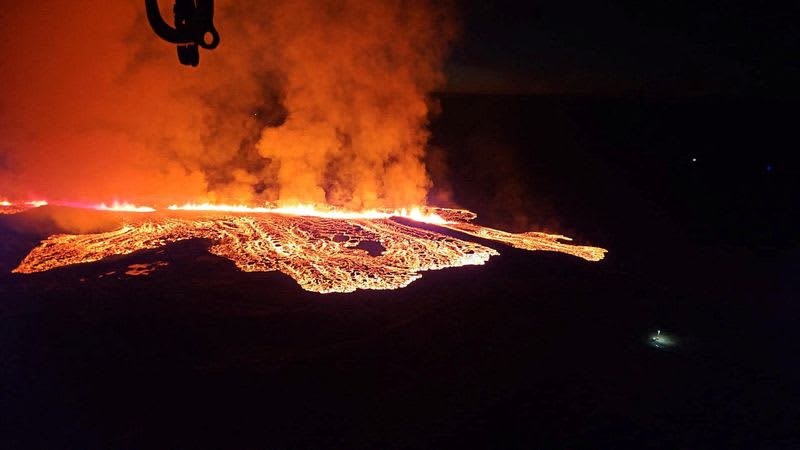
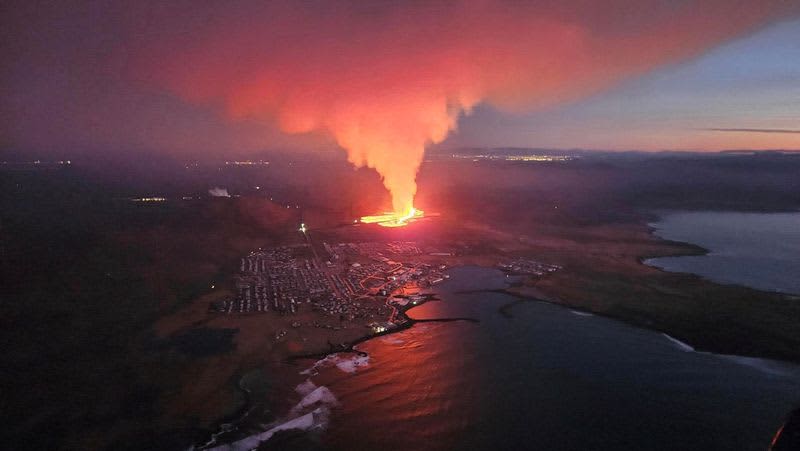
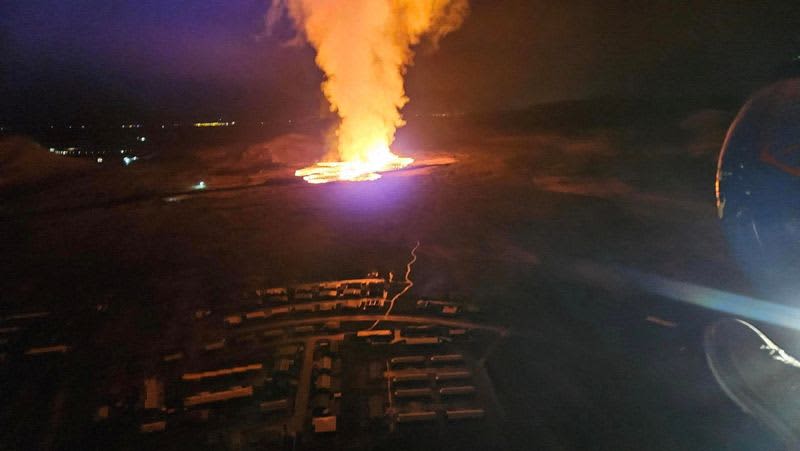
(Reuters) -A volcano erupted in southwest Iceland on Sunday, with molten lava flows reaching the outskirts of a small fishing town by midafternoon, setting some houses alight, although the town was evacuated earlier and no people were in danger, authorities said.

Fountains of molten rock and smoke spewed from fissures in the ground across a wide area stretching to the town of Grindavik, where at least one house had caught fire, live video published by daily Morgunbladid showed.

"No lives are in danger, although infrastructure may be under threat," Iceland's President Gudni Johannesson said on social media site X, adding there had been no interruptions to flights.

The eruption began early on Sunday north of the town, which just hours before had been evacuated for the second time since November over fears that an outbreak was imminent amid a swarm of seismic activity, authorities said.

Authorities built barriers of earth and rock in recent weeks to try to prevent lava from reaching Grindavik, some 40 km (25 miles) southwest of the capital Reykjavik, but the latest eruption have penetrated the town's defences.

The nearby geothermal spa Blue Lagoon had closed on Sunday, it said on its website.

VOLCANIC HOTSPOT

It was the second volcanic eruption on the Reykjanes peninsula in southwest Iceland in less than one month and the fifth outbreak since 2021.

Last month, an eruption started in the Svartsengi volcanic system on Dec. 18 following the complete evacuation a month earlier of Grindavik's 4,000 residents and the closing of the Blue Lagoon, a popular tourist spot.

More than 100 Grindavik residents had returned in recent weeks, before Saturday's renewed evacuation order, according to local authorities.

Iceland, which is roughly the size of the U.S. state of Kentucky, boasts more than 30 active volcanoes, making the north European island a prime destination for volcano tourism - a niche segment that attracts thousands of thrill seekers.

In 2010, ash clouds from eruptions at the Eyafjallajokull volcano in the south of Iceland spread over large parts of Europe, grounding some 100,000 flights and forcing hundreds of Icelanders to evacuate their homes.

Unlike Eyafjallajokull, the Reykjanes volcano systems are not trapped under glaciers and are thus not expected to cause similar ash clouds.

(Reporting by Stine Jacobsen, Louise Rasmussen, Anna Ringstrom and Terje SolsvikEditing by Tomasz Janowski and Frances Kerry)

© Reuters


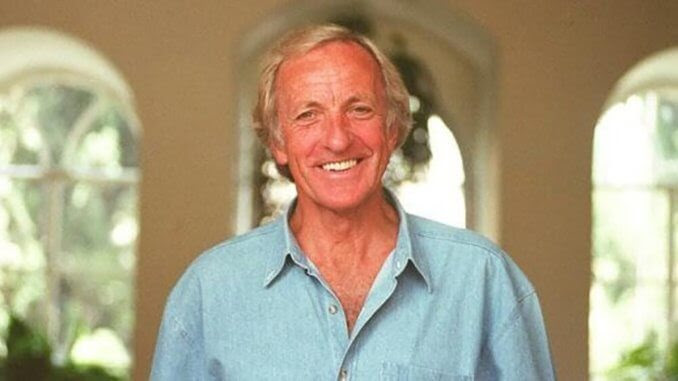
John Pilger: “A Majority of One”

Last week, the Observer reported that the slogan ‘united we will win’ is a fixture on Israeli screens ‘for most TV news and talk shows’. Raviv Drucker, one of Israel’s leading investigative journalists, commented:

In general, the Israeli media is drafted to the main goal of winning the war, or what looks like trying to win the war…

The shock [of 7 October] was so brutal, and the trauma is so hard that journalists see their role now, or part of their role, to help the state to win the war. And part of it is showing as little as possible from the suffering in Gaza, and minimising criticism about the army.

This is better termed anti-journalism, a propaganda system censoring even the most crucial facts. Thus, Anat Saragusti, press freedom director for Israel’s Union of Journalists and one of the few Israeli journalists to have reported from Gaza independently of the military during previous conflicts, commented:

They cover the Palestinians only in the framework of security. You hardly see any women, no kids. The spirit is that they are all Hamas. I know it’s not easy, but I think the media are not doing their job.

The Israeli public, then, is not seeing the footage of tiny, shivering infants with grotesque head wounds, of injured mothers cradling their dead babies – scenes that have been traumatising the rest of us on social media for three months. In a moment of stunning self-unawareness, the Observer added:

US president Joe Biden warned Israelis soon after 7 October against repeating America’s mistakes in its wars of vengeance in Iraq and Afghanistan. He could also have warned about the failings of journalists who smoothed the path to those conflicts.

One of the ‘failings of journalists who smoothed the path’ in the Observer, the Guardian, and everywhere else, was to portray the 2003 war of opportunity for oil in Iraq as an irrational ‘war of vengeance’ or a paranoid ‘war of national security’. To this day, British and US anti-journalism cannot discuss the brute fact that US-UK armies blasted the way open for US-UK oil companies like BP and Exxon to do big business in Iraq at the cost of more than one million Iraqi lives. Why? Because, as in Israel, ‘journalists see their role now… to help the state to win the war’. The global dominance of this anti-journalism is the correct context in which to evaluate the rare, authentic journalism of John Pilger, who died on 30 December, and the response of the corporate critics smearing him.

‘Reclaiming The Honour Of Our Craft’

In exact opposition to the way Israeli ‘journalists’ are now burying the truth of their government’s genocide in Gaza, Pilger wrote in 2006:

In reclaiming the honour of our craft, not to mention the truth, we journalists at least need to understand the historic task to which we are assigned – that is, to report the rest of humanity in terms of its usefulness, or otherwise, to “us”, and to soften up the public for rapacious attacks on countries that are no threat to us.

Is it difficult to understand that war-winning propagandists deem the trashing of real journalists like Pilger a key part of their role? This week, Declassified UK reported:

Recently declassified files show how the UK government covertly monitored Australian journalist John Pilger, and sought to discredit him by encouraging media contacts to attack him in the press.

Consider that, in 2005, Pilger said of Blair and Iraq:

By voting for Blair, you will walk over the corpses of at least 100,000 [ultimately, in excess of one million] people, most of them innocent women and children and the elderly, slaughtered by rapacious forces sent by Blair and Bush, unprovoked and in defiance of international law, to a defenceless country.’ (Pilger, “By voting for Blair, you will walk over the corpses of at least 100,000 people,” New Statesman, 25 April 2005.)

Naturally, anti-journalism reflexively brands this ‘an extreme left-wing and anti-American bias’ that ‘consistently underscored much of’ Pilger’s reporting, as The Times opined in its obituary. In fact, there is nothing ‘extreme’, ‘anti-American’ or even ‘left-wing’ about opposing the mass killing of civilians for profit. The Times noted the Orwellian effort to transform Pilger’s name into a verb:

… to Pilger, Pilgerise, or be Pilgered. It was defined as: “To present information in a sensationalist manner to reach a foregone conclusion; using emotive language to make a false political point; treating a subject emotionally with generous disregard for inconvenient detail; or making a pompous judgment on wrong premises.

A clearer case of psychological projection can hardly be imagined from a newspaper that has done all this and more in promoting the West’s wars of aggression. Even if everything The Times said was true, the fact that Pilger was right in opposing numerous war crimes and The Times was not just wrong but complicit in supporting them, renders their criticism absurd. The Times continued that Pilger’s ‘polemical approach’ involved ‘looking at all international conflicts through an anti-American prism’ leaving him ‘a dupe of the eastern bloc and, later, the Putin regime’.

No prejudicial prism is required to perceive the unmissable carnage generated by the American empire in Afghanistan, Iraq, Libya, Syria, Gaza and Ukraine. Pilger was no more a dupe of Putin than he was ‘anti-American’. He wrote in 2022:

‘Russia’s invasion of Ukraine is wanton and inexcusable. It is a crime to invade a sovereign country. There are no “buts” – except one.

When did the present war in Ukraine begin and who started it? According to the United Nations, between 2014 and this year, some 14,000 people have been killed in the Kiev regime’s civil war on the Donbass. Many of the attacks were carried out by neo-Nazis.

Of course, the ‘but’ was a betrayal for anti-journalism, but this was a rational question raised by a wide range of credible sources like Jeffrey SachsJohn MearsheimerAlastair Crooke and many others.

‘A Target No-One Else Can See’

Oliver Kamm, formerly a leader writer for The Times, went further in a CapX blog republished in the Telegraph:

Pilger was not really an investigative journalist at all, he fabricated his conclusions in order to accord with his premises. He operated with a combination of evasion, misdirection and fakery for decades.

Kamm lamented ‘the weakness of his technical grasp of almost any given subject’.

Back in the real world, Bill Haggerty, former Assistant Editor at the Mirror, wrote:

Was a time when young students planning a career in print journalism wanted to be John Pilger – even the girls….

I have never worked with anyone who came even close to matching the fire, outrage and descriptive power employed by Pilger when reporting from Vietnam, Cambodia and other hotspots for The Daily Mirror.’ (Bill Haggerty, ‘Hanging out with celebs has surpassed unearthing news,’ 15 November 2004, The Independent.)

This needs emphasising – no-one else even came close. Schopenhauer observed:

Talent hits a target no-one else can hit; Genius hits a target no-one else can see.

For thirty years, we have tried to see the target Pilger so consistently hit. How did his writing stand completely apart in delivering such inspirational, oxygenating impact? Part of the answer is that Pilger’s work transcended the dry intellectuality of more academic dissidents. He wrote with their precision and insight, but with an added dimension of passion, emotion and personal warmth. His writing is ablaze with an outrage rooted, not in some mindless ‘anti-American’ hatred, but in its exact opposite: a deeply felt love for ordinary people treated as trash by the powerful. Pilger really did care, injustice tortured him, and it is this compassion that is communicated to readers and viewers in every article, book, film and in the many emails he sent us over two decades. Remarkably, reading and watching Pilger enhances our sense of our own dignity because he reminds us of how much we can care, of how much we do care. The last message he sent us on 15 November, six weeks before he died, referred to a recent media alert:

Dear David

So good to hear from you, as ever (and thanks for the BBC piece which I hadn’t seen); I’m at my most restorative when my optimism reminds me how blessed I am; the truth is I am on a “journey”, as almost everyone says now, and it sometimes feels like I am still waiting for the bus. I am making progress on paper, and I can walk unaided with a protective guard at my elbow. But it’s calling on a determination I know I have, but prefer to send on a lifelong sabbatical.

Terrific piece, mate. What creatures Welby and the rest are…

all my best

John (Email to David Edwards, 15 November 2023)

Pilger sent us this kind of positivity, often unbidden, time and again, year after year. In the world of left activism – which is rather more competitive and ego-ridden than we might like to imagine – no-one else has done anything remotely comparable. That Pilger sent us one last message of encouragement at a time when he was gravely ill gives an idea of his inexhaustible generosity of spirit. Note, also, the sense of fun and even joie de vivre even in this last message sent at such a difficult time. Pilger’s love of writing, of word play, of supporting other people, came out of a deep love of life. Kamm’s claim that Pilger was ‘famously humourless’ is magnificently off. The extra ingredient we haven’t mentioned – the spice that helped him hit the target no one else can see – was a wonderfully understated, sardonic humour aimed at the many ‘windbags’ he so loved to deflate. He emailed us about the BBC’s famous and compromised Middle East correspondent Jeremy Bowen:

A few years ago, [Bowen] invited me to take part in a BBC special about war correspondents, and we spent an enjoyable hour or so “in conversation”. Although it was clear that tales of derring-do would have been preferred, I raised the unwelcome subject that the BBC was an extension and voice of the established order in Britain and its reporting on the Middle East and elsewhere reflected the prevailing wisdom — with honourable exceptions from time to time. My contribution was cut entirely from the programme. I emailed Bowen and sometime later received an unsatisfactory response that there wasn’t “time or space” in the film — something unsurprising like that. Censorship by omission is standard, if undeclared practice. (Email to David Edwards, 18 April 2008.)

Kamm again lamented:

While he talked a lot about the power of language, he didn’t know much about it.

Again, this couldn’t be more wrong. Pilger had an uncanny ability to capture the truth of an individual, idea, or issue with spectacular concision. In this single, witty sentence he caught and burst the much-lauded myth of BBC ‘objectivity’:

I’ve always found it amusing, bemusing, that so many people in the BBC see themselves as having entered into a Nirvana of objectivity, as if their objectivity and impartiality have been given to them intravenously.

In October 2003, in 64 words, Pilger demolished the idolatry of Clinton and Blair, the mythmaking of the US-UK ‘special relationship’, the West’s ethical pretensions, the credibility of the Independent and indeed of the entire Westminster press pack:

“The New Special Relationship” was the next good news, with Blair and Clinton looking into each other’s eyes in the garden at No 10 Downing Street. Here was the torch being passed, said the front page of the Independent, “from a becalmed and aimless American presidency to the coltish omnipotence of Blairdom”. This was the reverential tone that launched Blair into his imperial violence.’ (Pilger, ‘The Fall and Rise of Liberal England,’ New Statesman, 13 October 2003.)

The focus on Clinton and Blair ‘looking into each other’s eyes in the garden at No 10 Downing Street’ pricked perfectly the Disneyfied charade by which so many are gulled. The contrast between the fawning idolatry of the Independent’s front page and Pilger’s final, pitch-black sentence was devastating. Just these three sentences left the legions of ‘journalists of attachment’, the ‘client journalists’, the ‘presstitutes’, looking exactly what they are – pitiful and foolish. And he did this endlessly. No wonder a journalist friend working in a major British TV news studio told us:

You must see the reaction in a newsroom when one mentions Chomsky or Pilger. They run the other way, and I can see they are afraid by the look on their faces. Fact is that once you understand and admit what you are doing, you can’t continue with it. When I mentioned Chomsky, one person commented, “Oh, he’s way out there.” “Way out where?” I asked.’ (Email to Media Lens, 8 July 2005.)

Thoreau observed:

Any man more right than his neighbours constitutes a majority of one already. (Henry David Thoreau, Walden and Civil Disobedience, Penguin Classics, 1986, p. 397.)

On all the key issues, Pilger was more right than his neighbours; he was a towering, landslide ‘majority of one’. Kamm left his worst till last in speculating on Kosovo ‘that Pilger himself invented the tale of extensive Nato losses which were being suppressed by the state and the news media, because he wished to stimulate popular opposition to government policy. He was spectacularly lying for the cause, which in this case was to assist a genocidal regime in its campaign of brutal repression’.  Even from Kamm’s perspective this was ill-advised. How can the author of an article devoted to trashing a journalist’s character finally expose himself as someone willing to stoop so low as to accuse someone who has just died, who cannot defend himself, of ‘spectacularly lying’? Any decent person, even Pilger’s enemies, must shrink in revulsion. It is not our intention to suggest that these smears merit serious consideration. But they do provide a reminder of just how blatantly corporate critics are willing to reverse the truth. As Pilger himself said:

A common recipe for smear is half or quarter truth, conflation, misrepresentation, a pinch of sneer and a dollop of guilt-by-association. Stir briskly. (Email to David Edwards, 29 June 2011.)

Pilger was able to make light of the many baseless smears but they sometimes wounded him deeply. The Scottish philosopher, David Hume, described Rousseau as ‘one of the most singular of all human beings… his extreme sensibility of temper is his torment’; ‘he is like a man who were stripped not only of his clothes but of his skin’. (Quoted, John Hope Mason, The Indispensable Rousseau, Quartet Books, 1979, p. 5.)

Pilger was similarly sensitive to injustices perpetrated against others and against himself; hence his reputation for being ‘prickly’. If he was sometimes prickly, it was because he was sincere, human; because he felt things deeply, painfully. His great triumph was to use this sensitivity, this pain, in the cause of truth in defence of the powerless. Over the years, through many tests and travails, highs and lows, we developed a habit of ending our emails to each other with the same words. One last time, then, we say with all love and gratitude: Onwards, John!

We’d like to express our sincere condolences to John Pilger’s partner, Jane Hill, and to their family. We wish them all the very best.


Media Lens is a UK-based media watchdog group headed by David Edwards and David Cromwell. The most recent Media Lens book, Propaganda Blitz by David Edwards and David Cromwell, was published in 2018 by Pluto Press. Read other articles by Media Lens, or visit Media Lens's website.
 

The State of Capitalism’s Climate System


Three years ago, 15,000 scientists declared a climate emergency by signing onto a State of the Climate Report. That signing led to annual updates, for example, the most recent version: The 2023 State of the Climate Report: Entering Uncharted Territory, Bioscience, vol. 73, issue 12, December 2023, Oxford Academic (aka: “The Report”).

The initial paragraph of The Report suggests a planetary juggernaut of cascading ecosystems altering life systems: “Life on planet Earth is under siege. We are now in uncharted territory… a situation no one has ever witnessed firsthand in the history of humanity.” Therefore, it’s fair to say nobody really knows how this uncharted territory will play out.

The Report is a compendium of all-time climate record events depicting big-time trouble, going in the wrong direction versus maintaining a healthy planet. In and of itself, the analysis in The Report, researched and authored by top notch scientists, should be enough for world policymakers to insist upon going back to COP28 in Dubai/2023, redoing the two-week UN climate conference and adopting effective solutions to replace the mealy-mouthed inadequate proposals adopted at COP28. The world deserves better.

Thirty years of UN climate conferences failing to move the needle to help Earth’s ecosystems thrive and survive, and not collapse, has unintentionally cast a dark shadow over scientists’ climate warnings within the context of a commanding capitalistic socio-economic system based upon infinite growth at center stage, humming along like “no worries” economic growth always bails us out, but what’s left behind?

The Report makes the case that under the surface, and not clearly visible to society, a monstrosity of ecosystem turmoil threatens the entire foundation of capitalistic growth. The Report’s warnings are real, not fictional, not misleading but real warnings of a premature collapsing Earth system that’s the foundation for everything. This challenging situation has progressively gotten worse by the year, but it’s now starting to burst at the seams. The year 2023 exposed an off the charts dangerous climate system broadcasts on nightly news programs reporting massive wildfires, massive flooding, massive droughts, massive atmospheric rivers, massive everything, never witnessed previously. Scientists believe it’ll get worse.

According to the scientists: “We are afraid of the uncharted territory that we have now entered. Conditions are going to get very distressing and potentially unmanageable for large regions of the world… We warn of potential collapse of natural and socioeconomic systems… Massive suffering due to climate change is already here, and we have now exceeded many safe and just Earth system boundaries, imperiling stability and life-support systems.”

The Report states that 20 of 35 vital planetary signs are now at record extremes. This means that nearly 60% of the planet is huffing and puffing to stay on track of life-sourcing support. For example, the chart of Ocean Heat Content shows a nearly vertical upward thrust. This is viewed by scientists as especially troubling because of the knockoff impacts, including loss of sea life, coral reef bleaching, and intensified tropical storms. Hidden from view, the world’s oceans are under severe stress, not to mention extremely abusive overfishing, especially China’s inordinately large distant water fishing fleet of thousands of trawlers (“world’s worst abuser of sea laws” – IUU Fishing Index, US Coast Guard).

With 60% of the planet limping and few, if any, serious signs of governmental policy helping the 20 vital signs in various stages of deterioration, The Report addresses the root cause of trouble by identifying cause and effect; i.e., the ecological footprint of economic activity overwhelms any chances to heal the planet. In short, infinite economic growth and a steady state planet are like oil and water that do not mix.

According to the scientists, “economic growth, as it is conventionally pursued, is unlikely to allow us to achieve our social, climate, and biodiversity goals. The fundamental challenge lies in the difficulty of decoupling economic growth from harmful environmental impacts.”

More to the point, egregious, superfluous, redundant, unneeded wealth creation is at the heart of the problem. As it happens, sixty percent (60%) of planetary ecosystems hobbling along on crutches is the result of 10% of the world population enjoying a great ride at the top of a great economic bubble expanding year by year, as this minority of people lead the best possible lifestyle in classic double or triple or quadruple, or maybe even as much as 100 to 1,000 times overshoot. The 10% global footprint tramples the lowly 90%.

In a faux complexity of hopefulness, many GDP models assume that growth can be decoupled from emissions and from consumption-oriented environmental impacts and all will be hunky-dory, e.g., carbon capture will bail us out of the global warming imbroglio. However, The Report makes special mention of such assumptions as not realistic: “Negative emissions technologies are in an early stage of development, posing uncertainties regarding their effectiveness, scalability, and environmental and societal impacts. As such, we should not rely on unproven carbon removal techniques.”

In the final analysis, the hard truth is fossil fuel emissions must be halted at the source as soon as possible or future state of the planet reports will show surrealistic evidence of a sickly planet. At some point in time this image of a sickly planet will become unbearable, and the masses will turn extremely restless, similar to unwelcomed disruptions, as well as threats of disruptions, already becoming evident throughout the globe. Under the circumstances, this type of behavior is not at all surprising. After all, it’s only too obvious that nearly two-thirds of the planet’s vital signs are flashing code red, not code yellow. It’s too late for caution when immediate action is required.

According to the scientific evidence, the underlying message is clear: Do something different. The current trajectory is not working. What could policymakers of the world do differently to put the planet back to a steady state so that it doesn’t flame out near term? Climate change, like a wild roller coaster ride, is full of surprising turns and sudden rapid descent.

The Report contains ideas to hopefully shake off what looks like an inevitability of more and more failing ecosystems: “The fundamental challenge lies in the difficulty of decoupling economic growth from harmful environmental impacts. Although technological advancements and efficiency improvements can contribute to some degree of decoupling, they often fall short in mitigating the overall ecological footprint of economic activities. The impacts vary greatly by wealth; in 2019, the top 10% of emitters were responsible for 48% of global emissions, whereas the bottom 50% were responsible for just 12%. We therefore need to change our economy to a system that supports meeting basic needs for all people instead of excessive consumption by the wealthy.”

Frankly, that sounds like some version of socialism, but in America socialism is equated to Mephistopheles. But what if that’s not really true? What if socialism benefits everybody, except for the one percent?

Broadly speaking, The Report recommends: “Efforts must be directed toward eliminating emissions from fossil fuels and land-use change and increasing carbon sequestration with nature-based climate solutions.” All of which is doable., but honestly, that’s an often-repeated prescription that never seems to stick, never gains traction.  If otherwise, if it gained traction, over time The State of the Climate Reports would fade into the sunset without anything to write about.

Nevertheless, the ecological overshoot of human demands on natural resources, or overexploitation, is seemingly an insurmountable issue that points a finger at endless growth and its sidekick overconsumption by rich countries and wealthy individuals. And since socialism is out of the running to fix ecological overshoot, one way forward is a circular economy. Instead of a throw-away economic system, learn to recirculate across the board, like British economist Kate Raworth’s Doughnut Economics designed to avoid ecological overshoot.

In the final analysis, The Report is more relevant now than ever before simply because nearly 2/3rds of the planet’s vital signs are screaming for help, but none is forthcoming.  Therefore, and unfortunately, The Report is destined to grow and grow as ecosystems fail one by one, until one day Eureka! The State of the Climate Report will become sought after and studied and discussed by policymakers standing knee-deep in water.

Realistically, the issues described within this article about the state of the climate system do not get as much attention as warranted by policymakers or by the public. Assuming this article is read, the gist 0f it, alas, may be tossed aside as easily and quickly as our disposable-oriented society tosses aside paper wrappers, plastic containers, and pretty much everything, including nuclear waste, but where to?

Meanwhile, of special interest, the co-founder of Extinction Rebellion (XR) Roger Hallam has decided to accept the inevitability of collapsing ecosystems. He is turning his focus away from climate demonstrations and disruptions of society, gluing people to buildings, roadways, and airplanes to the discovery of a new type of civilization. He’ll be conducting a worldwide zoom session January 14th at 8:00 AM Pacific Coast time. It’ll be a rare opportunity to learn about and/or join a new world order that’s not sinister. To register for the zoom meeting: Here’s the link.


Robert Hunziker (MA, economic history, DePaul University) is a freelance writer and environmental journalist whose articles have been translated into foreign languages and appeared in over 50 journals, magazines, and sites worldwide. He can be contacted at: rlhunziker@gmail.com. Read other articles by Robert.


The End of the Great White Bogeyman Theory of History?

Have We just Witnessed a Sea Change in American Racial Propaganda?

For most of American history the dominant racist line was that of the Great White Benefactor bringing the gifts of civilization and abundance to the backward, immiserate peoples of the world; to liberate them from idolatry, want and depravity. All nonsense, of course, but it served its perception management  purpose and helped to garner the necessary support for the global pillage it was intended to camouflage. I came of age in the 1960s when that fictive narrative, its bankruptcy no longer concealable, began to invert. President Kennedy, in a nationally televised address, stated that “The treatment of the American Indian is a national disgrace.” No president had ever told the American people that they had something to be ashamed of. It came as quite a shock, and certainly was an unequivocal rebuttal of White Man’s Burden and all that had gone unchallenged before.

Kennedy should not be overcredited, he was merely reflecting the change which was ongoing in America’s self perception, not spearheading it. Nevertheless, this view and his support for civil rights for Blacks, be they impelled by conscience or realpolitik, did much to mainstream the revisionist position. The Great White Benefactor, now in his death throes, gave way to a new reification–the Great White Malefactor. No longer were Whites depicted by White elites and their institutions as uniquely altruistic, rather, now, uniquely venal. While many a ghastly crime has been committed by Whites against others, such horrors are now amplified, assigned solely to him, reproduced endlessly for mass consumption, attributed to “Whiteness” and White culture, and White victimhood at the hands of others ignored, denied or dismissed as justified. Western civilization was entirely good, now wholly base and villainous. The theory of White exceptionalism is maintained, but the script has been flipped and Whites are largely if not wholly responsible for the world’s injustices. So profound and widespread is the new anti-White racism that in a new book on critical race theory, penned by Geraldin Heng of the University of Texas, entitled The Invention of Race in the European Middle Ages, she refers to White people as a “monstrous race.” Did UT-Austin censure her for such unmistakable racist defamation? No, in fact they gave her an award.

Meanwhile, the old, anti-Black racism remains in force, save now in a more subtle, plausibly deniable form. Together, the two racisms have synergy in that they validate each other and inflame the aggrieved. Both racist delusions, exceptional White virtue and exceptional White vice, are only sustainable by massive distortion of world history and a pseudoscience like critical race theory to invest it with the imprimatur of the academy. If you have any doubts about White iniquity just ask Geraldine Heng, she is, after all, an award-winning author and college professor. What more validation could you want?

The point of the propaganda shift, I insist, is the preservation of the age-old canard of a racial hierarchy of merit. The new Great White Bogeyman paradigm foments racial animosity within the working class and compels the primacy of race in political discourse. The race war is class war in disguise, and the only winners are the plutocrats who oppress us all.

However, of late the Great White Malefactor Theory has come under attack, and from what I believe to be a state-aligned institution–of all places. Wikipedia describes PragerU as: “The Prager University Foundation, known as PragerU, is an American 501(c)(3) nonprofit advocacy group and media organization that creates content promoting conservative viewpoints on various political, economic, and sociological topics.” It is a mouthpiece for American imperialism whose belief in the sanctity of free-market capitalism never wavers. Their “content” is poorly researched and often inaccurate, and it’s clear that they do not care. Recently, they produced a video, hosted by Candace Owens, entitled “A Short History of Slavery” which has caused quite a stir.

In other venues, Candace Owens, a Black, has stated that American Blacks were doing quite well until the 1960s when they began to receive welfare (aid for the poor), which is daft. She has also said that British colonialism in Africa was a net positive for the colonized, which is daft and obscene. For those who may be unfamiliar with American history, let me assure you that these contentions are not merely incorrect but outlandish, sheer lunacy. Whether Owens is an idiot or just plays one on YouTube need not concern us. In the video in question, she gets it basically right.

One of the great racist myths of the Great White Malefactor school of American history is that the Transatlantic Slave Trade was something White people did to Black. In reality, White European elites and Black African elites were partnered in the abomination. Blacks did almost all of the capturing of slaves and sold them on the coast to White slavers under terms dictated by the Africans. Both elites prospered from the lucrative trade.

A brief history of the Transatlantic Slave Trade and its origins: The people of ancient China were menaced by a confederation of Steppe nomads whom they called the Qiongnu, which roughly translates, Sinologists speculate, to “the fierce people.” The Qiongnu frequently raided Chinese territory stealing whatever they could and raping, killing and enslaving captives for sale or personal use. Around 250 BCE, Qin Shih Huang united China and became its first emperor. He ordered the building of a wall along the northern border to prevent further attacks. In so doing, he set in motion a mass migration which would change the world.

This wall, later to be expanded to become the Great Wall of China, forced the Qiongnu to move west in order to get around it as brigandage is how they made their living, hideous as that is. As they did, they attacked the Yuezhi people who had once occupied the land now vacated by the Qiongnu. The invasion forced the Yuezhi westward again which in turn forced the migration to the west and south of the peoples now displaced by the newly arrived Yuezhi. This resulted in successive invasions of India.

Like the Qiongnu, the Yuezhi were a federation and one of its constituents, the Kushans, came to dominance, and they were one of the peoples who stormed through the Khyber Pass and struck at India. Unlike their predecessors, they were successful. The Kushan Empire soon became quite large and rich.

There had long been east-west trade across the Eurasian Steppe, but it had always been a dangerous venture. Now, with the stability brought to China by unification and centralization and the rise of the Kushan Empire, trade flourished. At this point there were four empires–Chinese, Kushan, Parthian, and Roman–strong enough to police the trade and provide security from the Pacific overland to the Atlantic. Nearly everyone in Afro-Eurasia would be touched by this trade.

The Silk Road may have been more accurately called the Spice Road. In addition to cookery, spices were used in medicine, cosmetics, and food preservation. They were household essentials. The trade became extensive and many peoples around Afro-Eurasia came to depend upon it.

The peace was not to last. The cascade of falling dominoes initiated by the Great Wall was not yet exhausted. The jostling for land upon the Steppe continued and the Road was harried by marauders as the empires weakened over time. Sections of it fell under the control of Huns, Turkics, and others. In time an empire would arise to capture nearly all of it.

The empire of the Mongols was so vast that it became impossible to maintain. It first broke into a few big pieces and then into many small fragments. Instead of being marked up a few times before reaching Europe, now dozens of statelets inflated the price as spices passed through their lands. By the time they reached Europe the cost was so high they were no longer affordable. The Portuguese sought to circumvent the problem by sailing around Africa. Columbus persuaded the Spanish that one could sail directly west from Spain and reach India.

At every stage of this process atrocities were committed. The Yuezhi did not grant permission to the Qiongnu to claim the land they themselves had expropriated by force. It was taken from them by violence in the same way that the American Indian was dispossessed. The Kushans were not invited into India. If the Mongols were guilty of half the barbarity they boasted of then they are the indisputable atrocity champions. It is estimated that they killed ten percent of the global population.

The discovery of the Americas was the greatest economic boom in human history. So colossal was the windfall that the endless stream of New World precious metals collapsed the Spanish economy. Predictably, the allure of easily acquired riches caused an international rugby scrum for control of the trade.

The Europeans in the Americas are guilty of acts of unimaginable savagery. Imperialism, genocide and slavery predates the arrival of Columbus in the New World, but the scale and scope of the predation he was to introduce had never been seen. This coupled with the diseases he brought resulted in the deaths of as many as 56 million people. So great was the death toll that “new research also reveals that following this rapid population decline and the subsequent reduction in land use, there was a global cooling trend.” It is the worst thing that has ever happened. We in the Americas are living in the world’s largest graveyard.

From the Real History of Columbus


None of this is denied or suppressed. What is omitted from state-sanctioned New World histories is that the same outrages were perpetrated in Africa, and by Black Africans against their fellow Black Africans. The discovery of the New World and the subsequent labor shortage created by the mass depopulation spurred demand for slaves which African profiteers were only too happy to supply. Slavery in Africa was Millennia old when Columbus landed in Hispaniola. Before Islam reached West Africa, slaves were used locally in agriculture, mining, government service and as domestics. With the arrival of Islam, the West African empires were connected to the Silk Road and the wider slave trade. Needless to say, this was good for business and the exporting of salt, slaves and gold made the West African empires exceedingly wealthy and powered a golden age of scholarship. However, none of this prepared African slavers for the unprecedented, ceaseless orders for slaves coming from the Americas. What followed is one of the ugliest chapters in human history.

African fought African for market share: the coastal Ouidah raided the smaller tribes of the interior capturing and selling literally millions. Covetous of Ouidah wealth, the Fon attacked and took over the sordid business. Then the Oyo attacked the Fon. And then the Allada and the Ashanti and the Mane and the Kingdom of Kongo and so it went. Some smaller tribes were literally sold out of existence. So profitable was the trade that some tribes abandoned traditional means of subsistence and gave themselves over to the slave trade as their sole occupation. As a result, fields lay fallow and craft production in particular suffered. This weakened Africa and made it more vulnerable to the European imperialism which was to come.

The worst example was the Kingdom of Dahomey. It became a slave state like no other. Half the population was enslaved to perform those tasks necessary to sustain the Kingdom while the other half was engaged in slave capture. Human sacrifices were regularly if infrequently held and the Dahomey kings insisted that the European slave buyers attend the ghoulish ritual. Dahomey was as close to dystopia as we are ever likely to see. The slave trade devastated African society. Culturally it sowed distrust of African for African, and materially it depopulated the continent and deprived it of its young. This in time brought a decline which further embedded Africa in the slave trade, the very thing which was causing this most vicious of cycles.

As stated above, Blacks and Whites were partnered in the slave trade, and both bear responsibility for the ransacking of the New World which likely would not have been possible without Africa’s provisioning the colonizers with millions of slaves. Buyer and seller are guilty. So why is this history suppressed? Why isn’t the Transatlantic Slave Trade presented in an open and accurate way? It isn’t. The American school system teaches that the slave trade occurred because White people are immoral. The reason for such slander is that an honest rendering of events outlined above, precludes race as cause. From Ancient Bactria to imperial Mali and colonial Virginia, people engaged in unspeakable acts, and White, Black, Brown and Asian people all have innocent blood on their hands. The Great White Bogeyman Theory of history serves the interests of the ruling class in that it acts to cow White people with guilt and to give Blacks every reason to fear and loathe Whites. A forthright accounting might make White and Black people feel differently about each other, and that might very well spell the end of capitalism. Interracial working-class cooperation is what American elites fear most; and what Whiteness studies, critical race theory, wokeness, intersectionality and all the other species of insipid race fetishism are intended to avert. When the curtain is lifted and truth revealed, it becomes abundantly clear that it was not race which catalyzed the holocaust that was the Transatlantic Slave Trade, but profit. The people on both ends of the oceanic slave trade were not sadists, they were businessmen.

And this is why PragerU’s video is so confounding. They have just slaughtered one of the sacred cows of American racism. Why? They have just debunked their own racial propaganda, one which has served the plutocracy well for half a century. Why decommission the Great White Bogeyman? Could this be related to the butchery currently occurring in Gaza? With Whites exterminating Browns with impunity perhaps some grandee thought it prudent to preemptively rehabilitate Mr. Bogeyman before too much anger developed and things got out of control. Could it be that this has something to do with the upcoming election? Is it an attempt by the anti-Trump faction to deprive him of discursive ammunition and take the sting out of his strongest talking points? Maybe it is merely a case of the faux social media Right provoking the faux social media Left so that both can attract clicks. Or perhaps it is just the latest tune pounded out on the ol’ Mighty Wurlitzer.

Whatever its purpose it seems a dangerous tack to release that genie from her bottle. It brought a tear to my eye watching several Black YouTubers wail in bewilderment that they had been taught something different. It made me reflect on how much we have been disinformed and made to hate each other, and it deepened my hatred of this loveless capitalist world in which we are condemned to live.

It should be noted that the video was not too heterodox. At the end Aunt Thomasina implores her fellow Blacks to put their faith in Uncle Sam and embrace American patriotism. I don’t believe the young Black YouTubers who reviewed her video will heed that call.


Dave Fryett is an anarchist in Pacific Northwest and can be reached at: metrobusman@yahoo.com. Read other articles by Dave, or visit Dave's website.

Criminality in the White House: The Rise of the Political Psychopath

When the President does it, that means that it is not illegal.

— Richard Nixon

Many years ago, a newspaper headline asked the question: “What’s the difference between a politician and a psychopath?

The answer, then and now, remains the same: None.

There is no difference between psychopaths and politicians.

Nor is there much of a difference between the havoc wreaked on innocent lives by uncaring, unfeeling, selfish, irresponsible, parasitic criminals and elected officials who lie to their constituents, trade political favors for campaign contributions, turn a blind eye to the wishes of the electorate, cheat taxpayers out of hard-earned dollars, favor the corporate elite, entrench the military industrial complex, and spare little thought for the impact their thoughtless actions and hastily passed legislation might have on defenseless citizens.

Psychopaths and politicians both have a tendency to be selfish, callous, remorseless users of others, irresponsible, pathological liars, glib, con artists, lacking in remorse and shallow.

Charismatic politicians, like criminal psychopaths, exhibit a failure to accept responsibility for their actions, have a high sense of self-worth, are chronically unstable, have socially deviant lifestyles, need constant stimulation, have parasitic lifestyles and possess unrealistic goals.

It doesn’t matter whether you’re talking about Democrats or Republicans.

Political psychopaths are all largely cut from the same pathological cloth, brimming with seemingly easy charm and boasting calculating minds. Such leaders eventually create pathocracies: totalitarian societies bent on power, control, and destruction of both freedom in general and those who exercise their freedoms.

Once psychopaths gain power, the result is usually some form of totalitarian government or a pathocracy. “At that point, the government operates against the interests of its own people except for favoring certain groups,” author James G. Long notes. “We are currently witnessing deliberate polarizations of American citizens, illegal actions, and massive and needless acquisition of debt. This is typical of psychopathic systems, and very similar things happened in the Soviet Union as it overextended and collapsed.”

In other words, electing a psychopath to public office is tantamount to national hara-kiri, the ritualized act of self-annihilation, self-destruction and suicide. It signals the demise of democratic government and lays the groundwork for a totalitarian regime that is legalistic, militaristic, inflexible, intolerant and inhuman.

Incredibly, despite clear evidence of the damage that has already been inflicted on our nation and its citizens by a psychopathic government, voters continue to elect psychopaths to positions of power and influence.

Indeed, a study from Southern Methodist University found that Washington, DC—our nation’s capital and the seat of power for our so-called representatives—ranks highest on the list of regions that are populated by psychopaths.

According to investigative journalist Zack Beauchamp, “In 2012, a group of psychologists evaluated every President from Washington to Bush II using ‘psychopathy trait estimates derived from personality data completed by historical experts on each president.’ They found that presidents tended to have the psychopath’s characteristic fearlessness and low anxiety levels — traits that appear to help Presidents, but also might cause them to make reckless decisions that hurt other people’s lives.”

The willingness to prioritize power above all else, including the welfare of their fellow human beings, ruthlessness, callousness and an utter lack of conscience are among the defining traits of the sociopath.

When our own government no longer sees us as human beings with dignity and worth but as things to be manipulated, maneuvered, mined for data, manhandled by police, conned into believing it has our best interests at heart, mistreated, jailed if we dare step out of line, and then punished unjustly without remorse—all the while refusing to own up to its failings—we are no longer operating under a constitutional republic.

Instead, what we are experiencing is a pathocracy: tyranny at the hands of a psychopathic government, which “operates against the interests of its own people except for favoring certain groups.”

Worse, psychopathology is not confined to those in high positions of government. It can spread like a virus among the populace. As an academic study into pathocracy concluded, “[T]yranny does not flourish because perpetuators are helpless and ignorant of their actions. It flourishes because they actively identify with those who promote vicious acts as virtuous.”

People don’t simply line up and salute. It is through one’s own personal identification with a given leader, party or social order that they become agents of good or evil.

Much depends on how leaders “cultivate a sense of identification with their followers,” says Professor Alex Haslam. “I mean one pretty obvious thing is that leaders talk about ‘we’ rather than ‘I,’ and actually what leadership is about is cultivating this sense of shared identity about ‘we-ness’ and then getting people to want to act in terms of that ‘we-ness,’ to promote our collective interests…. [We] is the single word that has increased in the inaugural addresses over the last century … and the other one is ‘America.’”

The goal of the modern corporate state is obvious: to promote, cultivate, and embed a sense of shared identification among its citizens. To this end, “we the people” have become “we the police state.”

We are fast becoming slaves in thrall to a faceless, nameless, bureaucratic totalitarian government machine that relentlessly erodes our freedoms through countless laws, statutes, and prohibitions.

Any resistance to such regimes depends on the strength of opinions in the minds of those who choose to fight back. What this means is that we the citizenry must be very careful that we are not manipulated into marching in lockstep with an oppressive regime.

Writing for ThinkProgress, Beauchamp suggests that “one of the best cures to bad leaders may very well be political democracy.”

But what does this really mean in practical terms?

It means holding politicians accountable for their actions and the actions of their staff using every available means at our disposal: through investigative journalism (what used to be referred to as the Fourth Estate) that enlightens and informs, through whistleblower complaints that expose corruption, through lawsuits that challenge misconduct, and through protests and mass political action that remind the powers-that-be that “we the people” are the ones that call the shots.

Remember, education precedes action. Citizens need to the do the hard work of educating themselves about what the government is doing and how to hold it accountable. Don’t allow yourselves to exist exclusively in an echo chamber that is restricted to views with which you agree. Expose yourself to multiple media sources, independent and mainstream, and think for yourself.

For that matter, no matter what your political leanings might be, don’t allow your partisan bias to trump the principles that serve as the basis for our constitutional republic. As Beauchamp notes, “A system that actually holds people accountable to the broader conscience of society may be one of the best ways to keep conscienceless people in check.”

That said, if we allow the ballot box to become our only means of pushing back against the police state, the battle is already lost.

Resistance will require a citizenry willing to be active at the local level.

Yet if you wait to act until the SWAT team is crashing through your door, until your name is placed on a terror watch list, until you are reported for such outlawed activities as collecting rainwater or letting your children play outside unsupervised, then it will be too late.

This much I know: we are not faceless numbers.

We are not cogs in the machine.

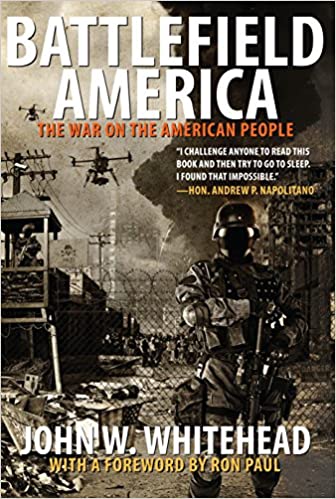
As I make clear in my book Battlefield America: The War on the American People and in its fictional counterpart The Erik Blair Diaries, we are not slaves.

We are human beings, and for the moment, we have the opportunity to remain free—that is, if we tirelessly advocate for our rights and resist at every turn attempts by the government to place us in chains.

The Founders understood that our freedoms do not flow from the government. They were not given to us only to be taken away by the will of the State. They are inherently ours. In the same way, the government’s appointed purpose is not to threaten or undermine our freedoms, but to safeguard them.

Until we can get back to this way of thinking, until we can remind our fellow Americans what it really means to be free, and until we can stand firm in the face of threats to our freedoms, we will continue to be treated like slaves in thrall to a bureaucratic police state run by political psychopaths.


John W. Whitehead, constitutional attorney and author, is founder and president of The Rutherford Institute. He wrote the book Battlefield America: The War on the American People (SelectBooks, 2015). He can be contacted at johnw@rutherford.org. Nisha Whitehead is the Executive Director of The Rutherford Institute. Read other articles by John W. Whitehead and Nisha Whitehead.