It’s possible that I shall make an ass of myself. But in that case one can always get out of it with a little dialectic. I have, of course, so worded my proposition as to be right either way (K.Marx, Letter to F.Engels on the Indian Mutiny)
For the Nimiipuu people, protecting wolves and grizzly bears is akin to protecting a family member. According to our law, every animal has a vital place in this world. When we disrupt that, we upset the entire balance within an ecosystem. We believe strongly in the sacredness of all life. Since time immemorial, we have shared this land with wolves and bears – sharing our resources, sharing food and learning from one another. It is critical that we maintain protections for our relatives, the wolves and grizzly bears, to ensure these species can continue to carry out their roles on this land.
In recent years, wolves and grizzly bears have faced increasing persecution in the Northern Rockies. The threat of hostile state management in Idaho, Wyoming and Montana only compounds the threats these species are already facing. To ensure the continued recovery of grizzly bears and gray wolves, continued protections under the Endangered Species Act are necessary – especially in light of the aggression we’ve seen toward these species in our states.
Most recently, Montana and Wyoming petitioned the federal government to remove Endangered Species Act protections for grizzly bears in the Greater Yellowstone Ecosystem and the Northern Continental Divide Ecosystem. Nimiipuu Protecting the Environment hopes these petitions will be rejected and ensure continued protections for grizzly bears in our region. We have already seen what has happened to wolves in the Northern Rockies since they were delisted – we cannot allow grizzly bears to face the same hostile state management and extreme killing.
Our group is also part of a lawsuit challenging Idaho’s wolf trapping and snaring laws that facilitate the killing of up to 90% of Idaho’s gray wolf population. The lawsuit contends that continued and expanded wolf trapping and snaring will injure and kill non-target grizzly bears, which are protected as threatened under the Endangered Species Act. Idaho has ignored the potential impacts to grizzlies and charged forward with its extreme killing practices to eradicate as many wolves as possible. We joined this lawsuit to end the trapping and snaring of wolves in grizzly bear habitat during non-denning periods.
In just a single year after Idaho’s aggressive new wolf trapping and snaring laws took effect in 2021, Idaho’s wolf population declined by 13 percent. We should be doing everything we can to protect and live alongside both wolves and grizzly bears, not actively facilitating their eradication. These species are incredibly important to the Nimiipuu people, and we are working to end the assault on these species – for the benefit of our environment and for future generations.
Nimiipuu Protecting the Environment recently spoke with tribal elders to document their stories about both wolves and grizzly bears. One elder spoke of seeing a gray wolf and how beautiful an experience it was – that an almost ghost-like figure moved past at a fast pace, and how fortunate they felt after. Another spoke of how connected we are to wolves and grizzlies by our shared food and resources. Another marveled at the harmonies from wolves – singing to one another across the canyons. Another’s daughter was named after the wolf, as she worked hard to take care of her family and boys. And another spoke of the need to work to better understand grizzly bears and their needs and restore our ecosystems back to their natural configurations.
The stories shine a light on just how important grizzly bears, wolves and the rest of the natural world have been to the Nimiipuu people for generations. These stories are passed down to all of us – stories of our ancestors and how important the species have been toward ensuring the continued survival of our landscapes and each of us. Every single one of us is connected. As we face the continued loss of nature, we should be fighting harder to protect these species, not harm them.
In the coming months, the U.S. Fish and Wildlife Service will decide whether to maintain protections for the grizzly bear in the Greater Yellowstone Ecosystem and the Northern Continental Divide Ecosystem. We are hopeful that the agency will decide to continue protecting the species, as climate change, habitat destruction and increased killing of bears has only made the situation more dire. We must do all we can to better foster connections between isolated grizzly populations and recommit to their recovery in the lower 48, including priority ecosystems like the Bitterroot and Cascades.
And as we move toward a decision in our Idaho litigation, we are hopeful for a ruling that protects both wolves and the ESA-protected grizzly bears that are indiscriminately killed through trapping and snaring. The Endangered Species Act has afforded grizzly bears protections and Idaho’s extreme killing program for wolves has put both species at risk.
In recent years, officials in this region have proven to be incredibly hostile toward the species that Indigenous communities, and most Americans, know and love. People travel from all over the world to see our grizzly bears and wolves, and they spend significant money in our region while they are here. We should be protecting these species and the role they play in our ecosystems, our culture and our economy, not targeting them. The extreme hostility toward these keystone species will only hurt all of us if it continues.
Julian Matthews is a member of the Nez Perce Tribe and the coordinator for Nimiipuu Protecting the Environment.
Losing World War II
A glorious moment against tyranny shadowed by an ignominy of helping tyranny
by Dan Lieberman / January 13th, 2024
British Prime Minister Winston Churchill desperately tried to persuade United States President Franklin Delano Roosevelt to declare war on Germany and enter World War II. The U.S. president recognized Nazi Germany’s threat to Western civilization and U.S. interests but his intuition told him that the American people were not ready for battle. Complicating a proposed alliance was FDR’s critical attitude toward the British Prime Minister; they had met at a 1919 post-World War I conference, where Roosevelt considered Churchill a heavy drinker who behaved in a superior manner. The British PM also represented the colonialists of the British Empire and supported the empire’s hold on world trade and world prices. Roosevelt sought the end of colonialism and the beginning of free trade. He considered Winston Churchill as an obstacle to achieving both pursuits.
German forces conquered France and Roosevelt realized the need to help Britain. His help considered British soldiers fighting the war with U.S. armaments and not together with U.S. soldiers. The entrance of the Soviet Union into the war increased the president’s belief that the joint Anglo-Soviet forces, aided by U.S. war materials, would be able to defeat Germany without the U.S. entering the war. The Japanese attack on Pearl Harbor reorganized the war map and Roosevelt found his nation forced into battle.
The U.S. declared war on imperial Japan and not on Nazi Germany. After Germany declared war on the U.S., considered one of the most strategic blunders ever made by a country at war, the U.S. returned the favor and entered the European theater of war. In December 1941, the U.S. military was unprepared and suffered quick losses from an advancing Japanese army. Preoccupied with stopping the Japanese, U.S. strategists had no will to fight on two fronts. However, they did. In the finest years of their history, the American people sacrificed everything, stood united as never before and never since, produced armaments at a record pace — a warship each day ─ and, together with the Soviet Union, liberated Europe and Asia from aggression and oppression.
To those who observe events from a socio-economic perspective, America fought in World War II to prevent German and Japanese economic dominance and assure American hegemony. Those familiar with FDR and America of that time have a different perspective — Roosevelt was an internationalist who believed no country should dominate and no country should be dominated. At Yalta, he knew that the United States and the Soviet Union would emerge as the dominant world powers and to prevent clashes, each needed its sphere of influence and defensive perimeter. Being dominant did not mean dominating and Roosevelt, maybe naively, expected that the Socialist Soviet Union would treat all nations in its sphere of influence as an equal partner. He titled the war effort “America, the arsenal of democracy,” assuring, by morality and military might that liberty and freedom would be made available to all.
Future U.S. presidents betrayed Roosevelt’s vision. The U.S. achieved dominance and fought to preserve it. The glow of the shining World War II years began to dim and was extinguished by President Biden’s actions at the start of Israel’s war on Gaza. Americans were now supporting tyranny that had many elements to what they had fought against, willing accomplices to an apartheid Israel that supposedly arose from the ashes of the Holocaust and developed from embers that characterized Nazi Germany — ultra-nationalism, racism, militarism, irredentism, belief in the unique folk, and perpetuation of genocide. List the characteristics of nations and compare apartheid Israel with Nazi Germany and the two nations have many similar characteristics, while apartheid Israel shows little relation to Western democracies. Not everyone will agree with the comparisons made with the writer’s knowledge and honest effort. Others can construct their comparison tables and gather their conclusions.
Israel does not have the totalitarian rule that characterized Nazi Germany but, during the last decades, extreme right governments have governed. Critics of China’s government rail at Xi Jinping’s extended rule after a 10-year presidency of two terms. Benjamin Netanyahu ruled for 11 years and has ruled again for the last year.
Israel does not have a corporate state (Fascist economy), where the government exercises strict control over corporate behavior and essentially regulates the economy. Social control is much less in Israel but existent. Modern techniques allow Israel’s intelligence agencies to conduct greater surveillance of the population, more than the intrusions that existed in Nazi Germany.
Israel is not nearly at the sinister level of the brutal Nazi system that murdered, plundered, and brought chaos to all of Europe but its policies have usurped Palestinian lands, held the Palestinians in captivity, destroyed their tools for having a decent life, reduced their feelings of security, and are directed to diminish their will to live; policies that are genocidal.
Assisting the development of apartheid Israel into acquiring characteristics associated with Nazi Germany and rewarding it for its brutal activities are one part of contemporary U.S. governments’ betrayal of World War II efforts to combat tyranny. The other part allows the memory and deaths of those who died in the World War II Holocaust to be used to advance Israel’s genocide of the Palestinian people.
Hundreds of books, films, plays (the Holocaust Theater Catalog has chronicled over 950 theater works from around the world relating to the Holocaust), TV dramas, radio broadcasts, and streaming videos on the Holocaust are available. A new performance appears every year. In 2022-2023, the silver screen featured The Zone of Interest, a loose film adaptation of Martin Amis’ 2014 novel, which describes, in fiction, the domestic life of Auschwitz commandant Rudolf Hoess and his family. Hasn’t this genre been done before, except the locales were on southern plantations? Who can be interested in the make-believe day-to-day walking around of a family with whom nobody has sympathy?
Tom Stoppard’s LEOPOLDSTADT (Vienna’s Jewish Quarter) played on Broadway from September 2022 to July 2023. Set in Vienna, the play follows the lives of one extended and prosperous Jewish family from 1899, through the war years and into the middle of the twentieth century.
An opera, The Garden of the Finzi-Continis, based on a 1962 book and a later film, had a short run in Manhattan in 2022. A brief description.
The Garden of The Finzi-Continis is set on the eve of World War II and tells the story of an aristocratic Italian-Jewish family, the Finzi-Continis, who believe they will be immune to the changes happening around them. As they make a gracious haven for themselves in their garden, walling out the unpleasantness of the world outside, Italy forms its alliance with Germany and begins to enforce anti-Semitic racial laws. But the Finzi-Continis discover too late that no one is immune, no one is untouchable.
I don’t expect any artistic presentations on the 75-year ongoing genocide of the Palestinian people, which has enough tragic stories to fill Broadway theaters for 15 million years, but how about something on Rohingya, Cambodia, Darfur, or Armenians, just one presentation? If events during WWII are appreciated, why not more in the visual arts that feature the heroism of American soldiers and the effects of the war on the American people — powerful dramas that inspire, encourage, and renew patriotism?
The extensive concentration on one particular atrocity captures each generation and accumulates material that can be revived after many years. For what purpose? It cannot be for an entertainment purpose ─ these are not themes that can be entertaining. Can’t be for commercial purposes ─ these stories don’t stimulate the box office. Can’t be for educational purposes ─ they have not prevented other mass atrocities or genocides, which is an important consideration. The cultural expressions of the WWII Holocaust serve to emotionally attach viewers to one ethnicity as perpetual victims and sympathize with them in the creation of a state that is also always a victim and must use pulverizing force against the worldwide army of anti-Semites who are conspiring to destroy that state.
The plethora of Holocaust dramas that suffocate the senses is not enough to rally Americans to support Israel. We also have museums. In twenty-six states there are sixty-six Holocaust museums and educational centers.
In the U.S. there are two prominent World War II history museums — The National WWII Museum, in New Orleans and The National Museum of the Pacific War, in Fredericksburg, Texas. Two other museums, World War II American Experience, in Gettysburg, Pennsylvania, and the Wright Museum, located in Wolfeboro, New Hampshire, “recognize and honor the contributions and enduring legacy of WWII-era Americans.” In addition to the two major and minor museums, there are another 128 museums and exhibits in the U.S. that focus on or relate to some aspect of World War II. Strange that the U.S. gave priority to constructing the Holocaust Memorial Museum in 1980 on prime and reserved land for federal buildings and did not finish construction of the World War II memorial (a World War I memorial is now being constructed) until 2004, 24 years after establishing the Holocaust Memorial Museum.
Unfortunately, the National WWII Museum has not escaped the clutches of the holocaust industry; for some unknown reason, it includes lectures, such as, “Why Did ‘Kristallnacht’ Happen? Teaching the History of European Antisemitism.” Why does a study of events that occurred before WWII, that are discussed in other venues, that is one part of a European history that has religious wars, and has no direct relation with Americans, appear in a national museum of World War II?
Why do U.S. authorities give little attention to an important period in U.S. history and give excessive attention to a tragic occurrence in a foreign country visited upon foreign people? We know Americans have not reacted to the World War II Holocaust and used their might to prevent other genocides. Do Americans enjoy any of these lugubrious, doleful, and depressing presentations of man’s inhumanity to man? Maybe, yes. The Native Americans constructed a museum of affirmation in Washington, DC, with exhibits describing the cultures of existing and living tribes. The museum does not highlight the genocides visited upon the indigenous peoples. The initial reaction to its presentation was not encouraging, Americans expected more blood and battle.
We could give Americans what they may want by converting the Holocaust Memorial museums into museums that describe the genocides of the indigenous tribes. Better than that ─ turn the Holocaust Memorial museums into inspirational museums, where Americans learn of the heroism, wisdom, and sacrifices of American people and institutions who fought for peace, justice, and freedom. American museums for Americans — museums that inform, give hope, arouse optimism, make Americans feel good, bring Americans together, and make them want to work united, as they did during the difficult World War II years.
Reverse what is now drastically wrong. Stop the special interests that manipulate and control the American people. If Israel carries out the genocide, which seems more likely each day, the World War II sacrifices and Holocaust deaths will have been in vain, the Statue of Liberty will signify hypocrisy, and the American Republic, established in 1789, will have reached its end.
Dan Lieberman publishes commentaries on foreign policy, economics, and politics at substack.com. He is author of the non-fiction books A Third Party Can Succeed in America, Not until They Were Gone, Think Tanks of DC, The Artistry of a Dog, and a novel: The Victory (under a pen name, David L. McWellan). Read other articles by Dan.
Boeing and U.S. aerospace set back by Alaska Airlines fuselage blowout
2024/01/14
When a door-sized section of a 737 MAX 9 fuselage exploded out into the void 16,000 feet over Portland, Boeing's once-solid reputation, already staggered by the two MAX crashes in 2018 and 2019, took another heavy blow.
The gaping hole that opened up and the violent decompression were terrifying and traumatic for the passengers and crew aboard Alaska Airlines Flight 1282.
Though no one died, and air travel still remains by far the safest form of transportation, this close call on a U.S. flight drew intense attention across the nation.
Everything points to a mistake in installing and inspecting a door plug, the part that blew out — it was assembled by Spirit AeroSystems of Wichita, Kan. — and a failure by Boeing to oversee the work of its supplier or catch the defect when the completed fuselage came to Renton for final assembly.
"It escaped their factory but then it escaped ours too," Boeing CEO Dave Calhoun said on CNBC.
Bjorn Fehrm, an expert engineering analyst with aviation consulting firm Leeham.net, says the details of how the door plug is held in place make it likely that four critical bolts were either not secured with a nut or, more likely, he said, not installed at all — a startling possibility.
This part, a 2-foot by 4-foot plug that covers a hole sometimes used to accommodate an additional emergency exit, is meant to be permanently fixed in place on most MAX 9s.
Longtime aviation analyst Richard Aboulafia, of AeroDynamic Advisory, said in an interview that the buck ultimately stops at Boeing.
"This isn't a Spirit jet. It's a Boeing jet," he said. "Whoever installed it, whoever built it, Boeing is more responsible."
And Aboulafia said fixing it means more than inspecting all the door plugs on every MAX 9 and calling it good.
Although all 171 of the grounded aircraft could well be back flying again within a month, inspecting and fixing those parts is now not enough for anyone to feel secure and safe again. The public needs reassurance that the entire aviation manufacturing system can be restored to producing quality airplanes without random life-threatening defects.
"It's a cultural fix," Aboulafia said. "That's much harder."
The Federal Aviation Administration has a new boss, former airline executive and pilot Michael Whitaker, who now faces tough questions from lawmakers about the safety agency's failed oversight of the manufacturing work.
Spirit has a new boss too, the hands-on former Boeing executive Pat Shanahan. After the previous CEO was fired, he was appointed to revamp Spirit's production quality, particularly at its 737 factory in Wichita.
That the Alaska Airlines blowout is only the latest in a long train of setbacks at Boeing means heads may eventually roll there too to make way for new leadership.
Meanwhile, until further notice United and Alaska Airlines cannot fly the dozens of MAX 9s in their fleets, leaving jittery air travelers to face a chaos of canceled flights.
Alaska has been canceling between 110 and 150 flights per day, and scrambling to put passengers on alternative flights.
As the airlines awaited the approval of inspection instructions needed to move forward, on Friday Alaska and United canceled all MAX 9 flights through Tuesday, as well as removing some MAX 9 flights in the days after that.
Forward momentum halted
At the end of last year, though Boeing was still slogging through repairs on long-parked 787s and 737 MAXs, it was finally ramping up new 737 MAX production and deliveries again after pauses forced by a litany of quality defects in 2023.
The jet maker appeared primed to move forward. It had big sales wins at the Dubai Air Show in November. In December, it won new orders for more than 300 MAXs and delivered 44 of the jets.
But the hope of a brighter 2024 that would speed Boeing's recovery from almost five years of constant bad news blew away with the door plug on Alaska Flight 1282.
If the incident had happened at cruise altitude when some passengers had unbuckled, someone could have been sucked out of the plane. If the door plug that blew off had struck and damaged the horizontal tail or the tail fin, the pilots could have lost control and the jet could have crashed.
Boeing escaped that but still faces an accounting, this time not for a system design flaw as in the MAX crashes, but for a serious quality control lapse that produced a manufacturing defect.
Aboulafia placed blame firmly on CEO Calhoun and Boeing's longtime focus on cost cutting and financial metrics.
In particular he cited the strategy Boeing euphemistically dubbed "Partnership for Success" that former CEO Jim McNerney pushed: squeezing suppliers with ever lower pricing for their parts.
That led Spirit in particular into a spiral of losing money in making parts for Boeing.
In June, Spirit was $3.7 billion in debt. Its cumulative losses on the 787 Dreamliner program alone amounted to a colossal $1.4 billion, or about $1 million per airplane.
"The idea of demanding more for less endlessly and leaving it to suppliers to worry how they're going to stay alive, that was just not a viable formula," Aboulafia said.
By October, the financial distress came to a head, and after Shanahan came in Boeing finally was persuaded to recognize it must pay Spirit more to save it.
It agreed to give Spirit better pricing, with one provision having Boeing pump in an additional $455 million over the next two years to build 440 Dreamliners — about $1 million per airplane.
Aboulafia said unless Boeing returns its focus to engineering and manufacturing, further quality problems will inevitably follow.
"It's gonna keep happening until they change their culture," he said. "And that change is not coming from the top."
"The message from Calhoun and company has been we'll turn on the free cash flow again, investors will be happy. That's it," Aboulafia said.
Since the Alaska Airlines incident, Calhoun has publicly and internally taken responsibility for the mistake and promised to "fix it and make sure it can never happen again."
But this echoed earlier pronouncements. In September, after misdrilled holes were discovered in the aft pressure bulkhead installed at Spirit, the CEO told Wall Street analysts quality checks had been stepped up.
"I got to tell you," Calhoun said on the third-quarter earnings call, "these fuselages, man, they have been gone over with a microscope in light of what we've experienced here."
With one quality lapse after another, the promises that everything will be fixed in the future are wearing thin.
On Thursday, the FAA said it has opened an investigation to determine if Boeing "failed to ensure completed products conformed to its approved design and were in a condition for safe operation."
And lawmakers are stepping up pressure on the FAA to enforce safety regulations and apply penalties.
On Thursday, Sen. Maria Cantwell, D-Wash., chair of the Senate Committee on Commerce, Science, and Transportation, sent a letter to FAA chief Whitaker calling on the agency to produce relevant documents from the past two years' worth of audits of both Boeing and Spirit.
"We want to know what the FAA has done, what legal enforcement action have they taken," Cantwell said in an interview. "We need to know whether ... we have serious enough actions taken by the FAA."
Speaking on CNBC Friday, Whitaker said the FAA will increase oversight by auditing the manufacturing process at both Boeing and Spirit.
He added that "we need to look at who's got authority to make approvals," and that the FAA will review the current system whereby Boeing personnel sign off on much of their own work.
It seems likely the FAA may now at least delay granting the exemption from safety regulations Boeing requested in December to get the MAX 7 certified.
That could push out the entry into service of both final MAX models, the MAX 7 and MAX 10, blocking some of the cash flow Boeing has promised investors.
Can Spirit be fixed?
Defects at Spirit plagued the MAX program last year.
In April, MAX deliveries were delayed after fittings used to attach the vertical fin were found defective. In August, more MAX deliveries were delayed after discovery of the aft pressure bulkhead defect.
The job of turning Spirit around was handed to Shanahan on Sept. 30. At Boeing he was known as a hard-driving Mr. Fix-It, focused on manufacturing operations. After he left Boeing he served as deputy defense secretary under President Donald Trump.
On Friday, Shanahan, who met with Boeing executives in Renton earlier in the week, released a video message to the Spirit workforce about the Alaska Airlines incident.
He noted that Spirit fabricates 10,500 parts for each 737 fuselage and uses 240,000 rivets to assemble each one.
"Hundreds of thousands of pieces and each part and each installation and each piece must be right," Shanahan told the workforce.
A person familiar with Shanahan's approach since he arrived at Spirit — who asked not to be named because of the sensitivity of the National Transportation Safety Board investigation — said getting the Wichita factory running smoothly is "a monster undertaking."
He added Shanahan is pushing a "a zero-defect mindset" and has instituted a "thorough feedback process" so that when defects are found a robust process is developed to prevent recurrence.
"I'm confident in Pat," Calhoun told CNBC. "I know that Pat knows the seriousness. ... He knows how to interrogate a manufacturing process."
The jet with the defective door plug was delivered to Boeing at the end of October, the month Shanahan took his position. Now he will have the FAA looking more closely over his shoulder.
No bolts installed?
The door plug that blew out is a panel used to seal a fuselage cutout where a few airlines install an extra emergency exit door so they can add more seats. Most airlines, including Alaska and United, don't have a door there, instead installing the plug, which appears to passengers inside as just another window.
The plug is secured during flight by the air pressure in the cabin. Six small metal brackets on either side of the door plug — 12 in all, called "stop fittings" — line up with 12 similar "stop pads" on the door frame.
With these pressed tightly together, the stop pads hold the plug in.
The only way for the plug to have blown out is if the plug moved up so the stop fittings were no longer aligned with the stop pads.
For maintenance on the ground, that's how the plug is opened. A mechanic raises it upward a couple of inches so the plug stop fittings are above those on the door frame. The plug then opens outward on a bottom hinge.
Four bolts, two at the top of the plug and two at the bottom, are inserted to where the plug is attached to the frame to make such upward movement impossible in normal operation.
These bolts have a head at one end and a nut secured with a lock wire at the other to ensure they don't come out. There's no stress on the bolts; their purpose is simply to prevent inadvertent upward movement of the door.
After the Flight 1282 blowout, the stop pads on the door frame were intact, as were the stop fittings on the door plug, found last Sunday in a Portland backyard. Somehow, the plug had moved up.
In an NTSB news conference Monday, structures specialist Clint Crookshanks said those four bolts that prevent upward movement have not been found, "and we have not yet determined if they existed there."
Fehrm, the engineering analyst, explained that even if just one of the four bolts were in place, the door couldn't move up. With that, and the intact condition of the stop fittings, "my conclusion is there were no bolts in the holes," he said.
How could the plane, just a couple of months old, have been flying since November without the bolts in place?
Fehrm said there's no way the plug can move up while the plane is at altitude because the air pressure keeps it tight against the stop pads. Even on the ground, while springs at the bottom counterbalance the weight of the plug, there's no force tending to shove the door up.
He surmises that when the cabin was not pressurized, for example when landing or at takeoff, if those bolts were missing then vibrations and bumps could have caused the plug to gradually work itself upward over time.
There are metal alignment pins pushed through the door plug stop fittings. Those are not fixed into the corresponding stop pads on the door frame and the tips of the pins could slide up.
NTSB Chair Jennifer Homendy said Monday that the agency's lab in Washington, D.C., will examine the plug and the connected door frame components and will be able to definitively say whether the bolts were installed by examining the holes for marks.
Inside a different Alaska Airlines MAX 9, parked Wednesday evening outside the airline's maintenance hangar at Seattle-Tacoma International Airport, the cabin sidewalls had been removed to get ready for inspection and the door plug could be minutely examined.
As is the case on the plug that blew out, an inscription written in marker on the side of the plug gave the part serial number and the words "Made in Malaysia."
All four bolts to prevent upward motion, each maybe 3 inches long, as well as all the roughly inch-long centering pins on the stop fittings, were snugly in place. It was clear that it would immediately be obvious from a visual inspection if any were missing.
Adding to the mystery, The Air Current aviation news website reported Thursday that during final assembly of the MAX 9 involved in the accident, Boeing mechanics did find some loose bolts in the door frame — different from the four bolts discussed above — around the plug on the right side that did not blow out, and had tightened them.
In typical final assembly operations, despite some reports to the contrary, Boeing doesn't remove and reinstall the plug. Renton mechanics would touch it only if something were seen to be amiss.
But if it's true the mechanics tightened some loose bolts around a plug on one side of the airplane, wouldn't they also have checked the plug on the other side?
The NTSB preliminary report, expected within a month, should tell us if indeed the bolts were never installed.
Another aspect of that investigation will be to assess how well the Flight 1282 cabin crew handled the emergency.
When the cabin decompressed and the oxygen masks dropped, the flight attendants focused on supporting the couple of unaccompanied minors on board and several babies on laps.
But NTSB Chair Homendy said they found it difficult to communicate with one another and understand what had happened. Some of them were unaware there was a large hole in the fuselage.
Analysis of the systems and procedures involved may help draw lessons for similar emergencies in the future.
With both Boeing and the FAA under scrutiny, that leaves the NTSB — a government agency with fewer than 440 employees — as the entity most trusted for an independent investigation of the Flight 1282 close call.
"Our entire mission is not just what happened but why it happened, to prevent it from reoccurring," Homendy said.
Rachel Becker, CalMatters January 14, 2024 Members of the 15th Marine Expeditionary Unit (MEU) Command Element learn how to probe for avalanche victims during training for winter conditions at the Marine Mountain Warfare Training Center on Dec. 9, 2005 at the Marine Mountain Warfare Training Center near Bridgeport, Calif.
(Photo by David McNew/Getty Images)
This story was originally published by CalMatters, nonprofit, nonpartisan media venture explaining California policies and politics.
As a popular Tahoe ski resort digs out from a tragedy that killed a skier and buried several others, scientists say predicting how the warming planet will affect avalanches is elusive at best.
An array of factors such as wind, rain, previous snowpack and temperatures can all enter into the equation of what causes a mass of snow to slide down a mountain.
“We are humans working in a natural world. And so everybody does the best they can,” said Jim Steenburgh, a University of Utah professor of atmospheric sciences and author of the book “Secrets of the Greatest Snow on Earth.”
The circumstances that lead to avalanches are multifaceted, Steenburgh said: a weak layer in the snowpack, a steep slope and a trigger — usually people on the slope. The frequency of human-triggered avalanches in the future will continue to depend in large part on how many skiers and snowboarders recreate in risky backcountry areas.
That also means untangling the effects of climate change is especially difficult, or “elusive,” as one team of scientists said.
Debris from an avalanche blocks California State Route 38 after a series of snow storms on March 2, 2023 near Big Bear, Calif.
(Photo by Michael Heiman/Getty Images)
Still, researchers are making a few predictions. Lower-elevation areas that see less snow in a warmer future may see fewer avalanches, but higher elevations could see more intense storms and the potential effects on avalanches there are uncertain.
The United Nations’ Intergovernmental Panel on Climate Change reported in 2019 that there was medium evidence for less avalanche hazard at lower elevations, and mixed changes at high elevation. Though the report predicted an increase in avalanches involving wet snow, they found “no clear direction of trend for overall avalanche activity.”
Avalanches involving wet snow could increase — as could conditions where scarce snow and cold, clear weather combine to cause persistent weak layers in the snowpack, creating “a major threat to recreationists,” a team of researchers from Switzerland, Italy and the U.S. wrote in a 2021 review paper.
Trauma and injuries could rise as snowpacks dwindle, with less snow to cushion blows from the terrain. And wetter avalanches also could increase buried victims’ risk of suffocation in the higher-density snow.
“There will be a higher risk of disastrous events where poorly managed winter tourism activities, transportation routes, and exploitation of natural resources lead to increases in exposure,” the international study said.
Mixed findings also were reported on other mountain ranges around the planet. Climate warming was linked to an increase in wet snow avalanches in the Western Himalayas — which the researchers said “contradict the intuitive notion that warming results in less snow, and thus lower avalanche activity.”
But three years later, another team found that the number and magnitude of avalanches dropped substantially at low-to-medium elevations of the Vosges Mountains in northeast France as snow became scarce. They predicted that the increases observed in the Alps and Himalayas “will eventually vanish as warming will become more pronounced to reduce snow cover at increasingly higher elevations.”
Mike Reitzell, president of Ski California, a trade association of 36 ski areas in California and Nevada, said ski resorts in avalanche-prone terrain already have programs to reduce the dangers – regardless of the impacts of climate change.
“The slope angles aren’t going to change with climate change,” Reitzell said. “The type of snowpack that there is, whether it’s a wet snow versus a drier snow, those are things they would already be analyzing anyway.” ‘Dangerous avalanche conditions’
Ski resorts have long used explosives and artillery to trigger avalanches and remove the mass of snow before it can produce avalanches dangerous to visitors. “This greatly reduces, but does not eliminate the avalanche threat,” Steenburgh said.
Before the deadly event on Wednesday, the Sierra Avalanche Center forecast a “considerable” risk of avalanches in the Central Sierra Nevada backcountry.
“Dangerous avalanche conditions will continue today. New snow and high winds have loaded existing weak layers in our snowpack. Large avalanches are the main concern today failing well below our recent storm snow. High winds will also continue to create slabs of wind blown snow in exposed areas,” the center reported today.
The resort had already seen a smattering of storms in the months before. Then the wind picked up on Monday night, and light snow started Wednesday morning before the avalanche occurred, according to Chris Johnston, a meteorologist with the National Weather Service office in Reno, Nevada. The storm dropped about 14 inches of snow on the resort’s upper mountain area over 24 hours.
The avalanche occurred just minutes after the resort opened on a steep, black diamond run made famous during the 1960 Olympics’ alpine skiing events at the resort, then called Squaw Valley. It was the first day that the famed KT-22 lift had opened for the season. While Palisades reopened today, KT-22 and nine other lifts remained closed.
Craig Clements, a San Jose State University chair and professor of meteorology who teaches a mountain meteorology class that covers avalanche mechanics, said conditions were primed for an avalanche because high winds transported snow to form a thick slab atop of weak layers of snow.
“You have a weak shear zone there, and so basically, all that new snow can slide … you just need to trigger it,” Clements said. “And then it will slide downslope — and that is dangerous.”
2023's record heat partly driven by 'mystery' process: NASA scientist
Agence France-Presse January 13, 2024 Firefighters (Shutterstock www.shutterstock.com)
It's no secret human activity is warming the planet, driving more frequent and intense extreme weather events and transforming ecosystems at an extraordinary rate.
But the record-shattering temperatures of 2023 have nonetheless alarmed scientists, and hint at some "mysterious" new processes that may be under way, NASA's top climatologist Gavin Schmidt tells AFP.
The following are excerpts from an interview with Schmidt:
- Can you put what we saw in 2023 into perspective? -
It wasn't just a record. It was a record that broke the previous record by a record margin.
We started with La Nina, this cool phenomenon in the tropical Pacific. That was still around until March. And then in May, we started to see the development of an El Nino, the warm phase of that cycle.
It normally affects the temperatures in the following year. So that would be 2024. But what we saw in 2023 was that the temperatures globally seemed to go up with the El Nino event, in a much greater way than we'd ever seen it before.
The long term trends we understand, and it's being driven by the greenhouse gases, it's being driven by anthropogenic effects. We're expecting that to continue, decade by decade, until we stop emitting greenhouse gases into the atmosphere, which we haven't done yet.
But what happened in 2023 was that, and then plus something. And that 'plus something' is much larger than we expect, or as yet can explain.
- What are the leading hypotheses for that 'plus something'? -
There have been emails and conversations going on around the world, among the scientists who are looking at this, and people say, 'Oh, let's look at the Earth's energy imbalances. Let's look at the aerosols, let's look at the El Nino, at what's happening in the Antarctic, in the North Atlantic.' And everybody has lots of ideas, but it doesn't quite add up.
It may be that El Nino is enough. But if I look at all of the other El Ninos that we've had, none of them did this. So either this El Nino is really super special, or the atmosphere is responding to this El Nino in a very special way. Or there's something else going on. And nobody has yet really narrowed these possibilities.
That long-term trend is still within the bounds of what we've been predicting for many years. But the specifics of what happened in 2023 are a little mysterious.
- What should we expect for 2024? -
It matters why 2023 was the way it was, because does that mean it's going to continue? Does that mean the impacts are going to start to accelerate? We don't know! And that's problematic.
2023 did not follow the old patterns. If the old patterns come back, and 2023 was just a blip, then 2024 will be very close to 2023. If it's not a blip, if it's something systematic that's changed, or that's changing, then you would expect 2024 to actually be warmer. Because you have the warmth that you would expect, and then there's this extra thing.
And that has implications for the weather, and heat waves, and intense rainfall, and coastal flooding, and all the rest of it, that we can expect this year.
la/ia/sst
‘It will be the end of democracy’: Bernie Sanders on what happens if Trump wins – and how to stop him
He’s the leftwing outsider who nearly became the Democrats’ candidate for president - twice. As his position on the Israel-Gaza war threatens to upset his support, the veteran senator says he’s tired but determined to fight the return of that ‘ bitter, humiliated man’
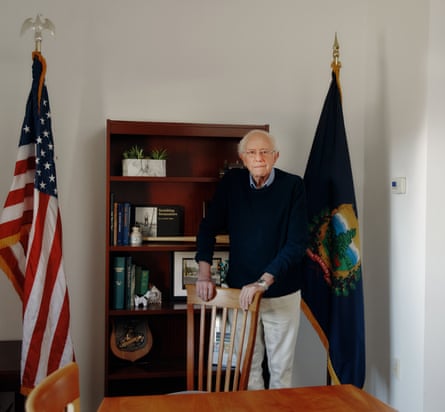
Bernie Sanders sweeps into his state office in Burlington, Vermont, itching to get on with our interview. When I try to break the ice by asking the US senator how he is, he replies gruffly, “Good,” and motions with his outstretched hand for our conversation to begin.
It’s a Saturday, and Sanders is dressed in his casual weekend uniform of cream chinos, blue shirt and sweater, no tie. I’d been hoping the day would be so cold and crisp in Burlington, the idyllic college town which has been his home since 1968, that he’d be wearing the mittens captured in a cult photo of Sanders huddled against biting winds at Joe Biden’s 2021 inauguration. The ones that launched a quadrillion memes and sent the US senator hurtling into the cyber stratosphere. “I couldn’t believe it, all I was doing was trying to keep warm!” he says, before breaking the bad news. Not only is he not wearing the mittens, “I don’t even know where they are.”
Sanders always seems to be in a hurry. Like Alice’s white rabbit, he’s forever racing against the clock in his battle with the billionaires and corporate interests. He is the most unlikely harbinger of change: a politician who drove young voters wild with “Berniemania” in 2016, when he was already 74; a man with none of the usual TV good looks and smooth talking attached to presidential candidates, but one who, by being absolutely himself, still turned out to be hugely charismatic.
In the past decade, he’s done more than almost anyone to change the political lens in the US, bringing income inequality, poverty and what he calls “uber-capitalism” into focus. And yet before that he was a virtual unknown.
In his 20s and 30s, Sanders worked lean years as a carpenter and freelance writer, alongside campaigning for the local socialist party, Liberty Union. It took him 10 years to learn how to win an election, which he did in 1981, aged 39, by all of 10 votes, to become Burlington’s mayor, before taking Vermont’s only congressional seat a decade later.
He remained for the next quarter of a century largely in the shadows, a rare overtly leftwing voice in Congress, diligently ploughing his self-styled democratic socialist furrow. And then in 2016, he suddenly burst on to the national stage in his challenge against Hillary Clinton for the Democratic presidential nomination, attracting an army of young voters chanting: “Feel the Bern”.
Bernie Sanders at Joe Biden’s inauguration, wearing the mittens that launched a million memes. Photograph: AFP/Getty Images
Eight years on, he’s still in a rush, but he comes across as more sombre now, more edgily reflective. He imbues that mood in an afterword to the new paperback edition of his book, It’s OK to Be Angry About Capitalism, in which he writes that though he would like to be optimistic about the future, he cannot. He invokes his seven grandchildren, and laments that they will inherit a world that faces “more urgent and undeniable crises than at any time in modern history”.
I ask him to spell that out. “We’re looking at a series of extraordinary crises. Climate: it’s up in the air whether the world community will make the cuts in carbon emissions to provide a habitable planet for our grandchildren. The growth of oligarchy: a small number of extremely wealthy people control the economic and political life of billions. Democracy: under severe threat from those capitalising on people’s fears.”
Not long ago, Sanders used to be ridiculed for such disquieting rhetoric; he was denounced as a firebrand, a rabble-rouser. No one’s laughing at him now. Two wars, a humanitarian catastrophe unfolding in Gaza, vast swathes of North America literally burning, inequality between rich and poor at mind-sizzling levels. As the New Yorker memorably noted, “reality has endorsed Bernie Sanders”.
Is that how it seems to him, that all his fears are coming home to roost? “It’s not a great feeling,” he says. “I’m extremely nervous about what is coming.”
Sanders has long had the measure of Trump. In 2016, when Trump said, “I alone can fix it,” as he accepted the Republican presidential nomination, Sanders commented: “Is this guy running for president or dictator?” Two months before the 2020 election, he predicted that a defeated Trump might not go peaceably – another portent that was dramatically fulfilled.
Now, as the Iowa caucus kicks off the 2024 primary season on Monday, Sanders is at it again. Except this time, he says, the stakes are much higher. A second Trump presidency will be more extreme. He is a bitter man, having gone through four indictments, humiliated, he’s going to take it out on his enemies
Even for a politician who doesn’t mince his words, his assessment of a Trump victory in November is sobering. “It will be the end of democracy, functional democracy.”
It may not happen on day one, he says. Trump wouldn’t be as obvious as to abolish elections. But he would steadily weaken democracy, making it harder for young people and people of colour to vote, enervating political opposition, whipping up anger against minorities and immigrants.
A second Trump presidency would be much more extreme than the first. “He’s made that clear,” says Sanders. “There’s a lot of personal bitterness, he’s a bitter man, having gone through four indictments, humiliated, he’s going to take it out on his enemies. We’ve got to explain to the American people what that means to them – what the collapse of American democracy will mean to all of us.”
He doesn’t ascribe the rise of Trump solely to a lumpen mass of redneck working-class Americans, deplorables to borrow a phrase. “I do not believe that all of Trump’s supporters are racist or sexist or homophobes. I think what’s going on in this country is a belief that the government is failing ordinary Americans.”
Sanders’ office sits in the main street of Burlington and is, like the man, minimalist and spare. There are posters from different stages in his political life, including an inevitable “Feel the Bern” placard and a photograph from Puerto Cabezas, Nicaragua, which mayor Sanders twinned Burlington with during Ronald Reagan’s Contra war against the leftwing Sandinistas. A third wall-hanging says: “In recognition of your support for fish hatcheries in the Lake Champlain Basin”.
He lives in a modest house a little way from the centre of town, with Jane O’Meara Sanders, whom he married in 1988 and to whom he dedicates It’s OK to Be Angry, calling her his “wife, co-worker and best buddy”. He also dedicates the book to his brother, Larry Sanders, who lives in Oxford, England, and is a former Green party councillor, and to his four children – one by his first wife, Deborah Shiling Messing, and three stepchildren, who are Jane’s but whom he considers his own – as well as to those seven grandchildren.
He has built his political persona around reciting startling and infuriating statistics, and my encounter with him is no exception. With his index finger jabbing as though pointing to an invisible crowd, he tells me that before the pandemic three multibillionaires (Jeff Bezos, Bill Gates and Warren Buffett) owned more between them than the combined wealth of the 160 million Americans who make up the bottom half of society. “Three people! That’s unbelievable! Incredible! Wages, accounting for inflation, are lower today for working people than they were 50 years ago. Think about that! My grandchildren will have a lower standard of living than my generation.” The challenge is to be able to show people that government in a democratic society can address their very serious needs. If we do that, we defeat Trump
In this scheme of things, Trump is merely doing what demagogues are doing the world over – capitalising on the anxieties and struggles of the people. “Trump comes along and says, ‘I’ll be your strong guy, I’ll deal with all your anxieties – immigration, transgender issues, race – I’ll be there for you.’”
Uncomfortably for his colleagues in Congress, Sanders reserves much of his sharpest criticism for the Democratic party. Officially, he has sat as an independent since entering the House of Representatives in 1991, but he votes as a Democrat in Congress and ran both his presidential campaigns as one. Yet he denounces the party establishment as a “consultant-driven, ad-producing election machine”.
It is “beyond pathetic”, he writes in the book, that a phoney corporate hack like Trump should be able to present himself as the “champion of the working classes”, while the Democratic party stands back and cedes territory to him. He caricatures the Democratic promise to voters as, “We’re pretty bad, but Republicans are worse”, and warns that is simply not good enough.
Which brings us to Biden.
Sanders describes Biden, whom he has known since he was elected to the Senate in 2007, as a likable and decent man. But he has a clear message for the sitting president: step up to the plate or the future of the United States, of the world, is in peril. “The challenge we face is to be able to show people that government in a democratic society can address their very serious needs. If we do that, we defeat Trump. If we do not, then we are the Weimar republic of the early 1930s.”
Sanders says he’s in touch with the White House, exhorting them to be more vocal in their appeals to working Americans. “He has got to say, in my view, that if he is re-elected, within two months he will bring about the sweeping changes the working class of this country desperately need.”
So are they listening? “As is always the case, not as strongly as I would like.”
You can see why Sanders was enticed to move to Burlington as a 27-year-old, having been brought up in a Brooklyn tenement. The town, which is famous as the birthplace of Ben & Jerry’s ice-cream, is flanked by Lake Champlain on one side and the Green mountains on the other, its steeples and cobbled streets dusted with snow. It feels like an oasis of peace in a very disturbed world.
Until it doesn’t.
On 25 November, three 20-year-old Palestinian-American students, best friends from Ramallah in the West Bank who had come to the US to pursue a safe university education, were shot in a Burlington street by a hate-filled stranger. One of the men, Hisham Awartani, is paralysed from the chest down.
The incident has left Sanders shaken. In a speech to the Senate five days after the shooting, he stepped out of the limited emotional range he usually displays in public – anger, outrage, disgust – and sounded palpably upset.
He sounds upset now. “Less than a mile away from where we are right now, three really bright young people were walking down the street, talking some Arabic. Words fail to describe the ugliness and the horror of this, in this city.”
The Israel-Hamas war that erupted on 7 October with the Hamas massacre has troubled Sanders like few other events in his 40 years in politics. “It’s on my mind all of the time,” he says. “This is something I literally dream about.”
That’s not surprising, given that he is both one of the most prominent Jews in the United States and a politician who puts human rights front and centre. And this is profoundly personal for him.
During his 2020 presidential campaign he told a CNN town hall that there were two main factors behind his worldview. One was growing up in a cash-strapped Brooklyn family supported by his father’s job as a paint salesman. The other was being Jewish.
Sanders recalls the visceral way he learned as a young child about the Holocaust. He lifts up the sleeve of his left arm and rubs his skin as he tells me: “I remember going down a few blocks to the shopping area, and there were people working in the markets, and they had their concentration camp numbers tattooed on their arms.”
Sanders in his office in Burlington, Vermont. Photograph: Tony Luong/The Guardian
His father, Elias Ben Yehuda Sanders, emigrated from Poland to the US in 1921. He was 17 and penniless, and fleeing antisemitic pogroms. Most of that side of Sanders’ family remained in Poland and were almost entirely wiped out by the Nazis.
A few years ago, Sanders went with his brother, Larry, to Słopnice, the Polish village where their father had been raised. “There was a mound, and it was a mass grave of people slaughtered in the town,” he says. “So racism, wiping out people because of a different religion, that’s stayed with me my whole life.”
His deep personal understanding of the horrors human beings can inflict on each other helps explain the tightrope Sanders has been walking over the war. He has always stood firmly beside Israel as a safe haven for Jews, and has also spoken up over many years for the right of the Palestinians to live in peace. It’s a classic two-state position.
That has translated in the current crisis as Sanders steadfastly defending the right of Israel to go after Hamas, which he calls a “disgusting terrorist organisation”. At the same time, he has become steadily more damning of Benjamin Netanyahu and the Israeli military’s “mass atrocity” in Gaza.
He has also grown increasingly disapproving of Biden’s staunch support for the Israeli war effort, condemning what he calls US complicity in “destroying the lives of innocent men, women and children in Gaza”. He is trying to block billions of dollars of extra US military aid to Israel, and is demanding a Senate investigation into how US arms are used in Gaza.
I ask him whether he feels a special distress watching a country he has always supported as a post-Holocaust shelter for Jews inflict such indiscriminate bombing on others. “The answer is yes. If there are any people that have suffered, it’s Jewish people. And they should not be imposing that type of suffering on Palestinian children – killing children is not the solution.”
To say the dual position Sanders is attempting to hold is uncomfortable would be a gross understatement. He has come under fire from pro-Israeli Democrats and Republicans who accuse him of betraying America’s great ally by failing to offer Netanyahu unconditional support. The polling is clear. Given the choice between Biden and Trump, there are a lot of people saying, ‘Thank you, but no thank you’
On his own progressive side, his refusal to countenance a permanent ceasefire, which he fears would merely embolden Hamas to renew its attacks with the aim of destroying Israel, has also landed him in hot water. More than 400 of his former staffers signed an open letter imploring him to shift his position; one of them, his 2020 campaign spokesperson, Briahna Joy Gray, tweeted “biggest political disappointment of our generation” in response to an interview in which Sanders explained his view.
There has also been fallout among young Americans, whom Sanders has long cultivated as the sweet spot of his base. Young voters, drawn towards his no-nonsense takedown of the ultra-rich, are at the core of his 15.2 million following on X, formerly known as Twitter. Yet amid the Gaza crisis, polls show a stark generational divide, with young, progressive Americans coalescing around demands for a permanent ceasefire. I ask him, does he fear that his movement of youthful supporters could be starting to splinter?
He clearly doesn’t want to go there. “I think, at the end of the day, we’ll be all right,” is all he’ll say.
Is Sanders swimming against the tide of an increasingly polarised and social-media-driven world?
“I’m trying to do my best,” he concedes, a little mournfully, “within the complexities.”
When Sanders went up against Hillary Clinton in the 2016 Democratic primary, those who were paying attention could feel the tectonic plates of US politics shifting. An insurgent campaign focused around inequality and corporate greed was giving a figurehead of the Democratic establishment a run for her money.
Not that there were many paying attention. Sanders clearly still feels riled by how marginalised he was in the 2016 race. While his gargantuan crowds chanted, “Feel the Bern”, pundits derided the “free stuff” he promoted, such as decent housing and healthcare for all, with the New York Times chiding that it would add $3tn a year to government spending.
Many media outlets largely ignored him. Even those dismissive of him had to recognise that he had become a phenomenon. By the end of the primaries he had won 22 states and more than 13m votes. Though he lost, he gained a universe: an army of young, progressive, impassioned Americans fluent in Bernie-ese.
Oh, and he also acquired a picture-perfect impersonation of himself on Saturday Night Live, courtesy of Larry David. The Curb Your Enthusiasm star was not only the spitting image of his subject, but he got Bernie’s arms-flailing stump speech and legendary crotchetiness to a T, and as a fellow Brooklyn Jew spoke his language (“yuuuge”). The two men appeared together on SNL just before the 2016 New Hampshire primary, and a few months later were revealed by genealogists to be distant cousins.
The shorthand often used for the uprising Sanders catalysed is the Squad, the team of progressive Congress members around Alexandria Ocasio-Cortez that emerged in the wake of 2016. Sanders writes in his book that the Squad were a “breath of fresh air”, but to me he insists the sea change went even deeper. “When I was elected to the House in 1990, there were five members of the progressive caucus. Today, there are well over 100. It is far more powerful and progressive than back then.”
Could there one day soon be a President AOC, not just a female president, but a progressive one?
Sanders squirms a little, saying he doesn’t want to play the name game. But then he says: “Absolutely. Absolutely. The possibility exists, of course.”
For all his talk of revolution, for all his tax-the-rich bills and declarations of radical populism, a large part of the Sanders creed is nothing more nor less than an appeal for the basic fundamentals of life – health, housing, a living wage, education – that are taken for granted by all other developed nations. He devotes an entire section of It’s OK to Be Angry About Capitalism to Finland, which is hardly a hotbed of revolution.
Look at it that way, and it’s not Bernie who is the extreme radical, it’s the far-right march of the Republican party. Which brings us back to Biden, the threat of Trump, and the ominous 10 months ahead.
Sanders has plenty of nice things to say about Biden. In the book he praises the president’s 2020 campaign platform, saying that if it had all been put into effect, he would have been the most progressive president since Franklin D Roosevelt. (The compliment is in part self-serving – Sanders credits himself with having pushed Biden further to the left in the run-up to the election.) He also applauds Biden’s decision to join a picket line during the recent auto workers strike, the first sitting president in history to do so.
But as we enter election year, he warns that there is much more to be done. “Look, the president has put a historic amount of money into transforming our energy system away from fossil fuels, but the fossil fuel industry keeps on its merry way, and we’re not stopping them. The president is making efforts to take on the greed of the pharmaceutical industry, but it’s nowhere near enough. He tried to lower student debt; it was reversed by the supreme court.”
Sanders suddenly leans towards me and gives me a blast of rhetoric that is almost overpowering.
“The president has got to acknowledge the enormous crises facing people’s lives. You can’t fool them. If I say to you all the great things I’ve done for you, you will come back and say, ‘Well, I can’t afford healthcare, I can’t send my kid to college.’ Americans are feeling anxious right now, and we’ve got to address that.” There’s no debate on the crumbling healthcare system, on climate, on wealth inequality. That’s distressing, and what we’re seeing in the world is distressing
Is there a danger many young Americans and voters of colour who formed a critical part of the coalition that elected Biden – and defeated Trump – in 2020 will look at the rematch of the same two candidates in November, decide they aren’t inspired by either, and stay at home?
“There’s no question. The polling is clear. Given the choice between Biden and Trump, there are a lot of people saying, ‘Thank you, but no thank you.’”
It’s a strikingly different analysis from that offered by much of the commentariat, which has lasered in on Biden’s age. Which is interesting, because Sanders, at 82, is a year older than the president yet rarely gets labelled as old. If anything, he comes across as ageless – as crotchety and energetic as he’s ever been.
I ask what he thinks of the focus on Biden’s age, remarking that it’s not just Biden. Mitch McConnell, Republican leader in the Senate, is the same age as Biden at 81, and has caused some alarm by freezing mid-speech. Is it time to drop to a younger cadre of political leaders?
“It’s a nice phrase, a new generation of leadership, and yes most of the strongest progressives are young people. But you’ve got young Republicans who are among the most rightwing people in the country. So it’s not age, it’s what the individual stands for.”
And what about him? On one level, with the world going up in smoke, his brand of urgent analysis is needed more than ever today. But he’s been at it a long time, he had a heart attack during the 2020 campaign, and must be feeling the weight of it all.
He’s surprisingly candid. “I am tired. I’ve been doing this since I was elected mayor of this city in 1981. What I see in Washington is so dishonest. There’s no debate on the crumbling healthcare system, no debate on climate, no debate on wealth inequality. None! That’s distressing, and what we’re seeing in the world is distressing, and being 82 … this is painful stuff.”
Just when I think Sanders might be about to announce his retirement, he sits back, rallies himself, and says: “Let’s get back to my grandchildren and the future generation. It’s in my DNA, it’s the way I look at the world. You’ve got to stand up and do the best you can. We don’t have the moral right to simply walk away.”
“You keep going,” I suggest.
“You gotta keep going.”
It’s OK to Be Angry About Capitalism by Bernie Sanders (Penguin Books Ltd, £10.99).
Several thousand demonstrate in Berlin against right-wing extremism (FASCISM)
2024/01/14
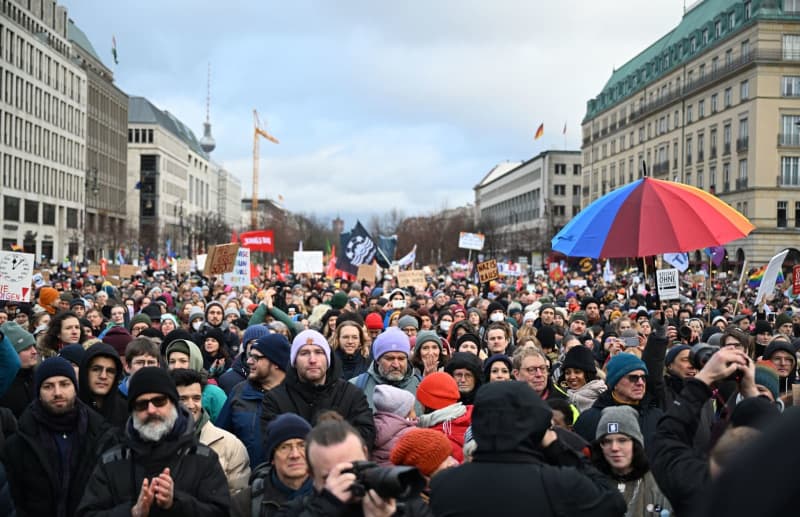
People take part in a demonstration against the right at the Brandenburg Gate under the slogan "Defend democracy". Soeren Stache/dpa
Thousands of people demonstrated on Sunday against right-wing extremism in front of Berlin's historic Brandenburg Gate, the city's police department said.
The police estimated the crowd at "several thousand," according to a spokeswoman, while the climate protection group Fridays for Future, which had called along with others for the demonstration, put the number at 25,000. There were initially no incidents, the police said.
Slogans saying the far-right Alternative for German (AfD) party is "not an alternative" could be read on banners and well-known climate activist Luisa Neubauer gave a speech.
A protester holds a poster reading "AfD is no alternative" during a demonstration against the right at the Brandenburg Gate under the slogan "Defend democracy". Soeren Stache/dpa
Ground staff at IAG-owned Iberia strike
2024/01/05
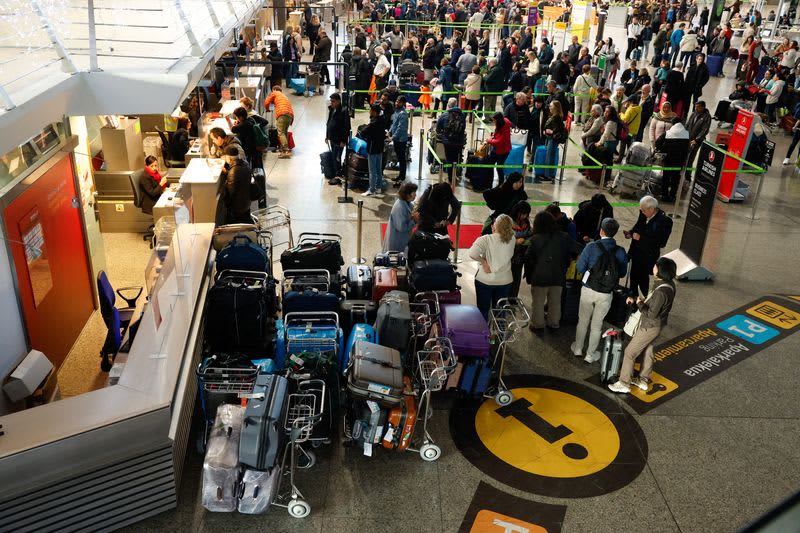
MADRID (Reuters) - Ground staff at IAG-owned Iberia airlines will stage a four-day strike at Spanish airports from Friday, forcing the cancellation of hundreds of flights, after talks between unions and the company failed at a last-ditch meeting, the airline said.
Ground staff including baggage handlers are protesting against contracts signed with new providers at Spanish airports.
Spain's two main unions UGT and CCOO plan a walkout from Jan. 5 until Jan. 8, disrupting travel over the country's traditional Epiphany holiday.
A member of Iberia's press office said Madrid airport would not be affected, but airports in Barcelona, Palma de Mallorca, Ibiza, Malaga, Bilbao, Gran Canaria, Tenerife and Alicante would.
Spain's flagship airline Iberia, Iberia Express and Air Nostrum had cancelled 400 flights and other IAG partner airlines an additional 300, she added.
Other airlines outside the IAG group that use Iberia Airport Services could be affected, she added, though minimum service legislation meant disruption should be limited.
Paloma Gallardo, the Iberia representative for union CCOO, said the union expected the strike to be observed at all airports, including Madrid. "We hope it will be as much as possible," she said. "The conflict is very serious."
With the strike trailed for weeks amid discussions between the company and unions, "more than 90% of customers have already obtained a solution to the cancellation of their flight," the company added in an earlier statement.
UGT did not immediately return requests for comment.
Spanish commercial airports are operated by state-controlled Aena, which in September hired new contractors for services that were previously provided by Iberia in many airports, angering unions even though the new suppliers committed to retain workers and their working conditions.
Iberia is challenging the new contracts in the Spanish courts and called strike action in the meantime "irresponsible".
The Iberia press office member said only 3,800 of its 8,000 ground service workers were in airports where services were now being run by new contractors and it remained unclear how widely the strike would be observed.
(This story has been corrected to say that it is a four-day, not three-day strike, in paragraph1)
(Reporting by Aislinn Laing and David Latona; Editing by Susan Fenton)
Amazon staff at new UK warehouse to strike on Jan. 25
2024/01/09
LONDON (Reuters) -Workers at Amazon's new distribution centre in Birmingham, England have voted to join ongoing strike action at the company over pay and working conditions, the GMB trade union said on Tuesday.
Around 100 workers at the warehouse will take strike action on Jan. 25, said GMB, which has not been formally recognised by the U.S. e-commerce giant.
A spokesperson for Amazon said the strike would cause "zero disruption" to customers and that 19 union members out of 2,000 employees at the warehouse had voted in favour of industrial action.
The company, which employs 75,000 people in Britain, added that it planned to raise minimum starting pay to 12.30-13 pounds ($16-$17) an hour by April.
Minimum wage in Britain is set to rise to 11.44 pounds an hour from April.
Over the past year, hundreds of employees have walked out during previous strikes at another Amazon warehouse, in Coventry, central England without much disruption to Amazon's operations.
"The message from GMB members at Amazon is the same; recognise our union and end poverty pay," GMB Organiser Rachel Fagan said.
($1 = 0.7855 pounds)
(Reporting by Sachin Ravikumar, writing by Muvija M)