It’s possible that I shall make an ass of myself. But in that case one can always get out of it with a little dialectic. I have, of course, so worded my proposition as to be right either way (K.Marx, Letter to F.Engels on the Indian Mutiny)
Saturday, January 20, 2024
MONOPOLY CAPITALI$M
CMA CGM Moves to Grow Logistics Business Agreeing to Acquire UK’s Wincanton
CMA CGM's CEVA Logistics looks to expand its British and Irish operations by acquiring Wincanton (Wincanton)
France’s CMA CGM Group is continuing its strategy to expand beyond its shipping operations focusing on logistics and shoreside operations. Today they announced through their subsidiary CEVA Logistics an agreement to buy Wincanton, a leading supply chain and logistics company in the UK and Ireland, in a deal valued the company at nearly $720 million.
“As a leading and trusted supply chain partner for many well-known British and Irish brands, Wincanton perfectly aligns with the CMA CGM Group’s ambition to further expand its presence in this strategic region,” said CMA CGM Chairman and CEO Rodolphe Saade. He highlights that it will strengthen the group’s presence in the United Kingdom and Ireland while also creating new opportunities.
In addition to expanding the geographic presence, they highlighted that the deal will diversify CEVA Logistics’ customer base. Wincanton serves many of Britain and Ireland’s best-known brands. It has broad operations in retail, grocery, eCommerce, construction, infrastructure, energy, and the defense sectors. In addition to managing warehouses and logistics operations for major companies, Wincanton reports it has responsibility for a fleet of approximately 8,500 vehicles.
Reports are that CMA CGM had made several previous approaches to the board of Wincanton before winning their support for the call-cash offer which provides an approximately 50 percent premium to the current market value of the company. The board of Wincanton accepted the offer agreeing to recommend it to shareholders.
"In unanimously recommending this offer to shareholders, the directors believe it is in the interests of all the company's stakeholders,” said Sir Martin Read, Chairman of Wincanton. “While we remain confident in the long-term prospects of Wincanton and the wider sector, we recognize that the strong performance of the company has not been reflected in the performance of its shares in recent years. We therefore believe this offer represents the best opportunity for shareholders to realize the value of their investment with greater certainty."
The company is nearly 100 years old and operates at more than 170 sites across the country. Last year, the company had revenues of more than $1.8 billion and EBITDA of nearly $154 million. The company has demonstrated strong growth in the past few years with CMA CGM calling it “an attractive growth opportunity. The acquisition is reported to be in line with CEVA Logistics’ expansion strategy. It would more than double the size of CEVA’s UK operation which currently generates approximately $950 million in revenues. Worldwide, CEVA generates approximately $15 billion in annual revenue.
Since acquiring CEVA Logistics, CMA CGM Group has moved aggressively to expand the business following a similar strategy to A.P. Moller-Maersk which is also focusing on adding logistics to the traditional shipping business. Fueled by strong profits from the container shipping business in the past few years, CMA CGM has made several key acquisitions for CEVA Logistics, including the 2022 purchase of the commerce business from Ingram Micro. They also acquired GEFCO which is in vehicles and automotive logistics and recently launched vehicle transport operations with a charter for PCTCs, car carriers, from Eastern Pacific.
CMA CGM announced this acquisition before it closed the pending acquisition of Bollore’s logistics. They made a $5.5 billion bid for the freight management business which CMA CGM says it is poised to soon complete.
CMA CGM Switches Course Rerouting Australia Service from Red Sea
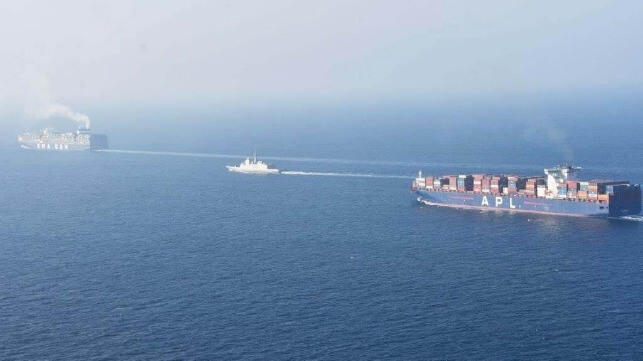
CMA CGM is transiting the Red Red with escorts but now says its Australia route will reroute around Africa (Armée Française - Opérations Militaires)
French shipping giant CMA CGM appears to have had a change of mind informing customers that it has temporarily switched its NEMO route to Australia to sail around Africa. This comes after the carrier had said at the beginning of the year that it would continue to send some vessels through the Red Sea and was “devising plans for the gradual increase in the number of vessels transiting through the Suez Canal.”
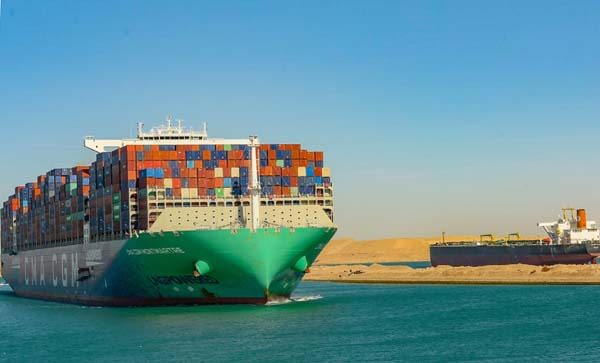
Last weekend, attempting to emphasize that transits were continuing, the Suez Canal Authority released pictures of the 44 vessels making the trip on Saturday, January 13, which features CMA CGM vessels including the company’s newest, largest class of LNG-fueled containerships. Similarly, the French Navy released pictures this week showing CMA CGM and APL branded containerships making the Red Sea transit accompanied by a warship, while CMA CGM Chairman and CEO Rodolphe Saade speaking to the Financial Times said they would continue to sail in the Red Sea when they can be accompanied.
Saade, however, went on to say in the Financial Times interview that it was on a case-by-case basis with the company meeting daily to plan its operations. The newspaper quotes Saade as saying the company schedules are in “complete disarray and we’re not able to stick to our timings.” He said some vessels are going around Africa while others are forced to wait for their Red Sea escorts.
Suez Canal Authority showed a CMA CGM vessels transiting the Canal on January 13 (SCA)
Writing to customers today, the company says “Due to recent attacks on commercial vessels in the Red Sea region, CMA CGM Group is taking contingency measures on several services usually crossing the Suez Canal in order to ensure the safety of its vessels and their crews navigating these waters.”
They are calling it a temporary change impacting the Europe to Australia routing in both directions. CMA CGM notes, however, that they are able to now provide weekly connections between Europe and Reunion, Mauritius, and Australia, and from Australia to Singapore and India. The company did not say why the decision was made to totally alter the one route.
Vessels owned by the company are making the Red Sea transit, but on January 2, the CMA CGM Tage (9,200 TEU registered in Malta) reported three explosions nearby. The vessel is on a different route operating between China, the Middle East, Greece, Romania, and Turkey.
“There appears to be no solution for now,” Saade told the Financial Times. “We’re bracing for this to last several months.”
Other major carriers including MSC Mediterranean Shipping Company, Maersk, Hapag-Lloyd, and many of the Asian-based companies, continue to entirely avoid the Red Sea and Suez Canal due to ongoing security concerns. Maersk CEO Vincent Clerc this week expressed a similar concern to Saade saying that he too expected the disruptions would continue for months.
OCEANOGRAPHY
Chile Becomes the First Country to Ratify the High Seas Treaty
Chile became the first country to ratify the historic High Seas Treaty adopted at the UN in 2023
Almost four months after the High Seas Treaty opened for signing at the UN General Assembly, Chile has become the first country to ratify the historic ocean conservation agreement. On Tuesday, Chile’s Senate unanimously approved the High Seas Treaty, officially known as the Biodiversity Beyond National Jurisdiction Treaty (BBNJ).
The treaty sets up a procedure to establish large-scale marine protected areas in the high seas, which cover nearly two-thirds of the world’s oceans. The goal is to facilitate reaching the target of conserving 30 percent of land and sea by 2030, agreed by UN member states in December 2022 within the Kunming- Montreal Global Biodiversity Framework.
While commenting on the Senate’s approval vote, Chilean Foreign Minister Alberto van Klaveren said the action confirms Chile’s strong focus on the oceans. Chile was among the UN member states that showed a strong political commitment for BBNJ adoption, while it was still in the negotiation stage.
Led by its President Gabriel Boric, Chile proposed the port city of Valparaíso, located 68 miles from Santiago, as the candidate to host the Treaty Secretariat.
Chile’s move to ratify the treaty has been welcomed by environmental campaign groups among them Greenpeace International.
“Chile has been a key country during all the years of negotiating this treaty. This is an achievement for the thousands of Chileans who called for the protection of oceans. We congratulate the action of the congress,” said Estefanía González, deputy director of Greenpeace Chile campaigns.
For the treaty to enter into force, 59 other countries are needed to ratify the treaty by 2025. This timing is to ensure the globally agreed target of protecting 30 percent of the oceans by 2030 is within reach.
The negotiations for the BBNJ treaty had been ongoing since 2004. It was only formally adopted by governments in June 2023 after exhaustive negotiations. The signing of the treaty took place in September, as the first formality before a country moves to ratification. So far, 84 countries have signed the treaty as the first step to ultimate ratification and coming into force.
Monterey Bay Aquarium study shows sea otters helped prevent widespread California kelp forest declines over the past century
After near-extinction, growth of the southern sea otter population helped kelp forests expand by increasing resilience to environmental stressors, including extreme ocean warming
Monterey Bay Aquarium researchers strengthen the link between sea otters and long-term health of California kelp forests in a new study released today. The paper, published in the journal PLOS Climate, finds that sea otter population growth during the last century enhanced kelp forest resilience in the state. This finding reinforces the importance of conservation and recovery of the threatened southern sea otter and highlights a potential nature-based solution for restoring kelp forests along the California coast, and perhaps beyond.
The study revealed dramatic regional kelp canopy changes over a 100-year period, from 1910 to 2016. During this time there was a significant increase in kelp forest canopy along the central coast, the only region of California where southern sea otters survived after being hunted nearly to extinction for their fur in the 1800s. At the century scale, the species’ favorable impact on kelp forests along the central coast nearly compensated for kelp losses along both northern and southern California resulting in a slight overall decline statewide during this period.
“Our study showed that kelp forests are more extensive and resilient to climate change where sea otters have reoccupied the California coastline during the last century. Where sea otters are absent, kelp forests have declined dramatically. In fact, we found sea otter population density as the strongest predictor of change in kelp canopy coverage across this hundred-year span,” said lead author Teri Nicholson, Senior Research Biologist with the Monterey Bay Aquarium Sea Otter Program.
Aquarium scientists used historical surveys of kelp forests dating back to the early 1900s to perform detailed estimates of canopy extent, biomass, and carbon storage – while correcting for annual variation and differences in survey methods. This allowed the scientists to examine California’s kelp forest trends over a longer time period, going back more than 60 years before available data from modern surveys based on aerial or satellite imagery. The team then compared the corrected and conservative historical estimates to contemporary datasets and used a machine learning framework to assess the dominant drivers of change over the last century.
“The use of historical maps provided an important opportunity to help us examine long-term kelp forest trends,” said Monterey Bay Aquarium Sea Otter Program Manager, Jess Fujii. “This broader view is important for understanding trends related to climate change, and developing effective science-based conservation strategies.”
Statewide, the data showed only a six percent decline in kelp canopy from 1910 to 2016. Regional changes, however, proved more sizable. Kelp canopy decreased in northern and southern regions by 63 and 52 percent, respectively. It increased nearly everywhere throughout the central coast, contrastingly, gaining an estimated 56 percent of kelp forest coverage.
While the modeling showed sea otter population density was the strongest predictor of change in kelp coverage, it also identified other factors, including extreme marine heat due to climate change.
“Today, extreme heat in the ocean is intense and persistent. Beginning a decade ago, this threat now affects more than half the ocean's surface,” said Kyle Van Houtan, a Research Scientist at Duke University, and senior author of the study. “This is a major problem for kelp forests as chronic temperature stress undermines kelp growth and health. Ecosystems are complex, and to give them their best chance at surviving these extreme changes, they need all their component parts. Sea otters, of course, are hugely influential for Pacific kelp forests. Historical studies like this are a crucial demonstration of this dynamic over the long term.”
Healthy kelp forest ecosystems provide many benefits, including serving as nursery grounds for fisheries, reducing coastal erosion from storms, and contributing to carbon storage. The study indicates returning otters to areas of their historical range could help recover kelp forests and restore their benefits in more places along the California coast.
About Monterey Bay Aquarium
With a mission to inspire conservation of the ocean, the Monterey Bay Aquarium is the most admired aquarium in the United States, a leader in science education, and a voice for ocean conservation through comprehensive programs in marine science and public policy. Everything we do works in concert to protect the future of our blue planet. More information at MontereyBayAquarium.org.
Sea otter recovery buffers century-scale declines in California kelp forests
ARTICLE PUBLICATION DATE
19-Jan-2024
Study says ice age could help predict oceans’ response to global warming
A team of scientists led by a Tulane University oceanographer has found that deposits deep under the ocean floor reveal a way to measure the ocean oxygen level and its connections with carbon dioxide in the Earth's atmosphere during the last ice age
A team of scientists led by a Tulane University oceanographer has found that deposits deep under the ocean floor reveal a way to measure the ocean oxygen level and its connections with carbon dioxide in the Earth's atmosphere during the last ice age, which ended more than 11,000 years ago.
The findings, published in Science Advances, help explain the role oceans played in past glacial melting cycles and could improve predictions of how ocean carbon cycles will respond to global warming.
Oceans adjust atmospheric CO2 as ice ages transition to warmer climates by releasing the greenhouse gas from carbon stored within the deep ocean. The research demonstrates a striking correlation between global ocean oxygen contents and atmospheric CO2 from the last ice age to today — and how carbon release from the deep sea may rise as the climate warms.
“The research reveals the important role of the Southern Ocean in controlling the global ocean oxygen reservoir and carbon storage,” said Yi Wang, lead researcher and an assistant professor of Earth and Environmental Sciences at Tulane University School of Science and Engineering. Wang specializes in marine biogeochemistry and paleoceanography.
“This will have implications for understanding how the ocean, especially the Southern Ocean, will dynamically affect the atmospheric CO2 in the future,” she said.
Wang conducted the study with colleagues from the Woods Hole Oceanographic Institution, the world’s leading independent nonprofit organization dedicated to ocean research, exploration and education. She worked for the institute before joining Tulane in 2023.
The team analyzed seafloor sediments collected from the Arabian Sea to reconstruct average global ocean oxygen levels thousands of years ago. They precisely measured isotopes of the metal thallium trapped in the sediments, which indicate how much oxygen was dissolved in the global ocean at the time the sediments formed.
“Study of these metal isotopes on glacial-interglacial transitions has never been looked at before, and these measurements allowed us to essentially recreate the past,” Wang said.
The thallium isotope ratios showed the global ocean lost oxygen overall during the last ice age compared to the current warmer interglacial period. Their study revealed thousand-year global ocean deoxygenation during abrupt warming in the Northern Hemisphere, whereas the ocean gained more oxygen when abrupt cooling occurred during the transition from the last ice age to today. The researchers attributed the observed ocean oxygen changes to Southern Ocean processes.
"This study is the first to present an average picture of how the oxygen content of the global oceans evolved as Earth transitioned from the last glacial period into the warmer climate of the last 10,000 years,” said Sune Nielsen, associate scientist at WHOI and co-author of the research. “These new data are a really big deal, because they show that the Southern Ocean plays a critical role in modulating atmospheric CO2. Given that high latitude regions are those most affected by anthropogenic climate change, it is troubling that these also have an outsize impact on atmospheric CO2 in the first place."
Protecting the world’s oceans against accelerating damage from human activities could be cheaper and take up less space than previously thought, new research has found.
The University of Queensland’s Professor Anthony Richardson collaborated on the study, which looks to halt the rapid decline of marine biodiversity from expanding industrial activities in marine areas beyond national jurisdictions (ABNJ).
“This ‘blue acceleration’ as we call it, has seen a greater diversity of stakeholders interested in ABNJs, such as the high seas and the international seabed beyond exclusive economic zones,” Professor Richardson said.
“This has led to an issue where current marine protection methods look at each sector separately – such as fishing, shipping, and deep-sea mining industries – all of which have their own suite of impacts on species, communities, and ecosystems.”
In response, researchers assessed the design of different networks of marine protection areas (MPA) across the Indian Ocean that target rich biodiversity areas with minimal impact on profitable human activity.
“Essentially, we assessed the potential trade-offs associated with including multiple stakeholders in a cross-sectoral, as opposed to sector-specific, protected area network, for ABNJs in the Indian Ocean,” Professor Richardson said.
“First, we created three sector-specific plans – involving fishing, shipping, and mining separately – to identify optimal locations for strict, no-take, MPAs.
“We then created a cross-sectoral no-take plan that minimises the opportunity cost to all stakeholders simultaneously, looking at the overall picture with each stakeholder in mind.
“After generating these plans, we compared the three sector-specific solutions, as well as their sum, to the cross sectoral solution.”
Lead researcher from the Royal Belgian Institute of Natural Sciences, Léa Fourchault, said the cross-sectoral approach met the same conservation targets at much lower additional costs for each stakeholder than if all sector-specific plans are implemented without coordination.
“For example, the fishing sector might lose 20 per cent of its potential revenue under the cross-sectoral plan, but it would lose 54 per cent if all sector-specific plans were implemented simultaneously without coordination,” Ms Fourchault said.
“This was consistent for the shipping and mining sectors, with the shipping sector now losing two per cent, instead of 26 per cent of its potential revenue, and the mining sector now losing one per cent instead of close to eight per cent.
“Our results also show that we can reduce the size of MPAs from 25 per cent of the spatial plan to eight per cent while meeting the same conservation objectives.
“This would still achieve 30 per cent coverage for important biodiversity features, including key life-cycle areas for marine megafauna, areas of biological and ecological interest, and areas important to deep-sea ecosystems, such as seamounts, vents, and plateaus.”
Researchers believe the cross-sectoral approach can be a first step to implementing the conservation objectives of the recently signed United Nations High Seas Treaty.
“The code from our research is available online and can be used by scientists, conservationists and politicians alike – and can be applied to any ocean on Earth,” Ms Fourchault said.
“Ultimately, the goal is not only to minimise conflicts between conservationists and multiple industries, but also to ensure marine life is protected against negative cumulative impacts from all three industries simultaneously.”
Generating affordable protection of high seas biodiversity through cross-sectoral spatial planning
ARTICLE PUBLICATION DATE
19-Jan-2024
Study identifies priority areas for conservation of endangered crustacean in Brazil
The land crab Johngarthia lagostoma occurs only on four ocean islands, three of which are in Brazil, but little is known of its natural history. A hill and beach on Trindade Island play a key role in the species’ reproductive cycle and survival
FUNDAÇÃO DE AMPARO À PESQUISA DO ESTADO DE SÃO PAULO
IMAGE:
AN EGG-BEARING FEMALE OF JOHNGARTHIA LAGOSTOMA ARRIVES ON THE BEACH ON TRINDADE ISLAND. AFTER THE LARVAE ARE RELEASED IN THE SEA, INDIVIDUALS THAT MANAGE TO RETURN TO LAND WILL ASCEND TO THE UPLANDS TO LIVE
Mass migration takes place between December and April on Trindade Island, the easternmost point of Brazil located in the Atlantic about 1,200 km from the coastal city of Vitória, capital of Espírito Santo state. Hundreds of Johngarthia lagostoma land crabs descend steep rocky trails from the upland peaks to the shore, where they mate and release larvae into the ocean.
The larvae develop into juveniles, which undertake an even more challenging journey back up to the heights in search of safe places in which to make the burrows they call homes. Their favorite sites are hilltops like Morro do Príncipe or Pico do Desejado, 136 m and 612 m above sea level respectively. In adulthood, they follow in their ancestors’ footsteps down to the shore, where the reproductive cycle is repeated on beaches like Praia dos Andradas.
The above information may seem basic but it is essential to conservation of this endangered species. It was obtained by Brazilian researchers in a project supported by FAPESP, along with a large amount of vitally important data on the crab’s breeding and other habits. Their findings are reported in an article published in the journal Marine Ecology.
The group was led by scientists affiliated with São Paulo State University (UNESP) and included colleagues from the Federal University of the ABC (UFABC) and the Federal University of Santa Catarina (UFSC).
After a series of analyses, the researchers concluded that Morro do Príncipe, the hill on which the largest proportion of juveniles was found, and Praia dos Andradas, the beach with the most egg-bearing females and other adults, should be considered priority areas for conservation of the species. Praia das Tartarugas and Pico do Desejado were classed as residential areas for the animals.
“Although Trindade Island is part of a conservation unit and has so far been satisfactorily protected, special care is advisable to assure effective conservation. Juveniles remain in Morro do Príncipe until they reach adulthood, so this area is important to maintain the population in the long run. Praia dos Andradas is a vital breeding ground,” said Márcio Camargo Araújo João, first author of the article. The study was part of his master’s research, which was supported by a scholarship from FAPESP. He is affiliated with São Paulo State University’s Institute of Biosciences on the Coastal Experiment Campus (IB-CLP-UNESP) in São Vicente.
Habitats of this land crab
J. lagostoma occurs in Brazil on the islands of the Fernando de Noronha archipelago and Atol das Rocas, as well as Trindade. It is also endemic to Ascension Island, a British Overseas Territory in the South Atlantic.
The only human inhabitants of Trindade, which is the tip of a large volcanic seamount, belong to a Brazilian Navy base and science station. Some 40 people work two-month shifts on this 13-square-kilometer island.
Most crab species spend their lives in contact with water, but land crabs have adapted to life in the bush, and use the sea only while developing and to disperse larvae. For this reason, it is vital to conserve the vegetation in order to assure survival of the species.
“The island’s forest is smaller than Ascension’s, for example, but there are many more crabs on Trindade, where they’re well-established, feeding not only on the vegetation but also on turtle eggs and hatchlings. They’re the apex predators and have no competitors,” said Marcelo Antonio Amaro Pinheiro, last author of the article and a professor at IB-CLP-UNESP.
“Humans have a far greater impact on Fernando de Noronha, with 3,167 inhabitants and almost 150,000 tourists in 2022. Their impact ranges from urbanization to the presence of introduced species such as cats, dogs and rats.”
Pinheiro is responsible for monitoring endangered species of Brazilian crustaceans for the Chico Mendes Institute of Biodiversity Conservation (ICMBio), an arm of the Environment and Climate Change Ministry. J. lagostoma is classified as endangered in Brazil in the latest list.
The study can help include the species in the IUCN’s Red List of Threatened Species, a global inventory of the conservation status of animal and plant species.
Night on Trindade
The researchers investigated the presence of the species on the two beaches and two hills during the breeding period, which runs from December through to April. Their study covered February-April 2019 and December 2019-February 2020.
They randomly selected individuals at night, when these crabs are most active, measuring carapace width and chela (pincer) length. They determined the sex of each individual on the basis of carapace shape and number of pleopods, small legs on the underside of the thorax used in mating and to carry eggs (brooding). J. lagostoma cannot be captured because it is an endangered species, so the specimens used in the study were released after the measurements were taken on each night of the study.
The researchers observed that males were more frequent in the population. The same pattern has been found in other land crabs, although on Praia dos Andradas the proportions of males and females were similar among adults. According to the authors, mortality is higher among females owing to heat stress and energy expenditure during migrations between the hillside habitat and the shore (and vice-versa), including the journey with eggs, as well as the lack of vegetation and shelter on the beaches.
“We saw many dead females in breeding grounds near the shore. This confirmed information from researchers who studied the species on Ascension,” João said.
On Ascension, however, only 1% of the crabs observed were juveniles, which was considered a sign of an aging population and prospective local extinction. On Trindade, the proportion was 20% (up to 30% on Morro do Príncipe), indicating sufficient population vitality.
“This is the picture we have at the moment, but it’s important to continue monitoring the species in other parts of the island to try to confirm patterns that may have gone unnoticed. In addition, concomitant investigation of these parameters on other Brazilian islands where the species occurs could provide an integrated profile that would serve as a basis for a more effective nationwide conservation plan,” João said.
The São Paulo Research Foundation (FAPESP) is a public institution with the mission of supporting scientific research in all fields of knowledge by awarding scholarships, fellowships and grants to investigators linked with higher education and research institutions in the State of São Paulo, Brazil. FAPESP is aware that the very best research can only be done by working with the best researchers internationally. Therefore, it has established partnerships with funding agencies, higher education, private companies, and research organizations in other countries known for the quality of their research and has been encouraging scientists funded by its grants to further develop their international collaboration. You can learn more about FAPESP at www.fapesp.br/en and visit FAPESP news agency at www.agencia.fapesp.br/en to keep updated with the latest scientific breakthroughs FAPESP helps achieve through its many programs, awards and research centers. You may also subscribe to FAPESP news agency at http://agencia.fapesp.br/subscribe.
Population biology of the endangered land crab Johngarthia lagostoma (H. Milne Edwards, 1837) in the Trindade Island, Brazil: Identifying crucial areas for future conservation strategies
South Florida’s nearshore reefs less vulnerable to ocean acidification, study finds
Results offer a glimmer of hope as climate change impacts coral reefs worldwide
UNIVERSITY OF MIAMI ROSENSTIEL SCHOOL OF MARINE, ATMOSPHERIC, AND EARTH SCIENCE
IMAGE:
SCIENTISTS RECOVER THE CTD DURING CHOPPY SEAS FROM THE STERN OF THE UNIVERSITY OF MIAMI'S RESEARCH VESSEL F.G. WALTON SMITH. THE CTD IS AN INSTUMENT USED TO COLLECT WATER SAMPLES AND MEASURE CONDUCTIVITY, TEMPERATURE, AND DEPTH OF THE OCEAN.
CREDIT: PHOTO: TYLER CHRISTIAN, UNIVERSITY OF MIAMI COOPERATIVE INSTITUTE FOR MARINE AND ATMOSPHERIC STUDIES.
South Florida’s Nearshore Reefs Less Vulnerable to Ocean Acidification, Study Finds
Results offer a glimmer of hope as climate change impacts coral reefs worldwide
Researchers studying South Florida’s coral reefs found that the region’s nearshore reefs and more sheltered inshore areas are less vulnerable to ocean acidification than previously thought – a major climate-related threat to coral reefs as ocean waters absorb more atmospheric CO2 from the burning of fossil fuels.
This new study, led by scientists at the University of Miami Rosenstiel School of Marine, Atmospheric, and Earth Science, and the National Oceanic and Atmospheric Administration’s (NOAA) Atlantic Oceanographic and Meteorological Laboratory (AOML) offers a glimmer of hope for Florida’s iconic coral reefs as ocean acidification, along with marine heat waves and other climate-related threats are impacting coral reefs worldwide.
“In contrast to many regions globally where ocean acidification is being exacerbated, we found that South Florida’s inshore reefs — and sheltered areas that co-exist with seagrass communities — are being buffered from the negative effects of acidification,” said the study’s lead author Ana Palacio-Castro, a researcher at the Rosenstiel School-based NOAA Cooperative Institute for Marine and Atmospheric Studies.
Ocean waters absorb atmospheric carbon dioxide, which results in a drop in pH levels, turning the water more acidic. This resulting ocean acidification impacts the ability of a wide range of marine life —from corals to clams—to build and maintain their calcium-based shells and skeletons, and ultimately compromises the structural integrity of coral reefs and the marine life that rely on them.
In this study, the researchers analyzed 10 years of continuous seawater samples collected at 38 monitoring stations across the Florida Reef Tract to assess carbonate chemistry variability among seasons, years, and reef areas, including ocean acidification. They looked at differences between Biscayne Bay and the Upper, Middle, and Lower Keys, and the inshore, mid-channel, and offshore reef zones.
The results showed potential ocean acidification refugia in inshore reefs with neighboring seagrass meadows as a result of enhanced primary production, highlighting the importance of the relationship that exists between coral reef and seagrass ecosystems to mitigate the impacts of future climate changes.
The results also suggest that Florida’s inshore reef structures could benefit from local mitigation strategies, such as reducing CO2 emissions, marine carbon dioxide removal or conserving intact seagrass meadows, according to the researchers.
“The findings underscore the importance of local monitoring to understand how ocean acidification is impacting our region and to identify potential acidification hotspots and refugia,” said Ana Palacio-Castro.
The project was supported by the South Florida Ecosystem Restoration Research Program (SFER) at NOAA’s Atlantic Oceanographic and Meteorological Laboratory (AOML) NOAA’s Ocean Acidification Program Project (grant # 20680), NOAA’s Coral Reef Conservation Program (grant # 743 as part of the National Coral Reef Monitoring Program). Data collection cruises were funded by NOAA’s Atlantic Oceanographic and Meteorological Laboratory and the State of Florida's Fish and Wildlife Research Institute.
About the University of Miami
The University of Miami is a private research university and academic health system with a distinct geographic capacity to connect institutions, individuals, and ideas across the hemisphere and around the world. The University’s vibrant and diverse academic community comprises 12 schools and colleges serving more than 17,000 undergraduate and graduate students in more than 180 majors and programs. Located within one of the most dynamic and multicultural cities in the world, the University is building new bridges across geographic, cultural, and intellectual borders, bringing a passion for scholarly excellence, a spirit of innovation, a respect for including and elevating diverse voices, and a commitment to tackling the challenges facing our world. Founded in the 1940’s, the Rosenstiel School of Marine, Atmospheric, and Earth Science has grown into one of the world’s premier marine and atmospheric research institutions. Offering dynamic interdisciplinary academics, the Rosenstiel School is dedicated to helping communities to better understand the planet, participating in the establishment of environmental policies, and aiding in the improvement of society and quality of life. www.earth.miami.edu.