Saturday, January 27, 2024

Kenya vows to challenge court ruling against Haiti deployment


By AFP
January 26, 2024

Kenya's government had said it was ready to provide up to 1,000 personnel in the deployment to Haiti - Copyright POOL/AFP Ludovic MARIN


Hillary ORINDE

Kenya’s government vowed Friday to challenge a court ruling against its decision to send a police contingent to Haiti to lead a UN-backed law and order mission in the gang-plagued Caribbean nation.

The ruling, which branded the deployment “illegal”, throws into doubt the future of a multinational force long sought by Haiti’s government, which has pleaded for international help to confront violence that has left nearly 5,000 dead.

The UN Security Council approved the mission in early October. But concerns in Kenya over Nairobi’s involvement prompted a court challenge.

On Friday, judge Enock Chacha Mwita ruled that “any decision by any state organ or state officer to deploy police officers to Haiti… contravenes the constitution and the law and is therefore unconstitutional, illegal and invalid.”

“An order is hereby issued prohibiting deployment of police forces to Haiti or any other country,” he said at Nairobi High Court.

Hours later, the authorities responded, with spokesman Isaac Mwaura saying: “While the government respects the rule of law, we have however made the decision to challenge the high court’s verdict forthwith.”

“The government reiterates its commitment in honouring its international obligations,” he said.

Ekuru Aukot, the opposition politician who challenged the deployment, said he was prepared for a long fight.

“We will still be waiting for them at the court of appeal, and we will go all the way to the Supreme Court. They should be thanking me for saving the government this embarrassment,” he told AFP.

The government had previously said it was ready to provide up to 1,000 personnel, an offer welcomed by the United States and other nations that had ruled out putting their own forces on the ground.

Kenya’s ambassador to the United Nations, Martin Kimani, on Thursday said that “significant progress” had been made in preparations towards the mission, which had parliamentary approval.

In the face of criticism, President William Ruto had described the Kenyan undertaking as a “mission for humanity” and one in step with its long record of contributing to peacekeeping missions abroad.

– War zone –


Haiti’s foreign minister on Thursday pleaded for the deployment to be speeded up, telling the UN Security Council that gang violence in the country was as barbaric as the horrors experienced in war zones.

“The Haitian people cannot take any more. I hope this time is the last time I will speak before the deployment of a multinational force to support our security forces,” Jean Victor Geneus told the council.

Gangs now run rampant in large swathes of the country and homicides in Haiti more than doubled last year to nearly 4,800 murders, according to a UN report released Tuesday.

The multinational mission — initially approved for one year — had envisioned Kenyan police on the offensive with their Haitian counterparts, who are outnumbered and outgunned by gang members.

Haiti, the Western hemisphere’s poorest nation, has been in turmoil for years, with armed gangs taking over parts of the country and unleashing brutal violence, and the economy and public health system in tatters.

The 2021 assassination of President Jovenel Moise plunged the country further into chaos. No elections have taken place since 2016 and the presidency remains vacant.

bur-amu-ho-np/kjm


Kenya court ruling forbids planned Haiti police deployment

Kenya's top court has ruled plans to lead a multinational mission in Haiti unconstitutional. The government plans to appeal. Kenya's offer had been met with relief as the international community struggled for volunteers.


The Kenyan government says it intends to challenge a court ruling against its decision to deploy a contingent of police officers to Haiti at the head of a UN-backed law-and-order mission to the Caribbean nation.

Nairobi's HIgh Court reached the ruling earlier on Friday.

The international community and the Haitian government had long been seeking a multinational force to help combat rising gang violence which saw almost 5,000 people murdered last year alone.

Many countries had been wary of supporting Prime Minister Ariel Henry's unelected administration — governing in the aftermath of the former president's assassination — and intervening in a nation where previous missions had been dogged by human rights abuses.

But months of fruitless appeals, Kenya stepped forward last July, saying it was doing so in "solidarity with a brother nation."

The UN Security Council had approved the mission in October, but the plans are now on hold after Justice Enock Chacha Mwita ruled that Kenya's National Security Council, which is led by the president, does not have the authority to deploy regular police outside the country.
Kenya: Haiti police deployment 'unconstitutional, illegal and invalid'

"Any decision by any state organ or state officer to deploy police officers to Haiti ... contravenes the constitution and the law and is therefore unconstitutional, illegal and invalid," he said, handing down the ruling at Nairobi High Court.

Via a spokesman, the Kenyan government responded that, while it "respects the rule of law," it had "made the decision to challenge the high court's verdict forthwith." It added: "The government reiterates its commitment in honoring its international obligations."

Why Kenya volunteered to lead a security mission in Haiti 01:36


Ekuru Aukot, the opposition politician who challenged the deployment, said he was prepared for a long fight.

"We will still be waiting for them at the court of appeal, and we will go all the way to the Supreme Court," he told the French AFP news agency. "They should be thanking me for saving the government this embarrassment."
President Ruto defends 'mission for humanity'

Kenya had been prepared to send up to 1,000 police and security personnel across the Atlantic, the first 300 of whom had been expected to arrive in the coming days. Chad, Senegal, Jamaica, Belize, the Bahamas and Antigua & Barbuda have also pledged officers for the coalition, bringing the total number of personnel to around 3,000.

President William Ruto had described the Kenyan undertaking as a "mission for humanity" and one in keeping with its record of contributing to peacekeeping missions abroad.

On Thursday, Haiti's foreign minister pleaded for the deployment to be speeded up, telling the UN Security Council that gang violence in the country was as barbaric as the horrors experienced in war zones.

"The Haitian people cannot take any more," Jean Victor Geneus told the council. "I hope this time is the last time I will speak before the deployment of a multinational force to support our security forces."

DW
mf/msh (AFP, Reuters)

UK facing Brexit realities after failed Canada talks


By AFP
January 26, 2024
Véronique DUPONT


The UK’s failed free trade talks with Canada show that it is struggling to deliver on its promises to thrive after Brexit, experts said on Friday.

London has been seeking to sign new trade pacts around the world to show it was right to sever ties with its nearest neighbours nearly four years ago.

But negotiators paused talks with Ottawa late Thursday, with sources pinpointing British cheese imports to Canada and Canadian beef exports to the UK as major sticking points to agreement.

“We will only negotiate deals that deliver for the British people, and we reserve the right to pause negotiations where progress is not being made,” said a spokeswoman for Prime Minister Rishi Sunak.

“We’re open to restarting talks with Canada in the future.”

The main opposition Labour party, which is widely expected to win this year’s general election, called it “another significant failure from the Conservatives to honour their promises”.

Keith Pilbeam, economics professor at City, University of London, said the pro-Brexit government had overplayed its cards.

“It undermines the UK and shows that the Brexiteers considerably overstated how easy trade deals would be to do alone in the world with our much smaller economy compared to that of the EU,” he told AFP.

“The UK did well rolling over existing EU deals but is finding it very hard to negotiate its own trade deals as the concessions that other countries like Canada and the US want from us are not acceptable to UK citizens, businesses and farmers.”

– Unrealistic –

King’s College London economist Jonathan Portes talked down the direct impact on UK trade, given that Canada is not one of the UK’s biggest trading partners.

But he added: “More broadly it shows the limitations of the government’s trade strategy… to use post-Brexit trade deals to offset the negative impacts of Brexit on trade.

“That was never realistic.”

Brexiteers have repeatedly talked up the benefits of leaving the EU since Britons voted narrowly in favour of quitting the bloc in 2016.

They promised “sunlit uplands” of economic prosperity, while Boris Johnson, the former prime minister, said Brexit would free the UK to project itself on the world stage.

Opponents, though, claim that alongside restrictions to freedom of movement and increased red tape, departure has helped fuel rampant inflation and worsen a cost-of-living crisis.

Some trade deals have been signed, including with faster-growing economies such as Australia, New Zealand and Singapore.

The UK also joined 11 Asia-Pacific countries who are members of the Comprehensive and Progressive Agreement for Trans-Pacific Partnership (CPTPP).

A much sought-after free trade deal with the United States remains elusive.

With Canada, an interim deal with the UK preserved many of the same conditions as under the Comprehensive Economic Trade Agreement (CETA) between Canada and the EU.

But its provisions for British cheese imports to Canada expired last month, leaving some UK exporters facing customs duties of 245 percent, according to the British Chambers of Commerce.

“Some exporters will not find it competitive to export to Canada anymore… They are in a worst position than they were before Brexit,” BCC head of trade policy William Bain told AFP.

– Protectionism –

Added to the picture, the rules of origin — which stipulate how much of the value of UK car exports must be produced in Britain — are due to expire in March.

That could slap customs duties of 10 percent on car exports heading to Canada, the BCC says.

The failure of talks between two G7 and Commonwealth allies which share a king showed the “rise in protectionism across the world”, with exporters suffering the consequences, said Bain.

The president of Britain’s National Farmers Union (NFU), Minette Batters, called it “the right decision”, however.

“On products such as beef and cheese, Canada was demanding too much and offering too little,” she said.

“We understand that Canada made repeated attempts to force the UK to change its food safety rules and to extract unreasonable concessions for maintaining our preferential access to its cheese market beyond the end of 2023.”

David Henig, trade expert at London-based think-tank the European Centre for International Political Economy, said Britain was looking to preserve its food and veterinary standards after criticism of its previous deal with Australia.

UK farmers contend they face competition from cheaper Australian exports like beef and lamb due to industrial farming methods and relaxed food safety requirements.

“This pause shows that the realities of trade negotiations are catching up with the UK, that protecting food standards can lead to problems in talks, and that choices have to be made,” he said,

“The UK has chosen — after a backlash from farmers to the Australia deal — to not repeat this experience.”


Bayer ordered to pay $2.25 billion in latest Roundup case


Roundup is a weedkiller that contains glyphosate, which researchers have called a "probable carcinogen." Bayer says that studies show its product is safe, and the company will appeal the verdict.

A subsidiary of German pharmaceutical giant Bayer was ordered to pay $2.25 billion (€2.07 billion) to a Pennsylvania man who said he developed cancer from exposure to the company's Roundup weedkiller.

A jury found that John McKivision developed non-Hodgkins lymphoma as a result of using Roundup for yard work over several years.

The verdict includes $2 billion in punitive damages and $250 million in compensation.

"The jury's punitive damages award sends a clear message that this multi-national corporation needs top to bottom change," Tom Kline and Jason Itkin, McKivision's attorneys, said in a joint statement.

Bayer said in a statement that it disagreed "with the jury's adverse verdict that conflicts with the overwhelming weight of scientific evidence and worldwide regulatory and scientific assessments, and believe that we have strong arguments on appeal to get this verdict overturned and the unconstitutionally excessive damage award eliminated or reduced."

A spokesperson for the company told the AFP news agency that it plans to appeal the verdict.

Thousands more claims

Roundup is among the top-selling weed killers in the United States.

It was originally produced by US agrochemical company Monsanto, which Bayer acquired in 2018. Bayer phased out sales of the household version of Roundup last year.

Bayer has said that decades of studies show that Roundup and its active ingredient, glyphosate, are safe for human use.

But in 2015, the World Health Organization's International Agency for Research on Cancer classified glyphosate as a "probable carcinogen."

Around 165,000 claims have been made in the US against the company for personal injuries — mainly non-Hodgkins lymphoma — that were allegedly caused by Roundup.

The company has paid out billions in various settlements in recent years.

zc/kb (Reuters, AFP)


WWE boss resigns over sexual misconduct allegations4 hours ago4 hours ago

NETFLIX AND WWE HAVE A DEAL 
COINCIDENCE, I THINK NOT

A former WWE employee alleged that Vince McMahon forced her into a relationship in order to get and keep her job. McMahon denies the accusations.


Wrestling icon Vince McMahon resigned from WWE's parent company on Friday after a former employee accused him of serious sexual misconduct.

A woman who worked in the legal and talent departments for TKO Group Holdings, filed a lawsuit on Thursday alleging that McMahon forced her into a sexual relationship in order for her to get and keep her job and passed around pornographic videos of her to other men, including other WWE employees.

McMahon denied the allegations at the time of his resignation and said the "lawsuit is replete with lies, obscene made-up instances that never occurred, and is a vindictive distortion of the truth."

"I intend to vigorously defend myself against these baseless accusations, and look forward to clearing my name."
TKO acknowledges 'horrific allegations'

McMahon has been one of the most recognizable faces in pro wrestling for decades. He purchased what was then the World Wrestling Federation from his father in 1982 and turned it into the international phenomenon now known as WWE.

WWE merged with the company that runs Ultimate Fighting Championship (UFC) last year to create the $21.4 billion (€19.7 billion) sports entertainment company TKO Group Holdings.

McMahon served as executive chairman to the board at TKO until his resignation on Friday.

A spokesperson for TKO said earlier in the week that McMahon did not control the company or "oversee the day-to-day operations of WWE."

The spokesman said TKO was taking the "horrific allegations very seriously" and that the matter was being addressed internally.

zc/kb (AP, EFE)
Brazil: The rise and risks of 'green' eucalyptus charcoal
DW
January 20, 2024

In an era of climate change, Brazil's eucalyptus plantations are no longer seen as harmful monoculture but as climate-friendly CO2 sinks. But locals say they exacerbate rural water shortages.


Tall, spindly eucalyptus trees, a species not native to Brazil, are a common sight in Jequitinhonha
Image: picture alliance / ASSOCIATED PRESS

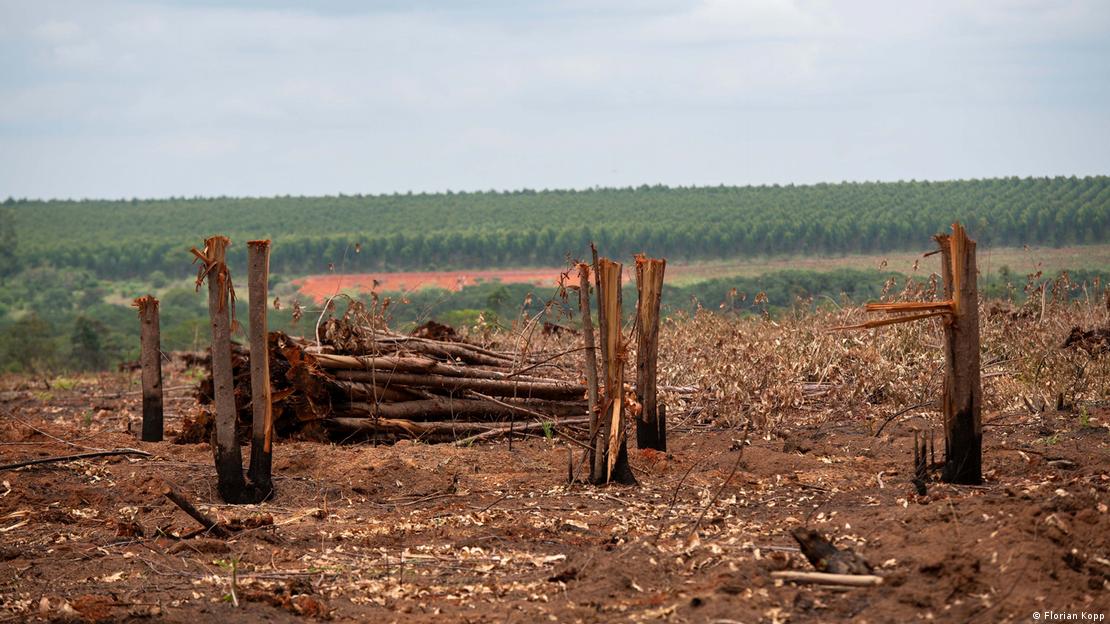
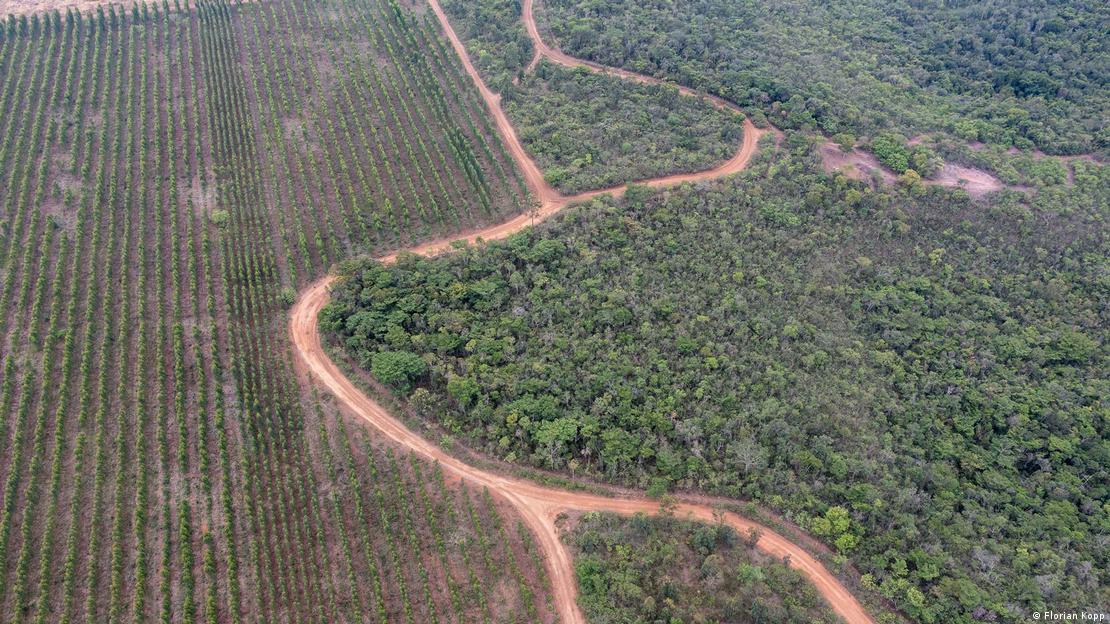
There's green, as far as the eye can see. In the Jequitinhonha Valley, eucalyptus plantations stretch to the horizon. But in this region of eastern Brazil, swathes of green can't necessarily be equated with protecting the environment.

For Valmir Soares de Macedo, director of the Vicente Nica Center for Alternative Agriculture (CAV), an NGO in the Turmalina municipality of the state of Minas Gerais, eucalyptus plantations are far from environmentally friendly.

"The roots of the trees are sucking up the water," he told DW. "The ground and the underground veins of water are drying up."

Soares de Macedo blames the plantations for increasingly scarce waterImage: Florian Kopp

Soares' organization helps advise local small farming businesses on the construction of cisterns and biogas systems. CAV gets support, among other things, from the German Catholic aid group Misereor.

Sources of water running dry

The deputy mayor of Turmalina is also skeptical about the proliferation of the tall, slender tree in the region. "After 40 years of eucalyptus cultivation, only 40 of the 481 water sources in and around Turmalina still provide water," Warlen Francisco da Silva said.

A study from the Minas Gerais State University supports this claim. According to researchers from its agricultural studies center, the region's groundwater level has sunk 4.5 meters (14.8 feet) in the past 45 years.

The high water consumption of eucalyptus plantations has dried up many springs and water veins in the 'Cerrado,' the wet savannahs of southeastern BrazilImage: Florian Kopp


Charcoal for the climate?


Much of the eucalyptus grown in Brazil ends up as charcoal for use in the steel industry, providing a renewable alternative to fossil fuel. With an annual production of 6.5 million tons of charcoal, Brazil is the world's largest charcoal producer, according to the UN Food and Agriculture Organization (FAO).

Domestic demand is enormous because Brazil is one of the world's largest iron ore and steel producers. The state of Minas Gerais is home to 70% of Brazil's steel production facilities.

Chimneys smoking in the forest

Not far from Turmalina, at a charcoal production facility belonging to Brazilian firm Aperam, site boss Ezio Santos is doing his utmost to step up output. From his control center at the Palmeiras plant, he looks out with satisfaction at a huge clearing.

Noise fills the air: humming, rattling and steam. Heavy goods vehicles loaded with logs keep pulling up. In the evening sun, chimneys smoke and airborne coal dust lingers in the twilight.

Cranes head towards piles of eucalyptus logs, picking up the wood with their booms. The cranes take their cargo to the nearest kiln and in go the long, narrow logs until they are packed to the roof.

A total of 55 ovens, each of them 4 meters wide and 26 meters long, are stuffed full around the clock. It takes four hours to load one oven, and later, it will take 2 1/2 hours to unload it. The cooling off process for the freshly made charcoal takes 10 to 12 days.

One generation of eucalyptus has been harvested, but seemingly endless generations wait in the backgroundImage: Florian Kopp

The process of turning wood into charcoal, known as pyrolysis, takes more than 100 hours. "The aim is to use as little oxygen as possible; that helps the process," Santos explained. Otherwise, the wood just burns up.
Steel without fossil fuel

In the near future, the already huge capacity of Palmeiras' ovens is set to quadruple. The kilns should soon measure 16 meters in breadth. Aperam, one of Brazil's biggest charcoal companies, has already applied for a patent for the new mega-ovens, hoping to position itself as a leader in the field.

Santos sees huge market potential. "At the moment, around 60% of charcoal is made manually in small ovens," he said. This production is not only inefficient, Santos tells DW, it is also often done under very poor working conditions.

As well as making charcoal, Aperam is also one of the world's largest producers of stainless steel. Its charcoal is used for smelting in the Timoteo steelworks, some 300 kilometers from the eucalyptus plantations.


Small farmer Jose Carlos Xavier Santos in front of his charcoal oven: 60% of charcoal in Brazil is still laboriously produced by hand in small igloo ovens. Aperam wants to change thisImage: Florian Kopp

The company employs almost 10,000 people and was formed in 2011 as a spinoff from steel giant Arcelor-Mittal. It has six production sites in Belgium, France and Brazil.
Forestry granted sustainable label

Aperam bills itself on its website as an "environmental champion." One of the company's engineers, Benone Magalhaes Braga, explained the company's approach: "Charcoal is better than fossil fuels. We don't just burn. Every year we plant trees that absorb 8 million tons of carbon dioxide."

According to Magalhaes, the company also wants to improve efficiency with genetic optimization, making their eucalyptus trees grow quicker and require fewer pesticides and water.

Aperam bills itself as a 'global player' and an 'environmental champion'Image: Florian Kopp

Back in 2020, the Forest Stewardship Council (FSC) certified the sustainability of Aperam Bioenergie's forest management on the 126,000 hectares of land it cultivates in the region. That seal of approval is valid until 2025.

In its most recent monitoring report from May 2023, FSC said the company's forest management had "implemented aims to conserve biological diversity and its associated values, water resources, soils, and fragile ecosystems and landscapes."

"There are safeguards to protect rare and endangered species, and their habitats," FSC wrote. "There are procedures to control erosion, minimize forest damage during harvesting, road construction and protection of water resources."

A cash injection from the UN

With its goal of using "green" charcoal to produce "green" steel, Aperam is hitting a growing market. Brazil's steel industry is a partner in an internationally backed charcoal initiative implemented by the UN Development Program (UNDP).

The project for "production of sustainable, renewable biomass-based charcoal for the iron and steel industry in Brazil " received $43 million (€40 million) from the Brazilian government, private donors, the UNDP and the Global Environment Facility (GEF) between 2014 and 2021.

The GEF, set up after the 1992 UN climate conference in Rio, brings together international funds to support climate protection projects in developing and middle-income countries.
International donors have supported the production of renewable charcoalImage: Florian Kopp

The GEF's final report on the project, compiled in 2022, gave a positive evaluation, "The most important result was development, validation and introduction of new low-emission technology for sustainable charcoal production.

"Even a project that involves cutting trees and emitting GHGs can be part of climate change mitigation," the auditors wrote. "What should be considered is the alternative, in this case the use of mineral coke."

The rise of "green" charcoal, therefore, seems unstoppable. However, the effects on the water supply and falling groundwater levels are not only a problem for the local rural and urban population.

Aperam itself is now addressing the topic. The company has announced its intention to reduce water consumption by 40% by 2030 compared to 2015.
'It's not going to stop'

For agricultural workers' union member Heli de Souza Nunes, the future of small farmers in the region depends first and foremost on the climate.

"The past two years have been good. There has been enough rain," he said. But before that came more than five years of drought.

Trade unionist and local councilor Heli de Souza Nunes has seen many small farmers give up and sell land to investorsImage: Florian Kopp

"It was bad; many people gave up," he said. De Souza said he believes the economic uncertainty will continue to force many small farms to give in. "If someone offers just a little more money for the land, many are prepared to sell," he said, predicting that eucalyptus cultivation will continue to grow.

"Anyone who earns money with eucalyptus wants to invest and buys up more and more land," he said. "That's how the business works; it's not going to stop."

This report was produced on a press trip organized by the Catholic aid organization Misereor.

This article was originally written in German.
 

Astrid Prange de Oliveira DW editor with expertise in Brazil, globalization and religion
The US Is Still Not Beyond Getting 'Beyond Vietnam'

“The war in Vietnam is but a symptom of a far deeper malady within the American spirit," Martin Luther King Jr. famously said.


Soldiers of the United States Army 9th Infantry Division 3 Battalion, armed with M16A1 rifles, as they walk through long grass during a patrol in Tan An, South Vietnam, 23rd January 1970.
(Photo by Bettmann Archive via Getty Images)


ROBERT C. KOEHLER
Jan 20, 2024
Common Dreams

“And some of us who have already begun to break the silence of the night have found that the calling to speak is often a vocation of agony, but we must speak.”

Take a day, pore over a few of his words. I’m talking about Martin Luther King, of course. His “day” is over, but his message still pulsates. We must speak! The world is bleeding with the wounds of war and poverty and racism, just as it was 57 years ago, when he spoke — infamously, you might say — at Riverside Church in New York City. He defied LBJ and stared directly into the muzzle of the Vietnam war, declaring it to be moral savagery, declaring the United States to be “the greatest purveyor of violence in the world today.”

We’ve given King a national holiday, made him a national hero — but that’s not the same thing as listening to him. It may be the opposite. Deifying him, turning him into a statue, revering his image, could amount to simply shutting him up.

A world that has truly transcended war? A world that embraces “unconditional love for all mankind”? I think not.

So I devoted a few hours of his national holiday (actually, the day after) to rereading “Beyond Vietnam,” the speech he gave on April 4, 1967, a year to the day before his assassination. His words aren’t merely critical of the cruelly pointless colonial war, or of the irony of the American public “watching Negro and white boys on TV screens as they kill and die together for a nation that has been unable to seat them together in the same schools.”

His words stir together love and hell, despair and hope. His words are deeply prescient:

“The war in Vietnam is but a symptom of a far deeper malady within the American spirit, and if we ignore this sobering reality . . .” Oh my God! Our wars will go on and on and on, unless we change as a country: fundamentally, spiritually.

No wonder J. Edgar Hoover (and so many others behind the scene) saw him as a danger to the nation who needed to be shut up, if not eliminated. He had already helped defeat segregation and had begun undoing systemic racism. Now he was taking on military-industrialism and American hegemony:
“A true revolution of values will soon look uneasily on the glaring contrast of poverty and wealth. With righteous indignation, it will look across the seas and see individual capitalists of the West investing huge sums of money in Asia, Africa, and South America, only to take the profits out with no concern for the social betterment of the countries, and say, ‘This is not just.’ It will look at our alliance with the landed gentry of South America and say, ‘This is not just.’ The Western arrogance of feeling that it has everything to teach others and nothing to learn from them is not just.”

What scared the nation’s leaders weren’t simply MLK’s words but the fact that he wielded remarkable power — a kind of power incomprehensible in political and military circles, a power that acknowledged humility and human oneness. What the hell is he talking about?

“Perhaps a new spirit is rising among us.”

And King was one of the carriers of that spirit — helping to implant it within the social core:

“I am convinced that if we are to get on the right side of the world revolution, we as a nation must undergo a radical revolution of values. We must rapidly begin the shift from a thing-oriented society to a person-oriented society. When machines and computers, profit motives and property rights, are considered more important than people, the giant triplets of racism, extreme materialism, and militarism are incapable of being conquered.”

It’s one thing to blather about America’s star-studded “official” values — life, liberty, blah blah blah — but it’s something else entirely to speak about transcending, indeed, “conquering” the (secretly) real values of the ruling class.

“Our only hope today lies in our ability to recapture the revolutionary spirit and go out into a sometimes hostile world declaring eternal hostility to poverty, racism, and militarism.”

A world that has truly transcended war? A world that embraces “unconditional love for all mankind”? I think not.

“When I speak of love,” he goes on, “I am not speaking of some sentimental and weak response. I am not speaking of that force which is just emotional bosh. I am speaking of that force which all of the great religions have seen as the supreme unifying principle of life. Love is somehow the key that unlocks the door which leads to ultimate reality.”

And my imagination — my sense of possibility — reopens. This is what MLK still brings to humanity: a vision of the future that is profoundly different from the present moment, but also present, desperately present, in this moment. “Tomorrow is today.” His words unite every religion on the planet. They tear the deepest values we espouse out of the holy books and bring them aboard the bus, across the bridge, into the halls of Congress and into every war room on the planet.

Their spirit still rises.


Our work is licensed under Creative Commons (CC BY-NC-ND 3.0). Feel free to republish and share widely.


ROBERT C. KOEHLER is an award-winning, Chicago-based journalist and nationally syndicated writer. Koehler has been the recipient of multiple awards for writing and journalism from organizations including the National Newspaper Association, Suburban Newspapers of America, and the Chicago Headline Club. He's a regular contributor to such high-profile websites as Common Dreams and the Huffington Post. Eschewing political labels, Koehler considers himself a "peace journalist. He has been an editor at Tribune Media Services and a reporter, columnist and copy desk chief at Lerner Newspapers, a chain of neighborhood and suburban newspapers in the Chicago area. Koehler launched his column in 1999. Born in Detroit and raised in suburban Dearborn, Koehler has lived in Chicago since 1976. He earned a master's degree in creative writing from Columbia College and has taught writing at both the college and high school levels. Koehler is a widower and single parent. He explores both conditions at great depth in his writing. His book, "Courage Grows Strong at the Wound" (2016). Contact him or visit his website at commonwonders.com.
Full Bio >
Editorial: Mark Robinson ‘doesn’t recall’ past statements on abortion. Here’s a reminder

2024/01/19
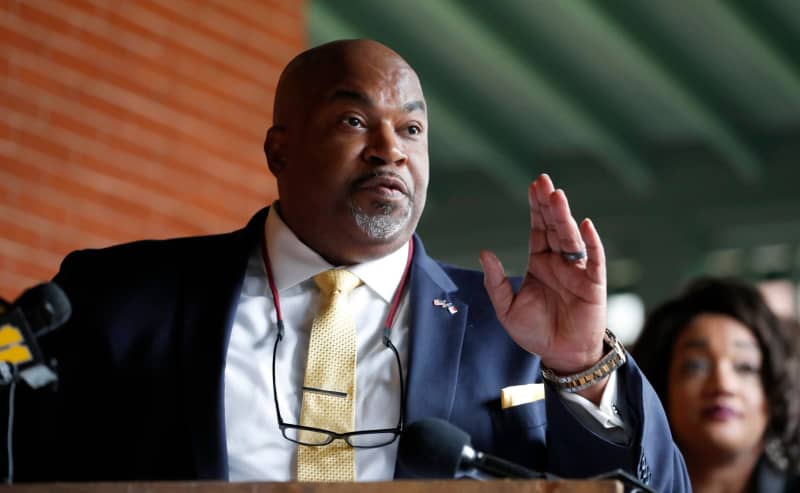
Mark Robinson speaks during a press conference in Raleigh 
 Ethan Hyman/The News & Observer/TNS

Lt. Gov. Mark Robinson has said he’d like abortion to be banned in all circumstances, including rape and incest. He has frequently likened abortion to murder and said that once a woman is pregnant, her body is no longer her own.

Now, as a candidate for governor, Robinson wants you to forget he ever said that. And he doesn’t seem to have much memory of it himself.

New reporting from CNN — which recently joined the growing list of national news stories about Robinson’s extremism — details how Robinson’s past statements on abortion contradict what he is saying now.

Robinson doesn’t want to talk about abortion much anymore, and if he does, he does so much more carefully. According to CNN, Robinson “denies ever supporting abortion bans without exceptions” and has stopped using what he calls “the a-word” in favor of more euphemistic words like “life.”

From the CNN article: “At a public event in August, Robinson said he didn’t recall making statements in support of a total ban on abortion and said that he always struggled on the issue.”

Didn’t recall? Well, here’s a reminder: Robinson once said “there is no compromise for me on abortion,” regardless of why or how a person becomes pregnant. He also said that if he were governor and had a willing legislature, he would pass a bill saying you can’t have an abortion in North Carolina for any reason. He also paid for his now-wife to have an abortion back in the 1980s, but wants to deprive others of that same choice.

That doesn’t sound like someone who has “always struggled” with his position on the issue.

Of course, Robinson is far from the only Republican who has quietly tried to soften their stance on abortion since the fall of Roe v. Wade. Ted Budd, for example, did the same when he was running for U.S. Senate in 2022 — largely avoiding the subject despite previously hinting that he’d like to ban abortions in nearly all cases. Republican congressional candidate Bo Hines scrubbed his website of all references to abortion while running in a swing district in 2022.

Let’s be clear, though: Robinson might be trying to ease up on abortion, but he’s nowhere close to seeming moderate on the issue. His office now says he supports legislation that bans abortion after about six weeks of pregnancy, with exceptions. That’s only marginally less extreme than banning it entirely. It’s still wildly out of step with the majority of voters, who were happy with abortion laws under Roe and don’t want to see them restricted much further.

Robinson can run from his extremist past, but he can’t hide from it. He may have “forgotten” where he once stood on abortion, but voters might have a much better memory.

© The Charlotte Observer


Here are the details of the new bipartisan border security bill Trump doesn’t want passed

Carl Gibson, AlterNet
January 26, 2024 

Chip Somodevilla/Getty Images

US Senate negotiators have reached a framework on a border security bill that will be unveiled as soon as next week, with a vote before the election likely despite former President Donald Trump's efforts to delay it.

According to CNN, Sens. James Lankford (R-Oklahoma), Chris Murphy (D-Connecticut) and Kyrsten Sinema (I-Arizona) have agreed on a border package aimed at curbing the flow of migrants at the Southern border. The framework stipulates that the Department of Homeland Security would be granted emergency powers to shut down the border outside of all legal points of entry if there are more than 5,000 encounters at the border in one week. Special considerations would still be in place for migrants who can prove that they're fleeing torture or persecution in their home countries.

In addition to the strict measures at the border, the bill would also drastically shorten the period of time in which asylum cases can be considered from 10 years to just six months. And even under the new emergency powers, there would still be a mandatory minimum of 1,400 asylum applications to be processed for migrants coming through ports of entry. President Joe Biden voiced support for the framework on Friday and has said previously that he would sign a bipartisan bill if it made it to his desk.


If the bill were currently in effect, the border would already be shut down as there were a record 300,000-plus border crossings in December alone. Many of those crossings were in Texas, where Gov. Greg Abbott (R-Texas) is currently defying a Supreme Court order to cut razor wire along the Southern border. Abbott argues the razor wire is necessary to stop an "invasion," but the Court reiterated in its ruling that the federal government — not the states — has jurisdiction over national borders.

While the final details of the legislation are still forthcoming, the bill would represent the most significant immigration-related legislation in decades if passed. However, Trump has been lobbying Republicans to not support any border legislation until they get a "perfect" bill, which means its passage is not likely in the GOP-controlled House of Representatives even if it passes the Democratic-run US Senate.

Senate Minority Leader Mitch McConnell (R-Kentucky) had been pushing for funding for border security to be included in a larger foreign aid package that would also include new appropriations for Ukraine's ongoing war against Russia, Taiwan's defense of its own borders in the face of threats from China and Israel as it continues its bombing of Gaza. But this week, McConnell acknowledged that the politics of the November presidential election had complicated efforts to pass a bill, which suggests Trump is in the ear of McConnell's caucus.

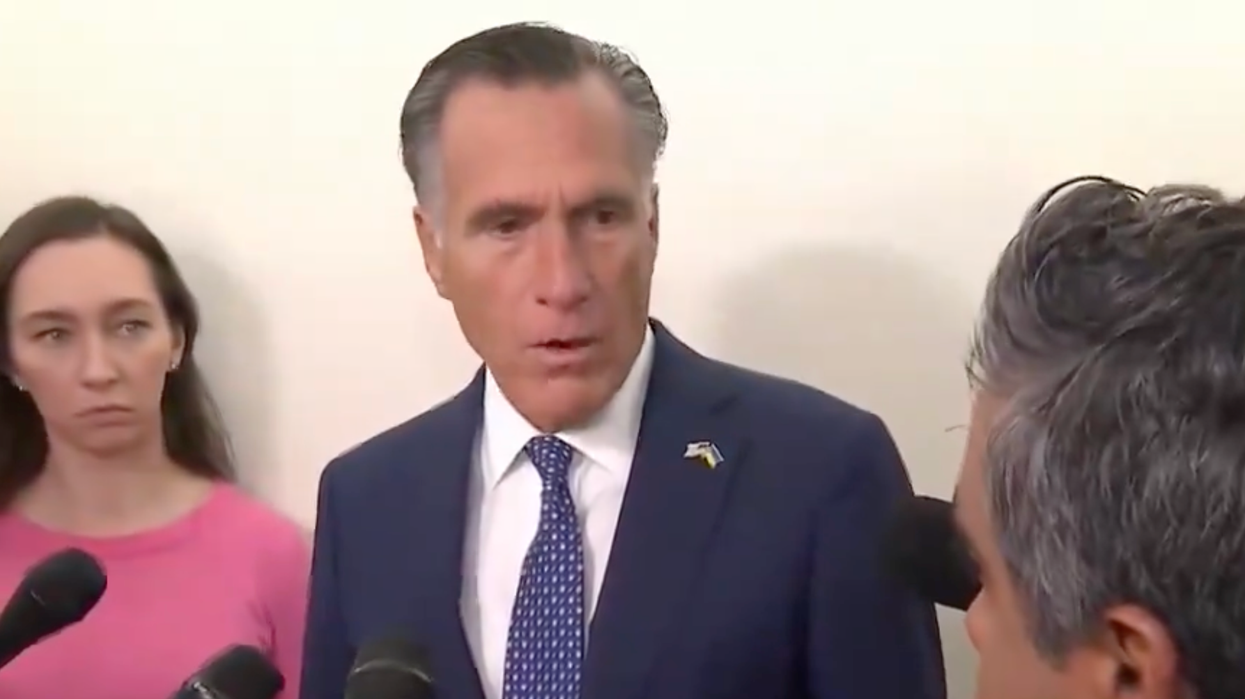
On Thursday, Sen. Mitt Romney (R-Utah) accused the former president of sabotaging a legislative solution to border security in order to reap political rewards in November, saying Trump wants an indefinite delay "because he wants to blame Biden."

Mitt Romney accuses Trump of delaying border legislation 'because he wants to blame Biden'

(Image: Screengrab via X / @mkraju)
Carl GibsonJanuary 25, 2024

One Republican senator says former President Donald Trump is making the problems at the Southern border worse by pressuring other Republicans to stop any legislative fixes until after the election in November.

In a recent interview with CNN, Sen. Mitt Romney (R-Utah) — who ran for president as the 2012 Republican nominee — slammed Trump for exacerbating problems in the US immigration system.

"I think the border is a very important issue for Donald Trump," Romney told congressional reporter Manu Raju. "And the fact that he would communicate to Republican senators and congresspeople that he doesn't want us to solve the border problem because he wants to blame Biden for it is really appalling."

"We have a crisis at the border. The American people are suffering as a result of what's happening at the border," he added. "And someone running for president ought to try to get the problem solved as opposed to saying 'hey, save that problem, don't solve it. Let me take credit for solving it later.'"

According to the department of Customs and Border Protection, there were more than 300,000 border crossings in December — a record high. The Rio Grande River crossing at Eagle Pass is particularly dangerous, with three migrants — including two children — drowning there earlier this month. Alicia Barcena, who is Mexico's secretary of foreign affairs, said last month that the traffic at the US/Mexico border can be attributed to root causes like "poverty, inequality, violence and family reunification."

A legislative solution to the US' border security is still in the works, as some members of Congress want to tie funding for Ukraine's ongoing defense of its own borders against Russian aggression with US border funding. However, Senate Minority Leader Mitch McConnell (R-Kentucky) said the politics of the November election has complicated that approach — a possible reference to Trump's meddling in legislative negotiations. Democrats have argued that border security should instead be addressed by revising the US' antiquated immigration system.

"Our country has failed our immigrant neighbors," said Rep. Rashida Tlaib (D-Michigan). "Our immigration system is so broken that many families are waiting 10 to 20 years to get interviews scheduled. It has been 28 years since Congress passed immigration reform. We have a responsibility to act."

READ MORE: 'I will not help the Democrats': GOP rep says he'll torch border deal to deny Biden a win

Watch the video of Romney's remarks below, or by clicking this link.


TRUMP THE RAPIST PAYS UP
Trump could be on the hook for $240 million in E. Jean Carroll damages: expert

Tom Boggioni
January 26, 2024 

Donald Trump frowning (Mandel Ngan:AFP)

Right after lawyers on both sides delivered closing arguments in the E. Jean Carroll defamation trial taking place in a Manhattan courtroom, CNN legal analyst Norm Eisen explained that Donald Trump could be ordered to pay over a quarter of a billion dollars in total damages.

Speaking with hosts Boris Sanchez and Briana Keilar, Eisen pointed out that Carroll's attorney Roberta Kaplan asked for compensatory damages of "up to $24 million," but that is not where it ends.

Pressed by the hosts about punitive damages that likely will be tacked on, Eisen said it was beyond the realm of possibilities that the jury would come back with a number in the billions, but there is a rule of thumb when it comes to "multipliers" used based on the compensatory amount.

And it could be very bad news for the former president.

ALSO READ: Behold: Donald Trump the chosen son — and religious con

"Damages are calculated into categories," he began. "There are compensatory damages, and we've just seen a request to make Carroll whole, things like hiring consultants, having a campaign to repair her reputation, the pain and suffering that she has endured: that's 24 million."

"Then to send lesson when a defendant is found to have acted with bad intent or malice, that he wanted to hurt E. Jean Carroll, you multiply that compensatory damages number by an X-factor," he continued.

"The factor can be quite high but there is a limit, they couldn't order billions in damages. Normally, the upper ceiling is about ten times compensatory. So, you could be looking here, if there is a true home run, and the proof is coming powerfully, the argument has been strong, and Trump wasn't allowed to speak. You could be looking at a multiple many times of $24 million. And that would send a message."

Watch below or at the link.


E. Jean Carroll's lawyer puts Trump on notice about a new potential lawsuit

M.L. Nestel
January 26, 2024 

Barry Willilams/New York Daily News/TNS

Trump's accuser hit him where it hurts — his bottom line.

Roberta Kaplan, attorney for E. Jean Carroll, believes money may talk, but it also silences.

"All he really understands is money and so you should award an amount of money that should make him stop," she said

Carroll, 80, won an $83.3 million jury verdict, proving in court that she suffered ridiculing in public again and again by former President Donald Trump, 77, years after coming forward to attest to being sexually assaulted inside of a Bergdorf Goodman dressing room back in the 1990s.

There is still a pause for Kaplan on whether the hit to his pocketbook will work as a kind of money muzzle. But she specifically didn't rule out future litigation against Trump.

Trump notably nixed Carroll's name when he responded to the steep sum imposed by the jury inside of the Manhattan federal courtroom on Friday.

"Absolutely ridiculous," he wrote in a post on Truth Social, vowing to contest it. "I fully disagree with both verdicts, and will be appealing this whole Biden Directed Witch Hunt focused on me and the Republican Party."

Kaplan believes Trump did himself zero favors when he and his entourage stood up and stormed out of the courtroom while she was offering her closing arguments.

Kaplan was in the process of telling the jury that the 45th president had the gall to call Carroll's sexual abuse allegations against him a "con job."

"I think it hurt him terribly," she said. "Our whole case is about the fact Donald Trump is unable to follow the law, unable to follow the rules. He thinks they don't apply to him."

And she said Trump's cruelest thing Trump did to Carroll beyond the physical attack, was his effort to repeatedly cut her down in public as being a "liar" and a "whack job.

"And as bad as what he did to E. Jean Carroll was and the sexual assault was terrible and as horrifying as the defamation was back in 2019 — the most amazing shocking part of it all is he kept on doing it, and he kept on doing it even during the trial."

She added: "What other person thinks they can openly break the law over and over again? Donald Trump."

Trump’s Brownshirts: How violence has become inherent to Trumpian politics

Robert Reich
January 22, 2024 


I apologize for the length of this letter, but the subject warrants it. Donald Trump has galvanized an army of vigilantes who are casting a fearsome shadow overthe 2024 election. Please spread the word.

It’s impossible to know how large this potential army is, but last October, 41 percent of pro-Trump Americans agreed with the statement that “because things have gotten so far off track, true American patriots may have to resort to violence in order to save our country.” (That view was shared by 22 percent of independents and 13 percent of Democrats.)

THE DAY AFTER MAINE SECRETARY OF STATE SHENNA BELLOWS barred Trump from the primary ballot there in late December, her home was “swatted.” As Bellows explained, “That’s when someone calls in a fake emergency to evoke a strong law enforcement response to scare the target. Swatting incidents have resulted in casualties although thankfully this one did not.”

The video player is currently playing an ad. You can skip the ad in 5 sec with a mouse or keyboard

Along with the swatting, Bellows discussed “extraordinarily dehumanizing fake images” of her online:
“I know from my previous work that dehumanizing a person is the first step in paving the way for attacks and violence against them. These dehumanizing images and threatening communications directed at me and people I love are dangerous. We should be able to agree to disagree on important issues without threats and violence.”

Colorado Democratic Secretary of State Jena Griswold has also faced mounting threats since the Colorado Supreme Court in December disqualified Trump from the state’s primary ballot.

“Within three weeks of the lawsuit being filed, I received 64 death threats,” Griswold said. “I stopped counting after that. I will not be intimidated. Democracy and peace will triumph over tyranny and violence.”

Jack Smith, the special counsel in charge of two federal prosecutions of Trump, has received a number of death threats. Between April and September of last year, the Justice Department spent more than $4.4 million providing security for Smith and his team. On Christmas Day, he was swatted.

On August 4, Trump posted, “IF YOU GO AFTER ME, I’M COMING AFTER YOU!” The following day, a Texas woman left a voicemail for Judge Tanya Chutkan, the judge presiding over the case charging Trump with seeking to overturn the 2020 election, threatening that “If Trump doesn’t get elected in 2024, we are coming to kill you.”

Security has been increased for Judge Chutkan, as well. On January 7, she was swatted.

On August 6, two days after Trump’s post, a man left a voicemail threatening the lives of Fulton County District Attorney Fani Willis and Sheriff Patrick Labat for their roles in the Georgia criminal election interference case against Trump.

Trump has also encouraged people to “go after” New York Attorney General Letitia James.

Trump is using the threat of violence to intimidate America as a whole. He recently warned of “bedlam in the country” if he’s disqualified from the ballot.

When asked recently if he would discourage his followers from violence, Trump simply refused to answer.


IN THE WEEKS BEFORE THE 2020 ELECTION, Trump operative and confidant Roger Stone can be heard on an audio recording telling Trump security agent Sal Greco: “Either [Congressman Eric] Swalwell or [Congressman Jerry] Nadler has to die before the election. They need to get the message. Let’s go find Swalwell and get this over with. I’m just not putting up with this shit anymore.”

Stone was the liaison between the Trump campaign and the Proud Boys, which, according to the Justice Department, “played a central role in setting the January 6 attack on our Capitol into motion.” The House Select Committee investigating the attack found that in the months leading up to it, Stone regularly communicated with Proud Boys members, including their leader, Enrique Tarrio.

In September, Tarrio was sentenced to 22 years in federal prison on charges related to the attack. (In July 2020, Trump issued Stone a blanket pardon.)

As of December, roughly 1,240 people have been arrested in connection with the attack. Some 170 have been convicted at trial, and 710 have pleaded guilty. So far, more than 720 have received prison sentences, ranging from a handful of days to more than 20 years.

Many have sought to defend themselves by saying they were doing what Trump asked them to do. On that fateful day, Trump told the crowd he had summoned to Washington that:
We will never give up, we will never concede. It doesn’t happen. You don’t concede when there’s theft involved. Our country has had enough. We will not take it anymore … We will stop the steal … Republicans are constantly fighting like a boxer with his hands tied behind his back … You’ll never take back our country with weakness. You have to show strength and you have to be strong … We fight like hell. And if you don’t fight like hell, you’re not going to have a country anymore.”

Afterward, the crowd stormed the Capitol.


THERE IS A DIRECT AND ALARMING CONNECTION between Trump’s political rise and and the increase in political violence and threats of such violence in America.

In 2016, the Capitol Police recorded fewer than 900 threats against members of Congress. In 2017, after Trump took office, that figure more than quadrupled, according to the Capitol Police.

The numbers continued to rise every year of the Trump presidency, peaking at 9,700 in 2021. In 2022, the first full year of Biden’s term, the numbers declined to a still-high 7,500. (The 2023 data is not yet available.)

Data also shows extraordinarily high levels of threats against mayors, federal judges, election workers and administrators, public health officials, and even school board members.

The threats have clearly intimidated some Republican lawmakers.

Retiring Sen. Mitt Romney of Utah hired personal security for himself and his family at a cost of $5,000 a day to guard against threats on their lives after he voted to remove Trump from office for his role in the January 6, 2021, attack on the Capitol.

Romney recounts (in McKay Coppins’s biography of him) that during Trump’s impeachment, a member of the Republican Senate leadership was leaning toward voting to convict Trump. But after several other senators expressed concern about their personal safety and that of their children, the senator in question voted to acquit.

Former Republican congresswoman Liz Cheney said that in that impeachment vote, “there were members who told me that they were afraid for their own security — afraid, in some instances, for their lives.” She cited how “members of Congress aren’t able to cast votes, or feel that they can’t, because of their own security.”

Just before the House vote on impeachment, Democratic Rep. Jason Crow of Colorado said he heard firsthand from Republicans that fear was holding at least two of them back. “I had a lot of conversations with my Republican colleagues last night, and a couple of them broke down in tears — saying that they are afraid for their lives if they vote for this impeachment,” Crow said on MSNBC.

Former Rep. Peter Meijer, a Republican from Michigan, recalls one of his House colleagues voting to overturn the election results on the evening of January 6, hours after the assault: “My colleague feared for family members, and the danger the vote would put them in.” After voting to impeach Trump, Meijer himself faced so many threats that he felt the need to purchase body armor and make changes to his daily schedule.

Meijer also noted that his colleagues who voted not to certify the 2020 election “knew in their heart of hearts that they should’ve voted to certify, but some had legitimate concerns about the safety of their families. They felt that that vote would put their families in danger.”

When announcing his retirement, former Republican congressman Anthony Gonzalez cited threats to him and his family after his vote in favor of Trump’s impeachment. Gonzalez was one of 10 House Republicans who voted to impeach Trump. In September 2021, Gonzalez announced he would not seek another term.

The Republican majority leader of the Pennsylvania state Senate explained why she signed a letter backing Trump’s attempt to overturn the results in that state: “If I would say to you, ‘I don’t want to do it,’ I’d get my house bombed tonight.”


POLITICAL VIOLENCE IS AN INHERENT PART OF FASCISM. Hitler’s SA — the letters stood for Sturmabteilung or “Storm Section,” also known as the Stormtroopers or Brownshirts — were vigilantes who did the Nazis’ dirty work before the Nazis took total power.

During the German presidential elections in March and April 1932, Brownshirts assembled Alarmbereitschaften, or “emergency squads,” to intimidate voters.

On the night of the Reichstag election of July 31, 1932, Brownshirts launched a wave of violence across much of northern and eastern Germany with murders and attempted murders of local officials and communist politicians and arson attacks on local Social Democratic headquarters and the offices of liberal newspapers.

When five Brownshirts were sentenced to death for the murders, Hitler called the sentences “a most outrageous blood verdict” and publicly promised the prisoners that “from now on, your freedom is a question of honor for all of us, and to fight against the government which made possible such a verdict is our duty.”

A chilling echo of these words can be found in one of Trump’s recent speeches in Iowa, in which he claimed that his supporters had acted “peacefully and patriotically” on January 6, 2021. “Some people call them prisoners,” he said of those who were serving sentences for their violence. “I call them hostages. Release the J6 hostages, Joe [Biden]. Release them, Joe. You can do it real easy, Joe.”

As I’ve said before, America is not the Weimar Republic on the eve of 1933, and Trump is not Hitler. But it is important to understand the parallels.

That Donald Trump still has not been held accountable for encouraging the attack on the U.S. Capitol, or for provoking his followers with his blatant lie that the 2020 election was stolen, continues to galvanize an army of potentially violent Americans.

Robert Reich is a professor at Berkeley and was secretary of labor under Bill Clinton. You can find his writing at https://robertreich.substack.com/.