Israel must prevent genocidal acts in Gaza: U.N. court
Agence France-Presse
January 26, 2024

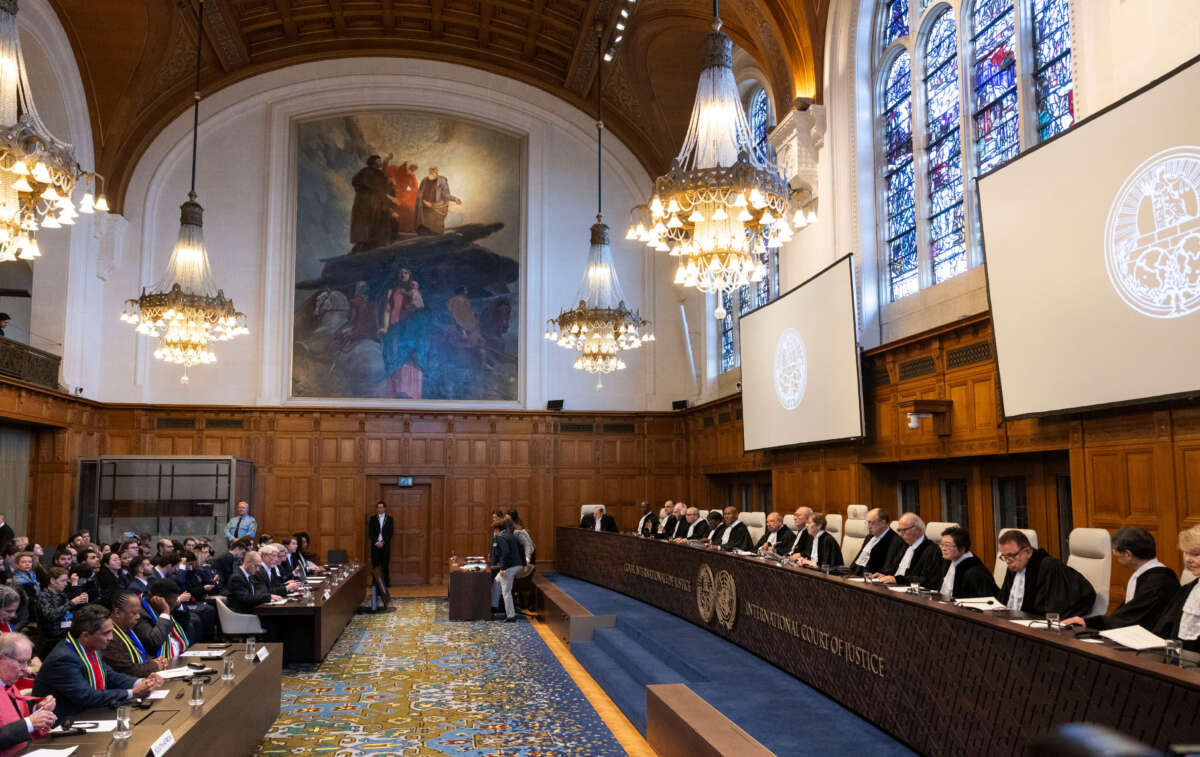
International Court of Justice (ICJ) President Joan Donoghue (C) speaks at the ICJ prior to the announcement of an initial ruling in the genocide case against Israel, brought by South Africa, in The Hague on January 26, 2024.
The UN top court on Friday said Israel must prevent genocidal acts in Gaza and facilitate "urgently needed" humanitarian aid into the besieged territory, handing down rulings in a case that has drawn global attention.
The court urged Israel to refrain from any possible genocidal acts as it presses its military operation in the Gaza Strip, but stopped short of ordering a ceasefire.
Israel must take "immediate and effective measures to enable the provision of urgently needed basic services and humanitarian assistance to address the adverse conditions of life faced by Palestinians," the court said.
At this stage, the ICJ was not considering whether Israel is actually committing genocide in Gaza -- that process will take several years.
But the court warned Israel to "take all measures in its power to prevent" acts that could fall under the UN Genocide Convention, set up in 1948 as the world reeled from the horrors of the Nazi Holocaust.
It also said Israel should "prevent and punish" any incitement to genocide.
The case was brought by South Africa, which has accused Israel of breaching the UN Genocide Convention.
Over two days of hearings earlier this month in the gilded hall of the Peace Palace, where the ICJ sits, lawyers from both sides battled it over the interpretation of this Convention.
South Africa accused Israel of "genocidal" acts that were intended to cause the "destruction of a substantial part of the Palestinian national, racial and ethnical group."
It urged the court to order Israel to "immediately suspend" its military operations in Gaza and allow humanitarian aid to reach the civiilians there.
'Grossly distorted'
Israel dismissed the case as a "grossly distorted story" and said that if any genocidal acts had been carried out, they had been executed against Israel during the October 7 Hamas attacks.
"What Israel seeks by operating in Gaza is not to destroy a people, but to protect a people, its people, who are under attack on multiple fronts," said Tal Becker, Israel's top lawyer.
The question now is whether the court's rulings will be obeyed.
Although its rulings are legally binding, it has no mechanism to enforce them and they are sometimes completely ignored -- it has ordered Russia to stop its invasion of Ukraine for example.
Prime Minister Benjamin Netanyahu has already hinted Israel would not abide by any ruling saying "no one will stop us", not even a verdict in The Hague.
But experts believe that aside from the significant symbolic impact of the ruling, there could be tangible consequences on the ground.
"It makes it much harder for other states to continue to support Israel in the face of a neutral third party finding there is a risk of genocide," said Juliette McIntyre, international law expert from the University of South Australia.
"States may withdraw military or other support for Israel in order to avoid this," she added.
The October 7 Hamas attack resulted in the death of around 1,140 people in Israel, most of them civilians, according to an AFP tally based on official Israeli figures.
At least 26,083 Palestinians, around 70 percent of them women, young children and adolescents, have been killed in the Gaza Strip in Israeli bombardments and ground offensive since then, according to the Hamas government's health ministry.
ICJ Finds It’s “Plausible” That Israel Is Committing Genocide in Initial Ruling
Advocates said that the ruling is a good first step, but it needed to include a ceasefire order.
By Sharon Zhang ,
Did you know that Truthout is a nonprofit and independently funded by readers like you? If you value what we do, please support our work with a donation.
The International Court of Justice (ICJ) found that it is “plausible” that Israel is committing genocide in a highly anticipated initial ruling on Friday, ordering Israel to take steps to avoid going even further in its violence in Gaza but stopping short of calling for a ceasefire.
In its decision, the ICJ ordered Israel to abide by its obligations under Article II of the UN Genocide Convention, especially with regard to four of the five convention’s criteria that define a genocide: killing members of the group, causing bodily or mental harm to the group, inflicting conditions meant to cause harm to the group, and preventing births within the group.
The ruling orders Israel to ensure that its military does not commit actions within the criteria, to take immediate action to enable humanitarian aid within Gaza, and to prevent
The court also orders Israeli officials to punish those who have been inciting genocide against Palestinians and to prevent similar incitements in the future.
The ruling highlighted several statements in October from Israeli officials, like President Isaac Herzog’s pledge for Israel to “fight until we’ll break their backbone” and Defense Minister Yoav Gallant’s speech to Israeli troops in which he called Palestinians “human animals.” The court then cites a November press release by the UN Human Rights Council calling attention to “discernibly genocidal and dehumanizing rhetoric coming from senior Israeli government officials.”
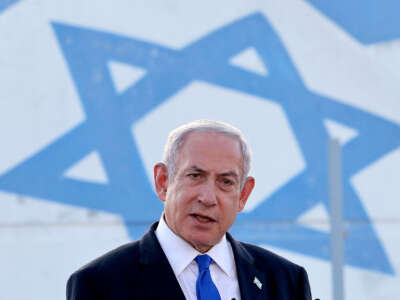
Netanyahu Says Israel’s Goal Is to Wipe Out All Possibility of Palestinian State
This is one of Netanyahu’s clearest statements yet about his goals for Palestine amid Israel’s genocide in Gaza.
By Sharon Zhang , TRUTHOUT January 18, 2024
Many Palestinians have been disheartened by the order, as Al Jazeera reports, with many hoping that the ICJ would bring an end to Israel’s relentless bombing, disease and starvation campaign in Gaza; indeed, even as the ICJ was delivering its decision on Friday, Israeli forces were dropping bombs in Khan Yunis in Southern Gaza.
“The ICJ forg[ot] to tell Israel in [its] decision today to cease fire against Palestinians in Gaza. We are under fire and under killing; we are under genocide,” said Palestinian journalist Bisan Owda in a video posted on Instagram from Gaza on Friday, with the sound of sirens clearly in the background.
“There is no justice in the International Court of Justice,” Owda continued. “There is no justice in this world. ICJ is a lie…. We’re continuing this alone, as we started this alone, with our own [cell phones] to tell you the truth, to seek for justice. Now, there’s no truth or justice. I’m just stuck out of my home and can’t get back, and no one can get me back to my home, or to stop killing us day after day, for 112 days.”
South African officials celebrated the decision as a “decisive victory for the international rule of law and a significant milestone in the search for justice for the Palestinian people” in a statement. However, they said that the implication of the ruling is that there must be a ceasefire.
Israeli officials have rejected the ruling, with Prime Minister Benjamin Netanyahu saying that the court is denying Israel the opportunity to defend itself — an action that apparently involves depriving Palestinians of nearly all humanitarian aid — and Security Minister Itamar Ben-Gvir outright mocking the ruling in a post on social media, saying “Hague shmague.”
Advocates for Palestinian rights say that the ruling is a historic step toward holding Israel responsible for its horror on the world stage. But they are discouraged by the lack of a ceasefire order, which they, like the South African officials, say is the only way to guarantee that Israel follows through on the court’s provisional measures, especially considering experts’ concerns that Israel may not abide by them.
Though the court’s decisions are binding, countries like Serbia and Russia have refused to abide by rulings from the ICJ in the past. And, indeed, Israeli officials have already pledged to defy the orders, saying that no one will stop them, not even the Hague.
“Everything [the ICJ] ordered in terms of preventive measures leads to only one conclusion, which is ceasefire,” said Mahmood Mamdani, a Columbia University professor with a specialization in colonialism, in an interview with Democracy Now!. “How do you stop killing people? Ceasefire. How do you ensure that supplies for human life get in? Ceasefire.”
Human rights attorney and Rutgers professor Noura Erakat said that she was “relieved” when the ICJ’s decision came down because, while it didn’t go far enough, it still provided “vindication” in regards to recognition of the suffering that Israel and the global community have forced on Palestinians. “This court was never going to save us,” and rather could have been “a great source of harm,” Erakat said in a video posted on social media.
Erakat added that the court’s decision should serve as a further call to action for advocates. The court “ordered all of the provisional measures requested by South Africa, stopping short of issuing an order for a cessation of military hostilities, which was already a longshot — and in all cases, even had they provided that order, it wouldn’t have been sufficient to do anything. It would still be in our hands to now take this ruling and to agitate globally,” Erakat continued.
Groups that advocate for Palestinian rights said that the ruling was a crucial first step in ensuring that Israel’s massacre is documented on the world stage, and have said that global leaders’ next moves will be crucial in showing whether or not they are willing to shirk a decision from the ICJ in order to assist Israel in its genocide.
“For over 100 days, the Israeli and the U.S. governments have gaslit and smeared the Palestinian people, denying what the entire world was witnessing: a genocide,” said Jewish Voice for Peace political director Beth Miller in a press release. “Now, the highest court in the world has found these claims plausible. President Biden has a choice to make: he can reject the entire system of international law and continue complicity in Israeli genocide, or he can stop arming a genocidal regime and stop attacking the people and movements struggling to build a more just and peaceful future.”
This article is licensed under Creative Commons (CC BY-NC-ND 4.0), and you are free to share and republish under the terms of the license.

SHARON ZHANG is a news writer at Truthout covering politics, climate and labor. Before coming to Truthout, Sharon had written stories for Pacific Standard, The New Republic, and more. She has a master’s degree in environmental studies. She can be found on Twitter: @zhang_sharon.
International Court of Justice Rules That Israel Must Cease Fire

The International Court of Justice has ruled that Israel must cease its warmaking in Gaza — cease committing and inciting genocidal acts — and that the case charging Israel with genocide must proceed.
This was a make or break moment for international law, or rather a break or make-a-first-step moment. There is hope for the idea and reality of international law, but this is only a beginning.
The president of the International Court of Justice, who read the ruling, is Judge Joan Donoghue, former top legal advisor under Hillary Clinton at the U.S. State Department during the Obama Administration. She previously was the lawyer for the United States in its unsuccessful defense before the ICJ against charges by Nicaragua of minining its harbor.
The court voted for portions of this decision by 15-2 and 16-1. The “No” votes came from Judge Julia Sebutinde of Uganda and Ad Hoc Judge Aharon Barak of Israel.
The case presented by South Africa was overwhelming (read it or watch a key part of it), and Israel’s defense paper-thin. And the case just grew more overwhelming during the bizarre delay (yes, courts are slow, but this genocide is swift).
People all over the world built the pressure to move South Africa to act and other nations to add their support. Over 1,500 organizations signed a statement. Individuals signed a petition by CODEPINK, and sent almost 500,000 emails to key governments’ United Nations consulates through World BEYOND War and RootsAction.org. Click those links because more emails are needed now. While several nations have made public statements in support of South Africa’s case, we need them to file papers officially with the International Court of Justice. To reach out to additional national governments, go here.
Governments that have made statement in support of the case against genocide include Malaysia, Turkey, Jordan, Bolivia, the 57 nations of the Organization of Islamic Countries, Nicaragua, Venezuela, Maldives, Namibia, and Pakistan, Colombia, Brazil, and Cuba.
Germany has backed Israel’s defense against the charge of genocide, which has been denounced by Namibia, victimn of a German genocide. Prominent Jews have denounced Germany’s shameful action.
Mass demonstrations in the streets of the world have continued in support of peace and justice, and to a far greater extent than major media outlets have reported.
Here’s a discussion of this campaign for justice with Sam Husseini on Talk World Radio.
Prior to today’s ruling from the International Court of Justice, the U.S. government pointedly refused to say whether it would comply with ruling, despite insisting that other nations comply with rulings by the ICJ.
Hamas said that it would cease fire if Israel does, and release all prisoners if Israel does
Germany, to its credit, reportedly said that it would comply.
Arming a genocide is complicity in genocide. While Israel gets most of its weapons from the United State, other weaponry comes from Germany, Italy, the UK, and Canada — at least some of which nations also provide parts to U.S. weaponsmakers that provide weapons to Israel. Italian opposition demanded an end to it. And then the Foreign Minister claimed Italy had stopped shipments on Oct 7. Meanwhile, Canada is coming under pressure to cease shipments and prevarications. In Canada, Members of Parliament are among over 250 people hunger striking for an arms embargo on Israel.
People in the United States can tell Congress to stop arming Israel here or here.
President Joe Biden already faces a lawsuit for aiding and abetting genocide in Gaza. In November 2023, Palestinian human rights organizations, along with Gaza- and U.S.-based Palestinians, filed suit in a U.S. federal court seeking declaratory and injunctive relief against the Biden Administration for failing to prevent genocide, and for aiding and abetting genocide. The plaintiffs seek an order to end U.S. military and diplomatic support to Israel. A hearing to address the government’s motion to dismiss will be held at 9 a.m. PT / 12 noon ET today, Friday. The hearing will be webstreamed to the public. You are encouraged to tune in and witness the U.S. government’s attempts at avoiding accountability and justify its support for the genocide that is happening in Gaza.
- First published at World Beyond War.
International Coalition to Stop Genocide in Palestine Welcomes Today’s ICJ Order; Demands its Implementation
The ICGSP encourages governments and global social movements to demand that provisional measures are enforced immediately
In its provisional ruling issued today on the South African Genocide Convention case against Israel, the International Court of Justice (ICJ—also known as the World Court) demanded Israel stop killing civilians and destroying civilian infrastructure and medical facilities; prevent and punish incitement to genocide by its top officials; and permit the delivery of humanitarian aid to Gaza. The International Coalition to Stop Genocide in Palestine (ICSGP) applauds the Court’s Order as a crucial first step toward forcing Israel and its primary sponsor and strongest political ally—the United States—to end the months-long brutal assault on Gaza, and the decades-long denial to Palestinians of their rights to self-determination and return.
However, the ICSGP also recognizes that Israeli and U.S. government officials have made repeated official declarations in the past week making clear their plan to ignore the ICJ’s legally binding ruling and rejecting the Court’s process as illegitimate, and that the U.S. has been threatening world governments with sanctions and war—a promise it is making good on already by bombing Yemen—for opposing the ongoing genocide. The ICSGP also recognizes that numerous powerful state allies of the U.S. and Israel, including Germany and Canada, have already made clear their intent to back Israel against an ICJ finding of genocide. The dangerous rejection by the United States, Israel and their allies of this process—which was set up through the United Nations precisely to prevent genocide—undermines the legitimacy of that institution and in particular the U.N. Security Council, where the U.S. has long used its veto power as a tool to promote war and genocide. The ICSGP calls upon social movements to demand that world governments uphold international law and protect the integrity of the United Nations by ensuring that the ICJ’s provisional measures are immediately enforced, and to hold Israeli war criminals and their powerful U.S. accomplices accountable for genocide.
The ICSGP stands in full solidarity with its Palestinian coalition members, who have emphasized in their own statements today the need for governments and social movements around the world to double down in their efforts to bring the ongoing genocide in Gaza to an end. Dr. Luqa AbuFarah, North America Coordinator for the Palestinian Boycott, Divestment and Sanctions National Committee (BNC), an ICSGP member organization, states:
“It’s clear we have a moral obligation to take action and end our government’s complicity with Israel’s Gaza genocide. We must have the courage to speak out and take action to advance the struggle for justice. We must end US military funding to Israel which at $3.8 billion USD a year could instead provide more than 450,000 households with public housing for a year or pay for 41,490 elementary school teachers. I also hope that every person outraged with the blatant disregard for Palestinian life will join and escalate our BDS Campaigns and make sure companies know that complicity with Israeli apartheid and genocide is unacceptable. We must take action now more than ever!”
ICSGP, together with numerous legal and human rights organizations including coalition members The PAL Commission on War Crimes and The Global Legal Alliance for Palestine, held press conferences in New York and Chicago following the Court’s Order on the request for the indication of provisional measures this morning, expressing gratitude to South Africa for its steadfast support, and calling on all organizations and countries to support South Africa’s legal actions against the Israeli military campaign.
Lamis Deek, cofounder the PAL Commission on War Crimes and convener of the Global Legal Alliance for Palestine, states:
“This historic decision changes international and domestic approaches—military, legal, and political—to stopping the genocide in Palestine. This verdict profoundly reshapes the geopolitical and legal topography, regardless of whether Israel complies or not. Following the Court’s decision we must issue calls on state parties to the ICJ and the Genocide Convention as regards their compliance obligations, and address our legal colleagues and our communities regarding the next steps we think will be most critical on the heels of this decision.
The brutal Israeli genocide and torture in Gaza, alongside the targeted assassinations, destruction of civilian infrastructure including all of Gaza’s hospitals and universities, blocking of aid, and use of starvation and spread of disease as a war tactic, constitute a grotesque series of the highest war crimes. We commend the Court’s positive decision. The question now is how to deal with the anticipated US-Israeli obstruction of that decision.”
Monisha Rios, president of SOLI PR, an international network of Puerto Ricans focused on growing solidarity with the Puerto Rican struggle for independence and ICSGP member organization, states:
As Puerto Ricans directly involved in the struggle against U.S.-led settler colonial violence, land grabs and the ongoing neoliberal assault, we have a special obligation to stand in firm, unwavering solidarity with our Palestinian cousins. Not only does the Zionist entity’s genocidal regime in Palestine owe its existence as such to U.S. financial and political backing since its inception, Israel has also directly contributed with military technologies, weapons and police training to the violent repression of peoples fighting for self-determination against the U.S. and its puppet regimes around the world, and of Indigenous Peoples and descendants of enslaved African Peoples subject to structural apartheid within the continental United States. Israeli Zionists themselves have recognized the parallels between Palestine and Puerto Rico, for example with the Minister of Heritage—who publicly called for using a nuclear bomb in Gaza—recently calling for a “Puerto Rican” solution to Palestine. The South African Case at the World Court, and the Court’s decision this morning provide Puerto Ricans and colonized peoples around the world a unique opportunity—in recognizing our common struggle and joining together to fight against Zionist fascism, we have tremendous power to both stop the ongoing genocide against Palestinians, and to contribute to our own liberation by shifting the balance of global power away from the U.S. and toward the Global South.
The ICSGP calls upon the over 2,000 organizational signatories to its original letter, and to social movements everywhere, to hold the profiteers and promoters of the Zionist genocide to account through concrete actions of boycott, divestment, and sanctions; to mobilize to demand the immediate enforcement of the ICJ’s Order of Provisional Measures and denounce accomplices to the genocide; and to continue to pressure all state parties to the Genocide Convention to issue Declarations of Intervention in support of the South African case at the ICJ.
Previous ICSGP press statements are available from January 17, January 8 and January 3, 2024.
The Black Alliance for Peace (BAP) seeks to recapture and redevelop the historic anti-war, anti-imperialist, and pro-peace positions of the radical black movement. Read other articles by Black Alliance for Peace, or visit Black Alliance for Peace's website.
In its provisional ruling issued today on the South African Genocide Convention case against Israel, the International Court of Justice (ICJ—also known as the World Court) demanded Israel stop killing civilians and destroying civilian infrastructure and medical facilities; prevent and punish incitement to genocide by its top officials; and permit the delivery of humanitarian aid to Gaza. The International Coalition to Stop Genocide in Palestine (ICSGP) applauds the Court’s Order as a crucial first step toward forcing Israel and its primary sponsor and strongest political ally—the United States—to end the months-long brutal assault on Gaza, and the decades-long denial to Palestinians of their rights to self-determination and return.
However, the ICSGP also recognizes that Israeli and U.S. government officials have made repeated official declarations in the past week making clear their plan to ignore the ICJ’s legally binding ruling and rejecting the Court’s process as illegitimate, and that the U.S. has been threatening world governments with sanctions and war—a promise it is making good on already by bombing Yemen—for opposing the ongoing genocide. The ICSGP also recognizes that numerous powerful state allies of the U.S. and Israel, including Germany and Canada, have already made clear their intent to back Israel against an ICJ finding of genocide. The dangerous rejection by the United States, Israel and their allies of this process—which was set up through the United Nations precisely to prevent genocide—undermines the legitimacy of that institution and in particular the U.N. Security Council, where the U.S. has long used its veto power as a tool to promote war and genocide. The ICSGP calls upon social movements to demand that world governments uphold international law and protect the integrity of the United Nations by ensuring that the ICJ’s provisional measures are immediately enforced, and to hold Israeli war criminals and their powerful U.S. accomplices accountable for genocide.
The ICSGP stands in full solidarity with its Palestinian coalition members, who have emphasized in their own statements today the need for governments and social movements around the world to double down in their efforts to bring the ongoing genocide in Gaza to an end. Dr. Luqa AbuFarah, North America Coordinator for the Palestinian Boycott, Divestment and Sanctions National Committee (BNC), an ICSGP member organization, states:
“It’s clear we have a moral obligation to take action and end our government’s complicity with Israel’s Gaza genocide. We must have the courage to speak out and take action to advance the struggle for justice. We must end US military funding to Israel which at $3.8 billion USD a year could instead provide more than 450,000 households with public housing for a year or pay for 41,490 elementary school teachers. I also hope that every person outraged with the blatant disregard for Palestinian life will join and escalate our BDS Campaigns and make sure companies know that complicity with Israeli apartheid and genocide is unacceptable. We must take action now more than ever!”
ICSGP, together with numerous legal and human rights organizations including coalition members The PAL Commission on War Crimes and The Global Legal Alliance for Palestine, held press conferences in New York and Chicago following the Court’s Order on the request for the indication of provisional measures this morning, expressing gratitude to South Africa for its steadfast support, and calling on all organizations and countries to support South Africa’s legal actions against the Israeli military campaign.
Lamis Deek, cofounder the PAL Commission on War Crimes and convener of the Global Legal Alliance for Palestine, states:
“This historic decision changes international and domestic approaches—military, legal, and political—to stopping the genocide in Palestine. This verdict profoundly reshapes the geopolitical and legal topography, regardless of whether Israel complies or not. Following the Court’s decision we must issue calls on state parties to the ICJ and the Genocide Convention as regards their compliance obligations, and address our legal colleagues and our communities regarding the next steps we think will be most critical on the heels of this decision.
The brutal Israeli genocide and torture in Gaza, alongside the targeted assassinations, destruction of civilian infrastructure including all of Gaza’s hospitals and universities, blocking of aid, and use of starvation and spread of disease as a war tactic, constitute a grotesque series of the highest war crimes. We commend the Court’s positive decision. The question now is how to deal with the anticipated US-Israeli obstruction of that decision.”
Monisha Rios, president of SOLI PR, an international network of Puerto Ricans focused on growing solidarity with the Puerto Rican struggle for independence and ICSGP member organization, states:
As Puerto Ricans directly involved in the struggle against U.S.-led settler colonial violence, land grabs and the ongoing neoliberal assault, we have a special obligation to stand in firm, unwavering solidarity with our Palestinian cousins. Not only does the Zionist entity’s genocidal regime in Palestine owe its existence as such to U.S. financial and political backing since its inception, Israel has also directly contributed with military technologies, weapons and police training to the violent repression of peoples fighting for self-determination against the U.S. and its puppet regimes around the world, and of Indigenous Peoples and descendants of enslaved African Peoples subject to structural apartheid within the continental United States. Israeli Zionists themselves have recognized the parallels between Palestine and Puerto Rico, for example with the Minister of Heritage—who publicly called for using a nuclear bomb in Gaza—recently calling for a “Puerto Rican” solution to Palestine. The South African Case at the World Court, and the Court’s decision this morning provide Puerto Ricans and colonized peoples around the world a unique opportunity—in recognizing our common struggle and joining together to fight against Zionist fascism, we have tremendous power to both stop the ongoing genocide against Palestinians, and to contribute to our own liberation by shifting the balance of global power away from the U.S. and toward the Global South.
The ICSGP calls upon the over 2,000 organizational signatories to its original letter, and to social movements everywhere, to hold the profiteers and promoters of the Zionist genocide to account through concrete actions of boycott, divestment, and sanctions; to mobilize to demand the immediate enforcement of the ICJ’s Order of Provisional Measures and denounce accomplices to the genocide; and to continue to pressure all state parties to the Genocide Convention to issue Declarations of Intervention in support of the South African case at the ICJ.
Previous ICSGP press statements are available from January 17, January 8 and January 3, 2024.
The Black Alliance for Peace (BAP) seeks to recapture and redevelop the historic anti-war, anti-imperialist, and pro-peace positions of the radical black movement. Read other articles by Black Alliance for Peace, or visit Black Alliance for Peace's website.Our Lawyers Made Us So Proud at the ICJ
Abahlali baseMjondolo commend the outstanding work by the South African legal team at the International Court of Justice in Hague. Many of us watched with great pride as our brilliant legal team stood in front of the world to protect humanity and end the devastating attacks against the people of Gaza that have led to the loss of more than 23 000 lives, including more than 8 000 children.
We do not see the importance of this case as being restricted to proving to the ICJ that the Israeli state is committing genocide. It is also a statement of conscience to the people of the world, and encouragement to the huge numbers of people around the world who have taken to the streets in solidarity with the people of Gaza.
We welcome the support of progressive governments in Brazil, Bolivia and Colombia for the action taken by the South African government. We also support the very strong statement issued by the government of Namibia condemning the decision by the German government to support the Israeli state at the ICJ.
The western media continues to condone the attacks on civilians in Gaza with its obvious and crude biases towards the oppressors and against the oppressed. They continue to refer to the attacks as a war between Israel and Hamas. This is not a war, it is a cowardly and genocidal attack on civilians by a country with one of the most powerful armies in the world, an army backed by the United States, the most powerful and dangerous state in the world.
Our movement has always been on the side of the oppressed. Until the South African government opened the case against Israel at the ICJ we had never taken a position or issued a statement commending our government in almost twenty years of struggle. We have faced severe repression under the South African government, ranging from illegal and violent evictions to the jailing and assassination of our leaders. However, politics must be guided by principles and when the South African government took the decision to stand up for justice for Palestine we offered our full support for that decision. We will continue to support any further actions motivated by genuine solidarity with the people of Gaza, and with any other oppressed people anywhere in the world.
We have a long and great tradition of radical lawyering in South Africa. Our movement has worked with a number of brilliant and committed radical lawyers since 2005. We were so proud to see this tradition show itself to the world in the struggle to insist that the humanity of every person must be recognised and defended.
The great step that the South African government has taken on the global stage to end genocide must also be undertaken internally to end oppression. They must treat their own people with the same dignity. Brutal evictions, cuts to social spending, corruption and political repression cannot continue to be the order of the day. Singalingisi ihlamvu lona elishanela kude kube kungcolile eduze.
\Abahlali baseMjondolo, or AbM, is a shack-dwellers' movement in South Africa. It campaigns to improve the living conditions of poor people and to democratize society from below. The movement refuses party politics and boycotts elections. It's key demand is that the social value of urban land should take priority over its commercial value and it campaigns for the public expropriation of large privately owned landholdings. Read other articles by Abahlali baseMjondolo, or visit Abahlali baseMjondolo's website.
