Saturday, January 27, 2024

Latest EPA assessment shows almost no improvement in river and stream nitrogen pollution

Ships travel along the Mississippi River in LaPlace, La., as the sun sets on Oct. 20, 2023. The nation’s rivers and streams remain stubbornly polluted with nutrients that can contaminate drinking water, degrade aquatic life and feed the so-called “dead zone” in the Gulf of Mexico, according to a recently released Environmental Protection Agency assessment. 
(AP Photo/Gerald Herbert, File)

BY MELINA WALLING AND MICHAEL PHILLIS
 January 21, 2024

ST. LOUIS (AP) — The nation’s rivers and streams remain stubbornly polluted with nutrients that contaminate drinking water and fuel a gigantic dead zone for aquatic life in the Gulf of Mexico, according to a recently released Environmental Protection Agency assessment.

It’s a difficult problem that’s concentrated in agricultural regions that drain into the Mississippi River. More than half of the basin’s miles of rivers and streams were in poor condition for nitrogen and phosphorus from fertilizer that drains into waterways, the agency found. For decades, federal and state officials have struggled to control farm runoff, the biggest source of nutrient pollution that is not typically federally regulated.

It’s a problem only expected to get harder to control as climate change produces more intense storms that dump rain on the Midwest and South. Those heavy rains flood farm fields, pick up commercial fertilizers and carry them into nearby rivers

“It’s really worrying that we are clearly not meeting the goals that we’ve set for ourselves,” said Olivia Dorothy, director of river restoration with the conservation group American Rivers.

The assessment is based on samples collected in 2018 and 2019 and it allows experts to compare river conditions from previous rounds of sampling, although different sampling sites were used. It takes years for the agency to compile the results and release the report, which is the most comprehensive assessment of the nation’s river and stream health. Phosphorus levels dipped slightly while nitrogen levels remained almost exactly the same.

About half of all river miles were found to be in poor condition for snails, worms, beetles and other bottom dwelling species that are an important indicator of biological health of the river. About a third were also rated as having poor conditions for fish based on species diversity.

“Controlling pollution is a big job. It is hard work,” said Tom Wall, director of watershed restoration, assessment and protection division at EPA. “Things are not getting worse, despite the tremendous pressures on our waterways. And we would like to see more progress.”

Water pollution from factories and industry is typically federally regulated. The Biden administration recently proposed toughening regulations on meat and poultry processing plants to reduce pollution, Wall said.

When nutrient pollution flows into the Gulf of Mexico, it spurs growth of bacteria that consume oxygen. That creates a so-called “dead zone,” a vast area where it’s difficult or impossible for marine animals to survive, fluctuating from about the size of Rhode Island to the size of New Jersey, according to Nancy Rabalais, professor of oceanography and wetland studies at Louisiana State University.

That affects the productivity of commercial fisheries and marine life in general, but nutrient pollution is also damaging upstream. Too much nitrate in drinking water can affect how blood carries oxygen, causing human health problems like headaches, nausea and abdominal cramps. It can especially affect infants, sometimes inducing “blue baby syndrome,” which causes the skin to take on a bluish hue.

The EPA established the hypoxia task force in the late 1990s to reduce nutrient pollution and shrink the dead zone, but it relies on voluntary efforts to reduce farm runoff and hasn’t significantly reduced the dead zone.

Anne Schechinger, Midwest director with the Environmental Working Group, said new regulations are needed, not voluntary efforts. She said the Biden administration has done a lot to improve drinking water, but not enough to reduce agricultural runoff.

Methods to prevent runoff include building buffers between farmland and waterways, creating new wetlands to filter pollutants and applying less fertilizer.

It’s a politically fraught issue, especially in major Midwest farming states that significantly contribute to the problem. Many of those states cite their voluntary conservation programs as evidence they’re taking on the problem, yet the new EPA data shows little progress.

Minnesota is one of the few states that has a so-called “buffer law” that requires vegetation to be planted along rivers, streams and public drainage ditches. But because groundwater and surface water are closely connected in much of the Upper Midwest, nutrient pollution can end up leaching underground through farm fields and eventually bypass those buffers, ending up in streams anyway, said Gregory Klinger, who works for the Olmsted County, Minnesota soil and water conservation district.

There should also be a focus on preventing over-fertilizing – about 30% of farmers are still using more than the recommended amounts of fertilizer on their fields, said Brad Carlson, an extension educator with the University of Minnesota who communicates with farmers about nutrient pollution issues.

Martin Larsen, a farmer and conservation technician in southeast Minnesota, said he and other farmers are interested in practices that reduce their nutrient pollution. He’s broken up his typical corn and soybean rotation with oats and medium red clover, the latter a kind of plant that can increase nitrogen levels in the soil naturally. He’s been able to get by with about half as much fertilizer for a corn crop that follows a clover planting as compared to a corn-corn rotation.

Growing oats and red clover as cover crops improves soil, too. But Larsen said it’s difficult for many farmers to plant them when they often rely on an immediate payback for anything they grow. Cover crops are planted on just 5.1% of harvested farmland, according to 2017 data from the U.S. Department of Agriculture.

Larsen said since regulations are so unpopular, more should be done to incentivize better practices. For example, he said that could include companies shifting the makeup of feed they use for animals, giving farmers an opening to plant some crops that use less fertilizer. Or government programs that do more to subsidize things like cover crops.

He said that many farmers in his community acknowledge the need to do things differently. “But we also feel very trapped in the system,” he said.
___

Walling reported from Chicago.
COMPARE AND CONTRAST
Ford to cut production of electric pickup on lower demand

By AFP
January 19, 2024


Ford is reducing output of its electric F-150 Lightning - Copyright AFP/File JEFF KOWALSKY

US auto giant Ford said Friday that it is reducing production of its F-150 Lightning electric pickup, as it anticipates weaker demand for electric vehicles this year.

The automaker plans to cut production at the Rouge Electric Vehicle Center to one shift from April 1, impacting about 1,400 workers, with some to transfer to other roles and others expected to take retirement packages.

“Ford expects continued growth in global EV sales in 2024, though less than anticipated,” the company said in a statement.

It is lowering production as it aims “to achieve the optimal balance of production, sales growth and profitability.”

Sales of the F-150 Lightning jumped 55 percent in 2023, with further growth forecast this year, according to Ford.

But the company earlier lowered the listed price by almost $10,000 for entry-level models.

With expectations for slower EV growth in the coming years, the auto industry has been pulling back from earlier targets.

US consumers remain cautious about the vehicles, partly due to costs, as well as concerns about recharging on longer trips, with the slow pace of programs to expand national recharging facilities.

On Friday, the White house announced $325 million in new investments this week, in part to help repair and replace EV chargers across the United States.

Automotive research firm Edmunds predicts that the share of electric vehicles in the United States will represent eight percent of sales in 2024, up from 6.9 percent in 2023.

On Friday, Ford also announced that it would add nearly 900 new jobs as part of a third crew at its Michigan Assembly Plant in Wayne, to boost production of its gasoline-powered Bronco sport-utility vehicles and Ranger pickups.

Flexible underpinnings of new big Stellantis vehicles will help company navigate political changes


 The Dodge Charger Daytona SRT concept is unveiled, Aug. 17, 2022, in Pontiac, Mich. New large vehicle underpinnings announced by Stellantis, the maker of Dodge cars, on Friday are key to the company’s ability to adjust to European and U.S. government electric vehicle requirements that could change depending on this year’s elections. (AP Photo/Carlos Osorio, File)


 The Dodge Charger Daytona SRT concept is unveiled, Wednesday, Aug. 17, 2022, in Pontiac, Mich. New large vehicle underpinnings announced by Stellantis, the maker of Dodge cars, on Friday are key to the company’s ability to adjust to European and U.S. government electric vehicle requirements that could change depending on this year’s elections. (AP Photo/Carlos Osorio, File)

BY TOM KRISHER
 January 19, 2024

DETROIT (AP) — On the surface, you wouldn’t think the platform beneath a new generation of automobiles has anything to do with politics and elections.

But at Stellantis, new large vehicle underpinnings announced Friday are key to the company’s ability to adjust to European and U.S. government electric vehicle requirements that could change depending on this year’s elections.

CEO Carlos Tavares says the company’s new large platform is flexible enough to handle batteries and electric motors, gas-electric hybrids and internal combustion engines. The company also can build midsize to large vehicles on those underpinnings, including sedans, crossover vehicles, SUVs and even off-road Jeeps

That flexibility is important, he said, because policies promoting EVs as a way to fight climate change could be rescinded depending on who is elected U.S. president or to European parliaments this year.

Tavares often says that EVs for 40% more to make than vehicles with combustion engines, boosting prices beyond what the middle class can afford. Governments have tried to promote EV sales with subsidies and tax credits, but some countries are starting to rethink those.

“As soon as you do not fix the affordability issue by giving me a significant subsidy that will fix it, then I stop buying,” Tavares said of consumers. “That message is loud and clear.”

Electric vehicle sales growth already is slowing in many countries with consumers balking at the added cost as well as limited range and too few charging stations. On Friday, Ford said it was cutting production of the F-150 Lightning electric pickup after weaker-than-expected electric vehicle sales growth.

Some politial candidates, including GOP front-runner Donald Trump in the U.S., have criticized the move to EVs, indicating they would end policies to promote them.

Stellantis, maker of Jeep, Ram, Dodge and other vehicles, has plans for two scenarios, one if populist candidates who are against EVs win, the other if EV-friendly candidates are elected, Tavares said. “One is to accelerate (EVs), the other one is to slow down,” he said. “Not necessarily stop. We need to fix the global warming issue.”

Tavares said in some European countries, governments are imposing electric vehicles on consumers who can’t afford them. So many are keeping their current vehicles longer, raising the average vehicle age, which he said is a “disaster” for the planet.

Stellantis, he said, makes money on its EVs now, unlike many competitors. Those who can’t get strong prices for their vehicles won’t have money to invest in lower-cost new ones, and could wind up being consolidated into another company or going out of business, he said.

If companies keep cutting EV prices to attract buyers and don’t make money, there could be a “bloodbath” in the industry, Tavares said.

Stellantis said vehicles built off the new large platform will be built at multiple North American and European factories. In North America, it’s likely that the first new vehicles to come out will be a replacement for the Dodge Charger muscle car and a new version of the Jeep Wagoneer S.

The platform can handle front wheel drive, all wheel drive and rear wheel drive vehicles, the company said. The first will reach the market this year, with eight vehicles from Jeep, Dodge, Chrysler, Alfa Romeo and Maserati on sale by the end of 2026.

The company can vary the length and width of vehicles and differentiate them from each other with ride and handling changes as well as infotainment and other interior features. Use of a platform for both battery and gasoline powertrains is unique to the industry, with many competitors building different chassis for each type of propulsion.

“The flexibility and agility of this platform is its hallmark and will be a driving force for our success in the shift to electrification in North America,” Tavares said.

A midsize vehicle platform announced by the company last year has similar flexibility, the company said. It’s also planning a new small-vehicle platform.


Earlier menopause can be triggered by toxic heavy metals


Dr. Tim Sandle
January 25, 2024


Picking up a glass of water. — Image © Tim Sandle.

A new health study finds middle-aged women with elevated levels of heavy metals are more likely to have depleted ovarian function and egg reserves. The significance is where this may lead to earlier arrival of menopause and its negative health effects.

The research comes from the University of Michigan, and it is based on assessing data relating to hundreds of women approaching menopause (drawn from the U.S. Study of Women’s Health Across the Nation). This review finds that the presence of cadmium, mercury and arsenic in their urine was connected to low levels of anti-Müllerian hormone (AMH).

The women in the study were ages 45 to 56 were ethnically diverse: 45 percent white, 21 percent Black, 15 percent Chinese and 19 percent Japanese.

AMH measures ovarian reserve, or the number of eggs available for fertilization or menstruation. The temporal significance is since the menopause is the time of life when hormone depletion ends monthly menstruation and sets off many changes to women’s health and wellness.

The of associations between heavy metals and AMH was stronger than the association between smoking and AMH, which is a previously characterised risk factor for depleted ovarian reserve. So far, only a few studies have explored associations of cadmium and lead with AMH.

Commenting on the findings, Sung Kyun Park, associate professor of epidemiology and environmental health sciences at the U-M School of Public Health, states; “Widespread exposure to toxins in heavy metals may have a big impact on health problems linked to earlier aging of the ovaries in middle-aged women, such as hot flashes, bone weakening and osteoporosis, higher chances of heart disease, and cognitive decline.”

Hence, the potential adverse effects of heavy metals on ovarian function should be of significant public health concern. Arsenic, cadmium, mercury and lead are commonly found in drinking water, air pollution and some foods, notably seafood and rice.

It is hoped the information will enable researchers to address adverse health outcomes known to be associated with metals and with reproductive hormone changes such as premature menopause, bone loss and osteoporosis, increased risks of cardiovascular disease, cognitive decline and vasomotor symptoms. The research is published in the Journal of Clinical Endocrinology & Metabolism. The study is titled “Heavy Metals and Trajectories of Anti-Müllerian Hormone During the Menopausal Transition.”

Pope defends blessings for same-sex ‘people’ 

JESUITS CREATED LIBERATION THEOLOGY

By AFP
January 26, 2024

Pope Francis has faced criticism from Catholic conservatives after the church agreed to give blessings to same-sex couples - Copyright POOL/AFP Ludovic MARIN

Pope Francis defended Friday the Catholic Church’s recent approval of blessings for same-sex couples, while attempting to soothe his conservative critics.

In December the Vatican’s Dicastery for the Doctrine of the Faith, its department for Roman Catholic doctrine, said priests could bless “irregular” and same-sex couples under certain circumstances.

That sparked an outcry in some quarters, particularly in Africa, with critics accusing the Church of back-tracking on the issues of gay marriage and homosexuality, both of which it opposes.

“These blessings… do not require moral perfection in order to be received,” the pope said during an audience with members of the dicastery.

“When a couple asks for it, it is not the union that is blessed, but simply the people who together have asked for it,” he said.

“Not the union, but the people, naturally taking into account the context, the sensitivities, the places where one lives and the most appropriate ways to do it,” Francis added.

The original declaration cautioned that priests could only perform blessings for same-sex couples, divorcees, or unmarried couples in “non-ritualised” contexts, and never in relation to weddings or civil unions.

Opposition to the Vatican’s move has been particularly strong in Malawi, Nigeria and Zambia, as well as in the Democratic Republic of Congo.

It has also sparked criticism at the highest levels, with Guinean Cardinal Robert Sarah, an influential figure in the conservative camp, slamming the declaration as “heresy”.

Earlier this month, the dicastery defended itself, saying the Church was “clear and definitive” about marriage — which it says can only be between a man and a woman — and sexuality, with homosexuality considered a sin.

But it urged “prudence and attention to the ecclesial context and to the local culture” in applying the measure.

Since his election in 2013, 87-year-old Pope Francis has insisted on opening the doors of the Church to all its faithful, including the homosexual and LGBTQ communities.

But his efforts have met with strong resistance among its traditional and conservative fringe.


Quality control at heart of latest Boeing crisis


By AFP
January 26, 2024

Boeing is facing intensifying scrutiny over its quality control practices - Copyright AFP Jason Redmond

Boeing is facing intensifying scrutiny over its quality control practices in the aftermath of a near-catastrophic Alaska Airlines flight three weeks ago when a panel blew out.

That January 5 incident on a Boeing 737 MAX 9 followed months of earlier, smaller problems with the same aircraft.

Exactly how the current difficulties will be resolved remains to be seen, but both the company’s regulator and its customers are demanding change.

“The quality assurance issues we have seen are unacceptable,” said Michael Whitaker, head of the Federal Aviation Administration.

The agency has vowed “more boots on the ground” for a comprehensive investigation of Boeing and contractor Spirit AeroSystems, adding that it will only greenlight production increases when Boeing gets its house in order.

American Airlines joined rival carriers in signaling displeasure, though it has not been directly impacted by the 737 MAX 9 grounding because it does not fly the jet.

“We’re going to hold them accountable,” American Airlines Chief Executive Robert Isom said Thursday on an earnings conference call.

“Boeing needs to get their act together,” said Isom, who characterized the problems as “unacceptable.”

Earlier problems –

The Alaska Airlines episode represents the most serious operational problem for Boeing since two crashes on 737 MAX 8 planes in 2018 and 2019 resulted in 346 causalities and led to a lengthy grounding of the jet.

The MAX also generated unexpected attention in April when it disclosed that Spirit had employed “a non-standard manufacturing process” during the installation of two fittings in the fuselage section.

In December, Boeing urged customers to inspect for loose hardware on plane rudder control systems after an international operator discovered a bolt with a missing nut while performing routine maintenance.

Such problems have slowed Boeing’s ability to deliver jets, crimping financial performance.

But the problem on January 5 was on a different level.

Video of the incident showed a gaping hole in the side of the plane, air rushing through the cabin, oxygen masks dangling and travelers observing city lights below.

National Transportation Safety Board (NTSB) chair Jennifer Homendy said it was “very, very fortunate” that the incident had not ended in tragedy.

On Friday, both Alaska Airlines and United Airlines could resume service of the MAX 9 planes after the FAA approved inspection protocols on Wednesday.

– More oversight –

Michel Merluzeau, an aeronautics specialist with consulting firm AIR, said the MAX travails likely stem from negative workforce impacts of the pandemic, which have been “underestimated,” he said.

“The industry lost a lot of know-how” with the retirements and departures in recent years, he said in an interview.

At its Renton, Washington factory where the MAX is assembled, Boeing on Thursday held the first of a series of “quality stand down” events — pauses in normal operations for day-long sessions to focus on quality control.

Homendy of the NTSB has described the investigation as focused in part on determining why the panel came loose, including learning whether there were bolts on the part.

But even if there had been a glitch in the manufacturing process, “the issue should have been discovered” during Boeing inspections, Merluzeau said.

“This kind of thing can’t slip through the cracks,” he said.

Alaska Airlines Chief Executive Ben Minicucci said that while he is awaiting the official investigations before commenting on what exactly went wrong, his carrier has also assigned its own staff to review Boeing’s processes.

“We want to watch it with our own eyes, what’s going through every phase of the assembly process, putting a second set of eyes,” he told CNBC. “And if we see something we don’t like, we’re going to raise the flag.”

AerCap Chief Executive Aengus Kelly has suggested that Boeing must rethink its focus, with financial targets taking a “back seat” to quality and safety, according to an interview in the Financial Times.

Op-Ed: Evictions and homelessness — A game of Monopoly vs democracy and sanity


By Paul Wallis
DIGITAL JOURNAL AUSTRALIA
January 26, 2024

America is off track. Immigration and homelessness crisis in large metropolises like Los Angeles is the best example. — Image: © AFP

It’s an obscene horror story like no other. It’s called homelessness. Around the world, people are being evicted in the name of money. Ineffectual governments don’t and can’t and obviously won’t do much. Tent cities are common enough.

Homelessness is now at plague levels worldwide. Homeless people are digging caves in California around Modesto. There are just too many statistics about homelessness in the US alone. Berserk rental increases are the main reason. According to CBS, 653,000 Americans are homeless, but really, who knows?

There’s only one question: Why?

You can call it interest rates. You can call it unrestrained market forces. It’s a lot simpler than that. Property owners can raise rent, and nobody can stop them. If everyone raises rents at the same time, nobody can get away. It’s a classic market monopoly worst case scenario. That’s it. No mystery. No Great Conspiracy, except the fact.

The fact is that nobody understands Main Street or tries to understand it. There’s a long tradition of the rock bottom of housing being rental market, too.

Corporate America, and most other countries, are famous for their indifference to Main Street economics in any form. The sub-primes were the classic case of a purely profit-driven approach to housing, however fraudulent
.
New York City. — Image: © Digital Journal

The finance sector decided long ago that Main Street doesn’t exist. If it’s not on the radar, it doesn’t get a mention. The property market is still basking in high property prices. The mere fact that things are so bad is an indicator that the markets are at risk, but the middlemen never seem to lose out.

Corporate landlords routinely gouge their renters. Now everyone else is merrily gouging away. Complex rental legislation and “custom” leases make renting even more turgid. In countries like the UK and Australia, the deregulation of rental protections are ambivalent. In the UK, the Guardian informs us that the Office of National Statistics may stop publishing mortality data related to homelessness.

(Britons never shall be what, again? Remind me. Land of the Free what, you theorize? Explain, please.)

Renters don’t have much clout to fight back. They generally can’t go to a lawyer every time there’s an issue. Their rights are at best nominal. They are not “represented” as a class of people.

In the single-income pays for a house and family days, it was understood that housing was critical to the economy. Now, barely literate graduates of something don’t even know that theory, let alone how to put it into practice.

This economic model, naïve as it seems now, paid for the boom times in America. It effectively created the famous American sitcom lifestyle. This was where buzz cuts and ponytails flourished. Food miraculously appeared on the table, and life was pretty bland according to some but safe.
New York City. — Image: © Digital Journal

The Millennials and Gen Z won’t have that world or anything like it. They’re in midair without a parachute. There are no recorded cases in history of incomes keeping up with greed, and certainly not on this scale.

Two entire generations are headed to “curated” poverty. They might scrape through. Some have enough money, but most don’t.

Happy?


Interest rates aren’t the answer. If you have an extra $200k on your personal portfolio mortgages, hitting people with no money won’t solve that problem. It won’t pay enough, either. You will have to divest or lose the portfolio. Anyone who’s telling you otherwise isn’t doing you a favor.

This is non-democracy at work. It’s the Middle Ages. A landed class vs everyone else tends to turn out badly for any society. It’s a game of Monopoly costing lives.

The stress levels are also dangerous. You may feel great about charging people ridiculous amounts of money until someone shoots you for destroying their lives.

People are moving their whole lives around. Families are winding up in tents, cars, and caves.

What’s wrong with this is that these massive disasters to large numbers of people are mindlessly accepted.

What in the name of insular useless idiots are you paying taxes for? You’re obviously not getting much in return.

What would you like to be paying for?

Sane economic policies that have something to do with reality, perhaps?

____________________________________________________

Disclaimer
The opinions expressed in this Op-Ed are those of the author. They do not purport to reflect the opinions or views of the Digital Journal or its members.

Farmers vow to besiege Paris to win govt concessions


By AFP
January 26, 2024

Some French motorways were blocked on Friday with burning bales of straw 
- Copyright POOL/AFP Ludovic MARIN


Juliette MICHEL and Taimaz SZIRNIKS with AFP regional bureaus

France’s top farmers’ union on Friday announced plans to blockade major roads around Paris, upping the pressure on the government to respond to their demands on pay, tax and regulations.

Facing his first major crisis, Prime Minister Gabriel Attal was expected to offer concessions on Friday as ministers scramble to keep discontent from spreading months ahead of European Parliament elections.

The encirclement of the capital follows days of disruption on motorways as well as tractor convoys through major cities and protests in front of government buildings.

Five toll stations on major road arteries into Paris would be blocked from 2:00 pm (1300 GMT), farmers’ union FNSEA told AFP, including on the A6 and A13 motorways.

The A1 motorway heading north from Paris was already blocked on Friday morning by tractors and hay bales, causing big jams.

“We’re expecting answers from the prime minister today and if we don’t get them the movement will continue,” said Jeremy Allard, a farming union member from northern France manning a blockade.

“Maybe we’ll get some answers by bringing France to a halt this way,” agreed Charles Demeyer, an endive grower also from the north.

In the south, around 400 kilometres (250 miles) of motorway were shut between the Lyon region and the Spanish border.

– ‘Weighing us down’ –


Attal gathered his economy, environment and agriculture ministers on Thursday, as the farmers’ movement reached new heights with major protests and blockades.

The rallies mobilised around 55,000 people, according to the FNSEA.


The government has trailed “concrete proposals for simplification measures” to be announced on Friday when Attal visits the Haute-Garonne department in southwest France, scene of the first motorway roadblocks.

As well as Attal’s proposals, ministers will on Friday receive an update on food purchasing talks between supermarkets and their suppliers — designed to offer revenue relief to farmers.

Farmers have fumed at what they say is a squeeze on purchase prices for produce by supermarket and industrial buyers, as well as complex environmental regulations.

But the last straw for many was the phasing out of a tax break on diesel for farm equipment.

The agricultural fuel tax “is a real priority, a crucial cost reduction,” said Thierry Cazemajou, who grows corn and green beans for a major canned-vegetables brand.

“It’s weighing us down,” he said.

Others have called for binding minimum prices for their farm produce, speedier aid payouts or a pause on restrictions on pesticide use.

Some of the FNSEA’s 140 demands could only be met with new legislation or tricky negotiations at the European Union level.

Demonstrators have also thrown a spotlight on resented free trade agreements between the European Union and food exporters, especially a deal with South American bloc Mercosur that is still in the works.

Farmers charge that their non-EU competitors abroad do not have to meet the same standards on issues such as pesticide use.

– Police holding back –


The authorities have so far held back from intervening by force against road blockades and other forms of protest, including defacement or break-ins at government buildings and food industry sites such as supermarkets and warehouses.

“There’s no cause that can justify property damage or violence… (but) at present there are unfortunately farmers who feel desperate,” Young Farmers (JA) union chief Arnaud Gaillot told broadcaster Sud Radio.

“The situation mustn’t be allowed to turn sour. The government can’t send a message that it doesn’t care or isn’t living up to its responsibilities,” he added.

President Emmanuel Macron’s government still bears the scars of the 2018-19 “yellow vests” movement, which mobilised huge numbers of people across French society and saw ugly clashes between demonstrators and police.

Interior Minister Gerald Darmanin has said the farmers are not harming police officers or setting fire to public buildings — drawing an implicit contrast with week-long riots in summer 2023 triggered by police officers’ fatal shooting of a teenage driver.


Thousands in Austria join protests against far right

By AFP
January 26, 2024


A placard that reads 'Never again' at a "Defend Democracy" rally against the far right in Vienna - Copyright POOL/AFP Ludovic MARIN

Thousands of people took to the streets across Austria on Friday to protest against right-wing extremism and racism, inspired by similar rallies in neighbouring Germany.

In recent weeks, hundreds of thousands have joined the German protests against the AfD party, after its members were revealed to have discussed a mass deportation plan at a meeting with extremists.

Among the participants was Martin Sellner, a leader of Austria’s Identitarian Movement, which subscribes to the “great replacement” conspiracy theory that alleges a plot to replace Europe’s “native” white population with non-white migrants.

In the capital Vienna, several thousand demonstrators braved rain to gather near the parliament building on Friday evening, braving the rain.

“We are here to defend democracy and stand up against the extremist movements that are growing in Europe,” one participant, Elena Tiefenboeck, told AFP.

“So that the past doesn’t repeat itself” at a time when the far-right FPOe party is expected to win this year’s parliamentary elections, the 25-year-old student said.

One banner read “Kickl is a Nazi” in reference to the FPOe’s hardline leader Herbert Kickl, known for his fiercely anti-migrant campaigns.

Similar rallies took place in Salzburg and Innsbruck in western Austria.

The rallies were called by the Fridays for Future environmental group along with two other activist groups, Black Voices and the Platform for a Humane Asylum Policy.

More than 200 demonstrations are planned across Germany over the weekend, most of them in midsize towns, including in the east of the country, where the AfD has obtained its best electoral results.

Austria is due to hold general elections this year, but no date has yet been announced.

The conservative People’s Party (OeVP) governs in a coalition with the Greens, but their approval ratings have plummeted.

The FPOe is currently leading opinion polls, buoyed by discontent over inflation, migration and the war in Ukraine.

It is already part of coalitions that govern several Austrian provinces.

Earlier this month, Austria’s interior ministry warned of a “noticeable influx” in the country’s extreme right scene, announcing the arrests of two men.

The Non-Aligned Movement calls Israel’s war in Gaza illegal and condemns attacks on Palestinians


Heads of States and members of the Non-Aligned Movement (NAM), pose for a photo at Speke resort convention centre in Kampala, Uganda Friday, Jan. 19, 2024. The President of the United Nations General Assembly Denis Francis and African Union Commission Chairman Moussa Faki Mahamat have called for an immediate ceasefire in Gaza. 


Delegates walk outside Speke resort convention centre during the 19th Summit of Heads of State and Government of the Non-Aligned Movement (NAM) in Kampala, Uganda Friday, Jan. 19, 2024. The President of the United Nations General Assembly Denis Francis and African Union Commission Chairman Moussa Faki Mahamat have called for an immediate ceasefire in Gaza. (AP Photo/Hajarah Nalwadda)


Jefes de Estado y miembros del Movimiento No Alineado posan para la foto en Kampala, Uganda, viernes 19 de enero de 2024. El presidente de la Comisión de la Unión Africana, Moussa Faki Mahamat, llamó a un cese de fuego inmediato en Gaza. 

Dennis Francis, president of the U.N. General Assembly, speaks during the 19th summit of Non-Aligned Movement (NAM) in Kampala, Uganda, Jan. 19, 2024. President of the UN General Assembly Dennis Francis and African Union Commission Chairman Moussa Faki Mahamat called for an immediate ceasefire in Gaza.
 
(AP Photo/Hajarah Nalwadda)

BY RISDEL KASASIRA
January 20, 2024

KAMPALA, Uganda (AP) — Heads of states of the Non-Aligned Movement Saturday called Israel’s military campaign in the Gaza Strip “illegal” and strongly condemned indiscriminate attacks against Palestinian civilians, civilian infrastructure and the forced displacement of the Palestinian population.

While calling for a ceasefire desperately needed for humanitarian aid to access the Gaza Strip, the movement in a joint statement called for a two-state solution, on the basis of the borders before 1967, when Israel seized Gaza, the West Bank and East Jerusalem in a brief war with neighboring Arab states.

The group also reiterated support for a Palestinian state to be admitted as a member of the United Nations to take its rightful place among the community of nations

The Non-Aligned Movement, formed during the collapse of the colonial systems and at the height of the Cold War, has played a key part in decolonization processes, according to its website. Member countries aspire not to be formally aligned with or against any major power bloc.

Ninety representatives, including 30 heads of state, from the 120 countries that are members of NAM took part in the week-long conference in the Ugandan capital, Kampala. It culminated in a summit of heads of state on Friday and Saturday.

Gaza’s Health Ministry says more than 24,400 Palestinians have died in the current war, and the United Nations says a quarter of the 2.3 million people trapped in Gaza are starving. In Israel, around 1,200 people were killed during the Oct. 7 attack by Hamas that sparked the war and saw some 250 people taken hostage by militants.

The NAM statement said members were very concerned at the continued deterioration of the situation on ground and the humanitarian crisis. It condemned Israel’s continuing settlement construction and expansion activities throughout the Palestinian territories, as well as in Syria’s Israeli-occupied Golan Heights.

The group called for the attention of the international community, especially the U.N. Security Council.

“To this end, it is high time to end this abhorrent occupation, which continues to be imposed in flagrant violation of international law, and to ensure the implementation of the countless relevant General Assembly and Security Council resolutions,” the statement said.

UN Secretary General António Guterres told the summit that the refusal to accept the two-state solution for Israelis and Palestinians, and the denial of the right to statehood for the Palestinian people, were unacceptable.

He supported the NAM’s position calling for reform of the Security Council.

“Your Movement has long highlighted the Council’s systemic shortcomings and the need for reforms to make it truly effective and representative. How can we accept that the African continent still lacks a single Permanent Member?” he asked.

Guterres said the killing of 152 UN staff in Gaza is disheartening adding that the Hamas attack on Israel and the destruction of Gaza by the Israel army in 1

Former ICC prosecutor says ICJ ruling puts US in tough position

The United States cannot continue to support Israel's war in Gaza in the same way as it did before, Luis Moreno Ocampo, the former chief prosecutor at the International Criminal Court (ICC), told DW on Friday.

"The US cannot support a similar campaign now, because it could be accomplice of genocide," said Moreno Ocampo.

He was reacting to the ruling of the International Court of Justice (ICJ) earlier Friday that said Israel risked genocide in its war in Gaza, and must take steps to avoid this. However, the ruling stopped short of ordering a cease-fire.

The court instead ordered the country to prevent acts of genocide against Palestinians in Gaza and do more to help civilians.

"The court is saying to Israel what you are doing is a very imminent risk of genocide for these people in Gaza," said Moreno Ocampo.

The ICJ asked Israel to report back in one month with evidence that it is implementing the orders.

Moreno Ocampo described the court's decision not to order a complete cease-fire as smart, saying it was now up to Israel to decide how to prevent genocide.

The idea is not "to punish people here, the priority is to prevent genocide, and that why the issue is how Israel will adjust," said Moreno Ocampo.

Friday's ruling did not deal with South Africa's core accusation in the case as to whether Israel is committing genocide in the Palestinian enclave. The arguments about that might take years, but Moreno Ocampo said that does not matter.

"It is a compromise, because it give us a space, to political leaders to find a solution. If we believe in law, we have to stop it," he said. 


UN court ruling on Gaza 'hard to ignore' for Israel's allies


DW
Ella Joyner in The Hague, Netherlands


All eyes were on The Hague as the UN's International Court of Justice ordered Israel to prevent genocidal acts in Gaza but failed to demand a cease-fire. The decision puts Israel's allies in a difficult spot.

As 17 judges inside the International Court of Justice (ICJ) prepared to deliver their first ruling in a landmark genocide trial against Israel, some 100 pro-Palestinian protesters were gathered outside the Palace of Peace to watch on a big screen. "No Genocide. No ethnic cleansing. Nowhere," read one banner, emblazoned with the Palestinian flag.

A few hundred meters down the road from the ornate red-brick courthouse in The Hague, Netherlands, a similarly sized cluster of demonstrators waved Israeli and Dutch flags, holding pictures of hostages seized from southern Israel by Hamas militants on October 7.

That deadly terrorist attack triggered a devastating Israeli military offensive in Gaza with the stated aim of wiping out Hamas — the armed Islamist group that controls the densely populated Palestinian enclave and is classified as a terror group by the EU, the US and other governments — in order to defend the Jewish state's population. In the nearly four months since then, Israeli strikes have killed more than 26,000 people according to the Hamas-run Health Ministry in Gaza.

Friday's ruling was eagerly awaited by protesters outside the courthouse
Image: Piroschka van de Wouw/REUTERS

One side, or perhaps even both, of those assembled on this crisp, bright Friday was bound to be disappointed. In the end, a nuanced ruling left both sides with reason for dissatisfaction, though the scales tipped largely against Israel, as many had expected.
Court orders Israel to ease humanitarian blockade

As a signatory to the 1948 UN convention on genocide, Israel was ordered to take a range of steps to prevent genocide and irreparable harm to the Palestinian people in Gaza — including easing a near-total blockade on humanitarian aid. It was not, however, ordered to halt its military campaign outright.

Court President Joan E. Donoghue, who hails from the US, was at pains to stress that the judges were in no way ruling on whether Israel had breached the Genocide Convention or not. That decision could take years. At stake on Friday were a series of emergency injunctions requested by South Africa, which brought the case to the ICJ one month ago on behalf of Palestinians in Gaza.
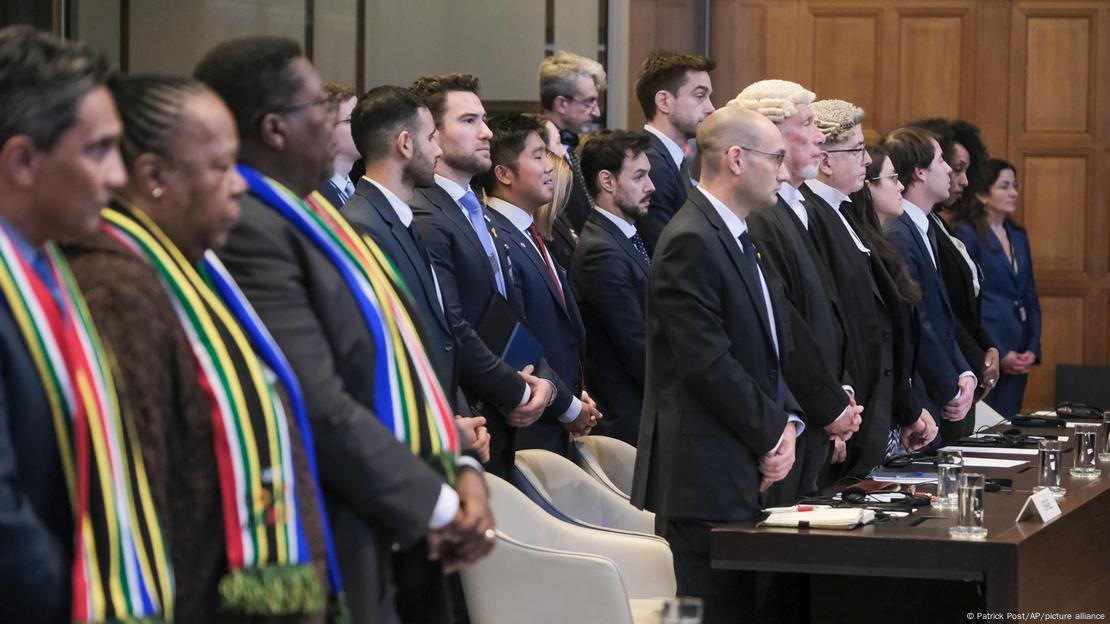
A South African delegation (left) brought the case against Israel on behalf of Palestinians in Gaza
Image: Patrick Post/AP/picture alliance

Nonetheless, with the reported Palestinian death toll now over 26,000 and close to 2 million people internally displaced, the court found the situation grave enough to issue a series of emergency injunctions pending its long-off final verdict.

The decision will put pressure on Israel and its allies, including the United States, who had argued the case had no merit whatsoever.

Israel handed a string of injunctions over Gaza conduct

"The military operation conducted by Israel after 7 October, 2023, has resulted, inter alia, in tens of thousands of deaths and injuries; and the destruction of homes, schools, medical facilities and other vital infrastructure, as well as displacement on a massive scale," said Donoghue.

A clear majority of judges ordered Israel to "take all measures within its power" to prevent the killing of Palestinians as a protected group under the Genocide Convention and to prevent "causing serious bodily or mental harm," Donoghue added.

The government must ensure the Israel Defense Forces (IDF) do not carry out acts that may constitute genocide, and also prevent and punish the incitement of genocide, she continued.
Crucially, officials must "take immediate, effective measures to enable the provision of urgently needed basic services and humanitarian assistance." The World Health Organization (WHO) warned late last month that an unprecedented 93% of Gazans were experiencing crisis levels of hunger, Donoghue noted.
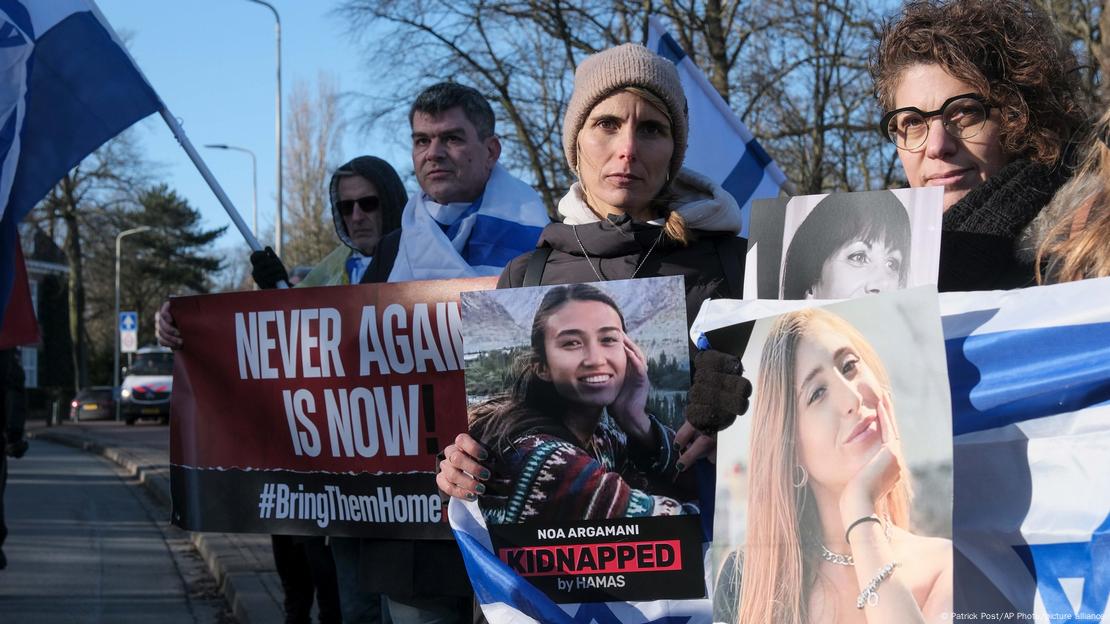
Demonstrators waving Israeli and Dutch flags held up pictures of hostages seized from southern Israel by Hamas militants
 Patrick Post/AP Photo/picture alliance

Donoghue took time to read out several statements from top-tier Israeli officials, including President Isaac Herzog and Defense Minister Yoav Gallant, that had been flagged by UN officials as exhibiting "dehumanizing language." The court also instructed Israel to submit a report on how it was complying with ICJ measures within a month.

With an eye to Hamas, which is not involved in proceedings because it is not defined as a state actor, Donoghue made clear that "all parties to the conflict in the Gaza Strip are bound by international humanitarian law."

On behalf of the ICJ, Donoghue also demanded the release of all the remaining hostages taken by Hamas on October 7. Israel believes that of the 253 people originally kidnapped, over 100 are still alive and being held in Gaza.

Israel calls genocide charge 'false and outrageous'


Israel was incensed by Friday's ruling, with the Foreign Ministry calling the "charge of genocide leveled against Israel" at the ICJ "false and outrageous" in a statement.

In the same press release, Foreign Minister Israel Katz said his country's commitment "to international law is unwavering. It exists independently of any ICJ proceedings, as does Israel's inherent right to defend itself against the genocidal terrorists of Hamas."

Two weeks earlier, Israeli lawyers had asked the top UN court to throw out South Africa's case as meritless and "grossly distorted."

The Genocide Convention, they recalled, was drawn up in the wake of the Holocaust, the carefully plotted mass murder of millions of European Jews by the German Nazi regime during World War II.

Speaking to DW in The Hague, Ammar Hijazi, a representative of the Palestinian Authority in the occupied West Bank, welcomed the ruling as a "historic decision."

"Today, for the first time in the history of the Palestinian people and their struggle for independence and freedom, Israel, their oppressor, has been held to account in front of the highest court in the world," he said.


Several supporters of South Africa's case told DW they were mostly happy with the outcome, with many interpreting it as a de facto order for Israel to lay down its weapons. As it was read out, the crowd outside the courthouse occasionally erupted with appreciative shouts.

One person at the pro-Palestinian rally, a man named Mouaan Al-Borsh, told DW that he had lost much of his family in Gaza and was "very sad" about the ICJ decision, saying he had been hoping for a cease-fire order. "This is exactly what America, what Israel wants," he said of the ruling.

ICJ ruling 'hard to ignore' for Israeli allies


Richard Gowan, an analyst at the International Crisis Group, a conflict resolution NGO, did not share that assessment. "A lot of states and legal experts will argue that Israel will have to fundamentally change its tactics or simply end hostilities," Gowan told DW by phone from New York. While Israel was likely expecting such a ruling, Gowan said it would be too much to call the lack of a cease-fire order a victory.

The ICJ ruling puts Israel's allies in a "painful quandary," according to Gowan. "Officials in Washington and London will be saying quietly to the Israelis, you really do have to significantly curb your campaign now because international outrage is continuing to mount," he said.

Unlike a national court, which relies on the police or the prison system, the ICJ has little means to enforce its rulings.

The ball, therefore, now passes back to the UN, Gowan explained. "A lot of diplomats here in New York expect that Algeria, as the Arab member of the Security Council, might table a resolution next week essentially demanding that Israel abides by the ICJ measures," he said.


The US would find it hard to sign off on anything that gave even mild credence to the notion that Israel was committing genocide, Gowan said. Nonetheless, "Israel and its friends will find [the ICJ ruling] hard to ignore," he added.

Khaled Elgindy, an analyst from the Middle East Institute, a Washington-based think tank, agreed.

Elgindy said the US, Britain and Germany — who have been "the most full-throated and unconditional in their support for Israel's military campaign" — will find it difficult to "dismiss the court's findings and preliminary measures without undercutting the institution of the ICJ and their own stated commitment to a rules-based order."

"I don't see a way for Israel to continue operating the way it has in Gaza and still be in compliance with the court's ruling," Elgindy told DW from Washington.

Edited by: Jon Shelton

Ella Joyner Correspondent@EllaRoseJoyner

S.Africa hails ‘decisive victory’ at UN court

By AFP
January 26, 2024

Many South Africans reacted with pride after a UN court ordered that Israel refrain from taking genocidal actions in Gaza, in response to a case brought by South Africa - Copyright POOL/AFP Ludovic MARIN


Umberto BACCHI with Julie BOURDIN in Cape Town

South Africa on Friday hailed a ruling by the United Nations’ top court that Israel should do everything it can to prevent any acts of genocide in Gaza.

The International Court of Justice (ICJ) in The Hague handed down its verdict in a landmark case brought by Pretoria also ordering Israel to allow humanitarian access to the Palestinian territory.

“Today marks a decisive victory for the international rule of law and a significant milestone in the search for justice for the Palestinian people,” South Africa’s ministry of foreign affairs said.

“The decision is a momentous one,” it added, thanking the court for its “swift ruling”.

South Africa has accused Israel of breaching the 1948 UN Genocide Convention — set up in the aftermath of World War II and the Holocaust — during its military campaign in Gaza, sparked by the October 7 attacks by Hamas.

The court did not pass judgement on whether or not Israel is actually committing genocide but handed down emergency orders while it considers the wider accusation — a process that is likely to take years.

– ‘Plausibly genocidal’ –

“Third States are now on notice of the existence of a serious risk of genocide against the Palestinian people in Gaza,” the ministry of foreign affairs said.

“This necessarily imposes an obligation on all States to cease funding and facilitating Israel’s military actions, which are plausibly genocidal.”

President Cyril Ramaphosa and the ruling council of the ruling African National Congress party erupted in cheers, singing and dancing after judges read the order.

Ramaphosa was due to make a speech on the ruling later Friday.

The ANC’s National Executive Committee suspended a meeting to watch a broadcast from the court, and live footage from the event showed senior party and government figures celebrating.

The case, and their government’s involvement in it, has also generated public interest in South Africa, where many have sympathy for the Palestinian quest for statehood.

In Cape Town and Pretoria, AFP reporters found people gathering to watch the ruling, which was carried in full on state television.

As the ICJ judge announced the provisional measures, applause erupted among a diverse crowd of about 30 gathered in a community centre in Cape Town, some wearing earrings and colours in support of Palestine.

“We are discussing the extent to which it can have an impact… For now it is a step in the right direction,” said medical student Kwezi Zwane, 24, as attendees embraced and commented on the ruling.

The ICJ’s rulings are binding on all parties but it has no mechanism to enforce them. Sometimes they are completely ignored.

– Anti-apartheid struggle –

“South Africa sincerely hopes that Israel will not act to frustrate the application of this order, as it has publicly threatened to do, but that it will instead act to comply with it fully, as it is bound to do,” the ministry said.

Pretoria has long been a vocal supporter of the Palestinian cause, with the ANC party often linking it to its own struggle against apartheid.

The October 7 Hamas attack resulted in the death of around 1,140 people in Israel, most of them civilians, according to an AFP tally based on official Israeli figures.

At least 26,083 Palestinians, around 70 percent of them women, young children and adolescents, have been killed in the Gaza Strip in Israeli bombardments and ground offensive since then, according to the Hamas government’s health ministry.

‘End to war’: World reacts to Gaza-Israel ruling


By AFP
January 26, 2024


Israeli air strikes on Gaza continued on the day the top UN court said that it had to prevent acts of genocide - Copyright ANP/AFP Remko de Waal

The reactions to the top UN court’s ruling Friday in the Israel-Gaza case were split along the lines of the war raging in the Palestinian territory.

The International Court of Justice (ICJ) said Israel must prevent genocidal acts in Gaza and allow humanitarian aid into the besieged strip of land.

The war in Gaza started with the October 7 attack by Hamas that resulted in about 1,140 deaths in Israel, mostly civilians, according to an AFP tally of official Israeli figures.

Militants also seized about 250 hostages and Israel says around 132 of them remain in Gaza, including the bodies of at least 28 dead captives.

Israel has vowed to crush Hamas and launched a military offensive that Gaza’s health ministry says has killed at least 26,083 people, about 70 percent of them women and children.


– ‘False, outrageous’ –


“The charge of genocide levelled against Israel is not only false, it’s outrageous, and decent people everywhere should reject it,” said Israeli Prime Minister Benjamin Netanyahu.


– ‘No state above law’ –


“The ICJ order is an important reminder that no state is above the law,” Palestinian foreign minister Riyad al-Maliki said in a video statement, adding that the ruling “should serve as a wake-up call for Israel and actors who enabled its entrenched impunity”.


– ‘Victory for justice’ –


“Today marks a decisive victory for the international rule of law and a significant milestone in the search for justice for the Palestinian people,” said the foreign affairs ministry of South Africa, which brought the case before the ICJ.


– ‘Isolating Israel’ –


“The (International) Court of Justice’s decision is an important development which contributes to isolating Israel and exposing its crimes in Gaza,” said Palestinian militant group Hamas.


– ‘Advocate for peace’ –


“We will continue to advocate for peace and an end to war, the release of hostages, access to humanitarian aid and the establishment of a Palestinian state alongside Israel, so that both nations coexist in peace and security,” said Spain’s Prime Minister Pedro Sanchez.


– ‘Hope attacks end’ –


“We hope that Israel’s attacks against women, children and the elderly will come to an end,” Turkish President Recep Tayyip Erdogan said, calling the ruling “valuable”.


– ‘Must comply with orders’ –


“Orders of the International Court of Justice are binding on the parties and they must comply with them. The European Union expects their full, immediate and effective implementation,” the European Union said.


– ‘Prevent genocide’ –


“The World Court’s landmark decision puts Israel and its allies on notice that immediate action is needed to prevent genocide and further atrocities against Palestinians in Gaza,” said Balkees Jarrah, associate international justice director at Human Rights Watch.

Gazans torn between pride and frustration after UN court ruling


By  AFP
January 26, 2024

The court session was closely watched around the world and in the occupied West Bank - Copyright AFP Zain JAAFAR

Mai Yaghi with Hossam Ezzedine in Ramallah

Palestinians trapped in the grip of war were caught between feelings of pride and frustration on Friday following the UN’s top court saying Israel must prevent genocide in Gaza.

In the Palestinian territory’s southern city of Rafah, more than a million displaced people are struggling to survive amid bombardment and severe shortages of basic supplies.

Some who had access to electricity gathered around a television Friday to watch the International Court of Justice make an initial ruling on the genocide case brought by South Africa against Israel.

“I feel proud of the court’s decision, it’s the first time that the world’s telling Israel that it crosses all lines and international law,” said Maha Yasin, who was forced to flee from the northern Gaza City to Rafah.

“At least I feel that the world has started to feel for us, and that our blood, our martyrs, our physical and mental loss is not in vain,” the 42-year-old told AFP.

More than 26,000 people have been killed in Gaza, about 70 percent of them women and children, according to the health ministry in the Hamas-run territory.

The war erupted on October 7 with an unprecedented Hamas attack which resulted in about 1,140 deaths in Israel, mostly civilians, according to an AFP tally of official Israeli figures.

Militants also seized about 250 hostages and Israel says around 132 of them remain in Gaza, including the bodies of at least 28 dead captives.

The Israeli military has laid to waste swathes of Gaza in its blistering assault, with 1.7 million people forced to flee their homes according to the United Nations.

– ‘Stop the war’ –


Abu Mohammed Zaqout, 55, reached Rafah with dozens of relatives who were crammed into a tent unfit for the harsh winter weather.

“I was pinning my hopes on the court ordering a stop to the war,” he said.

“But I am happy that I lived to see the day when the world is saying to Israel that it is criminal and its war unethical,” added Zaqout.

The ICJ’s landmark decision also said Israel must facilitate “urgently needed” humanitarian aid to Gaza, where the limited number of trucks that enter are often swamped by people desperate for food.

Zaqout supported the court’s ruling, but said it would not be enough to stop the suffering.

“We need to see an end to the war on the ground. No one can bear it anymore,” he told AFP.

The court session was closely watched around the world and in the occupied West Bank, where residents gathered at a cinema in Ramallah.

“Thank you South Africa” placards were on display, but attendees were disappointed the court stopped short of ordering an immediate halt to hostilities.

“It is unacceptable for the world to stand today — after more than a hundred days — and still watch, and not make an immediate decision to stop the fire, bring in food and medicine, and evacuate the wounded,” said Hala Abu Gharbiyeh, with a South African flag in her hand.

A metres-high statue of South Africa’s anti-apartheid hero Nelson Mandela stands in Ramallah, while earlier this month Palestinians raised the country’s flag over the West Bank city of Bethlehem.

Back at the cinema, Palestinian Mais Shabana said she was disappointed with the court’s response to the South Africa case.

“We were very optimistic, but now we are not happy. We feel that the court could have clearly decided that there would be a ceasefire,” she said.


South Africa’s genocide case against Israel explained


By AFP
January 26, 2024


Friday's ruling is a landmark moment for the court
 - Copyright AFP Money SHARMA

Richard CARTER

The International Court of Justice will hand down a highly anticipated ruling on Friday in South Africa’s case against Israel over alleged genocidal acts in Gaza.

Here are some key questions about a case that has drawn global interest:

– Will the court decide whether Israel is committing genocide? –

No. At this stage, the ICJ is only deciding whether to impose emergency orders on Israel (“provisional measures” in the court’s jargon).

A ruling on whether Israel is committing genocide in Gaza will be for a second stage of the procedure and is likely to take years.

The war started on October 7, when Hamas staged an unprecedented attack on Israel that left about 1,140 people dead, mostly civilians, according to an AFP tally based on official Israeli figures.

Israel’s relentless military campaign on Gaza since has left at least 26,083 dead — about 70 percent of them women, children and adolescents — according to the territory’s Hamas-run health ministry.

“At this stage, South Africa does not need to prove that Israel is committing genocide,” Juliette McIntyre, a lecturer in international law at the University of South Australia, told AFP.

“They simply need to establish that there is a plausible risk of genocide occurring.”

Even if the court rules against Israel, “it means that there is a plausible risk of genocide — not that there is genocide”, she said.

– What could the court do? –

South Africa has asked the ICJ to impose nine orders on Israel, including to immediately suspend military activity and to enable more humanitarian access to Gaza.

The court could order all nine of the orders, none of them, or even make up its own completely different orders.

“It seems likely that the court will grant some of the requests made by South Africa,” said Cecily Rose, an assistant professor of public international law at Leiden University.

Israel argued during the hearings that a ceasefire was unrealistic as the court could only order that on one party, since Hamas is not part of the proceedings.

However, Hamas said on the eve of the ruling that it would abide by a ceasefire order if Israel did the same.

“The court may order a ceasefire, but more likely in my opinion is an order that Israel take all measures within its power to ensure access to adequate food, water and humanitarian assistance,” McIntyre said.

– What happens next? –

From the court’s viewpoint, the case moves onto the “merits” stage, where it will determine whether Israel is actually committing genocide in Gaza.

The key is whether Israel will abide by any potential ICJ ruling.

Prime Minister Benjamin Netanyahu has already hinted he does not feel bound by the court.

Regardless of Israel’s reaction, the ruling will have important “ripple effects”, McIntyre said.

If the court rules there is a “risk” of genocide, “it makes it much harder for other states to continue to support Israel… states may withdraw military or other support”.

ICJ rulings are binding but it has little way of enforcing them and some states ignore them completely. Russia was ordered to stop its invasion of Ukraine, for example.

However, “it creates an important historical record which may not change things on the ground right this moment but can be essential in future negotiations under new governments”, McIntyre said.

“Finally, there is the symbolic aspect which, given Israel’s context, is huge.”

– Why South Africa? –


South Africa brought the case against Israel because both countries have signed the United Nations Genocide Convention, drawn up in 1948 when the world vowed “never again” after the Holocaust.

Its filing states that Pretoria is “acutely aware” of the “particular weight of responsibility” in accusing Israel, of all countries, of breaking the Genocide Convention.

But it also says that no attack can justify alleged breaches of the convention and that Israel has “its own obligation” as a signatory to prevent genocide.

Pretoria has long been a vocal supporter of the Palestinian cause, with the governing African National Congress (ANC) often linking it to its own struggle against apartheid.

South Africa and Israel have in the past cut off diplomatic ties over the issue.

– What other cases are there? –

The ICJ rules on disputes between countries and is often confused with the International Criminal Court (ICC), also based in The Hague, which prosecutes war crimes by individuals.

ICC chief prosecutor Karim Khan has started an investigation into events in Gaza and vowed to “step up” his probe.

Five countries including South Africa called in November for an ICC investigation into the Gaza war, and Khan says his team has gathered a “significant volume” of evidence.

International legal experts have told AFP that war crimes have probably been committed by both sides.

Finally, the United Nations has asked the ICJ to look into the legal consequences of Israel’s actions in the Palestinian Territories.

This will be an advisory opinion and will not focus on the military operation after October 7, when Hamas militants crossed into Israel.

https://p.dw.com/p/4bjgk