Wednesday, February 28, 2024

 UK

THEATRE

New show about the Battle of Cable Street deserves a much wider audience

Rap, rock and romance bring this story to life with a rousing score and star performances

That the Battle of Cable Street would even be considered as a suitable subject for the song and dance treatment will no doubt result in some eye-rolling, but writer Alex Kanefsky and lyricist Tim Gilvin have handled that painful day – October 4, 1936 – with kid gloves and instilled the score with the courage and conviction that honours those who fought against the Fascists.

The story of the eventual battle with Oswald Mosley’s Blackshirts is told through the friendship between three young people: a Brit new to the city, an Irish girl and a Jew. What could be the opening to a familiar joke is instead the set up for what becomes a triumvirate of unity delivered through rap and pop tunes. Danny Colligan (Book of Mormon) is Ron, Sha Dessi (Les Mis) is Mairead, and newcomer Joshua Ginsberg as Sammy is likely to touch a few hearts as he has charm, cheekiness and chein in equal measure. Debbie Chazen is a welcome presence and many will have seen her recently seen in Red Riding Hood and the Big Bad Pig at JW3, but refreshingly she has not been cast to type.

How a disparate group of young people came together to stand against fascism was the starting point for writer Kanefsky, whose own grandmother witnessed the battle.

“It may have been 88 years ago, but it feels a deeply resonant, modern story of hope in turbulent times,” he says. “Cable Street serves as a strong antidote to the ‘great man’ theory of history, as well as to frequent portrayals of Jews solely as victims in popular culture that I had seen so much growing up.

“When Tim and I discovered we both wanted to tell this story, writing together seemed serendipitous. We wanted to write something that could be faithful to those communities who banded together in the face of hatred, yet delve deeper beyond the popular myths and simple solutions.”

Despite being a show that could (and should) transfer to a bigger stage, the Southwark Playhouse feels suitably humble for a musical wanting to convey the struggle of poor Eastenders, and the intimacy of the small auditorium brings tangibility to the growing tensions. That those tensions resonate more deeply now because of October 7 is why the musical matters and brings another layer to the creators’ themes.

“The 2016 Brexit vote seemed to open a Pandora’s box of xenophobia, nationalism, and overt racist rhetoric across the country” Kanefsky continues. “The parallels with the 1930s jumped out at me: financial depression, political upheaval and powerful figures scapegoating minorities for all of society’s ills.

“At the time I was delivering anti-discrimination workshops with teens in schools for Stand Up (a partnership of CST with TellMAMA). When young Muslims spoke of their negative portrayal in the media it really struck a chord: we’ve been here before.”

Capturing the sentiments of 1936 in such songs as the rousing No Parasan, which closes out the first act with barricades being built and the community uniting, is quite an achievement as this is dark material and not an obvious fit for chorus numbers. “Musicals can work well when the story they tell is larger than life,” insists Gilvin. “On 4th October 1936, Londoners from all backgrounds and cultures took the streets to unite with one voice. There was singing in the streets and chanting of ‘no pasaran’ (they shall not pass). It’s a story that cries out to be told with music.

“Early on in the process, we decided to use contemporary music as a metaphor for the parallels between 1936 and the present day, and within that we wanted to showcase eclecticism, reflective of the eclecticism of the Londoners on the streets that day. We have three protagonists: Mairead, from an Irish background, is a revolutionary and lives in a punk/protest-folk world. Our Jewish lad Sammy is a bit of a scrapper, and a former boxer, and uses rap to tell his story. Ron has recently moved to London from the north of England, and has an idealistic, lyrical Indie/Brit-rock sound. We have also included a bit of music hall, the popular music of the day, and have tried to create a real melting pot of influences, just like the East End, then and now.”

Joshua Ginsberg as Sammy

With rap, rock and a touch of romance the story comes to life with limited props and most cast members playing multiple roles, effortlessly slipping between them with just a change of headgear or the donning of an armband. They were encouraged to research the story and in particular their role, and in a real-life case of things coming full circle, Joshua Ginsberg discovered that his great grandfather Isidore Baum was among those who took to the streets. “I really was gobsmacked,” says Ginsberg. “I didn’t even know about Cable Street, so it’s such a privilege to find out my family’s story and how similar it is to the play.”

With a score that takes inspiration from Come From Away and Hamilton and first class performances Cable Street should be relocated to the West End as quickly as possible, not only because the Southwark run has completely cold out, but because it has a message that needs to be heard by many .


A growing hunger: Argentina’s soup kitchens battle Milei’s spending cuts

Under President Javier Milei, Argentina’s government has cut funds to community kitchens, sparking mass protests.

Protesters on January 24 raise an effigy of newly inaugurated President Javier Milei [Patricio A Cabezas/Al Jazeera]

By Josefina Salomon and Patricio A Cabezas
Published On 28 Feb 2024

Buenos Aires, Argentina – It is an unusually hot Friday morning but the line outside the communal soup kitchen in Merlo — a town on the outskirts of Buenos Aires, Argentina — is particularly long, stretching around the block.

Some of the people waiting are first-timers, fidgeting with empty plastic containers in their hands. Many have jobs. Still, the rice stew the soup kitchen is ladling out could be their only meal of the day.

Similar scenes have been playing out across Argentina in recent weeks. As inflation skyrockets, advocates and everyday citizens are warning of a hunger crisis that could ravage the country’s poor.

Much of the outcry has been directed at libertarian President Javier Milei. Less than three months into his term, Milei’s administration has implemented a series of austerity measures that have slashed government spending — including funds already allocated for soup kitchens, or “comedores”, like the one in Merlo.

“Demand for food has doubled in recent months,” said Liliana Soledad Loto, 38, one of the soup kitchen’s cooks and a leader of the social organisation Somos Barrios de Pie.

“We have seen many more people come, including people with jobs, people who work in construction or in factories and still cannot make it to the end of the month. These people don’t come because they want to. They do it because they need to.”

The institution where she works, the Padre Mugica soup kitchen, is one of approximately 38,000 social organisations that distribute meals to Argentinians in need. Together, they serve an estimated 10 million people, out of a total population of 46 million.

But advocates say the number of people experiencing food insecurity could be even higher, with some of the neediest individuals going uncounted.

That is because some communities, particularly in marginalised areas, have informal systems to address hunger: neighbours helping neighbours individually, by offering free meals or even a simple cup of milk to children in need.

A line forms outside the Padre Mugica soup kitchen in Merlo, Argentina [Patricio A Cabezas/Al Jazeera]


Government clashes with protesters

Outrage over the rising numbers has grown this month, particularly after news cameras captured a member of Milei’s administration, Sandra Pettovello, clashing with protesters over the issue.

Pettovello is the head of the Ministry of Human Capital, a newly created entity designed to replace the government agencies overseeing education, social security, labour, welfare and culture.

Her ministry governs the distribution of federal money assigned to social programmes. But those funds have been curtailed since December, when Milei took office.

In a bid to reduce federal debt, Milei cut public spending, including money already budgeted for community kitchens. Pettovello has argued the cuts were necessary to eliminate the “poverty managers” who serve as “problematic” intermediaries between the government and its people.

On February 1, Pettovello confronted picketers at the gates of her ministry, where news outlets recorded her statements. She told the demonstrators that “anyone who is hungry” can come to her directly for assistance.

“Let them come,” she said of those in need. “Come one by one, and I will write down your ID number, your name, where you are from. And you will receive help individually.”

Worker Diego Markus says the government is ‘stigmatising’ soup kitchens
 [Patricio A Cabezas/Al Jazeera]

The following day, thousands of people queued outside her office. Local news outlets reported the line snaked past nearly 20 city blocks.

Pettovello, however, refused to meet with them. Instead, she signed an agreement to distribute a fraction of the funds allocated to combat hunger to two religious organisations associated with the evangelical and Catholic churches.

“The government says that help needs to reach those in need directly, and we agree with that. Help needs to reach people in any way,” said Diego Markus, 27, a social leader who works in soup kitchens in La Matanza, one of the poorest districts in the greater Buenos Aires area.

“The problem is that people are not receiving anything.”

Markus disputes the notion that community outreach organisations have siphoned government funds with little oversight or transparency, a criticism raised by Milei’s administration.

“The government knows where we are, what we do. People from each administration have come to check what we do, and everything is registered,” he said. “What the government is doing is stigmatising us for what we do.”

Even the Argentinian Episcopal Conference, a Catholic leadership body, denounced the newly implemented cuts.

“All care spaces that provide food, all community kitchens, parish kitchens, evangelical churches and popular movements must receive help without delay,” the group wrote in a statement. “Food cannot be used as a variable for [economic] adjustment.”

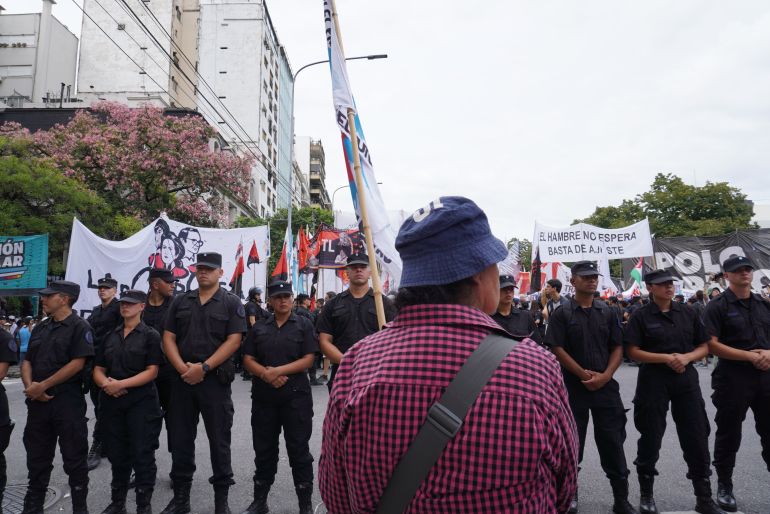
A protester confronts a row of police officers near the Ministry of Human Capital in Buenos Aires, Argentina, on February 23 
[Josefina Salomon/Al Jazeera]

Poverty expected to rise


The loss in funds, in the meantime, has left some soup kitchens and food pantries struggling to accommodate a burgeoning number of clients.

Argentina has fallen deep into an economic crisis, with an annual inflation rate of nearly 255 percent. More than 57 percent of its population lives below the poverty line — the highest rate in 20 years, according to a report this month from the Universidad Católica Argentina.

The report warned that the number is expected to grow, as prices for electricity, gas, public transport and health insurance are set to rise in March.

To help address its poverty, Argentina has long relied on community kitchens, traditionally financed through a combination of state and federal resources. But with future funds in peril, some pantries are questioning how long they can stay open.

Veronica Cussimamani, 30, and Zulma Mejia, 27, work in Sol y Tierra, a soup kitchen and community centre in Villa Celina, part of La Matanza.

They say the number of people arriving for food has risen each week, but the pile of pasta, rice and polenta they have has decreased. With less available to cook, four tall metal pots sit empty in a corner of their kitchen, ready and waiting atop a cold stove.

The kitchen, which opened in 2018, used to feed 300 people every day of the week. Since government assistance stopped arriving two months ago, Sol y Tierra has only been able to offer meals twice a week.

“We get creative and still really struggle to make ends meet. When we are closed, people have to try and find somewhere else to get food from,” Mejia told Al Jazeera as she looked at her dwindling pile of food packets.

Zulma Mejia, Beto Acebay and Veronica Cussimamani work at the soup kitchen Sol y Tierra, which has had to reduce its operating hour
s [Patricio A Cabezas/Al Jazeera]

Inflation forces kitchens to shutter

Cussimamani added that Sol y Tierra has sought donations from local shops, but with budgets running tight — and the Argentinian peso worth less and less — fewer businesses are willing and able to participate.

“The local butcher used to donate, but now even he is struggling,” she explained. “The same with the vegetable shops: They used to give us the things they couldn’t sell, but now they just reduce the price and try to sell it, as everybody is looking to make ends meet.”

Liliana Soledad Loto, right, with her colleague Tamara del Valle Albornoz
 [Patricio A Cabezas/Al Jazeera]

Inflation and the resulting price increases have also chipped away at the soup kitchens’ operating budgets. Soledad Loto, the cook at the Padre Mugica kitchen, said her organisation has already had to cut its opening days to three a week.

“To cook anything, you also need to get gas. The gas bottle used to be 2,000 pesos [$2.38], and now it’s 12,000 pesos [$14.27]. We use one bottle every two weeks. It’s almost impossible to continue like this,” she said.

Some smaller community kitchens have been forced to shut down altogether, she added. Many serve remote or marginalised areas where resources are already scant.

Hunger is particularly dangerous for children, for whom malnutrition can have lifelong effects, ranging from stunted growth to weakened immune systems. As of 2023, more than 56 percent of children aged 14 and younger fell below the poverty line.

“Without food, kids don’t have the energy to do anything. They get sick. That is the problem. And things are likely to get even worse,” said Beto Acebay, 27, who works in a soup kitchen in La Matanza.

“It’s heartbreaking when children come, knowing that we have nothing to give them. We always try to make things work, but it is getting very very difficult.”

Protester Marisela Escalante, centre, called on the Argentinian government to make the ‘food emergency’ its first priority 
[Josefina Salomon/Al Jazeera]

Challenging times ahead


President Milei has warned that more challenging times are on the horizon. “We know that the situation will get worse,” he said in his inaugural address in December. “But we will see the fruits of our labours.”

But activists concerned about the hunger crisis argue there is no time to spare. They urged the government to reinstate funding and food deliveries to the communal soup kitchens to prevent further harm

Some picketers have even taken to banging pots and pans — a form of protest known as “cacerolazo”. Named for a type of stew pan, cacerolazo demonstrations have become widespread in Latin America, the cacophony of empty, clattering dishes particularly poignant during times of food shortages.

On Friday, further protests erupted near the Ministry of Human Capital, with hundreds of people gathering in the wealthy Barrio Norte neighbourhood of Buenos Aires.

Federal police tried unsuccessfully to keep protesters from blocking the large avenue outside the ministry. But crowds clogged the thoroughfare, chanting protest songs and carrying banners and signs that read, “Hunger cannot wait.”

“The food emergency should be the government’s first priority, but they are not doing anything about it. The minister refuses to speak with us, so we have to keep coming,” said Marisela Escalante, who cooks in a soup kitchen in Villa 31, a low-income neighbourhood located in the middle of one of Buenos Aires’s richest areas.

“The situation is infuriating. We have not received any food in two months. Some soup kitchens had to shut down. The only ones that remain open are those that manage to gather help from neighbours and others. We need answers.”
Advertisemen

Meanwhile, cooks in community kitchens across the country continue to keep their stoves burning and their pans hot, trying to answer Argentina’s rumbling hunger.

“Why do I go on?” asked Judit Hanco, 40, who receives a government stipend and volunteers by cooking twice a week at Sol y Tierra. “Because many families need us. Helping them not to be hungry is what gives me strength to go on.”

SOURCE: AL JAZEERA

U.S. Semiconductor Firms, Having Outsourced Production Overseas, Struggle To Trace Evasion

Russia’s military industrial complex is heavily reliant on Western technology, including semiconductors, for the production of sophisticated weapons. (file photo)
February 28, 2024

WASHINGTON -- U.S. semiconductor firms must strengthen oversight of their foreign partners and work more closely with the government and investigative groups, a group of experts told the Senate Committee on Homeland Security and Governmental Affairs, saying the outsourcing of production overseas has made tracking chip sales more difficult, enabling sanctions evasion by Russia and other adversaries.

U.S. semiconductor firms largely produce their chips in China and other Asian countries from where they are further distributed around the world, making it difficult to ascertain who exactly is buying their products, the experts told the committee at a hearing in Washington on February 27.

The United States and the European Union imposed sweeping technology sanctions on Russia to weaken its ability to wage war following its full-scale invasion of Ukraine in February 2022. Russia’s military industrial complex is heavily reliant on Western technology, including semiconductors, for the production of sophisticated weapons.

“Western companies design chips made by specialized plants in other countries, and they sell them by the millions, with little visibility over the supply chain of their products beyond one or two layers of distribution,” Damien Spleeters, deputy director of operations at Conflict Armament Research, told senators.

He added that, if manufacturers required point-of-sale data from distributors, it would vastly improve their ability to trace the path of semiconductors recovered from Russian weapons and thereby identify sanctions-busting supply networks.

The banned Western chips are said to be flowing to Russia via networks in China, Turkey, Central Asia, and the Caucasus.

Spleeters said he discovered a Chinese company diverting millions of dollars of components to sanctioned Russian companies by working with U.S. companies whose chips were found in Russian weapons.

That company was sanctioned earlier this month by the United States.

'It's Going To Be Whack-A-Mole'

The committee is scrutinizing several U.S. chip firms whose products have turned up in Russian weapons, Senator Richard Blumenthal (Democrat-Connecticut) said, adding “these companies know or should know where their components are going.”

Spleeters threw cold water on the idea that Russia is acquiring chips from household appliances such as washing machines or from major online retail websites.

“We have seen no evidence of chips being ripped off and then repurposed for this,” he said.

“It makes little sense that Russia would buy a $500 washing machine for a $1 part that they could obtain more easily,” Spleeters added.

In his opening statement, Senator Ron Johnson (Republican-Wisconsin) said he doubted whether any of the solutions proposed by the experts would work, noting that Russia was ramping up weapons production despite sweeping sanctions.

“You plug one hole, another hole is gonna be opening up, it's gonna be whack-a-mole. So it's a reality we have to face,” said Johnson.

Russia last year imported $1.7 billion worth of foreign-made microchips despite international sanctions, Bloomberg reported last month, citing classified Russian customs service data.

Johnson also expressed concern that sanctions would hurt Western nations and companies.

“My guess is they're just going to get more and more sophisticated evading the sanctions and finding components, or potentially finding other suppliers...like Huawei,” Johnson said.

Huawei is a leading Chinese technology company that produces chips among other products.

James Byrne, the founder and director of the open-source intelligence and analysis group at the Royal United Services Institute, said that officials and companies should not give up trying to track the chips just because it is difficult.

'Shocking' Dependency On Western Technology

He said that the West has leverage because Russia is so dependent on Western technology for its arms industry.

“Modern weapons platforms cannot work without these things. They are the brains of almost all modern weapons platforms,” Byrne said.

“These semiconductors vary in sophistication and importance, but it is fair to say that without them Russia … would not have been able to sustain their war effort,” he said.

Byrne said the depth of the dependency on Western technology -- which goes beyond semiconductors to include carbon fiber, polymers, lenses, and cameras -- was “really quite shocking” considering the Kremlin’s rhetoric about import substitution and independence.

Elina Ribakova, a Russia expert and economist at the Peterson Institute for International Economics, said an analysis of 2,800 components taken from Russian weapons collected in Ukraine showed that 95 percent came from countries allied with Ukraine, with the vast majority coming from the United States. The sample, however, may not be representative of the actual distribution of component origin.

Ribakova warned that Russia has been accelerating imports of semiconductor machine components in case the United States imposes such export controls on China.

China can legally buy advanced Western components for semiconductor manufacturing equipment and use them to manufacture and sell advanced semiconductors to Russia, Senator Margaret Hassan (Democrat-New Hampshire) said.

Ribakova said the manufacturing components would potentially allow Russia to “insulate themselves for somewhat longer.”

Ribakova said technology companies are hesitant to beef up their compliance divisions because it can be costly. She recommended that the United States toughen punishment for noncompliance as the effects would be felt beyond helping Ukraine.

“It is also about the credibility of our whole system of economic statecraft. Malign actors worldwide are watching whether they will be credible or it's just words that were put on paper,” she said.

House approves bipartisan bill aimed at bolstering nuclear energy 

- 02/28/24 
BBC

FILE – Units 3, left, and 4 and their cooling towers stand at Georgia Power Co.’s Plant Vogtle nuclear power plant, Jan. 20, 2023, in Waynesboro, Ga. Georgia’s Public Service Commission voted 5-0 on Tuesday, Dec. 19, 2023 to approve a 6% rate increase for remaining costs that will take effect once Unit 4 begins commercial operation. 
(AP Photo/John Bazemore, File)


The House on Wednesday evening approved bipartisan legislation that aims to bolster nuclear energy.

The vote was 365-36, with one additional lawmaker voting present.

All of the “no” votes were Democrats and included several members of the Progressive Caucus. Rep. Marcy Kaptur (D-Ohio) voted present.

The legislation aims to bolster the U.S.’s nuclear energy production by speeding up environmental reviews for new nuclear reactors and reducing fees that applicants for advanced nuclear reactor licenses must pay.

It would also extend a law that limits the industry’s legal liability for nuclear accidents by 40 years.

In addition, the bill would also seek to bolster nuclear approvals by requiring “efficient, timely, and predictable reviews and proceeding” for licensing reactors.

The bipartisan legislation was sponsored by Reps. Jeff Duncan (R-S.C.) and Diana DeGette (D-Colo.).

“The Atomic Energy Advancement Act restores American leadership in nuclear energy and technology which is critical to our economic and national security. I’m proud to lead the most significant update to nuclear energy policy in the United States in over a generation,” Duncan said in a written statement on its passage.


While it has bipartisan support in the House, it’s unclear whether the bill will advance in its current form, as the Senate has its own nuclear energy bill.

Both bills have bipartisan support and reports have indicated that both chambers have been in talks on how to reconcile the legislation.


US airman who burned himself to death at Israeli embassy had anarchist past


Aaron Bushnell also grew up in a strict religious sect, the Community of Jesus, whose members would often join the military

Richard Luscombe
THE GUARDIAN
Tue 27 Feb 2024 

A uniformed airman who burned himself to death in protest over the US’s role in Israel’s military strikes in Gaza was an anarchist who grew up in a strict religious sect with links to a school in Canada that “controlled, intimidated and humiliated” students, it was reported on Tuesday.


US air force member dies after setting himself on fire outside Israeli embassy


Aaron Bushnell, an active-duty US air force senior airman from San Antonio, Texas, died in hospital on Sunday several hours after he doused himself in a flammable liquid and set himself alight outside the Israeli embassy in Washington DC.

Bushnell, 25, livestreamed the self-immolation on the social media platform Twitch, declaring he “will no longer be complicit in genocide” and shouting “Free Palestine” as he started the fire.

Less than two weeks before the episode, Bushnell and a friend spoke by phone about what “sacrifices” were needed for them to be effective as anarchists, the Washington Post reported on Monday, having spoken with several people who knew him.

Bushnell did not mention anything violent or self-sacrificial during the call, the Post said, citing the friend.

But on Sunday morning, just before setting himself on fire at about 1pm outside the embassy on International Drive, he texted the friend, whom the Post did not name to protect his anonymity. “I hope you’ll understand. I love you,” Bushnell wrote. “This doesn’t even make sense, but I feel like I’m going to miss you.”

He also sent the friend a copy of his will, the newspaper added. In the will, Bushnell gave his pet cat to a neighbor and root beers in his fridge to the friend.

According to the air force, Bushnell was a cyber defense operations specialist with the 531st intelligence support squadron at joint base San Antonio. He had been on active duty since May 2020. And he was set for discharge in May after a four-year term of duty.

The Post spoke with some people who described his upbringing on a religious compound in Orleans, Massachusetts, run by a Benedictine monastic religious group called the Community of Jesus. He was a young man who liked karaoke and The Lord of the Rings, they said.

The church, however, has a darker side, at least according to a lawsuit in Canada brought by former students of a now-closed Ontario school where many officials were alleged to be members of the US-based religious group, according to the Post.

Those officials, the students said, ran a “charismatic sect” that “created an environment of control, intimidation and humiliation that fostered and inflicted enduring harms on its students”.

The school and church denied the allegations. But an appeals court last year awarded the former students C$10.8m (US$8m).

Susan Wilkins, who left the church in 2005, when she said Bushnell was still a member, told the Post it was common for members of the Community of Jesus to join the military, from “one high-control group to another high-control group”.


At the time of his death, Bushnell was making plans to transition back into civilian life in May. He told another friend, quoted by the Post, that he considered leaving the air force early to “take a stand” against what he saw as state-sponsored violence, especially US support for Israel in Gaza. But he decided he was close enough to the end of his contracted term of duty to be able to stick it out.

Officials at Southern New Hampshire University said Bushnell had enrolled for an online computer science degree course in August 2023 and was registered for a new term beginning next week.

In the US, you can call or text the National Suicide Prevention Lifeline on 988, chat on 988lifeline.org, or text HOME to 741741 to connect with a crisis counselor. In the UK and Ireland, Samaritans can be contacted on freephone 116 123, or email jo@samaritans.org or jo@samaritans.ie. In Australia, the crisis support service Lifeline is 13 11 14. Other international helplines can be found at befrienders.org


Idaho halts execution by lethal injection after 8 failed attempts to insert IV line

BY REBECCA BOONE, ASSOCIATED PRESS - 02/28/24 

Protesters gather outside of the Idaho Maximum Security Institution in Kuna, Idaho, to protest the death penalty, Wednesday, Feb. 28, 2024. Idaho delayed the execution of serial killer Thomas Eugene Creech, one of the longest-serving death row inmates in the U.S., after a failed attempt at lethal injection. The 73-year-old was imprisoned in 1974 and has been convicted of five murders in three states and suspected of several more. 
(Sarah A. Miller/Idaho Statesman via AP)


KUNA, Idaho (AP) — Idaho halted the execution of serial killer Thomas Eugene Creech on Wednesday after medical team members repeatedly failed to find a vein where they could establish an intravenous line to carry out the lethal injection.

Creech, 73, has been in prison half a century, convicted of five murders in three states and suspected of several more. He was already serving a life term when he beat a fellow inmate, 22-year-old David Dale Jensen, to death in 1981 — the crime for which he was to be executed.


Creech, one of the longest-serving death row inmates in the U.S., was wheeled into the execution chamber at the Idaho Maximum Security Institution on a gurney at 10 a.m.

Three medical team members tried eight times to establish an IV, Department of Correction Director Josh Tewalt told a news conference afterward. In some cases, they couldn’t access the vein, and in others they could but had concerns about vein quality. They attempted sites in his arms, legs, hands and feet. At one point, a medical team member left to gather more supplies.

The warden announced he was halting the execution at 10:58 a.m.

The corrections department said its death warrant for Creech would expire, and that it was considering next steps. While other medical procedures might allow for the execution, the state is mindful of the 8th Amendment’s ban on cruel and unusual punishment, Tewalt said.

Creech’s attorneys immediately filed a new motion for a stay in U.S. District Court, saying “the badly botched execution attempt” proves the department’s “inability to carry out a humane and constitutional execution.” The court granted the stay after Idaho confirmed it would not try again to execute him before the death warrant expired; the state will have to obtain another warrant if it wants to carry out the execution.

“This is what happens when unknown individuals with unknown training are assigned to carry out an execution,” the Federal Defender Services of Idaho said in a written statement. “This is precisely the kind of mishap we warned the State and the Courts could happen when attempting to execute one of the country’s oldest death-row inmates.”


Six Idaho officials, including Attorney General Raul Labrador, and four news media representatives, including an Associated Press reporter, were on hand to witness the attempt — which was to be Idaho’s first execution in 12 years.

The execution team was made up entirely of volunteers, the corrections department said. Those tasked with inserting the IVs and administering the lethal drug had medical training, but their identities were kept secret. They wore white balaclava-style face coverings and navy scrub caps to conceal their faces.

With each attempt to insert an IV, the medical team cleaned the skin with alcohol, injected a numbing solution, cleaned the skin again and then attempted to place the IV catheter. Each attempt took several minutes, with medical team members palpating the skin and trying to position the needles.

Creech frequently looked toward his family members and representatives, who were sitting in a separate witness room. His arms were strapped to the table, but he often extended his fingers toward them.

He appeared to mouth “I love you” to someone in the room on occasion.

After the execution was halted, the warden approached Creech and whispered to him for several minutes, giving his arm a squeeze.

A few hours afterward, Labrador released a statement saying that “justice had been delayed again.”

“Our duty is to seek justice for the many victims and their families who experienced the brutality and senselessness of his actions,” the attorney general wrote.

Creech’s attorneys filed a flurry of late appeals hoping to forestall his execution. They included claims that his clemency hearing was unfair, that it was unconstitutional to kill him because he was sentenced by a judge rather than a jury — and that the state had not provided enough information about how it obtained the lethal drug, pentobarbital, or how it was to be administered.


But the courts found no grounds for leniency. Creech’s last chance — a petition to the U.S. Supreme Court — was denied a few hours before the scheduled execution Wednesday.

On Tuesday night, Creech spent time with his wife and ate a last meal including fried chicken, mashed potatoes, gravy and ice cream.

A group of about 15 protesters gathered outside the prison Wednesday, at one point singing “Amazing Grace.”

An Ohio native, Creech has spent most of his life behind bars in Idaho. He was acquitted of a killing in Tucson, Arizona, in 1973 — authorities nevertheless believe he did it, as he used the victim’s credit card to travel to Oregon. He was later convicted of a 1974 killing in Oregon and one in California, where he traveled after earning a weekend pass from a psychiatric hospital.

Later that year, Creech was arrested in Idaho after killing John Wayne Bradford and Edward Thomas Arnold, two house painters who had picked him and his girlfriend up while they were hitchhiking.

He was serving a life sentence for those murders in 1981 when he beat Jensen to death. Jensen was disabled and serving time for car theft.

Jensen’s family members described him during Creech’s clemency hearing last month as a gentle soul who loved hunting and being outdoors. Jensen’s daughter was 4 years old when he died, and she spoke about how painful it was to grow up without a father.

Creech’s supporters say he is a deeply changed man. Several years ago he married the mother of a correctional officer, and former prison staffers said he was known for writing poetry and expressing gratitude for their work.

During his clemency hearing, Ada County Deputy Prosecuting Attorney Jill Longhorst did not dispute that Creech can be charming. But she said he is nevertheless a psychopath — lacking remorse and empathy.

Last year, Idaho lawmakers passed a law authorizing execution by firing squad when lethal injection is not available. Prison officials have not yet written a standard operating policy for the use of firing squad, nor have they constructed a facility where a firing squad execution could occur. Both would have to happen before the state could attempt to use the new law, which would likely trigger several legal challenges.

Other states have also had trouble carrying out lethal injections.

Alabama Gov. Kay Ivey paused executions for several months to conduct an internal review after officials called off the lethal injection of Kenneth Eugene Smith in November 2022 — the third time since 2018 Alabama had been unable to conduct executions due to problems with IV lines.

Smith in January became the first person to be put to death using nitrogen gas. He shook and convulsed for several minutes on the death chamber gurney during the execution. Idaho does not allow execution by nitrogen hypoxia.

In 2014, Oklahoma officials tried to halt a lethal injection when the prisoner, Clayton Lockett, began writhing after being declared unconscious. He died after 43 minutes; a review found his IV line came loose.
France's organic farmers 'green with rage' over lack of government support

French farmers are showcasing their wears, and their woes, at the annual agricultural fair in Paris. And while each sector has its particular problems, organic farmers say they're facing the double blow of a drop in sales and a reduction in government support.

 
RFI
Issued on: 28/02/2024 - 
    
Sheepfarmer and market gardener Vincent Delmas with his flock of ewes. 
© RFI/Pauline Gleize


By:Alison HirdFollow|Pauline Gleize

Jean-Maxime Buisson raises 3,000 laying hens on his organic farm in Bourdeaux in the southern Drôme region. An administrator with France's Organic Farming Federation (FNAB) he says difficulties in the sector kicked in following the second Covid lockdown at the end of December 2020.

"Lockdown turned the market upside down in terms of consumer habits, and at the same time the state withdrew finance," he told RFI. "Our region lost the MAB – the bonus to help maintain organic agriculture. That was the first stab in the back."

Buisson has his own network for selling his eggs and some of his chicken feed is produced on the 30-hectare family farm, but he's still felt the impact of inflation and the economic crisis.

“Our charges have gone up a lot and I’ve scarcely drawn a salary to avoid having to lay staff off. The €110 million emergency plan that the government put on the table in 2023 has helped me hang on to my employees, but we have no prospects

He hopes that running a small farm means he can adapt more easily to the uncertainty of the market, but bigger organic farmers are more vulnerable.

"People who are working in longer chains need strong support because distributors don’t play the game and soak up a big part of the profit margins.”
Jean-Maxime Buisson on his organic egg farm in Bourdeaux, in the southern Drome region. 
© Jean-Maxime Buisson


Drop in sales


After years of growth in France's organic food market, sales dropped by 5 percent (excluding inflation) in 2022.

“50 percent of organic apples are not finding buyers," says Vincent Delmas, a sheepfarmer and marketgardener, who is also a representative with the Farmers' Confederation union (Confederation Paysanne).

"Maybe a lot of people converted to organic and the market wasn’t sufficiently developed," he told RFI.

But he also blames the state's failure to fully implement the 2018 Egalim law which aims to increase the protection of farmers in their trade relations with the large retail sector, allowing them to set selling prices based on their production costs.

The law also set a target of 20 percent organic produce in public-subsidised canteens such as schools, by 2022.

That hasn't happened, says Delmas, "so the state has a responsibility, and so do the big supermarkets – their profit margins on organic foods are much bigger than on non-organic".

This has led to consumers with tights budgets "turning away from organic foods", he says.Paris Agriculture Show opens as angry farmers continue quarrel over costs

Meanwhile, the amount of farmland converted to organic dropped by 24 percent in 2022, and the number of farmers giving up on organic farming has increased.

Delmas fears that the trend could continue.

“When you see that organic grain is bought for the same price as non-organic, some people are asking themselves questions because they’ve got higher costs and lower yields.”

'We feel abandoned'


Organic farmers also feel let down by the government's decision to pause a plan on reducing pesticide use following major protests by France's leading farming unions.

The government has notably abandoned a measure called Nodu which would have limited the quantity of pesticides farmers are allowed to use. Instead, they will use a measure based on the strength of pesticides used.NGOs denounce France's 'pause' on pesticide ban to placate farmers

Buisson says France's turnabout on reducing pesticides – which pose a significant risk to human health and the environment – didn't begin just a few weeks back.

"It's been going on for six years or so," he said. “An organic farmer used to receive just over 200 euros per hectare to compensate for services rendered [by not using pesticides]. “It’s gone down to 92 euros."

And while the government put an additional €50mn on the table this month to help organic farmers get through the crisis, this is far from enough, Buisson told RFI.

“Our network estimates a loss of €300 mn in 2023. We feel abandoned. And yet given what’s at stake regarding human health, we should be supported.”

In April 2022, while campaigning for a second term, President Emmanuel Macron promised to make France "a great green nation". But Buisson says the reality has simply made farmers like him “green with rage”.

This article was based on reporting by Pauline Gleize, words by Alison Hird.
U.S. Higher Education Is Being Gutted, but We Can Fight Back


Across the United States, higher education is being gutted through program eliminations and budget cuts. We must prepare to fight these attacks with everything we have

February 28, 2024
LEFT VOICE


In January 2023, Governor Ron DeSantis overhauled the Board of Trustees of the New College of Florida, replacing several members with conservative activists, including Christopher Rufo. New College of Florida was known as a hippie college, a queer college, but Rufo aimed to change all that, saying, “We will be shutting down low-performing, ideologically-captured academic departments and hiring new faculty.” He added, “The student body will be recomposed over time: some current students will self-select out, others will graduate; we’ll recruit new students who are mission-aligned.” His explicit mission included de-queering the college.

This takeover occurred after two and a half years of a Rufo-manufactured panic around “critical race theory” in universities and other symptoms of “wokeism” (code for any discussion of race, gender, and sexuality), and it was a turning point in conservative state interventions in higher education in the United States. Shortly after the takeover, the University of North Carolina at Chapel Hill passed a resolution to establish a conservative campus center in order to create ideological “balance.” Later that spring, Florida passed a new law aimed at decimating public-sector unions — including university workers’ unions — through banning automatic dues collection and setting membership thresholds that would decertify any unions that fail to meet them. Tens of thousands of Florida workers have lost their unions as a result. In April 2023, Texas and North Carolina advanced new laws that would severely weaken the job security offered by tenure. This year, the Indiana Senate is pushing a bill to undermine tenure, undermine diversity initiatives, and require “political diversity” in courses. But if these spring attacks were the Right’s initial forays in a new assault on higher education, the attacks the following fall took a different form, one of explicit neoliberal austerity.

While the attacks discussed above were implemented in early 2023, and those discussed below were mostly announced in the latter half of 2023 and continue to unfold in 2024, any piece of legislation or academic policy process takes a long time to implement. These changes all began much earlier: in the years immediately following the onset of the pandemic, as a set of new shock-doctrine tactics that reacted to and capitalized on the pandemic and the resulting economic crisis. Both federal and state governments initially dedicated large amounts of new spending — trillions of dollars, at the federal level — to address the pandemic, followed by a sharp retraction of investments in an attempt to get people back to work and avoid long-term commitments to social programs, like enhanced unemployment benefits, student loan forgiveness, tenant protections, and investments in public health and education. But the message seems to be “don’t get used to it” — and now we’re feeling the effects. Not only are these spending programs being retracted, but public services like education are beng curtailed even further than before.
“Academic Program Review” Means Program Eliminations

In August, West Virginia University (WVU) announced a plan to eliminate 9 percent of its majors (32 programs total), all foreign-language offerings, and 16 percent of its full-time faculty (169 people). While many of the lost jobs were in the eliminated programs, programs that continued faced mandatory “reduction in force” orders. After significant pushback from students and faculty, the numbers were slightly reduced (28 programs cut, 143 full-time faculty positions eliminated), but even deeper cuts were announced later, bringing total jobs lost up to about 300. This was an enormous blow to the quality of education at the university and to the workers whose livelihoods have been upended. WVU is one of the state’s only two research universities (that is, PhD-granting universities with substantial research activity), heightening the stakes of this decimation for West Virginia residents, especially those who cannot afford out-of-state tuition.

The “academic program review” process and subsequent cuts were conducted at the recommendation of the consulting firm rpk GROUP, which is also contracted by several other universities implementing similar cuts. While WVU was implementing its cuts, the University of North Carolina at Greensboro (UNCG) was conducting a similar process. The university’s administration claimed that it faced a budget crisis (which was found to be false by an independent analysis commissioned by the UNCG chapter of the American Association of University Professors) and impending cuts from the state (which also turned out to be false). The final cuts were announced in February: 20 programs will be eliminated, including the BA in anthropology and the MA in mathematics, even though both programs “met expectations” in the university’s program assessment. The associate dean of the College of Arts and Sciences, who had also been serving as the interim head of the anthropology department, resigned in protest of the academic program review’s mismanagement, alleging that the cuts to anthropology and math were forced onto the college by the provost, despite their programmatic health. While the university claimed that faculty in these programs could keep their jobs until the final students graduated (a “teach out” period), there are reports that faculty are already being asked to resign, and tenured and tenure-track faculty who will be relocated to teaching in other departments will be stripped of their job titles and tenure protections, placed on year-to-year contracts, and subjected to significant pay cuts. Wade Maki, the chair of the UNC system’s faculty assembly who is also a philosophy professor at UNCG, told the Chronicle of Higher Education that Greensboro is only the first of North Carolina’s public universities to make these cuts, and more are coming.

WVU and UNCG are not the only universities facing cuts like these: Vermont State University, Marymount University (Virginia), the State University of New York (SUNY) at Potsdam and Fredonia, the University of Toledo, and Wright State University are also eliminating or proposing to eliminate programs, with the University of Connecticut, University of New Hampshire, Pennsylvania State University, and University of Arizona are all facing significant budget reductions in the near future as well, although it is unclear if these schools are also considering program eliminations. While this new wave is a 2023 phenomenon, the University of Alaska eliminated 39 departments in 2020.

Program eliminations are not taking place only in the humanities and arts, as one might expect. Physics, math, and other STEM programs are also on the chopping block at these schools.

My own university, the City University of New York (CUNY), is also a client of rpk GROUP. Campus workers recently discovered, thanks to a leaked memo from the executive vice chancellor to campus presidents and deans, that academic program review is in our future too, alongside other “cost-saving” (workload-increasing) measures. The threat of program elimination is just one more item to be added to the list of issues we are facing, including significant cuts in funding from the city and the state, campus cuts imposed by CUNY Central administration, vacancies leading to higher workloads, increased class sizes (sometimes increased right before the semester starts), and more.

The memo claims that increasing average class sizes will “not adversely impact educational outcomes,” but teachers and students all know — and research supports this — that smaller classes are better for everyone. A smaller class means teachers can give more individualized attention to each student, but it also means students can build closer relationships with one another and feel more comfortable participating in group discussions; my own students often speak about how much shyer they feel in large groups compared to how they can connect with others in a more intimate environment. On academic program review specifically, the memo says, “The Council on Academic Policy (CAP) is developing parameters to guide this effort based on national practices.” It’s this reference to “national practices” that leads many CUNY workers to suspect the involvement of rpk GROUP and an intended replication of the processes that are leading to hundreds of our colleagues across the country losing their jobs. An informal study conducted by the chair of the CUNY University Faculty Senate estimates that as many as 200 programs could be potential targets for elimination, and the chair acknowledges that program eliminations may well result in meaningful savings only if faculty positions affiliated with them are also eliminated.

When asked about the memo at my own college’s campus-wide faculty senate meeting this month, the university administrators claimed that this is “not a retrenchment memo” and that they have “no plans to eliminate programs” — but the memo clearly anticipates program eliminations, which “national practices” strongly link with retrenchments. They urged the faculty not to worry about the memo and to keep our attention on Albany and the state budget process. But even if my own college administrators are sincere about their intention to maintain programs (and tenured faculty), their sentiments may not be shared by all the other campus leaders, and the memo is very clear, in its discussion of “scheduling optimization,” that our part-time faculty colleagues are on the chopping block. The language of the memo doesn’t even consider part-time faculty real members of the instructional staff, defining the “supply of instruction” as “the number of full-time faculty” and viewing part-timers (many of whom teach the same number of credits as full-timers, for a fraction of the pay) as merely “fill[ing] in the gap.”

Some may think that because we are unionized, program eliminations and retrenchments won’t happen to us. But the faculty at SUNY are unionized too, and it hasn’t saved their jobs. Nor would this be the first time retrenchments have come to CUNY. In the 1976–77 academic year, the Board of Higher Education authorized the retrenchment of 2,000 employees, including those with tenure and job security certificates. While union activism managed to reduce this number significantly (“to less than half” that, according to a union history by Irwin Yellowitz), it was unable to save everyone’s jobs. The union managed to negotiate a new retrenchment plan that required programs to close in order to lay off tenured faculty — this requirement limited how many faculty members were affected, but the university did close programs (including the counseling department at City College and the education department at Queens College). In 1993–94, further retrenchments occurred, including 30 retrenched faculty and two eliminated programs at just one college, CUNY’s flagship campus, the City College of New York.

It’s true that we are better equipped to fight threats like these because we are already organized into a union (for instance, UNCG faculty are running a GoFundMe campaign to raise money for legal fees, because their AAUP chapter doesn’t have union dues to support a legal defense). But being unionized doesn’t mean we can ignore the memo or the prospect of academic program review. It means we have more tools and experience at our disposal — but we need to be ready and willing to use them. “The union” is not an abstract, removed body that will protect us when we are threatened: we are the union, and it’s our collective experiences as organized workers that can prepare us for the battles ahead — battles we will still need to fight. It means organizing for class struggle through rank-and-file mobilizing, not just through lobbying trips and labor-management meetings. It means telling members that this is something we should all be concerned about, and need to take action on. We can’t afford to settle for “good enough” or “it could be worse” — our universities are being destroyed, our colleagues are being fired, and each of us could very well be next.

Imagine a “red state revolt” in higher education, similar to the statewide K-12 teachers’ strikes in 2018 and 2019; imagine higher ed unions aligning their contract expirations — perhaps with the UAW’s call for a May Day General Strike in 2028. Imagine a new wave of shop-floor organizing, in which higher education workers are active as union members not only during a contract campaign or an election year, but year round, organizing in their departments and offices to fight every attack on themselves and their coworkers. Imagine us seizing our power as a segment of the working class, rather than merely hoping for the goodwill of legislators and governors. These are all real tactics we can use, no matter what state we’re in, if we collectively commit to making it happen. And it starts with convincing our coworkers that the threat of program eliminations is both serious and stoppable. I’m writing this article to make the case for both.
Why Is This Happening?

Some of these attacks are centered around higher education’s role as a site of ideological production and social reproduction. This is especially the case in Florida, given the New College takeover and the passing of S.B. 266, which bans colleges and universities from “advocat[ing’ for diversity, equity, and inclusion, or promot[ing] or engag[ing] in political or social activism.” In short, state legislators are trying to censor ideas they deem threatening, calling them “liberal indoctrination.” We see these attacks most acutely at the K-12 level. Earlier this month, a parent of two children enrolled in Miami-Dade Public Schools shared a permission slip he had to sign to allow his child to read a book, because the book’s author is Black. While Florida remains the most egregious example, “Don’t Say Gay” bills modeled on Florida’s have been passed in five states so far and proposed in 23. Governments don’t want children — or adults enrolled in college — to learn about sexual and gender diversity or about systemic racism, ideas that are seen as threats to the roots of America itself.

Other attacks, like the proposed elimination of tenure, have ideological components (undermining academic freedom and empowering universities to fire professors with political views deemed unacceptable), but they also have economic components — and the economically motivated attacks are taking place under both Republican and Democratic governments. Without the protections of tenure, higher-paid faculty can be replaced with lower-paid faculty who receive fewer benefits. For public colleges and universities, less spending also means less public investment and further privatization of public goods. On a recent lobbying trip to Albany, a state legislator told one of my coworkers that significant state investment in public higher education was unlikely to happen unless it could be done in a way that also benefited private industry. The legislature simply doesn’t want to increase funding for higher education, even with a “historically progressive” Democratic supermajority.

It’s true that public university administrations have to work with the amount of funding they receive from the state, but administrators play a role in what that amount is. While the CUNY Board of Trustees requested a larger amount of funding than Governor Kathy Hochul is proposing in the Executive Budget, the Board of Trustees nonetheless reduced its own wish list before making its request to the state, cutting several key items in its initial proposal by 50 percent or more. Why wouldn’t the Board of Trustees want as much money as possible for the university? Research shows that investing in public higher education creates significant returns on investment for the state, and CUNY schools are routinely ranked among the very best for return on investment for students — it’s in the state’s own best interest to fund higher education, and it’s very effective for helping students too. The same is true in California and West Virginia, among other states. Yet higher education is still defunded, reflecting a neoliberal political program of austerity that runs contrary to everyone’s interests. States are committed to spending less and funneling public funds into private hands; higher education is treated like a commodity, to be produced as cheaply as possible and “sold” to students, rather than as a public good that should be available to anyone who wants it.

These program eliminations and budget cuts are not inevitable; there are other solutions to the structural deficits — such as cutting positions in the upper administrations and increasing state funding. A new bill in New York that would tax Columbia and NYU and redirect the funding to CUNY could fix the structural deficit all on its own. We must always remember that austerity is always a policy choice — it is not inevitable. These cuts and academic program reviews are not “best practices for running a university,” as one of the senior officials at my own college called them — they’re mechanisms of neoliberalism, and we must prepare to fight them with everything we have.


Olivia Wood
  is a writer and editor at Left Voice and lecturer in English at the City University of New York (CUNY).


Alaska's king salmon fishing industry caught in lawsuit over threat to killer whale population


ABC News
Feb 28, 2024