Monday, July 22, 2024


Russia destroys monuments to Victims of Holodomor and Stalin’s Terror in occupied Luhansk

22.07.2024   
Halya Coynash
Russia’s war of aggression against Ukraine is accompanied on all occupied territory by efforts to destroy historical memory and Ukrainian identity

Destruction of the memorials to the Victims of Holodomor and Stalin’s Repression in occupied Luhansk From the propaganda video

Destruction of the memorials to the Victims of Holodomor and Stalin’s Repression in occupied Luhansk From the propaganda video

Missiles are the deadliest, but by no means the only weapon Russia is using in its determination to eradicate Ukrainian identity and Ukrainian historical memory on all occupied territory. 

The latest attack on Ukrainians’ memory of Holodomor, the man-made Famine of 1932-33 in Ukraine, and of Soviet repression was reported on 18 July 2024 in occupied Luhansk.  The Russian propaganda ‘Luhansk information centre’ announced the dismantling of stone monuments to the Victims of Holodomor and to the Victims of Stalin’s Repression on Remembrance Square in occupied Luhansk.  The report, although very brief, was filled with all the standard aspects of Russia’s narrative about Ukraine.  This, for example, includes labelling any Ukrainians or Ukrainian organizations with a pronounced sense of Ukrainian identity and patriotism as ‘nationalist’.   These are claimed to have been places of pilgrimage for “Ukrainian nationalists” and Prosvita activists, with this clearly viewed as something suspect.  The Prosvita, or Enlightenment, Society was only ‘radical’ to Russians who wanted to deny Ukrainian statehood, and the importance of Ukrainian as the state language. 

Even more typical is the pretence that the destruction of monuments honouring the memory of Ukrainians deliberately starved to death or persecuted was at the initiative of ‘Luhansk residents’.  It is claimed that there were appeals from “veteran organizations” which purportedly “demanded the dismantling of monument-fakes that have no historical or cultural significance and insult the patriotic sentiments of Luhansk residents.”

Memorial to the Victims of Holodomor in occupied Luhansk on 27 November 2023 Photo Realna Gazeta

Memorial to the Victims of Holodomor in occupied Luhansk on 27 November 2023 Photo Realna Gazeta

Worth noting a poignant photo from 27 November 2023 of roses underneath the words: Rest in Peace, Those Starved to Death’  in occupied Luhansk.  The victims of this genocide are honoured throughout the world each year on the third Saturday in November, with at least one ‘Luhansk resident’ willing to take a major risk and lay flowers in memory, even though this was at the Monument to the Victims of Holodomor in a part opposite the Russian-controlled ‘ministry of state security’.

It is telling that the monuments, like others to Victims of Holodomor in particular, have been demolished since Russia began its full-scale invasion of Ukraine and openly annexed Ukrainian territory, including Luhansk.  While a huge number of countries have joined Ukraine in recognizing Holodomor as an act of genocide, Russia has carried out an aggressive campaign of denial and disinformation.  The current regime under Russian leader Vladimir Putin has not openly denied the crimes of the Soviet era, and specially the Terror under bloody dictator Joseph Stalin.  It has, however, actively sought to ‘rehabilitate’ or whitewash Stalin and his henchmen, the notorious secret police from Cheka to KGB and has persecuted those organizations and activists who seek to remember the victims of the regime’s crimes.   Since Russia’s full-scale invasion, huge numbers of books on Ukrainian culture and history have been banned as ‘extremist’, including any books telling the truth about Holodomor and Soviet history.

The Monument to Victims of Stalin’s Repression in Luhansk that the Russians destroyed

The Monument to Victims of Stalin’s Repression in Luhansk that the Russians destroyed

The attacks on Ukrainian historical memory began back in 2014 in both occupied Crimea and the Russian proxy ‘Luhansk and Donetsk people’s republics’ [‘LPR/DPR’].  In August 2015, a Memorial to the Victims of Political Repression and Holodomor was dismantled in Snizhne, within ‘DPR’. Such destruction was claimed to be aimed at the “reinstatement of historical justice”.  

By October 2022, the Russians had destroyed the Memorial to Victims of Holodomor in Mariupol.  The monument was made of granite and erected in 2004 near the Drama Theatre which was sheltering around a thousand residents when it was bombed by the Russians on 16 March 2022.   Here too the Russians produced a propaganda video claiming that Mariupol residents were in favour of the monument’s destruction, while only showing one collaborator who actually claimed that it was not Ukraine which had suffered from the Famine of 1932-33.   There was an especially cynical note in the attempt to justify the destruction by claiming that the granite was to be used ‘for construction work’.  No mention, of course, was made of who had destroyed Mariupol hospitals, residential buildings and places of culture.

Monuments to the Victims of Holodomor were also ostentatiously destroyed in occupied parts of Kherson oblast in late 2023.  The occupation forces in Ivanivka Hromada boasted of having destroyed at least fourteen memorials to Victims of Holodomor.  They prefaced Holodomor with the word ‘so-called’, and reposted images of the destruction, however did themselves wear masks to conceal their own identity.

How loss of India's vultures might have led to half a million deaths

Near extinction of the invaluable carrion eaters in 1990s left cattle carcasses piled up and disease spreading widely


Vultures performed a crucial public health service by clearing away carrion but a drug used to treat livestock poisoned most of the birds
(Image credit: Pascal Deloche / Godong / Universal Images Group via Getty Images)

BY HARRIET MARSDEN, THE WEEK UK

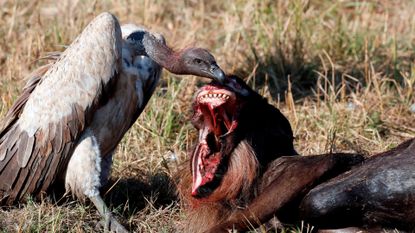
Vultures have long evoked images of death, hovering over ailing animals and feeding off their rotting corpses.

But the near extinction of the scavenger birds in India during the 1990s led to the spread of disease-carrying pathogens – and may have killed half a million people, according to a new study.

The working paper, due to be published in an upcoming issue of the American Economic Review, estimates that the related public health crisis between 2000 and 2005 cost the Indian government nearly $70 billion a year.

'Nature's sanitation service'

In India, vultures are a "keystone species", said Science, "essential to the functioning of many of the country's ecosystems".

Unlike mammal scavengers, vultures do not also hunt. They only feed on carrion – and in a country with more than 500 million livestock, they perform a crucial duty of removing disease-ridden carcasses. That also helps to "reduce the populations of other scavengers, such as feral dogs that can transmit rabies".

The birds were once widespread in India, acting as "nature's sanitation service", said The Economist. They are also highly efficient. "A group of vultures can polish off a cow's carrion in 40 minutes."

But in 1994, farmers began giving their livestock a painkiller called diclofenac. When they disposed of dead livestock, the vultures who fed on the carcasses were poisoned by the anti-inflammatory drug, dying within weeks.

In one decade, India's vulture population fell from 50 million birds to just a few thousand: the fastest population collapse of a bird species in history. The worst-hit species, the white-rumped vulture, "declined by a dreadful 99.9%" between 1992 and 2007", said Bird Guides.

Cattle bodies piled up around tanneries and fields "became carcass dumps" for feral dogs and rats, said Science, leading to the spread of disease. The government also forced tanneries to use chemicals to dispose of the carcasses, which caused toxic substances to "leach into waterways used by people".

The vulture wipeout was later attributed to diclofenac, and India banned the use of the drug in 2006. Pakistan and Nepal followed suit. But India's vulture population is unlikely to ever completely recover.

The human cost of vulture wipeout


Anant Sudarshan, an environmental economist at the University of Warwick, witnessed the crisis growing up in India. Sudarshan, and Eyal Frank of the University of Chicago, co-authors of the upcoming American Economic Review paper, compared maps of vulture habitats to health records for more than 600 Indian districts between 2000 and 2005.

In districts that were "highly suitable to vultures", there was an average increase in human deaths of 4.2%. That implies about 104,386 additional deaths each year, or half a million in total. Previous research had calculated that India would spend roughly $665,000 to save one life. The economic damage, according to the team's estimates, was about $70 billion per year.

"This [upcoming paper] will be a classic in the field," said Atheendar Venkataramani, a health economist at the University of Pennsylvania. It could also convince lawmakers to "push forward policy and conservation measures", said Andrea Santangeli, a conservation scientist at the Institute for Mediterranean Studies.

"Scientific evidence suggests the Earth is undergoing a mass extinction of species, caused by human activity," said Sudarshan and Frank. "Evaluating the social costs of losing non-human species is necessary to manage biodiversity and target conservation resources."

Traditional Zoroastrian burial rites are also becoming "increasingly impossible to perform" because of the decline in vultures, said The Guardian. Parsi communities in India and Pakistan have for thousands of years placed their dead on top of dakhma, or "towers of silence", built above the soil to prevent contamination. Vultures "eat the flesh on the bones", which are later collected in an ossuary pit.

Offering the body to the birds is "the devout Zoroastrian's ultimate act of charity", one Karachi resident told The Guardian. The vulture's eye is believed to help the soul's transition. But there are only two remaining towers of silence in Karachi, Pakistan's largest city. "We've lost a way of life, our culture," said one resident.

This year, there are "signs of stabilisation" among India's critically endangered vultures, said Bird Guides – but they are "still in a precarious situation".

Images of their "blood-splattered bills" tend to "evoke less sympathy" than "majestic tigers, adorable pandas" or other staples of wildlife conservation campaigns, said The Economist: animals that "tug at human heartstrings".

But "conserving these animals should be a priority. They may not be cute or cuddly, but they are important."


Social Media Accountability In Pakistan – OpEd

 Network Internet Online Social Media


By 

In recent years, social media platforms have become an integral part of daily life in Pakistan, providing a means for people to connect, share ideas, and access information. However, with the increasing influence of these platforms, there is a growing need to address various issues arising from their use. It is crucial for social media companies operating in Pakistan to respect local laws, follow to cultural norms, and fulfil their tax obligations. It’s important to investigate the necessity of reigning in social media platforms in Pakistan to ensure they operate in a manner that is respectful and beneficial to the country’s legal, cultural, and economic landscape.

One of the primary concerns with the operation of social media platforms in Pakistan is their compliance with local laws. The Pakistani government has implemented several regulations aimed at ensuring the responsible use of digital platforms. These regulations include the Prevention of Electronic Crimes Act (PECA) 2016, which addresses cybercrimes and provides a legal framework for controlling online content. Despite these measures, social media platforms often fail to fully comply with local laws, leading to issues such as the spread of fake news, hate speech, and other harmful content. To address this, it is essential for social media companies to cooperate with Pakistani authorities and ensure their platforms are used responsibly. This includes implementing robust content moderation policies, promptly responding to legal requests from the government, and taking down content that violates local laws. By doing so, social media platforms can contribute to a safer and more secure online environment in Pakistan.

Pakistan is a country with a rich cultural heritage and deeply rooted social norms. The influence of social media on societal values and behaviours cannot be underestimated. Unfortunately, the content shared on these platforms often does not align with local cultural norms, leading to the erosion of traditional values and the promotion of behaviours that are considered inappropriate or offensive. Social media companies need to be more sensitive to the cultural context in which they operate. This means developing and enforcing guidelines that respect Pakistani cultural values and prevent the dissemination of content that could harm societal cohesion. By fostering an environment that respects and upholds local cultural norms, social media platforms can become a force for positive social change rather than a source of cultural conflict.

Another critical issue related to the operation of social media platforms in Pakistan is their tax obligations. Like any other business entity operating within the country, social media companies are expected to pay taxes on their revenue. However, many of these companies have been found to be evading taxes or underreporting their earnings, depriving the Pakistani government of much-needed revenue. The government must take stringent measures to ensure that social media platforms fulfil their tax obligations. This includes implementing clear tax regulations specific to digital businesses, improving the tax collection infrastructure, and taking legal action against companies that evade taxes. By doing so, the government can ensure that social media platforms contribute their fair share to the country’s economic development.

To effectively reign in social media platforms, the Pakistani government, civil society, and the platforms themselves must work together. The government should continue to refine and enforce regulations that address the challenges posed by digital platforms while ensuring these regulations do not stifle freedom of expression. Additionally, the government should engage in dialogue with social media companies to understand their concerns and find mutually beneficial solutions. Civil society also plays a crucial role in this process. Advocacy groups, non-governmental organizations, and media watchdogs can help monitor the activities of social media platforms, raise awareness about their responsibilities, and hold them accountable. Public awareness campaigns can educate users about the importance of responsible social media use and encourage them to report content that violates local laws and cultural norms.

The need to reign in social media platforms in Pakistan is evident, given the challenges related to compliance with local laws, adherence to cultural norms, and fulfilment of tax obligations. By fostering a cooperative relationship between the government, civil society, and social media companies, Pakistan can ensure that these platforms operate in a manner that respects its legal and cultural landscape while contributing to its economic development. It is only through collective effort and mutual respect that the benefits of social media can be fully realized without compromising the values and laws that define Pakistani society.


Dr. Sahibzada Muhammad Usman is a Research Scholar and Academic;
Ph.D. in Political Science at the University of Pisa, Italy. Dr. Usman has participated in various national and international conferences and published 30 research articles in international journals.

Sunday, July 21, 2024

As Georgia presses on with ‘Russia-style’ laws, its citizens describe a country on the brink


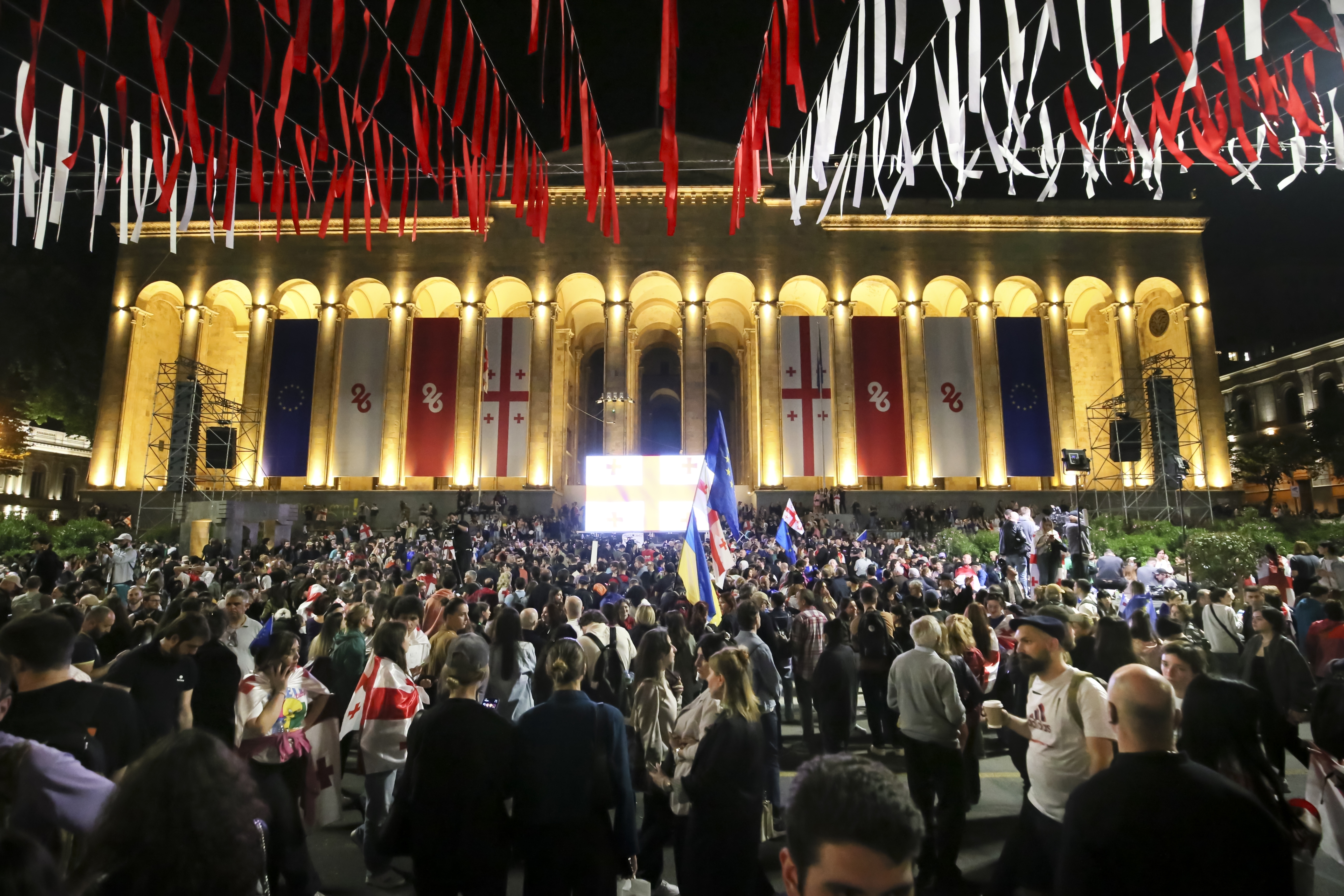
A demonstrator gestures trying to stop riot police during an opposition protest against “the Russian law” near the Parliament building in Tbilisi, Georgia, on Tuesday, April 30, 2024. Thousands of people rallied in Georgia for weeks against the foreign influence bill. Critics compared it to similar legislation Russia uses to stifle dissent, and they worried it would jeopardize Georgia’s prospects of joining the European Union. (AP Photo/Zurab Tsertsvadze, File)Read More

Police officers detain a protestor during a demonstration outside the parliament building in Tbilisi, Georgia, on April 16, 2024, to protest against “the Russian law” similar to a law that Russia uses to stigmatize independent news media and organizations seen as being at odds with the Kremlin. Thousands of people rallied in Georgia for weeks against the foreign influence bill. Critics compared it to similar legislation Russia uses to stifle dissent, and they worried it would jeopardize Georgia’s prospects of joining the European Union. (AP Photo/Zurab Tsertsvadze, File)

Top presidential candidate Mikhail Saakashvili, left, smiles while listening to the preliminary election results as his wife Sandra Roelofs applauds him in Georgia’s capital Tbilisi Sunday, Jan. 4, 2004. A pro-Western reformist, Saakashvili was president in 2004-13 and was renowned for his energetic efforts against Georgia’s endemic corruption, but Georgians became increasingly uneasy with what they saw as his authoritarian inclinations and his sometimes-mercurial behavior. (AP Photo/Ivan Sekretarev, File)

Bodyguards escort Georgian President Mikhail Saakashvili, center, to shelter under a threat of Russian air attack in Gori, Georgia, Monday, Aug. 11, 2008. A pro-Western reformist, Saakashvili was president in 2004-13 and was renowned for his energetic efforts against Georgia’s endemic corruption, but Georgians became increasingly uneasy with what they saw as his authoritarian inclinations and his sometimes-mercurial behavior. (AP Photo/Sergei Grits, File)

BY JOANNA KOZLOWSKA
, July 20, 2024

Eka Gigauri is used to harsh words from officials about the anti-corruption work she does in Georgia. But seeing her face on posters, accusing her of being an agent of foreign influence, a traitor and a spy, rattled her.

Gigauri, who leads one of Georgia’s main anti-corruption campaign groups, says she and many others have been targeted in connection with a new law, pushed through parliament by the government.

The “foreign influence” law requires media, civil society groups and nonprofit organizations to register as “pursuing the interests of a foreign power” if they receive more than 20% of their funding from abroad. It also subjects them to intense state scrutiny and imposes steep fines for noncompliance.

The government argues the law is needed to curb harmful foreign actors trying to destabilize the South Caucasus nation of 3.7 million. Many journalists and activists say its true goal is to stigmatize them and restrict debate before an election scheduled for October. It could also threaten Georgia’s bid to join the European Union.
___

This story, supported by the Pulitzer Center for Crisis Reporting, is part of an ongoing Associated Press series covering threats to democracy in Europe.


RELATED STORIES

US imposes travel bans on Georgian officials over new law that critics say will curb media freedom

Russian court orders arrest of opposition leader Navalny's widow

Scientists, a journalist and even a bakery worker are among those convicted of treason in Russia
___

The law resembles similar legislation in Russia, where it has been used to crack down on opposition supporters, independent media and human rights activists. Georgian Dream, the country’s ruling party, got the legislation through on its second attempt.

In 2012, after years of turbulence, Georgian Dream came to power. The party was set up by Bidzina Ivanishvili, a shadowy billionaire who made his fortune in Russia and served briefly as Georgia’s prime minister. He has stayed out of public view since 2013.

Georgian Dream promised to restore civil rights and “reset” relations with Moscow. It also vowed to pursue EU membership and ties with the U.S., reassuring those Georgians who looked to the West to protect them from their overbearing northern neighbor.

In August 2008, Russia fought a brief war with Georgia, which had made a botched attempt to regain control over the breakaway province of South Ossetia. Moscow then recognized the independence of South Ossetia and another breakaway Georgian province, Abkhazia, and set up military bases there.

In 2022, after Russia’s full-scale invasion of Ukraine, Georgia formally applied to join the EU. Support for EU membership was already high, but after the invasion, polls showed about 74% of Georgians were in favor.


A demonstrator holds a EU flag during an opposition protest against the foreign influence bill at the Parliamentary building in Tbilisi, Georgia, on May 28, 2024. (AP Photo/Shakh Aivazov, File)

Many in Georgia, with its long history of domination by Moscow, supported Ukraine as it battled the Russian invasion. But the Georgian government abstained from joining sanctions against Russia, barred dozens of Kremlin critics from entering the country, and accused the West of trying to drag Tbilisi into open conflict with Moscow.

Almost exactly a year later, Georgian Dream first put the “foreign influence” bill before parliament. Weeks of demonstrations followed, where police used tear gas and water cannons to disperse protesters.

The EU made clear that the bill, if passed, would damage Georgia’s membership prospects. In March 2023, the draft legislation was withdrawn. In December, the EU offered Georgia official candidate status, despite concerns about the rule of law.

In April 2024, Georgian Dream brought the bill back to parliament and the protesters returned to the streets. Georgia’s pro-EU President Salome Zourabichvili used her veto, but parliament overrode her with a simple majority, and the bill became law.


Georgian President Salome Zourabichvili, right, and Prime Minister Irakli Kobakhidze, left, leave a podium after celebration of the Independence Day in Tbilisi, Georgia, on May 26, 2024. (Irakli Gedenidze/Pool Photo via AP, File)

Rights advocates cast the law as an existential threat.

“By labeling independent groups and media as serving foreign interests, they (Georgia’s leadership) intend to marginalize and stifle critical voices in the country that are fundamental for any functioning democracy,” said Hugh Williamson from the advocacy group Human Rights Watch.

The day after the bill was enacted, Georgian Dream introduced proposals to ban media depictions of same-sex relations and any public gatherings endorsing them.

Tamar Jakeli, the head of prominent LGBTQ+ rights group Tbilisi Pride, argues that both initiatives are part of a broader strategy by the ruling party to divide society.

“The West, the opposition, LGBT people, and civil society — we are all, together, demonized as spreading LGBT propaganda, trying to impose a Western lifestyle, erase Georgian traditions,” said Jakeli, who has moved homes because of safety reasons and carries pepper spray when out.

Like the “foreign influence” bill, the proposed anti-LGBTQ+ provisions mirror Russian legislation. Rumors have swirled for months that Georgian Dream may be acting in coordination with the Kremlin — something the party vehemently denies.


Georgian far right parties and their supporters hold a banner that reads: “No to LGBT darkness”, as they gather in front of the Parliament building during a rally against Pride Week in Tbilisi, Georgia, on July 2, 2022. (AP Photo/Shakh Aivazov, File)

“The evidence for Russia being the power behind Ivanishvili — and Georgian Dream — is, at this stage, circumstantial. But it is nevertheless compelling,” James Nixey, Russia and Eurasia director at the London-based think tank Chatham House, wrote in an analysis in May.

Georgia’s pro-government media sound a steady drumbeat of fear, warning of the West’s supposed attempts to destabilize Tbilisi and stoke conflict with Moscow.

In a speech on April 29 that baffled Tbilisi’s EU partners, Ivanishvili charged that a “global party of war” is secretly channeling funds into Georgia through nonprofits, to topple the government and turn Georgians into “cannon fodder” in a war with Russia.

Maka Bochorishvili, a Georgian Dream lawmaker who heads the parliamentary EU integration committee, told The Associated Press that the “foreign influence” law aims to ensure transparency.

She argued, without providing evidence, that some nonprofits back “nonconstitutional ways of change of government in Georgia,” and that as the election looms, some have started to resemble political parties.

Most organizations targeted by the new law aren’t prominent or influential. Major groups like Gigauri’s Transparency International will face the same level of scrutiny as small news outlets.


Police officers detain a protestor during a demonstration outside the parliament building in Tbilisi, Georgia, on April 16, 2024, to protest against “the Russian law” similar to a law that Russia uses to stigmatize independent news media and organizations seen as being at odds with the Kremlin. (AP Photo/Zurab Tsertsvadze, File)

None of the journalists and campaigners who spoke to the AP said their organizations would voluntarily join the “foreign influence” register. Gigauri called the decision “a matter of dignity.”

“First of all, we are citizens and patriots of this country,” she said.

But the law means officials can register their publications and organizations anyway. It also allows Georgia’s justice ministry to conduct detailed audits, potentially seizing laptops and other equipment for months at a time.

Nino Bakradze, whose investigative publication iFact.ge has for years tracked secretive offshore companies, corruption and the impact on Georgians of major foreign investment projects, says this would essentially halt their operations.

Seizing the equipment also means authorities could access sensitive data on the organizations’ staff, sources, whistleblowers and those who approach them for assistance. In a country where far-right groups still attack Pride marches, this is especially worrying for LGBTQ+ rights groups like Jakeli’s, many of which have received foreign grants.

Tbilisi’s modernization in recent decades, and its increasingly active citizenry, appeared to signal that democracy can succeed in post-Soviet states, threatening the Kremlin and other regional autocrats.

In October, Georgia faces its next big test: a parliamentary election. Zaza Bibilashvili, an analyst with the Chavchavadze Center, a civil society group, said there was little hope for a meaningful vote if the “foreign influence” law is applied.

Like others, he described an atmosphere of fear and intimidation. Opposition figures have suffered extensive injuries they blame on beatings from police or pro-government thugs. Gia Japaridze, a university lecturer and brother of a top opposition politician, told the AP that his assailants freely admitted he had been targeted because of his criticism of the “foreign influence” law.

“Right now, we still have a civil society that’s trying to survive. In October, we’ll probably have none of that. People will have been arrested (or) expelled,” Bibilashvili argued.

In Tbilisi, the protests against the foreign influence law have grown less frequent as campaigners shift their attention to the upcoming election. But many still draw comfort from the spirit of the rallies that drew Georgians of all ages and backgrounds.

“I’ve never seen Georgian society so united,” said Giorgi Kikonishvili, an LGBTQ+ activist and club promoter in Tbilisi.

“Right now, things are devastating, but at the same time, it’s a very beautiful thing to watch,” he said.

Miss Kansas called out her abuser in public. Her campaign against domestic violence is going viral

 July 21, 2024

WICHITA, Kan. (AP) — A newly posted video of Miss Kansas calling out her domestic violence abuser from the stage the night she was crowned is whipping up a maelstrom of support on social media.

Alexis Smith, who works overnight shifts as a cardiothoracic intensive care nurse in Wichita, was crowned Miss Kansas on June 8, but posted the video of her on-stage comments just this past week on the platform now known as X. Her comments are resonating with thousands in part because she called out her own abuser from the stage while she said the perpetrator was sitting in the audience.

The video Smith posted July 16 has been viewed more than 60,000 times and generated a rash of news stories.

“My vision as the next Miss Kansas is to eliminate unhealthy and abusive relationships,” Smith said during the interview portion of the pageant last month. “Matter of fact, some of you in this audience saw me very emotional because my abuser is here today. But that’s not going to stop me from being on this Miss Kansas stage and from representingas the next Miss Kansas.”

Smith just recently started her reign and began raising concerns about the issue in interviews and social media posts. Her bold pageant statement against domestic abuse and her courage to speak out is being praised online by dozens of people as her video gets shared again and again.

The beauty queen cares deeply about domestic violence issues because not only was she a victim, but so were many of the other women in her family, she has said.

“My family, every single woman in my family, was impacted by domestic violence,” she said in an interview with Wichita television station KSN. “At the age of 14, I got in my first relationship, but it was also an abusive relationship that I was in until about 2018, 2019. It’s something that I’m still experiencing and dealing with today.”

Smith said she even moved to Texas for a couple years after she escaped the relationship. She returned to Wichita to study nursing at Newman University.
FREE PAUL WATSON!
Anti-whaling campaigner arrested in Greenland and police say he may be extradited to Japan


 Paul Watson, then founder and President of the animal rights and environmental Sea Shepherd Conservation, attends a demonstration against the Costa Rican government near Germany’s President residence during a visit of Costa Rica’s president in Berlin, Germany, on Wednesday, May 23, 2012. Greenland police said they arrested Watson on Sunday, July 21, 2024, on an international arrest warrant issued by Japan. (AP Photo/Markus Schreiber, file)

July 21, 2024

BERLIN (AP) — Greenland police said they arrested a veteran environmental activist and anti-whaling campaigner on Sunday on an international arrest warrant issued by Japan.

Paul Watson was arrested when his ship docked in Nuuk, Greenland’s capital, a police statement said. He will be brought before a district court with a request to detain him pending a decision on his possible extradition to Japan, the statement said.

The Captain Paul Watson Foundation said that more than a dozen police boarded the vessel and led Watson away in handcuffs when it stopped to refuel. The foundation said the ship, along with 25 volunteer crew members, was en route to the North Pacific on a mission to intercept a new Japanese whaling ship.

“The arrest is believed to be related to a former Red Notice issued for Captain Watson’s previous anti-whaling interventions in the Antarctic region,” the foundation said in an emailed statement.

“We implore the Danish government to release Captain Watson and not entertain this politically-motivated request,” Locky MacLean, a foundation director, said in the statement.

Greenland is an autonomous territory of Denmark.

Watson, a 73-year-old Canadian-American citizen, is a former head of the Sea Shepherd Conservation Society whose direct action tactics, including high-seas confrontations with whaling vessels, has drawn support from A-list celebrities and featured in the reality television series “Whale Wars.”

However, it has also brought him into confrontation with authorities. He was detained in Germany in 2012 on a Costa Rican extradition warrant, but skipped bail after learning that he was also sought for extradition by Japan, which has accused him of endangering whalers’ lives during operations in the Antarctic Ocean. He has since lived in countries including France and the United States.

Watson, who left Sea Shepherd in 2022 to establish his own organization, was also a leading member of Greenpeace, but left in 1977 amid disagreements over his aggressive tactics.

According to his foundation, Watson’s current ship, the M/Y John Paul DeJoria, was due to sail through the Northwest Passage to the North Pacific to confront a newly built Japanese factory whaling ship, “a murderous enemy devoid of compassion and empathy hell bent on destroying the most intelligent self-aware sentient beings in the sea.”
With AI, jets and police squadrons, Paris is securing the Olympics — and worrying critics


Soldiers stationed in Paris for the Olympic Games took part in a close combat training session on Friday in the wake of a string of knife attacks targeting security forces deployed in the French capital.
(AP video shot by Alexander Turnbull)


BY JOHN LEICESTER
July 21, 2024

PARIS (AP) — A year ago, the head of the Paris Olympics boldly declared that France’s capital would be “ the safest place in the world " when the Games open this Friday. Tony Estanguet’s confident forecast looks less far-fetched now with squadrons of police patrolling Paris’ streets, fighter jets and soldiers primed to scramble, and imposing metal-fence security barriers erected like an iron curtain on both sides of the River Seine that will star in the opening show.

France’s vast police and military operation is in large part because the July 26-Aug. 11 Games face unprecedented security challenges. The city has repeatedly suffered deadly extremist attacks and international tensions are high because of the wars in Ukraine and Gaza.

Rather than build an Olympic park with venues grouped together outside of the city center, like Rio de Janeiro in 2016 or London in 2012, Paris has chosen to host many of the events in the heart of the bustling capital of 2 million inhabitants, with others dotted around suburbs that house millions more. Putting temporary sports arenas in public spaces and the unprecedented choice to stage a river-borne opening ceremony stretching for kilometers (miles) along the Seine, makes safeguarding them more complex.

Olympic organizers also have cyberattack concerns, while rights campaigners and Games critics are worried about Paris’ use of AI-equipped surveillance technology and the broad scope and scale of Olympic security.


RELATED STORIES

In and on the water, French troops secure the River Seine for the Paris Olympics opening ceremony

Paris gets into the groove for historic Olympic opening ceremony, adapted to its iconic cityscape


France's Bastille Day parade meets the Olympic torch relay in an exceptional year

Paris, in short, has a lot riding on keeping 10,500 athletes and millions of visitors safe. Here’s how it aims to do it.

The security operation, by the numbers

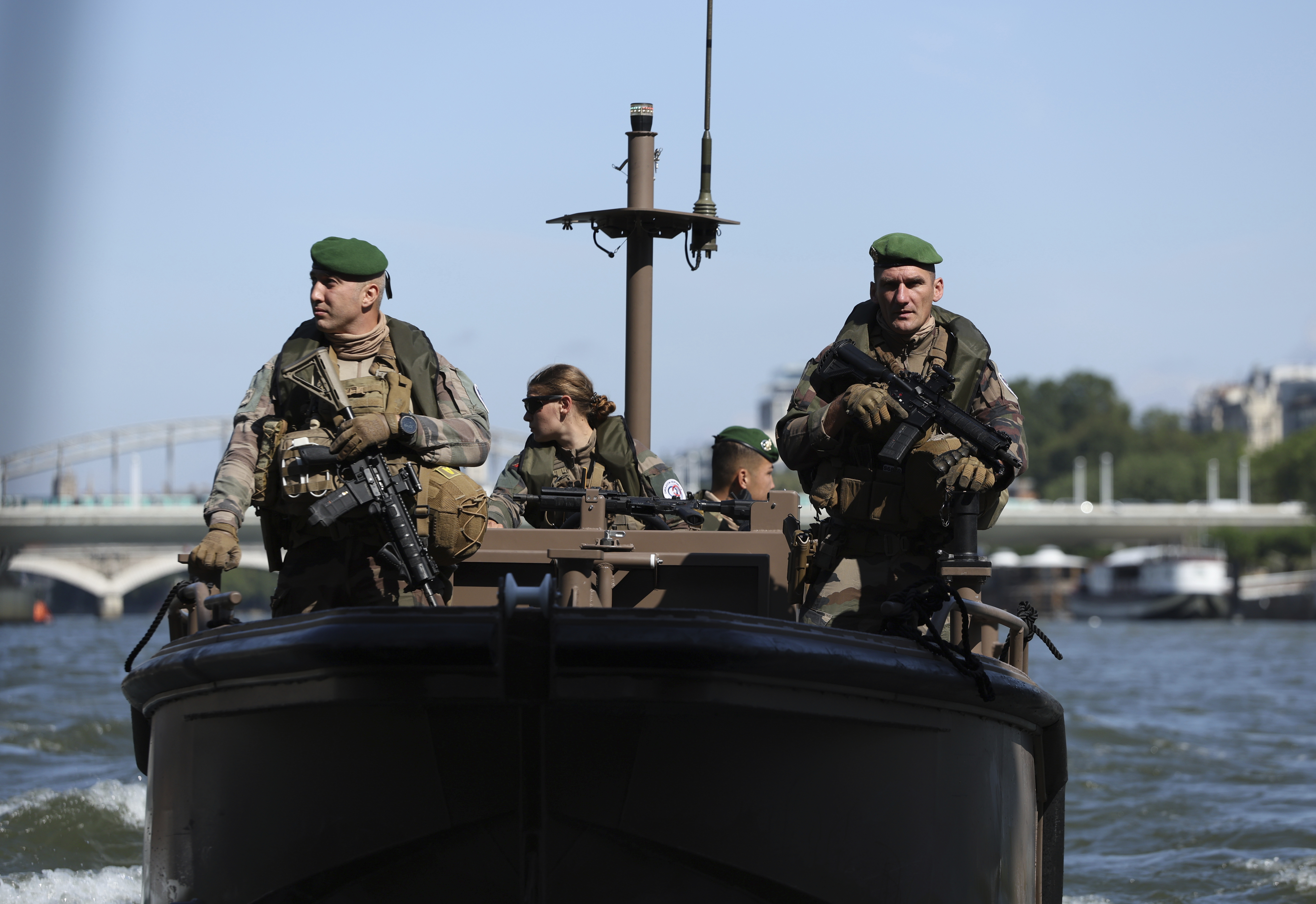
A Games-time force of up to 45,000 police and gendarmes is also backed up by a 10,000-strong contingent of soldiers that has set up the largest military camp in Paris since World War II, from which soldiers should be able to reach any of the city’s Olympic venues within 30 minutes.

Armed military patrols aboard vehicles and on foot have become common in crowded places in France since gunmen and suicide bombers acting in the names of al-Qaida and the Islamic State group repeatedly struck Paris in 2015. They don’t have police powers of arrest but can tackle attackers and restrain them until police arrive. For visitors from countries where armed street patrols aren’t the norm, the sight of soldiers with assault rifles might be jarring, just as it was initially for people in France.

“At the beginning, it was very strange for them to see us and they were always avoiding our presence, making a detour,” said Gen. Éric Chasboeuf, deputy commander of the counter-terror military force, called Sentinelle.

“Now, it’s in the landscape,” he said.

Rafale fighter jets, airspace-monitoring AWACS surveillance flights, Reaper surveillance drones, helicopters that can carry sharpshooters, and equipment to disable drones will police Paris skies, which will be closed during the opening ceremony by a no-fly zone extending for 150 kilometers (93 miles) around the capital. Cameras twinned with artificial intelligence software — authorized by a law that expands the state’s surveillance powers for the Games — will flag potential security risks, such as abandoned packages or crowd surges,

France is also getting help from more than 40 countries that, together, have sent at least 1,900 police reinforcements.

Trump assassination attempt highlights Olympic risks

Attacks by lone individuals are major concern, a risk driven home most recently to French officials by the assassination attempt against Donald Trump.

Some involved in the Olympic security operation were stunned that the gunman armed with an AR-style rifle got within range of the former U.S. president.

“No one can guarantee that there won’t be mistakes. There, however, it was quite glaring,” said Gen. Philippe Pourqué, who oversaw the construction of a temporary camp in southeast Paris housing 4,500 soldiers from the Sentinelle force.

In France, in the last 13 months alone, men acting alone have carried out knife attacks that targeted tourists in Paris, and children in a park in an Alpine town, among others. A man who stabbed a teacher to death at his former high school in northern France in October had been under surveillance by French security services for suspected Islamic radicalization.


Soldiers demonstrate operational technics for close combat in a training class at a military camp set up for the Paris Olympic games Friday, July 19, 2024, Vincennes, just outside Paris, France. (AP Photo/David Goldman)

With long and bitter experience of deadly extremist attacks, France has armed itself with a dense network of police units, intelligence services and investigators who specialize in fighting terrorism, and suspects in terrorism cases can be held longer for questioning.

Hundreds of thousands of background checks have scrutinized Olympic ticket-holders, workers and others involved in the Games and applicants for passes to enter Paris’ most tightly controlled security zone, along the Seine’s banks. The checks blocked more than 3,900 people from attending, Interior Minister Gerald Darmanin said. He said some were flagged for suspected Islamic radicalization, left- or right-wing political extremism, significant criminal records and other security concerns.

“We’re particularly attentive to Russian and Belorussian citizens,” Darmanin added, although he stopped short of linking exclusions to Russia’s war in Ukraine and Belarus’ role as an ally of Moscow.

Darmanin said 155 people considered to be “very dangerous” potential terror threats are also being kept away from the opening ceremony and the Games, with police searching their homes for weapons and computers in some cases.


A security officer watches people taken photographs in front of the Eiffel Tower at the 2024 Summer Olympics, Saturday, July 20, 2024, in Paris, France. 
(AP Photo/Thomas Padilla)

He said intelligence services haven’t identified any proven terror plots against the Games “but we are being extremely attentive.”

Critics fear intrusive Olympic security will stay after the Games


Campaigners for digital rights worry that Olympic surveillance cameras and AI systems could erode privacy and other freedoms, and zero in on people without fixed homes who spend a lot of time in public spaces.

Saccage 2024, a group that has campaigned for months against the Paris Games, took aim at the scope of the Olympic security, describing it as a “repressive arsenal” in a statement to The Associated Press.

“And this is not a French exception, far from it, but a systematic occurrence in host countries,” it said. “Is it reasonable to offer one month of ‘festivities’ to the most well-off tourists at the cost of a long-term securitization legacy for all residents of the city and the country?”
Vatican’s Pius XII archives shed light on another contentious chapter: The Legion of Christ scandal


Pope John Paul II gives his blessing to late father Marcial Maciel, founder of Christ’s Legionaries, during a special audience the pontiff granted to about four thousand participants of the Regnum Christi movement, at the Vatican, on Nov. 30, 2004. The recently-opened archives of Pope Pius XII have shed new light on claims the World War II-era pope didn’t speak out about the Holocaust. But they’re also providing details about another contentious chapter in Vatican history: the scandal over the founder of the Legionaries of Christ. (AP Photo/Plinio Lepri, File)

Undated file photo of Pope Pius XII. The recently-opened archives of Pope Pius XII have shed new light on claims the World War II-era pope didn’t speak out about the Holocaust. But they’re also providing details about another contentious chapter in Vatican history: the scandal over the founder of the Legionaries of Christ. (AP Photo, File)

BY NICOLE WINFIELD
 July 21, 2024

VATICAN CITY (AP) — The recently opened archives of Pope Pius XII have shed new light on claims the World War II-era pope didn’t speak out about the Holocaust. But they’re also providing details about another contentious chapter in Vatican history: the scandal over the founder of the Legionaries of Christ.

Entire books have already been written about the copious documentation that arrived in the Holy See in the 1940s and 1950s proving its officials had evidence of the Rev. Marcial Maciel’s dubious morals, drug use, financial recklessness and sexual abuse of his young seminarians.

Yet it took the Holy See more than a half-century to sanction Maciel, and even more for it to acknowledge he was a religious fraud and con artist who molested his seminarians, fathered three children and built a secretive, cult-like religious order to hide his double life.

The newly opened archives of the Pius papacy, which spanned 1939-1958, are adding some new details to what has been in the public domain, since they include previously unavailable documentation from the Vatican secretariat of state.

They confirm that Pius’ Vatican was cracking down on Maciel in 1956 and was poised to take even tougher measures against him — including removing him from priestly ministry altogether — but that Pius’ 1958 death enabled Maciel’s supporters to take advantage of the leadership vacuum to save his name and order.

Until now, the biggest stash of publicly available documentation about Maciel had come from the Vatican’s Congregation for Religious, which oversaw the Legion after its founding in 1941 in Mexico.

In 2012, some of Maciel’s Mexican victims put online 200-plus documents spanning the 1940s-2002 that they had obtained from someone with access to the Congregation for Religious archive. These documents, also in the book “La Voluntad De No Saber” (The Will to Not Know) detailed the evidence the Vatican had of Maciel’s depravities, but also how decades of bishops, cardinals and popes turned a blind eye and believed instead the glowing reports that also arrived in Rome.

Now the new documents from the Vatican’s central governing office are fleshing out that history, providing more details about who in the Vatican helped Maciel evade sanction, believing the claims against him to be slander, and who sought to take a tougher line.

One new document, being published in Sunday’s Corriere della Sera cultural supplement La Lettura, contains the original draft of an Oct. 1, 1956, memo by the No. 3 in the Vatican’s office for religious orders.

On that day, Maciel arrived in Rome after he had been suspended by the Vatican as Legion superior and ordered to go into detox to kick a morphine addiction.

According to the memo, the Vatican’s Congregation for Religious wanted an additional measure imposed on Maciel: that he be barred from having contact with young seminarians or risk being suspended from priestly ministry altogether, meaning he couldn’t celebrate Mass publicly, hear confessions or celebrate any other sacraments as a priest.

The author of the note, the Rev. Giovanni Battista Scapinelli, wrote that if Maciel came to the congregation “I will order him to get treated, to abandon any contact with his students until the congregation says otherwise. And if he doesn’t show up, in two days, a pre-emptive order should be given to Maciel: Either you go get treated or you will remain suspended a divinis.”

The draft is significant because it shows that by 1956, at least some in the Vatican took seriously the reports that had reached Rome that Maciel was molesting his young seminarians and wanted to protect them — and wanted to punish Maciel with one of the church’s harshest penalties for his crimes. It would take 50 years though, until 2006, for the Vatican to finally condemn Maciel to a comparatively light sentence of a “lifetime of penance and prayer” for sodomizing his young recruits.

A subsequent draft of the Oct. 1, 1956, memo was published in 2012 by the Mexican victims. It showed that Scapinelli had scratched out his original order for Maciel to refrain from having contact with his seminarians and merely ordered Maciel to get medical treatment for the drug addiction. It contains another page and a half of handwritten notes, as if Scapinelli rewrote it following consultation with others.

The secretariat of state archives contain what appears to be a final, typewritten version of the memo, dated Oct. 2, 1956 which omits any reference to Maciel being prohibited from contact with youngsters and speaks only of him getting medical help, with no further threats of ministerial suspension. A few weeks later, the Vatican appointed outside clerics to do a more thorough investigation onsite.

All versions of the Oct. 1, 1956 memo make clear that Maciel had a great protector in the Vatican in the form of Cardinal Giuseppe Pizzardo, the No. 2 in the powerful Congregation for the Doctrine of the Faith. Other documents say the Congregation for Religious “couldn’t proceed further against F. Maciel because of recommendations and interventions by high-ranking personalities.”

Scapinelli suggests that Pius was fully versed in the Maciel affair and had endorsed his removal as the Legion’s superior, writing that Maciel had been temporarily removed “for reasons known to the Holy Father.”

Indeed, in September of that year the Congregation for Religious handed over a file of “abundant documentation” for Pius to read, with a cover letter recalling that the Congregation had never wanted to recognize the Legion as a pontifically approved religious order because of its “serious” concerns about Maciel.

Pius died two years later, on Oct. 9, 1958. In the chaos of a new papacy, a change in leadership in the Congregation for Religious and interventions by Maciel’s supporters, Maciel was reinstalled as superior of the Legion in early 1959. The Legion was recognized as a pontifical religious order a few years later.

Maciel died in 2008. A year later the Legion admitted to some of his crimes, and a year after that the Vatican took the Legion over and imposed a process of reform and “purification.”

Most of the attention on the 2020 opening of the Pius archives has focused on what he and his advisors did or didn’t do to save Jewish lives during the war.
A Lebanese photojournalist, wounded in Israeli strike, carries Olympic torch to honor journalists


Press agency photographer Christina Assi arrives for the Olympic torch relay at the 2024 Summer Olympics, Sunday, July 21, 2024, in Vincennes, outside Paris, France. Assi was struck by a tank shell on Oct. 13, 2023 while reporting clashes between the Israeli army and armed groups in southern Lebanon. (AP Photo/Thomas Padilla)

Press agency photographer Christina Assi, right, holds the Olympic torch with. Nicolas Payeur, left, at the 2024 Summer Olympics, Sunday, July 21, 2024, in Vincennes, outside Paris, France. Assi was struck by a tank shell on Oct. 13, 2023 while reporting clashes between the Israeli army and armed groups in southern Lebanon. (AP Photo/Thomas Padilla)

Press agency photographer Christina Assi, left, holds the Olympic torch with. Tinam Pung, right, at the 2024 Summer Olympics, Sunday, July 21, 2024, in Vincennes, outside Paris, France. Assi was struck by a tank shell on Oct. 13, 2023 while reporting clashes between the Israeli army and armed groups in southern Lebanon. (AP Photo/Thomas Padilla)

BY LUJAIN JO AND KAREEM CHEHAYEB
 July 21, 2024

VINCENNES, France (AP) — A Lebanese photojournalist who was severely wounded during an Israeli strike on south Lebanon carried Sunday the Olympic torch in Paris to honor journalists wounded and killed in the field.

The torch relay, which started in May, is part of celebrations in which about 10,000 people from various walks of life were chosen to carry the flame across France before the Games opening ceremony on July 26.

Christina Assi, of Agence France-Presse, was among six journalists struck by Israeli shelling on Oct. 13 2023 while reporting on fire exchange along the border between Israeli troops and members of Lebanon’s militant Hezbollah group. The attack killed Reuters videographer Issam Abdallah. Assi was severely wounded and had part of her right leg amputated.

AFP videographer Dylan Collins, also wounded in the Israeli attack, pushed Assi’s wheelchair as she carried the torch across the suburb of Vincennes Sunday. Their colleagues from the press agency and hundreds of spectators cheered them on.

“I wish Issam was here to see this. And I wish what happened today was not because we were struck by two rockets,” Assi told The Associated Press, struggling to hold back her tears. “I wish I could have honored journalists this way while walking and in my best health.”

AFP, Reuters and Al Jazeera accused Israel of targeting their journalists who maintained they were positioned far from where the clashes with vehicles clearly marked as press, while international human rights organizations, Amnesty International and Human Rights Watch, said the attack was a deliberate attack on civilians and should be investigated as a war crime.

“This is a chance to continue talking about justice, and the targeted attack on Oct. 13 that needs to be investigated as a war crime,” said Collins.

The Israeli military at the time said that the incident was under review, maintaining that it didn’t target journalists.

While holding the torch, Assi said participating in the relay “is to send a message that journalists should be protected and be able to work without fearing that they could die at any moment.”

In late November 2023, Rabih al-Maamari and Farah Omar of the pan-Arab television network Al-Mayadeen were also killed in an apparent Israeli drone strike in southern Lebanon while covering the conflict.

Assi doesn’t believe there will be retribution for the events of that fateful October day but hopes her participation in the Olympic torch relay can bring attention to the importance of protecting journalists. “For me, justice comes the day I can stand up again, hold my camera, and get back to work,” she said.

The watchdog group Committee to Protect Journalists, in a preliminary count, said at least 108 journalists have been killed since the start of the Israel-Hamas war on Oct. 7, the majority in the Gaza Strip.

The war was triggered by the Palestinian militant group Hamas’ sudden attack on southern Israel, killing some 1,200 people and abducting 250 others. Israel says Hamas is still holding about 120 hostages — about a third of them thought to be dead. Israel retaliated with an offensive that has killed more than 38,000 people in Gaza, according to the territory’s Health Ministry, which does not distinguish between combatants and civilians.

Hezbollah militants have traded near-daily strikes with the Israeli military along their border over the past nine months.


Chehayeb reported from Beirut.
WWIII
South Korea's Yoon says alliance with U.S. is now 'nuclear-based'

By Thomas Maresca


South Korean President Yoon Suk Yeol (C) said at a Cabinet meeting Tuesday that the U.S.-South Korea alliance has been upgraded to a "nuclear-based" one in the wake of new joint guidelines. Photo by Yonhap

SEOUL, July 16 (UPI) -- South Korean President Yoon Suk Yeol said Tuesday that the alliance with the United States has been raised to a "nuclear-based" one capable of warding off threats from North Korea in the wake of new joint deterrence guidelines.

Last week, Yoon and U.S. President Joe Biden authorized the nuclear deterrence guidelines on the sidelines of the NATO summit in Washington, D.C.

"The South Korea-U.S. alliance has been firmly upgraded to a nuclear-based alliance in name and reality," Yoon said during a cabinet meeting.

"Whether in wartime or peacetime, U.S. nuclear assets are specially assigned to missions on the Korean Peninsula," he said. "Now we have established a posture that can respond quickly and effectively to any kind of North Korean nuclear threat."

Related
U.S., South Korea sign nuclear deterrence guidelines against rising North Korea threat
In highly watched appearance, Joe Biden lauds NATO as he blasts Putin, Trump
North Korean leader's sister calls South's live-fire drills 'suicidal hysteria

Washington has worked to reassure Seoul that its nuclear umbrella will be sufficient to protect South Korea. The allies have held expanded joint military drills and simulated "table-top" exercises while U.S. assets such as aircraft carriers, a B-52 nuclear bomber and a nuclear ballistic missile submarine are regularly deployed to the peninsula.

The new guidelines follow up on last year's creation of a joint Nuclear Consultative Group to bolster bilateral planning and responses to North Korean aggression.

Over the weekend, North Korea condemned the adoption of the guidelines, calling it a "reckless provocative act" that is the "root cause of endangering the regional security."

"We seriously warn the hostile states not to commit such provocative acts causing instability anymore," a Defense Ministry spokesman said in a statement carried by official media.

"If they ignore this warning, they will have to pay an unimaginably harsh price for it," the spokesman said.

South Korea's military responded Sunday by calling the North's statement "self-contradictory" and warned that any attempt to use nuclear weapons would bring about the end of its regime.

"If there had been no nuclear threat from North Korea in the first place, the South Korea-U.S. joint guidelines would not have been necessary," Seoul's Defense Ministry said in a message sent to reporters.

"If North Korea attempts to use nuclear weapons, the overwhelming response of the South Korea-U.S. alliance will bring about the end of the North Korean regime," it said.