SPACE
Bizarre ‘Garden Sprinkler-Like’ Jet Is Spotted Shooting Out Of Neutron Star For First Time
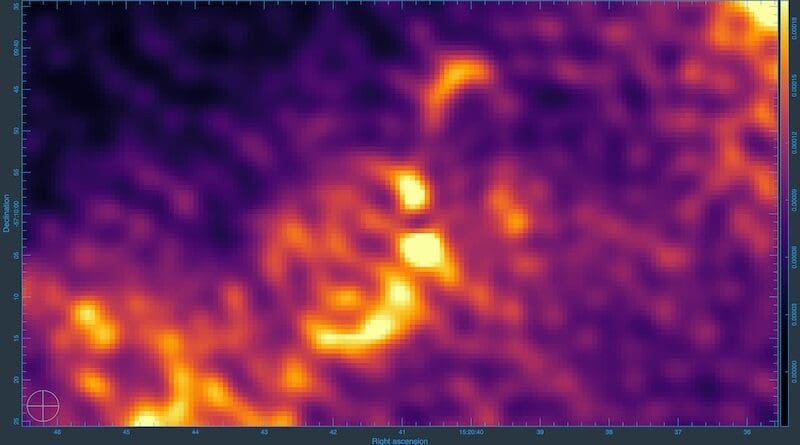
Radio image of the S-shaped precessing jet launched by the neutron star in Circinus X-1. Both Cir X-1 itself (centre of the image) and a background source have been subtracted from the image to make the S-shape clearer. The jets are fast, narrow flows of material outwards from Cir X-1. The size of the jets against the sky is the same apparent size as a penny viewed from 100 metres away, but their real size is greater than five light-years.
A strange ‘garden sprinkler-like’ jet coming from a neutron star has been pictured for the first time.
The S-shaped structure is created as the jet changes direction due to the wobbling of the disc of hot gas around the star – a process called precession, which has been observed with black holes but, until now, never with neutron stars.
This particular object sits in the binary system Circinus X-1 more than 30,000 light-years from Earth and formed from the core of a massive supergiant star that collapsed around the same time Stonehenge was built.
It is so dense that a teaspoon of its material weighs as much as Mount Everest.
Binary systems have two stars that are bound together by gravity. In the case of Circinus X-1, one of these is a neutron star.
Both neutron stars and black holes are cosmological monsters which form when the biggest stars in the Universe die and collapse under their own gravity.
However, the latter are considerably more massive and can only be detected through their gravitational effects, while the former can be observed directly despite their denseness.
They are some of the most extreme objects in the Universe and have interiors almost entirely made of neutrons.
The jet emanating from the neutron star was spotted by a team of astronomers at the University of Oxford, who used MeerKAT – a radio telescope in South Africa – to create the most detailed, high-resolution images of Circinus X-1.
The pictures, which were presented at this week’s National Astronomy Meeting at the University of Hull, include the first-ever image of an S-shaped jet coming from a confirmed neutron star – a breakthrough that could help unravel the extreme physics behind the astronomical phenomenon.
Lead researcher Fraser Cowie said there was another system known for its S-shaped jets, called SS433, but recent results suggest that object is likely a black hole.
“This image is the first time we have seen strong evidence for a precessing jet from a confirmed neutron star,” he said.
“This evidence comes from both the symmetric S shape of the radio-emitting plasma in the jets and from the fast, wide shockwave, which can only be produced by a jet changing direction.
“This will give valuable information about the extreme physics behind the launching of the jet, a phenomenon which is still not well understood.”
The neutron star’s huge density creates a strong force of gravity that strips gas from the companion star, forming a disc of hot gas around it that spirals down towards its surface.
This process, called accretion, releases huge amounts of energy per second with more power than a million Suns. Some of this energy powers jets – narrow beams of outflowing material from the binary system travelling close to the speed of light.
Recent upgrades to the MeerKAT telescope have resulted in excellent sensitivity and higher-resolution images. With these the team saw clear evidence of an S-shaped structure, similar in shape to water spraying from a garden sprinkler, in Circinus X-1’s jet.
Not only that, but researchers also discovered moving termination shocks – the first recorded from an X-ray binary. These are regions where the jet violently rams into the surrounding material, causing a shockwave.
Cowie’s team measured the waves moving at roughly 10 per cent of the speed of light, confirming that they were caused by the fast-moving jet and not something slower such as a wind of material from the stars.
“The fact that these shockwaves span a wide angle agrees with our model,” Cowie said. “So we have two strong pieces of evidence telling us the neutron star jet is precessing.”
Measuring the velocity of the shockwaves will also help astronomers understand what the jet causing them is made from.
The shockwaves effectively act as particle accelerators in space – producing high-energy cosmic rays – and the maximum energy of particles that can be accelerated depends on their velocity.
“Circinus X-1 is one of the brightest objects in the X-ray sky and has been studied for over half a century,” Cowie said. “But despite this, it remains one of the most enigmatic systems we know of.
“Several aspects of its behaviour are not well explained so it’s very rewarding to help shed new light on this system, building on 50 years of work from others.”
He added: “The next steps will be to continue to monitor the jets and see if they change over time in the way we expect.
“This will allow us to more precisely measure their properties and continue to learn more about this puzzling object.”
The research was performed as part of the X-KAT and ThunderKAT projects on the MeerKAT telescope operated by the South African Radio Astronomy Observatory (SARAO). The observations were carried out using the recently installed S-band receivers provided by the Max-Planck Institute (MPG).
Detected Largest Methane Leak Ever Recorded In An Oil Well
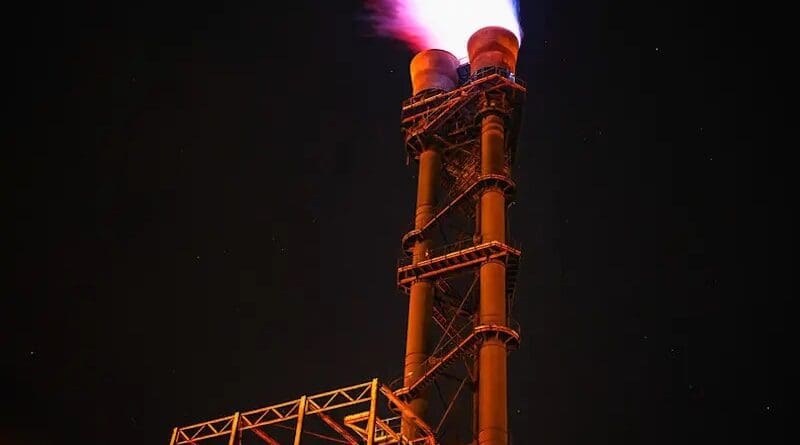
A study, published in Environmental Science & Technology Letters and selected by Nature as a Research Highlight, quantifies and tracks the evolution of this massive methane emission, thanks to the potential of combining satellite data from several missions such as TROPOMI, GHGSat, PRISMA, EnMAP and EMIT, together with Sentinel-2 and Landsat multispectral radiometer.
The research led by the LARS group (IIAMA-UPV) indicates that this accident, which caused a 10-metre-high fire and the formation of a 15-metre-wide crater, has significantly outperformed previous events such as Aliso Canyon in 2015, Ohio in 2018 and Louisiana in 2019.
The leak started on 9 June 2023 and has released approximately 131.00 tonnes of methane into the atmosphere during the 205-day incident. Thousands of tonnes of water were injected to seal the well. Finally, the gas flow was stopped on 25 December 2023 by injecting drilling mud,” explains Luis Guanter, a researcher at IIAMA
.Importance of the work done
Researchers from the LARS-IIAMA group, such as Javier Roger, Adriana Valverde, Itziar Irakulis and Javier Gorroño, have participated in the study, together with experts from several international institutions such as SRON Netherlands Institute for Space Research, Kayrros, Environmental Defense Fund and United Nations Environment Programme.
This research has developed new data processing methods to improve the reporting and handling of the large, concentrated methane plumes detected.
“These optimised methods include the implementation of a tailored filter to detect plumes and specific methane quantification models for hyperspectral instruments,” explain the researchers from the LARS group.
As such, they stress that advanced satellite-based technologies are crucial for detecting and quantifying methane emissions, especially in remote locations where these events often go unnoticed.
“Our work demonstrates how advanced space-based tools are essential for discovering and managing these super-emission events, enabling accurate reconstruction and robust emissions quantification,” state the LARS group members.
Finally, the IIAMA researchers highlight the need for continuous and accurate monitoring to mitigate the environmental impacts of industrial activities such as oil and gas extraction.
“Natural gas, in addition to being an important energy source, is also a greenhouse gas responsible for almost a third of global warming, as it contains more than 90% methane. The difference with CO2 is that it has a greater impact in the short term, so it is necessary to act at source and reduce emissions,” they conclude.

July 22, 2024
By Girish Linganna
House Intelligence Committee Chairman Mike Turner from Ohio cautioned that the US could encounter a scenario like the ‘Cuban Missile Crisis’—a tense 13-day confrontation in October 1962 between the US and the erstwhile Soviet Union over Soviet nuclear missiles placed in Cuba—but in space, if Russia deploys a satellite equipped with nuclear weapons, according to Spacenews.com.
Root of the Cuban Missile Crisis
The Cuban Missile Crisis had cast the shadow of a nuclear war over the world. The crisis ended when the Soviet Union agreed to remove the missiles in exchange for the US promise of not to invade Cuba and secretly removing American intermediate range ballistic missiles (IRBMs) placed in Turkey during the Cold War to deter Soviet aggression. Turkey’s proximity to the Soviet Union allowed the US to launch nuclear strikes more effectively, reducing warning times.
Balancing Space Tensions Wisely
Russia today is more anxious and desperate than the former Soviet Union was in 1962. In 2024, the US has more at stake and fewer ways to counter Russia’s actions. In this new ‘Cuban Missile Crisis in space’, the US must balance deterring a reckless Russia with avoiding actions that could lead to disastrous consequences.
Considering the differences between these situations, it is clear that the US has fewer good options and Russia is more dangerous.
May 1960: The Soviet Union, worried over prospects of the US invading Cuba and toppling Fidel Castro, stationed medium- and intermediate-range N-missiles in that country. In that decade, the Soviet Union was a world superpower and saw the US as an increasing threat to its clout. Stationing missiles in Cuba was a defensive strategy.
In 2024, Russia is a weakening power trying to alter the current balance. If Russia were to put a nuclear weapon in space, it would be an aggressive move aimed at targeting US satellites and challenging the US-led world order.
In 1962, Russia was like a bear protecting its territory and had reasons to safeguard its domain.
By 2024, this Russian bear is injured and desperate. With little left to lose, it is willing to do whatever it takes to survive.
US Reliability : Key Difference #2
October 22, 1962: In a surprising 18-minute TV address, President John F Kennedy stunned Americans by sharing clear proof of a missile threat in Cuba. He was adamant that the Soviets remove their missiles, or else US would be compelled to blockade ships transporting weapons to Cuba.
In the 1960s, the US had more strategic missiles, giving Kennedy the confidence to challenge the Soviet Union in a high-stakes standoff. Today, the US has a strategic edge on Earth but not in space. Financial issues have weakened Russia’s space efforts, resulting in fewer launches, and allowed the US to take a lead in the space race. Given its greater assets to protect and fewer targets to strike, the US needs to carefully manage its actions to prevent a disastrous reaction from Russia.
US Strategic Choices: Key Difference #3
October 23, 1962: US Ambassador Adlai Stevenson briefed the UN Security Council while American ships took up positions around Cuba. President Kennedy created a blockade around Cuba and started talks with the Soviet Premier. They eventually agreed that the US would remove missiles from Turkey and promise not to invade Cuba, while the Soviet Union would take down its missiles in Cuba.
But unlike the Port of Havana—plays a crucial role in Cuba’s economy by facilitating trade, tourism, military and maritime operations—a spaceport cannot be blockaded. Unless there is a risky interception or an attack on the launch site, a nuclear satellite will reach its orbit.
Kennedy had evaluated various options, from taking no action (which could be ineffective or highly dangerous), to launching a full-scale invasion of Cuba (the riskiest choice), to implementing a naval blockade (the least unfavourable option). If Russia did launch nuclear-armed satellites, however, the US of today would have fewer alternatives to work on than it had in 1962.
Futility of Ignoring Soviet Missiles in Cuba
Do Nothing Option: Russia is a weakening country trying hard to reclaim its former glory. But its decline will not be fixed by threatening US space assets. If the US gives in to Russia, It will lead to a cycle of bad behaviour and giving in.
Summit Diplomacy: Due to the conflict in Ukraine and the forthcoming US presidential election in November, direct talks between presidents are probably not an option.
Economic Sanctions: Russia, possibly, considers sanctions to be a minor annoyance and perceives its geopolitical situation as a critical issue. Sanctions are unlikely to have a significant impact at best and, at worst, they could worsen Russia’s decline, possibly resulting in even more reckless actions.
The Most Dangerous Choice: Invasion of Cuba
Destroy the Satellite in Orbit: The US probably does not have the cyber abilities to disable the satellite in space. While a direct attack on the satellite is possible, it is very risky. Similar to how the Soviets might respond to a US invasion, Russia could choose to use the weapon rather than see it destroyed if they feel they have no other option.
The Least Harmful Choice: Naval Blockade
Low-Level Diplomacy: The US Administration is engaging with Moscow to find a solution before the satellite launch. Since Russia is a weakening power, the US has the advantage of time.
Global Diplomacy: China, India and the UK all have important satellites in the same orbit as Russia’s test satellite. By standing together, these countries might deter Russia more effectively than the US acting alone.
This is not the Cuban Missile Crisis of the past. Today’s Russia is a weaker, more anxious country and more likely to take risky actions that could affect global space assets. The US has fewer options now compared to the bold actions taken during the Cold War. Ultimately, it needs to prevent a disastrous escalation while keeping space safe and secure.

Girish Linganna
Girish Linganna is a Defence, Aerospace & Political Analyst based in Bengaluru. He is also Director of ADD Engineering Components, India, Pvt. Ltd, a subsidiary of ADD Engineering GmbH, Germany. You can reach him at: girishlinganna@gmail.com