Monday, October 28, 2024

Lessons of the Peloponnesian War

 October 28, 2024
Facebook
A close-up of a map Description automatically generated

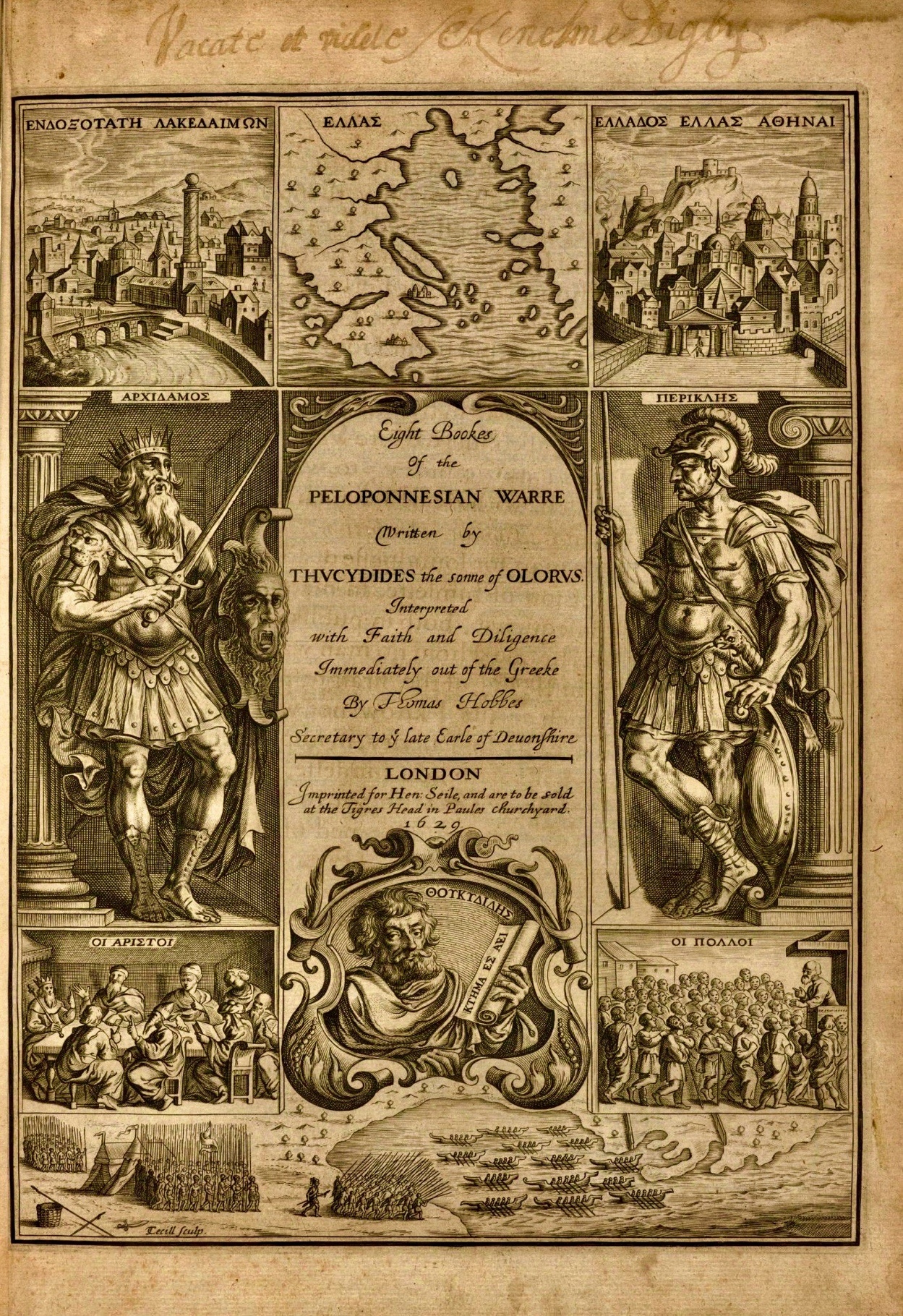
Title: Eight Bookes of the Peloponnesian Warre written by Thucydides. Interpreted by Thomas Hobbes. London, 1629. Houghton Library, Harvard. Public Domain

The Peloponnesian War by Thucydides is an awesome story about the ancient Greeks. But the story is more than a war report. It opens the doors into the nature of the Greeks, their culture, their greatness, and fatal weakness — their conviction each was better than the rest, each polis (city-state) thinking itself the Olympic champion in a perpetual Hellenic struggle. And in the case of the two most powerful poleis, Athens and Sparta, if they could not rule the other, they would stay fiercely independent. But in war they became barbarians — and worse. All or nothing. They fought persistently, with vigor, courage, brutality, to the last man.

This was real tragedy written all over the Greek world. That’s why the theater was so fundamental to the Greeks. The tragedies of Aeschylus, Sophocles and Euripides fought the Greeks’ greatest intellectual and spiritual battles. The tragic poets desperately tried to make the Greeks rethink their killer impulse. Sophocles and Euripides never ceased reminding them they were one people worshipping the same gods, kept together by the same divine traditions. And Aeschylus, probably because of the Persian invasion of Greece, always reminded them that it was better to die on one’s feet than live on one’s knees. Yes, freedom was the message of Aeschylus and Greek tragedy. But the Peloponnesian War blurred tragedy and freedom. In fact the Peloponnesian War brought tragedy nearly to an end since the conflict itself became the new tragedy. Could the carnage of the war be explained as a result of the Spartans’ fear of Athenians’ growing power? Thucydides was certain of that. But it was the Spartan ambassador Melesippos who predicted that the Peloponnesian War would bring nothing but grief to the Greek people.

In some twenty-seven years, the Athenians and the Peloponnesians devastated Greece proper, the Greek poleis of Ionia (Asia Minor), the islands of the Aegean and Ionian Sea, and Sicily. They also practiced biological warfare with their persistent burning and destroying of each other’s land and crops. Moreover, they slaughtered each other by the thousands, enslaved and sold their women and children by the thousands, brought barbarians to their politics and warfare — and the Spartans and the Peloponnesians made the Persians, the Greeks’ ancient enemies, their pay masters. Indeed, it was the Athenian general Alcibiades who urged Persian leaders to keep funding Greeks killing Greeks.

Clearly, the Peloponnesian War was the beginning of the end of Greek political freedom. With Athens prostate in 404 BCE, the dream of a united Hellas remained a dream for another sixty-eight years until 336 BCE when Alexander the Great brought all Greeks under his command to fight the Persians. But by that time, not merely Athens but Sparta and Thebes and Argos — the greatest of Greek poleis — were exhausted. War, particularly their nearly ceaseless fratricidal conflicts, had sapped their military and political power. No wonder that the Greek historians Polybius and Plutarch, one living in the second century BCE and the other during the second century of our era, spanning between them four centuries of Roman domination of Greece, did not hate Rome. They knew that Rome extinguished Greek political independence and freedom. But they also had studied the history of the Peloponnesian War. Rome was the enemy, but Rome had stopped the endless antagonisms and often bloody civil wars. Polybius was quite loyal to Rome.

Yet the fifth century BCE, the last 27 years of which were disrupted by the Peloponnesian War, was so much a century of original creation in political theory, democracy, medicine, architecture, science, tragedy, theater, sculpture, art, literature, history, and Greek culture in general, that, despite the Peloponnesian War’s devastation, the Greeks were preeminent in Europe for nearly another 800 years down to the making of Christianity the official religion of the Roman Empire in the fourth century of our era.

War and light
A painting of a group of people Description automatically generated

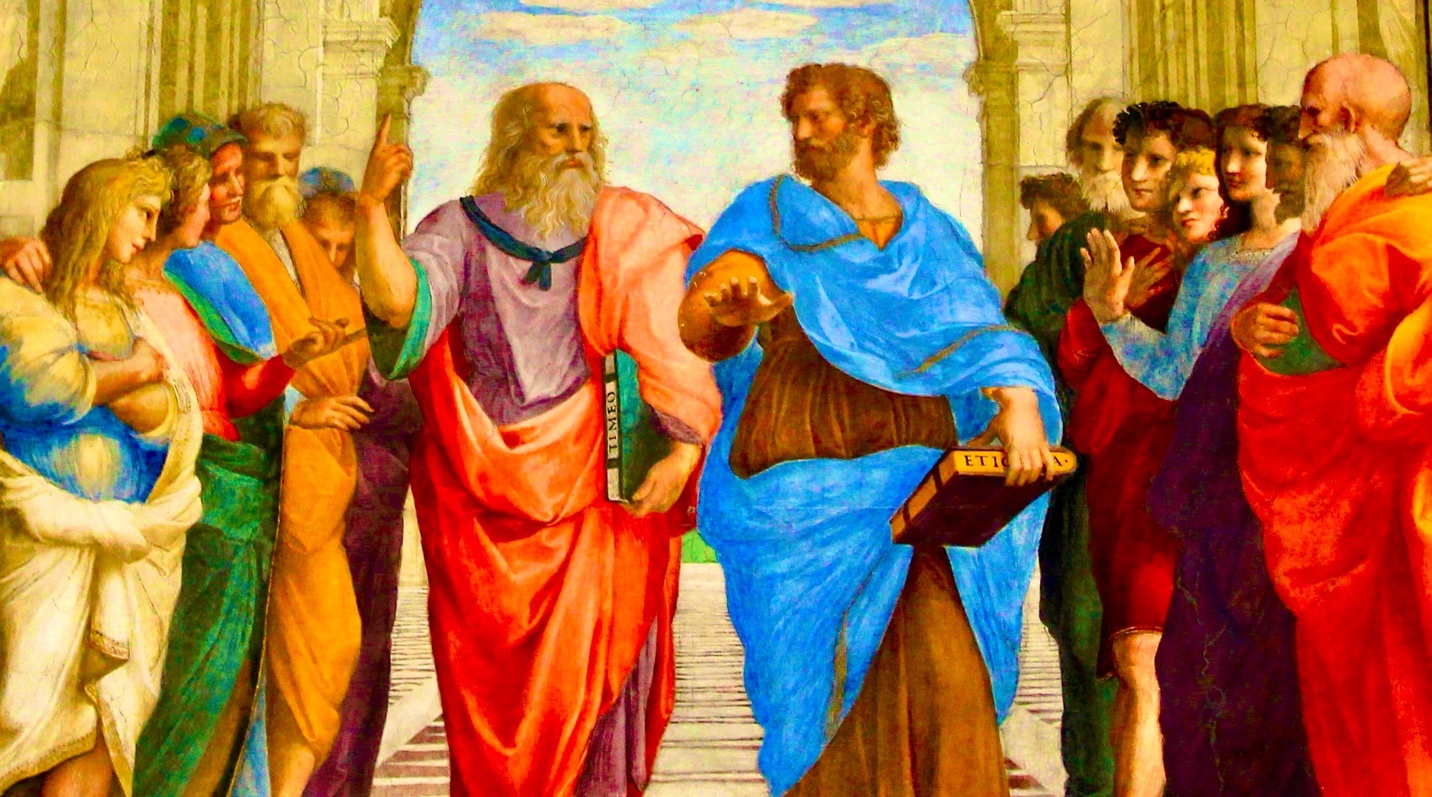
Plato and Aristotle, center, in the School of Athens by Raphael, 1511. Public Domain

Plato and Aristotle flourished in the fourth century BCE, the century after the end of the Peloponnesian War. But the overall achievements of the fifth century were of such magnitude that even the ferocity of the Peloponnesian War was probably subsumed into that greatness. The fifth century was a phenomenon so unique in Greek and global history that the English classical scholar Peter Levi rightly saw it as “an explosion of light which affected everything and still does so today [1980]. Europe is the result and Greece is the key.”[1]

The light (from craftsmanship, science, technology, art, and architecture and theater) reflects honest efforts of the Greeks to set their civilization on more solid foundations. But the darkness of the Peloponnesian War clouded, to some degree, that light.

The Peloponnesian War was like angry Poseidon threatening to sink the country under the waters of the Mediterranean. Xenophon, who gave us the narrative of the carnage of the last seven years of the Peloponnesian War, was a pupil, like Plato, of Socrates, an Athenian patriot and moral philosopher that fought in the war defending Athens. In fact Socrates was the only elected citizen in the Athenian Assembly in 406 BCE who dared to vote against killing the ten generals because they failed to prevent the drowning of several Athenian sailors after a victorious naval engagement with Sparta near Lesbos. This was also the year, 406 BCE, that the Athenians had turned with vengeance, for the second time, against Alcibiades, Socrates’ beloved pupil.

Democracy as usual, aristocracy, monarchy

Xenophon and Plato loved Socrates. They also loved a united Hellas. Their writings constitute a great documentary evidence of the Hellenic light that exploded in Greece in the fifth and fourth centuries BCE. They wrote about nearly everything. Yet Plato’s Republic, the political masterpiece of Greece’s greatest moral philosopher, and Xenophon’s Cyropaideia, a historical novel, have something in common. They are the direct consequence of the Peloponnesian War. They searched for alternatives to the failing democratic institutions of Athens that put Socrates to death. They are also trying to expand Greek political theory so that the Greeks could build a unified Hellas. Plato created an ideal polis that filled the gaps of human imperfection and corruption in a democracy. The best, the aristoi, are the aristocratic rulers in Plato’s Republic, not the average citizen of a Greek democratic polis, all too often tempted to overstep the bounds of justice and public interest. Xenophon’s Cyropaideia took the founder of the Persian Empire, Cyrus the Great, and made him the ideal ruler of a vast country. Both Plato and Xenophon witnessed firsthand the catastrophic effects of the Peloponnesian War. They were angry and bitter with the unwillingness and inability of the Greeks to form a Hellenic state. The Republic and Cyropaideia end instability in the Greek world, one with a polis governed by men who love wisdom, philosophers, and the other with a virtuous, compassionate, and just ruler. Plato and Xenophon were not enemies of democracy. They were enemies of the disintegrating forces in the Greek world that made war inevitable. Their proposals were designed not as models but as inspiration to expand the theoretical political horizon of the Greeks beyond the self-destructive confines of the jealous polis. After all, the Athenians, the Spartans, the Corinthians, the Thebans and the Macedonians were convinced they were the very best of the Greek people that had to rule the rest of the Greeks. Set on that narrow path, they could not see their enemies.

The Persian invasion of Greece caught most of them by surprise. And while the Athenians, Spartans, Plataeans and some other Greeks defeated the Persians, the Thebans joined the Persians against the Greeks. With the Republic and Cyropaideia, Plato and Xenophon sounded the alarm bells that Greece had to rethink its political life, or it would lose its freedom. Plato was a moral philosopher who, naturally, concluded that men of ethical standards and deep knowledge, men like him, would provide a more secure future for the Greek people. And Xenophon used his military experience and understanding of the Persians to suggest that, perhaps, the Greeks had to modify and subordinate the political independence of the polis to a broad Hellenic interest – a unified Hellas — that included the interest and security of all Greeks.

Greece in 2024

Modern Greece includes most Greeks, but the country is neither unified nor independent. The loss of Greek freedom to the Romans in 146 BCE, the Christianization of Hellas in the fourth century and after, the occupation of the country by Mongol Turks in 1453, and Western influence after the liberation of Greece in the 1820s by Greeks themselves, are forces shaping the future of Greece.

The German occupation of Greece, April 1941-October 1944, nearly annihilated the country. And because America embraced the defeated Germans for the Cold War against the Soviet Union / Russia, Greece never received the war reparations from Germany. This was an additional blow to the destruction of the country from the civil war in Greece, 1945-1949, cooked by Germany and England. The German debt and reparations owned to Greece are approximately one trillion euros. If Greece had those substantial funds, the country would have avoided the humiliating debt that, starting in 2010, during the Obama administration, all but made the country a colony of Germany, the European Union and the United States. And because the US is still fighting its Cold War against Russia, it probably forced the governments in Greece to do the bidding of its archenemy, Turkey.

This unpatriotic policy, due to external influences on the government in Athens, has weakened the imported democracy in Greece, which is completely undemocratic. The Prime Minister acts like a monarch, nay a tyrant. Turkey keeps humiliating Greece and Greece, doing the bidding of US / NATO, keeps deceiving its citizens with propaganda while sending defeatist messages to Turkey and the world.

Is anybody reading Thucydides?

This is opening the appetite of Turkey, especially after the US in 1974 made its invasion of Cyprus possible. What the US and NATO fail to understand is that Cyprus is a Greek island, extremely ancient with sophisticated Greek civilization. Britain prevented the union of Cyprus to Greece. In fact, England brought Turkey back to Cyprus and urged it to launch its vicious 1955 pogrom against 85,000 Greeks of Istanbul. Like the Peloponnesian War, this story has consequences. Greeks don’t forget their friends and their enemies. NATO’s blindness for ephemeral if ill chosen priorities is bound to backfire. You cannot keep historical enemies in the same house. The house will collapse. In other words, Turkey does not belong in NATO, Europe or any other civilized conclave or organization. Europeans and Americans, at least their educated elites, know that Turks have enslaved Europeans, including Greeks, for centuries. They have been employing genocide and atrocities as conventional weapons to terrorize the non-Turks. So why has the US recruited them for their holy war against Russia? Don’t they know the Turks have no friends outside the Islamic world? The Turks besides would not fight Russians because the Russians defeated then repeatedly in the past. But aside from that, supporting Turkey you tell the Greeks you are against them. But the Greeks gave the US and Europe science, technology, architecture, law, democracy, in short, civilization.

So, neither Greece, in its modern resurrection, nor Europe, nor the US have learned anything from Thucydides. Perhaps, the Peloponnesian War just happened? Of course, not. Sparta, like America in 2024, went to war because it feared the rising power of Athens. Similarly, the US must feel uncomfortable with a strong Russia, a giant of a country recovering from the disbanding of its empire. However, the US ignores the fallout of the Peloponnesian War at its own peril. In fact, the peril is already threatening the country from within. Former President Trump, who should be in prison for his January 6, 2021 effort to overthrow the government, is running for president, again! But the administration of President Biden ignored Trump and focused on fighting Russia through Ukraine. Moreover, Biden is funding Israel in its deadly wars against Palestine and Lebanon and Iran. This folly may bring Trump to power, a calamity for democracy, the American people, the natural world, and possibly the planet.

NOTES

1. Peter Levi, Atlas of the Greek World (New York: Facts on File, 1980), p. 10. 

Evaggelos Vallianatos, Ph.D., studied history and biology at the University of Illinois; earned his Ph.D. in Greek and European history at the University of Wisconsin; did postdoctoral studies in the history of science at Harvard. He worked on Capitol Hill and the US EPA; taught at several universities and authored several books, including The Antikythera Mechanism: The Story Behind the Genius of the Greek Computer and its Demise. He is the author of Earth on Fire: Brewing Plagues and Climate Chaos in Our Backyards, forthcoming by World Scientific, Spring 2025.

Femicide is Rising, But Where’s the Outrage?
October 28, 2024
Source: Africa is a Country

Activists and relatives of Ugandan Olympic athlete Rebecca Cheptegei march calling for an end to femicide, 2024. Credit Andrew Kasuku / AP Photo

In Kenya, Olympic athlete Rebecca Cheptegi was brutally murdered—doused in petrol and set on fire by her ex-boyfriend just three weeks after returning from the Paris Olympics. In Switzerland, authorities recently revealed that Kristina Joksimovic, a former Miss Switzerland finalist, was killed by her husband, who confessed to the crime and allegedly dismembered her body and pureed it in a blender. In London, Cher Maximen was fatally stabbed in front of her daughter by a stranger while on her way to the Notting Hill Carnival.

Another day, another femicide globally. Although these incidents occurred separately, and these women live worlds apart, their deaths are tragically interconnected. While global homicide rates have generally declined, femicide has been steadily rising over the past two decades. In 2022, the UN recorded 89,000 cases of femicide globally, with 55% of these deaths caused by intimate partner violence or other perpetrators known to the victim. On average, this means that every 11 minutes, a woman or girl is killed somewhere in the world. In response to these troubling statistics, women across the globe have mobilized, with movements like #StopKillingUs in Kenya, #TotalShutdown in South Africa, and #NiUnaMenos in Latin America, fighting to end this violence.

Femicide is broadly understood as the killing of a woman or girl because of her gender—the most extreme form of gender-based violence. The 2012 UN Economic and Social Council’s Vienna Declaration on Femicide was the first to outline and recognize various forms of femicide, including intimate partner violence, targeted killings of women and girls in armed conflict, female infanticide, deaths related to genital mutilation, honor killings, and murders following accusations of witchcraft, among others.

Feminist scholars and activists have highlighted that femicide is not only about women and girls who have been killed, but also those who endure a continuum of gender-based violence, including ongoing violence, harassment, and assault. Academics Maya Dawsone and Saide Vega explain that femicide serves as a social barometer, reflecting the level of violence that women and girls experience, which may not always lead to death but can feel like a “slow death” for many. A contemporary example is the harrowing case of Gisele Pelicot in France, who discovered that her husband, Dominique Pelicot, had been drugging her for nearly a decade, inviting strangers to rape her in their home between 2011 and 2020 while filming the assaults as a form of “public revenge on men.” Pericot’s daughter describes the experience as a “slow descent into hell,” highlighting the horrifying sentiment of new cases of gender-based violence that emerge, challenging our perception of extreme violence.

While feminist movements have made significant strides in naming, recognizing, and advocating against femicide, it often seems as though the rest of the world remains disturbingly indifferent to this “silent pandemic,” carrying on with business as usual. The alarming rise in femicide, coupled with the relentless advocacy of feminists worldwide, makes it more urgent than ever to confront the root causes of this global epidemic of violence against women, and to take action to uproot it.

About 30% of women have experienced physical or sexual violence at least once in their lives. The Convention on the Elimination of All Forms of Discrimination against Women (CEDAW) 2005 recognized that femicide is not “isolated, sporadic or episodic cases of violence; rather they represent a structural situation and a social and cultural phenomenon deeply rooted in customs and mindsets.” One structural cause of femicide lies in how states and governments enable these killings—either through inadequate responses or a complete lack of action. Significant gaps in data collection also hinder the fight against femicide. Most data is drawn from national crime statistics or homicide records, which are often not gender-specific due to inconsistent criminal justice reporting across countries. As a result, the actual global rate of femicide is likely much higher. In many countries the lack of digital records further exacerbates these challenges, creating additional barriers to accurate data collection.

Government failures continue to play a key role in facilitating femicide—particularly through the lack of legal responses to domestic violence. Rebecca Cheptegi’s family highlighted this state-sanctioned femicide when they revealed that they reported her ex-boyfriend to Kenyan police, but authorities failed to respond to their plea for help, a failure that might have prevented her death. Political and economic factors also drive this troubling trend as national economies shape power dynamics within households and the public sphere. Economic hardship, particularly, threatens men’s livelihoods and social status, often escalating violence. Many countries have reported links between women’s murders and factors such as male unemployment and lack of income.

Furthermore, patriarchal traditions and norms that reinforce male dominance and female subordination, combined with external economic pressures, can result in gender-based violence. The expectation that men should be the primary breadwinners is a key component of patriarchal norms. When women out-earn their male partners, some men may feel emasculated and attempt to “restore” their perceived loss of power or control through violence. It has been speculated that Rebecca Cheptegei’s ex-boyfriend may have killed her over a land dispute, reflecting broader tensions around women’s increasing financial independence. This pattern may also explain the deaths of other Kenyan female Olympians, such as Agnes Tirop, who was similarly the breadwinner of her family and was murdered by her husband. Women across all social classes remain vulnerable to the threat of femicide, including celebrities whose partners may feel threatened by their economic and social status as public figures.

Mainstream approaches to ending femicide have largely focused on legal solutions and the criminal justice system. One example is the push to classify femicide as a distinct crime—in 2022, Cyprus incorporated femicide into its criminal code, making gender-related killings an aggravating factor in sentencing. Although classifying femicide as a distinct crime can aid in advocacy, awareness, and harm reduction, it remains limited by the broader shortcomings of carceral approaches. This classification alone is unlikely to serve as a strong deterrent to future crimes, and in many cases, gender-based violence laws exist but are poorly enforced.

Abolitionist feminists argue that criminalization is ineffective at protecting women but productive at reproducing harm. In Kenya, for example, conviction rates for sexual assault and rape are extremely low. Studies illustrate that only 6% of reported rape cases result in convictions. Contributing to the low conviction rates are factors such as policy inefficiencies, mishandling of DNA, lack of post-rape counseling and resources, and cultural stigmas. A carceral feminist politic, which relies on policing, prosecution, and imprisonment as the primary responses to gender-based violence, is ultimately myopic and can even be situationally dangerous for the victims seeking redress.

Effective measures seek to address the underlying socioeconomic inequalities and precarious conditions that contribute to violence against women. This includes providing financial support, accessible shelter, and economic empowerment for women reporting violence. For instance, cash transfer programs in low- and middle-income countries have shown a positive correlation between women’s income and lower rates of domestic violence. A successful example is South Africa’s IMAGE Programme (Intervention with Microfinance for AIDS and Gender Equity), which equips women with microfinance to enhance their economic independence. Additionally, governments must increase social spending on health and education to alleviate the burden on households, particularly the unpaid domestic labor that disproportionately falls on women.

Lastly, education and community outreach efforts must not only be inclusive of women but should also actively engage men, boys, and all other victims of patriarchal norms. Such education can dismantle deep-rooted cultural beliefs and harmful misrepresentations, like “boys will be boys” or the myth that a woman’s choice of dress justifies sexual assault. The Swedish government has consistently invested in educational programs aimed at addressing gender violence, including re-socializing boys by integrating gender equality into school curriculums. These efforts have contributed to Sweden’s relatively low levels of intimate partner violence and femicide, fostering a more gender-equal society.

Each day, cases of femicide remind us that ignorance of violence against women is deadly. Legal reforms, while essential, are not enough to end this crisis. To truly combat femicide, we must dismantle the deep-rooted inequalities, patriarchal norms, and systemic failures that sustain it. Femicide is not just a feminist issue, it’s everyone’s problem, and more people should be outraged. The time for action is now.

Naila Aronii is a writer and artist from Nairobi, Kenya.

Violent Rhetoric Rising: an Analysis of Nine Years of Trump’s Speeches


 October 28, 2024
Facebook

Donald Trump’s political career has been marked by a unique and often controversial rhetorical style. Since 2015, his rhetoric has evolved significantly, attracting attention for its direct, often violent tone.

Analyzing his speeches offers a revealing look at how his language has shaped both his political persona and the broader landscape of American politics.

We are political scientists who analyzed Trump’s campaign and presidential speeches from 2015 through 2024. We found that one of the most striking trends in Trump’s rhetoric is the sharp rise in his use of violent vocabulary. The share of words associated with violence rose from almost 0.6% in 2016 to 1.6% in 2024 in Trump’s speeches. As a comparison, the proportion of violent words in 40 randomly chosen weekly radio addresses by Barack Obama was 0.79%.

From Trump’s first campaign in 2015 through the next nine years, his speeches have increasingly included words and phrases related to crime and military conflict. In March 2024, for example, Trump said that “it’s going to be a bloodbath for the country” if he wasn’t reelected in November.

By 2024, Trump’s use of violent language had surpassed that of nearly all other democratic politicians we considered, approximating that of authoritarian figures such as Kim Jong Un and Fidel Castro.

This surge in violent rhetoric is not linked to significant external events such as wars. Trump has focused his messaging on violent crime, particularly in American cities, even as crime rates were declining. His repeated references to “murderers, rapists and thugs” paint a picture of a nation under siege, heightening anxiety among his supporters.

At the same time, he casts himself as a strong leader capable of confronting these perceived threats.

Trump tells supporters, ‘I am the only one that can save this nation,’ on June 13, 2023, after his arraignment on 37 criminal charges related to his handling of classified documents.

Economic, public service language declines

While Trump’s rhetoric has become more violent, it has simultaneously moved away from traditional political discourse on economic performance and public services. Early in his political career, Trump quite frequently mentioned economic issues, tapping into concerns about jobs, trade and prosperity. Over time, however, his focus on economics has significantly declined.

This trend is not unique to Trump. Both Democratic and Republican candidates have been using less economic vocabulary in their speeches since at least 2012.

Trump’s retreat from economic discussions, however, is particularly pronounced. He has always focused less than other presidential candidates on the provision of public services such as health care, housing and transportation. His speeches contained fewer words such as “medicine,” “education,” “child care,” etc.

Instead, his rhetoric has increasingly centered on identity politics and cultural issues, reflecting broader changes in U.S. political discourse.

Shift away from inclusive language

Populism is often characterized by a focus on “the people” versus “the elites,” with politicians presenting themselves as champions of the common citizen against corrupt insiders. Early in his political career, Trump did use such inclusive language invoking “the people” quite often.

Since then, however, his rhetoric has shifted toward what we call “exclusionary populism,” with frequent attacks on political elites, immigrants and media figures. The Sept. 10, 2024, debate between Trump and Kamala Harris was rife with such examples, the most famous of which concerned immigrants eating dogs.

This shift from inclusive to exclusionary rhetoric reflects a broader strategy of defining politics as a battle between “us” and “them,” with Trump casting himself as the defender of ordinary Americans against external threats.

Trump’s rhetorical style has undergone significant changes since he launched his first presidential campaign. During his initial run in 2015-2016, his language became more inclusive, with a rise in the use of “we” and “the people” and fewer references to elites and social groups he views negatively (“them”).

Once in office, however, his speeches exhibited a more combative style. His use of violent language surged, and references to “them” became more frequent.

This evolution suggests that Trump’s rhetoric is adaptable, changing in response to political contexts and the audience he aims to engage. His increasing use of inflammatory language and swear words after taking office contrasts with the more measured tone he adopted during his 2016 campaign.

‘One really violent day’ would end crime in the U.S., said Trump on Sept. 29, 2024, in Erie, Pa.

Aggressive attacks on elites

Trump’s rhetoric can be understood more fully by comparing it with the rhetoric of other U.S. presidential candidates since 1952, as well as world leaders, both democratic and authoritarian.

The only other recent presidential candidates with levels of violent language comparable to Trump’s in 2024 were Republican George W. Bush and Democrat John Kerry in 2004. But while Bush and Kerry were discussing the ongoing Iraq war, which was then causing hundreds of U.S. casualties a year, Trump’s violent claims were not connected to actual events or statistics.

In terms of populism, Trump stands out from other leaders for his aggressive attacks on elites. Since the beginning of his political career in 2016, Trump has talked about his intention to “drain the swamp,” referring to the corruption of political elites. While populist candidates often criticize political insiders, the frequency of Trump’s denunciations surpasses that of most recent U.S. presidential candidates.

Trump’s 2024 speeches, for instance, feature far more references to corrupt elites than those of his predecessors, revealing a deeper attachment to exclusionary populist rhetoric.

While politicians’ rhetoric does not always predict their actions, Trump’s increasing attachment to violent language and populist themes may offer insight into his future approach, whether as president or in defeat. As political scientists, we believe the rise of such rhetoric merits close monitoring because of its potential implications for the broader political landscape.The Conversation

This article is republished from The Conversation under a Creative Commons license. Read the original article.

Nikita Savin, PhD Candidate in Political Science, University of California, Los Angeles. Daniel Treisman, Professor of Political Science, University of California, Los Angeles.