Monday, October 28, 2024

How the Israeli Attack on Iran Could Seed a New World War

Source: The Intercept

Credit: kristiantowibowo123 / DeviantArt


If you ask the average citizen of any country whether their leaders should start wars, almost all would give a resounding “No.” The public, overall, opposes war, but tolerates leaders who prioritize power, legacy, and special interests over the wishes of their own people.

This is how we find ourselves recklessly stumbling toward a global conflict that could erupt out of the regional crises currently unfolding.

With its early Saturday morning attack, Israel is on the verge of dragging the U.S. into a regional war with Iran.

Let’s start with the Middle East. With its early Saturday morning attack, Israel is on the verge of dragging the U.S. into a regional war with Iran. The plans were drawn up weeks ago and, despite U.S. warnings, Israel went ahead with the bombing.

Though, for the moment, Iran seems to be exercising restraint, U.S. leadership seems to not be up for the challenge of averting this conflagration. The Biden administration has proven ineffective. Not only has it failed to secure a ceasefire in Gaza, the administration is also emboldening Israel by providing military assistance against retaliatory attacks from Iran.

For its part, Israel keeps pushing the envelope, ignoring U.S. pleas for restraint, confident that powerful Israel lobby groups will ensure American politicians will continue to supply them with money, weapons, and intelligence.

Enter Russia and Ukraine

A regional Middle East conflict could itself grow into larger war — by dragging in Russia. Given its presence in Syria, there is no predicting exactly how Russia might react to a regional war with U.S. involvement. What we do know is that Russia has issued ominous warnings to Israel about attacking Iranian nuclear sites — warning that will now be tested.

The Russian stance is not difficult to understand. For the U.S., a regional Middle East war would mean jumping into Israel’s fight. For Russia, isolated on the world stage, the region holds the key to a web of interlocking interests. Russia buys drones and ballistic missiles from Iran for use against Ukraine, and Iran, for its part, is perpetually a potential customer for Russia’s sophisticated defense systems. 

Then there is the war in Ukraine itself, where the sides for a global conflict were drawn up. NATO members, bound by a mutual defense pact, are supporting Ukraine in its war against Russia. As a response, four countries are coming together as “the axis of resistance” — against, as how Senate Republican Leader Mitch McConnell refers to it, the new “axis of evil”: Russia, China, North Korea, and Iran.

As part of its alliance, the West continues to supply military equipment with more offensive capabilities. Ukrainian President Volodymyr Zelenskyy wants long-range missiles that can attack deeper into Russian territory. Russian President Vladimir Putin has repeatedly warned that if certain red lines get crossed, he will retain the right to use tactical nuclear weapons.

So far, the West has crossed a few of Putin’s red lines without consequence. The question we might ask is: How long do both sides want to play this Russian roulette? 

Both the Middle East and Ukraine conflicts create a growing risk that the U.S. and NATO and end up in direct confrontation with Russia and its allies — the new world war. 

Snowball in the Far East

If this world war breaks out along the lines of the Middle East war and Ukraine conflict, there is no reason to think the conflagration would be contained.

Any number of miscalculation or military accident in either the Taiwan Strait or South China Sea could trigger direct confrontation between China — unlike Russia, an ascendant world power — and the U.S.

A wider war in Easter Europe or the Middle East could, for instance, give China an opening to go to war over Taiwan. So far, China seems in no rush to invade, tacitly accepting the U.S. policy of “strategic ambiguity” — where the U.S. remains deliberately vague on whether it would defend Taiwan militarily.

A wider war in Easter Europe or the Middle East could give China an opening to go to war over Taiwan.

If the West becomes embroiled in a full-scale war with Russia or in the Middle East, that calculation could change.

Even short of an invasion of Taiwan, China is likely to leverage a distracted West into ever more aggressive actions in the South China Sea, where the potential for conflict is high.

The burgeoning Eastern power is already carrying out its own version of the Monroe Doctrine. Flouting international law, China is flexing its muscle by claiming control over navigation pathways that threaten the neighboring countries of Vietnam, Malaysia, and the Philippines — the latter of which bears the brunt of Chinese harassment and, ominously, has a mutual defense pact with the U.S.

History as Our Guide

There are two absolute truths about war. Once started, the outcome is unpredictable. Secondly, and more importantly, wars always escalate. We are witnessing conflicts on three fronts that are exhibiting both characteristics.

History is a powerful teacher, and it’s time we dust off a few history books. Much of what is occurring on today’s geopolitical chessboard has analogues to events that unfolded in the early 20th century. 

Due to arrogance and sheer folly, the relationships between the three cousins — King George V of Britain, Kaiser Wilhelm II of Germany, and Tsar Nicholas II of Russia — deteriorated due to a mix of personal, political, and national factors. This ultimately contributed to the outbreak of the colossal sibling squabble we know as World War I.

Much like today, several key factors set the stage for the First World War. Militarism and nationalism were on the rise, and an arms race between major powers raged. European empires were engaged in intense competition for global dominance and access to resources, particularly in Africa.

As it is today, the powers divvied up into alliances: The Triple Alliance between Germany, Austria–Hungary, and Italy (though Italy later withdrew) on one side, and the Triple Entente, with a surrounded Russia joining France and the United Kingdom. In a scenario with echoes today, these alliances were meant to provide mutual defense but also created a precarious situation where a conflict involving one member could quickly spiral into a wider war.

Many of today’s politicians cater to the donor class and special interests that favor conflict.

Those were empires. Their subjects could be excused for their inability to sway their leaders, whose sheer stupidity they would always be subject to. Today, some of the players fit this bill — but not all.

In the democratic West, we are supposed to have a voice. Yet, many of today’s politicians, with the help of the mainstream media, seem indifferent to the desires of their voters, catering instead to the donor class and special interests that favor conflict.

In this dizzying milieu of crisscrossed global interests and unaccountable leadership, our odds can look daunting. Yet those of us bestowed with the right to press our governments must continue to press policymakers to stop this madness before it’s too late.


Israel’s Limited Strikes On Iran Show The Enormous Constraints Faced By Netanyahu

October 26, 2024

Source: Informed Comment

“Fighter Jet,” Digital, Dream / Dreamland v3, 2024.

The limited strikes on Iran carried out by Israeli fighter-jets early on Saturday morning Tehran time above all demonstrated the constraints under which even this extremist Israeli government has to operate. The bombings are said to have been limited to military targets, including missile manufacturing facilities.

The first constraint Israel faced was logistical. The Netanyahu government could not have its fighter jets fly straight to Iran, which would have allowed a more extensive set of attacks. Israel could not gain overflight permissions from Turkey, Iraq or any of the Gulf Cooperation Council states (Kuwait, Bahrain, Qatar, Saudi Arabia, the United Arab Emirates, and Oman). Sean Matthews at Middle East Eye points out that as a result, the Israelis would have had to fly down the Red Sea, go west across the Gulf of Aden, and approach Iran from the Arabian Sea. It is a long way around. They would have had to bring along large hulking refueling planes. This long, clumsy flight path limited what the Israelis could accomplish.

Extremist Israeli Prime Minister Benjamin Netanyahu had earlier not ruled out hitting Iran’s nuclear facilities or its oil fields. Iran, however, essentially held the GCC countries hostage, warning that if US-backed Israel hit Iranian oil fields, Tehran would retaliate against US-backed Arab oil monarchies in the Gulf such as Saudi Arabia. The Biden administration is trying to woo those countries into recognizing Israel, and having a berserker Israeli government draw them into hostilities with Iran would instead make these Arab countries flee both the US and the possible Israeli embrace. For some diplomatic purposes, as with detente with Iran, Saudi Arabia has already gone to China instead.

According to Middle East Eye, Iran’s foreign minister, Abbas Araghchi, had announced Tuesday that Iran had been promised by the Gulf Arabs that they would not allow their air space or soil to be used for Israeli attacks on Iran.

At the same time, Joe Biden pressured Israel not to attack Iranian nuclear facilities or oil fields.

I view Netanyahu as an adventurer who has been attempting to widen the war so as to force the Biden administration to support him. Although Iran backs Hamas, the CIA assessed that the ayatollahs had no idea Hamas was planning to carry out the October 7 attacks, and, indeed, that the Iranian leadership had declined to support Hamas during the past year precisely because they were furious that Yahya Sinwar had tried to drage them into a war without so much as consulting them. Iran also put pressure on Hezbollah not to provoke a war with Israel.

That is, though Iran certainly supports anti-Israel guerrilla groups in the region and enjoys harassing the Israelis through them and their rockets and drones, it doesn’t appear to have acted aggressively given the ferocity of Netanyahu’s genocide in Gaza.

Netanyahu struck the Iranian embassy in Damascus last spring in an obvious attempt to bring Iran into the war, and Iran replied with a missile barrage that the US shot down.

Then this summer Netanyahu assassinated Ismail Haniyeh, the civilian head of the Hamas Party politburo (which is no the same as the al-Qassam Brigades paramilitary). The assassination was carried out in Tehran, in a clear attempt to get Iran’s goat. Likewise, Netanyahu’s creepy pager booby trap attack on Hezbollah personnel (and some Iranians, such as the Iranian ambassador to Lebanon) and his assassination of Hassan Nasrallah in September were in part aimed at humiliating Iran.

Iran’s October 1 missile barrage at Israel was mostly shot down by the US, but some missiles got through and one hit an Israeli military base. This attack was revenge for the killings of Haniyeh and Nasrallah.

Israel’s riposte was so limited that it might well not elicit any response from Iran, drawing a line under this phase of the Israel-Iran conflict.

But Netanyahu was forced into a limited response by the Arab Gulf states (two of which –Bahrain and the Emirates– recognize Israel) and by the Biden administration. The refusal of oveflight permissions by the GCC states also limited what Israel could accomplished with its F-35s.

I view Iran’s missile program as largely defensive. They have used it against Israel twice this year, and both came in response to Israeli provocations (provocations that I believe to be deliberate on Netanyahu’s part). Israel has made the point that its jets can now reach Iran with extensive refueling. Iran has made the point that a swarm of missile attacks can penetrate Israel’s missile defenses and hit an Israeli military base.

Each side is seeking some form of deterrence against the other, a deterrence that has broken down this year because of Israel’s aggression in Gaza and Lebanon and its anti-missile defenses.

I think Iran will be satisfied if it feels that a restoration of deterrence has been achieved. I don’t think Netanyahu is defending; I think he is attacking and attempting to expand his influence in the region. For that reason, it will be difficult to reestablish deterrence between the two countries.

For the moment, however, all-out war seems to have been averted.


Juan Cole
Juan R. I. Cole is Richard P. Mitchell Collegiate Professor of History at the University of Michigan. For three and a half decades, he has sought to put the relationship of the West and the Muslim world in historical context, and he has written widely about Egypt, Iran, Iraq, and South Asia. His books include Muhammad: Prophet of Peace Amid the Clash of Empires; The New Arabs: How the Millennial Generation is Changing the Middle East; Engaging the Muslim World; and Napoleon’s Egypt: Invading the Middle East.

 

Source: Barn Raiser

Even though statistics show a consistent downward trend in violent crime since the early 1990s, conservative politicians and media are trying to convince voters that America is under attack. Often these messages are geared toward rural voters to make them think large cities are rife with crime.

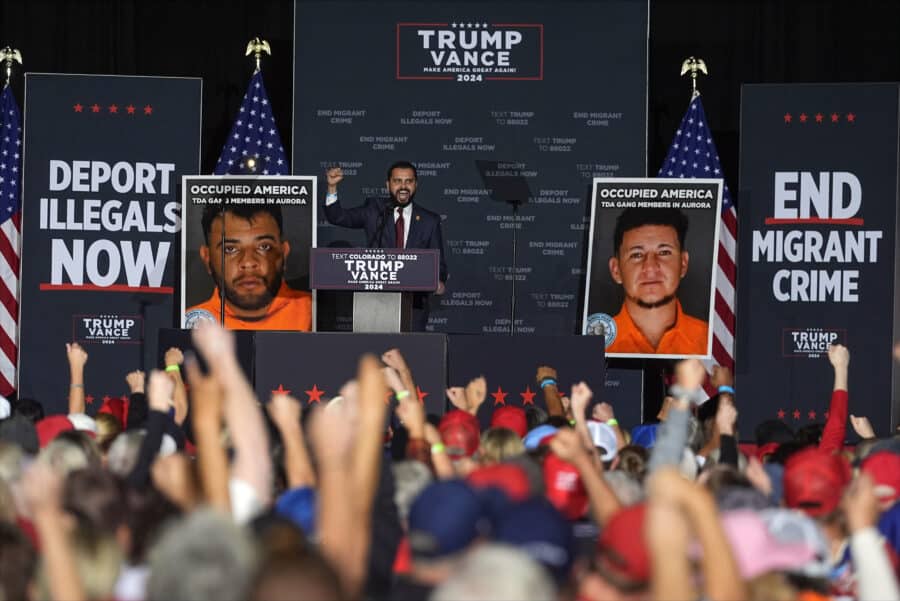
Colorado GOP chairman Dave Williams speaks before Republican presidential nominee former President Donald Trump at a campaign rally at the Gaylord Rockies Resort and Convention Center Friday, Oct. 11, 2024, in Aurora, Colo. (David Zalubowski, AP Photo)

The overarching message: the only way to keep this crime from infiltrating rural areas is to vote for conservatives.

Examples abound. On Monday, vice-presidential nominee J.D. Vance visited Minneapolis, stopping at the site of the Third Precinct, which burned in protests after the 2020 murder of George Floyd. Conservatives often criticize Minnesota Gov. Tim Walz, Kamala Harris’s running mate, for not doing more to stop the protests.

“The story of Minneapolis is coming to every community across the United States of America if we promote Kamala Harris to president of the United States,” Vance told a phalanx of media and supporters.

Nearly 6 in 10 Americans (58%) say that reducing crime should be a top priority for politicians. That number is nearly 7 out of 10 for Republican voters or those who lean Republican, according to the Pew Research Center. In comparison, three years ago the number of Americans who said reducing crime should be a priority was at 47%.

Experts on politics and political rhetoric say that voters in rural areas may be susceptible to claims of violent crime rampant in large cities because instead of seeing cities for themselves, they rely on news reports and political speeches.

“Conservative media has painted a wholly false picture of urban centers as ‘Mad Max’ wastelands where you can’t step out the door without getting stabbed or there are people dying of fentanyl overdoses on every corner,” says Brian Hughes, a research assistant professor in the Department of Justice, Law & Criminology at American University.

Hughs calls it a “divide-and-conquer” approach. “People who watch these reports are more fearful, less likely to connect with neighbors, less likely to visit the cities and experience lives of people who live there.”

The facts of violent incidences are often cherry-picked by politicians and held up as examples emblematic of a wider problem.

“The right is totally comfortable perverting the truth and the circumstances of a crime to fit a particular narrative,” says Seyward Darby, editor-in-chief of Atavist magazine and the author of Sisters in Hate: American Women on the Front Lines of White Nationalism (2020, Little, Brown and Company).

While voters say violent crime is up and that politicians should make fighting it a priority, they are more likely to believe it is a problem elsewhere rather than where they live. According to the Pew Research Center, 55% of people say there is more crime in their local area, while 77% believe crime rates are up nationally.

It’s only logical to realize that crime exists in rural areas. But in small towns where everyone seems to know each other’s business, it can be easier to explain away criminal actions, says Kevin Parsneau, a professor of political science at Minnesota State University, Mankato.

“You look around your hometown and let’s say somebody had a drug problem. Well, the thinking goes, they never had their life together to begin with. So then it becomes a personal thing.” Or, he adds, “You either misunderstand what’s going on in the city, or you don’t see what’s going on right in front of you.”

Exaggerating, misleading or simply false claims about crime is not a new tactic from the right.

“Fear mongering is one of the classic propaganda techniques. What it does is it softens us up, softens up our critical faculty,” Hughes says. He says this type of propaganda does an end run around intelligence, logic and reason, making it especially effective. This can be particularly true when the suspension of critical thinking is used as a pretext to dehumanize certain groups like immigrants.

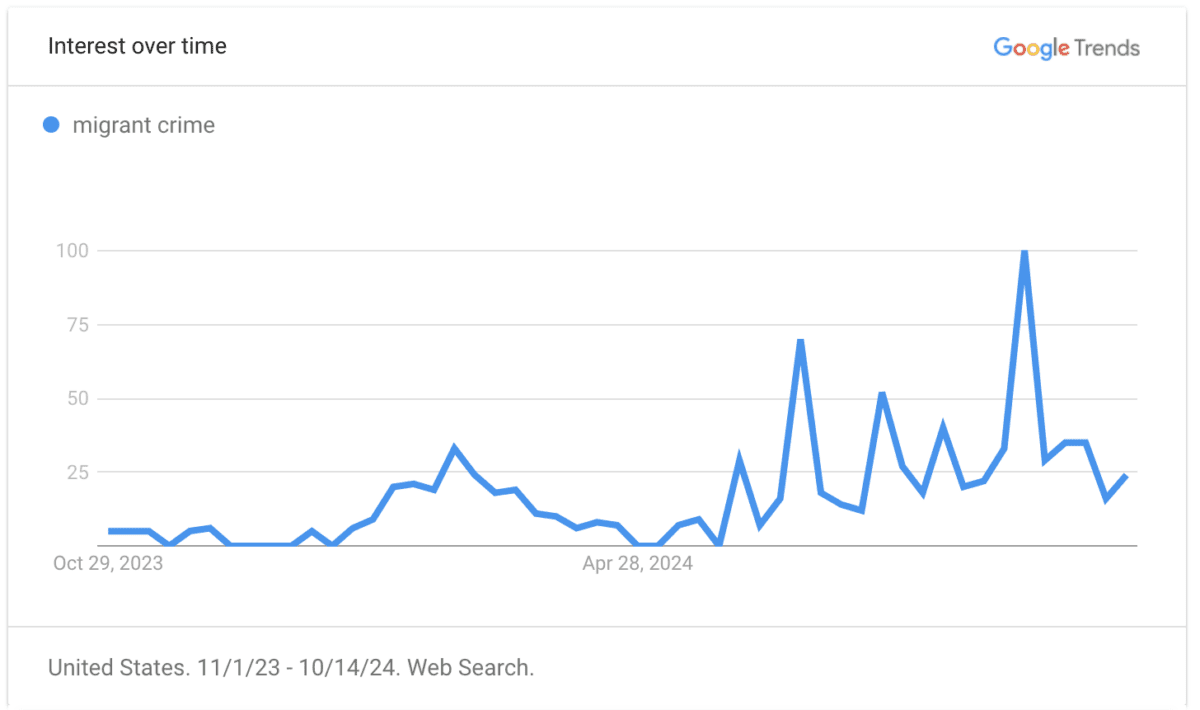
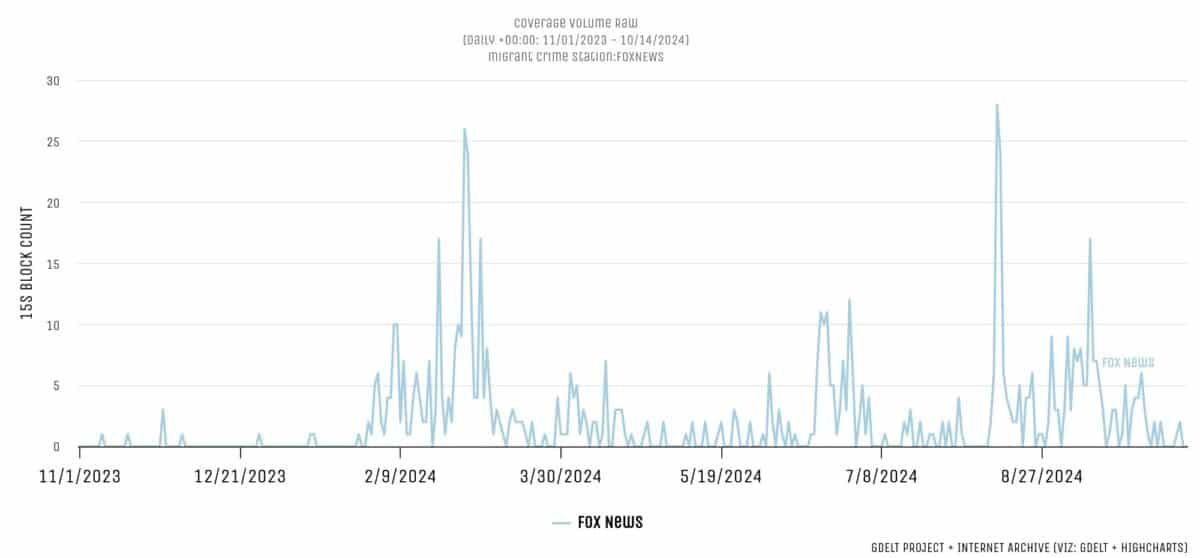
A constant refrain from both the Trump campaign and Fox News warns that “dangerous criminals” are flooding across the southern border at unprecedented rates, causing a wave of so-called “migrant crime.” The category may be invented but the rhetoric has real consequences, with Trump claiming that criminal illegal immigrants are “poisoning the blood” of this country. Aside from a few highly publicized cases, data show there is no increase in crime attributable to immigration. According to border officials, most migrants are families fleeing violence and poverty.


Mentions of “migrant crime” on Fox News from Nov. 1, 2023 to Oct. 14, 2024. Source: GDELT Television Explorer, Internet Archive.
Frequency of “Migrant crime” as a Google search term. Source: Google Trends. Numbers represent search interest relative to the highest point on the chart for the given time.

Darby says that this tactic can be found in the post-Civil War era. The Ku Klux Klan, founded in rural Tennessee, rose to prominence by promoting the idea that the end of slavery posed dangers to a white populace, particularly white women. Then, as now, the racial component of imagined crime was emphasized.

“I really don’t think a lot has changed,” she says. Over time, too, the American public has overestimated crime rates. Pew Research Center data shows for the past 30 years, in 23 out of 27 surveys about crime rates, at least 60% of adults said crime is on the rise, even when statistics show the opposite is true.

These attitudes on crime reflect media coverage, Parsneau says. Indeed, the saying “If it bleeds, it leads,” is a given on local television newscasts.

“Fear of crime correlates more with media coverage of crime than actual crime. So crime can be going up, but if the media aren’t talking about it, people aren’t that concerned. But if crime is going down, but the media is still talking about it, the fear of crime goes up,” Parsneau says. It’s the “mean world syndrome,” a phrase coined by communications scholar George Gerbner in the 1970s. When people learn about the wider world only through media reports, the media can shape a false reality.

People generally do not directly consult sources of crime statistics, such as the FBI or Bureau of Justice Statistics. Instead, they rely on local news reports or social media. Even for official statistics, there’s an atmosphere of distrust.

“Increasingly we see that people on the right do not care about official statistics and say, ‘No, that’s fake’ or ‘That’s someone lying,’ ” Darby says.

Even mainstream media don’t always remind voters of the hard facts, Parsneau says. Reporters, when asking politicians questions, might say something like, “A big issue for voters is crime. What are you going to do about violent crime?” without noting that violent crime rates are actually down.

In rural America, emphasis on crime takes attention away from other, more pressing issues, such as the agricultural economy and infrastructure needs.

Even though rural voters know those issues are important, “that doesn’t seem to overwhelm their fear that somebody from Mexico is going to sneak across the border and sell them fentanyl,” says Parsneau says. “It makes the assumption that we could reduce the amount of drugs if we could just stop them at the border. Well, they’re actually cooking the meth a few blocks away, so work on that.”

Hughes, who is also the associate director of Polarization and Extremism Research and Innovation Lab (PERIL) at American University, uses “attitudinal inoculation” to combat manipulative messages.

“It’s a tried-and-true practice demonstrated effectively hundreds of times in lab environments,” he says.

Attitudinal inoculation involves showing people a short sample of propaganda and warning them about manipulative methods they will see—for example, the use of deep, ominous sound effects to produce an unsettled feeling.

Hughes would like to see more money invested in helping people understand how political messaging can be manipulative. But it can be an uphill battle. Propaganda comes out of the big-money advertising industry. Show people how they are being manipulated politically, and they may also start to see how they are manipulated by advertising.

“It’s a tall order to get people with money to fight this,” Hughes says.

Even though political manipulation around crime is not new, it’s disheartening to see it continue to wield influence, Darby says.

“It reveals how little people learn, how prone we are as a society of making the same mistakes over and over.”

But Parsneau says to some degree, this could be politics as usual.

“If you’re the out party,” he says, “you want to portray everything that’s happening now as bad, as a justification as to why the Democrats should be thrown out.”


Rachael Hanel began her career as a newspaper reporter and now teaches creative nonfiction at Minnesota State University, Mankato. She’s the author of Not the Camilla We Knew: One Woman’s Path from Small-Town America to the Symbionese Liberation Army (2022) and We’ll Be the Last Ones to Let You Down: Memoir of a Gravedigger’s Daughter (2013).

 BDS and Its Allies Are Exposing the Companies Fueling the Genocide in Gaza

Source: Waging Nonviolence


Israeli activists chained themselves up in the lobby of the Chevron corporate offices near Tel Aviv to demand that the fossil fuel giant stop fueling the war in Gaza. (Twitter/Olivia Katbi)

In late September, half a dozen activists with the group Voices Against War chained themselves to turnstiles inside the lobby of Chevron’s offices in Herzliya, Israel, just north of Tel Aviv. Reading from prepared remarks, a spokesperson for the group said that they were Israeli citizens “horrified by the genocide that is being committed in our names” and accused Chevron of “fueling the genocide in Gaza with hundreds of millions of dollars in tax payments, fueling energy apartheid throughout Palestine and destroying our planet’s climate along the way.” 

The spokesperson also explained that they were acting in solidarity with the Boycott, Divestment and Sanctions movement, or BDS, which advocates economic opposition to the Israeli genocide and occupation. In addition to the action in Herzliya, there were nearly two dozen more documented by BDS in the United States alone during the week of action against Chevron for its ongoing business with Israel amid the genocide. 

Since Palestinian militants attacked Israel on Oct. 7, 2023, Israeli forces have killed more than 43,000 Palestinians, including 16,000 children, according to the Palestinian Ministry of Health. The true toll of the genocide, obscured by the continued Israeli attacks and blockade, may top 330,000 deaths by the end of the year, according to estimates published in The Guardian.

Activists’ efforts to pressure the U.S. government, Israel’s principle weapons supplier, to institute an arms embargo continue to be ignored, so many have been searching for other points to wrench the Israeli war machine. As Kelly Hayes has reported, activists with Dissenters, Palestine Action U.S., and Resist and Abolish the Military Industrial Complex, or RAM INC, have blockaded and otherwise disrupted weapons manufacturers in the United States that continue to supply the Israeli military, including RaytheonBoeingWoodward and Elbit. RAM INC has also mapped the locations of those weapons manufacturers across the country to empower other activists to do the same. 

Yet other activists are focusing on the companies fueling the Israeli war machine, such as Chevron. They hope that the combined movements for Palestinian liberation and climate justice will finally bring the genocide to an end.

‘Profit over peace’

From October 2023 to July 2024, Israel imported 4.1 million tons of crude oil, according to a report published by Oil Change International, which is dedicated to driving the transition from fossil fuels to clean energy. As Andy Rowell, a contributing editor at Oil Change International explains, that crude oil is refined in Israel and — along with other petroleum products — fuels Israeli military vehicles, aircraft and other equipment necessary to continue the genocide in Gaza.

“Oil companies and countries that supply oil bear the bloodstains of conflict on their hands, as they prioritize profit over peace,” Rowell said. “These countries and companies could turn off the tap and levy pressure to end the genocide against the Palestinian people.”

International oil and gas companies supply 35 percent of Israel’s crude oil. Among those companies are not only U.S. ones — such as Chevron, which supplies 8 percent of Israel’s crude oil — but others with consumer-facing businesses in the United States, including BP (also 8 percent), ExxonMobil (6 percent) and Shell (5 percent). Chevron, Shell and Exxon all hold stakes in the Caspian Pipeline, which delivers oil from Kazakhstan to Israel via Russia, the Black Sea and the Mediterranean. And BP holds a stake in the Baku-Tbilisi-Ceyhan Pipeline, which delivers oil from Azerbaijan to Israel via Georgia, Turkey and the Mediterranean. The understanding of such supply chains can aid activists in disrupting them, according to Rowell.

“For example, the U.S.-registered tanker Overseas Santorini, which supplies U.S. jet fuel to Israel, faced increased protest from communities and activists en route when it docked in Israel’s Ashkelon port in early August,” Rowell said, referencing another report on Israel’s fuel supply chain published by Oil Change International and Data Desk, a research agency. “These reports help bring data and up-to-date information to those movements. We are also now working with other partners on related research projects on fuel to Israel, which will be published later this year.”

In March, Oil Change International and Data Desk identified two U.S. ships, Overseas Santorini and Overseas Sun Coast, as likely responsible for transporting jet fuel from the United States to Israel. In response, activists from around the world successfully prevented the Overseas Santorini from docking at ports along its route, including in Spain, Gibraltar and Malta, either by appealing to local governments to prohibit it or dock workers to refuse it service. While the ship eventually reached Israel, its arrival was successfully delayed, according to Progressive International.

A protest against Chevron in California
A protest against Chevron in California during the week of action in September 2024. (Twitter/Olivia Katbi)

BDS has further singled out Chevron for its investment in Israel. In 2020, Chevron acquired Noble Energy, another U.S.-based international oil and gas company with holdings in fracked gas fields in the Mediterranean offshore from Israel, as well as the Arab Gas Pipeline, which delivers fracked gas from Egypt to Israel. More recently, researchers with the Gastivists Collective, who focus on the intersection of climate and oppression, reported that Israel is also exporting fracked gas to France, the United Kingdom, Italy, Poland, Greece and Belgium via Egypt. Although the report concedes that it is unknown how much gas from Egypt is Israeli in origin (rather than Egyptian or from elsewhere), Chevron has previously publicized transferring gas from offshore Israel to Egypt.

In response to Chevron’s business with Israel, BDS called on supporters to boycott the company’s gas stations and products in 2022. But that call has been taken up with new vigor since the start of the Israeli genocide in Gaza, according to Olivia Katbi, BDS’ North American campaign coordinator.

“In March of this year, for instance, the International Alliance of App-based Transport Workers — 100,000 members-strong in 20 countries — voted to boycott Chevron-branded gas stations,” Katbi said. “In May, activists organized an ‘Anti-Chevron Month’ to highlight Chevron’s human rights abuses in Palestine, Ecuador, California and beyond. The month of mobilization included … a kayak action at Chevron’s Richmond refinery, support for the launch of a ‘polluters pay’ tax in Richmond, and a disruption of Chevron’s annual shareholders meeting at the company’s former global headquarters in San Ramon, California.”

According to Katbi, the aim of such actions is simple: To pressure Chevron to cease doing business with Israel — and to serve as a warning to other companies that might consider entering the market. To that end, BDS continues to call on supporters to join its boycott by signing the pledge, sharing it with family and friends and connecting with local groups to organize further.

“Chevron entered the Israeli market in 2020,” Katbi said. “It can just as easily exit.”

Common enemies

But the influence of oil and gas companies like Chevron isn’t limited to fueling the Israeli war machine. Genocide Gentry, a recently launched online project, illustrates how executives from oil and gas companies also occupy leadership roles at weapons manufacturers and cultural institutions, implicating them all in the ongoing genocide. 

For example, Chevron board member Debra Reed-Klages is also on the board of Lockheed Martin, which manufactures fighter jets, transport helicopters and transport aircraft for the Israeli military. She was also formerly on a board of councilors at the University of Southern California, where 90 anti-genocide student activists were arrested in May. Revealing such connections helps activists from both the Palestinian liberation and climate justice movements come together, says Lauren Parker, senior researcher with LittleSis, a public interest research organization behind Genocide Gentry’s methodology.

“We wanted to show that these struggles have common enemies, not only down to the corporations that are perpetuating the disasters, but down to the actual individuals — board members who both enable and are enriched by these industries of war and fossil fuels,” Parker said. “Also, we wanted to show how this contributes in meaningful ways to a culture of silence or repression at academic and cultural institutions that these board members are also part of.”

Activists from both the Palestinian liberation and climate justice movements have already begun to seize on such connections, as is evident in the case of Citigroup, one of the largest financial institutions in Israel and one of the largest investors in fossil fuels in the world. Furthermore, Citigroup board member James S. Turley is also on the board at Northrop Grumman, which manufactures fighter jets for the Israeli military, as detailed by Genocide Gentry. Parker says that these connections inspired a series of actions against Citigroup.

“Over the summer, we saw both Palestinian liberation and climate justice movements hold dozens of demonstrations and protests outside of Citi’s New York City headquarters,” Parker said. “They had this wave of coordinated action called the Summer of Heat. Activists are demanding that Citi end its financing of fossil fuel infrastructure, as well as its financing of Israel’s occupation of Palestine and the genocide in Gaza.”

In addition to connecting the dots between the fossil fuel industry, weapons manufacturers and cultural institutions, Genocide Gentry encourages activists to conduct their own research into the individuals and institutions in their areas who are benefiting from the ongoing Israeli genocide in Gaza. Understanding the connections between local institutions and genocide profiteers can empower activists who otherwise feel they have little leverage, explains Sandra Tamari, executive director of the Adalah Justice Project, which advocates for Palestinian liberation and is also behind Genocide Gentry.

Genocide Gentry features two case studies: the South by Southwest music festival and the Human Rights Campaign, which both effectively illustrate Tamari’s point. In June, South by Southwest announced that it would be severing partnerships with both the U.S. Army and the weapons manufacturer RTX (better known as Raytheon) after more than 80 performers withdrew from the annual festival in protest, explicitly citing the Israeli genocide in Gaza. Similarly, Human Rights Campaign quietly removed weapons manufacturer Northrop Grumman from its list of corporate partners following a protest against the gay rights advocacy organization’s “pinkwashing of the war machine” in February.

“The main hope is that people will take a look at this list and see what’s local, what is happening in their city,” said Tamari, referring to Genocide Gentry. “There’s an opportunity with these secondary targets. A weapons company is probably not going to care that we’re calling them out. Their bread and butter is manufacturing weapons of death. Museums and universities have more diverse audiences. Students, families and community members are more sympathetic to the idea that their institutions should not be part of a death machine.”


Arvind Dilawar is an independent journalist. His articles, interviews and essays have appeared in The New York Times, Time Magazine, The Daily Beast and elsewhere. Find him online at: adilawar.com