Sunday, December 01, 2024

Botswana: left victory

Saturday 30 November 2024, by Paul Martial

The elections in Botswana a southern African country of 2.6 million inhabitants situated above South Africa, took place on 30 October. Unexpectedly, the left-wing opposition won a landslide victory, forcing a change of government unseen since the country’s independence in 1966. The electoral victory of the left has raised hopes of a break with the inegalitarian policies that have prevailed since independence.

Diamonds for some

More than a defeat, it was a rout. The Umbrella for Democratic Change won 36 seats and obtained an absolute majority, with its leader Duma Boko becoming president. The Botswana Democratic Party, the former ruling party, was reduced to four MPs. Botswana has lived up to its reputation as a democratic country, with Mokgweetsi Masisi, the outgoing president, acknowledging his defeat and undertaking a fair transfer of power. For Botswana, this is a historic event that cannot be explained solely by the wear and tear of power.

Botswana’s relative prosperity is due to its diamond mines. It is the world’s second largest exporter of diamonds, which account for 90% of its economic exports. Masisi has been content to manage this windfall without ever embarking on economic diversification, while competition is fierce with the production of synthetic diamonds used in particular in industry. This crisis is only exacerbating the high unemployment rate, particularly among young people. Added to this gloomy picture is the authoritarian drift of power, with a deeply divided ruling elite.

Misery for others

The Afrobarometer survey revealed that a large majority of Botswana’s inhabitants consider Masisi’s entourage to be corrupt, and criticise him for his nepotism and contempt for parliament.

The first-past-the-post electoral system meant that the traditionally divided opposition had to unite. From 2012 onwards, the UDC was formed, with the Botswana National Front as its backbone, a party claiming to be a social-democrat from which Duma Boko emerged. The other decisive elements are the social themes of the UDC campaign, which revolve around youth employment and, as the media outlet The Voice Botswana points out: ‘a national health insurance scheme that will guarantee everyone access to quality health care, paid for by the government and guaranteeing them a decent life and livelihood’. In a country where prosperity benefits a minority, such a proposal hits the nail on the head. Botswana has almost 2,500 millionaires and is considered to be one of the most unequal countries in the world. Financing this measure will require a new distribution of wealth to the detriment of the country’s wealthy elite. Will the UDC be prepared to do this? Popular mobilisation will be a decisive factor in imposing this new social policy.
Greece: A meeting for left perspectives

Sunday 1 December 2024, by Andreas Sartzekis


The need for a left-wing political response as an extension of the social struggles is beginning to take on a unitary dimension in Greece. The disappearance of a ‘Pasokified’ Syriza, which led to its implosion, is clarifying the landscape.

While the congress of Nea Aristera, a group formed on the initiative of former cadres around Syriza, is calling for a Popular Front, accepting Tsipras’ disastrous policies in power, it is on the radical and revolutionary left that forces want to put an end to the self-proclamation of the revolutionary party and are working towards a unitary framework, in the light of other experiences. To this end, five groups invited our comrade Olivier Besancenot from France’s Nouveau parti anticapitaliste (NPA) to Athens on 8 November to lead a meeting on the question of the New Popular Front, which is being discussed a bit here. These organisations included DEA, Anametrissi (where comrades from the Fourth International Programmatic Tendency, one of the two groups in the Greek FI section, are active) and Metavassi (a group from NAR, the main organisation of the revolutionary left).

A successful meeting

Olivier began by stressing the seriousness of the world situation, with the bourgeoisie choosing to allow governments of the extreme right to be formed, with all the threats of war that are piling up in the context of inter-imperialist competition, and of course a general extension of repression against mobilisations and the left. He showed how the Nouveau front populaire (NFP) in France is above all the fruit of an exceptional mobilisation that gives hope in the mass movement’s capacity for resistance. And this mobilisation is at the same time the fruit of previous mass movements, for example against retirement at 64, and of the unitary pressure that played an important role for the trade union front last year. But the current situation is that of an abandonment of the NFP in favour of a partisan withdrawal into the electoral framework of the institutions, and in the face of this, the NPA wishes to keep local NFP committees alive.

Various questions from the floor followed, showing an interest that went beyond the five organisations. Generally speaking, everyone seemed very happy with a meeting that ended with an internationalist call to struggle. The event was a great success, with 350 to 400 people in attendance. Everyone left with the energy to face the many deadlines ahead, and with the idea that we must work to create a united and revolutionary front.

Social anger is rising!

There have been major mobilisations in recent days: against the repression of teaching trade unionists, the government wanted to ban a teachers’ strike, but ended up with a public service strike! Of course, things are moving in the universities, in the face of plans to cut a third of the public university’s departments. But also among secondary school pupils, against the lack of teachers and the merging of classes. The 2,500 seasonal fire-fighters are mobilising to ensure that their contracts are not reduced to the summer months, given the catastrophic situation of fires and fire prevention. The inhabitants of islands such as Ikaria and Samothrace are rejecting the imposition of hundreds of wind turbines en masse. All against a backdrop of repression that is becoming Orwellian against fire-fighters, or as in Piraeus, where schoolchildren have been summoned by the police on suspicion of wanting to ‘occupy their school’! One result of the atmosphere may be promising: PAME, the very sectarian trade union branch of the KKE (Greek Communist Party), has invited radical unions such as the delivery workers’ union to a conference.

Not forgetting, of course, the annual mobilisation on 17 November to commemorate the massacre at the Polytechnic University by the colonels’ junta, a high point on the social and therefore political agenda will be the general strike called for 20 November, at a time when 2.5 million taxpayers are living below the poverty line.

To End the Fossil Fuel Era, Activists in London Target the Insurance Industry

Warning of coming floods, famine and riots, campaigners call on insurance companies to “Insure Our Survival” and stop enabling new oil, gas and coal development, joining a global movement.
November 30, 2024


Several hundred activists marched through the streets of London on Oct. 28, holding flags bearing the Extinction Rebellion logo and posters calling for insurance companies to stop underwriting fossil fuel projects. 
Credit: Keerti Gopal/Inside Climate News

As a group of nearly five hundred marched through Leadenhall Marketin London’s financial district wearing wetsuits, goggles, flippers and life vests, a few voices in the crowd began to sing to the tune of a popular nursery rhyme.

“Row, row, row, for life, floods are rising high,” they sang quietly. “Urgently, urgently, urgently, urgently, act now or we’ll die.”

Activists leading the march carried a bright pink life raft with the words “Insure Our Survival” painted on the side, and posters with slogans like “Stop Climate Crimes, Stop Fossil Fuels” and “Floody Hell!”

The Oct. 28 march was the first in a week of demonstrations across the United Kingdom held by Extinction Rebellion UK, the direct action activist organization, pressuring insurance companies to stop underwriting new oil, gas and coal projects. The demonstrations used costumes, songs, performances and demonstrations to paint a picture of the crises likely to ensue as global heating intensifies: disastrous global floods followed by widespread food shortages and ensuing civil unrest exacerbated by population growth and insufficient resources.

The U.K.-based campaign comes eight monthsafter a global week of action with the same goal led by the international coalition Insure Our Future. As a growing body of attribution science tracks the impact of human-induced climate change in spawning more frequent and severe climate disasters, activists see insurance—without which new fossil fuel projects can’t be built—as a critical lever on the financial viability of the oil, gas and coal industries.

“The weak spot of the fossil fuel industry is insurance,” said Extinction Rebellion activist Marijn van de Geer on the first day of protests in London. “If we can persuade as many insurers as possible to pull out of these projects, we have a real chance of actually stopping those projects, and that’s ultimately what the goal is.”
Targeting the “Weak Spot in the Fossil Fuel Death Star”

In a Star Wars themed recruitment video for the Insure Our Survival actions, British naturalist and nature photographer Chris Packham called the insurance industry the “weak spot in the fossil fuel Death Star,” and urged supporters of Extinction Rebellion—who commonly refer to themselves as “rebels”—to descend on the city of London to oppose the destructive forces of “oily darkness.”

“The global week of action [brought] a lot of attention on insurers and their role in the climate crisis,” Ariel Le Bourdonnec, an analyst for Reclaim Finance, a research organization focused on analyzing financial actors’ climate impacts, said of the spring protests. “You see groups actually launching new campaigns on insurers.”

Activists say it’s hypocritical that insurance companies publicize growing climate dangers and pull coverage from vulnerable zones while continuing to profit off the projects that are increasing the emissions driving global warming. Unlike banks and fossil fuel businesses, insurance companies’ financials are intrinsically linked to the real-world ramifications of continued fossil fuel development, said Extinction Rebellion UK activist Jamie Anderson.

“They’ve got more stake in taking the long-term view, but it doesn’t stop them taking the short-term view for profit,” Anderson said.

Insure Our Survival organizers said they were inspired by insurance company policy announcements that followed Insure Our Future’s global week of action.

In March, Probitas, a London-based insurer that’s part of the Lloyd’s of London syndicate, confirmed that it did not intend to insure the West Cumbria coal mine in the U.K. or the East African Crude Oil Pipeline, though it attributed those decisions to the company’s environmental, social and governance policy and said it was not influenced by the week of protests. A month later, the Zurich Insurance Group announced that it would not underwrite new oil and gas extraction and metallurgical coal projects.

Activists cite these decisions as evidence that protest tactics are effecting change.

“We have absolute evidence that the pressure worked,” said Steve Tooze, an activist with Extinction Rebellion in London. “We knew that this was having an impact. Within [the insurance company] buildings themselves, it was a topic of conversation.”

Although some companies have begun to limit their coverage of fossil fuel projects, activists still face an uphill battle to rein in the underwriting enabling fossil fuel development. In the meantime, the industry’s other customers are suffering as the global costs of climate-driven disasters accumulate, leading insurance companies to raise premiums or drop coverage in vulnerable zones.

Extinction Rebellion targeted major insurance and reinsurance companies including AIG, Allianz, Chubb, Hiscox, Marsh McLennan, Tokio Marine, QBE and the world’s leading insurance and reinsurance market, Lloyd’s of London.Two weeks before the actions, the group wrote letters to 59 insurers, saying that they would target the companies with disruptive protest, “reluctantly and with regret,” unless they received a “public declaration” that they would stop insuring all new fossil fuel projects.

According to Extinction Rebellion UK, QBE was the only company that responded to the activists’ demands. Days before the protests, the firm shared existing sustainability commitments, including those focused on achieving net zero emissions for its own operations by 2030, but making no new restrictions on the underwriting of fossil fuels.

“We replied that, unfortunately, this is a form of greenwash as it ignores the massive oil, gas and coal elephant in the room—the carbon emissions from their fossil fuel clients,” Tooze said.
“We’ve had no reply so far to our invitation to talk further about dropping these clients.”

QBE has a stated goal of a net-zero underwriting portfolio by 2050 and has some restrictions on fossil fuel underwriting, including no new coal and oil sands, but it continues to underwrite oil and gas activities such as exploration, drilling and refining.

“We see firsthand the impacts of a changing climate on our customers, communities and partners, and we support an orderly and inclusive transition to a net-zero emissions economy,” wrote Sandra Villanueva, head of media relations and content at QBE in London, in an emailed statement. “We recognise the importance of addressing climate change and incorporating climate-related risk and opportunities into our decision-making.”

Organizers said they were contacted by employees from several insurance companies who expressed guilt about their companies’ climate impact and committed to meeting with activists to discuss how to influence their workplaces to stop insuring fossil fuel projects.


“They’ve got more stake in taking the long-term view, but it doesn’t stop them taking the short-term view for profit.”— Jamie Anderson, Extinction Rebellion UK activist

On the second day of protests, six activists were arrested for using water-soluble paint to write “Insure Our Survival” and the Extinction Rebellion logo on the windows of Willis Towers Watson. They also put up posters that said “stop insuring climate criminals” and referenced WTW’s own reports that climate change may exacerbate global unrest.

WTW is an insurance broker that has written extensively about the risks of climate change for the insurance industry, and provides risk management and insurance solutions to oil and gas producers.

“WTW was a pioneer among global brokers to invest in climate analytics,” said a statement emailed by Miles Russell, WTW’s global head of external communication. “Today, we are a leading advisor working with companies, financial institutions, governments and vulnerable communities to help them build their resilience to physical risks and transition to Net Zero. We have over 70 climate experts working in partnership with clients big and small and are proud of the work we are doing to address this critical risk together.”

Allianz declined to comment specifically on the week of action but said that it has “strict guidelines when it comes to underwriting or investing in fossil energies.” It pointed to policies that included restrictions on investments in coal-based infrastructure and certain oil and gas infrastructure. Among global insurers, Allianz has held Insure Our Future’s highest score for the last three years in the group’s assessments of overall policies restricting fossil fuel underwriting.

Lloyd’s of London declined a request for an interview or comment, and Chubb, Hiscox, Marsh McLennan, AIG and Tokio Marine did not respond to requests for comment.
London Activists Look Beyond the City

Although they varied widely in age, many Insure Our Survival attendees were senior citizens taking advantage of retirement to devote more time to activism.

Among them was 82-year-old Dennis Ayling, who has family in Florida and was wearing a bright yellow rain poncho on which he’d written, “Florida ’24, Debby, Helene, Milton.”

“Florida’s already been forgotten,” he said.

That day, Insure Our Survival activists focused on global flooding, which, intensified by climate change, has killed thousands of people across four continents just this year. During the week of the U.K. actions, catastrophic flash floods in eastern Spain killed at least 223 people. Insured losses from the floods are expected to add up to more than $3.8 billion, Bloomberg reported.

“My whole focus now is on the next generation,” said Ayling, who joined the Extinction Rebellion in 2019 after spending more than 30 years as a science teacher reading and talking about climate change. “I think we’ve badly shortchanged them, and we should be doing everything we possibly can.”

Many attendees at the march voiced frustration with the lack of public urgency on climate.

“We’re sitting here in the city of London, and the reality for people on the ground, it’s incredible to say it, but I think it’s still too far removed from them,” van de Geer said. “People are still sticking their heads in the sand, or maybe just think, ‘Well, it won’t affect me.’”

Although the U.K. is less immediately vulnerable to the worst impacts of climate change than other parts of the world, the country is already facing more common and longer heat waves, increased wildfires, more storms and flooding, coastal erosion and threats to domestic food production.

Extinction Rebellion, known for its creative and sometimes provocative demonstrations, tried to use art to make these seemingly abstract impacts more visceral. On the second day of action, activists wheeled the “world’s last potato,” a giant papier-mâché vegetable that they attempted to auction with a £1,000,000 starting bid, and offered baskets of carrots for £300 or leeks for £400, trying to illustrate how climate impacts on agriculture will raise grocery prices in the U.K.

Highlighting the role of U.K. insurance companies in enabling climate destruction outside of Great Britain, the London activists specifically demanded insurers publicly commit to not underwriting the East African Crude Oil Pipeline, which stretches from Uganda to Tanzania and has received international condemnation for displacing local populations, human rights violations and deleterious environmental impacts.

Campaigns to stop the underwriting of EACOP, which has been called a carbon bomb, have had some success—29 companies have committed to not underwriting the project. But work on thepipeline is still underway and Lloyd’s of London has not ruled out insuring it.

Nicholas Omonuk, an activist from Uganda who traveled to the U.K. for the week of action, said it is crucial for activists in London to speak up about the project, given the repression that his fellow activists have faced in Uganda.

“We see how people are making corporations scared, and corporations are afraid of us and that’s why they oppress us,” Omonuk said.

At the end of the first day’s march, Omonuk—who is part of End Fossil Occupy Uganda, a youth-led group fighting for a just transition to renewable energy sources—addressed the rest of the marchers.

“For us, with climate change, it’s not just a weather issue,” Omonuk said, outlining the intersections of climate impacts on Uganda, where increasing floods, landslides, drought and fossil fuel development have driven displacement and food and economic insecurity. “It’s a social issue, it’s an economic issue, and that’s why we have to fight together.”

Omonuk asked British activists to recognize the disproportionate burdens that the U.K., as a seat of global financial power, has placed on the rest of the world.

“It’s your corporations that are affecting us,” Omonuk said. “It’s your banks that are funding these corporations; it’s your insurance companies that are funding these corporations; and these corporations make our own government stand against us and make us look like we are standing against the government.”

On the third day of protests, activists rallied outside of Marsh McLennan dressed as zombies in tattered clothes and painted faces waving satirical newspapers with headlines like “Floods or fire? Insurers cash in,” and handing out flyers calling on onlookers to “be a climate hero.” Marsh McLennan won a contract in 2022 to find insurers for EACOP, despite internal pressure from more than 100 employees who urged the company not to broker insurance for the pipeline, citing its “disastrous consequences” for the climate, according to The Bureau of Investigative Journalism.

“Marsh is absolutely complicit in the fossil fuel industry’s continuing destruction of our planet,” said Insure Our Survival activist and Olympic gold medal canoeist Etiene Stott, outside the company’s office. “And my understanding is that Marsh insurance [is] the broker of choice if you want to get a rotten, nasty, dirty, grotty fossil fuel project insured.”
Progress, Setbacks on Insurance Industry Climate Action

According to Insure Our Future’s October appraisal of leading insurance companies around the world, 46 insurers have committed to ending or restricting services for coal projects, 26 for oil sands and 19 for Arctic fossil fuel development. Eighteen have committed to some restrictions on oil and gas production.

Last month, the Italian insurer Generali announced that it will no longer insure risks associated with oil and gas expansion, including new liquified natural gas terminals, power plants and refineries. According to Reclaim Finance and Insure Our Future, it is the first insurer in the world to adopt an exclusion policy that affects the entire oil and gas value chain, although its policies toward midstream and downstream energy companies only apply to those found to be “transition laggards.”

Anti-fossil fuel campaigners have said that the policy signals positive momentum in the movement. In particular, the Generali policy’s inclusion of LNG projects with other fossil fuel assets is a significant development for the insurance industry, said Risalat Khan, a senior strategist with Insure Our Future U.S. But he added that it doesn’t go far enough, given that any expansion of fossil fuels is incompatible with the directive from scientists to limit global warming to 1.5 degrees above pre-industrial levels to avoid the worst impacts of climate change.

“For us, almost by definition, pretty much the entire oil and gas industry have proved themselves to be ‘transition laggards’ if you actually set the benchmarks based on science,” Khan said. “The insurance industry doesn’t take that perspective and they use various internal methodologies … and it usually falls short of aligning with a true 1.5-degree pathway.”

Some campaigners said that overall climate progress from insurance companies has slowed in recent years, especially in the U.S., a trend that some have attributed in part to conservative backlash over environmental, social and governance investing and the “greenhushing” that’s come in response.

“The insurance industry tends to tout its expertise in extreme weather and risk management,” said Carly Fabian, a policy advocate at Public Citizen focused on climate change and insurance. “But so far, we’re not seeing that expertise translate to action when it comes to aligning their investments and underwriting with climate risks.”

Insurance companies are directly impacted by costly climate-related disasters. Last year in the U.K., weather-related home insurance claims hit a record high of more than $720 million, according to the Association of British Insurers. In the U.S., there have already been 24 distinct weather or climate disaster events in 2024 alone in which the losses exceeded $1 billion.

But instead of addressing these rising costs by reevaluating their role in enabling the root cause of climate change—excessive greenhouse gas emissions—insurance companies have sometimes chosen to focus on portfolio risk, raising premiums or pulling out of areas vulnerable to climate-driven disasters while continuing to profit from underwriting fossil fuel projects. With this model, some say that insurance companies stand to profit from climate disasters—at least in the short term.

Lloyd’s of London is the topglobal insurer of fossil fuel projects, according to Insure Our Future. It reported a nearly $1.3 billion increase in pre-tax profits in the first half of this year, compared to last year.

A Reclaim Finance report released in October found that of Lloyd’s 51 managing agents—which oversee and manage underwriting on behalf of syndicate companies—only 15 have committed to refraining from underwriting risks related to new coal mines and coal plants. Only five had committed to not underwriting new oil and gas fields. None had made commitments not to cover new LNG projects.
CHILE MAPUCHE

Fighting for Freedom in Wallmapu
November 30, 2024
Source: Ojalá

Mapuche Community Lorenzo Quintrileo of Tirúa | CC Image by Ministerio Bienes Nacionales/WikimedaCommons

The autonomous Mapuche community of Lof Rofue lies at the end of a tree-lined gravel road off the side of the highway, a ten-minute bus ride from the town of Temuco, the capital of the Araucanía region in southern Chile.

When I visited the community earlier this year, two blue flags with a white, eight-pointed star known as the guñelve marked the path. Between them flew a banner with the name of Luis Tranamil, a 33-year-old Mapuche man serving a 32-year prison sentence in Temuco.

Luis’ older brother Fidel Tranamil welcomed me in a battered jeep. The path opened into a clearing, before winding through fields dotted with modest houses, a landscape that differs sharply from its surroundings.

Throughout much of the rest of the Araucanía, monocrops cover the hills as far as the eye can see. Forestry companies plant water-guzzling crops of pine and eucalyptus for the global lumber trade. The over-exploitation of water by industry has caused a permanent state of drought. In the summertime, helicopters cross the sky to quench the wildfires that tear through the region.

A bearlike man with a soft, steady voice, 35-year-old Fidel is the community’s machi, a traditional leadership role akin to a healer, and a leading figure in the movement for Mapuche autonomy.

In December 2023, Luis was found guilty of the 2020 shooting death of police officer Eugenio Naín, despite the judge recognizing that he was not carrying a weapon. Naín’s killing served as the justification for a new law, passed in record time by President Gabriel Boric, that permits police officers to shoot without first being fired upon. Fidel counts his brother as one among several dozen political prisoners linked to the struggle for Mapuche national liberation across Wallmapu, the Mapundungun name for historic Mapuche territory.

On Jan. 22, 2024, I spoke with Fidel at his home in Lof Rofue, a modest wooden house with a high gable roof, glass windows and minimal furnishings. Cows and horses wandered under the summer sun and grazed, and kittens and puppies tumbled across the floor where his children played. Our conversation was translated and edited for clarity and length.

Madeleine Wattenbarger: Where are we and what is the history of this place?

Fidel Tranamil: This is land recovered from Swiss settlers, by means of land occupation rather than by legal means. Our grandparents recovered the land in 1971, but the settlers took it back after Pinochet’s counter-reform. We reoccupied it in 2009 and have held it since then.

This isn’t something we thought up yesterday. We are fighting for something that belongs to us. The only people in the world that could stop the Spanish crown were the Mapuche people. In the parliament of Quilín, in 1604, the Spanish government signed a treaty recognizing us as a nation. For 300 years, from the Bio Bio River southward, we were independent from Chile.

We intend to recover what the colonists stole from us. Our fight is directly with the rich; the forestry companies and large landholders. The state protects capital, and when Wallmapu rises up for Mapuche national reconstruction, it faces political, legal and military repression. Gabriel Boric talked a lot about what was going to change, but under him we have had a state of exception for three years, which didn’t even happen under fascist [former President Sebastián] Piñera.

MW: How was Luis arrested and sentenced?

FT: Luis was accused of murdering Corporal Eugenio Naín, just because he knew that the officer would be murdered. He was killed 500 meters past the entrance to the Lof, and authorities decided the Tranamils were the ones who would pay the price.

They went after Luis because he was part of the struggle against the Besalco company’s hydroelectric dam, which is four kilometers south of here. More than 50 communities united against the project. They could not connect me to the murder, so they accused my brother, even though he is innocent. The court convicted him even though he was absolved of using a weapon. Who killed Corporal Naín? The prosecutor’s office has to figure out who did it. They can’t just grab anyone.

MW: How did the movement go from fighting in the political realm to thinking about autonomy?

FT: With the return of democracy, our parents—who had fought so hard for it—realized that the [Communist] Party was using them for other ends. There were still political prisoners; that’s not what our parents fought for. The dictator [Pinochet] did not leave; he was given a pension for life. The disappeared detainees did not reappear. The Mapuche experienced more discrimination than ever. The party told us: “You’re Marxists first and Mapuche second,” and the peñis [the Mapundungun word for comrades] said, “No, first we are Mapuche, then we are Marxists.” That’s where the conflict between the parties and the Mapuche community began, and that’s when they split.

After the 1990s, [the Mapuche people] withdrew from the parties and carried on autonomously. They said, “We are not cannon fodder for them, we have our own logic, we have history, we have culture, we have language, we have traditions, let’s move forward.” That is when they began to think as Mapuches and to exercise their legitimate right to the territory as Mapuches.

Land recoveries by the autonomist movement began in the nineties with the creation of the Consejo Todas las Tierras [All Lands Council]. From 99 onwards, activists formed the most radical organizations, such as the Arauco-Malleco Coordination (CAM). They began with the idea of occupying the land, not asking for permission, not asking for land back, “please.” They took it back.

MW: What role has the anti-terrorist law played in the repression of the Mapuche struggle?

FT: The state used the anti-terrorist law to revive the idea that the Mapuche people are an internal enemy. The government held many peñis in preventive detention due to the anti-terrorist law. The problem for the government was that it wasn’t legally successful, there weren’t many convictions. There are very high [international] standards for proving terrorism. But the anti-terrorist law served to justify the repression and criminalization of Mapuche people. The media manipulation worked. The idea that the Mapuche are terrorists is implanted deep in the subconscious of Chilean society.

Today most of the peñis that are in prison are in for timber theft. They are being prosecuted for usurpation, and the Nain-Retamal law is protecting the police to the maximum. Those are the three laws that directly hold back the advance of the Mapuche national liberation process.

The Boric government handed itself over to capital, like a rabbit bound hand and foot. This law justifies the massacre of our people. The police are totally protected. They can come in and arrest anyone. They call it the Nain-Retamal law; but we call it the “trigger-happy law.” The police can kill you whenever they want. They have nothing to lose. The law empowers them.

MW: You talk about the process of healing territory through taking land back. How have you experienced that here?

FT: When the peñis go in where the forestry companies were, they cut down pines and remove eucalyptus, and springs begin to flow. Ancestral medicinal plants begin to emerge. Native biodiversity begins to flourish. The whole process of the land cycle begins, from the recovery of water, to the return of the animals that were there before.

Our children are growing up free. We plant potatoes and raise animals. Before, children did not learn Mapundungun because their parents had to go to the city to work; now they do. The land gives us firewood, meat, food, social, economic, political, spiritual and cultural growth. Our children attend school like other children, but they also have the Mapuche way of thinking. Territorial recovery is key to the reconstruction of everything.


Fidel Tranamil is the machi, a traditional leadership role akin to a healer, in the autonomous Mapuche community of Lof Rofue in southern Chile. He is a leading figure in the movement for Mapuche autonomy.
What International Solidarity Means to Palestinian Women
November 30, 2024
Source: Waging Nonviolence


Image: Diane Greene Lent/Flickr - May 23, 2021, Support for Palestine. Queens NY.

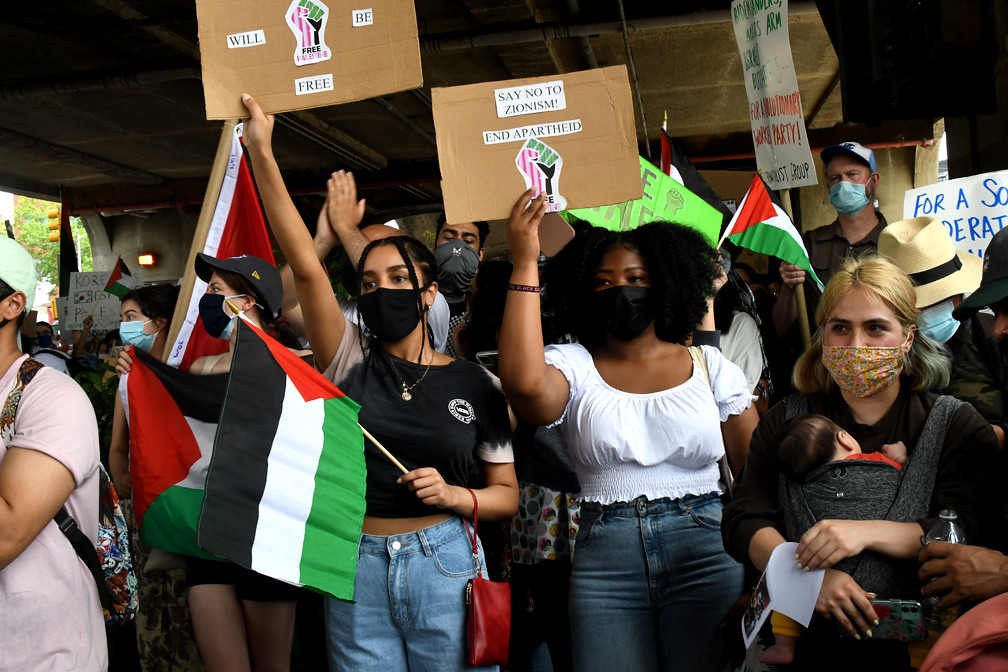
Nov. 29 is the International Day of Solidarity with the Palestinian People, marked by the United Nations since 1977. But how can solidarity be effectively shown in the context of ongoing, escalating war? Here is what women in Palestine say.

Doaa Ahmad, a women’s rights activist and the head of programs for a grassroots organization in northern Gaza, and her three boys just escaped death for the fourth time. Doaa fetches her laptop and work-related material every time she escapes. Even in genocide, Doaa says, I have a duty to help others, particularly women and girls. (Doaa and the other women in this story have had their names changed at their request.)

The widely recognized genocide in Gaza has claimed the lives of at least 50,000 Palestinians, and displaced nearly all its population, 1,000,000 of whom are women. Every hour, two mothers lose their lives. Sexual violence is used against Palestinian women and men. According to a U.N. report, the Gaza blockade has taken a heavy toll on women and girls by undermining living conditions, restricting access to essential services, increasing their care burden, and heightening vulnerability to all forms of gender-based violence. Experts are “appalled” by reports of deliberate targeting and extrajudicial killing of Palestinian women and children in places of refuge or while fleeing.

The brunt of the work of survival in Gaza rests on local organizations. UN Women estimates that 83 percent of Gaza’s women’s organizations are still at least partially operational. Dina Sami, finds time to work on women protection services and support survivors of gender-based violence. She and her team, all of whom live in a school-turned-shelter in Khan Younis, installed a tent to provide counseling for women and girls in need. “All of our programs were disrupted and changed, all our premises were destroyed, 10 of our colleagues were killed, and many of us are grieving,” Sami said. “However, we are committed to create safe spaces for women and girls and help them with whatever tools and capacities we have left.”

Shaden Emad works in a local organization that provides pro bono legal representation services for survivors of gender-based violence in Tubas, in the northeast of the West Bank. Settler attacks make commuting between cities and villages dangerous for Palestinians. The increase in settler attacks limit Shaden’s ability to work in courts and shelters. “International solidarity can shed light on the challenges faced by grassroots women organizations working in Area C [an area administered by Israel, comprising of 60 percent of the West Bank] and the Jordan Valley,” she said. “International voices and donors must support us to amplify our voices in the face of the shrinking civic space.”

Solidarity with the Palestinian people is solidarity with Doaa, Dina and Shaden. International solidarity with Palestinian women’s organizations and activists means influencing governments to uphold human and civil rights of Palestinians, including their right to independence and self-determination. At the same time, it’s important to hold Israel accountable for crimes against humanity, including the Gaza genocide, and the suffering inflicted under colonization and occupation — as well as for the dispossession from land and resources, and lost opportunities for the Palestinian people.

Standing with Palestinians is not buying goods from companies that fund the genocide. We have the power to say no. Students around the world have been demanding divestment from Israel. Nobel Peace Prize laureate the American Friends Service Committee has compiled a thorough list of companies profiting from the ongoing war. One concrete way to stand with our Palestinian sisters is with our buying power.

International solidarity means holding politicians accountable. Governments’ supporting Israel are complicit in terror. We cannot stand by in silence. This moment demands that all states that signed the Rome Statute establishing the International Criminal Court now uphold their obligations by enforcing the court’s arrest warrants for Israel’s Prime Minister Benjamin Netanyahu and former Defense Minister Yoav Gallant. (A warrant has also been issued for the military leaders of Hamas). This moment also demands an arms embargo. Britain, Italy, Spain, Belgium, the Netherlands and Canada have suspended arms trade with Israel.

What can you, as one individual, do? Lobby your government, protest, demand action and lobby again.

Our struggle is the Palestinian struggle. Our fight is Doaa’s fight for resistance, Dina’s fight for justice, and Shaden’s fight for freedom.

On this day, as violence and misogyny echo across the world, let us reimagine feminist solidarity. Women everywhere must seek sisterhoods, we must foster direct partnerships with Palestinian women’s groups and amplify their voices and agency.

Tawakkol Karman is a Nobel Peace Prize laureate. She was awarded the prize in 2011 in recognition of sparking the nonviolent struggle for women’s rights and democracy in Yemen. She is a journalist and human rights advocate. Tawakkol is the founder of Tawakkol Karman Foundation and a member of Nobel Women’s Initiative.
The Fascist Counter-revolution


Karl Korsch
 1940

First Published: in Living Marxism, Volume 5, Number 2, Fall 1940, pp. 29-37
Source: Class Against Class;
Transcribed: by Zdravko Saveski, for marxists.org 2009;

What hope have we revolutionary Marxists, remnants of a past epoch, inheritors of its most advanced theories, illusions, ideologies-what hope have we left for a revolutionary turn of the sweeping counterrevolutionary movement of victorious fascism? The fate of France has finally proved that the old Marxist slogan of "world revolution" has in our epoch assumed a new meaning. We find ourselves today in the midst not of a socialist and proletarian but of an ultra-imperialistic and fascist world revolution. Just as in the preceding epoch every major defeat-the defeat of France in 1871, that of Russia, Germany, Hungary in 1905, 1917, 1918-resulted in a genuine revolution, so in our time each defeated country resorts to a fascist counterrevolution. Moreover, present-day war itself has become a revolutionary process, a civil war with an unmistakably predominant counterrevolutionary tendency. Just as in a horse race we do not know which horse will win but we do know that it will be a horse, so in the present war the victory of either party will result in a further gigantic step toward the fascization of Europe, if not of the whole European, American, Asiatic world of tomorrow.


I

There seem to be two easy ways for the "orthodox" Marxist of today to handle this difficult problem. Well-trained in Hegelian philosophical thought, he might say that all that is, is reasonable, and that, by one of those dialectical shifts in which history rejoices, socialism has been fulfilled by the social revolution implied in the victory of fascism. Thus Hegel himself at first followed the rising star of the French Revolution, later embraced the cause of Napoleon, and ended by acclaiming the Prussian state that emerged from the anti-Napoleonic wars of 1812-1815 as the fulfilment of the philosophical "idea" and as the "state of reason" corresponding to the given stage of its historical development.

Or, for that matter, our orthodox Marxist might not be willing, for the present, to go so far as to acknowledge the fascist allies of Stalin as the genuine promoters of socialism in our time. He would then content himself with feeling that the victory of fascism, planned economy, state capitalism, and the weeding out of all ideas and institutions of traditional "bourgeois democracy" will bring us to the very threshold of the genuine social revolution and proletarian dictatorship - just as, according to the teachings of the early church, the ultimate coming of Christ will be immediately preceded by the coming of the Anti-Christ who will be so much like Christ in his appearance and in his actions that the faithful will have considerable difficulty in seeing the difference.

In so reasoning, our orthodox Marxist would not only conform with the church but would also keep well in line with the precedents set by the earlier socialists and "revolutionary" Marxists themselves. It was not only the moderately progressive bourgeois ex-minister Guizot who was deceived by the revolutionary trimmings of Louis Napoleon's coup d'etat of 1851 and, when he heard the news burst out into the alarmed cry, "This is the complete and final triumph of socialism." Even the leading representative of French socialism, P. J. Proudhon, was taken in by the violently anti-bourgeois attitude displayed by the revolutionary imperialist, and he devoted a famous pamphlet to the thesis that the coup d'etat of the Second of December did in fact "demonstrate the social revolution."[1]

Indeed, in many ways that counterrevolutionary aftermath of 1848 is comparable to the infinitely more serious and more extended counterrevolutionary movement through which European society is passing today after the experience of the Russian, the German, and the other European revolutions which followed in the wake of the First World War. Every party and every political tendency had to go through a certain period of bewilderment until it had adapted itself to a totally changed situation. Marx himself, although he utterly despised the imperialist adventurer because of his personal inadequacy, was inclined to believe in the revolutionary significance of the counterrevolutionary coup. He described the historical outcome of the two years of revolutionary defeat from 1848 to 1849 by the paradoxical statement that "this time the advance of the revolutionary movement did not effect itself through its immediate tragicomic achievements but, the other way round, through the creation of a united and powerful counterrevolution, through the creation of an antagonist by opposing whom the party of revolt will reach its real revolutionary maturity." And even after the fateful event he most emphatically restated his conviction that "the destruction of the parliamentary republic contains the germs of the triumph of the proletarian revolution." This is exactly what the German Communists and their Russian masters said 80 years later when they welcomed the advent of Nazism in Germany as a "victory of revolutionary communism."

This ambiguous attitude of Proudhon and Marx toward counterrevolution was repeated ten years later by Ferdinand Lassalle, a close theoretical disciple of Marx and at that time the foremost leader of the growing socialist movement in Germany. He was prepared to cooperate with Bismarck at the time when that unscrupulous statesman was toying with the idea of bribing the workers into acceptance of his imperialistic plans by an apparent adoption of the universal franchise and some other ideas borrowed from the 1848 revolution and the Second Empire. Lasalle did not live to see Bismarck at the end of the 70's, when he had subdued the liberals and the ultra-montane Catholic party, revert to his old dream of enforcing a kind of "tory-socialism" based on a ruthless persecution and suppression of all genuine socialist workers' movements.

There is no need to discuss the wholesale conversion of internationalists into nationalists and proletarian Social Democrats into bourgeois democratic parliamentarians during and after the First World War. Even such former Marxists as Paul Lensch accepted the war of the Kaiser as a realistic fulfilment of the dreams of a socialist revolution, and the about-face of the socialists they themselves glorified as a "revolutionization of the revolutionaries." There was a "national-bolshevist" fraction of the German Communist party long before there was a Hitlerian National Socialist Party. Nor does the military alliance that was concluded "seriously and for a long time" between Stalin and Hitler in August 1939, contain any novelty for those who have followed the historical development of the relations between Soviet Russia and imperial, republican, and Hitlerian Germany throughout the last twenty years. The Moscow treaty of 1939 had been preceded by the treaties of Rapallo in 1920 and of Berlin in 1926. Mussolini had already for several years openly proclaimed his new fascist credo when Lenin was scolding the Italian Communists for their failure to enlist that invaluable dynamic personality in the service of their revolutionary cause. As early as 1917, during the peace negotiations in Brest Litovsk, Rosa Luxemburg and Karl Liebknecht had been aware of the dreadful danger that was threatening the proletarian revolution from that side. They had said in so many words that "Russian socialism based on reactionary Prussian bayonets would be the worst that still could happen to the revolutionary workers' movement."

It appears from this historical record that there is indeed something basically wrong with the traditional Marxian theory of the social revolution and with its practical application. There is no doubt, today less than at any former time in history, that the Marxian analysis of the working of the capitalist mode of production and of its historical development is fundamentally correct. Yet it seems that the Marxian theory in its hitherto accepted form is unable to deal with the new problems that arise in the course of a not merely occasional and temporary but deep-rooted, comprehensive, and enduring counterrevolutionary development.


II

The main deficiency of the Marxian concept of the counterrevolution is that Marx did not, and from the viewpoint of his historical experience could not, conceive of the counterrevolution as a normal phase of social development. Like the bourgeois liberals he thought of the counterrevolution as an "abnormal" temporary disturbance of a normally progressive development. (In the same manner, pacifists to the present day think of war as an abnormal interruption of the normal state of peace, and physicians and psychiatrists until recently thought of disease and more especially the diseases of the mind as an abnormal state of the organism.) There is, however, between the Marxian approach and that of the typical bourgeois liberal this important difference: they start from a totally different idea about just what is a normal condition. The bourgeois liberal regards existing conditions or at least their basic features as the normal state of things, and any radical change as its abnormal interruption. It does not matter to him whether that disturbance of existing normal conditions results from a genuinely progressive movement or from a reactionary attempt to borrow revolution's thunder for the purpose of a counterrevolutionary aggression. He is afraid of the counterrevolution just as much as of the revolution and just because of its resemblance to a genuine revolution. That is why Guizot called the coup d'etat "the complete and final triumph of the socialist revolution" and why, for that matter, Hermann Rauschning today describes the advent of Hitlerism as a "revolt of nihilism."

As against the bourgeois concept, the Marxian theory has a distinct superiority. It understands revolution as a completely normal process. Some of the best Marxists, including Marx himself and Lenin, even said on occasion that revolution is the only normal state of society. So it is, indeed, under those objective historical conditions which are soberly stated by Marx in his preface to the "Critique of Political Economy."

Marx did not, however, apply the same objective and historical principle to the process of counterrevolution, which was known to him only in an undeveloped form. Thus, he did not see, and most people do not see today, that such important counterrevolutionary developments as those of present-day fascism and nazism have, in spite of their violent revolutionary methods, much more in common with evolution than they have with a genuine revolutionary process. It is true that in their talk and propaganda both Hitler and Mussolini have directed their attack mostly against revolutionary Marxism and communism. It is also true that before and after their seizure of state power they made a most violent attempt to weed out every Marxist and Communist tendency in the working classes. Yet this was not the main content of the fascist counterrevolution. In its actual results the fascist attempt to renovate and transform the traditional state of society does not offer an alternative to the radical solution aimed at by the revolutionary Communists. The fascist counterrevolution rather tried to replace the reformist socialist parties and trade unions, and in this it succeeded to a great extent.

The underlying historical law, the law of the fully developed fascist counterrevolution of our time, can be formulated in the following manner: After the complete exhaustion and defeat of the revolutionary forces, the fascist counterrevolution attempts to fulfil, by new revolutionary methods and in widely different form, those social and political tasks which the so-called reformistic parties and trade unions had promised to achieve but in which they could no longer succeed under the given historical conditions.

A revolution does not occur at some arbitrary point of social development but only at a definite stage. "At a certain stage of their development the material productive forces of society come into contradiction with the existing production-relations (or property-relations) within which they hitherto moved. From being forms of development, those relations turn into fetters upon the forces of production. Then a period of social revolution sets in." And again Marx emphasized, and even to a certain extent exaggerated, the objectivistic principle of his materialist theory of revolution according to which "a formation of society never perishes until all the forces of production for which it is wide enough have been developed." All this is true enough as far as it goes. We have all seen how evolutionary socialism reached the end of its rope. We have seen how the old capitalistic system based on free competition and the whole of its vast political and ideological superstructure was faced by chronic depression and decay. There seemed no way open except a wholesale transition to another, more highly developed form of society, to be effected by the social revolution of the proletarian class.

The new historical development during the last twenty years showed, however, that there was yet another course open. The transition to a new type of capitalistic society, that could no longer be achieved by the democratic and peaceful means of traditional socialism and trade unionism, was performed by a counterrevolutionary and anti-proletarian yet objectively progressive and ideologically anti-capitalistic and plebeian movement that had learned to apply to its restricted evolutionary aims the unrestricted methods developed during the preceding revolution. (More particularly, both Hitler and Mussolini had learned much in the school of Russian Bolshevism.) Thus, it appeared that the evolution of capitalistic society had not reached its utter historical limit when the ruling classes and the reformistic socialists-those self-appointed "doctors at the sickbed of capitalism" -reached the limits of their evolutionary possibilities. The phase of peaceful democratic reforms was followed by another evolutionary phase of development-that of the fascist transformation, revolutionary in its political form but evolutionary in its objective social contents.

The decisive reason that the capitalistic formation of society did not perish after the collapse of the First World War is that the workers did not make their revolution. "Fascism," said its closest enemy, "is a counterrevolution against a revolution that never took place." Capitalistic society did not perish, but instead entered a new revolutionary phase under the counterrevolutionary regime of fascism, because it was not destroyed by a successful workers' revolution, and because it had not, in fact, developed all the forces of production. The objective and the subjective premises are equally important for the counterrevolutionary conclusion.

From this viewpoint all those comfortable illusions about a hidden revolutionary significance in the temporary victory of the counterrevolution, in which the earlier Marxists so frequently indulged, must be entirely abandoned. If counterrevolution is only extremely and superficially connected with a social revolution by its procedures, but in its actual content is much more closely related to the further evolution of a given social system, and is in fact a particular historical phase of that social evolution, then it can no longer be regarded as a revolution in disguise. There is no reason to hail it either as an immediate prelude to the genuine revolution, or as an intrinsic phase of the revolutionary process itself. It appears as a particular phase of the whole developmental process, not inevitable like revolution yet becoming an inevitable step within the development of a given society under certain historical conditions. It has reached its up-to-now most comprehensive and important form in the present day fascist renovation and transformation of Europe, which in its basic economic aspect appears as a transition from the private and anarchic form of competitive capitalism to a system of planned and organized monopoly capitalism or state capitalism.


III

It would be the greatest folly and, for people even slightly imbued with the great discoveries of Marx in the field of the social sciences, a total relapse into a pre-materialist and pre-scientific manner of thought if one were to expect that the historical progress from competitive capitalism to planned economy and state capitalism could be repealed by any power in the world. Least of all can fascism be defeated by those people who, after a hundred years of shameless acquiescence in the total abandonment of their original ideals, now hasten to conjure up the infancy of the capitalist age with its belief in liberty, equity, fraternity, and free trade, while at the same time they surreptitiously and inefficiently try to imitate as far as possible fascism's abolition of the last remnants of those early capitalist ideas. They feel a sudden and unexpected urge to celebrate the French Revolution's fourteenth of July and at the same time dream of destroying fascism by adopting fascist methods.

In opposition to the artisan and petty-bourgeois spirit of early utopian socialism, the first word of scientific and proletarian socialism stated that big industry and the machine age had come to stay, that modern industrial workers had to find a cure for the evils of the industrial age on the basis of a further development of the new industrial forces themselves. In the same manner the scientific and proletarian socialists of our time must try to find remedies for the wrongs of monopoly capitalism and fascist dictatorship on the basis of monopoly and state capitalism itself. Neither free trade (that was not so free for the workers after all) nor the other aspects of traditional bourgeois democracy - free discussion and free press and free radio - will ever be restored. They have never existed for the suppressed and exploited class. As far as the workers are concerned, they have only exchanged one form of serfdom for another.

There is no essential difference between the way the New York Times and the Nazi press publish daily "all the news that's fit to print"-under existing conditions of privilege and coercion and hypocrisy. There is no difference in principle between the eighty-odd voices of capitalist mammoth corporations-which, over the American radio, recommend to legions of silent listeners the use of Ex-Lax, Camels, and neighbourhood groceries, along with music, war, baseball and domestic news, and dramatic sketches-and one suave voice of Mr. Goebbels who recommends armaments, race-purity, and worship of the Fuehrer. He too is quite willing to let them have music along with it-plenty of music, sporting news, and all the unpolitical stuff they can take.

This criticism of the inept and sentimental methods of present-day anti-fascism does not imply by any means that the workers should do openly what the bourgeoisie does under the disguise of a so-called antifascist fight: acquiesce in the victory of fascism. The point is to fight fascism not by fascist means but on its own ground. This seems to the present writer to be the rational meaning of what was somewhat mystically described by Alpha in the spring issue of Living Marxism as the specific task of "shock-troops" in the anti-fascist fight. Alpha anticipated that even if the localized war-of-siege waged during the first seven months of the present conflict were to extend into a general fascist world war, this would not be a "total war" and an unrestricted release of the existing powers of production for the purpose of destruction. Rather, it would still remain a monopolistic war in which the existing powers of production (destruction) would be fettered in many ways for the benefit of the monopolistic interests of privileged groups and classes. It would remain that kind of war from fear of the emancipatory effect that a total mobilization of the productive forces, even restricted to the purpose of destruction, would be bound to have for the workers or, under the present-day conditions of totally mechanized warfare, for the shocktroopers who perform the real work of that totally mechanized war.

This argument of Alpha’s can be applied more widely and much more convincingly. First of all we can disregard for the moment (although we shall have to return to it at a later stage) the peculiar restriction of the argument to the "shock-troops" and to the conditions of war. The whole traditional distinction between peace and war, production and destruction, has lost in recent times much of that semblance of truth that it had in an earlier period of modern capitalistic society. The history of the last ten years has shown that ever since, in a world drunk with apparent prosperity, the American Kellogg Pact outlawed war, peace has been abolished. From the outset Marxism was comparatively free from that simple-mindedness which believed in an immediate and clear-cut difference between production-for-use and production-for-profit. The only form of production-for-use under existing capitalistic conditions is just the production-for-profit. Productive labor for Marx, as for Smith and Ricardo, is that labor which produces a profit for the capitalist and, incidentally, a thing which may also be useful for human needs. There is no possibility of establishing a further distinction between a "good" and a "bad," a constructive and a destructive usefulness. The Goebbelian defense of the "productivity" of the labor spent on armaments in Germany by referring to the amount of "useful" labor spent in the United States for cosmetics had no novelty for the Marxist. Marx, who described the working class in its revolutionary fight as "the greatest of all productive forces" would not have been afraid to recognize war itself as an act of production, and the destructive forces of modern mechanized warfare as part of the productive forces of modern capitalistic society, such as it is. He, like Alpha, would have recognized the "shock-troops" in their "destructive" activity in war as well as in their productive activity in industry (armament and other industries-war industries all!) as real workers, a revolutionary vanguard of the modern working class. Historically it is a well-established fact that the soldier (the hired mercenary) was the first modern wage-laborer.

Thus, the old Marxian contradiction between the productive forces and the given production relations reappears in the warlike as well as in the peaceful activities of modern fascism. With it there appear again the old contrast between the workers, who as a class are interested in the full application and development of the productive forces, and the privileged classes, the monopolists of the material means of production. More than at any previous time the monopoly of political power reveals itself as the power to rule and control the social process of production. At the same time this means, under present conditions, the power to restrict production-both the production of industry in peace and destructive production in time of war-and to regulate it in the interest of the monopolist class. Even the "national" interest that was supposed to underly the present-day fascist war waged by Hitler and Mussolini is revealed by the war itself and will be revealed much more clearly by the coming peace as being ultimately an interest of the international capitalist and monopolist class. Much more clearly than at the end of the First World War it will appear that this war is waged by both parties-by the attacking fascists as well as by the defending "democrats"-as a united counterrevolutionary struggle against the workers and the soldiers who by their labor in peace and war prepared and fought the truly suicidal war.

What, then, is the hope left for the anti-fascists who are opposing the present European war and who will oppose the coming war of the hemisphere? The answer is that, just as life itself does not stop at the entrance of war, neither does the material work of modern industrial production. Fascists today quite correctly conceive the whole of their economy-that substitute for a genuine socialist economy-in terms of a "war economy" (Wehrwirtschaft). Thus, it is the task of the workers and the soldier to see to it that this job is no longer done within the restrictive rules imposed upon human labor in present-day capitalist, monopolist, and oppressive society. It has to be done in the manner prescribed by the particular instruments used; that is, in the manner prescribed by the productive forces available at the present stage of industrial development. In this manner both the productive and the destructive forces of present-day society-as every worker, every soldier knows-can be used only if they are used against their present monopolistic rulers. Total mobilization of the productive forces presupposes total mobilization of that greatest productive force which is the revolutionary working class itself.

Notes

[1] Oeuvres Completes de Proudhon, vol. VIII, Paris, 1868.

[2] First article on Class Struggles in France, Neue Rheinische Zeitung, January, 1850.

[3] The Eighteenth Brumaire of Louis Bonaparte, February, 1852.

[4] Ignazio Silone, School of Dictators, 1938.

[5] Living Marxism, vol. V, no. I, pp. 44-58.

Karl Korsch Archive