RUSSO UKRAINE WAR AT SEA
Ukraine Expands Caspian Sea Strikes Hitting Russian Vessels Carrying Arms
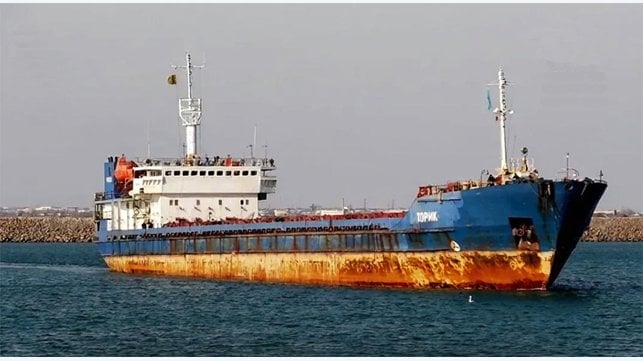
Days after Ukraine claimed its first-ever strike on an oil platform in the Caspian Sea, the Special Forces are reporting that they have expanded the attacks. They are claiming strikes on two Russia-flagged cargo ships reported to be carrying arms and military equipment.
The Special Operations Forces released reports saying that with the aid of resistance fighters, it had been able to track the two vessels. It did not say how the vessels were struck or provide details on the damage.
They claimed strikes on the Kompozitor Rakhmaninov (IMO: 8606616), a Ro-Ro cargo ship operating under the Russian flag, and the Askar Sarydzha (IMO: 9082142), a General Cargo, also sailing under the Russian flag. The Rakhmaninov is a 4,600 dwt vessel built in 1986, while the Askar Sarydzha is 6,200 dwt. Both vessels are owned by MG-Flot.
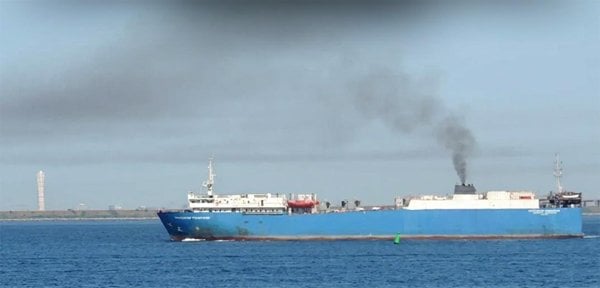
Kompozitor Rakhmaninov was sanctioned in 2024 (Ukraine SOF)
The United States imposed sanctions in September 2024 on the Rakhmaninov as property of the sanctioned MG-Flot. They said the vessel regularly operated on the Caspian Sea, transported cargo between Iran and Russia. The Askar Sarydzha was sanctioned by the United States in May 2022 for transporting weapons for the Russian Federation.
Ukraine reported that the “Black Spark” resistance movement provided detailed information about the routes and cargo of the two vessels.
Separate, unconfirmed reports indicated that Ukraine had also staged a second wave of attacks on the Russian oil platforms in the Caspian Sea. It said that the Lukoil platform Filanovsky had been struck for the second time and that attacks expanded to the Korchagin platform.
It comes as Ukraine has asserted that it is expanding the geography of its attacks, with experts pointing out that the Caspian Sea is more than 450 miles from the Ukrainian border. Ukraine has said it is increasing its focus on Russia’s oil operations to choke off the revenues used to maintain the war.
Turkish-Owned RoPax on Fire After Russian Attack on Odesa Region
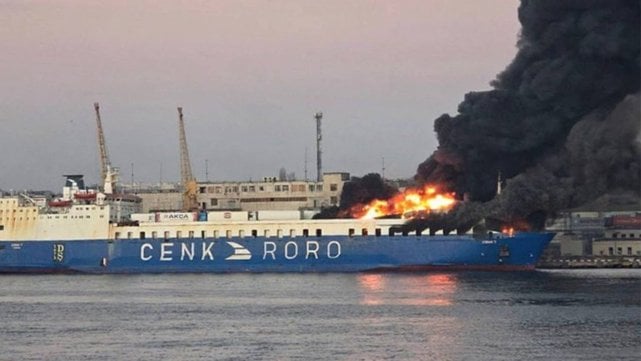
A Turkish-owned RoPax transporting cargo to Ukraine was set on fire during a midday Russian attack on the Great Odesa region. Reports indicate that one person, possibly a dockworker, was injured, but there are no fatalities.
The Ukrainian Air Force had issued the alert at around 1500 local time, reporting high-speed targets coming from the south. It is believed that at least two ballistic missiles had been fired, as well as a launch of drones. It followed an overnight barrage on the same region, which reportedly left more than 90,000 families without electricity. The missiles were targeting Odesa and Chornomorsk, while the drones also targeted Pividennyi.
The Turkish Foreign Ministry confirmed a vessel strike, reporting that the crew and truck drivers were being evacuated. Pictures and videos posted online show the forward section of the vessel ablaze with Ukrainian firefighters working to control the fire.
The vessel is the Cenk T, owned by Turkey’s Cenk RoRo. Built in 1978, the vessel previously operated for Stena and has been owned by the Turks since 2021. It is 21,000 GT / 8,400 dwt with a capacity to transport up to 130 trucks. Security consultants Vanguard quotes the vessel's owners as saying the ship was carrying "essential food supplies."
The Turkish ministry, in its statement, reiterated its “concerns regarding maritime security and freedom of navigation, as the ongoing war in our region is spreading to the Black Sea… we once again emphasize the importance of urgently ending the war between Russia and Ukraine, and we recall the need for an arrangement to ensure navigation safety in the Black Sea and for the parties to suspend attacks targeting energy and port infrastructure in order to prevent escalation.”
Vanguard quotes the Ukrainian Navy as reporting a total of three ships were damaged in today's attacks at two of Ukraine's ports. The details on the other ships have not been confirmed, and the damage appears to be minor compared to Cenk T which continued to burn into the night.
Tanker Operator Quits Russian Trade After Suspected Ukrainian Strike
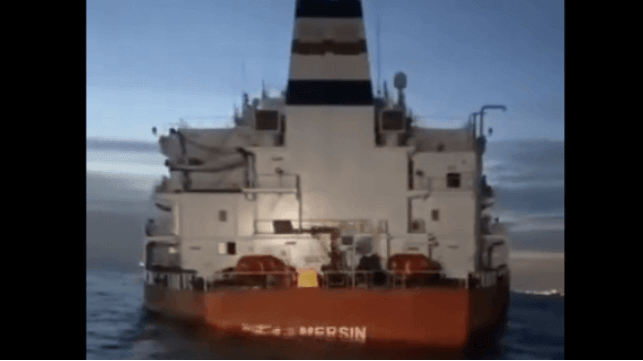
After one of its vessels was hit and damaged in a suspected Ukrainian attack, Turkish tanker owner Besiktas Shipping has decided to quit all trade with Russia. The business decision suggests that Ukraine's covert and overt strikes have created a strong perception of ongoing risk to Russia-linked energy shipping, and not just in the Black Sea.
On the night of November 27-28, the Besiktas-owned tanker Mersin was at anchor off the coast of Senegal when flooding occurred in the engine room. The Senegalese Navy responded to the scene and the crew were all safely rescued, but photos showed the tanker's stern riding low in the water. Besiktas later reported that Mersin had been struck by four "external explosions."
AIS data provided by Pole Star Global shows that the vessel had previously called at multiple Russian ports in the Black Sea, including some as recent as August. The attack on the Mersin occurred at almost the same time as the Ukrainian drone boat strikes on two tankers in the Black Sea, the Kairos and the Virat. Both are known "shadow fleet" vessels with opaque ownership and ties to the Russian energy trade, and Ukraine claimed responsibility for strikes on both vessels - but not the strike on the Mersin.
In a statement, Besiktas said that it has not violated any international sanctions, and said that it has maintained "full compliance with the G7/EU price cap mechanism and all relevant trade restrictions." In the same message, without naming Ukraine directly, the company said that regional security risks have grown too high to continue trading to Russia.
"We have decided to cease all shipping operations involving Russian interests," Besiktas said in a brief update on its site. "After a thorough assessment, we have concluded that the risks posed to our vessels and crew have become untenable."
Besiktas Shipping has been in the tanker business for six decades, and it also manages dry bulk vessels. It has about three dozen ships under management, primarily product tankers. Two of these vessels - Esentepe and Kocatepe - were previously sanctioned by the government of Ukraine for alleged involvement in deceptive shipping practices with Russian cargoes.
Third Shadow-Fleet Tanker Hit by Suspected Ukrainian Drone-Boat Attack
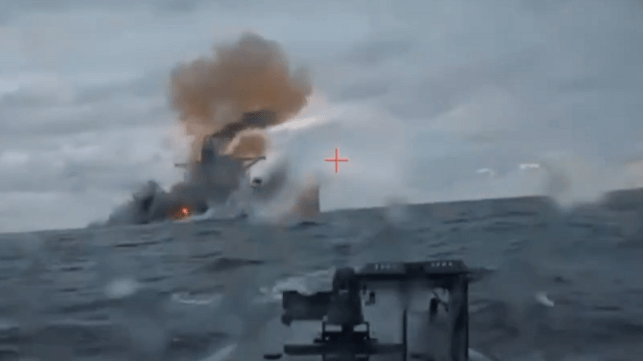
Russian and Ukrainian sources report that Ukraine's covert operations agency has attacked another Russia-facing "shadow fleet" tanker in the Black Sea. If accurate, it would be the third strike on a foreign-flag tanker in a month by Ukraine's drone-boat units.
The target vessel has been named as the Dashan (ex name Mianzimu, IMO 9299666), a 2005-built Suezmax of 165,000 dwt. According to Ukrainian accounts, the vessel was under way for Novorossiysk to take on a load of Russian oil.
Dashan is associated with the former Gatik Ship Management fleet, and is sanctioned by the European Union and the UK for suspicious transactions involving Russian oil. Previously flagged in Gabon and Comoros, the vessel is currently stateless and flying a false flag, according to IMO database Equasis.
Video feed footage appearing to show the drone-boat attack has emerged on social media, and it suggests that Dashan was hit at least two times in way of the engine room. The video footage shows a Ukrainian drone edging up to the tanker's port quarter as the vessel was under way, then driving under the counter of the stern and making contact with the hull. (The vessel was in ballast, exposing the counter and other areas normally submerged.) The blast was recorded by another drone.
A second video clip shows a similar drone approaching and making contact with the starboard quarter in approximately the same area, just forward of the rudder. The final clip shows smoke and flame enveloping the transom, and appears to show that the vessel was slightly trimmed by the stern after the strikes.
Ukraine has not claimed formal responsibility for the strike, but its leaders have made clear that stopping Russian tankers is a high priority, and confirmed the two previous tanker strikes. Off the record, a Ukrainian official told Ukrinform that the 13th Main Directorate of the SBU and the Ukrainian Navy were responsible for the attack on Dashan.
Surface conditions were calm in the footage, and the Dashan was under way at a slow bell with minimal wake - factors that would have facilitated the boat handling required for such a precision attack. The target selection - aft, under the counter - matched previous Ukrainian attacks and would favor flooding the engine room without causing a major spill or a sinking. Likewise, the selection of an unladen tanker would minimize the potential magnitude of any spill or fire; it also maximizes the target vessel's reserve buoyancy, with positive implications for its odds of staying afloat and odds of crew survival.
Ukraine Damages Russian LPG Export Terminal on Sea of Azov
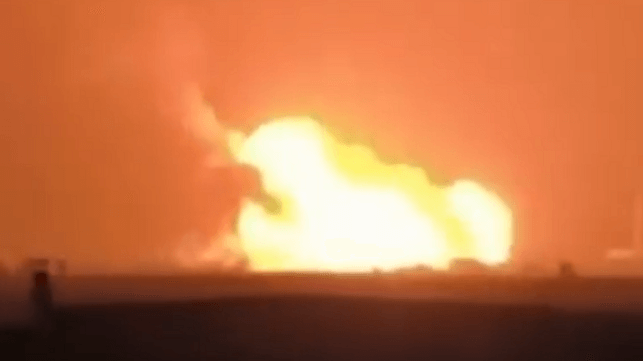
Ukraine's armed forces have hit a fuel terminal at the Russian port of Temryuk, a small harbor on the Sea of Azov. The port is home to a liquefied petroleum gas (LPG) export terminal, which is designed to move 400,000 tonnes of gas per year.
The Maktren-Nafta LPG terminal has a total of 30 storage tanks for up to 6,000 tonnes of LPG storage. It was built by Ukrainian contractor Ukrgazproekt in the years before the war, and was the first purpose-built transshipment terminal of its kind in Russia.
A Ukrainian special forces strike on December 5 destroyed 20 tanks, or two-thirds of onsite storage capacity, according to Ukraine's SBU service. The fire reportedly burned for three days, based on social media reports from within Russia. The extent of the damage could not be independently confirmed, but could potentially reduce Russian revenue from petroleum exports until repairs are made.
It is not the first time that Ukraine attacked the port. In May 2024, Ukrainian drones and missiles hit petroleum storage tanks at Temryuk, causing a large fire.
The Maktren-Nafta LPG terminal was also indirectly linked to the two-ship LPG carrier fire in the Kerch Strait six years ago, according to Ukrainian outlet Liga. The Turkish-operated LPG carriers Maestro and Candy caught fire during a ship-to-ship transfer operation in January; Maestro had been refused entry to the Maktren-Nata terminal because of U.S. sanctions shortly before the fire. The blaze left about 23 crewmembers dead or lost at sea, and the fires burned for weeks after.

No comments:
Post a Comment