Kurds' dream of self-rule under threat as Turkish-backed forces sweep across Syria
Analysis
Islamist rebels and armed groups backed by Ankara swept across Syria this past week, seizing Aleppo and putting President Bashar al-Assad’s soldiers to flight. Having achieved a hard-won autonomy in the turmoil of the Syrian Civil War, the country’s Kurds now find themselves once again cornered between the Damascus regime, Islamist insurgents and Turkish-backed troops eager to put an end to Kurdish self-rule.
Issued on: 05/12/2024
By: Paul MILLAR

Surrender or die
Fawaz Gerges, professor of international relations at the London School of Economics, said that the militants' lightning assault could cost the Kurds dearly.
“The Kurds stand to lose the most,” he said. “Their very autonomy, the security of their communities. I think Turkey has been biding its time and waiting for the right moment to strike, and the pro-Turkish opposition forces have really launched a shock attack, not only against the Assad government, but even against the Kurds. In Aleppo, the Kurds were told either to surrender or to die – and they decided to surrender.”
While HTS appears to be trying to avoid direct clashes with Kurdish forces, Kurdish civilians now living under the banners of the SNA have reported having their homes seized by Turkish-backed troops. As many as half a million Kurds are believed to live in Aleppo and surrounding towns and villages west of the Euphrates. Just what their lives are likely to be like under the new dispensation remains a question that few are keen to learn the answer to.
Dara Salam, a teaching fellow at SOAS University of London's department of politics and international studies, said that Kurdish communities in Syria's northwest were now once again at the mercy of Ankara's ambitions.
“The sole aim of Turkey-backed SNA is to implement Turkey's Syria policy, that is, destroying the Kurdish entity and having the upper hand over Assad's regime in Syria,” he said. “As the conflict in the past days unravels, Kurds once again face displacement, massacres and persecution at the hands of these jihadi-Islamist groups in many places like Aleppo, Tal Rifaat and Shahba.”
For years now, that policy has been put into increasingly bloody practice. In 2018, Turkish air strikes heralded the seizure of Afrin, the western-most canton of the Autonomous Administration of North and East Syria – more commonly known as Rojava. The occupying SNA has been accused of leading campaigns of mass violence against the Kurdish civilian population.
Dastan Jasim, a research fellow at the GIGA Institute for Middle East Studies, said Syria's Kurds had good reason to be fearful given what she described as years of abuses against Kurdish communities in parts of the country's northwest held by the SNA and Islamist opposition groups.
"The only basis on which Kurds can judge that question is their own experience," she said. "We’re heading towards six years of occupation of Afrin, for example, and Kurdish life in Afrin is a living hell – it’s basically impossible. Sexual violence is rampant, there have been kidnappings of people – just ordinary Kurdish people that are accused out of the blue of being PKK sympathisers are being abducted and killed."
‘In the eye of the storm’
Jasim said that the country's Kurdish communities had long struggled to find a place within the broader array of opposition forces that rose up against Assad more than a decade ago.
“In 2011 when the opposition came up, let’s remember that especially in Aleppo the Kurdish neighbourhoods were very active when it was about protesting against Assad,” she said. “People were obviously not happy with the situation – there have been many Kurdish uprisings that were attacked very violently. But at the same time, the Kurds saw there was no space for them, there was no space for a discussion of Kurdish autonomy, Kurdish self-rule. A lot of the elements are very nationalist, and that’s what we’re seeing right now.”
![]() 42:45
42:45
Having proved themselves to be a fierce and disciplined force against the emerging Islamic State group, the Kurds soon found themselves leading the US-backed SDF. Despite frictions between Washington and Ankara over US support for what Turkey considered to be violent separatist groups, the SDF played a crucial role in reclaiming territory from the Islamic State group.
Since then, though, the Kurds have been increasingly isolated. In 2019, then US president Donald Trump announced his plans to pull the last remaining American troops from Syria, leaving the Kurds undefended in the face of Turkey's advance.
Although Trump's generals managed to convince the president to keep a contingent of troops in the region to secure oil fields, guard against Islamic State group remnants and maintain pressure on Iran, it was a bitter blow for a community already under assault by a US ally and NATO member. Now, with Israel hammering Iran-backed groups across Syria and Trump set to return to the White House in January, Gerges said that forces across the Middle East were anxious to strengthen their hands before inauguration day.
“This is just the beginning – I think what Turkey and its Syrian allies are trying to do is to really basically change the current balance of power on the Turkish-Syrian borders before Trump enters the White House,” he said. “They’re using the retreat of the Assad forces as a means to weaken and degrade the pro-American Kurdish forces. All in all it’s not just that the Assad government is losing territories, but I think the Kurds are also in the eye of the storm. And I think by the end of the current round, their areas will shrink, their power will be degraded and they will be facing bitter choices.”
Gerges said that the next days and weeks of fighting could determine the very survival of the Kurds' long-held dream of self-governance.
“This is what’s going on in the Kurds’ minds – that’s why they called a general mobilisation,” he said. “This is one of the few times that they’re facing in their view a threat of this dimension. It’s no longer really a military threat, it goes to the very heart of what they’ve been trying to achieve since 2011 – full autonomy and a pathway to statehood.”
Analysis
Islamist rebels and armed groups backed by Ankara swept across Syria this past week, seizing Aleppo and putting President Bashar al-Assad’s soldiers to flight. Having achieved a hard-won autonomy in the turmoil of the Syrian Civil War, the country’s Kurds now find themselves once again cornered between the Damascus regime, Islamist insurgents and Turkish-backed troops eager to put an end to Kurdish self-rule.
Issued on: 05/12/2024
By: Paul MILLAR
A Syrian Kurdish woman, fleeing from north of Aleppo, stands leaning on a bullet-riddled wall upon arriving in Tabqa, on the western outskirts of Raqa, on December 4, 2024. © Delil Souleiman, AFP
As Israel and Hezbollah settled into an uneasy ceasefire last week, armed Islamist opposition forces stormed out of Syria’s northwest, seizing the nation’s second city Aleppo over the weekend before advancing south on the road to Damascus.
While the forces of Hayat Tahrir al-Sham (HTS) – an offshoot of al Qaeda’s former Syria branch Jabhat al-Nusra – surged inwards from Idlib, another assault came pouring down from the northern borderlands with Turkey. These groups – backed by Ankara and calling themselves the Syrian National Army – began to seize territory northeast of Aleppo, including the town of Tal Rifaat and surrounding villages on December 1.
But Tal Rifaat was not being held by Assad’s loyalists. Instead, the Syrian National Army has once again set its sights on territory held by the Kurdish People’s Protection Units (YPG), the iron core of the US-backed Syrian Democratic Forces (SDF) – a key Western ally in the fight against the Islamic State (IS) group.
The fighting has been fierce. Already, tens of thousands of Kurds have begun the long winter march east across the Euphrates River, where the Kurdish-led SDF still holds sway. In Aleppo, where SDF troops have held the Kurdish neighbourhoods of Ashrafiyeh and Sheikh Maqsoud throughout the civil war, the triumphant HTS negotiated the Kurdish troops' withdrawal from the city, weapons still in hand. Hours after Aleppo fell, footage emerged of convoys of Kurdish fighters filing out of the city under the watchful gaze of HTS troops.
Worse may await them beyond the city limits. Having seized a hard-won autonomy in the early days of the Syrian Civil War, the country’s Kurds have for the past few years come under heavy assault by Turkey and the Syrian armed groups that it backs. Ankara views the autonomous Kurdish regions in Syria as a creation and extension of the Kurdish Workers' Party (PKK), a group that has for years fought for Kurdish self-rule and is banned in Turkey as a terrorist organisation.
Now, with Assad's global allies exhausted by wars of attrition in Ukraine and Lebanon, Ankara seems once again set on strangling the Kurdish dream of self-governance in the crib.
As Israel and Hezbollah settled into an uneasy ceasefire last week, armed Islamist opposition forces stormed out of Syria’s northwest, seizing the nation’s second city Aleppo over the weekend before advancing south on the road to Damascus.
While the forces of Hayat Tahrir al-Sham (HTS) – an offshoot of al Qaeda’s former Syria branch Jabhat al-Nusra – surged inwards from Idlib, another assault came pouring down from the northern borderlands with Turkey. These groups – backed by Ankara and calling themselves the Syrian National Army – began to seize territory northeast of Aleppo, including the town of Tal Rifaat and surrounding villages on December 1.
But Tal Rifaat was not being held by Assad’s loyalists. Instead, the Syrian National Army has once again set its sights on territory held by the Kurdish People’s Protection Units (YPG), the iron core of the US-backed Syrian Democratic Forces (SDF) – a key Western ally in the fight against the Islamic State (IS) group.
The fighting has been fierce. Already, tens of thousands of Kurds have begun the long winter march east across the Euphrates River, where the Kurdish-led SDF still holds sway. In Aleppo, where SDF troops have held the Kurdish neighbourhoods of Ashrafiyeh and Sheikh Maqsoud throughout the civil war, the triumphant HTS negotiated the Kurdish troops' withdrawal from the city, weapons still in hand. Hours after Aleppo fell, footage emerged of convoys of Kurdish fighters filing out of the city under the watchful gaze of HTS troops.
Worse may await them beyond the city limits. Having seized a hard-won autonomy in the early days of the Syrian Civil War, the country’s Kurds have for the past few years come under heavy assault by Turkey and the Syrian armed groups that it backs. Ankara views the autonomous Kurdish regions in Syria as a creation and extension of the Kurdish Workers' Party (PKK), a group that has for years fought for Kurdish self-rule and is banned in Turkey as a terrorist organisation.
Now, with Assad's global allies exhausted by wars of attrition in Ukraine and Lebanon, Ankara seems once again set on strangling the Kurdish dream of self-governance in the crib.
Surrender or die
Fawaz Gerges, professor of international relations at the London School of Economics, said that the militants' lightning assault could cost the Kurds dearly.
“The Kurds stand to lose the most,” he said. “Their very autonomy, the security of their communities. I think Turkey has been biding its time and waiting for the right moment to strike, and the pro-Turkish opposition forces have really launched a shock attack, not only against the Assad government, but even against the Kurds. In Aleppo, the Kurds were told either to surrender or to die – and they decided to surrender.”
While HTS appears to be trying to avoid direct clashes with Kurdish forces, Kurdish civilians now living under the banners of the SNA have reported having their homes seized by Turkish-backed troops. As many as half a million Kurds are believed to live in Aleppo and surrounding towns and villages west of the Euphrates. Just what their lives are likely to be like under the new dispensation remains a question that few are keen to learn the answer to.
Dara Salam, a teaching fellow at SOAS University of London's department of politics and international studies, said that Kurdish communities in Syria's northwest were now once again at the mercy of Ankara's ambitions.
“The sole aim of Turkey-backed SNA is to implement Turkey's Syria policy, that is, destroying the Kurdish entity and having the upper hand over Assad's regime in Syria,” he said. “As the conflict in the past days unravels, Kurds once again face displacement, massacres and persecution at the hands of these jihadi-Islamist groups in many places like Aleppo, Tal Rifaat and Shahba.”
For years now, that policy has been put into increasingly bloody practice. In 2018, Turkish air strikes heralded the seizure of Afrin, the western-most canton of the Autonomous Administration of North and East Syria – more commonly known as Rojava. The occupying SNA has been accused of leading campaigns of mass violence against the Kurdish civilian population.
Dastan Jasim, a research fellow at the GIGA Institute for Middle East Studies, said Syria's Kurds had good reason to be fearful given what she described as years of abuses against Kurdish communities in parts of the country's northwest held by the SNA and Islamist opposition groups.
"The only basis on which Kurds can judge that question is their own experience," she said. "We’re heading towards six years of occupation of Afrin, for example, and Kurdish life in Afrin is a living hell – it’s basically impossible. Sexual violence is rampant, there have been kidnappings of people – just ordinary Kurdish people that are accused out of the blue of being PKK sympathisers are being abducted and killed."
‘In the eye of the storm’
Jasim said that the country's Kurdish communities had long struggled to find a place within the broader array of opposition forces that rose up against Assad more than a decade ago.
“In 2011 when the opposition came up, let’s remember that especially in Aleppo the Kurdish neighbourhoods were very active when it was about protesting against Assad,” she said. “People were obviously not happy with the situation – there have been many Kurdish uprisings that were attacked very violently. But at the same time, the Kurds saw there was no space for them, there was no space for a discussion of Kurdish autonomy, Kurdish self-rule. A lot of the elements are very nationalist, and that’s what we’re seeing right now.”
Having proved themselves to be a fierce and disciplined force against the emerging Islamic State group, the Kurds soon found themselves leading the US-backed SDF. Despite frictions between Washington and Ankara over US support for what Turkey considered to be violent separatist groups, the SDF played a crucial role in reclaiming territory from the Islamic State group.
Since then, though, the Kurds have been increasingly isolated. In 2019, then US president Donald Trump announced his plans to pull the last remaining American troops from Syria, leaving the Kurds undefended in the face of Turkey's advance.
Although Trump's generals managed to convince the president to keep a contingent of troops in the region to secure oil fields, guard against Islamic State group remnants and maintain pressure on Iran, it was a bitter blow for a community already under assault by a US ally and NATO member. Now, with Israel hammering Iran-backed groups across Syria and Trump set to return to the White House in January, Gerges said that forces across the Middle East were anxious to strengthen their hands before inauguration day.
“This is just the beginning – I think what Turkey and its Syrian allies are trying to do is to really basically change the current balance of power on the Turkish-Syrian borders before Trump enters the White House,” he said. “They’re using the retreat of the Assad forces as a means to weaken and degrade the pro-American Kurdish forces. All in all it’s not just that the Assad government is losing territories, but I think the Kurds are also in the eye of the storm. And I think by the end of the current round, their areas will shrink, their power will be degraded and they will be facing bitter choices.”
Gerges said that the next days and weeks of fighting could determine the very survival of the Kurds' long-held dream of self-governance.
“This is what’s going on in the Kurds’ minds – that’s why they called a general mobilisation,” he said. “This is one of the few times that they’re facing in their view a threat of this dimension. It’s no longer really a military threat, it goes to the very heart of what they’ve been trying to achieve since 2011 – full autonomy and a pathway to statehood.”
Syria rebel leader says goal is to overthrow Assad
By AFP
December 6, 2024

A Syrian rebel fighter cheers as he enters the central city of Hama
Layal Abou Rahal
Rebel forces pressing a lightning offensive in Syria aim to overthrow President Bashar al-Assad’s rule, their Islamist leader said in an interview published on Friday.
The Islamist-led rebels were at the gates of Syria’s Homs, a war monitor said, after wresting other key cities from government control.
In little over a week, the offensive has seen Syria’s second city Aleppo and strategically located Hama fall from President Bashar al-Assad’s control for the first time since the civil war began in 2011.
Should the rebels capture Homs, that would cut the seat of power in the capital Damascus from the Mediterranean coast, a key bastion of the Assad clan.
By Friday morning, the rebels were just five kilometres (three miles) from the edge of Homs, according to the Syrian Observatory for Human Rights monitor.
Abu Mohammed al-Jolani, the leader of the Hayat Tahrir al-Sham (HTS) rebel alliance, said the goal of the offensive was to overthrow Assad’s rule.
“When we talk about objectives, the goal of the revolution remains the overthrow of this regime. It is our right to use all available means to achieve that goal,” Jolani told CNN in an interview.
The rebel alliance conducting the offensive that began on November 27 is led by HTS, which is rooted in the Syrian branch of Al-Qaeda but has sought to moderate its image in recent years.
Fearing the rebels’ advance, tens of thousands of members of Assad’s Alawite minority were fleeing Homs on Thursday, residents and the Observatory said.
Khaled, who lives on the city’s outskirts, told AFP that “the road leading to (coastal) Tartus province was glowing… due to the lights of hundreds of cars on their way out”.
Homs was the scene of a months-long government siege of opposition areas and deadly sectarian attacks in the early years of the civil war.
Early in the war, which began with Assad’s brutal crackdown on democracy protests, activists referred to the city as “the capital of the revolution” against the government.
– ‘Extremely afraid’ –
Haidar, 37, who lives in an Alawite-majority neighbourhood, told AFP by telephone that “fear is the umbrella that covers Homs now”.
“I’ve never seen this scene in my life. We are extremely afraid, we don’t know what is happening.”
After the government lost control of Aleppo and Hama, air strikes targeted a bridge on the highway linking Hama and Homs, the Observatory said.
But on Friday, the rebel alliance “entered the cities of Rastan and Talbisseh” on the main road between Hama and Homs, the monitor added, saying that the factions were faced with “a total absence” of government forces.
The Syrian defence ministry said the army launched strikes against “terrorist” fighters in Hama province.
The Observatory, which relies on a network of sources in Syria, said 826 people, mostly combatants but also including 111 civilians, have been killed since the offensive began last week.
The United Nations said that the violence has displaced 280,000 people, warning that numbers could swell to 1.5 million.
Many of the scenes witnessed in recent days would have been unimaginable earlier in the war.
The rebels announced on Telegram their capture of Hama following street battles with government forces, describing it as “the complete liberation of the city”.
Rebel fighters kissed the ground and let off volleys of celebratory gunfire as they entered the city on Thursday.
Many residents turned out to welcome the rebel fighters. An AFP photographer saw some residents set fire to a giant poster of Assad on the facade of city hall.
The army admitted losing control of the city, though Defence Minister Ali Abbas insisted that the army’s withdrawal was a “temporary tactical measure”.
– ‘Massive blow’ –
In a video posted online, HTS leader Jolani said his fighters had entered Hama to “cleanse the wound that has endured in Syria for 40 years”.
He was referring to an army massacre in Hama in the 1980s that targeted people accused of belonging to the banned Muslim Brotherhood.
In another message on Telegram congratulating “the people of Hama on their victory,” he used his real name, Ahmed al-Sharaa, instead of his nom de guerre for the first time.
Aron Lund, a fellow of the Century International think tank, called the loss of Hama “a massive, massive blow to the Syrian government”.
Should Assad lose Homs, it wouldn’t mean the end of his rule, Lund said.
“But at that point, without Aleppo, Hama or Homs, and with no secure route from Damascus to the coast, I’d say it’s over as a credible state entity,” he added.
UN chief Antonio Guterres said Thursday that the escalation in Syria is the result of a “chronic collective failure” of diplomacy.
The rebels launched their offensive in northern Syria the same day a ceasefire took effect in the war between Israel and Hezbollah in neighbouring Lebanon.
Both Hezbollah and Russia have been crucial backers of Assad’s government, but have been mired in their own conflicts in recent years.
Israel’s army said Friday it had conducted air strikes on Hezbollah “weapon-smuggling routes” on the Syria-Lebanon border, just over a week into the fragile ceasefire in their war.
By AFP
December 6, 2024
A Syrian rebel fighter cheers as he enters the central city of Hama
- Copyright AFP Bakr ALKASEM
Layal Abou Rahal
Rebel forces pressing a lightning offensive in Syria aim to overthrow President Bashar al-Assad’s rule, their Islamist leader said in an interview published on Friday.
The Islamist-led rebels were at the gates of Syria’s Homs, a war monitor said, after wresting other key cities from government control.
In little over a week, the offensive has seen Syria’s second city Aleppo and strategically located Hama fall from President Bashar al-Assad’s control for the first time since the civil war began in 2011.
Should the rebels capture Homs, that would cut the seat of power in the capital Damascus from the Mediterranean coast, a key bastion of the Assad clan.
By Friday morning, the rebels were just five kilometres (three miles) from the edge of Homs, according to the Syrian Observatory for Human Rights monitor.
Abu Mohammed al-Jolani, the leader of the Hayat Tahrir al-Sham (HTS) rebel alliance, said the goal of the offensive was to overthrow Assad’s rule.
“When we talk about objectives, the goal of the revolution remains the overthrow of this regime. It is our right to use all available means to achieve that goal,” Jolani told CNN in an interview.
The rebel alliance conducting the offensive that began on November 27 is led by HTS, which is rooted in the Syrian branch of Al-Qaeda but has sought to moderate its image in recent years.
Fearing the rebels’ advance, tens of thousands of members of Assad’s Alawite minority were fleeing Homs on Thursday, residents and the Observatory said.
Khaled, who lives on the city’s outskirts, told AFP that “the road leading to (coastal) Tartus province was glowing… due to the lights of hundreds of cars on their way out”.
Homs was the scene of a months-long government siege of opposition areas and deadly sectarian attacks in the early years of the civil war.
Early in the war, which began with Assad’s brutal crackdown on democracy protests, activists referred to the city as “the capital of the revolution” against the government.
– ‘Extremely afraid’ –
Haidar, 37, who lives in an Alawite-majority neighbourhood, told AFP by telephone that “fear is the umbrella that covers Homs now”.
“I’ve never seen this scene in my life. We are extremely afraid, we don’t know what is happening.”
After the government lost control of Aleppo and Hama, air strikes targeted a bridge on the highway linking Hama and Homs, the Observatory said.
But on Friday, the rebel alliance “entered the cities of Rastan and Talbisseh” on the main road between Hama and Homs, the monitor added, saying that the factions were faced with “a total absence” of government forces.
The Syrian defence ministry said the army launched strikes against “terrorist” fighters in Hama province.
The Observatory, which relies on a network of sources in Syria, said 826 people, mostly combatants but also including 111 civilians, have been killed since the offensive began last week.
The United Nations said that the violence has displaced 280,000 people, warning that numbers could swell to 1.5 million.
Many of the scenes witnessed in recent days would have been unimaginable earlier in the war.
The rebels announced on Telegram their capture of Hama following street battles with government forces, describing it as “the complete liberation of the city”.
Rebel fighters kissed the ground and let off volleys of celebratory gunfire as they entered the city on Thursday.
Many residents turned out to welcome the rebel fighters. An AFP photographer saw some residents set fire to a giant poster of Assad on the facade of city hall.
The army admitted losing control of the city, though Defence Minister Ali Abbas insisted that the army’s withdrawal was a “temporary tactical measure”.
– ‘Massive blow’ –
In a video posted online, HTS leader Jolani said his fighters had entered Hama to “cleanse the wound that has endured in Syria for 40 years”.
He was referring to an army massacre in Hama in the 1980s that targeted people accused of belonging to the banned Muslim Brotherhood.
In another message on Telegram congratulating “the people of Hama on their victory,” he used his real name, Ahmed al-Sharaa, instead of his nom de guerre for the first time.
Aron Lund, a fellow of the Century International think tank, called the loss of Hama “a massive, massive blow to the Syrian government”.
Should Assad lose Homs, it wouldn’t mean the end of his rule, Lund said.
“But at that point, without Aleppo, Hama or Homs, and with no secure route from Damascus to the coast, I’d say it’s over as a credible state entity,” he added.
UN chief Antonio Guterres said Thursday that the escalation in Syria is the result of a “chronic collective failure” of diplomacy.
The rebels launched their offensive in northern Syria the same day a ceasefire took effect in the war between Israel and Hezbollah in neighbouring Lebanon.
Both Hezbollah and Russia have been crucial backers of Assad’s government, but have been mired in their own conflicts in recent years.
Israel’s army said Friday it had conducted air strikes on Hezbollah “weapon-smuggling routes” on the Syria-Lebanon border, just over a week into the fragile ceasefire in their war.
Damascus gripped by anxiety in face of rebel offensive
By AFP
December 6, 2024

Syrians chat at a cafe in the historic Old City of Damascus.
HTS rebel group sweeping Syria tries to shed its jihadist image
Analysis
Unexpected alliances, seeing strength in "diversity" – Syria's Islamist insurgent group Hayat Tahrir al-Sham (HTS), a former branch of al Qaeda, is trying to soften its public image in a bid to become one of Syria’s key political players. After seizing Aleppo in a lightning offensive, the armed group on Thursday broke Damascus’s hold on the crucial city of Hama.
Issued on: 05/12/2024 -
By: Bahar MAKOOI


According to Nasr, al-Golani maintains that he has put global jihad and international terror behind him, believing “that these things ‘bring nothing but destruction and failure’”. For the Islamist leader, his group “has no problem with the West, his problem is with the Syrian regime as well as the Iranians and Russians that support it”.
HTS and its leader are still designated as terrorist organisations by the United Nations, the US and a number of European countries – a fact that has put something of a crimp in al-Golani’s political ambitions.
“One of his objectives is to be taken off the international list of terrorist organisations so he can travel and become a leading Syrian political player,” Quesnay said.
The new normal
The rebel leader has not been idle. Al-Golani set up the so-called Salvation Government in Idlib, a local administration that serves as a kind of laboratory for what his rule could bring if extended over the whole country.
Nasr, who visited Idlib in 2023, said he had witnessed a limited freedom of religion, with Christian masses tolerated but no displays of crosses or ringing of church-bells allowed. He also described a policy of returning land occupied by foreign jihadists to their Syrian owners, even if they were Christians or Druze.
Ever pragmatic, al-Golani tried to win the support of those living in the territories his group had conquered, Quesnay said.
“In Idlib, the population is mostly Sufi – a popular and more classic form of Syrian Islam,” he said. “We’ve seen HTS evolve little by little, abandoning its original Salafist line to better adapt itself to those it was supposed to be governing. Other experts have noted that minorities such as the Druze and the Kurds also enjoyed some protection.
 11:54© FRANCE 24
“It’s the first time that a group with jihadist roots – that is to say radical Islam – has shown itself to be open to other forms of Islam or other religions,” Quesnay said. “Certainly there has been localised repression against activists, but there have also been regular demonstrations against HTS, and in those cases, al-Golani engaged in the kinds of negotiations that we have usually seen elsewhere.”
“We need to be cautious in how we look at it, but it’s what they’ve been doing in Idlib for five years,” Nasr said. “HTS is far from espousing democratic values or those of a liberal society, but they have taken something of a turn – or found an unexpected third way.”
Charm offensive
Applying the same strategy after the conquest of Aleppo, al-Golani tried to reassure the population of his group’s goodwill – in particular towards the city’s religious and ethnic minorities. In a publicised statement, he called on his fighters not to mistreat the Christian community in Syria’s second city. “Treat them well,” he said, going on to tell local believers that HTS “had treated the Christians of Idlib and Aleppo well – you have nothing to fear”.
Speaking to the city’s large Kurdish minority, HTS offered a message of unity that would have been unimaginable just a few short years ago.
“You have the right to live freely … Diversity is a strength of which we are proud,” the group said in a statement verified by Nasr. “We denounce the actions of the Islamic State group against the Kurds, including the enslavement of women … We are with the Kurds to build the Syria of tomorrow.”
The Islamist rebel group also offered Kurdish fighters the possibility to leave the city with their families.
“They’re working on a corridor to evacuate those who now find themselves in [HTS] territory towards the Kurdish bastions in the northeast, and in good agreement with the YPG – the main Kurdish militia in Syria – which is not necessarily to Turkey’s liking,” Nasr said.
The apparent agreement with the Kurds could irritate the other rebel groups that took part in the seizure of Aleppo. Although HTS may have been the driving force behind the shock assault this past week, it’s not the only one that has been fighting to claim territory.
Partners of convenience
As Aleppo fell, HTS was supported on the northern front by the Syrian National Army (SNA) a coalition of a dozen rebel groups largely financed, equipped and trained by Turkey. Based across a long stretch of the Turkish border, these groups are united by a fierce anti-Kurdish sentiment.
“Ankara was surprised by HTS’s lightning offensive against Aleppo,” Nasr said. Faced with the new facts on the ground, Turkey launched the SNA into the fray “to cut any possible link between the Kurdish bastions of Syria’s northeast and those remaining in Aleppo”, as well as to prevent al-Golani from setting himself up as the sole master of the rebel-held area.
Although HTS and these Turkish-backed armed groups are often referred to as allies, Nasr said, they should more accurately be seen as being in a “balance of power that we can’t call friendly relations”. It’s a relationship marked by much friction – particularly on the Kurdish question.
Al-Golani has not been shy about publicly criticising the SNA’s armed groups – over the reported looting of a factory in Aleppo on December 3, for example.
For Ankara, returning the 3 million Syrian refugees currently residing in Turkey to their homeland is the main priority. A larger and more secure area under rebel control would certainly be a welcome step towards this goal. But it remains to be seen just how much Turkey is prepared to tolerate the fragile entente struck between HTS and the Kurds, who Ankara continues to see as its sworn enemies.
This piece has been adapted from the original in French by Paul Millar.
By AFP
December 6, 2024
Syrians chat at a cafe in the historic Old City of Damascus.
- Copyright AFP Eitan ABRAMOVICH
Like many others in the Syrian capital Damascus, student Shadi chose to stay home so he could keep up with the pace of events since rebels launched a shock offensive last week.
“I had no wish to go out and everyone chose to stay in to follow the news surrounded by their loved ones,” said Shadi, who did not wish to give his full name.
As the rebels have taken city after city in quick succession, many Syrians have been wracked by uncertainty, fearing a revival of the worst days of Syria’s grinding civil war now in its 14th year.
“We don’t understand anything anymore. In just one week, the twists and turns have been so overwhelming that they are beyond all comprehension,” the young man said.
“The worry is contagious but we have to keep our cool,” he said, never once taking his eyes off the alerts on his mobile phone.
Syrian rebels, led by Islamist militant group Hayat Tahrir al-Sham (HTS), launched the shock offensive on November 27, sweeping from their stronghold in the northwest to capture swathes of northern and central Syria including the major cities of Aleppo and Hama.
Government forces have launched a counteroffensive seeking to repel the rebels but at the cost of relaxing their grip on other parts of the country, notably the east where Kurdish-led forces have taken over.
“Whenever rumours spread, people rush to buy various products, bread, rice, sugar and detergents,” said Amine, 56, who runs a grocery store in the Sheikh Saad neighbourhood of the capital.
“Today, I bought twice from my wholesaler to keep up with demand.”
– Exams delayed –
The offensive has already sent food prices skyrocketing by 30 percent in Damascus, according to residents.
The Syrian pound is trading at an all-time low of 19,000 to the dollar, down from 15,000 before the rebels launched their offensive on Wednesday of last week.
Security measures — already strict before the offensive — have been beefed up, with extra car searches, particularly on vehicles coming from outside the capital, according to residents.
Concerns have been further driven by the spread of disinformation and rumours.
The Syrian defence ministry has denounced “fabricated” videos, including of explosions at the headquarters of the general staff, calling on citizens not to fall prey to “lies” that “aim to sow chaos and panic among civilians”.
In the usually lively neighbourhood of Bab Sharqi, restaurants and cafes are near-deserted in the evening, with some even closing up early due to the absence of customers.
Damascus University has delayed end-of-term exams and the Syrian football federation has postponed matches until further notice.
State news agency SANA reported that at Friday prayers, imams called on the faithful “not to panic… and to stand as one behind the Syrian Arab Army to defend the homeland”.
Georgina, 32, said she had “heard a lot of rumours”.
“I went to Old Damascus and saw a normal situation,” she said, adding that nonetheless “everyone was keeping an eye on the news”.
Meanwhile, some radio stations have switched from variety programming to non-stop news segments.
On state television, programmes host analysts and witnesses on the ground, including those denying “rumours” of fresh territorial losses to the advancing rebels.
Like many others in the Syrian capital Damascus, student Shadi chose to stay home so he could keep up with the pace of events since rebels launched a shock offensive last week.
“I had no wish to go out and everyone chose to stay in to follow the news surrounded by their loved ones,” said Shadi, who did not wish to give his full name.
As the rebels have taken city after city in quick succession, many Syrians have been wracked by uncertainty, fearing a revival of the worst days of Syria’s grinding civil war now in its 14th year.
“We don’t understand anything anymore. In just one week, the twists and turns have been so overwhelming that they are beyond all comprehension,” the young man said.
“The worry is contagious but we have to keep our cool,” he said, never once taking his eyes off the alerts on his mobile phone.
Syrian rebels, led by Islamist militant group Hayat Tahrir al-Sham (HTS), launched the shock offensive on November 27, sweeping from their stronghold in the northwest to capture swathes of northern and central Syria including the major cities of Aleppo and Hama.
Government forces have launched a counteroffensive seeking to repel the rebels but at the cost of relaxing their grip on other parts of the country, notably the east where Kurdish-led forces have taken over.
“Whenever rumours spread, people rush to buy various products, bread, rice, sugar and detergents,” said Amine, 56, who runs a grocery store in the Sheikh Saad neighbourhood of the capital.
“Today, I bought twice from my wholesaler to keep up with demand.”
– Exams delayed –
The offensive has already sent food prices skyrocketing by 30 percent in Damascus, according to residents.
The Syrian pound is trading at an all-time low of 19,000 to the dollar, down from 15,000 before the rebels launched their offensive on Wednesday of last week.
Security measures — already strict before the offensive — have been beefed up, with extra car searches, particularly on vehicles coming from outside the capital, according to residents.
Concerns have been further driven by the spread of disinformation and rumours.
The Syrian defence ministry has denounced “fabricated” videos, including of explosions at the headquarters of the general staff, calling on citizens not to fall prey to “lies” that “aim to sow chaos and panic among civilians”.
In the usually lively neighbourhood of Bab Sharqi, restaurants and cafes are near-deserted in the evening, with some even closing up early due to the absence of customers.
Damascus University has delayed end-of-term exams and the Syrian football federation has postponed matches until further notice.
State news agency SANA reported that at Friday prayers, imams called on the faithful “not to panic… and to stand as one behind the Syrian Arab Army to defend the homeland”.
Georgina, 32, said she had “heard a lot of rumours”.
“I went to Old Damascus and saw a normal situation,” she said, adding that nonetheless “everyone was keeping an eye on the news”.
Meanwhile, some radio stations have switched from variety programming to non-stop news segments.
On state television, programmes host analysts and witnesses on the ground, including those denying “rumours” of fresh territorial losses to the advancing rebels.
Analysis
Unexpected alliances, seeing strength in "diversity" – Syria's Islamist insurgent group Hayat Tahrir al-Sham (HTS), a former branch of al Qaeda, is trying to soften its public image in a bid to become one of Syria’s key political players. After seizing Aleppo in a lightning offensive, the armed group on Thursday broke Damascus’s hold on the crucial city of Hama.
Issued on: 05/12/2024 -
By: Bahar MAKOOI
Abu Mohamed al-Golani, head of Hayat Tahrir al-Sham (HTS), an Islamist insurgent group led by Al-Qaeda's former Syria branch, poses for a selfie during a press conference near the Bab al Hawa border crossing in northern Syria, March 12, 2024.
© Omar Haj Kadour, AFP
They took Aleppo in less than three days. Now, the city of Hama, a crucial point on the road to Damascus – and the regime of President Bashar al-Assad – has also fallen. Who are the Islamist rebels of Hayat Tahrir al-Sham, the driving force behind a lightning offensive that has caught the Syrian regime so utterly off guard?
The "Organisation for the Liberation of the Levant", more commonly known by its initials HTS, was the Syrian branch of al Qaeda before disassociating itself in 2016. The group owes much to its strategically minded leader Abu Mohammad al-Golani. This Syrian fighter, a former member of the Islamic State in Iraq – which later expanded into the Islamic State group – founded al-Nusra Front in 2012 before pledging allegiance to al Qaeda in 2013. The two groups reportedly severed ties by mutual agreement three years later.
They took Aleppo in less than three days. Now, the city of Hama, a crucial point on the road to Damascus – and the regime of President Bashar al-Assad – has also fallen. Who are the Islamist rebels of Hayat Tahrir al-Sham, the driving force behind a lightning offensive that has caught the Syrian regime so utterly off guard?
The "Organisation for the Liberation of the Levant", more commonly known by its initials HTS, was the Syrian branch of al Qaeda before disassociating itself in 2016. The group owes much to its strategically minded leader Abu Mohammad al-Golani. This Syrian fighter, a former member of the Islamic State in Iraq – which later expanded into the Islamic State group – founded al-Nusra Front in 2012 before pledging allegiance to al Qaeda in 2013. The two groups reportedly severed ties by mutual agreement three years later.
An image grab taken from a video broadcast on July 28, 2016 by Dubai-based Orient News satellite television shows the head of Al-Nusra Front in Syria, Abu Mohammad al-Golani, giving a speech from an undisclosed location, in the first-ever video showing his face to be released. © AFP, HO
In January 2017, the former Nusra Front began trying to remake its image, declaring it had undergone an ideological transformation and adopting a new name – Hayat Tahrir al-Sham. The group also began to rid itself of some of its most radical figures – willingly or not.
‘A rigid, conservative Islamist group’
In the beginning of 2019, HTS fighters took control of most of Idlib province in Syria’s northwest – to the detriment of other rebel groups active in the area. In a 2023 interview with FRANCE 24’s Wassim Nasr in Idlib, the group’s leader Abu Mohammed al-Golani said that he was working to ensure that the areas under his control would not be used as rear bases for preparing attacks against the West.
Abu Maria al-Qahtani, one of the group’s leading figures also interviewed in Idlib, said that the group was doing “all [that they could] to stop the youngest men from joining al-Qaeda or IS by showing them that another path was possible with what had been put in place in Idlib”.
"Not only has the HTS group broken ties with al Qaeda, but it’s been fighting al Qaeda and Islamic State group on an equal footing for years,” Nasr said, describing HTS as a “rigid, conservative Islamist group”.
“It was even their fighters that killed the Islamic State group’s fourth caliph [Abu al-Hussein al-Husseini al-Qurashi] in August 2023,” he said.
Watch more Domino effect? Assad's allies stretched thin as Syrian rebels pounce
Speaking on FRANCE 24, Arthur Quesnay, PhD candidate in political science at Paris’s Pantheon-Sorbonne University, said that HTS – now almost entirely made up of Syrian fighters – had become “a revolutionary Syrian group that is fighting a war in Syria and has stopped trying to wage a global jihad and strike at overseas targets, but is just here to take Damascus”.
In January 2017, the former Nusra Front began trying to remake its image, declaring it had undergone an ideological transformation and adopting a new name – Hayat Tahrir al-Sham. The group also began to rid itself of some of its most radical figures – willingly or not.
‘A rigid, conservative Islamist group’
In the beginning of 2019, HTS fighters took control of most of Idlib province in Syria’s northwest – to the detriment of other rebel groups active in the area. In a 2023 interview with FRANCE 24’s Wassim Nasr in Idlib, the group’s leader Abu Mohammed al-Golani said that he was working to ensure that the areas under his control would not be used as rear bases for preparing attacks against the West.
Abu Maria al-Qahtani, one of the group’s leading figures also interviewed in Idlib, said that the group was doing “all [that they could] to stop the youngest men from joining al-Qaeda or IS by showing them that another path was possible with what had been put in place in Idlib”.
"Not only has the HTS group broken ties with al Qaeda, but it’s been fighting al Qaeda and Islamic State group on an equal footing for years,” Nasr said, describing HTS as a “rigid, conservative Islamist group”.
“It was even their fighters that killed the Islamic State group’s fourth caliph [Abu al-Hussein al-Husseini al-Qurashi] in August 2023,” he said.
Watch more Domino effect? Assad's allies stretched thin as Syrian rebels pounce
Speaking on FRANCE 24, Arthur Quesnay, PhD candidate in political science at Paris’s Pantheon-Sorbonne University, said that HTS – now almost entirely made up of Syrian fighters – had become “a revolutionary Syrian group that is fighting a war in Syria and has stopped trying to wage a global jihad and strike at overseas targets, but is just here to take Damascus”.
According to Nasr, al-Golani maintains that he has put global jihad and international terror behind him, believing “that these things ‘bring nothing but destruction and failure’”. For the Islamist leader, his group “has no problem with the West, his problem is with the Syrian regime as well as the Iranians and Russians that support it”.
HTS and its leader are still designated as terrorist organisations by the United Nations, the US and a number of European countries – a fact that has put something of a crimp in al-Golani’s political ambitions.
“One of his objectives is to be taken off the international list of terrorist organisations so he can travel and become a leading Syrian political player,” Quesnay said.
The new normal
The rebel leader has not been idle. Al-Golani set up the so-called Salvation Government in Idlib, a local administration that serves as a kind of laboratory for what his rule could bring if extended over the whole country.
Nasr, who visited Idlib in 2023, said he had witnessed a limited freedom of religion, with Christian masses tolerated but no displays of crosses or ringing of church-bells allowed. He also described a policy of returning land occupied by foreign jihadists to their Syrian owners, even if they were Christians or Druze.
Ever pragmatic, al-Golani tried to win the support of those living in the territories his group had conquered, Quesnay said.
“In Idlib, the population is mostly Sufi – a popular and more classic form of Syrian Islam,” he said. “We’ve seen HTS evolve little by little, abandoning its original Salafist line to better adapt itself to those it was supposed to be governing. Other experts have noted that minorities such as the Druze and the Kurds also enjoyed some protection.
11:54© FRANCE 24“It’s the first time that a group with jihadist roots – that is to say radical Islam – has shown itself to be open to other forms of Islam or other religions,” Quesnay said. “Certainly there has been localised repression against activists, but there have also been regular demonstrations against HTS, and in those cases, al-Golani engaged in the kinds of negotiations that we have usually seen elsewhere.”
“We need to be cautious in how we look at it, but it’s what they’ve been doing in Idlib for five years,” Nasr said. “HTS is far from espousing democratic values or those of a liberal society, but they have taken something of a turn – or found an unexpected third way.”
Charm offensive
Applying the same strategy after the conquest of Aleppo, al-Golani tried to reassure the population of his group’s goodwill – in particular towards the city’s religious and ethnic minorities. In a publicised statement, he called on his fighters not to mistreat the Christian community in Syria’s second city. “Treat them well,” he said, going on to tell local believers that HTS “had treated the Christians of Idlib and Aleppo well – you have nothing to fear”.
Speaking to the city’s large Kurdish minority, HTS offered a message of unity that would have been unimaginable just a few short years ago.
“You have the right to live freely … Diversity is a strength of which we are proud,” the group said in a statement verified by Nasr. “We denounce the actions of the Islamic State group against the Kurds, including the enslavement of women … We are with the Kurds to build the Syria of tomorrow.”
The Islamist rebel group also offered Kurdish fighters the possibility to leave the city with their families.
“They’re working on a corridor to evacuate those who now find themselves in [HTS] territory towards the Kurdish bastions in the northeast, and in good agreement with the YPG – the main Kurdish militia in Syria – which is not necessarily to Turkey’s liking,” Nasr said.
The apparent agreement with the Kurds could irritate the other rebel groups that took part in the seizure of Aleppo. Although HTS may have been the driving force behind the shock assault this past week, it’s not the only one that has been fighting to claim territory.
Partners of convenience
As Aleppo fell, HTS was supported on the northern front by the Syrian National Army (SNA) a coalition of a dozen rebel groups largely financed, equipped and trained by Turkey. Based across a long stretch of the Turkish border, these groups are united by a fierce anti-Kurdish sentiment.
“Ankara was surprised by HTS’s lightning offensive against Aleppo,” Nasr said. Faced with the new facts on the ground, Turkey launched the SNA into the fray “to cut any possible link between the Kurdish bastions of Syria’s northeast and those remaining in Aleppo”, as well as to prevent al-Golani from setting himself up as the sole master of the rebel-held area.
Although HTS and these Turkish-backed armed groups are often referred to as allies, Nasr said, they should more accurately be seen as being in a “balance of power that we can’t call friendly relations”. It’s a relationship marked by much friction – particularly on the Kurdish question.
Al-Golani has not been shy about publicly criticising the SNA’s armed groups – over the reported looting of a factory in Aleppo on December 3, for example.
For Ankara, returning the 3 million Syrian refugees currently residing in Turkey to their homeland is the main priority. A larger and more secure area under rebel control would certainly be a welcome step towards this goal. But it remains to be seen just how much Turkey is prepared to tolerate the fragile entente struck between HTS and the Kurds, who Ankara continues to see as its sworn enemies.
This piece has been adapted from the original in French by Paul Millar.
Firas Makdesi/Reuters
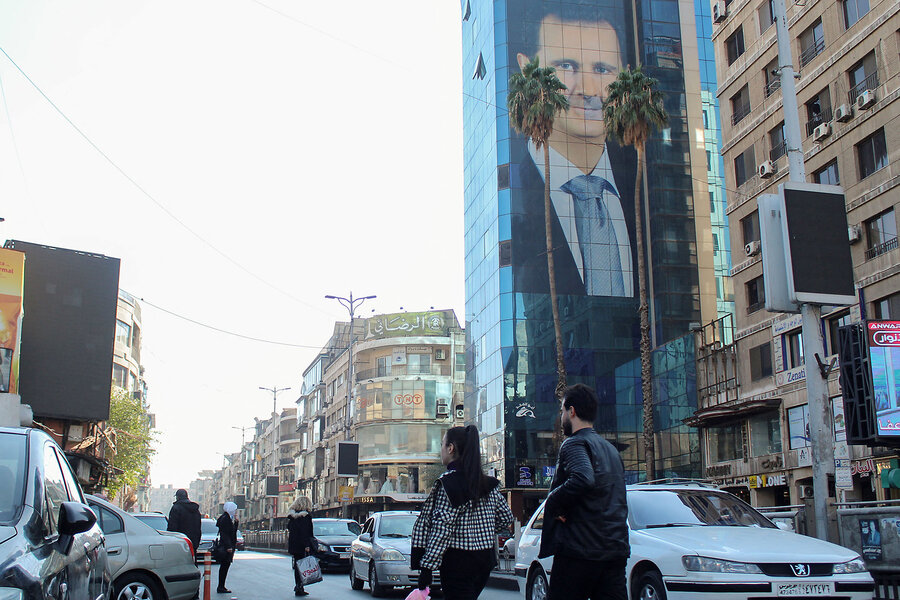
People walk near a poster depicting Syrian President Bashar al-Assad after last week's rebel seizure of Aleppo marked the rebels' biggest offensive for years, in Damascus, Syria, Dec. 5, 2024.
By Scott Peterson Staff writer
@peterson__scott
CHRISTIAN SCIENCE MONITOR
Dec. 05, 2024|LONDON
Iran and its alliance of regional militias are seeking once again to defend the embattled regime of Syrian President Bashar al-Assad, as Sunni Islamist rebels make swift territorial gains in a surprise offensive.
But the array of forces, supported by Russian air power, that prevailed over anti-Assad insurgents and preserved his rule a decade ago during the first phase of Syria’s devastating civil war, is weaker today, and not focused on Syria.
Iran and its regional “Axis of Resistance” fighters, chief among them Lebanese Hezbollah, are all degraded and distracted after more than a year of war with Israel.
Why We Wrote This story focused on Resilience
What can Iran do to help Syrian President Bashar al-Assad defeat newly energized rebel forces? Its anti-Israel “Axis of Resistance” has been overworked and diminished. Yet even as Iran searches for solutions, there are some suggestions that it is not panicking.
Syrian government troops melted away in the face of the offensive launched last week from the rebel-held northwest province of Idlib. Within days, Islamist groups led by Hayat Tahrir al-Sham (HTS), which was once affiliated with Al Qaeda, had captured Syria’s second city of Aleppo.
By Thursday, rebels had taken control of Hama, 80 miles to the south. HTS, designated a terrorist group by the United States, sent messages to Syrian minority groups to reassure them of freedom and protection, prompting Aleppo Christians to put up Christmas decorations.
Nevertheless, there has been consternation but not panic in Iran about the investment of billions of dollars over many years, both to defend Mr. Assad and to create the Axis, which aims to counter Israeli and American influence in the Mideast.
Dec. 05, 2024|LONDON
Iran and its alliance of regional militias are seeking once again to defend the embattled regime of Syrian President Bashar al-Assad, as Sunni Islamist rebels make swift territorial gains in a surprise offensive.
But the array of forces, supported by Russian air power, that prevailed over anti-Assad insurgents and preserved his rule a decade ago during the first phase of Syria’s devastating civil war, is weaker today, and not focused on Syria.
Iran and its regional “Axis of Resistance” fighters, chief among them Lebanese Hezbollah, are all degraded and distracted after more than a year of war with Israel.
Why We Wrote This story focused on Resilience
What can Iran do to help Syrian President Bashar al-Assad defeat newly energized rebel forces? Its anti-Israel “Axis of Resistance” has been overworked and diminished. Yet even as Iran searches for solutions, there are some suggestions that it is not panicking.
Syrian government troops melted away in the face of the offensive launched last week from the rebel-held northwest province of Idlib. Within days, Islamist groups led by Hayat Tahrir al-Sham (HTS), which was once affiliated with Al Qaeda, had captured Syria’s second city of Aleppo.
By Thursday, rebels had taken control of Hama, 80 miles to the south. HTS, designated a terrorist group by the United States, sent messages to Syrian minority groups to reassure them of freedom and protection, prompting Aleppo Christians to put up Christmas decorations.
Nevertheless, there has been consternation but not panic in Iran about the investment of billions of dollars over many years, both to defend Mr. Assad and to create the Axis, which aims to counter Israeli and American influence in the Mideast.
Ghaith Alsayed/AP
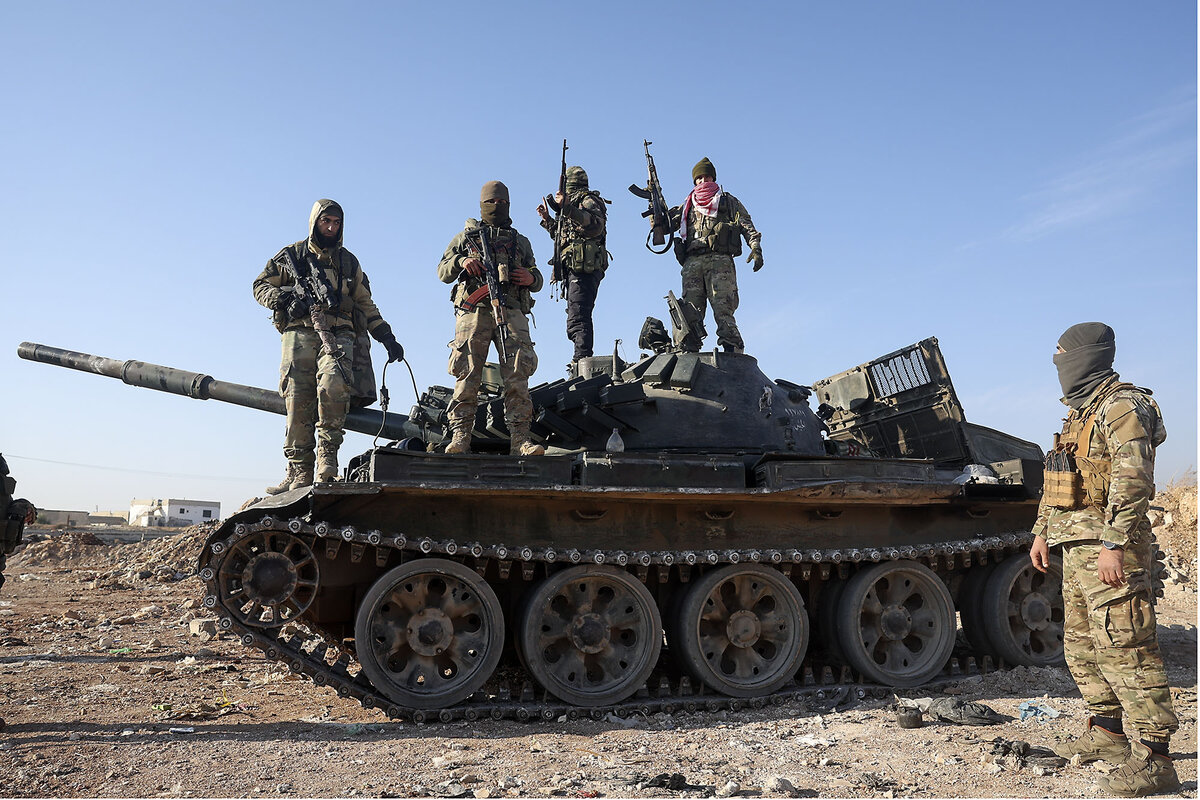
Syrian opposition fighters stand atop a seized tank on the outskirts of Hama, Syria, Dec. 3, 2024.
Iran-backed Shiite militias from Iraq reportedly have sent hundreds of fighters to Syria, to help defend an Axis ally that serves as a critical weapons route between Iran and Lebanon. Hezbollah is also trying to mobilize for Syria, but its leadership has been decimated and its units degraded by 14 months of escalating conflict with Israel.
That fight culminated in a ceasefire coming into effect Nov. 27 – the day the Syrian rebels launched their offensive.
“This whole thing is coming at the worst moment for Iran and the Axis, and I think also explains the timing on the side of the rebels,” to take advantage of the relative weakness of Mr. Assad’s allies, says Hamidreza Azizi, an expert on Iran’s role in Syria at the German Institute for International and Security Affairs.
“Compared to a decade ago, Iran has fewer resources to invest in the Axis. ... So I can see why they are quite concerned,” he says.
Two pivotal events have changed the safety net dynamic for Mr. Assad and for Iran, Mr. Azizi says. The first was Russia’s invasion of Ukraine in February 2022, which diverted Moscow’s focus and prompted it to withdraw some troops and hand over some bases to the Syrian army even as it kept an air capability in the country.
The second was the October 2023 attack by Axis-member Hamas on Israel. That triggered Hezbollah’s first rocket strikes on Israel in solidarity, as well as attacks from Iran-backed groups in Iraq and Yemen, ostensibly to stop Israel’s onslaught in Gaza.
“Obviously everybody in the Axis started to get distracted, and focused on the Gaza front, especially those actors whose presence was significant in the Syrian war,” Mr. Azizi says.
Iran’s supreme leader Ayatollah Ali Khamenei complained on X this week that the Sunni extremists were "good news for enemies" of Islam by drawing the world’s attention away from the “issue of Palestine.”
“The current moment [in Syria] shows how significant the Iranian and Iran-backed manpower was, because they were able to prevent further advances by the rebels. But when there is nobody on the ground over those areas, they [the rebels] come again,” says Mr. Azizi. “That’s the problem: Airpower alone can’t secure victory.”
Office of the Iranian Supreme Leader/AP/File
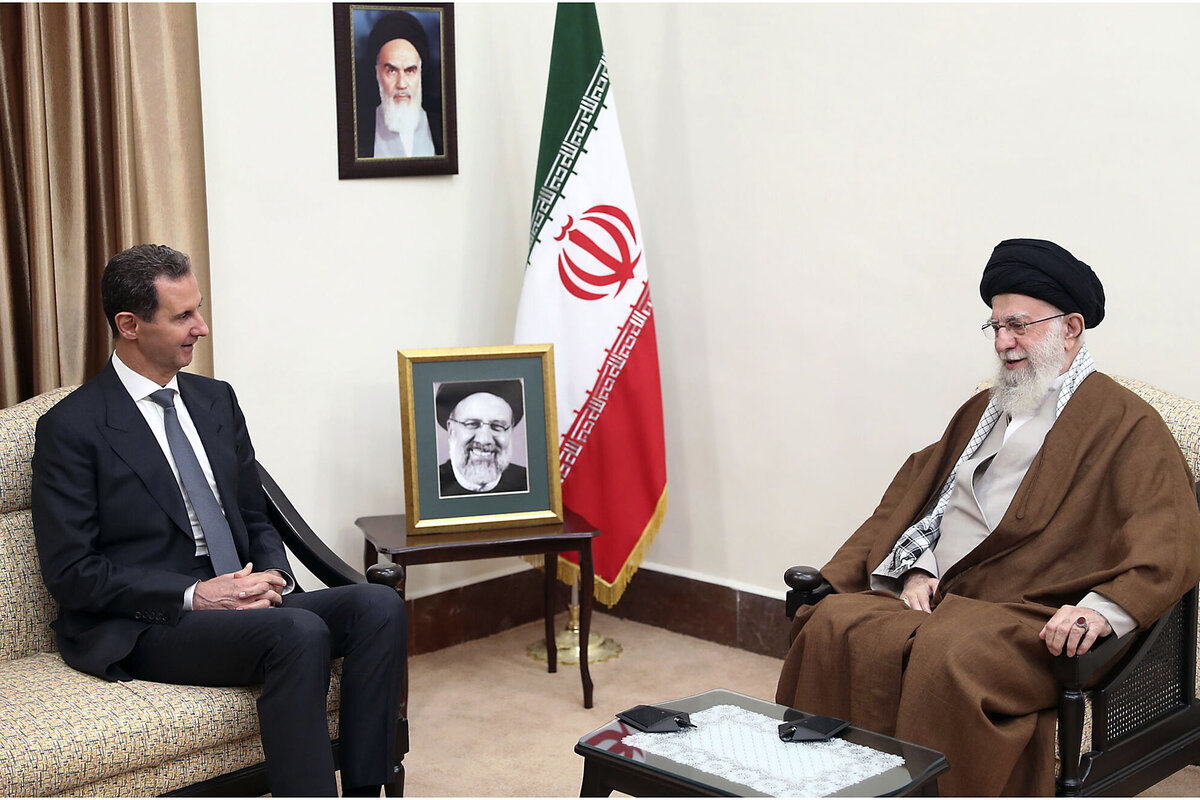
Iran's supreme leader, Ayatollah Ali Khamenei, right, speaks with Syrian President Bashar al-Assad in Tehran, Iran, May 30, 2024.
To be sure, Israel has used airstrikes to kill several senior Iranian commanders of the Revolutionary Guard Qods Force, who were responsible for operations in Syria and Lebanon.
“What is Iran capable of doing, and not capable of doing? Clearly its command structure in Syria is damaged,” says Mohammad Ali Shabani, editor of the London-based news website Amwaj.media, which focuses on Iran, Iraq, and Arabian Peninsula countries.
Those networks, steeped in long-standing personal relationships, will take time to reestablish. But Iran can afford its military work in Syria, he says, and does not have an overall manpower problem, considering its past advisory role and the deployment of relatively few of its own troops.
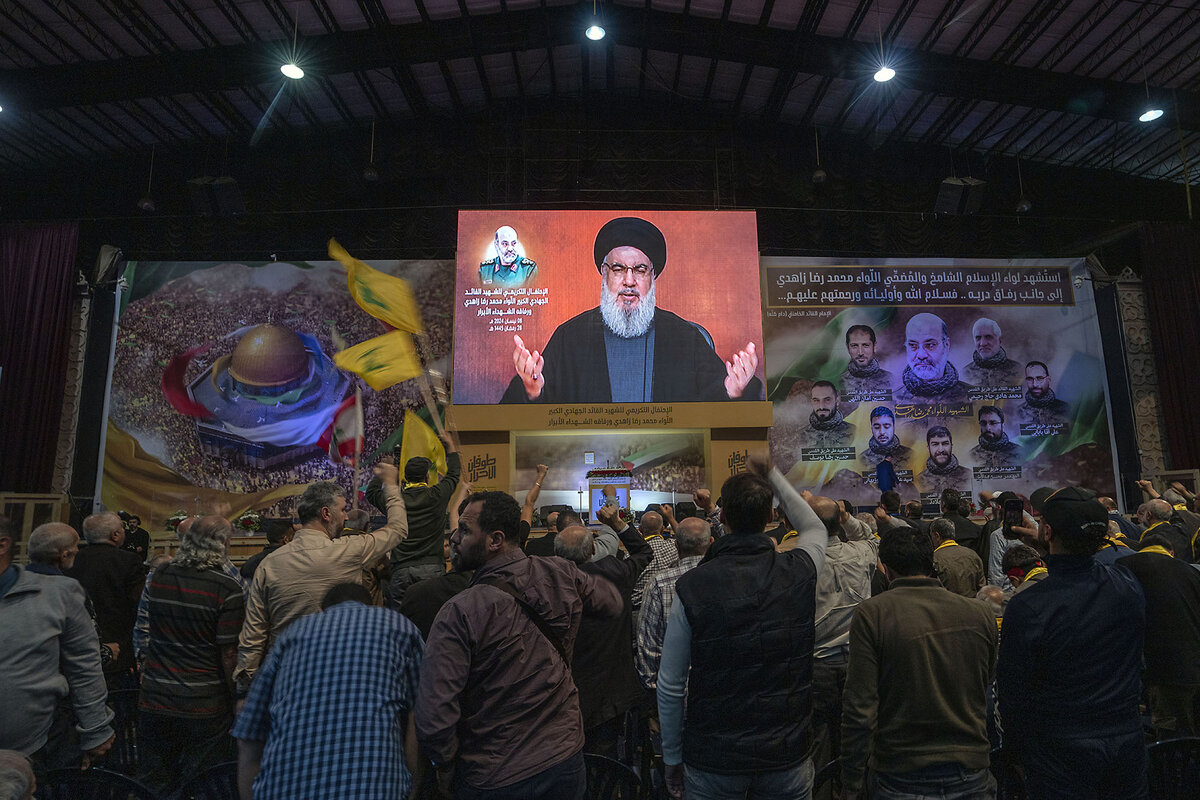
“These are personal relationships that are hard to reconstitute,” says Mr. Shabani, noting for example Gen. Mohammad Reza Zahedi, who was killed by an Israeli airstrike in April on an Iranian diplomatic compound in Damascus.
General Zahedi was in charge of all the Levant and of funneling weapons to Lebanon and Syria. He was reportedly the only non-Lebanese person to sit on Hezbollah’s top Shura Council, while also exercising “veto power” over its subordinate military Jihad Council. His death triggered an unprecedented direct Iranian retaliation against Israel, with 300 missiles and drones.
Hassan Ammar/AP
Hezbollah leader Hassan Nasrallah speaks via a video link during a ceremony to commemorate the death of Iranian Revolutionary Guard Gen. Mohammad Reza Zahedi, who was among those killed by an Israeli airstrike that demolished an Iranian consular building in Damascus, in the southern suburbs of Beirut, April 8, 2024.
“Many other, if not all, members of the Jihad Council are [also] dead. So they are all in a state of reconstituting these structures,” says Mr. Shabani, whose website first reported the significance of General Zahedi.
Nevertheless, Mr. Shabani explains why, practically and politically, Iran may not be more urgently coming to Mr. Assad’s aid.
“Do I believe [pro-Assad forces] can seize back all of Syria? No. They couldn’t even do that last year, or last month,” he says. “But is it enough to keep Assad in power? Pick up a map, and look at what Iran’s objectives are in Syria.”
Those objectives include ensuring cross-country routes for Iranian weapons to reach Lebanon and key destinations in Syria, including Damascus, areas close to the Israeli-occupied Golan Heights, and Qusayr, where Hezbollah had a significant victory in 2012.
“[Rebels] have taken Aleppo. It’s a loss, for sure. But is this integral to Assad maintaining power? No. Is it integral to Iran’s core interests in Syria? No,” says Mr. Shabani. “I don’t see Iran rushing to Assad’s aid. Not because they don’t want to keep him in power … but because they want him to better appreciate their role.”
Four days after the rebel offensive erupted, Iranian Foreign Minister Abbas Araghchi flew to Damascus to reassure Mr. Assad. According to news reports, the two detailed the support that needs to be provided for Syria.
In a show of calm, Mr. Araghchi was later filmed eating at a fast-food restaurant in Damascus. But in a diplomatic push, he then flew to Ankara to meet his counterpart from Turkey, which has backed factions of the Syrian opposition.
Maxim Shemetov/Reuters
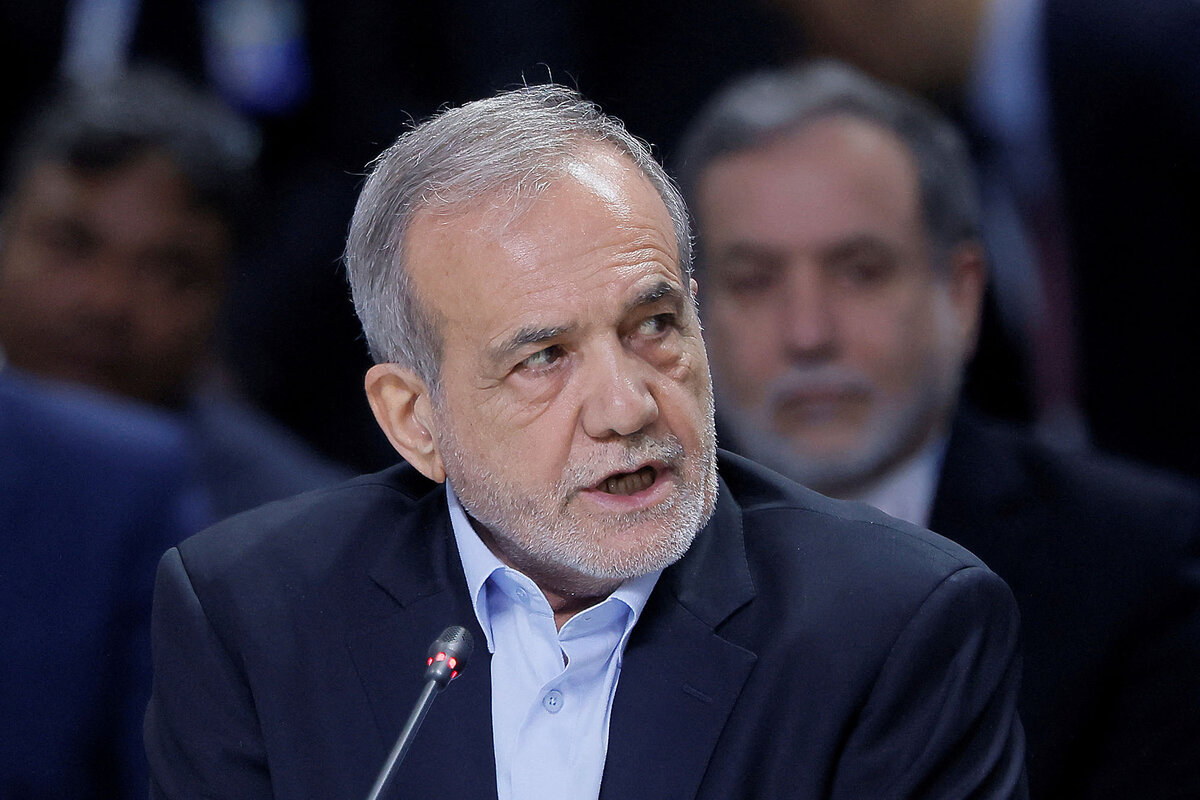
Iranian President Masoud Pezeshkian speaks at the BRICS summit in Kazan, Russia, Oct. 24, 2024.
Iranian media reported Monday that Iranian Qods Force Gen. Javad Ghaffari arrived in Damascus to lead Iranian “military advisers” and help the Syrian army battle the advancing rebels. He has often been lauded in Iran for safeguarding Aleppo in 2016, but earned the title “Butcher of Aleppo” by opponents of Iran who recall brutal tactics there.
In Parliament Dec. 1, Iran’s President Masoud Pezeshkian called on Muslim nations to “intervene and not allow America and Israel to take advantage” in Syria. Yet when asked on state television the next day about the chances of a direct Iranian military engagement in Syria, Mr. Pezeshkian twice dodged the question, and noted instead his government’s diplomatic efforts.
It is not yet clear if several hundred Iran-backed fighters from Iraq have made it to Syria, as reported, or if orders to fight have been given to those members of the Axis already on the ground in Syria, who are mostly Shiite Afghans.
As rebels advanced Thursday, the HTS commander, Abu Mohamed al-Jolani, issued a request to Iraqi politicians to “do their duty” to prevent Iran-aligned militias from intervening “in what is happening in Syria.”

 European Commission chief Ursula von der Leyen (centre) pictured with the leaders of Argentina, Uruguay, Brazil and Paraguay at a summit in Montevideo on December 6, 2024. © Eitan Abramovich, AFP







.jpg)