Friday, December 06, 2024

U$A FOR PROFIT HEALTHCARE

Forbes Healthcare Summit: AI can improve the quality, cost of healthcare

The healthcare summit is an annual event sponsored by Forbes and includes leaders in the nation's $4 trillion healthcare industry.

THE SUMMIT WHERE UNITED HEALTHCARE CEO 


Forbes Chairman and Editor-in-Chief Steve Forbes speaks at the 2024 Forbes Healthcare Summit at Murphy Alumni Hall - NYU Langone Health in New York City on Wednesday. Photo by John Angelillo/UPI | License Photo

Dec. 4 (UPI) -- Artificial intelligence can improve the effectiveness and affordability of how healthcare is delivered, attendees at the 2024 Forbes Healthcare Summit in New York City were told Wednesday.

Ajay Shah, Cytovale co-founder and chief executive officer, said artificial intelligence tools are helping patients stay healthier while caregivers are lowering their healthcare delivery costs.

Cytovale is the maker of the IntelliSep AI tool that specifically diagnosis sepsis that it says is common, costly and difficult to diagnose.

"The conversation is really about the clinical operation and financial benefits to hospitals and healthcare systems," Shah said when asked about the healthcare benefits of AI tools, like IntelliSep.

"Some of what we've been able to share over the last year is demonstrating a reduction in length of stay by over a day for every patient tested with IntelliSep," Shah said.

"That's the result of enabling the physician and the providers to see the right diagnosis from the first minute of that patient's visit and dramatically changing their care pathways," he added.

"The long-term effects of sepsis are really meaningful," Shah said. "Getting patients aggressive care quickly improves the outcome of their long-term costs."

The healthcare summit is an annual event sponsored by Forbes and includes leaders in the nation's $4 trillion healthcare industry.

AI "is a powerful and disruptive area of computer science, with the potential to fundamentally transform the practice of medicine and the delivery of healthcare," the National Institutes of Health reported in 2021.

AI can help healthcare systems around the world to achieve the four-part goal of improving population health, patients' care, caregivers' experiences and lowering the cost of healthcare delivery.

"Aging populations, growing burden of chronic diseases and rising costs of healthcare globally are challenging governments, payers, regulators and providers to innovate and transform models of healthcare deliver," the NIH said.

The recent COVID-19 pandemic also demonstrated shortfalls in the available healthcare workforce and inequities in accessing care that the NIH says AI could help alleviate.

"The application of technology and artificial intelligence in healthcare has the potential to address some of these supply-and-demand challenges," the NIH said.

President Joe Biden agrees and last year issued an executive order requiring the federal government to "prioritize generative AI and other critical and emerging technologies" to accelerate their responsible use in the nation's healthcare systems and other industries.

"AI holds extraordinary potential for both promise and peril," Biden said in the executive order.

"Responsible AI use has the potential to help solve urgent challenges while making our world more prosperous, productive, innovative and secure," Biden said. "At the same time, irresponsible use could exacerbate societal harms."

He said, "harnessing AI for good and realizing its myriad benefits requires mitigating its substantial risks."

Mitigating the risks requires a "society-wide effort that includes government, the private sector, academia and civil society,"Biden said.

The Healthcare Summit fits within the context of Biden's executive order.

"The AI revolution is unleashing new ways to discover drugs, personalize medicine and even manage a doctor's paperwork," Healthcare Summit organizers said.

The invitation-only annual event at Murphy Alumni Hall, NYU Langone Health, is the 13th that Forbes has held.
Torrent of hate for health insurance industry follows CEO’s killing
NYTimes News Service | Friday, December 6, 2024,

Reuters People walk next to a poster on Thursday outside the Hilton hotel near the scene where the CEO of UnitedHealthcare, Brian Thompson, was shot dead in Midtown Manhattan. REUTERS/Mike Segar


The fatal shooting Wednesday of a top UnitedHealthcare executive, Brian Thompson, on a New York City sidewalk has unleashed a torrent of morbid glee from patients and others who say they have had negative experiences with health insurance companies at some of the hardest times of their lives.

It is unclear what motivated the incident or whether it was tied to Thompson’s work in the insurance industry. Police have yet to identify the shooter, who is still on the loose.

But that did not stop social media commenters from leaping to conclusions and from showing a blatant lack of sympathy over the death of a man who was a husband and father of two children.

“Thoughts and deductibles to the family,” read one comment underneath a video of the shooting posted online by CNN. “Unfortunately my condolences are out-of-network.”

On TikTok, one user wrote, “I’m an ER nurse and the things I’ve seen dying patients get denied for by insurance makes me physically sick. I just can’t feel sympathy for him because of all of those patients and their families.”

The dark commentary after the death of Thompson, a 50-year-old insurance executive from Maple Grove, Minnesota, highlighted the anger and frustration over the state of health care in America, where those with private insurance often find themselves in Kafkaesque tangles while seeking reimbursement for medical treatment and are often denied.

Messages that law enforcement officials say were found on bullet casings at the scene of the shooting in front of a New York hotel — “delay” and “deny” — are two words familiar to many Americans who have interacted with insurance companies for almost anything other than routine doctor visits.

Thompson was chief executive of his company’s insurance division, which reported $281 billion in revenue last year, providing coverage to millions of Americans through the health plans it sold to individuals, employers and people under government programs like Medicare. The division employs roughly 140,000 people.

Thompson received a $10.2 million compensation package last year, a combination of $1 million in base pay and cash and stock grants. He was shot to death as he was walking toward the annual investor day for UnitedHealth Group, UnitedHealthcare’s parent company.

Stephan Meier, the chair of the management division at Columbia Business School, said the attack could send shock waves through the broader health insurance industry.

About seven CEOs of publicly traded companies die each year, he said, but almost always from health complications or accidents. A targeted attack could have much larger implications.

“The insurance industry is not the most loved, to put it mildly,” Meier said. “If you’re a C-suite executive of another insurance company, I would be thinking, what’s this mean for me? Am I next?”

A longtime employee of UnitedHealthcare said that workers at the company had been aware for years that members were unhappy. Thompson was one of the few executives who wanted to do something about it, said the employee, who spoke on condition of anonymity because the company does not allow workers to speak publicly without permission.

In speeches to employees, Thompson spoke about the need to change the state of health care coverage in the country and the culture of the company, topics other executives avoided, the employee said.

Already, there is heightened concern among some public-facing health care companies, said Eric Sean Clay, president of the International Association for Healthcare Security and Safety. The trade group includes members that offer security to some of the largest health care companies in North America.

“The CEOs are quite often the most visible face of an organization,” he said. “Sometimes people hate on that individual and wish to do them harm.”

But few health care companies provide security for their executives, he said, in part to avoid bad optics or because it may seem unnecessary.

In the hours after the shooting early Wednesday, social media exploded with anger toward the insurance industry and Thompson.

“I pay $1,300 a month for health insurance with an $8,000 deductible. ($23,000 yearly) When I finally reached that deductible, they denied my claims. He was making a million dollars a month,” read one comment on TikTok.

Another commenter wrote, “This needs to be the new norm. EAT THE RICH.”

“The ambulance ride to the hospital probably won’t be covered,” wrote a commenter on a TikTok video in which another user featured an audio clip from the Netflix show “Queen Charlotte: A Bridgerton Story.” In it, the queen makes a dramatic show of faux sorrow over a death.

The shooting prompted a wrenching outpouring of patients and family members who also posted horror stories of insurance claim reimbursement stagnation and denials.

One woman expressed frustration with trying to get a special bed for her disabled son covered by UnitedHealthcare. Another user described struggling with bills and coverage after giving birth.

“It is so stressful,” the user said in a video. “I was sick over this.”

This article originally appeared in The New York Times.

© 2024 The New York Times Company


CEO’s murder provokes 'dark' humor in response to America’s 'dysfunctional healthcare system'


Slain UnitedHealth CEO Brian Thompson
 (Photo: United Health Group)


December 05, 2024
ALTERNET

In the early morning hours of Wednesday, December 4, 2024, UnitedHealth CEO Brian Thompson was shot dead by a masked gunman who remains at large. On social media, his murder was met not with an outpouring of mourning, but ridicule.

In an article published by Science publication Futurism, writer Victor Tangermann explored the "incredibly dark" responses to Thompson's killing on platforms like X and Bluesky. He noted that many of the responses were "gallows humor" that were both "simultaneously ghoulish" yet also "illustrative of America's profoundly dysfunctional medical system."

"Rotating Sandwiches" meme creator Lauren Walker wrote on Bluesky: "[A]ll human life is sacred, so it's not proper to laugh when serious harm befalls someone," she wrote. "[T]he moral thing to do is instead charge them hundreds of thousands of dollars."

READ MORE: United Healthcare CEO gunned down outside Manhattan hotel: report

"Our apologies, but bullet wounds are only covered under our platinum+ package," one user wrote in response.

Many of the memes circulating in response to Thompson's murder invoke the cold nature of the private health insurance industry, in which an insured's claim can be denied even if it's for filling a prescription for medication prescribed by their doctor or for treatment necessary to save someone's life. LendingTree's ValuePenguin wrote that UnitedHealth is the worst offender, denying roughly one-third of all in-network claims (32%), which is double the industry average of 16%.

UnitedHealth has also been accused in a lawsuit of using artificial intelligence (AI) to deny claims filed by Medicare Advantage patients. The plaintiffs claim that the company had knowledge that the AI it was using "had a high potential for error," and that UnitedHealth employees were pressured by supervisors to use the algorithm to issue denials. They were also reportedly told to keep patient stays within 1% of the length of stay predicted by the AI.

The New York Post recently reported that Thompson and several UnitedHealth executives were under investigation by the Department of Justice for alleged insider trading. Thompson and three others allegedly sold more than $101 million in shares before news of the investigation was announced, which resulted in the company's stock price declining. Thompson himself reportedly made $15 million on the sale.


"deny," "defend," and "depose"

Police find words on shell casings at scene of UnitedHealthcare CEO's killing


As the manhunt for the killer of UnitedHealthcare CEO Brian Thompson continued Thursday, law enforcement said the words "deny," "defend,"and "depose" were found on shell casings left at the scene of Thompson's midtown Manhattan murder. NYPD police officers investigate the crime scene around the New York Midtown Hilton following Thompsn's murder in New York City on Wednesday.
Photo by John Angelillo/UPI | License Photo

Dec. 5 (UPI) -- Law enforcement on Thursday said that words were found on shell casings left at the scene of UnitedHealthcare CEO BrianThompson's midtown Manhattan killing as a manhunt for the suspect continued.

The words "deny," "defend" and "depose" were found on the cases, ABC NewsNBC News and CNN reported, citing law enforcement sources.

The words may be a message from the gunman and police investigators are looking at whether they may indicate a motive in the killing.

The similar words " "delay, deny, defend" are commonly known as the three D's of the insurance industry.

As police search for the killer and investigate to determine the motive, bounty hunter and liaison to the U.S. Marshals Zeke Unger told CNN the killer didn't appear to be a professional hitman.

"I believe that the individual, by looking at the footage, had some psychological issues. That this is a revenge shooting," Unger said. "This is not a professional killer, a contract killer by his mannerisms and by the failure of the weapon."

Unger was referring to the gun appearing to jam temporarily during the shooting.

New York City Police Commissioner Jessica Tisch said Thompson was targeted in a premeditated, preplanned targeted attack.
Advertisement

Security video of the killing showed Thompson walking toward the Hilton Hotel in midtown Manhattan early Wednesday morning when a hooded and masked gunman walked up behind him, pointed a silenced pistol at Thompson and fired multiple times before fleeing on a bike.

CBS News, citing a police source, said "forensic evidence" was found at the Starbucks the gunman visited before the shooting. A cellphone was also recovered in an alleyway near the shooting site that police said had investigative value.

Paulette Thompson, wife of the slain CEO, told NBC News Wednesday there had been threats against her husband.

"Basically, I don't know, a lack of coverage? I don't know details. I just know there were some people that had been threatening him," she said.

The killer was described as a 6'1" tall skinny White man dressed in all black with a hoodie and a mask.

A $10,000 reward is being offered for information leading to the suspect's arrest and conviction.


NASA administrators reach for the stars while navigating budgets, politics on Earth

By Wendy Whitman Cobb, Air University
12/6/22024
THE CONVERSATION

Bill Nelson has served as NASA Administrator since 2021.
 File Photo by Annabelle Gordon/UPI | License Photo

Leaders of NASA sit in an awkward position. While they are the head of a widely recognized organization, they're often not the most famous individual in the agency. More people probably know the names of Butch Wilmore and Suni Williams, the astronauts currently "stranded" on the International Space Station, than Bill Nelson, the current NASA administrator.

Astronauts might be the people most closely associated with NASA, but administrators are arguably more integral to getting programs off the ground.

As a space policy expert, I've seen the impact that individual NASA leaders can have on NASA's success. They play a vital role in deciding what NASA does and how it does it, and they also help build political support for space exploration.

The role of the NASA administrator

NASA is an independent government bureaucracy, meaning that it does not fall under one of the cabinet departments -- like the Department of State. As such, the leader of NASA is an administrator rather than a secretary.

Although the name differs, a NASA administrator has similar duties and responsibilities as a cabinet secretary. They help make decisions about which major programs and policies should be pursued and how they're carried out. NASA administrators work with partners in industry, including the commercial space industry. They also represent NASA while presenting to Congress and during diplomatic relations with other countries.

NASA administrators are also accountable to elected officials. Administrators are appointed by the president but must be confirmed by the Senate. Congress has a great deal to say about the budget that NASA gets each year. They also must authorize major programs, like the Artemis program, which aims to return the United States and its partners to the Moon.

Although major decisions like these are often out of their hands, NASA administrators still have a lot of influence behind the scenes. James Webb, NASA's second administrator, who held the office between 1961 and 1968, is often credited as being integral in maintaining political support for the Apollo program.

Dan Goldin, the longest-serving NASA administrator, helped save the International Space Station from cancellation in the early 1990s by convincing the Clinton administration to invite Russia's participation.

As administrator in the early 2000s, Mike Griffin helped jump-start the commercial space industry by instituting the Commercial Orbital Transportation Services program. This program provided funding to companies who would first send cargo to the International Space Station, and then later, astronauts.

However, not all administrators are as productive as Webb, Goldin or Griffin. Richard Truly was fired from the post by George H.W. Bush in 1992 after disagreeing with the administration's 1989 proposal to return the United States to the Moon.

Charles Bolden found controversy when he told Al-Jazeera that President Barack Obama instructed him to make outreach to Muslim countries one of NASA's priorities.

Both Truly and Bolden were astronauts before becoming administrator. But that doesn't mean that former astronauts are somehow worse in the position than people coming from other backgrounds. NASA administrators have historically had a wide variety of backgrounds, including scientists, engineers and even former members of Congress.

The current NASA administrator, Bill Nelson, is both a former senator and a former astronaut, having gone to space on the shuttle Columbia in January 1986.

Major questions ahead


No matter the administrator, the coming years will bring big decisions for whoever is next.

With the recent announcement that the around-the-moon mission of Artemis II is delayed until spring of 2026, NASA still has much work to do in its Artemis program. Major issues remain to be addressed with the crew vehicle, including problems with the capsule's heat shield and electronic systems.

Further, the success of commercial space companies like SpaceX means there will be more pressure on NASA to find ways to reduce costs by leveraging the services of commercial companies.

More broadly, many other countries are looking to how the United States is operating in space. Aside from what some see as a new space race with China, questions about space debris, space traffic management and space resources will involve cooperation with other countries and will require administrator involvement.

Finally, the NASA administrator will have to contend with a recurring issue: fewer resources. Historically, NASA has been appropriated less money than necessary to carry out all the things it has been charged to do.

This situation leads to hard decisions about what kinds of missions to support. Space science and robotic exploration typically lose out to things like human spaceflight.

Even though the next administrator will need to make hard decisions, the next few years will be full of excitement as the United States and others pursue increasingly ambitious goals.

Wendy Whitman Cobb is a professor of strategy and security studies at Air University.

This article is republished from The Conversation under a Creative Commons license. Read the original article. The views and opinions expressed in this commentary are solely those of the author.
SPACE/COSMOS

NASA’s stuck astronauts hit 6 months in space. Just 2 more to go


 NASA astronauts Suni Williams, left, and Butch Wilmore stand together for a photo enroute to the launch pad at Space Launch Complex 41 Wednesday, June 5, 2024, in Cape Canaveral, Fla., for their liftoff on the Boeing Starliner capsule to the international space station. (AP Photo/Chris O’Meara, File)

 In this photo provided by NASA, Boeing Crew Flight Test astronauts Butch Wilmore, left, and Suni Williams pose for a portrait inside the vestibule between the forward port on the International Space Station’s Harmony module and Boeing’s Starliner spacecraft on June 13, 2024. (NASA via AP, File)

This image made from a NASA live stream shows NASA astronauts Suni Williams and Butch Wilmore during a press conference from the International Space Station on Friday, Sept. 13, 2024. (NASA via AP, File)

 In this image released by NASA, NASA astronauts Suni Williams and Butch Wilmore, both Expedition 71 Flight Engineers, make pizza aboard the International Space Station’s galley located inside the Unity module on Sept. 9, 2024. Items are attached to the galley using tape and velcro to keep them from flying away in the microgravity environment. (NASA via AP, File)

BY MARCIA DUNN
 December 5, 2024


CAPE CANAVERAL, Fla. (AP) — Known across the globe as the stuck astronauts, Butch Wilmore and Suni Williams hit the six-month mark in space Thursday with two more to go.

The pair rocketed into orbit on June 5, the first to ride Boeing’s new Starliner crew capsule on what was supposed to be a weeklong test flight. They arrived at the International Space Station the next day, only after overcoming a cascade of thruster failures and helium leaks. NASA deemed the capsule too risky for a return flight, so it will be February before their long and trying mission comes to a close.

While NASA managers bristle at calling them stuck or stranded, the two retired Navy captains shrug off the description of their plight. They insist they’re fine and accepting of their fate. Wilmore views it as a detour of sorts: “We’re just on a different path.”

“I like everything about being up here,” Williams told students Wednesday from an elementary school named for her in Needham, Massachusetts, her hometown. “Just living in space is super fun.”

Both astronauts have lived up there before so they quickly became full-fledged members of the crew, helping with science experiments and chores like fixing a broken toilet, vacuuming the air vents and watering the plants. Williams took over as station commander in September.

RELATED STORIES

NASA astronaut in hospital after returning from extended stay in space

NASA astronauts won't say which one of them got sick after almost 8 months in space

Billionaire who performed the first private spacewalk is Trump's pick to lead NASA

“Mindset does go a long way,” Wilmore said in response to a question from Nashville first-graders in October. He’s from Mount Juliet, Tennessee. “I don’t look at these situations in life as being downers.”

Boeing flew its Starliner capsule home empty in September, and NASA moved Wilmore and Williams to a SpaceX flight not due back until late February. Two other astronauts were bumped to make room and to keep to a six-month schedule for crew rotations.

Like other station crews, Wilmore and Williams trained for spacewalks and any unexpected situations that might arise.

“When the crews go up, they know they could be there for up to a year,” said NASA Associate Administrator Jim Free.

NASA astronaut Frank Rubio found that out the hard way when the Russian Space Agency had to rush up a replacement capsule for him and two cosmonauts in 2023, pushing their six-month mission to just past a year.

Boeing said this week that input from Wilmore and Williams has been “invaluable” in the ongoing inquiry of what went wrong. The company said in a statement that it is preparing for Starliner’s next flight but declined comment on when it might launch again.

NASA also has high praise for the pair.

“Whether it was luck or whether it was selection, they were great folks to have for this mission,” NASA’s chief health and medical officer, Dr. JD Polk, said during an interview with The Associated Press.

On top of everything else, Williams, 59, has had to deal with “rumors,” as she calls them, of serious weight loss. She insists her weight is the same as it was on launch day, which Polk confirms.

During Wednesday’s student chat, Williams said she didn’t have much of an appetite when she first arrived in space. But now she’s “super hungry” and eating three meals a day plus snacks, while logging the required two hours of daily exercise.

Williams, a distance runner, uses the space station treadmill to support races in her home state. She competed in Cape Cod’s 7-mile Falmouth Road Race in August. She ran the 2007 Boston Marathon up there as well.

She has a New England Patriots shirt with her for game days, as well as a Red Sox spring training shirt.

“Hopefully I’ll be home before that happens -- but you never know,” she said in November. Husband Michael Williams, a retired federal marshal and former Navy aviator, is caring for their dogs back home in Houston.

As for Wilmore, 61, he’s missing his younger daughter’s senior year in high school and his older daughter’s theater productions in college.

“We can’t deny that being unexpectedly separated, especially during the holidays when the entire family gets together, brings increased yearnings to share the time and events together,” his wife, Deanna Wilmore, told the AP in a text this week. Her husband “has it worse than us” since he’s confined to the space station and can only connect via video for short periods.

“We are certainly looking forward to February!!” she wrote.

NASA project NEOWISE ends after cataloging objects around Earth for over a decade

By Toshi Hirabayashi, Georgia Institute of Technology & Yaeji Kim, University of Maryland
THE CONVERSATION

The NASA project NEOWISE, which has given astronomers a detailed view of near-Earth objects -- some of which could strike the Earth -- ended its mission and burned on reentering the atmosphere after over a decade.

On a clear night, the sky is full of bright objects -- from stars, large planets and galaxies to tiny asteroids flying near Earth. These asteroids are commonly known as near-Earth objects, and they come in a wide variety of sizes. Some are tens of kilometers across or larger, while others are only tens of meters or smaller.

On occasion, near-Earth objects smash into Earth at a high speed -- roughly 10 miles per second (16 kilometers per second) or faster. That's about 15 times as fast as a rifle's muzzle speed. An impact at that speed can easily damage the planet's surface and anything on it.

Impacts from large near-Earth objects are generally rare over a typical human lifetime. But they're more frequent on a geological timescale of millions to billions of years. The best example may be a 6-mile-wide (10-kilometer-wide) asteroid that crashed into Earth, killed the dinosaurs and created Chicxulub crater about 65 million years ago.

Smaller impacts are very common on Earth, as there are more small near-Earth objects. An international community effort called planetary defense protects humans from these space intruders by cataloging and monitoring as many near-Earth objects as possible, including those closely approaching Earth. Researchers call the near-Earth objects that could collide with the surface potentially hazardous objects.

NASA began its NEOWISE mission in December 2013. This mission's primary focus was to use the space telescope from the Wide-field Infrared Survey Explorer to closely detect and characterize near-Earth objects such as asteroids and comets.

NEOWISE contributed to planetary defense efforts with its research to catalog near-Earth objects. Over the past decade, it helped planetary defenders like us and our colleagues study near-Earth objects.

Detecting near-Earth objects

NEOWISE was a game-changing mission, as it revolutionized how to survey near-Earth objects.

The NEOWISE mission continued to use the spacecraft from NASA's WISE mission, which ran from late 2009 to 2011 and conducted an all-sky infrared survey to detect not only near-Earth objects but also distant objects such as galaxies.

The spacecraft orbited Earth from north to south, passing over the poles, and it was in a Sun-synchronous orbit, where it could see the Sun in the same direction over time. This position allowed it to scan all of the sky efficiently.

The spacecraft could survey astronomical and planetary objects by detecting the signatures they emitted in the mid-infrared range.

Humans' eyes can sense visible light, which is electromagnetic radiation between 400 and 700 nanometers. When we look at stars in the sky with the naked eye, we see their visible light components.

However, mid-infrared light contains waves between 3 and 30 micrometers and is invisible to human eyes.

When heated, an object stores that heat as thermal energy. Unless the object is thermally insulated, it releases that energy continuously as electromagnetic energy, in the mid-infrared range.

This process, known as thermal emission, happens to near-Earth objects after the Sun heats them up. The smaller an asteroid, the fainter its thermal emission. The NEOWISE spacecraft could sense thermal emissions from near-Earth objects at a high level of sensitivity -- meaning it could detect small asteroids.

But asteroids aren't the only objects that emit heat. The spacecraft's sensors could pick up heat emissions from other sources too -- including the spacecraft itself.

To make sure heat from the spacecraft wasn't hindering the search, the WISE/NEOWISE spacecraft was designed so that it could actively cool itself using then-state-of-the-art solid hydrogen cryogenic cooling systems.

Operation phases

Since the spacecraft's equipment needed to be very sensitive to detect faraway objects for WISE, it used solid hydrogen, which is extremely cold, to cool itself down and avoid any noise that could mess with the instruments' sensitivity. Eventually the coolant ran out, but not until WISE had successfully completed its science goals.

During the cryogenic phase when it was actively cooling itself, the spacecraft operated at a temperature of about -447 degrees Fahrenheit (-266 degrees Celsius), slightly higher than the universe's temperature, which is about -454 degrees Fahrenheit (-270 degrees Celsius).

The cryogenic phase lasted from 2009 to 2011, until the spacecraft went into hibernation in 2011.

Following the hibernation period, NASA decided to reactivate the WISE spacecraft under the NEOWISE mission, with a more specialized focus on detecting near-Earth objects, which was still feasible even without the cryogenic cooling.

During this reactivation phase, the detectors didn't need to be quite as sensitive, nor the spacecraft kept as cold as it was during the cryogenic cooling phase, since near-Earth objects are closer than WISE's faraway targets.

The consequence of losing the active cooling was that two long-wave detectors out of the four on board became so hot that they could no longer function, limiting the craft's capability.

Nevertheless, NEOWISE used its two operational detectors to continuously monitor both previously and newly detected near-Earth objects in detail.

NEOWISE's legacy

As of February, NEOWISE had taken more than 1.5 million infrared measurements of about 44,000 different objects in the solar system. These included about 1,600 discoveries of near-Earth objects. NEOWISE also provided detailed size estimates for more than 1,800 near-Earth objects.

Despite the mission's contributions to science and planetary defense, it was decommissioned in August. The spacecraft eventually started to fall toward Earth's surface, until it reentered Earth's atmosphere and burned up on Nov. 1.

NEOWISE's contributions to hunting near-Earth objects gave scientists much deeper insights into the asteroids around Earth. It also gave scientists a better idea of what challenges they'll need to overcome to detect faint objects.

So, did NEOWISE find all the near-Earth objects? The answer is no. Most scientists still believe that there are far more near-Earth objects out there that still need to be identified, particularly smaller ones.

To carry on NEOWISE's legacy, NASA is planning a mission called NEO SurveyorNEO Surveyor will be a next-generation space telescope that can study small near-Earth asteroids in more detail, mainly to contribute to NASA's planetary defense efforts. It will identify hundreds of thousands of near-Earth objects that are as small as about 33 feet (10 meters) across. The spacecraft's launch is scheduled for 2027.

Toshi Hirabayashi is an associate professor of aerospace engineering at Georgia Institute of TechnologyYaeji Kim is a postdoctoral associate in astronomy at University of Maryland.

This article is republished from The Conversation under a Creative Commons license. Read the original article.


Nasa delays astronaut flight around the Moon

 it's hard to predict what this combination of Isaacman, Musk and Trump might mean for Nasa as we know it."


Pallab Ghosh
BBC Science Correspondent

Frank Michaux/NASA
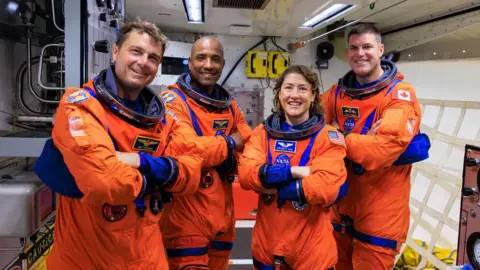
Left to Right: Nasa astronauts Reid Wiseman, Victor Glover, Christina Hammock Koch and Jeremy Hansen. Their mission around the Moon is now delayed until April 2026

US space agency Nasa has announced a further delay to its plans to send astronauts back to the Moon.

The agency's chief, Bill Nelson, said the second mission in the Artemis programme was now due for launch in April 2026.

The plan had been to send astronauts around the Moon but not land in September 2025. The date had already slipped once before, from November of this year.

That will mean that a Moon landing will not take place until at least 2027, a year later than originally planned.

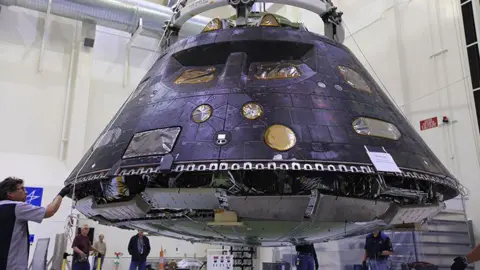
The delay is needed to fix an issue with the capsule's heat shield, which returned from the previous test flight excessively charred and eroded, with cracks and some fragments broken off.

Mr Nelson told a news conference that "the safety of our astronauts is our North Star".

"We do not fly until we are ready. We need to do the next test flight, and we need to do it right. And that's how the Artemis programme proceeds."

Nasa/Leif Heimbold
The Orion Crew module's heat shield was excessively damaged after its test flight in 2022

Mr Nelson said that engineers had got to the root of the problem and believed that it could be fixed by changing the trajectory of the capsule's re-entry – but it would take time to carry out a thorough assessment.

Nasa is in a race with the Chinese space agency, which has its own plans to send astronauts to the Moon. Mr Nelson said he was confident that the Artemis programme would reach the lunar surface first, but he called on Nasa's commercial and international partners to "double down to meet and improve this schedule".

"We plan to launch Artemis 3 in mid-2027. That will be well ahead of the Chinese government's announced intention that they have already publicly stated is 2030."

NASA
Nasa's Space Launch System (SLS) rocket and Orion spacecraft have been criticised for being expensive and slow to develop


The added delay, however, will increase the pressure on government-run Nasa – whose rocket system for sending astronauts to the Moon, the Space Launch System (SLS), has been criticised as being expensive and slow to develop.

This is in stark contrast to Elon Musk's private sector firm, SpaceX, which is surging ahead in its efforts to build its own, eventually much cheaper and reusable Starship rocket.

The nomination of Jared Isaacman by President-elect Donald Trump to take over from Mr Nelson as Nasa's head has added to growing concerns that big changes are in store for Nasa's Moon programme.

Mr Isaacman is a billionaire and close collaborator with Mr Musk, who has paid for two private sector missions which have taken him to space. His entrepreneurial approach might prove a shock to Nasa's system, according to Dr Simeon Barber, a space scientist at the Open University.

"SLS is an old-school rocket. It is not reusable like Starship, hence very expensive, and it has taken a long time to get it operational. And slow and expensive is a precarious position to be in when the incoming president, we expect, is looking to save costs.

"Isaacman is going to bring a new pair of eyes over how Nasa operates. And it's hard to predict what this combination of Isaacman, Musk and Trump might mean for Nasa as we know it."


European Vega-C rocket launches after two-year gap


Europe's Vega-C rocket has successfully returned to space after failing on its first commercial mission two years ago.


Vega-C is carrying the Sentinel-1C satellite for the EU's Copernicus observation programImage: RONAN LIETAR/AFP

Europe's new Vega-C rocket was successfully launched from French Guiana on Thursday. It was the first launch of the troubled rocket since a failed flight two years ago.

After days of delays, the rocket carrying the Sentinel-1C satellite for the European Union's Copernicus Earth observation programme blasted off into space.

"Piloting is calm and the parameters on board are normal," said Jean-Frederic Alasa, Range Operations Manager, in the Guiana Space Center's control room a few minutes into the mission.

Sentinel-1C is expected to expand the use of radar imagery to monitor the Earth's environment. With 12 families of Sentinel satellites, Copernicus is the world's largest Earth observation system, according to its developers, and holds the largest repository of radar data.


What is Vega-C?


The Vega-C is an evolution of the Vega rocket, which carried lightweight satellites into space from 2012 until this autumn.

According to the European Space Agency (ESA), the new rocket can carry about 800 kilograms more payload, is cheaper and can put satellites into orbits at different altitudes. In total, the Vega C can transport more than two tonnes of payload.

In December 2022, Vega rockets were grounded after the latest model failed two and a half minutes into its second mission and first commercial flight due to a motor anomaly, destroying two Earth-imaging satellites.

The rocket was grounded for two years while the nozzle of the Zefiro 40 rocket motor that caused the failure was redesigned.


Europe's prospects in space


The new rocket is expected to play a key role in Europe's access to space after Moscow's full-scale invasion of Ukraine forced the bloc to stop using Russian Soyuz vehicles.

Previously, Europe relied on earlier versions of Vega for light payloads, Soyuz for medium payloads, and Ariane for heavy payloads.

Four-year delays to Europe's new Ariane 6 rocket have exacerbated the problem, forcing the continent to turn to rivals such as Elon Musk's SpaceX.

However, the heavy-lift Ariane 6 made a successful maiden flight in July, providing some relief to Europe's space efforts.

Four launches with Vega-C are planned for next year, followed by five more in 2026, according to ESA.

dh/kb (AFP, dpa, Reuters)


India launches European 'artificial eclipse' satellites

Agence France-Presse
December 5, 2024 


The Proba-3 mission will emulate a solar eclipse to find out more about the Sun's mysterious outer atmosphere (Proba-2 minisatellite/ESA/AFP)

India on Thursday successfully launched into space a pair of European satellites that will create artificial solar eclipses to help scientists catch a rare glimpse of the Sun's mysterious atmosphere.

Scientists broke into rapturous applause at the Sriharikota launch site as the Indian Space Research Organization (ISRO) chief announced the spacecraft had been ejected as planned.

"The spacecraft has been placed in the right orbit," ISRO chief S. Somanath said.

The launch, originally scheduled for Wednesday but delayed by a technical fault, was for the European Space Agency's "Project for On-Board Autonomy 3" (Proba-3) mission, part of a series of "in-orbit missions to test out new technologies".

The mission, at a cost of 200 million euros ($211 million), creates artificial total solar eclipses by positioning two satellites 150 meters (500 feet) apart from each other.

The shadow cast by one satellite allows the other to observe solar phenomena while blocking out the light from the Sun itself.

"For six hours at a time, it will be able to see the Sun's faint atmosphere, the corona, in the hard-to-observe region between the Sun's edge and 1.4 million kilometers from its surface," the European Space Agency said in a pre-launch analysis.

The project will help scientists answer key questions, including why the corona is so much hotter than the Sun itself, and how the Sun's energy output changes over time.

India has emerged as a reliable and low-cost option for putting commercial spacecraft and the satellites of other countries into space.

Experts say New Delhi can keep costs low by copying and adapting existing technology, and thanks to an abundance of highly skilled engineers who earn a fraction of their foreign counterparts' wages.

The world's most populous country has flexed its spacefaring ambitions in the last decade with its space program growing considerably in size and momentum, matching the achievements of established powers at a much cheaper price tag.

In August 2023, it became just the fourth nation to land an unmanned craft on the Moon after Russia, the United States and China.


Prime Minister Narendra Modi also announced plans last year to send a man to the Moon by 2040.

© Agence France-Presse


How quantum black holes explain why we don’t see the end of space and time

The Conversation
December 5, 2024 

Black Hole (Vadim Sadovski/Shutterstock)

Albert Einstein’s theory of gravity, general relativity, is famously incomplete. As proven by physics Nobel laureate Roger Penrose, when matter collapses under its own gravitational pull, the result is a “singularity” – a point of infinite density or curvature.

At a singularity, space, time and matter are crushed and stretched into nonexistence. The laws of physics as we know them suffer a complete breakdown. If we could observe singularities, our physical theories couldn’t be used to predict the future from the past. In other words, science would become an impossibility.

Penrose also realised nature may hold a remedy for this fate – black holes. A defining feature of a black hole is its event horizon, a one-way membrane in space-time. Objects – including light – that cross the event horizon can never leave due to the black hole’s incredibly strong gravitational pull.

In all the known mathematical descriptions of black holes, singularities are present in their core. Penrose postulated that all the singularities of gravitational collapse are “clothed” by the event horizons of black holes – meaning we could never observe one. With the singularity inside the event horizon, physics in the rest of the universe is business as usual.

This conjecture of Penrose, that there are no “naked” singularities, is called cosmic censorship. After half a century, it remains unproven and one of the most important open problems in mathematical physics. At the same time, finding examples of instances where the conjecture doesn’t hold up has proven equally difficult.

In recent work, published in Physical Review Letters, we showed that quantum mechanics, which rules the microcosmos of particles and atoms, supports cosmic censorship.

Black holes

Black holes are influenced by quantum mechanics to some extent, but such influence is normally ignored by physicists. For example, Penrose excluded these effects in his work, as did the theory that enabled scientists to measure ripples in space-time called gravitational waves from black holes.

When they are included, scientists call the black holes “quantum black holes”. These have long provided a further mystery, as we don’t know how Penrose’s conjecture works in the quantum realm.


A model where both matter and space-time obey quantum mechanics is often considered the fundamental description of nature. This could be a “theory of everything” or a theory of “quantum gravity”. Despite tremendous effort, an experimentally verified theory of quantum gravity remains elusive.

It is widely expected that any viable theory of quantum gravity should resolve the singularities present in the classical theory – potentially showing they are simply an artifact of an incomplete description. So it’s reasonable to expect quantum effects should not make the problem of whether we could ever observe a singularity worse.

That’s because Penrose’s singularity theorem makes certain assumptions about the nature of matter, namely that the matter in the universe always has positive energy. However, such assumptions can be violated quantum mechanically – we know that negative energy can exist in the quantum realm in small amounts (called the Casimir effect).


Without a fully fledged theory of quantum gravity, it is difficult to address these questions. But progress can be made by considering “semi-classical” or “partially-quantum” gravity, where space-time obeys general relativity but matter is described with quantum mechanics.

Though the defining equations of semi-classical gravity are known, solving them is another story entirely. Compared to the classical case, our understanding of quantum black holes is much less complete.

From what we do know of quantum black holes, they also develop singularities. But we expect a suitable generalization of classical cosmic censorship, namely, quantum cosmic censorship, should exist in semi-classical gravity.

Developing quantum cosmic censorship

So far, there is not an established formulation of quantum cosmic censorship, though there are some clues. In some cases, a naked singularity can become modified by quantum effects to shroud the singularities; they become quantum dressed. That’s because quantum mechanics plays a role in the event horizon.


First ever image of black hole. Event Horizon Telescope/Wiki Commons, CC BY-SA

The first such example was presented by physicists Roberto Emparan, Alessandro Fabbri and Nemanja Kaloper in 2002. Now, all known constructions of quantum black holes share this feature, suggesting a more rigorous formulation of quantum cosmic censorship exists.

Intimately linked to cosmic censorship is the Penrose inequality. This is a mathematical relationship that, assuming cosmic censorship, says the mass or energy of of space-time is related to the area of black hole horizons contained within it. Consequently, a violation of the Penrose inequality would strongly suggest a violation of cosmic censorship.


A quantum Penrose inequality could therefore be used to rigorously formulate quantum cosmic censorship. One team of researchers proposed such an inequality in 2019. While promising, their proposal is very difficult to test for quantum black holes in regimes where quantum effects are strong.

In our work, we discovered a quantum Penrose inequality that applies to all known examples of quantum black holes, even in the presence of strong quantum effects.

The quantum Penrose inequality limits the energy of space-time in terms of the total entropy – a statistical measure of a system’s disorder – of the black holes and quantum matter contained within it. This addition of quantum matter entropy ensures the quantum inequality is true even when the classical version breaks down (on quantum scales).

That the total energy of this system cannot be lower than the total entropy is also natural from the standpoint of thermodynamics. To prevent a violation of the second law of thermodynamics – that the total entropy never decreases.


When quantum matter is introduced, its entropy is added to the black hole’s, obeying a generalized second law. In other words, Penrose inequality can also be understood as bounds on entropy – exceed this bound, and the space-time develops naked singularities.

On logical grounds, it was not obvious that all known quantum black holes would satisfy the same, universal inequality, but we showed they do.

Our result is not a proof of a quantum Penrose inequality. But that such a result holds in the quantum domain as well as the classical one strengthens it. While space and time may end at singularities, quantum mechanics screen this fate from us.


Andrew Svesko, Research Associate of Theoretical Physics, King's College LondonAntonia Micol Frassino, Research fellow, Scuola Internazionale Superiore di Studi AvanzatiJuan F. Pedraza, Research Fellow at Instituto Fisica Teorica UAM/CSIC, Universidad Autónoma de Madrid, and Robie Hennigar, Willmore Fellow of Mathematical Physics, Durham University

This article is republished from The Conversation under a Creative Commons license. Read the original article.


Oregon approves largest solar project in United States


Dec. 6 (UPI) -- Officials in Oregon have given the final green light to the largest proposed solar project in the United States.

The Oregon Energy Facility Siting Council gave its approval to the 1,200 MW Sunstone Solar project, which will be owned and operated by Pine Gate Renewables.
Advertisement

The clean energy project will be located in Morrow County, Ore., with a population of around 12,000 people and support its wheat agricultural economy.

"Oregon's energy facility permitting process is one of the most rigorous in the entire country," Pine Gate Renewables CEO Ben Catt said in a statement Friday.

"The recent unanimous permit approval is a testament to the way our team worked with stakeholders to provide a win-win for Oregon and the Morrow County community."

Procurement on the project is expected to start next year with construction set to begin in 2026.

"The fight against the climate crisis depends on a variety of successful energy solutions like Pine Gate Renewables' solar power and energy storage project in Eastern Oregon," Oregon Sen. Ron Wyden said in the same statement.

"This is just another example of the important federal investments I fought for in the Inflation Reduction Act, and I will continue to advocate for tech-neutral solutions in our tax code that promote innovation and efficiency in Oregon and across the nation."

The company already operates 17 other solar facilities in Oregon.
Size of Stegosaurus readily apparent in new NYC display to open this weekend


"Apex," a 150 million-year-old Stegosaurus that is the most complete and well-preserved specimen of its size ever discovered, is seen on display for a media preview at Sotheby's in New York City on Wednesday. Photo by John Angelillo/UPI | License Photo

Dec. 5 (UPI) -- The 150 million-year-old fossil remains of a Stegosaurus dinosaur named "Apex" will be displayed at the American Museum of Natural History in New York City starting Sunday.

The dinosaur's remains are considered by many to be the largest and most complete examples of the Stegosaurus ever discovered and are displayed in the museum's Kenneth C. Griffin Exploration Atrium.


The fossil measures 11.5 feet high and 27 feet in length and is mounted in a defensive pose with its spiked tail raised high.

It was discovered in the Morrison Formation near Dinosaur, Colo., in 2022 and contains more than 254 of its original 320 bone elements.

The missing bones were recreated using 3D printing and sculpted pieces to create a complete display of the dinosaur.

The museum chose the atrium to display it so that visitors can walk around the dinosaur's skeleton and appreciate its size.

Researchers with the museum's Paleontology Division will study the fossil to learn more about its growth, life history and variations compared to similar specimens at other natural history institutions.

The fossil is on loan from billionaire Kenneth Griffin, who purchased it in 2024 at auction from Sotheby's for $44.6 million.


The Stegosaurus is the most expensive dinosaur fossil ever sold at auction.

Although it is named Apex, the Stegosaurus was a plant-eater that lived between 145 million and 152 million years ago and is found in the United States, according to the U.K. Natural History Museum in London.

The armored dinosaur used its spiked tail to defend against predators and had distinctive vertical bony plates along its back that were embedded into its skin but not attached to its skeleton.

Scientists are unsure what the purpose might be for the bony plates, with some suggesting they discouraged predators, enabled recognition of other Stegosaurus dinosaurs or helped regulate its body temperature.


Analysis predicts big drop in U.S. global health ranking

"The rapid decline of the U.S. in global rankings from 2022 to 2050 rings the alarm for immediate action"

By Dennis Thompson, HealthDay News


Americans are falling farther behind the rest of the developed world when it comes to health and life expectancy, a new study shows. Photo by Adobe Stock/HealthDay News

Americans are falling farther behind the rest of the developed world when it comes to health and life expectancy, a new study shows.

Life expectancy in the United States is expected to increase to 79.9 years in 2035 and 80.4 years by 2050, up from 78.3 years in 2022, researchers reported.

That sounds good, but it's actually a modest increase that will lower the nation's global ranking from 49th in 2022 to 66th in 2050 among 204 countries around the world, they found.

"The rapid decline of the U.S. in global rankings from 2022 to 2050 rings the alarm for immediate action," said co-senior study author Dr. Stein Emil Vollset, an affiliate professor with the Institute for Health Metrics and Evaluation at the University of Washington in Seattle.

"The U.S. must change course and find new and better health strategies and policies that slow down the decline in future health outcomes," Vollset added in a university news release.

The United States is also expected to rank progressively lower than other nations in the average number of years a person can expect to live in good health, researchers reported Thursday in the Lancet journal.

The U.S. ranking in healthy life expectancy will drop from 80th in 2022 to 108th by 2050, results showed.


The comparative health of U.S. women is expected to fare worse than that of men.

Female life expectancy in the U.S. is forecast to drop to 74th in 2050, down from 19th in 1990, while male life expectancy will decrease to 65th in 2050 from 35th in 1990, the study found.

The major drivers of poor health in America include obesity, high blood sugar and high blood pressure, researchers noted.

If those risk factors were eliminated by 2050, 12.4 million deaths could be averted, researchers forecast.

"In spite of modest increases in life expectancy overall, our models forecast health improvements slowing down due to rising rates of obesity, which is a serious risk factor to many chronic diseases and forecasted to leap to levels never before seen," said co-senior study author Dr. Christopher Murray, director of the Institute for Health Metrics and Evaluation (IHME) at the University of Washington.

"The rise in obesity and overweight rates in the U.S., with IHME forecasting over 260 million people affected by 2050, signals a public health crisis of unimaginable scale," Murray added.

Drug-related deaths also are eating into American health.

The United States recorded an 878% increase in the death rate from drug use disorders between 1990 and 2021, rising from 2 deaths to 19.5 deaths per 100,000, researchers noted.

And that rate is expected to climb another 34% by 2050, up to 26.7 deaths per 100,000 -- the highest drug-related mortality rate in the world, more than twice that of the second-highest country, Canada.

"The stark contrast that's forecasted in the next 30 years comes after a concerted effort by federal, state and local government agencies and health systems launched after the opioid crisis was declared a public health emergency in 2017," said lead researcher Ali Mokdad, a professor with IHME.

"The opioid epidemic is far from over, and greater effectiveness and continued expansion of programs to prevent and treat drug use are still needed," Mokdad added.

These trends harm not only individual Americans, but the nation as a whole, researchers said.

"Poor health harms the economy because the nation suffers from a reduced workforce, lower productivity and higher health care costs for companies and their employees," Murray said. "That leads to a lower GDP and a chance for peer countries with a stronger economy to overtake the U.S., creating a ripple effect around the world financially and geopolitically."

Expanding health care access is the most straightforward way to improve America's standing, as such coverage allows doctors to catch and treat disease more effectively, researchers said.

"All Americans must have access to high-quality health care through universal health coverage to prevent illness, stay healthy and be protected from financial hardship, regardless of their income," Mokdad said.

More information

The U.S. Centers for Disease Control and Prevention has more about U.S. life expectancy.

Copyright © 2024 HealthDay. All rights reserved.


Study: 1 in 20 pregnant U.S. women experience emotional, physical abuse

By Ernie Mundell, HealthDay News


New research shows that 1 in 20 American women suffer physical, sexual or emotional abuse during pregnancy. Photo by Adobe Stock/HealthDay News

Pregnancy can be a trying time for women at best, but new research shows that 1 in every 20 pregnant American women also suffer physical, sexual or emotional abuse.

Abuse can take a toll on the mental and physical health of the mom-to-be and her baby, because it's strongly linked to "delayed prenatal care, depression and post-traumatic stress disorder [PTSD]," the research team wrote.

The new study also showed that abuse experienced in pregnancy can raise risks for maternal substance abuse, premature delivery and low birth weight.

The research was led by Megan Steele-Baser, of the Division of Violence Prevention at the U.S. Centers for Disease Control and Prevention.

Her team looked at 2016-2022 data on self-reported levels of physical or sexual violence and emotional abuse for pregnant women living in Arkansas, the District of Columbia, Indiana, Kansas, Mississippi, Pennsylvania, South Dakota, Washington and Wisconsin.

Women were also asked about the state of their health and health care during the pregnancy.

The data showed that more than 1 in every 20 of the women (5.4%) had some experience of abuse from an intimate partner during their pregnancy.

Emotional abuse (denigrating comments, yelling and other abuse) was most common, with 5.2% of women citing these experiences, while 1.5% of women suffered physical violence from a partner and 1% cited sexual violence.

All of this could seriously impact pregnancy outcomes.

For example, experiencing emotional abuse was linked to a near-tripling of the risk for depression during pregnancy, and it greatly raised the odds that a mom-to-be would smoke or use alcohol or marijuana.

Physical violence inflicted on a pregnant women upped her chances of depression nearly three-fold, and it raised her chances for gestational high blood pressure by 30% and preterm birth by 50%, the research showed.

Sometimes, outcomes can be fatal: According to Steele-Baser and colleagues, 40% of homicides affecting pregnant women coincide with intimate partner violence.

The researchers also noted that suicide, drug overdose and other forms of fatalities linked to mental health issues remain the leading cause of death for pregnant women. All may be linked to depression, which can easily arise in the context of abuse by an intimate partner.

According to Steele-Baser's team, more can and must be done to prevent these tragedies.

"Addressing multiple intimate partner violence types through comprehensive prevention efforts is critical to supporting maternal ad infant health," they wrote.

The new findings were published Thursday in the CDC journal Morbidity and Mortality Weekly Report.

More information

Find out more about signs of depression in pregnancy at the American College of Obstetricians and Gynecologists.
Advertisement


Copyright © 2024 HealthDay. All rights reserved.