A rare Venus solar transit helps unravel exoplanet atmospheres
A team led by the Institute of Astrophysics and Space Sciences (IA) analysed data from this century’s last Venus solar transit and validated methods to study the atmosphere of Earth-sized exoworlds
image:
In June 2012, Hinode probe (of JAXA and NASA), dedicated to the study of the Sun, observed the planet Venus transiting in front of our star.
view moreCredit: JAXA/NASA/Lockheed Martin
In the next decade, researchers will start probing the atmosphere of planets as small as Earth and Venus orbiting nearby stars. But although these two Solar System planets are similar in size and bulk density – so that some call them ʻtwinsʼ – their atmospheres are nothing alike. Would scientists be able to set them apart if seen from light-years away?
A team led by the Instituto de Astrofísica e Ciências do Espaço (IA) pretended Venus was faraway in another planetary system – an exoplanet – and asked what kind of information they could extract. The results were published in an article in the Atmosphere journal and prove that techniques being used to study large hot exoplanets can be effectively applied to those with a diameter ten times smaller. It also paves the way to the identification of markers that might discriminate between nitrogen dominated mild atmospheres, like Earth’s, and those mostly made of carbon dioxide, as the hot and violent Venus atmosphere.
“The techniques currently used to study the atmosphere of exoplanets are effective for giant planets close to their star, thus with a hot atmosphere. However, it is challenging to study the atmosphere of bodies as small as Earth or Venus,” says first author Alexandre Branco, a MSc student at IA and the Faculty of Sciences of the University of Lisbon (Ciências ULisboa). “The most promising targets are often bathed in a stellar radiation regime much like Venus, so ‘ExoVenus’ are most likely to be the first small worlds to have their atmosphere characterised. Our work had this aim of looking at Venus as if we were looking at an exoplanet.”
With decades of other studies on Venus, the researchers were able to validate their conclusions. Furthermore, they show that the atmospheres of Solar System bodies may also be probed using these same techniques for distant atmospheres, to detect in our close neighbours chemical species of very low concentrations, hard to find through other means.
A rare chance
To observe Venus as an exoplanet, the team analysed a very rare set of data, collected on 5 and 6 June 2012, the last time in this century Venus crossed the disc of our Sun – much in the same way the atmospheres of exoplanets are probed when they pass in front of their host star from our point of view on Earth. They imprint their presence on the star’s light as it passes on its way to Earth. Among the traces are signals left by molecules in their atmosphere that tell astrophysicists what it is made of.
This is harder the smaller the planet is, but new astronomical instruments are planned to start operations in the 2030s, and exoplanets the size of Earth and Venus will be within their reach. Thus, the techniques already being successfully used on large hot exoplanets need to be tested and calibrated for these more challenging cases, where relevant signals are likely to be too small and hidden in the noise.
By applying those techniques to data from the Venus transit in front of the Sun, the researchers validated their future use with powerful facilities such as ESO’s Extremely Large Telescope (ELT) and European Space Agency (ESA)’s Ariel space mission, projects in which Portugal and IA are involved. However, to discriminate between worlds like Earth and those like Venus, more needs to be done. Seen from afar, Venus could be mistaken by a planet like our own.
Will the first distant “Earth” actually be another hellish Venus?
Due to its carbon dioxide concentration, Venus' atmosphere is subject to an extreme greenhouse effect that melts lead on the planet’s surface, and pressure reaches that inside divers bottles. Actually, a Venus-like atmosphere is likely to be the first to be characterised in an “Earth-sized” exoplanet.
“The high temperatures intrinsic to rocky planets with an atmosphere rich in carbon dioxide, and thus subject to intense greenhouse effect, lead to a chemically active environment, with many chemical transitions. This makes this type of atmosphere easy to detect,” says Pedro Machado, of IA and Ciências ULisboa, and the second author of this study.
Co-author Olivier Demangeon, of IA and Faculty of Sciences of the University of Porto (FCUP), adds: “Venus’ atmosphere is around 90 times denser than Earth and is also significantly hotter. So much so that, despite being denser, Venus’ atmosphere is larger. Larger and denser both imply a strong signature in our observations. We detected some faint signatures of carbon dioxide on the Venus data that are not expected in Earth-like atmospheres. Yet, it is still not the most efficient way to differentiate between the two planets.”
Positive results also for the other worlds in the Solar System
In 2012, Pedro Machado and his team participated in the coordinated observations of Venus for the international campaign when the planet crossed the solar disc in June. They also analysed spectroscopic data collected at Dunn Solar Telescope (National Solar Observatory, New Mexico, USA) using the Facility Infrared Spectropolarimeter (FIRS). The data refers to light from the Sun refracted by the upper atmosphere of Venus during the moments the rim of the planet touched and, at the end, released the solar disc.
“We adapted to a Solar System body the sophisticated techniques used to study the atmosphere of worlds incredibly farther,” says Pedro Machado, “and we proved they can also be used to detect minor chemical components in the atmospheres in our Solar System. We are preparing observations that will benefit from this technique to probe the atmospheres of Júpiter and Saturn when a bright star passes behind them as seen from our telescopes on Earth. Orbital missions around Venus or Mars also have observed the Sun across their atmospheres.”
“We even detected the clear signatures of the isotopes of carbon and oxygen in the molecules of carbon dioxide and carbon monoxide,” adds Machado. The amount of certain isotopes change with time and are used to assess past atmospheric environments of temperature and pressure and their timescales.
“Estimating the relative amounts of isotopes enables us to extract conclusions about the story of how Venus evolved,” says Alexandre Branco. Machado adds: “This is something to which this work contributes very clearly, and this is also one of the goals of the next European Space Agency mission to Venus, EnVision, in which Portugal and IA collaborate: to study Venus' past evolution.”
The ANDES spectrograph, for ESO’s ELT, and ESA’s Ariel space mission, both with contributions from IA on the science and the technology, are two facilities that will boost the research into other worlds, and will benefit from studies in line with the work by this team. Ariel will enable the study of the atmosphere of about 1000 exoplanets already known, and to do so it will use the same observing and analysis techniques this team applied in this work. Pedro Machado is member of the Ariel Consortium board and coordinator of the Ariel working group that links the study of atmospheres of exoplanets with that of the Solar System.
Gliese 12 b exoplanet, which discovery was announced on May 2024, is 40 light-years away and might have the size of Earth ot slightly smaller, in which case would be equivalent to Venus. In this artistic concept on the right are presented possible interpretations of the planet, without and with atmosphere, which could be thick and dense as Venus’.
Credit
NASA/JPL-Caltech/R. Hurt (Caltech-IPAC)
Venus solar transit in June 2012 observed with Dunn Solar Telescope, of the National Solar Observatory (National Science Foundation, EUA), the source of the data analysed for this study now published on Atmosphere.
Credit
National Solar Observatory
Artist concept of a star seen through the atmosphere of a planet orbiting it.
Credit
NASA/Goddard Space Flight Center
High resolution images available at: https://divulgacao.iastro.pt/en/link-press-202412-venus-exoatmospheres/
Journal
Atmosphere
Subject of Research
Not applicable
Article Title
Transmission Spectroscopy Along the Transit of Venus: A Proxy for Exoplanets Atmospheric Characterization
By Robert Lea
An asteroid hitting a neutron star could release enough energy to power humanity for 100 million years, more than enough to explain fast radio bursts.
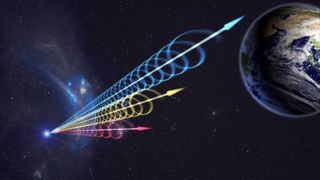
Scientists have discovered that mysterious blasts of energy called fast radio bursts (FRBs) may be created when asteroids slam into ultradense extreme dead stars called neutron stars. Such a collision releases enough energy to supply humanity's power needs for 100 million years!
FRBs are transient pulses of radio waves that can last from a fraction of a millisecond to a few seconds. In this period, an FRB can release the same amount of energy that it would take the sun several days to radiate.
The first FRB was observed in 2007, and since then, these blasts of energy have maintained their aura of mystery because they were infrequently detected until 2017. That was the year when the Canadian Hydrogen Intensity Mapping Experiment (CHIME) came online and began making frequent FRB discoveries.
"FRBs so far defy explanation, with over 50 potential hypotheses of where they come from - we counted!" team leader and University of Toronto scientist Dang Pham told Space.com.
The possible connection between FRBs and asteroids, as well as comets slamming into neutron stars, has been suggested before. This new research by Pham and colleagues further solidifies that link.
"It's been known for many years that asteroids and comets impacting neutron stars can cause FRB-like signals, but until now, it was unclear if this happened often enough across the universe to explain the rate at which we observe FRBs occurring," Pham said. "We have shown that interstellar objects (ISOs), an understudied class of asteroids and comets thought to be present between stars in galaxies throughout the universe, could be numerous enough that their impacts with neutron stars could explain FRBs!"
Pham added that the team's research also showed other expected properties of these impacts match up with observations of FRBs such as their durations, energies, and the rate at which they occur over the lifetime of the universe.
The question is: Even though asteroid impacts can be devastating (just ask the dinosaurs), how could they possibly release the same amount of energy that a star takes days to radiate?
Extreme stars mean extreme explosions
Neutron stars are created when massive stars die and their cores collapse, creating dense bodies with the mass of the sun, only crammed into a width no larger than the average city on Earth.
The result is a stellar remnant with extreme properties, such as the densest matter in the known universe (one teaspoon would weigh 10 million tons if brought to Earth) and magnetic fields that are the strongest in the universe, trillions of times more powerful than Earth's magnetosphere.
"Neutron stars are extreme places, with over the mass of the sun squeezed into a sphere about 12 miles (20 km) across, giving them some of the strongest gravitational and magnetic fields in the universe," team member and Oxford University astrophysicist Matthew Hopkins told Space.com. "This means that a huge amount of potential energy is released when an asteroid or comet drops onto one, in the form of a flash of radio waves bright enough to be seen across the universe."
So, how much energy are we talking about here? To consider this, let's swap out an asteroid for something a touch sweeter.
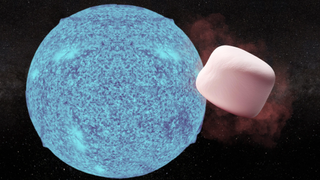
According to NASA's Goddard Flight Center, if a normal-sized marshmallow were dropped to the surface of a neutron star, the gravitational influence of the dead star is so great that the treat would accelerate to speeds of millions of miles per hour. That means when the marshmallow hits the neutron star, the collision releases the energy equivalent to the simultaneous explosion of a thousand hydrogen bombs!
Exactly how much energy the asteroid/neutron star smash-up releases depends on several factors.
"The energy released depends on the size of the asteroid and the strength of the magnetic field on the neutron star, both of which can vary by a lot, by several orders of magnitude," Hopkins added. "For an asteroid 0.62 miles (1 km) across and a neutron star with a surface magnetic field strength over one trillion times the Earth's magnetic field strength, we calculate the energy released to be about 10^29 Joules (that's 10 followed by 28 zeroes).
"This is a huge number, about one hundred million times all the energy used by all of humanity over a year!"
Clearly, asteroids slamming into neutron stars can release enough energy to explain FRBs, but are these collisions frequent enough to account for FRB observations?
Could asteroid 'combo attack' neutron stars to create repeat FRBs?
Astronomers have detected FRBs from all over the sky, with some scientists estimating that 10,000 FRBs could occur at random points in the sky over Earth each day. If this team is right, that's a lot of collisions between neutron stars and asteroids.
Interstellar rocks are certainly abundant enough in the Milky Way to account for this rate; there are about 10^27 (10 followed by 26 zeroes) in our galaxy alone. But how often do these encounter a neutron star?
"The collision between one neutron star and an interstellar object is rare. We estimate it to be about one collision every 10 million years in the Milky Way," Pham said. "However, there are many neutron stars in the galaxy, and there are many galaxies! Taken together, we find that the neutron star-interstellar objects collision-rate in the universe is comparable with currently observed FRB rates."
Additionally, the researcher pointed out that the number of neutron stars and interstellar objects increases over the lifetime of the universe. That means the rate of neutron stars and interstellar object collisions should also increase over cosmic time.
"If this model is true, then we should observe FRB rates increase as the universe ages," Pham said. "This remains an open research question that could benefit from more observations!"
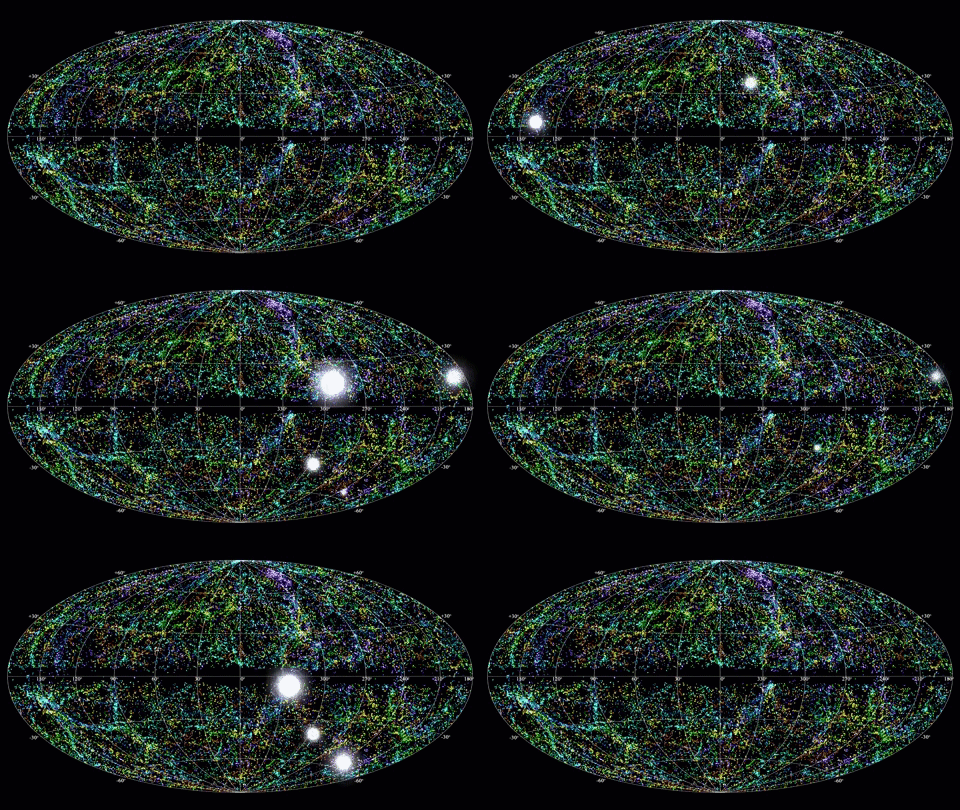
Even if this theory is correct, it doesn't answer everything about FRBs. That is mainly because there are two types of these energetic blasts of radiowaves.
Thus far, we have been talking about single-occurrence FRBs. However, there are also repeating FRBs that fire off more than once. Could asteroid incursions also explain repeat FRBs?
"We find that this model cannot account for repeating FRBs because a neutron star colliding with an interstellar rock is a rare, random event," Hopkins explained. "It is rare for an individual neutron star to collide with an interstellar object. In comparison, repeating FRBs generally occur at a much faster rate, with some observed to be as fast as two bursts per hour!"
Prior research has suggested that if a single-occurrence FRB is caused by collisions between a neutron star and an asteroid, then repeating FRBs could represent these dead stars colliding with an asteroid belt, like the one in our solar system between Mars and Jupiter.
"There are still some debates around this idea, specifically on how dense these debris fields must be. This scenario is beyond what we considered in our model, which is neutron stars colliding with interstellar objects," Pham said. "Further observations are needed to understand the emission mechanisms of FRBs and their sources."
Pham and Hopkins pointed out that the neutron star-interstellar object collision rates will depend on the kinds of galaxies, such as elliptical or spiral galaxies, in which they occur. That means astronomers will need to observe more FRBs and track them back to host galaxies to determine what type of galaxies are most associated with these blasts of energy.
"Understanding the evolution of FRB rates over cosmic time can also help us understand more about this model," Pham added. "More FRB observations could also place more constraints on how energetic these events are, which will inform us about how FRBs are emitted." The research team told Space.com this will be done with FRB observational projects, such as CHIME, the Canadian Hydrogen Observatory and Radio-transient Detector (CHORD), and the Australian Square Kilometre Array Pathfinder (ASKAP).
"Additional works to constrain how populated galaxies are with interstellar objects will also give us better information on how often neutron stars can collide with these objects in the universe," Pham concluded.
The team's results have been accepted for publication in the Astrophysical Journal. A preprint version of the team's paper is available on the repository site arXiv.
Originally posted on Space.com.
NRL hosts NASA astronaut Loral O’Hara
Naval Research Laboratory
image:
Loral O’Hara (right), NASA astronaut, holds a model of Vanguard America 2nd satellite while Bernard Kelm, U.S. Naval Research Laboratory (NRL) acting director of Naval Center for Space Technology, explains to her the history of the satellite in Washington, D.C. Dec. 2, 2024. While at NRL O’Hara received briefings regarding the laboratories mission and viewed current research being conducted at the Naval Center for Space Technology.
view moreCredit: U.S. Navy photo by Jonathan Steffen-Arnold
WASHINGTON — NASA Astronaut Loral O’Hara visited the U.S. Naval Research Laboratory (NRL) on Dec. 2, to share her firsthand experiences during her 200+ day mission aboard the International Space Station.
O’Hara told stories about her research in space and narrated a 20-minute video documenting her time on the space station before taking several questions from NRL scientists and engineers providing unique insights into life and research in space.
O’Hara captivated the audience with tales of her daily routine on the station, the challenges faced by the crew, and the most memorable moments of her mission. She also delved into the scientific research that was most meaningful to her, emphasizing the importance of space exploration for advancing human knowledge and technology.
She said one of the most interesting projects she got to work on was CIPHER. The Complement of Integrated Protocols for Human Exploration Research program helps scientists pinpoint how the human body reacts to time in space. The research will help NASA prepare astronauts for missions to the Moon, Mars, and beyond.
“I got to look at all aspects of human health in space, with an eye on how to protect astronauts for longer duration missions,” O’Hara said.
On Sept. 15, 2023, O’Hara launched to the space station aboard the Soyuz MS-24 spacecraft alongside Roscosmos cosmonauts Oleg Kononenko and Nikolai Chub. Aboard the space station, she became a flight engineer for Expedition 70. Throughout her mission, O’Hara contributed to a host of science and maintenance activities and technology demonstrations, including investigating heart health, cancer treatments, and space manufacturing techniques. O’Hara conducted one spacewalk totaling 6 hours, 42 minutes, joined by NASA astronaut Jasmin Moghbeli, replacing one of the 12 trundle bearing assemblies on the port solar alpha rotary joint, which allows the arrays to track the Sun and generate electricity to power the station.
After making a safe, parachute-assisted landing southeast of the remote town of Dzhezkazgan, Kazakhstan, on April 6, 2024, O’Hara completed her more than six-month science mission, logging 204 days aboard the space station. She traveled 86,555,554 miles during her mission and completed 3,264 orbits around Earth. Expedition 70 was the first spaceflight for O’Hara.
Following her presentation, O’Hara received a tour of the NRL facility, gaining firsthand knowledge of the laboratory's state-of-the-art research capabilities. She also participated in meetings with NRL scientists and engineers, discussing ongoing space research projects and exploring potential avenues for future collaboration between NASA and NRL.
This event further solidifies the strong bond between NRL and NASA, fostering collaboration and innovation in areas such as materials science, space physics, and advanced technologies.
Loral O’Hara, NASA astronaut, answers questions from U.S. Naval Research Laboratory about her mission on Expedition 70 aboard the International Space Station in Washington, D.C. Dec. 2, 2024. While at NRL O’Hara received briefings regarding the laboratories mission and viewed current research being conducted at the Naval Center for Space Technology.
Credit
U.S. Navy photo by Jonathan Steffen-Arnold
About the U.S. Naval Research Laboratory
NRL is a scientific and engineering command dedicated to research that drives innovative advances for the U.S. Navy and Marine Corps from the seafloor to space and in the information domain. NRL is located in Washington, D.C. with major field sites in Stennis Space Center, Mississippi; Key West, Florida; Monterey, California, and employs approximately 3,000 civilian scientists, engineers and support personnel.
For more information, contact NRL Corporate Communications at (202) 480-3746 or nrlpao@nrl.navy.mil. Please reference package number at top of press release.
###
