Thursday, January 09, 2025

Waymo exec hopeful Trump will boost autonomous driving


By AFP
January 9, 2025


Waymo Co-Chief Executive Officer Tekedra Mawakana said she welcomed competition in the growing autonomous driving space - Copyright AFP Ian Maule

A top Waymo executive said Wednesday the United States could lead globally on autonomous driving, expressing hope that a national standard under the incoming Trump administration would boost safety.

Tekedra Mawakana, co-chief executive of the Google-owned robotaxi venture, said the “race” around autonomous driving had “matured” compared with Donald Trump’s first presidential administration, alluding to a global competition in which the US company is competing with Chinese and German auto players.

“This is a real opportunity for US leadership and so enabling safe sustainable transportation that is autonomous is very aligned with what I think this administration will want to do,” Mawakana said during a fireside chat interview at the Consumer Electronics Show.

Tech experts expect the Trump administration to set a national standard on autonomous driving standards after Trump donor and Tesla Chief Executive Elon Musk embraced the move.

Musk, who is expected to play an influential role in the Trump White House, has expressed frustration with the gap between Texas and California when it comes to rules on autonomous vehicles.

Musk plans to launch a robotaxi venture that would compete directly with Waymo. He is targeting the venture to begin by 2027.

Mawakana declined to comment directly on whether she trusted Musk to treat competitors fairly in his dealings with Trump. But she welcomed competition, saying “making the road safer is an important mission, and it’s too big for one company.”

Although autonomous driving is still a long way from mainstream use, Waymo made strides in 2024. The company operates commercially in three US cities and plans two more US city launches in 2025. It currently provides more than 150,000 trips weekly.

Mawakana cautioned of the risk with a national standard of “a race to the bottom on safety,” but said Trump’s team had been “very forward-leaning” on autonomous driving.

“As far as a national framework, that’ll be great. It’s just that that framework should require people to demonstrate their safety record,” she said.
UK FM Lammy refuses to condemn Trump comments on Greenland

LABOUR SUCKS UP TO TRUMP

\
By AFP
January 9, 2025


British Foreign Secretary David Lammy once described Donald Trump as a 'tyrant' and 'xenophobic' 
- Copyright GETTY IMAGES NORTH AMERICA/AFP/File MARIO TAMA

British Foreign Secretary David Lammy on Thursday refused to condemn president-elect Donald Trump’s Greenland ambitions while insisting that the US acquiring the self-governing Danish territory is “not going to happen”.

“I’m not in the business of condemning our closest ally,” Lammy told Sky News, adding that he was “in the business of interpreting what sits behind this and there are some very serious national economic security issues”.

The comments contrast with the response of some European leaders on Wednesday to Trump refusing to rule out using economic or military force to acquire Greenland.

Germany’s Olaf Scholz said the stance had sparked “notable incomprehension” and “uneasiness” among EU leaders, and later noted on social media that “borders must not be moved by force”.

London, which prizes its so-called special relationship with Washington, is eager not to damage relations with Trump and his team under the UK’s new Labour government.

It follows a number of Labour ministers previously making disparaging comments about the president-elect, including Lammy, who once described him as a “tyrant” and “xenophobic”.

Trump has designs on the mineral- and oil-rich Arctic island, an autonomous territory of European Union member Denmark that itself has eyes on independence.

He set alarm bells ringing on Tuesday at a news conference when he said the US needs Greenland “for national security purposes”.

In a round of interviews on Thursday, Britain’s top diplomat branded the incoming US president’s remarks “classic Donald Trump” and said they were centred around “Americans’ national economic security”.

“In the end, that is up to the people of Greenland and their own self-determination, and there is a discussion within Greenland about those very same issues,” he told Sky News.

Asked by BBC radio how Britain would respond if Trump acted on his claim that the US might try to acquire Greenland by economic or military force, Lammy insisted that “it’s not going to happen”, noting that “no NATO allies have gone to war, since the birth of NATO”.

But he was also careful not to criticise Trump, noting that while his “rhetoric” and “unpredictability” can be “destabilising”, the outcomes of that can be beneficial to Western allies.

He cited Trump’s insistence on increased defence spending by NATO members as an example.

Lammy added that Trump was addressing valid “concerns about Russia and China in the Arctic” as well as “national economic security” in his Greenland comments.

“He recognises, I’m sure, that in the end, Greenland today is a (part of the) Kingdom of Denmark. There is a debate in Greenland about their own self-determination.”

Lammy also noted that the US has troops and a military base on Greenland.

“So it has got a stake in that Arctic theatre,” he added.
US emissions stagnate in 2024, challenging climate goals: study


By AFP
January 9, 2025


The US Supreme Court ruled in June that the government's key environmental agency cannot issue broad limits on greenhouse gases. 
— UK PARLIAMENT/AFP/File JESSICA TAYLOR

Issam AHMED

US greenhouse gas emissions barely decreased in 2024, leaving the world’s largest economy off track to achieve its climate goals, according to an analysis released Thursday, as the incoming Trump administration looks set to double down on fossil fuels.

The preliminary estimate by the Rhodium Group, an independent research organization, found a net fall of just 0.2 percent in economy-wide emissions.

Lower manufacturing output drove the modest decline, but it was undercut by increased air and road travel and higher electricity demand.

Study co-author Ben King told AFP the small drop came despite the US economy expanding last year by 2.7 percent, “a continuation of a trend that we’ve seen where there’s a decoupling between economic growth and greenhouse gas emissions.”

Overall, emissions remain below pre-pandemic levels and about 20 percent below 2005 levels, the benchmark year for US commitments under the Paris Agreement.

The accord aims to limit global warming to 1.5 degrees Celsius above pre-industrial levels, to avert the worst catastrophes of planet-wide heating.

But with 2024 effectively static, decarbonization must accelerate across all sectors.

“To meet its Paris Agreement target of a 50-52 percent reduction in emissions by 2030, the US must sustain an ambitious 7.6 percent annual drop in emissions from 2025 to 2030,” the report said — an unprecedented pace outside of a recession.

What’s more, Trump has signaled plans to roll back President Joe Biden’s green policies, including rules that require sweeping cuts from fossil fuel power plants and provisions of the Inflation Reduction Act, which channels hundreds of billions of dollars into clean energy.

Should these plans materialize, the US would likely achieve only a 24–40 percent emissions reduction by 2035, the report concluded.

– Off track –

Even under Biden, the US has logged more tepid reductions compared to some other major emitters.

German greenhouse gas emissions fell by three percent in 2024, following a 10 percent year-on-year drop the previous year, according to Agora Energiewende.

The European Union’s emissions are forecast to have dropped by 3.8 percent in 2024, according to Carbon Brief, a UK-based analysis site.

Such predictions precede official government data and only represent estimates, meaning final figures can vary significantly.

Lower manufacturing output drove a modest decline in US emissions in 2024, but it was undercut by increased air and road travel and higher electricity demand
– Copyright GETTY IMAGES NORTH AMERICA/AFP/File MARIO TAMA

US emissions have been trending downward in bumpy fashion since they peaked in 2004. They fell 3.3 percent in 2023 but rose 1.3 percent in 2022 and 6.3 percent in 2021 amid a post-pandemic rebound.

“When we looked at the Inflation Reduction Act a couple of years ago… we would have expected slightly lower emissions today than we’re seeing right now,” said King.

Still, these investments may just need more time to pay off: with the report finding clean energy and transportation spending reached a record $71 billion in last year’s third quarter.

“It’s kind of a mixed bag from my perspective,” King said.

– Air conditioning demand –

Positives in the report include a bigger share of green energy in the grid — solar and wind combined surpassed coal for the first time — and a drop in methane emissions from reduced coal use and cleaner oil and gas production.

Climate scientist Michael Mann of the University of Pennsylvania told AFP he welcomed the continued decoupling of growth and emissions.

But “emissions aren’t coming down anywhere near the rate they need to, yet at least,” he added.

“Simply flatlining emissions puts the United States even farther off track from meeting its climate commitments,” warned Debbie Weyl, US Acting Director for the World Resources Institute.

Rachel Cleetus, policy director with the climate and energy program at the Union of Concerned Scientists, called the findings “sobering,” noting the increased electricity demand came from residential buildings requiring more air conditioning.

“Now that’s a reality, as we see year upon year of the temperature records being broken,” she told AFP, as 2024 is set to be named the hottest year on record.


New twist in US-Cuba trademark fight over Havana Club rum


By AFP
January 8, 2025


A bartender prepares a cocktail with the new Havana Club Cuban Spiced rum at Havana's rum museum in 2022 
- Copyright AFP/File YAMIL LAGE


Jordane BERTRAND

One rum, two owners: the decades-long legal battle between the Cuban government and spirits giant Bacardi over the popular Havana Club rum brand has entered a new phase with the enactment of a new US trademark law.

Entitled “No Stolen Trademarks Honored in America Act” and signed into law last month by outgoing US President Joe Biden, it prohibits US courts from recognizing trademarks that were “illegally confiscated” by the Cuban government since the 1959 Cuban Revolution.

The law cements Bacardi’s rights to Havana Club and could prevent Cuba’s state-owned Cubaexport and its French partner, beverage giant Pernod Ricard, from asserting their rights to the brand in the United States.

While Cuba currently cannot export its rum to the United States because of a decades-long trade embargo, the government in Havana and Pernod Ricard believe that maintaining trademark rights to the iconic drink is important in case restrictions are lifted.

The law, which was championed by incoming Secretary of State and Cuba hardliner Marco Rubio, was swiftly criticized by the government of the Communist island, which said that it violates international norms.

“Once again, the United States government provides space for the dark interests of the most aggressive anti-Cuban sectors whose manipulation of the American political system has become a practice,” the government said in a recent statement.

Bacardi, which was exiled from Cuba after the country’s Communist revolution, says that the Cuban government unlawfully seized rum distilleries and the Havana Club brand from its founder Jose Arechabala SA in 1960.

But the Cuban government has maintained its rights to the brand and has marketed Havana Club worldwide, with the exception of the United States because of the embargo Washington imposed in 1962.

In 1976, Cuba managed to assert its rights to the brand in the United States, until Bacardi contested it in 1995 and started selling its own rum in the United States under the Havana Club brand.


– Booming market –


The legal fight is unlikely to subside because the rum industry is booming.

According to a recent report by Dublin-based consultancy Research and Markets, the global rum market is expected to grow at an average rate of 7.7 percent per year over the next six years, jumping from $19.1 billion in 2024 to $32.2 billion by 2031.

In 2016, the United States Patent and Trademark Office (USPTO) renewed Cubaexport’s registration of the Havana Club brand for ten years, but the enactment of the law is likely to complicate its renewal in 2026.

John Kavulich, director of the New York-based Cuba-US Trade and Economic Council described the law as “an immensely cost-effective” lobbying effort for Bacardi.

“Most significantly was the complete lack of opposition — even from the most vocal members of the United States Congress who support commercial, economic, financial, and political re-engagement with Cuba,” Kavulich said to AFP.

After the brief thaw in US-Cuban ties that began under Barack Obama (2009-2017) and the strengthening of sanctions during Republican Donald Trump’s first presidency (2017-2021), which largely remained unchanged under Democrat Biden, tensions with Havana could rise further under Trump’s second term.
Rubber tappers forge sustainable future in Amazon


By AFP
January 8, 2025


Renato Cordeiro, 57, harvests rubber from a hevea tree (Hevea brasiliensis) near his home - Copyright AFP Pablo PORCIUNCULA

Anna PELEGRI

As the sun rises over the Amazonian island of Marajo, Renato Cordeiro laces up his boots, grabs his knife, and heads out to tap his rubber trees.

Drop by drop, he collects the milky white sap, known as latex, that sustains him.

The recent revival of the rubber tapper trade in this impoverished northern Brazilian region has created jobs for families who once thrived during the Amazonian rubber boom, which collapsed in the late 20th century.

A local company called Seringo has enabled Cordeiro and more than 1,500 other rubber tappers to resume their craft. The company produces goods such as footwear while also protecting the forest, increasingly threatened by deforestation.

For Cordeiro, a wiry 57-year-old, the Amazon is his backyard.

Behind his stilt house on the Anajas River, dozens of natural rubber trees blend with centuries-old trees and palms typical of this island, surrounded by rivers on one side and the sea on the other.


– ‘Family heritage’ –


“I started tapping trees at age seven with my mother, deep in the forest,” said Cordeiro, holding his knife, which has a protruding metal piece for making precise cuts in the bark.

With each incision made carefully to avoid harming the trunk, the native Amazonian tree begins to drip its latex into a container placed underneath. As it fills, Renato moves on to the next tree.

Each day, he collects about 18 liters (4.8 gallons), mixing it with vinegar to produce white rubber sheets. These hang on a rope for 10 days to dry before being sold to Seringo, which picks them up from his riverside home.

Cordeiro, a married father of three, beams with pride. After nearly two decades of scraping by through hunting and acai harvesting, he returned to rubber tapping in 2017 to protect what he calls his family heritage — the forest.

“I longed for this work to return,” says Valcir Rodrigues, another rubber tapper and father of five, from a stilt house along the river north of Anajas.

“We want to leave a better world for our children, so we don’t deforest,” he says.

Rodrigues frequently confronts loggers who invade his land to cut down trees.

“They need to understand how much they harm the forest — and themselves — since many end up in debt to their employers,” he explains.

Deforestation surged in Marajo when global demand for Amazonian rubber plummeted as countries like Malaysia began large-scale rubber tree plantations.

Today, however, rubber sustains Rodrigues’s entire family. His wife and mother-in-law skillfully craft colorful artisanal goods sold primarily in Belem, the capital of Para state, to Marajo’s east.

“I was a civil servant, but the local government never gave me a job. This is my first real trade, and I love it,” said his mother-in-law Vanda Lima, a smiling 60-year-old.


– Expansion –


With one of Brazil’s worst Human Development Index rankings, “it was necessary to create income in Marajo,” says Zelia Damasceno, who co-founded Seringo with her husband to boost the region’s bio-economy.

Initially focused on promoting artisanal work, the couple realized that rubber tappers were “unsatisfied,” extracting latex sporadically for their spouses to use in making crafts.

“That’s why we envisioned a second purpose — footwear — so they could also earn a living,” says Damasceno, 59, from Para.

At its factory in Castanhal, about 300 kilometers (200 miles) east of Marajo, Seringo produces 200 pairs of biodegradable shoes daily, made from 70 percent rubber and 30 percent acai powder.

The company recently received support from the Para government to expand the number of rubber tappers it calls on in Marajo to 10,000.

That is part of a sustainable development program launched ahead of COP30, a UN climate conference scheduled for November in Belem.

Still, challenges remain, Damasceno admits: “Some young people don’t want to follow this path. We must raise awareness about the importance of this work to preserve the forest and their future.”


‘No more fires,’ demand fed-up Amazon residents


By AFP
January 8, 2025


View of burned acai palm trees due to an out-of-control fire in the Amazon region of the Marajo archipelago in Breves - Copyright AFP Pablo PORCIUNCULA
Anna PELEGRI

Giovana Serrao was not home when a fire lit in a neighboring agricultural field got out of control and destroyed her acai palms on the island of Marajo in the Brazilian Amazon.

Paulinho dos Santos remembers the dark nights in November when he would leap out of bed to use buckets of water to douse flames threatening his farm.

And Maria Leao’s two daughters suffered sinusitis, caused by a smoke cloud that for weeks enveloped Breves, the largest city on the island, surrounded by sea and rivers in the northern state of Para.

Like them, many residents of the region felt the brunt of blazes in the Brazilian Amazon, which had over 140,000 fires in 2024 — the highest number in 17 years.

The situation was worst in Para state, whose capital Belem will in November host the COP30 climate conference, with more than 56,000 fires during the peak of the fire crisis last year.

According to scientists, the fires were linked to global warming, which dries out vegetation and makes it more flammable.

But they are almost always started by people clearing land for pasture or agriculture, or for illegal logging.


– ‘Intolerable’ –


“We lived through intolerable weeks. We couldn’t even go outside because visibility was zero. The medical center was overwhelmed with patients suffering from respiratory problems,” says Zairo Gomes, a 51-year-old teacher and a prominent civil society figure in Breves.

At the time, the air quality monitor at the city’s federal university recorded 480 micrograms per cubic metre of harmful fine particulate matter (PM2.5), far exceeding the WHO’s 24-hour limit of 15.

Breves, an impoverished city of 107,000, relies primarily on its river port connecting Marajo with Belem, the state capital.

Unemployment is widespread, and much of the population depends on farming acai fruit, a staple in Para’s diet.

Authorities were notably absent during the two-month fire crisis from October to November, Gomes notes.

The city’s open dumps, swarmed by vultures amid a strong stench, reflect the lack of sanitation.

When contacted, neither the mayor nor the environmental secretary responded to AFP requests for information.


– ‘Right to Breathe’ –


The wave of fires sparked an unprecedented grassroots mobilization.

“We achieved something crucial: citizens began talking about the environment, climate change, and criminal arson. We stopped passively suffering,” says Gomes.

This led to the creation of a collective called “Breves Asks for Help: The Right to Breathe,” which regularly meets to pressure authorities and prevent similar destruction during the dry season, which starts every July.

“We want more resources for local firefighters, who are overwhelmed, and punishment for those responsible,” said Maria Leao, a 50-year-old midwife and activist.

Greenpeace data highlights that most Amazon fires go unpunished, and less than one percent of fines levied are paid.


– ‘Lack resources’ –


“We lack resources to fight the fires and apprehend those responsible,” admitted Lieutenant Colonel Luciano Morais, at the Breves military police headquarters.

This year, “we made only two arrests” because proving responsibility is “very difficult,” as fires are often started at night, he said.

At those hours, the forces “avoid entering the forest. And no one wants to talk,” whether out of fear or ignorance, he conceded.

Outside his farm on the city’s outskirts, Paulinho dos Santos, 65, said he doesn’t know who started the fires that kept him awake for nights.

“Maybe it’s better that way because I could have done something reckless,” he said, still shaken.

The retiree lost vegetation across 40 percent of his land, though his house and chicken coop survived.


– ‘Same Struggle’ –


Serrao, however, pointed to her neighbor, who destroyed her acai plantation while burning his field for farming.

“The police spoke to him, but he is still there,” said the 45-year-old woman.

Serrao and her husband planted her palms seven years ago with a bank loan they were finally about to repay by selling acai to Breves’s schools.

“Now we don’t know what we’ll do,” she said, standing among the charred trees.

Beside her, Gomes added: “We need to organize and unite with neighboring towns also seeking help. We’re in the same struggle. No more fires!”

Indonesia upholds iPhone 16 sales ban after Apple offers $1 bn investment


By AFP
January 8, 2025


Vendors wait for customers at a mobile phone shopping centre in Jakarta
 - Copyright AFP BAY ISMOYO

Indonesia on Wednesday upheld a ban on iPhone 16 sales despite Apple’s $1 billion pledge to invest in the country after a negotiation deadlock, citing the company’s failure to meet domestic market requirements.

Indonesia in October prohibited the marketing and sale of the iPhone 16 model over Apple’s failure to meet local investment regulations requiring that 40 percent of phones be made from local parts as the country seeks to boost investments from giant tech companies.

Investment Minister Rosan Roeslani told reporters on Tuesday that Apple was fully committed to invest $1 billion to build an AirTag factory on Batam island, which was expected to supply 65 percent of the global supply.

It was unclear if the deal on the factory in the industrial zone had been signed.

“AirTag is an accessory, not a component or part of gadgets,” Industry Minister Agus Gumiwang Kartasasmita told a press briefing on Wednesday, referring to the Apple tracking device.

“Until this afternoon, the ministry doesn’t have any reason to issue the domestic component level certificate for Apple products, especially iPhone 16,” he said.

Agus met with Apple representatives on Tuesday, but he said a deal had not been reached.

He said Indonesian officials gave Apple a counterproposal and the giant phone maker did not give an immediate answer.

“If Apple wants to sell iPhone 16 as soon as possible, the ball is in their hand, please respond to our counterproposal immediately,” he said.

Apple previously offered to increase its investments in Indonesia by $100 million to lift the iPhone 16 sales ban, but the Indonesian government refused the proposal in November.

Despite the sales ban, the government allows iPhone 16s to be carried into Indonesia if they are not being traded commercially.

The government estimates about 9,000 units of the new model have entered the country that way.

Indonesia also banned the sale of Google Pixel phones for failing to meet the 40 percent parts requirement.

About 22,000 Google Pixel phones entered the country last year despite the ban.
FacebookTwitterLinkedInEmailShare
Bangladesh garment industry rebounds, but workers say little change


By AFP
January 8, 2025

Bangladesh's clothing manufacturing industry was crippled by a revolution that toppled the government last year - Copyright AFP/File Munir UZ ZAMAN
Sheikh Sabiha ALAM

In a vast Bangladeshi factory hall thrumming with sewing machines, garment workers churn out seemingly endless pairs of mountain hiking trousers for customers in Europe and North America.

Bangladesh’s key clothing manufacturing industry supplying global brands was crippled by a revolution that toppled the government last year, in which garment sector protesters played an important role.

While owners say business has bounced back, frustrated workers say hard-won concessions have done little to change their circumstances, and life remains as hard as ever.

“It is the same kind of exploitation,” said garment worker Khatun, 24, asking that only her first name be used as speaking out would jeopardise her job.

Production in the world’s second-largest garment manufacturer was repeatedly stalled by the months-long violence, before protesters forced long-time autocrat Sheikh Hasina to flee in August.

An interim government, led by Nobel Peace Prize winner Muhammad Yunus, took over.

Protests, however, continued in a string of garment factories for better conditions and more pay, with the Bangladesh Garment Manufacturers and Exporters Association (BGMEA) warning in October of $400 million in losses.

Scores of factories closed and tens of thousands lost their jobs.

But after a five percent wage hike was agreed in September, the industry rebounded.


– ‘Operating at full swing’ –


“We are doing well,” said garment producer factory owner S.M. Khaled, who heads the Snowtex company, employing 22,000 workers.

The South Asian nation produces garments for global brands — ranging from France’s Carrefour, Canada’s Tire, Japan’s Uniqlo, Ireland’s Primark, Sweden’s H&M and Spain’s Zara.

The apparel industry accounts for about 80 percent of Bangladesh’s exports, earning $36 billion last year, dropping little despite the unrest from the $38 billion exported the previous year.

“I am working with at least 15 international brands, and our products will be available in 50 countries,” Khaled said.

“Almost all garment factories are operating at full swing after waves of unrest. We are on the growth side.”

Despite challenges with a cooling of demand, Anwar Hossain, the government-appointed administrator of BGMEA, said the industry was returning to strength.

“The largest contributor to exports was the apparel sector,” Hossain said.

The garment industry recorded a 13 percent increase from July-December 2024 — the period after the revolution — compared to the same period the year before, he said.


– ‘Half my basic wage’


Workers tell a different story.

Khatun welcomed the wage rise but said factory managers then hiked already onerous demands for “nearly unachievable production targets”.

Scraping by in the capital Dhaka’s gritty industrial suburb of Ashulia, she earns $140 a month including overtime and benefits to support a family of four.

The wage increase of $8.25 a month seems a miserly addition.

Opening her fist, she showed a 500-taka note, just over four dollars, all she had left after paying rent and other expenses.

“We have good facilities inside the factory, like toilets, a canteen, and water fountains,” she said. “But we don’t get even a 10-minute break while trying to meet the targets”.

Many factory owners were close to the former ruling party.

In the immediate days after Hasina was toppled, several factories were damaged in retaliatory attacks.

Some owners were arrested and accused of supporting Hasina, who is herself in exile in India skipping an arrest warrant for “massacres, killings, and crimes against humanity”.

Most factories are now back in operation, but employees say some offer conditions far worse than before.

“We weren’t receiving salaries on time after the owner was arrested,” said worker Rana, also asking not to be identified.

“Now, they’ve offered me half my basic wage, around $60 to $70. I have a six-month-old child, a wife, and elderly parents to support”, he added.

Hussain, who lost his job in the unrest, tells a common tale.

While he has since found work packing clothes, the new job means he “doesn’t benefit from the increment” deal, while living costs have risen.

“House rents have shot up with the news of the pay rise,” he said.


– ‘Take more responsibility’ –


Taslima Akhter, from the Bangladesh Garment Workers’ Solidarity (BGWS) group, a labour rights organisation, said that “workers are struggling to maintain a minimum standard of living”.

Akhter said factory bosses must push back against global purchasers wanting to maximise profits at the expense of a living wage.

“Garment (factory) owners need to take more responsibility and learn to negotiate better with international buyers,” she said.

“This industry is not new, and problems are not impossible to solve.”

Despite the industry’s apparent fiscal success, Abdullah Hil Raquib, a former BGMEA director, warned it was on fragile ground.

“The stability in the garment sector we see now is only on the surface,” he said.

 Spanish PM says Musk ‘stirs up hatred’, warns against fascism


By AFP
January 8, 2025


Prime Minister Pedro Sanchez has announced around 100 events this year to mark the half-century since Spain initiated its democratic transition following Francisco Franco's death in 1975 - Copyright AFP/File ANGELA WEISS

Alfons LUNA

Spanish Prime Minister Pedro Sanchez warned Wednesday that fascism could return as X owner Elon Musk, an ally of US President-elect Donald Trump, “openly attacks our institutions” and “stirs up hatred”.

Musk, who is set for a role in Trump’s administration, has provoked fury across Europe with a string of attacks on the continent’s leaders, including German Chancellor Olaf Scholz and UK Prime Minister Keir Starmer.

During a speech for the start of official commemorations on the 50th anniversary of dictator Francisco Franco’s death, Sanchez accused Musk of heading an “international reactionary” movement that “openly attacks our institutions, stirs up hatred and openly calls for the support of the heirs of Nazism in Germany’s upcoming elections”.

“All this is a problem, a challenge, a challenge that should challenge all of us who believe in democracy,” the Socialist premier added at the event at Madrid’s Reina Sofia art museum, home to Pablo Picasso’s “Guernica” painting, one of the most famous anti-Franco works.

“Autocratic regimes are advancing halfway around the world,” Sanchez said, warning that “the fascism we thought we had left behind is now the third political force in Europe”, a reference to far-right parties that have gained ground across the continent.

Musk has offered strong support to the extreme-right Alternative for Germany (AfD) ahead of snap elections in the country on February 23, and will host a discussion on X with the party’s leader Alice Weidel on Thursday.

The billionaire has also called for Starmer to be removed and urged the release from jail of Tommy Robinson, one of Britain’s most prominent far-right agitators.

French Foreign Minister Jean-Noel Barrot earlier on Wednesday urged the European Commission to protect its member states with “the greatest firmness” against interference in political debate by Musk, telling France Inter radio: “We have to wake up.”

– Opportunistic ploy? –

Sanchez has announced around 100 events in schools, universities, museums and the streets this year to “showcase the great transformation achieved” in the half-century since Spain initiated its democratic transition following Franco’s death in November 1975.

The general overthrew a democratic republic in a brutal civil war that killed hundreds of thousands and ruled with an iron fist with the backing of fascist forces from 1939 until his death from natural causes aged 82.

Spain’s main opposition conservative Popular Party (PP) believes the initiative is an opportunistic ploy by the minority leftist government to distract attention from its political and legal woes.

Corruption investigations are ongoing against Sanchez’s wife and political allies, while the Socialists have to negotiate painstakingly with an array of fringe and separatist parties to pass legislation.

But the Socialists have retorted by pointing to the origins of the PP, born in 1989 as the successor to the Popular Alliance, founded in 1976 by a former Franco minister.

– ‘Dark years’ –

Sanchez recalled the “ironclad censorship” that existed during the Franco dictatorship and other restrictions such as a ban on divorce and limits on the use of the regional Basque and Catalan languages.

“You don’t have to be of a particular ideology, left, centre or right, to look with sadness, with great sadness and also with terror, at the dark years of Franco’s regime and fear that this regression will be repeated,” he said.

“Forgetting the mistakes of the past is the first step towards repeating them again,” he added.

Neither King Felipe VI nor PP leader Alberto Nunez Feijoo attended the event. Feijoo instead visited towns in the eastern region of Valencia that were ravaged by recent floods that killed over 200 people.

“Sanchez, with Franco. Feijoo, with the people of Valencia,” the PP said in a statement.


France urges European Commission to be firm against Musk interference


By AFP
January 8, 2025


Elon Musk has provoked anger in Germany over his comments on the country's politics - Copyright POOL/AFP Christophe PETIT TESSON

France on Wednesday urged the European Commission to protect its member states with “the greatest firmness” against interference in political debate particularly from the billionaire owner of social media platform X, Elon Musk.

“Either the European Commission applies with the greatest firmness the laws that we have given ourselves to protect our public space, or it does not do so and then it will have to agree to give back the capacity to do so to the EU member states,” Foreign Minister Jean-Noel Barrot told France Inter radio.

“We have to wake up,” he said.

Asked whether X could be banned in Europe, Barrot replied that such a mechanism to close a platform “is laid out in our laws.”

Musk, who has secured unprecedented influence thanks to his proximity to US president-elect Donald Trump, is set for a role in Trump’s administration.

He has provoked fury across Europe with a string of attacks on the continent’s leaders, including German Chancellor Olaf Scholz and UK Prime Minister Keir Starmer.


French Foreign Minister Jean-Noel Barrot urged the European Commission to protect its member states against interference from the billionaire owner of social media platform X, Elon Musk – Copyright AFP JAM STA ROSA

“When you take part in a government or aspire to take part in one, your opinions have a rather special value,” said Barrot.

On Monday, French President Emmanuel Macron accused Musk of intervening in elections, including Germany’s snap legislative polls next month.

“Ten years ago, who could have imagined it if we had been told that the owner of one of the largest social networks in the world would support a new international reactionary movement and intervene directly in elections, including in Germany,” Macron said in a speech to French ambassadors.
LGBTQ+ RIGHTS ARE HUMAN RIGHTS

Transgender Bathroom Ban Takes Effect in House-Controlled Capitol Spaces

Many transgender visitors to the House have stated they will not comply with the anti-trans bathroom policy.
 Truthout
January 8, 2025  
 
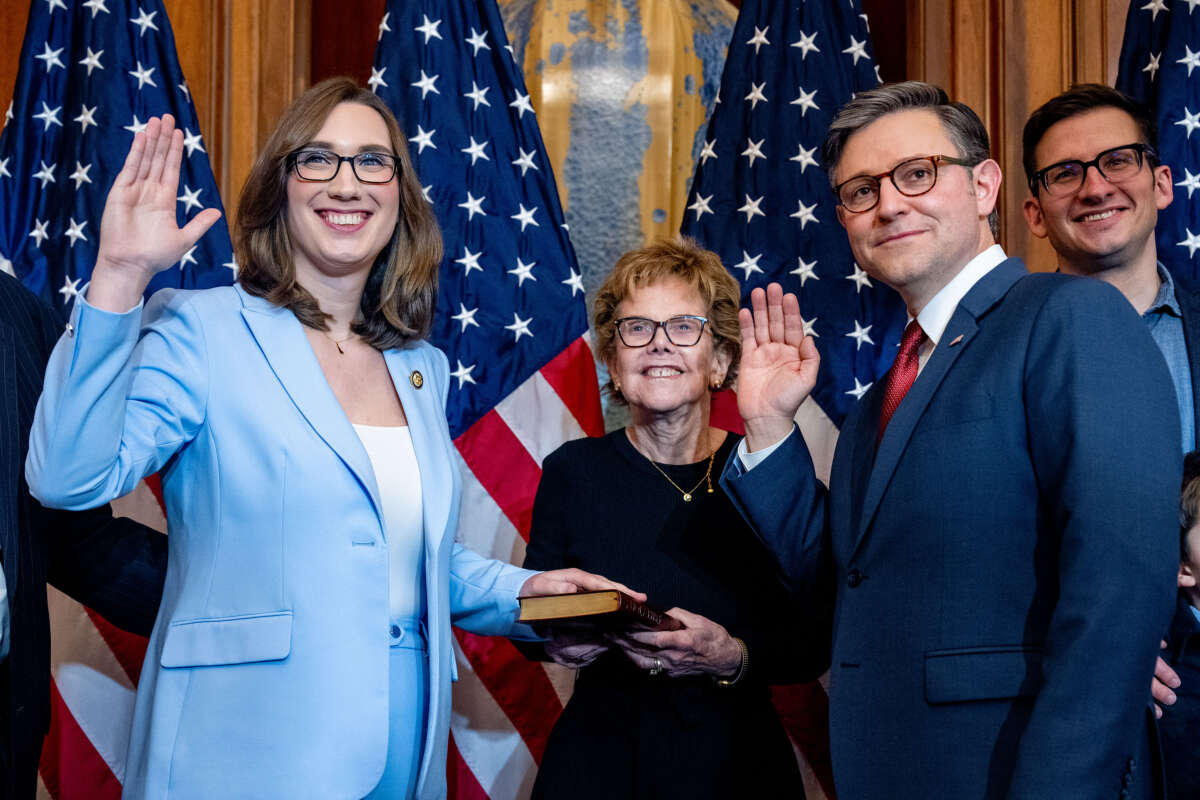
Speaker of the House Mike Johnson poses with Rep. Sarah McBride and members of McBride's family during a ceremonial swearing-in photo after being re-elected Speaker on the first day of the 119th Congress in the U.S. Capitol Building on January 3, 2025, in Washington, D.C.Andrew Harnik / Getty Images

Under a policy renewed on Friday by House Speaker Mike Johnson, transgender people will be prohibited from using single-sex bathrooms that correspond with their gender in areas belonging to the House of Representatives. The policy, which states that “all single-sex facilities — such as restrooms, changing rooms, and locker rooms — are reserved for individuals of that biological sex,” is now in effect.

Although earlier reports indicated that the policy was not officially part of the House rules package passed on Friday during the first session, the ban was listed among Speaker Johnson’s policies for the 119th Congress, as reflected in the Congressional Record, a daily account of congressional proceedings.

According to the Congressional Record, the policy will be enforced by the sergeant-at-arms and applies to “all areas of the Capitol subject to the Speaker’s general control.” This includes the House chamber, the hallways and pathways in the Capitol designated for House use, and any unassigned rooms in that area, per the House rules.

“While this will be enforced by the sergeant-at-arms, it’s still unclear how they intend to do so,” transgender legislative researcher Allison Chapman told Truthout.

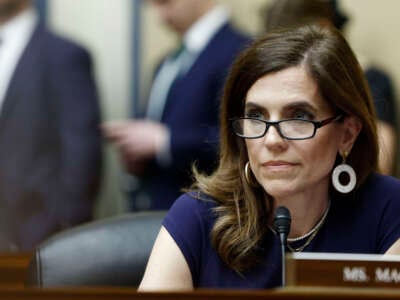
While the policy was first proposed by Rep. Nancy Mace (R-South Carolina) in November to directly target the nation’s first openly trans member of Congress, Rep. Sarah McBride (D-Delaware), it will affect all transgender staff, interns and visitors to the House.

Related Story

GOP House Rep Aims to Ban Incoming Trans Lawmaker From Using Women’s Restrooms
Rep.-elect Sarah McBride called the proposal a distraction to “manufacture culture wars” and avoid important issues. By Chris Walker , Truthout November 19, 2024


“Transgender people have been working on the Hill for years and their bathroom usage has never been an issue,” Chapman told Truthout. “This rule is clearly an attempt to retaliate against Rep. McBride for her status as a transgender person. Unfortunately, all transgender people working and visiting in the House are now caught in the crosshairs of this hostile rule.”

In November, McBride disappointed many transgender activists by saying she would comply with the anti-trans policy. “I’m not here to fight about bathrooms,” McBride said in a statement. McBride has a private bathroom in her office and had previously stated that she planned to avoid using multi-stall women’s restrooms, likely to avoid this specific issue.

“No amount of attempting to ingratiate ourselves to the people who would sooner see us dead than happily transitioned is going to lead to our liberation,” Gavin Grimm, a transgender man and activist who sued his high school in 2015 after being banned from using the boys’ restroom due to being trans, wrote for the Bay Area Reporter. “The time for optics over action is over.”


Many transgender people who visit the House have said that they will refuse to comply with the policy. “I will under no circumstances be complying with this ban and intend to use the bathroom matching my gender regardless of cruel and unjust rule and laws,” Chapman said.

About 15 activists, including Raquel Willis and Chelsea Manning, were arrested for protesting the policy in December by staging a “sit-in” in a women’s bathroom across from Johnson’s congressional office in response to the anti-trans policy. The Gender Liberation Movement, which organized the protest, noted that the bathroom ban would affect “trans people at every level of government and in every sector of society,” in addition to “cisgender people who are perceived as gender non-conforming.”


Trudeau Coasted on Progressive Vibes, But Served the Interests of Corporations

Canadians flocked to food banks and inequality rose as corporations profited under Trudeau. He wasn’t “far to the left.”

HE IS NOT EVEN A SOCIAL DEMOCRAT; 
LIKE MOST CANADIENS
January 8, 2025

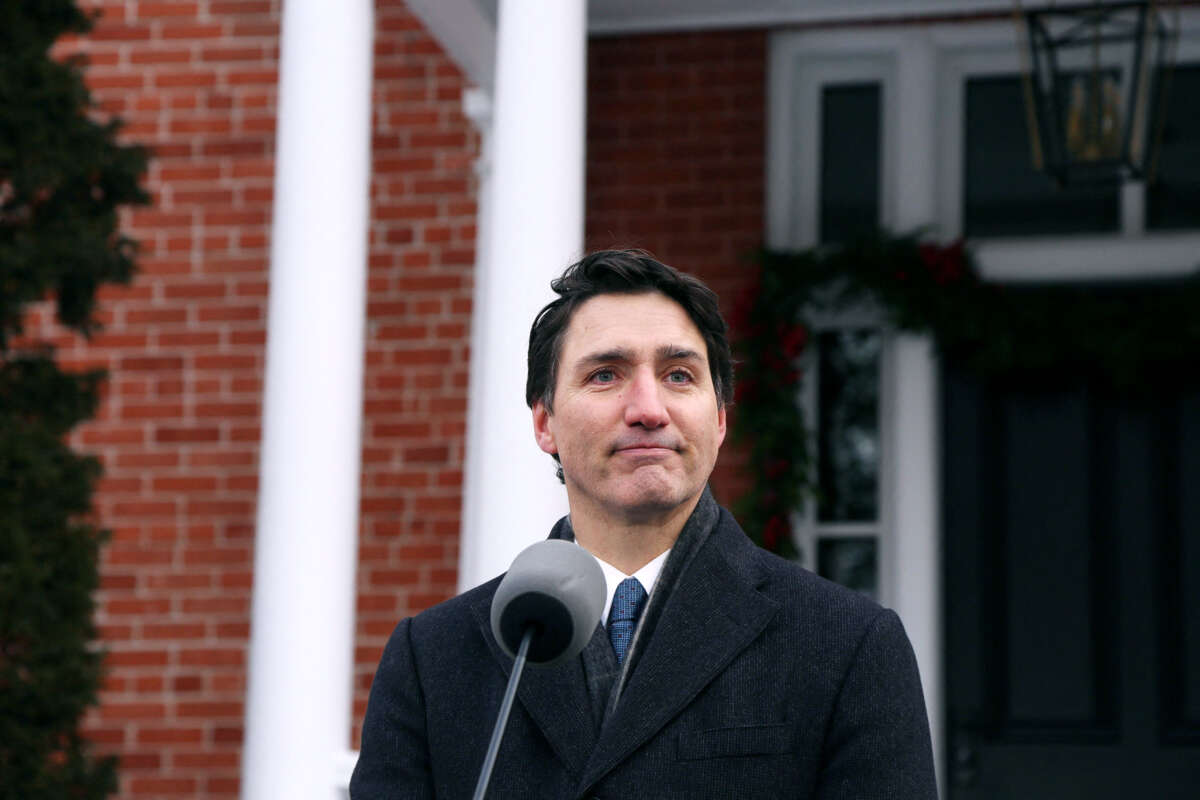
Canadian Prime Minister Justin Trudeau speaks during a news conference at Rideau Cottage in Ottawa, Canada, on January 6, 2025.
DAVE CHAN / AFP via Getty Images

Legislative action has ground to a halt in the Canadian Parliament, which has suspended its work until March. The legislative stop is now the Liberal Party’s de facto deadline for selecting a leader to replace Prime Minister Justin Trudeau, who announced on Monday that he will resign as soon as his replacement has been chosen.

But despite the political turmoil, Canada’s wealthy are still having a field day. Corporate earnings are at record highs. In 2022, profits made in Canada were CAD$275 billion higher than they were in 2019. Profits in 2022 were the highest they have ever been in Canada’s existence. And while the jury is still out for where 2024 will land, Canada’s main stock exchange, the S&P/TSX Composite Index was 18 percent higher than last year and also reached record high levels at various points in the year.

Canada’s most important sectors have made huge financial gains since 2015, when Trudeau took office. Bank profits have trended higher. (For example, the Royal Bank’s 2023 profits were record-breaking, and at $16.24 billion, 62.4 percent higher than in 2015.) Oil and gas moved from a net income of $11.8 billion in 2014 to $63.1 billion in 2022 and benefit from a new, publicly funded pipeline that cost Canadians more than $34 billion to build. Insurance companies’ profits are breaking records. Profits in telecommunications hit a record high in 2022. You get the idea.

And CEOs are rolling in it. In 2024, Canada’s 100 top paid CEOs made $13.2 million, on average. It’s the third highest payout of all time — after 2021 and 2022.

Of course, there’s a flip side to this wealth accumulation: record-breaking numbers of visits to food banks; a housing crisis that exists in every single town and city across Canada (a crisis that, in the winter especially, leads to death and amputation); record-breaking income inequality. The Canada of 2025 is in a delicate, precarious state. People are on thin ice.

Related Story

Here’s What Canada’s Vote to End Arms Sales to Israel Means for Antiwar Effort
Canada’s Parliament passed a nonbinding motion to end arms sales to Israel — but not arms purchases from Israel. By Nora Loreto , Truthout  March 22, 2024


While we can’t give credit to or blame any single politician for where we find ourselves today, there’s no question that the policies of the federal government play an important role in reducing or exacerbating income inequality. The proof is in the pudding: Justin Trudeau has overwhelmingly served the interests of corporations and their leaders.

And so, when a narrative emerged from corporate media and analysts that Trudeau had to go because he had moved too far to the left, I did a spit take: What in the universe are they talking about?

The members of Parliament (MPs) who made this claim mostly spoke under a cloak of anonymity. Global News’ David Akin reported, “Almost all of the MPs Global News spoke to believe Trudeau has moved the party too far to the left and that shift has played a key role in the decline of the Liberals.” Akin didn’t say who or explain how these MPs were defining “the left.”

How can it be that a prime minister whose tenure saw record-breaking corporate performance paired with widening social inequality is also “too far to the left”? What kind of left-wing doctrine supports extreme income inequality and a tax structure that has failed to redistribute profits?

No one could reasonably believe that Trudeau’s economic policy was too far to the left. What they’re really saying is that Trudeau’s vibes were too far to the left. From the moment he took office, Trudeau draped himself in the language of the left but then never put that language into any useful action. Remember his famous mic drop moment when, after a journalist asked him why his cabinet had an equal number of women and men, he declared, “because it’s 2015”? Many concluded that Trudeau’s reply signaled that he was a feminist, unlike the previous prime minister, who flirted with anti-abortion activists and who would probably shrivel up and die if he found himself the lone man in a room full of trans-inclusive radical feminists.

But Trudeau’s policies weren’t even particularly feminist. And when his first justice minister, Jody Wilson-Raybould resigned, his feminist bona fides were called into question. Wilson-Raybould’s account of their confrontation painted a downright unfeminist portrait of the man.

One can coast on vibes for a bit, but vibes are not enough to support political regimes. From marching in Pride parades to taking a knee among Black Lives Matter activists, so much of Trudeau’s left-wing politics were vibes, and many of us could see through them.

In fact, in nine years, his government only accomplished one major progressive victory: the Canada Child Benefit. This benefit instantly lifted hundreds of thousands of children out of poverty. It offers the lowest-income Canadians $648.91 per month for every child under 6 years old. However, combined with broader social forces, even this benefit isn’t enough: Child poverty has been on the rise in the post-pandemic period.

Otherwise, Trudeau’s biggest promises were far more bluster than they were helpful. The Liberals’ pharmacare plan only covers two drugs at the moment and hasn’t been put into force through provincial agreements. Their new dental benefit isn’t yet fully operational, but when it is, it will only help low-income Canadians, many of whom won’t have the resources or access necessary to benefit from it. Universal daycare is great, if you’re lucky to be at a daycare that’s part of the program (and most aren’t) and still, it’s expensive.

A change to the tax code to subject more profits to tax hasn’t yet passed a vote in the House of Commons. (And if it doesn’t get passed before the election is called, it will die.) And promises to change the electoral system or create real changes within the housing market have been swept under the carpet.

Even pandemic-era benefits, arguably the most significant financial supports that the Trudeau government created (indeed, they built the most expensive social program in the history of Canada virtually overnight), collapsed after it was clear that the program turned into a mass transfer of public money to private coffers, with large businesses being the principal winners. The poorest Canadians received nothing, the Canadians who made more than $5,000 annually and lost a salary due to the pandemic received a monthly benefit that hundreds of thousands were forced to pay back, and small businesses who couldn’t pay back their business loans were thrown into chaos as they tried.

The cynicism around these programs was the quiet fuel that simmered the campaign that led to Trudeau’s demise. All this, while profitable companies like telecoms, and even some long-term care facilities that managed waves of mass death in their facilities, were each handed tens of millions of dollars in pandemic aid, no questions asked.

Half-measures have been the undoing of Trudeau’s popularity. Indeed, the vibes have run out, and people are realizing that their government isn’t exactly interested in helping them. And with few options on offer for help, many Canadians have parked their support with Conservative Party leader Pierre Poilievre, despite the Conservatives’ record of failure in reducing poverty or helping average people.

Mainstream media has pushed out most progressive journalists and commentators. This has created a world where what is or isn’t left-wing is defined by the right, and it’s usually a caricature of what left-wing politics really are.

The fact that Trudeau has occupied the place that journalists call “progressive” has left no space for Canadians to have a serious and credible conversation about progressive politics. Instead, mainstream journalists boost members of Parliament who look at the world, look at their party’s record and look at their leader and conclude: oh, the problem is that he was too left-wing.

Of course, there’s no truth in that. But what does truth matter, when you’re priming the next person to be just as friendly to the corporate world as the last one was?

This article is licensed under Creative Commons (CC BY-NC-ND 4.0), and you are free to share and republish under the terms of the license.


Nora Loreto is a writer and activist based in Quebec City. She is also the president of the Canadian Freelance Union.