Thursday, January 09, 2025


Bunkering Service Introduced with Barge Fleet at Strategic Canadian Port
Robert Allan Ltd.

Published Jan 8, 2025 8:00 AM by The Maritime Executive


[By: Robert Allan Ltd.]

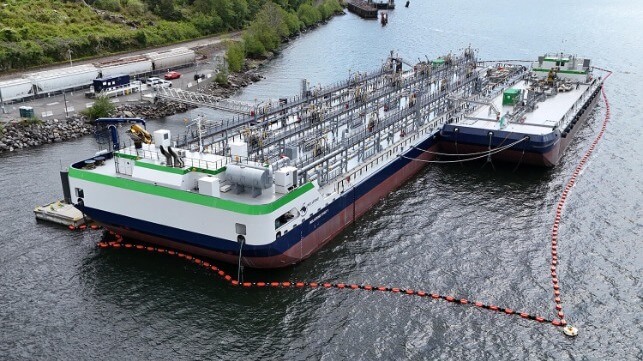
The port of Prince Rupert has recently welcomed the startup of Wolverine Terminals’ marine bunkering service for deep sea shipping, thus adding a key logistical capability to this strategic deepwater port on the west coast of Canada. Using a unique pair of barges designed by Robert Allan Ltd., Wolverine Terminals can deliver a wide range of fuels to suit the needs of vessels calling at the port, including marine diesel, heavy, intermediate, and other blends to individual customer specifications. By introducing this new service, deep-sea ships may now bunker at this key and growing gateway to North America, which features favourably short trading routes to Asia and access to a supply of domestically produced fuels delivered by rail.

The Wolverine Terminals fleet is composed of a transloading barge and a fuel delivery (lightering) barge.

Wolverine Spirit 1, the 142-metre long transloading barge, has been custom-designed to accept up to twenty-four rail tank-cars on deck. These are loaded using a marine rail ramp in Prince Rupert with maximum efficiency using four rail lanes with a pair of onboard turnouts (switches) – a novel arrangement on a rail barge. Combined with a high-performance ballasting system and Wolverine’s dedicated locomotive, this barge can onboard a full set of railcars during a single tide. Once loaded and secured, the Transloading Barge is moved using tugs from the loading ramp to the Wolverine Terminals project site, where once moored, the railcars can be drained into the barge’s hull tanks, which have a combined capacity of nearly 80,000 barrels of oil products.

Wolverine Spirit 2, the 78-metre long lightering barge, receives fuels from the Transloading Barge, and is towed to client vessels in harbour where it delivers fuel to their individual requirements. With a capacity of approximately 30,000 barrels of products, this barge can efficiently deliver fuels to ocean-going vessels at up to 450 m3/hr.

Both barges have been designed to maximize the safety of operations. In addition to featuring double-hulls, there are extensive containment and response systems aboard both barges, as well as fire-fighting systems and equipment. Access to the railcar tops is via a fixed gantry system with Safe Harbor access platforms/gangways, while access between the barges is via a swinging Verhoef gangway with articulated stairs that adjust to ensure safe passage for all combinations of drafts and freeboards between the two barges. Cranes on both barges facilitate the transfer of equipment from shore and handling of hoses.

Both barges are fully compliant with Transport Canada regulations and are classed for their service with Lloyds Register. Attention has been paid to keep all potential sources of emissions low, with IMO Tier III compliant exhausts equipped with after-treatment, silencing for all diesel-fired machinery, vapour recovery for the cargo systems, and low-intensity lighting.

Specifically tailored to meet Wolverine Terminals’ needs, these barges deliver best-in-class bunkering and logistics whilst minimizing environmental impact and contributing to the economic growth of the port and region. They are fine examples of Robert Allan Ltd.’s ability to design highly customized vessels of virtually any type and complexity to customers’ unique project requirements.

The products and services herein described in this press release are not endorsed by The Maritime Executive.

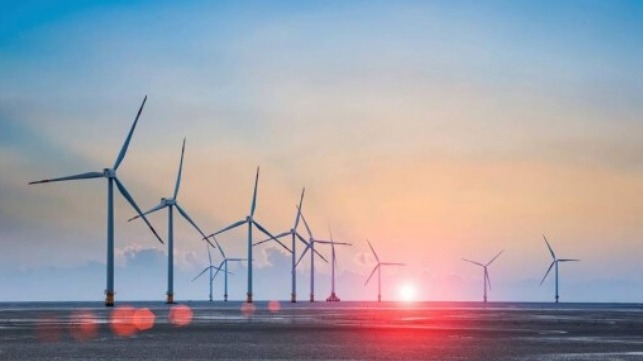
 

“No Windmills Are Being Built,” Trump Declares

CUTS NOSE TO SPITE FACE

offshore wind farm
Trump vows "no new windmills" while addressing future energy policy (file photo)

Published Jan 7, 2025 6:38 PM by The Maritime Executive


President-elect Donald Trump talked for the first time about the energy policy of his second administration and reiterated his opposition to renewable energy and specifically wind farms. The remarks came during a press conference in Florida which is being described by the media using words such as “rambling,” “freewheeling,” and “meandering,” and during which he said he would rename the Gulf of Mexico and would not rule out using force to take Greenland and the Panama Canal.  

Trump is well-known for his disparaging remark against renewable energy in favor of fossil fuels and his campaign slogan, “Drill, Baby Drill.” During the campaign, he spoke against wind power and while naming executives from the energy industry and fracking to his new administration, had yet to directly clarify his administration’s policy toward wind farms. 

“We're going to try and have a policy where no ‘windmills’ are being built,” he said during today’s press conference. “They litter our country…Nobody wants them….”

During what Bloomberg is describing as a “lengthy tirade against wind power,” Trump repeated many of his assertions against the industry. He asserts wind turbines “don’t work without subsidy,” are too expensive to develop, and are harmful to the environment. During his first administration, he said the noise from “windmills” causes cancer and that if they are near someone’s house it ruins the value of the property. (Possibly a veiled reference to his personal fight to stop a Scottish wind farm developed near one of the Trump golf clubs.)

Trump makes other accusations against wind turbines saying the offshore wind farms “obviously kill whales.” Multiple studies by the U.S. government and ecological groups have said no link has been found between whale strandings and death and offshore wind turbines.

While Trump says none will be built it is unclear how far his administration will be able to go in stopping the industry. The New York Times cites data from the Department of Energy reporting wind power is one of the fastest-growing and lowest-cost sources of electricity in the United States. DOE says wind power accounted for 22 percent of new installed electric capacity in 2022. 

Onshore wind power development is mostly on private lands. It is also in states including Texas, Wyoming, and Iowa. The New York Times cites data from the American Clean Power Association reporting that 24 GW of onshore wind power is under development in Wyoming, Montana, North Dakota, Oklahoma, and Texas.

Offshore wind farms however are on U.S. federal lands and leases. The first Trump administration was accused of “slow walking” permitting for offshore wind farms. The Biden administration moved to launch the offshore sector and accelerated permitting in its final months. It ends having approved 11 commercial-scale offshore wind farms. The Department of the Interior and its Bureau of Ocean Energy Management highlighted the approval of over 19 GW of offshore wind energy projects – enough to power more than six million homes.

Biden's policy for offshore wind also contributed to shipbuilding, port development and other industries. In 2023, Biden highlighted at the first steel cut for a rock installation vessel, that companies had announced 18 offshore wind shipbuilding projects as well as investments of nearly $3.5 billion across 12 manufacturing facilities and 13 ports to strengthen the American offshore wind supply chain. The vessels range from the first Jones Act-compliant installation vessels to a SOV, and crew transfer vessels. They are being built at shipyards ranging from Florida to Louisiana, New York, Massachusetts, Michigan, Rhode Island, Wisconsin, and Pennsylvania. The industry created new business for companies ranging from tugboats to supplying and marine services.

Experts point out it is unlikely the Trump administration can cancel leases and reverse the approvals. The first offshore wind farms started delivering power in 2024 and construction is underway from Massachusetts to Virginia for large offshore projects. 

The industry however has already been confronted with challenges and the speculation is that further licensing will be curtailed. Leaders in the industry including RWE and TotalEnergies had already said they would be delaying U.S. developments based on the uncertainties of the new administration. Energy majors including Shell and BP have also announced a shift in their policies reducing the focus on wind energy in the companies’ portfolios.


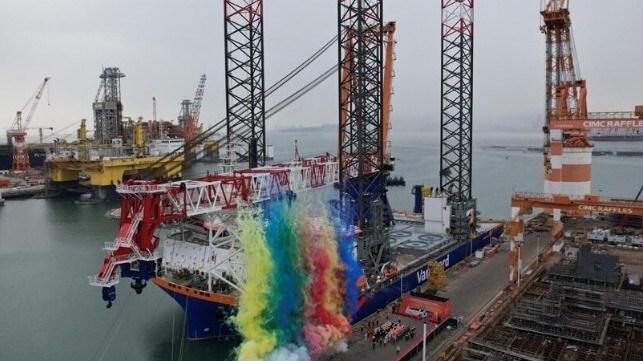
CIMC Delivers World's Biggest Wind Turbine Installation Vessel

Van Oord Boreas
Courtesy Van Oord

Published Jan 9, 2025 3:47 PM by The Maritime Executive


Dutch offshore services contractor Van Oord has taken delivery of a new wind turbine installation vessel to keep up with the changing offshore wind sector. The company is anticipating an increase in scale in the offshore wind industry and believes the addition of the newbuild Boreas to its fleet will cement its competitive edge.

Constructed at the Yantai CIMC Raffles Offshore Ltd. shipyard in China, Boreas is purpose-built for the transport and installation of the next generation of foundations and turbines at offshore wind farms. The dual fuel engine vessel is expected to be the largest of its kind once operational, and is named after the Greek god of the Northern winds.

Measuring 175 meters with a 155-meter-high boom, the vessel will have the capability to lift more than 3,000 tonnes while her four giant legs - each measuring 126 meters - will allow the vessel to be jacked up for work in waters up to 70 meters deep.

With these outsize dimensions, Boreas will be able to install turbines of up to 20 MW. The ship is also methanol-ready, and running on the green fuel would reduce its carbon footprint by more than 78 percent.

The vessel is also equipped with a cutting-edge active emissions control technology that will reduce NOx emission to an absolute minimum. A battery pack of about 6,000 kWh will be able to take peak loads and regenerate energy to reduce the fuel consumption and corresponding emissions even further.

Following the completion of its construction in China, Boreas is now being prepared to sail to the Netherlands for final outfitting works, which will include the installation of equipment for storing and handling the foundations of wind turbines. The vessel is expected to be commercially available in the third quarter of this year.

The company has said it intends to deploy the vessel to transport and install 104 monopile foundations for the Nordseecluster offshore wind project in Germany that is being developed by RWE. Some 44 monopiles are planned for installation this year and the remaining 60 in 2027. The 1.6 GW wind farm will generate enough renewable energy to supply the equivalent of 1.6 million households. 

“Undoubtedly Boreas is a benchmark for the whole offshore wind industry for many years to come and will play a significant role for the transportation and installation of the next generation of foundations and up to 20 MW offshore wind turbines at sea,” said Zhao Hui, CIMC Raffles Group Vice President.

Van Oord has been assembling specialized offshore wind assets to cement its competitiveness in the industry. These include the Aeolus, a vessel that is purpose-built to transport and install foundations and offshore wind turbines; and Nexus and Calypso, two cable-layers designed for challenging tasks. Van Oord’s unique heavy lift installation vessel Svanen is one of the largest crane vessels in the world.


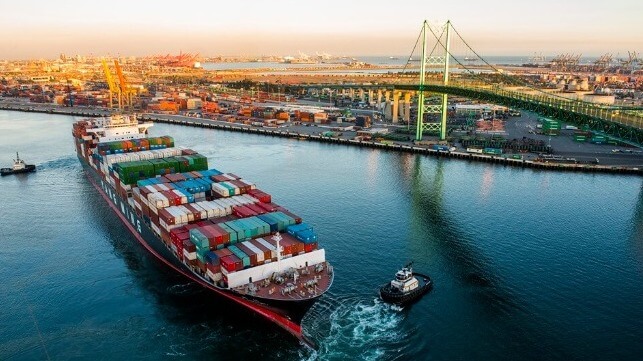
EPA Approves California's Strict Harbor Craft Emissions Rule

California will be the first jurisdiction in the U.S. to require diesel particulate filters on commercial vessels

Port of Los Angeles tug assist
File image courtesy Port of Los Angeles

Published Jan 8, 2025 8:38 PM by The Maritime Executive


With just days to go before the end of the Biden administration, the EPA has approved a controversial California rule requiring diesel particulate filters aboard ship-assist tugs and other small harbor craft. 

Because of the unique smog issues of the Los Angeles airshed, the state of California has a carve-out in federal law that allows it to create its own motor-vehicle emissions regulations. The California Air Resources Board (CARB) writes statewide exhaust limits that are often more stringent than federal standards - like its recently-revised Commercial Harbor Craft Rule. 

The revised rule requires tug and harbor craft operators to use an EPA Tier IV engine, the cleanest on the market. In addition, unlike any other regulator, CARB requires local harbor tugs to have a "level 3 Verified Diesel Emission Control Strategy (VDECS)" - any system that reduces particulate emissions by at least 85 percent. Options include switching to a zero-emissions newbuild, like Crowley's groundbreaking eWolf, or installing a diesel particulate filter (DPF) - an emissions control system that is rarely used in commercial maritime applications. (Marine DPFs are primarily sold for the luxury-yacht market, where they are known as "soot filters" and used to control exhaust stains on white hulls.)

CARB's justification for the DPF rule is to reduce the cumulative public health burden of diesel particulate matter, a suspected carcinogen and contributor to athsma. The agency estimates that statistically, the DPF rule will save about 500' lives, many in the port-adjacent communities most affected by harbor air pollution. 

Acting EPA Administrator Jane Nishida approved the DPF rule (and other elements of CARB's revision) in a Federal Register notice this week. 

"CARB has demonstrated the existence of compelling and extraordinary conditions justifying the need for such state standards," Nishida wrote.  "The administrative record, including information presented to me by parties opposing California’s authorization request, did not demonstrate that California does not need such state standards."

Tug operators and Coast Guard regulators have expressed concern that DPFs could create a new fire hazard in the tight confines of a tug engine room. These filter devices need a cleaning cycle to periodically burn off accumulated soot. When activated, the cycle runs the filter's internal temperature up to more than 900 degrees F. This means that DPF exhaust designs get much hotter than non-DPF designs, raising fire risk concerns. 

Tug operators warned that the retrofits could create a safety hazard or - if not possible to perform - could take tugs out of service, hampering California's thriving port sector. Last year, they campaigned against the requirement in a direct appeal to California's legislature. As a result of this effort, the California House and Assembly  passed a bill to modify CARB's DPF rule; the text provided for an emergency-bypass safety system for the DPF and an extended compliance timeline. However, the bill was vetoed by Gov. Gavin Newsom in September. 

Environmental justice activists have cheered CARB's rule as another step towards clean air for port communities.

"EPA's decision to approve the bulk of California’s commercial harbor craft standard will give urgently needed relief to portside communities who breathe in dirty diesel pollution from tugboats, ferries, and other harbor vessels," said Regina Hsu, senior attorney on Earthjustice's Right To Zero campaign. "This standard will gradually shift these boats to zero-emissions over the coming years. Now, other states with ports should take a keen look at this life-saving rule and consider adopting it to protect their own residents.”


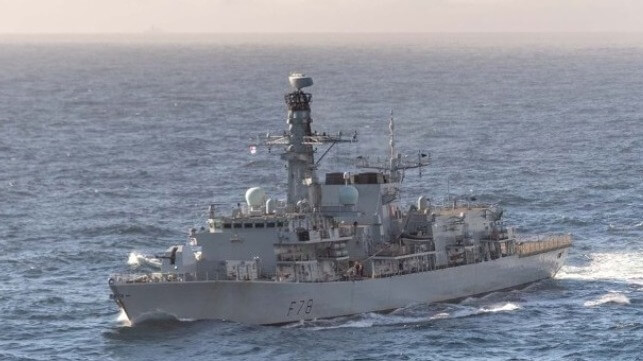
UK Politician Mistakes Royal Navy Destroyer for James Bond Movie Ship

HMS Northumberland
HMS Northumberland, a real vessel (file image courtesy Royal Navy)

Published Jan 8, 2025 9:23 PM by The Maritime Executive


A Member of Parliament in the United Kingdom has been left with egg on the face after confusing a nonexistent vessel that featured in a James Bond movie with a real Royal Navy warship.

Conservative MP and Shadow Defence Secretary James Cartlidge tabled a written question in Parliament seeking to know the estimated amount the government intended to spend in repairing the structural damage to "HMS Devonshire." The question was directed to Secretary of State for Defence John Healey.

The UK government provided the written answer through Minister for Defence Procurement, Maria Eagle, stating “There is no ship of the name HMS Devonshire currently in service with the Royal Navy.”

Cartlidge, who was Defence Minister until last July when the new Labor Government assumed power, has found himself at the center of ridicule after it emerged the vessel Devonshire is a fictional ship in the 1997 film "Tomorrow Never Dies," starring Pierce Brosnan as 007. In the spy film, Devonshire was sunk by villains in Chinese-occupied waters in the South China Sea.

The last real Royal Navy vessel to bear the name HMS Devonshire was sunk in 1984 for target practice in the Atlantic. The guided missile destroyer was built in the early 1960s and was decommissioned in 1978.

The Sun reports that following his realization that he meant to ask about HMS Northumberland, Cartlidge joked that he intentionally made the blunder to see if the Ministry of Defence was using artificial intelligence instead of humans to answer questions. “I’m pleased to say they passed the test on this occasion,” he said.

A Type 23 frigate, Northumberland is preparing for decommissioning in March after the government said that keeping the ship in service would be too expensive. The ship was deemed “uneconomical to repair” after structural damages were discovered during a planned refit.

The UK government had estimated that it would cost at least $150 million to repair the frigate, with the decision to decommission the ship early preventing most of the cost and saving the taxpayer about $130 million. 

TOMMOROW NEVER DIES


Video: Syria's Coast Guard Reboots Under New Regime

Signs of revival: Syrian Coast Guard patrol boats make a public appearance in Latakia and Tartus as operations resume (Syrian social media)

Published Jan 8, 2025 3:33 PM by The Maritime Executive


Less than a month after seizing power, Syria's new rulers are wasting no time in their effort to re-establish credible governance over the wartorn country, and are working on bringing back energy importsgrain shipments, banking institutions - and a coast guard. 

After 13 years of civil war, Syria's government and military collapsed under an Islamist-led rebel assault in early December. Former President Bashar al-Assad - an accused war criminal - fled to seek asylum from Russia, his regime's longtime sponsor. Syria remains divided among warring factions, but its main population centers are now governed by Hayat Tahrir al-Sham (HTS), a U.S.-designated terrorist organization and a one-time supporter of Al-Qaeda. 

Though HTS' views have moderated over the years, it is an avowed Islamist movement, and it is taking steps to reassure Syria's many ethnic and religious groups (and the international community) that it wants to set up a comparatively modern administration. It has kept many civilian officials from the previous regime, including former central bank deputy governor Maysaa Sabrine, a female economist who has been appointed to help restore the country's shattered finances - an unthinkable arrangement under Islamist extremist groups like the Taliban or the Islamic State, which both removed women from public life. 

HTS' moves to assert administrative control include resurrecting Syria's coast guard. On Tuesday, Syria's interior ministry dispatched coast guard small-boat units to carry out a parade through the streets of Tartus and Latakia, the country's two main port cities. The first official reappearance of the nation's coast guard administration was captured by bystanders and posted to social media. Later imagery appears to show well-armed interdiction units operating the craft just off the coast. 

Though new in appearance, the patrol boats date back to the Assad regime, according to Al-Araby, and are not part of any new foreign-assistance package. 

As HTS strengthens its control of the ports, the Russian Navy - which has had a base at Tartus since the Cold War - appears to be losing its foothold. Long lines of military equipment are stacked at the pier, the final outcome of troop withdrawals Russia ordered during HTS' assault on the capital. The berths, however, are empty of cargo ships or warships - and a Russian military freighter that was likely dispatched to evacuate the gear has been orbiting in a holding pattern off Tartus for days. 

 COLD WAR 2.0

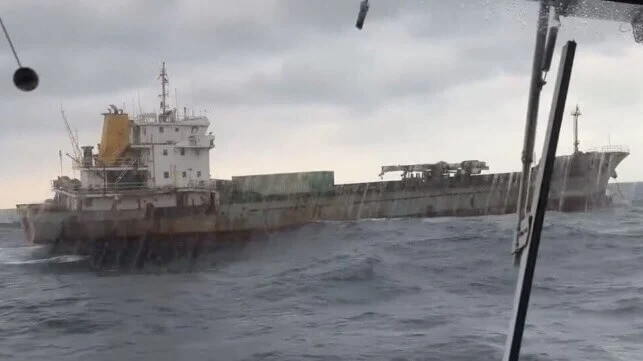
Chinese Ship Suspected of Cable Sabotage May Have Had Two AIS Devices

Xing Shun 39
Xing Shun 39 off Taiwan (CGA)

Published Jan 7, 2025 8:56 PM by The Maritime Executive


The Chinese-owned ship suspected of damaging a subsea cable off the north coast of Taiwan appears to have been using two different AIS transponders at the same time, according to Taiwan's coast guard. 

The incident began Friday at about 1240 hours, when Chungwha Telecom notified Taiwan's Coast Guard Administration (CGA) that a subsea communications cable had been severed just off the coast of Keelung. The cable was a component of the Trans-Pacific Express, a high-speed fiber optic cable linking China, Taiwan, Korea, Japan and the United States. 

At about 1700 hours, a CGA patrol boat intercepted the Hong Kong-owned freighter Xing Shun 39 (IMO 8358427) at a position near the cable break. The coast guard crew was unable to board the freighter because of rough surface conditions, and instead of heading for a Taiwanese port, the Xing Shun 39 got under way for Busan, South Korea. It departed Taiwanese jurisdiction later that day. 

After the incident, the CGA identified the vessel as the Shunxing-39, a ship that does not exist in IMO records. The authorities now believe that the freighter was using two different AIS devices and two different identities: its legitimate name, Xing Shun 39, and a closely-matched fake name, Shunxing-39. By switching back and forth, the ship created an interrupted AIS record.

William Conroy, an analyst with Semaphore Maritime Solutions, told the New York Times that the ship appeared to switch AIS transponders at about the same time that the Taiwan CGA asked it to halt for an inspection. "Shunxing-39" disappeared from AIS tracking at 1651 hours Friday, and Xing Shun 39 appeared one minute later at a position about 50 feet away. 

Though the freighter is now out of reach of Taiwanese authorities, they have asked officials in the port of Busan to help in obtaining evidence from the vessel if it arrives in Korea. The case will be forwarded to the prosecutor's office in Keelung for possible criminal or civil actions against the freighter.  

In the meantime, the CGA is launching a comprehensive review of its procedure for responding to potential cable sabotage incidents involving ships, and it is coordinating with other security agencies, officials told state news outlet CNA. 


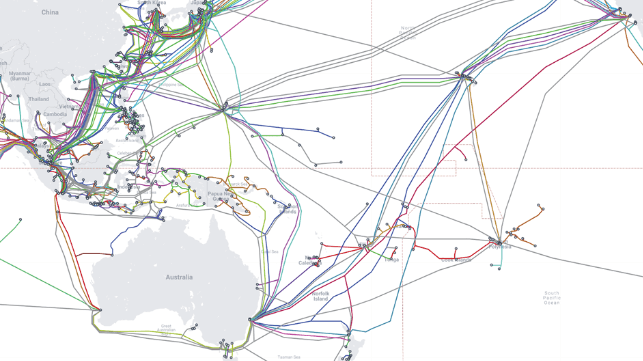
Vanuatu Illustrates Risks of Thin Subsea Cable Infrastructure

A single point of failure for connectivity is a common vulnerability across the Pacific


Submarine cable chart for the Pacific
The Pacific subsea cable network has limited redundancy for small island nations (Telegeography / CC BY ND 4.0)

Published Jan 5, 2025 8:31 PM by The Lowy Interpreter


[By Cynthia Mehboob]

Last month’s magnitude 7.3 earthquake near Vanuatu caused widespread devastation and left at least a dozen people dead. The disaster also exposed a critical vulnerability in Vanuatu’s digital infrastructure, specifically the over-reliance on a single undersea cable, ICN1. A fire at the cable landing station temporarily interrupted the power supply, disabling internet traffic. The connection was restored 10 days later, after what was described as “a multilateral effort under extreme conditions”.

Vanuatu’s heavy dependence on a single point of failure for its connectivity was not a surprise. The 2022 volcanic eruption in Tonga, which similarly disrupted communications across the Pacific, raised concerns about the need for redundancy in submarine cable systems. Despite this, securing funding for additional cables in Vanuatu is an uphill battle.

The Vanuatu government has long recognised the importance of diversifying its digital infrastructure, yet progress remains slow. Since 2018, the government has advocated for a second cable. The challenge lies in financing. A new cable would require substantial capital and maintaining it could raise telecommunications prices for Vanuatu’s already vulnerable population. Hence, Vanuatu requires funding for new cable infrastructure alongside financial commitment from external development partners to pay for the operational costs.

This difficulty is not unique to Vanuatu. Western governments, including Australia and the United States, have acknowledged the need for increased investment in submarine cable infrastructure across the Pacific, including Vanuatu, Papua New Guinea and Solomon Islands. These countries are seen as strategically important in the face of rising Chinese influence in the region. Yet, despite this recognition, the funding for second cables remains elusive. With competing priorities – healthcare, education, and transport – Pacific governments often struggle to allocate the necessary resources.

With the government faced with financial difficulties, the private sector is providing connectivity solutions.However, geopolitical competition has posed challenges for Vanuatu's submarine cable sector since at least 2018. At that time, Simon Fletcher, CEO of The Interchange Group – a Vanuatu-based consortium rolling out the nation’s internet cables – stated that Australia’s intervention in the Solomon Islands Coral Sea Cable project had adversely impacted its privately funded projects. Fletcher tweeted that it was “very hard to compete with a free cable”.

Despite the challenges, Interchange Limited is implementing the TAMTAM system, the world’s first Science Monitoring and Reliable Telecommunications (SMART) cable set to connect Vanuatu to New Caledonia, a project contracted to Alcatel Submarine Networks. Meanwhile, Google has proposed a third cable connecting Vanuatu to the broader Pacific network.

However, until these projects are completed, Vanuatu lies exposed.


Satellite solutions often considered the fallback for cable outages, offer limited relief in Vanuatu. Geostationary (GEO) satellites, used historically for island communications before any cable, have reduced bandwidth and high operational costs, so are typically reserved for critical services such as government, airlines, banking and healthcare. During major outages, commercial services such as social media and entertainment are sacrificed. As a result, the country remains heavily dependent on its sole undersea cable.

The arrival of low Earth orbit (LEO) satellites such as Starlink has introduced new possibilities. Starlink’s higher bandwidth and lower cost make it an attractive alternative for countries such as Vanuatu. Yet not without complex policy questions.

Starlink offers direct-to-consumer broadband, bypassing traditional telecom providers and disrupting local markets. Additionally, the dual-use nature of Starlink – serving both civilian and military purposes – raises significant security and legal concerns. In light of its involvement in conflicts like the war in Ukraine, questions emerge over whether Starlink could be considered a legitimate target under international law, especially if its services become integral to military operations. This concern extends to countries relying on Starlink for resilience during undersea cable outages, where the line between civilian and military use becomes increasingly blurred.

Furthermore, while Starlink may be useful as a backup in times of crisis, it cannot replace the capacity and reliability of submarine cables. The service is finite, with bandwidth limitations that could lead to congestion, particularly in densely populated regions where demand for high-speed internet is growing. Unlike cables, which offer scalable infrastructure, Starlink’s network is constrained by the number of satellites in orbit and the number of users accessing the system at any one time. As Vanuatu’s digital economy grows, a satellite network may provide insufficient capacity when it is needed most.

The case for a second submarine cable in Vanuatu is clear. Satellite systems, while effective for temporary outages, cannot provide the high-capacity, low-latency connectivity that a robust undersea cable offers.

Cynthia Mehboob is a PhD Scholar based at the Department of International Relations at the Australian National University. Her research interrogates the international security politics of submarine cables in the Indo-Pacific region.

This article appears courtesy of The Lowy Interpreter and is reproduced in abbrebiated form. The original may be found here

The opinions expressed herein are the author's and not necessarily those of The Maritime Executive.


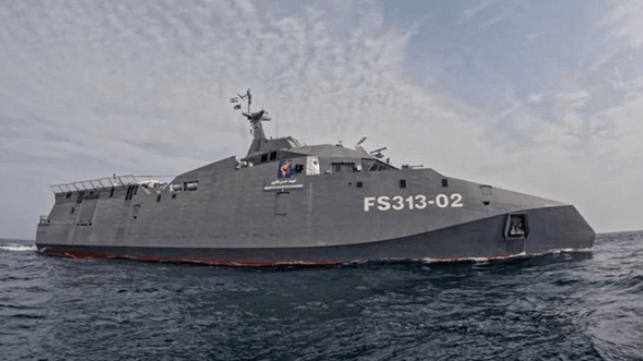
Iran Mounts Naval Show of Force

Shahid Hassan Bagheri (FS313-02) (Iranian Ministry of Defense)
Shahid Hassan Bagheri (Iranian Ministry of Defense)

Published Jan 8, 2025 12:37 PM by The Maritime Executive


Over the next two weeks, Iran is planning to put on a naval show of force involving the Islamic Revolutionary Guard Corps (IRGC) Navy (Nesda).

Brigadier Ali Mohammad Naeini, the IRGC spokesman, announced that Nesda intends to mount a major exercise in the Straits of Hormuz on January 11, involving 300 combat vessels - most presumably being speedboats.  This will be followed by an exercise January 18-23 within the Gulf, all to be concluded by the IRGC’s “largest ever fleet review” on January 27, probably off Bandar Abbas, involving “approximately 2,000 military and civilian vessels.”

Nesda is planning to unveil two additions to its fleet on January 27, namely the Shahid Bahman Baqeri and the Shahid Rais Ali Delvari. The Shahid Rais Ali Delvari (FS313-04), according to a press release from the Iranian Ministry of Defense, will the fourth vessel in the Shahid Soleimani-class, which are 67m long catamarans with a top speed of 32 knots.  The ships have 23mm and 30mm cannons and short-range air defense missile systems, but their principal weapons are four 300km range Ghader cruise missiles and two 90km Nasir cruise missiles.  All the missiles are vertically launched, improving stealth profile against radar detection by reducing deck clutter. The vessels also have a helicopter desk, which appears as if it could support a landed helicopter only during calm weather. The class is built at the Shahid Mahallati Marine Industrial Institute in Bushehr, a yard which is owned by the IRGC itself.

The IRGC are also intending to publicize the existence of new underground missile and drone complexes, albeit details of exact locations rarely accompany such press releases. The IRGC has at least 25 known underground facilities, from which missiles can be fired from silos or trailer-mounted missiles and drones driven out rapidly to pre-prepared firing positions nearby.

In addition to Nesda’s activities, the IRGC is currently undertaking a series of internal security exercises across all regions of Iran, focused on border areas that have seen separatist activity. On January 10, an unprecedented internal security exercise involving 110,000 mobilized Basij volunteers is scheduled to take place in Tehran. Major IRGC air defense exercises are also underway around threatened nuclear sites.

Brigadier Naeini told the Financial Times on January 7 that "the number of IRGC exercises has almost doubled this year compared with last year, in response to the evolving threat landscape," reflecting the IRGC’s primary role as a defender of the clerical regime from internal threats to its survival.


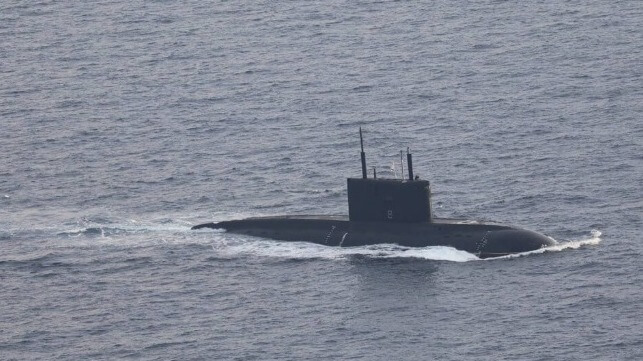
Russian Evacuation From Tartus Naval Base Appears Stalled

Novorossiysk
The Russian Navy's last known sub in the Mediterranean, the Kilo-class Novorossiysk, was spotted heading home off Portugal last week (Portuguese Air Force)

Published Jan 6, 2025 8:54 PM by The Maritime Executive


After the recent regime change in Syria, the Russian military has concentrated its trucks and heavy equipment at its naval base in Tartus for a likely evacuation - but so far, it has yet to send any of its auxiliary ships in to take on cargo. Recent satellite imagery shows that the piers at the base are empty, even though a military auxiliary ship is just offshore and evacuation flights are in full swing at nearby Hmeimim Airbase.

High resolution satellite images taken by Maxar and released on social media show at least 100 drab-green trucks of various sizes staged at the Tartus base on Monday, the fruits of a large-scale Russian pullback that has been under way for a month (video below). An air defense and surface search radar located near the Tartus harbor entrance has also been disassembled for return home. 

Meanwhile, on Monday, a Ropucha-class amphib - often used by the Russian Navy for military logistics - was loitering just offshore, along with the freighter Sparta

The Sparta is a sanctioned Russian military cargo ship, and it made the long journey from the Baltic to Syria last month, arriving in early January. It was once a familiar sight on routes from Russia and Crimea to Syria: though it was blacklisted years ago by the U.S. Treasury for its role in supporting Russian involvement in the Syrian Civil War, it was always welcome in Tartus. As of Monday, it was in a holding pattern outside the port, being watched by a U.S. Navy P-8 Poseidon maritime patrol aircraft.  

The apparent loss of access to Tartus will have operational implications for the Russian Navy. Without a local base, the Mediterranean Sea Task Force may have difficulty sustaining submarine operations, and its last known sub - the Kilo-class Novorossiysk (B-61) - exited the Strait of Gibraltar on January 2, according to analyst H.I. Sutton. 

With Novorossiysk's departure, Russia no longer has any known attack subs in the Mediterranean. Given its resource constraints, Western sanctions, and the shortage of basing options, "it seems unlikely that Russia will be able to maintain regular submarine deployments there for the foreseeable future," Sutton assessed. 


Risk Rises for Russian Military Cargoes at Sea

Russian military cargo ship Baltic Leader under way off Portugal, headed for the Mediterranean, January 2 (Portuguese Air Force)

Published Jan 5, 2025 11:05 PM by The Maritime Executive


A number of recent developments have combined to suggest that the risk to Russian military cargoes at sea has risen markedly in recent weeks. Indeed, the sinking off Oran of the Russian military cargo auxiliary Ursa Major on December 23, shortly after it had passed through the Straits of Gibraltar, may be the first manifestation of this increased threat.

The Russian war effort in Ukraine has now become highly dependent on armament shipments from abroad, given that the Russian military industry, hindered by Western sanctions and a shortage of manpower, is failing to keep up with the ammunition demands of the front line. Two of Russia’s foreign suppliers rely on seaborne freight as part of their delivery routing into Russia. 

North Korea ships ammunition from its port at Raijin to Dunai near Vladivostok, where it is loaded onto the Russian rail network.  Via this route, North Korea is believed to have been exporting about 300,000 122mm and 152mm shells per month, shipped in about 1,000 containers. Shipments are increasing and now include missiles and armored vehicles as well. Estimates vary, but Ukrainian Military Intelligence (GUR) believes North Korea may be providing as much as 50% of Russia’s artillery ammunition expenditure.

Iran is also supplying 122mm and 152mm ammunition shells, in lesser quantities, but its principal exports have been of drones, which have had a major impact on the battlefield. Iran cannot rely on rail routes through Azerbaijan into Chechnya, and ships through the Caspian ports of Bandar-e Anzali and Amirabad to either Kaspiysk in Dagestan or the Volga-Don transshipment port at Olaya. 

On January 2, Iranian social media images (of uncertain provenance) were shown of Iranian air defense systems and truck-mounted Fath-360 tactical ballistic missiles (comparable in capability to the M142 HIMARS) at the dockside at Bandar-e Anzali prior to loading.  Again, these supplies are critical to the Russian war effort.

Fath-360 systems under tarpaulins at the Bandar-e Anzali IRISL dock facility

From the Ukrainian perspective, it is much more cost-effective to attack a concentrated cargo of munitions at sea than before they are dispersed and delivered to protected ammunition storage sites. Moreover, Ukraine has demonstrated that it has no compunction in attacking Russian targets outside Russia. 

Putting aside any attribution of the attack on the Ursa Major in the Straits of Gibraltar through lack of any evidence, Ukraine is believed to have had technical and material input in operations against Russian Africa Corps mercenaries deployed in Sudan, Niger and Mali, and is reported to have provided drone assistance to HTS forces in their victorious campaign in Syria. By mounting drone attacks on Russian naval vessels Tatarstan (F691) and Dagestan (F693) in Kaspiysk on November 6, the Ukrainians have already demonstrated a capability to attack shipping in the Caspian Sea.

Mounting attacks on any of these sea routes – and potentially on the imminent sea evacuation of Russian military equipment from Tartus - would be a high priority, but technically challenging. Nevertheless, the Ukrainians have a well-proven capacity to field ingenious solutions to such complex military requirements, and this particular challenge would offer a high-value return on the resource investment necessary. Moreover, an increasing number of nations may be willing to provide covert technical assistance and support to the Ukrainians in such endeavors, now that evidence is emerging that the Russians themselves may be orchestrating covert attacks on seabed cables in the Baltic.

The opinions expressed herein are the author's and not necessarily those of The Maritime Executive.