Tuesday, January 14, 2025

What does the fall of the Assad regime mean for the Palestinian struggle?

Author Anne Alexander and German-Palestinian activist Ramsis Kilani detail the context of the Middle East in the wake of Assad's fall, the opportunities for mass resistance in Syria and, crucially, what it means for Palestinian liberation


In Depth
SOCIALIST WORKER
Tuesday 14 January 2025
Issue 2938

The fall of Assad, and the failures of the 2011 Syrian revolution, have implications for the Palestinian struggle

The fall of the Assad regime has triggered polarised reactions from Palestinian activists and in the broader Palestine solidarity movement.

One tendency views the collapse of Assad’s regime as a catastrophe. The collapse compounds the damage inflicted on Hezbollah in Lebanon in its war with Israel. According to this viewpoint, the weakening of the Axis of Resistance—Iran and the militias it backs—constitutes a major setback for the Palestinian liberation movement.

Others have celebrated Assad’s fall, on the grounds that HTS’ leader Mohamed al-Jolani will allow Sunni Muslims to “emerge as a major power in the area and work for the liberation of Palestine,” according to researcher Zain Hussain.

What these two sharply-divided analyses have in common is their focus on liberation strategies “from above”. But the success of Syrian rebels has also revived discussions around resistance “from below”. Assad’s fall may create opportunities to rebuild mass mobilisations and popular resistance, both in Syria and the Middle East.

These debates unfold as Israeli forces escalate their hideous crimes. Indeed, the aftermath of Assad’s overthrow has more evidence of Israeli ambitions for territorial expansion, including the seizure of Mount Hermon overlooking Syria’s capital Damascus.

The long process which led to the fall of Assad illustrates once again two basic features of the struggle for Palestinian liberation.

First is the weakness of strategies based on conventional military contests with Israeli forces, which naturally depend on the support of regional states.

Secondly, an alternative strategy is one which places the Palestine revolution where it belongs— at the heart of the struggle of ordinary people across the region to liberate themselves.

This demands the active and conscious participation of organised workers to have the best chance of succeeding. That in turn requires political space for workers and the poor to organise themselves independently of the state.

Only under these conditions can the masses make Palestinian liberation one of their own demands and recognise the overthrow of regional tyrants a necessary step in their victory.

The collapse of Assad’s regime has demonstrated once again the limitations of relying on regional states to provide a bulwark against Israeli aggression using the tools of conventional warfare. Despite the hopes of many, the Axis of Resistance was not able to match the military capacity of Israel and its Western backers.

If Hamas intended the 7 October attacks to mobilise other regional states behind its besieged fighters and overwhelm Israeli forces, this has not happened so far. Both the leaders of Iran or Hezbollah were hesitant over escalating missile exchanges with Israel in response to the brutal assault on Gaza.

The leaders of Hezbollah and Iran were clearly operating under greater constraints than their Israeli counterparts. Their hesitation created opportunities for the Israeli military to pick off Hezbollah’s experienced leadership and pound Lebanon into a ceasefire. The Axis of Resistance was unable to combine the military resources of its members to outweigh Israel’s Western-backed firepower.

On the other hand, if the 7 October attacks were primarily a diplomatic gambit to stimulate negotiations on more favourable terms for Palestinians, they were also a miscalculation. Israel’s genocide has made the normalisation of Saudi-Israeli relations more difficult, in the short-term at least.

The implementation of the Abraham Accords—the attempt at normalisation in 2020—will be harder. But it also revealed the depths of the Western powers’ political support for Israeli, despite considerable levels of opposition from their own citizens. The Israeli leadership has so far enjoyed complete political impunity where it matters—among their Western allies and principal arms and military components suppliers.

Some, such as author Tariq Ali, have suggested that Assad’s fall means Turkey, Israel and the Gulf States can now dismember Syria, as part of a resurgent US plan to reshape the Middle East. While Turkey has clearly benefitted from Assad’s collapse, and played a key role in it, Turkey has its own ambitions. These have the potential to create future conflicts, as Israeli officials’ concerns over the transfer of Turkish arms to HTS illustrate.

But do these setbacks mean Israel is certain of victory over Hamas and other resistance groups?

The US acted with similar levels of brutality and apparent impunity as it napalmed, defoliated and bombed its way across Vietnam and Cambodia, yet still ultimately lost. French colonial forces killed at least one in ten of Algeria’s 1954 population, but ultimately failed.

Israeli forces, despite superior firepower, have been unable to eradicate resistance fighters in South Lebanon and Gaza. Moreover, their expanding occupation in Syria will create a new insurgency. Israeli troops shot and wounded seven residents of Al-Suwisa village protesting over the occupation of their land in one of many incidents in the areas recently seized.

The other factor limiting Israel’s victory is the rage and fury of the dispossessed, which can power national liberation movements from below. It is those who have nowhere left to go, the ones who never had the luxury to buy an escape route, who turn out to be unconquerable. It is not an accident that Palestinian refugee camps have forged so many generations of fighters, even if leaders are drawn from higher social classes.

This rage is certainly present in the Jenin refugee camp in the West Bank. Here, it is not difficult to see dynamics of a kind of class war unfolding in the recent escalation of clashes and resistance. Israel devastated Jenin during the Second Intifada and repeatedly bombards it. It also has one of highest levels of poverty and unemployment in the West Bank. New resistance formations are emerging as factions from Palestinian Islamic Jihad to the Fatah party’s Al-Aqsa Martyrs’ Brigades join forces.

Recent attacks on the camp, abductions and assassinations of several fighters have been carried out not by Israelis, but by the Palestinian Authority’s (PA) militarised police force. Young men and women have staged mass protests, surrounded the PA’s armoured police vehicles, denouncing the security officers as traitors and collaborators.

Other camps, such as al-Am’ari near Ramallah, Tulkarem and Al-Khalil are too drawing the conclusion that PA is an obstacle to the struggle against genocide and settler colonialism.

The story of Assad’s downfall echoes the Palestinian struggle. Part of the political appeal of HTS’ military offensive was a powerful story of return from exiled and impoverished refugees. Images of fighters marching from the Syrian city of Idlib to the areas they were forced to leave a decade ago will remain with Syrians for many years.

As Palestinian writer Ahmad Ibsais points out, these images have special meaning for many Palestinians. “The images of Syrians returning home have stirred something deep in our collective consciousness—the possibility of a return, of roads reconnected, of borders erased by the simple act of people walking home.”

But there are many contradictions in Syria after Assad. There are potential tensions between the interests of rank and file exiled fighters and Jolani’s leadership bent on inserting itself into the state machine—and integrating that machine into the global system.

Jolani’s pragmatism towards Israel is partially a result of the same types of pressures that drove former PA leader Yasser Arafat towards compromise and betrayal. The pressure to present a reasonable face to uncertain allies and fickle friends to secure funding to rebuild shattered homes, pay government workers’ wages and gain access to weapons will likely work themselves even more quickly than in the Palestinian case.

There are further reasons to be wary of HTS and sceptical of its role in Palestinian liberation. One of these is the chauvinist and sectarian inclinations of figures such as Jolani who are more focussed on a battle with Iranian influence in the region than the Palestinian cause. The reactionary politics of the HTS leadership on issues such as women’s rights and the authoritarian nature of the state it wants to build are a threat to Syrians who have fought so hard for liberation.

There is a problem with reducing the debate about the overthrow of Assad to an assessment of the ‘revolutionary’ potential of two different elite strategies. It risks obscuring three important lessons for the Palestinian struggle that can be taken from the Syrian revolution in 2011.

The first is that Syria’s uprising was powered by the rage of the marginalised and dispossessed. Impoverished suburbs of the major cities acted as vital reservoirs for revolutionary mobilisations, becoming spaces of sanctuary and hope in the face of the regime’s repression. They also paid a heavy price for their defiance through sieges, starvation, bombardment and exile, yet never gave up. When conditions allowed, ordinary people began to organise themselves again to demand basic freedoms and social justice.

Secondly, the fate of the Palestinian community in Yarmouk in South Damascus demonstrates the impossibility of ‘neutrality’ or ‘non-interference’ for ordinary Palestinians during a popular revolution. By 2011 the original camp in Yarmouk was integrated into the surrounding working class suburbs—Palestinian identity despite the difficulties. Palestinians wanting to join the revolution were threatened with massacres and becoming refugees again.

Despite this, many Palestinians instinctively and unconditionally saw themselves on the side of the people against the state and acted accordingly.

This was why the camp exploded first against the Palestinian factions allied with the Assad regime, such as the PFLP-GC This armed faction’s leadership acted essentially as mercenaries for Assad’s Ba’athist state. The first major confrontation came after the PFLF-GC recruited young activists for a demonstration on the border of the occupied Golan Heights in June 2011. Israeli forces shot and killed over 20 Palestinians.

The funerals brought 30,000 onto the streets of Yarmouk, and anger turned towards the Syrian regime. Protesters accused the PFLP-GC of spending the lives of Yarmouk’s young people to try and deflect attention from the increasingly brutal crackdown on protests against Assad’s rule. These had been underway for six weeks by that time and, according to media reports, PFLP-GC gunmen opened fire on the crowd.

Syrian-Palestinian writer Nidal Betare recalled later his intense feelings of release during the June 2011 funeral protest in Yarmouk.

“In that demonstration, I realized I was screaming the word freedom from the bottom of my heart because I longed for it: I craved it. I also realized that Palestine was nothing but the bridle that the regime had covered our mouths with for 30 years of my life. I chanted a lot, and that barrier collapsed, the veil was pulled back.”

Over the following years, the Assad regime’s war on the people would grow ever more intense. In December 2012, the Syrian air force first bombed Yarmouk, forcing most residents to flee. The following year, the regime besieged the area, subjecting it to the Syrian government’s “surrender or starve” policy aimed at breaking both political and armed resistance.

The grim similarities with the horrors Israel forces upon Palestinians in northern Gaza a decade later are clear to see.

The third key lesson from is that the fury of the dispossessed and the marginalised was not enough on its own to destroy the regime. What was missing in the Syrian experience was an organic connection between revolutionary activism in the streets and the workplaces.

The absence of an independent working class movement has devastating consequences. The revolution was unable to deny Assad’s regime the use of public sector workplaces, schools and hospitals, as well as public squares as platforms for its propaganda.

Ultimately, it was unable to shut down normal life in the heart of the capital. Unlike in Tunisia and Egypt, the revolution could not impose on Syrian society as a whole the realisation that it was time to take sides.

The intervention of organised workers does not prevent immense state violence. But, as seen in the Tunisian and Egyptian revolutions of 2011, and the Sudanese revolution of 2019 it can constrain or delay the deployment of the kind of deadly force that the Assad regime used in Syria to fragment the popular movement.

As in 2011, strikes in solidarity with Palestinian resistance have the greatest potential to turn the tide. Strikes create a different dynamic of escalation to street protests. They threaten to disrupt transport and public services, stop the import and export of goods or flows of finance through the banking system.

One of the more hopeful outcomes of the large-scale Palestine solidarity movements in Europe and the US has been the modest, but important attempts to take action in the workplaces for Palestine.

In Europe and the US, one of the more hopeful outcomes of the large-scale Palestine movements is the important attempts to take action in the workplace. University workers’ strikes in the US and Netherlands have challenged the repression of Palestine encampments. The trade union SI Cobas in Italy has called strikes, arms factory pickets and port blockades, co-organised with Giovanni Palestinese d’Italia, a network of Palestinian activists.

In Britain, workplace days of action have involved protests and symbolic walkouts rather than strikes, but some have involved impressive numbers of workplaces.

There is no doubt that the place where a revival of workers’ struggles would have the greatest impact for Palestinian liberation currently is in Egypt. A chill wind from Damascus has been blowing through the corridors of president Abdel Fattah El-Sisi’s palaces.

The Egyptian state has been busy arresting Syrians for daring to celebrate the downfall of a dictator in case their hopes for liberation prove contagious. The media is in overdrive attempting to ‘disprove’ evidence of atrocities of the Ba’athist torture machine precisely because the similarities between Sednaya and Toura Prison, near Cairo, are patently obvious.

In Egypt, the majority experience grinding poverty, while the enriched elite is deeply complicit in the genocide in Gaza. These contradictions have not yet exploded into a protest or strike movement which threatens the regime.

If it did, this would transform the situation in the Middle East opening immense possibilities to relieve pressures on the Palestinian resistance in Gaza.
Israel has no intention of ceasing its genocide in Gaza

As Israel continues to bombard Gaza, there is renewed optimism for a ceasefire in Gaza—but an agreement would destroy Netanyahu's government


The last national protest for Palestine in November 2024 (Photo: Guy Smallman)

By Arthur Townend
Tuesday 14 January 2025
SOCIALIST WORKER  Issue 2938

There aredeep divisions within the Israeli government over a ceasefire in Gaza. Israeli prime minister Binyamin Netanyahu has repeatedly blocked any ceasefire attempt and called for “absolute victory”.

But, partly due to United States pressure for a ceasefire, he reportedly tried to convince far right finance minister Bezalel Smotrich to back a deal.

But on Monday Smotrich said, “We will not be part of a surrender deal that would include releasing terrorists. This is the time to continue with all our might, to occupy and cleanse the entire Strip.”

Far right security minister Itamar Ben-Gvir has said he will resign if there is a ceasefire—and is urging Smotrich to do the same.

If that were to happen, Netanyahu would lose his majority. The US is talking up the ceasefire while providing Israel the arms to murder Palestinians.

On Monday, US security adviser Jake Sullivan said that a deal was “close”, but he wouldn’t be shocked if there was no agreement. Antony Blinken, US secretary of state, said that “any agreement will ultimately be based on the framework proposed by president Joe Biden”.

Biden’s “framework” seems to be cementing his reputation as “Genocide Joe.” Amid ceasefire talks, he’s trying to push through an arms sale of over £6 billion to Israel.

Netanyahu’s push for a ceasefire comes as Donald Trump’s envoy visited him last week.

Trump has threatened Palestinian resistance group Hamas with “hell” if it does not release hostages before his inauguration on 20 January.

Hamas has given Israel the names of the hostages it would release, but is demanding that Israel forces withdraw. But Netanyahu wants them to remain inside a new buffer zone.

He is determined to retain the ability to continue the genocide. This could work—any ceasefire under a Trump administration will be heavily stacked in Israel’s favour.

Trump is a committed Zionist, and his presidency would bolster Israel’s expansionist and colonial policies such as ramping up attacks in the West Bank.

As Israel’s siege of northern Gaza entered its 100th day on Monday, Israel murdered at least 58 people.

Palestinian journalist Alaa Salameh, who has been displaced to the al-Mawasi camp, told Socialist Worker, “We are trying to survive, but still the Israeli killing machine hasn’t had enough.”

“Israel targets our tents that can barely protect us from the cold. They want to see us dead—they see us as targets and a threat.

“We are humans. You, in the free world, can you hear us? Please put more pressure to stop this bloodshed.”


Britain’s betrayal of Palestine is our story

By Hugh Lanning, 
Labour and Palestine

Indigenous writer Alexis Wright talks about what happens when you tell somebody else’s story: “Indigenous people become other people’s subject matter in the stories we tell.” In the months and years of campaigning in support of Palestine, there is a risk – in re-telling the story of Palestinian pain – its ‘hell on earth’, we forget our culpability, of Britain’s role in bringing about today’s tragedy.

We British are past-masters in brushing over the truth of the British Empire. This is the case not just of the slave trade and the wealth we stole, but the colonial legacy we have then left destroying the lives and freedoms of peoples across the globe. Wherever you see a straight line on a map, you can more or less guarantee that the Brits have been there meddling and interfering with borders and cultures, plundering people and resources.

But Palestine is not a legacy; it is an ongoing colonial war seeking to impose an imperial solution on a local population. It is a war in which Britain is not a bystander or an onlooker – it is the instigator, the promoter and the supporter of that war. Britain’s role has been even more critical in the settler colonialism that is taking place, Israel’s sought-after elimination of Palestine, than the US multi-billion supplies of military arms and munitions. True, they are the means of Israel’s military might. But Britain supplied the end, the narrative that is used to justify the war on Palestine and it is a deeply anti-Arab, anti-Semitic role we have played.

The dual racism at play from the late 19th Century onwards was not a benign wish to make reparation for the wrongs done to Jews over centuries of European pogroms. It was driven by anti-Semites such as Balfour who did not want to see Jews fleeing Europe to come to England. This was the main motive behind our first anti-immigrant legislation – the 1905 Aliens Act. The other dimension was that Arabs in general and, in this instance, Palestinians in particular, were lesser beings who did not have the same rights or claim on humanity as Western peoples.

This meant that Balfour and the British Government believed they had the right to give away Palestine for “the establishment of a national home for the Jewish people.” Behind this diplomatic cover was Britain’s desire to maintain control of the Suez Canal and lines of access to the oil fields further east. Israel was always designed to be the West’s frontline state in the war for control of the wealth of the Middle East.

When tens of thousands march the streets once again on 18th January, it is important to realise that if we are to translate this grassroots movement and public support for Palestine into political action, then it will only come about when we win recognition of the need to end Britain’s ongoing colonial war. Starmer is not an aberration in his betrayal of the Palestinian people, nor in his obsequious support for Israel. It is the norm of British Governments, Labour and Tory, since before the First World War, through the wars and until the present day.

Despite the time of year, there is no epiphany, no moment of blinding revelation when the level of Israel’s atrocities is such that Starmer and his ilk say: OK, enough is enough, stop. Individuals might have what Omar Barghouti describes as ‘aha’ moments when they realise the truth of what is going on, but Governments do not magically see the light. As the Palestinian death toll rises remorselessly towards 50,000 and beyond, it is already clear that there is no figure that is unacceptable – be it named genocide, apartheid or ethnic cleansing, the rules of international law do not apply to Israel. They have carte blanche to continue with their historic plan to eliminate Palestine from the River Jordan to the Mediterranean Sea.

It will only be when political and economic reality hits will Governments start to listen. Nostalgia for times past was used during austerity to falsely remember the good old days. It is being used now in the neo-liberal anti-immigrant agenda – remember the never-neverland days when there were no immigrants. Nostalgia for the Empire re-writes history to ignore Britain’s role. If, when, we win recognition of Palestinian rights, it will only be because we have succeeded in getting acceptance for the idea that there can never be justice for Palestine until we ‘de-colonise’ – until we withdraw support for the establishment of an apartheid Israeli state built on stolen Palestinian land.

Palestine is not just another international cause and issue. When supporters of Israel criticise us, wrongly, for not campaigning against others, we need to remember that this is not someone else’s story. This is our story. It was us who militarily ruled Palestine from 1918 to 1948, who put down the Arab uprising and resistance in the 1930’s, who facilitated and allowed the Nakba to take place in 1947. It was us who stood back when Israel occupied the West Bank and annexed East Jerusalem in 1967.

Through two intifadas, under the moniker of self-defence, Britain has not just tolerated but provided military, intelligence and logistics support to Israel’s wars on Gaza and the West Bank. We have supplied money, trade and diplomatic cover for Israel’s war crimes. ‘Not in our name’ is a call often heard from Jews about Israel, but we should be using it in relation to the UK Government – past and present. Support for Boycott, Divestment and Sanctions and marching in solidarity are critical parts of our campaign, but if we are to help liberate Palestine from the cycles of hell it is enduring, to end the UK’s treachery of Palestinian trust, we have to mainstream the issue in the labour and trade union movement. We need to organise within and outside to build a wave of support that is too big, too irresistible to be ignored by this or any other Government.

The self-inflicted climate-denying fires that are causing death and havoc in California are trtagic. But they pale into insignificance in comparison to the deliberate firestorms inflicted on the people of Gaza. We have a chance – our generation has the opportunity to stop this wrong being done in our name. To do so we need to tell our story – the continuing story of our country’s betrayal of the Palestinian people.EVENT with Mustafa Barghouti: Palestine – the struggle for justice in 2025

Online, Tuesday January 21st 2025, 18.30 UK time. Register here // FB share here // RT here

In-depth Briefing with time for Q&A, direct from Palestine, with Dr. Mustafa Barghouti.

Mustafa Barghouti is a Palestinian physician, activist and politician who serves as General Secretary of the Palestinian National Initiative (PNI). He has been a member of the Palestinian Legislative Council since 2006 & is a member of the Palestine Liberation Organization Central Council. In 2007, he was Minister of Information in the Palestinian Unity Government.

Hosted by Labour & Palestine with Arise – A Festival of Left Ideas. Free event but solidarity donations here essential to hosting & streaming costs.

UK

Workers Policy Project Launches “End Not Defend” Campaign to Tackle Sexual Harassment and Strengthen Victim Protections


JANUARY 11, 2025

Workers Policy Project, in collaboration with a growing coalition of trade unions and community organisations, has announced the launch of the “End Not Defend” campaign – a bold initiative aimed at eradicating sexual harassment in workplaces by prioritising victims over corporate interests and demanding stricter laws for perpetrators and enablers.

The “End Not Defend” campaign seeks to reshape how sexual harassment cases are handled, ensuring that victims are protected, supported, and empowered, while companies that prioritise reputation over justice face legal consequences. The initiative will work closely with lawmakers, unions, and advocacy groups to push for legislative reforms that hold businesses and individuals accountable.

“Sexual harassment in the workplace is not just an HR issue – it’s a systemic failure that thrives in environments where company image comes before human dignity,” said Jessie Hoskin, Director of Workers Policy Project. “It’s time to end the culture of silence and defence. This campaign aims to put survivors first and make harassment a relic of the past.”

The campaign will focus on three core pillars:

     1.  Stronger Legislation – Advocating for laws that enforce companies to act and end sexual harassment rather than the current approach, which is a tick-box to protect themselves if they are taken to an employment tribunal or court. And that the Health and Safety Executive is brought in as the enforcement body.

     2.  Survivor-centred Approach – Establishing frameworks such as reporting procedures that ensure victims have access to legal support and workplace protections without fear of retaliation.

     3.  Accountability and Transparency – Calling for annual public reporting on harassment cases and demanding that organisations demonstrate their commitment to ending workplace abuse.

Trade unions, grassroots organisations and community leaders have already begun rallying behind the initiative, recognising that a collective response is essential to dismantle systemic inequalities in the workplace.

“No one should have to choose between their safety and their livelihood. This campaign is about power – shifting it away from those who abuse it and into the hands of those who have been wronged,” added Ian Hodson President BFAWU, a key partner in the coalition.

Write to your MP today asking them to support real protections against workplace harassment on the website here: End Not Defend – Workers Policy Project.

For more information or to get involved, visit Workers Policy Project 

The campaign launch event will be held in Westminster – House of Common Committee Room 5 starting 5pm on Wednesday 15th January.


AI:

UK Unions warn artificial intelligence risks ‘surveillance and discrimination’


© everything possible/Shutterstock.com

Two large Labour-affiliated trade unions have warned about the impact of artificial intelligence on workers, hours after Keir Starmer pledged to make the UK a “great AI superpower”.

The Prime Minister said in a speech today that AI meant changes in jobs rather than lost jobs, but the unions, which are both major financial backers of the party, said that workers must have a say in how the new technology is implemented.

Unite general secretary Sharon Graham said her union’s members had already experienced major changes to their working conditions, leaving some feeling “alienated and demotivated”.

“We also have serious concerns about matters such as AI-powered surveillance and discrimination by algorithm, particularly with ‘high-risk’ decisions like recruitment, performance assessments and discipline,” she said.

“After years of fighting against discrimination, there is now the genuine threat of it being further embedded through AI, against women, Black and Asian ethnic minority, disabled and LGBTQ+ workers.

“The introduction of AI in the workplace must be something that happens with workers and not to workers. Government, employers, and unions all need to be working together to avoid the potential dangers of workplace AI.”

Unison warning over algorithm decisions made ‘on the sly’

Meanwhile UNISON said the new technology must be managed “carefully and responsibly”.

“That means proper input from workers and all parts of society to ensure it’s not only the voice of big tech being heard,” UNISON policy officer Kate Jones said.

“UK workers have vast expertise and insight that can help shape AI development in ways to benefit everyone. The technology must be used to enhance jobs and services, not cut corners, costs and human input.

READ MORE: ‘AI is the future of campaigning. Labour must embrace this emerging technology’

“History shows that when workers have a real say in how new technologies are developed and used, society is all the better for it.

“AI in the public sector has huge implications, from data privacy to bias and discrimination. The public needs to know their concerns are being addressed.

“No one wants their details being misused by tech giants or biased algorithms making decisions about their welfare on the sly.”

It comes after the Prime Minister said AI was the “defining opportunity” of our generation as he outlined the government’s AI plans, which include the creation of several AI growth zones and the building of a new supercomputer.

PM: ‘It’s about changed jobs, not lost jobs’

Asked by the BBC about AI taking worker’s jobs, he said: “I think we have to look at this through the lense of opportunity. So when it comes to jobs, the question isn’t the loss of jobs, it’s the change in jobs.

“To take an example, for a doctor who spends less time on the notes, that doctor can spend more time on the patient.

“It will change jobs, but it will change them for the better, same for teachers with the preparation of lessons. And that will be the story behind this, (AI will) change jobs so that we can get on with more of the human element to some extent.”

Among the criticisms following the Prime Minister’s speech, there was also cautious optimism from the Institute for Public Policy Research.

‘Whether we like it or not, AI will change everything’

Carsten Jung, head of AI at IPPR, said AI has the power to either disrupt the economy or transform it for the better.

“Our previous research found that AI could either lead to eight million job losses and no GDP gains, or no job losses and GDP gains worth up to £306bn a year,.”” he said.

“The government has today made it clear that it’s understood this potential and the need to steer AI towards a positive scenario.

“The government has fired the starting gun on giving AI deployment more strategic direction. Next to productivity, AI should also help solve big social challenges such as poor health and the energy transition. Rather than a scattergun approach, AI should be laser focussed on delivering the government’s missions. This will require big changes to the way tech policy is run.”

READ MORE: Labour must resist Tory deregulation of AI and set out an alternative vision

“Today’s announcement to invest big in public and private AI infrastructure will be crucial to achieve this. Running public AI on public computers will also be key to ensure citizens’ trust in the technology. Similarly, investing in our regulators so they’re equipped to regulate AI properly will need to go hand in hand with this.”

Writing for LabourList ahead of the speech, Ryan Wain, political director at the Tony Blair Institute, warned that if progressives don’t harness the power of AI, the populist right will.

“Whether we like it or not, AI will change everything,” he said. “It should be the progressive mission to harness it for our people by putting it at the heart of a new mode of government.”


Artificial intelligence: ‘If progressives don’t harness AI, the populist right will’


Photo: ComposedPix/Shutterstock

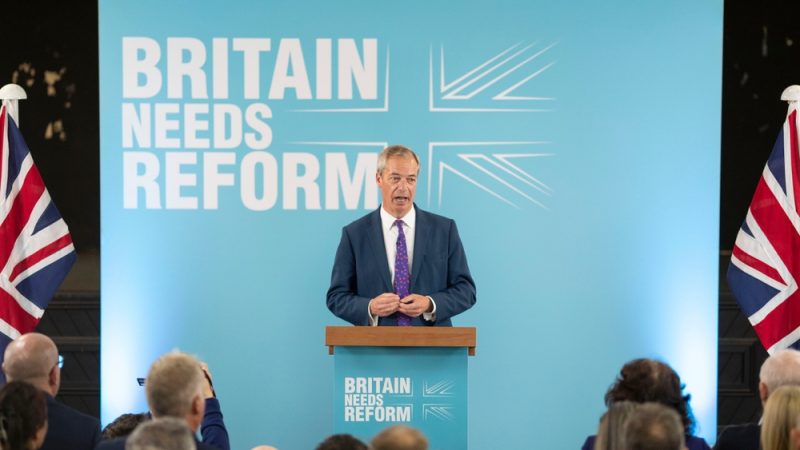
Is Reform taking on Labour or the Tories? Commentators who have been fiercely speculating on this question will hear the answer when Nigel Farage takes to the stage at Reform’s latest regional conference today. The setting – a hotel in Chester – is deliberate, bedding down in Labour’s north-western heartlands. However, Farage’s focus is more fundamental. He will position Reform as the disruptors in British politics, challenging the status quo. Labour must do the same or risk becoming accidental defenders of it.

The narrative that Reform is in a straight fight with Labour makes sense on the surface, but a narrow interpretation risks the wrong response. Yes, majorities have been slashed. The average Labour MP in a safe seat in the North West holds a smaller majority over their nearest opponent compared to 2019. Reform is second to Labour in 89 seats, with many of these in the North West. Meanwhile, the Tories have shifted from being the chased to the chasers, moving further rightwards in search of voters who deserted them in 2024. However, this is ultimately a futile exercise. They will not out-Reform Reform. 

‘Key to the success of the government is not drifting into defending the status quo’

The Prime Minister has rightly resisted taking Labour down this path. His calm and measured response to the populist right’s denigration of him and his ministers showed a strength needed in 21st-century politics. This must be coupled with radical policymaking that addresses the fundamental challenges facing the country. Key to the success of this government – and progressives worldwide – is that they don’t drift into becoming accidental defenders of the status quo. 

After all, the status quo is failing Britain. The country is stuck in a doom loop of low productivity, low growth, low investment, and high taxation. Healthcare spending consumes 43 percent of day-to-day government departmental budgets, and this is only set to grow as people live longer but not necessarily healthier lives. An increasingly insecure world rightly demands increased investment in military power, but this comes at the cost of reduced investment in our own people.

‘It should be the progressive mission to harness AI’

There must be a fundamental reimagining of the state that the left helped create. It won’t be a big state or an ideologically small state. It will be an enabling state, ready for the age of Artificial Intelligence (AI). Too often seen as just a clever chatbot, AI will bring high-IQ intelligence at speed to humanity’s greatest challenges. It will discover new therapeutics and personalize medicine. It will unearth new elements that will create new materials. It will transform complex networks, such as the national grid, making smart decisions to increase energy efficiency and consumption. It will power driverless cars and combine with robotics to move from concept to practice.

Whether we like it or not, AI will change everything. It should be the progressive mission to harness it for our people by putting it at the heart of a new mode of government. This requires data. An enabling state would ensure that every citizen has control of their data through a digital identity – a digital space where their data combines safely and securely. Imagine a student’s digital learner ID, offering a complete record of academic performance, learning styles, attendance, and attainment.

It could plug into game-changing AI tutors that personalize teaching, recognizing that every student is different and breaking the link between geography and access to quality learning. Meanwhile, a patient’s digital health ID will boost efficiency in the NHS, removing the need to endlessly share personal information at reception desks or in multiple appointments.

Over time, it will secure the much-needed shift to prevention, as AI continually maps a patient’s risk profile and proactively offers treatments to enable people to live healthier, happier lives. Digital ID will personalize public services, but the real magic will happen in the insight it generates across services – for example, understanding the interplay between health and education – allowing the government to make better decisions.

If progressives don’t own this, then the right will – as seen with the fusion of technologists and populists in the US. Reform’s ambition is clear: they want to win everywhere. Their North West conference won’t be about speaking to a particular geography but addressing the palpable sense of disdain with the country – one shared by three quarters of voters. Labour can counter this in government. With a strong majority and time on their side, they must out-reform Reform. This means reimagining what the state is and what it’s capable of.


Revealed: 17 UK union chiefs urge PM to support backbench climate bill


Union leaders have written to Keir Starmer calling on him to back a new bill that will require the UK to set more ambitious climate change targets, LabourList can reveal.

The Climate and Nature Bill, a backbench private members’ bill backed by more than 200 MPs including 88 Labour MPs, is set to be debated in Parliament on Friday.

If passed, it will require the UK to achieve climate and nature targets, including fulfilling its obligations under the Paris Agreement, and will require the secretary of state to implement a strategy to achieve those targets within 12 months of the Bill passing.

Writing to the Prime Minister, the 17 trade union leaders warned that the “climate-nature crisis is already impacting workers’ lives and livelihoods across the UK”, as they called on him to support it.

The signatories include the general secretaries of the National Education Union; Bakers, Food & Allied Workers Union; University and Colleges Union; and the Public & Commercial Services Union.

READ MORE: ‘We have a narrow window to cut emissions – we need a Climate Change Act 2’

They said it was essential that “Parliament sets the strongest laws to rise to this existential threat”, while protecting the future livelihoods of the British public.

The bill has already been backed by more than one in five Labour MPs, and counts party MPs Alex Sobel and Olivia Blake among its co-sponsors.

Environmental campaign group Zero Hour, which supports the bill, said that MPs should be afforded a free vote, similar to Kim Leadbeater’s Assisted Dying Bill.

READ MORE: ‘We’re behind on our climate targets for 2030. So make action a council duty’

Co-director of Zero Hour, Amy McDonnell, said: “The Climate and Nature Bill tackles the environmental emergency by introducing an integrated plan to protect our planet for future generations, led by the science.”

“What could be a bigger issue of conscience than whether we save the planet or let it burn up? Keir Starmer needs to make sure MPs get a free vote next week and back the Bill.”

A government spokesperson said: “The only way to protect current generations in the UK is by making Britain a clean energy superpower, and the only way to protect our children and future generations is by leading global climate action.

“That’s why we have launched a rapid review to deliver on our legally binding environment targets and have set an ambitious new climate target to reduce emissions by 81% by 2035 – which will deliver security, jobs and economic growth as we drive forward with our Plan for Change to rebuild Britain.”

The signatories are:
 
Sarah Woolley (General Secretary, Bakers, Food & Allied Workers Union)
Daniel Kebede (General Secretary, National Education Union)
Jo Grady (General Secretary, University and College Union)
Fran Heathcote (General Secretary, Public & Commercial Services Union)
Paul Day (Director, Pharmacists’ Defence Association Union)
David Collingwood (President, Association of Educational Psychologists)
Paul W. Fleming (General Secretary, Equity)
Julie Georgiou (General Secretary, National House Building Council Staff Association)
Steve Gillan (General Secretary, Prison Officers Association)
Zita Holbourne (Co-Chair, Artists Union of England)
Ian Lawrence (General Secretary, National Association of Probation Officers)
Gawain Little (General Secretary, General Federation of Trade Unions)
Brian Linn (General Secretary, Aegis)
John McGowan (General Secretary, Social Workers’ Union)
Tahir Latif (Greener Jobs Alliance)
Professor Phil Banfield, Council Chair, British Medical Association
Amira Campbell, President, National Union of Students UK

Labour losing more votes to Greens and Lib Dems than ReformUK – YouGov


© Alex Danila/Shutterstock.com:

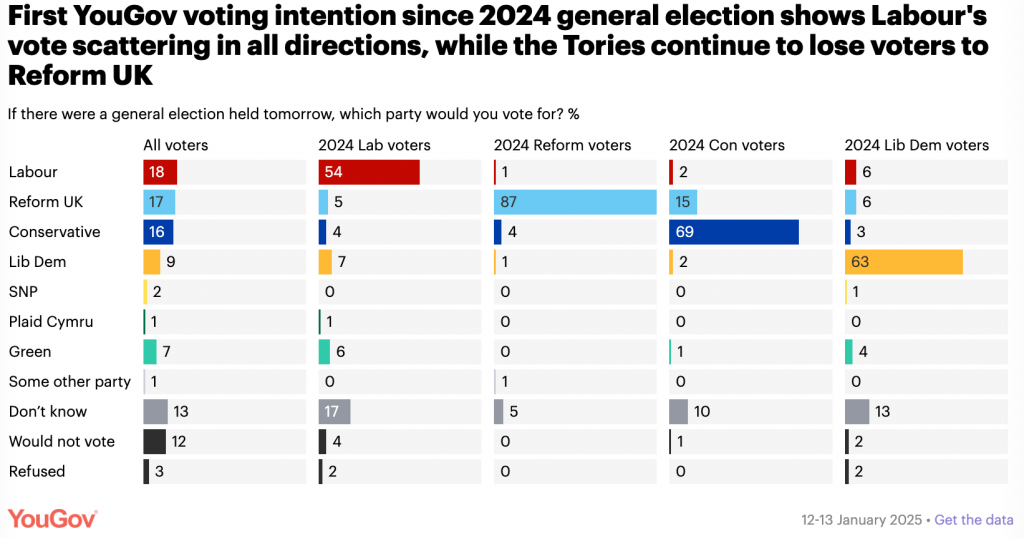
Labour is losing more voters to the Greens and Lib Dems than to Reform, despite Nigel Farage’s party now polling better than the Conservatives, according to a new survey by YouGov.

The voting intention survey – the first since the 2024 general election – makes painful reading for the government, as embattled Chancellor Rachel Reeves faces growing criticism over her management of the economy.

Only a slight majority of Labour’s 2024 general election voters, at 54%, would still vote for the party if a general election was held tomorrow, the survey found.

Credit: YouGov

READ MORE: More Labour voters would rather see Farage as PM over Rachel Reeves, poll finds

Former supporters are jumping ship to the Lib Dems, 7%, the Greens, 6%, Reform, 5%, and the Tories, 4%. A further 17% of the 2024 Labour voters say they don’t know who they would vote for currently.

The polling leaves Labour with a voting share of just 26%.

The survey also makes difficult reading for new Tory leader Kemi Badenoch, as her party slides into third place at 22% – three percentage points lower than Reform – who now poll as the second biggest party at 25%.

READ MORE: Voters believe Labour is doing worse than Tories on delivering pledges, poll finds

Labour remain by far the most popular party with young people, with 36% of 18-24 year olds saying they would vote for them. The Greens are in second place at 22%. 

However, Reform have become the most popular right wing party, with 19%, dwarfing the Tories who have just 5% of the youth vote share. 

The Tories continue to be the most popular party with the oldest voters, aged 65+, with 35% of the vote share. Reform come a close second at 30%, and Labour net just 14% of 65+ year olds.

Labour faces competition from different right wing parties depending on voters’ gender. The party comes in second place among men, at 27% to Reform’s 30%. Meanwhile Labour ties with the Tories among women, with 25% of the voting share each.

Right-Wing Watch


MAGA mania – will Britain follow Trump’s immigration rift?

Unless Britain truly distances itself from the racially charged nationalism emerging from MAGA mania across the Atlantic, the true victims will be immigrants, who will face an increasingly normalised wave of vilification.


LEFT FOOT FORWARD
12 January, 2025 

A civil war is brewing in Trumpland and he hasn’t even taken office yet. Tensions are rising between two distinct Republican factions. On one side, there’s the hard-right, anti-immigrant “Make America Great Again” (MAGA) supporters. They tend to be white, working class, less educated, and disillusioned, believing that minority rights have undermined American values. They advocate isolationism, seeking to detach the US from the rest of the world.

In opposition, are the hyper-capitalist tech elites, many of whom are immigrants themselves. They’re led by Elon Musk, the world’s richest man, who helped to bankroll Trump’s election campaign.

At the heart of the rift is immigration. The MAGA diehards resent the arrival of foreign workers, particularly skilled immigrants on H-1B visas. In a tirade on X, Musk told H-1B opponents to: “F*** yourself in the face.” Steve Bannon, Trump’s former White House strategist, who was released from prison in October after serving a sentence for contempt of Congress during the Capitol Hill riots, hit back. Unless Musk smartens up and stops pushing visas for skilled workers to take well-paid tech jobs away from Americans, he and other MAGA diehards will “rip your face off,” warned the War Room podcaster.

Lovely people, aren’t they.


DOGE vs MAGA

Musk and Vivek Ramaswamy, a fellow tech entrepreneur and Trump’s former rival for GOP presidential nomination, are spearheading efforts to streamline the federal government under Trump’s new “DOGE’’ (Department of Government Efficiency,) tasked with cutting wasteful spending.

Both men support H-1B visas, arguing that foreign talent is crucial for innovation. Musk, who was born in South Africa, sparked controversy by dismissing American workers as “re****ed” and defending the visas. Ramaswamy has similarly argued that Americans cannot compete with foreign workers due to a “dumbed down” culture.

Despite MAGA’s vocal opposition, Trump himself has expressed support for the H-1B programme, telling the New York Post: “I’ve always liked the visas, I have always been in favour of the visas. That’s why we have them.”

This position has baffled many within his base, given his previous push to restrict visas during his first term. Then again, perhaps it’s not so surprising, considering Trump’s penchant for changing his mind as often as a four-year-old changes their mind about their favourite toy.

DOGE/MAGA tensions deepened with the appointment of Sriram Krishnan, an Indian American advisor close to both Musk and Trump, who supports easing restrictions on H-1B visas. MAGA activist Laura Loomer, a self-proclaimed “proud Islamophobe,” chimed in. Taking to X she insisted that H-1B jobs should go to American STEM graduates, not foreign workers.

“Our country was built by white Europeans… Not third-world invaders from India,” she posted on X. “It’s not racist against Indians to want the original MAGA policies I voted for.”

Which of course, rather overlooks the role of generations of black slaves, as well as the Chinese labourers, who laid America’s railways.

Democrats are already positioning themselves to capitalise on the divide, with a memo circulating among a group of entrepreneurs, lawyers, and academics seeking to unite factions of the Republican Party critical of Musk’s influence on tech and immigration. Concerns over Musk’s foreign ties, particularly with China and Russia, have also raised alarms within the defence community.

Progressive voices like Bernie Sanders have spoken out, accusing Musk of pushing for H-1Bs to secure “cheaper” labour, not more qualified workers.

Why does this all matter? Because while Trump’s people insist he won on a landslide and has a mandate that he will put in place on day one, his fragile coalition is splintering even before he takes office.

The immigration divide in Britain

More concerningly still from a UK perspective, the Republicans’ ideological battle has parallels within the UK right-wing, where immigration remains a major point of contention. Ironically, Elon Musk, the figure catalysing division within the MAGA movement, has become an unlikely lightning rod in Britain’s political discourse, commanding attention in news cycles and political debate.

In Britain, much like in the US, the right-wing is fracturing, with immigration at the heart of the conflict. For over a decade, successive Tory administrations promised to tackle illegal migration and reduce legal immigration, yet their failure to deliver infuriated many voters and further demonised immigrants to the UK. Despite ambitious targets and aggressive anti-immigration policies, immigration levels, both legal and illegal, have not decreased.

The Tories’ civil war

The civil war within the Conservative Party, ongoing for months – even years – intensified in the wake of their disastrous election defeat.

Liz Truss’s ‘Pop Con’ think-tank aims to pile pressure on the party, lobbying for more hardline measures on issues dear to the right of the party, such as immigration. Led by Mark Littlewood, former director of the Institute of Economic Affairs, which helped shape Truss’s ill-fated mini budget, the think-tank embodies the growing division within the party.

Kemi Badenoch, the first black woman to lead a major UK political party, remains a divisive figure, even within her own party. Known for her firm “anti-woke” position and no-nonsense style, she became a hero to many on the Conservative right. During her leadership campaign, Badenoch warned that Conservatism was “in crisis,” under siege from a progressive ideology and identity politics.

Yet, several months into her tenure, many Tories – and their supporting media – are questioning whether Badenoch has a plan, as the Spectator belligerently asked this week.


Despite Keir Starmer’s declining support, Britons remain unconvinced that the Conservatives are ready for government or that Badenoch is a prime minister-in-waiting

.

Badenoch’s response to the ‘MAGA mania’ spreading across the Atlantic is also telling. As Guardian columnist Rafael Behr wrote on the matter, Badenoch had a choice, “police the boundary where reputable Tory tradition shades into racially aggravated nationalism or hasten the dissolution of that line.”

In other words, distance the Conservatives from growing nationalism in the US or endorse it for political gain. She opted for the latter.

Amid the resurfaced grooming gangs’ scandal, strategically fostered by Elon Musk, whose raft of erratic social media posts put a decades-long child sexual abuse scandal back under the political spotlight, shadow justice secretary Robert Jenrick, and Badenoch’s rival in the Tory leadership race, suggested that migrants with “medieval attitudes to women,” should be barred from coming to Britain.

His comments were backed by Badenoch, who has previously said that all cultures are not “equally valid.”

Sadly, similar to the diehard MAGAs, the UK right’s approach to immigration is marked by hostile language which only serves to incite racial tensions.

What about Labour?

Like its predecessors, Labour has made a series of ambitious pledges on migration, to bring down net migration, reduce reliance on overseas workers, tackle smuggling gangs, clear the asylum backlog, and accelerate the removal of people without legal status in the UK.

But the Refugee Council has warned that unless Labour challenges aggressive Conservative rhetoric and reframes the debate, it risks perpetuating harmful attitudes toward refugees. The charity’s chief executive, Enver Solomon, urged Starmer to use the language of “compassion and humanity” to tackle the vilification of refugees.


In an exchange during a recent PMQs, Starmer and Badenoch clashed over the Tories’ record on immigration, with the PM accusing the previous government of overseeing “open borders” and record-high immigration levels. Badenoch fired back, questioning why cutting immigration wasn’t a priority for Labour.

Reform makes gains

As Labour and the Tories engage in a blame game over immigration, Nigel Farage’s Reform is reaping the rewards.

Stephen Flynn, the SNP’s Westminster leader, noted that Farage is the true beneficiary of these divisive discussions on immigration. Following the PMQs’ exchange, Flynn remarked:

“Only one person wins from PMQs being dominated by these race to the bottom arguments on immigration. And it’s neither Keir, nor Kemi.”

As reported in the National, Morgan McSweeney, the PM’s chief of staff, has instructed Labour MPs to talk about immigration more frequently, a move widely seen as an attempt to regain control of the debate from Reform.

Indeed, Farage’s Reform is making gains. Membership of the anti-immigration party has reportedly overtaken that of the Tories, described by Farage as a “historic moment.” However, some Tory figures, including Badenoch, have dismissed these claims as “fakery.”

Farage’s relationship with Elon Musk has also dominated the headlines. Last month, the Clacton MP was reportedly in talks with the world’s richest man about securing a donation for his hard-right party. Yet Musk and Farage’s relationship soured over the controversial figure of Tommy Robinson, the far-right former leader of the English Defence League. Musk had called for Robinson’s release, while Farage condemned him, stating, “he’s not what we need.”

Despite the rift, a split between Farage and Musk may not necessarily hinder Reform’s progress.

Farage’s party has risen rapidly, and he’s led successful campaigns on limited resources before. The party received a huge PR boost from Farage’s association with Musk, and distancing himself from the controversial figure may even enhance Farage’s credibility.

That said, the Clacton MP is flying to the US once again for Trump’s inauguration and has said he hopes to patch things up with Musk.

Dear oh dear, it seems whatever Farage does he can’t lose. And sadly, unless Britain truly distances itself from the racially charged nationalism emerging from MAGA mania across the Atlantic, the true victims will be immigrants, who will face an increasingly normalised wave of vilification.

Right-wing media watch – Conservative media deflects California wildfire blame, targeting Gavin Newsom over climate change

This week’s wildfires ravaging Los Angeles, causing fatalities and widespread destruction, made headlines around the world. Experts have pointed to climate change as a major factor behind the increasing intensity and frequency of these fires, with California particularly vulnerable due to prolonged dry spells following a hot summer.

According to Professor Stefan Doerr, director of the Centre for Wildfire Research at Swansea University, the region has seen some of the most drastic increases in “fire weather” globally, “largely driven by climate change.”

However, right-wing media, both in the US and the UK, have largely sidestepped the climate change angle. Instead, they’ve focused on political scapegoating, with California’s Democratic governor Gavin Newsom bearing the brunt of criticism.

Newsom, who’s widely expected to be a potential Democratic presidential contender in 2028, has faced accusations of mismanaging the state’s land and forest policies, with some critics suggesting his focus on the “globalist climate change agenda” undermines his responsibility to manage natural resources effectively.

The Daily Mail has led the charge, running a headline decrying Newsom’s “terrible record of California forest management.” The article claims that Newsom’s time in office has been marked by criticism over his handling of forest fires. The Mail even quoted Breanna Morello, a right-wing social media personality, accusing Newsom of neglecting forest management and focusing too heavily on the “globalist climate change agenda.”


Donald Trump has, of course, waded in, insisting that California’s fires were exacerbated by Newsom’s unwillingness to “clean” the forest floors. Trump also claimed that Newsom had failed to act on water restoration initiatives. The Mail doubled down, publishing Trump’s earlier warnings about the governor’s forest management decisions, further fuelling the attack.

Naturally, Trump-endorsing Fox News jumped on the same bandwagon, amplifying Trump’s criticisms and framing Newsom as responsible for the devastation.

Sadly, with outlets like the Daily Mail, which doesn’t exactly have a good track record on climate reporting, with analysis finding that the newspaper continues to promote climate change denial, including headlines denouncing “climate hysteria,” the decision to focus less on the link between climate change and the fires, and instead blame Newsom’s policies and leadership, comes as no surprise.

Smear of the week – Sun in meltdown over civil servants celebrating ‘Juneteenth’

It’s January. It’s cold. It’s dark. It’s wet. And, if you live where I live, you’re shovelling snow. You’re not contemplating distant events in June.

But not the Sun, which decided to leap straight to summer – and not for the reasons you’d expect, or perhaps hope.

In its latest bout of woke-bashing smear, the Murdoch-owned tabloid took aim at civil servants celebrating ‘Juneteenth’.

Juneteenth (June 19th) became an official US federal holiday in 2021, thanks to President Joe Biden. It’s a pivotal day in American history, which not only ended slavery but also helped ignite decades of struggle for racial justice, while reshaping the nation socially, politically and economically.

The Sun devoted an entire article to ‘quangocrats’ – which seems to be a new buzzword within right-wing media circle. Short for quasi-autonomous non-governmental organisations, it’s used derogatorily to describe the civil service, apparently taking over Britain.

According to the Sun, “woke” officials in the Intellectual Property Office (IPO) have been commemorating Juneteenth, the American holiday marking the abolition of slavery in 1865.


You’d think that we’d be encouraged to celebrate the June 19 event. But not the Sun, which portrayed the Juneteenth celebrations among UK civil servants as something to mock.

And it doesn’t stop there. The same report also takes issue with civil servants observing the UN’s International Day of Indigenous Peoples, held in even longer away, on August 9. According to the IPO’s annual inclusion and diversity report, that by celebrating these events they had “broadened awareness and understanding” across the workforce.

This international day is about raising awareness for the rights and achievements of Indigenous peoples globally. But for the Sun, it’s just another example of those “quangocrats” wasting taxpayer money on irrelevant causes.

Hold on a second, though, who exactly is complaining? William Yarwood that’s who, media campaign manager at our old friends the Taxpayers’ Alliance, the secretly funded think-tank which cheered Liz Truss’s disastrous mini-budget, opposes measures to combat climate change, among many other crimes.

Yarwood dismisses the celebrations as a sign that these “busybody quangocrats clearly don’t have enough work to do.”

“If these pen-pushers are able to find time to commemorate events that have nothing to do with their role or the country as a whole, taxpayers will be asking whether we need to employ many of them in the first place,” he said.

Let’s not forget, this is the same Sun and Taxpayers’ Alliance duo that tried to shift blame for the UK’s huge death rate during the pandemic. As LFF reported at the time, the Tufton Street think-tank and right-wing newspaper worked together on a hit piece, entitled: “Public Health England paid £60,000 bonuses to top execs before bungling Covid.”

In actual fact, no one got £60k. Six people received a bonus of between £5k and £10k.

It seems the Sun seriously needs to update its contacts’ book. Rather than relying on old, ideologically driven think-tanks like the Taxpayers’ Alliance, it and could definitely benefit from sourcing more informed, diverse opinions.


Gabrielle Pickard-Whitehead is author of  
Right-Wing Watch