.JPG)
Squeezed domestic spending and extravagant military spending have widened inequality, with dire consequences for democracy.
Catherine LutzAnne Lutz Fernandez
Dec 19, 2025
No single explanation exists for how our American democracy came under siege. But with Donald Trump having spent 2025 in escalating conflict across the hemispheres, there is one big factor we shouldn’t keep ignoring: the role that our bloated military budget has played in expanding authoritarianism in the United States.
Year after year, trillions are spent on military affairs—via the Pentagon, nuclear weapons programs, Veterans Affairs, and interest on war debt. War and preparation for it takes an ever-bigger bite—now two-thirds—of the discretionary federal budget. Add security work in Homeland Security and the Justice Department, and just 25% of Trump’s 2026 budget request is left for Americans’ other needs, including transportation, housing, disaster response, cancer research, education, and more.
RECOMMENDED...

‘Don’t Give the Pentagon $1 Trillion,’ Critics Say as House Passes Record US Military Spending Bill
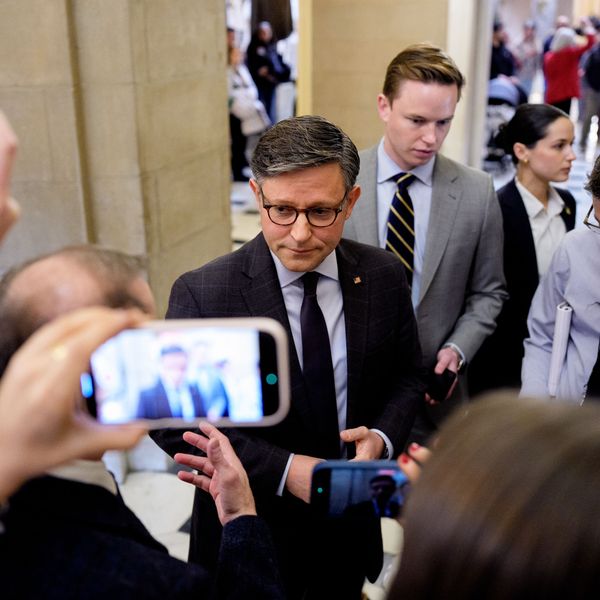
Mike Johnson Touts $901 Billion Military Budget Plan After Gutting Medicaid, SNAP
Squeezed domestic spending and extravagant military spending have widened inequality, with dire consequences for democracy.
That Pentagon spending creates a more unequal America may seem counterintuitive when it is so often touted as a boon to communities with military bases or weapons makers. But military spending has complex effects that belie its reputation as an economic good for the American public as a whole.
Making it harder to go to war is one critical way to help revive democracy.
The truth is that millitary expenditures create far fewer domestic jobs than other types of federal spending—health, education or housing, for example. What Mary Kaldor called the “baroque arsenal“ of ultraexpensive, advanced technologies requires a much smaller workforce than did the more numerous mass-produced weapons of the past.
So, where does all of that federal spending on defense go? To military contractors. In the 1980s, many uniformed military jobs were outsourced to private companies; then came phenomenal consolidation in the defense industry. The top five contractors now eat more than half the Pentagon budget. While enlisted soldiers receive pay that leaves many qualifying for SNAP benefits, CEOs and stockholders of these firms dine on the rewards of larger budgets.
Some of this spending goes to a few tech billionaires, whose wealth explodes as most Americans’ sputters. Pro-authoritarian Trump donors such as Palantir’s Peter Thiel and SpaceX’s Elon Musk walk the halls of power as systems providers, policy advisors, and surveillance installers.
Inequality has also been worsened by how the U.S. finances its military. Political scientist Rosella Capella Zielinski explains: “Deficit financing, indirect taxation, and printing money…contribute to war inflation, reducing the purchasing power of low- to middle-income households.”
Studies of 21st century democracies show that the risk of electing an authoritarian leader rises as the wealth gap widens. In the U.S., the contrast between the yachts of the oligarchs and the leaky boats of the majority has fostered cynicism and a sense that our government cannot meet people’s needs. MAGA politicians have capitalized on this cynicism to scapegoat immigrants and others for the disappointments and struggles caused by tax and spending policies that promote inequality. This dark tangle of experience and disinformation helped Trump regain power.
Trump’s authoritarian impulses have an outlet in a presidency that has become more “imperial” as our military reach has expanded across the globe since World War II. POTUS’s war-making role, meant by the founders to be rarely exercised, has moved to the center of presidential energy and identity. Our massive military budget meets Trump’s thirst to use the military as the crucial instrument and spectacle of his power. The repressive capacity of a man with more military dollars in his fist than any authoritarian in history should inspire dread.
The campaign story many voters embraced—that Trump was reticent to start wars and eager to end them—has been blown up by the man himself. He has struck inside Iran and Yemen; suggested seizing the Panama Canal, annexing Greenland and Canada, and invading Mexico; and extended U.S. support of Israel’s destruction in Gaza. He is calling for renewed nuclear testing, reviving old Latin American bases, striking boats in the Caribbean, and provoking war with Venezuela.
Therein lies some hope. Pushback from the MAGA base and pols who wish to lead them in the future might help as Trump’s net approval drops lower than low. Before Rep. Marjorie Taylor Greene split from Trump on the Epstein files, she had diverged on his Iran bombings and on Gaza. She lamented, “We elected the president to stop sending tax dollars and weapons for the foreign wars.” Americans have soured on militarism: Only a quarter surveyed in 2023 believed the US improves things in the countries in which it intervenes militarily.
Serious change, however, can only come after Congress reasserts its authority to declare war and provide oversight informed by public opinion. Making it harder to go to war is one critical way to help revive democracy. It could allow us to reallocate funding to improve the lives of Americans and restore faith in the democratic system.
US Congress passes defense bill defying Trump anti-Europe rhetoric
By AFP
December 17, 2025

The defense bill aims to tie the Pentagon's hands on troop deployments in Europe - Copyright AFP/File Daniel SLIM
US lawmakers on Wednesday passed a sweeping defense policy bill, signaling ironclad bipartisan support for Europe and delivering a blistering repudiation of President Donald Trump’s increasingly hostile posture toward NATO and America’s closest allies.
The comfortable 77-20 Senate vote sends the $900 billion National Defense Authorization Act (NDAA) to the White House, closing out one of Congress’s few remaining rituals of cross-party cooperation even as foreign policy divisions sharpen elsewhere in Washington.
“We ask a lot of the brave Americans serving in uniform. And they give a lot,” Republican Senate Majority leader John Thune said ahead of the vote.
“And I’m proud that this year’s National Defense Authorization Act will help ensure that they have what they need to keep America safe in a dangerous world.”
The action in the upper chamber follows House passage last week and comes amid unease in European capitals over Trump’s rhetoric, especially after the recent White House national security strategy painted Europe as over-regulated, culturally adrift and insufficiently committed to its own defense.
The strategy questioned the continent’s strategic value and openly echoed themes championed by far-right parties, fueling fears of a widening transatlantic rift.
By contrast, the NDAA reflects lawmakers’ determination to anchor the United States firmly in Europe.
The bill bars US troop levels on the continent from falling below 76,000 for more than 45 days and restricts the removal of major military equipment, effectively tying the administration’s hands on any rapid drawdown.
It also boosts resources for frontline NATO states, particularly in the Baltic region, reinforcing the alliance’s northeastern flank.
The measure authorizes roughly $8 billion more than the administration requested, a signal of congressional assertiveness on defense priorities.
Beyond Europe, the NDAA locks in $400 million in security assistance for Ukraine, aiming to preserve a baseline of support even as broader funding debates grind on, and places new limits on any reduction of the 28,500 US troops stationed in South Korea.
As ever, the NDAA drew fire from multiple directions — from conservative critics of Ukraine aid to safety experts warning about aviation provisions rolling back critical air-safety requirements for military aircraft operating in Washington’s restricted airspace.
But none came close to derailing a package long seen as must-pass legislation.

Majority of Democrats Join Senate GOP to Pass Trump’s $900 Billion Pentagon Wish List
Sen. Ron Wyden said the bill “increases military spending by tens of billions of dollars and fails to include guardrails against Donald Trump and Hegseth’s authoritarian abuses.”
Stephen Prager
Dec 17, 2025
A majority of Democratic senators joined Republicans on Wednesday to pass the largest military spending bill in US history, handing President Donald Trump the bulk of his demands, even as he enacts steep cuts across nearly every other sector of the federal budget.
The more than $900 billion National Defense Authorization Act (NDAA) passed by a vote of 77-20, with 27 Democrats, as well as the independent Sen. Angus King (Maine), in support. Just three members of the Republican majority voted against the bill, along with 16 Democrats and independent Sen. Bernie Sanders (Vt.).
Among many other items on Trump’s wish list, the bill provides funds for weapons meant to counter China, full funding for Trump’s National Guard deployments to support the US immigration agents, and more funds for what are described as “counternarcotics operations.”
It also removes a measure that would have restored collective bargaining rights that Trump stripped earlier this year from Pentagon employees, permanently ends Defense Department initiatives to curb climate change, and excludes a measure that would mandate healthcare coverage for in vitro fertilization.
Combined with $156 billion in the GOP’s One Big Beautiful Bill Act this July, the package passed by the Senate pushes military spending for fiscal year 2026 into the trillions—a new record in absolute terms and a relative level unseen since World War II.
The bill will head to Trump’s desk just a day after he announced a “total and complete blockade” on Venezuelan oil tankers, a major escalation described by Rep. Joaquin Castro (D-Texas) as “unquestionably an act of war.”
The bill contains a measure demanding that the Pentagon release the unedited video of a September 2 “double-tap” strike on a boat in the Caribbean that members of both parties have suggested may violate international law.
On Tuesday, Defense Secretary Pete Hegseth and Secretary of State Marco Rubio declined another congressional request to release the video. The defense bill ramps up the pressure for transparency, mandating a 25% cut to Hegseth’s travel budget if the administration does not comply.
Senate Democrats have previously voted in support of war powers resolutions to require congressional approval for Trump’s boat strikes and for further military action against Venezuela. These measures have repeatedly fallen just short in the Republican-controlled Senate.
But Stephen Semmler, a co-founder of the Security Policy Reform Institute, argued that “if the Senate truly cared about Trump seeking congressional approval before starting a war with Venezuela, it wouldn’t have passed a bill authorizing $901 billion in military spending.”
Sen. Ron Wyden (D-Ore.), who voted no on the defense spending bill, said, “I cannot support a bill that increases military spending by tens of billions of dollars and fails to include guardrails against Donald Trump and Hegseth’s authoritarian abuses.”
“Donald Trump has repeatedly used the military to occupy major US cities, including Portland—endangering our service members, disrupting our economy, and eroding trust in our communities,” Wyden continued. “He has also shown that he will use the Department of Defense to conduct deadly military operations without congressional authorization to intimidate political opponents and immigrants through the military, to purge senior military leaders without cause, to funnel billions of dollars in contracts to his personal supporters, and to waste billions of taxpayer dollars.”
The defense spending bill passed the US House last week, with support from 115 Democrats. This was despite opposition from the Congressional Progressive Caucus, whose deputy chair, Rep. Ilhan Omar (D-Minn.), said it was “enabling unchecked executive war powers.”
The House is expected to vote Wednesday evening on a pair of war powers resolutions. One, introduced by Rep. Gregory Meeks (D-NY), would block Trump’s extrajudicial airstrikes on boats in the Caribbean. Another bipartisan resolution would require Trump to receive congressional approval before taking direct military action, including land strikes, against Venezuela.
By AFP
December 18, 2025
The National Defense Authorization Act for 2026, signed into law by US President Donald Trump, aims to tie the Pentagon's hands on troop deployments in Europe - Copyright AFP/File Daniel SLIM
President Donald Trump signed a sweeping defense policy bill into law Thursday that signaled strong bipartisan support for Europe and defied the US leader’s increasingly hostile posture toward NATO and America’s closest allies.
The annual National Defense Authorization Act (NDAA), one the few remaining rituals of cross-party cooperation in Congress even as divisions sharpen elsewhere in Washington, sets out the country’s national security and foreign policy priority areas for the coming year, according to lawmakers.
White House spokesperson Anna Kelly said Trump signed into law a measure which raises pay for US troops, codifies the country’s “PEACE THROUGH STRENGTH agenda,” and “funds the Golden Dome” air and missile defense system backed by Trump.
The NDAA, at some $900 billion, also “removes woke priorities” like diversity, equity and inclusion (DEI) programs opposed by many conservatives, and “requires promotions based on merit, not DEI,” Kelly added.

The Senate easily passed the NDAA measure on Wednesday following the House’s green light last week.
The success comes amid unease in European capitals over Trump’s rhetoric, especially after the recent White House national security strategy painted Europe as over-regulated, culturally adrift and insufficiently committed to its own defense.
The strategy questioned the continent’s strategic value and openly echoed themes championed by far-right parties, fueling fears of a widening transatlantic rift.
By contrast, the NDAA reflects lawmakers’ determination to anchor the United States firmly in Europe.
The bill bars US troop levels on the continent from falling below 76,000 for more than 45 days and restricts the removal of major military equipment, effectively tying the administration’s hands on any rapid drawdown.
It also boosts resources for frontline NATO states, particularly in the Baltic region, reinforcing the alliance’s northeastern flank.
The measure authorizes roughly $8 billion more than the administration requested, a signal of congressional assertiveness on defense priorities.
Beyond Europe, the NDAA locks in $400 million in security assistance for Ukraine, aiming to preserve a baseline of support even as broader funding debates grind on, and places new limits on any reduction of the 28,500 US troops stationed in South Korea.
As ever, the NDAA drew fire from multiple directions — from conservative critics of Ukraine aid to safety experts warning about aviation provisions rolling back critical air-safety requirements for military aircraft operating in Washington’s restricted airspace.
But none came close to derailing a package long seen as must-pass legislation.
Invest in the Planet, Not the Pentagon
December 19, 2025

Photo by Karl Anderson
Ten years ago as of December 2025, nearly every country in the world made a promise. By signing the Paris Agreement, governments committed to limit global temperature rises to no more than 2°C — and ideally 1.5°C — to avoid the most devastating impacts of a warming planet.
Recognizing their historic responsibility for greenhouse gas emissions, the Paris Agreement called on wealthier countries like the United States to contribute funding to help poorer countries adapt. And it envisioned the economic and social transformations needed to keep the planet from overheating to unlivable levels.
In practice, that means phasing out fossil fuels, scaling up renewable energy, and investing in sustainable systems — from agriculture to transportation — to keep our world powered and going.
Unfortunately, that’s not what our leaders are doing.
With the world’s largest economy and the greatest chunk of historical emissions, the United States should be contributing an estimated $446 billion per year to meet its fair share of global climate action. Instead, Washington has repeatedly abandoned global leadership — joining the Paris Agreement in 2016, pulling out in 2020, rejoining a year later, and withdrawing again this year.
For the past century, at least 80 percent of U.S. energy consumption has come from fossil fuels like natural gas, coal, and oil. Today, domestic energy demand is soaring as Big Tech and private corporations race to build massive, water and energy-intensive AI data centers — further locking in fossil fuel dependence.
Meanwhile, rather than aligning its national priorities with climate commitments, the U.S. government has doubled down on a different and dangerous path: wars and weapons.
The Pentagon is the most carbon intensive institution on the planet, with emissions exceeding those of entire nations like Sweden, Denmark, and Portugal. And those emissions will likely grow as Pentagon spending continues to skyrocket.
Congress recently approved a $900 billion Pentagon budget. When combined with the $156 billion boost for the Pentagon from Trump’s so-called “Big Beautiful Bill,” that brings the total to over $1 trillion for the U.S. war machine.
That’s right: a trillion dollars.
At the same time, the Trump administration made sweeping cuts to environmental programs that took decades to build.
The Environmental Protection Agency’s budget was slashed by more than half — from $9.14 billion for 2025 to just $4.16 billionfor 2026. And Trump has cancelled or frozen $29 billion in environmental grants for local communities, undermining efforts to secure clean air and water, clean up contaminated sites, improve public health, and create jobs.
The National Priorities Project of the Institute for Policy Studies, my organization, found that we’ve spent $79 billion on Foreign Military Financing over the last decade alone. In these deals, the U.S. provides grants to other countries to purchase U.S.-made weapons. On the flip side, only $2 billion has gone to the Green Climate Fund, the primary pool of money supporting nations most impacted by, yet least responsible for, climate change. (Under Trump, the figure is actually $0.)
So in addition to cutting our own renewable programs to spend more on the carbon-intensive Pentagon, we’re also spending nearly 40 times more helping other countries do the same rather than helping them adapt to our warming planet.
Ordinary people are already paying the price for these choices. Floods, hurricanes, and wildfires are growing more frequent and destructive, driving up recovery expenses and insurance costs. Utility bills are climbing, too, due to extreme temperatures and energy-thirsty AI data centers.
Ten years after the Paris Agreement, the choice is clear. We can continue down a path of fossil fuels and endless wars, or we can invest in climate solutions that actually keep people safe. Business as usual will leave homes destroyed, families hungry, and people sicker and more vulnerable.
The clock is ticking. It’s time to stop funding destruction and start putting money towards just, healthy futures for all.

No comments:
Post a Comment