Friday, January 17, 2025


Arctic hotspots study reveals areas of climate stress in Northern Alaska, Siberia


Woodwell Climate Research Center
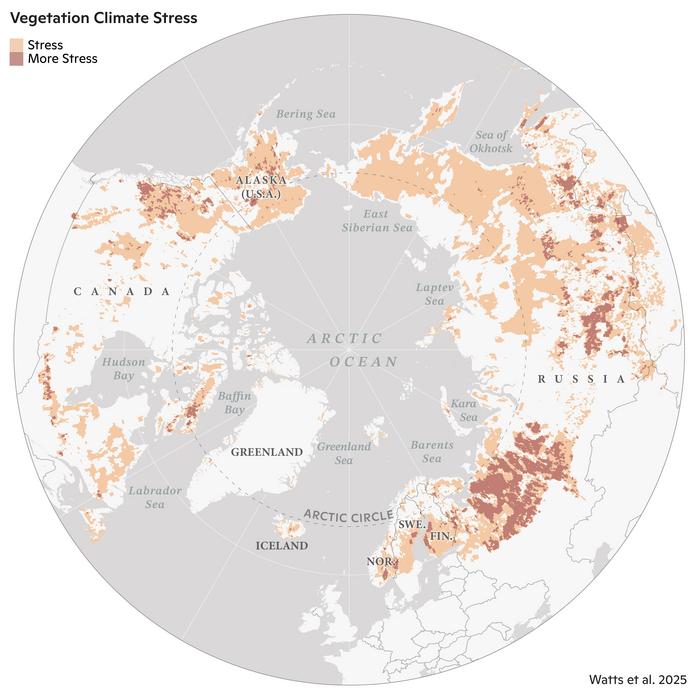
Ecosystem climate stress in the Arctic-boreal region, 1997-2020 

image: 

Map of areas that experienced ecosystem climate stress in the Arctic-boreal region between 1997-2020 as detected by multiple variables including satellite data and long-term temperature records. 

view more 

Credit: Christina Shintani / Woodwell Climate Research Center


Ecological warning lights have blinked on across the Arctic over the last 40 years, according to new research, and many of the fastest-changing areas are clustered in Siberia, the Canadian Northwest Territories, and Alaska. The analysis of the rapidly warming Arctic-boreal region, published in Geophysical Research Letters this week, provides a zoomed-in picture of ecosystems experiencing some of the fastest and most extreme climate changes on Earth.


Many of the most climate-stressed areas featured permafrost, or ground that stays frozen year-round, and experienced both severe warming and drying in recent decades.


To identify these “hotspots,” a team of researchers from Woodwell Climate Research Center, the University of Oslo, the University of Montana, the Environmental Systems Research Institute (Esri), and the University of Lleida used more than 30 years of geospatial data and long-term temperature records to assess indicators of ecosystem vulnerability in three categories: temperature, moisture, and vegetation. 


Building on assessments like the NOAA Arctic Report Card, the research team went beyond evaluating isolated metrics of change and looked at multiple variables at once to create a more complete, integrated picture of climate and ecosystem changes in the region.


“Climate warming has put a great deal of stress on ecosystems in the high latitudes, but the stress looks very different from place to place and we wanted to quantify those differences,” said Dr. Jennifer Watts, Arctic program director at Woodwell Climate and lead author of the study. “Detecting hotspots at the local and regional level helps us not only to build a more precise picture of how Arctic warming is affecting ecosystems, but to identify places where we really need to focus future monitoring efforts and management resources.”


The team used spatial statistics to detect “neighborhoods,” or regions of particularly high levels of change during the past decade. 


“This study is exactly why we have developed these kinds of spatial statistic tools in our technology. We are so proud to be working closely with Woodwell Climate on identifying and publishing these kinds of vulnerability hotspots that require effective and immediate climate adaptation action and long-term policy,” said Dr. Dawn Wright, chief scientist at Esri. “This is essentially what we mean by the ‘Science of Where.’”


The findings paint a complex and concerning picture. 


The most substantial land warming between 1997-2020 occurred in the far eastern Siberian tundra and throughout central Siberia. Approximately 99% of the Eurasian tundra region experienced significant warming, compared to 72% of Eurasian boreal forests. While some hotspots in Siberia and the Northwest Territories of Canada grew drier, the researchers detected increased surface water and flooding in parts of North America, including Alaska’s Yukon-Kuskokwim Delta and central Canada. These increases in water on the landscape over time are likely a sign of thawing permafrost.


Among the 20 most vulnerable places the researchers identified, all contained permafrost.


“The Arctic and boreal regions are made up of diverse ecosystems, and this study reveals some of the complex ways they are responding to climate warming,” said Dr. Sue Natali, lead of the Permafrost Pathways project at Woodwell Climate and co-author of the study. “However, permafrost was a common denominatorthe most climate-stressed regions all contained permafrost, which is vulnerable to thaw as temperatures rise. That’s a really concerning signal.”   


For land managers and other decisionmakers, local and regional hotspot mapping like this can serve as a more useful monitoring tool than region-wide averages. Take, for instance, the example of Covid-19 tracking data: maps of county-by-county wastewater data tend to be more helpful tools to guide decision making than national averages, since rates of disease prevalence and transmission can vary widely among communities at a given moment in time. So, too, with climate trends: local data and trend detection can support management and adaptation approaches that account for unique and shifting conditions on the ground.


The significant changes the team detected in the Siberian boreal forest region should serve as a wakeup call, said Watts. “These forested regions, which have been helping take up and store carbon dioxide, are now showing major climate stresses and increasing risk of fire. We need to work as a global community to protect these important and vulnerable boreal ecosystems, while also reining in fossil fuel emissions.”


***

This project was supported by the Gordon and Betty Moore Foundation and through the TED Audacious Project for Permafrost Pathways: Connecting Science, People, and Policy for Arctic Justice and Global Climate. 


How to reduce environmental impact with diet: a Politecnico study published in Nature


Meeting the Lancet ‘healthy’ diet target while protecting land and water resources


Politecnico di Milano


Milan,  16 January 2025 – Is it possible to feed the planet in a healthy way while reducing the use of land and water? A study conducted by researchers from the Glob3science Lab of the Department of Civil and Environmental Engineering at the Politecnico di Milano and published in Nature Sustainability, proposes a global model that makes the best use of agricultural and water resources, making the adoption of the EAT-Lancet universal reference diet a sustainable possibility.

The EAT-Lancet diet is a science-based dietary model that aims to improve human health while reducing the environmental impact of food production. It advocates a balance between different foods of plant origin, such as whole grains, fruit, vegetables, legumes and nuts, and a limited intake of food of animal origin. However, it was unclear until now how the food system could be reorganised in a way that would allow this diet to be adopted on a global scale without compromising natural resources.

The researchers looked at six country-specific dietary scenarios, combining an agro-hydrological model with studies into optimal use. Crop redistribution and improvements to trade flow could reduce the extent of global cropland by 37-40% and irrigation water use by 78%, while meeting the nutritional requirements of the EAT-Lancet diet.

The model shows that the global adoption of this diet would require an increase in international food trade, increasing the amount of production set aside for export from 25% to 36%. On the economic front, it is estimated that this would lead to a 4.5% increase in food costs, while also bringing significant environmental and nutritional benefits.

As Professor Maria Cristina Rulli, coordinator of the research, explained: "This study shows that it is possible to ensure healthy and sustainable diets for everyone, while also protecting the planet's basic resources.
 Our research suggests that smart crop redistribution and better management of trade flow could lead to more efficient use of agricultural and water resources on a global scale. However, for all this to be implemented, we need both targeted policies that support a reorganisation of the food system - including financially, plus social acceptance and the desire to share. Then there are the co-creation processes involving local producers, in relation to the redistribution of crops."

The study is available in Nature Sustainability, and offers a real roadmap for more equitable and sustainable food production in the future.

On the 8th of November, Maria Cristina Rulli of the Glob3science Lab at the Politecnico di Milano and Paolo D’Odorico of the University of California, Berkeley, were awarded the Prince Sultan Bin Abdulaziz International Prize for Water (PSIPW) at the United Nations. This prestigious award was in recognition of their innovative research into the water-energy-food nexus, which offers real solutions for the sustainable management of water resources, responding to the global challenges of an ever-changing world.


Rulli, M.C., Sardo, M., Ricciardi, L. et al. Meeting the EAT-Lancet ‘healthy’ diet target while protecting land and water resources. Nat Sustain (2024). https://doi.org/10.1038/s41893-024-01457-w


Early humans adapted to harsh conditions more than a million years ago


Multidisciplinary study brings together researchers from UCalgary and around the world


University of Calgary

Julio Mercader 

image: 

Julio Mercader, a professor in both the Faculty of Arts and the Faculty of Science, is the lead author on a new study published in Nature.

view more 

Credit: Colette Derworiz/Faculty of Science/University of Calgary


A long-standing question about when archaic members of the genus Homo adapted to harsh environments such as deserts and rainforests has been answered in a new research paper.

The study, published in Nature Communications Earth & Environment, finds it was earlier than originally thought.

“We reveal how early humans – known as hominins – were able to thrive under harsh conditions,” says lead author Dr. Julio Mercader Florín, PhD, a professor in both the Faculty of Arts and the Faculty of Science at the University of Calgary.

The multidisciplinary analysis by researchers at UCalgary, the University of Manitoba and 17 other institutions around the world shows Homo erectus adapted at least 1.2 million years ago – long before our species, Homo sapiens, emerged.

Mercader, who studies human evolution, explains that the archaeological research was done at Olduvai Gorge, a UNESCO World Heritage site in Tanzania.

“By doing archeology, what we can see is that Homo erectus keeps coming back to the same place in the landscape over thousands of years,” he says in an interview. “It’s not a one-time camp.

“There is thickness to the accumulation of archeological remains and fossils that is telling us that a species was targeting a very specific point in the landscape to do what they came here to do.”

The archeological evidence shows that groups of

Co-author Dr. Jed Kaplan, PhD, a Canada Research Chair in global systems modelling, says he was able to reconstruct past landscapes to simulate the East African region at the time.

“Things like extreme climate change leading to desertification would have been really difficult for hominins to survive,” he says. “What we discovered in the study is that, in fact, we find plenty of evidence for hominin activity under environmental conditions – so climate, vegetation – that suggest really hot and dry periods.

“So, it’s changing our understanding of the adaptability of these early hominins to extreme environments and demonstrating that Homo erectus were more adaptable than we realized.”

Kaplan, a professor with the Department of Earth, Energy and Environment in UCalgary’s Faculty of Science, says it has interesting implications.

“It’s well known that by the time modern humans come on the landscape, 200,000 to 300,000 years ago, we are really adaptable,” he explains. “We not only spread out in Africa but also start inhabiting all of these really different environments – everything from the Arctic tundra to the Sahara dessert and the tropical rainforest and everything in between.”

It’s now become clear, he says, that our human ancestors were demonstrating their ability to survive in a wide range of environments – including really extreme ones.

“That’s new, that pretty neat,” Kaplan says.

Ultimately, he expects scientists will be able to show the overall adaptability of Homo erectus.

“These prominent ancestors were not just able to survive in every kind of environment from rainforest to dessert, but also build boats and get across ocean straits and get to different islands.”

It’s still unknown whether they could talk or had language, he says, but they may have been able to communicate in other ways to find resources such as water or rocks for making tools or fire.

Kaplan says the study is important because it helps us to learn about who we are and where we come from.

“It is a contribution to a better understanding of our planet and human’s role in it,” he says.

Both researchers note that the paper is also important because it brought together a broad range of experts – from archaeologists and biogeochemists to paleoclimate specialists – to produce some ground-breaking research.

“It illustrates how modern climate research works,” says Mercader. “It is a model for addressing the science of past and present-day climate science research.”


Child undernutrition may be contributing to global measles outbreaks, researchers find


Study of fully vaccinated children finds a link between stunted growth and weakened immunity, suggesting combatting child hunger could help prevent the disease’s spread


McGill University


Amid a global surge in measles cases, new research suggests that undernutrition may be exacerbating outbreaks in areas suffering from food insecurity.

A study involving over 600 fully vaccinated children in South Africa found those who were undernourished had substantially lower levels of antibodies against measles.

Researchers from McGill University, UC Berkeley School of Public Health and the University of Pretoria tracked the children's growth over time as an indicator of undernutrition and measured their antibody levels through blood tests. Children who were stunted around age three had an average of 24-per-cent-lower measles antibody levels by age five compared to their typical-sized peers.

The findings, published in Vaccinesuggest that undernutrition may affect the duration of vaccine protection.

This indicates that addressing child hunger could be a key piece of the puzzle in preventing viral outbreaks, said senior author Jonathan Chevrier, an Associate Professor in McGill’s Department of Epidemiology, Biostatistics and Occupational Health and Canada Research Chair in Global Environmental Health and Epidemiology.

A growing threat worldwide

Measles is a highly contagious viral infection that causes symptoms such as a rash, fever and cough, and can lead to severe complications, especially in young children. The disease is a threat in regions where it was once under control, including Canada, which in 2024 reported its highest number of cases in nearly a decade.

“Global measles cases declined from 2000 to 2016, but the trend reversed in 2018, driven in part by under-vaccination and the impact of the pandemic. Measles is now making a strong comeback in many parts of the world despite being preventable with vaccination and adequate immunity,” said co-author Brian Ward, Professor in McGill’s Department of Medicine.

“We need to vaccinate children against infectious diseases that are preventable and ensure they are protected,” said first author Brenda Eskenazi, Professor Emerita of Public Health at the University of California, Berkeley. “This is especially important now, given that many known diseases are expected to spread with climate change.”

About 22 per cent of children under age five worldwide — approximately 148 million — were stunted in 2022, Chevrier added, with the highest rates in Asia and sub-Saharan Africa.

The team plans to monitor the children in the study as they grow older to understand whether the effects of early-life undernutrition persist.

This study was funded by the U.S. National Institute of Environmental Health Sciences and the Canadian Institutes of Health Research.

About the study

Undernutrition and antibody response to measles, tetanus and Haemophilus Influenzae type b (Hib) vaccination in pre-school south African children: The VHEMBE birth cohort study” by Brenda Eskenazi, Brian Ward and Jonathan Chevrier et al., was published in Vaccine.


The ins and outs of quinone carbon capture


Goal is safe, cost-effective greenhouse gas removal technologies


Harvard John A. Paulson School of Engineering and Applied Sciences


electrochemical lab experiment 

image: 

Quinone-mediated electrochemical carbon capture experimental setup. 

view more 

Credit: Kiana Amini / UBC


Carbon capture, or the isolation and removal of carbon dioxide from the atmosphere during industrial processes like cement mixing or steel production, is widely regarded as a key component of fighting climate change. Existing carbon capture technologies, such as amine scrubbing, are hard to deploy because they require significant energy to operate and involve corrosive compounds. 

As a promising alternative, researchers from the Harvard John A. Paulson School of Engineering and Applied Sciences (SEAS) have developed carbon capture systems that use molecules called quinones, dissolved in water, as their capturing compounds. A new study in Nature Chemical Engineering provides critical insights into the mechanisms of carbon capture in these safer, gentler, water-based electrochemical systems, paving the way for their further refinement. 

Led by former Harvard postdoctoral fellow Kiana Amini, now an assistant professor at University of British Columbia, the study outlines the detailed chemistry of how an aqueous, quinone-mediated carbon capture system works, showcasing the interplay of two types of electrochemistry that contribute to the system’s performance.

The study’s senior author is Michael J. Aziz, the Gene and Tracy Sykes Professor of Materials and Energy Technologies at SEAS. Aziz’ lab previously invented a redox flow battery technology that uses similar quinone chemistry to store energy for commercial and grid applications.  

Quinones are abundant, small organic molecules found in both crude oil and rhubarb that can convert, trap, and release CO2 from the atmosphere many times over. Through lab experiments, the Harvard team knew that quinones trap carbon in two distinct ways. These two processes happen simultaneously, but the researchers have been unsure of each one’s contributions to overall carbon capture – as if their experimental electrochemical device were a black box. 

This study opens the box.

“If we are serious about developing this system to be the best it can be, we need to know the mechanisms that are contributing to the capture, and the amounts … we had never measured the individual contributions of these mechanisms,” Amini said. 

One of the ways dissolved quinones trap carbon is a form of direct capture, in which quinones receive an electrical charge and undergo a reduction reaction that gives them affinity to CO2. The process allows quinones to attach to the CO2 molecules, resulting in chemical complexes called quinone-CO2 adducts.

The other way is a form of indirect capture in which the quinones are charged and consume protons,which increases the solution’s pH. This allows CO2 to react with the now-alkaline medium to form bicarbonate or carbonate compounds.

The researchers devised two real-time experimental methods for quantifying each mechanism. In the first, they used reference electrodes to measure voltage signature differences between the quinones and resulting quinone-CO2 adducts.

In the second, they used fluorescence microscopy to distinguish between oxidized, reduced, and adduct chemicals and quantified their concentrations at very fast time resolutions. This was possible because they discovered that the compounds involved in quinone-mediated carbon capture have unique fluorescence signatures.

“These methods allow us to measure contributions of each mechanism during operation,” Amini said. “By doing so, we can design systems that are tailored to specific mechanisms and chemical species.”

The research advances understanding of aqueous quinone-based carbon capture systems and provides tools for tailoring designs to different industrial applications. While challenges remain, such as oxygen sensitivity that can hinder performance, these findings open new avenues for investigation.

The research was supported by the National Science Foundation and the U.S. Department of Energy.

VIDEO
https://www.eurekalert.org/multimedia/1056711