Friday, January 17, 2025

Christian fundamentalist 'tech bros' growing more influential in MAGA World


Facebook's Mark Zuckerberg in 2019 (Wikimedia Commons)

January 15, 2025
ALTERNET

White evangelical Christian fundamentalists are among Donald Trump's most ardent supporters, and the president-elect also enjoys strong support from some prominent figures in the tech world — including X.com owner Elon Musk and PayPal founder Peter Thiel. Meanwhile, Amazon's Jeff Bezos and Facebook/Meta's Mark Zuckerberg, both of whom were critical of Trump in the past, made an effort to curry favor with him after he won the 2024 election.

Mother Jones' Kiera Butler, in an article published on January 15, describes a Trump-friendly trend that brings the evangelical and tech worlds together: Christian fundamentalist tech bros.

Butler cites 24-year-old Augustus Doricko, who runs the startup Rainmaker, as an example.

"Last year," Butler reports, "PayPal founder Peter Thiel's foundation granted Doricko a Thiel Fellowship, a grant awarded annually to a select group of entrepreneurs who have foregone a college degree in order to pursue a tech-focused business venture….. (Doricko) believes his work manifests God’s will."

Doricko, according to Butler, "is just one example within a rising tide of American Christianity that appears to be cresting in California's tech enclaves."

"Recent news stories have described a new generation of tech bros flocking to church in the famously secular San Francisco Bay Area and Silicon Valley, discovering Christianity through PayPal founder and billionaire investor Peter Thiel, and investing in a Christ-centered real estate enclave in rural Kentucky," Butler explains. "There are the usual reasons for this surging interest in Christianity like yearning for community and searching for the greater meaning of life…. But there are other forces at play, which revolve around a very specific kind of Christianity: that of the TheoBros, a group of mostly Millennial and Gen Z, ultra-conservative men, many of whom proudly call themselves Christian nationalists."

Butler continues, "Among the tenets of this branch of Protestant Christianity — known as reformed or reconstructionist — is the idea that the United States should be subject to biblical law. While the TheoBros' beliefs are extreme — many of them think women shouldn't be able to vote, and that the Constitution has outlived its usefulness and we should instead be governed by the Ten Commandments — their movement is moving out of the fringe."

TheoBros, according to Butler, favor "hypermasculine aesthetics" — including a group of tech bros in El Segundo, California who call themselves the Gundo Bros.

Butler notes, "The Gundo Bros have a way of casually mixing the realms of tech, masculinity, and Christianity…. Many of the Gundo Bros have benefitted from the largesse of tech investor Marc Andreessen, a major Trump supporter, friends with Elon Musk and Peter Thiel, and close adviser to Trump's newly convened Department of Government Efficiency or DOGE….. The TheoBros’ mingling with MAGA elites is likely just getting started."


Kiera Jones' full article for Mother Jones is available at this link.

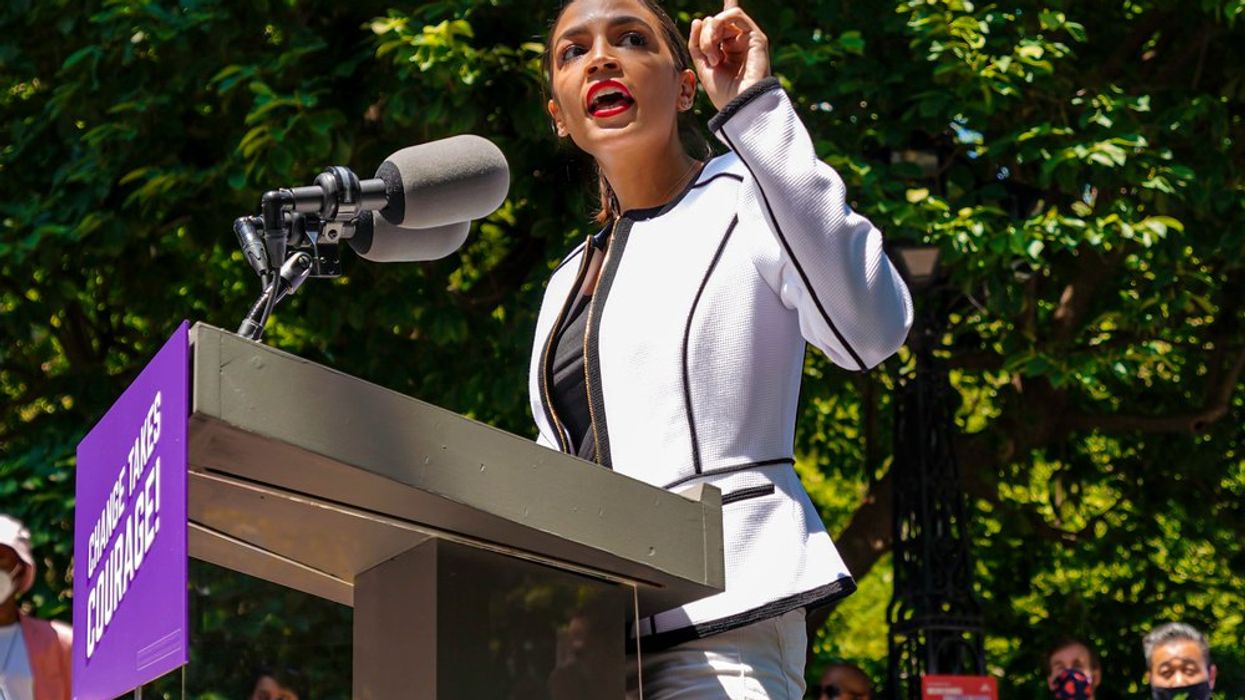
'Bigoted folks': AOC says CEOs love trans sports ban for the diversion it creates


Image via Daniel Lehrhaupt/Shutterstock

January 15, 2025

While Republicans claimed a bill restricting transgender girls' participation in school sports was aimed at protecting "our culture and civilization" on Tuesday, U.S. Rep. Alexandria Ocasio-Cortez said the legislation benefits the corporate class as it distracts from true life-threatening emergencies faced by communities across the country.

"Thank you for your concern about women for the first time that I've seen," said the New York Democrat on the House floor, noting that Republicans have consistently voted against the Violence Against Women Act and backed abortion bans that have stripped women of the ability to control their own bodies proven deadly.

But contrary to the GOP's claims that barring transgender girls and women from playing on sports teams that align with their gender will protect girls from assault, Ocasio-Cortez suggested, the biggest beneficiaries of the legislation include corporate executives whose companies do far more harm to American families than transgender athletes.

"I know who loves this bill," said the congresswoman. "Yes, bigoted folks love this bill. Assaulters love this bill. But also, CEOs love this bill. Because Los Angeles is on fire right now, and this is the number one priority this majority has."

The bill passed 218-206, with the entire Republican caucus supporting it and all but two Democrats voting no. If the legislation is signed into law, schools that receive federal funding would be barred from allowing transgender girls from playing on girls' sports teams.

Republicans have poured $111 million on political ads regarding the issue in the past year, as communities in the Southeast have suffered catastrophic hurricane damage and homelessness has soared by 18%.

Rep. Suzanne Bonamici (D-Ore.) agreed with Ocasio-Cortez's comments about the distraction caused by the transgender sports bill.

"Republicans fearmonger about the trans community to divert attention from the fact they have no real solutions to help everyday Americans," said Bonamici. "Transgender students, like all students, they deserve the same opportunity as their peers to learn teamwork, to find belonging and to grow into well-rounded adults through sports."

Ocasio-Cortez added that the bill, which lacks an enforcement mechanism, would open the door to "genital examinations" of student athletes as it would force schools to confirm the sex assigned at birth of each member of a school sports team.

"What this also opens the door for is for women to try to perform a very specific kind of femininity for the very kind of men who are drafting this bill, and to open up questioning of who is a woman because of how we look, how we present ourselves, and yes, what we choose to do with our bodies," said Ocasio-Cortez.

The so-called Protection of Women and Girls in Sports Act was the subject of a letter signed by more than 400 civil society groups on Monday, who urged members of Congress to reject the "discriminatory proposal."

"Although the authors of the legislation represent themselves as serving the interests of cisgender girls and women, this legislation does not address the longstanding barriers all girls and women have faced in their pursuit of athletics," said the groups, led by the Leadership Conference on Civil and Human Rights. "We firmly believe that an attack on transgender youth is an attack on civil rights."
'Better luck next time, America': Voters mocked for telling WSJ they only want 'MAGA-lite'

Matthew Chapman
January 17, 2025 
RAW STORY

A woman places a MAGA hat on a man?s head while listening to Donald Trump Jr. speak during the AmericaFest 2024 conference sponsored by conservative group Turning Point in Phoenix, Arizona, U.S. December 19, 2024. REUTERS/Cheney Orr

The Wall Street Journal is out with a new poll showing that voters somewhat approve of President-elect Donald Trump's agenda — but not all of it and not exactly.

And some analysts have nothing but contempt for these findings.

The result of the poll, according to their writeup, is that voters want "MAGA lite, rather than extra-strength MAGA."

"Some 53% want Trump to make significant changes in how government is run once he is inaugurated Monday. But more than 60% oppose one of his central ideas for doing so — replacing thousands of career civil-service workers with people chosen by the president," said the report. "More than 60% also oppose eliminating the Education Department, a marquee Trump proposal for paring the federal government. Only 18% would supersede congressional powers and give Trump more authority over federal spending, as he has proposed."

Even on immigration, which was supposedly a major factor in Trump's election victory, "nearly three-quarters say that only those with criminal records should be removed from the country, and 70% would protect longtime residents from removal if they don’t have criminal records" — a policy that Trump and his surrogates appear poised to reverse.

Commenters on social media reacted with disgust at voters who backed Trump but opposed much of his plans.

"Sorry, you’re getting highly concentrated MAGA," wrote Gizmodo tech reporter Matt Novak. "Unpasteurized MAGA. Black tar MAGA. Better luck next time, America."

"This MAGA is processed by being eaten and pooped out by the trained rats on one single Caribbean island. It costs 600 dollars a pound," joked magazine editor Spencer Wildes in response.
Thought UnitedHealthcare couldn’t get more awful? They’ve gone villain mode

Killing people with paperwork instead of a gun doesn’t make you any less of a murderer

Arwa Mahdawi
Tue 14 Jan 2025
THE GUARDIAN

At this very moment Luigi Mangione, who is accused of shooting UnitedHealthcare’s CEO last month, is sitting in a federal jail cell in Brooklyn. He’s got a barrage of court appearances scheduled and, once he has wound his way through the criminal justice system, he could be behind bars for the rest of his life.

Which, of course, is as it should be. While there are a lot of reasons that many people find the 26-year-old alleged assassin sympathetic, you can’t just gun a CEO down outside a hotel in Manhattan and face no consequences for it. And Mangione, who is, by all accounts, an extremely smart guy with an Ivy League education, should really have known better. He should have known that if he wanted to murder someone – and get away with it – there were far more socially acceptable ways of doing so.

Mangione could, for example, have got a well-paid job as a management consultant and helped supercharge the country’s opioid epidemic; chances are he would have faced little more than a slap on the wrist. He could have gone to Gaza and shot some Palestinian children in the head – in which case, not only would he probably face no consequences whatsoever, US lawmakers would probably go out of their way to shield him from accountability. And, of course, Mangione could have gone into the health insurance industry himself, and routinely denied life-saving care to desperate people in order to boost profits. That type of violence is perfectly fine.

Mangione is now a household name around the globe: there’s pro-Luigi graffiti everywhere from Chicago to London to Rome. According to one recent poll, 48% of college students in the US say they view the killing of the UnitedHealthcare CEO, Brian Thompson, as totally or somewhat justified. In a more functional world, the outpouring of support for Mangione would have given the folk at UnitedHealthcare (part of UnitedHealth Group and the US’s largest private health insurer based on revenue) pause for thought. On another timeline the endless horror stories shared on social media about how health insurance companies had denied coverage and ruined people’s lives might have pushed the industry to change their business practices. But we live in hell, so none of that happened, did it

Instead, lawmakers (who get extremely good health insurance thanks to US taxpayers) have made it clear to their corporate overlords that their No 1 priority is ensuring the safety of their donor base. Mangione hasn’t just been charged with murder; he’s been charged with terrorism. Last month New York’s Governor Kathy Hochul made headlines for reportedly considering a special hotline for CEOs to report safety threats. Are you an obscenely rich CEO worried the proletariat may rise against you? Just call 1-800-SAVEOURCEOS and we’ll dispatch 24-hour-security! We’ve de-funded the libraries to pay for it.

Meanwhile, insurers seem to have gone into full-on villain mode; just when you think you can’t hear anything worse about the insurance industry, a new horror story comes out. There’s been an uptick in stories about insurers limiting coverage of prosthetic limbs and questioning their medical necessity, for example. Mr Beast, an influencer with 343 million subscribers on YouTube, recently railed against the healthcare industry in a new video where he helped 2,000 amputees walk again. “Many lived in America and it feels so disgusting that in a country with this much wealth, a fucken YouTuber is their only option to get a prosthetic leg,” he tweeted. “We need to fix this.”

And last week a plastic surgeon called Dr Elisabeth Potter – a specialist in reconstructive surgery for breast cancer patients who have had mastectomies – went viral on TikTok for claiming she had to step out of an operation (where another surgeon was also present) because a health insurance representative demanded proof it was necessary. According to Potter, her patient was under anesthesia when she got an urgent phone call from UnitedHealthcare while in the operating room.

“So I scrubbed out of my case and I called UnitedHealthcare, and the gentleman said he needed some information about her,” said Potter. “Wanted to know her diagnosis and whether her inpatient stay should be justified.”

Potter reportedly explained to the insurance representative that her patient had breast cancer – something he apparently didn’t know because someone else in a “different department” had that information. This is why health insurance executives get paid so much money, you see. They structure their companies in complicated ways that mean you have to go through at least 50 different people in different departments to try and sort out a claim; in the end, a certain percentage of people just give up because the process is so laborious. That said, actually going through real life customer service representatives is becoming less common. UnitedHealth Group has been under the spotlight for how it uses AI to aggressively deny claims. A lawsuit filed last November claims UnitedHealth illegally denied “elderly patients care owed to them under Medicare advantage plans” by deploying an AI model known by the company to have a 90% error rate.

To be clear: it is difficult to completely validate Potter’s story because of laws that protect patients’ health information. UnitedHealthcare, for their part, seem to reject the doctor’s account of events and have insinuated that Potter was being unprofessional. A spokesperson from the company told me: “There are no insurance-related circumstances that would require a physician to step out of surgery … We did not ask, nor would ever expect, a physician to interrupt patient care to answer a call and we will be following up with the provider and hospital to understand why these unorthodox actions were taken.”

Nevertheless, the virality of the story is yet another reminder of just how frustrated everyone – from doctors to patients – is with the profit-driven health insurance industry in the US. Yet, despite this palpable anger there seems to be no appetite by those at the top to change the system. Indeed, it looks likely that Donald Trump’s administration will shrink Medicaid (a government system which helps low-income people access healthcare at a reduced cost or for free) and insurance companies will up their use of AI to deny coverage. Mangione should absolutely be facing consequences for what he is alleged to have done – but there should also be more legal consequences for those pushing predatory health insurance practices. Killing people with paperwork instead of a gun doesn’t make you any less of a murderer.


Arwa Mahdawi is a Guardian US columnist
FOR PROFIT HEALTHCARE U$A

Shocking revelation: Hospital chain owes more than $1B — without enough cash to make payroll


Royalty-free stock photo ID: 528854752 Silhouette of a doctor walking in a hurry in the hospital corridor.

Nancy Lavin, 
January 16, 2025

Prospect Medical Holdings’ dire financial straits were well-documented, even before the owner of Roger Williams Medical Center and Our Lady of Fatima Hospital declared bankruptcy on Jan. 11.

But its cash flow woes are even worse than previously aired in public. The national hospital chain operator owes more than $1 billion to more than 100,000 creditors, but has just $3.4 million cash on hand, Paul Rundell, Prospect’s chief restructuring officer, wrote in testimony ahead of a federal bankruptcy court hearing in Dallas on Tuesday.

“It is my understanding that, without post-petition financing, the Debtors will be unable to meet their next payroll cycle,” Rundell wrote in the Jan. 13 filing.
Prospect declares bankruptcy, says sale of Roger Williams and Fatima hospitals will continue

Even Chris Callaci, who represents the 1,200 United Nurses & Allied Professionals members who work for Prospect’s Rhode Island facilities, was taken aback.

“That was more grave than we thought in terms of a brush with disaster of not making payroll,” Callaci said in an interview on Wednesday. “We thought they had access to a little more capital.”

The 12,500 Prospect hospital employees, including the 2,500 in Rhode Island, will get their next paycheck, after a federal bankruptcy judge in Dallas authorized a $100 million line of credit on Tuesday.

Not that it offered much assurance to Rhode Island Attorney General Peter Neronha, whose office has been keeping close tabs on Prospect’s management of Roger Williams and Fatima for the last decade. Anticipating the potential for bankruptcy, Neronha’s office also brought on New York bankruptcy attorney Andrew Troop last year; Troop attended the hearing in Dallas Tuesday on the AG’s behalf.

“We wanted to be ready,” Neronha said in an interview on Wednesday.
In search of investors

But the proactive approach may not be enough to save Rhode Island’s safety net hospitals, whose fates hinge on their cash-strapped owners’ ability to drum up the money to sell the facilities. The $80 million sale to The Centurion Foundation was expected to close this month, following a yearslong application and review process, which included a set of 85 conditions set by state regulators.

Both Prospect and Centurion insist they still intend to go through with the deal, using a clause in federal bankruptcy code that allows debtors to sell certain assets through private sale, according to court documents.

But first, they have to finish securing the $160 million in financing — $80 million for the sticker price of the sale plus another $80 million injected directly into hospital operations — required by state regulators. Neronha said Wednesday the companies had not finished raising the funds required.

Callaci doubted Prospect would be able to entice investors, given its bankruptcy declaration, and feared the company would ask state regulators to ease up on the financial strings attached to the sale.


Neronha maintained that his office did not intend to change its conditions. Joseph Wendelken, a spokesperson for the Rhode Island Department of Health, said in an email Wednesday that the agency was “committed to ensuring the hospitals have new ownership.”


That was more grave than we thought in terms of a brush with disaster of not making payroll. We thought they had access to a little more capital.
– Chris Callaci, general counsel for United Nurses & Allied Professionals

Dr. Jerry Larkin, state health director, stressed the importance of keeping Roger Williams and Fatima open in pre-filed testimony to the federal bankruptcy court. The two hospitals, with 500 beds between them, account for more than 50,000 emergency room visits per year. Together they have 104 beds for behavioral health patients, representing more than 20% of behavioral health beds available statewide.

“It is certain that an abrupt closure of RWMC and/or OLF will disproportionately impact vulnerable and underserved populations, creating deeper inequities in access to care,” Larkin wrote. “The closure of these RI safety net hospitals would overwhelm RI’s healthcare system and create significant barriers to care for individuals already facing profound health disparities.”

Surgeries rescheduled

Not that operations have been running smoothly now. Rundell testified in bankruptcy court Tuesday that the company also owes millions of dollars to vendors at its 16 hospitals, forcing delays in surgeries, according to news reports.

Otis Brown, a spokesperson for CharterCARE Health Partners, Prospect’s Rhode Island subsidiary, confirmed in an email Wednesday that two spine surgeries scheduled for that day in Rhode Island had been moved to Monday, Jan. 20 because a vendor “unexpectedly requested pre-payment.”

“We are actively working with them to resolve it,” Brown said of the payment problem, adding that the rescheduling of surgeries was “without incident.”


It’s not the first time the hospital operator let bills at its Rhode Island hospitals pile up. In November 2023, Neronha’s office sued Prospect for missing $24 million in payments to vendors at Roger Williams and Fatima, forcing elective surgeries to be canceled due to lack of staff, supplies and equipment. Paying its bills on time and keeping day-to-day operations running was one of a host of conditions set by Neronha’s office in 2021, when Prospect’s ownership composition changed.

A Providence Superior Court judge sided with Neronha, demanding Prospect fork over the longest overdue vendor payments — $17 million — and blasting the company for using its Rhode Island hospitals as a “line of credit” to pay off debts elsewhere. A Prospect executive confirmed it had paid the $17 million balance as of July, but in November, filed a new affidavit that the company again let bills pile up beyond the 90-day payment deadline.

Prospect intended to rectify the late payments by the time its pending sale of Roger Williams and Fatima to The Centurion Foundation closed at the end of January 2025, George Pillari, Prospect’s senior vice president and chief performance officer, wrote in the Nov. 15 Rhode Island Superior Court filing.

“For years, they’ve been playing this game of slow walking on paying their bills, gimmicks like that to save a buck,” Callaci said. “Our guys consistently, for years, have been telling us it’s a struggle to do their jobs in a timely fashion.”

Union members who work at Roger Williams and Fatima had not indicated that daily operations had worsened in recent weeks, Callaci said.

While the union railed against the pending sale to Centurion, citing the debt financing used to fund the deal and Centurion’s lack of experience, Callaci now considers hospital closure a worse outcome.
McKee ‘missing in action’

Potential buyers were few when Prospect first sought interest in 2023. And Neronha isn’t hopeful that the pool will be larger now, given Rhode Island’s uncompetitive reimbursement rates relative to neighboring states, and his criticism of Gov. Dan McKee.
McKee attempts to rally his team in 2025 State of the State

McKee in his 2025 State of the State Tuesday night acknowledged Prospect’s financial crisis with a single line, saying he was “in conversations” with Prospect and Centurion executives.

Neronha, who sat in the front row for the packed State House event, called McKee’s statement “meaningless.”

“I don’t know what he’s talking about,” Neronha said Wednesday. “He’s not involved in any talks with Prospect.”

Callaci blasted McKee for being “missing in action.”

“He ought to be making unequivocal affirmative commitments to the 2,500 to 3,000 people who work in that system and the tens of thousands of people who use those facilities,” Callaci said. “He’s chief executive officer of this state. It is his job to do the job.”

Olivia DaRocha, a spokesperson for McKee’s office, offered further explanation on McKee’s State of the State remarks in an email Wednesday.

“Discussions have centered on a potential carve-out for Prospect’s Rhode Island facilities and ensuring that the sale of Roger Williams and Fatima moves forward,” DaRocha said.

She did not respond to requests for comment on criticisms of the governor made by Callaci and Neronha.

A second hearing on Prospect’s request for short-term financing is set for Feb. 12 in federal bankruptcy court in Dallas.

Updated to include comment from Gov. Dan McKee’s office and from the Rhode Island Department of Health.


Rhode Island Current is part of States Newsroom, a nonprofit news network supported by grants and a coalition of donors as a 501c(3) public charity. Rhode Island Current maintains editorial independence. Contact Editor Janine L. Weisman for questions: info@rhodeislandcurrent.com.
'Severe economic downturn': Why MAGA’s pro-tariff arguments 'will backfire'


January 17, 2025
ALTERNET


Workers remove snow outside the White House in Washington - Copyright AFP Mandel NGAN


President-elect Donald Trump and others in the MAGA movement are arguing that tariffs will encourage U.S. manufacturing, benefit the economy, and promote job creation. Trump is proposing 25 percent across-the-board tariffs on all goods imported into the United States from Mexico and Canada, and he favors aggressive tariffs with products manufactured in Mainland China as well.

In an op-ed published by Politico on January 15, Matthew C. Klein — co-author of the 2020 book "Trade Wars Are Class Wars: How Rising Inequality Distorts the Global Economy and Threatens International Peace" — lays out some reasons why the tariffs Trump is proposing will not create the U.S. manufacturing renaissance he says they will.

Klein makes it clear that he is "sympathetic" to Trump's complaints about the decline of U.S.-based manufacturing, which, the author says, threatens the U.S. from both a "prosperity" standpoint and a "national security" standpoint. And he acknowledges that "the global trading system has failed many workers in the U.S. and elsewhere."

READ MORE: The real reason Trump is pushing for acquiring Greenland: analysis

But Klein is highly critical of the tariffs Trump is proposing, arguing that the president-elect "needs to think harder about the tools he wants to use" and avoid creating a "severe economic downturn."

"Several of the policies Trump and his advisers have floated — primarily universal tariffs — risk making things worse, or, at best, will do nothing to revive American manufacturing or improve the lives of its workers," Klein warns. "Prosperity is not zero-sum, and just because we inflict pain on trading partners doesn't mean we'll benefit. More likely, punitive measures will backfire."

According to Klein, the "net effect" of tariffs "depends on how easily American workers and factories can ramp up production of goods that are currently imported."

"For goods where U.S. demand is relatively low but domestic capacity is rising rapidly thanks to government subsidies, such as battery electric vehicles, the benefits of tariffs could outweigh the costs," Klein explains. "At the other extreme would be tariffs on imports of goods where demand is strong and domestic capacity is extremely constrained, such as coffee beans. There, tariffs would be closer to a sales tax that takes money from American consumers to reduce the federal budget deficit."

READ MORE: Canada's fight with Trump isn't just economic — it’s existential

Klein adds, "In the middle are goods that Americans could make more of, but only by moving workers and machines away from other activities: more U.S.-made t-shirts, but fewer childcare workers. Unfortunately, the incoming administration does not seem to appreciate these nuances."

READ MORE: 'He's mad': GOP reps say ousted intel chair now 'never going to vote' for Johnson’s bills


Matthew C. Klein's full Politico op-ed is available at this link.
Scathing analysis exposes MAGA’s 'illusion of populism' as a total 'con job'


Donald Trump with Elon Musk and House Speaker Mike Johnson on November 16, 2024 (Wikimedia Commons)

January 16, 2025
ALTERNET

During the United States' 2024 presidential race, Democratic nominee and Vice President Kamala Harris laid out a variety of reasons why she believed that Republican Donald Trump's policies would be terrible for working-class Americans if he won — from health care to tax policy to tariffs. But right-wing media outlets repeatedly attacked Harris as an "elitist," praising Trump as the "populist" in the race — which, in the end, President-elect Trump narrowly won.

Salon's Amanda Marcotte examines the MAGA movement's "populism" in a scathing article published on January 16, arguing that Trump and MAGA's alliance with billionaire tech bros exposes their "populism" as an "illusion."

"Trump's Diet Coke addiction has long been used by the grifter-in-chief to sell his fans on the big lie of his career: that, beneath all the private jets and over-the-top gilded decor, he's a 'regular' guy just like them," Marcotte observes. "He, too, houses the sugar-free caffeinated beverages as a vague gesture towards 'health' in between housing vegetable-free greasy meals of cheap hamburgers and sugary desserts. He must be an ordinary, salt-of-the-earth man! After all, he drinks a product found at every common supermarket."

READ MORE: Torture? Shoot protesters? Greenland? Questions Hegseth refused to answer

Marcotte adds, "Never mind that Trump would never sully himself by entering a grocery store. He pays people to do that for him."

Trump, the Salon journalist laments, is able to "trick" MAGA voters "into thinking the rich former reality TV star is one of them."

"On Tuesday, (January 14)," Marcotte observes, "NBC News reported that tech billionaires Elon Musk, Jeff Bezos, and Mark Zuckerberg will all have prominent seats on the platform at Trump's inauguration. The symbolism is unmistakable."

Marcotte continues, "Those seats are usually reserved for family members, former presidents, and prominent politicians. Giving those seats to billionaires signals loudly that this is a new era of oligarchy, without even an attempt to feign allegiance to pre-Trump notions of government for and by the people. President Joe Biden was alarmed enough to make this issue the focal point of his final speech in office."

During a recent appearance on the New Republic's "Daily Blast" podcast, economist and former New York Times columnist Paul Krugman was vehemently critical of Trump's "extremely regressive economic program" — warning that "working-class voters are going to face higher prices and upper-income voters are going to benefit from tax cuts."

"Sure, you may never be able to retire or own a home," Marcotte laments, " but it seems the r-word is coming back into fashion! I'd call that a bad trade-off."

READ MORE: Economist Paul Krugman explains why Trump voters are being 'brutally scammed'

Amanda Marcotte's full article for Salon is available at this link.
Trump ran on promise to lower grocery prices — few Americans now believe he will


FILE PHOTO: Supporters of Republican presidential nominee former U.S. President Donald Trump react as Trump speaks from the Palm Beach County Convention Center, as they attend an election watch party at Maricopa County Republican Committee during the 2024 U.S. presidential election in Chandler, Arizona, U.S., November 6, 2024. REUTERS/Go Nakamura/File Photo
Supporters of Republican presidential nominee former U.S. President Donald Trump react as Trump speaks from the Palm Beach County Convention Center, as they attend an election watch party at Maricopa County Republican Committee during the 2024 U.S. presidential election in Chandler, Arizona, U.S., November 6, 2024. REUTERS/Go Nakamura/File Photo
January 16, 2025
ALTERNET

Just days before he is set to raise his right hand and place his left on a Bible to swear an oath to the Constitution, President-elect Donald Trump faces low public confidence in his ability to fulfill one of his top campaign promises: lowering the price of groceries. According to a new Associated Press poll, most Americans, many of whom cast their ballot on that pledge, do not believe he will bring them relief.

“From the day I take the oath of office, we’ll rapidly drive prices down and make America affordable again,” Trump told supporters on the campaign trail in North Carolina, the Washington Post reported. “Prices will come down. You just watch. They’ll come down fast.”

Just weeks before Election Day, Trump promised, “Vote Trump and your incomes will soar. Your net worth will skyrocket. Your energy costs and grocery prices will come tumbling down,” Business Insider reported.

He repeatedly vowed to voters that he would “get the prices down,” “end inflation,” and even “slash your prices.”


Then, after winning the election largely on that platform, TIME magazine asked Trump, “If the prices of groceries don’t come down, will your presidency be a failure?”

“I don’t think so,” Trump insisted, before seeming to backtrack on one of his top campaign promises. “I’d like to bring them down. It’s hard to bring things down once they’re up. You know, it’s very hard.”

Despite having voted for him, in many cases, on his pledge to lower the cost of groceries, voters now appear to have come to believe he will be unable to do that.

“Only about 2 in 10 Americans are ‘extremely’ or ‘very’ confident that Trump will be able to make progress on lowering the cost of groceries, housing or health care this year, according to a survey from The Associated Press-NORC Center for Public Affairs Research, while about 2 in 10 are ‘moderately’ confident,” the AP reported.

The AP poll finds 61% are slightly or not at all confident in Trump’s ability to lower the cost of food and groceries.

An extensive AP survey “showed that about 4 in 10 voters in the November election identified the economy and jobs as the most important issue facing the country and that about 6 in 10 of those voters cast their ballot for Trump.”

Those voters who believe Trump will not be able to fulfill his promise to lower prices may be correct.

Just days after the November election, the Associated Press reported, “many economists think Trump’s plans, including putting tariffs on imported foods and deporting undocumented workers, could actually make food prices rise.”

There is one person who appears to be holding Trump to his promise to lower prices, however. Karoline Leavitt, the Trump campaign’s national press secretary, now his incoming White House Press Secretary.

“The American people re-elected President Trump by a resounding margin, giving him a mandate to implement the promises he made on the campaign trail,” Leavitt told the AP after the election. “He will deliver.”

Watch the video above or at this link.
Trump-voting farmer warns crops will 'rot' if his workers get deported

Brad Reed
January 17, 2025 
RAW STORY


A farmer (Shutterstock)

A farmer who voted for President-elect Donald Trump is warning him not to go too far with his pledge to carry out the largest deportation in American history.

In an interview with Bloomberg, tomato grower Tony DiMare said that it would be a major mistake for Trump to institute the kind of crackdown on undocumented farm labor that has been enacted in Florida, where he says he's having trouble finding enough people to pick crops.

"A lot of people left Florida for Georgia, north, scared,” DiMare told Bloomberg. “Farmers had to let their crops rot.”

37-year-old immigrant farmworker Rene Trujillo similarly said that he's had trouble getting work ever since the Florida crackdown went into effect.

“Ever since they made that law, almost no one will hire you without papers,” he said.

Idaho-based farmer Shay Myers, meanwhile, tells Bloomberg that it is simply not realistic given current conditions to hire only American citizens or even only documented immigrants who come into the country on H-2A guest worker visas.

Myers says that he lost an entire asparagus crop recently when guest workers he'd hired were delayed at the southern border.

He also bluntly tells Bloomberg that if he "had to replace every falsely documented worker with an H-2A worker, it wouldn’t happen."

Trump's threats to conduct mass deportations, combined with his long-threatened tariffs and the continued spread of bird flu, could put upward pressure on food prices despite the fact that Trump pledged during the 2024 campaign to reduce the price of groceries.
Private firefighters highlight wealth divide in ruined Los Angeles


By AFP
January 16, 2025


Private firefighters stand watch at property opwned by billionaire developer Rick Caruso - Copyright AFP JUNG YEON-JE


Romain FONSEGRIVES

On one side of the street lie the ashes of ruined houses, lost to the huge blazes that defeated Los Angeles firefighters when hydrants ran dry.

On the other side, a small village of shops is still intact, watched over by tanker trucks and an army of private firemen.

More than a week after enormous blazes spread unchecked through swathes of America’s second largest metropolis, questions are being asked about how some of the city’s super-rich seem to have survived almost unscathed.

“All I can say is that we got hired and we have been ordered to stay here. I’m not allowed to tell you more than that.” a man in a yellow and green uniform told AFP in front of the commercial development.

The men, along with their pick-up trucks with Oregon license plates, were stationed at property owned by billionaire developer Rick Caruso.

Their presence — protecting stores hawking luxury brands like Yves Saint-Laurent, Isabel Marant and Erewhon — jars in a city where more than two dozen people have died and thousands of people have lost their homes.

“It sucks that there’s a lot of politics involved,” says another of the men. “We just want to do the job and help however we can.”

Caruso, who ran unsuccessfully for mayor of Los Angeles in 2022, did not respond to AFP requests for comment.

But in Pacific Palisades, a haunt of Hollywood celebrities and the ultra-rich, he is not the only one apparently using his wealth to protect his property.

Other private firefighters stand guard in front of some of the untouched princely villas that dot the hillsides.

– ‘Will pay any amount’ –


The sector made headlines in 2018 when Kim Kardashian and her then-husband Kanye West hired private firefighters to protect their lavish pad in the affluent community of Hidden Hills, north of the city.

The profiles of the two distinct areas that were hit by last week’s blazes — wealthy Pacific Palisades and the more mixed Altadena — have already served to put a spotlight on economic divisions in the United States.

The disparity was further highlighted in the immediate aftermath of the fires when real estate developer Keith Wasserman attracted an avalanche of criticism after a social media post.

“Does anyone have access to private firefighters to protect our home?” he wrote in the now-deleted post.

“Need to act fast here. All neighbors houses burning. Will pay any amount.”

Such services can cost between $2,000 and $15,000 per day, US media has reported, citing local companies.

But even for those with the means, calling on private firefighters is not always simple — most firms are contracted by cities, government departments or insurance companies.

In California, a law passed in 2018 limits how they can operate.

They are not allowed to use flashing lights or badges similar to those of public firefighters, and are required to coordinate with them.

Since this legislation came into force some companies have refused to serve individuals.

– Whose water? –

Private or public, firefighters all have the same mission: “protecting our community,” said Jake Heflin, a firefighter from the publicly funded Long Beach Fire Department.

“If it’s done correctly and done in partnership and in concert together, it can be very effective,” Heflin said.

But it can also create problems.

Taxpayer-funded services should not have to focus “resources on taking care of them, because either they’re ill-equipped or ill-prepared and they’ve gotten themselves into a difficult situation,” he said.

Firefighters “want to have those conversations well ahead of the event.”

How much coordination there was before the catastrophe in Pacific Palisades, where hydrants ran dry and some houses were effectively left to burn, is unclear.

For Jeff Ridgway, a 67-year-old Pacific Palisades resident who resorted to scooping buckets out of a swimming pool when the mains supply petered out, that is a key question.

“It will be very interesting to know if they used these fire hydrants,” Ridgway told AFP.

“I really hope they brought their own water.”