It’s possible that I shall make an ass of myself. But in that case one can always get out of it with a little dialectic. I have, of course, so worded my proposition as to be right either way (K.Marx, Letter to F.Engels on the Indian Mutiny)
Friday, January 17, 2025
SPACE/COSMOS
'It blew up': Social media mockery takes off as SpaceX rebrands midair explosion
Erik De La Garza January 16, 2025 RAW STORY FILE PHOTO: Tesla and SpaceX's CEO Elon Musk gestures, as he attends political festival Atreju organised by Italian Prime Minister Giorgia Meloni's Brothers of Italy (Fratelli d'Italia) right-wing party, in Rome, Italy, December 16, 2023. REUTERS/Guglielmo Mangiapane/File Photo
The midair explosion of SpaceX’s Starship rocket took over social media on Thursday with space watchers ridiculing the Elon Musk-owned company’s rebranding of the incident as “a rapid unscheduled disassembly.”
“Starship experienced a rapid unscheduled disassembly during its ascent burn,” the company wrote in a post on X of the company's seventh test of its mega-rocket. “Teams will continue to review data from today's flight test to better understand root cause.”
Musk himself weighed in on his own X account, ensuring his space enthusiast followers that “nothing so far suggests pushing next launch past next month,” and thanking supporters like NASA Administrator Bill Nelson, who just months ago called for Musk to be investigated for his ties to Russian President Vladimir Putin.
“Spaceflight is not easy,” Nelson wrote on X. “It’s anything but routine. That’s why these tests are so important—each one bringing us closer on our path to the Moon and onward to Mars through #Artemis.”
But not all were as impressed by the spacecraft blowing up midair as Nelson was, with many social media users particularly amused by the company’s curious rewording.
“It blew up,” biologist Daniel Schneider wrote on Bluesky. “Elon Musk. It. Blew. Up. Starship exploded.” He later shared a photo circulating social media of a colorful array of fireballs falling from the sky and added: “Who knew that when Space X Starship explodes it looks like an LGBTQ pride flag.”
“SpaceX: Starship experienced a rapid unscheduled disassembly during its ascent burn,” artist Art Candee wrote to her followers on Bluesky. “Everyone else: It blew up.”
“Hope Musk's presidency experiences a rapid unscheduled disassembly,” Michael Little, a U.S. Navy veteran, said on Bluesky.
Legal report Chris Geidner posted to his social media followers: “Yeah, ‘rapid unscheduled disassembly’ is going in the books.”
“The harbinger of Tuesday January 20, the rapid unscheduled disassembly of democracy,” teacher Paulette Feeney told her followers.
Researchers from Göttingen in Germany shed new light on the formation of the Moon and origin of water on Earth
University of Göttingen
image:
Since the Apollo era, the lunar samples have been stored at NASA's Johnson Space Centre in Houston and are available for research. All lunar samples analysed in the laboratory in Göttingen were provided by NASA.
A research team from the University of Göttingen and the Max Planck Institute for Solar System Research (MPS) has discovered another piece in the puzzle of the formation of the Moon and water on Earth. The prevailing theory was that the Moon was the result of a collision between the early Earth and the protoplanet Theia. New measurements indicate that the Moon formed from material ejected from the Earth's mantle with little contribution from Theia. In addition, the findings support the idea that water could have reached the Earth early in its development and may not have been added by late impacts. The results were published in the Proceedings of the National Academy of Sciences (PNAS).
The researchers analysed oxygen isotopes from 14 samples from the Moon and carried out 191 measurements on minerals from Earth. Isotopes are varieties of the same element that differ only in the weight of their nucleus. The team used an improved version of “laser fluorination”, a method in which oxygen is released from rock using a laser. The new measurements show a very high similarity between samples taken from both Earth and the Moon of an isotope called oxygen-17 (17O). The isotopic similarity between Earth and Moon is a long-standing problem in cosmochemistry for which the term “isotope crisis” had been coined.
“One explanation is that Theia lost its rocky mantle in earlier collisions and then slammed into the early Earth like a metallic cannonball,” says Professor Andreas Pack, Managing Director of Göttingen University’s Geoscience Centre and Head of the Geochemistry and Isotope Geology Division. “If this were the case, Theia would be part of the Earth's core today, and the Moon would have formed from ejected material from the Earth's mantle. This would explain the similarity in the composition of the Earth and the Moon.”
The data obtained also provide an insight into the history of water on Earth: according to a widespread assumption, it only arrived on Earth after the formation of the Moon through a series of further impacts known as the “Late Veneer Event”. As the Earth was hit much more frequently by these impacts than the Moon, there should also be a measurable difference between the oxygen isotopes – depending on the origin of the material that impacted. “However, since the new data shows this is not the case, many types of meteorites can be ruled out as the cause of the ‘late veneer’,” explains first author Meike Fischer, who was working at the Max Planck Institute for Solar System Research in Göttingen at the time of the research. “Our data can be explained particularly well by a class of meteorites called ‘enstatite chondrites’: they are isotopically similar to the Earth and contain enough water to be solely responsible for the Earth's water.”
Original publication: Meike Fischer et al. Oxygen isotope identity of Earth and Moon with implications for the formation of the Moon and source of volatiles. Proceedings of the National Academy of Sciences. DOI: 10.1073/pnas.2321070121
View of the Moon with the Earth in the foreground: new measurements support the theory that the Moon is material ejected from the Earth's mantle.
Extremely precise measurements of the distance between the Earth and the Coma cluster of galaxies provide new evidence for the Universe’s faster-than-expected rate of expansion.
The Universe really seems to be expanding fast. Too fast, even.
A new measurement confirms what previous — and highly debated — results had shown: The Universe is expanding faster than predicted by theoretical models, and faster than can be explained by our current understanding of physics.
This discrepancy between model and data became known as the Hubble tension. Now, results published in the Astrophysical Journal Letters provide even stronger support to the faster rate of expansion.
“The tension now turns into a crisis,” said Dan Scolnic, who led the research team.
Determining the expansion rate of the Universe — known as the Hubble constant — has been a major scientific pursuit ever since 1929, when Edwin Hubble first discovered that the Universe was expanding.
Scolnic, an associate professor of physics at Duke University, explains it as trying to build the Universe’s growth chart: we know what size it had at the Big Bang, but how did it get to the size it is now? In his analogy, the Universe’s baby picture represents the distant Universe, the primordial seeds of galaxies. The Universe’s current headshot represents the local Universe, which contains the Milky Way and its neighbors. The standard model of cosmology is the growth curve connecting the two. The problem is: things don’t connect.
“This is saying, to some respect, that our model of cosmology might be broken,” said Scolnic.
Measuring the Universe requires a cosmic ladder, which is a succession of methods used to measure the distances to celestial objects, with each method, or “rung,” relying on the previous for calibration.
The ladder used by Scolnic was created by a separate team using data from the Dark Energy Spectroscopic Instrument (DESI), which is observing more than 100,000 galaxies every night from its vantage point at the Kitt Peak National Observatory.
Scolnic recognized that this ladder could be anchored closer to Earth with a more precise distance to the Coma Cluster, one of the galaxy clusters nearest to us.
“The DESI collaboration did the really hard part, their ladder was missing the first rung,” said Scolnic. “I knew how to get it, and I knew that that would give us one of the most precise measurements of the Hubble constant we could get, so when their paper came out, I dropped absolutely everything and worked on this non-stop.”
To get a precise distance to the Coma cluster, Scolnic and his collaborators, with funding from the Templeton foundation, used the light curves from 12 Type Ia supernovae within the cluster. Just like candles lighting a dark path, Type Ia supernovae have a predictable luminosity that correlates to their distance, making them reliable objects for distance calculations.
The team arrived at a distance of about 320 million light-years, nearly in the center of the range of distances reported across 40 years of previous studies — a reassuring sign of its accuracy.
“This measurement isn’t biased by how we think the Hubble tension story will end,” said Scolnic. “This cluster is in our backyard, it has been measured long before anyone knew how important it was going to be.”
Using this high-precision measurement as a first rung, the team calibrated the rest of the cosmic distance ladder. They arrived at a value for the Hubble constant of 76.5 kilometers per second per megaparsec, which essentially means that the local Universe is expanding 76.5 kilometers per second faster every 3.26 million light-years.
This value matches existing measurements of the expansion rate of the local Universe. However, like all of those measurements, it conflicts with measurements of the Hubble constant using predictions from the distant Universe. In other words: it matches the Universe’s expansion rate as other teams have recently measured it, but not as our current understanding of physics predicts it. The longstanding question is: is the flaw in the measurements or in the models?
Scolnic’s team’s new results adds tremendous support to the emerging picture that the root of the Hubble tension lies in the models.
“Over the last decade or so, there's been a lot of re-analysis from the community to see if my team’s original results were correct,” said Scolnic, whose research has consistently challenged the Hubble constant predicted using the standard model of physics. “Ultimately, even though we're swapping out so many of the pieces, we all still get a very similar number. So, for me, this is as good of a confirmation as it's ever gotten.”
“We’re at a point where we’re pressing really hard against the models we’ve been using for two and a half decades, and we’re seeing that things aren’t matching up,” said Scolnic. “This may be reshaping how we think about the Universe, and it’s exciting! There are still surprises left in cosmology, and who knows what discoveries will come next?”
#
CITATION: Scolnic, D., Riess, A.G., Murakami, Y.S., Peterson, E.R., Brout, D., Acevedo, M., Carreres, B., Jones, D.O., Said, K., Howlett, C. and Anand, G.S., 2025. The Hubble Tension in our own Backyard: DESI and the Nearness of the Coma Cluster.The Astrophysical Journal Letters, 979, L9. DOI 10.3847/2041-8213/ada0bd
This work was conducted with funding from the Templeton Foundation, the Department of Energy, the David and Lucile Packard Foundation, the Sloan Foundation, the National Science Foundation and NASA.
The Hubble Tension in our own Backyard: DESI and the Nearness of the Coma Cluster
Article Publication Date
15-Jan-2025
NASA's Hubble traces hidden history of Andromeda galaxy
NASA/Goddard Space Flight Center
image:
This is the largest photomosaic ever assembled from Hubble Space Telescope observations. It is a panoramic view of the neighboring Andromeda galaxy, located 2.5 million light-years away. It took over 10 years to make this vast and colorful portrait of the galaxy, requiring over 600 Hubble overlapping snapshots that were challenging to stitch together. The galaxy is so close to us, that in angular size it is six times the apparent diameter of the full Moon, and can be seen with the unaided eye. For Hubble's pinpoint view, that's a lot of celestial real estate to cover. This stunning, colorful mosaic captures the glow of 200 million stars. That's still a fraction of Andromeda's population. And the stars are spread across about 2.5 billion pixels. The detailed look at the resolved stars will help astronomers piece together the galaxy's past history that includes mergers with smaller satellite galaxies.
Credit: NASA, ESA, Benjamin F. Williams (UWashington), Zhuo Chen (UWashington), L. Clifton Johnson (Northwestern); Image Processing: Joseph DePasquale (STScI)
In the years following the launch of NASA's Hubble Space Telescope, astronomers have tallied over 1 trillion galaxies in the universe. But only one galaxy stands out as the most important nearby stellar island to our Milky Way — the magnificent Andromeda galaxy (Messier 31). It can be seen with the naked eye on a very clear autumn night as a faint cigar-shaped object roughly the apparent angular diameter of our Moon.
A century ago, Edwin Hubble first established that this so-called "spiral nebula" was actually very far outside our own Milky Way galaxy — at a distance of approximately 2.5 million light-years or roughly 25 Milky Way diameters. Prior to that, astronomers had long thought that the Milky way encompassed the entire universe. Overnight, Hubble's discovery turned cosmology upside down by unveiling an infinitely grander universe.
Now, a century later, the space telescope named for Hubble has accomplished the most comprehensive survey of this enticing empire of stars. The Hubble telescope is yielding new clues to the evolutionary history of Andromeda, and it looks markedly different from the Milky Way's history.
Without Andromeda as a proxy for spiral galaxies in the universe at large, astronomers would know much less about the structure and evolution of our own Milky Way. That's because we are embedded inside the Milky Way. This is like trying to understand the layout of New York City by standing in the middle of Central Park.
"With Hubble we can get into enormous detail about what's happening on a holistic scale across the entire disk of the galaxy. You can't do that with any other large galaxy," said principal investigator Ben Williams of the University of Washington. Hubble's sharp imaging capabilities can resolve more than 200 million stars in the Andromeda galaxy, detecting only stars brighter than our Sun. They look like grains of sand across the beach. But that's just the tip of the iceberg. Andromeda's total population is estimated to be 1 trillion stars, with many less massive stars falling below Hubble's sensitivity limit.
Photographing Andromeda was a herculean task because the galaxy is a much bigger target on the sky than the galaxies Hubble routinely observes, which are often billions of light-years away. The full mosaic was carried out under two Hubble programs. In total, it required over 1,000 Hubble orbits, spanning more than a decade.
This program was followed up by the Panchromatic Hubble Andromeda Southern Treasury (PHAST), recently published in The Astrophysical Journal and led by Zhuo Chen at the University of Washington, which added images of approximately 100 million stars in the southern half of Andromeda. This region is structurally unique and more sensitive to the galaxy's merger history than the northern disk mapped by the PHAT survey.
The combined programs collectively cover the entire disk of Andromeda, which is seen almost edge-on — tilted by 77 degrees relative to Earth's view. The galaxy is so large that the mosaic is assembled from approximately 600 separate fields of view. The mosaic image is made up of at least 2.5 billion pixels.
The complementary Hubble survey programs provide information about the age, heavy-element abundance, and stellar masses inside Andromeda. This will allow astronomers to distinguish between competing scenarios where Andromeda merged with one or more galaxies. Hubble's detailed measurements constrain models of Andromeda's merger history and disk evolution.
A Galactic 'Train Wreck'
Though the Milky Way and Andromeda formed presumably around the same time many billions of years ago, observational evidence shows that they have very different evolutionary histories, despite growing up in the same cosmological neighborhood. Andromeda seems to be more highly populated with younger stars and unusual features like coherent streams of stars, say researchers. This implies it has a more active recent star-formation and interaction history than the Milky Way.
"Andromeda's a train wreck. It looks like it has been through some kind of event that caused it to form a lot of stars and then just shut down," said Daniel Weisz at the University of California, Berkeley. "This was probably due to a collision with another galaxy in the neighborhood."
A possible culprit is the compact satellite galaxy Messier 32, which resembles the stripped-down core of a once-spiral galaxy that may have interacted with Andromeda in the past. Computer simulations suggest that when a close encounter with another galaxy uses up all the available interstellar gas, star formation subsides.
"Andromeda looks like a transitional type of galaxy that's between a star-forming spiral and a sort of elliptical galaxy dominated by aging red stars," said Weisz. "We can tell it's got this big central bulge of older stars and a star-forming disk that's not as active as you might expect given the galaxy's mass."
"This detailed look at the resolved stars will help us to piece together the galaxy's past merger and interaction history," added Williams.
Hubble's new findings will support future observations by NASA's James Webb Space Telescope and the upcoming Nancy Grace Roman Space Telescope. Essentially a wide-angle version of Hubble (with the same sized mirror), Roman will capture the equivalent of at least 100 high-resolution Hubble images in a single exposure. These observations will complement and extend Hubble's huge dataset.
The Hubble Space Telescope has been operating for over three decades and continues to make ground-breaking discoveries that shape our fundamental understanding of the universe. Hubble is a project of international cooperation between NASA and ESA (European Space Agency). NASA's Goddard Space Flight Center in Greenbelt, Maryland, manages the telescope and mission operations. Lockheed Martin Space, based in Denver, also supports mission operations at Goddard. The Space Telescope Science Institute in Baltimore, which is operated by the Association of Universities for Research in Astronomy, conducts Hubble science operations for NASA.
Hubble Compass and Scale Image of M31 PHAT+PHAST Mosaic
This is the largest photomosaic ever made by the Hubble Space Telescope. The target is the vast Andromeda galaxy that is only 2.5 million light-years from Earth, making it the nearest galaxy to our own Milky Way. Andromeda is seen almost edge-on, tilted by 77 degrees relative to Earth’s view. The galaxy is so large that the mosaic is assembled from approximately 600 separate overlapping fields of view taken over 10 years of Hubble observing—a challenge to stitch together over such a large area. The mosaic image is made up of at least 2.5 billion pixels. Hubble resolves an estimated 200 million stars that are hotter than our Sun, but still a fraction of the galaxy’s total estimated stellar population.
Interesting regions include: (a) Clusters of bright blue stars embedded within the galaxy, background galaxies seen much farther away, and photo-bombing by a couple bright foreground stars that are actually inside our Milky Way; (b) NGC 206 the most conspicuous star cloud in Andromeda; (c) A young cluster of blue newborn stars; (d) The satellite galaxy M32, that may be the residual core of a galaxy that once collided with Andromeda; (e) Dark dust lanes across myriad stars.
Credit
NASA, ESA, Benjamin F. Williams (UWashington), Zhuo Chen (UWashington), L. Clifton Johnson (Northwestern); Image Processing: Joseph DePasquale (STScI)
Large and small galaxies may grow in ways more similar than expected
New observations suggest that contrary to conventional wisdom, dwarf galaxies can accrete mass from other small galaxies.
University of Arizona
image:
NGC 300 is a small galaxy in a relatively isolated region of the universe. About 6 million light-years from Earth, it is one of the Milky Way's closer neighbors.
A team of astronomers led by University of Arizona researcher Catherine Fielder has obtained the most detailed images of a small galaxy and its surroundings, revealing features typically associated with much larger galaxies. The observations provide a rare, elusive glimpse into how small galaxies form and evolve, suggesting that the mechanisms fueling galaxy growth may be more universal than previously thought.
Fielder presented the findings at the 245th meeting of the American Astronomical Society in National Harbor, Maryland, during a press briefing on Jan. 16.
Galaxies, including the Milky Way, grow and evolve by merging with smaller galaxies over billions of years in a process called hierarchical assembly. This cosmic "building block" approach has been well observed in large galaxies, where streams of ancient stars – remnants of swallowed-up galaxies – trace their turbulent history. These streams, along with other faint features such as old, scattered stars, form a so-called stellar halo: a sprawling, low-density cloud of stars that surrounds the bright central disk of a galaxy and traces its evolutionary history.
According to traditional wisdom, smaller galaxies such as the nearby Large Magellanic Cloud may have fewer opportunities to attract mass and merge with smaller systems, including other dwarf galaxies, because of their weaker gravitational pull. Understanding how such galaxies acquire mass and grow in the context of hierarchical assembly remains an open question.
The researchers used the Dark Energy Camera, or DECam, on the 4-meter Blanco Telescope in Chile's Cerro Tololo Inter-American Observatory to conduct a deep imaging survey of 11 dwarf galaxies, including the spiral galaxy NGC 300, which is similar in mass to the Large Magellanic Cloud. The observations were made as part of the DECam Local Volume Survey, or DELVE, and revealed unprecedented details of NGC 300's features. Spanning about 94,000 light-years, NGC 300's galactic disk is a little smaller than the Milky Way and packs only about 2% of its stellar mass.
"NGC 300 is an ideal candidate for such a study because of its isolated location," said Fielder, a research associate at the U of A Steward Observatory. "This keeps it free from the influential effects of a massive companion like the Milky Way, which affects nearby small galaxies like the Large Magellanic Cloud. It's almost a bit like looking at a cosmic 'fossil record.'"
Fielder and her collaborators created stellar maps around the small galaxy and discovered a vast stellar stream extending more than 100,000 light-years from the galaxy's center.
"We consider a stellar stream a telltale sign that a galaxy has accreted mass from its surroundings, because these structures don't form as easily by internal processes," said Fielder, whose findings will be published in The Astrophysical Journal.
In addition, the researchers found traces of stars arranged in shell-like patterns reminiscent of concentric waves emanating from the center of the galaxy, as well as hints of a stream wrap – evidence that whatever caused the stream may have changed direction in its orbit around NGC 300.
"We weren't sure we were going to find anything in any of these small galaxies," she said. "These features around NGC 300 provide us with 'smoking gun' evidence that it did accrete something."
The team also identified a previously unknown, metal-poor globular star cluster in the galaxy's halo, another "smoking gun" of past accretion events.
When gauging the age of stellar populations, astronomers frequently turn to a feature known as "metallicity" – a term referring to the chemical elements present inside stars. Because heavier elements are forged mostly in more massive stars at or near the end of their lifespans, it takes several generations of star formation to enrich those elements. Therefore, stellar populations lacking heavier elements – or having low metallicity – are presumed to be older, Fielder explained.
"The stars in the features we observed around NGC 300 are ancient and metal-poor, telling a clear story," Fielder said. "These structures likely originated from a tiny galaxy that was pulled apart and absorbed into NGC 300."
Together, these findings clearly reveal that even dwarf galaxies can build stellar halos through the accretion of smaller galaxies, echoing the growth patterns seen in larger galaxies, Fielder said.
"NGC 300 now stands as one of the most striking examples of accretion-driven stellar halo assembly in a dwarf galaxy of its kind, shedding light on how galaxies grow and evolve across the universe."
Fielder and her collaborators created stellar maps around the small galaxy and discovered a vast stellar stream extending more than 100,000 light-years from the galaxy's center. This image shows NGC 300 with its associated features, such as streams and shell structures, indicated by white lines.
Streams, Shells, and Substructures in the Accretion-Built Stellar Halo of NGC 300
This tiny galaxy is answering some big questions
Rutgers-led research using the Webb Telescope reveals patterns of star formation in Leo P
Rutgers University
image:
This image from NASA’s James Webb Space Telescope shows a portion of the Leo P dwarf galaxy (stars at lower right represented in blue). Leo P is a star-forming galaxy located about 5 million light years away in the constellation Leo. A team of scientists collected data from about 15,000 stars in Leo P to deduce its star formation history.
Credit: Kristen McQuinn/NASA’s James Webb Space Telescope
Leo P, a small galaxy and a distant neighbor of the Milky Way, is lighting the way for astronomers to better understand star formation and how a galaxy grows.
In a study published in the Astrophysical Journal, a team of researchers led by Kristen McQuinn, a scientist at the Space Telescope Science Institute and an associate professor in the Department of Physics and Astronomy at the Rutgers University-New Brunswick School of Arts and Sciences, has reported finding that Leo P “reignited,” reactivating during a significant period on the timeline of the universe, producing stars when many other small galaxies didn’t.
By studying galaxies early in their formation and in different environments, astronomers said they may gain a deeper understanding of the universe's origins and the fundamental processes that shape it.
McQuinn and other members of the research team studied Leo P through NASA’s James Webb Space Telescope, a space-based apparatus that features a large, segmented mirror and an expansive sunshield, both of which enable it to capture detailed images of distant celestial objects.
Leo P, a dwarf galaxy some 5.3 million light years from Earth, was discovered by McQuinn and other scientists in 2013. The celestial structure is far enough away from the Local Group, a clump of galaxies straddling the Milky Way, to be its neighbor without being affected by the gravitational fields of larger star systems.
The galaxy, located in the constellation Leo, is about the same size as a star cluster within the Milky Way and is about the same age as the Milky Way. The “P” in Leo P refers to “pristine,” because the galaxy has so few chemical elements beside hydrogen and helium.
“Leo P provides a unique laboratory to explore the early evolution of a low-mass galaxy in detail,” said McQuinn, who also is the mission head for the Science Operations Center for the Nancy Grace Roman Space Telescope at the Space Telescope Science Institute in Baltimore.
The team started by looking deeply into the past. Since the stars detected by the team with the telescope are about 13 billion years old, they can serve as “fossil records” of star formation that occurred at earlier times. “Essentially, instead of studying the stars in-situ [in their original positions] as they are forming in the early universe, we study the stars that have survived over cosmic history and use their present-day properties to infer what was occurring at earlier times,” McQuinn said.
The team found that Leo P formed stars early on but then stopped making them for a few billion years. This stoppage happened during a period known as the Epoch of Reionization. It took a few billion years after the epoch for the galaxy to reignite and start forming new stars.
“We have a measurement like this for only three other galaxies – all isolated from the Milky Way – and they all show a similar pattern,” McQuinn said.
Observations of the dwarf galaxies within the Local Group, however, show that, in contrast, star production disappeared during this period.
The Epoch, regarded by astronomers as a significant period in the history of the universe, occurred between about 150 million and one billion years after the Big Bang. It was during this period that the first stars and galaxies formed.
The contrast between the star production of the dwarf galaxies provides compelling evidence that it isn’t just the mass of a galaxy at the time of reionization that determines whether it will be quenched, McQuinn said. Its environment – meaning whether it is isolated or functioning as a satellite of a larger system – is an important factor.
McQuinn said the observations will help pin down not only when little galaxies formed their stars, but how the reionization of the universe may have impacted how small structures form.
“If the trend holds, it provides insights on the growth of low-mass structures that is not only a fundamental constraint for structure formation but a benchmark for cosmological simulations,” she said.
The researchers also found that Leo P is metal-poor, possessing 3% of the sun’s metallicity. This means that the stars of the dwarf galaxy contain 30 times fewer heavy elements than the sun, which makes Leo P similar to the primordial galaxies of the early universe.
Knowledge gleaned from these observations will help astronomers piece together the timeline of cosmic events, understand how small structures evolved over billions of years and learn about the processes that led to the creation of stars, McQuinn said.
Other scientists from Rutgers on the study included Alyson Brooks, an associate professor; Roger Cohen, a postdoctoral associate; and Max Newman, a doctoral student, all with the Department of Physics and Astronomy.
The Ancient Star Formation History of the Extremely Low-mass Galaxy Leo P: An Emerging Trend of a Post-reionization Pause in Star Formation
Astronomers observe real-time formation of black hole jets for the first time
University of Maryland Baltimore County
image:
Active galaxy 1ES 1927+654, circled, has exhibited extraordinary changes since 2018, when a major outburst occurred in visible, ultraviolet, and X-ray light. The galaxy harbors a central black hole weighing about 1.4 million solar masses and is located 270 million light-years from Earth. Observations of this galaxy from 2018 -- 2024 revealed phenomena never before observed in real time, including the formation of plasma jets.
A large international team of scientists has observed a phenomenon that astronomers didn’t ever expect to see happen in real time. The findings are described in a new paper published in Astrophysical Journal Letters led by Eileen Meyer, associate professor of physics at UMBC.
A galaxy about 270 million light-years away from Earth in the constellation Draco called 1ES 1927+654 is the focus of the excitement. For many years, scientists had classified 1ES 1927+654 as an “active galactic nucleus,” or AGN, meaning it has an active black hole at its center. This particular black hole was adding material at a slow rate—until it wasn’t.
Back in 2018, the black hole first made news when it suddenly increased its activity exponentially. It dramatically increased the rate at which it was consuming material and became over 100 times brighter in the visible light spectrum over the course of a few months. A shift like that was once thought to take far longer than a human lifetime, on the order of thousands to millions of years. Since then, scientists have been observing it closely for any additional interesting phenomena, and 1ES 1927+654 has delivered.
More drama
After the major increase in activity began in 2018, which included nearly a year of extremely high levels of X-ray emission, the black hole quieted down again by 2020—only to dramatically increase its output again in 2023. At that time, it began emitting radio waves at 60 times the previous intensity over just a few months, behavior which has never been monitored in real time for a supermassive black hole.
Some of the highest-resolution imaging of radio frequency emissions was collected using a technique called Very Long Baseline Interferometry (VLBI). It clearly shows a pair of oppositely directed plasma jets forming near the black hole and expanding outward over the course of 2023 – 2024. Among the other unusual behavior of the black hole, this is the first-ever observation of jet formation in real time.
In recent years, scientists have discovered a handful of supermassive black holes that appear to emit far more intensely at radio frequencies compared to when they were first observed, which they call “changing-look AGN.” However, until now all of them had been observed at two timepoints years or decades apart, and the assumption was that “something happened” in between. This new paper gives the very first look at how this kind of change occurs in detail.
Turning on in real time
In some cases, black hole jets “can reach huge scales well outside the host galaxy. They can affect how many stars are forming,” Meyer says. Figuring out how the jets work “is a very important thing, in order to understand the big picture of how the universe is evolving and galaxies evolved.”
In the case described in the new paper, “We have very detailed observations of a radio jet ‘turning on’ in real time, and even more exciting are the VLBI observations, which clearly show these plasma blobs moving out from the black hole,” Meyer says. “That shows us that this really is an outflow jet of plasma that’s causing the radio flare. It’s not some other process causing increased radio emission. This is a jet moving at likely 20 to 30 percent of the speed of light originating very near a black hole. That’s the exciting thing.”
Sibasish Laha, an assistant research scientist for UMBC with the Center for Space Sciences Technology and second author on the new paper, has long studied changing-look AGN at X-ray wavelengths. On a hunch that 1ES 1927+654’s radio frequency emission might show interesting behavior as well, he reached out to Meyer to form a collaboration to study 1ES 1927+654 and other similar galaxies back in 2020. He is lead author on a companion paper that is currently under review. It includes additional X-ray observations and interpretation of the jet formation event.
“We still do not understand how black holes and their host galaxies interact with each other and co-evolve in cosmic time,” Laha says, “and this study for the first time gives us the rare opportunity to understand how a supermassive black hole ‘talks’ to the host galaxy."
Not for the faint of heart
In this kind of work, time is of the essence. “Time-domain astronomy,” as it’s called, “is not for the faint of heart,” Meyer says. “You know, there are rapid alerts—something happens and you have to go follow up. You gotta get on it, and it doesn’t matter if it’s midnight, you have to send that email because you know every hour counts. It’s a little stressful.”
The project became an “all hands on deck” moment for the UMBC collaboration. Once Meyer and Laha saw the huge jump in radio activity in 2023, Meyer says, “We were like, ‘whoa, ok, something is happening.’ This has never been seen before. We got very excited, so this is where we went all in on basically trying to grab every radio telescope and get it to look at this source.”
Because 1ES 1927+654 was changing so rapidly before their eyes, the team was awarded new, unscheduled observations on telescopes around the world during the study period, when typically telescope time must be scheduled months or years in advance.
A postdoctoral fellow working with Meyer, Onic Shuvo, who is third author on the paper, took on the lion’s share of the late-night duties, rapidly analyzing incoming data and requesting new observations. He’s thrilled to be part of such an exciting discovery. “This remarkable finding challenges existing models of AGN activity and highlights the unique role that changing-look AGN play in unraveling the mysteries of the central engine of active galaxies in real-time,” Shuvo says.
A new jet is born
The newborn jets coming from 1ES 1927+654 are relatively small compared to the massive jet structures in some of the most powerful AGN, Meyer says. But that doesn’t make them less interesting—in fact, they are probably more common across the universe and therefore very important to understand, she says.
Some data suggested that the 2018 flare, in the visible spectrum, could be due to a “tidal disruption event,” where a large object like a star or cloud of gas gets too close to an inactive black hole and artificially brightens it for just a few years, Meyer says. But observations of tidal disruption events in already-active galaxies are rare and not well understood.
While the largest plasma jets extend well beyond their host galaxies and last millions of years, scientists are gaining understanding of a new class of smaller, shorter-lived jets called “compact symmetric objects,” or CSOs. Meyer believes the data in this case point most strongly to the birth of a new CSO. One recent hypothesis is that jets in CSOs are qualitatively different from the very large and long-lived jets seen elsewhere, Meyer says, perhaps representing “a single ingestion of a star or a gas cloud; basically a single tidal disruption event happens and powers this short-term jet for maybe 1,000 years.”
Perhaps the tidal disruption event occurred several years ago, “and it took a few years for the accreting black hole to organize and start producing the jet,” as the team saw in 2023 – 2024, Meyer says.
Open questions
Overall, “We still don’t really understand after all these decades of studying these sources why only a fraction of accreting black holes produce jets and then exactly how they launch them. Until recently we could not literally look into that innermost region to see what’s happening—how the accretion disk surrounding the black hole is interacting with and producing the jet. And so there are still a lot of open questions there,” Meyer says.
Questions remain, but today there are many promising models of how black holes produce jets, Meyer says. Next steps will include working with theorists to understand how the data from this study can help test and refine those models.
“There’s a lot of theoretical work to be done to understand what we’ve seen, but the good thing is that we have a massive amount of data,” Meyer says. “We’re going to keep following this source, and it’s going to continue to be exciting.”
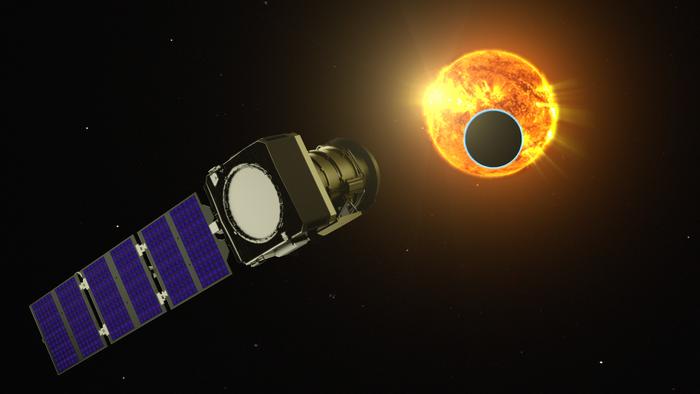
An artist's concept of the Pandora mission, seen here without the thermal blanketing that will protect the spacecraft, observing a star and its transiting exoplanet.
Credit: NASA’s Goddard Space Flight Center/Conceptual Image Lab
Pandora, NASA's newest exoplanet mission, is one step closer to launch with the completion of the spacecraft bus, which provides the structure, power and other systems that will allow the mission to carry out its work. Pandora's exoplanet science working group is led by the University of Arizona, and Pandora will be the first mission to have its operations center at the U of A Space Institute.
The completion of the bus was announced during a press briefing at the 245th Meeting of the American Astronomical Society in National Harbor, Maryland, on Jan. 16.
"This is a huge milestone for us and keeps us on track for a launch in the fall," said Elisa Quintana, Pandora's principal investigator at NASA's Goddard Space Flight Center in Greenbelt, Maryland. "The bus holds our instruments and handles navigation, data acquisition and communication with Earth – it's the brains of the spacecraft."
Pandora is a small satellite poised to provide in-depth study of at least 20 known planets orbiting distant stars to determine the composition of their atmospheres – especially the presence of hazes, clouds and water. The data will establish a firm foundation for interpreting measurements by NASA's James Webb Space Telescope and future missions aimed at searching for habitable worlds.
"Although smaller and less sensitive than Webb, Pandora will be able to stare longer at the host stars of extrasolar planets, allowing for deeper study," said Pandora co-investigator Daniel Apai, professor of astronomy and planetary sciences at the U of A Steward Observatory and Lunar and Planetary Laboratory who leads the mission's Exoplanets Science Working Group. "Better understanding of the stars will help Pandora and its 'big brother,' the James Webb Space Telescope, disentangle signals from stars and their planets."
Astronomers can sample an exoplanet's atmosphere when it passes in front of its star as seen from Earth's perspective, during an event known as a transit. Part of the star's light skims the planet's atmosphere before making its way to the observer. This interaction allows the light to interact with atmospheric substances, and their chemical fingerprints — dips in brightness at characteristic wavelengths — become imprinted in the light.
The concept of Pandora was born out of necessity to overcome a snag in observing starlight passing through the atmospheres of exoplanets, Apai said.
"In 2018, a doctoral student in my group, Benjamin Rackham – now an MIT research scientist – described an astrophysical effect by which light coming directly from the star muddies the signal of the light passing through the exoplanet's atmosphere," Apai explained. "We predicted that this effect would limit Webb's ability to study habitable planets."
Telescopes see light from the entire star, not just the small amount grazing the planet. Stellar surfaces aren't uniform. They sport hotter, unusually bright regions called faculae and cooler, darker regions similar to the spots on our sun, both of which grow, shrink and change position as the star rotates. As a result, these "mixed signals" in the observed light can make it difficult to distinguish between light that has passed through an exoplanet's atmosphere and light that varies based on a star's changing appearance. For example, variations in light from the host star can mask or mimic the signal of water, a likely key ingredient researchers look for when evaluating an exoplanet's potential for harboring life.
Using a novel all-aluminum, 45-centimeter-wide telescope, jointly developed by Lawrence Livermore National Laboratory and Corning Specialty Materials in Keene, New Hampshire, Pandora's detectors will capture each star's visible brightness and near-infrared spectrum at the same time, while also obtaining the transiting planet's near-infrared spectrum. This combined data will enable the science team to determine the properties of stellar surfaces and cleanly separate star and planetary signals.
The observing strategy takes advantage of the mission's ability to continuously observe its targets for extended periods, something flagship observatories like Webb, which offer limited observing time due to high demand, cannot regularly do.
Over the course of its yearlong mission, Pandora will observe at least 20 exoplanets 10 times, with each stare lasting a total of 24 hours. Each observation will include a transit, which is when the mission will capture the planet's spectrum.
Karl Harshman, who leads the Mission Operations Team at the U of A Space Institute that will support the spacecraft's operation once it launches later this year, said: "We have a very excited team that has been working hard to have our Mission Operations Center running at full speed at the time of launch and look forward to receiving science data. Just this week, we performed a communications test with our antenna system that will transmit commands to Pandora and receive the telemetry from the spacecraft."
Pandora is led by NASA's Goddard Space Flight Center. Lawrence Livermore National Laboratory provides the mission's project management and engineering. Pandora's telescope was manufactured by Corning and developed collaboratively with Livermore, which also developed the imaging detector assemblies, the mission's control electronics, and all supporting thermal and mechanical subsystems. The infrared sensor was provided by NASA Goddard. Blue Canyon Technologies provided the bus and is performing spacecraft assembly, integration and environmental testing. NASA's Ames Research Center in California's Silicon Valley will perform the mission's data processing. Pandora's mission operations center is located at the University of Arizona, and a host of additional universities support the science team.
Pandora’s spacecraft bus sits in a thermal-vacuum testing chamber at Blue Canyon Technologies in Lafayette, Colorado. The bus provides the structure, power and other systems that will enable the mission to help astronomers better separate stellar features from the spectra of transiting planets.
Credit
NASA/Weston Maughan, BCT
Flexible electronics integrated with paper-thin structure for use in space
University of Illinois Grainger College of Engineering
Credit: The Grainger College of Engineering at the University of Illinois Urbana-Champaign
Being lightweight is essential for space structures, particularly for tools used on already small, lightweight satellites. The ability to perform multiple functions is a bonus. To address these characteristics in a new way, researchers at the University of Illinois Urbana-Champaign successfully integrated flexible electronics with a three-ply, self-deployable boom that weighs only about 20 grams.
“It's difficult to get commercial electronics integrated into these super thin structures,” said Xin Ning, an aerospace professor in The Grainger College of Engineering at U. of I. “There were a lot of engineering constraints adding to the challenge of making the electronics able to withstand the harsh environment of space.”
Ning said the concept for the work began at a conference about two years ago. He presented his unique expertise in making multifunctional space structures that integrate lightweight, flexible electronics.
“It got the attention of Juan Fernandez from NASA Langley Research Center. He was making a boom structure for a Virginia Tech CubeSat project and saw the opportunity to collaborate and add multi-functional devices to the structures instead of just a pure structure,” Ning said.
Ultimately, the boom to contain the electronics was made at NASA Langley Research Center, Ning said. It is a three-ply carbon fiber and epoxy composite material designed to be extremely thin—about as thick as a sheet of paper. It is rolled up like a tape measure with stored energy in its coils until it unfurls on its own in space.
“Virginia Tech had specific requirements for us to follow, some that created challenges,” Ning said. “One was the length. They wanted to have power and data lines over a meter in length embedded in a paper-thin composite material. We tried different materials and different technologies.
“Eventually, we went with thin commercial wires coated with insulation and it worked. I think we were overthinking it at the beginning. We tried more difficult, fancier approaches, but they failed. This was a simple and reliable solution using off-the-shelf, readily available wires.”
Another key component is a lightweight, flexible electronics patch with a motion sensor, a temperature sensor, and a blue LED, all mounted on the boom tip. Ning explained that the electronics needed to endure the harsh thermal-vacuum conditions of space while remaining flexible enough to withstand the sudden unfurling of the coiled boom. The motion sensor monitors the deployment and vibration of the boom, and the blue LED assists CubeSat cameras in seeing the structure in space once deployed.
Ning’s team conducted comprehensive on-ground experiments and simulations to explore the mechanics of the bistable boom with flexible electronics, as well as its deployment and vibration behavior. Ning said that these fundamental studies could offer valuable insights for future designs of multifunctional space structures.
The Virginia Tech three-unit CubeSat with the multifunctional boom is aiming for launch in 2025.
“We are also working on making the flexible electronics more durable in space—ways to protect the electronics so they will be operational longer in the space environment.”
The study, “Multifunctional bistable ultrathin composite booms with flexible electronics,” by Yao Yao and Xin Ning from Illinois, Juan Fernandez from NASA Langley Research Center and Sven Bilén at Penn State is published in Extreme Mechanics Letters. DOI: 10.1016/j.eml.2024.102247
Yao Yao earned a double major in 2018 from Illinois in materials science and engineering and physics. He began working with Xin Ning when he was an undergraduate and Ning was a postdoctoral research associate in materials science at Illinois. Later, Yao joined Ning’s research group when Ning was a professor at Penn State, and now is completing his Ph.D. with Ning back at Illinois again.
WASHINGTON, Jan. 16, 2025 – The Heineman Foundation, American Institute of Physics, and American Astronomical Society are pleased to announce Priyamvada Natarajan as the winner of the 2025 Dannie Heineman Prize for Astrophysics.
Natarajan was selected for her groundbreaking contributions to advancing our understanding of dark matter substructure in galaxy clusters, the formation and fueling of black holes, and their feedback into the surrounding environment.
“AIP is proud to recognize the achievements of Dr. Natarajan and her research on dark matter and the formation of black holes,” said Michael Moloney, chief executive officer of AIP. “Her work has laid the foundation for modeling of black hole populations across the lifetime of the universe, which can be validated by direct observations.”
Natarajan is the Joseph S. and Sophia S. Fruton Professor in the astronomy and physics departments at Yale University. She also serves as the chair of the Department of Astronomy at the university.
Born in Coimbatore, India, Natarajan came to the U.S. to study physics and mathematics at the Massachusetts Institute of Technology. She received a Master of Science from the MIT Program in Science, Technology and Society and traveled to the University of Cambridge in the U.K. to study astrophysics through the Isaac Newton Fellowship.
While completing her doctorate at Cambridge’s Trinity College, she was the first woman in astrophysics to be elected as a Trinity fellow. Before accepting a professorship at Yale, she was a visiting postdoctoral fellow at the Canadian Institute for Theoretical Astrophysics in Toronto, Canada.
Natarajan’s research has been foundational to the field of cosmology. As a theoretical physicist with an interest in dark matter and black holes, she has focused on making maps of dark matter in galaxy clusters, the largest known concentrations of dark matter.
“The invisible ingredients of the universe have always deeply fascinated me,” Natarajan said. “While we now know how these components manifest in the universe, their true nature remains unknown, and I find these cosmic mysteries deeply inspiring.”
Dark matter repositories have enough gravity to bend light, which creates a type of telescope, a process known as gravitational lensing that allows for distant galaxy observation.
Natarajan is currently developing methods to use gravitational lensing to constrain dark energy models. Her work has created a powerful tool that utilizes gravitational lensing to its fullest.
Her research on black hole seeds has contributed to a new model of galaxy formation, one in which the first black holes evolved with the universe, rather than being created from the end state of the very first stars. Recent discoveries by the James Webb Space Telescope and Chandra X-Ray Observatory have validated one of her predictions regarding the formation of the first black holes, that a population of over-massive black hole seeds likely formed in the very early universe.
In 2016, she published “Mapping the Heavens: The Radical Scientific Ideas That Reveal the Cosmos.”This book chronicles the biggest discoveries in the field of cosmology in the past century.
“I was thrilled and excited to hear about this award, and this recognition from colleagues and peers is very meaningful,” Natarajan said. “I am delighted to be able to celebrate with my mother, who has played a critical role by enthusiastically supporting me unconditionally in everything I have done.”
Natarajan’s award of the 2024 Dannie Heineman Prize for Astrophysics was announced at the 245th AAS meeting in National Harbor, Maryland, on Jan. 16. She will be invited to speak at next year’s AAS Winter Meeting in Phoenix, Arizona, and will receive a certificate and a $10,000 award.
###
ABOUT THE DANNIE HEINEMAN PRIZE FOR ASTROPHYSICS
The prize is named after Dannie N. Heineman, an engineer, business executive, and philanthropic sponsor of the sciences. The prize was established in 1979 by the Heineman Foundation for Research, Education, Charitable and Scientific Purposes, Inc. Awarded annually by the AIP and the AAS, the prize consists of $10,000 and a certificate citing the contributions made by the recipient(s) plus travel expenses to attend the meeting at which the prize is bestowed. https://www.aip.org/aip/awards-and-prizes/heineman-astro
ABOUT AIP
As a 501(c)(3) non-profit, AIP is a federation that advances the success of our Member Societies and an institute that engages in research and analysis to empower positive change in the physical sciences. The mission of AIP (American Institute of Physics) is to advance, promote, and serve the physical sciences for the benefit of humanity.
ABOUT AAS
The American Astronomical Society (AAS), established in 1899, is a major international organization of professional astronomers, astronomy educators, and amateur astronomers. Its membership of approximately 8,000 also includes physicists, geologists, engineers, and others whose interests lie within the broad spectrum of subjects now comprising the astronomical sciences. The mission of the AAS is to enhance and share humanity’s scientific understanding of the universe as a diverse and inclusive astronomical community, which it achieves through publishing, meetings, science advocacy, education and outreach, and training and professional development.
###
'Den of lions': Evangelists take over the Texas State Capitol to cast out 'Jezebel' spirit
The line separating church and state was mercilessly blurred in Texas this week, as Christian worshippers inundated the state capitol to pray for spiritual protection for lawmakers.
Robert Downen, who covers politics and extremism for The Texas Tribune, posted to X, "At the Texas Capitol, Christian worshippers are blessing the walls of a hearing room to protect lawmakers from spiritual forces and the 'Jezebel' spirit. 'Pray for the fear of the Lord to come into this place,' says MercyCulture pastor Landon Schott."
In the video, participants can be seen laying hands on the walls of the capitol, while others raised their hands in worship.
Schott can be heard over music playing in the background, "We pray that we would not bow to fear! We pray like Shadrach, Meshach and Abednego, be willing to be thrown into a fiery furnace. We say that our God is able. And even if he doesn't, he's God. We say, like a Queen Esther that says, 'If I perish, I perish.' We say like a Daniel, 'I will sleep in a den of lions.'"
Downen also posted a link to Wednesday's Tribune article, writing, "The chair of the Texas GOP said Tuesday that church-state separation doesn't exist as Republican lawmakers vowed to give the Legislature 'back to the Holy Spirit' and pastors promised to weed out 'cowardly' clergy who won't politick from the pulpit."
Downen wrote that the chair's comments "are the latest sign of the Texas GOP’s embrace of fundamentalist ideologies that seek to center public life around their faith by claiming church-state separation is a myth or that America’s founding was God-ordained, and its laws should thus favor conservative Christianity."
Evangelicals have long rallied around Republicans, and were instrumental in helping Donald Trump win the presidency in 2016 and 2024. Time magazine reported, "Trump has white evangelicals in his pocket. Whatever cognitive dissonance some devout Christians may feel for supporting a twice-impeached serial philandering liar who tried to stage a coup and threatens violence against political opponents is easily dismissed with the conviction that no Republican nominee, no matter how problematic, could be worse than losing to a Democrat."
The Associated Press reported Monday that the former first lady will not attend Donald Trump’s inauguration next week. Her husband will be there, however. So will the other former presidents and their spouses. So will the current president and the current first lady.
Michelle Obama didn’t attend Jimmy Carter’s funeral, so her decision to skip Trump’s swearing-in can be interpreted as less pointed than it seems. However, I’m not buying speculation about her health. She has said on more than one occasion that Trump’s white-power rhetoric (not her words) literally puts her life and her loved one’s lives at risk.
It’s fair to say that she “just hates Trump,” as Margaret Hartmann reported, but it’s also fair to say that she hates him for a good reason. And it’s fair to say that when someone endangers your life, you’re under no obligation to be nice to him. Indeed, being nice to him might actually embolden him, compounding the danger to you and yours.
Liberals like New York magazine’s Ed Kilgore might interpret Obama’s “boycott” as a sign of weakness. Last month, he said “the peaceful transition of power is central to our traditions as a constitutional democracy, which was precisely why it was so outrageous that the 45th president tried to disrupt it four years ago. His installment as the 47th president will be the last time Democrats have to bow to Trump’s power as a properly elected chief executive, but bow they must before getting down to the hard and essential work of fighting his agenda.”
I don’t see Obama’s decision as a sign of weakness.
She knows people will fairly and unfairly compare her actions to Trump’s. There’s no doubt about that. She understands the expedience that goes into bowing down briefly before “getting down to the hard and essential work of fighting his agenda.” She knows the trade-offs.
Yet she’s choosing to play according to her own rules. She is not going to extend to someone who threatens her life and humanity the same courtesy that she would to someone who does not. That’s not a sign of weakness, because courage like that is never a sign of weakness.
Honestly, the same can’t be said of her husband.
Trump tried in his first term to not only erase Barack Obama’s record as president, including Obamacare, but also erase Barack Obama’s image. Yet, at Carter’s funeral, Barack Obamasat next to Trump. According to the AP, he even “chatted and laughed” with him, like they were “old friends,” as if declaring to the world that politicians never mean what they say, whether it’s that Obama is an evil foreign-born puppetmaster or that Trump is an existential threat to democracy.
The same can’t be said of other Democrats, too.
At least five House Democrats who boycotted Trump’s first inaugural are going to his second, per Politico. California Congressman Jared Hoffman rationalized his choice, saying, “Like it or not, this guy was just elected by the country with full disclosure of all of his ugliness.”
Another takeaway, however, is Trump’s ugliness can’t have been so ugly given that at least five Democrats have now changed their minds.
At least four Democratic governors will be attending, according to the Connecticut Post, including Connecticut’s. Ned Lamont said he was going out of respect for the presidency, even though Trump’s agents have already threatened him and other governors with arrest and prosecution “if they don't comply with Trump's actions on immigrants.” “Look,” Lamont told Dan Haar, “I’m not looking to pick fights and I’m going down there out of respect for the peaceful transition of power."
All this sounds noble, but it looks like fear.
Because it is, according to Keith Ellison. Podcaster Dean Obeidallah asked the Minnesota attorney general why leading Democrats are suddenly quiet about Trump being a fascist threat to democracy.
“I have an answer for you,” said Ellison, a Democrat. “It’s like, ‘yeah, we think he’s a fascist and now that he has power, we’re scared, and so we’re trying to keep our head down so we don’t attract the negative attention of the fascist.’ I have been in so many [cover-your-ass] conversations, Dean, I’ve stopped counting people who have said ‘I’m going to keep my head down and hope I don’t get any attention by the bad guy.’ It’s really fear. That’s what you’re seeing. Many of the louder voices are quiet, because they fear he’s going to keep his promise.”
That promise of vengeance against his enemies, through the Justice Department or some other means available to a president, should put all the happy talk about democratic norms in a less flattering light.
Was Barack Obama chatting and laughing with Trump, as if they were old friends, out of basic human decency, even though Trump has tried to erase him and his presidential record? Or was he scared? (If so, George W. Bush put him to shame by completely ignoring Trump. )
Did at least five House Democrats change their minds about attending Trump’s inaugural out of deference to the will of voters who elected him despite “full disclosure of all of his ugliness”? Or were they scared?
Are Lamont and three other Democratic governors extending a courtesy to Trump, which by the way Trump never felt obligated to extend to his Democratic successor, out of respect for norms and institutions or fear of getting negative attention “by the bad guy.”
The Democrats’ defense of norms and institutions sounded righteous before the election. Afterward, however, and in the calm before the storm, such defense increasingly has the ring of appeasement to it.
The Democrats say they don’t want to normalize Trump, yet the highest-profile among them are about to do just that. And perhaps they are going to do that, not because of some passion for principle but because they are afraid of what might happen to them if they don’t.
"It's breathtaking that in the United States of America, a powerful person tied to the incoming president, credited as the architect of Trump's immigration policy, would threaten governors with prison for their state laws protecting immigrants,” said the Connecticut Post’s Dan Haar on the threat to Lamont. “That's not the stuff of a free country.
That’s the stuff of fear.
There’s no freedom with fear like that.
If only more Democrats were as free as Michelle Obama.