Saturday, January 18, 2025

Expanding LNG Over Renewable Energy Is Economic and National Security Failure: Report

"When comparing natural gas and renewables for energy security, renewables generally offer greater long-term energy security due to their local availability, reduced dependence on imports, and lower vulnerability to geopolitical disruptions."


This aerial photo shows the Freeport LNG terminal in Brazoria County, Texas in August, 2023.
(Photo: Ted Auch/FracTracker Alliance/flickr/cc)

Brett Wilkins
Jan 17, 2025
COMMON DREAMS


As Republican President-elect Donald Trump prepares to further accelerate already near-record liquefied natural gas exports after taking office next week, a report published Friday details how soaring U.S. foreign LNG sales are "causing price volatility and environmental and safety risks for American families in addition to granting geopolitical advantages to the Chinese government."


The report, Strategic Implications of U.S. LNG Exports, was published by the American Security Project, a Washington, D.C.-based think tank, and offers a "comprehensive analysis of the impact of the natural gas export boom from the advent of fracking through the Russian invasion of Ukraine, and provides insight into how the tidal wave of U.S. exports in the global market is altering regional and domestic security environments."

According to a summary of the publication:
The United States is the world's leading producer of natural gas and largest exporter of liquefied natural gas (LNG). Over the past decade, affordable U.S. LNG exports have facilitated a global shift from coal and mitigated the geopolitical risks of fossil fuel imports from Russia and the Middle East. Today, U.S. LNG plays a critical role in diversifying global energy supplies and reducing reliance on adversarial energy suppliers. However, rising global dependence on natural gas is creating new vulnerabilities, including pricing fluctuations, shipping route bottlenecks, and inherent health, safety, and environmental hazards. The U.S. also faces geopolitical challenges related to the LNG trade, including China's stockpiling and resale of cheap U.S. LNG exports to advance its renewable energy industry and expand its global influence.

"When comparing natural gas and renewables for energy security, renewables generally offer greater long-term energy security due to their local availability, reduced dependence on imports, and lower vulnerability to geopolitical disruptions," the report states.

American Security Project CEO Matthew Wallin said in a statement that "action needs to be taken to ensure Americans are insulated from global price shocks, the impacts of climate change, and new health and safety risks."

"Our country must also do more to protect its interests from geopolitical rivals like China that subsidize their growth and influence by reselling cheap U.S. LNG at higher spot prices," Wallin asserted. "U.S. LNG has often been depicted as a transition fuel, and our country must ensure that it continues working towards that transition to clean sources instead of becoming dependent on yet another vulnerable fuel source."

Critics have warned that LNG actually hampers the transition to a green economy. LNG is mostly composed of methane, which has more than 80 times the planetary heating power of carbon dioxide during its first two decades in the atmosphere.


Despite President Joe Biden's 2024 pause on LNG export permit applications, his administration has presided over what climate campaigners have called a "staggering" LNG expansion, including Venture Global's Calcasieu Pass 2 export terminal in Cameron Parish, Louisiana and more than a dozen other projects. Last month, the U.S. Department of Energy acknowledged that approving more LNG exports would raise domestic energy prices, increase pollution, and exacerbate the climate crisis.

In addition to promising to roll back Biden's recent ban on offshore oil and gas drilling across more than 625 million acres of U.S. coastal territory, Trump—who has nominated a bevy of fossil fuel proponents for his Cabinet—is expected to further increase LNG production and exports.

A separate report published Friday by Friends of the Earth and Public Citizen examined 14 proposed LNG export terminals that the Trump administration is expected to fast-track, creating 510 million metric tons of climate pollution–"equivalent to the annual emissions of 135 new coal plants."

While campaigning for president, Trump vowed to "frack, frack, frack; and drill, baby, drill." This, as fossil fuel interests poured $75 million into his campaign coffers, according to The New York Times.

"This research reveals the disturbing reality of an LNG export boom under a second Trump term," Friends of the Earth senior energy campaigner Raena Garcia said in a statement referring to her group's new report. "This reality will cement higher energy prices for Americans and push the world into even more devastating climate disasters. The incoming administration is poised to haphazardly greenlight LNG exports that are clearly intended to put profit over people."
As Donald Trump threatens mass deportations, Africans in Philadelphia remain unfazed


Faced with the threats made by Donald Trump to carry out mass deportations of immigrants, the thriving African population in Philadelphia is keeping its cool. The locals of Africatown, who hover between denial and resistance, are focused on developing their businesses in a city that voted blue when most of Pennsylvania veered red.

 17/01/2025 
FRANCE24/AFP
By: David RICHLara BULLENS

Founder Voffee Jabatee and project manager Musa Trawally of the African Cultural Alliance of North America (ACANA) stand in front of their Africatown offices in Philadelphia. © David Rich, FRANCE 24


Against a backdrop of brick row houses and shuttered shops, a brightly coloured façade stands out on Chester Avenue in southwest Philadelphia. Behind the doors, a maze of corridors and staircases lead to cramped office spaces. On the first floor is a meeting room with two sofas and a low table camouflaged by informational pamphlets for lawyers and marketing classes. Freshly arrived from Mali on a tourist visa, Mohammed has come here to find help getting an ID card. Up the stairs on the top floor, a young immigrant woman is seeking legal advice.

The three-storey house may not look like much on the inside, but it has been optimised to provide a multitude of services to the community. “We are a one-stop shop,” says Voffee Jabatee, the founder of the non-profit African Cultural Alliance of North America (ACANA), half-jokingly.
A mural by artist Walé Oyéjidé in Africatown symbolising harmony between the African American and African population of the community. © David Rich, FRANCE 24

The organisation was set up by Jabatee after he arrived in the United States from Liberia 30 years ago and has now become a landmark in Africatown, a neighbourhood that stretches across 50 blocks and is home to most of the city’s African population.

Virtuous integration


“We work on helping people assimilate and create professional opportunities for them, all while maintaining their African heritage,” explains Musa Trawally, the project developer at ACANA and Jabatee’s right-hand man.

He mainly spends his time helping residents get funding to kickstart their own businesses. Mauritanian restaurants, Senegalese bodegas, African wax print seamstresses and dozens of other shops filled with diaspora goods have made their way to the neighbourhood in recent years – bringing with them a swell of public interest and a keen eye from investors.

Voffee Jabatey and Musa Trawally watch a news report about Africatown in Trawally's office. © Lara Bullens, FRANCE 24

ACANA relies on a virtuous integration model for African immigrants arriving in the US that the organisation hopes will bring new energy to the community in Africatown.

But their approach is in direct contrast with that of incoming president Donald Trump, who believes immigrants pose a major security threat for the country. In 2018 he described African countries, Haiti and El Salvador as “shithole” nations. At the time, ACANA fervently opposed his insults and posted a statement in their office that is still visible today.

ACANA staff put up this sign after President Donald Trump called African nations “shithole countries” in January 2018. © Lara Bullens, FRANCE 24

Set to take power on January 20 for a second time, the president-elect has pledged to slash immigration by carrying out “the largest mass deportation programme” in US history on day one of his presidency. His main targets are those living in the country illegally and those with temporary protections.
Unafraid and here to stay

Although he is quick to admit he did not vote for Trump in November last year, Jabatee does not seem particularly worried about his arrival in the Oval Office. “Trump’s problem is that he doesn’t understand the dynamics of immigration … He won’t be able to just go and grab immigrants to deport them. They are all over the place!” he exclaims confidently.

In the neighbourhood where the smell of jollof rice and jerk chicken fills the streets, shopkeepers also seem to have little faith in the incendiary threats made by the president-elect. “It is nothing but political talk. Will it happen? I don’t think so. And I hope it doesn’t,” admits Abderrahmane Diop, a Mauritanian restaurant owner who arrived in the US several decades ago and who is now an American citizen.

Abderrahmane Diop in his restaurant African Small Pot, posing next to a photo of his former deceased boss, an Italian chef. © David Rich, FRANCE 24

Diop is convinced it is best to read between the lines because he believes Trump is counting on deporting “criminals” only. “In any case, God is the one who chooses. If you were meant to stay here, you were meant to stay here. If you were meant to go back to your country, you were meant to go back,” he concludes.

Benin seamstress Fati Lafia Soumaila shares the same convictions as Diop. “I am not at all worried about Trump’s arrival … I haven’t committed any crimes, so I won’t have any issues,” the young woman says. But Soumaila is in a precarious situation. Even though she owns her shop, which sells a range of products and textiles from West Africa, she is on a temporary work visa awaiting the decision on her green card application.

She admits having nothing against Trump, who she says she would have voted for if she had her papers. She doesn’t want to go into details as to why. “That is private,” she says, insistent on keeping her lips sealed.

Fati Lafia Soumaila sells African textiles and food products in her small Africatown shop. © David Rich, FRANCE 24

But Trump says he wants to target people like Soumaila who rely on temporary work visas to make a living by tightening the conditions for work permits and deter asylum seekers, a commitment he had already made in the past.

A few hundred metres down Woodland Avenue at the heart of Africatown, the owner of Jamaican restaurant Kingston 11 – Abbygale Bloomfield – indicates why some locals are so forgiving of the president-elect. “There are a lot of Christians who don’t believe in abortion or same-sex marriage,” she posits as she oversees her staff preparing boxes jam-packed with ackee and saltfish.

Bloomfield moved to the US from Jamaica at age five and grew up in the neighbourhood. “In the 90s, most of the businesses here were owned by Asians,” she recalls. “Now they are predominantly owned by Africans who resettled here.” The young entrepreneur feels hopeful about the positive turn Africatown has taken in recent years, but is wary of the persistent sense of insecurity that permeates the area. “It is a rough neighbourhood,” she admits.

Sanctuary city

Africatown may seem like a tight-knit community far removed from the political debates on immigration that so fiercely rocked the US in recent months. And there is a good reason for it. Immigrants feel safe here because Philadelphia is what is known as a sanctuary city. “Most Africans who come here already have family or relatives living here,” ACANA’s Trawally explains. “But also," he adds, "because it is a welcoming city for immigrants.”

Sanctuary cities have policies that limit or even restrict collaboration between local authorities and the US Immigration and Customs Enforcement (ICE). Philadelphia first claimed the title under former Democratic mayor Michael Nutter, who introduced a policy in 2009 that prevented city officials from asking about a person’s status and barring police from stopping someone solely because of their perceived immigration situation.

The city then reinforced its sanctuary policies in 2016 when then mayor Jim Kenney signed an executive order preventing police from holding immigrant detainees longer than they should because of their non-citizen status.

The policies were pivotal in creating a climate of trust for immigrants, who feel safe calling the police or accessing healthcare without being afraid of facing consequences. Since 2014 in Philadelphia, police don’t notify ICE when illegal immigrants are detained – unless they committed a serious, violent crime.

In 2017, when Trump was president, he accused the city of protecting criminals and threatened to cut $1.5 million in federal funding to strong-arm authorities into ditching their sanctuary policies. A year later, in 2018, a federal judge eventually ruled that the president-elect could not cut off grants over the way the city deals with immigrants.

But for his second term, Trump has reiterated his threats and said he wants to ban sanctuary cities altogether. And even though policies to protect immigrants have been implemented in Philadelphia, there is no way to enforce them. City officials do not face consequences if they violate the policies, so it is largely up to the goodwill of authorities to keep the protections in place.

Can Philadelphia resist the threats?

Mainly Hispanic immigrant advocacy groups took to the streets of Philadelphia in recent weeks to demand stronger sanctuary city protections for undocumented people, and called for Democratic Mayor Cherelle Parker to resist the threats made by the president-elect. Protesters also called on outgoing President Joe Biden to shut down three ICE detention centres in the city amid fears that Trump will use them to execute his mass deportation plan.

“Some people in Philadelphia are questioning the current mayor’s willingness to combat Trump’s threats on immigration,” says Camille Kamkaing, a Cameroonian social worker who works at Africom, a non-profit helping African and Caribbean immigrants and refugees in Africatown.

Raised in a tough neighbourhood, Parker became the first Black woman to be elected mayor of the city in January 2024. So far, she has enjoyed strong support from within her community. But when it comes to immigration issues, she has been far more discreet than her predecessor Kenney. “Some people think her silence speaks volumes and that immigration may not be her top priority, which is why they are out protesting,” Kamkaing explains.

Jabatee, on the other hand, is more optimistic. “Trump talks a lot, but the devil is in the details. He won’t be able to undo Philadelphia’s immigration laws. Things like this don’t happen overnight and anyway, he will only be here for four years,” he says confidently.

More determined than ever, the ACANA founder intends to accelerate his efforts to promote Africatown and its community. He will soon be moving his three-storey row house office into a complex with multiple floors – a serious upgrade. The site is currently under construction, but it already has a name. It will be baptised “the Africa Center”. The project was funded by the city and boasts a staggering $23 million budget.

Jabatee holds up an A1 printout of the complex proudly and sets it on the table of ACANA’s meeting room. “It will be a way to showcase Africatown,” he beams. His boundless ambition for the place he has called home for several decades seems to have no limit. Jabatee can already picture swarms of tourists flocking to the neighbourhood to discover Philadelphia’s little Africa.

The ACANA team at the construction site of the Africa Center, which is set to be finished by 2026. © David Rich, FRANCE 24
How Trump won over Pennsylvania  Latino Catholic working class;  with money, religion and machismo

Incoming US president Donald Trump made significant inroads in the 2024 vote in Reading, home to Pennsylvania’s largest Latino community. Many of his supporters here say his attacks on immigrants pale in comparison to his promises to defend tradition, family and the economy.


Issued on: 18/01/2025 
By:
Lara BULLENS
David RICH
FRANCE24/AFP
Pastor Tony Perez, Joseph Nunez and Estefania Tyler are all Latinos who voted for US President-elect Donald Trump in Reading, Pennsylvania. © FRANCE 24

Nestled between lofty brick family homes on a bucolic street, Iglesia Betania blends in almost seamlessly. If it were not for its decorated lancet windows and boxy red entrance sign, the church could easily be mistaken for a neighbourhood townhouse.

Inside, two women speak in hushed tones as they take down Christmas decorations and prepare the pulpit for the upcoming Sunday service. Pastor Tony Perez, who opened the conservative Hispanic evangelical church in 1990, overlooks the ornamental adjustments.

Despite his “playboy” personality and incendiary remarks on Latino immigrants, most of Perez’s 200-member strong congregation voted for Donald Trump.

“If your house is burning, you don't care what the firefighter does in his spare time. You don't care what he's like. You just want him to put out the fire,” Perez says, dimples forming on either cheek as he smiles to finish his allegory.

“To me, our country was on fire and I just needed the best firefighter to put it out. And I think Trump is the guy.”

Where moral values and politics meet

Religion and politics go hand in hand at Iglesia Betania. For its devout followers, moral issues are often the alpha and omega of their principles – largely influencing how they vote.

“We are very pro-life,” Perez explains. “I personally only vote pro-life, so against abortion and euthanasia.”

The soft-spoken pastor does not explicitly preach politics to the 75 families who attend his services, but advocates for traditional values such as the sanctity of marriage and family in his sermons. During the elections last November, he “encouraged people to vote on those values”.

Guided by these traditional values, some Latino voters had adverse opinions about the stance Democrats took on topics such as same-sex marriage and transgender rights. During a recent service, Perez explains how one of his congregants put their son in a private school after he brought home a children’s book about a transgender boy in his rucksack.

“We send our kids to school to read and write,” he says firmly. “Not to learn gender ideology,” which Perez considers a “cult”.

While the Puerto Rican native admits being ruffled by the unorthodox “personal choices” Trump made in the past and thinks that he talks too much, these are sins the pastor and his followers were evidently willing to forgive.

The measured absolution Perez grants Trump is somewhat reflected in his aloof response when asked about the Calvary United Church of Christ a stone’s throw away from his iglesia. In a short five-minute walk, passersby can observe a rainbow flag banner that hangs off the main church window. “God is still speaking,” the banner reads. A support network for Reading's LGBTQ+ community, the pastors of this church position themselves as activists for social change.
The Calvary United Church of Christ donning a rainbow flag and a sign reading "LGBT Center", a five minute walk away from Iglesia Betania in Reading. © Lara Bullens, FRANCE 24

“They have an LGBTQ+ service and I think they even have a lesbian Mexican pastor,” Perez says with a wry smile. He insists there are no conflicts between the two neighbourhood churches, but says they do not communicate much either.

“In Reading, we have a consortium of churches,” he explains. “But it’s divided … I would not feel comfortable preaching in the ones that run with a lot of these liberal causes.”
Not blue, not red, but a green election

Perez used to preach in both Spanish and English when he first opened his church. But the mass arrival of Latinos in Reading in recent decades created an overwhelming demand for Hispanic sermons in non-denominational churches, so the pastor now only preaches in Spanish.

Reading is home to Pennsylvania's largest Latino community and is the fourth biggest city in Pennsylvania after Philadelphia, Pittsburgh and Allentown.

While Kamala Harris won the vote in Reading by a close margin in the 2024 presidential election, Trump made significant inroads in the city, winning nearly 35 percent of the vote compared to 27 percent in 2020.

Nationwide, Trump also swept up a large percentage of Latino votes in 2024, winning 8 percent more than in the previous presidential election.

“Hispanics are very conservative. Faith is very important to them and it is also an important part of the Republican values,” Michael Rivera explains from his office on the 13th floor of the Berks County Courthouse in Reading. Half Pennsylvanian Dutch and half Puerto Rican, Rivera became the first Latino county commissioner in 2020.

For the conservative elected official, the newfound popularity Trump has enjoyed can also be explained by the economic difficulties his mostly working-class constituents have faced in recent years.

“We have seen first-time homelessness increase for the first time in years,” he says. “People aren't making as much as they were three or four years ago. Groceries have gone up. Housing has gone up. Gas and other utilities have gone up. So people's quality of life has gone down, because their cost of living has spiked but their income has not increased.”
Michael Rivera in his office in Reading, Pennsylvania. © David Rich, FRANCE 24

Though the economy grew under Joe Biden, a multitude of factors made it difficult for the outgoing president to shake off voters feeling stung by inflation and therefore blaming him for their increased costs. “Bidenflation” ran rampant in the US, mostly due to Covid-19. Even though earnings rose less during Trump’s first term as president than under Biden, inflation back then was far lower, so families felt like they could get beyond just making ends meet.

Trump has repeatedly touted the use of tariffs on foreign products as a way to bring down inflation. But experts say the measure is likely to make inflation worse by increasing the price of imported goods across the country. Rivera admits he doesn't quite understand how the policy could help lower inflation, but is convinced the tax cuts on Social Security benefits and small businesses Trump is promising will be a good thing.

“I’ve always been a small business owner and I believe that businesses should be able to run with as little interference from the government as possible,” Rivera maintains.

Pastor Perez believes that for most voters in Pennsylvania, economy was the number one issue in 2024. He is convinced it was a crucial factor that helped the president-elect win significantly more votes from the Latino community in the last election.

“The colour of this election was not blue or red,” he says before sitting down on a velvet chair in the main hall of his church. “It was green.”
Immigrants with anti-immigrant sentiments

Donning aviator sunglasses and camel brown dress shoes, Joseph Nunez walks into a local Colombian cafe alongside two friends with an air of undeniable confidence. His gait matches his card, which has the words “Minister of Business” printed in large font across the front.

“The pro-business stance Trump took resonated strongly with Latinos,” says Nunez, a jack-of-all-trades who works as an independent real estate agent and political strategist. “We are a community of builders and entrepreneurship is very important to us.”

The son of Dominican parents, Nunez spearheaded the local campaign for the Republican party in Reading last year. The 40-year-old grew up in a Catholic and Democratic family, but confesses having switched political camp after being marked by a traumatic personal event back when Barack Obama was president.

“I am married to a Guatemalan woman. When we were coming back to the US from our honeymoon, the authorities denied her entry and deported her back to her country. It was the most heartbreaking thing I’ve ever had to experience,” he recalls. “I ended up having to leave everything behind to join her.”

Though Nunez was eventually able to bring his wife to the US, the experience left a bitter taste in his mouth. “I have no issue with illegal immigrants coming to the country,” he says. “But I am not happy with the chaotic way immigration has been handled.”

Joseph Nunez and his friend Miguel Santiago-Leon at a Colombian café in Reading, Pennsylvania. © David Rich, FRANCE 24

The Biden administration saw a spike in illegal immigration to the US, from 1.9 million arrivals in 2021 to 2.9 million in 2024, which prompted fervent criticism from its opponents who accused the outgoing president of adopting a laxist policy. The issue reached a boiling point in 2023 when a rumour that illegal immigrants were getting $2,200 per month spread like wildfire. While the claim has been repeatedly debunked by several news outlets, many Trump supporters still believe it to be true.

Back in Iglesia Betania, Perez points to the two women redecorating.

“The woman on the right arranging the flowers had to wait 12 years to come to the United States,” he whispers. “Many long-established Latinos here feel they have been treated unfairly because undocumented immigrants who entered the country illegally are getting more benefits then they ever could have dreamed of.”

But this could not be further from the truth for Mireilla, a young waitress who works in the center of Reading. She arrived with her 7-year-old daughter from Honduras in 2023 after a long and perilous journey. Even though she considers herself lucky to have found a job, she deplores the “dispiriting” welcome immigrants get when arriving in the city, where she has found it “extremely difficult” to find housing. With a quavering voice, she describes a daily life tainted by the fear of being deported and says she is “very worried” about the arrival of Trump.
A masculine leader with a ‘tough hand’

It has been several years since Nunez decided to place all his bets on Trump. But he readily admits that the violent outbursts made by the president-elect about Latino immigrants bothered him. During a campaign rally in September 2024, Trump falsely claimed that migrants crossing the border were slaughtering people across the country and previously called Mexicans “rapists” on several occasions. Still, the Democrat-turned-Republican believes the US needs a “strong, masculine” leader capable of commanding respect.

“In the Latino community, we are still men. We still want to be men who take charge and lead our families into a better place,” he says, leaning back on his chair. “We couldn’t live with the fact that we had a weak president [Biden] in charge of the greatest economy in the world.”

The machismo Nunez purports is also shared by some Latino women, even if the majority of Trump's supporters are men.

Estefania Tyler and her husband Rhys walk into Pastor Perez's church and take a seat next to him. She arrived in the US from Ecuador three decades ago and moved to Reading after one of her aunts told the family about cheap housing opportunities in the city.

“I like the fact that he is unpredictable,” Tyler says assuredly. “I am Latina and I like a tough hand, maybe that’s a cultural thing, but I like seeing a fighter and I think Trump is one.”
Estefania Tyler and her husband at Iglesia Betania. © FRANCE 24

“When Trump said insulting things about immigrants, I understood that he was talking about criminals. I never interpreted it as being every single Latino,” the young woman explains in defence of the incoming president. “His words didn't shock me as much as the superiority that I heard from the Harris camp. She doesn't understand the culture of the people. Maybe of California, maybe of the elite, but not of the people. She spoke like she knew better than us.”

The growing romance between Latinos in the US and Trump is a big deal, as the community has historically voted Democrat. It was something that former Republican president Ronald Reagan prophesied back in the 1980s when he told his Hispanic outreach director that “Latinos are Republicans, they just don’t know it yet".

Because of deep-rooted Democratic support in the Latino community, making the switch to the Republican camp was not easy. Many people, including Nunez, recall having lost friends and even family members in their transition to Trump.

“For a long time, it was taboo for Latinos to vote Republican because they were always considered the rich party,” confesses Pastor Perez. “But now they are a working-class party,” he says with an air of pride.

“Families will not be switching back.”

'To Instill Widespread Fear Is the Point': Trump Plots Chicago Immigration Raids

"It's a performance with serious costs for immigrant communities," said one critic. "And it's a performance to help sell their greater authoritarian agenda."


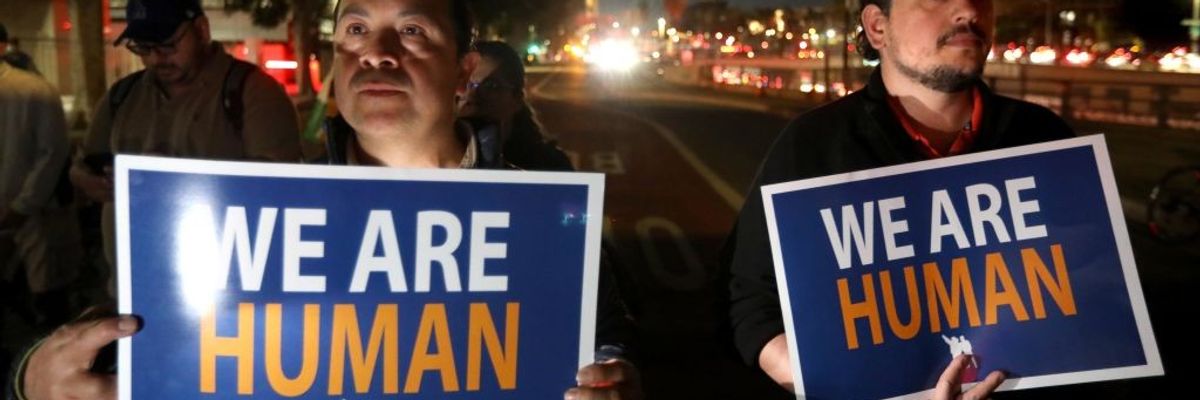
Gerald Diaz, left, and Abraham Roma march against the possibility of mass deportation in Los Angeles, California on December 18, 2024.
(Photo: Genaro Molina/Los Angeles Times via Getty Images)

Jessica Corbett
Jan 18, 2025
COMMON DREAMS

Citing four unnamed sources, The Wall Street Journalreported late Friday that U.S. President-elect Donald Trump's administration intends to start delivering on his long-promised mass deportations with "a large-scale immigration raid" in Chicago, Illinois that "is expected to begin on Tuesday morning, a day after Trump is inaugurated, and will last all week."

"The Trump team intends to target immigrants in the country illegally with criminal backgrounds—many of whose offenses, like driving violations, made them too minor for the Biden administration to pursue," according to the newspaper. "But, the people cautioned, if anyone else in the country illegally is present during an arrest, they will be taken, too."

After considering which "sanctuary cities" to target, "they settled on Chicago both because of the large number of immigrants who could be possible targets and because of the Trump team's high-profile feud with the city's Democratic Mayor Brandon Johnson," the Journal detailed. "Large immigrant centers, such as New York, Los Angeles, Denver, and Miami, are also in the incoming administration's sights, and more targeted raids could come."

The Trump transition team, U.S. Immigration and Customs Enforcement (ICE), and representatives for Johnson and Gov. JB Pritzker did not respond to the paper's request for comment, but the Democratic governor on Saturday circulated "know your rights" resources from the Illinois Coalition for Immigrant and Refugee Rights on his social media accounts and pledge to "protect those rights and ensure our state laws are followed."


As that resource sheet notes, people questioned by ICE officers have the right to remain silent, and the federal agency's officers must have a warrant signed by a judge to enter a private residence without consent.

The Chicago Sun-Timesreported that "Beatriz Ponce de Leon, deputy mayor for immigrant, migrant, and refugee rights, warned City Council members of the impending street sweeps during a series of virtual briefings Friday" and advocates are "organizing 'know your rights' workshops and distributing cards in Latino neighborhoods with bilingual information on residents' legal rights."

Under the Welcoming City Ordinance, the Chicago Police Department does not document immigration status or share information with federal immigration authorities. WGN9pointed out that "Chicago Public Schools, the Chicago Transit Authority, the Chicago Park District, and Community Colleges of Chicago have all been directed not to allow ICE access into any of its buildings."

According toThe New York Times, which spoke with two unnamed sources and obtained related correspondence, "hundreds of agents were asked to volunteer" for ICE's "Operation Safeguard," and the agency plans to send roughly 150 agents to Chicago.

Tom Homan, Trump's incoming " border czar" and former acting director of ICE, previewed the administration's targeting of the Illinois city while attending a Northwest Side GOP holiday party last month, telling other attendees that "Chicago's in trouble because your mayor sucks and your governor sucks," and if Johnson "doesn't want to help, get the hell out of the way."


In a social media thread about the reported plans for Chicago, Zachary Mueller, senior research director at the advocacy group America's Voice, said that Trump's administration "will parade out some number of immigrants who have committed serious crimes, to sell the lie that this is about protecting the American people. It's not."

"Don't fall for their trap," Mueller continued. "There will be arrests in other cities to say that this is not weaponized raids as [a] political attack on political opponents. But the [performance] to instill widespread fear is the point. Fear to immigrant communities. Fear to any elected official not in a major city of the cost of speaking out."

"Homan wants a confrontation. They want to perform the narrative for their audience they are taking it to the 'enemy within," Mueller added. "It's a performance with serious costs for immigrant communities. And it's a performance to help sell their greater authoritarian agenda."

Aaron Reichlin-Melnick, a senior fellow at the American Immigration Council, responded similarly, saying Friday: "The actual operation described in the piece (100-200 agents) seems not that unusual for ICE (Google Operation Cross-Check). Expect a PR blitz, though."

"Not to diminish the ways the impact, but from [the Journal's] reporting it seems that the scale of this is entirely precedented. ICE has done similar operations in the past. This seems mostly about generating media," Reichlin-Melnick explained.

"As many people have said, it is going to take time for the Trump administration to ramp up immigration enforcement," he added. "In the meantime, however, they are going to basically slap a 'mass deportation' logo on the side of every regular ICE operation."


In addition to sounding the alarm over how Trump's mass deportations are expected to impact the estimated 11.7 million undocumented immigrants in the United States and their families, migrant rights advocates and experts have warned that the plan, if fully implemented, "would deliver a catastrophic blow to the U.S. economy."

Although Trump won't be president again until his Monday inauguration, Republicans on Capitol Hill are already pushing forward the GOP's anti-migrant agenda, with help from some Democrats in Congress. On Friday, 10 Democratic senators voted with Republicans to advance the Laken Riley Act, setting it up for a final vote next week.

Those 10 Democrats are Sens. Catherine Cortez Masto (Nev.), Ruben Gallego (Ariz.), Maggie Hassan (N.H.), Mark Kelly (Ariz.), Jon Ossoff (Ga.), Gary Peters (Mich.), Jacky Rosen (Nev.), Jeanne Shaheen (N.H.), Elissa Slotkin (Mich.), and Mark Warner (Va.). Gallego and Sen. John Fetterman (D-Pa.), who did not vote on Friday, also co-sponsored the bill.

"The process displayed by Democrats during the Laken Riley Act legislative debate is an alarming first sign of acquiescence to Donald Trump and Stephen Miller," said America's Voice executive director Vanessa Cárdenas, referring to the family separation architect set to serve as the president-elect's homeland security adviser and deputy chief of staff for policy.

"Greenlighting a massive increase in unnecessary detention and empowering the radical anti-immigrant state attorneys general is deeply harmful and undermines the solutions we need," she stressed. "Despite Donald Trump's victory and the prominence of his vicious anti-immigrant pledges, a strong majority of the American public prefers a balanced approach to immigration, involving both border security and legalization for undocumented immigrants, instead of mass deportation."

According to Cárdenas's group, a coalition of nearly two dozen organizations including Families for Freedom, United We Dream, and multiple state arms of Make the Road are launching a nationwide week of action scheduled to begin Monday in California, Connecticut, Colorado, Florida, Illinois, Kansas, Nevada, New Jersey, New York, Pennsylvania, Texas, Virginia, and Washington, D.C.


Trump administration plans mass immigrant arrests next week: incoming official

By AFP
January 18, 2025


US immigration authorities will carry out mass arrests of undocumented immigrants across the country on Tuesday, a top border official in the incoming administration of Donald Trump has said.

The move would be among the first by Republican Trump, who returns to the White House on Monday, to uphold a campaign pledge to deport millions of undocumented immigrants from the United States.

The remarks on Friday by Trump’s incoming “border czar” Tom Homan to Fox News came in response to reports in the Wall Street Journal and other US outlets that Trump’s new administration planned to carry out an “immigration raid” in Chicago beginning Tuesday.


People protest against US Immigration and Customs Enforcement and the first Trump administration's immigration policies outside a Chicago ICE office in 2018 
- Copyright GETTY IMAGES NORTH AMERICA/AFP/File Joshua LOTT

“There’s going to be a big raid across the country. Chicago is just one of many places,” said Homan, a former acting director of Immigration and Customs Enforcement (ICE) who oversaw a policy that separated migrant parents and children at the border under the first Trump administration.

“On Tuesday, ICE is finally going to go out and do their job. We’re going to take the handcuffs off ICE and let them go arrest criminal aliens,” he said in the interview.

“What we’re telling ICE, you’re going to enforce the immigration law without apology. You’re going to concentrate on the worst first, public safety threats first, but no one is off the table. If they’re in the country illegally, they got a problem,” Homan added.

The Wall Street Journal reported that the “large-scale immigration raid” in Chicago was expected to start on Tuesday, a day after Trump’s inauguration, would “last all week” and would involve 100 to 200 ICE officers, citing four unnamed people familiar with the operation’s planning.

Don Terry, a Chicago police spokesman, told the New York Times that the department would not “intervene or interfere with any other government agencies performing their duties.”

But he said the department “does not document immigration status” and “will not share information with federal immigration authorities.”

Midwestern Chicago is one of several Democrat-led US cities that have declared themselves “sanctuaries” for migrants — meaning they will not be arrested solely for not having legal immigrant status.

A Trump representative did not immediately respond to a request for comment from AFP.


Deportation raids reportedly to begin in Chicago after Trump sworn in


 President-elect Donald Trump’s incoming administration plans to immediately order a series of deportation raids targeting illegal immigrants, according to multiple reports Saturday. Pool Photo by Brendan McDermid/UPI | License Photo


Jan. 18 (UPI) -- President-elect Donald Trump's incoming administration plans to immediately order a series of deportation raids targeting illegal immigrants, according to multiple reports Saturday.

Chicago is expected to be the first major city targeted by Immigration and Customs Enforcement agents as part of Operation Safeguard, the New York Times reported, citing two people familiar with planning the undertaking.

The massive deportation operation is expected to target criminals and gang members in the United States illegally and run for one week.

Trump has promised to conduct the largest deportation program in U.S. history, both during his presidential campaign and as part of his post-election rhetoric.

Related
Trump inauguration to be held indoors at U.S. Capitol due to extreme cold
Trump, Xi Jinping talk on phone before inauguration
NYC Mayor Eric Adams to meet with President-elect Donald Trump
Trump's homeland security pick Noem unclear about border authority

Up to 200 ICE agents are being sent to Chicago to help kick off the operation on Tuesday, the Wall Street Journal reported. The agency has already asked agents to volunteer for the post-inauguration raids.

"There's gonna be a big raid across the country," Tom Homan, who will be in charge of U.S. borders once Trump takes office, told Fox News in an interview.

Homan has previously said he will instruct ICE agents to carry out raids on illegal immigrants at their workplaces.

In addition to Chicago, the sweeping crackdown will also target other major U.S. cities with large immigrant populations.

Trump is said to be prioritizing so-called sanctuary cities, where municipal officials have previously offered limited cooperation with federal immigration officials on the deportation front.

Under President Joe Biden's administration, ICE agents have generally limited their involvement to illegal immigrants perceived to be national security threats, those with serious criminal records and people having recently crossed the border into the United States.

New York Mayor Eric Adams recently met with Trump and signaled his city's willingness to work with the new administration.

Trump is set to take the oath of office Monday, with cold weather forcing the inauguration to take place indoors.


FASCIST INTERNATIONALE

Inside the parade of right-wing world leaders flocking to D.C. for Trump's inauguration

Matt LasloNicolae Viorel Butler
January 18, 2025

REUTERS/Hollie Adams

WASHINGTON—In a historic first, President-elect Donald Trump is bucking centuries of American tradition by welcoming an array of foreign leaders to his second inauguration.

The parade is about as far-right as they come, including many who — whether in policy or bombast — have been compared to Trump himself.

One of Trump’s guests is known for hoodwinking the English people into Brexiting the EU, but others aren’t household names. Still, they’re hailed as heroes in Trump’s Republican Party, where fealty, allegiance and unflinching — and unforgiving — conservative policy positions are prized more than the compassionate conservatism of a bygone era.


Below is a partial list of the Trump-like leaders coming to kiss the ring. They range from deportation advocates — one who even promised Morocco would pay for his wall — to those who deride migrants as "fortune seekers." One’s rhetoric has been dubbed Mussolini-like, while another has questioned why Germany is blamed for the atrocities of the Nazis during WW II. Still, another has derided the Pope as a “communist.”

With the far-right on the rise globally, Trump’s planning to be with his own as he celebrates his second inauguration.

Trumplike European leaders


Nigel Farage — Brexit salesman. He is known for his anti-EU and anti-immigrant stances and accused of inciting xenophobia throughout his Brexit campaign.

Giorgia Meloni — Italy’s first female prime minister. Leader of the Brothers of Italy, a far-right party with post-fascist roots. Advocate for strict immigration controls and preservation of Italy's ‘Christian’ identity. She’s alarmed critics for declaring herself a defender of "God, homeland and family," echoing nationalist slogans from the past (think Mussolini).

Rewriting Nazi atrocities

Tino Chrupalla — Co-leader of Alternative for Germany Party (AfD). Known for nationalist and Eurosceptic stances. Advocate for ending Russian sanctions and Trump fanboy. In a televised debate, Chrupalla once drew outrage for questioning Germany’s responsibility for World War II atrocities.

Mateusz Morawiecki — Former Polish prime minister. Member of the right-wing Law and Justice Party (PiS). A staunch conservative who regularly deploys anti-LGBTQ and anti-EU rhetoric. Once claimed Poland shouldn’t be blamed for Nazi atrocities during World War II.

Persecuting ethnic minorities now en vogue


Tom Van Grieken — Leader of Belgium’s far-right Vlaams Belang Party, which advocates for Flemish independence and stringent immigration policies. Has labeled refugees "fortune seekers" and likened multiculturalism to “the destruction of Europe.”


André Ventura — Leader of Portugal’s right-wing populist Chega Party. Anti-migrant and anti-Roma, a minority community of asylum seekers fleeing persecution back in India. Controversially called Roma communities a “state-sponsored gang” and proposed DNA testing for welfare applicants to prove their identity.

Xenophobia in the House (Senate too)!


Éric Zemmour — French far-right commentator, author and politician. Anti-immigrant, Eurosceptic. He claims France’s decline is due to immigration and liberal policies in his book, The French Suicide. Sparked outrage for accusing Muslim asylum seekers of being focused on the “colonization” of France.

Santiago Abascal — Leader of Spain’s far-right Vox Party. A vocal critic of multiculturalism and immigration. Calls for building Trump-like walls along Spain's borders to deter migrants. Calls Islam a "threat to European civilization." Once claimed feminists were part of “gender totalitarianism” at a political rally.

Mixing religion and politics


Javier Milei — Newly elected president of Argentina. A Trump-like populist. Called Pope Francis a “communist” and “representative of the evil left.”

Election denier’s request to attend inauguration denied

Jair Bolsonaro — Former President of Brazil. Bombastic right-wing populist. Facing charges for allegedly trying to overturn Brazil’s 2022 election. He had his passport confiscated, and on Thursday, the Brazilian Supreme Court denied his request to travel to Washington for Trump’s second inaugural.


On the eve of Trump's inauguration, thousands rally in Washington against his policies


Thousands took part in the “People’s March” in protest of the policies of US President-elect Donald Trump in Washington on Saturday. The march included members of civil rights and social justice groups who campaign on issues like abortion access, climate change, the need for better protections against gun violence and immigrant rights.


Issued on: 18/01/2025 - 
FRANCE24
AFP
By: NEWS WIRES
Protestors rallying in opposition to the incoming Trump administration's policy objectives attend the "People's March on Washington" on January 18, 2025.
 © Christopher Furlong, AFP

Thousands of demonstrators marched through the streets of Washington on Saturday in protest at the policies of Donald Trump and his Republican Party, two days before the billionaire reclaims the Oval Office.

The “People’s March” has been organized by a collective of civil rights and social justice groups, including the team behind the Women’s March, which drew hundreds of thousands of people to the US capital in the wake of Trump’s first inauguration in 2017.

Participants are highlighting a range of issues which they say are under attack from Trump and his party’s leaders, including abortion access, climate change, the need for better protections against gun violence, and immigrant rights.

Colorful signs and plenty of pink pussy hats—a throwback to the 2017 event—dotted the crowd in downtown Washington, which gathered at three parks before converging for a march to the Lincoln Memorial for a rally.

“These laws endanger our lives. Women are dying,” said demonstrator Aisha Becker-Burrowes, who was barely audible over the crowd’s chants of “My body, my choice.”

Susan Dutwells, a 60-year-old who came from Florida with her daughter to protest, said she was “scared” and “angry” about Trump’s return to office.

“So many people are voting against their own interests. I don’t understand it,” Dutwells told AFP.

Another protester, Carine—a 40-year-old who came from Arizona and declined to give her last name—said she was afraid of what might happen during Trump’s second term but was committed to remaining engaged.

“I’m trying to remain hopeful. It feels very good to be surrounded with so many people. I’ll continue the fight back home,” she told AFP, adding that it was her first time protesting in the US capital.

Sarah Kong, a 31-year-old psychiatrist who came from Colorado with her mother to participate, echoed Carine’s nervous optimism.

“This is my first time marching. And I want to do this again. I feel motivated, stimulated by all these people. I have faith in the future, even though I’m scared,” Kong said.

“These are important times.”

Sister marches were planned nationwide, including in New York.

The catch-all march was unfolding after Trump’s incoming “border czar” Tom Homan told Fox News that a “big raid” would be carried out across the country shortly after Trump takes the oath of office on Monday.

Trump, who defeated Vice President Kamala Harris in November’s presidential election, is returning to the White House for a second term. He has vowed swift action to deport millions of undocumented migrants upon taking office.

(AFP)

Thousands gather in Washington to protest Trump inauguration

January 18, 2025 
People attend the “People’s March on Washington” ahead of the presidential inauguration of US President-elect Donald Trump in Washington, US, Jan 18. — Reuters

Several thousand people, mostly women, gathered in Washington on Saturday to protest US President-elect Donald Trump’s inauguration, with some wearing the pink hats that marked the much larger protest against his first inauguration in 2017.

In Franklin Park, one of three kickoff locations for the “People’s March” that will wind through downtown, protesters gathered in light rain to rally for gender justice and bodily autonomy.

Other protesters gathered at two other parks near the White House, with one group focused on democracy and immigration and another on local Washington issues, before heading toward the march’s final gathering at the Lincoln Memorial. Police cars, with sirens on, drove between the kickoff locations.

Protests against Trump’s inauguration are much smaller than in 2017, in part because the US women’s rights movement fractured after Trump defeated US Vice President Kamala Harris in November.

Vendors hawked buttons that said “#MeToo” and “Love trumps Hate”, and sold People’s March flags for $10. Demonstrators carried posters that read “Feminists v Fascists” and “People over Politics”.

“It’s really healing to be here with all of you today in solidarity and togetherness, in the face of what’s going to be some really horrible extremism,” Mini Timmaraju, the head of advocacy group Reproductive Freedom for All, told the crowd as events kicked off.

She said the good news was that abortion rights remain popular despite Trump’s win, leading a chant of “We are the majority!”

Reproductive groups joined civil rights, environment and other women’s groups in organising the march against Trump and his agenda as he prepares to take office on Monday.

Trump won all seven battleground states and the popular vote in November’s election
South African union calls Stilfontein mine siege a 'state-sponsored massacre'

South African rescuers on Thursday ended their attempts to find anyone left in an illegal gold mine where at least 78 people died during a months-long police siege. The Giwusa labour union called the operation the "worst state-sponsored massacre" since the end of apartheid.

Issued on: 17/01/2025 - RFI
Mine rescue workers host up a cage that was used to rescue trapped miners at an abandoned gold mine, where miners were rescued from below ground, in Stilfontein, South Africa, Thursday, 16 January 2025.
 © Themba Hadebe / AP

Since Monday, rescuers have used a cylindrical metal cage to pull up 78 bodies and 248 survivors, some of them emaciated and disorientated, in a court-ordered operation at the mine near the town of Stilfontein, southwest of Johannesburg.

The cage was sent down to 1,280 metres with cameras on Thursday for a final sweep.

"We couldn't see any person still left behind and we couldn't hear any voices on the recording," head of Mines Rescue Services, Mannas Fourie, told reporters at the site.

The police operation, "Vala Umgodi" ("close the hole" in Zulu), started in August. Over the course of the siege, 1,907 miners resurfaced, while 87 bodies were retrieved.

Most of the survivors are foreign nationals, including 1,125 Mozambicans and 465 Zimbabweans. Only 26 are South Africans, according to police.

They have been arrested and charged with illegal immigration, trespass, illegal mining and other offences.

Investigators now face "a mammoth task" in identifying the dead as some of the bodies were already decomposing, and in some cases just bones, police spokeswoman Athlenda Mathe told journalists.

Among the dead, only two have been identified so far, Mathe said.

Death toll rises as more bodies pulled from disused South African gold mine
Deaths could have been averted

No longer viable for commercial extraction, the mine – known as Shaft 11 – was entered illegally by the men trying to eke out a living.

Locally known as "zama zamas" – or "those who try" – illegal miners frustrate mining companies and are often accused of criminality by residents.

To force the miners out, police had restricted supplies of food and water that the surrounding community had been dropping down the shaft.

In November, a court ordered police to end all such restrictions.

UN panel seeks to stem mining abuses in global rush for critical minerals

But local community members, civil society groups and labour unions have denounced the Stilfontein crackdown.

Zinzi Tom told France 24 her brother had been down the mine for six months and she still didn't know what had become of him.

"Even if they’re saying he’s a criminal, does he deserve to die?" she said.

Community leader Johannes Qankase told French news agency AFP on Thursday that "the site had been turned into a mass grave by the government" and he believed most of the men starved to death.

Thembile Botman, a community leader in Khuma, told Reuters news agency that local residents had been warning for months that people would die, and the deaths could have been averted had the rescue operation taken place sooner.
Dehumanisation

The General Industries Workers Union of South Africa (Giwusa) condemned what it called "the dehumanisation and criminalisation of these poor, desperate miners".

"This is a bloody culmination of treacherous policies pursued by the government. This was a campaign of lies," its president Mametlwe Sebei told reporters.

The police have denied blocking the miners' exit and said more than 1,500 miners did get out by their own means between the start of the siege in August and the rescue operation.

Africa takes centre stage as South Africa maps ambitious G20 agenda

Authorities said they were investigating the broader criminal networks that orchestrate the mining activity, recruit miners and traffic the illicit gold.

"Those ringleaders who are controlling what happens underground... some of them have been retrieved, some already in police custody, but we are looking for the real kingpins," Mathe said.

Illegal mining cost South Africa over $3 billion last year.

(with newswires)

South African state has mine workers’ blood on its hands

Police have blocked “illegal miners” in an abandoned gold mine at Stilfontein near Johannesburg for months, resulting in over 100 deaths


A copper mine in South Africa (Picture: Bjorn Christian Torrissen)

By Camilla Royle
Wednesday 15 January 2025
SOCIALIST WORKER Issue


The South African state has orchestrated a massacre of mine workers.

Thousands of “illegal miners” have been living more than a mile underground in an abandoned gold mine at Stilfontein near Johannesburg for months. They dig for scraps of gold and minerals in abandoned mines without permits.

The police blocked their access to necessities including food and water and threatened to arrest them if they came to the surface.

Sabelo Mnguni of the Mining Affected Communities United in Action (MACUA) group said cops removed the ropes and pulleys that the miners had used to enter the mine.

The High Court last week ordered the government to start a rescue operation, which started on Monday. And horrific videos emerged of dead bodies wrapped in makeshift body bags— and the emaciated survivors.

A voice in one of the videos says, “We’re starting to show you the bodies of those who died underground. And this is not all of them. Do you see how people are struggling? Please we need help.”

As of Wednesday, 166 people had been brought up alive and 78 dead bodies. The miners say there are 109 dead in total. This makes it among the deadliest mining incidents in recent South African history.

The leader of the Giwusa general union, which released the video, said, “What has transpired here has to be called what it is—this is a Stilfontein massacre. This footage shows a pile of human bodies—of miners that died needlessly.”

Community activist Bongani Uhuru Jonas told Socialist Worker he was relieved that people are now going to be saved. But he said the rescue mission was long overdue and not well planned.

“We as communities have been raising funds for food. Two of our leaders are volunteering on a daily basis to go down in the crane and insure that people are assisted to resurface.”

In South Africa, up to 100,000 people work informally and often illegally in mines like the one at Stilfontein. The mines are abandoned by the multinationals when they are no longer a source of huge profits.

These miners are sometimes known as artisanal miners or “Zama Zama”—meaning “take a chance”.

Artisanal miners are often migrant workers from countries such as Zimbabwe, Lesotho and Mozambique who have few other options for work and face the threat of deportation if arrested.

They do an almost unimaginably dangerous job where they risk death from suffocation and mine collapses.

Clement Moeletsi, who was able to leave the mine in December, described watching people starve. “It was not an illness that killed them. It was starvation. A cruel, drawn-out death that consumed them piece by piece,” he said.

“This is what I saw underground. This is what we lived through, and this is why, respectfully, no one, despite what they have done, should ever endure such suffering again.”

He said he became a miner because he was “driven by financial hardship and the overwhelming need to provide for my family”. “Despite my best efforts, I was unable to secure employment,” he said.

“The pressure of not being able to provide food or basic necessities for my child and loved ones became unbearable. It left me with no choice but to take this desperate step in the hope of alleviating our dire situation.”

Bongani said that the narrative from the state has been to criminalise miners, and the community organisations that support them.

Mining minister Gwede Mantashe, who was at the site on Tuesday, said, “It’s a criminal activity. It’s an attack on our economy by foreign nationals in the main”.

Bongani added that Mantashe—a former mineworkers’ union activist—has done nothing to support these miners, other than calling them criminals. “But the wheels of justice have turned now,” he said.

“We want to insure that after this rescue mission the state is held accountable. We are going to advocate that the government decriminalises and legitimises the sector.

“The struggle of Stilfontein opens an eye to all mining affected communities. We have learnt as the working class that there cannot be a situation where workers are poor, where there are 6,000 derelict ownerless mines in South Africa.”
UK

Manchester mental health workers fight for better staffing

Workers are furious at health bosses for underfunding the services they provide


Unison union mental health workers on strike in Manchester

By Yuri Prasad
Thursday 16 January 2025
SOCIALIST WORKER Issue

Striking mental health workers in Manchester took their fight to Greater Manchester mayor Andy Burnham and top health bosses on Thursday as part of their battle for better staffing.

They are furious at NHS mental health service commissioners who are underfunding the services they provide—and putting vulnerable users at risk.

The Unison and Unite union members work for Manchester Early Intervention in Psychosis teams. They walked out for 48 hours on Wednesday morning as part of a long-running campaign.

Strikers include nurses, psychologists, social workers, support workers, welfare rights workers, CBT therapists and employment specialists.

From the picket line at Chorlton House, Unite rep and clinical psychologist Dr John Mulligan told Socialist Worker what is at stake.

“This strike is about safer staffing,” he said. “For the last four years we’ve been in dispute with commissioners in Manchester because they and the government have not invested in mental health services in the community. And our service users are getting a very poor service.

“That’s part of a national shame. Across the country some 43,800 people with mental health problems die unnecessarily every year.

“We need enough staff to do the job properly and we need a radical overhaul of mental health services.”

Speaking before attending the commissioners’ Care Board meeting, John said, “Five of us are heading into the meeting and we’ve submitted 12 questions that apparently the body has to answer within about 20 days.”

Picket lines at Prestwich hospital have been swelled by supporters, including other trade unionists and service users.

In response, John said, “We want to thank everybody who’s come here today, and all the other days we’ve been on strike. That’s much appreciated.”

Health trade unionists across the north west of England should highlight this vital strike and look for ways to show solidarity.

And national unions should do more to publicise and support those who have walked out in Manchester. Many other mental health workers could potentially be in dispute over cuts—and hitting back together would be powerful.

Mental health services everywhere are neglected and in crisis. Strikes and protests are the best way to pressurise local commissioners and the national government into taking action.

• Send messages of support to MancStrikeMH@yahoo.com
• Sign the strikers’ petition for more resources at tinyurl.com/MMHpetition
UK

Disabled people win court battle for welfare rights

Activist Ellen Clifford appealed against the way the Tories handled a public consultation into changes to the Work Capability Assessment


A vigil outside the Royal Courts of Justice in December


By Camilla Royle
Thursday 16 January 2025
SOCIALIST WORKER Issue

Disabled people have won a crucial battle in defending welfare rights against attacks from the state.

Activist Ellen Clifford went to the High Court last month to appeal against the way the former Tory government handled a public consultation into changes to the Work Capability Assessment (WCA).

The judge ruled on Thursday that the consultation was “so unfair as to be unlawful”.

The government ran the consultation in 2023 and announced changes to the WCA in the autumn budget that year.

The plan will drive more people into poverty by moving more of them into the Limited Capability for Work group. This means being expected to do more to find work and facing cuts of £416 a month to their benefits if they don’t find a job.

The court ruling found it unfair that the Department for Work and Pensions rushed through the consultation in just eight weeks. It refused to extend the deadline despite disability and anti-poverty organisations writing to protest that the timeline was too short.

The department did not properly explain the effect that the proposals would have on disabled people, including that they would lose hundreds of pounds worth of benefits.

Inclusion London, Disability Rights UK and Disability North said in their response to the consultation, “It is shocking that the consultation proposal does not mention this at all. It is also disappointing there is no clear indication of how many people will be affected.

“This is crucial information and we seriously doubt the public can make informed contributions to this consultation without fully understanding the negative financial impact for future claimants.”

It also failed to mention that “the number of people expected to find employment was vastly outweighed by the number of people who would lose money and face conditionality but would not as a result find employment”.

And it did not properly explain the rationale for the proposed changes—that they were intended to save the government money.

The consultation makes a mockery of the previous government’s claims to fully consult with people affected and listen to the views and voices of disabled people.

The changes are due to come into effect this year, unless the new Labour government scraps them.