"While this temporary cessation of fighting and bombing must be both respected and long-term, this is only the beginning of addressing the immense humanitarian, psychological, and medical needs in Gaza."
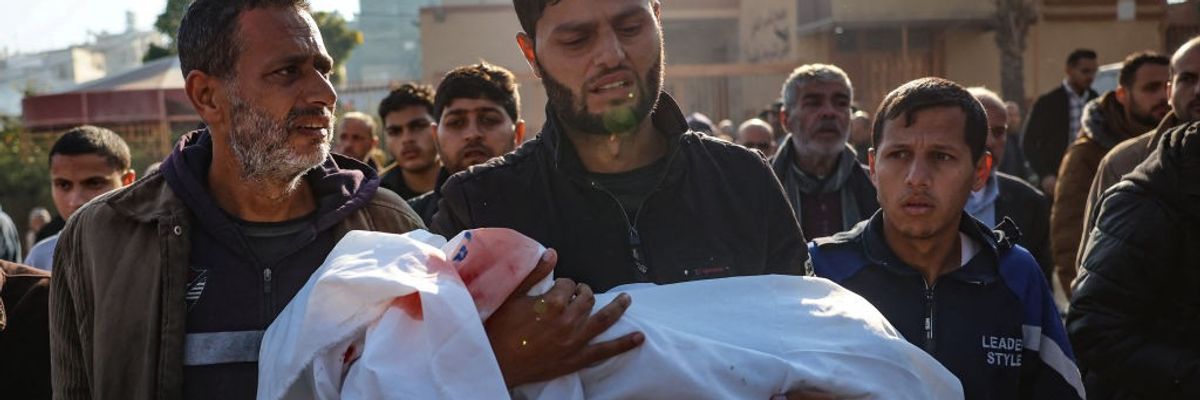
A relative carries the body of a child, one of four members of a Palestinian family killed in an Israeli strike that hit their tent north of Khan Younis in the southern Gaza Strip, in the yard of the Nasser Hospital on January 18, 2025.
(Photo: Bashar Taleb/AFP via Getty Images)
Jessica Corbett
Jan 18, 2025
COMMON DREAMS
As Israel's military continued its 15-month assault that has killed tens of thousands of Palestinians and decimated the Gaza Strip, Israeli Prime Minister Benjamin Netanyahu's office confirmed that early Saturday the full Cabinet approved a recently announced cease-fire and hostage-release deal that is set to take effect at 8:30 am local time Sunday.
The 24-8 vote on the three-phase deal negotiated by Egypt, Qatar, and the outgoing Biden and incoming Trump administrations came after the Security Cabinet endorsed it on Friday.
Later Saturday, Netanyahu said that "we will be unable to move forward with the framework until we receive the list of the hostages who will be released, as was agreed. Israel will not tolerate violations of the agreement. Hamas is solely responsible."
Since negotiators announced the agreement on Wednesday, the Israel Defense Forces (IDF) have killed over 100 more Palestinians, according to the Gaza Ministry of Health's figures.
Gaza health officials said Saturday that the Israeli assault has killed at least 46,899, with another 110,725 wounded since the Hamas-led October 7, 2023 attack on Israel. More than 10,000 people remain missing in the Palestinian region reduced to rubble, and experts warn the official death toll is likely a significant undercount.
"The temporary cease-fire agreement in Gaza is a relief, but it arrives more than 465 days and 46,000 lives too late," Doctors Without Borders said in a Saturday statement. "While this temporary cessation of fighting and bombing must be both respected and long-term, this is only the beginning of addressing the immense humanitarian, psychological, and medical needs in Gaza."
"Israel must immediately end its blockade of Gaza and ensure a massive scale-up of humanitarian aid into and across Gaza so that the hundreds of thousands of people in desperate conditions can begin their long road to recovery," added the group, also known by its French name Médecins Sans Frontières. "The toll of this hideous war includes the obliteration of homes, hospitals, and infrastructure; the displacement of millions of people that are now in desperate need of water, food, and shelter in the cold winter."
After reaching a cease-fire deal to stop Israel's assault on Lebanon late last year, the IDF was accused of violating it with continued strikes allegedly targeting the political and militant group Hezbollah.
According toDrop Site News: "Egyptian media reported the formation of a joint operations room in Cairo, with representatives from Egypt, Palestine, Qatar, the United States, and Israel, to oversee the Gaza cease-fire and 'ensure effective coordination and follow up on compliance with the terms of the agreement.'"
Israel—whose troops have been armed by the United States—faces a genocide case at the International Court of Justice over its war on Gaza and the International Criminal Court in November issued arrest warrants for Netanyahu, former Israeli Defense Minister Yoav Gallant, and Hamas leader Mohammed Diab Ibrahim Al-Masri.
After the Israeli Security Cabinet's Friday decision, Kenneth Roth, the former director of Human Rights Watch, said: "Keep in mind that a cease-fire is NOT an amnesty. Senior Israeli officials must still be prosecuted for genocide and war crimes. Otherwise, governments could commit atrocities with impunity by simply agreeing to a cease-fire at the end."
This post has been updated with Israeli Prime Minister Benjamin Netanyahu's later Saturday statement.
Why Gaza's future remains unclear despite the Israel-Hamas ceasefire agreement
Despite the announcement that Israel and Hamas had reached a ceasefire and hostage-for-prisoner exchange agreement on Wednesday, the question of who is going to govern Gaza after the war's end remains unresolved. Both Israel and the US, alongside the Palestinian Authority, reject any future governance involving Hamas, which, despite being weakened, has not been eradicated by Israeli military operations.
Issued on: 16/01/2025
By: Marc DAOU
Despite the announcement that Israel and Hamas had reached a ceasefire and hostage-for-prisoner exchange agreement on Wednesday, the question of who is going to govern Gaza after the war's end remains unresolved. Both Israel and the US, alongside the Palestinian Authority, reject any future governance involving Hamas, which, despite being weakened, has not been eradicated by Israeli military operations.
Issued on: 16/01/2025
By: Marc DAOU
FRANCE24/AFP

‘A fully reformed Palestinian Authority’
The plan, which aims to eventually replace Hamas with the Palestinian Authority, includes, according to Blinken, “the unification of Gaza and the West Bank under the Palestinian Authority; no Israeli military occupation of Gaza or reduction of Gaza's territory [Editor's note: no Israeli settlements]; no post-conflict attempt to besiege or block it; and no forced displacement of Gaza's population”.
"The Palestinian Authority should invite international partners to help establish and run an interim administration with responsibility for key civil sectors in Gaza," Blinken said on Tuesday. "The international community would provide funding, technical support and oversight."
Blinken added that an interim administration would include “Gaza Palestinians and Palestinian Authority representatives, selected after genuine consultation with Gaza residents.” The interim administration would transfer power “to a fully reformed Palestinian Authority administration as soon as it’s feasible".
Several Arab and Western nations, including France and the US, have urged Abbas to reform the Palestinian Authority, weakened by corruption and unpopularity. Abbas, whose presidential term expired in 2009 and who’s still clinging onto power at the age of 89, has yet to initiate significant reforms.
‘We are the government of Palestine’
Holding limited authority in the occupied West Bank, a territory beset by an increase in Israeli military operations and growing pressure from settlers, the Palestinian Authority rejects any return to a Hamas-led Gaza.
During a meeting in Oslo on Wednesday, Palestinian Prime Minister Mohammad Mustafa said that "it will not be acceptable for any entity other than the Palestinian Authority to govern Gaza".
"We are the government of Palestine, ready to assume our responsibilities in the Gaza Strip as we did before," he added.
The Palestinian Authority, which advocates for "a political solution for all of Palestine", seeks to revive efforts toward an independent state. However, this vision is firmly opposed by Netanyahu and his government allies.
Read moreWhat we know about the Gaza truce between Israel and Hamas
Hamas, an unavoidable force?
Just who exactly will run Gaza when the war ends, and how, remains an open question. According to Haaretz, the most optimistic scenario involves lasting calm in Gaza and Gulf-funded reconstruction in exchange for Hamas relinquishing power.
Regardless of the scenario, everything will depend on Israel's willingness to make compromises, Trump’s regional plans as he aims “to further expand the historic Abraham Accords", and the Palestinian actors themselves – including the Palestinian Authority, which has lost legitimacy, and Hamas, which is far from being eliminated in Gaza.
Earlier in January, the Israeli press reported that Hamas continued to demand a role in Gaza’s governance post-war as a precondition for any agreement on releasing Israeli hostages.
Despite devastating Israeli bombardment and the targeted assassinations of its leaders Yahya Sinwar and Ismail Haniyeh, Hamas remains the dominant force in Gaza. It led negotiations in Doha and is still the key Israeli interlocutor for implementing the three-phase deal signed Wednesday.
According to Blinken, Hamas has nearly restored its forces lost since October 2023.
"We assess that Hamas has recruited almost as many new militants as it has lost,” Blinken said on Tuesday. "That is a recipe for an enduring insurgency and perpetual war."
Pending the establishment of an administrative authority capable of governing Gaza in the coming months, the Israeli military is expected to gradually withdraw from densely populated areas, as well as the Philadelphi corridor along the Egyptian border and the Netzarim corridor that divides the Palestinian territory within the next 60 days to facilitate the return of displaced people.
Full Israeli withdrawal from Gaza is slated for the second phase of the plan announced on Wednesday. Reconstruction and governance issues are likely to be addressed in a potential third phase.
This article has been adapted from the original in French by Anaëlle Jonah.
Reagan and Carter 2.0?
The ceasefire deal comes at an unusual time in US politics, as the Biden administration prepares to cede power to Trump. But such a last-minute deal is not without precedent.
In 1981, outgoing president Jimmy Carter was still struggling to secure the release of American diplomats held hostage in Iran as Ronald Reagan prepared to take the reins. At the time, Reagan was suspected of sabotaging the Carter administration’s behind-the-scenes negotiations to be able to claim credit for the hostage release at the start of his term.
Watch more'Ironic that Trump is taking credit' for Gaza ceasefire deal, John Bolton says
For Gaza, negotiators sent by both Biden and Trump worked together to demonstrate the continuity of US commitment to the region.
Considering the highly polarised nature of current US politics, it was an unusual move, according to René Lindstädt, an expert in US politics at the University of Birmingham.
"The fact that the incoming team and the Biden administration did work together gives you a pretty good idea that this was a win-win for both sides," he said.
Savvy negotiating or just good timing?
Trump has repeatedly called for Israeli hostages to be freed before his return to the Oval Office on January 20.
Some note that the involvement of Trump’s Middle East envoy Steve Witkoff in the negotiations was key.
Before Witkoff’s trip to the region, “the only party which was not agreeing to the ceasefire was Binyamin Netanyahu”, said Anurag Mishra, US political analyst at the International Team for the Study of Security (ITSS) Verona, adding that Witkoff was the instigator of meetings with Netanyahu in which the Israeli prime minister ultimately agreed to the ceasefire.
“It really looks like a deal which has been done by Trump administration,” he said.
Moreover, relations between Netanyahu and Biden have been notoriously rocky, and the hardline Israeli prime minister has made no secret of his support for Trump.
Indeed, Trump was the first person that Netanyahu called to thank for his part in the agreement. The Israeli prime minister named Trump at the beginning of an official statement while President Biden was not mentioned until the fourth paragraph, according to the New York Times.
"It was only because of the promise of Donald Trump coming to the White House and his special envoy being involved in this case, that this ceasefire happened," said Shahin Modarres, an international security analyst at ITSS.
Modarres said Trump was hoping for an early ceasefire deal before he takes office so that his administration “can devote its focus to Iran”.
Watch moreAll eyes on Gaza: United Arab Emirates positions itself for post-war period
"Trump didn't want to come in and immediately have to deal with this issue,” Lindstädt agreed, citing the president-elect's desire to begin the mass deportation of immigrants and getting his controversial cabinet approved, among other pressing priorities.
Not everybody agrees that Trump was such a key player in the deal's success.
Biden and his administration have noted that the agreement is essentially the same three-phase ceasefire deal they have been trying to get both sides to agree to since May. Recent events, they argue, just made it possible to nudge it over the finish line.
According to Lindstädt, the "Biden administration knew that Netanyahu wanted to get back into the good graces of Trump, and having [Witkoff] present would probably make Netanyahu be a little bit more cooperative".
While Trump’s involvement was “very helpful to get the agreement over the line”, giving Trump too much credit is a mistake and ignores other factors that influenced Netanyahu’s decision and the work done by the Biden administration, said Amnon Aran, a specialist in the Israeli-Palestine conflict at City University of London.
Lindstädt agreed, noting the similarities with a deal that has been in the works for months.
"Let's not forget the text agreed upon is very similar to the one the Biden administration has been working on," he said.
Convincing the Israeli prime minister to come to the table may have been easier than ever, given recent events across the region.
"The significant hit Hezbollah sustained over the summer followed by the fall of the Assad regime [in Syria] and also the limited, but nevertheless effective, Israeli attacks on Iran put Netanyahu in a better strategic position and gave him more internal legitimacy," said Aran.
“I think this context is more relevant than Donald Trump and his envoy's work."
Aran added that much of this “would never have happened unless the Biden administration … provided the security envelope that it did".
"This is all the work of Joe Biden,” he said.
"Biden has to be significantly credited for it … this is still very much a Biden achievement, to my mind, more than a Trump achievement," he added.
Just a starting point
For Lindstädt, the question of which president should enjoy more credit for achieving the deal is beside the point.
The debate around the signing of the deal, which he describes as a “PR stunt from both sides”, should not distract from the difficulties that will ensue.
"We'll see what kind of stance the Trump administration will adopt for the negotiation … that will show whether or not this deal can last," he said.
While Mishra believes Trump “really wants a lasting peace in this part of the region” so he can turn his focus to other priorities such as Iran, he warns that the danger is that Trump will put the Israeli-Palestinian issue aside prematurely.
That would be a risky move to make with a fledgling peace accord in such a highly volatile region.
This article has been translated from the original in French by Anna Hartley.
People check the rubble of buildings hit in Israeli strikes the previous night in Jabalia in the northern Gaza Strip, on January 16, 2025, following a truce announcement amid the war between Israel and the Palestinian Hamas movement. © Omar Al-Qatta, AFP
While negotiators in Doha appeared on Wednesday night to have agreed on a ceasefire between Israel and Hamas in the Gaza Strip and a hostage-for-prisoner exchange, the issue of Gaza’s post-conflict governance remains unaddressed by the three-phase plan. The question's absence from the deal, which still has to be approved by Israel's cabinet, risks feeding new tensions despite the tentative truce that looks likely to take effect on Sunday.
Israeli Prime Minister Binyamin Netanyahu, who vowed to destroy Hamas in response to the October 7, 2023, terrorist attacks, continues to reject any prospect of Hamas returning to power in Gaza.
After winning the 2006 legislative elections, Hamas seized control of Gaza in 2007, ousting the Palestinian Authority led by Fatah and President Mahmoud Abbas.
Since the war began, Netanyahu's far-right government has shown divisions on Gaza’s post-war governance. Radical ministers including Finance Minister Bezalel Smotrich have even suggested the return of a "Jewish civilian presence" in Gaza.
In January 2024, Defence Minister Yoav Gallant, later dismissed over policy disagreements with Netanyahu, proposed a plan for the Israeli military to retain operational rights in Gaza, similar to the way it does in the occupied West Bank.
"Hamas will not govern Gaza, and Israel will not govern Gaza's civilians. Gaza's residents are Palestinian, so Palestinian bodies will oversee governance," Gallant said in a statement.
"The entity controlling Gaza will rely on existing administrative mechanisms [civil committees]," he added. This plan de facto excludes the Palestinian Authority, even though the US has repeatedly advocated for the organisation to play a role in Gaza's future.
Options for Gaza's governance, including military rule or foreign oversight of humanitarian aid distribution, remain highly divisive within Israel's cabinet. Netanyahu, firmly against a complete troop withdrawal from Gaza, has avoided making a decision, leaving his intentions unclear.
Israeli media reported Netanyahu mocking the idea of replacing Hamas with an interim Arab coalition. Gulf countries including Saudi Arabia and Qatar, along with Egypt, Jordan and the Palestinian Authority, had reportedly endorsed this idea, but Netanyahu said such a thing would not happen “before total victory and the eradication” of Hamas was achieved.
Read moreLive: Hamas denies Israeli claim it is backtracking on Gaza ceasefire deal
Trump vows Gaza will not become a ‘terrorist safe haven’
The US administration has repeatedly demanded a Gaza “never again governed by Hamas or used as a platform for terrorism” and has done so ever since November 2023.
The Palestinian Islamist movement is considered a terrorist organisation by the United States and the European Union.
Outgoing Secretary of State Antony Blinken reiterated on Tuesday that it was essential to achieving "a lasting peace".
"For many months, we’ve been working intensively with our partners to develop a detailed post-conflict plan that would allow Israel to fully withdraw from Gaza, prevent Hamas from filling back in, and provide for Gaza’s governance, security, and reconstruction," he said before the Atlantic Council in Washington, DC.
He noted the plan would be handed off to the incoming Trump administration so they could "carry (it) forward".
Shortly after the Doha agreement, President-elect Donald Trump vowed "to work closely with Israel and our Allies to make sure Gaza NEVER again becomes a terrorist safe haven”.
His future administration has not revealed its intentions regarding governance in Gaza, or its views on the Biden plan.
Watch more
While negotiators in Doha appeared on Wednesday night to have agreed on a ceasefire between Israel and Hamas in the Gaza Strip and a hostage-for-prisoner exchange, the issue of Gaza’s post-conflict governance remains unaddressed by the three-phase plan. The question's absence from the deal, which still has to be approved by Israel's cabinet, risks feeding new tensions despite the tentative truce that looks likely to take effect on Sunday.
Israeli Prime Minister Binyamin Netanyahu, who vowed to destroy Hamas in response to the October 7, 2023, terrorist attacks, continues to reject any prospect of Hamas returning to power in Gaza.
After winning the 2006 legislative elections, Hamas seized control of Gaza in 2007, ousting the Palestinian Authority led by Fatah and President Mahmoud Abbas.
Since the war began, Netanyahu's far-right government has shown divisions on Gaza’s post-war governance. Radical ministers including Finance Minister Bezalel Smotrich have even suggested the return of a "Jewish civilian presence" in Gaza.
In January 2024, Defence Minister Yoav Gallant, later dismissed over policy disagreements with Netanyahu, proposed a plan for the Israeli military to retain operational rights in Gaza, similar to the way it does in the occupied West Bank.
"Hamas will not govern Gaza, and Israel will not govern Gaza's civilians. Gaza's residents are Palestinian, so Palestinian bodies will oversee governance," Gallant said in a statement.
"The entity controlling Gaza will rely on existing administrative mechanisms [civil committees]," he added. This plan de facto excludes the Palestinian Authority, even though the US has repeatedly advocated for the organisation to play a role in Gaza's future.
Options for Gaza's governance, including military rule or foreign oversight of humanitarian aid distribution, remain highly divisive within Israel's cabinet. Netanyahu, firmly against a complete troop withdrawal from Gaza, has avoided making a decision, leaving his intentions unclear.
Israeli media reported Netanyahu mocking the idea of replacing Hamas with an interim Arab coalition. Gulf countries including Saudi Arabia and Qatar, along with Egypt, Jordan and the Palestinian Authority, had reportedly endorsed this idea, but Netanyahu said such a thing would not happen “before total victory and the eradication” of Hamas was achieved.
Read moreLive: Hamas denies Israeli claim it is backtracking on Gaza ceasefire deal
Trump vows Gaza will not become a ‘terrorist safe haven’
The US administration has repeatedly demanded a Gaza “never again governed by Hamas or used as a platform for terrorism” and has done so ever since November 2023.
The Palestinian Islamist movement is considered a terrorist organisation by the United States and the European Union.
Outgoing Secretary of State Antony Blinken reiterated on Tuesday that it was essential to achieving "a lasting peace".
"For many months, we’ve been working intensively with our partners to develop a detailed post-conflict plan that would allow Israel to fully withdraw from Gaza, prevent Hamas from filling back in, and provide for Gaza’s governance, security, and reconstruction," he said before the Atlantic Council in Washington, DC.
He noted the plan would be handed off to the incoming Trump administration so they could "carry (it) forward".
Shortly after the Doha agreement, President-elect Donald Trump vowed "to work closely with Israel and our Allies to make sure Gaza NEVER again becomes a terrorist safe haven”.
His future administration has not revealed its intentions regarding governance in Gaza, or its views on the Biden plan.
Watch more
‘A fully reformed Palestinian Authority’
The plan, which aims to eventually replace Hamas with the Palestinian Authority, includes, according to Blinken, “the unification of Gaza and the West Bank under the Palestinian Authority; no Israeli military occupation of Gaza or reduction of Gaza's territory [Editor's note: no Israeli settlements]; no post-conflict attempt to besiege or block it; and no forced displacement of Gaza's population”.
"The Palestinian Authority should invite international partners to help establish and run an interim administration with responsibility for key civil sectors in Gaza," Blinken said on Tuesday. "The international community would provide funding, technical support and oversight."
Blinken added that an interim administration would include “Gaza Palestinians and Palestinian Authority representatives, selected after genuine consultation with Gaza residents.” The interim administration would transfer power “to a fully reformed Palestinian Authority administration as soon as it’s feasible".
Several Arab and Western nations, including France and the US, have urged Abbas to reform the Palestinian Authority, weakened by corruption and unpopularity. Abbas, whose presidential term expired in 2009 and who’s still clinging onto power at the age of 89, has yet to initiate significant reforms.
‘We are the government of Palestine’
Holding limited authority in the occupied West Bank, a territory beset by an increase in Israeli military operations and growing pressure from settlers, the Palestinian Authority rejects any return to a Hamas-led Gaza.
During a meeting in Oslo on Wednesday, Palestinian Prime Minister Mohammad Mustafa said that "it will not be acceptable for any entity other than the Palestinian Authority to govern Gaza".
"We are the government of Palestine, ready to assume our responsibilities in the Gaza Strip as we did before," he added.
The Palestinian Authority, which advocates for "a political solution for all of Palestine", seeks to revive efforts toward an independent state. However, this vision is firmly opposed by Netanyahu and his government allies.
Read moreWhat we know about the Gaza truce between Israel and Hamas
Hamas, an unavoidable force?
Just who exactly will run Gaza when the war ends, and how, remains an open question. According to Haaretz, the most optimistic scenario involves lasting calm in Gaza and Gulf-funded reconstruction in exchange for Hamas relinquishing power.
Regardless of the scenario, everything will depend on Israel's willingness to make compromises, Trump’s regional plans as he aims “to further expand the historic Abraham Accords", and the Palestinian actors themselves – including the Palestinian Authority, which has lost legitimacy, and Hamas, which is far from being eliminated in Gaza.
Earlier in January, the Israeli press reported that Hamas continued to demand a role in Gaza’s governance post-war as a precondition for any agreement on releasing Israeli hostages.
Despite devastating Israeli bombardment and the targeted assassinations of its leaders Yahya Sinwar and Ismail Haniyeh, Hamas remains the dominant force in Gaza. It led negotiations in Doha and is still the key Israeli interlocutor for implementing the three-phase deal signed Wednesday.
According to Blinken, Hamas has nearly restored its forces lost since October 2023.
"We assess that Hamas has recruited almost as many new militants as it has lost,” Blinken said on Tuesday. "That is a recipe for an enduring insurgency and perpetual war."
Pending the establishment of an administrative authority capable of governing Gaza in the coming months, the Israeli military is expected to gradually withdraw from densely populated areas, as well as the Philadelphi corridor along the Egyptian border and the Netzarim corridor that divides the Palestinian territory within the next 60 days to facilitate the return of displaced people.
Full Israeli withdrawal from Gaza is slated for the second phase of the plan announced on Wednesday. Reconstruction and governance issues are likely to be addressed in a potential third phase.
This article has been adapted from the original in French by Anaëlle Jonah.
Biden or Trump: Who should we thank for the ceasefire in Gaza?
Analysis
In the wake of the ceasefire agreement between Israel and Hamas, outgoing US President Joe Biden and President-elect Donald Trump, who returns to office on Monday, both raced to take credit for what they hope will be a major diplomatic success. It is a deal, however, that could still collapse at any moment.
17/01/2025
By: Sébastian SEIBT
In the wake of the ceasefire agreement between Israel and Hamas, outgoing US President Joe Biden and President-elect Donald Trump, who returns to office on Monday, both raced to take credit for what they hope will be a major diplomatic success. It is a deal, however, that could still collapse at any moment.
17/01/2025
By: Sébastian SEIBT
FRANCE24/AFP

US President Joe Biden and Donald Trump, who takes office on January 20, both want to take credit for the ceasefire agreement between Israel and Hamas.
© France Médias Mondey
“Is that a joke?”
US President Joe Biden responded curtly on Wednesday to a journalist who asked whether he or Trump deserved more credit for securing a Gaza ceasefire deal between Israel and Hamas.
But President-elect Donald Trump took a different view.
“This EPIC ceasefire agreement could have only happened as a result of our Historic Victory in November,” he wrote on his social network Truth Social, celebrating victory even before the White House had announced the conclusion of the talks.
The agreement, which was approved by Israel’s security cabinet on Friday, should be the first step to ending the bloody war that has been raging since Hamas’s October 7 terrorist attacks on Israel.
“Is that a joke?”
US President Joe Biden responded curtly on Wednesday to a journalist who asked whether he or Trump deserved more credit for securing a Gaza ceasefire deal between Israel and Hamas.
But President-elect Donald Trump took a different view.
“This EPIC ceasefire agreement could have only happened as a result of our Historic Victory in November,” he wrote on his social network Truth Social, celebrating victory even before the White House had announced the conclusion of the talks.
The agreement, which was approved by Israel’s security cabinet on Friday, should be the first step to ending the bloody war that has been raging since Hamas’s October 7 terrorist attacks on Israel.
Reagan and Carter 2.0?
The ceasefire deal comes at an unusual time in US politics, as the Biden administration prepares to cede power to Trump. But such a last-minute deal is not without precedent.
In 1981, outgoing president Jimmy Carter was still struggling to secure the release of American diplomats held hostage in Iran as Ronald Reagan prepared to take the reins. At the time, Reagan was suspected of sabotaging the Carter administration’s behind-the-scenes negotiations to be able to claim credit for the hostage release at the start of his term.
Watch more'Ironic that Trump is taking credit' for Gaza ceasefire deal, John Bolton says
For Gaza, negotiators sent by both Biden and Trump worked together to demonstrate the continuity of US commitment to the region.
Considering the highly polarised nature of current US politics, it was an unusual move, according to René Lindstädt, an expert in US politics at the University of Birmingham.
"The fact that the incoming team and the Biden administration did work together gives you a pretty good idea that this was a win-win for both sides," he said.
Savvy negotiating or just good timing?
Trump has repeatedly called for Israeli hostages to be freed before his return to the Oval Office on January 20.
Some note that the involvement of Trump’s Middle East envoy Steve Witkoff in the negotiations was key.
Before Witkoff’s trip to the region, “the only party which was not agreeing to the ceasefire was Binyamin Netanyahu”, said Anurag Mishra, US political analyst at the International Team for the Study of Security (ITSS) Verona, adding that Witkoff was the instigator of meetings with Netanyahu in which the Israeli prime minister ultimately agreed to the ceasefire.
“It really looks like a deal which has been done by Trump administration,” he said.
Moreover, relations between Netanyahu and Biden have been notoriously rocky, and the hardline Israeli prime minister has made no secret of his support for Trump.
Indeed, Trump was the first person that Netanyahu called to thank for his part in the agreement. The Israeli prime minister named Trump at the beginning of an official statement while President Biden was not mentioned until the fourth paragraph, according to the New York Times.
"It was only because of the promise of Donald Trump coming to the White House and his special envoy being involved in this case, that this ceasefire happened," said Shahin Modarres, an international security analyst at ITSS.
Modarres said Trump was hoping for an early ceasefire deal before he takes office so that his administration “can devote its focus to Iran”.
Watch moreAll eyes on Gaza: United Arab Emirates positions itself for post-war period
"Trump didn't want to come in and immediately have to deal with this issue,” Lindstädt agreed, citing the president-elect's desire to begin the mass deportation of immigrants and getting his controversial cabinet approved, among other pressing priorities.
Not everybody agrees that Trump was such a key player in the deal's success.
Biden and his administration have noted that the agreement is essentially the same three-phase ceasefire deal they have been trying to get both sides to agree to since May. Recent events, they argue, just made it possible to nudge it over the finish line.
According to Lindstädt, the "Biden administration knew that Netanyahu wanted to get back into the good graces of Trump, and having [Witkoff] present would probably make Netanyahu be a little bit more cooperative".
While Trump’s involvement was “very helpful to get the agreement over the line”, giving Trump too much credit is a mistake and ignores other factors that influenced Netanyahu’s decision and the work done by the Biden administration, said Amnon Aran, a specialist in the Israeli-Palestine conflict at City University of London.
Lindstädt agreed, noting the similarities with a deal that has been in the works for months.
"Let's not forget the text agreed upon is very similar to the one the Biden administration has been working on," he said.
Convincing the Israeli prime minister to come to the table may have been easier than ever, given recent events across the region.
"The significant hit Hezbollah sustained over the summer followed by the fall of the Assad regime [in Syria] and also the limited, but nevertheless effective, Israeli attacks on Iran put Netanyahu in a better strategic position and gave him more internal legitimacy," said Aran.
“I think this context is more relevant than Donald Trump and his envoy's work."
Aran added that much of this “would never have happened unless the Biden administration … provided the security envelope that it did".
"This is all the work of Joe Biden,” he said.
"Biden has to be significantly credited for it … this is still very much a Biden achievement, to my mind, more than a Trump achievement," he added.
Just a starting point
For Lindstädt, the question of which president should enjoy more credit for achieving the deal is beside the point.
The debate around the signing of the deal, which he describes as a “PR stunt from both sides”, should not distract from the difficulties that will ensue.
"We'll see what kind of stance the Trump administration will adopt for the negotiation … that will show whether or not this deal can last," he said.
While Mishra believes Trump “really wants a lasting peace in this part of the region” so he can turn his focus to other priorities such as Iran, he warns that the danger is that Trump will put the Israeli-Palestinian issue aside prematurely.
That would be a risky move to make with a fledgling peace accord in such a highly volatile region.
This article has been translated from the original in French by Anna Hartley.
'Ironic that Trump is taking credit' for Gaza ceasefire deal, John Bolton says
Issued on: 17/01/2025 -
Issued on: 17/01/2025 -
FRANCE24/AFP
Play (12:27 min)
FRANCE 24 spoke to John Bolton, a former national security adviser under Donald Trump. Bolton reacted to the ceasefire deal that's been struck for Gaza, following a devastating 15-month war between Israel and Hamas. The deal was clinched through cooperation between the outgoing Biden administration and the incoming Trump team, and after months of diplomatic activity under Biden's leadership. "It's kind of ironic that Trump is taking credit for putting Biden's deal over the line," Bolton commented.
Bolton also said that he did not think the Gaza ceasefire deal was a particularly good agreement: "I don't think the deal itself is a very good deal; it looks a lot like what the Biden administration had been pushing for about the last seven months. I didn't think it was good then, I don't think it gets any better because Trump endorsed it".
Bolton, who served as national security adviser under Donald Trump, resigned in 2019 and has since become a fierce critic of his former boss.
Trump, who takes office as US president again on January 20, has been front and centre in the media for several weeks, making a series of controversial statements. He has notably pushed the idea that he will take over Greenland from Denmark, reclaim the Panama Canal and absorb Canada into the United States. Trump said he did not rule out the option of using military force to take Greenland and the Panama Canal.
"That kind of approach can cause damage," Bolton told FRANCE 24. "[Chinese President] Xi Jinping in Beijing could say 'we consider Taiwan central to our national security as well and I'm not going to rule out the use of force to take Taiwan''.
In Moscow, too, Russian President Vladimir Putin could argue that "Ukraine is critical to our security" as a justification for the 2022 full-scale invasion, Bolton continued.
Trump, who initially promised to end the war in Ukraine in 24 hours, now plans to end it in six months.
By: Marc Perelman
Play (12:27 min)
FRANCE 24 spoke to John Bolton, a former national security adviser under Donald Trump. Bolton reacted to the ceasefire deal that's been struck for Gaza, following a devastating 15-month war between Israel and Hamas. The deal was clinched through cooperation between the outgoing Biden administration and the incoming Trump team, and after months of diplomatic activity under Biden's leadership. "It's kind of ironic that Trump is taking credit for putting Biden's deal over the line," Bolton commented.
Bolton also said that he did not think the Gaza ceasefire deal was a particularly good agreement: "I don't think the deal itself is a very good deal; it looks a lot like what the Biden administration had been pushing for about the last seven months. I didn't think it was good then, I don't think it gets any better because Trump endorsed it".
Bolton, who served as national security adviser under Donald Trump, resigned in 2019 and has since become a fierce critic of his former boss.
Trump, who takes office as US president again on January 20, has been front and centre in the media for several weeks, making a series of controversial statements. He has notably pushed the idea that he will take over Greenland from Denmark, reclaim the Panama Canal and absorb Canada into the United States. Trump said he did not rule out the option of using military force to take Greenland and the Panama Canal.
"That kind of approach can cause damage," Bolton told FRANCE 24. "[Chinese President] Xi Jinping in Beijing could say 'we consider Taiwan central to our national security as well and I'm not going to rule out the use of force to take Taiwan''.
In Moscow, too, Russian President Vladimir Putin could argue that "Ukraine is critical to our security" as a justification for the 2022 full-scale invasion, Bolton continued.
Trump, who initially promised to end the war in Ukraine in 24 hours, now plans to end it in six months.
Trump 'doesn't care how the wars end'
The US president-elect "wants the Ukraine war off the table; he wants the war in the Middle East off the table, too," Bolton explained.
However, "he doesn't care how the wars end, so long as he doesn't have to worry about them. And I think that that's very bad news for Ukraine," Bolton said. "I'm really quite worried about the direction that Trump will take."
He continued: "JD Vance, the incoming vice president, said during the campaign that he thought the solution was a ceasefire in place in Ukraine, creating a demilitarised zone and then committing that Ukraine would not join NATO. That's an outcome you could have written in the Kremlin."
Asked about his biggest worry for Trump's second term, Bolton said he believes "the issue that's not receiving enough attention internationally is the question of tariffs".
He explained: Trump "hopes to raise significant revenues from higher tariffs. And every indication is [that the] European Union, China, Canada, Mexico, which are our two biggest trading partners, will retaliate".
It may be easier to get into a fully-fledged trade war than to get out of it, Bolton noted.
"The potential economic consequences "should be a lot more concerning to people than they seem to be," he concluded.
The US president-elect "wants the Ukraine war off the table; he wants the war in the Middle East off the table, too," Bolton explained.
However, "he doesn't care how the wars end, so long as he doesn't have to worry about them. And I think that that's very bad news for Ukraine," Bolton said. "I'm really quite worried about the direction that Trump will take."
He continued: "JD Vance, the incoming vice president, said during the campaign that he thought the solution was a ceasefire in place in Ukraine, creating a demilitarised zone and then committing that Ukraine would not join NATO. That's an outcome you could have written in the Kremlin."
Asked about his biggest worry for Trump's second term, Bolton said he believes "the issue that's not receiving enough attention internationally is the question of tariffs".
He explained: Trump "hopes to raise significant revenues from higher tariffs. And every indication is [that the] European Union, China, Canada, Mexico, which are our two biggest trading partners, will retaliate".
It may be easier to get into a fully-fledged trade war than to get out of it, Bolton noted.
"The potential economic consequences "should be a lot more concerning to people than they seem to be," he concluded.
By: Marc Perelman




.jpg)


