Thursday, January 30, 2025

Trump’s Taxes (Tariffs) on Imports and Sales Taxes on Stocks (FTT)



 January 29, 2025
FacebookTwitter

A Liberia-flagged vehicle cargo ship on the Columbia River, transporting cars from South Korea to the West Coast of the US. Photo: Jeffrey St. Clair.

I have been pushing for financial transactions taxes (FTT) for more than three decades. The logic is straightforward. We have an enormous volume of transactions in the financial sector that serve no productive purpose. Hedge funds and other big actors can buy millions of dollars of stock or other financial assets and then sell them off five minutes or even five seconds later.

While these trades can make some people very rich, they serve no economic purpose. It is important that we have well-working financial markets where businesses can raise capital and people can invest their savings, but these short order trades do not advance these ends. The total volume of trading of stock is now more than $150 trillion a year, more than five times GDP. Trading in bonds would also be in the tens of trillions, while the notional value of trading in options, futures, and other derivative instruments is in the thousands of trillions.

Given the incredible volume of trading, even a modest tax could raise an enormous amount of money, as can be seen with simple arithmetic. If we taxed $150 trillion in stock trades at a 0.1 percent rate (ten cents on one hundred dollars), it would raise $150 billion a year. If we applied scaled taxes to trades of bonds and derivatives we could get to twice this amount, or $300 billion.

However, this would hugely overstate the amount the tax would raise, since there would be a large reduction in trading volume. Most estimates of the impact of higher costs on trading volume find that the reduction in trading volume is roughly proportionate to the increase in trading costs. If the tax doubles trading costs, which this rate roughly would, then we can expect trading volume to be cut in half. That means that this sort of tax could raise roughly $150 billion a year or a bit more than 0.5 percent of GDP.

However, the neat aspect to this tax is the reduction in trading volume caused by the tax is actually a good thing. If we were to tax housing or health care, and people reduced the amount of housing or health care they consumed, that would be a bad story since people value housing and health care. But no one values trading in the same way. If we eliminated $150 billion in trading expenses, this would effectively make the financial sector more efficient, unless there was some reason to believe that it would be less capable of allocating capital or keeping savings secure.

Since even a 50 percent reduction in trading volume would still mean we had very high volumes, and much higher than in prior decades, it is hard to believe that the operations of the financial markets would be seriously impeded. We would just see many fewer people making big fortunes by beating the market by a few hours or seconds. That is bad news for these would be billionaires, but not the sort of thing the rest of us need to worry about. They can look for more productive jobs elsewhere.

So why don’t we have financial transactions taxes? The main reason is that the billionaires who make big bucks on short-term trades make large campaign contributions to politicians to ensure they never get enacted. But special tax treatment of stock sales, as opposed to sales of items like shoes and furniture, in order to protect billionaires’ money, is not a very good political argument.

So instead, we have people jumping up and down yelling about how a FTT would be a tax on the savings of ordinary people. The Wall Street shills tell us that if we imposed a tax of 0.1 percent on stock trades, middle-income people would be nailed on their 401(k)s.

Let’s look at the arithmetic on that. The median 401(k) balance is roughly $140,000. Let’s say 15 percent of this turns over each year or $21,000. If there were a 0.1 percent tax on these trades, that would cost this person $21 a year. Even this is an overstatement, since we would expect that they would reduce their trading volume roughly in proportion to the amount of the tax.

While individuals typically aren’t trading stocks directly in their 401(k)s, we would expect their fund managers to reduce their trading roughly in proportion to the size of the tax. That would mean that their funds would reduce their trading costs by an amount roughly equal to the $21 that the typical 401(k) holder would pay in taxes. The net in this story would be close to zero, with the savings on trading costs offsetting the tax.

But let’s take the $21 tax bill that is supposedly a big concern for politicians who say they otherwise might be interested in an FTT. President Trump has repeatedly talked about his plans for big taxes on imports or tariffs. While he constantly changes the amount of the taxes he wants to impose and the imports on which he would impose them, the Center for American Progress recently estimated that Trump’s import taxes would cost the typical family $3,300 a year.

There are many reasons for thinking these taxes are bad policy, but it is worth just making the comparison of the size of the tax burden that scares ostensibly progressive politicians away from supporting a financial transaction tax with the burden that Trump’s import taxes would impose, as shown below.
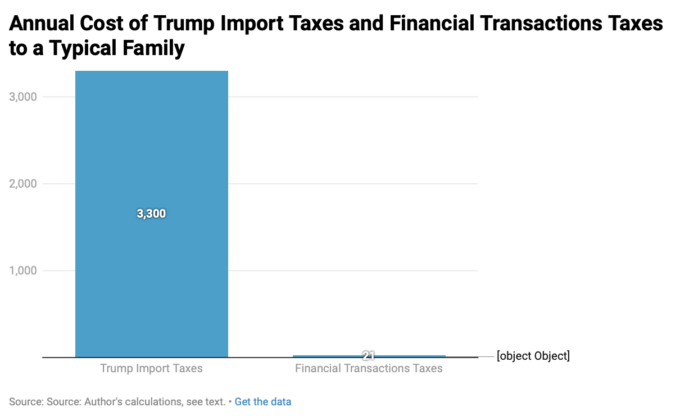

As can be seen, the burden of Trump’s import taxes is more than 150 times as large as the burden from a financial transaction tax on the median 401(k) holder. However, for some reason this burden does not appear to be a major obstacle to putting Trump’s import taxes into effect. Draw your own conclusions.

This first appeared on Dean Baker’s Beat the Press blog.

Dean Baker is the senior economist at the Center for Economic and Policy Research in Washington, 


The Abortion Wars Continue


 January 29, 2025
Facebook

Photo by Nathaniel St. Clair

“Mrs. Porsha Evette Ngumezi, 35 passed away at Houston Methodist Hospital in Sugarland, TX on June 12, 2023.” So reports the All Families Mortuary.

What the announcement did not report was that over the course of six hours the previous day Porsha had bled so much in the emergency department at Houston Methodist Sugar Land Hospital that she’d needed two transfusions.  According to a nurse’s notes, she was “passing large clots the size of grapefruit.” Her husband, Hope Ngumezi, called his mother, a former physician, who told them that, “You need a D&C.”  She recommended a “dilation and curettage” procedure because it is often given for first-trimester miscarriages or abortions for it could remove the remaining tissue from Porsha’s uterus and stop the bleeding.

Dr. Andrew Ryan Davis, the obstetrician on duty, informed the couple that it was hospital’s “routine” to give patients “misoprostol,” a drug to induce second trimester fetal death or termination of pregnancy and can also reduce the risk of stomach ulcers.  Hope later reported that he trusted the doctor and his wife took the pills.  But the bleeding continued, and Porsha died three hours later.

On June 24, 2022, the Supreme Court issued its Dobbs v. Jackson Women’s Health that overturned its landmark 1973 Roe v. Wade decision. One month later, on August 25th, Texas adopted “Chapter 170A” to its Health & Safety Code that “prohibits a person from performing, inducing, or attempting an abortion.”  Exceptions include when a patient’s life or major bodily function is at risk.  However, many doctors say they don’t know how to interpret that clause and, if they make the wrong call, they could face prison time, thousands of dollars in fines and loss of their medical license.

Porsha’s is the fifth case of a woman dying after they did not receive a D&C or its second-trimester equivalent; three of those deaths were in Texas.

In August 2024, Tabitha Crowe, a Florida resident, was visiting her parents in Louisiana, when she started miscarrying her first pregnancy.  She woke up one morning covered in blood and her parents drove her to the nearby LSU Health Lallie Kemp Medical Center hospital while she suffered ongoing blood loss in their car’s back seat.  After returning to her parents’ home, she again felt horrible pains and went to Lallie Kemp who transferred her to St. Tammany Parish Hospital Emergency Department because it was the closest hospital with an OB/GYN unit.

On the same day the Supreme Court issued its Dobbs decision, Louisiana began enforcing its “trigger ban” that prohibits abortion at all stages of pregnancy.  Its actions followed shortly after the Supreme Court issued its Dobbs decision in 2022 overturning Roe in 2022. And it was the first state to reclassify two abortion and miscarriage medications — mifepristone and misoprostol — as controlled substances, even though they haven’t been shown to cause addiction or dependence.

According to one report, “She [Crowe] was also (allegedly unbeknownst to her) administered misoprostol, a drug used to treat miscarriage that is also the second drug of the two-drug abortion pill regimen.”  Crowe said she passed baseball-sized blood clots and experienced extreme pain and dizziness in two different hospitals, while never being offered a common miscarriage procedure, a D&C.

“I had a sense it was because of the abortion laws, because by the time they did the canal sweep of blood clots, they didn’t even want to listen that I was in pain anymore. They were like, brushing it off, like, you’ll be fine,” Crowe said. “Even if them not doing it was wasn’t because of the abortion laws, I still didn’t get the treatment that I needed.”

“For me to have a miscarriage for the first time, it’s already a very scary process,” she said.   Crowe and her husband returned to their home state of Florida, where they went to the emergency room on Eglin Air Force Base where she said she was given a D&C. “You go to a hospital, you expect care, you expect some type of answers on what’s going on. And I didn’t get that.”

As Donald Trump takes office as president, Texas and Louisiana have been joined by 17 other states to ban abortion (e.g., Alabama, Arkansas, Idaho and South Dakota) or restrict the procedure earlier in pregnancy (e.g., 6 weeks for Georgia, Iowa and South Carolina) than was the standard of 24 weeks under Roe.

Some Christian conservatives have backed a nationwide ban on abortion.  During the 2024 presidential campaign Trump took numerous positions on a nationwide ban.  In some news conference he supported a ban after 20 weeks, in another he supported a 15-week ban.  However, in October, late in the campaign, he stated unequivocally his opposition to a nationwide abortion ban. “Everyone knows I would not support a federal abortion ban, under any circumstances, and would, in fact, veto it, because it is up to the states to decide based on the will of the their voters.” So, who knows what he will do?

As president, Trump can – as one source notes – invoke the 1873 Comstock law and “basically shut down almost all abortion care nationwide.”

On a second front, the Republican-controlled Congress can pass a national abortion ban that the president could sign. An indication of what might happened is suggested by the March 2024 report by the Republican Study Committee that endorsed a national abortion ban with zero exceptions for rape or incest.  The committed represents 100 percent of House Republican leadership and called for support for Life at Conception Act.  In addition, it called for eliminating reproductive freedom for all women in every state; calls for the end for In vitro fertilization (IVF) treatment; and the banning mifepristone.

Finally, the Supreme Court could decide that fetuses and embryos are persons under the 14thAmendment, thus override all state laws permitting abortions.  In 2020, Texas passed S.B. 8 (aka Texas Heartbeat Act) that banned abortions after six weeks of gestation.  In follow-up, in 2024, the Texas League of Women Voters in Amarillo promoted the “Sanctuary City for the Unborn Ordinance” that would outlaw abortions in the city’s limits.  Similar laws were adopted in Lubbock, Abilene and San Angelo.

However, the Supreme Court heard oral argument regarding Alliance for Hippocratic Medicine v. FDA, in which anti-abortion groups sought to overturn the FDA’s decisions approving the medical use of mifepristone.  On June 13, 2024, the Court ruled that the Alliance lacked Article III standing to challenge the FDA’s approval or rule making. The decision reversed the Fifth Circuit ruling and lifted the injunction.  Nevertheless, further efforts will likely follow.

So, sadly, the abortion wars continue.

David Rosen is the author of Sex, Sin & Subversion:  The Transformation of 1950s New York’s Forbidden into America’s New Normal (Skyhorse, 2015).  He can be reached at drosennyc@verizon.net; check out www.DavidRosenWrites.com


Frankfurt Airport: A Special Kind of Loathing


 January 29, 2025
Facebook

Photograph Source: Brücke-Osteuropa – CC0

It cuts against the grain of the Teutonic character.  Instead of steely no-nonsense efficiency, we see gross lethargy in moving people across terminals.  Instead of promptitude in offering advice to those desperately in need of it, we get inconsistent messages, errors and utterances of sheer ignorance.  This is the message from Frankfurt Airport, one of the industrialised world’s worst marked and governed aviation hubs.

The errors begin with a rather jaunty announcement by a cabin crew member that the flight from London is ahead of schedule.  “You will have plenty of time to make your connecting flight.  Take your boarding pass and head to the gate.  That is all you need to do.”  Sounds enchantingly simple.

The moment you touch down in the terminal, a bewilderingly poor set of signs start to manifest.  There is a confusing grouping of gates under letters, though these are arranged differently.  A, for instance, keeps company with Z.  Having left from a gate with B, the question is how to reach the relevant letter without making some dangerous detour into any number of intrusive, routine and frankly bizarre screening points for luggage through the airport.  It soon becomes clear that the fiends responsible for creating this airport intended constant screening to become an institution and a fetish.

One makes it through passport control without seemingly getting any closer to the relevant gate, a point not helped by the compressed, container quality of the halls.  Instead of having the liberating interiors of breathing and clarity offered in such airports as Singapore’s Changi or Bangkok’s Suvarnabhumi, we have sinister concentration and sclerosis.

The impression is worsened by various routine, if meaningless screening areas that are confusingly placed near exit gates, inviting people to offer their goods to be searched.  The mistake then dawns, and the baggage items, having been neatly spread out on trays, must be reclaimed.  “Hallo!” bellows a matronly battle tank, eager for battle and confrontation.  “Halt!” exclaims another.  Amidst the yacking and bellowing from this tribe of uniformed dolts, a member of the screening team with what seems to be subcontinental background inquires about the gate being sought.  On being told it is A26, a sadistic thrill is noticeable in his demeanour.

You won’t make it.

That cannot be.  We were told that it would be a smooth transfer to the flight for those with a boarding pass.

To go to A26, you need to go right out and take a train.  It will take so long you will miss the flight.  You could also walk.  That would be VERY long.

After this hideous revelation, which said more about the fellow’s colossal ignorance than it did about any accurate movement to the gate, the journey continues, with panic levels rising, and sweat beads forming.  The winter coats start to cloy and stick.  This is the clamminess of fear and abandonment, the sense that the machine will be there leaving the gate as you turn up, helplessly frustrated by the very airport in which, supposedly, there was a vast amount of time to make it.

The signs become more bewildering, and there is yet another airport screening to go through.  At this point, the Kafkaesque chill of bureaucratic idiocy and meaningless routine starts to manifest.  Naturally, it is mandatory for all such staff to be curt and rude.  Friendliness might be construed as weakness.  Passengers are constantly called back and told to resubmit to screening, even as the staff banter and muse about what their own children are up to, or the latest football results.  Patting of the body by the security personnel is particularly aggressive, almost to the point of being lecherous.  Luggage is left to clutter the lines in solemn regret.  Bags are routinely stopped to merely confirm what can already be seen on the X rays.  The queues swell with mechanical terror.

Another dreaded fork in the road was then reached.  This is where A26 might be in sight.  Time is now critically short, as the boarding of the flight to Zagreb has already begun.  At least, at this point, there is no suggestion that a train is required.  But to get to the gate entails taking a poorly marked side exit to a lift or going through passport control again.  Doing the latter would most certainly quash any real chance of making the flight.

When a humourless, burly airport staff member clearly cranky about his dinner was asked to clarify the right direction, the answer game with savage glee: “You have been in area A the whole time.”  In other words: take the lift.  The end is my beginning, and, with so much movement, so little had been gained.

The task now became one of rushing in winter shoes rather inadequate for the sprint.  The sweating became torrential, the hair shedding moisture liberally.  “Your gate is approximately 10 minutes away,” another, no doubt mendacious sign says on route.  In the faint distance, the ground staff and irritated crew are still waiting.  With the flight boarded, the drenched layers of jackets and overalls are peeled off.  And Frankfurt’s airport can be abominated for the horror that it is.

Binoy Kampmark was a Commonwealth Scholar at Selwyn College, Cambridge. He lectures at RMIT University, Melbourne. Email: bkampmark@gmail.com