Saturday, February 01, 2025


Historic Washington State Ferry Cheats Scrappers to Become Floating Office
Washington State Ferry
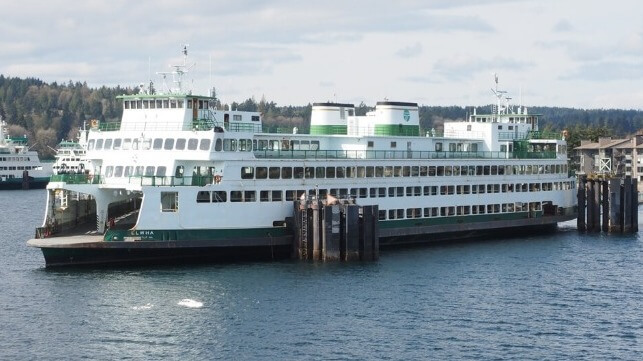
After a close call with scrappers, Elwha which was retired in 2020 will now be repurposed as a floating office and warehouse (Takeshita Kenji - CC BY-SA 3.0)

Published Jan 31, 2025 4:27 PM by The Maritime Executive


One of the storied ferries familiar to residents of Washington State for its more than 50 years of service is cheating the scrappers and by a quirk of fate will be saved through creative reuse.  Everett Ship Repair and Washington State Ferries have reached terms to see the Elwha, which was built in 1967, repurposed at the shipyard.

Last fall, Elwha, which had been retired in 2020, was due to slip away on a towline bound for dismantling in Ecuador. She had been sold for $100,000 and a tug arrived to start her final voyage along with another WSF ferry. They got the boats away from the maintenance dock in Bainbridge, Washington, but that’s when things started to go wrong.

According to reports the hookup failed. Then there were reports of problems with the 60-year-old tug that was hired for the 34-day trip. The ferries were brought back to the maintenance dock while rumors swirled in the media that the operator had abandoned the crew which was made up of people from Peru, Colombia, and Panama. U.S. Customs and Border Protection stepped in detaining the four crewmembers and ordering them deported.

Embarrassed by the ordeal, Washington State Ferries reported the deal was canceled. The ferry operator however wanted to sell the decommissioned vessels to free more dock space at its Eagle Harbor Maintenance Facility for planned and unplanned maintenance on its current fleet. They reported the two ferries were back up for sale.

Everett Ship Repair closed the deal this week to buy the Elwha for $100,000. According to the reports, the repair yard plans to modify and convert the ferry to a floating office and warehouse space. A tug was due to arrive on Thursday, January 30, to begin preparation to move the ferry to the shipyard.

“The Elwha has been part of Washington State Ferry history since 1968, and we're excited to see one of our ferries with so much history and memories for millions of passengers is being repurposed locally. It won't be the Elwha we've all come to know and appreciate, but I'm confident it's in good hands with a local shipyard,” said WSF Assistant Secretary Steve Nevey.

She was one of four 144-car Super-class ferries. It measures 382 feet and is 2,800 gross tons and when she was introduced, Elwha was considered to be one of the most modern ferries in service. She started service from Seattle to Bainbridge but was replaced by a larger ferry in 1972. Next, she was used to fill in on various routes for other ships that were undergoing maintenance and finally in the 1980s took up her permanent assignment sailing to British Columbia. She became a fixture of the route before her retirement. Two other ships of the class, Kaleetan and Yakima, are still in service.

After sitting at the repair facility, WSF was anxious to make space. They sold Elwha and a smaller ferry last year and reported that another retired ferry was also slated to be sold. The near-miss with the scrappers was not the only close call for Elwha during her long career. She went aground in 1983, with reports her captain steered off course to give a visitor a better view of her waterfront home reports the outlet MyNorthwest. In 1990, the ferry broke away from her dock in a storm and was damaged as she slammed into a concrete pier. There were also reports of several docking failures and problems during its career.

Washington State Ferries reports it plans to offer two other retired ferries, Klahowya and Hyak, for sale to clear more space at its repair yard. Klahowya was built in 1958 and is an 87-car Evergreen State-class ferry that was decommissioned on July 1, 2017. Hyak is a sister to Elwha that was decommissioned on June 30, 2019.

Top photo: Takeshita Kenji - CC BY-SA 3.0


Royal Caribbean’s Second-Generation Innovator Departs for Scrap
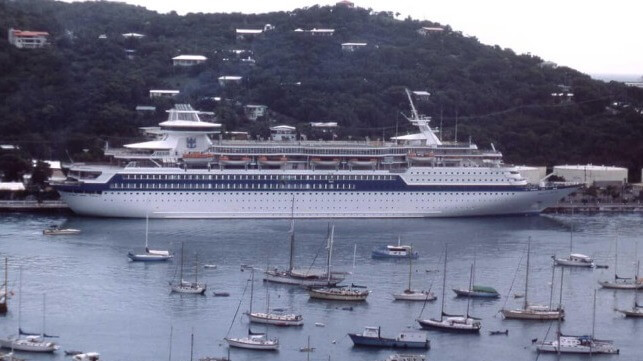
Song of America cruise ship
Song of America introduced in 1982 was one of the largest cruise ships in the industry (Allan Jordan)

Published Jan 31, 2025 11:33 AM by The Maritime Executive


Another of the last survivors from the second generation of the modern cruise ship era and a pioneer for Royal Caribbean Cruise Line has quietly slipped away on her final voyage. Introduced in 1982 as the Song of America (37,500 gross tons), she was one of the largest cruise ships in the world and an innovator that would see 40 years of service first in the American market, later in Europe, and finally in the Greek Islands.

She had been retired in 2023 by her last owner, Greece’s Celesytal Cruises which had operated her for 11 years with her final name of Celestyal Olympia. She was sold in early 2024 to a flag of convivence company which renamed her Bella Fortuna and shortly after she departed for an anchorage off the UAE flying the flag of Liberia. It is often a way stop on a one-way trip to be recycled while getting the ships outside the European Union and the restrictions on licensed scrappers.

As of the first of the year, the cruise ship’s name was shortened to Fortu and her flag moved to Comoros. She departed the UAE on January 22 with her status listed in the databases as “to be broken up.” She is bound it appears to beaches of India’s infamous Alang.

When she was introduced in 1982, Royal Caribbean boasted that she was state-of-the-art. In the first preview brochure for consumers released in 1981, they wrote, “Every innovative maritime feature, every one of ‘tomorrow’s’ cruise concepts, will be part of Song of America today.” The company had gone into business a decade earlier the brainchild of an American entrepreneur Edwin Stephan with investments from Norway’s Wilhelmsen and I. M. Skaugen, and later Gotaas-Larsen. The first ships were 18,500 gross tons and embodied Stephan’s vision of “propelled hotels.”
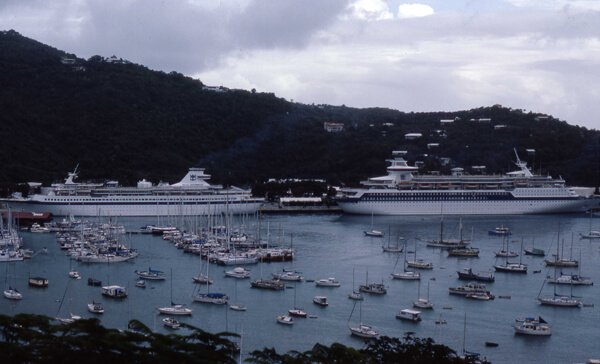
 

Royal Caribbean first two generations: Nordic Prince (left) after the 1980 stretch and Song of America (right) (Allan Jordan photo)


Royal Caribbean was growing rapidly like all the cruise lines in the 1970s but had fallen behind Carnival Cruise Lines which converted a liner into the 38,000 gross ton Festivale and Norwegian Caribbean Lines which converted the superliner France, the longest passenger ship in the world, into the 70,000 gross ton ss Norway. First to increase capacity, Royal Caribbean stretched two of its ships but instead of rebuilding its third smaller ship, turned to the famed Wartsila shipyard in Finland to build what became Song of America.

The new ship was 705 feet in length with accommodations for 1,400 passengers and 500 crew. Externally she was sleek and advanced designs including taking the cantilevered lounge on the ship’s funnel by making it larger, with an interior entrance and elevator, and wrapped fully around the funnel. She used the design concept of “vertical separation” that places the public spaces and lounges aft and cabins mostly forward. She also innovated with a half (tween) deck of cabins in front of the extra-height main lounges. Passenger cabins however were still the small, standardized box Stephan had envisioned to encourage passengers to spend their time on deck or in the bars and lounges. (There was no casino in 1982, only a handful of slot machines placed in a discreet hallway.)

Keeping with a Royal Caribbean style her public spaces were all named from Broadway shows. The lounges were Can Can, Oklahoma, and Guys and Dolls, while the dining room was Madame Butterfly. She took over the “milk run” as the weekly cruises from Miami to Nassau, San Juan, and St. Thomas were known and was an instant success due to her comforts. 
 
Song of America was part of the second generation of modern cruise ships all of which were around 40,000 gross tons and had accommodations for 1,000 or more passengers. They were larger than the first generation introduced in the late 1960s and provided a stepping stone to larger and finally the mega cruise ships of today.

The ship was christened by renowned American opera singer Beverly Sills, and on her maiden voyage the passenger list included former U.S. President Jimmy Carter and his wife Rosalyn. Just six years later, Song of America would be eclipsed by Royal Caribbean’s new 70,000 gross ton Sovereign of the Seas, but she remained a workhorse for the company. She was also among the company’s first ships to homeport beyond Miami.
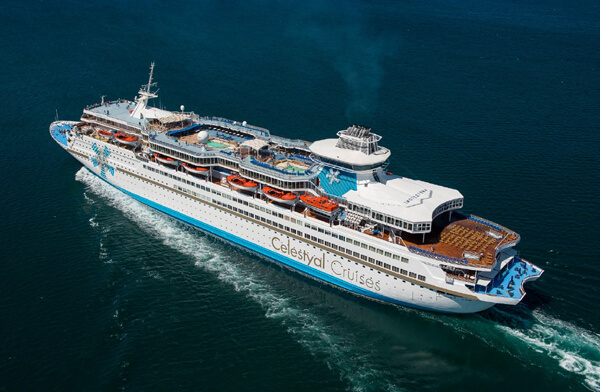
 

Remarkably unchanged she spent her last decade in the Greek islands as Celestyal Olympia (Celestyal Cruises)


Song of America left Royal Caribbean after just 17 years. She went to a UK operator and was renamed Sun Bird. She helped to build the UK market before being sold to the Cypriot firm Louis Cruises. Instead, she would sail on charter to another British firm Thomson Holidays as the Thomson Destiny. As part of the TUI family, Thomson evolved into Marella Cruises but before the transition seeking to modernize the fleet the now 30-year-old cruise ship was returned to her owners. She became the Louis Olympia and later Celestyal Olympia when the company was rebranded. She cruised the Greek Islands in the summer and spent winters in layup.  

Remarkably unchanged since her introduction in 1982, she was finally retired late in 2023. She had outlived most of the second and even the third generation of modern purpose-built cruise ships. With her goes the link to the heady days of growth, but before cruise ships had water slides and water parks or any of the modern amusements. Passengers lounged in the sun by day, saw a floor show or a movie in the evening, and enjoyed their time at sea. She was a pioneer and then a throwback to the simpler, earlier days of cruising.


 ECOCIDE

Two Sunken Tankers at Kerch Strait Were Refueling Russia's Dark Fleet

The stern section of Volgoneft-239 aground in the Kerch Strait (Morspas)
The broken-off stern section of Volgoneft-239, aground in the Kerch Strait (Morspas)

Published Jan 30, 2025 8:36 PM by The Maritime Executive


The two river-sea tankers that broke up near the Kerch Strait last month were part of a flotilla that bunkers Russia's "dark fleet," including at least three U.S.-sanctioned deep sea tankers, according to Russian investigative news outlet IStories. Many of their sister ships continue in the same trade today, and many are operating beyond the limits outlined in their registration papers, documents obtained by the outlet suggest

Volgoneft-212 and -239 were built between 1969 and 1973, produced under a major Soviet construction program that delivered hundreds of ships for the Black Sea-Volga "river-sea" tanker and freighter fleet. Both broke up in a storm on December 15, spilling an estimated 2,000-3,000 tonnes of bunker fuel into the Black Sea. Cleanup efforts are still under way. 

"The problem with the Volgoneft type vessels has been known for a long time. These vessels are declared as 'river-sea' class, but in fact in Soviet times they were used for river shipping, at most with an exit to the bay at the river mouth. They were not intended for full-fledged sea shipping," said Yuri Kurnakov, chairman of Russia's Marine Trade Union, in an interview in December. 

In 2013, Russian Marine Engineering Bureau director Gennady Egorov published a technical review of the class' design and its maintenance challenges. The Soviet naval architects who designed the Volgoneft tanker fleet relied on a mix of standard plate and thinner, higher-strength steel to reduce weight for the shallow-draft riverine vessels, increasing their cargo capacity but creating areas that were prone to serious cracking. All of these ships have spent 50 years or more transiting through a series of locks on the Volga, and after decades of contact with fendering, their hull plating is deeply indented between the scantlings. In a refit program in the 2010s, a few of these tankers had the entire cargo section cropped out and replaced due to corrosion and cracking - everything between the pump room and the forepeak bulkhead.

"In the long term, ensuring sustainable safe transportation of oil and oil products on tankers of mixed river-sea navigation is possible only through new shipbuilding," concluded Egorov, writing 12 years ago. 

According to IStories, these aging riverine tankers are now employed to transport thousands of tonnes of bunker fuel from Russian refineries to a transshipment zone off Kavkaz, at the southern entrance to the Kerch Strait. There, they rendezvous with dark fleet tankers or - more often - with a designated storage and offloading tanker, identified as the Firn (ex name SCF Caucasus). The fuel carried by the Volgoneft fleet helps Russia's sanctions-busting oil export tankers to keep moving, according to IStories, including the dark fleet vessels Triumph, NS Spirit, Utaki, Beks Iron and Sezar. In all, an estimated 660,000 tonnes of bunker fuel moved from refineries to "shadow fleet" vessels aboard the Volgoneft fleet over the last year, the outlet concluded. 

Triumph and NS Silver are both under U.S. sanctions. In addition, Firn has transloaded bunker fuel from the Volgoneft fleet onto at least one other sanctioned tanker, the Mum.  


Ørsted Ousts CEO as Pressure Continues in Offshore Wind Sector

Orsted
Orsted continues to face challenges in its offshore wind portfolio and other renewable projects

 (Orsted)

Published Jan 31, 2025 6:16 PM by The Maritime Executive


Danish renewable energy giant Ørsted reported today, January 31, a change in CEOs as the company continues to struggle with pressures in the offshore wind sector. The news of the change in leadership came just days after Ørsted reported it would be taking a further $1.7 billion in impairment charges related to its U.S. offshore wind projects following a massive $5.6 billion write-down in November 2023.

The board of directors announced that the company was replacing Mads Nipper who had led the company as Group President and CEO since January 2021. They reported he is stepping down effective tomorrow, February 1, but acknowledged during his four-year tenure Ørsted’s installed renewable capacity grew from 11.3 GW to the current 18.2 GW in 2025.

“The renewable energy market has fundamentally changed since January 2021. The impacts on our business of the increasingly challenging situation in the offshore wind industry, ranging from supply chain bottlenecks, interest rate increases, to a changing regulatory landscape, mean that our focus has shifted. Therefore, the board has today agreed with Mads Nipper that it’s the right time for him to step down, and the board has appointed Rasmus Errboe to take over as CEO,” announced Lene Skole, Chair of Ørsted’s Board of Directors.  

Analysts highlighted that Ørsted has lost more than 80 percent of its market value from its peak. In 2021, the stock was trading at nearly $75 a share making the company worth nearly $100 billion while today the shares closed at $12.82 giving the company a market value of just $15 billion.

Despite the significant write-down charges due to the impairment of assets, Ørsted issued preliminary 2024 results reporting an operating profit (EBITDA) for 2024 of $3.5 billion. However, it said that would be after a $1.7 billion charge due to long-dated U.S. interest rates, reduced value of its subsea leases located off the coasts of New Jersey, Maryland, and Delaware, and mounting construction costs and delays for Sunrise Wind, located in the New York Bight, which is following Revolution Wind, located off Connecticut and Rhode Island, into construction.

Nipper called the challenges “very disappointing” while saying the company remained committed to the U.S. market. The 2023 charges were due to the decision to pull out of two late-stage planned large wind farm projects off the coast of New Jersey. The 2023 charges led to the ouster of the group’s Chief Financial Officer Daniel Lerup and its Chief Operations Officer Richard Hunter.

The company has continued to realign its global portfolio but just this week announced it was proceeding with the construction of the largest wind farm in the Baltic. Other disappointments included the shelving in August 2024 of an ambitious methanol production plant which would have been a supplier to the shipping industry,

The new CEO, Rasmus Errboe, joined the company in 2012 and became Deputy CEO and Chief Commercial Officer after the reorganization in 2023. 

Speaking about Errboe, board chair Skole said, “As our Deputy CEO and CCO, and former Regional Head of our European market and former CFO for the global offshore business, he has a deep understanding of our business and an extensive knowledge of the energy industry. I’m therefore convinced that Rasmus is the right person to lead the company through the challenges facing the industry and Ørsted.”

Before being appointed Deputy CEO and Chief Commercial Officer, Rasmus Errboe held the positions of Interim Group CFO, Regional Head of Europe, Regional Head of Continental Europe, CFO for the Offshore business unit globally, and Head of Ørsted’s Group M&A department, and he was overall responsible for the IPO of Ørsted in 2016 and the divestment and carve-out of Ørsted’s Oil & Gas business in 2017.

Ørsted emerged as the successor to the former Danish Oil and Natural Gas as the focus shifted from fossil fuels to renewables. The company is majority-owned by the Danish government. In late December 2024, it was announced that Equinor, the Norwegian state energy company, had increased its ownership stake to 10 percent of Ørsted.

The company is scheduled to publish its annual report for 2024 on Thursday, February 6. It will be hosting a presentation to analysts and investors.


Norway Releases Reefer Cargo Ship After Investigation into Cable Damage

Norwegian reefer cargo ship
Norwegian-owned reefer cargo ship was brought to port as part of the investigation into cable damage (Fjord Shipping Management)

Published Jan 31, 2025 10:52 AM by The Maritime Executive


Norwegian authorities late on Friday, January 31, reported they have released a Norwegian-owned reefer cargo ship used in the fish trade after a day-long investigation. It was the latest vessel to be detained in the growing investigations into damaged cables in the Baltic. Norwegian police confirmed in a briefing this morning that they had directed the vessel, the Silver Dania, into the port of Tromsø and were aboard searching the vessel and interviewing the Russian crew.

The police reported that they were acting on a court request from Latvian authorities which made the application to Norway to stop the vessel and launch the investigation. Speaking at a press briefing on Friday, January 31, the Troms Police District said it had responded to the court order while noting the vessel is one of several currently being investigated.

Latvia suspected the Norwegian ship may have had a role in the damage discovered on Sunday, January 26, to a fiber optic cable owned by Latvia’s state radio and TV company. The cable runs between Ventspils, Latvia and the Swedish Gotland island. Sweden earlier in the week also detained a Bulgarian-owned bulker Vezhen accusing the vessel of dragging its anchor and damaging the cable.

"Troms police district has now conducted a number of investigative steps and secured what we see as necessary considering the request from Latvia. The investigation will continue, but we see no reason for the ship to remain in Tromsø any longer. No findings have been made linking the ship to the act," said police attorney Ronny Jørgensen in Troms police district.

The Silver Dania is a 5,300 dwt reefer cargo ship built in 1989 and operating at least since 2019 for the Norwegian company Silver Sea. The vessel is registered in Norway and is operated by a crew of 11 Russian nationals. Silver Sea started in 2000 and operates a fleet of 11 reefer vessels as well as support ships and two Arctic containerships.

The Norwegian police reported that a Norwegian Coast Guard vessel intercepted the cargo ship Thursday night while it was sailing along the northern Norwegian coast. They said it was on a trip from St. Petersburg to Murmansk. Friday morning, the Norwegian Coast Guard vessel KV Bison escorted the Silver Dania to a dock in Tromsø.

The owner of Silver Sea Tormod Fossmark was quick to make a statement denying any involvement in the cable incident. He asserted the vessel was sailing at a constant speed of 13 knots near Gotland and did not drop its anchor. He said the crew was well-known to the company and had been working for it for years.

Fossmark told the Norwegian media, “We did nothing wrong. The Norwegian authorities have brought us into port to clear up any involvement.”

The police commander during a briefing confirmed that the vessel and crew were cooperating and had come into port voluntarily. He said the police were aboard to search the ship, conduct interviews, and secure any clues to the activity.

The Baltic countries remain on heightened alert and with the support of NATO increased their patrols to guard vital undersea infrastructure. This is at least the fourth recent incident involving damage to undersea cables. 


Video: Massive Fire Damages Shipyard in Egypt

shipyard fire
Egyptian shipyard was damaged by an intensive fire (YouTube)

Published Jan 31, 2025 1:17 PM by The Maritime Executive


[Brief]  A massive fire broke out overnight in one of the Egyptian shipyards south of the Suez Canal. According to local media reports the yard area that was damaged by the fire was used for fishing boats and pleasure craft.

The fire began late on Thursday, January 30, and burned for approximately six hours. Teams from the Suez Governorate responded but according to the reports, the efforts were hampered by the flammable materials used in the shipyard.


Pictures and videos show intense flames in the yard area destroying multiple boats. The shipyard is located in the Adabiya area near the southern entrance of the Suez Canal. 

Authorities are reporting that there were no facilities but three people were taken to the hospital for treatment. At least 10 fishing boats and pleasure craft were destroyed in the fire.

Teams were continuing to search the area and working to determine the cause of the fire and why it spread so quickly.


Fire Cleanup Underway as Blaze Continues to Smolder in Bulker’s Cargo Hold

bulker
Blaze was reproted bruning in one of the bulker's cargo holds

Published Jan 31, 2025 6:53 PM by The Maritime Executive


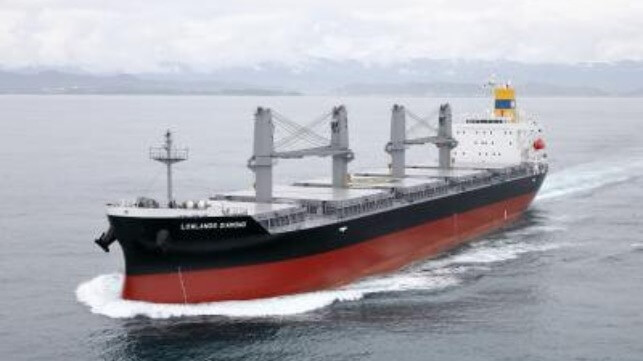
Fire crews at the Port of Aberdeen in Scotland have spent several days battling a cargo hold fire aboard a Panama-flagged bulker docked in the port. The ship and the port are reported to be in no immediate danger as several fire departments and specialist teams worked to extinguish the blaze.

The Japanese-owned bulker Lowlands Diamond, a Handymax bulker (39,996 dwt) reported the fire to the local authorities on Monday, January 27, as the ship was making its way to the South Harbor at the Port of Aberdeen. Local media showed pictures of multiple fire engines alongside on the dock assisting with the stubborn fire.

A spokesperson for the fire department said the blaze was contained to a cargo hold on the vessel which was built in 2023. She is approximately 600 feet (183 meters) in length and was reported operating under a time charter to Coblefret.


Fire officials did not report what was burning but said it was a “complex and unusual” operation that they expected would last for days. They later said it would require removing the burning cargo from the hold. 

The local Press & Journal newspaper today published pictures of boxes or bales saying it was “charred cargo” from the vessel. It was cordoned off by a ring of shipping containers. Another report said there were “heaps of burnt cargo being removed from the vessel.”

The Port of Aberdeen issued a statement saying it was coordinating with the fire teams and thanked them for their effort. They reported operations at the South Harbor had not been disrupted by the fire.


Canada Aims to Restore Reliable Ferry Service on Critical Route to PEI

Canadian ferry Northumberland
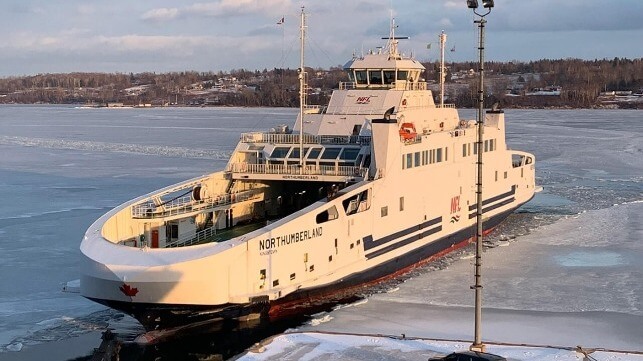
Northumberland reached Nova Scotia this week promising better service for the 2025 ferry season (Transport Canada)

Published Jan 31, 2025 8:02 PM by The Maritime Executive


Canada is hoping to restore reliable ferry transport on the critical Prince Edward Island (PEI) and Nova Scotia route following the arrival of ro/pax ferry MV Northumberland. The government acquired the ferry in November 2023 as an interim replacement for the former MV Holiday Island which was taken out of service after a fire in July 2022.

The 130-meter (426-foot) Northumberland, formerly MV Fanafjord, arrived in Pictou, Canada on the north shore of Nova Scotia on January 26 after a 5-week trip from Norway.  The Canadian Coast Guard sent a notice that it would be conducting ice-breaking operations around Pictou to make it possible for the ferry to complete the last miles of its trip.

The vessel is expected to undergo final refit work before commencing service at the beginning of the 2025 operating season. The 2007-built ferry with a capacity of 600 passengers and 180 vehicles will serve on the critical route that has been experiencing challenges since the Holiday Island engine room fire.

The federal government purchased Fanafjord for C$38.6 million (US$27 million) after it faced strong pressure to restore reliability on the PEI and Nova Scotia route. The ferry, which will be operated by Northumberland Ferries Limited, will serve on the route until a successor for Holiday Island is built and ready to enter service in 2028. Holiday Island was one of two vessels used to provide service on the route, the second ferry being MV Confederation.

Confederation plowed into a pier on Prince Edward Island in September 2024 causing a dent and structural damage. The operator Northumberland Ferries later blamed a mechanical failure reporting the visor needed repairs that would require several months. It was hoping to place the vessel back in service by December before the route closed for the winter. After the accident with Confederation, the company was down to just one ferry running four trips a day but then in September MV Saaremaa, leased from Quebec's ferry service, started having unending engine problems. 

The PEI and Nova Scotia ferry route is considered an essential transportation link that supports the regional economy and provides employment for approximately 200 people. The route contributes about C$39 million (US$27 million) to the regional economy annually. During the summer months, both are popular tourist destinations.

“After an extremely disappointing season, I’m so pleased to see the MV Northumberland arrive in Canadian waters,” said Lawrence MacAulay, Minister of Agriculture. “Our government fully understands the importance of a safe, reliable two-vessel ferry service, and we are committed to restoring this vital transportation link for all of the families, local businesses, and tourism operators who depend on it.”

The government’s acquisition of Northumberland falls under its Ferry Services Contribution program which ensures that federally-owned ferry assets are part of a safe, reliable, and affordable transportation system. Through the program, the government provides funding to private operators for ferry operations and maintenance. Currently, the government owns four ferry vessels and six shore facilities that are leased to operators.   

After the repeated mishaps, the federal government called Northumberland’s frequent service problems unacceptable. The day after the new ferry arrived in Canada, the press reported the government had ordered an audit of the company. Transport Canada has published a request for an independent company to commence the audit.

The company was established in 1941 to provide the critical ferry service. The route to Prince Edward Island is due to resume in May 2025 for the summer season. The company with its sister brand Bay Ferries also maintains service from Nova Scotia to New Brunswick and to Maine.


New diagnostic tool will help LIGO hunt gravitational waves


Machine learning tool developed by UCR researchers will help answer fundamental questions about the universe


University of California - Riverside


RIVERSIDE, Calif. -- Finding patterns and reducing noise in large, complex datasets generated by the gravitational wave-detecting LIGO facility just got easier, thanks to the work of scientists at the University of California, Riverside. 

The UCR researchers presented a paper at a recent IEEE big-data workshop, demonstrating a new, unsupervised machine learning approach to find new patterns in the auxiliary channel data of the Laser Interferometer Gravitational-Wave Observatory, or LIGO. The technology is also potentially applicable to large scale particle accelerator experiments and large complex industrial systems.

LIGO is a facility that detects gravitational waves — transient disturbances in the fabric of spacetime itself, generated by the acceleration of massive bodies. It was the first to detect such waves from merging black holes, confirming a key part of Einstein’s Theory of Relativity. LIGO has two widely-separated 4-km-long interferometers — in Hanford, Washington, and Livingston, Louisiana — that work together to detect gravitational waves by employing high-power laser beams. The discoveries these detectors make offer a new way to observe the universe and address questions about the nature of black holes, cosmology, and the densest states of matter in the universe.

Each of the two LIGO detectors records thousands of data streams, or channels, which make up the output of environmental sensors located at the detector sites. 

“The machine learning approach we developed in close collaboration with LIGO commissioners and stakeholders identifies patterns in data entirely on its own,” said Jonathan Richardson, an assistant professor of physics and astronomy who leads the UCR LIGO group. “We find that it recovers the environmental ‘states’ known to the operators at the LIGO detector sites extremely well, with no human input at all. This opens the door to a powerful new experimental tool we can use to help localize noise couplings and directly guide future improvements to the detectors.”

Richardson explained that the LIGO detectors are extremely sensitive to any type of external disturbance. Ground motion and any type of vibrational motion — from the wind to ocean waves striking the coast of Greenland or the Pacific — can affect the sensitivity of the experiment and the data quality, resulting in “glitches” or periods of increased noise bursts, he said. 

“Monitoring the environmental conditions is continuously done at the sites,” he said. “LIGO has more than 100,000 auxiliary channels with seismometers and accelerometers sensing the environment where the interferometers are located. The tool we developed can identify different environmental states of interest, such as earthquakes, microseisms, and anthropogenic noise, across a number of carefully selected and curated sensing channels.”

Vagelis Papalexakis, an associate professor of computer science and engineering who holds the Ross Family Chair in Computer Science, presented the team’s paper, titled “Multivariate Time Series Clustering for Environmental State Characterization of Ground-Based Gravitational-Wave Detectors,” at the IEEE's 5th International Workshop on Big Data & AI Tools, Models, and Use Cases for Innovative Scientific Discovery that took place last month in Washington, D.C.

“The way our machine learning approach works is that we take a model tasked with identifying patterns in a dataset and we let the model find patterns on its own,” Papalexakis said. “The tool was able to identify the same patterns that very closely correspond to the physically meaningful environmental states that are already known to human operators and commissioners at the LIGO sites.”

Papalexakis added that the team had worked with the LIGO Scientific Collaboration to secure the release of a very large dataset that pertains to the analysis reported in the research paper. This data release allows the research community to not only validate the team’s results but also develop new algorithms that seek to identify patterns in the data.

“We have identified a fascinating link between external environmental noise and the presence of certain types of glitches that corrupt the quality of the data,” Papalexakis said. “This discovery has the potential to help eliminate or prevent the occurrence of such noise.”

The team organized and worked through all the LIGO channels for about a year. Richardson noted that the data release was a major undertaking. 

“Our team spearheaded this release on behalf of the whole LIGO Scientific Collaboration, which has about 3,200 members,” he said. “This is the first of these particular types of datasets and we think it’s going to have a large impact in the machine learning and the computer science community.”

Richardson explained that the tool the team developed can take information from signals from numerous heterogeneous sensors that are measuring different disturbances around the LIGO sites. The tool can distill the information into a single state, he said, that can then be used to search for time series associations of when noise problems occurred in the LIGO detectors and correlate them with the sites’ environmental states at those times.

“If you can identify the patterns, you can make physical changes to the detector — replace components, for example,” he said. “The hope is that our tool can shed light on physical noise coupling pathways that allow for actionable experimental changes to be made to the LIGO detectors. Our long-term goal is for this tool to be used to detect new associations and new forms of environmental states associated with unknown noise problems in the interferometers.”

Pooyan Goodarzi, a doctoral student working with Richardson and a coauthor on the paper, emphasized the importance of releasing the dataset publicly. 

“Typically, such data tend to be proprietary,” he said. “We managed, nonetheless, to release a large-scale dataset that we hope results in more interdisciplinary research in data science and machine learning.”

The team’s research was supported by a grant from the National Science Foundation awarded through a special program, Advancing Discovery with AI-Powered Tools, focused on applying artificial intelligence/machine learning to address problems in the physical sciences. 

Richardson, Papalexakis, and Goodarzi were joined in the research by Rutuja Gurav, a doctoral student working with Papalexakis; Isaac Kelly, a summer undergraduate REU student; Anamaria Effler of the LIGO Livingston Observatory; and Barry Barish, a UCR distinguished professor in physics and astronomy.

The University of California, Riverside is a doctoral research university, a living laboratory for groundbreaking exploration of issues critical to Inland Southern California, the state and communities around the world. Reflecting California's diverse culture, UCR's enrollment is more than 26,000 students. The campus opened a medical school in 2013 and has reached the heart of the Coachella Valley by way of the UCR Palm Desert Center. The campus has an annual impact of more than $2.7 billion on the U.S. economy. To learn more, visit www.ucr.edu.