Saturday, February 01, 2025

Kazakhstan's Ambitious Nuclear Energy Plans Face Public Scrutiny

By Eurasianet - Jan 31, 2025


Kazakhstan is accelerating its nuclear power program, with plans for at least two nuclear power plants to support economic growth and address energy shortages.

The government aims to create a "nuclear cluster" in the country, but public concerns remain about the potential involvement of Russia's Rosatom and safety standards.

Alongside nuclear power development, Kazakhstan is also launching a fracking project to extract shale oil, expecting to produce its first shale oil this year.


Following up on last year’s referendum that endorsed the pursuit of nuclear energy in Kazakhstan, the government is moving quickly to lay the groundwork for at least two reactors. President Kassym-Jomart Tokayev has expressed a desire to eventually construct a “nuclear cluster” in the country to power economic growth.

The government is working to finalize an agreement on the construction of an initial nuclear plant in the Almaty region “in the near future,” according to a report published by the Kazakh news outlet Vlast.kz, citing Prime Minister Olzhas Bektenov. Preliminary work is being performed to identify a second site for a nuclear plant, Bektenov added during a January 28 government session.

In a major policy speech on January 28, Tokayev indicated that Kazakhstan’s ability to sustain economic growth depends on the construction of even more plants.

“Our strategic course on achieving carbon neutrality remains unchanged. However, its implementation should be approached more rationally. We need to effectively use our natural wealth and natural advantages,” Tokayev stated, adding that at present the country is heavily dependent on coal-fired power plants.

“Against the background of a growing energy deficit, the construction of the first nuclear power plant should be accelerated and, in general, the creation of a nuclear cluster in the country should be started. This is an important task to ensure the progress of our country,” Tokayev stated.

A majority of Kazakhs approved a referendum question last autumn on the construction of a nuclear power plant. The question that remains open is who will build the plants envisioned by the government. There is widespread public concern that Russia’s nuclear agency, Rosatom, will get the construction contracts, despite worries about the Russian firm’s spotty record of adherence to safety standards.

Although Kazakhstan may be embracing nuclear energy, the country is not de-emphasizing natural resource extraction: Bektenov announced January 28 that the country will launch a fracking project to extract shale oil.

“This year, the first Kazakh shale oil is expected to be produced. This will create additional incentives to attract investments to the oil and gas industry,” Bektenov announced. Initial estimates peg the potential fracking production total at roughly 800 million tons in oil equivalent.

By Eurasianet.org
IRAQI  KURDISTAN

BP’s High-Stakes Return to Kirkuk


By Shahriar Sheikhlar - Jan 31, 2025


bp is set to return to Kirkuk’s oil sector in February 2025.

This deal could strengthen both bp’s position in Iraq and Prime Minister Al-Sudani’s political standing.

Challenges remain, including security threats, export infrastructure uncertainties, and regional geopolitical tensions.


The history of the British Petroleum Company (bp) in Kirkuk and Iraq can be traced back to the 1920s, when the company—later named BP—spearheaded the operations of locating, exploring, producing, and exporting crude oil from Baba Gurgur in Kirkuk, which was considered the world's largest oilfield at the time. The exploitation of Kirkuk's oil lasted until the early 1970s, when the then-Iraqi government nationalized the crude oil industry after a decade of challenges.

Following the 2003 invasion of Iraq by U.S. alliances, bp's presence in Iraq resumed with a major stake in the Rumaila oilfield contract. Subsequently, the company signed a $100 million agreement with Iraq's North Oil Company (NOC) to study Kirkuk's oil fields. However, this agreement was not renewed beyond 2019 due to what bp claimed was "below expectations ... at least for us." This perspective was linked at the time to the lack of export opportunities for Kirkuk's oil, particularly in light of the 2017 conflict between Iraq and the Iraqi-Kurdish region. This conflict stemmed from the Kurdish Regional Government's (KRG) push for independence, which led to the Iraqi military's intervention to reclaim control of Kirkuk and other disputed areas from the Kurdish Peshmerga forces.

In a recent update, it was revealed that bp will officially sign a deal for its third involvement in Kirkuk's oil sector in the first week of February 2025. Meanwhile, Kurdistan's oil exports remain halted due to a ruling by the Paris Arbitration Court of the International Chamber of Commerce (ICC) in March 2023. Responsibility for the Kurdish region’s oil exports is now under the control of Iraq's state-owned company SOMO, which supports the previous argument about bp's withdrawal from Kirkuk in 2020.

Even though bp had previously downplayed Kirkuk's oil reserves in 2020, its decision to return could face geopolitical and geo-strategic challenges.

Kirkuk: A Disputed Area with Huge Oil Reserves

Kirkuk is one of Iraq’s disputed regions, beyond the control of the Kurdistan Regional Government (KRG) and subject to Article 140 of the Iraqi Constitution, a claim consistently asserted by Kurdish leaders over the past two decades.

The governance of Kirkuk province has also been a point of internal Kurdish conflicts, particularly between the KDP and PUK. At times, securing control over Kirkuk has required alliances with non-Kurdish entities, as seen in the 2024 power shift when the PUK reclaimed the governorship after a seven-year tenure.

Furthermore, Kirkuk holds one of Iraq's largest oil and gas reserves, estimated at over 9 billion barrels of oil and billions of cubic feet of associated and natural gas. The province also boasts a refining capacity of approximately 200,000 barrels per day.

These resources, combined with its diverse demographics, underscore Kirkuk’s strategic importance in Iraq’s modern history, dating back to the 1920s.
bp in Kirkuk: Impacts, Internally and Regionally

bp's return to Kirkuk through a new contract with the Iraqi government could bring mutual benefits. The deal is expected to be profitable for the oil company while also carrying geopolitical significance for the government.


A reliable source familiar with the negotiations stated that the agreement includes profit-sharing provisions if production reaches 1 million barrels per day (bpd). Given that Kirkuk’s production capacity was around 1.5 million bpd in the 1970s, this goal seems achievable—though damages caused by reinjecting excess fuel oil and sediments into Kirkuk's wells could lead to serious operational challenges and increased extraction costs.

The new contract structure appears more attractive to major technology companies like bp, as opposed to the Technical Service Agreement (TSA) previously used by the Iraqi government.

Both parties stand to strategically benefit from this deal.

The giant oil company bp will regain access to the Kirkuk oil fields after years of absence, while the Iraqi federal government and Prime Minister Al-Sudani will leverage this deal to strengthen their political standing ahead of elections.

This agreement, alongside Al-Sudani’s recent deals with U.S. and Western companies, suggests that he may have secured Western support for his political future, despite lacking the religious influence of some competitors.


Additionally, achieving over 1 million bpd in Kirkuk could strengthen Iraq’s position in negotiations with the KRG, particularly regarding oil exports and federal budget allocations.

From a regional perspective, expanding Iraq’s northern and western oil production could enhance its export capacity through routes such as:The Kirkuk-Ceyhan pipeline (Turkey)
A potential restoration of the Kirkuk-Syrian Banias pipeline
The Iraqi-Jordanian Aqaba pipeline

This could further boost Iraq’s geopolitical leverage and reinforce its role in OPEC and OPEC+, particularly in addressing global energy security challenges affecting Western nations and China.

In conclusion, bp's reemergence in Kirkuk, as part of Al-Sudani's ambitious agenda for his upcoming tenure in governing the Iraqi cabinet, could present significant challenges to both the oil company and Al-Sudani's belief in the future of the country's political environment. The forthcoming months are likely to offer greater clarity on the power struggles among Shiaa parties in anticipation of the upcoming elections, the dynamics within Kurdish factions, and the regional reactions to the developments surrounding bp's contract and Al-Sudani's positioning within the Iraqi government.

By Shahriar Sheikhlar for Oilprice.com
JPMorgan plans $4 billion gold delivery in US amid tariff fears


Bloomberg News | January 31, 2025 


JPMorgan headquarter in Canary Wharf in London. Stock image.

JPMorgan Chase & Co. will deliver gold bullion valued at more than $4 billion against futures contracts in New York in February, at a time when surging prices and the threat of import tariffs are fueling a worldwide dash to ship metal to the US.


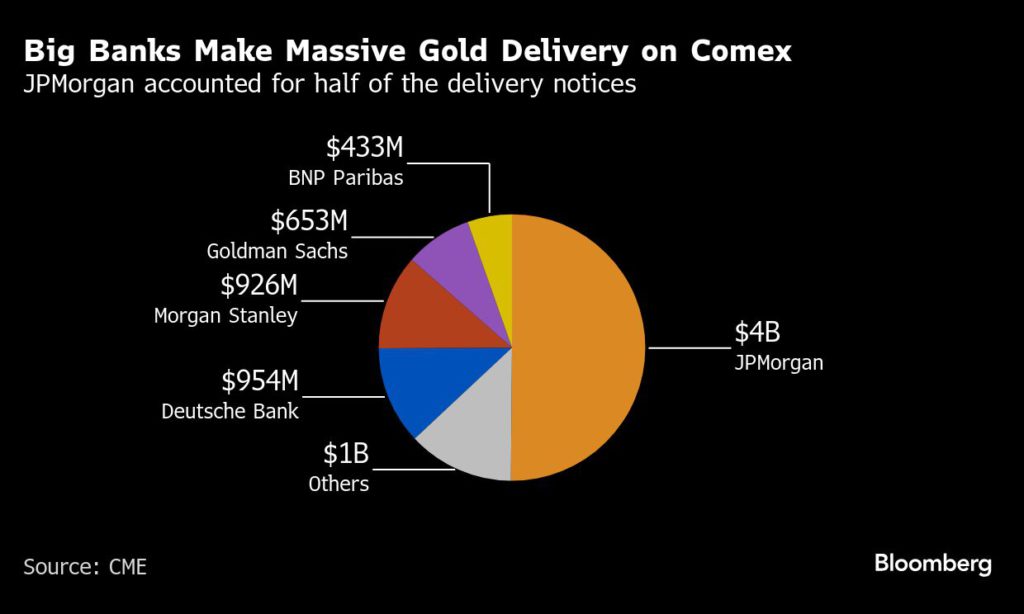
The bank, which is by far the world’s biggest bullion dealer, was one of several institutions to declare plans on Thursday to deliver bullion against contracts traded on CME Group’s Comex that will expire in February. The delivery notices — which total 30 million troy ounces of gold — were the second largest ever in bourse data going back to 1994.


Fears of imminent tariffs on imports following the election of US President Donald Trump have caused prices for gold futures on Comex to surge over spot prices in London. Spot prices shot to record highs this week, but the additional premium on Comex has created a lucrative arbitrage opportunity for the handful of banks that can quickly fly bullion between key trading hubs.

Similar pricing dynamics have emerged in other Comex contracts too, and the disparity has become so large that traders have started flying silver into the country. The precious metal is usually too cheap and bulky to justify the cost of airfreight, and one industry veteran says it’s the first time they’ve seen it happen.

While millions of ounces of gold trade on Comex every day, typically only a small fraction of that goes to physical delivery, with most long positions being rolled over or closed out before they expire.

The exchange is often used to hedge positions in London, the largest trading hub, with banks offsetting longs with paper short positions in New York. Since the day of the US election though, physical inventories in the exchange’s depositories have swelled by 13 million ounces, around $38 billion of gold.


It is unclear whether JPMorgan or the other banks were delivering bullion physically to take advantage of an arbitrage opportunity, or were simply using the deliveries to exit existing short positions. JPMorgan and exchange owner CME Group Inc. declined to comment.

JPMorgan issued delivery notices for 1.485 million ounces of gold to meet physical delivery for the February gold 100-ounce contract, with deliveries on Feb 3. That accounted for roughly half the total to be delivered, with Deutsche Bank AG, Morgan Stanley and Goldman Sachs Group Inc making up the bulk of the rest.

Deutsche Bank, Morgan Stanley and Goldman declined to comment.

(By Jack Ryan and Jack Farchy)

Gemfields halts emerald sales over Zambia export tax

Cecilia Jamasmie | January 31, 2025 |


Emeralds from the Kagem mine in Zambia. (Image courtesy of Gemfields.)

Coloured precious stones miner Gemfields (LON: GEM) (JSE: GML) has paused the sale of emeralds from its Kagem mine in Zambia, but hopes the government will soon reverse a 15% export tariff reintroduced earlier this month.


Zambia, the world’s second largest emerald producer after Colombia, first implemented the 15% export duty in early 2019. It was later scrapped on January 1, 2020, following industry pressure.

Before the recent reintroduction, Gemfields had already suspended production at Kagem, citing market saturation caused by an influx of heavily discounted emeralds.

“Kagem anticipates that the duty may be revoked and allow a commercial-quality emerald auction to go ahead in Q1 2025”, the company said.

If the tariff remains in place, Gemfields’ 75%-owned local subsidiary, Kagem Mining, will face an effective revenue tax of 21%, which includes the existing 6% mineral royalty tax. This would force the company to lay off employees, chief executive Sean Gilbertson said earlier this month.

Zambia’s government is targeting a gross domestic product (GDP) growth rate of 6.6%, an inflation rate between 6% and 8%, and a budget deficit of 3.1% of GDP, according to data from PwC. Revenue projections include a 26% increase in domestic revenues and grants, with tax revenues anticipated to rise by 20%.

Gemfields also said on Friday that production at its Montepuez ruby mine in Mozambique had resumed. Operations were halted in December following violent post-Presidential elections incidents that resulted in two deaths.

Despite the disruption, the company confirmed that construction of a second processing plant at the mine remains on schedule and within budget, with completion expected by the end of the first half of 2025.

Gemfields said it would release its annual financial results on March 27.
Chile orders definitive closure of Lundin’s Alcaparrosa mine

Cecilia Jamasmie | January 30, 2025 | 


Sinkhole at the Alcaparrosa mine in 2022. (Source: SMA.)


Chile’s environmental authority SMA ordered on Thursday the “total and definitive” closure of Lundin Mining’s (TSX: LUN) Alcaparrosa mine, as a result of an almost three-year long probe into a massive sinkhole that emerged near the operation in 2022.


The huge 36-metre-diameter sinkhole more than 60 meters deep that appeared close to the Alcaparrosa mine in northern Chile drew widespread global attention and saw Lundin being charged by authorities.


SMA officials said at the time that preliminary investigations linked the sinkhole on the mine’s property to the over extraction of ore.

On Thursday, the watchdog confirmed four environmental violations, including over-extraction of minerals, unauthorized infrastructure modifications, and other breaches of the project’s environmental permits. In addition to the permanent closure of mining operations, the company faces a fine of $3.41 million.

The regulator’s head, Marie Claude Plumer, said that Lundin operated in unauthorized sectors up until the Copiapo River aquifer, which allowed more water to infiltrate in and subsequently weaken the rock mass.

“The company caused irreparable environmental damage,” she said.

Plumer emphasized the importance of adhering to environmental permits. “The rules are clear and must be followed. Companies are fully aware of the conditions under which they are allowed to operate,” she said.

The SMA said the company has 10 business days to pay or 15 days to appeal the decision before the Environmental Tribunal.

Alcaparrosa is one of two underground mines that make up the Ojos del Salado operation, within the Candelaria complex (pictured here).
 (Image courtesy of Minera Candelaria.)

Lundin’s local unit, Ojos del Salado, said in a statement that it would review the ruling and determine its next steps.

The Toronto-based miner owns 80% of the Ojos del Salado complex, which holds two underground mines: Santos and Alcaparrosa. The remaining 20% is held by Japan’s Sumitomo Metal Mining and Sumitomo Corporation.

Sinkholes are pits that form over areas where water gathers underground without external drainage, causing the water to carve out subterranean caverns.

These cavities also form regularly near old and active mines, where large amounts of rock and ore have been extracted, studies have shown.

Sinkholes often form gradually over many years, but can also open quite suddenly, taking cars, homes and streets down with them.
World’s longest cargo sail ship launched in Turkey


By AFP
January 31, 2025


The Neoliner Origin, with its massive masts as yet unfurled
 - Copyright AFP CHARLY TRIBALLEAU

The world’s longest wind-powered cargo ship was launched Friday in Turkey, offering a promising way to slash carbon emissions from merchandise trade.

The 136-metre (450-foot) Neoliner Origin was floated at the Turkish port of Tuzla, and will now undergo six months of fitting-out.

Designed by French company Neoline and built by Turkish shipyard RMK Marine, the ship can carry 5,300 tonnes of freight over long distances thanks to its two masts and 3,000 square metres of sails.

“Thanks to the wind, and by reducing speed from 15 knots (about 30 kilometres or 18 miles an hour) to 11 knots, we can cut fuel consumption and therefore emissions by a factor of five compared with a conventional ship,” Jean Zanuttini, president of Nantes-based Neoline, told AFP.

With about 90 percent of world trade going by sea, the maritime transport sector is responsible for about three percent of greenhouse gas emissions, according to the International Maritime Organization.

The ship will leave Turkey during the summer of 2025 for the French Atlantic port of Saint-Nazaire, then will begin its first rotation toward North America, serving the French island of Saint-Pierre-et-Miquelon, the US port of Baltimore and Halifax in Canada.

The project received support from France’s public investment bank (BPI) and the French shipping company CMA-CGM.

Zanuttini said the shipyard would soon begin work on a second similar ship.


Two Men Get Three Years for Smuggling Drugs Inside Buses on a Ro/Ro

ROLL ON/ROLL OFF 

ABF suspect luxury bus
Image courtesy ABF

Published Jan 30, 2025 6:58 PM by The Maritime Executive


Two men have been sentenced to three years each for their roles in a plot to import nearly 140 kilos of cocaine into Australia, hidden inside a shipment of 13 luxury buses. At a street-level retail value of $200,000 per kilo on the Australian market, the value of the cocaine shipment likely exceeded the value of the motor coaches. 

In January 2024, Australian police intelligence identified an inbound shipment of cocaine hidden aboard a ro/ro bound for Adelaide. When the ship called at Fremantle, Western Australia, Australian Border Force officers boarded it and searched a consignment of 13 luxury buses on board. In four of the buses, they found packages of cocaine totaling 139 kilos. It was the second-largest bust ever for a shipment headed for South Australia. 

The police allowed the buses to stay on board the ro/ro and continue on to the destination port, Adelaide, under close monitoring. On February 3, after the vessel arrived and offloaded its vehicles, the two men broke into the buses at the port and retrieved the shipment of cocaine. 

Police followed them to a hotel in Adelaide, then arrested them. The two young men - now aged 20 and 23 - were charged with attempting to possess a commercial quantity of cocaine, an offense with maximum sentence of life in prison. They pleaded guilty late last year. 

On Wednesday, they were each sentenced to three years in prison, including at least 18 months without parole. 

The Australian Federal Police said the cocaine could have been divided up and sold as nearly 700,000 doses at retail level, generating about $30 million in revenue for dealers. 

"Organized crime groups are seeking to import illicit drugs into Australia on an industrial scale," ABF acting Superintendent Prue Otto said. "Drawn by the high street prices, criminals seek profits to fund lavish lifestyles and other criminal activities and the cost of this greed is paid by the Australian community."


How to Get Ready for the U.S. Coast Guard's Cybersecurity Rule

iStock photo of digits
iStock / JuSun

Published Jan 30, 2025 7:31 PM by Andrew R. Lee, Richard D. Bertram, James A. Kearns and Ilsa Luther


On January 17, the US Coast Guard released its much-anticipated final rule on cybersecurity in the US Marine Transportation System, which establishes mandatory minimum cybersecurity requirements for the maritime sector. The new regulations are effective July 16, 2025 and represent the most significant maritime cybersecurity regulations to date. Affected entities should review their existing policies, identify any gaps or deficiencies, and implement compliance procedures.

I. Scope and Applicability

The primary goal of the final rule is to enhance the cybersecurity of the US Marine Transportation System. The new regulations establish minimum mandatory requirements for US flag vessels, Outer Continental Shelf (OCS) facilities, and facilities subject to the Maritime Transportation Security Act of 2002. The rule aims to address the increasing risks posed by cyber threats due to the growing reliance on interconnected digital systems within the maritime industry. It emphasizes both preventing cyber incidents and preparing to respond to them effectively.

The rule applies to:

a. US flag vessels subject to 33 CFR part 104:

  • Cargo vessels greater than 100 gross tons
  • Commercial passenger vessels certified to carry more than 150 passengers
  • Offshore Supply Vessels (OSVs)
  • Mobile Offshore Drilling Units (MODUs)
  • Towing vessels more than 26 feet long engaged in towing certain dangerous cargo barges
  • Cruise ships and passenger vessels carrying more than 12 passengers on international voyages

b. Facilities subject to 33 CFR part 105:

  • Container terminals
  • Chemical facilities with waterfront access
  • Petroleum terminals
  • Cruise ship terminals
  • Bulk liquid transfer facilities
  • LNG/LPG terminals
  • Barge fleeting facilities handling dangerous cargo
  • Facilities that receive vessels carrying more than 150 passengers
  • Marine cargo terminals otherwise subject to the Maritime Transportation Security of 2002

c. OCS facilities subject to 33 CFR part 106:

  • Offshore oil and gas production platforms
  • Offshore drilling rigs
  • Floating production storage and offloading units (FPSOs)
  • Deepwater ports
  • Offshore wind energy facilities
  • Offshore loading/unloading terminals

II. Core Requirements

The cybersecurity plan must include measures for account security (e.g., automatic account lockout, strong passwords, multifactor authentication), device security (e.g., approved hardware/software lists, disabling executable code), and data security (e.g., secured logging, data encryption). Entities must also create or implement the following:

a. Cybersecurity Officer 

Each covered entity must designate a Cybersecurity Officer (CySO) responsible for implementing and maintaining cybersecurity requirements. The rule allows for designation of alternate CySOs and permits one individual to serve multiple vessels or facilities, providing welcome flexibility for operators.

b. Cybersecurity Plans and Assessments — Organizations must develop and maintain the following:

  • A comprehensive Cybersecurity Plan
  • A separate Cyber Incident Response Plan
  • Regular cybersecurity assessments
  • Plans must be submitted to the Coast Guard for review within 24 months of the rule’s effective date.

c. Training and Exercises — The rule mandates the following:

  • Cybersecurity training for all personnel using IT/OT systems beginning July 17, 2025
  • Two cybersecurity drills annually
  • Regular penetration testing aligned with plan renewal cycles

d. Technical Controls — Required security measures include the following:

  • Account security controls including multifactor authentication
  • Device security measures and approved hardware/software lists
  • Data encryption and secure log management
  • Network segmentation and monitoring
  • Supply chain security requirements

III. Implementation Timeline

Key phase-in compliance dates include:

  • Rule effective date: July 16, 2025
  • Training requirements begin: July 17, 2025
  • Initial cybersecurity assessment: Due by July 16, 2027
  • Cybersecurity Plan submission: Due by July 16, 2027

The Coast Guard is seeking comments on extending implementation periods for the new requirements by two to five years for US flag vessels. Comments are due no later than March 18, 2025. After review of these comments, the Coast Guard may issue a future rule to allow additional time for US flag vessels to implement the new regulations.

IV. Harmonization with Other Requirements

The Coast Guard has worked to align these requirements with other cybersecurity regulations, including the Cybersecurity and Infrastructure Security Agency’s (CISA) Cyber Incident Reporting for Critical Infrastructure Act of 2022 reporting requirements. The rule establishes the National Response Center (NRC) as the primary reporting channel for maritime cyber incidents, simplifying compliance for regulated entities.

V. Basic Questions and Answers

What are the mandatory cybersecurity measures outlined in the rule? 

Owners and operators must implement a range of cybersecurity measures that are based on “cybersecurity performance goals” developed by CISA. This includes vulnerability identification of critical IT and OT systems, addressing known exploited vulnerabilities in those critical systems, and conducting penetration testing in conjunction with renewing the Cybersecurity Plan.

What constitutes a reportable cyber incident, and to whom do I report it? 

A reportable cyber incident is defined as any incident leading to substantial loss of confidentiality, integrity, or availability of a covered system; to disruption to business operations; to unauthorized access to nonpublic personal information of a large number of individuals; or to operational disruption of critical infrastructure. Such an incident also includes any event that may lead to a “transportation security incident.” Such incidents must be reported to the NRC.

What is the Coast Guard’s approach to compliance and enforcement of this new rule? 

The rule takes a performance-based approach, meaning that it focuses on outcomes rather than prescribing specific technical solutions, thus providing some flexibility to the entities in meeting the requirements. However, the rule does not specify the methods of enforcement, and the Coast Guard is currently working with policymakers to define the compliance criteria. The Coast Guard will address those questions at upcoming symposiums. Noncompliance with the rule could lead to penalties, legal action, and financial losses.

Is there any flexibility or possibility of waivers in complying with this rule? 

Yes. After completing a cybersecurity assessment, owners and operators can seek a waiver or an equivalence determination for the requirements, based on the waiver and equivalency provisions of 33 CFR parts 104, 105, and 106. Owners and operators must also notify the Coast Guard of temporary deviations from the requirements.

VI. Key Takeaways

  • Begin preparation now — the 24-month implementation period will pass quickly given the scope of required changes.
  • Evaluate current cybersecurity staffing and capabilities against new CySO requirements.
  • Review existing security measures against the detailed technical requirements.
  • Plan for increased training and exercise obligations.
  • Consider whether to comment on the proposed implementation extension for vessels.

Andrew R. Lee, CIPP/US, is a partner in Jones Walker’s Litigation Practice Group and co-leader of the privacy, data security, and artificial intelligence team. 

Richard D. Bertram is a partner in Jones Walker’s Maritime Practice Group and leader of the maritime regulatory team. H

James A. Kearns is special counsel in Jones Walker's Maritime Practice Group. 

Ilsa Luther is an associate in Jones Walker’s Maritime Practice Group. 

The opinions expressed herein are the author's and not necessarily those of The Maritime Executive.

WWIII


Marcos: Manila Will Give Up Missiles if China Stops Maritime Aggression

U.S. Army Midrange Capability (Typhon) launcher arrives at an airfield in Luzon (U.S. Army file image)
U.S. Army Typhon launcher system arrives at an airfield in Luzon (U.S. Army file image)

Published Jan 30, 2025 10:47 PM by The Maritime Executive


The Chinese government has repeatedly criticized the Philippines for hosting the U.S.-built Typhon missile system, a mobile launcher that can be used against land, air and naval targets. On Thursday, Philippine President Ferdinand Marcos Jr. issued an offer: stop aggression in Philippine waters, and Manila will send back the missile system. 

"Let's make a deal with China: stop claiming our territory, stop harassing our fishermen and let them have a living, stop ramming our boats, stop water cannoning our people, stop firing lasers at us and stop your aggressive and coercive behavior and I'll return the Typhon missiles," he told reporters. "I don't understand the comments on the Typhon missile system. We don't make any comments on their missile systems and their missile systems are a thousand times more powerful than what we have." 

China claims almost all of the South China Sea as its own, including a large swath of the Philippines' western exclusive economic zone (EEZ). The China Coast Guard has often used physical tactics to block Philippine vessels' movements, including shouldering, water-cannoning, aggressive maneuvering and at least one opposed boarding. So far, Manila has refrained from responding with force.  

The Typhon is a mobile launcher for SM-6 and Tomahawk missiles. With modern variants of the Tomahawk, it can strike naval and land-based targets at very long range, up to about 1,000 miles. This is enough to reach mainland China from northern Luzon.  

Typhon may have some deterrent effect in the South China Sea, but China has a steep advantage with a vast ballistic missile force, a network of strategic airbases and the world's largest navy. It also has the world's largest coast guard, which has steadily ratcheted up pressure on Philippine forces, including a new presence operation in Philippine waters (below).


Rescue Plan Emerges for Germany’s FSG and Nobiskrug Shipyards

German shipbuilder
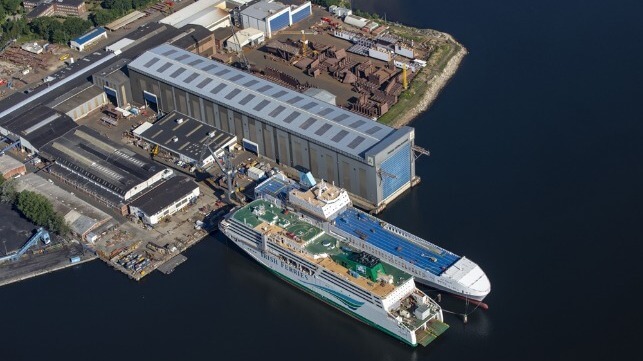
Rescue plan was agreed to save the operations of Germany's FSG shipbuilder (FSG file photo)

Published Jan 31, 2025 2:44 PM by The Maritime Executive


At a press conference on Friday, January 31, at the now closed FSG Shipyard (Flensburger Schiffbau-Gesellschaft) the provisional insolvency administrators announced their rescue plan for the group’s two shipyard groups. They have reached terms for the two divisions to be sold independently of each other but also reported that investor Lars Windhorst continues to oppose the bankruptcy of the shipyard group.

“We have managed to find two renowned strategic investors for FSG and Nobiskrug within the extremely tight time frame of just seven weeks,” said lawyer Christoph Morgen who is the provisional insolvency administrator for FSG. He also oversaw the previous insolvency of the company and the sale of the former MW Werften. According to Morgen, the best outcome has been reached for FSG ensuring the yard will resume work.

The group was forced into bankruptcy in December 2024 by insurance administrators with reports employees had not been paid for weeks. There are also reports of a long list of creditors for the shipyards with many suppliers not having been paid in months. Windhorst had controlled the yards since 2000.

Under the terms of the provisional agreement, the Heinrich R?nner Group from Bremerhaven will acquire the FSG shipyard. The yard has been building Ro/Ro ferries and currently has an incomplete ferry in the yard for Australia’s Searoad. The Australian company is reported to support the deal and has already entered into a contract with R?nner for the completion of the ferry.

R?nner is active in shipbuilding as well as steel construction. The company acquired the Lloyd Werft shipyard in Bremerhaven in 2022 during the insolvency proceedings for Genting Hong Kong and MV Werften.

The fate of the Nobiskrug operation is less clear. Lawyer Hendrick Gittermann is the provision insolvency administrator for the yards which specialize in luxury yacht construction. He reported that a notarized offer had been received from the Lürssen group, another of Germany’s large yacht shipbuilding groups. He reported that under the terms of the agreement, Lürssen would acquire Nobiskrug. Initially, it appears work and employees will be transferred to the neighboring Lürssen-Kr?ger shipyard.

During the press conference, it was highlighted that neither of the shipyards can immediately resume work due to permitting and other considerations. Morgen said the deal would signal the start of investments by the acquirers to restore the operations. 

Employees of the bankrupt companies have agreed to the formation of a transfer company. It is a German system that provides for 80 percent of their historic wages along with retraining. The transfer company will run for four months with 310 employees from FSG and 140 from Nobiskrug. The intent is for them to transfer back to the shipyards.

Morgen reported however that late last night he and the judge overseeing the insolvency received a communication from Lars Windhorst. He reportedly offered to make available €50 million ($52 million) in a trust and would resume his role as managing director of FSG Group and the two shipyard groups.

The administrators said they viewed this as a delaying tactic noting that the insolvency had progressed and could not be stopped. They plan to present the plan to the court on February 1 and begin the insolvency process. Once the court rules, Morgen and Gittermann will have sole authority over the shipyards. They said as early as next week they plan to accept the offers from R?nner and Lürssen.

Government officials hailed the agreements as a good outcome that would preserve jobs and the shipbuilding industry. Prime Minister Daniel Günther of the Schleswig-Holstein state and representatives of the union IG Metall joined in the press conference expressing their support for the deal.

FSG however continues to face a lack of orders to ensure its long-term future. R?nner reported it is already in discussions with Searoad for a second ferry. They said the future emphasis would be on new ship construction contracts but they could also look to diversify such as with the construction of components for offshore wind power.

The two shipyard groups are among the oldest operating in Germany. Flensburger Schiffbau Gesellschaft traces its roots to 1872 while Norbiskrug traces its origins to 1895 and was officially incorporated in 1905. It built commercial ships before taking its first yacht contract in 2000. Today it is recognized as one of the leading builders of luxury yachts.