It’s possible that I shall make an ass of myself. But in that case one can always get out of it with a little dialectic. I have, of course, so worded my proposition as to be right either way (K.Marx, Letter to F.Engels on the Indian Mutiny)
Saturday, February 01, 2025
Chevron Starts Using ‘Gulf of America’ in Nod to Trump
By Kevin Crowley
January 31, 2025
(Bloomberg) -- Chevron Corp. has begun using “Gulf of America” instead of “Gulf of Mexico” to describe the location of some of its largest oil operations, after President Donald Trump ordered the US to rename the body of water.
“That’s the official position of the US government,” Chief Executive Officer Mike Wirth said in an interview. “If Google Maps is using it — then Chevron is using it.”
Chevron made the switch in a Friday earnings statement and on its website, where its details the company’s extensive offshore operations. It’s just one sign of how the US oil and gas industry has started to align itself with the incoming Trump administration, in contrast to the frosty — and often hostile — relations with Joe Biden’s government.
Trump has promised to support oil and gas production by removing Biden-era regulations. His election campaign was backed by several big oil industry donors, and the president and his allies have repeatedly talked about seeking American “energy dominance.”
Trump called for the name change on his first day in office last week, saying it was part of his push to make the US “the greatest, most powerful, most respected nation on Earth.” The US Interior Department formally announced the change Jan. 24.
Google’s parent company Alphabet Inc. has said it will update Google Maps once the change has been made to the United States Geological Survey’s database.
Chevron put in a good word for Trump earlier this week when it announced a new venture to build gas-fired power plants to supply electricity to data centers. “We are proud to play our part in bringing to fruition President Trump’s vision for a new American golden age,” Wirth said in the accompanying statement.
Exxon Mobil Corp. CEO Darren Woods said on his company’s earnings conference call with analysts that Trump is “right to reverse” many of the Biden administration’s constraints on fossil fuels, specifically the pause on new liquefied natural gas export facilities and executive orders limiting offshore drilling.
However, as the call progressed Friday, Woods stuck with calling it the Gulf of Mexico.
UK Sizewell C reports project progress to parliament
Friday, 31 January 2025
The Sizewell C nuclear power plant project in the UK is "on time and on budget" and is "the best prepared nuclear project in modern nuclear history", MPs have been told in the first annual progress update on the project.
The planned Sizewell C plant (Image: EDF Energy)
The update delivered to MPs by Sizewell C - majority owned by the government - outlines the progress made since the project received its Development Consent Order (DCO) one year ago. It was delivered by Julia Pyke and Nigel Cann, Sizewell C's joint managing directors, at the beginning of Nuclear Week in Parliament.
The MPs also heard that independent due diligence commissioned for the HSBC bank by consultancy firm Enco praised the project's progress, stating that "Sizewell C is likely the best prepared nuclear project in modern nuclear history".
The independent assessment concluded: "The Sizewell C project has high chances of avoiding pitfalls that led to a significant schedule and cost overruns on many nuclear projects, including those with EPR reactor models."
The EDF-led plan is for Sizewell C to feature two EPRs producing 3.2 GW of electricity, enough to power the equivalent of around six million homes for at least 60 years. It would be a similar design to the two-unit plant being built at Hinkley Point C in Somerset, with the aim of building it more quickly and at lower cost as a result of the experience gained from what is the first new nuclear construction project in the UK for about three decades.
The update noted the project is demonstrating the "game-changing benefits" of replicating Hinkley Point C's reactor design, with GBP1 billion (USD1.2 billion) of cost savings identified so far through innovation and replication.
MPs were told that contracts worth GBP2.5 billion have already been agreed with 290 suppliers across the UK. The project will eventually support over 70,000 jobs across the UK, and generate income for over 2000 UK-based suppliers, with 90% of the supply chain benefits felt in the UK. 1000 people are now employed on site, with a 60% female executive team. Sizewell C's apprenticeship recruitment has been 50% female since the programme began in 2021. The workforce is currently over 40% female. The project will generate around GBP2.92 of economic value for every GBP1 invested during construction and will create over GBP100 billion of value for the UK over the lifecycle of the project.
Commenting on the update, Pyke and Cann said: "Sizewell C is already a massive driver of growth in the UK, and the team has made extraordinary progress in the year since we received permission to begin construction.
"Sizewell C is on time and on budget and has a stable cost base. That's in no small part because we're using exactly the same reactor design as Hinkley Point C, which means we've benefitted from the research and innovation already done there.
"Sizewell C is the most important energy project that the UK is likely to undertake in the next two decades, and its benefits will be felt in every constituency across the country."
The project received an additional GBP2.7 billion in funding from the government in the 2024 Budget and is due to receive its Final Investment Decision in the upcoming Spending Review.
Kairos Power fabricates and installs test unit reactor vessel
Friday, 31 January 2025
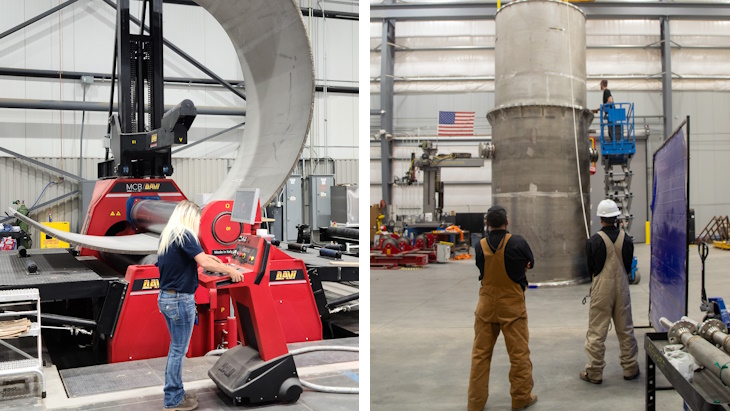
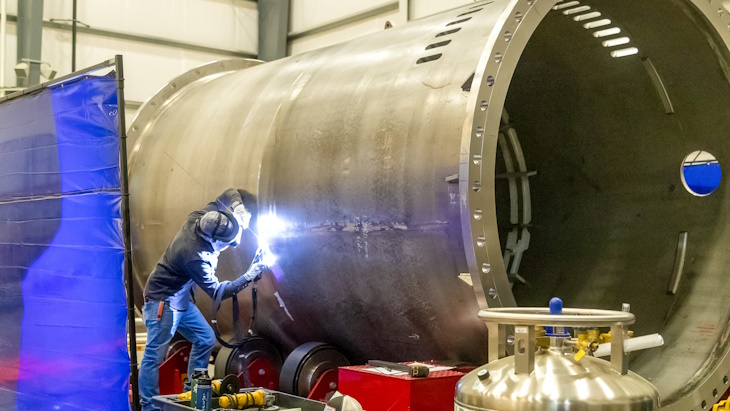
The central component for the second-iteration test unit for Kairos Power's Hermes reactor is the first reactor vessel to be fabricated in-house at Kairos Power’s Manufacturing Development Campus in Albuquerque, New Mexico.
(Image: Kairos Power)
Kairos is following an iterative approach for the development of its Fluoride Salt-Cooled High-Temperature Reactor (KP-FHR) technology. The non-power Engineering Test Unit 2 (ETU 2.0) follows ETU 1.0, a full-scale, electrically heated prototype of the Hermes reactor which carried out more than 2000 hours of pumped salt operations demonstrating the design and integration of key systems, as well as exercising the supply chain and establish new capabilities, including the production of the high-purity fluoride-lithium-beryllium (FLiBe) salt coolant.
ETU 1.0 completed operations in mid-2024. ETU 2.0 will demonstrate modular construction methods: as part of the project the company is ramping up output of ASME U-stamped pressure vessels, producing specialised reactor components, and gaining proficiency in modular construction methods.
The dedicated shop for KP-FHR vessel production at Albuquerque includes large-scale plate-rolling, cutting, automated welding and machining capabilities. (Image: Kairos Power)
Kairos Power has established a dedicated shop in its Albuquerque facility for KP-FHR vessel production. Its in-house engineering, procurement, and manufacturing teams collaborated closely in the project to deliver the ETU 2.0 reactor vessel, enabling key learnings that will carry forward to future iterations, the company said. The company is minimising outsourced production of specialised components under its vertical integration strategy, aiming for 80% of ETU 2.0 costs to derive from raw materials or commercial off-the-shelf parts which it says gives better control over product cost, quality, and schedule.
Kairos Power co-founder and CEO Mike Laufer described the completion of the ETU 2.0 vessel as a "monumental achievement" for the company, illustrating the synergy between its rapid iterative development approach and vertical integration strategy. "We are systematically building the capabilities and know-how to self-produce major reactor components over multiple iterations - an investment that will ultimately lower costs for the commercial fleet," he said.
(Image: Kairos Power)
The KP-FHR is one of five technologies selected in 2020 to receive federal funding for risk reduction projects under the US Department of Energy's Advanced Reactor Demonstration Program, with the department investing up to USD303 million in the Hermes reactor project. The DOE ETU 2.0 reactor vessel is a contract milestone under that investment agreement.
ETU 2.0 will be followed by a third non-nuclear iteration, ETU 3.0, which will be built adjacent to the site in Oak Ridge, Tennessee, where the Hermes Low-Power Demonstration Reactor will be built. Both ETU 3.0 and Hermes will use reactor modules fabricated at the Albuquerque facility.
Hermes is the first non-light-water reactor to be permitted in the USA in over 50 years. It will not produce electricity, but Hermes 2 - a two 35 MWt-unit plant for which the US Nuclear Regulatory Commission issued a construction permit in November - will include a power generation system.
A deal signed in October by Kairos and Google will support the first commercial deployment of Kairos Power's reactor by 2030, with multiple reactors supplying clean electricity to Google data centres through power purchase agreements.
Partnership to promote nuclear projects in Norway
Friday, 31 January 2025
Nuclear project developer Norsk Kjernekraft has signed a letter of intent with Nordic consultancy company Norconsult to promote the development of nuclear power in Norway. The partners said their cooperation could "result in concrete projects".
(Image: Norsk Kjernekraft)
Norsk Kjernekraft aims to build, own and operate off-grid small modular reactor (SMR) power plants in Norway in collaboration with power-intensive industry. It says it will prepare licence applications in accordance with national regulations and international standards. It will follow the International Atomic Energy Agency's Milestones approach, and focus on what creates value in the early phase. Financing will take place in collaboration with capital-strong industry and solid financial players.
Norconsult - headquartered in Sandvika, Norway - is one of the Nordic region's leading consulting engineering companies.
"By combining Norsk Kjernekraft's technological innovation and Norconsult's advisory expertise, the companies will be able to strengthen each other and together develop responsible decision-making bases in meeting future energy needs," said Norsk Kjernekraft CEO Jonny Hesthammer.
"Norconsult's experience with large and complex projects will be very valuable in the work of investigating the possibility of nuclear power projects in Norway," added Montserrat Telset, Regional Director West at Norconsult. "Through this agreement, Norconsult will contribute its expertise to ensure that all necessary analyses and studies are carried out in a thorough and fact-based manner."
Norsk Kjernekraft has entered into agreement of intents on the investigation of nuclear power with several municipalities. Halden, in southeast Norway, is the fourth possible location for a nuclear power plant that Norsk Kjernekraft has announced. In August last year, it submitted a proposal to the Ministry of Energy for an assessment of the construction of a power plant based on multiple SMRs in the municipality of Øygarden, west of Bergen. That proposal followed proposals submitted for SMR power plants in Aure and Heim municipalities, as well as Vardø municipality.
In June last year, the Norwegian government announced the appointment of a committee to conduct a broad review and assessment of various aspects of a possible future establishment of nuclear power in the country. It must deliver its report by 1 April 2026.
GE Vernova to invest in North Carolina fuel operations
Friday, 31 January 2025
GE Vernova has announced plans to invest more than USD50 million in GE Hitachi's Wilmington site in North Carolina as part of USD600 million of investments across its US factories and facilities over the next two years.
The Wilmington site (Image: GE Vernova)
The investment in GE Hitachi's manufacturing site will be used to enhance safety, quality and productivity and to launch its next generation nuclear fuel design for the company's BWRX-300 small modular reactor. "Expanding capacity of the fuel manufacturing operation further positions the BWRX-300 as the most ready to deploy advanced reactor on the market," GE Vernova said.
The investment will also go towards expanding automation at the plant, which produces fuel for many of the USA's boiling water reactors, "strongly positioning it for the future as the demand for nuclear energy increases globally, particularly as several US utilities restart retired plants."
The new investments are expected to create more than 1500 new jobs and help drive US energy affordability, national security, and competitiveness, the company said. The investments are the largest since GE Vernova was spun off from GE in April last year, and with worldwide energy needs forecast to double, will help to meet soaring customer demand, strengthen domestic supply chains, and continue developing US technology, the company said. They are the first part of a larger USD9 billion cumulative global capex and R&D investment plan over the next three years announced by the company in December.
"These investments represent our serious commitment and responsibility as the leading energy manufacturer in the United States to help meet America's and the world's accelerating energy demand," said GE Vernova CEO Scott Strazik. "These strategic investments and the jobs they create aim to both help our customers meet the doubling of demand and accelerate American innovation and technology development to boost the country's energy security and global competitiveness."
GE Hitachi's Wilmington operations include the production of zircalloy components, uranium dioxide powder and pellets, and fuel assemblies for the boiling water reactor market.
Landmark agreement clears way for restart of uranium transport
Thursday, 30 January 2025
Energy Fuels Inc expects shipments of ore from its Pinyon Plain Mine in northern Arizona to the White Mesa Mill in southern Utah will restart in February following the signature of an agreement with Navajo agencies on the transport of uranium ore along federal and state highways crossing the Navajo Nation.
The Pinyon Plain mine in Arizona, seen here in a screengrab from an Energy Fuels video (Energy Fuels/Youtube)
The agreement with the Navajo Nation Department of Justice and the Navajo Nation Environmental Protection Agency also includes a commitment from Energy Fuels to assist in the cleanup of abandoned uranium mines dating as far back as the 1940s. It comes after months of negotiations between the Denver-based company and the Nation's senior leadership following Energy Fuels' voluntary suspension of transports of uranium across Navajo lands in August 2024.
Energy Fuels has agreed to limit transportation to specified routes and hours of the day; not transporting ore on days involving celebrations or public events in respect of the Navajo Nation's culture and traditions; clearly spelled out emergency response procedures, notice and reporting requirements; additional requirements for insurance, driver qualification and training; obtaining Navajo Nation transport licenses; the use of state-of-the-art cover systems to prevent fugitive dust from transport trucks; and provisions for escorts and blessings at the discretion of the Nation. Additional procedures will enable the Navajo Nation to ensure that all applicable rules and agreements are being satisfied.
In addition, Energy Fuels has committed to accepting and transporting, at no cost to the Nation, up to 10,000 tons of uranium-bearing cleanup materials from abandoned uranium mines and to make further contributions to support the Nation's transportation safety programmes, education, the environment, public health and welfare, and local economic development on the Navajo Nation relating to uranium matters.
"The Navajo Nation has suffered longstanding impacts from uranium mining conducted during the cold war era, resulting in numerous abandoned mine and mill sites on their lands. This has understandably caused mistrust toward the US government and energy companies," Energy Fuels President and CEO Mark Chalmers said. "I am personally honoured that the Navajo Nation was willing to work with us in good faith to address their concerns and ensure that uranium ore transportation through the Navajo Nation will be done safely and respectfully."
"We have a settlement agreement that will allow the Navajo Nation to monitor and inspect the haul trucks and that provides financial compensation for the expenses to improve safety and protect the environment," Executive Director of the Navajo Nation Environmental Protection Agency Stephen Etsitty said.
Energy Fuels announced it had started production at Pinyon Plain in late 2023, with the ore to be stockpiled at White Mesa ahead of processing. The company and its predecessors had previously hauled hundreds of thousands of tons of uranium ore and other materials on state and federal highways and interstates crossing the Navajo Nation between 2007 and 2024 without incident. But on 31 July - after the completion of the first uranium shipment from the project - Navajo Nation President Buu Nygren issued an executive order banning the transport of radioactive material through the Navajo Nation without a prior agreement, referencing existing Navajo laws. "Good faith" negotiations between Energy Fuels and the Navajo Nation to find a solution began in mid-August.
Addressing the legacy
According to the US Environmental Protection Agency, nearly 30 million tons of uranium ore were extracted from Navajo lands from 1944 to 1986, under leases with the Navajo Nation. With little regulation or oversight of facilities in the 1940s and 1950s - when the focus was on national security rather than environmental protection - those mostly government-sponsored operations have left a legacy of pollution from hundreds of abandoned uranium mines and treatment plants.
Under its agreement with the Navajo Nation, Energy Fuels has committed to accepting and transporting up to 10,000 tons of uranium-bearing cleanup materials from abandoned uranium mines, materials the company described as "an unfortunate relic of old US government uranium programmes that began in the 1940s, in which Energy Fuels had no involvement."
"We are proud to be a part of a historic agreement with the Navajo Nation, and we are committed to fulfilling our promises to the," Chalmers said. "We hope this agreement marks the beginning of a constructive relationship that restores trust with our neighbours, while also paving the way for future collaborations on cleanups and other areas of shared interest."
Mining has continued at Pinyon Plain during the transport suspension, with ore being stockpiled at the mine site: as of 30 September, ore containing around 180,000 pounds U3O8 (69 tU) had been stockpiled at the Arizona mine for eventual processing at White Mesa.
Westinghouse and EDF in running for Slovenia unit, KHNP not bidding
Thursday, 30 January 2025
Westinghouse Electric Company and EDF are each to conduct a Technical Feasibility Study for GEN energija assessing the deployment of their reactors at the proposed new nuclear power plant next to the existing Krško site.
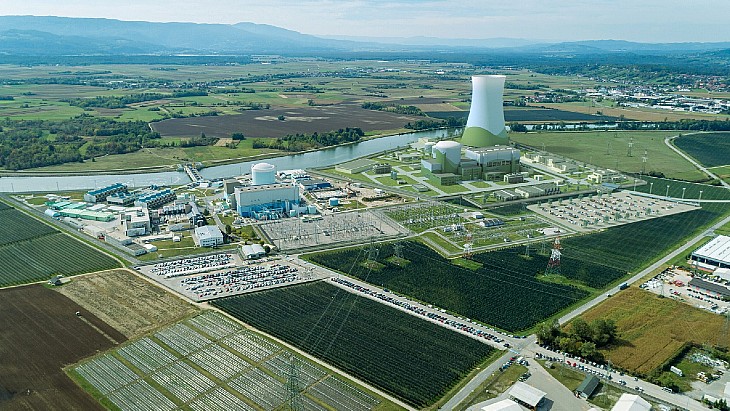
How JEK2 could look (Image: GEN energija)
Slovenia's JEK2 project is for a new one or two-unit nuclear power plant, with up to 2400 MW capacity, next to Krško NPP which has a 696 MWe pressurised water reactor generating about one-third of the country's electricity. Krško is owned and operated by Nuklearna Elektrarna Krško, which is jointly owned by Croatia's Hrvatska elektroprivreda (HEP Group) and Slovenia's GEN Energija.
The JEK2 project team, following discussions with potential nuclear power plant providers EDF, Korea Hydro & Nuclear Power (KHNP) and Westinghouse, in May last year, estimated the cost for various reactor sizes, ranging from EUR9.314 billion (USD10.1 billion) for a 1000 MW unit, up to EUR15.371 billion for a 1650 MW unit.
At a press conference on Wednesday Bruno Glaser, GEN energija's JEK2 project manager, said that the Technical Feasibility Studies for the two bidders would cost about EUR8.3 million and would assess the technical and legislative requirements and a range of safety and implementation aspects covering construction and operation. The aim of such a study was to ensure "that the project is planned based on realistic technical possibilities and in accordance with the highest safety and technological standards".
According to the company's briefing "the originally planned third bidder, the Korean company KHNP, informed GEN that it will not submit a bid for the preparation of the study and will not participate in the submission of a bid for the construction of the JEK2 project. Their decision is based on an assessment of the current business environment and a change in their strategic business priorities".
Dan Lipman, President of Westinghouse Energy Systems, said: "Since delivering the first Krško unit, which has operated very successfully since it started operating in 1983, Westinghouse has built a decades-long partnership with GEN energija through operational and fueling support. We are pleased to extend the relationship to closely study the feasibility of the Krško-II project. This potential AP1000 project will not only provide clean, reliable baseload power to Slovenians, it will also deliver real economic benefits and high-quality jobs for years to come while fostering Slovenia’s energy independence."
Westinghouse describes the AP1000 as "the only operating Generation III+ reactor with fully passive safety systems, modular construction design and the smallest footprint per MWe on the market". There are six AP1000 reactors in operation - including Vogtle 3 and 4 in the USA - plus 12 under construction and five more under contract, with AP1000s selected for nuclear programmes in Poland, Ukraine and Bulgaria. It said it had teamed up with Hyundai Engineering & Construction to conduct the Slovenian Technical Feasibility Study.
Slovenia had been due to hold a referendum on new nuclear in November, but that was called off amid a political row over how it was being conducted. Prime Minister Robert Golob said he remained committed to holding a referendum before a final investment decision is taken - which is currently due to be in 2028.
GEN energija said that in 2025 it will also continue to prepare professional studies, namely site safety analysis reports, radiological analyses, flood studies, seismic safety studies and technical feasibility studies. It also said it would be carrying out a pre-feasibility study for the construction of small modular reactors in the country.
Last year Westinghouse, EDF and KHNP were the three bidders for new nuclear in the Czech Republic. KHNP was the winning bidder and an EPC contract is expected to be signed by the end of March, despite EDF and Westinghouse appealing against the decision. Since then it has been announced that Westinghouse and KHNP and Korea Electric Power Cooperation have reached agreement on intellectual property issues - the subject of court cases in the USA - and while details regarding the terms of the settlement remain confidential the companies said "the agreement also sets the stage for future cooperation between the parties to advance new nuclear projects globally".
Energy Transition Takes a Backseat as Shell Rewards Shareholders
The FTSE 100 giant reported a dip in earnings from £23bn in 2023 to £19.1bn in 2024 amid weaker oil prices and lower demand for fossil fuels.
Despite the drop-off in earnings, Shell said on Thursday it had hiked dividends by four per cent in the fourth quarter and announced a £2.8bn share buyback programme, which it expects to be completed by its first quarter results for 2025.
Chief executive Wael Sawan said: “Our continued focus on simplification helped to deliver over $3bns in structural cost reductions since 2022, meeting our target ahead of schedule, whilst also making significant progress against all our other financial targets.”
He added cash flow had remained “solid” at around £32bn for the year.
Shell’s spending on renewables falls
Shell has pledged to become a net-zero energy business by 2050, but last year, it watered down green targets for the end of this decade, holding oil production steady and growing its liquified natural gas business.
Overall, for the year, the company’s capital spending on renewable projects fell from £2.3bn to £2.1bn, although overall external power sales from the division rose 10 per cent to 306 terawatt hours.
The company’s overall cash capital spending fell from £19.6bn to £17bn.
Derren Nathan, head of equity research at Hargreaves Lansdown, said: “Shell remains at a crossroads torn between the seemingly inevitable pull of the energy transition and the demands of shareholders.
“Its financial strength gives it the firepower to invest for the future as well as make generous distributions, but there are still some major doubts as to how the company plans to adapt to changing shifts in the energy mix.”
Shares in Shell are up more than four per cent over the last 12 months.
Oil prices have broadly steadied over the last year amid falling demand and a surge in the number of motorists buying electric vehicles (EVs).
Despite ambitious targets, less than a tenth of planned green hydrogen projects were implemented in 2023.
High production costs, lack of offtake agreements, and insufficient policy support are hindering green hydrogen's progress.
The study found that significant subsidies would be needed to realize current green hydrogen projects.
Over the past decade, countries and private enterprises around the world have made ambitious goals and pledges to expand the production and use of green hydrogen in their operations. These targets come as a part of broader clean energy transition efforts, as green hydrogen could be a critical component of any feasible pathway to meeting global climate goals. Since hydrogen can be combusted at high heats like fossil fuels, it can help to decarbonize hard-to-abate industries like steel making and shipping.
When hydrogen is burned, instead of emitting carbon dioxide and other greenhouse gasses, it leaves behind nothing but water vapor. This makes it an enormously useful fuel source for a wide range of industrial applications, with potentially massive implications for global greenhouse gas emissions. “Replacing the fossil fuels now used in furnaces that reach 1,500 degrees Celsius (2,732 degrees Fahrenheit) with hydrogen gas could make a big dent in the 20% of global carbon dioxide emissions that now come from industry,” Bloomberg Green wrote in a 2021 report titled “Why Hydrogen Is the Hottest Thing in Green Energy.”
But so far, despite the industry’s lofty promises, the global green hydrogen hype has not materialized into tangible results.
A new study reveals that in 2023, less than a tenth of planned green hydrogen was actually carried out. “Tracking 190 projects over 3 years, we identify a wide 2023 implementation gap with only 7% of global capacity announcements finished on schedule,” reads the abstract of the paper, “The green hydrogen ambition and implementation gap”, published this month in the scientific journal Nature Energy.
The study finds that on the whole, the world is getting closer to actually committing to a pathway to capping global warming to 1.5 °C over pre-industrial average temperatures, but while the ‘ambition gap’ is shrinking, implementation has to follow suit. And so far, that’s not happening.
The paper authors identify three primary reasons for the green hydrogen implementation gap. First is that green hydrogen is expensive to produce, and costs are on the rise. Second is a lack of offtake agreements, possibly due to industry anxieties about “the risk of becoming locked into an expensive and potentially scarce energy carrier.” Third, robust policy measures are needed to de-risk investment in green hydrogen.
A major finding of the study was that green hydrogen ambitions have failed in large part because they are not sufficiently funded or subsidized. “We estimate that, without carbon pricing, realizing all these projects would require global subsidies of US$1.3 trillion (US$0.8–2.6 trillion range), far exceeding announced subsidies,” the paper states. “Given past and future implementation gaps, policymakers must prepare for prolonged green hydrogen scarcity.”
Green hydrogen, by definition, must be produced using emissions-free energy like wind or solar power. Gray hydrogen, which is cheaper and much more abundant in industrial applications, is created using fossil fuels. Some also distinguish hydrogen produced with natural gas, calling it blue hydrogen, as a supposedly less emissions-intensive stepping stone between gray and green hydrogen.
Not only is green hydrogen by far the most expensive form of hydrogen, it also might not even be that great for decarbonization in the big picture. According to some experts, diverting renewable energy to create green hydrogen may not be the best or most efficient use of these resources. In fact, diverting too much green energy toward hydrogen production could actually slow down the decarbonization movement as a whole. A 2022 report by the International Renewable Energy Agency (IRENA) warned against the “indiscriminate use of hydrogen.” Policy-makers should instead weigh their priorities carefully and consider that extensive use of green hydrogen “may not be in line with the requirements of a decarbonised world.”
By Haley Zaremba for Oilprice.com
PINK HYDROGEN
Equilibrion to lead UK study on nuclear-enabled hydrogen
Friday, 31 January 2025
Technical and strategic nuclear consultancy Equilibrion announced it is to lead a study to explore how deployment of nuclear-enabled hydrogen production could support the repurposing of the UK's existing extensive gas network for low-carbon hydrogen.
(Image: Pixabay)
The company has been appointed by Northern Gas Networks (NGN) - the gas distributor for the north of England - and Wales & West Utilities (WWU) - a supplier of gas emergency and pipeline services across the south west of England and Wales - to lead the SHyNE study, which is supported by the Energy Innovation Centre.
Nuclear-enabled hydrogen is recognised by the UK's Low-Carbon Hydrogen Standard and uses the heat and electricity from nuclear reactors to generate hydrogen. Previous studies show that nuclear-enabled hydrogen can reduce costs for consumers, as well as providing resilience in production.
The SHyNE project will develop a deployment roadmap for capacity introduction to meet user demand, looking at estimated production rates, a geographical analysis that considers potential nuclear new-build sites in the context of existing infrastructure, customer demand centres and a techno-economic analysis.
SHyNE will build on advancements in nuclear technology - particularly with small modular reactors and advanced modular reactors - by assessing how improved siting flexibility and financing methods for reactors can accelerate nuclear deployment to support an energy transition and reduce costs for consumers.
The project will also assess how a nuclear power plant, twinned with electrolytic hydrogen production, can provide flexible electricity output to help balance the grid.
"Adopting nuclear-enabled hydrogen complements the UK Government's plans, with Labour expressing its intent to deliver nuclear electricity production and being set to publish its new nuclear siting policy offering more opportunities for nuclear sites across the UK from 2025 onwards," Equilibrion said.
"Nuclear-enabled hydrogen represents a powerful, yet largely untapped, opportunity to drive the UK's journey to net-zero at a significant scale and, for the first time, both the nuclear and hydrogen sectors can fully appreciate how working together can be a game-changer to the availability of low-cost electrolytic hydrogen and expand opportunities for organisations in both sectors," said Equilibrion Chief Technologist Allan Simpson. "We are committed to enhancing the opportunities for collaboration between the hydrogen and nuclear sectors for mutual benefit and are delighted to be appointed by Northern Gas Networks and Wales & West Utilities to advance the role of nuclear energy in delivering scalable, low-carbon hydrogen through the existing gas infrastructure."
Matthew Hindle, head of net-zero and sustainability at WWU, added: "We're excited to work with Equilibrion and NGN to better understand how nuclear-enabled hydrogen can support gas customers through the energy transition, by providing reliable, scalable low-carbon hydrogen for supply into the UK gas networks. SHyNE can support the reuse and adaptation of existing infrastructure to reduce costs, while accelerating the energy transition and enhancing energy security."
"Hydrogen can be a key enabler of accelerated decarbonisation for industry, transport and heat, and as an energy network it's critical we understand all the angles for hydrogen production and what's required to ready our infrastructure," said NGN Innovation Manager Lewis Kirkwood. "Network Innovation Allowance projects such as this are essential to unlocking the potential for hydrogen investment, to support the UK's decarbonisation strategy and diversify its energy portfolio, reduce reliance on fossil fuels and shore up energy security."
The UK government's Energy White Paper, published in 2020, identified hydrogen as a potential source of decarbonised heat in buildings and, whilst there has been significant progress in recent years to accelerate the shift to green gases, including existing use of biomethane, the transition of a natural gas distribution network to one transporting green gases is recognised as a complex challenge.
In July 2023, WWU announced it was partnering with National Gas and NGN to develop the gas control room of the future, assessing the impact of distributing a wider range of gases, including hydrogen, through the existing network infrastructure to help meet the UK's future of energy plans to decarbonise heat in buildings.
Norwegian-Korean cooperation
Meanwhile, Norway's Nel Hydrogen has announced the signing of a memorandum of understanding with Korea Hydro & Nuclear Power (KHNP) to collaborate on clean hydrogen production technology.
"This partnership combines Nel's expertise in alkaline electrolysis with KHNP's experience in nuclear power," Nel said in a LinkedIn post. "KHNP is South Korea's largest power generation company, specialising in nuclear and hydroelectric energy to support the country's electricity needs and carbon neutrality goals."
The partners, Nel said, "intend to expand into global clean hydrogen markets".
Nel noted KHNP has been researching nuclear-produced clean hydrogen since 2022. It is currently undertaking a demonstration project and has been conducting the world's largest nuclear clean hydrogen production demonstration project as a national R&D project since April last year.
In October 2024, US firm FuelCell Energy signed a memorandum of understanding with KHNP on jointly investigating hydrogen energy projects in South Korea using FuelCell's solid oxide electrolysis hydrogen technology.
Most hydrogen today is made by steam reforming of natural gas or coal gasification, both with carbon dioxide emissions. Future demand will be mainly for zero-carbon hydrogen. Plans for increased hydrogen production are essentially based on electrolysis using electricity from intermittent renewable sources. Off-peak capacity from conventional nuclear reactors or other power plants can also be used. In future, a major possibility for zero-carbon hydrogen production is decomposition of water by direct use of heat from nuclear energy, using a thermochemical process enabled by high-temperature reactors.
Jul 8, 2024 ... The Colors of Hydrogen · Black or brown hydrogen refers to hydrogen produced by coal gasification. · Blue hydrogen is produced mainly from ...
Chevron and GE Vernova Partner to Power Data Centers with Natural Gas
Chevron, Engine No. 1, and GE Vernova are partnering to build natural gas power plants co-located with data centers to support AI development.
The project aims for a multi-gigawatt scale and includes "power foundries" to deliver up to 4 GW to data centers across the US.
DeepSeek's new AI chatbot has intensified the US-China AI rivalry, prompting a response from President Trump with an executive order and a $500 billion infrastructure investment plan.
Despite the market scare about data centers and AI offered up by Deepseek this week, U.S. based energy companies don't seem phased.
The latest example? Chevron, Engine No. 1, and GE Vernova are teaming up to build natural gas power plants in the U.S., co-located with data centers to meet growing electricity demands driven by AI development, according to Yahoo Finance.
Chris James, founder and chief investment officer of investment firm Engine No. 1 commented: “Energy is the key to America’s AI dominance. By using abundant domestic natural gas to generate electricity directly connected to data centers, we can secure AI leadership, drive productivity gains across our economy and restore America’s standing as an industrial superpower."
He continued: "This partnership with Chevron and GE Vernova addresses the biggest energy challenge we face.”
The project aims for a multi-gigawatt scale.
Yahoo Finance wrote that separately, Chevron, Engine No. 1, and GE Vernova unveiled plans for "power foundries," natural gas-based projects delivering up to 4 GW to co-located data centers across the U.S., avoiding strain on the existing grid. Completion is expected by 2027, with future expansions planned.
Chinese startup DeepSeek’s new AI chatbot has intensified the U.S.-China AI rivalry, drawing comparisons to OpenAI’s ChatGPT. Its launch caused tech and energy stocks to fall, with analysts speculating whether DeepSeek offers comparable performance at a lower cost.
In response, President Trump signed an executive order removing barriers to U.S. AI innovation and announced a $500 billion infrastructure investment plan by OpenAI, Oracle, and SoftBank under a new venture, Stargate. With an initial $100 billion investment, Stargate aims to build data centers and power facilities, starting in Texas. By Zerohedge.com
Investor Who Fought Exxon Will Build Gas Plants for AI with Chevron
Activist investor Engine No.1 is now teaming up with Chevron to build natural gas-fired power plants to meet soaring AI-driven electricity demand.
Engine No. 1 sees a huge opportunity in the AI-led power demand growth in the United States.
The joint development plans to deliver up to 4 gigawatts (GW), the equivalent of powering 3-3.5 million U.S. homes.
Engine No. 1, the investment firm that four years ago picked a fight with U.S. oil and gas supermajor Exxon over climate – and won – is now teaming up with the other supermajor, Chevron, to build natural gas-fired power plants to meet soaring AI-driven electricity demand.
In a sign of changing times and a signal that investors continue to chase money and profitability, Engine No. 1 sees a huge opportunity in the AI-led power demand growth in the United States.
The Investment Firm That Took On Exxon
The hedge fund grabbed quite a few headlines in 2021 when it won a proxy fight at Exxon.
Engine No. 1, which launched in December 2020, scored a huge victory for activist shareholders at Exxon’s annual general meeting in May 2021, winning three board seats despite the tiny stake that it holds in the oil supermajor.
Back then, the Engine No. 1 win signaled an unprecedented shift of shareholder sentiment in the oil and gas industry. The vote, according to observers, signaled the continued displeasure of a growing number of shareholders with how Exxon was handling the push for lower-carbon energy and called to do more to mitigate the impact of its business on the environment.
Engine No. 1 was demanding from Exxon a proactive long-term strategy to address the threats and opportunities facing the company “in a changing world.”
That was four years ago.
Since then, the Russian invasion of Ukraine and the oil and gas price spikes that followed, the backlash against ESG investing and portfolio emission targets in the United States, and the advancements in AI and the surge of data center needs have changed the world dramatically, again.
Engine No. 1 has also changed its primary objective as an investment firm. It says now that it “builds and invests in companies that are driving the reindustrialization of the United States.”
Partnering with Chevron is not a pivot, Engine No. founder and chief investment officer Chris James tells the Financial Times.
“The Exxon campaign was focused on governance and capital allocation as a way to create value for shareholders,” the executive told FT.
“It was not about ideology or fossil fuels or renewables,” James said, after this week’s announcement that the investment firm is partnering with Chevron and GE Vernova to power U.S. data centers with natural gas power plants. Partnership with Chevron
Engine No. 1 and Chevron said they would create a new company to develop scalable, reliable power solutions for U.S.-based data centers running on U.S. natural gas.
The joint development, together with GE Vernova, which will supply U.S.-made natural gas turbines, aims to establish the first multi-gigawatt-scale co-located power plant and data center during President Trump’s second term.
“Early actions of the Trump Administration are setting the critical foundation to encourage investment leveraging America’s energy abundance to enable America’s AI leadership,” the three companies said in a joint statement.
The projects are expected to serve co-located data centers in the U.S. Southeast, Midwest, and West regions.
The joint development plans to deliver up to 4 gigawatts (GW), the equivalent of powering 3-3.5 million U.S. homes, with initial in-service targeted by the end of 2027 and potential for project expansion beyond this capacity. The projects are expected to be designed with the flexibility to integrate lower carbon solutions, such as carbon capture and storage (CCS) and renewable energy resources, the companies said.
“Energy is the key to America’s AI dominance. By using abundant domestic natural gas to generate electricity directly connected to data centers, we can secure AI leadership, drive productivity gains across our economy and restore America’s standing as an industrial superpower,” Engine No.1’s James commented.
Chevron’s CEO Mike Wirth added, “President Trump’s pro-American energy policies and commitment to energy and AI dominance give us the confidence to invest in projects that will create American jobs and strengthen our national security.”
Natural Gas Becomes Big Winner of the AI Boom
The project highlights the opportunities that energy firms, the supply chain, and Wall Street investors see in powering the future of AI and data centers.
Data center load growth in the U.S. has tripled over the past decade and is projected to double or triple by 2028, the U.S. Department of Energy said in December, commenting on a report produced by Lawrence Berkeley National Laboratory.
After two decades of flat power consumption, U.S. electricity demand rose by 2% in 2024 and is set to rise at a similar pace this year and next, the EIA says.
Higher U.S. power demand due to AI advancements and data center construction is set to unleash a new boom in the buildout of natural gas power plants to provide reliable 24/7 electricity.
U.S. power-generating companies are announcing plans for the highest volume of new natural gas-fired capacity in years.
Case in point: Chevron’s new venture to power data centers with co-located gas-fired plants, in partnership with the investor that took on Exxon and won.
By expanding renewables domestically, these petrostates are freeing up more of their oil and gas for export instead of burning it for power.
Chinese manufacturers are supplying most of the clean technology for the giant projects in the Middle East.
Rystad Energy: The region is expected to see exponential growth in renewable energy capacity, especially of solar plus battery storage.
The biggest and most influential Middle Eastern oil producers in OPEC are making headlines for a rather surprising reason—their giant renewable energy projects.
Saudi Arabia and the United Arab Emirates (UAE) have recently announced gigawatt-scale solar plus battery developments, which are set to boost the share of renewables in their electricity mix.
The Middle Eastern petrostates are not pivoting from oil and gas—on the contrary. By expanding renewables domestically, these petrostates are freeing up more of their oil and gas for export instead of burning it for power.
The Middle East region added record renewables capacity in 2023. Although the nominal capacity commissioned, 5.1 gigawatts (GW), was much lower than the capacity connected to the grid in the EU and the U.S., the Middle East’s growth from a low base, at 16.6%, was the second highest growth in the world after China, according to the International Renewable Energy Agency (IRENA).
Since the end of 2023, the Middle East has seen announcements of mega solar projects, which are the largest single developments in the world and will provide clean energy to hundreds of thousands of homes.
But the Saudi announcement was eclipsed by the UAE, which earlier this month announced plans to launch the world’s first large-scale ‘round the clock’ gigascale project, combining solar power and battery storage in Abu Dhabi.
Masdar, the UAE’s state-held clean energy giant, said it would build the project to deliver up to 1 GW of daily baseload power from renewable energy. The project will feature a 5.2 GW (DC) solar photovoltaic (PV) plant, coupled with a 19 gigawatt-hour (GWh) BESS, which would provide 24/7 electricity to around 700,000 homes in the country.
“For the first time ever, this will transform renewable energy into a world-leading 1GW of reliable baseload energy every day on an unprecedented scale – a first step that could become a giant leap for the world,” said Sultan Al Jaber, UAE Minister of Industry and Advanced Technology and Chairman of Masdar.
China-based Contemporary Amperex Technology (CATL) will provide the energy storage technology for the $6-billion project in the UAE.
Another Chinese giant, battery and EV manufacturer BYD, provided the batteries for the already operational BESS facility Bisha in Saudi Arabia.
“Our batteries can withstand temperatures of over 60C, and they are sand, water and wind resistant,” Yong Liu, a marketing executive at BYD, told the Financial Times, commenting on the advantages of the Chinese solar and battery products for the Middle Eastern market.
Chinese manufacturers are supplying most of the clean technology for the giant projects in the Middle East.
The region is expected to see exponential growth in renewable energy capacity, especially of solar plus battery storage, analysts say.
Renewables capacity is set to outpace fossil fuel usage in the power sector by 2040, consultancy Rystad Energy said last year. Solar PV is expected to emerge as the predominant source, accounting for more than half of the region’s power supply by 2050, up from just 2% in 2023.
Renewable energy sources, including hydropower, are set to account for 70% of the Middle East’s power generation mix by 2050, according to Rystad.
Solar power capacity in the Middle East is set to surge to 160 GWdc by 2033, an eightfold increase from 2023, Wood Mackenzie analysts said last month, noting that the region “is solidifying its position as a solar energy hub, driven by ambitious national targets and record-low tariffs achieved in competitive auctions.”
In addition to solar, the Middle Eastern petrostates are looking to become leaders in green and low-carbon hydrogen and green ammonia production with the help of electrolysis from renewable power sources.
Moreover, Saudi oil giant Aramco, the world’s biggest oil firm, has just announced plans to set up a joint venture with Maaden to extract lithium from high-concentration deposits and advance cost-effective direct lithium extraction (DLE) technologies.
The Middle East is embracing clean energy technologies to diversify its fossil-fuel-reliant power mix, free up oil and gas for exports, and remain relevant in the energy transition. It’s not surprising that the world’s biggest solar and battery projects are in the Middle East—Saudi Arabia and the UAE have been raking in billions of U.S. dollars of oil money for decades. By Tsvetana Paraskova for Oilprice.com
CNOOC and CNPC are leading major drilling projects, including the Deep Sea #1 offshore field and the Shendi Take 1 well in the Tarim Basin.
Ultra-deepwater drilling in the Tarim Basin is reaching record depths to unlock new hydrocarbon resources.
The Chinese Academy of Geological Sciences is developing a next-generation 15,000-meter smart drilling rig.
In October last year, China’s CNOOC reported record oil and gas production from a field called Deep Sea #1. The field was the company’s first ultra-deep project, an example of the pursuit of new, untapped resources that lie deeper under the sea. Yet it’s not only ultradeep offshore drilling that the Chinese are focusing on. Right now, China is building a new rig that should be able to drill much deeper than any other rig—onshore.
Led by the Chinese Academy of Geological Sciences, the project involves a number of research institutions and companies. Its purpose: to develop a smart drilling rig that could reach depths of 15,000 meters, or about 50,000 feet. “The Deep Earth National Science and Technology Megaproject is a forward-looking strategy that aligns with global scientific frontiers while ensuring national energy and resource security,” state news outlet Xinhua said, as quoted by the South China Morning Post.
Scientific frontiers aside, it’s all about the oil and gas and other mineral resources. That was the purpose of a CNPC project in the Tarim Basin in Northwestern China, where the state oil major experimented with drilling depths of up to 11,000 meters. The drilling began in 2023. Last year, after 279 days of drilling, the drill broke the 10,000-meter mark, per Chinese media reports, making the well the deepest ever drilled in the country. It was also the deepest well drilled in Asia—and the fastest drilled well of over 10,000 meters. The well was completed in March last year.
Drilling ultra-deep wells is certainly a challenging endeavor. The deeper you go, the hotter it gets, and this can interfere with the process, which is why ultradeep drilling is not yet standard practice. However, the fact that Chinese energy companies and researchers teamed up on the subject is telling—and it tells us that China is prepared to go to these lengths to increase the degree of self-sufficiency in the energy space.
The Shendi Take 1 well—the one that CNPC drilled in the Tarim Basin—cuts through 13 layers of rock, reaching formations that are 500 million years old. The new drill that the Chinese Academy of Geological Sciences-led team is developing will make it possible to cut even deeper into the Earth’s crust and tap new oil and gas. And there is lots of these at such depths.
The Shendi Take 1 well is certainly an achievement. But it is not the deepest well drilled in the world. That honor falls to the Chayvo well, drilled offshore Russia’s Sakhalin island by a local subsidiary of Exxon—the operator of the Sakhalin-1 project. The Chayvo well exceeds 12,000 meters in depth, which makes it 15 times longer than the world’s tallest building, Dubai’s Burj Khalifa. The deposit, which the well was drilled into, holds an estimated 2.3 billion barrels of crude oil and 480 billion cu m of natural gas.
This is the ultimate reason for the ultra-deep drilling exercises: finding new hydrocarbon resources. Because the biggest energy challenge that human civilization faces—as articulated by “Landman” protagonist Tommy Norris—is whether we would find an alternative before it runs out. There are schools of thought that argue there is in fact an unending supply of hydrocarbons in the Earth’s crust. While that remains debatable, it is a fact that the world’s undiscovered oil and gas resources lie in greater depths than previously considered standard. Researching ultra-deep drilling is an example of adaptation to the changing realities of energy supply.
China is the most obvious candidate for such research and experiments. The largest crude oil and gas importer in the world has substantial local reserves of hydrocarbons, but reaching them is more challenging than it is, say, in the Permian. Hence the concerted investment in ultra-deep drilling and the pursuit of “leading-edge scientific breakthroughs as soon as possible” – even as China cements its dominance in the wind and solar sector.
By Irina Slav for Oilprice.com
Trump Envoy Pressures Maduro as U.S. Weighs Cutting Venezuelan Crude
Richard Grenell, one of Donald Trump’s closest advisors, is set to meet with Venezuelan President Nicolás Maduro this Friday. Yes, that Maduro—the same one Trump spent years sanctioning, isolating, and calling illegitimate.
This meeting isn’t being framed as a grand negotiation—at least not officially. Instead, it seems like a blunt demand from Team Trump: take back your criminals. The U.S. wants Maduro to accept the deportation of Venezuelan gang members, particularly those tied to the notorious Tren de Aragua. And they aren’t asking nicely. According to U.S. Special Envoy Mauricio Claver-Carone, this is “non-negotiable.”
Of course, there’s more at play here than just a one-way extradition demand. There’s Chevron’s continued operation in Venezuela, American detainees stuck in Venezuelan prisons, and Trump’s fresh talk about cutting off Venezuelan oil imports.
Just a few years ago, Trump’s White House refused to recognize Maduro’s government at all. Now, his team is dealing with him directly. That’s a major shift, and whether it leads to a thaw in U.S.-Venezuela relations or just another political standoff remains to be seen.
One thing is certain: Grenell isn’t flying to Caracas just to have a polite chat. The stakes are high, and Maduro knows it. How he responds could have big implications for Venezuela’s economy, U.S. foreign policy, the global crude oil markets, and the fate of the Americans still detained there.
Venezuela boasts the largest proven oil reserves in the world, and US refiners are chewing through Venezuela’s heavy crude at an increasing pace, reaching a six-year high in December to 300,000 bpd. Venezuela’s oil is critical for US refiners such as Chevron and Valero. President Trump’s move here may just be to exert leverage over Canada well, with Canadian Foreign Minister Melanie Joly telling the FT earlier this week that Trump’s threat on Canadian imports could leave the US reliant on Venezuelan crude.
By Julianne Geiger for Oilprice.com
Trump Understands That the US Needs Venezuelan Oil
The US Gulf Coast heavily relies on Venezuelan crude, with imports hitting a six-year high. While Trump has left room for maneuvering on Venezuela, he is unlikely to cut off imports entirely.
Disruptions to this supply would force refiners to seek lower-quality alternatives, threatening energy stability.
Venezuela has the largest proven oil reserves on Earth, but its energy prowess is as much about quality as quantity. Refineries on the US Gulf Coast process Venezuelan crude by the hundreds of thousands of barrels per day. Volumes hit a six-year high in December, according to Kpler, reaching approximately 300 kbd – a 150 kbd year-on-year increase.
The Gulf Coast, or PADD 3, is crucial to the United States’ energy supremacy. If flows of Venezuelan crude to the region were disrupted, refiners like Chevron and Valero would have to shift to lower-quality, less reliable suppliers—an undesirable prospect.
Indeed, production in Mexico remains lackluster, while the erection of trade barriers in North America would curtail Canadian imports. Confirming the point, Kpler predicts that the Gulf would face severe shortages if Venezuelan crude imports fell by 200 kbd this year. These metrics support the case for a US-Venezuela détente.
While relations between President Nicolás Maduro and the Republican Party have historically been strained, each side is ultimately motivated by the economic necessity of the northward flow of Venezuelan crude. The inauguration and spate of Executive Orders that followed have consumed the US media cycle, but the prospects of détente have not been completely dimmed. President Trump certainly gave himself plenty of room to push back against the hawks in his party when he quipped that his administration would “probably” halt the import of Venezuelan crude.
As with prospective tariffs on the United States’ trade partners near and far, the new President is not allowing himself to be hemmed in by precise policy prescriptions. Trump’s mission objective, as often stated, is a new golden age; he knows disrupting America’s energy ecosystem would be prohibitive.
The administration is also cautious of any association with former President Biden’s failed Latin America policy. Biden was credited for freezing sanctions on Venezuela’s energy sector in October 2023 under the Barbados Agreement, only to reimpose them in April of last year, succumbing to proponents of regime change. With Maduro as powerful as ever, this proved an illusion.
Imports from Venezuela have at least continued under special license agreements secured by majors like Chevron, but the South American nation’s extraordinary potential remains untapped. President Trump is said to fully recognize this potential. Ever interested in confounding elite expectations with a grand bargain, he will surely be tempted to lock in crucial supplies to the Gulf.
The alternative—a halt on Venezuelan imports—would be a blow to US economic stability and the broader well-being of the Western Hemisphere.
Cast out, Maduro would have every incentive to further deepen his ties with the United States’ antagonists.
Cheap Venezuelan crude would bolster the economic performance of BRICS, the non-aligned bloc. And if Venezuela could no longer import refined products from the United States, then it too would turn to new suppliers.
Iran, a leading producer of condensates, would be more than willing.
Such an outcome would surely be viewed by Trump and those in his circle as an unacceptable violation of the Monroe Doctrine, which demands that outside powers must not interfere in the Western Hemisphere.
Trump’s recent statements on the sovereign status of Greenland and the management of the Panama Canal are very much in line with this standpoint.
As such, the new President will be wary of hamstringing the US energy industry to the benefit of Russia, China, and Iran, regardless of anti-Venezuelan sentiment in his cabinet.
Re-engagement with Venezuela based on mutually beneficial trade terms—specifically, the exchange of much-needed crude oil for much-needed US dollars—is surely the best path forward. By Cyril Widdershoven for Oilprice.com