Friday, February 07, 2025

'Cult making kids kill': Mysterious online figure linked to at least 2 school shootings

February 06, 2025
RAW STORY

Before 17-year-old Solomon Henderson fatally shot a fellow student and then took his own life at Antioch High School in Nashville, Tennessee last month, he left a trail of documents and social media posts that revealed his immersion in a swirl of violent white supremacy, occultism and edgy far-right memes.

He name-dropped a parade of white supremacist mass murderers and school shooters, while resharing terror manuals that goad impressionable and troubled teenagers like himself to gamify violence by encouraging efforts to improve on their predecessors’ lethality.

Henderson’s writings and social media posts also referenced “groomers” and “handlers.” Among the half-dozen nicknames Henderson dropped, one has been flagged for its association with three separate deadly attacks.

“Nitro groomed me,” Henderson wrote on his Bluesky account one day before he took a gun to school and killed a 16-year-old student. And in a diary that he left behind, Henderson mentioned Nitro, also known as “Nitrogen,” as being among his “top ‘groomers.’”


Henderson’s writings brim with dehumanizing tropes and grotesque descriptions of violence, suggesting, at least in part, that the purpose of his propaganda was to shock and alarm parents, teachers and other authority figures.

Carla Hill, director of investigative research for the Anti-Defamation League’s Center on Extremism, told Raw Story in an email that Henderson’s post “may have been a trolling effort” or “perhaps an inside joke.” She added: “We have no evidence that Nitro played a direct role in guiding or mentoring Henderson. What is more likely and perhaps notable is that Henderson had to have been in online spaces either with Nitro or where he was discussed, because he was familiar with him and versed in his activities/reputation perhaps.”

While the exact role played by the “groomers” and “handlers” cited by Henderson remains unclear, the nicknames and social media accounts are likely to provide investigators with leads on a potential network of operators — part of a global network — who may be working behind the scenes to instigate terrorism.
by Taboola
Sponsored LinksYou May Like

Advance Your Career with a Nursing Degree—Flexible Online Programs for Aspiring Healthcare Heroes!Pursue your passion for healthcare with a flexible nursing degree. Study at your own pace, anytime, anywhere.toptip
Learn More


“They think we’re satanic pdf groomers. Part of super Mkultra cult making kids kill,” Henderson wrote in an X post that tagged Nitro in mid-December last year, referring to a CIA mind-control experiment. “They [sic] people are f---ing stretching. I’m just trolling; I barely know her.”

Henderson was talking about Natalie Rupnow, a 15-year-old who fatally shot a fellow student and teacher at Abundant Life Christian School in Madison, WI before taking her own life. Rupnow’s attack turned out to be eerily similar to the one Henderson himself would carry out about a month later.

But privately, according to a diary entry from the same period, Henderson suggested he was much more closely connected to Rupnow.

Henderson took note of an X post by Rupnow shortly before she carried out her attack. In the post, Rupnow displayed a photo of herself making a hand sign. Henderson wrote in his diary that he recognized the gesture as the “white power symbol” used by Brenton Tarrant, the white supremacist who slaughtered 51 Muslims in an attack on two mosques in Christchurch, New Zealand in 2019.

Rupnow followed the photo with a post linking to a Google Docs version of her manifesto, although she neglected to make it public.

“Livestream it,” Henderson wrote in reply.

Later, he expressed excitement in his diary that Rupnow had followed two of his X accounts.

For his part, the person who goes by the name Nitro admitted to being in an online voice chat with Rupnow, and, according to the Center on Extremism, distributed a hoax version of her manifesto on X.

Nitro’s identity remains unknown, but based on an apparent recording of his voice reviewed by Raw Story, he appears to have an English accent and confirmed in the recording that he was in the time zone for the United Kingdom. An X post uncovered by the Center on Extremism indicates Nitro is 17 years old — the same age as Henderson was — and that he is a person of Russian heritage. The post displays a photo of a balloon that says, “Happy 17th Birthday” in Russian, while another X account uses a Russian flag in the bio.

An archived version of another X account shows Nitro telling another user that he planned to “get into contact with my FSB friends,” suggesting that he knows people who work for Russian intelligence.

Henderson’s dismissive post came in response to a post by another X user tagging the FBI and calling on the agency to detain Henderson and “Nitro” based on their apparent foreknowledge of Rupnow’s attack.

Three days later, Henderson posted a link in his diary to a video recording of Nitro giving an interview to an unidentified reporter about the Rupnow shooting. Nitro livestreamed the interview in a Discord group chat as four other anonymous users listened in and typed comments in the chat to help him script his responses.

There was no mistaking in the exchange that took place before the call started that Nitro’s intention was to misdirect the reporter.

“This is going to be fun,” Nitro told the other users in the group chat. “The greatest psy-op ever.”

In a comment in his diary accompanying the link, Henderson remarked that Nitro was “trolling” the reporter, adding a homophobic slur and the text acronym for “laugh out loud.”

During the interview, Nitro admitted that he and Rupnow had interacted in a Discord group chat, while presenting himself as an amused bystander. Based on the coaching from the other members of the chat and their celebratory post-interview assessment, it’s clear what they intended to present as a red herring to explain the motivation behind the attack.

About 10 minutes into the interview, a user with the screen name “Chud King” encouraged Nitro to talk about a concept called “radfem Hitler,” and that was the theme Nitro emphasized during the interview.

“So, radfem Hitler — it’s this really insane bats--- crazy misandrist, like racist woman on Twitter,” Nitro told the reporter. He added that when Rupnow started following the account that supposedly promoted radical feminism and Hitler worship, “that’s kind of when she spiraled.”

Another user in the group chat goes by the name Kristiyan on Discord and X.

In recent X posts, Kristiyan identifies himself as a pan-Slavist. He laments that Eastern Europeans “have this idiotic aggressive pettiness towards the people who are the most similar to them, which is how they end up conquered and taken over by total aliens.

Two days after Donald Trump’s inauguration, Kristiyan expressed disdain for Russian far-rightists who welcome the new U.S. president, writing, “The US will remain an enemy, and I’m grateful things are that way.”

Following Nitro’s phone call with the reporter seeking information about the Rupnow shooting, Kristiyan commented with wry satisfaction: “Journalist owned.”

In addition to playing up the “radfem Hitler” concept as a driver of the attack, Nitro also attempted to minimize connections between Rupnow and another attacker — an 18-year-old named Arda Küçükyetim, who stabbed five people at an outdoor café in the northwestern Turkish city of Eskisehir in August.

“Nobody actually knows about this Arda guy outside of probably people in Turkey, right?” Nitro said. “Nobody’s ever heard of him. He’s such a nothing-burger.”

The reporter asked Nitro whether Rupnow had ever mentioned Küçükyetim.

“No,” Nitro responded.

What Nitro didn’t mention was that both he and Rupnow were in a Telegram chat that had been set up in advance so they could watch Küçükyetim livestream his attack.

Hill at the Center on Extremism told Raw Story that her team found a Telegram chat group where Küçükyetim posted his manifesto. An associate known as “Hansen” then posted a link to a livestream of a promised attack. While the members of the chat group were waiting for the attack to begin, Hill said, Rupnow joined the chat through an invitation link, indicating she had a preexisting relationship with at least one other participant.

Afterwards, members of the chat group critiqued the attack.

By the standards of the accelerationist movement, where success is measured in kill counts, it was a disappointment to them: No one died.

“A for effort,” Nitro wrote in the chat.

“At least he did it,” Hansen said.

Rupnow concurred.

“Credit given for that at least,” she wrote.

This story is the second in a three-part series exploring how violent online subcultures provide the opportunity for teenagers attracted to accelerationism and inceldom to network and encourage one another to carry out terrorist attacks. Read Part 1 here.


Catch-22: The great antiwar novel whose barbs still strike home — even in times of peace


February 04, 2025


Joseph Heller’s Catch-22 (1961) is a satirical antiwar novel about an American bomber squadron stationed in Italy in the second world war. It exposes the horrors of war, but, even more, it is about the inept and immoral military bureaucracy and the grim relationships between men and women within the war. Its barbs still strike home, even in times of relative peace.

This is because Heller was not just writing against war. “Frankly, I think the whole society is nuts,” he once said – “and the question is: What does a sane man do in an insane society?”


The novel doesn’t exactly have a plot. For the most part, its 42 chapters circle around episodes and characters. It is not until you are some way in that you begin to get a feel for its content and method.

The novel needs a second pass to catch everything you missed the first time, such as the first mention of the central “Snowden” episode, or the extent to which various characters are morally compromised, or the way the protagonist Yossarian replies “pretty good” whenever anyone asks him how he is (he is far from pretty good).


Key episodes include Yossarian spending time in hospital, either because he is actually injured or feigning illness to get out of fighting (his commander Colonel Cathcart keeps raising the number of missions to be flown), the depictions of Yossarian’s flight missions, and the exploits of mess officer Milo Minderbinder, who builds a world-spanning syndicate that profits from everything from selling eggs to bombing his own squadron.

The novel also describes the numerous visits the men make to brothels in Rome and, in its later parts, Yossarian’s refusal to fly any more missions and the consequences of his refusal.

Heller, like Yossarian, was a bombardier in WWII. He joined the US Army Air Corps when he was 19 and flew 60 combat missions. He started writing Catch-22 in 1953, but took eight years to finish it.

The book received mixed reviews. In the United States, the hardcover sold slowly in its first year. Yet it quickly gained a cult following among young people. It was a word-of-mouth success. Unlike in the US, it was immediately successful in the United Kingdom. Once the paperback was released, its sales exploded.

The novel is filled with gags – mostly paradoxes in the style of Oscar Wilde, of which the central one is the eponymous “catch-22”. It is explained by the squadron’s physician Doc Daneeka, who tells Yossarian he has to ground anyone who is crazy. But the person has to ask to be grounded. The catch is that if someone asks to be grounded, this is a sign of a rational mind, so the person cannot be grounded.

The gags seem a little inane at first:
The Texan turned out to be good-natured, generous and likeable. In three days no one could stand him.
[…]
Nately had a bad start. He came from a good family.

But their cumulative effect points to something fundamental: our promotion of evil for the sake of self-interest or cowardice, and our tendency to hide this with doublespeak and bureaucratic cant.

Returning to the novel after a long time, I found it slow going at first. But by the end I was racing through the chapters – the last five are dark and brilliant – searching for anything redeeming.

I was hoping to be convinced the morality I hold to is not merely “a vain sticking up for appearances”, to quote Joseph Conrad, whose novel Heart of Darkness inspired the anti-Vietnam War movie Apocalypse Now (1979), which has some thematic similarities to Catch-22.

In the weighty Chapter 39, The Eternal City, which draws on James Joyce’s Ulysses and Dostoevsky’s Crime and Punishment, we read:
[…] how many good people were bad people? When you added them all up and then subtracted, you might be left with only the children, and perhaps with Albert Einstein and an old violinist or sculptor somewhere.

Bureaucracy versus humanity

One of the most successful aspects of Catch-22 is the way the inhuman military bureaucracy is juxtaposed with various human moments.

One involves McWatt, a pilot, who is one of those fearless wartime characters like Lieutenant Colonel Kilgore in Apocalypse Now.

Kilgore makes his men surf in the middle of battle, and has the famous line: “I love the smell of napalm in the morning.” McWatt is always buzzing the base and flying dangerously low during bombing runs. After an incident where Yossarian tries to choke McWatt for flying too low, Yossarian asks him: “Aren’t you ever afraid?” McWatt replies: “Maybe I ought to be […] I guess I just don’t have brains enough.”

Later in the novel, McWatt is flying low over the sea, approaching the base. Shockingly, the propeller of his plane kills a young soldier standing on a pontoon. McWatt flies around for a while. Then we read:
He dipped his wings once in salute, decided oh well, what the hell, and flew into a mountain.

McWatt’s sudden demise inclines us to see his erstwhile fearlessness more as a nihilistic death wish: something driven by trauma, not character.

The most intense episode in the novel is the death of the radio-gunner Snowden. After their plane is hit by flak, Yossarian tries but fails to save Snowden’s life.

The most comprehensive retelling of the episode occurs in the climactic second-last chapter, which gives a detailed account of Yossarian competently and tenderly treating Snowden’s leg wound. It seems as if Snowden will be saved, though incongruously he keeps saying “I’m cold”. The crushing moment comes when Yossarian realises he has missed that a piece of shrapnel has penetrated Snowden’s flak vest, spilling out his entrails.

There are the many other smaller human moments, such as when the sensitive and moral chaplain is talking with Yossarian. I love this part:
‘Have you ever […] been in a situation which you felt you had been in before, even though you knew you were experiencing it for the first time?’ Yossarian nodded perfunctorily, and the chaplain’s breath quickened in anticipation as he made ready to join his will power with Yossarian’s in a prodigious effort to rip away at last the voluminous black folds shrouding the eternal mysteries of existence.

The chaplain, who is the object of the first line of the novel – “It was love at first sight” (this is from Yossarian’s perspective) – is also with Yossarian at the end, and shares in his defiance.

A man’s world

Then there is the sex. Numerous bleak sexual relationships between men and women occur in Rome – often in brothels – but also on the military base, for example between Yossarian and Nurse Duckett.

At best, the women in Catch-22 are opportunistic. Nurse Duckett breaks off her relationship with Yossarian because she prefers the financial stability of a doctor. Doc Daneeka’s wife seems a little too ready to move on after he is wrongly reported dead and she receives a substantial payout.

But much of the time the women – often prostitutes – seem numb about what is happening to them. We read descriptions like this one, when a prostitute is rejected by several men:
She seemed more fatigued than disappointed. Now she sat resting in vacuous indolence, watching the card game with dull curiosity as she gathered her recalcitrant energies for the tedious chore of donning the rest of her clothing and going back to work.


I said that as I approached the end of the novel I was racing through the pages, searching for anything redeeming. It is easy to identify with everyman Yossarian. He has been traumatised by the war. He speaks plainly when few do. He shows great humanity, particularly when he tries to save Snowden. Ultimately, he refuses to lie, even though doing so will give him a way out of the war.

Yet he, like the other soldiers, is a user and abuser of women.

Towards the end, after Nurse Duckett has broken it off with him, Yossarian travels to Rome, desperately seeking women he has known before.

He has sex with two prostitutes. On one savage page we read, among other horrors: “He banged a thin streetwalker with a wet cough […] but that was no fun at all.” And directly after:
He woke up disappointed and banged a sassy, short, chubby girl he found in the apartment […] but that was only a little better, and he chased her away when he’d finished.

We can say that Yossarian’s treatment of women is a symptom of the war. But my sense is that the novel is also making the deeper point that in our insane society men’s treatment of women doesn’t figure in our assessment of their character. Yossarian himself, in the climactic chapter The Eternal City, reflects: “It was a man’s world.”

To strengthen my point: at the time of writing, the Wikipedia entry for Catch-22, which is strong in most respects, says nothing about the relationships between men and women in the novel

. 
Alan Arkin as Yossarian in the 1970 film adaptation of Catch-22.
 Ralf Liebhold/Shutterstock

Catch-22 also drives home a more unspeakable point. Yossarian reflects on why a particular prostitute likes a particular officer. He says the officer, “treats her like dirt” and reflects: “Anyone can get a girl that way.” As Annie Lennox sings: “Some of them want to abuse you, some of them want to be abused.” Nice guys finish last.

Yet there is a glimmer of redemption. At the end of the novel, Yossarian is committed to rescuing a young girl: the sister of “Nately’s whore”, a prostitute his naive friend Nately is in love with.

Significantly, after she is told of Nately’s death on a mission, Nately’s whore blames Yossarian and spends the remainder of the novel trying to kill him. The last lines of the novel are
Nately’s whore was hiding just outside the door. The knife came down, missing him by inches, and he took off.

Her wordless and implacable rage feels like the return of the repressed for all the women in the novel. It is a fury that cannot be articulated, because the truth is too dark – but it can nonetheless be embodied.

The phrase “catch-22” has entered common usage to describe a situation where someone is trapped by contradictory rules. Many subsequent movies and shows are thematically and tonally similar to Heller’s novel – for example, Stanley Kubrick’s satirical Dr Strangelove or: How I Learned to Stop Worrying and Love the Bomb (1964).

And while movies like Apocalypse Now, Platoon (1986) and Full Metal Jacket (1987) are not humorous, we can see in them similar critiques of the violence of war, the treatment of women, and the wartime bureaucracy that makes it all possible. As Captain Willard says in Apocalypse Now: “The bullshit piled up so fast in Vietnam, you needed wings to stay above it.”

The bullshit depicted in Catch-22 is legion. As it is, alas, in our own institutions and organisations today.

Jamie Q. Roberts, Lecturer in Politics and International Relations, University of Sydney

This article is republished from The Conversation under a Creative Commons license. Read the original article.
Art as resistance: A digital archive documents how protest arts address police violence


A person walks past a mural of George Floyd in Victoria, B.C., in June 2020. Floyd was murdered by a police officer in 2020 in Minneapolis, Minn. 
THE CANADIAN PRESS/Chad Hipolito
February 06, 2025

Policing has become a contentious subject globally, with systemic injustices prompting diverse responses of resistance and revolt. In turn, protest movements around the world have increasingly turned to art as a dynamic tool for resistance, awareness and advocacy for change.

In this context, the Centre for Socially Engaged Theatre (C-SET) at the University of Regina launched the Ar(c)tivism and Policing digital archival research project as part of a five-day Festival of Art and Discourse.

This “living archive” initiative documents and analyzes the role of protest arts in addressing police brutality and systemic injustice through digital ethnography — the study of cultural and social aspects of human interaction through online technologies.
Socially engaged art

The archive is concerned with how socially engaged art has shaped resistance movements and “artivism”the combination of art and activism for transformative social action. The archive emphasizes the role of art in resisting oppressive systems such as police violence, systemic racism and the enduring effects of colonialism.

Our methodology for gathering and documenting works prioritizes inclusivity, focusing on works that address systemic injustices and resonate with resistance movements. The archive features a diverse range of artworks connected to protests or broader cultural concerns for change.

We document both creative works from grassroots creators and from established figures (for example, such as Kent Monkman or Laolu Senbanjo).

Currently, the archive is designed to focus on Nigeria, Bangladesh, the United States and Canada. Materials are organized into categories such as Visual Arts, Music, Performance, Documentaries, Literary Works and News headlines (news about art as resistance). This structure captures the diverse ways artists and activists respond to police brutality and systemic oppression.

All the content is publicly accessible through social media platforms and online news outlets. The archive is open to input and collaboration from artists, researchers and activists.
The ‘r’ in ar(c)tivism

By showcasing the cultural resistance embedded in art, the project highlights the capacity of art to drive social change and foster collective empowerment. Current archival collections focus on:

Nigeria: The Sorosoke Movement: The project’s Nigerian segment spotlights the 2020 Sorosoke movement, a youth-led protest demanding the disbandment of the Special Anti-Robbery Squad (SARS). SARS, notorious for corruption, extortion, arbitrary detention and extrajudicial killings, symbolized systemic abuse within the Nigerian Police Force (NPF). Protest art from this movement includes paintings, murals, illustrations, spoken word performances, skits, images and music that captured the frustrations and aspirations of a generation demanding accountability and systemic reform.

Bangladesh: The Quota Reform Movement 2024: In Bangladesh, the focus shifts to the 2024 mass uprising that sought equitable government job opportunities and an end to systemic discrimination. Protest art from this movement includes posters, graffiti, street art, paintings and drawings that conveyed themes of resistance and aspirations for democratic reform. These artworks reflect the youth’s vision for a fairer society.

United States: Black Lives Matter (BLM): The archive prominently features the Black Lives Matter movement in the United States, particularly following George Floyd’s murder in May 2020. Protest art includes large-scale murals, graffiti, music, light projections and performance pieces. These works mourned the loss of Black lives while demanding systemic change and racial justice.
Canada: Amplifying marginalized voices

The Canadian segment of the archive is still in early stages. It aims to feature art created by Black, Indigenous and people of colour (BIPOC) communities that protests police violence and systemic racism or that is meaningful to protest movements.

Scholars and creative practitioners challenge Canada’s self-image as a multicultural haven, exposing systemic inequalities. For instance, scholar Robin Maynard’s book Policing Black Lives highlights systemic injustice and state violence in Canada against Black bodies.

Publications like the “Kanesatake Resistance” and others by the Art Canada Institute highlight contributions from Indigenous activists or artists who have waded into sociopolitical discourse, drawing on creativity to change oppressive structures. Such publications offer critical context for the works the archive seeks to document.


The digital repository

As the project evolves, it aims to offer several key insights based on prior research that can also shape new perspectives and inquiries around:

1. Art as a catalyst for change:Art has the ability to mobilize communities and sustain momentum in social movements, such as the #EndSARS protests in Nigeria. The archive aspires to build on these foundations by curating a diverse array of artworks that exemplify this dynamic.

2. The role of youth in protest movements: Young people are central to driving protest movements. Through digital communication networks and creative expressions, youth amplify their demands globally. The archive seeks to document these contributions.

3. Global solidarity through the art: The archive’s goal is to highlight themes of resistance and resilience that resonate across movements, fostering a sense of global connection. Prior analyses highlight art’s potential to inspire solidarity.

4. Sustainability of justice movements: Protest symbols such as the raised fist or the “I Can’t Breathe” murals have become enduring icons of resistance. Specific language, symbolism, gestures and images are are critical to youth, activism and social movements. Through creative practice, symbols play evocative role, foster political participation in social movements and sustain justice movements over time. The archive aims to document important symbols.


A resource for researchers, educators, ‘arctivists’


We hope the archive will serve as a valuable resource for educators, researchers and activists exploring the power of art in advocacy with regards to:Data for research across fields such as policing, media, sociology, anthropology, political science and more;
Case studies for teaching related to art as a resistance tool, enriching courses on social movements, human rights, digital ethnography, media, cultural studies, and more;
Inspiration for ar(c)tivists — the repository can serve as a source of inspiration for artists and activists looking to create their own works of resistance.

By documenting protest art from Nigeria, Bangladesh, Canada and the United States, the Ar(c)tivism and Policing project preserves powerful expressions of dissent and amplifies their impact. It invites reflection on creativity’s role in resistance and showcases how art can continue shaping the fight for justice and equity worldwide.

Taiwo Afolabi, Canada Research Chair in Socially Engaged Theatre; Director, Centre for Socially Engaged Theatre (C-SET), University of Regina and Gabriel Friday Shina, Assistant Researcher, University of Regina


This article is republished from The Conversation under a Creative Commons license. Read the original article.
While Hollywood ignored stories of Black resistance, Cuban filmmakers celebrated Black power


‘Gone with the Macho’ print by Elio Rodriguez. Contemporary debates over slavery, race and racism continue to take place in a public sphere that has been shaped in part by cinematic films. 
(Elio Rodriguez/532 Gallery) , Author provided (no reuse)


The Conversation
February 06, 2025

In recent years, there has been an increased push for more diversity and representation on our entertainment screens. The #OscarsSoWhite campaign of 2015 and the enduring social justice movement it generated increased public awareness of the longstanding problematic issues of discrimination and exclusion in Hollywood.

The movement drew needed attention to Hollywood as an insular industry characterized by institutionalized racism and entrenched disparities. Nearly a decade later some progress has been made, but race, class and gender remain sources of inequality in Hollywood.

Hollywood’s depictions of slavery are emblematic of the persistence of this problem. Although Hollywood has produced several notable films on slavery, more often than not, these films reveal partial and biased views.

For example, one of the world’s first slavery films dating from 1903, is an adaptation of Harriet Beecher Stowe’s 1852 anti-slavery novel, Uncle Tom’s Cabin. In that film, Black people are portrayed by white actors in blackface and slaves are seen dancing at a slave auction.

In general, Black points of view, Black voices and Black historical achievement have been marginalized or overlooked in Hollywood. And in particular, there is a notable lack of films that centre Black resistance to slavery. From overt anti-Black racism in slavery films dating from the earlier part of the 20th century, to a deep-seated and enduring aversion to depicting Black resistance, Hollywood has always lived in a fantasyland when it comes to Black history.

While conducting research into the history of the representation of slavery in cinematic history, I learned that, in contrast to films coming out of the United States, Cuban cinema depicted a very different Black history and culture. Starting in the 1970s, Cuban filmmakers told stories to revalorize Black history and culture.


Black representation in Cuban cinema

Following the Cuban Revolution of 1953–1959, a film industry grew that sought to construct an assertive and representative picture of Black Cuban history and culture, including the history of Black resistance to slavery, which had long been overlooked and misrepresented.

Initially, this work took the form of documentary films that profiled the African roots of Cuban music, a form of cultural expression saturated with a sensibility of resistance. Then, in the 1970s, this work blossomed into a series of feature-length films.

Some examples include the 1976 film La última cena (The Last Supper) by Cuba’s most feted filmmaker, Tomás Gutiérrez Alea. The film is an ironic historical drama of slave revolt and religious hypocrisy set in 1780s Cuba.


A still from the film La última cena (1976), by Tomás Gutiérrez Alea.(Instituto Cubano del Arte e Industria Cinematográficos)

An aristocratic Havana plantation owner decides one Easter week, in imitation of Christ, to invite 12 of his slaves to sup with him at his dinner table. However, far from mollifying the enslaved workers or reconciling them to their status, the count’s 12 chosen slaves respond to their master’s antics by organizing an uprising and burning down the sugarcane mill, thereby demonstrating their selfhood and asserting their agency.

A trilogy of films by one of Cuba’s most underappreciated filmmakers, Afro-Cuban director, Sergio Giral: El otro Francisco (The Other Francisco, 1974), Rancheador (The Slave Hunter, 1976), and Maluala (1979) are also worthy of note. Giral’s trilogy has been regarded as a “welcome tonic to the cloying melodrama of American period films like Gone with the Wind” that erased Black agency as part of their romantic sanitization of slavery.

In El otro Francisco, sentimental, bourgeois perspectives of slavery and abolition are turned upside down. In Rancheador, the perspectives of various poorer whites — smallholder farmers and slave catchers — are brought to the fore to emphasize the insufficiency of race, when taken in isolation, as an explanation for the social dynamics of oppression in slave holding societies.

In Maluala, the strategic and political dilemmas faced by the leaders of Cuba’s maroon communities are emphasized as part of the film’s depiction of the growth of Afro-Cuban consciousness. By foregrounding perspectives that had been sidelined, Giral’s trilogy recovers the history of slave resistance and narrates a counter-history of Cuban slavery and abolition.

Hollywood’s historical inaccuracies


Meanwhile, in the U.S., slavery films have established a popular historiography of slavery for a global audience and have also exerted influence on those in positions of power. One of the most notorious slavery films of all time, D.W. Griffith’s grotesquely racist The Birth of a Nation of 1915, was the first film to be screened in the White House as well as the first film to be projected for the justices of the U.S. Supreme Court and the members of the United States Congress.

It projected flagrant historical inaccuracies, including the perception that the slave-holding American South had been a rural idyll where a noble, chivalrous and pious culture had flourished. The U.S. president of the day, Woodrow Wilson, was among the many millions duped by the film’s depictions; on viewing the film he remarked, “It is like writing history with lightning, and my only regret is that it is all so terribly true.”

The regressive impact of Griffith’s film on American and global public conversations about race should not be underestimated.
Adaptation of a slave narrative

Since The Birth of a Nation, Hollywood has produced several acclaimed movies about slavery in the U.S., but it took nearly a century before the first cinematic adaptation of a slave narrative would appear — Steve McQueen’s celebrated triple Oscar winner 12 Years a Slave of 2013.

Lauded by some critics as “the greatest feature film ever made about American slavery,” 12 Years a Slave received a special screening at the United Nations’ New York headquarters and undeniably represents a significant moment in the history of slavery on screen.


A trailer for ‘12 Years a Slave.’


Nevertheless, and notwithstanding the film’s progressive aspirations, McQueen’s adaptation inadvertently gave new life to sentimental ways of apprehending the history of slavery. The accounts of Black resistance that are present in the source material on which the film was based, Solomon Northup’s 1853 narrative, Twelve Years a Slave, are omitted and the film overlooks the attention paid in the original to slavery as a social and economic system.

For example, the 1853 narrative carefully noted the inadequacy of explaining the evil of slavery by leveling blame at individuals: “It is not the fault of the slaveholder that he is cruel, so much as it is the fault of the system under which he lives.” However, as I argue in my book, McQueen’s adaptation emphasizes the cruelty of individuals. With this focus, the film could be seen as tracing the atrocities of slavery to individuals’ cruelty.

Contemporary debates over slavery, race and racism continue to take place in a public sphere that has been shaped in part by cinematic films produced in Hollywood that have always perpetuated potent fantasies and misunderstandings about slavery.

Cuban cinematic treatments of slavery have sought to correct the record. They celebrate Black power and remind us of the extraordinary efforts of countless Black men and women throughout the history of transatlantic slavery to resist their enslavement.

Philip Kaisary, 2023–2025 Ruth and Mark Phillips Professor of Cultural Mediations, Carleton University

This article is republished from The Conversation under a Creative Commons license. Read the original article.


Thursday, February 06, 2025

A common thread between Trump's agency destruction, his absurd Gaza plan and Dems' silence


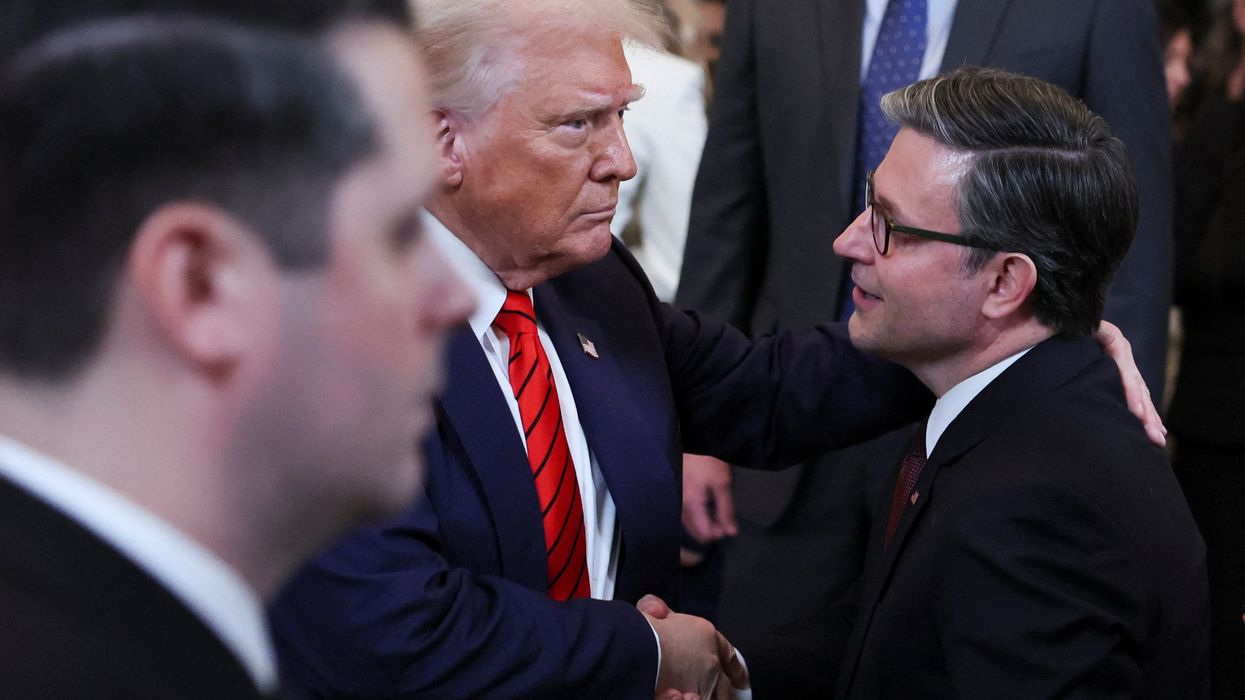
U.S. President Donald Trump shakes hands with Speaker of the House Mike Johnson, after signing an executive order banning transgender girls and women from participating in women's sports, in the East Room at the White House in Washington, U.S., February 5, 2025.
REUTERS/Leah Millis

February 06, 2025
ALTERNET

There is one thread that ties together Trump’s destruction of American government agencies, his offer to take the Gaza crisis off Israel’s hands and dump it on our military, and senators’ and representatives’ failure to challenge him: This is how kingdoms operate. Rule by decree.

It proves that we’re asking the wrong question.

Plug “Can American democracy survive Trump?” into a search engine and you’ll find thousands of websites, blogs, articles, and podcasts devoted to that one, single question.

But American democracy was kneecapped by five Republicans on the Supreme Court years ago when they ruled that money was the same thing as “free speech”; that corporations are “persons” with rights under the Bill of [Human] Rights; and that political operatives can engage in virtually unlimited purges of voting rolls, accompanied by racial- and gender-targeted laws to make it harder to vote.

The correct question is: “Can the American system — now that it’s become flooded with dark money and the ‘right to vote’ has become a mere privilege in Red states — ever again represent the interests of average citizens? Can we ever return to democracy?”

In an open call on X yesterday with Republican Senators Joni Ernst and Mike Lee, apartheid billionaire Elon Musk — whose father says he was chauffeured to school in white-run South Africa in a Rolls Royce — lit into the regulations that created and protect the American middle class and our democracy:
“Regulations, basically, should be default gone. Not default there, default gone. And if it turns out that we missed the mark on a regulation, we can always add it back in.

In a child-like echo of Ayn Rand, Musk added:
“These regulations are added willy-nilly all the time. So, we’ve just got to do a wholesale, spring cleaning of regulation and get the government off the backs of everyday Americans so people can get things done. … If the government has millions of regulations holding everyone back, well, it’s not freedom. We’ve got to restore freedom.”


Both capitalism and democracy could be likened to a game — say, football — ideally played to benefit the largest number of people by creating and guaranteeing “Life, Liberty, and the pursuit of Happiness.”

But imagine if the NFL were to suspend their regulations just before this Sunday’s Super Bowl. And the Chiefs, like most elected Democrats, chose to continue playing by the old regulations, but the Eagles started gut-punching, facemask-pulling, and even threw five extra players onto the field.

The only team that would ever win would be the one most willing to play dirty or buy off the refs. And, increasingly, that’s where we are today, both with our democracy and our economy.

We know this is crazy: Every state in the union has put into place an agency to regulate insurance companies because that very industry has a long, horrible history of ripping people off and refusing to pay claims unless the power of the state is invoked against them.

We regulate banks and brokerages for the same reason; when we deregulated them in the 1920s and the late 1990s the result was huge rip-offs that produced the Republican Great Depression and the Bush Crash of 2008.

We regulate automobile manufacturers because they have a history of putting profits over the lives of their customers (Ford Pinto 900 dead, GM trucks 2000 dead, etc.); refineries because their emissions cause cancer and asthma; drugs because unscrupulous manufacturers killed people in previous eras; workplace safety after the Triangle Shirtwaist fire killed 146 young women; voting because corrupt politicians rigged elections.

We regulate traffic with signs and stoplights to keep order and reduce accidents; we regulate police to prevent them from abusing innocent people; we regulate building codes so peoples’ homes don’t collapse or catch on fire from faulty cheap wiring.

And there was a time in America when we regulated money in politics and guaranteed the right to vote.

Those two types of regulations were passed in the late 19th and early 20th centuries after multiple scandals, like in 1899 when William Clark — then the nation’s second-richest man — openly bribed Montana legislators by standing outside the legislative chamber passing out brand new $1000 bills to the men who voted his way. Or when state after state — most all former Confederate states — repeatedly refused to allow Black people to vote.

We passed regulations guaranteeing a minimum wage, unemployment insurance, and the right to unionize to create the world’s first large-scale middle class. And we regulated the morbidly rich with a 90% income tax rate to prevent them from amassing so much wealth that their financial power could become a threat to our democratic republic.

And, of course, it’s those regulations — money in politics, the right to vote, and preventing the accumulation of dangerous levels of wealth — to which today’s broligarchs most strenuously object.

In each case, it was five Republicans on the US Supreme Court who gutted our protective regulations and put America on a direct collision course with today’s oligarchic neofascist takeover.

— They ruled that billionaires can buy politicians because giving money in exchange for votes isn’t bribery, but merely an expression of First Amendment-protected “free speech.”
— They claimed that corporations aren’t soulless creations of the law but are “persons” with the same right to share their “free speech” with politicians who do their bidding.
— And they ruled that voting is not a right in America — in open defiance of US law — but a mere privilege, giving the green light to Republicans to purge or refuse to count over 4 million votes in the 2024 election.


The result of all this Republican corruption is that the will of the majority of American voters hasn’t been fulfilled in two generations. The last time our political system was truly responsive to the voters was in the 1960s, when Medicare, Medicaid, and food stamps were created, and the Civil Rights and Voting Rights Acts were passed. And in the early 1970s, when we outlawed big money in politics.

Then, in 1978, five Republicans on the Supreme Court ruled in the Bellotti decision (written by Lewis Powell himself) that corporations are persons and money is merely free speech. Two years later, Reagan floated into the White House on a river of oil money and systematically began gutting the protective regulations that had built the largest and most successful middle class the world had ever seen.

Since then, big money has frozen us like a mosquito in amber. Even Obama’s big effort to establish a national healthcare system with an option for Medicare had to kneel before the throne of rightwing billionaires and the insurance industry.

Every developed country in the world has some variation on a free or low-cost national healthcare system, and free or even subsidized higher education. In most developed countries homelessness is not a crisis, nobody goes bankrupt because somebody in their family got sick, and jobs pay well enough (and have union pensions) so people can retire after 30 or 40 years in the workforce and live comfortably for the rest of their lives.

But not in America. Since the Reagan Revolution, rightwing billionaires have blocked any of those things from happening because they’d be paid for with taxes, and there’s nothing rightwing billionaires hate more than paying taxes.

— Dark money has destroyed the notion of one-person-one-vote.
— Monopoly — allowed because corporations can now buy politicians — has destroyed the small businesses that once filled America’s malls and downtowns.
— And voter suppression and voter list purges handed the 2024 election to Trump, as reporter Greg Palast documented in a recent, shocking report.

So, yeah, let’s do away with all the regulations like wannabe Kings Elon and Donald say. And make the United States look and operate more like Syria and its failed-state relatives than anything Americans would recognize.

After all, freedumb!

Government-funded landlord Trump hypocritically attacks government spending


By Gotfryd, Bernard, photographer - https://www.loc.gov/item/2020733783/, 
Public Domain, https://commons.wikimedia.org/w/index.php?curid=130775287
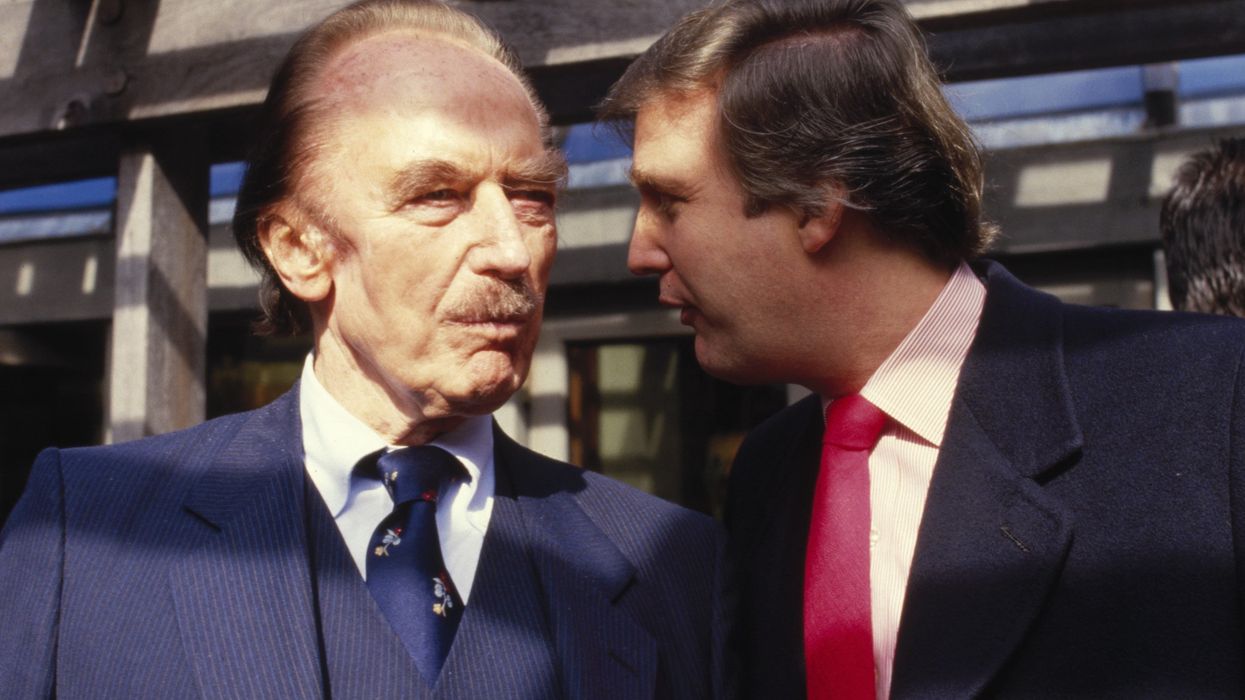
Fred and his son Donald at Central Park's Wollman Ice Rink (c. 1986), which was renovated by their company between 1980 and 1986
February 05, 2025
ALTERNET

President Donald Trump is making good on his promised threat to “dismantle Government bureaucracy” and “cut wasteful expenditures,” issuing orders to choke off the funding pipeline for federal grants and assistance programs.

The hypocrisy is breathtaking.

Because government spending, particularly the generous big-landlord benefits baked into U.S. law and tax policy, forms the very foundation of Trump’s own wealth. The Trump real estate fortune was built by hundreds of millions of dollars in government subsidies and huge tax breaks, none of which are available to the working people Trump is hurting with his current attacks.

Trump became wealthy the traditional American way: he was born into it. As most thoroughly described in Samuel Stein’s excellent 2019 book, Capital City: Gentrification and the Real Estate State, Donald’s father Fred’s real estate empire began with Brooklyn and Queens housing developments financed by the Federal Housing Administration (FHA). For some of those Trump developments, the path was literally cleared by government demolition of existing homes and buildings. Fred Trump’s appetite for government funding was so voracious that he was investigated by the Senate Banking Committee for defrauding post-World War II government housing programs by lying about the costs of his projects.

That was not the only investigation targeting Fred Trump’s government-funded properties. His Maryland buildings were so decrepit and his ignoring of the residents’ pleas for help and city orders to repair so blatant that the elder Trump was actually arrested in 1976 for operating a “slum property.” A U.S. Department of Justice discrimination lawsuit during the same era showed that the Trump properties systematically blocked Black prospective renters, using racist practices like attaching to their applications a paper bearing a big letter “C”—for Colored—so they could be rejected out of hand.

Fred Trump’s appetite for government funding was so voracious that he was investigated by the Senate Banking Committee for defrauding post-World War II government housing programs by lying about the costs of his projects.

That federal housing discrimination lawsuit, filed in 1973, did not just name Fred Trump. It also included the company’s president, his 27-year-old son Donald.

Donald Trump soon followed in his father’s footsteps by exploiting government programs to develop his buildings. The benefits included an unprecedented 40-year tax abatement, funding that was designed to support low-income neighborhoods, sweetheart deals to privatize public land, and government bonds used to finance his developments. “Donald Trump is probably worse than any other developer in his relentless pursuit of every single dime of taxpayer subsidies he can get his paws on,” a New York deputy mayor told the New York Times in 2016.

For example, the famous Trump Tower benefited from over $163 million in tax abatements provided by New York politicians whose campaigns Trump helped fund. That money was part of what the Timesestimated was nearly a billion dollars Trump received in government grants and tax breaks for his New York properties alone, not counting the government benefits for his properties in Florida, Nevada, and Atlantic City. "Donald Trump's business wouldn't be possible but for major government subsidies,” Timothy O'Brien, author of TrumpNation: The Art of Being the Donald, toldNPR.

Trump’s dependence on government funding is more than matched by the taxpayer dollars hoovered up by his designated government waste czar Elon Musk. As CNN has reported, the world’s richest person reached his status thanks to government loans and contracts that propped up Tesla and SpaceX in their vulnerable beginning stages. Musk still rakes in billions of dollars from government contracts and government-mandated payments to Tesla by other automakers.

“The foundation for Musk’s financial success has been the U.S. government,” tech analyst Daniel Ives told CNN.

We know that the Trump-Musk attacks on federal government programs are deeply harmful to vulnerable people, devoted civil servants, and communities and organizations trying to make the world a better place. Less well known is that Trump and Musk both owe their fortunes and careers to the very government spending they demonize now. They used government programs to climb to great heights, and now are intent on pulling up the ladder behind them.

Former Democratic presidential candidate Adlai Stevenson once said that a hypocrite politician is one who cuts down a redwood tree, then stands on its stump to deliver a speech about conservation. When the wealthy and powerful Donald Trump mounts his attacks on government programs, he does so while standing on a platform built by government largesse.
Robert Reich: This is no longer about Democrats versus Republicans


REUTERS/Brian Snyder/File Photo
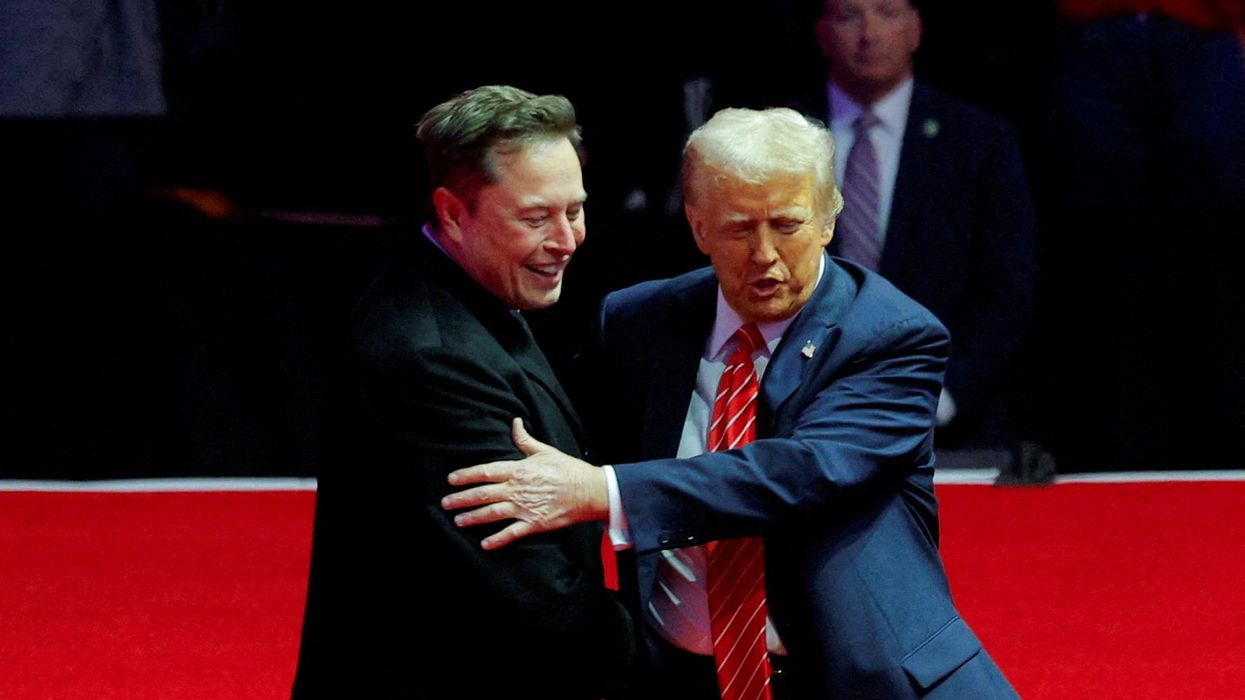
FILE PHOTO: U.S. President-elect Donald Trump greets Tesla CEO and X owner Elon Musk during a rally the day before Trump is scheduled to be inaugurated for a second term, in Washington, U.S., January 19, 2025.

February 06, 2025
ALTERNET

It’s a coup.


As Trump talks about taking over Gaza (“beautiful shoreline”), Greenland (“great minerals”), Panama (“very strategic”), and making Canada the 51st state, the media has gone ape-shite wild.

Meanwhile, Trump’s goons are taking over the federal government without congressional authority and very little public awareness.

They’re using two techniques.

The first is to physically take over an agency or department.

Consider USAID. Elon Musk (now a “special government employee”) calls it a “criminal organization” that needs to “die” and brags about feeding it “into the wood chipper.”

Which is what he and his tech goons have done — dismantling the work of the 10,000-person, $40 billion foreign-assistance agency, along with the thousands of people in nonprofits and other groups that work with it.

The irony of the richest man in the world almost single-handedly destroying an agency designed to help the world’s poor, so that the U.S. federal budget has more room for another giant tax cut for the richest man in the world and his pals, should not be lost on anyone.

Yesterday, all of USAID’s Washington facilities were closed. Nearly all USAID’s 10,000 employees have been put on administrative as of Saturday. Staff working around the world have been ordered to return home within 30 days.

“Thank you for your service,” is the last message on USAID’s website, which for days was offline.

Make no mistake: The takeover and dismantling of USAID is a test case for whether Musk and the Trump regime can destroy a part of government without legal or political resistance.

So far, the answer seems to be yes.

Republican Senate Majority Leader John Thune says he “doesn’t believe” the Trump administration is closing an agency without congressional approval, but that it is rather reviewing how the agency is spending money.

Thune is either a fool or a knave.

The second technique being used by Musk and his tech goons is to gain access to the Treasury Department’s payments system, responsible for nearly all payments made by the U.S. government, and alter it — writing new code for programs that control more than 20 percent of the U.S. economy, including Social Security benefits and veterans’ pay.

Musk says he’ll be shutting down some Treasury payments in an effort to root out “corruption and waste.” That is, whatever Musk considers corruption and waste.

What’s next? Will Trump, Musk, and Musk’s tech goons take over, or stop funding, the Labor Department? (My sources there tell me Department of Labor workers have been ordered to give Musk’s DOGE access to anything they want — or risk termination.)

I don’t know, but I do know that nothing right now seems to be stopping them.

The Republican-controlled Congress has essentially surrendered Congress’s powers, including the power of the purse (it has already surrendered its powers over tariffs and foreign policy). There’s not much of a role for Congress left.

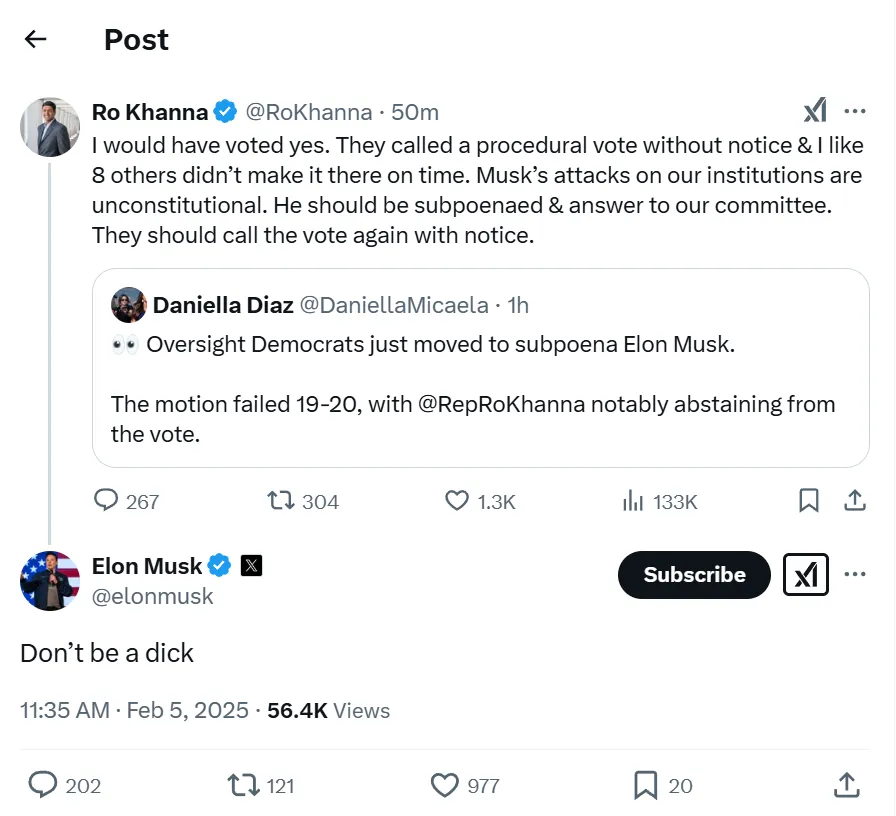
This afternoon, Democrats on the House Oversight Committee tried to subpoena Musk, but Republicans called a procedural vote without notice so the Dems wouldn’t get there on time. Here’s Congressman Ro Khanna’s account, followed by Musk’s response.


substackcdn.com


My friends, this is no longer about Democrats versus Republicans, left versus right, liberals versus conservatives.

The choice right now is democracy or dictatorship (or if you’d rather use the term fascism, go right ahead). And we are sliding faster than I ever thought possible into the latter

Everyone must choose which side they’re on. Now.

More on this to come.
Trump team heard him talk Gaza takeover for months and made no plan


'like 25 percent tariffs on Canada':

February 06, 2025
ALTERNET

President Donald Trump has been discussing his idea for the United States to takeover the Gaza Strip "for months," MAGA aides told Politico Wednesday.

Per the report, "It was clear Wednesday that they did little to prepare the rest of the world for Trump’s pitch to relocate nearly 2 million Palestinians from their homeland in Gaza so the U.S. could assert ownership of the area and turn it into 'the Riviera of the Middle East."

One person granted anonymity told the news outlet, "This was a 'get your ass to the negotiating table’ message."

READ MORE: ‘He does not want war’: Fox News host downplays Trump’s plan to take over Gaza

Drawing a comparison to Trump's tariff plan that he discussed for months ahead of his election win, the person added, "It was just like 25 percent tariffs on Canada."

Politico reports, "Another senior administration official given anonymity to discuss internal thinking said that Trump’s blunt statement that the U.S. would 'own and be responsible' for a Gaza Strip that has been reduced to rubble by 15 months of Israeli bombing should be read more broadly as an expression of his determination to lead a rebuilding process that achieves a lasting peace."

'Life or death consequences for millions': NGOs stunned by U.S. aid freeze

THIS HAS BEEN GOP POLICY SINCE JOHN BIRCH

Agence France-Presse
February 6, 2025 10:45AM ET


The measures against USAID have been hugely controversial (Mandel NGAN/AFP)

by Joris Fioriti with Cecil Morella in Manila and Joe Jackson in London

The freeze in aid funding by Donald Trump's new U.S. administration has left humanitarian workers seeing a large proportion of their budget cut off and fearing millions will be affected as programs are suspended.

On January 24, four days after Trump returned to power, NGOs linked to the US Agency for International Development (USAID) received a first letter asking them to cease all activities funded by the agency.

A week later, a second letter, seen by AFP, authorized them to resume certain missions intended for "life-saving humanitarian assistance".

But the terms used are vague and the NGOs say they feel lost.

The new administration has launched stinging attacks on USAID -- which Trump claimed was "run by radical lunatics" and his ally and advisor, the world's richest person Elon Musk, has described as a "criminal organization".


US Secretary of State Marco Rubio is now its acting director, vowing to put an end to its "insubordination".

Global and regional NGOs told AFP in interviews that the effect to their work has been immediate and warned the move could also erode US influence worldwide.
- Solidarites International -


Kevin Goldberg, director of French NGO Solidarites International, said that the move has already forced the pausing of certain aid operations in countries including Mozambique, Syria and Yemen.

"Today, the United States is debating the future of its development agency. But this subject concerns the entire planet," he said.

"We know that this is a sector that, in any case, must innovate," he said.


"But to stop everything overnight, to not take into account at all the fact that we are talking about millions of human lives, that's crazy."

He said the unclear instructions from the U.S. administration could prevent some charities from risking going ahead with programs in case they then had to foot their costs themselves.

"It's like trying to drive with a massive spoke in the wheel," he said.

- Oxfam America -

Daryl Grisgraber, humanitarian policy lead for Oxfam America, said that change was likely to be drastic.

"It really will have a potentially life or death consequences for millions of people.


"At the end of those 90 days, it's very likely there are going to be huge cuts on what aid can continue to move.

"So there is effectively a pause on all future funding as well," he said.

"We have been looking at it as really basically a cynical power play. This is going to put lives in danger and it's unacceptable as a representation of United States values and interest in the world."

- Balay Rehabilitation Center -

The centre, which provides psycho-social counseling and other help for survivors of torture in the conflict-plagued southern Philippines, said it was already feeling the effects of Trump's policy.

"We are still in limbo as to whether this project will continue or not," said executive director Josephine Lascano.

She said she had already been forced to suspend a program that was helping "about 20" victims of violence.


The Philippines received close to $190 million in USAID funding in 2023.
- MSI Reproductive Choices -

Beth Schlachter, senior director of US external relations at sexual and reproductive healthcare provider MSI Reproductive Choices, said it was fully aware that nearly 10 percent of its budget from the US government could disappear.


"There's a lot of chaos that's going to play out, or starting to play out already, at the country level," she said.

"Our... colleagues who are running these programs in the countries are already feeling just the fear and the chaos of not knowing what will be supported and what will go away.

"Money is power... You can't just wield this kind of destruction and then expect to still have a seat at the table and to have the kind of influence that you want to have."

- InterAction -

Tom Hart, CEO of InterAction, an alliance of NGOs and partners in the United States, said bringing life-saving programs to a halt was "counterproductive to this administration's own stated goals".

"Where we stand today is children going without education and mothers not receiving prenatal care," he added.

© Agence France-Presse
TRUMP MINI ME

Five ways in which Argentina's Milei has mirrored Trump

Agence France-Presse
February 6, 2025 


Argentine President Javier Milei called COVID-19 lockdowns 'one of the most bizarre crimes against humanity' (FABRICE COFFRINI/AFP)

by Sonia AVALOS with Clare BYRNE in Bogota

Imitation is the sincerest form of flattery, as the saying goes, and Argentina's President Javier Milei has made clear his admiration for Donald Trump by liberally borrowing from the US president's playbook.

On Wednesday, Argentina announced it would follow the United States out of the World Health Organization, echoing Trump's repeated complaints about what he called the body's mishandling of the COVID-19 pandemic.

Andrea Oelsner, professor of international relations at the University of San Andres in Buenos Aires, called Argentina's WHO exit "another sign" of the country's return to the policy pioneered by post-dictatorship president Carlos Menem in the 1990s of "automatic alignment" with Washington.


She added that Milei's claim that the WHO impinged on Argentina's sovereignty "serves to get closer to Trump."

Here are five other issues on which Argentina's self-declared "anarcho-capitalist" leader has followed his US counterpart's lead:

- Climate scepticism -

Like Trump -- who has vowed to "drill, baby, drill" -- Milei is a climate skeptic, who declared during campaigning for president that "policies that blame humans for climate change are wrong."

After Trump's re-election in November, Argentina abruptly pulled out of UN climate talks in Azerbaijan, raising fears Milei could imitate Trump's withdrawal from the Paris Agreement on curbing carbon emissions.

Argentina said it was "reevaluating" its participation in the deal.

The talks snub coincided with a visit by Milei to Trump's Mar-a-Lago estate, the first foreign leader to visit the Republican after his election win.

But Milei nonetheless went on to sign a declaration by G20 leaders at a summit in Rio recognizing the need for "substantially scaling up climate finance."

- War on 'woke' -


Like Trump, Milei has repeatedly railed against what he calls "woke ideology", most recently at the World Economic Forum in Davos where he described it as a "cancer."

On Wednesday, his spokesman announced he would ban gender reassignment surgery and hormone therapy for transgender children, days after Trump announced restrictions on gender transition procedures for minors.

Milei's government added that minors would also not be allowed to make any changes to their ID documents, including their gender, until they had reached adulthood.


- Mad about Musk -

Milei and Trump share a deep admiration for brash billionaire Elon Musk, with Milei lavishing praise on Trump's budget-slashing consigliere as the "Thomas Edison of the 21st century."

Trump for his part has given the Tesla and SpaceX boss, who has turned his X platform into an echo chamber for the MAGA (Make America Great Again) movement, extraordinary powers as the head of a new department in charge of slashing federal spending.

Musk, in turn, has championed Milei's "chainsaw" economics and declared Argentina to be "experiencing a giant improvement" since Milei took over.


- Social media attacks -


Both leaders have been accused of stoking hate speech and intolerance by copiously insulting critics and political opponents on social media.

Milei has labeled economists who question his policies "econochantas" ("eco-phonies"), trade unionists "garcas" ("crooks") and political opponents are "mandrills" (a type of monkey), "rats" and "parasites."

Like Trump, he and his online shock troops have also repeatedly attacked the media and critics as "corrupt" -- language reminiscent of Trump's 2017 promise to "drain the swamp" of Washington insiders and influence-peddlers.


- Iron-clad Israel support -


Milei, who has professed a deep interest in Judaism and studied Jewish scripture, is one of Israel's staunchest defenders.

During a visit to Israel last year he announced plans to move Argentina's embassy from Tel Aviv to Jerusalem -- a controversial move that echoed Trump's shock 2017 decision to unilaterally recognize Jerusalem as Israel's capital.

He also likened the October 7, 2023 Hamas attacks on Israel to the Holocaust.


© Agence France-Presse