Friday, February 21, 2025


UKRAINE , GAZA JUST REAL ESTATE TO TRUMP

'Game changer': US reportedly threatens to revoke Ukraine's Starlink access over minerals

Daniel Hampton
February 21, 2025 
RAW STORY


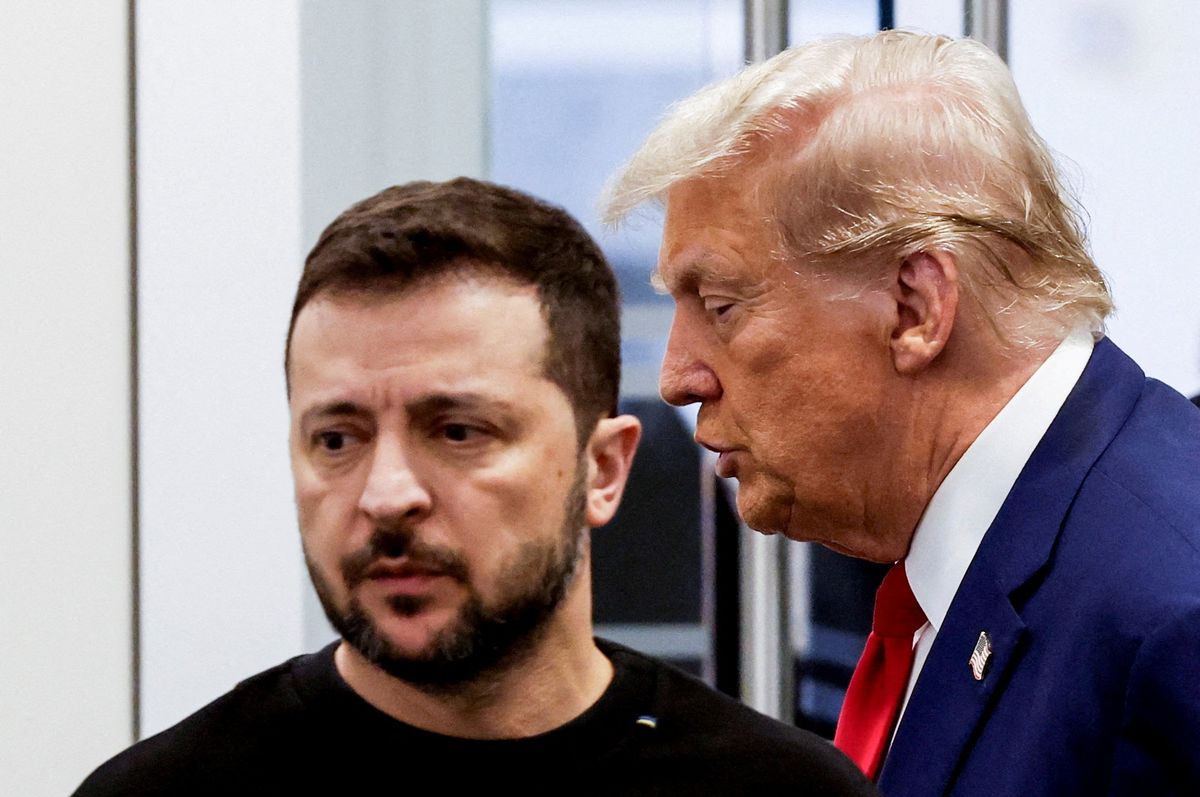
FILE PHOTO: Republican presidential nominee and former U.S. President Donald Trump and Ukraine's President Volodymyr Zelenskiy meet at Trump Tower in New York City, U.S., September 27, 2024. REUTERS/Shannon Stapleton/File Photo

American negotiators reportedly threatened to revoke Ukraine's access to Elon Musk's vital Starlink satellite internet network if they refuse to give the U.S. access to critical minerals, according to a report.

Three sources familiar with the matter told Reuters on Friday that Ukraine's access to the network of satellites was raised during talks between officials between the two nations after Ukraine President Volodymyr Zelenskiy rejected a proposal from Treasury Secretary Scott Bessent.

Starlink access was raised again Thursday, according to the report, and Ukraine was threatened that's its access could be imminently shut off.

"Ukraine runs on Starlink. They consider it their North Star," a source told Reuters. "Losing Starlink ... would be a massive blow."

The Trump administration has proposed a deal to Ukraine that would give the U.S. access to a significant portion of the country's rare earth minerals in exchange for continued military support. An initial proposal sought half of the revenue from Ukraine's rare earth minerals and other natural resources.


Zelensky declined the deal and said he couldn't "sell the country off." The Trump administration later provided an "improved" draft of the minerals deal.

Musk brought thousands of Starlink terminals to Ukraine after Russia destroyed Ukraine's communications services.

“Losing Starlink would be a game changer,” Melinda Haring, a senior fellow with the Atlantic Council, told Reuters.
THE R WORD REDUX: RECESSION

Billionaire predicts 'regime shift' after Trump policies prove 'negative for the economy'
AlterNet
February 21, 2025 

One billionaire investor is predicting a sharp policy reversal from President Donald Trump's administration after his policies caused shock throughout the economy.

CNBC reported Friday that Steve Cohen — the billionaire hedge fund manager who owns the New York Mets baseball team — is bearish on the economy in the wake of Trump's signature policies. He specifically mentioned Trump's mass deportations of undocumented immigrants, layoffs of thousands of federal workers due to budget cuts and the tariffs he imposed on goods imported from overseas.

"Tariffs cannot be positive, okay? I mean, it’s a tax,” Cohen said during a talk in Miami Beach, Florida. “On top of that, we have slowing immigration, which means the labor force will not grow as rapidly as ... the last five years and so.”

Cohen, who is ranked by Forbes as the 39th richest person in the United States with a net worth of $21.3 billion, predicted that GDP growth would slow from Trump's policies by anywhere from 1.5% to 2.5% in the latter half of 2025. However, he said that it likely wouldn't be a "disaster" that the U.S. economy would be unable to bounce back from in the future.

"When that money has been coursing through the economy over many years, and now, potentially it will be reduced or stopped in many ways, has got to be negative for the economy," Cohen said. "I think we’re seeing the regime shift a little bit. It may only last a year or so, but it’s definitely a period where I think the best gains have been had and wouldn’t surprise me to see a significant correction."

Cohen's remarks come on the same day that the S&P 500 saw all post-inauguration gains wiped out, according to the New York Times. Even though the index recently hit a record high, investors are wary that corporations will continue to perform at such a high level due to the new economic climate. Additionally, the University of Michigan's consumer sentiment index — which marks how American consumers feel about the economy — hit its lowest point in roughly a year.

The Times reported that consumers are expecting prices for goods to increase by roughly 3.5% annually over the next five to ten years, which would be the highest rate of increase since 1995. The Federal Reserve has also said it's unlikely to lower interest rates throughout the remainder of 2025, unless inflation rates drop back down to its target of 2%.

Click here to read CNBC's full report, and click here to read the Times' article in full (subscription required).


Musk, Trump threats to NOAA could harm Great Lakes  
WHICH U$ SHARES WITH CANADA
Wisconsin Examiner
February 21, 2025 


Mobile phone with website of National Oceanic and Atmospheric Administration (NOAA) on screen in front of logo. (Photo credit: T. Schneider / Shutterstock)

by Henry Redman, 
Ohio Capital Journal
February 21, 2025

Kayakers on Wisconsin’s Lake Superior coastline rely on data collected by buoys operated by the National Oceanic and Atmospheric Administration (NOAA) to determine if conditions are safe enough for a weekend paddle or if the swells and wind could spell danger on a lake famous for wrecking much larger watercraft.

Surfers in Sheboygan use buoys on Lake Michigan to figure out if the city is living up to its name as the “Malibu of the Midwest” on a given day. Anglers on the shores and on the ice all over the lakes rely on the buoy data to track fish populations.

Freighters sailing from Duluth, Minnesota and Superior use NOAA data to track weather patterns and ice coverage.

Wisconsin’s maritime economy provides nearly 50,000 jobs and nearly $3 billion to the state’s gross domestic product, according to a 2024 NOAA report, but in the first month of the administration of President Donald Trump, the agency is being threatened.

The University of Wisconsin-Milwaukee’s School of Freshwater Sciences, UW-Madison’s Sea Grant and UW Extension’s National Estuarine Research Reserve use funds through NOAA grant programs to study the state’s two Great Lakes.

Faculty at universities across the state receive NOAA money to study weather forecasting, severe droughts and precipitation on the Pacific Ocean. NOAA helps the state Department of Administration manage more than 1,000 miles of coastline and funds local efforts to control erosion and prevent flooding. A previous NOAA project worked with the state’s Native American tribes to study manoomin, also known as wild rice, to help maintain the plant that is sacred to the tribes and plays an important ecological role.

All of that research could be at risk if cuts are made at NOAA.

Elon Musk’s Department of Government Efficiency (DOGE) — named for an internet meme of a shiba inu (a breed of Japanese hunting dog) first made popular more than a decade ago — has set its sights on NOAA. In early February, staffers with DOGE entered NOAA’s offices seeking access to its IT system, the Guardian reported. A week later, the outlet reported that scientists at the agency would need to gain approval from a Trump appointee before communicating with foreign nationals. The agency has been asked to identify climate change-related grant projects.

To run the agency, Trump has nominated Neil Jacobs as NOAA administrator. Jacobs was cited for misconduct after he and other officials put pressure on NOAA scientists to alter forecasts about 2019’s Hurricane Dorian in a scandal that became known as “Sharpiegate.” Trump has also nominated Taylor Jordan as the assistant Secretary of Commerce overseeing NOAA. Jordan previously worked as a lobbyist for private weather forecasting agencies that would benefit from the dismantling of NOAA — which runs the National Weather Service.

A suggested Trump administration plan for NOAA was laid out in the Heritage Foundation’s Project 2025 blueprint. The plan calls for NOAA to “be dismantled and many of its functions eliminated, sent to other agencies, privatized, or placed under the control of states and territories,” because it has “become one of the main drivers of the climate change alarm industry and, as such, is harmful to future U.S. prosperity.”

Sara Hudson, the city of Ashland’s director of parks and recreation, says the community is dependent on Lake Superior year round and funding from NOAA helps the city manage its coastline. She says the city has about $1.2 million in grant funding that could be affected by cuts at NOAA. The city’s total 2024-25 budget is about $2.4 million.

“With the funding that Ashland has, we really don’t have a lot of access to be able to do coastal resiliency or coastal management projects,” she says. “So we rely on grants to be able to do extra.” Among the affected projects, she says, could be coastal resiliency projects that help maintain public access to a waterfront trail along Lake Superior, projects to help improve water quality including the Bay City Creek project and work on invasive species and promoting native species within public lands.

Even if Trump and Musk are trying to erase climate change research from NOAA’s mandate, the effect of a warming climate could have dire consequences for Ashland’s lake-based economy, according to Hudson. Hundreds of businesses on Lake Superior can’t survive if the tourism season ends in the fall.

“For a community that relies on winter and every year sees less winter, economically it could be devastating,” Hudson says. “We need to have tourism 12 months out of the year. And if our winters go away, that really, that’s going to be a pivot to us. But our winter … that’s the only way our businesses can stay alive here.”


The Great Lakes provide drinking water for about 40 million people across the United States and Canada. Organizations like the National Estuarine Research Reserve are funded by NOAA to help make sure that water is healthy.

“We’re doing things like tracking algae blooms and changes in water quality that are really important for tourism and fishing and drinking water,” Deanna Erickson, the research reserve’s director, says. “On Lake Superior we’re working in rural communities on flood emergencies and emergency management and coastal erosion; 70% of the reserve’s operational funding comes through NOAA, and that’s matched with state funds. So in Superior, Wisconsin, that’s, you know, a pretty big economic impact here we have about a million dollars in funding for our operations.”

Eric Peace, vice president of the Ohio-based Lake Carriers Association, says that cuts to NOAA could have drastic effects on Great Lakes shipping because the data collected by the agency is crucial to navigating the lakes safely.


“On Lake Michigan, those buoys are critical to navigation safety, because what they do is provide real time data on wind, waves, current water temperatures, etc,” he says. “And our captains use those extensively to avoid storms and to find places to transit and leave.”

Further north on Lake Superior, real-time reports on water conditions are crucial because of how dangerous the lake can get.

“I was stationed on a buoy tender in Alaska, and I’d take the 30-footers that you get up there over the 10-footers you get on Lake Superior, because they’re so close together here,” says Peace, who spent more than 20 years in the U.S. Coast Guard. “They’re all wind-driven, and they’re dangerous. Couple that with icing and everything else, you have a recipe for disaster.”

The DOGE mandate for NOAA scientists to stop communicating with foreign nationals could have a significant impact on Great Lakes shipping because the agency coordinates with the Coast Guard and a Canadian agency to track ice conditions on the Great Lakes.

“That is one area that would be detrimental,” Peace says. “We wouldn’t have that ice forecasting from the Canadians. We would have to assume control of that completely for our own sake.”

U.S. Sen. Tammy Baldwin recently introduced a bipartisan bill with a group of senators from seven other Great Lakes states to increase funding for the Great Lakes Restoration Initiative. The initiative involves 12 federal agencies, including NOAA, to keep the lakes clean. In a statement, Baldwin said she’d work to fight against any efforts that would harm Wisconsin’s Great Lakes.

“Republicans are slashing support for our veterans, cancer research, and now, they are coming after resources that keep our Great Lakes clean and open for business — all to find room in the budget to give their billionaire friends a tax break,” she said. “Wisconsin communities, farmers, and businesses rely on our Great Lakes, and I’ll stand up to any efforts that will hurt them and their way of life.”


Ohio Capital Journal is part of States Newsroom, a nonprofit news network supported by grants and a coalition of donors as a 501c(3) public charity. Ohio Capital Journal maintains editorial independence. Contact Editor David Dewitt for questions: info@ohiocapitaljournal.com


'Just awful': Outrage as Trump ousts Joint Chiefs chairman

HIS ARMY IS WHITE STR8 CHRISTIAN MALE
PREPING FOR THE END TIMES

Matthew Chapman
February 21, 2025 
RAW STORY


FILE PHOTO: U.S. Chairman of the Joint Chiefs of Staff General Charles Q. Brown speaks during annual Memorial Day in Arlington National Cemetery in Arlington, Virginia, U.S., May 27, 2024. REUTERS/Ken Cedeno/File Photo


President Donald Trump announced on Friday that he is ousting C.Q. Brown as chair of the Joint Chiefs of Staff.

"Today, I am honored to announce that I am nominating Air Force Lieutenant General Dan 'Razin' Caine to be the next Chairman of the Joint Chiefs of Staff. General Caine is an accomplished pilot, national security expert, successful entrepreneur, and a 'warfighter' with significant interagency and special operations experience," Trump posted to his Truth Social platform. "Despite being highly qualified and respected to serve on the Joint Chiefs of Staff during the previous administration, General Caine was passed over for promotion by Sleepy Joe Biden. But not anymore!"

Brown's ouster, which came despite furious warnings from analysts not to remove senior military officials, triggered an intense reaction from commenters on social media — many of whom speculated Trump wanted to get rid of Brown because he had been a champion of diversifying the military.

"This is just awful," wrote former U.S. Ambassador to Russia Michael McFaul. "I have had the honor of working with and meeting many Chairmen of the Joint Chiefs over the decades. General CQ Brown was one the finest of them all, especially suited for the challenges of our current era of great power competition with China."

"Remember, they want to fire Gen. CQ Brown because he’s Black, and to them, minorities don’t earn their jobs," wrote journalist Kevin Baron. "He also supports a diverse military. Like every. Single. Other. Joint. Chief."

"We knew General CQ Brown’s days were numbered since Election Day - Trump simply was NOT going to sit next to a Black Joint Chief’s Chairman," wrote political strategist Drexel Heard.

"General CQ Brown, Chairman of the Joints Chief of Staff, was just apparently 'fired' by Trump via a social media post by Trump," wrote Meidas Touch co-founder Ben Meiselas. "Just an hour ago General Brown posted this so it seems he wasn’t expecting Trump’s post firing him."

He shared a post from Brown on Friday afternoon, talking about his commitment to securing the border.

"President Trump just fired Joint Chiefs Chairman CQ Brown — no reason given," wrote former Joe Biden strategist Chris D. Jackson. "That’s another highly qualified African American official ousted, only to be replaced by a white guy. This is what 'America First' looks like? So sad."

Trump's 'anti-diversity' executive order dealt a blow in court

Matthew Chapman
February 21, 2025 
RAW STORY

A federal judge has blocked President Donald Trump's far-reaching order banning diversity, equity, and inclusion, or DEI, programs in the government, reported The Associated Press on Friday.

This marks the latest in a series of court actions blocking Trump's massive array of start-of-term executive orders.

Trump signed an order his first day in office directing federal agencies to terminate all 'equity-related' grants or contracts. He signed a follow-up order requiring federal contractors to certify that they don’t promote DEI," said the report.

However, "the plaintiffs — including the city of Baltimore and higher education groups — sued the Trump administration earlier this month, arguing the executive orders are unconstitutional and a blatant overreach of presidential authority. They also allege the directives have a chilling effect on free speech."

Judge Adam Abelson, an appointee of former President Joe Biden, agreed that the order likely violates freedom of speech, and issued an order preventing the government from enforcing the order while the litigation continues.

Trump's order had been so broadly written that the Defense Intelligence Agency even advised its staff not to publicly recognize Martin Luther King Day, Holocaust Remembrance Day, or Black History Month, and removed several non-white history pieces from the agency museum.
OK Education Department seeks to buy bible lessons for elementary kids

Jennifer Palmer, Oklahoma Watch
February 21, 2025 

Reading the Bible (Shutterstock)


While its effort to buy Bibles for classrooms is tied up in court, the Oklahoma Department of Education initiated a new vendor search to purchase materials containing Bible-infused character lessons for elementary-aged students.

The department is looking to buy supplemental instructional materials containing age-appropriate biblical content that demonstrates how biblical figures influenced the United States. Additionally, the materials must emphasize virtues, significant historical events, and key figures throughout Oklahoma history, according to bid documents published Friday.


The request for proposals doesn’t specify how many copies the state wants to buy, only that the vendor must be willing to ship directly to districts.

Like the Bibles the department sought in the fall, this request could be challenged under the state constitution, which prohibits public money from being spent for religious purposes.

“This RFP seems to be another constitutional violation,” said Alex Luchenitser, an attorney for Americans United for Separation of Church and State and one of the attorneys representing Oklahomans in the Bible lawsuit.


“It seeks to inject the Bible into public school curricula, and only refers to the Bible and doesn’t refer to any other religious texts, so it’s clearly a move to push Christianity,” he said.

The Education Department wants the character materials to align with Oklahoma’s new social studies standards, which have been revised to contain more than 40 references to the Bible and Christianity, compared to two in the current version. But the proposed standards haven’t been approved.

Superintendent of Public Instruction Ryan Walters is expected to present the standards to the Board of Education at its next meeting, scheduled for Thursday. It will be the first time the board meets since Gov. Kevin Stitt replaced three members. If approved, the standards will move to the Legislature for consideration.

The standards review committee included several nationally prominent conservatives: Dennis Prager of PragerU, David Barton of the Christian Nationalist organization Wallbuilders, and the president of the Heritage Foundation, Kevin Roberts.

While standards guide what schools are to teach, school districts have sole authority to choose curriculum and books.

In November, the state abruptly canceled a search to buy 55,000 King James Bibles, an effort that attracted criticism for appearing to exclude all Bibles except an expensive version endorsed by President Donald Trump.


Walters vowed to reissue that request, but a coalition of parents, students, teachers and faith leaders asked the Oklahoma State Supreme Court to block the purchase and Walters’ mandate to teach the Bible.

The Office of Management and Enterprise Services, the state’s central purchasing agency, also wants to wait. It asked the court for an order allowing it to delay the new Bible request for proposals until the case is resolved. Two OMES employees are named in the lawsuit.

This article first appeared on Oklahoma Watch and is republished here under a Creative Commons license.
\


'Not the greatest pick': 'Religious row' reportedly ignites over Trump's new appointment

Erik De La Garza
February 21, 2025 

A Crucifix and an American flag stand at St Mary's Church in Champlain, a town at the Canada-U.S. border between the U.S. state of New York and the Canadian province of Quebec, in Champlain, New York, U.S., January 22, 2025. REUTERS/Carlos Osorio

A disagreement in conservative Christian circles being described as a “religious row” has broken out over President Donald Trump’s re-appointment of the evangelical Rev. Paula White-Cain to head the White House Faith Office, according to a new report.

That decision set off a flurry of criticism among the Christian far-right – with naming-calling, second-guessing and accusations of potentially incriminating videos on the horizon – flying from religious leaders angry at the pick.

Right-wing megachurch pastor Doug Wilson, an influential Trump supporter, described White-Cain to Religion News Service as an “erratic woman preacher who has been all over the map.”

“It’s not the greatest pick in the world,” he told the outlet, adding that she was “the kind of person that embarrassing video footage can be rolled out almost at will.”

His remarks are just the latest in a series of blowbacks set off just after Trump announced earlier this month that the Faith Office would once again be run by White-Cain, who Religion News Service said has been “long regarded as Trump’s closest religious adviser.”

“Unlike critiques from Trump and White-Cain’s numerous liberal detractors, the latest round of criticism has pitted prominent Pentecostal and charismatic Christians such as White-Cain, who have made up an important part of Trump’s evangelical Christian base, against a cadre of conservative Calvinists — including a subset influential among some of Trump’s advisers and cabinet members,” according to the religious outlet.

Matthew Taylor, a scholar at the Institute for Islamic, Christian and Jewish Studies who has studied the influence of charismatic Christianity on Trump, told Religion News Service that while White-Cain faced opposition during Trump’s first term from moderate evangelicals uncomfortable with Pentecostalism, “this time the fight is more of a ‘sibling rivalry’ between different factions of the ‘Christian far-right.’”

“Paula White and her circle truly dominate the Trump advisory circles, the evangelical advisory circles,” Taylor told Religion News Service. “Now you have these kind of natalist, radical traditionalist Catholics that see an avenue to power through JD Vance, and you see these kind of Reconstructionist Calvinist-types who see an avenue through Pete Hegseth and maybe Russ Vought. So now there’s real power and policy in play.”

White-Cain served in the same position toward the end of Trump's first term and was among the speakers at the "Stop the Steal" rally on Jan. 6, 2021, before a mob of MAGA rioters attacked the Capitol.


U$ Medicare Defenders Slam 'Obscene' Looming Cuts to Telehealth Coverage


"We have trillions to spend on tax breaks for the rich and corporations," said one economic policy expert, "but we can't afford to cover telehealth visits for seniors?"



A patient receives a teleconsultation with a specialist in this stock photo.
(Photo: BSIP/Universal Images Group via Getty Images)


Brett Wilkins
Feb 21, 2025
COMMON DREAMS


The announcement Thursday that Medicare will no longer cover many telehealth services starting April 1 prompted elder and telemedicine advocates to urge the Trump administration to continue the provision of vital remote care for millions of Americans.

According to the Medicare website, "you can get telehealth services at any location in the U.S., including your home" until March 31. Beginning April 1, "you must be in an office or medical facility located in a rural area... for most telehealth services. If you aren't in a rural healthcare setting, you can still get certain Medicare telehealth services on or after April 1."

These services include monthly kidney dialysis treatments; diagnosis, evaluation, or treatment of acute stroke symptoms; and mental and behavioral health services, including addiction treatment.

"What is the rationale for this, other than making life more difficult for many seniors?"

The announcement came as the White House signaled Republican U.S. President Donald Trump's openness to slashing Medicare's budget under the guise of the Department of Government Efficiency's (DOGE) mission of reducing "waste, fraud, and abuse."

"Unreal," economic policy expert Michael Linden said on social media. "We have trillions to spend on tax breaks for the rich and corporations, but we can't afford to cover telehealth visits for seniors?"


One Trump supporter asked on social media: "Why is Medicare eliminating telemedicine? I'm a senior and find it very convenient. If it's fraud, figure out a way to prevent fraud. Have calls made over a government app! I want to know why!"

Congressman Ro Khanna (D-Calif.) asked, "What is the rationale for this, other than making life more difficult for many seniors?"

Campaign for New York Health executive director Melanie D'Arrigo accused Trump of "killing telehealth for seniors, because many seniors will skip seeing a doctor if they have to go in person."


"Patients skipping appointments saves money, but also leads to more preventable deaths," D'Arrigo added. "Guess which he cares about more?"

Dean Baker, senior economist at the Center for Economic and Policy Research, quipped: "Not sure who this is a handout to. I know Trump wants to burn as much fossil fuel as possible, so that is one motivation. Maybe people were getting fewer unnecessary tests with telemedicine, so the medical testing industry could also have been a factor. Any other explanations?"


Georges Benjamin, executive director of the American Public Health Association—an advocacy group for U.S. public health professionals—toldRoute Fifty's Kaitlyn Levinson Thursday that "the federal contribution is absolutely essential for [telemedicine] to be a seamless system."

However, Benjamin said that "it is unclear what the Trump administration's financial policies will be in terms of supporting telemedicine and incentivizing telemedicine."

Benjamin added that he hopes the Trump administration will "provide supplemental funding and support for states that want to beef up their telemedicine capacity."

The American Telemedicine Association (ATA), another advocacy group, last month praised Trump for temporarily expanding Medicare telehealth coverage during the Covid-19 pandemic.

"Trump can cement his legacy as the president to modernize the American healthcare system by permanently enabling omnichannel care delivery that leverages both in-person and virtual care," ATA senior vice president for public policy Kyle Zebley said in a statement.

"In doing so," Zebley added, "he will expand access to needed care for millions of patients, boost a beleaguered provider population, and create greater efficiencies and operational successes for struggling healthcare organizations."

American Medical Association president Dr. Bruce A. Scott said last month that "congressional action is required to prevent the severe limitations on telehealth that existed before the Covid-19 pandemic from being restored."

"We must make these flexibilities permanent and secure telehealth's future as an essential element of our patient toolbox, and ensure that all Americans—including rural, underserved, and historically marginalized populations—can receive full access to the care they need," Scott added.

Ousted workers dispute claims DOGE saved Medicare and disease jobs from cuts: report

Sarah K. Burris
February 18, 2025

FILE PHOTO: Elon Musk listens to U.S. President Donald Trump speak in the Oval Office of the White House in Washington, D.C., U.S., February 11, 2025. REUTERS/Kevin Lamarque/File Photo

The Trump administration's insistence that it's avoiding cutting certain healthcare workers — including those involved with disease response and Medicare — appears to be false, according to a report.

An anonymous official in the administration told Politico last week they were trying to be "thoughtful about critical functions that the government needs to perform."

But not so, laid-off workers told HuffPost.

Even those "keeping dangerous chemicals out of the food supply, and those on a project to reduce America’s notoriously high maternal mortality rate" are now gone, reported Jonathan Cohn.

Two HHS employees who work on Medicare were given dismissal notices. The sources told HuffPost "plenty more" were cut, including those hired to renegotiate drug prices for Medicare.

"But the idea that this effort is 'thoughtful' seems pretty dubious, given the broad, chaotic way firings have taken place ― and the fact that, as employees told HuffPost, many of the people who lost jobs were working on projects to reduce costs, to guard against fraud or to promote better health outcomes," wrote Cohen.

Trump claimed DOGE's goal was to reduce "waste, fraud, and abuse," but one worker told HuffPost that the cuts are not being made efficiently and will not help save taxpayer dollars.

“If you want to talk about saving money for taxpayers, we were the ones that were ensuring that it actually was budget neutral for the federal government,” that worker said.


Trump tasked Elon Musk's Department of Government Efficiency initiative with finding what should be cut, resulting in an indiscriminate firing of whole offices.

At the Department of Energy, for example, as many as 350 National Nuclear Security Administration employees were laid off last week, leaving offices vacant for some of the most sensitive nuclear positions. The White House team wanted to bring them back once they realized their mistake, but couldn't find any contact information, NBC News said.

While the U.S. faces a bird flu outbreak, the administration fired those at the Department of Agriculture on Friday who were working on it. DOGE fired those tasked with disease detection, The Independent reported Monday. Like with the Department of Energy, the administration is now scrambling to find those workers to ask them to return.


Read the full list here.
In First Major Climate Challenge to Trump 2.0, Groups Work to Block Offshore Drilling Once Again


Climate campaigners defeated the president's offshore drilling push during his first term, and they are pledging to do so again.


An offshore oil platform is seen in the Santa Barbara Channel in California on January 1, 2024.
(Photo: Marli Miller/UCG/Universal Images Group via Getty Images)


Julia Conley
Feb 21, 2025
COMMON DREAMS

Climate advocates are expressing confidence as they file the first major environmental legal challenges to U.S. President Donald Trump's administration, with the legal group Earthjustice noting that campaigners were victorious during Trump's first term when they sued to stop him from gutting protections from offshore oil drilling.

"We defeated Trump the first time he tried to roll back protections and sacrifice more of our waters to the oil industry," said Earthjustice managing attorney Steve Mashuda on Wednesday as the organization filed a challenge against an executive order Trump signed on his first day of his new White House term. "We're bringing this abuse of the law to the courts again."

Trump urged oil and gas companies—which poured nearly $450 million into efforts to get him and other anti-climate Republicans elected last year—to "drill, baby, drill" as he signed the order hours into his second term.

The order rolled back former Democratic President Joe Biden's ban on offshore drilling over more than 625 million acres of coastal territory, including parts of the Gulf of Mexico that were impacted by BP's Deepwater Horizon oil spill in 2010, which killed 11 people and devastated local ecosystems and businesses.

"Trump tried this illegal move to undo protections during his first administration, and he failed. We will keep working to ensure he won't be any more successful this time around."

As Common Dreamsreported in January, Biden invoked the Outer Continental Shelf Lands Act to protect areas of the U.S. coasts from future oil and gas leasing, and a federal judge ruled in 2019 that withdrawals under the law cannot be revoked without an act of Congress.

"When nearly 40% of Americans live in coastal counties that rely on a healthy ocean to thrive, removing critical protections shows how little care Trump has for these communities," said Devorah Ancel, senior attorney at Sierra Club, which joined the lawsuit along with climate groups Oceana, Greenpeace, the Northern Alaska Environmental Center, and other organizations. "Trump tried this illegal move to undo protections during his first administration, and he failed. We will keep working to ensure he won't be any more successful this time around."

Earthjustice noted that a poll conducted by Ipsos last year on behalf of Oceana found that 64% of Americans want elected officials to keep offshore areas off-limits for new oil and gas leasing. Climate scientists have consistently warned that new fossil fuel projects have no place on a pathway to limiting planetary heating to 1.5°C or as close to it as possible.


The possibility of fossil fuel drilling near coastal communities threatens "the health and economic resilience of millions of people who rely on clean and healthy oceans for everything from tourism to commercial fishing," said Earthjustice.

Trump is pushing to open up new areas for offshore drilling even as fossil fuel production in the U.S. has surged to record highs in recent years. He has claimed the country faces an "energy emergency" even as the oil industry has not yet begun drilling in 80% of the millions of public acres of water where it already holds leases.

"Trump's putting our oceans, marine wildlife, and coastal communities at risk of devastating oil spills and we need the courts to rein in his utter contempt for the law," said Kristen Monsell, oceans legal director at the Center for Biological Diversity, which is also involved in the legal action. "Offshore oil drilling is destructive from start to finish. Opening up more public waters to the oil industry for short-term gain and political points is a reprehensible and irresponsible way to manage our precious ocean ecosystems."

In a separate legal challenge, several climate action groups are asking the U.S. District Court for the District of Alaska to reinstate a 2021 federal ruling that blocked Trump from rolling back offshore protections that had been introduced by the Obama administration in the Atlantic and Arctic Oceans.

"The Arctic Ocean has been protected from U.S. drilling for nearly a decade, and those protections have been affirmed by the federal courts," said Sierra Weaver, senior attorney at Defenders of Wildlife. "Though these coastlines have been protected, the administration is showing no restraint in seeking to hand off some of our most fragile and pristine landscapes for the oil industry's profit."
Bird Flu Looms as Trump’s Mass Firings Unleash Chaos at Public Health Agencies

Trump and RFK Jr. have moved to fire thousands of highly trained employees at the CDC and other agencies since Friday.
February 20, 2025
A Centers for Disease Control (CDC) scientist uses a pipette to transfer H7N9 virus into vials for sharing with partner laboratories for public health research purposes.BSIP / Universal Images Group via Getty Images

The United States is experiencing the peak of one of the worst flu seasons in years. COVID-19 infection rates are also elevated in many parts of the country, and officials in Canada and the U.S. are stockpiling a new vaccine to protect farmworkers from bird flu as the outbreak, which caused the price of eggs to skyrocket, intensifies in the dairy and poultry industries.

We have a snapshot of such health threats thanks to the Centers for Disease Control (CDC). But the CDC is one of the federal health agencies thrown into chaos by a flurry of mass firings this week as President Donald Trump and his allies attempt to stretch the limits of executive power by gutting the civil service, leaving the future of those reports on health threats uncertain.

Despite troubling headlines about disease outbreaks and pushback from the medical community, Trump and his newly confirmed health secretary, Robert F. Kennedy Jr., have moved quickly since Friday to terminate thousands of highly trained employees at the CDC and other Health and Human Services (HHS) agencies tasked with protecting public health.

Most job losses are among probationary employees — which can include employees who are newer hires or were recently promoted to different positions, as well as those on two-year assignments — who have fewer protections than tenured federal employees. But the CDC recruits long-term talent through programs whose members fall under those categories, and critics say Trump is essentially wiping out the next generation of leadership in disease control and prevention.

“They are absolutely gambling with the public’s health,” Elizabeth Jacobs, an epidemiologist at the University of Arizona and founder of the grassroots group Defend Public Health, told Truthout. “We’re at the roulette table and hoping that nothing blows up before we can get the infrastructure back in place.”

Related Story

RFK Jr. Nomination Advances on Same Day Trump Pushes Anti-Vax Talking Points
The Senate Finance Committee narrowly advanced Kennedy's nomination to the full Senate by a 14-13 vote on Tuesday. By Chris Walker , Truthout February 5, 2025


The threat of mass firing of roughly 5,000 employees across HHS agencies this week appeared sloppy and haphazard, with Kennedy and other Trump officials backpedaling on multiple occasions after it became clear that firing thousands of workers would imperil critical programs such as the Indian Health Service, which provides health care to Native communities across the country.

“We’re at the roulette table and hoping that nothing blows up before we can get the infrastructure back in place.”

At the U.S. Department of Agriculture, hundreds of federal workers on the front lines of the bird flu outbreak received termination letters over the weekend that were rescinded a few days later. It was only the latest embarrassing incident resulting from the purge directed by Trump and unelected billionaire Elon Musk, who has been boasting on social media about using his so-called “Department of Government Efficiency” or “DOGE” as a political weapon against the federal bureaucracy.

A similar scenario played out at the CDC, with Musk and Kennedy appearing to reverse course and sparing an elite group of “disease-detectives” known as the Epidemic Intelligence Service (EIS) from being cut in half after public outcry. According to Denis Nash, a former EIS officer and now professor of epidemiology at the City University of New York’s Graduate School of Public Health, the CDC nearly lost a “cornerstone” of its ability to investigate and control disease outbreaks.

“I believe the mere proposition of dismantling such a pivotal program underscores a troubling reality: Our nation’s already tenuous public health infrastructure and response capacity are alarmingly susceptible to political whims and are at risk of being indiscriminately cut,” Nash wrote in StatNews.

However, 16 of 24 fellows were terminated from a similar CDC program that employs scientists to help labs across the country meet safety standards and monitor outbreaks of infectious disease, according to the Associated Press.

Officials originally announced 1,300 job cuts at the CDC on Friday — about 10 percent of the agency’s workforce — but by Wednesday that number had reportedly dropped to about 750, according to CDC employees who spoke to NPR on condition of anonymity. That number could easily change before the smoke around Musk and DOGE finally clears.

Employees described a climate of fear and chaos at the CDC this week, and protest erupted outside CDC offices in Atlanta after job cuts were announced on Tuesday. Jacobs said experts are still trying to wrap their heads around the long-term impacts to the nation’s health and science infrastructure, including state and local public health agencies that depend on funding, data, staffing and guidance coordinated by the CDC and HHS.

“The damage that’s being done to the U.S. science infrastructure is almost too big to fully capture; it’s happening everywhere,” Jacobs told Truthout. “It’s like trying to grab all the fallout from a bomb that’s been dropped on our public health infrastructure, and it’s being done willy-nilly, so we can’t even predict what the outcome would be yet.”

Doctors and public health experts complain that crucial CDC health information went missing online or was delayed for weeks after Trump put a stranglehold on federal agency communications and ordered that government websites be scrubbed of diversity language. On February 11, a federal judge intervened and ordered the CDC and other health agencies to restore data sets and webpages that were censored under Trump’s executive orders, but the disruption delayed the release of key data and research on the seasonal flu and bird flu outbreaks until late last week, according to KFF Health News.

Trump also severed ties with the World Health Organization, leaving international disease tracking programs without data on the bird flu and other diseases.

“It’s like trying to grab all the fallout from a bomb that’s been dropped on our public health infrastructure.”

Jacobs pointed to a CDC study on bird flu infections in dairy and poultry workers that was delayed under Trump’s executive orders. Testing in September of 150 veterinarians who work with cows found that three had previous asymptomatic infections, suggesting that animal-to-human transmission is going undetected to a greater extent than previously known.

Officials close to Trump changed the language of weekly CDC mortality reports during the height of the COVID-19 outbreak in 2020 in order to bolster the president’s rosy propaganda about the pandemic. The study on the bovine veterinarians and CDC’s weekly update on the seasonal flu are both included in these weekly reports.

“The way that public health infrastructure works in this country is that local and county health departments report to state departments, and states report to CDC, and the CDC reports to the American people, and each step in that link is critical,” Jacobs told Truthout.

Jacobs noted that local health departments do communicate with the communities they serve but said doctors across the country rely on guidance and data that was constantly updated on the CDC website until Trump took office and launched a massive campaign of censorship. Despite ongoing legal challenges, Trump’s executive orders left physicians and journalists scrambling to archive important government health data and set up alternative webpages.

“There’s a real fear right now among public health practitioners about what they’re permitted to say and what they are not, and keeping the bird flu data down and delaying it for weeks when you are looking at an outbreak of this magnitude is extremely dangerous,” Jacobs said.

As of February 8, the seasonal flu has caused 29 million illnesses and 16,000 deaths, according to the CDC’s weekly report. The rate of confirmed hospitalizations for the seasonal flu is higher than every peak week going back to 2011. The report for the week ending on February 15 is expected to be released on Friday.

While human-to-human transmission has not been confirmed, and the risk posed by the bird flu infection remains low outside of the poultry and dairy industries, Jacobs said Trump’s blitzkrieg to remake the federal agencies with mass firings and legally dubious power grabs is causing untold damage to the nation’s system for detecting and responding to public health threats.

“It’s not just the actual suppression of data like we saw earlier, but also the generation of fear, which is a very powerful tool if you are trying to control people,” Jacobs said.

Trump’s health secretary spent years promoting baseless conspiracy theories about vaccines, most notably the debunked idea that childhood vaccinations are linked to autism. In order to garner support from skeptical Republicans — notably Sen. Bill Cassidy (R-Louisiana), who is a physician — Kennedy claimed during recent Senate confirmation hearings that he supports the childhood vaccination schedule.

However, in a private address to HHS employees that leaked to the media this week, Kennedy said “nothing is going to be off limits” in his quest to uncover the roots of chronic disease in the U.S., including “formally taboo” factors such as the childhood vaccination schedule.

“Those who are unwilling to embrace those kinds of ideas can retire,” Kennedy said.

Jacobs said Kennedy wants to oversimplify extremely complex relationships between health exposure and chronic disease with blockbuster claims tying vaccines or food additives to illnesses, but that’s not how research works. Many factors combine to cause chronic disease, including problems Republicans in Congress do not want to fix, such as underfunded public health departments and persistent air and water pollution.

“I want to say clearly that requirements for vaccines for school entry are the most important public health strategy right now for preventing infectious disease, and he announced he’s going ‘look into it’ after all, and that’s alarming, because he cannot be trusted to oversee or interpret legit scientific research,” Jacobs told Truthout.


REVERSE ZOONOSIS
People can spread bird flu to their cats, U.S. study suggests

Agence France-Presse
February 21, 2025 

Cats may be at heightened risk of bird flu if their owners work with affected dairy herds, a new study suggests (Mandel NGAN/AFP)

by Issam AHMED

A study published Thursday by the U.S. Centers for Disease Control and Prevention (CDC) suggests that people can transmit bird flu to their domestic cats, with fatal consequences.

Two household case studies from Michigan in May 2024 were published in the agency's Morbidity and Mortality Weekly Report, as fears grow that the virus could mutate and cause a human pandemic.

Since then, it has also emerged that cats can be infected by pet food contaminated with the virus -- and it can spread between "big cat" species in shelters.

Both case studies involved pet owners who worked at or near dairy cattle farms affected by bird flu, and both resulted in deaths of infected felines.

In the first case, a five-year-old indoor female cat rapidly developed a loss of appetite, poor grooming habits, disorientation, lethargy, and neurological deterioration.


Her condition worsened quickly, requiring emergency care at the Michigan State University (MSU) Veterinary Medical Center.

Despite intervention, her symptoms progressed, and she was euthanized within four days. Postmortem testing confirmed she had contracted bird flu.

Two other cats lived in the same household. One exhibited mild symptoms, which the owners attributed to allergies, and they ceased communication with public health officials.

Among the household members, the farm worker declined testing, while an adult and two adolescents tested negative for bird flu.
- Unpasteurized milk connection -

Days later, a second case involving a six-month-old male Maine Coon was brought to the university. The cat exhibited symptoms including anorexia, lethargy, facial swelling, and limited movement, and died within 24 hours.

This cat lived with another feline that remained unaffected.

The Maine Coon's owner regularly transported unpasteurized milk from various Michigan farms, including those confirmed to have infected dairy cattle.

The owner reported handling raw milk without protective gear, frequently getting splashed in the face, eyes, and clothing, and failing to change work clothes before entering the home.

Notably, the sick cat frequently rolled in the owner's contaminated work clothes, whereas the unaffected cat did not.

The owner also experienced eye irritation before the cat fell ill but declined testing for bird flu.

"Farmworkers are encouraged to consider removing clothing and footwear and to rinse off any animal byproduct residue (including milk and feces) before entering households," the CDC researchers advised.

Since the US outbreak began in 2024, 69 human cases of bird flu have been officially reported in the US, though the true number may be significantly higher due to limited testing among farm workers. One person has died.

Experts warn that as the virus continues to circulate widely among mammals and birds, it could eventually mix with seasonal influenza, potentially mutating into a strain capable of efficient human-to-human transmission.

Newly confirmed US Health Secretary Robert F. Kennedy Jr. has said he wants the government to pivot away from infectious disease research and cast doubt on whether germs actually cause illness.

He has also for decades questioned the use of vaccines -- seen as key to containing bird flu if it does become a pandemic -- and has promoted the consumption of raw milk, a known vector for bird flu.

© Agence France-Presse


Trump’s Executive Orders Build Toward Dictatorial “Unitary Executive” Power


The president’s power grab over federal agencies is the latest example of his use of the controversial legal theory.


By C.J. Polychroniou
Truthout
February 21, 2025

President Donald Trump holds a joint press conference with Indian Prime Minister Narendra Modi in the East Room at the White House on February 13, 2025, in Washington, D.C.Andrew Harnik / Getty Images

During his first month in office, President Donald Trump has signed a plethora of executive orders that have proclaimed a dramatic expansion of the powers of the executive branch. In his latest, issued on February 18 and entitled Ensuring Accountability for all Agencies, Trump aims to bring all independent federal regulatory agencies under the direct control of the chief executive. Unsurprisingly, the 47th president of the United States has already referred to himself as the “king” and may even envision himself as emperor, making the Napoleonic statement “He who saves his Country does not violate any Law” after several judges blocked a slew of his executive actions.

David M. Driesen, university professor at Syracuse University College of Law, says that Trump’s executive order to curb the authority of independent agencies is illegal and that the president is using unitary executive theory to establish a dictatorship. In the interview that follows, Driesen addresses Trump’s recent actions as well as the debate over unitary executive theory — a legal theory which says that the U.S. president can rule over the executive branch with absolute power. In two recent cases the far right Supreme Court has signaled increasing openness to this theory, once considered a fringe interpretation of the Constitution. Legal scholars and advocates, including Driesen, are now sounding the alarm that Trump’s seizure of dictatorial executive power may succeed with the court’s approval.

Driesen is the author of many academic articles and books, including The Specter of Dictatorship: Judicial Enabling of Presidential Power.

Uncompromised, uncompromising news

Get reliable, independent news and commentary delivered to your inbox every day.

Email*


C. J. Polychroniou: On February 15, Donald Trump proclaimed on his Truth Social network that “He who saves his Country does not violate any Law.” The post raised a lot of eyebrows, as this quote is often attributed to Napoleon, who crowned himself emperor. Trump then went on to sign an executive order that allows him to claim power over independent agencies, which would turn the presidency into an office of almost unlimited powers. Many constitutional experts say that he cannot do that — so what are the constitutional powers and limits on the U.S. presidency?

David M. Driesen: Demagogues and tyrants frequently claim that they are saving the country and denigrate the need to follow law. But the Constitution requires the president to “take care that the law be faithfully executed,” and Trump is doing the opposite, attacking law at every turn.

The order asserting control over independent agencies usurps congressional authority to structure the government under the Necessary and Proper Clause. It also asserts a power to “adjust” statutes (referred to as “obligations” of independent agencies) to fit the president’s political preferences. This amounts to usurping congressional authority to amend statutes. It also calls for defunding activities that the president does not support, thereby usurping the power of the purse. The fundamental limit on executive power is that it must be used to faithfully implement, not violate or impede, statutes and further their purposes.

Does this mean then that Trump’s executive order to curb the authority of independent agencies lacks legality?

Yes, the order is illegal. But the courts will probably not adjudicate it. Instead, it will likely play out in a number of illegal decisions by agencies, many of which the courts will likely overrule. In the first term, the Trump administration lost about 77 percent of its regulatory cases. That is a lawbreaking record. Normally, the executive branch loses only about 30 percent of these cases.

There is a debate over the unitary executive theory, which argues that the president possesses sole authority over the executive branch of government. What gave rise to the idea of a presidency with virtually unlimited powers, and what are the arguments in favor of it?

The Constitution says that the president has “executive power.” The Supreme Court infers from this statement an intention to give “all” executive power to the president and not allow anybody else to exercise any part of that power, something the court emphasized in its decision granting presidents immunity from criminal prosecution. But the court, in Seila Law LLC v. Consumer Financial Protection Bureau, does admit that there are some exceptions to this reading of the Constitution, for “inferior officers” and members of multimember commissions exercising only quasi-legislative or judicial power. I would say the exceptions, including some that the court does not mention, are so striking as to undermine the rule the court has constructed. After all, the Appointments Clause authorizes Congress to deny the President any say in who becomes inferior officers by authorizing the judiciary to make those appointments. Similarly, the requirement of Senate confirmation for “Officers of the United States” and the Constitution’s only removal provision, which authorizes removal by the Senate after impeachment, show that the Constitution’s framers provided for checks and balances rather than sole presidential control over the executive branch.

Many scholars, including yourself, contend that unitary executive theory is a dangerous idea. What makes it so dangerous? How is it used? And is Trump the first president seeking to implement the unitary executive theory?

The court has inferred from the president’s power to execute law an authority to remove at least the single heads of administrative agencies without any reason at all. Arbitrary removal authority is dangerous because, as the court said in Seila Law, this power will make government officials “fear and obey” the president. That means that they will likely carry out illegal orders and can be fired for faithfully implementing law, as their oath of office demands. That paves the way for statutes a president does not like to become a dead letter and for all sorts of heinous things that the law does not authorize. And that is exactly what the Trump administration is doing.

All working democracies that I know of have independent agencies. They have found them necessary for functions where apolitical fairness is especially important. For that reason, agencies regulating the media, elections and carrying out prosecutions usually have some form of independence, whether provided by law or custom. This is true of the U.S. as well (with the Department of Justice independent by custom and the Federal Election Commission and Federal Communications Commission by law). Elected autocrats who have attacked and often destroyed democracies do away with independent agencies and purge the government of neutral civil servants in favor of loyalists. That is what Trump is doing.

Many recent presidents seem to believe in the unitary executive theory to some degree. But the presidents before Trump were not trying to establish a dictatorship and therefore limited their attacks or left alone agencies that protect democracy, regulate finance (the Securities and Exchange Commission, Consumer Financial Protection Bureau and Federal Reserve), or protect labor (the National Labor Relations Board).

Some of Trump’s more contentious actions may reach the Supreme Court. But isn’t it the case that the current Supreme Court has already embraced the unitary executive theory?

The court has indeed embraced the unitary executive theory, claiming (wrongly in my view) that original intent supports it in Seila Law and hyperbolically declaring that the president constitutes a branch of government by himself in the presidential immunity is carried to its logical extreme, the civil service might be unconstitutional, but the court rejected that idea long ago in Myers v. United States, the 1926 case that first sugge
 case. But an older line of cases upholds arrangements in tension with the theory, accepting the constitutionality of independent agencies in Humphrey’s Executor and the independent counsel established after Watergate in Morrison v. Olson. If the theorysted a unitary executive theory. So, we may find out soon whether the court will use amateur history to overturn or undermine more than 100 years of practice and precedent, thereby helping end constitutional governance in the United States. I expect that challenge to arise in cases contesting Trump’s decisions to fire members of the National Labor Relations Board and Merit Systems Protection Board.

Is it an exaggeration to say that the specter of dictatorship looms large in today’s United States?

It is not an exaggeration. It is a consensus view of many well-informed lawyers and law professors. Even the relatively conservative American Bar Association (ABA) has suggested that Trump has attacked the rule of law and felt obliged to issue a statement about its importance:


The administration cannot choose which law it will follow or ignore. These are not partisan or political issues. These are rule of law and process issues. We cannot afford to remain silent. We must stand up for the values we hold dear. The ABA will do its part and act to protect the rule of law. We urge every attorney to join us and insist that our government, a government of the people, follow the law.

The world is also scared of Trump. And it’s obvious that Congress isn’t stopping him. Can the courts block his efforts to be a dictator?

Elon Musk and the “Department of Government Efficiency” cutting off funding is very egregious and is producing pressures on Republicans to constrain Trump’s destruction of the government. So, Congress’s current abdication may change.

The courts could at least slow Trump down, and the lower courts will. But the Supreme Court may amend the Constitution to facilitate dictatorship by further extending the unitary executive theory.