Saturday, March 01, 2025

Exclusive Report: SAVE Act Threatens to Disenfranchise Trans Voters

According to an exclusive report obtained by Truthout, the SAVE Act would “be a disaster for Americans.”
 Truthout
February 28, 2025

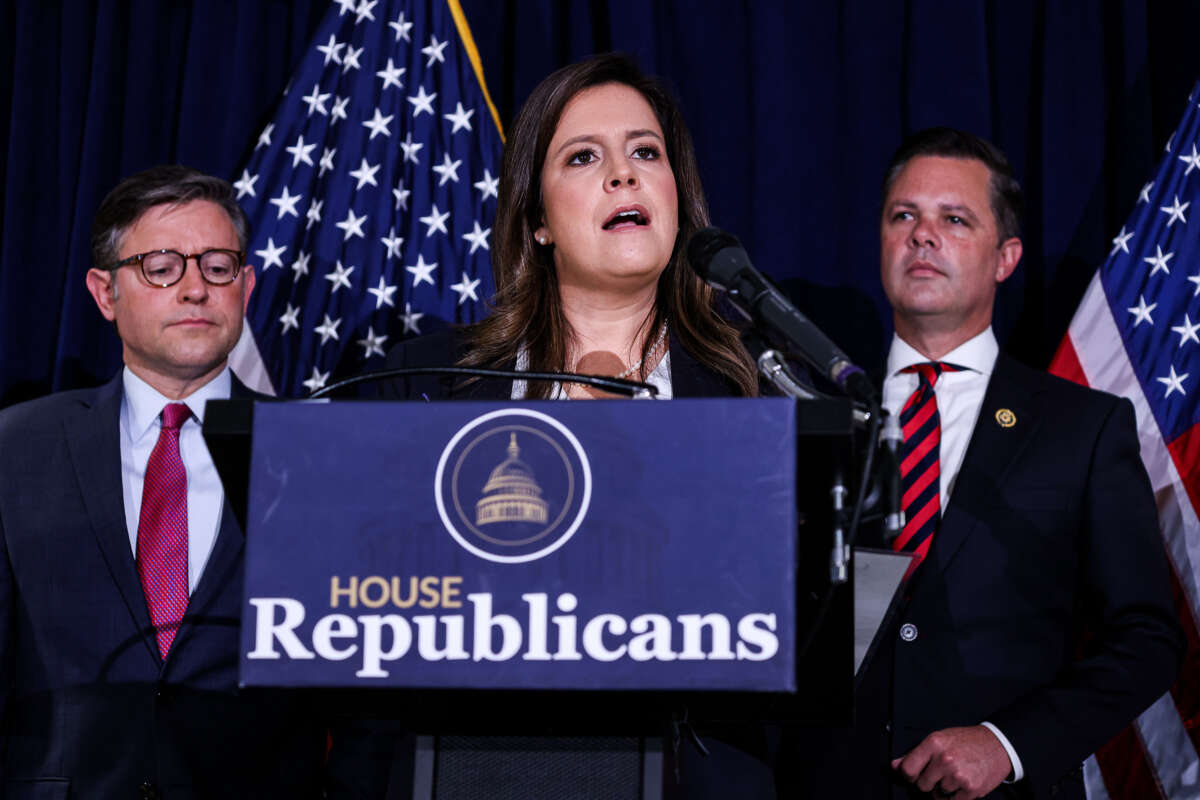
Rep. Elise Stefanik speaks during a House Republican Leadership post-meeting press conference ahead of a vote on a bill to fund the government for six months and the SAVE Act that requires proof of citizenship in order to vote in elections, at the Republican National Committee on September 18, 2024.
Valerie Plesch for The Washington Post via Getty Images

According to an exclusive report from the Center for American Progress (CAP), obtained by Truthout, a recently reintroduced bill in the U.S. House of Representatives could create new barriers to voter registration for transgender Americans, jeopardizing the voting rights of millions. The Safeguard American Voter Eligibility (SAVE) Act would require all U.S. citizens to verify their citizenship in person when registering to vote or updating their registration.

“The SAVE Act pretends to be about protecting election integrity, but in reality, it could keep millions of Americans — including trans Americans — out of the voting booth. Supporting legislation like this is supporting voter suppression,” Cait Smith, the director of LGBTQI+ policy at CAP, told Truthout.


The SAVE Act aims to amend the National Voter Registration Act of 1993, which currently allows voter registration during the driver’s license application process. If enacted, the bill would require documentary proof of citizenship, making driver’s licenses and other commonly used IDs insufficient for voter registration. This requirement would apply each time a voter updates their registration. Most people would need to present either a passport or birth certificate — documents that may not reflect the current name of transgender individuals, creating additional hurdles to voting.

The House passed the bill in 2024, but it stalled in the Senate. In January, U.S. Rep. Chip Roy (R-Texas) reintroduced it for the current Congress.

“Legislation such as the SAVE Act is a costly and faulty solution in search of a nonexistent problem. Numerous investigations and research findings have shown the extreme rarity of instances of election fraud,” the report states. “In reality, the SAVE Act is legislation disguised to look like it protects election integrity while actually seeking to make voting harder for millions of American citizens.”

Related Story 

Republicans Plan to Revive Legislative Attacks on Voting Rights
A key GOP lawmaker said the party would push to resurrect the ACE Act and the SAVE Act under a GOP trifecta. By Jessica Corbett , CommonDreams December 27, 2024

The report highlights that many transgender people use a name different from their birth name, but not everyone can legally change it. The process varies by state and is often lengthy and complicated. Those unable to update their legal name may face discrimination or be denied services when their ID does not match the name they go by.

Under the Trump administration, obtaining a passport that reflects a transgender person’s correct name and gender has become more challenging. The State Department’s policies on updating passports for transgender applicants have been unclear, and the administration has paused applications for gender marker changes.

If the SAVE Act were to pass, many transgender people would have to rely on birth certificates to register to vote, creating further obstacles, the report says. Relying on birth certificates for voter registration would be particularly challenging for transgender voters. These documents are often difficult to update to reflect a person’s chosen name and gender. According to the 2015 U.S. Transgender Survey (USTS), 44 percent of transgender adults had legally updated their name on IDs, but only 18 percent of those who use a different name had successfully changed it on their birth certificate.

Additionally, while the SAVE Act purports that a REAL ID driver’s license can be used for voter registration, the law also requires licenses to indicate voters’ citizenship status — something not mandated by the REAL ID Act of 2005. “[N]early all Americans would not be able to use a REAL ID to register to vote under the SAVE Act,” the report states.

The 2015 USTS found that just 11 percent of transgender respondents had identification documents that fully matched their name and gender marker on all of their identification documents. With the ongoing uncertainty around passport name change policies, this issue could become more widespread. If the SAVE Act passes, as many as 3 million voters may lack the necessary documentation to register, the report states.

“The SAVE Act is a trick by politicians that threatens to disenfranchise millions of eligible American citizens. It would particularly make it difficult to vote for Americans who have changed their name, including trans Americans and married women,” Greta Bedekovics, the associate director of democracy policy at CAP, told Truthout.

Voting rights experts also warn that the SAVE Act could create obstacles for married women who have changed their last names. While the bill does not directly prohibit these women from voting, it could introduce additional hurdles in the voter registration process. A 2006 Brennan Center survey found that 34 percent of women do not have proof of citizenship that reflects their current legal name.

Experts also note that the high cost of obtaining passports and other documentation could lead to voter suppression. In fact, only one in five Americans with a household income below $50,000 have a valid passport. “The policies in the SAVE Act are a serious socioeconomic issue that would disproportionately impact the voting rights of working-class and lower-income Americans,” CAP explains in a separate report on the SAVE Act.

In fact, in response to a concerned community member who asked what would happen if people couldn’t afford a “$200 passport,” U.S. Representative Tim Walberg (R-Michigan) replied, “Well, then they shouldn’t be voting.”

Voting rights advocates have also contended that the SAVE Act would make voting more difficult for senior citizens, college students and tribal citizens, as military and tribal IDs do not meet the bill’s requirements.

“[W]hether by incompetence or intent, the legislation would be a disaster for Americans. Congress cannot allow this bill to pass,” Bedekovics told Truthout.

The CAP report cites Kansas and Arizona, where similar laws have been enacted, as examples of how such legislation can “make voting harder.” “We don’t have to wonder how this would play out; Kansas and Arizona have shown how eligible Americans would be blocked from the ballot box,” Bedekovics told Truthout.

In Kansas, while the law was in effect, 31,000 eligible citizens were unable to register — 12 percent of whom were first-time voters. In Arizona, just weeks before the 2024 general election, nearly 100,000 voters were at risk due to administrative errors related to the state’s noncitizen voting requirement, and another 40,000 faced potential disenfranchisement for lacking the required documentation. These voter suppression laws may have had a disproportionate impact on transgender voters.

“Congress must resist harmful proposed policies such as those in the SAVE Act in order to ensure that all Americans, including transgender Americans, are able to exercise their right to vote. Should this legislation pass, it would only serve to further discrimination against transgender people and could keep millions of voters out of the voting booth,” the report concludes.

$60 Billion in Waste and Fraud Easily Found Where Trump Refuses to Cut: The Pentagon

"We need a better balance between military spending and investments in diplomacy, development, humanitarian aid, global public health, and environmental protection," said one analyst.


U.S. Defense Secretary Pete Hegseth (L) listens as U.S. Commerce Secretary Howard Lutnick speaks during a Cabinet meeting at the White House on February 26, 2025 in Washington, D.C.
(Photo: Andrew Harnik/Getty Images)


Julia Conley
Feb 28, 2025
COMMON DREAMS

A trio of government watchdogs on Friday advised U.S. President Donald Trump and his billionaire adviser, Elon Musk, to take a "road map for achieving efficiency" at the only federal agency that has failed seven consecutive audits of its spending, and the one that spends by far the most in taxpayer money: the Department of Defense.

The Department of Government Efficiency (DOGE) has spent recent weeks seizing data and slashing spending and tens of thousands of employees at agencies across the government, including the Department of Education, the U.S. Agency for International Development, and the Department of Labor.

But Musk's advisory body has had considerably less to say about waste and fraud at the Pentagon. The Tesla CEO met with Defense Secretary Pete Hegseth earlier this month for preliminary talks about possible spending cuts; Hegseth suggested climate programs at the Pentagon could be on the chopping block, but did not mention any cuts to weapons systems—advocating instead to shift current spending to other DOD programs.

"Unlike cuts to education, medical research, environmental protection, and food assistance programs, the administration is proposing that any Pentagon 'savings' be redirected to missile defense systems, border militarization, and other controversial and destructive military projects," wrote Mike Merryman-Lotze of the American Friends Service Committee in a column on Friday. "This is an enormous missed opportunity. We don't need a rearranging of the deck chairs on the Pentagon's titanic budget. We need fundamental change."

A new report by the Quincy Institute for Responsible Statecraft, the Stimson Center, and Taxpayers for Common Sense on Friday suggested "eliminating dysfunctional weapons systems and outmoded business practices"—steps that would cut at least $60 billion in waste and inefficiencies at the DOD.


"The result will be more security at a lower cost," said William Hartung, senior research fellow at the Quincy Institute.

The report highlights significant cuts that could be made, including:The F-35 combat aircraft program, saving $12 billion or more per year;
Aircraft carriers, saving $2.3 billion or more annually;
Canceling plans to replace land-based intercontinental ballistic missiles (ICBM), saving $310 billion total; and 
Cutting long-range missile defense, saving $9.3 billion per year.

The think tanks also advised introducing measures to rein in overcharging by defense contractors, who are known to charge the government as much as 3,800% above the fair and reasonable price, as one did for a spare part in a recent case; and cut excess basing infrastructure around the world, saving as much as $5 billion each year.

"Contrary to popular belief in Washington, national security and fiscal discipline are not mutually exclusive," reads the report. "In fact, they are inextricably linked. Budgeting for U.S. national security needs today and into the future requires that policymakers tackle wasteful spending and inefficiencies across the board, and with the Pentagon budget closing in on $1 trillion per year, the United States cannot afford to ignore it."

"Thankfully, tackling Pentagon programs and practices that do not offer a good return on investment will not only save taxpayers billions of dollars—it will also help illuminate and sustain the U.S.' greatest national security priorities," the report continues.

Gabe Murphy of Taxpayers for Common Sense pointed out that F-35 combat aircrafts and the Sentinel ICBM are "overpriced, underperforming, and out of step with current missions."

Defunding such weapons programs "would allow us to invest more in real priorities," said Murphy.

Truly eliminating waste at the Pentagon, Hartung toldThe Intercept on Friday, "would mean abandoning America's 'cover the globe' military strategy in favor of a genuinely defensive approach, and one would have to make sure that cuts in legacy systems weren't just filled in with drones and other emerging tech."

"We need a better balance between military spending and investments in diplomacy, development, humanitarian aid, global public health, and environmental protection," Hartung added. "Some of our biggest existential threats are not military in nature—such as climate change and pandemics."


Sanders: Trump Cabinet Picks Are Nearly Irrelevant With Musk in Charge


“If you want to discuss policies in the Department of Labor, let’s bring in the real secretary,” Sanders said.
February 27, 2025

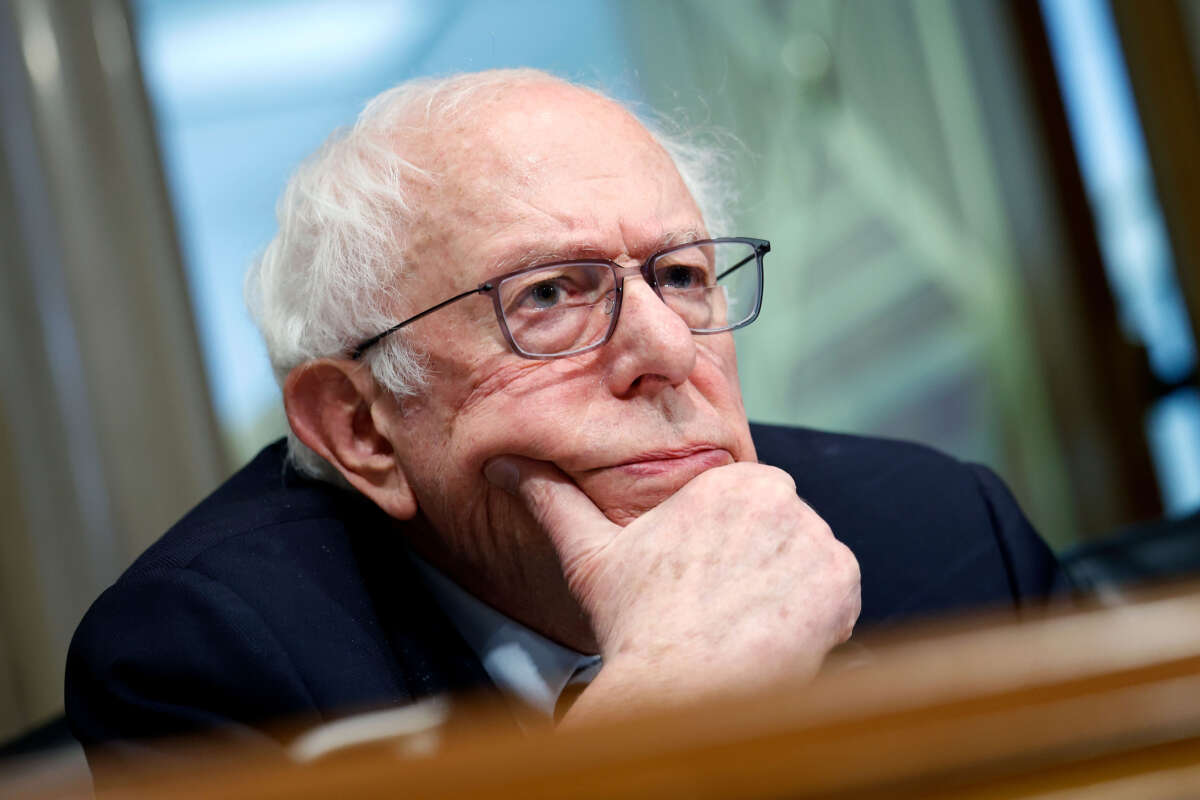
Sen. Bernie Sanders looks on during a Senate Committee on Health, Education, Labor and Pensions confirmation hearing at the Dirksen Senate Office Building on January 30, 2025, in Washington, D.C.Kevin Dietsch / Getty Images


Sen. Bernie Sanders (I-Vermont) is urging Republicans to call on Elon Musk to testify before the Senate labor committee in order to probe who in the Trump administration is truly in charge, as the Senate continues advancing cabinet picks in spite of Musk seemingly being behind most major decisions.

In remarks on the nomination of President Donald Trump’s labor secretary pick, Lori Chavez-DeRemer, in the Senate Health, Education, Labor and Pensions Committee, Sanders said that he opposes Chavez-DeRemer’s nomination — but that it hardly matters who is in the cabinet with Musk at large.

The labor secretary should be someone who protects workers’ rights and the interests of working people, with tens of millions workers subject to “starvation wages” and an increasingly huge gulf between the rich and the working class, Sanders said. And yet, the person making decisions related to labor and other issues facing working people is instead the richest person on earth, he said.

“The most important point of this hearing is, let me be very clear: Today, we are not voting on who the next Secretary of Labor is. The next Secretary of Labor, the next Secretary of Education, the next Secretary of Housing, the next Secretary of the Treasury is Elon Musk. And let us understand that reality and not play along with this charade,” Sanders said.

“Does anyone here really think that any Secretary of Labor, any Secretary of Education, is going to make decisions by himself or herself?” he asked.

Related Story

AOC: Pharma Reforms Had Almost Unanimous House Support — Until Elon Musk Tweeted
“He sends one tweet, and all of a sudden, everyone backs off,” Rep. Alexandria Ocasio-Cortez said. By Sharon Zhang , Truthout February 27, 2025

Indeed, as the senator pointed out, Musk held an outsized presence at Trump’s first cabinet meeting of his second term on Wednesday. Musk is not a cabinet-level official — in fact, his title as a special government employee means that he is only supposed to work for 130 days in a calendar year and underwent less vetting than normal federal employees.

And yet, Musk spoke more than any of the official cabinet members, and when he was not speaking, Trump often referred to him as someone advising him on major decisions like laying off a million federal workers.

At one point, Trump said: “Is anybody unhappy with Elon?” Trump asked. “If you are, we’ll throw them out of here.”

“Let’s be honest. The American people understand it, and it’s time that we understood it as well. If you want to discuss policies in the Department of Labor, let’s bring in the real secretary,” Sanders said. “Mr. Chairman, I respectfully request that this committee bring Elon Musk before this committee so that we can really hear what’s going on with the government.”

The committee ultimately voted 14 to 9 to advance Chavez-DeRemer’s nomination, with three Democrats joining Republicans in voting in her favor.

Sanders voted “no.” Labor advocates have noted that, while Chavez-DeRemer was one of the few Republicans to support the pro-union Protecting the Right to Organize Act when she was a House member, she also falls in line with Republicans’ anti-worker views — supporting anti-union “right to work” laws.

Musk, meanwhile, wants to shut down federal labor regulation entirely. After years of his companies being investigated by labor regulators for numerous alleged labor violations, Musk’s SpaceX filed a lawsuit last year attempting to shutter the National Labor Relations Board, the country’s top labor regulator.
Boycott Major Retailers to Show Them We Have the Power

If politicians won’t hear the voices of average Americans who are being shafted by corporate America, we have to deliver our message to corporate America directly.


a close-up is shown of a sign with a logo on the facade of the regional headquarters of ecommerce company Amazon in the Silicon Valley town of Sunnyvale, California 
(Photo: Smith Collection/Gado/Getty Images)


Robert Reich
Feb 28, 2025
Inequality Media


A grassroots movement is calling on all Americans to abstain from shopping with major retailers—including Amazon—today, February 28, as part of an “economic blackout.”

The purpose is to send a clear message: We have the power. We don’t have to accept corporate monopolies. We don’t have to live with corporate money corrupting our politics.

We don’t have to accept more tax cuts for billionaires. We don’t have to pay more of our hard-earned cash to Elon Musk or Jeff Bezos or Mark Zuckerberg or the other billionaire oligarchs.

Consider this a test run. If lots of people participate, I’m sure a longer one will be organized.

We don’t have to reward corporations that have abandoned their DEI policies to align themselves with President Donald Trump’s racist, homophobic, misogynistic agenda.

We have choices.

Most Americans are struggling to keep up. Most live from paycheck to paycheck. Most can barely afford housing costs, food prices, and pharmaceuticals—kept high by monopolies, and fueled by private equity.

If politicians won’t hear the voices of average Americans who are being shafted by corporate America, we have to deliver our message to corporate America directly.

From midnight February 28 to midnight March 1, please: No Amazon, no Walmart, no Best Buy, no Target, no Disney, no Google, no Facebook. Don’t spend on fast food, major retailers, or gas.

Avoid using credit or debit cards to make nonessential purchases.

Buy essentials such as medicine, food, and emergency supplies, of course, but make those purchases at small, local businesses.

Consider this a test run. If lots of people participate, I’m sure a longer one will be organized.

(Today’s economic blackout is an initiative of The People’s Union USA, which describes itself as a “grassroots movement dedicated to economic resistance, government accountability, and corporate reform.”)


Fueled by Anger at Trump and Corporate Greed, Economic Blackout Underway

"We have the power," said one supporter of the boycott. "We don't have to accept corporate monopolies. We don't have to live with corporate money corrupting our politics."


A Target store and its parking lot are seen in San Ramon, California on January 18, 2025.
(Photo: Smith Collection/Gado/Getty Images)

Julia Conley
Feb 28, 2025
COMMON DREAMS

After hundreds of thousands of social media users in recent days shared posts calling for an economic blackout at major retail corporations on February 28, the boycott was underway Friday, with proponents saying the aim was to deliver a message about widespread anger over corporate greed "to corporate America directly."

"We have the power. We don't have to accept corporate monopolies. We don't have to live with corporate money corrupting our politics," said former Labor Secretary Robert Reich. "We don't have to accept more tax cuts for billionaires. We don't have to pay more of our hard-earned cash to Elon Musk or Jeff Bezos or Mark Zuckerberg or the other billionaire oligarchs."

The idea of the blackout originated with a self-described "mindfulness and meditation facilitator," John Schwartz, who urged consumers to join the push for "systemic change," emphasizing that the boycott was not targeting President Donald Trump, his billionaire adviser and benefactor Elon Musk, or a political party, as both Democratic and Republican leaders "have manipulated the economy and profited off the working class."

But Schwartz noted on his website for The People's Union USA, "a grassroots movement dedicated to economic resistance, government accountability, and corporate reform," that the group stands "firmly for equality and freedom for ALL people, regardless of race, gender, background, or identity. The idea that companies and institutions should abandon diversity and inclusivity is regressive and unacceptable."

The statement was an apparent reference to Trump's executive order threatening to open investigations into companies that do not dismantle initiatives aimed at promoting "diversity, equity, and inclusion" (DEI). The order—and the decision by some companies including Target, Walmart, Amazon to roll back DEI programs—has been named by some participants in Friday's economic blackout as a reason to withhold their spending from the corporations.

"We don't have to reward corporations that have abandoned their DEI policies to align themselves with Trump's racist, homophobic, misogynistic agenda," said Reich. "We have choices."

"It is promising that people are responding to the current moment by showing their distrust of these corporations."

Schwartz's posts about the blackout on social media went viral in recent weeks, with 700,000 people sharing his Instagram post and the content generating 8.5 million total views.

The boycott has gained the attention of celebrities with wide followings including actor Mark Ruffalo and author Stephen King.

While one marketing expert, Anna Tuchman of Northwestern University's Kellogg School of Management, toldThe Associated Press that the boycott was unlikely to lead to "long-run sustained decreases in economic activity" that would impact the financial bottom line of Amazon, Target, Walmart, and other affected companies, she noted that the blackout could make an impact on daily sales.

"I think this is an opportunity for consumers to show that they have a voice on a single day," said Tuchman.

Based on information from a data company called Placer.ai, the one-day blackout is likely not the only action many shoppers have been taking.

During the week of February 10, according to the company, which uses phone location date to track visits to stores, foot traffic dropped at Target stores by 7.9% and at Walmart by 4.8%, while it increased by 4.8% at Costco locations; Costco has defended its DEI policies under the Trump administration.

Joseph Feldman of financial research firm Telsey Advisory Group told clients that recent data "shows a clear drop in traffic in late January into mid-February following [one] company's step back from DEI."

According to Schwartz's website, more economic blackouts—both wide-scale and those targeting specific corporations—are being planned for the coming weeks.

The People's Union USA called for an Amazon blackout, including Whole Foods, during the week of March 7; a boycott of Nestlé to protest water exploitation and child labor during the week of March 21; and 24-hour economic blackouts on March 28 and April 18.


In a separate push, labor unions led by the United Auto Workers have already begun preparing for a general strike on May 1, 2028—International Solidarity Day.

Friday's blackout comes on the heels of news that consumer confidence plummeted in February, likely leading some corporations to already have felt the impact of fewer shoppers. Analysts linked the drop in consumer spending to anxiety stemming from Trump's mass firing of federal workers and his threatened tariffs on imports from the European Union, Canada, and Mexico.

The video posted by Schwartz on Instagram recently rallied consumers by telling them that "corporations profit off of our labor while keeping wages low, banks steal billions through inflation and predatory policies, politicians accept bribes disguised as donations while ignoring the people."

"They have taken everything from us while convincing us we should be grateful of the scraps," said Schwartz. "And that ends now."

With enthusiasm and media coverage of the blackout spreading in recent days, Aaron Vansintjan, co-author of The Future Is Degrowth: A Guide to a World Beyond Capitalism, toldThe Intercept that "people are getting a sense that they're ripped off, that they're being taken advantage of and exploited as consumers."

"It is promising that people are responding to the current moment by showing their distrust of these corporations," said Vansintjan, whose book calls for reducing consumption and production of fossil fuels, factory-farmed meat products, and other goods that harm the planet.

Vansintjan noted that consumers have power that is more limited than that of unionized workers and tenants, who can organize for fair wages, working conditions, and rent prices.

"It's hard to have an impact where you shop, because most of us don't actually have much of a choice in that," Vansintjan said.

Schwartz toldThe Washington Post: "We are the economy. We are the workforce."

Corporate retailers, he said, "benefit only because we get up every day and do what we do. If we stop, they have nothing, and it's time for them to accept that truth."

NY’s Prison Guard Strike Has Roots in Decades of Racialized Deindustrialization


The guards’ demand for impunity is about the maintenance of violence at the core of the system, says Andrea R. Morrell.

By Jarrod Shanahan ,
February 28, 2025

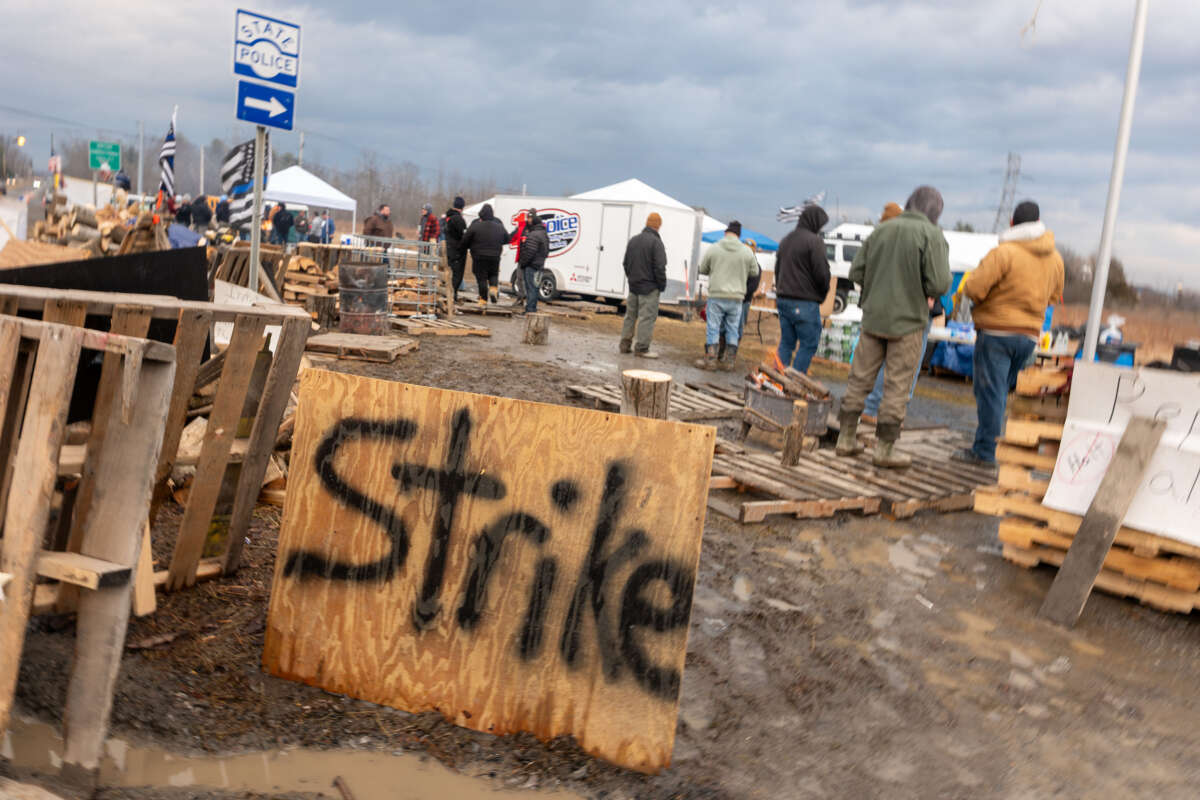
New York correctional officers and sergeants continue their strike for a second week outside of the Coxsackie Correctional Facility as mediation continued for a fifth day on February 27, 2025, in Coxsackie, Greene, New York.Spencer Platt / Getty Images

A strike wave has spread throughout New York State prisons. Since February 17, 14,000 guards in 40 of the state’s 42 facilities have joined wildcat walkouts, neglecting and endangering incarcerated people throughout the state. Since February 19, National Guard troops have been deployed to replace striking guards. These actions are illegal under New York State’s Taylor Law, which prohibits public sector workers from striking. Nonetheless, state correctional officials have negotiated with the guards — and have agreed to suspend compliance with a recent law limiting the amount of a time a prisoner can spend in solitary confinement, among other concessions. One of the first prisons to join the strike wave was Elmira Correctional Facility in Elmira, New York. To make sense of this movement, I sat down with Andrea R. Morrell, author of the forthcoming book Prison Town: Making the Carceral State in Elmira, New York. Morrell is an associate professor of anthropology at Guttman Community College, City University of New York.

Jarrod Shanahan: What context do readers need in order to understand the nature of this strike wave?

Andrea R. Morrell: In 2021, New York State passed the Humane Alternatives to Long-Term Solitary Confinement (HALT) Act, which limits the use of solitary confinement to 15 consecutive days and 20 days in a 60-day period, and outlaws it altogether for people under 21 and over 55, people with disabilities and pregnant people. The New York State prison system has largely failed to enforce the law since it came into effect in March 2022. Solitary was widespread in the New York State system. Until two years ago, when they closed because of political pressure, there were two all SHU [Special Housing Unit] facilities in New York State, where every person in the jail was in solitary. This was a win of the Black Lives Matter movement, of abolitionism and a general set of social movements focused on the lives of incarcerated people. And if you look at the guards’ wildcat strike right now, a lot of the signs that guards are holding are against the HALT Act. This is guards reacting to the state trying to actually fulfill some of the push of this legislation.

What is the guards’ interest in opposing limits on solitary confinement?

When your job is to physically control other humans, it is difficult, impossible work. It’s always an incomplete project. And if your job is to physically control other people, then solitary is where you cage the radicals, people who ask for more than you want to give them, people you don’t like, people who treat you with disrespect. Since we do not have a proper system of mental health care in this country, solitary is used to house people who need mental health care and aren’t getting it, the people that guards have been known to call “the bugs.”

Related Story
Rikers’ Forceful Guard Union Is Deepening the Jail’s Humanitarian Crisis
Rikers Island guards appear to be engaging in work stoppages to demand more guards and less oversight of their abuses. By Jarrod Shanahan , Truthout October 17, 2021

So, for the guards, it’s just an easier job. And that’s really the problem. We can’t rely on a system of punishment that puts the needs of jailers ahead of everyone else.

Are there any other grievances?

Some of it is about overtime. During the current strike, the New York Post’s version of the story has been that there was a riot, and so the guards had to pull back because they were scared.

The guards also say this in New York City; it allows them to frame the problems of the jail as a matter of understaffing, which can be fixed with more money for the prisons, which means more guards, more members in their union, more political power… all leading toward more control over the prisons by the guards themselves, and more freedom for them to dole out violence and neglect as they see fit.

Exactly. And part of the striking guards’ line, and the Post’s line, has been: “New York state is getting too soft. They don’t want to allow us to use the tools at our disposal. Sometimes these people are such bad people that we need the most intense tools. And, segregating people, the worst of the worst, is necessary to maintain a safe jail.”

That’s their line. And all of this is just a racialized way of saying these people are not people; making incarcerated people seem like animals and the guards seem like victims. And at the root of this is the stubborn fact that jails and prisons are not safe places. They cannot be safe.

They are great concentrations of violence.

That’s right. Imagining a safe place from the perspective of a guard would mean having every tool at your advantage to physically control and maim people’s psyches and bodies. Think about solitary; we know what it does to people.

Charles Dickens observed this during his visit to Eastern State Penitentiary in the 1840s! He said it was nothing but torture, with long lasting psychological damage.

That’s right; it’s a torture chamber. And it’s been well known for many years. But for the guards, it makes their job easier. But what does that mean for the incarcerated person? The basic act of being able to share a meal with somebody, or talk to somebody, or go and do some work, all of those things that give you an ounce of life, are taken away.

Shifting gears, tell us a little bit about why you have been studying the New York State prison system.

I have been studying and writing about Elmira, New York, as a prison town for probably 15 years. Elmira is a small city in a rural part of central New York State. And it is my hometown.

My grandfathers were both guards, which is what drew me to the project. Elmira has had a prison since 1876. It was the third prison built in New York State, after Auburn and Sing Sing. In the mid-’80s, during the big prison boom era in New York State, they built a second prison in Auburn and it was completed in ’88. In 1991, it was converted to an all-special housing unit, a “SHU” facility. That second prison closed two years ago. So now there’s just one, and it’s maximum security.

You just completed an ethnographic study of Elmira, as a prison town. What’s unique about a prison town, and what did you find about Elmira in particular?

Many prison towns share the commonalities of the violence within the prison “leaking out” of the prison. There are high rates of alcoholism and domestic violence, often described by guards as “letting the job get to you.” In Elmira, there is also a panic that crime is rising in the town because prisoners’ families are moving to the city to be closer to their incarcerated kin. I found that not to be true, but rather that Elmira is just becoming poorer, in a pattern similar to many deindustrialized cities.

Elmira has had a prison for 150-plus years. The second prison was sought after by the town elites, as a way to make up for the losses of deindustrialization. There’s a very clear pattern of state reorganization: Basically, New York State was giving out prisons in a parallel pattern of development to “enterprise zones.” This was the foundation of neoliberal state policy in the ‘80s: Public sector growth was limited to prisons and policing while the state created avenues, like enterprise zones which offered tax cuts, for private capital to flourish. The only state funding that was being given was through prisons, prison expansion and the salaries of prison workers. That’s why Elmira wanted the second prison.

So, there wasn’t exactly a crowded field of options for the local economy.

Right. The way the story is often told is that small towns were salivating for prisons. I think it’s more correct to say that certain elements of the local elite were salivating for capital. I found that in Elmira, like most places, there are debates about what kind of place Elmirans want the town to be. There is an interfaith group that runs a welcome center for people visiting the prison after seeing women and children waiting in long lines in the rain for their visits. Not to mention that having the reputation as a prison town may scare off other potential investments.

That was the case in the ‘80s, that was the case in the ‘90s and that’s the case now. It’s important to think about Elmira as a place where prisons grew, and why it was a place ripe for prison expansion. But I also think then, after it was built and maintained, what does a prison do to a place?

And I think it is a source of immiseration. To me, that’s the most important part of it. It foments racism. The last time they would release the information to me, in 2008, the guards at Elmira were 97 percent white, and my fieldwork indicates that this has held steady. And the prisoners are 60 to 70 percent people of color. As Dylan Rodriguez says, it’s not an apartheid in the orthodox sense. Right? But there is a racial character undoubtedly to how these relationships inside the prison happen. And that’s replicated and becomes stronger on the outside; it brings that set of relationships and brings it onto the outside.

Part of the story that you’re telling is how an industrial workforce was transformed into a workforce that’s dependent on the prison.

Absolutely. And when they were building the second prison, the former industrial workers were the ones who were imagined to be the guards. One guard I spoke with talked about taking the guard exam in the early ‘80s. He scored really well, and his boss at the A&P plant, a massive food processing facility, said: “If you don’t take that job, I’m gonna kick your ass. That’s a good job!” And a year later the A&P plant closed down. Right? So, in the imagination of the state, this was who was going to take those jobs. However, there are only 400 or 500 jobs in the prison, compared with the tens of thousands of jobs lost to deindustrialization. Prison expansion did not bring the city back to the era of near full employment — “the glory days” of the city. But there was also some truth to it. If you have a high school diploma and you want to stay near your family in Elmira, here’s the set of choices. Prison work is one of those choices

Can you say a little bit more about the racial breakdown? I have studied the New York City system, which is a lot different from upstate: ninety percent people of color guarding 90 percent people of color. In City Time, David Campbell and I reflect on meeting many incarcerated men at Rikers who say “this is nothing like upstate,” where the “good ol’ boys club” is still very much in control. Looking at places like Elmira, I’m interested in how it came to be that a certain percentage of the former industrial workforce were staffing the facilities, while another percentage of that same workforce became locked up in them.

Part of the formation of whiteness is that when you become a guard, you are well compensated enough that you become a category of “good white.” And that protects you in some limited ways from doing state time. The dispossessions of Black and Brown workers by the state through mass incarceration are built on the organization of Jim Crow North, are built on immigration restrictions of the postwar era. In some ways, these racializations become naturalized in the institution of the prison as jailer and jailed, deserving and undeserving.

How do labor unions figure into this transition?

It’s a defeated union system. I went to the unions there when I was doing research, and they are trying to make sense of the fact that a huge part of the workforce is this right-wing group that left the AFL. Guard and police unions are not a group of people that sees itself aligned with the historical goals of the union movement. During World War II, there was a CIO union working in the steel-based industries in Elmira who went on strike with Jamaican workers there on temporary visas. There were real historical solidarities there, and those have diminished with the transition to a prison-based local economy.

What is it about the prison that is so disastrous for solidarity?

First of all, I think you have to think of what it means to be upstate. You and Jack Norton wrote about this in “The Long Shadow of the Prison Wall.” Being upstate is part of the punishment. And you know, when those guys told you Rikers is “nothing like upstate,” part of that narrative is the fact that the guards are white and rural, and they identify very strongly with their whiteness, especially in that system of cages. It’s also a very particular workplace. I had one guard say to me it is unsafe, physically unsafe for them to empathize with incarcerated people. He said, “Of course I sometimes think about them and their life and their experiences and their, you know, what led them, how their lives are different. But I can’t.” He physically could not think too hard about it.

These are white men who are recruited to do the work of physical control. That’s the job. The ethnographer, Lorna Rhodes, in the book Total Confinement, describes an all-solitary facility in the Pacific Northwest. One of the guards she interviewed described himself as “a dog on a chain for the state.” If you have a dog on a chain, then you can pull it back and let it go when you need to. Looking at the guard strike going on right now, I think that’s what these guards are fighting for. They’re like: You’ve let me be this rabid dog for this long. Why stop now?

New York Gov. Kathy Hochul has charged six officers at Marcy Correctional Facility for the murder and manslaughter of Robert Brooks — and they obviously murdered the man. But Hochul has overseen this whole system of murder. The prison system is the architecture of murder, of slow death and lost life.

Something that I’ve been interested in, and emphasized a lot in my book Captives, is the way that guards covet their ability to use force, not just as a practical tool, but as kind of a barometer of their political power. It seems like this latest guard strike has taken up this issue, which we’ve seen a lot in the history of the New York City jails, which is the ability of guards to use violence as they see fit without any civilian oversight or the threat of any kind of consequences. Do you see this going on in the strike?

I do. This is most often framed as: “This is a difficult job. How can you take away our right to do this? I try to remember that everyone in a given prison knows that there are certain guards who have a reputation for particular brutality. Right? There’s a range of ways guards do the work of social control, and there are certain people who have a particular penchant for violence. They are useful to the wardens, and they’re useful to the state, right? Like the most brutal people serve a use and have value to the state of New York in controlling huge groups of people. Again, they’re a dog on a chain for the state.

The guards’ demand for impunity is related to the maintenance of the system in general. Because if the brass expects you to go out and kick ass, and that’s really the only way to do the job, then it’s central to how the prison functions. And it’s such a part of the culture of the job that if you reduce the guards’ ability to be brutes, to brutalize, then how do you maintain the whole system? Right? The impunity to brutalize hits up against the whole structure of guarding and the violence at the center of the system.

From this perspective, the guards sort of have a point when they say to the state: You’re tasking us with great violence, and then penalizing us for it when you lose your stomach at what you’ve asked us to do. It reminds me of a common scene from Chester Himes’s Harlem Detective novels, when the Black detectives, Grave Digger and Coffin Ed, are called into their boss’s office, and he says, “Thanks for saving the day, but do you have to be so brutal in the process?” Their reply is something like: “You have given us the job of enforcing social order in Harlem, where Black people are fenced in and kept in desperate poverty. Did you think this would be a peaceful affair?”

Right! “Did you expect it to be clean?” New York State gives guards this whole arsenal to maintain control through violence, but then says: “If you don’t do it in a way that we can suture it up, then we’re gonna let you go.”

There’s a recurrent ideology that you find among cops and guards, which is essentially a fascist ideology, that basically says: You cannot trust the elites above us; they’re weak, and anyway are just using us and will throw us under the bus at the first chance. And you equally cannot trust the rabble below; they’re just scum and will wreck society if they aren’t repressed. We occupy a middle stratum that alone understands what’s necessary to hold things together.

Rebecca Hill wrote this great essay about guard strikes in the 1970s called “The Common Enemy is the Boss and the Inmate” that shows the history of this.

As the meme goes, my book Captives is the anime, and Rebecca’s essay is the manga! This has been going on for decades, but I was recently scolded on a progressive podcast for supporting the removal of guards from the AFL-CIO.

I think that the questions that come out of removing guards’ unions and cops from the AFL-CIO would be the richest conversations the labor movement had in generations. It would open up discussions of the basic racializations that are at the heart of these prisons. If you avoid this question, you miss half of what happened to working-class life in the U.S. in the late-20th century. Right? I mean, you miss the story of Black dispossession, of homelessness and of how elites tried to resolve these racializations with prison expansion.

Cops and guards have carved out lucrative jobs and comfortable lives for themselves in a period of such catastrophic defeat for much of the U.S. working class. And they have real incentives to keep things exactly the way they are.

This brings us back to Elmira. Guards have a very distinct social position. They lost one prison, and if they lose a second one, then it destroys that group’s power. Right? And these are real people. They’re the coaches of their kids’ little league teams. They have social standing, nice cars, they can go on vacation, all the trappings of a middle-class life. They don’t want to lose that.

One final question: This strike is in violation of the Taylor Law, which prohibits public sector workers in New York State from going on strike. But the guards are winning concessions, and seem on track to succeed in getting what they want, while effectively ignoring the law.

It just goes to show, there’s no such thing as an illegal strike — only one you win or lose!

This article is licensed under Creative Commons (CC BY-NC-ND 4.0), and you are free to share and republish under the terms of the license.

Jarrod Shanahan  is the author of Captives: How Rikers Island Took New York City Hostage (Verso, 2022); coauthor of States of Incarceration (Field Notes, 2022), City Time (NYU Press, 2025), and Skyscraper Jails (Haymarket, 2025); and editor of Treason to Whiteness Is Loyalty to Humanity (Verso, 2022). He works as an assistant professor of criminal justice at Governors State University.

'Bloodbath': US Social Security Administration Begins Mass Firings


What is being described as a "total annihilation" of SSA, say critics, proves that Trump's promises to protect Social Security "are a sham."


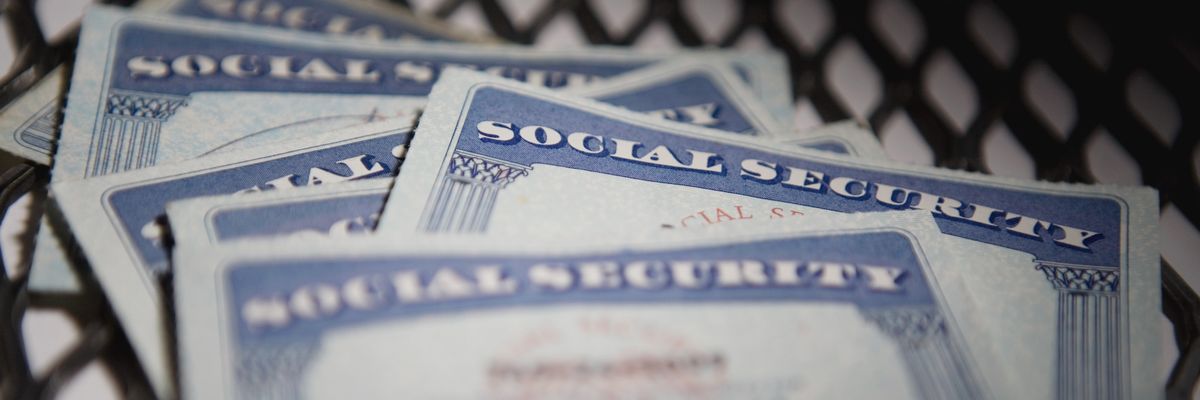
Several Social Security cards are pictured.
(Photo: Getty Images)


Jake Johnson
Feb 28, 2025
COMMON DREAMS

The Social Security Administration, now under the control of an official installed by U.S. President Donald Trump, began the process of gutting whole segments of the agency and firing a huge portion of its already diminished workforce, sparking alarm among advocates who say the move will almost certainly result in benefit delays and disruptions.

The American Prospect, which first reported earlier this week that Acting SSA Commissioner Leland Dudek was weighing staff cuts of up to 50%, obtained an email sent late Thursday indicating that the department has launched an "agency-wide organizational restructuring that will include significant workforce reductions."

"The email gives employees until March 14 to decide among a number of options," the Prospect reported. "They can seek voluntary reassignments, or 'separate from federal service through retirement or resignation.' All employees at least 50 years of age with at least 20 years of service are being offered an 'early out' voluntary early retirement; that's lower than the typical benchmarks for federal employees. Early retirees are typically eligible for an annuity."

"In addition, between now and March 14 employees can take voluntary separation incentive payments of up to $25,000, depending on job classification. Employees are also encouraged in the email to resign and take the payout of their annual leave," the outlet added.

Trump has pledged that Social Security "will not be touched," but the progressive advocacy group Social Security Works argued that the assault on SSA "has only one goal: The total annihilation of Social Security by firing half of the workforce and closing the field offices."

"Wall Street billionaires want to destroy Social Security so they can give themselves trillions in tax handouts," the group wrote on social media.


The Prospect reported that while the email sent to SSA staff on Thursday "does state that some employees may be reassigned from so-called 'non-mission critical' positions to direct service positions at field offices and processing centers, it would be difficult to achieve large-scale reductions in force without impacting staff at the more than 1,200 field offices across the country."

"Already, one large hearing office in White Plains, New York has been shuttered, and there are unclear plans for other lease terminations on the Department of Government Efficiency( DOGE) website," the Prospect observed.

SSA, which is highly efficient despite being chronically understaffed, is one of a number of federal departments that Elon Musk's lieutenants have infiltrated in recent weeks as part of a lawless onslaught against government workers and operations.

"The goal of this effort is to hollow out an agency that currently delivers retirement benefits with a 99.7% accuracy rate, and hand over the keys to private equity and grifters who want to pillage Social Security for all it's worth."

ProPublicareported over the weekend that DOGE staffers' "first wave of actions" at SSA, including the elimination of dozens of jobs and shuttering of local offices, "was largely lost in the rush of headlines."

"Those first steps might seem restrained compared with the mass firings that DOGE has pursued at other federal agencies," the investigative outlet noted. "But Social Security recipients rely on in-person service in all 50 states, and the shuttering of offices, reported on DOGE's website to include locations everywhere from rural West Virginia to Las Vegas, could be hugely consequential. The closures potentially reduce access to Social Security for some of the most vulnerable people in this country—including not just retirees but also individuals with severe physical and intellectual disabilities, as well as children whose parents have died and who've been left in poverty."

Sen. Ron Wyden (D-Ore.), the top Democrat on the Senate Finance Committee, said Thursday that "firing half of all Social Security workers will guarantee that seniors will stop seeing their earned benefits arrive on time and in full."

"Trump's promises to protect Social Security are a sham, just like the rest of his actions since taking office," Wyden added. "A plan like this will result in field office closures that will hit seniors in rural communities the hardest. The goal of this effort is to hollow out an agency that currently delivers retirement benefits with a 99.7% accuracy rate, and hand over the keys to private equity and grifters who want to pillage Social Security for all it's worth."


As Freed Palestinians Describe Torture, Trump OKs $3 Billion Arms Package for Israel

Like the Biden administration, Trump is claiming an "emergency" in order to bypass Congress.


An Israeli soldier carries a U.S.-supplied 155mm artillery shell near a self-propelled howitzer deployed at a position near the border with Lebanon in the upper Galilee region of northern Israel 
(Photo: Jalaa Marey/ AFP via Getty Images)

Brett Wilkins
Feb 28, 2025
COMMN DREAMS

As Palestinians released from Israeli imprisonment recount torture and other abuse suffered at the hands of their former captors, the Trump administration on Friday approved a new $3 billion weapons package for Israel.

The new package, reported by Zeteo's Prem Thakker, includes nearly $2.716 billion worth of bombs and weapons guidance kits, as well as $295 million in bulldozers. The Trump administration said that "an emergency exists that requires the immediate sale," allowing it to bypass Congress, as the Biden administration did on multiple occasions. However, the weapons won't be delivered until 2026 or 2027.


From October 2023 to October 2024, Israel received a record $17.9 billion worth of U.S. arms as it waged a war of annihilation against the Gaza Strip that left more than 170,000 Palestinians dead, maimed, or missing and millions more displaced, starved, or sickened. Israel is facing genocide allegations in an International Court of Justice case brought by South Africa. The International Criminal Court has also issued arrest warrants for Israeli Prime Minister Benjamin Netanyahu and former Israeli Defense Minister Yoav Gallant.

Reporting on the new package came after U.S. Sen. Bernie Sanders (I-Vt.) on Monday announced an effort to block four other arms sales totaling $8.56 billion in offensive American weaponry to Israel.

Meanwhile, some of the approximately 1,000 Palestinians released by Israel as part of a prisoner swap described grim stories of abuse by Israeli forces. The former detainees, who were arrested but never charged with any crimes, "have returned visibly malnourished and scarred by the physical and psychological torture they say they faced in Israeli prisons," according toThe Washington Post. Some returned to what were once their homes to find them destroyed and their relatives killed or wounded by Israeli forces.

Eyas al-Bursh, a doctor volunteering at al-Shifa Hospital in Gaza City when he was captured by Israeli troops, was held in Sde Teiman and the Ofer military prison in the illegally occupied West Bank for 11 months.

"The places where we were held were harsh, sleep was impossible, and we remained handcuffed and blindfolded," al-Bursh told the Post.

"We endured psychological and physical torture without a single day of respite—whether through beatings, abuse, punches, or even verbal insults and humiliation," he added.

The Israel Defense Forces told the Post that it "acts in accordance with Israeli and international law in order to protect the rights of the detainees held in the detention and questioning facilities."

However, farmer Ashraf al-Radhi, who was held for 14 months—including at the notorious Sde Teiman prison in Israel's Negev Desert—told the Post that "we witnessed all kinds of humiliation."

According to the newspaper:
Radhi said he "wished for death" during his detention, which included long periods when he was blindfolded, handcuffed, andcrammed into a filthy cell with dozens of other prisoners. The 34-year-old said he had no access to a lawyer; no idea why he was there; or what, in his absence, had become of his family.

Rahdi also said that Mohammed al-Akka, a 44-year-old detainee held with him, died last December. Al-Akka is one of dozens of Palestinian prisoners who have died in Israeli custody, some from suspected torture and, in at least one case, rape with an electric baton. A number of Israeli reservists are being investigated for the alleged gang-rape of a Sde Teiman prisoner.


Democrats Now Prefer Cuba to Israel, Gallup Finds

Left: Rep. Rashida Tlaib (D., Mich.) speaks during a hearing on gun violence on Capitol Hill in Washington, D.C., June 8, 2022. Right: Rep. Ilhan Omar (D., Minn.) addresses the media at a press conference in Brooklyn Center, Minn., April 20, 2021. ( Andrew Harnik, Nicholas Pfosi/Reuters)

By Philip Klein
February 26, 2025 
NATIONAL REVIEW

The anti-Israel left has gained so much ground that Cuba now rates higher among Democrats than the Jewish state.

Just 33 percent of Democrats said that they had a “very” or “mostly” favorable view of Israel, according to Gallup, compared with 55 percent who said the same about the repressive communist dictatorship of Cuba. Also, 45 percent of Democrats said they had favorable views of the “Palestinian Territories.”

In contrast, 83 percent of Republicans hold a favorable view of Israel.

While Democrats and Republicans once shared similar levels of admiration for Israel, that gap has widened considerably over time.

Following the October 7 attacks, Republicans rallied around Israel and sustained their high levels of support for the nation’s campaign against Iran and its proxies, Hamas and Hezbollah, while Democratic support for Israel cratered.

Though it’s good news for Israel that President Trump is currently in office, the numbers should be of longer-term concern. For decades, the perception of bipartisan support for Israel has maintained the alliance no matter who has been in power.

But as older Democrats retreat from public life and die off, they are getting replaced by younger, anti-Israel Democrats. That creates the possibility of a deep rupture in relations during the next Democratic administration.

GLOBAL WAR ON LGBTQ+ RIGHTS

TURKIYE
Gov’t proposes law restricting gender transition, criminalizing expression of LGBTQ+ identity

By Turkish Minute
February 28, 2025
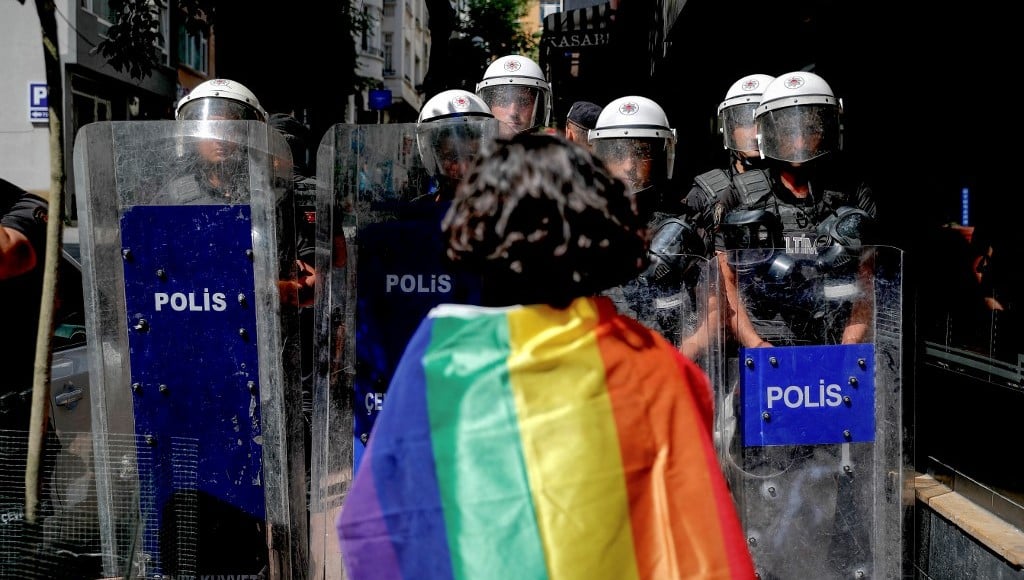
A participant faces riot policemen wearing a rainbow flag during a Pride march in Istanbul, on June 26, 2022. KEMAL ASLAN / AFP


Turkey’s Justice Ministry is proposing sweeping legal changes that would restrict gender transition procedures and criminalize public expression of LGBTQ+ identity, according to a draft bill obtained by Kaos GL, one of the oldest LGBTI+ rights groups in Turkey.

The proposal, developed under the ministry’s Fourth Judicial Reform Strategy as part of the government’s “Year of the Family” initiative for 2025, aims to amend Turkey’s Civil Code and Penal Code, incorporating the term “biological sex” into the latter.

If enacted, the law will raise the minimum age for gender transition from 18 to 21 and require individuals to provide extensive medical documentation proving they are “permanently infertile” and that gender transition is “medically necessary.” The process will involve assessments conducted over a year at state-designated hospitals.

The bill also criminalizes public displays of LGBTQ+ identity under the penal code’s “public obscenity” article. A proposed provision states that anyone “who publicly promotes, praises, or encourages behaviors contrary to biological sex and general morality” will be sentenced to from one to three years in prison, with another clause imposing up to four years for same-sex engagement ceremonies or symbolic weddings.


lawyer Kerem Dikmen, Kaos GL’s human rights program coordinator, criticized the proposed changes, arguing that they would roll back legal recognition for transgender people.

“Under these changes, a transgender person whose legal gender has not yet been recognized, or someone defying traditional gender norms through clothing, speech or self-expression, could be prosecuted,” he said.

The bill also seeks to reinstate a legal provision that Turkey’s Constitutional Court struck down in 2017. The previous law required individuals seeking gender transition to prove they were permanently infertile.

Dikmen argued that LGBTQ+ rights organizations could face legal prosecution for “publicly encouraging attitudes and behaviors contrary to biological sex.” This would extend to leaders and staff of organizations advocating for gender expression and freedom of speech as well as journalists who interview individuals with unrecognized gender identities and help make them visible.


Although homosexuality has been legal throughout modern Turkey’s history, gay people regularly face harassment and abuse.

The proposed changes reflect recent rhetoric from President Recep Tayyip ErdoÄŸan and his government, which have portrayed LGBTQ+ identity as a threat to traditional family values. The LGBTQ+ community, which is increasingly marginalized in Turkey, has been a key target in ErdoÄŸan’s speeches. Pride parades have been banned since 2015, and state-sponsored anti-LGBTQ+ rallies have become more frequent. The Religious Affairs Directorate has also used Friday sermons to label LGBTQ+ movements as attempts to “erase the natural essence of men and women.”

If passed, the bill would mark one of the most significant legal setbacks for LGBTQ+ rights in Turkey in years.


Turkey among top 10 countries with sharpest decline in freedoms: Freedom House

ByTurkish Minute
February 26, 2025

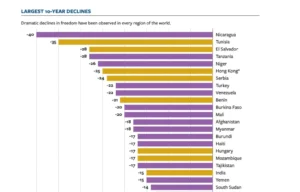
Turkey is among the top 10 countries that have seen the sharpest decline in freedoms over the past decade, the Stockholm Center for Freedom reported, citing the “Freedom in the World 2025” report published by Freedom House on Wednesday.

The US-based watchdog found that Turkey’s score has dropped by 22 points since 2014, placing it alongside Venezuela in the seventh spot on the list of countries that have experienced the worst democratic backsliding.

The report evaluates freedom based on two main pillars: political rights and civil liberties. Turkey has seen declines in both areas, particularly in judicial independence, press freedom, freedom of expression and political pluralism.


The report continues to classify Turkey as “Not Free,” a designation it has held since 2018. The findings put Turkey in the company of Nicaragua, Tunisia, El Salvador and Tanzania, all of which have experienced significant declines in freedoms.

The findings come amid a broader trend of democratic decline worldwide. The report notes that global freedom has deteriorated for the 19th consecutive year, with 60 countries experiencing a reduction in political rights and civil liberties in 2024 alone.

Turkey remains part of this downward trajectory, with restrictions on press freedomjudicial independence and political opposition continuing to raise concerns.

Turkey’s democratic decline accelerated after a coup attempt on July 15, 2016. President Recep Tayyip ErdoÄŸan and his government blamed the coup on the faith-based Gülen movement, inspired by the late Muslim cleric Fethullah Gülen, and responded with a nationwide purge of perceived dissidents. Gülen and the movement strongly deny involvement in the failed coup or any terrorist activity.

Erdoğan has been targeting followers of the Gülen movement since corruption investigations revealed in 2013 implicated then-prime minister Erdoğan as well as members of his family and inner circle.

Dismissing the investigations as a Gülenist coup and conspiracy against his government, Erdoğan designated the movement as a terrorist organization and began pursuing its followers. He intensified the crackdown on the movement following the abortive putsch in 2016.

Since the coup attempt, more than 705,172 people have been investigated on terrorism related charges due to their alleged links to the movement. There are at least 13,251 people in prison who are being held in pretrial detention or convicted of terrorism charges in Gülen-linked trials.

Following the failed coup, the Turkish government declared a state of emergency and carried out a massive purge of state institutions under the pretext of an anti-coup fight. Over 130,000 public servants, including 4,156 judges and prosecutors, and more than 24,000 members of the armed forces were summarily removed from their jobs for alleged membership in or relationships with “terrorist organizations” by emergency decree-laws subject to neither judicial nor parliamentary scrutiny.

Since then, Turkey has maintained a state of heightened repression. The political opposition, media and civil society have faced mounting pressure, making it increasingly difficult to challenge the ruling government.

The erosion of political rights in Turkey has been accompanied by a series of high-profile cases that exemplify the government’s tightening grip on opposition voices. Selahattin DemirtaÅŸ, the former co-chair of the pro-Kurdish Peoples’ Democratic Party (HDP), has been imprisoned since 2016 on terrorism-related charges that human rights organizations call politically motivated. Despite repeated rulings from the European Court of Human Rights demanding his release, Turkish courts have refused to comply.

Osman Kavala, a prominent philanthropist and civil society leader, has been serving a life sentence without parole over his alleged role in the 2013 Gezi Park protests and the 2016 coup attempt, despite a lack of credible evidence. His prolonged detention has drawn international criticism, with the European Union and the Council of Europe urging Turkey to abide by international human rights standards.

Ekrem İmamoÄŸlu, the opposition mayor of Istanbul, was sentenced to more than two years in prison in 2022 for allegedly insulting election officials. The ruling, widely condemned as an attempt to sideline a potential challenger to ErdoÄŸan, has added to concerns about the government’s use of the judiciary to suppress political rivals.

Press freedom has also suffered, with Turkey ranking among the worst jailers of journalists in the world. Independent media outlets have been shut down or forced into government control, and journalists critical of the government have faced arrest, surveillance and intimidation. Broad anti-terror laws have been used to silence dissent, making it increasingly risky for reporters to cover politically sensitive topics.

The Freedom House report points to election manipulation as a growing global concern, particularly in hybrid and authoritarian regimes. While Turkey still holds multi-party elections, opposition parties and international observers have long raised concerns over electoral fairness, state media bias and restrictions on political campaigning.

During past elections, the government has been accused of using state resources to boost ErdoÄŸan’s ruling party, manipulating the judiciary to disqualify opposition candidates and controlling media narratives to limit public discourse. The 2024 local elections were closely watched for potential irregularities, with critics warning that the electoral process remains skewed in favor of the ruling Justice and Development Party (AKP).

Freedom House’s “Freedom in the World” report is one of the most comprehensive annual assessments of global democracy, covering 195 countries and 13 territories. The 2025 edition evaluates developments between January 1 and December 31, 2024.