According to an exclusive report obtained by Truthout, the SAVE Act would “be a disaster for Americans.”
By Zane McNeill ,
Truthout
February 28, 2025
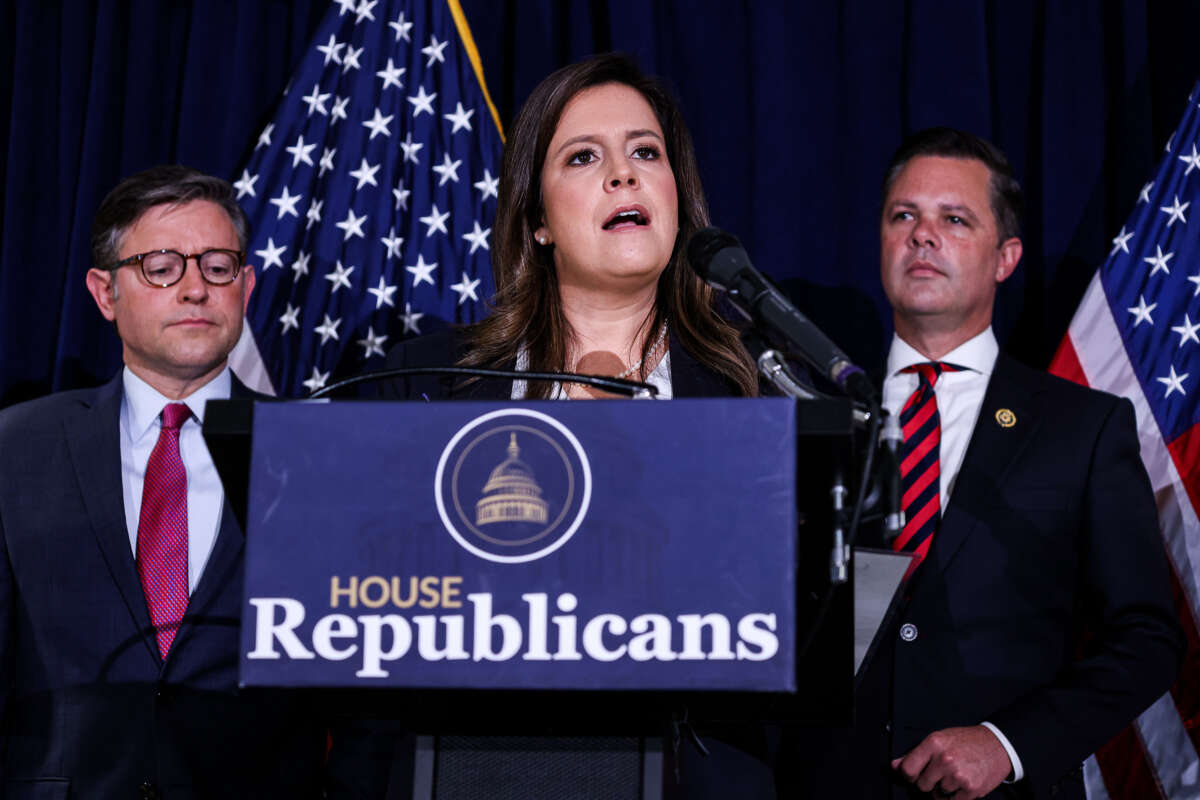
Rep. Elise Stefanik speaks during a House Republican Leadership post-meeting press conference ahead of a vote on a bill to fund the government for six months and the SAVE Act that requires proof of citizenship in order to vote in elections, at the Republican National Committee on September 18, 2024.
Valerie Plesch for The Washington Post via Getty Images
According to an exclusive report from the Center for American Progress (CAP), obtained by Truthout, a recently reintroduced bill in the U.S. House of Representatives could create new barriers to voter registration for transgender Americans, jeopardizing the voting rights of millions. The Safeguard American Voter Eligibility (SAVE) Act would require all U.S. citizens to verify their citizenship in person when registering to vote or updating their registration.
“The SAVE Act pretends to be about protecting election integrity, but in reality, it could keep millions of Americans — including trans Americans — out of the voting booth. Supporting legislation like this is supporting voter suppression,” Cait Smith, the director of LGBTQI+ policy at CAP, told Truthout.
The SAVE Act aims to amend the National Voter Registration Act of 1993, which currently allows voter registration during the driver’s license application process. If enacted, the bill would require documentary proof of citizenship, making driver’s licenses and other commonly used IDs insufficient for voter registration. This requirement would apply each time a voter updates their registration. Most people would need to present either a passport or birth certificate — documents that may not reflect the current name of transgender individuals, creating additional hurdles to voting.
The House passed the bill in 2024, but it stalled in the Senate. In January, U.S. Rep. Chip Roy (R-Texas) reintroduced it for the current Congress.
“Legislation such as the SAVE Act is a costly and faulty solution in search of a nonexistent problem. Numerous investigations and research findings have shown the extreme rarity of instances of election fraud,” the report states. “In reality, the SAVE Act is legislation disguised to look like it protects election integrity while actually seeking to make voting harder for millions of American citizens.”
Related Story
According to an exclusive report from the Center for American Progress (CAP), obtained by Truthout, a recently reintroduced bill in the U.S. House of Representatives could create new barriers to voter registration for transgender Americans, jeopardizing the voting rights of millions. The Safeguard American Voter Eligibility (SAVE) Act would require all U.S. citizens to verify their citizenship in person when registering to vote or updating their registration.
“The SAVE Act pretends to be about protecting election integrity, but in reality, it could keep millions of Americans — including trans Americans — out of the voting booth. Supporting legislation like this is supporting voter suppression,” Cait Smith, the director of LGBTQI+ policy at CAP, told Truthout.
The SAVE Act aims to amend the National Voter Registration Act of 1993, which currently allows voter registration during the driver’s license application process. If enacted, the bill would require documentary proof of citizenship, making driver’s licenses and other commonly used IDs insufficient for voter registration. This requirement would apply each time a voter updates their registration. Most people would need to present either a passport or birth certificate — documents that may not reflect the current name of transgender individuals, creating additional hurdles to voting.
The House passed the bill in 2024, but it stalled in the Senate. In January, U.S. Rep. Chip Roy (R-Texas) reintroduced it for the current Congress.
“Legislation such as the SAVE Act is a costly and faulty solution in search of a nonexistent problem. Numerous investigations and research findings have shown the extreme rarity of instances of election fraud,” the report states. “In reality, the SAVE Act is legislation disguised to look like it protects election integrity while actually seeking to make voting harder for millions of American citizens.”
Related Story

Republicans Plan to Revive Legislative Attacks on Voting Rights
A key GOP lawmaker said the party would push to resurrect the ACE Act and the SAVE Act under a GOP trifecta. By Jessica Corbett , CommonDreams December 27, 2024
The report highlights that many transgender people use a name different from their birth name, but not everyone can legally change it. The process varies by state and is often lengthy and complicated. Those unable to update their legal name may face discrimination or be denied services when their ID does not match the name they go by.
Under the Trump administration, obtaining a passport that reflects a transgender person’s correct name and gender has become more challenging. The State Department’s policies on updating passports for transgender applicants have been unclear, and the administration has paused applications for gender marker changes.
If the SAVE Act were to pass, many transgender people would have to rely on birth certificates to register to vote, creating further obstacles, the report says. Relying on birth certificates for voter registration would be particularly challenging for transgender voters. These documents are often difficult to update to reflect a person’s chosen name and gender. According to the 2015 U.S. Transgender Survey (USTS), 44 percent of transgender adults had legally updated their name on IDs, but only 18 percent of those who use a different name had successfully changed it on their birth certificate.
Additionally, while the SAVE Act purports that a REAL ID driver’s license can be used for voter registration, the law also requires licenses to indicate voters’ citizenship status — something not mandated by the REAL ID Act of 2005. “[N]early all Americans would not be able to use a REAL ID to register to vote under the SAVE Act,” the report states.
The 2015 USTS found that just 11 percent of transgender respondents had identification documents that fully matched their name and gender marker on all of their identification documents. With the ongoing uncertainty around passport name change policies, this issue could become more widespread. If the SAVE Act passes, as many as 3 million voters may lack the necessary documentation to register, the report states.
“The SAVE Act is a trick by politicians that threatens to disenfranchise millions of eligible American citizens. It would particularly make it difficult to vote for Americans who have changed their name, including trans Americans and married women,” Greta Bedekovics, the associate director of democracy policy at CAP, told Truthout.
Voting rights experts also warn that the SAVE Act could create obstacles for married women who have changed their last names. While the bill does not directly prohibit these women from voting, it could introduce additional hurdles in the voter registration process. A 2006 Brennan Center survey found that 34 percent of women do not have proof of citizenship that reflects their current legal name.
Experts also note that the high cost of obtaining passports and other documentation could lead to voter suppression. In fact, only one in five Americans with a household income below $50,000 have a valid passport. “The policies in the SAVE Act are a serious socioeconomic issue that would disproportionately impact the voting rights of working-class and lower-income Americans,” CAP explains in a separate report on the SAVE Act.
In fact, in response to a concerned community member who asked what would happen if people couldn’t afford a “$200 passport,” U.S. Representative Tim Walberg (R-Michigan) replied, “Well, then they shouldn’t be voting.”
Voting rights advocates have also contended that the SAVE Act would make voting more difficult for senior citizens, college students and tribal citizens, as military and tribal IDs do not meet the bill’s requirements.
“[W]hether by incompetence or intent, the legislation would be a disaster for Americans. Congress cannot allow this bill to pass,” Bedekovics told Truthout.
The CAP report cites Kansas and Arizona, where similar laws have been enacted, as examples of how such legislation can “make voting harder.” “We don’t have to wonder how this would play out; Kansas and Arizona have shown how eligible Americans would be blocked from the ballot box,” Bedekovics told Truthout.
In Kansas, while the law was in effect, 31,000 eligible citizens were unable to register — 12 percent of whom were first-time voters. In Arizona, just weeks before the 2024 general election, nearly 100,000 voters were at risk due to administrative errors related to the state’s noncitizen voting requirement, and another 40,000 faced potential disenfranchisement for lacking the required documentation. These voter suppression laws may have had a disproportionate impact on transgender voters.
“Congress must resist harmful proposed policies such as those in the SAVE Act in order to ensure that all Americans, including transgender Americans, are able to exercise their right to vote. Should this legislation pass, it would only serve to further discrimination against transgender people and could keep millions of voters out of the voting booth,” the report concludes.

No comments:
Post a Comment