Wednesday, March 19, 2025


Canadian opposition leader vows 6-month Ring of Fire OK in Ontario


Drill site near the Eagle’s Nest nickel-copper-PGM project in northern Ontario’s Ring of Fire region. Credit: Wyloo Metals

Canadian opposition leader Pierre Poilievre says he would give federal approval for the contentious Ring of Fire development in northern Ontario within months if he takes power after an imminent election.

“My government will set a deadline of six months to green light permits for the Ring of Fire,” Poilievre told reporters in Sudbury on Wednesday. “We will unleash the production of chromite, cobalt, copper, nickel, platinum and others. We will also commit C$1 billion over three years to help the Ontario government build the highway to get there.”

The Ring of Fire area, about 540 km northeast of Thunder Bay, lies in a remote swampy region where only one venture is considered advanced, the Eagle’s Nest project held by Wyloo Metals. It’s owned by Australian tycoon and former Fortescue Metals Group (ASX: FMG) CEO Andrew Forrest.

Roads that are estimated to cost at least C$2 billion to access the region are winding their way through provincial and federal environmental assessments steered by local Indigenous communities. Some First Nations groups with claims in the area oppose development, which could take a decade to implement judging by other projects. Environmentalists say it will release the same global warming gases from the region’s muskeg that the electric-battery vehicle metals it would produce are supposed to limit.

Ontario Premier Doug Ford has also said he would accelerate the Ring of Fire project, which has become the mining industry’s focus point for transition metals in the province. Ontario has a slew of other projects also geared to eventually funnel supplies to its C$50-billion-a-year cross-border auto industry that includes Ford, GM, Stellantis, Honda and Toyota.

Single process

Ford and Poilievre want a single environmental process, instead of two levels, to speed projects like Ring of Fire to market. The federal Conservative leader criticized the Liberal government’s Impact Assessment Act passed in 2019 from Bill C-69.

“We’ve known about this place for a long time,” Poilievre said. “The Liberals did everything they could to block this project. They have a ‘keep-it-in-the-ground’ ideology.”

The federal Conservatives and Liberals are tied at 38% support, a poll by the 338Canada project showed on Wednesday. The results mark a dramatic increase in Liberal support under new leader Mark Carney while the leftist NDP has declined to 11%. Carney, who was sworn in as prime minister Friday, has said he will call an election within days. It would likely be held by mid-May. 

In one of his first decisions as PM, Carney has scrapped the Liberal consumer carbon tax – a move Poilievre has long said he would make. The Conservative leader went further on Wednesday saying he would also abolish carbon taxes on industry.

“We will repeal liberal law C-69 and instead grant rapid permission to our companies to build more pipelines, more natural gas exports, more data centres, more mines and more projects of all kind across this country,” Poilievre said. “We will stand up for this economy and our people. We will also repeal the entire carbon tax law on consumers, on industry, for everyone, for good that will protect paychecks and bring production home.”

Ontario projects

Several battery metal projects are progressing in Ontario’s north. This month Ottawa announced C$120 million – to be matched by a similar amount from Queen’s Park – for a new road and bridge to access Frontier Lithium’s (TSXV: FL; US-OTC: LITOF) PAK project.

Canada Nickel (TSXV: CNC: US-OTC: CNIKF) is advancing the Crawford nickel-cobalt sulfide project near Timmins. Crawford, believed to hold the world’s second-largest nickel reserves and resources, hosts 1.72 billion tonnes of proven and probable reserves grading 0.22% nickel, plus copper, palladium, and platinum, according to a 2023 feasibility study. In September, Export Development Canada expressed interest in providing a long-term loan of up to C$500 million to support the project’s development.

Electra Battery Materials (Nasdaq: ELBM; TSXV: ELBM) is upgrading and expanding an existing cobalt refinery near Temiskaming Shores which may become North America’s only refinery producing battery-grade cobalt sulphate. Avalon Advanced Materials (TSX: AVL; US-OTC: AVLNF) is developing the Separation Rapids lithium project, 70 km north of Kenora, for chemicals essential for lithium-ion batteries.

Li-Cycle (NYSE: LICY), a lithium battery recycler, began operations in Ontario in 2019 and ramped up to recycling and processing up to 5,000 tonnes of used lithium-ion batteries per year in 2020. The company focuses on recovering valuable materials like lithium, cobalt, and nickel from spent batteries.

 

Deep-sea miners are set to dig for critical minerals, even if rules aren’t done


Miners plan to extract cobalt and other battery metals from the seabed. (Image courtesy of The Metals Co.)

As companies seek to extract critical minerals used in electric vehicle batteries and other green technologies from the deep sea, a showdown is underway over when and whether to allow mining of untouched, biodiverse ecosystems.

For more than a decade, delegates from the United Nations-affiliated International Seabed Authority (ISA) have been negotiating regulations to allow deep-sea mining as required by a 1982 UN treaty. Those deliberations are continuing this week during a meeting in Kingston, Jamaica, in advance of a July deadline to finish the job. With a breakthrough looking out of reach, miners could get an opening to force the organization to consider — and potentially approve — mining applications before environmental safeguards have been put in place.

One high-profile mining startup, Canada-registered The Metals Company (TMC), has said it will file an application in June for an ISA license to begin mining, regardless of whether regulations have been enacted. That could force the organization to decide whether to review and approve a contract in the absence of environmental protections. Other mining companies could follow suit.

The push by miners comes as a growing number of nations have vowed not to move forward without strong regulations to protect marine ecosystems. “Tensions are building, and something’s going to have to give,” said Matthew Gianni, a longtime ISA observer and a founder of the Deep Sea Conservation Coalition, which represents more than 130 environmental groups and other nongovernmental organizations.

The brewing fight threatens to upend the decades-long framework that has governed the vast swathes of the ocean beyond countries’ territorial waters. The ISA has jurisdiction over 54% of the world’s ocean floor, which is estimated to harbor the world’s largest reserves of metals but also thousands of otherworldly marine species that are new to science.

As ISA delegates gathered to continue drafting the mining rules, some noted they have yet to resolve many crucial issues, including agreeing on how to avoid irreversible harm to marine life and the tax rate on mining royalties to be distributed among member states. “The potential consequences for marine ecosystems demand rigorous scientific scrutiny,” Luisa Araúz, Panama’s representative, told delegates attending the two-week gathering of the ISA Council, the organization’s policymaking body. “The abyss has waited millions of years and it can wait for us to get this right.”

Mining companies, meanwhile, have been demanding the organization enact regulations this year. “The current situation imposes an unfair burden on contractors, requiring substantial investments without the security of a clearly defined regulatory framework,” eight companies stated in a January letter to the ISA.

The ISA didn’t respond to a request for comment.

Some 2,000 points in the current draft regulations remain in dispute. If agreement can’t be reached at this month’s meeting and another in July, the ISA will likely set a new deadline, possibly triggering legal challenges from mining companies.

The UN Convention on the Law of the Sea established the ISA in 1994 to regulate the exploitation of the seabed in international waters while also ensuring the effective protection of the marine environment. The organization, which has 169 member states plus the European Union, has issued exploration contracts to private and state-backed companies to prospect for minerals across more than 1.3 million square kilometers (500,000 square miles) of the global seabed at depths that can exceed 4,000 meters (13,123 feet). But extraction of metals can’t begin until the ISA issues mining licenses.

The first area targeted for mining is the Clarion-Clipperton Zone, an immense stretch of the Pacific Ocean seabed between Hawaii and Mexico covered by billions of polymetallic nodules. The potato-sized rocks formed over millions of years and are rich in metals such as cobalt and nickel used in electric vehicle batteries.

Scientists estimate that at least 30% to 40% of marine life in the area live on the nodules and that only 8% of its more than 5,000 species have been identified. A 2022 peer-reviewed study of available research by leading deep-sea scientists found “no or next to no scientific knowledge” for most of the seabed targeted for mining.

New players in the debate

Two contentious recent elections have scrambled deep-sea mining politics. On Jan. 1, Brazilian oceanographer Leticia Carvalho took office as the new ISA secretary-general after ousting her predecessor, British lawyer Michael Lodge, in a landslide election. Lodge had pushed for completion of mining regulations despite scientific objections and drew scrutiny for his closeness to mining companies. Carvalho on Monday told ISA delegates that she would serve as a neutral administrator dedicated to “transparent, inclusive and science-based governance.”

Deep-sea mining opponents believe Carvalho’s approach could lead to more deliberations over mining regulations, while some mining executives have said they think negotiations may move faster without Lodge as a lightning rod for environmental activists.

The ISA meeting comes as US President Donald Trump has upended the sort of multilateral consensus needed to set international rules for the deep ocean. The Trump administration’s focus on securing critical minerals and the appointment of top officials who favor deep-sea mining has emboldened some seabed miners who believe US influence will spur nations to complete the regulations. The US hasn’t ratified the Law of the Sea treaty and isn’t a member of the ISA, but it participates in the organization’s deliberations as an observer.

“The big breakthrough for this industry is the new administration in DC,” said Gerard Barron, TMC’s chief executive officer. The company holds two exploration contracts in the Clarion-Clipperton Zone, and it’s unclear under existing ISA rules how the agency would handle an application for a mining license. “This year will be a year when it all gets decided. And, of course, the USA’s heavy hand will be felt.”

A deep-sea metals rush

China on Monday pushed for approval of mining regulations, with delegate Chen Daojiang arguing that “​​environmental protection, however, does not mean abandoning exploitation.” The country, which holds five exploration contracts — the most of any nation — intends to test mining machine prototypes in the Clarion-Clipperton Zone as soon as this year.

Interest in joining the deep-sea mining rush is growing. Indonesia, the largest miner of nickel on land, notified the ISA last year that it intends to sponsor an exploration contract, the first in three years, according to a document reviewed by Bloomberg Green. Indonesia’s representative to the ISA didn’t respond to requests for comment.

Impossible Metals, a Silicon Valley startup with operations in Riyadh, Saudi Arabia, has told the ISA it plans to apply for an exploration license, according to a document seen by Bloomberg Green. The company is developing a mining machine that it says uses artificial intelligence to lessen impacts on nodule-dwelling organisms.

In a January Linkedin post, an Impossible Metals executive thanked Saudi Arabia’s Ministry of Industry and Mineral Resources for “its support and sponsorship for Impossible Metals Arabia and for having the vision to take global leadership in the world’s first fully sustainable mining in the deep sea.” The ministry didn’t respond to a request for comment.

Impossible Metals CEO Gunasekara declined to comment on any potential Saudi sponsorship. “We are in discussions with some parties and you could imagine us sending in an application later in the year,” he said.

In February, Impossible Metals announced the delay of a planned 2026 test of its mining technology in an area of the Clarion-Clipperton Zone licensed to a German government agency. Gunasekara said the technology isn’t ready, but he noted that mining regulations may not be ready either since the most contentious issues remain unsettled.

“It may push into next year,” he said.

(By Todd Woody)


21 Years After First LCS Order, First Minehunters Deploy

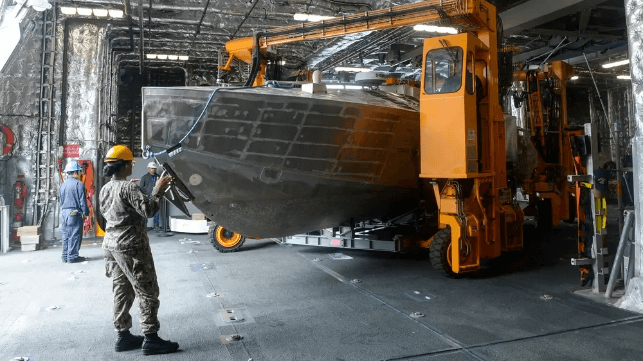
Sailors use a straddle carrier to load a minehunting USV sonar tow vessel aboard USS Canberra, 2024 (USN)

Published Mar 19, 2025 2:59 PM by The Maritime Executive


After decades of development, the U.S. Navy has deployed its first mine countermeasures mission package aboard an Independence-class Littoral Combat Ship, fulfilling the vessel's capability to perform its designated role at last.

The MCM package consists of a Textron-designed unmanned surface vehicle, aluminum-hulled and unpainted like the Independence-class; the AN/AQS-20 towed sonar for minehunting, installed on the USV; a helicopter-mounted mine detection system; and a minesweeping package installed on the USV. In service, it will replace the Navy's MH-53 mine countermeasures helicopter platform and the aging Avenger-class minehunting vessels.

Design of the Independence-class formally began in 2004, and the mission packages were designed in parallel. Initially, the minehunting package centered on Lockheed Martin's Remote Multi Mission Vehicle, an unmanned semisubmersible that the Navy bought in low-rate production to use for sonar towing. The Navy struggled to keep the RMMV in service at sea for more than 75 hours between failures, and it was ultimately replaced with a Textron USV design. This required the development team to start over in testing USV-sonar integration. The General Dynamics Knifefish unmanned submersible was also part of the initial package for neutralizing buried mines, but was canceled in 2021.  

The revised MCM package achieved initial operational capability (IOC) in March 2023, nine years behind schedule, and the first unit was embarked aboard USS Canberra in April 2024. Installation involves craning the USV and containerized support equipment into the starboard side loading hatch, then maneuvering it around the mission bay with a compact, special-purpose straddle carrier. 

After a year of further experience with the package, USS Canberra and USS Santa Barbara have now deployed from San Diego on a mission to replace existing minehunting assets in Japan and the Mideast, according to USNI. One more vessel is expected to deploy this year. 

Work on the package is not yet done. In February, the Navy awarded Bollinger an advance order for $8 million to procure "items needed to improve the MCM USV based on findings from operational testing." Production is under way for the minehunting payload for the USV, as well as the minesweeping payload.

The twin LCS classes were initially intended to accept all mission packages and to be interoperable with each other. This concept proved impractical in service, and in 2016, the Navy assigned the mine countermeasures role to the Independence-class and the antisubmarine warfare role to the Freedom-class. The ASW sonar suite failed to develop, in part because of interference from high noise levels from the Freedom-class' machinery, and the ASW package was canceled in 2022. 

The Navy has downsized the Freedom-class, as the vessels cannot perform the ASW mission without an ASW sonar suite. Under then-Chief of Naval Operations Adm. Mike Gilday, the Navy sought to decommission the first nine Freedom hulls - one just five years old. Five Freedom-class vessels have been removed from service to date, along with the first four Independence-class hulls. 


Neptun Werft Delivers First of New Series of River Cruise Ships to Viking

'NO GAMBLING AND NO CHILDREN'
VIKING AD

Viking river cruise in Paris
Viking took delivery on the first of its new ships for cruises on the Seine (Viking)

Published Mar 19, 2025 4:47 PM by The Maritime Executive


After a pause in new river cruise ship construction, Viking is embarking on the next phase of growth for its European river cruise operations which parallels the ongoing expansion in ocean cruising. By 2028, Viking expects to take delivery on 25 additional river cruise ships, and by 2030 nine additional ocean cruise ships. With these orders, Viking will have 109 river ships in 2028 and 21 ocean and expedition cruise ships in 2030.

The first of the new deliveries was completed on March 18 at the Neptun Werft shipyard in Rostock in the Warnemünde region of Germany. It is number 66 in the “Longship” series built by the yard for the company using a patented river cruise ship design. The partnership between Viking and Neptun Werft built the luxury river cruise ships for more than a decade marking the completion of the first series in 2021. Two river ships were delivered in March 2021 and one more in February 2023.

Recovering from the pandemic, Viking placed its first order for a new river cruise ship with Neptun Werft in February 2023 and that is the ship that was delivered yesterday. It is part of a “shortened Longship” specifically designed for navigation on France’s Seine. It measures 125 meters (410 feet) making it possible for the vessel to dock in the center of Paris. Named, Viking Nerthis, it has 86 passenger cabins accommodating 168 passengers. 

"With this delivery, we can continue our extraordinarily successful partnership with Viking. For Neptun Werft, each new ship means further employment in the core business of river cruise ships. With the new orders from the beginning of the year, we are fully utilized until 2028," says Stephan Schmees, CEO of Neptun Werft.

At the end of 2023, Viking expanded its cruise ship orders with Neptun Werft for a total of nine river cruise ships, one additional for the Seine plus eight of the Longship series. The larger vessels are 135 meters (443 feet) long and accommodate 190 passengers. 

One ship from the Seine series and four of the Longships will be delivered in 2025 and another set in 2026. Viking also added another eight ships to the order in January 2025. Those are scheduled for delivery in 2027 and 2028.

Neptun Werft had previously built four river cruise ships, Viking KariViking RadgridViking Skaga, and Viking Fjorgyn, in the Seine class. All the newer ships are being equipped with a hybrid system consisting of a diesel-electric drive, a battery system, and exhaust gas after-treatment. This will absorb peak loads and save a considerable amount of fuel. The ships will also be equipped with a number of technical innovations, such as a compact system for wastewater treatment as well as connections for shore power. Onboard, they have solar panels to further contribute to the ships’ energy efficiency.

Founded in 1997 by Torstein Hagen, Viking is one of the pioneers in the modern river cruise industry.  It operates river cruises in Europe, Asia, and Egypt and has one ship on the Mississippi in the United States.


Danish Consortium Grows to Complete Redesigned Plan for Arctic Patrol Ships

Danish frigate Thetis
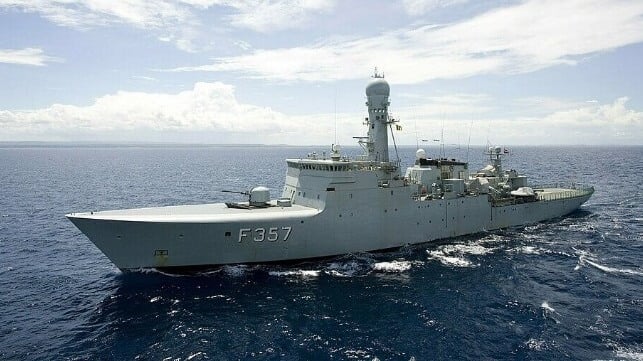
The project calls for replacements of the Thetis class (Peter van Bastelaar photo courtesy Netherlands Defense)

Published Mar 19, 2025 5:51 PM by The Maritime Executive


The consortium of Danish companies set up to develop the next-generation patrol ships for the Danish Armed Forces reports it is being taken over by Semco Maritime as it stands ready to meet the challenges to redesign and build the new ships. The group was selected in 2023 for the project but the government has recently decided to shift the focus to new ships better suited for the Arctic.

"The situation has changed in several areas since the decision to design new patrol ships was made in 2021,” said Minister of Defense Troels Lund Poulsen. At the end of January, he said, “We are in a significantly changed security policy situation, and the Danish Armed Forces are demanding a replacement for the aging Thetis class. The contracting parties have therefore agreed to reorient the existing patrol ship project to focus on the Arctic ships."

The Danish patrol ships were originally designed to operate in the Baltic Sea and Danish waters. According to the minister, the mission changed after Sweden and Finland joined NATO. He said there would be more countries and assets available for the security patrols in the Baltic.

While the Baltic remains a Danish focus, the Defense Command has also expressed a desire for an early replacement of the current Arctic ships, the existing Thetis class. Commissioned in 1991, they are four 3,500-ton displacement patrol ships deployed by the Royal Danish Navy. The goal was shifted to design modern ships that will be more efficient and require less maintenance as replacements for the aging Thetis class. The new ships will strengthen Denmark’s support of Greenland as well as its operational capacity in the Arctic and the North Atlantic.

Poulsen said in January, "The work so far has by no means been wasted. A reorientation makes it possible to get started more quickly with the design work on the Arctic ships. It is expected that sub-elements from the design work of the patrol ships and experiences from the work with a Danish construction strategy can be reused."

The partnership then known as Danske Patruljeskibe (Danish Patrol Ships) received a contract for the front-end engineering and design activity for a new class of flexible patrol ships in June 2023. It consists of Denmark's largest defense company Terma, Odense Maritime Technology, a world leader in the design of military ships with ongoing frigate projects in, among others, the UK, Poland, and Singapore, one of Denmark's largest pension funds and investors in infrastructure, PensionDanmark.

Semco Maritime has entered into an agreement to take over ownership of the group now known as Danske Flådeskibe. The consortium says it is ready to undertake the entire task of delivering and servicing new Arctic patrol ships and future frigates for the Danish Armed Forces.

“With Semco Maritime as part of Danske Flådeskibe, we can deliver the entire package to the Danish Armed Forces when it comes to both state-of-the-art frigates and Arctic ships – from design, equipment and launching to service of the finished ships,” said Hans Schneider, CEO of Danske Flådeskibe.

Semco Maritime they note has existing facilities and good expansion opportunities at the Port of Esbjerg, which has a good strategic location and status as a NATO port after significant investments in the infrastructure. The group says it expects to deliver the first ship to the Danish Navy as early as 2029.


Stena to Install Wind Rotors on New Hybrid Methanol-Fueled Ro-Ro

Ro-Ro fitted with wind rotors for Irish Sea service
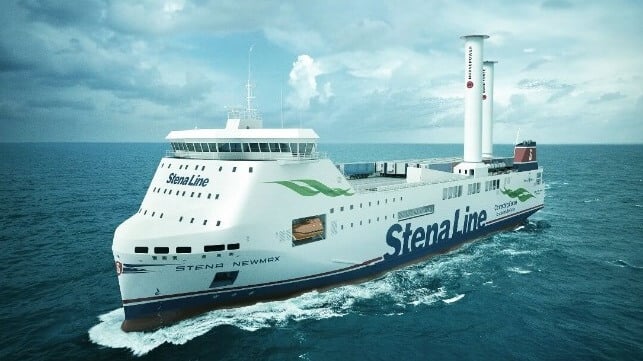
Stena is adding wind rotors to one of its two NewMax hybrid methanol-fueled vessels (Stena)

Published Mar 18, 2025 7:59 PM by The Maritime Executive


Continuing its efforts to incorporate new technologies to advance its efforts at reducing emissions, Stena Line is adding two wind rotor sails to one of its two NewMax hybrid vessels and completing the other sister ship “rotor sail ready.” The two vessels currently under construction in China are among the most advanced designs incorporating new technologies to be “future proof” as the company seeks to expand on its strategic ambition of shifting to renewable fuels and cutting CO2 emissions by 30 percent by 2030.

The NewNax vessels were ordered in early 2023 to be built by China Merchant’s Jinling Shipyard in WeiHai. At 147 meters (428 feet) in length and with 2,800 lane meters of capacity, the vessels represent an 80 increase over the current ships operating the freight service on the route from Belfast, Northern Ireland to Heysham, England. The ships will be equipped to carry 12 passengers and 26 crew.

Among the advanced features incorporated into the design is a hybrid propulsion plant able to operate on methanol fuel. In addition, to future proof the design, Stena reported during construction it was incorporating technologies that would take advantage of both battery propulsion and shore power when it becomes available.

The company reports it has now completed a deal with Norsepower to add two Rotor Sails to one of the vessels. Each rotor will measure 28 x 4 meters (approximately 92 x 13 feet) and is expected to deliver a further nine percent fuel savings on the planned route. The sister ship will be delivered ready for the future addition of rotor sails.

According to Stena, operating on the Irish Sea between Belfast and Heysham, the vessels will have wind conditions that are very favorable for wind-assisted propulsion. The company has also said that the unique tidal systems prevailing in Heysham can be challenging, so each vessel will be fitted with a technology configuration making the ships more resilient to the prevailing weather conditions. They will have three bow thrusters for maneuverability and specially designed engine/propeller configuration to enhance berthing capabilities in extreme weather conditions.


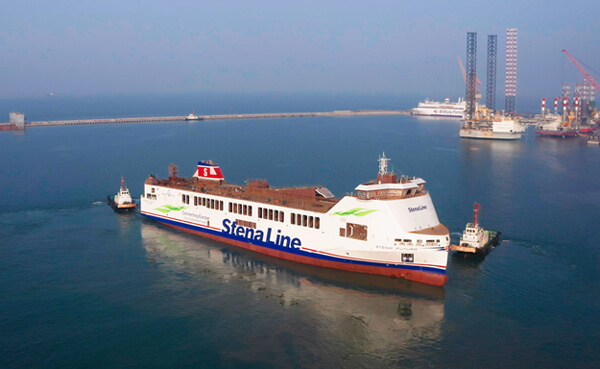
The first vessel of the class, Stena Futura, was launched in October 2024 (Stena Line)


Steel cutting for the first of the vessels began in January 2024 and its keel was laid in July. The vessel was floated in October as the Stena Futura while the keel for the second ship Stena Connecta was laid at the same time. Stena Connecta was launched at the end of February 2025. The first of the ships is scheduled for delivery in the fourth quarter of this year and the second one in 2026.

The company highlights that it became the first ferry operator to run a vessel on methanol with the 2015 conversion of the Stena Germanica. Since then, it has pursued further steps including the addition of more bulbous bows, tilted propellers, additional shore power capabilities, and experimented with battery power. It views the rotor as the next step in its continuing effort to improve performance and reduce emissions from its fleet.


Hong Kong’s Chief Says Hutchison’s Port Sale Requires “Serious Attention"

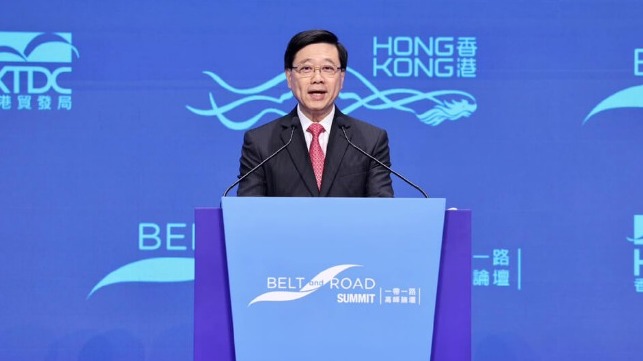
Hong Kong Chief Executive John Lee
Hong Kong's Chief Executive spoke out regarding the sale of Hutchison's foreign ports (HK Government file photo)

Published Mar 18, 2025 4:04 PM by The Maritime Executive


The Chinese government continues to apply pressure after the news of CK Hutchison’s planned sale of its international port operations, including in Panama to a partnership between U.S. investment group BlackRock and MSC Mediterranean Shipping Company’s TiL ports group. The deal has become mired in the politics between Donald Trump and China.

While Beijing has officially remained silent on the deal, it has used proxies to increase the pressure against Hutchison and Li Ka-shing, the tycoon behind the company. He has long been seen at odds with the Communist Party but when CK Hutchison announced plans to sell its foreign port operations early in March it called the deal “purely commercial,” and said it was “unrelated to recent political news reports,” in a veiled reference to Trump’s assertions regarding the Panama Canal. 

The company, headquartered in Hong Kong, has largely gone silent in the face of the campaign being waged in the media. Yesterday, the company said it would not hold its normal briefings with investors and the media when it releases its financial results.

In a regularly scheduled press conference, Hong Kong’s Chief Executive John Lee spoke out against the proposed sale echoing last week’s pressure from a newspaper closely linked to the Community Party. Analysts highlight that historically Hong Kong has not asserted legal rights to review transactions selling assets to foreign companies, unlike the mainland government that closely controls foreign asset sales.

Lee speaking to reporters cited the “extensive discussions” related to Hutchison’s proposed sale saying it reflects “society’s concern” over the sale which last week the newspaper called unpatriotic and against national interests. Today, Lee said, “These concerns deserve serious attention.”

He said that any transaction “must comply with the legal and regulatory requirements. Hong Kong will handle it in accordance with the law and regulation.”

Hutchison highlighted when announcing its plan that the deal, which involves a total of 43 ports in 23 countries, does not involve its Chinese port operations. Further, the sale of the two terminals in Panama is in a parallel transaction subject to the review of the Panama government and separate from the other international ports.

China has said it views the deal as coercion by the United States and efforts to extend the U.S.’s dominance over China and others.

“The Hong Kong Special Administrative Region Government urges foreign governments to provide a fair and just environment for enterprises, including enterprises from Hong Kong,” Lee told reporters today. “We oppose the abusive use of coercion or bullying tactics in international, economic, and trade relations.”

At the same time, it was reported that China sent a delegation to Panama over the weekend. Under pressure from Trump, Panama has sought to back away from its close relationship with China including serving notice that it would not renew its participation in the Belt and Road initiative. The Panama Government continues to assert that the canal belongs to Panama but said it would review the proposed transaction between Panama Ports controlled by Hutchison and the BlackRock-MSC partnership. Earlier, Panama said it was reviewing the contract awarded to Hutchison to run the two terminals.

Hutchison and BlackRock agreed in March to enter into exclusive negotiations to finalize the terms of the transaction. The companies set a target of on or before April 2 to sign definitive documentation for the Panama Ports Corporation portion of the deal. It said that the acquisition of the HPH Ports Sale Perimeter would proceed on “an expedited basis” subject to the BlackRock-TiL Consortium conducting normal and usual confirmatory due diligence, settlement of definitive documentation, and receipt of any necessary regulatory approvals, amongst others.


AAPA, BIMCO Warn of Side Effects From U.S. Port Fees for Chinese Ships

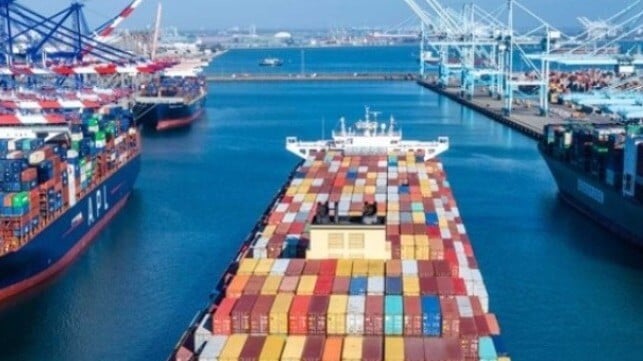
Port of Los Angeles
File image courtesy Port of Los Angeles

Published Mar 18, 2025 9:41 PM by The Maritime Executive


America's seaports have weighed in against the Trump administration's steep proposed fees on Chinese-built shipping, which could amount to an additional $3.5 million per port call if fully implemented. In comments to the Office of the United States Trade Representative (USTR), the American Association of Port Authorities (AAPA) warned that the unprecedented fees would make U.S. exports less competitive, and it provided the industry's first hard numbers for what the proposal might cost in lost revenue. 

In a statement, AAPA president and CEO Cary Davis warned that the fee structure would do little to counter China's dominance in shipbuilding, and said that it would have few near-term effects on domestic shipyard production. "A fee on foreign vessels will simply not bring back American shipbuilding. Our existing shipyards are working at or near capacity, and higher demand for American vessels will not enable them to produce more ships with the same resources," Davis said, noting AAPA's support for alternative support policies like the SHIPS Act. 

After the USTR announced the fee proposal last month, AAPA joined a multi-industry study to assess the impact of the fees, conducted by Trade Partnership Worldwide. The early results suggest a double-digit decline for American exports because of the increased cost of shipping. The study's initial conclusions suggest that if the fees fully enter into effect, agricultural exports will drop by about 16 percent, petroleum and coal exports will fall by eight percent, and U.S. goods exports overall will drop by about 12 percent. 

U.S. goods exports amount to roughly $2.1 trillion per year, so a 12 percent drop would be a revenue decline of about $250 billion annually for U.S. exporters - equal to about one percent of U.S. GDP. 

The plan as written would likely reduce traffic to smaller secondary ports, AAPA said, and would risk squandering federal investments in channel deepening and port infrastructure in midsize seaports on the Gulf and East Coasts. 

"AAPA respectfully urges the Office of the United States Trade Representative (USTR) to reconsider its approach to countering Chinese dominance in the global shipbuilding industry by narrowing the scope of the proposed fees or reversing course," the association said. 

The Louisiana Maritime Association (LaMA), which represents Lower Mississippi River maritime service companies, warned that American maritime workers could lose out in the near term, even if the fees eventually succeed in boosting future U.S. shipyard activity. 

"The fallout will affect railroads, pilots, towage (tug) companies, barge companies and many small, independent businesses such as line handling companies, dock, terminal and facility workers," warned LaMA. "The myriad of United States companies dependent on the shipping industry could (and reportedly already are) lose business based on the anticipation of the implementation of this USTR action."

BIMCO reviews effects of port fees

Shipping association BIMCO also weighed in this week, and it provided a detailed overview of the likely effects. 

"The proposed actions will impose much increased transport costs on US imports and exports and have negative effects on the wider US economy; their impact on Chinese dominance is much less certain," said BIMCO deputy secretary general Lars Robert Pedersen in a statement. "The ships already built of Chinese origin will not disappear from the world fleet if the proposed port fees are introduced."

Pedersen predicted a splitting of the global shipping market into two halves: some shipowners would put together fully non-Chinese fleets in order to call in the U.S. without the penalties. Meanwhile, other shipowners would use Chinese tonnage to serve the rest of the global market, without making port calls in the U.S., and at lower price. 

"The totality of the world fleet would not change, but the overall cost of maritime trade would increase due to less competition in the now segregated US market," he cautioned. 

The boxship sector, which has consolidated into less than 10 large operators, is less likely to divide up the market in the same way, he said. Instead, ocean carriers will concentrate port calls into the largest hubs, avoiding the extra fees that would come with each call at secondary ports. Those smaller ports would go underutilized while congestion would grow at the major trade gateways, he warned. 

Pedersen noted that a U.S.-built requirement for U.S. export shipping would raise costs "significantly," and would affect the competitiveness of American exporters - particularly farmers. Inexpensive commodities like grain and soy would be most affected as a percentage of cargo value, he warned. 


Chinese Fishermen "Spontaneously" Raise $18M for Deep-Sea Research Ship

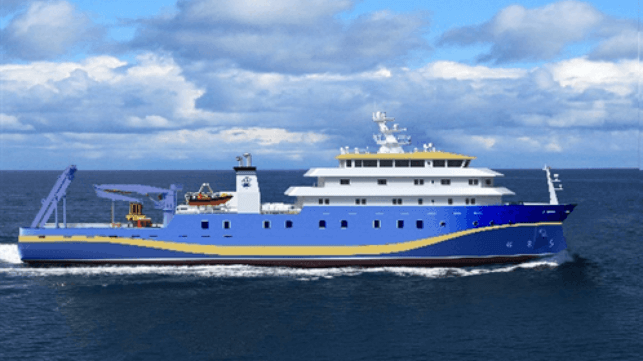
Zhejiang research vessel
Illustration courtesy Tenglong Shipbuilding

Published Mar 19, 2025 4:48 PM by The Maritime Executive


Chinese fishermen in Zhejiang have paid for the construction of an oceangoing scientific research vessel capable of "global unlimited navigation," according to Chinese state media. 

Fishermen at the port of Wenling, Zhejiang "spontaneously raised" $18 million to build the 270-foot vessel for deep-sea scientific research, according to state-owned China News Service. The vessel is primarily designed for activity unrelated to fishing, like geological and geophysical surveys, seabed mapping, ROV deployment and deep sea exploration. It has DP2 diesel-electric propulsion to maintain position to within one meter of accuracy. 

The 3,500-tonne vessel will be built at Wenling's Tenglong Shipbuilding. With a speed of 14 knots, a range of 5,000 nm and endurance of up to 60 days at sea, the vessel has the capability to conduct long research voyages. It is also envisioned as a support vessel for wind farm maintenance, seabed engineering and offshore oil field operations. 

"It has great potential in deep-sea scientific research and operations. The deep-water equipment, power system and DP system equipped on board are all at the international advanced level," said Wang Haozhao, chief ship designer of Fujian Fuchuan Marine Engineering Technology Research Institute, which provided the design. 

Though fishermen-funded, it will be operated by Quanzhou-based Fujian Baozhou Shipping Co., Ltd. The vessel will be the first privately-run oceangoing research vessel in China. It will also be the first research vessel built at Tenglong Shipbuilding, better known for small specialty vessels like dredgers, distant-water fishing vessels and asphalt carriers. 

Like Hainan's fishing community, Zhejiang and Fujian fishermen are known for involvement in maritime militia organizations, state-backed paramilitary groups that leverage private vessels for presence operations in foreign waters. China denies the militia's existence in foreign-facing statements, but celebrates its achievements in Chinese-language media. 

STATEHOOD OR INDEPENDENCE

Crowley Launches New Dedicated Service to Transport U.S. LNG to Puerto Rico

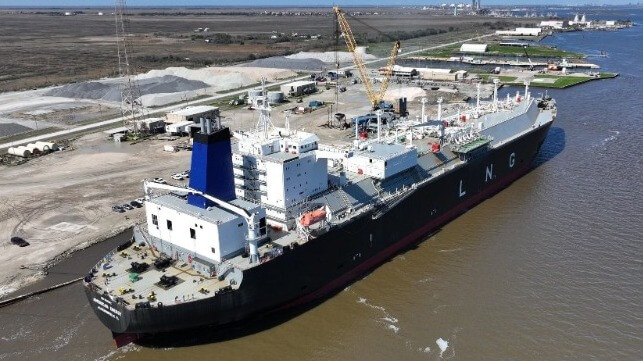
LNG carrrier
Crowley-owned American Energy will provide regular LNG deliveries to Puerto Rico (Crowley)

Published Mar 18, 2025 1:42 PM by The Maritime Executive


U.S. shipping company Crowley in partnership with Naturgy is launching a new service to supply U.S.-produced LNG on a regular basis to Puerto Rico. It is part of a history-making move that brought a 1994 French-built LNG carrier into the U.S. registry using a provision added to the Jones Act for shipping LNG or LPG to Puerto Rico.

Crowley acquired the LNG vessel in December 2024 from a subsidiary of Malaysia’s MISC Berhad. After U.S. Coast Guard inspection and approval, the vessel was renamed American Energy and placed in the U.S. registry as of January 2025. It had previously operated as the Intan and was registered in Liberia. The vessel, originally known as Puteri Intan, was built by France’s Chantiers de l'Atlantique. 

The 900-foot-long (274 meters) LNG carrier has a capacity 130,400 cubic meters (34.4 million gallons) per voyage and is now owned by Crowley and will be crewed by U.S. mariners providing regular service from the U.S. Gulf Coast to Puerto Rico. Crowley reports it will operate in accordance with the U.S. Coast Guard Authorization Act of 1996. A provision made it possible for a foreign-built vessel to enter the U.S. registry for the trade to supply gas to Puerto Rico.


“The entry into service of?American Energy?marks a significant step for fuel supply reliability in Puerto Rico for our energy grid, which will greatly benefit our people,” said Puerto Rico Governor Jenniffer González-Colón. “This partnership is an initiative to act using existing regulations to increase access to a U.S.-based LNG source that expands our options for the stabilization of our energy grid, as we work towards providing our residents and businesses a more consistently reliable power generation source.”

Crowley highlights that the new operation builds on its 70-plus years of service to Puerto Rico. Annually, Crowley reports it delivers more than 94 million gallons of LNG through its LNG Loading Terminal in Penuelas as well as provides ocean delivery and land transportation using ISO tank containers. The company also operates the full-service marine Isla Grande cargo terminal in San Juan for its container and roll-on/roll-off vessels, including two LNG-fueled ships, and logistics services. 


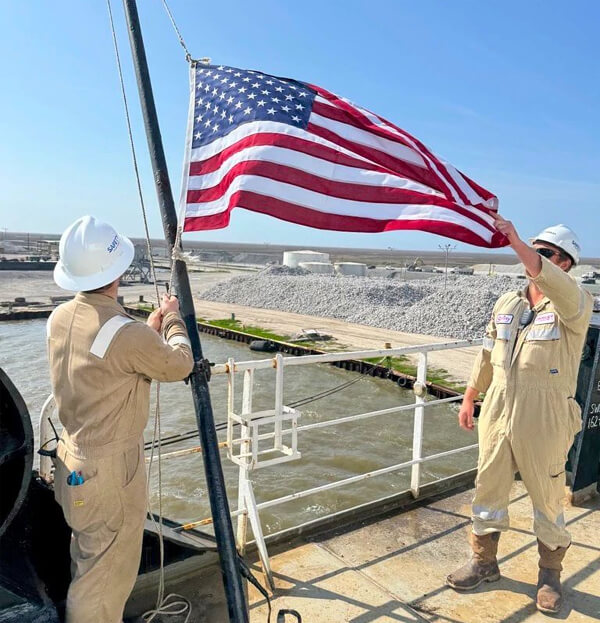
U.S. flag raising on the American energy which has a homeport of Jacksonville, Florida (Crowley)


Crowley and Naturgy have entered into a multi-year agreement that provides for the regular delivery of the U.S. mainland-sourced LNG to Naturgy’s operating facility in Penuelas, Puerto Rico.  

“This contract strengthens our presence in the global LNG market, particularly in the United States, and allows Puerto Rico to obtain a stable and competitive energy supply route,” said Jon Ganuza, general manager of supply and wholesale markets, Naturgy.  

The U.S. Merchant Marine Act of 1920, widely known as the Jones Act, requires that cargo transported by ship between U.S. ports must be handled on vessels that are owned and registered in the U.S. While it also requires U.S.-built ships, provisions and exemptions have been provided when unique vessels, such as LNG carriers, are not available so that the ships can be added to the U.S. registry.

The new LNG service, which is expected to travel to the island twice each month comes as the recently-elected governor also looks to strengthen the island’s manufacturing sector. Today, she announced a new initiative to reshore manufacturing to the island as part of an effort to attract investment and strengthen the job market and economy of Puerto Rico.