Wednesday, March 19, 2025


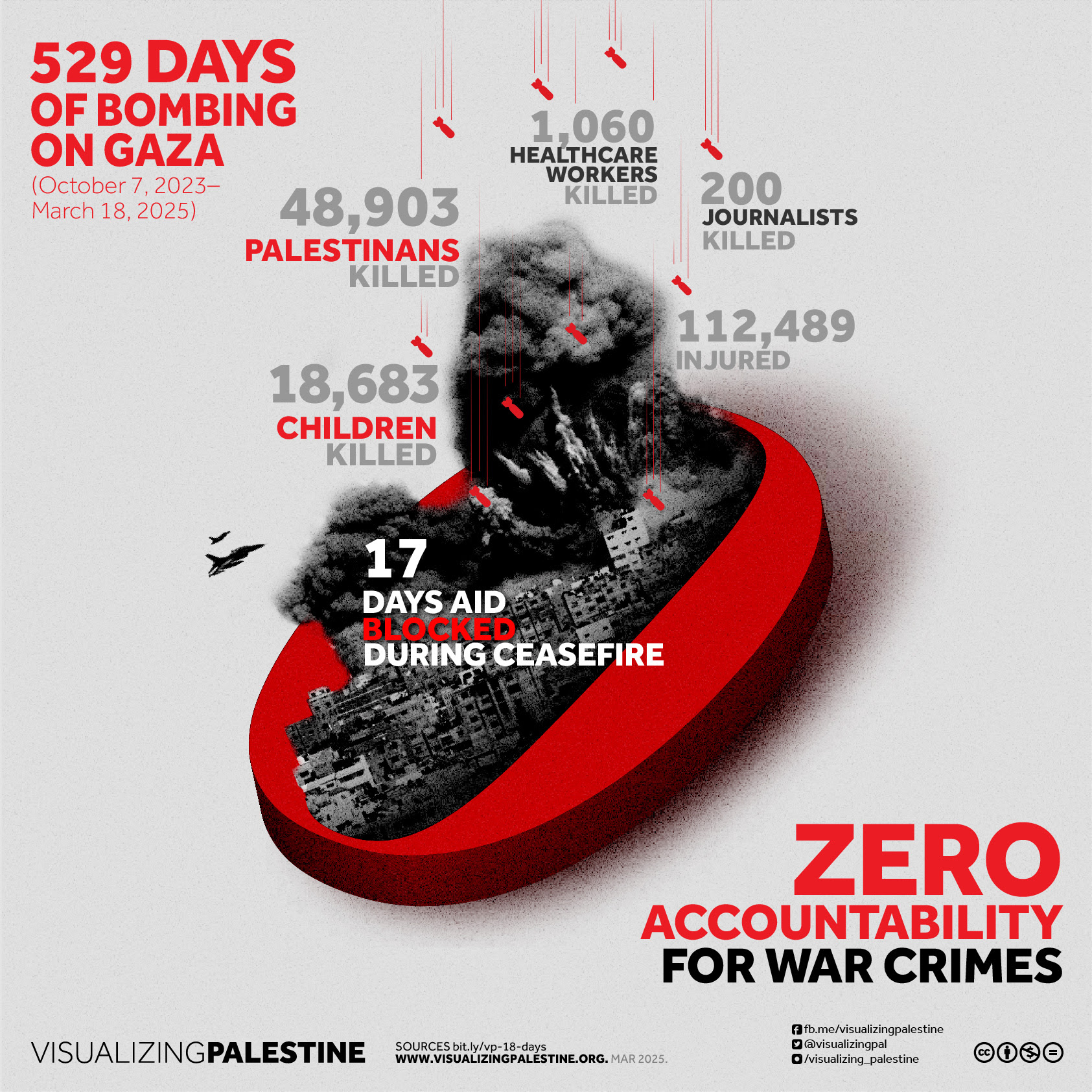
Zero Accountability


Monday night, Israel killed more than 400 Palestinians in a massacre intended to destroy the ceasefire for good. This is not the first time that Israel has tried to upend the agreement. Over the last two months, Israel has killed hundreds of Palestinians, blocked aid shipments, and refused to participate in talks on the next phase of the ceasefire.

This is the sixth time we update this visual with figures on Israel’s wanton destruction of Gaza and genocide against Palestinians since October 2023. We used data from the United Nations Office for the Coordination of Humanitarian Affairs (OCHA) and Al-Jazeera to update this visual. According to a report released by The Lancet in July 2024, the estimates of Palestinians killed is much higher than the figures included in this visual.

As we grieve this continued devastation and loss, we must not be intimidated into silence. We must continue to push for Israel to be held accountable for its crimes, and demand an arms embargo now.


Visualizing Palestine is the intersection of communication, social sciences, technology, design and urban studies for social justice. Visualizing Palestine uses creative visuals to describe a factual rights-based narrative of Palestine/Israel. Read other articles by Visualizing Palestine, or visit Visualizing Palestine's website.


Israel Doesn’t Care about the Captives


It always planned to reboot the genocide


What excuses has Israel given for renewing the genocide:

1. Israel says it is trying to force Hamas to release the captives in Gaza.

Yet, as we know from those already released, the indiscriminate bombing of Gaza only increases the chances the captives will be killed. There is no plausible scenario in which dropping US-supplied 2,000lb bombs across Gaza makes any Israeli held in the enclave safer or brings them home sooner.

In any case, there was a known and easy way for Israel to get the last of the captives back. They were due to be freed in the second phase of the ceasefire agreement, already well past its implementation date. But weeks ago Israel decided to tear up the agreement it had signed and impose new terms in which the rest of the captives would have to be returned – and without Israel either ceasing its fire or withdrawing from the enclave, as it had agreed to do.

What Israel’s return to genocide shows is that the Israeli government would rather kill the remaining captives – vaporising them with Trump’s latest shipment of 2,000lb bombs – than either make a concession to secure their release or place any limitation on its ability to slaughter the people of Gaza.

2. Israel claims Hamas was re-arming and planning a new attack.

As ever, Israel is inverting the truth. It was Israel that was re-armed by the Trump administration with the bombs now tearing apart Gaza’s children. Hamas – isolated from the outside world – had no obvious route to re-arming.

And as for plans for another October 7, both Hamas and the world were shocked its fighters managed to break out of the tiny, besieged territory of Gaza the first time. Hamas assumed it would be a suicide mission. It succeeded only because Israel had grown so complacent in its 17-year siege of the enclave, it imagined the 2.3 million people there were permanently entombed.

Israel’s assumption was the Palestinians would never manage to find a way out of the giant concentration camp Israel had built for them. Israel will not likely drop its guard again any time soon.

In other words, Israel is flat-out lying about its reasons for renewing the slaughter. It is lying as it has done over and over again, throughout the past 18 months.

Israel always intended to reboot the genocide as soon as the Trump administration had been able to take credit for negotiating the ceasefire. Then they could work together to concoct a new set of pretexts – based on lies about who was violating the ceasefire – to justify why more of Gaza’s children needed to be murdered.

Certainly, Joe Biden and his officials must be put on trial in the Hague for the first 15 months of the genocide. But it is Trump and his administration that are responsible for every Palestinian death from here on out.

Jonathan Cook, based in Nazareth, Israel is a winner of the Martha Gellhorn Special Prize for Journalism. His latest books are Israel and the Clash of Civilisations: Iraq, Iran and the Plan to Remake the Middle East (Pluto Press) and Disappearing Palestine: Israel's Experiments in Human Despair (Zed Books). Read other articles by Jonathan, or visit Jonathan's website.


This Is Trump’s Genocide Now


This is Trump’s genocide. Trump is just as culpable for what happens in Gaza as Netanyahu. Just as guilty as Biden was during the last administration.

Trump signed off on the reignition of the Gaza holocaust. He spent weeks sabotaging the ceasefire and then gave the thumbs up to the resumption of the genocide. He did this while bombing Yemen and threatening war with Iran for Israel.

I don’t know why Trump has done these things. Maybe it’s all for the Adelson cash. Maybe Epstein recorded him doing something unsavory with a minor during their long association and gave it to Israeli intelligence for blackmail purposes. Maybe he owed somebody a favor for bailing him out of his business failures in the past. Maybe he’s just a psychopath who enjoys murdering children. I don’t know, and it doesn’t really matter. What matters is that he did it, and he is responsible for his actions.

Trump supporters will justify literally anything their president does using whatever excuses they need to, but they are only revealing how completely empty and unprincipled their political faction is. They are unthinking worshippers of power who go along with whatever the president tells them to. By continuing to support Trump even as he continues Biden’s legacy of mass murder in the middle east, they are proving themselves to be mindless stormtroopers for the empire in full view of the entire world.

You can still support Trump if you hate immigrants and LGBTQ people and want lower taxes for the obscenely wealthy, but there is no legitimate reason to support him on antiwar or anti-establishment grounds. He’s just another evil Republican mass murderer president.

*****

Republicans in 2002: We need more authoritarianism and more wars in the middle east. Anyone who disagrees is a terrorist supporter.

Republicans in 2025: We need more authoritarianism and more wars in the middle east. Anyone who disagrees is a terrorist supporter, and antisemite.

*****

By the way has anyone checked on the western Zionist Jews? How are their feelings feeling today? Are they feeling nice feelings or bad feelings? Are their feelings feeling safe or unsafe? We need wall to wall news coverage of this supremely urgent issue; no time to cover any other story.

*****

I write so much about the fake “antisemitism crisis” not only because it’s being used to destroy civil rights throughout the western world, but because it’s one of the most dark and disturbing things I’ve ever witnessed.

It’s been so intensely creepy watching all of western society mobilize around a complete and utter fiction in order to stomp out all criticism of a foreign state. It’s about as dystopian a thing as you can possibly imagine, all these pundits and politicians pretending to believe that Jewish safety is seriously being threatened by an epidemic of antisemitism which must be aggressively silenced by any means necessary. All to shut down opposition to the worst inclinations of a genocidal apartheid state and the complicity of our own western governments with its crimes.

And we’re all expected to treat this scam seriously. Anyone who says the emperor has no clothes and calls this mass deception what it is gets tarred with the “antisemite” label and treated as further evidence that we’re all a hair’s breadth from seeing Jews rounded up onto trains again if we don’t all hurry up and shut down anti-genocide protests on university campuses. They’re not just acting out a fraudulent melodrama staged to rob us of our rights, they’re demanding that we participate in it by pretending it’s not what it plainly is.

It’s not just tyranny, it’s tyranny that orders people to clap along with it. It’s such a disgusting, evil thing to do to people. Such psychologically dominating abusive behavior. The more you look at it, the creepier it gets.

*****

The anti-imperialist left is what MAGA and right wing “populism” pretend to be. We ACTUALLY oppose the empire’s warmongering — not only when Democrats are in power. We ACTUALLY want to defeat the deep state — we don’t applaud billionaire Pentagon contractors like Elon Musk taking power. We ACTUALLY oppose the establishment order — because the establishment order is capitalist. We ACTUALLY stand up to the powerful — we don’t offload half the blame onto immigrants and marginalized groups.

The anti-imperialist left is also what liberals pretend to be. We ACTUALLY support the working class. We ACTUALLY stand up for the little guy. We ACTUALLY want justice and equality. We ACTUALLY support civil rights. We ACTUALLY oppose tyranny.

Everything the human heart longs for lies in the death of capitalism, militarism and empire, and yet both of the dominant western political factions of our day support continuing all of these things. This is because westerners spend their entire lives marinating in power-serving propaganda which herds them into these two mainstream political factions to ensure that they will pose no meaningful challenges to our rulers. All political energy is funneled into movements and parties which are set up to maintain the status quo while pretending to support the people, with the illusion of political freedom sustained by a false two-party dichotomy in which both factions serve the same ruling power structure.

Of course, what mainstream liberalism and right wing “populism” have to offer that anti-imperialist socialism does not is the ability to win major elections with successful candidates. This is because generations of imperial psyops have gone into stomping out the anti-imperialist left in the western world, and because only candidates which uphold the status quo are ever allowed to get close to winning an election. This doesn’t mean mainstream liberalism or right wing “populism” are the answer, it just means our prison warden isn’t going to hand us the keys to the exit door.

At some point we’re going to have to rise up and use the power of our numbers to force the urgently needed changes we long to see in our world. Everything in our society is set up to prevent this from ever happening. That’s all the two mainstream political factions are designed to do. That’s why they both have phony “populist” elements within them which purport to be leading a brave revolutionary charge against the establishment, while herding everyone into support for the two status quo political parties. And that’s why the anti-imperialist left is everything they pretend to be.

Caitlin Johnstone has a reader-supported Newsletter. All her work is free to bootleg and use in any way, shape or form; republish it, translate it, use it on merchandise; whatever you want. Her work is entirely reader-supported, so if you enjoyed this piece and want to read more you can buy her books. The best way to make sure you see the stuff she publishes is to subscribe to the mailing list on Substack, which will get you an email notification for everything she publishes. All works are co-authored with her husband Tim Foley. Read other articles by Caitlin.

NDP Singh Embarrassingly Trails PM Carney on Questioning F-35 deal

The NDP’s belated call to scrap the F-35 contract is a damning comment on Jagmeet Singh’s leadership. This cautious response to a rapidly shifting political terrain also includes an outrageous sop to the military industrial complex.

On February 25 I asked the NDP leader if he’d reconsider paying tens of billions of dollars to a US arms giant for offensive fighter jets as part of his stated desire to take a hardline in response to Donald Trump’s threats. Singh spent over a minute responding to my question but refused to answer. While seeking to portray himself as the ‘get tough on Trump’ candidate, Singh was unwilling to even say the party could reconsider paying huge sums to Lockheed Martin for 88 F-35s. To make his cautiousness even more absurd, the NDP has effectively opposed the F-35 contract, which is to cost $19 billion upfront and $70 billion over the life cycle.

The answer wasn’t simply off the cuff. I arrived half an hour early and had a conversation with Singh’s assistant in which I told her the two questions I hoped to ask.

Two weeks later I asked Yves Francois Blanchet basically the same question I had asked Singh. Last Tuesday the Bloc Québécois leader said he was open to canceling the F-35 contract in response to Trump’s belligerence. Blanchet expressed concern about a “switch off controlled in the US” for Canada’s expensive fighter jets.

In a sign that the issue was ripe, my Blanchet clip was viewed by over 200,000 times on social media, which is a surprisingly large number for an exchange in French.

To be fair to Singh, days before my question to Blanchet Postmedia reporter David Pugliese published a story discussing the US having an effective “kill switch” over the warplanes. Additionally, Michael Byers published a column in the Globe and Mail detailing some nationalist reasons to oppose the F-35 deal.

Also on Tuesday, thousands began responding to a Canadian Foreign Policy Institute, Just Peace Advocates and World Beyond War email campaign to Mark Carney and the leaders of the other political parties. It called for the F-35 contract to be scrapped and to “Stop Canada’s plan to spend billions on U.S.-made & controlled weapons of war.”

On Thursday former Liberal foreign affairs minister Lloyd Axworthy added his voice to a rapidly growing number of Canadians speaking out on the F-35. That day Portugal also announced it was abandoning a plan to purchase the F-35s. The government cited concerns about US reliability and control over the planes’ logistics and parts.

Amidst the mounting pressure, defence minister Bill Blair told CBC on Friday that Carney asked him to reconsider the F-35 deal. The news made international headlines and has hit Lockheed Martin’s stock.

In effect, Canada’s new investment banker prime minister outflanked the leader of a social democratic party polling under 15%. In a widely circulated YouTube interview Saturday morning Brent Patterson and I discussed the NDP brass’ caution amidst a rapidly changing political terrain.

On Sunday the NDP released a sloppily put together statement (they rewrote the headline after publishing) saying the government should cancel the F-35 deal and its contract for 16 Boeing P-8A Poseidon Multi-Mission Aircraft. It notes “At a time when Donald Trump has threatened not just workers and jobs, but Canada’s very sovereignty, it’s a matter of national security that our defence technology not be controlled by the United States. That’s why we’ll cancel the F-35 contract, and build the fighter jets Canada needs in Canada, using Canadian workers.”

Simultaneously, NDP defence critic Lindsay Mathyssen released a statement on the F-35. It noted, “We cannot allow President Trump to control the production, maintenance, and software of our military equipment. At a time when the United States is not respecting our territorial sovereignty, we cannot risk him being able to control our military equipment … Cancelling these projects would have an immediate impact on President Trump’s economy and send our clearest message yet that Canada will not stand for his disrespect.”

Mathyssen has largely ignored the issue even though 1,400 emailed her in 2022 calling on the party to question the “Liberal’s fighter jet plans” in a statement headlined “NDP must oppose F-35 purchase”. Previous to that the NDP largely ignored the widely mediatized 2021 No New Fighter Jets for Canada statement signed by Neil Young, Stephen Lewis, Teagan and Sarah, David Suzuki and many other notable Canadian and international figures.

While it’s good the NDP has decided to criticize the F-35, their Sunday statement also calls for Canada to spend 2% of GDP on its military by 2032. That would boost outlays on the war machine by some $20 billion per year (with annual rises matching GDP growth).

This is an odious shift in NDP policy. In July Singh repeated to me that the NDP considered NATO’s 2% of GDP target “arbitrary”. Their shift reflects the party’s subservience to an alliance NDP members previously voted to withdraw from as well as to the president seeking to annex Canada.

The NDP statement even responds to the contradiction, noting that “We don’t do this [call to increase military spending] to placate Donald Trump.” But that is precisely who has spurred the renewed push to boost military spending. Trump’s criticism is what led the Liberal leadership candidates to seek to outdo each other in declaring the speed at which they would hit the 2% of GDP target.

While it may be difficult to have principles in electoral politics, the opportunism shaping NDP military policy is beyond embarrassing.
Centrica CEO Pay Reduced by Half

By City A.M - Mar 19, 2025

Centrica CEO Chris O’Shea saw his pay slashed by almost half for the latest financial year, but the company plans to increase his base salary to align with market rates.

Despite a decrease in earnings compared to the previous year, Centrica beat analyst expectations and announced a dividend hike and share buyback program.

The company’s annual report indicates that its business model is resilient and well-positioned for the transition to net zero.


The boss of Centrica, the FTSE 100 parent company of British Gas, has seen his pay slashed by almost half for the group’s latest financial year.

Chris O’Shea took home £4.3m for the 12 months, down from the £8.2m he received in the prior year.

O’Shea, who has been CEO of the FTSE 100 company since 2020, had previously received £4.49m in 2022.

His latest pay packet included a base salary of £845,000, £1.4m from the annual incentive plan and £2m from the long-term incentive plan.

Last year’s package consisted of £810,000 in salary, a £1.4m annual bonus and £5.9m in long-term bonus, and some pension and benefits.

However, the owner of British Gas added that O’Shea’s “remuneration is no longer sufficiently aligned with our peers, and his performance and experience warrants positioning his pay between the median and upper quartile of the FTSE 100”.

As a result, the group confirmed it will increase the CEO’s salary from £855,000 to £1.1m from 1 April.

Centrica also confirmed that O’Shea’s maximum RSP (Restricted Share Plan) award would be increased from 150 per cent of salary to 200 per cent.
British Gas owner backs salary hike

The group said: “The committee considered whether the increase should be phased over multiple years.

“However, considering the CEO’s track record and experience as well as the current positioning versus the market, the committee determined that it would be inappropriate to continue to pay him below market competitive rates and therefore decided to implement a one-off adjustment.

“This also reflects the prudent decisions taken over the past four years, which restrained the committee from applying phased relative increases up to this point.”

Centrica’s annual report comes after the owner of British Gas beat earnings estimates for its latest financial year and hiked its dividend.

The group posted earnings before interest, taxation, depreciation and amortisation (EBITDA) of £2.3bn for the 12 months ended 31 December.

While this was down from last year’s £3.5bn, it was well ahead of analyst expectations of £1.6bn.

Adjusted earnings per share came in at 19p, ahead of prior forecasts of 18.62p.

Centrica added that it planned to hike its dividend by 13 per cent to 4.5p and extended its existing share buyback programme by £500m.

In its annual report, the owner of British Gas said: “Our performance in 2024 demonstrates that our business model is resilient in different market conditions, and we are well placed to benefit from the transition to net zero.”

By City AM
Chevron Out, Black Market In?
The Fallout of U.S. Sanctions on Venezuela

By Elias Ferrer - Mar 19, 2025

Revoking Chevron’s license in Venezuela could drive oil sales back underground, reducing transparency and benefiting corrupt intermediaries.

Sanctions on Venezuela have had mixed effects.

The removal of licenses may disrupt Venezuela’s foreign exchange market and private sector.


On 26 February, U.S. President Donald Trump announced his intention to end General License 41, which allowed Chevron to operate in Venezuela despite sanctions. Meanwhile, there are other “specific licenses” for oil and gas companies at risk. The U.S. Treasury’s Office of Foreign Assets Control (OFAC) had created a system to monitor at least part of Venezuela’s oil industry by waiving sanctions for certain American, European, and Indian companies but with strict limitations.

Four corporations that were authorized by licenses or comfort letters—Chevron, Repsol, Maurel et Prom, and Eni—contributed to a production of 325,000 barrels per day (bpd) in January, to the country’s total of 1,068,000 bpd, according to PDVSA, the state-owned energy company. Mukesh Ambani’s Reliance Industries and Harry Sargeant’s Global Oil were also authorized to ship Venezuelan petroleum products.

What does it mean if the “Chevron License” is over? Is there a way to know who will be the winners and the losers after Trump’s decision? How will the revocation impact the oil market, geopolitics, and the Venezuelan economy?

We have one benefit. We have seen how financial and economic sanctions were introduced and intensified from 2017 to 2020 under the first Trump term and then how they were eased via licenses under Biden. While there are many more variables at play affecting Venezuela’s politics, economy, and its oil sector, we can form a good understanding of who wins and who loses with tougher sanctions.

What was the purpose of the Chevron license? The Chevron authorization, and later the specific licenses, were carefully designed to maximize recouping debt and minimize cash flows to the Venezuelan state in a country with an oil sector that has the highest government take in the world.


Related: Is the Endgame with Iran About to Begin?

Juan González oversaw policy towards Caracas under the Biden administration, as National Security Council Director. He was the lead designer of General License 41. He says that the idea was to allow Chevron to recoup its debt while bringing transparency to the sector and limiting cash flows to the Maduro government.

“Before the Chevron license, Venezuela sold all its oil on the black market, pocketing every dollar. With the license, most of the oil revenue [from joint ventures with Chevron] went to pay off debt, leaving the regime with less money—not more. Revoking it doesn’t punish Maduro; it just drives oil sales back underground, undermining U.S. leverage,” says Gonzalez. Under the license, “the regime only got taxes and royalties, and the rest went to Chevron.”

Many foreign policy analysts have argued that sanctions can work as a “shock and awe” weapon but that they lose effectiveness over time as targeted states gradually adapt. While some argue that revoking the Chevron license will push oil sales underground, proponents of stricter sanctions believe that cutting off all revenue streams will increase economic pressure on the Maduro government, potentially leading to political concessions.

Who benefits? Corrupt officials like opaque systems.


A strict sanctions environment is where shady intermediaries and corrupt officials are allowed to flourish. The targeted state has no choice but to hide data on production, exports and revenue, at the expense of transparency and accountability.

In the Venezuelan case, we have seen shadow fleets charging higher freight costs for older, rundown tankers. Shipping companies also had to turn off radars at sea and carry out ship-to-ship transfers. There would also be added layers of separation between PDVSA and the final buyer. Altogether, exports became riskier and more costly, benefitting intermediaries.

Certain PDVSA managers have also profited. There is the infamous corruption scandal where the then Oil Minister Tareck El Aissami flourished under the strictest period of sanctions. In March 2023, it was leaked to Reuters that PDVSA had $21.2 billion in unpaid bills from intermediaries.

El Aissami managed the oil sector from April 2020 until his downfall in March 2023, when the scandal was uncovered. In that time, he constructed an opaque system to produce and sell Venezuelan oil. He did manage to ramp up output, from a trough of 393,000 bpd in June 2020 to 754,000 bpd when he was forced to resign.

But with virtually all transactions carried out with cash and crypto, and sales numbers hidden from the public, El Aissami and his associates were able to divert billions of dollars. The final count of all the damages caused is not available to the public.


“Grey market” importers in China buy at a discount

In a scenario of all-out sanctions, even major Chinese companies shied away from Venezuelan oil. But there are always willing buyers, in black or “grey” markets, with a low-enough price. And that is the key: in the period from 2019 to 2022, the discount of Venezuela’s Merey to the Brent benchmark could be as high as $35.

PDVSA still exports part of its crude via Malaysia, where it is rebranded, and then on to China. However, their share fell in the last two years as more North American, European and Indian buyers were allowed by the OFAC to enter the market.

In the book On Sanctions in Venezuela, economists Asdrubal Oliveros and Juan Palacios show that in 2023, the U.S., Spain and India represented 34% of Venezuelan oil exports, while China and Malaysia took 51.6%. In 2024, their shares virtually inverted, with 56.2% going to the first group and 26.8% to the second.

Diluent imports: Iran says “take it or leave it”


The Orinoco Oil Belt, the formation with the largest known reserves of crude, has mostly extra heavy oil, like bitumen. It is too sticky even to move through pipelines, so it needs to be mixed with diluents, like gas condensate at a ratio of 3.5 to 1. Later, other petroleum products are needed to refine heavy crude for a final product, like car fuel.

Many of these diluents are produced locally, but a vital share is imported. For decades, the U.S. was the main oil partner, and thus provided the lion’s share. At the toughest point of sanctions, Iran became the sole provider of diluents for Venezuela.

Currently, there are series of OFAC licenses and comfort letters for U.S., European and Indian companies to swap vital inputs for Venezuela’s oil industry, as a way to pay part of their bill with PDVSA.

However, between 2020 and 2022, Iran was the only source of diluents. There really was no one else. In Venezuela, many will remember waiting with anxiety for the arrival of Iranian tankers, also targeted by sanctions themselves, which would be essential to produce car fuel. Many external observers then were shocked to see that a petrostate needed oil imports.

An Atlantic Council paper shows that from July 2021 and July 2023, Iran gave Venezuela 35 million barrels of condensate, in return for 47 million barrels of crude, with most shipments sent for China at steep discounts. That was not a bad deal for Iran.


Who loses?

The Venezuelan foreign exchange market might stand to lose the most, and with it the private sector. Chevron, as well as the other oil companies, have to make large payments in bolívares, such as for taxes, covering the payroll, and purchasing services.

Even while the Venezuelan economy is highly dollarized, many transactions are carried out in the local currency—though using the dollar to set the price. Furthermore, the OFAC licenses authorize companies only to pay in bolivars, as opposed to the greenback.

Energy corporations thus sell hard currency through private banks, which are then bought by local companies, for example, if they need to buy imports. Without licenses, the market dries up. Corrupt officials such as Tareck El Aissami had no need to trade in their dollars, instead stashing away whatever they do not spend on consumption.

Asdrubal Oliveros, a Venezuelan economist, argued in a radio interview that 85% of the nation’s income comes from oil exports, which would be about $15 billion. “The net effect [of removing GL 41] is that the country would lose $3.1 billion this year.”

On the other hand, some policymakers contend that removing sanctions too soon could provide the Maduro government with financial relief without securing meaningful democratic reforms.

By Elias Ferrer via Orinoco Research


NGO Research Shows European ESG Funds Investing Heavily in Fossil Fuel Firms

European ESG funds have invested $134 billion (123 billion euros) in companies actively pushing fossil fuel expansion projects or lacking a credible Paris-aligned coal phase-out plan, in what NGOs Urgewald und Facing Finance say is a massive greenwashing by well over one-third of the 14,000 ESG-labeled funds analyzed.

The ESG funds are known as Article 8 and Article 9 funds under the EU’s Sustainable Finance Disclosure Regulation (SFDR), adopted in 2021. The so-called Article 8 funds are registered as “promoting” ESG goals, while the “greenest” funds, the Article 9 products, are those funds that have sustainable investment as their objective.

Now extensive financial research by Urgewald and Facing Finance found that nearly 5,000 out of the more than 14,000 ESG funds analyzed invested in companies pushing fossil fuels expansion.

The six oil and gas majors – TotalEnergies, Shell, ExxonMobil, Chevron, Eni, and BP – alone account for investments worth $25.6 billion (23.5 billion euros), the NGOs said in a new report published on Wednesday.

The new rules on the naming of ESG funds, presented by the European Securities and Markets Authority (ESMA), are a step in the right direction, the organizations said.

However, Urgewald and Facing Finance’s research shows that of the almost 14,300 Article 8/9 funds examined, two-thirds (9,420 funds) are not covered by the new ESMA guideline since no ESG- or sustainability-related terms appear in their names.

“Retail investors in particular can hardly see through the ESG jungle and often have no idea in what dirty companies they are investing their money,” said Frederike Potts, financial analyst at Facing Finance.

“It is beyond reason why funds with the term 'transition' in their name are allowed to keep investments in companies that are slowing down the transformation of our energy systems and pursuing fossil fuel expansion projects.”

Last year, environmental organization Reclaim Finance said that a total of 70% of passive funds passed off as “sustainable” by five of the largest asset managers in the U.S. and Europe are exposed to companies developing new oil and gas projects.

By Charles Kennedy for Oilprice.com