Kurdistan: ‘Turkey must choose between the status quo, endless war and peace with the Kurds’.
Monday 17 March 2025, by Salih Azad
Following the appeal by Abudllah Öcalan, leader of the Kurdish Workers’ Party (PKK), for his movement to lay down its arms, what are the prospects for the Kurdish people? L’Anticapitaliste spoke with Salih Azad, head of the Kurdish Democratic Centre in Marseille.
Can you shed some light on Öcalan’s call? Will the PKK dissolve itself?
Discreet talks have been going on for some time and have taken a positive turn. The PKK was founded in the 1970s against a backdrop of the Cold War in which armed struggle was the only possible option. This struggle led to recognition of the existence of the Kurdish people and, above all, of their fight for their legitimate rights. In 2025, conditions are different. The PKK as it existed has ‘had its day’ and a new chapter may be opening today. If the Turkish state is prepared to listen to Öcalan’s appeal, if the Kurdish question is no longer seen as a question of terrorism, a peaceful and democratic solution may be possible.
Twice in 25 years, most recently in 2009, Öcalan has made attempts in this direction, both of which failed. Turkey (a nation-state of Turks alone) is the consequence of the dismemberment of the Ottoman Empire after 1918, to the sole benefit of the British and French imperialists. This model is no longer viable. Given the situation in the Middle East, Turkey is at a crossroads and can no longer pursue the policy it has pursued to date.
Turkey must choose between the status quo, endless war and peace with the Kurds. This will not be easy. This war has claimed more than 10,000 victims on both sides; 5,000 villages have been razed to the ground; deportations and torture have gone on for forty years.
Can we trust Erdoğan?
Turkey has no other choice. The Turks, but the Kurds too, aspire to live in peace.
Does Öcalan’s appeal also concern Kurdish organisations in Syria, Iraq or Iran?
For the moment, no. It is up to the Kurds in these regions to decide freely on their strategy.
If this process succeeds, what will be the effects on the region?
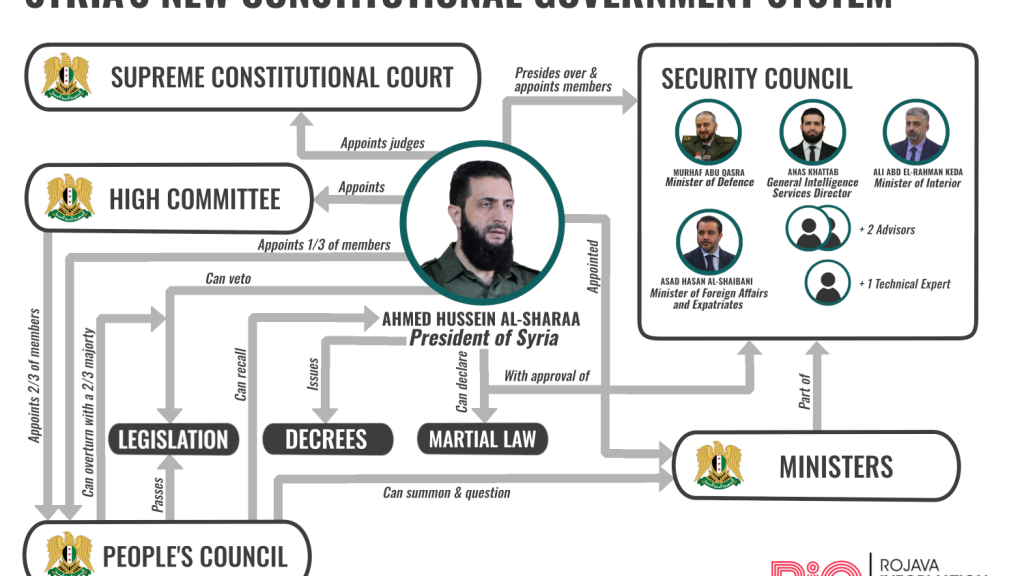
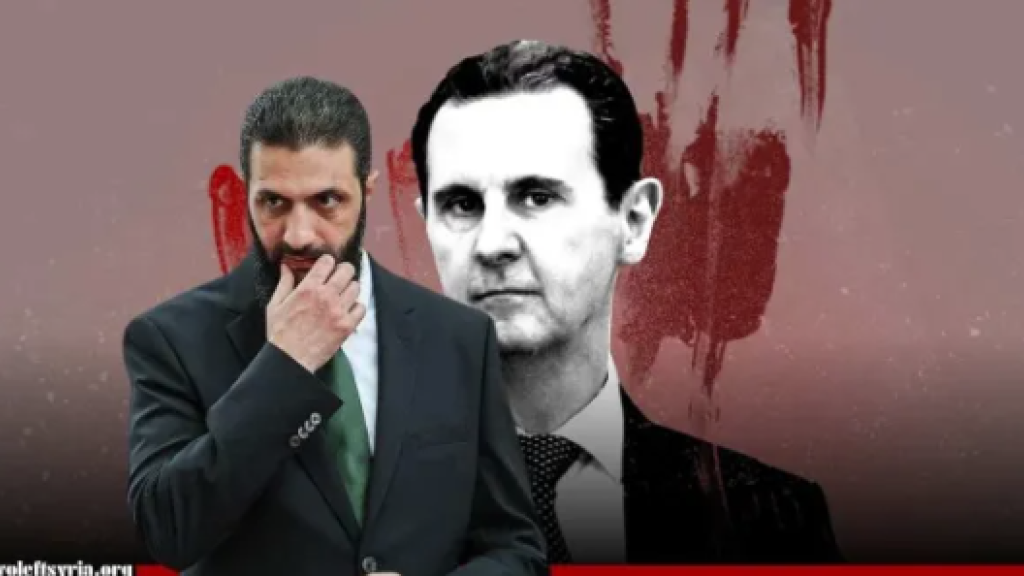
The effects could be very significant. We may be on the brink of a historic moment. But let’s not forget that ISIS is still a mortal danger for the region, especially after Ahmed al-Sharaa, who came to power in Syria through al-Qaeda and ISIS, and is still supported by Erdoğan.
Thousands of jihadist prisoners of all nationalities were being held in camps in Syria and are about to be released. Their children, indoctrinated in the ideology of ISIS for years could be a real danger.
What will happen to the Rojava ‘model’ in this context?
Rojava will continue to uphold its multinational, multi-faith and democratic ‘model’, especially if Turkey’s ‘anti-terrorist’ war comes to an end. If this peace process succeeds, if the ‘terrorist’ label disappears, the whole Kurdish question will take on a different character and will finally be able to be extended. This could be the first step towards the community of free peoples to which we have long aspired. Not a ‘Kurdish state’, but a free, secular, democratic state for all the peoples living in this land: Kurds, Turks, Arabs, Persians and so on.
All in all, are you rather optimistic?
Yes, I admit that I am optimistic. As I said, Turkey has no other solution. And this issue will eventually affect other states in the region, like Iran perhaps. That’s my hope for the whole of the Middle East.
L’Anticapitaliste 7 March 2025
Attached documentskurdistan-turkey-must-choose-between-the-status-quo-endless_a8903.pdf (PDF - 899.9 KiB)
Extraction PDF [->article8903]
Salih Azad
Salih Azad is head of the Kurdish Democratic Centre in Marseille.
International Viewpoint is published under the responsibility of the Bureau of the Fourth International. Signed articles do not necessarily reflect editorial policy. Articles can be reprinted with acknowledgement, and a live link if possible.
The Kurdish issue, Öcalan’s call and developments in Rojava
First published at ANF English.
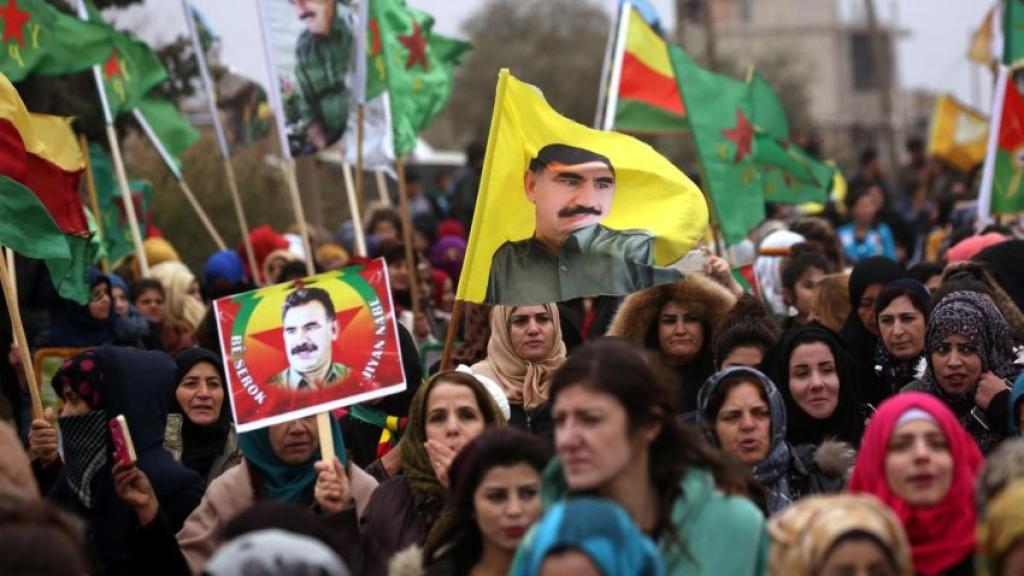
Abdullah Öcalan’s historic February 27 declaration marked a turning point in discussions on the democratic resolution of the Kurdish issue in Turkey. By challenging the state’s long-standing claim that “there is no Kurdish issue, only a terrorism problem,” he forcefully revealed the historical reality and legitimacy of the issue.
Professor Hamit Bozarslan, a Middle East expert and faculty member at the Paris School of Social Sciences, spoke about the historical roots of the Kurdish issue, Öcalan’s call and recent developments in Northern and Eastern Syria.
Today, discussions on the democratic resolution of the Kurdish issue are once again taking place. On February 27, Mr. Öcalan framed his call within a historical context. Before addressing this historic call, what is the Kurdish issue that we are discussing today, and what kind of historical trajectory does it have?
The Kurdish issue is, above all, a matter of denial. Kurdistan has been a geographical entity for more than a thousand years. Both Arab and Persian sources mention Kurdistan.
Throughout history, events such as the formation of Kurdish emirates, the shaping of Kurdistan between Ottoman and Persian rule, and the destruction of Kurdish emirates in the 19th century are well known. However, the emergence of the Kurdish issue as a problem began with the establishment of new nation-states and their adoption of a radical nationalist approach. These states refused to recognize the existence of the Kurds as a distinct people and forcibly imposed a national identity, thereby denying the Kurdish issue. The Kurdish issue, first and foremost, is about rejecting this denial.
Secondly, the Kurdish issue is the struggle of the Kurdish people to reject the status imposed upon them and to become active agents in shaping their own history and lives. Without accepting this, the resolution of the Kurdish issue is impossible. Moreover, the Kurdish issue is not merely a phenomenon associated with violence; it is a process that began long before violence became a factor.
The Kurdish issue did not arise due to imperialist interventions. On the contrary, the resolution of the Kurdish issue must come from within Kurdish society itself. For this, the process of Kurds becoming historical subjects must be recognized and legitimized. There are two fundamental bases of legitimacy here.
The first is the recognition of the Kurdish issue as a national issue in Iraq, Iran, Syria, and Turkey. The second is the acknowledgment that Kurdistan is a region that extends beyond the borders of existing states and that the Kurdish issue should be addressed as a Middle Eastern reality. Without understanding and accepting these two fundamental points, a permanent solution to the Kurdish issue cannot be found.
How did the Kurdish issue take shape in the early years of the Republic? How have the policies of “one nation, one language” and the state’s response to uprisings affected the present day?
Before these uprisings even began, the denial of the Kurdish issue was already a reality. Take the case of Sheikh Said, for example. Before the Sheikh Said uprising, there was the 1924 Constitution, which did not acknowledge the existence of Kurds. The Kemalist movement had made promises to the Kurds. In 1919 and 1920, the Kemalist movement needed the Kurds, but from 1921 on, we see a complete shift. However, the Kurdish issue was still not being explicitly mentioned. When we look at what happened in Dersim and Koçgiri, we see that major massacres took place.
The uprisings were a consequence of existing policies and massacres. In other words, they were a direct result of this policy of denial. They began when Kemalism betrayed its promises to the Kurds. They also started when Kemalism accepted the partitioning of Kurdistan. It is essential to read the state’s secret reports from 1925. Kurds were perceived in two ways: either as a biological threat to Turkishness or as raw material that could strengthen Turkish demographics. But for this “raw material” to be utilized, Kurds had to abandon their Kurdish identity and integrate into Turkishness. That is why I believe the issue is not solely connected to the uprisings.
We are specifically discussing Turkey here. I believe the Kurdish issue in Turkey is extremely important. It has shaped Turkey’s past, blocked its future, and still has the potential to hinder Turkey’s progress. Alternatively, if resolved, it could open the way for Turkey. However, radical nationalism is also present in Syria, Iraq and Iran. The Kurdish movement is fragmented because it belongs to a divided society. Yet, since the 1920s, there has been an overarching vision that unites all of Kurdistan. In response to the division, Kurds have symbolically united.
One of the responses to this division has been the writing of Kurdish history. Historians may not fully accept this Kurdish historiography because it is partly based on legends and myths. However, it remains a deeply rooted part of Kurdish collective memory. It includes a sense of mapping, a national flag and a shared identity. All of these elements unify the Kurds. We are witnessing a unification that transcends borders. That is why I believe we must discuss the Kurdish issue in Turkey. But as we engage in this discussion, we must also recognize that the Kurdish issue in Turkey is a part of, and a significant component of, the broader Kurdish issue in the Middle East.
What have been the key breaking points in recent history regarding the Kurdish issue? Which periods stand out?
The most significant breaking point has been the persistent denial of not only the Kurdish issue in Turkey and the Ottoman Empire but also the broader Kurdish issue in the Middle East, from the Committee of Union and Progress (İttihat ve Terakki) to the present day. We have seen this in Iraq as well. In the 1960s and 1970s, Turkey adopted a harsh stance against the Barzani movement. Although some changes occurred under Özal, when we look at the 1990s and 2000s, Turkey continued to perceive Iraqi Kurdistan as almost an enemy and carried out numerous interventions against it.
It is important to recall the developments that took place after 2003. The discourse of “The Kurds are our enemies,” “Kirkuk is Turkish and will remain Turkish,” and “The Mosul province is Turkmen and will remain Turkmen” persisted until 2007-08. Over the past decade, Turkey’s hostile approach toward Rojava has become particularly evident.
Turkey does not accept Rojava gaining any form of legitimate status and has pursued a strict policy against it. The breaking points are not limited to within Turkey; they also stem from Turkey’s broader Middle East strategies.
Although Turkey pursues a broad foreign policy, its central axis has often been the Kurdish issue. For instance, the crisis with Russia in the 2000s and the subsequent rapprochement were directly linked to the Kurdish issue. The near-total destruction of Afrin and the interventions that reached the level of ethnic cleansing were consequences of the Turkey-Russia agreements.
Similarly, one of the key factors in Turkey’s crisis with the United States has been the Kurdish issue. The Kurdish issue is not just a matter affecting Turkey’s internal dynamics; it is also a significant source of crisis in Middle Eastern and global politics, one that Turkey struggles to manage.
Under what historical and sociological conditions did the Kurdistan Workers' Party (PKK) emerge, to which Öcalan has now made a call for change and transformation. Did the issue of denial that you mentioned shape the PKK’s emergence?
The emergence of the PKK was shaped by both historical and sociological factors. First and foremost, historical factors played a major role. To understand the formation of the PKK, one must examine the historical ground from which it emerged. This foundation was shaped by social mobilization and the Kurdish awakening of the 1960s. Immediately after, the 1971 military coup took place, which was of great significance for the Kurds. Up until 1971, the Kurdish movement believed that the Kurdish issue could be resolved within a constitutional framework.
However, the 1971 coup made it clear that this was not possible. Another crucial development was the defeat of the Barzani movement in 1975. The collapse of Barzani’s guerrilla insurgency, which had lasted for fifteen years and was highly successful, led to significant radicalization among the Kurds. It was within these historical conditions that the PKK took shape. At the same time, there was also a sociological dimension. The 1970s were a period of severe economic crisis in Kurdistan, during which a new generation emerged while the old intelligentsia weakened. This new generation carried strong plebeian dynamics, which positioned them as elements capable of radicalization.
The PKK was not the only actor of that period. Alongside the Kurdistan National Liberators (KUK), another organization that embraced armed struggle, it became one of the most significant actors resorting to violence. Subsequently, the [September 12] 1980 military coup took place, dealing severe blows to Kurdish identity. During this period, the PKK reorganized itself outside of Turkish Kurdistan, particularly in Syria and Lebanon, and later initiated an insurrection and guerrilla war in 1984. At the time, very few observers believed that this guerrilla movement, which began in 1984, could succeed.
However, the Kurdish youth, who had been forced into an underground socialization process during the 12 September period, viewed this insurrection and guerrilla movement positively and joined rapidly. From this point on, a new process began with the participation of young people in the PKK’s movement, symbols, and actions. Over time, this process expanded, leading to the formation of the Kurdish political movement and the establishment of Kurdish identity as a hegemonic issue within Kurdish society. It also influenced developments within the Kurdish diaspora.
As I said, the 1970s and 1980s were critical years for both the Kurdish issue and the emergence of the PKK from a historical and sociological perspective.
We are talking about an armed struggle that has been ongoing for half a century. To put it concretely, what gains have the Kurdish people achieved through the PKK’s fifty-year struggle?
We are speaking of a half-century-long process. However, the 1960s were already highly dynamic years for both Turkey and Kurdistan. The PKK emerged within this historical framework, both continuing and breaking away from that legacy. There is a dialectical relationship here; continuity and bifurcation.
Bifurcation refers to a process that radicalizes to its ultimate limits while simultaneously necessitating an inevitable break. For the PKK, this rupture was essential because the radicalization of the process made it unavoidable. However, the consequences of this rupture extended beyond the PKK itself, leading to much broader transformations.
One of the most significant outcomes has been the emergence of a new political class within Kurdish society. There were already Kurdish groups engaged in politics before. For example, in 1977, a Kurdish candidate was elected as mayor in Diyarbakır (Amed). There were also Kurdish movements within various political parties. However, the formation of a political movement that explicitly identified with Kurdish identity and became a hegemonic actor across a vast region of Kurdistan only became possible from the late 1980s on.
The PKK was at the center of these developments. One of the most crucial transformations has been the institutionalization of Kurdish politics. Today, we are talking about a political movement that cannot be thought of independently of the PKK, yet it cannot be entirely reduced to the PKK either. For instance, the political movement shaped by the HEP-DEP [People's Labour Party or Halkın Emek Partisi, HEP, and Democracy Party or Demokrasi Partisi, DEP] tradition, which now appeals to millions of voters, emerged within the broader framework set by the PKK, but it is not solely defined by it.
Over the past 40 years, Kurdish society has undergone a significant intellectual transformation. The Kurdish intellectual class, which was weak in the 1980s, has now become much stronger. Kurdish culture has become highly vibrant. There is an ongoing process of both transmission and redefinition between different generations.
The women’s movement has also been a crucial part of this transformation. There was already a women’s movement before the PKK, but it became significantly stronger under the PKK’s influence. Today, there is a vast sociological difference between Kurdistan in 1984 and Kurdistan in 2024. However, within these changes, elements of continuity also persist.
Today, we are witnessing a historic call from Öcalan. You mentioned that the existence and legitimacy of the Kurdish issue were still not acknowledged. At this point, has the existence of the Kurdish issue been officially recognized?
No, it has definitely not been officially recognized. However, there has been a slight change compared to five or six months ago. In this change, we see that the regime has been forced to re-legitimize Öcalan. Everyone has now realized the strong link between Öcalan and the Kurdish issue. The expectation from Öcalan was that, in his first statements, he would say, “I founded this terrorist organization, and I am dissolving it,” without mentioning the Kurdish issue at all. However, when we look at Öcalan’s statements, we see quite the opposite — he speaks of a century-long Kurdish issue and frames the PKK’s guerrilla war not as a matter of terrorism but as an issue of violence that must be understood within its historical conditions. Thus, Öcalan’s message is clear: “We are not a terrorist organization. The Kurdish issue is not a terrorism problem; it is a national issue.”
Reading between the lines of this call, this is the reality that emerges. Therefore, it is difficult to predict how much longer the Kurdish issue can continue to be denied.
However, when we look at Erdoğan’s and the Minister of National Defense’s statements, it is clear that the state still perceives the Kurdish issue as either a terrorism or an imperialism-related matter. Yet, we are starting to hear some exceptions and dissenting voices. For instance, Numan Kurtulmuş is one of the figures who, in some way, acknowledges the existence of the Kurdish issue. Bülent Arınç, in his speech in Erbil, almost had to admit that the Kurdish issue is a national issue. Compared to six months ago, there are now more dissenting voices within the ruling bloc. Even in Devlet Bahçeli’s rhetoric, some shifts can be observed.
The fact that Öcalan is no longer being referred to solely as a “terrorist leader” but also as the founding leader of the PKK indicates this shift. So, there are some advancements, but there is still no institutional state policy that recognizes the Kurdish issue as a legitimate reality.
I describe these developments as “small” because they have not yet transformed into long-term, institutionalized changes. There are many small developments, such as the Republican People's Party (CHP) leader Özgür Özel’s remarks while receiving a delegation from the Peoples’ Equality and Democracy Party (DEM Party).
Will these small developments gradually lead to a new institutional approach, a shift in the state’s discourse, and the recognition of the Kurdish issue both in Turkey and the Middle East? I remain quite hesitant. However, despite everything, it is clear that the process should not be obstructed. Or at the very least, the Kurdish side should not be the ones responsible for blocking it.
You interpret Öcalan’s statements more in terms of what they do not say or do not include. You highlighted critical aspects regarding the PKK’s emergence. Now, when we look at Öcalan’s call, we see a declaration that is firmly grounded in historical context. At this stage, how should Öcalan’s call for change and transformation within the PKK be understood?
At this point, it is difficult to know what is happening behind the scenes. However, when we examine the PKK’s evolution over the past twenty years, we see that the organization has repeatedly stated on various occasions that the era of armed struggle is coming to an end and that a new historical phase must begin. In other words, we are not facing an entirely new phenomenon, but rather new conditions. The peace process between 2013-15 ultimately collapsed due to several factors, including Erdoğan and the ruling bloc’s refusal to accept it, the rejection of the process by radical nationalism in Turkey, and developments in Syria. Therefore, while it is possible to discuss the opening of a new phase today, this possibility is still filled with uncertainties.
For this process to evolve into a permanent transformation, certain aspects must be extended over the long term, institutionalized, and legitimized. Even now, we cannot be certain that those engaging in talks with Öcalan will not face arrest tomorrow. In other words, the situation remains entirely ambiguous. Many things are possible, but nothing is certain.
From my perspective, for the past decade, the heart of Kurdistan has been beating in Rojava. Today, the most critical issue is the protection of Rojava and the securing of its status. When we analyze Öcalan’s statements, we do not see any indication that Syrian Kurds should dissolve themselves and become ordinary Syrian citizens or that Syria should revert to being the “Syrian Arab Republic”. On the contrary, Öcalan’s call appears to be directed explicitly at the PKK and its affiliated armed units. At this moment, the most crucial issue seems to be persuading Turkey to recognize the legitimacy of Rojava and establishing a roadmap for this.
Following Öcalan’s call, the PKK released a statement indicating that disarmament could be discussed. What would laying down arms mean for the PKK? Does this signify the end of the organization?
No, it definitely does not mean that the PKK’s struggle has come to an end. The PKK, in one way or another, continues and will continue to exist and struggle. Today, the PKK’s armed activities are largely limited to responding to Turkish military attacks. However, when we take a broader perspective, we see a highly dynamic Kurdish society, particularly in Turkish Kurdistan and the diaspora.
Within these societal dynamics, 99% of activities are already conducted in non-military spheres. These are not underground or secret activities; on the contrary, they take place openly, in the public eye. Today, a Kurdish politician who decides to run for mayor is fully aware that they risk arrest at any moment. A Kurdish journalist who openly expresses their identity faces the same threat. Even an academic writing a Kurdish-language textbook for children risks pressure and imprisonment.
Despite all this, the Kurdish movement is no longer an underground movement. On the contrary, the biggest driving force behind Kurdish politics and struggle now unfolds in the open, in front of society. Kurdish society has reached this point. It is no longer possible to say that clandestine activities constitute a determining factor in the Kurdish movement. The social dynamic, in every way, is now a visible and public dynamic.
With the fall of the Assad regime, the balance of power in the country continues to shift rapidly. In this process, General Commander of SDF [Syrian Democratic Forces], Mazloum Abdi and the leader of HTS, the jihadist group in power in Syria, Ahmed Al-Sharaa (Al-Jolani), signed an eight-point agreement that serves as a roadmap. How do you interpret this agreement, and what does it mean?
This is a very recent and historic development, making it difficult to draw definitive conclusions at this stage. However, it is important to recall the key points emphasized by Mazloum Abdi in the context of this agreement. The most striking aspect is the apparent acceptance of the principle of decentralization. It is widely understood that the current Autonomous Administration [of North and East Syria] will undergo changes, but the crucial question is: What will be the scope of these changes? Will there be an Autonomous Administration limited to Kurdish regions, or will a broader autonomous governance structure be established that extends beyond Kurdish territories? What will the institutional framework of this new administration look like? These questions remain unanswered for now. However, the main point of contention between the Kurds and HTS, which can be described as a militia regime, has been the issue of decentralization. Based on Mazloum Abdi’s statements, it appears that a common understanding has been reached on this matter.
Another significant provision in the agreement is the issue of “transferring existing institutions to the state.” This does not mean the complete dismantling of existing structures. If this transfer takes place within the framework of decentralization, it also implies preserving or formally recognizing a certain level of autonomy. However, as I mentioned earlier, it is still too early to make a definitive assessment of this process. The agreement is relatively short, recognizing the Kurdish issue, the status of Kurds in Syria, and the need for their rights to be constitutionally safeguarded. Beyond that, it is currently difficult to make further interpretations. However, if decentralization has indeed been accepted, it suggests that Kurdish institutions will be maintained in some form, though the exact name and structure of this entity remain uncertain.
At the same time, extreme caution is necessary. We have seen what happened in Latakia as what occurred there was a massacre of immense scale. The mobilization of pro-Bashar al-Assad forces and the killing of a thousand civilians cannot be justified in any way. This atrocity evokes memories of the great massacres in Ottoman and Turkish history, particularly those targeting Alawites. Even more concerning is the fact that HTS refuses to take responsibility for these massacres. This stance suggests either that HTS lacks control over other militia forces or that it is displaying an extreme level of hypocrisy. Moving forward, we do not know whether a strengthened regime will adopt a different strategy toward the Kurds. Therefore, the Kurds must be extremely vigilant. For now, the presence of the United States in the region remains an important guarantee for the Kurds. However, the duration of this presence is uncertain. Still, at least for the time being, the continued presence of the U.S. provides a level of security for the Kurds.
We have transitioned from an era where Kurdish existence was denied to a period where the constitutional protection of all Kurdish rights is being debated. One of the key provisions of the agreement states: “The Kurdish community is an indigenous part of the Syrian state, and the Syrian state guarantees their citizenship and all constitutional rights.” Considering this provision in particular, as well as the overall content of the agreement, can this be regarded as a success for the Kurds?
If these principles are fully implemented, it will be a significant achievement for the Kurds. This provision marks the first time in Syria’s century-long history that Kurds are officially recognized as a fundamental component of the country. This recognition has been a long-standing goal of Kurdish intellectuals and political movements in Syria. From a historical perspective, particularly in the 1920s and later during the radical shifts of the 1950s and 1960s, Kurds found themselves navigating between two radical movements: one aimed at integrating into Syrian society and another focused on being part of Kurdistan. This is a critical distinction, Kurds are being acknowledged as part of Syria, yet they are also being recognized as Kurds. Recognizing Kurds as Kurds inherently acknowledges their connection to Kurdistan as well.
A similar process can be observed in Iraq. During the 2000s, Iraq experienced both a “re-Iraqization” and a “re-Kurdistanization”, two interconnected processes. If the Kurds in Syria are constitutionally recognized as part of the country, this would be a historic milestone for them. However, caution is necessary. HTS is currently quite weak, and transforming a militia force into a full-fledged state is an immense challenge. It remains unclear whether HTS truly envisions a secular, democratic, and pluralistic Syria. Furthermore, whether HTS can effectively control other militia groups is highly uncertain. Reports indicate that some of the militias responsible for the massacres of Alawites are the same groups that participated in the ethnic cleansing in Afrin (Efrîn). Some of these militias have received direct support from Turkey or consist of mercenaries funded and armed by the Turkish state.
HTS must dismantle these groups, not just disarm them, but completely eliminate their presence. Whether HTS is capable of doing this remains uncertain. Therefore, the Kurds must focus on advancing the constitutional process and working toward the establishment of a decentralized Syria. However, while doing so, they must also remain acutely aware of the uncertainties of the future and proceed with extreme caution.
Before traveling to Damascus, Abdi reportedly held a meeting with various ethnic and religious groups within the Autonomous Administration. One of the key provisions of the agreement guarantees the right of all Syrians, regardless of religious or ethnic background, to participate in the political process and state institutions based on authority and responsibility. In essence, this clause mirrors the existing system in Rojava. But is it feasible to implement this provision? Is there an effort to extend the Rojava model to all of Syria?
I believe that the future Syria will not be a country shaped solely by constitutional principles. Instead, a multilayered structure may emerge, where different regions implement different social and political formulas. For example, when looking at Christians, they do not have a defined territorial base. There is no concentrated Christian-majority region, yet their rights and representation must be safeguarded. The Druze, on the other hand, hold a distinct position. Despite being entirely Arab in identity, they possess both territorial and religious uniqueness in the border region. As for the Alawites, they do have a specific regional base, but that area is also home to a significant Sunni population.
When it comes to Kurdistan, meaning present-day Rojava, we can speak of a dual structure. First, there is Rojava as a region predominantly inhabited by Kurds. Second, there is a broader Autonomous Region under Kurdish control, extending beyond Kurdistan’s historical boundaries. Initially, the Kurds did not intend to move toward Raqqa, but because it served as the second capital of ISIS, capturing the city became unavoidable. It was a necessity in the fight to eliminate ISIS. The key question for the future is whether the Kurdish movement wants to maintain control over Raqqa. Or, if the Arab population there demands the continuation of the Autonomous Administration, would the Kurds withdraw? At this stage, there are no clear answers to these questions.
For this reason, representation is not an issue that can be resolved with a single formula. Unless it is violently sabotaged, as in Latakia, we are likely to witness a long-term process in which different regions implement different governance models. These models cannot be implemented overnight; we may need to think in terms of the 2030s or even 2035. The greatest advantage for the Kurds is that they have been governing themselves for the past twelve years. Institutionally, they are far ahead of other groups. Municipalities, schools, hospitals, and Kurdish-language education systems are in place. Additionally, there are three universities in Kurdistan. However, despite these advancements, it will take time to determine the final map of Syria’s future.
Officials from the Autonomous Administration stated that the agreement aligns with the letter sent by Öcalan to Rojava, emphasizing that this development signifies the Kurds becoming a recognized partner in the Syrian state. What are your thoughts on this?
Since we do not know the full content of Öcalan’s letter, it is difficult to make a direct assessment. However, based on the information I have gathered, Öcalan reportedly said, “There is no reason for the Kurds to exhaust their forces at the Tishrin Dam. The Kurds need to go to Damascus.” This suggests that he might have emphasized the need to resolve many issues not only through armed struggle but also by directly engaging with Damascus and negotiating. It is possible that he expressed such a perspective, which would indicate that recent developments have unfolded in line with Öcalan’s expectations or recommendations.
The idea of the Kurds “becoming a partner in the state” most likely refers to their constitutional recognition as a fundamental component of Syria. Moreover, this recognition could be at a relatively high level. For instance, it is uncertain whether Abdi might hold a significant position as a general in the future Syrian military. If Abdi were to secure a position within the Syrian army while maintaining his Kurdish identity and preserving Kurdish military units, this would be a highly significant development.
A comparable situation can be observed in Iraqi Kurdistan. Of course, there have been serious challenges, and unresolved issues remain, particularly the Kirkuk question must not be overlooked. However, at the same time, the Kurds play a decisive role in Iraqi politics. Today, the formation of any government in Iraq is highly dependent on Kurdish support. The Kurds not only have their own parliament but also hold considerable influence within the Iraqi parliament.
While the Kurdish side remains steadfast in defending Rojava’s status, the Turkish state has pursued a policy aimed at eradicating the Kurdish presence in the region since the beginning of the Syrian war. In recent developments, Rojava’s military structure has repeatedly been used as a pretext by Turkey. However, with this agreement, Turkey’s justifications have essentially been rendered void. Does this signify the collapse of Turkey’s Rojava and Syria policy?
Yes, you are absolutely right on this point. Turkey’s hypothesis that “there is no Kurdish issue in Syria” has completely collapsed. We now have an eight-point agreement signed by Ahmed Al-Sharaa (Al-Jolani). The mere existence of this agreement signifies that the Kurdish reality in Syria has been recognized. Moreover, the agreement was signed by Abdi, whom Turkey has long labeled as a “terrorist leader”. This, in turn, demonstrates that Abdi is now recognized as a legitimate political actor in Syria. He is not only acknowledged as a legitimate Kurdish representative but also as a key figure representing the Autonomous Administration. And this recognition is not confined to Kurdistan alone, it extends to Syria as a whole, where he is now seen as a legitimate actor in the broader political landscape.
From this perspective, as you pointed out, Turkey’s reading of the region, its political impositions, and its attempts to legitimize its strategy of violence have all collapsed. However, Turkey is deeply entrenched in rigid ideological positions and radical nationalist sentiments. Predicting how such an ideology will respond to these developments is difficult. If Turkey were to act rationally, it would welcome these developments, acknowledge Rojava’s existence, and even attempt to leverage Rojava’s position to gain influence in Syria. A power seeking to maintain a foothold in Syria putting aside ethical concerns and evaluating the situation purely from a geostrategic standpoint would recognize Rojava’s legitimacy. Any external power that acknowledges Rojava’s legitimacy could gain a much stronger position in Syria. However, the issue here is one of rationality. The real question is whether Turkey’s current leadership is capable of adopting such a rational stance. At this stage, it is difficult to predict.
It has been reported that the United States and certain international powers played a role in the agreement signed between Abdi and Al-Sharaa (Al-Jolani). Does the involvement of these powers indicate that Rojava’s status is beginning to gain international recognition?
Yes, at this stage, we can say that such a recognition is emerging, but it has not yet reached an official or legal level. It is known that two days before the agreement was signed, a U.S. representative met with Abdi for significant negotiations. These discussions were most likely related to the continuation of U.S. influence in the region and relations with Damascus. Additionally, reports indicate that Abdi traveled to Damascus aboard a U.S. helicopter to sign the agreement. All of these developments point to a form of de facto recognition. However, the critical issue is transforming this de facto recognition into a legally binding status, one that engages states and the international community in a legal framework. When recognition remains only de facto, its future remains uncertain. This is why the Kurds must approach this process with extreme caution.
The future remains unpredictable, and it is difficult to determine how things will unfold. This is precisely why the presence of the U.S. in the region holds immense strategic importance. Careful and calculated steps must be taken during this period. On the other hand, much of Turkey’s rhetoric over the past decade has effectively collapsed. If the Damascus administration, which Turkey has supported, is now engaging with Abdi, signing an agreement with him, and recognizing him as a legitimate actor in Syria, then Turkey loses its ability to frame this as “negotiating with terrorists”. The Turkish state can no longer sustain its narrative that any engagement with Abdi constitutes legitimizing terrorism.