Wednesday, March 26, 2025

Unenforced ICC Arrest Warrants Are Just Part Of The Wider Zionist Impunity Framework

By Ramona Wadi
March 22, 2025
Source: Middle East Monitor


Israeli Prime Minister Benjamin Netanyahu will be following up on his Hungarian counterpart Victor Orban’s invitation to visit his country, Israeli media have reported. This, despite the International Criminal Court’s arrest warrant for Netanyahu, which signatories to the Rome Statute are obliged to enforce. As is usually the case when it comes to Israel, however, possibilities take precedence over absolutes.

The visit is scheduled to take place before Easter. “Once the date of the visit is confirmed, we will, of course, announce it, taking into account the extremely important security considerations in this case,” said Orban’s Chief of Staff Gergely Gulays.

In February, Hungarian Foreign Minister Péter Szijjártó announced Hungary’s decision to reassess “its future participation” in the ICC, allegedly because the international arrest warrants against Netanyahu and his former Defence Minister Yoav Gallant make the court’s actions “seriously politicised”.

Soon after his electoral victory, Chancellor Friedrich Merz invited him to Germany. “I have also promised him that we will find ways and means for him to visit Germany and also to be able to leave again without being arrested in Germany,” Merz told journalists in Berlin. “I think it is a completely absurd idea that an Israeli prime minister cannot visit the Federal Republic of Germany.”

Earlier this year, Italy also announced that it would not enforce the ICC arrest warrants, while France cast doubt over them, claiming that Netanyahu has immunity since Israel is not a member of the court.

The truth is that despite the arrest warrants, few EU countries have stated explicitly that they will obey the ICC and enforce its warrants when it comes to Netanyahu (and Gallant, presumably). Which means that the ICC’s lack of authority over each individual country’s decision whether or not to enforce the warrants enables Netanyahu to avoid prosecution for war crimes and crimes against humanity in Gaza. And enables him to continue committing them.

And while Israel continues to target Gaza and the occupied West Bank, Netanyahu’s forthcoming visit to Hungary will reinforce that normalisation. Hungary’s stance, as well as that of Germany, may be the most explicit in tone. However, the politics of both countries expose what the EU attempts to do through diplomatic channels; they ensure Israel’s protection at all costs, even if that means that tens of thousands of Palestinians have to be massacred in the process.

In November last year, Orban said that the arrest warrants are “complete defamation” and that his invitation to Netanyahu signals that he had no other choice but to go against the court’s decision. It is bizarre to say that a prime minister facing international arrest warrants over a genocide that was not only live-streamed, but also lauded and supported in various ways by Israelis and the international community, is now being “defamed” by a system that is replete with bureaucracy and loopholes. But that’s far-right populism for you: bizarre.

However, Orban is voicing what many world leaders are no doubt trying to work out, albeit less blatantly. The ceasefire negotiations, for example, rested more on what Netanyahu wants rather than justice and international law. And the fact that the Israeli narrative is so entrenched in global discourse gives more cover to Netanyahu and decisions such as those taken by Hungary, Germany and Italy.

If other countries emulate Hungary’s example, we must question the significance and future of the ICC in the face of opposition from states that are parties to the Rome Statute. They have opened the door to international anarchy.


Source: Jason Hickel Substack

Conventional narratives in the West claim that the government in China lacks popular legitimacy and only retains power through coercion. But existing evidence from the two main studies on this question – both conducted by established Western institutions – shows the opposite. These studies demonstrate that the government in China enjoys strong popular support, and that most people in China believe their political system is democratic, fair, and serves the interests of the people.

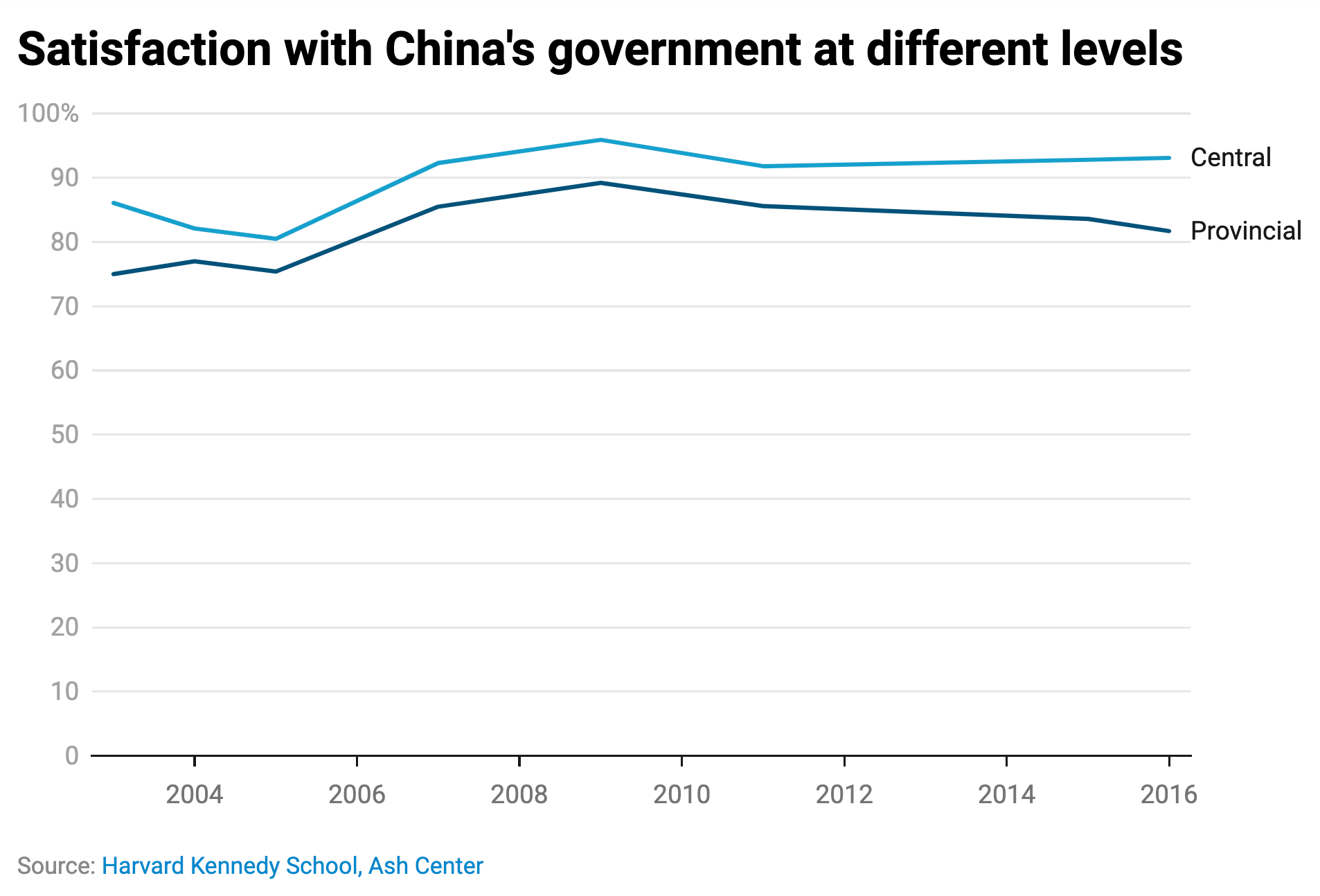
The first study is published by Harvard’s Ash Center for Democratic Governance and Innovation. The Ash Center operates what they describe as “the longest-running independent effort to track Chinese citizen satisfaction with government performance”. Regular surveys have been conducted since 2003. The most recent results were published in 2020, in a report titled “Understanding CCP Resilience: Surveying Chinese Public Opinion Through Time”.

This is not a pro-China publication. In fact, the Ash Center starts with the assumption that China is an authoritarian system dependent on coercion, and is therefore likely to face a crisis of public legitimacy. But the study’s actual results establish very different conclusions.

The authors summarize their results as follows. “We find that, since the start of the survey in 2003, Chinese citizen satisfaction with government has increased virtually across the board. From the impact of broad national policies to the conduct of local town officials, Chinese citizens rate the government as more capable and effective than ever before. Interestingly, more marginalized groups in poorer, inland regions are actually comparatively more likely to report increases in satisfaction. Second, the attitudes of Chinese citizens appear to respond (both positively and negatively) to real changes in their material well-being.”

The report finds that public satisfaction with the central government is extremely high. In 2016, the final year of data, it stood at 93%, having generally increased over time. Satisfaction with lower levels of government is somewhat lower but still very strong; for instance, provincial governments enjoyed 82% support in the final year of data.

The second study is published by the Alliance of Democracies (AoD), a Danish NGO founded by the former Secretary General of NATO and the former Prime Minister of Denmark. AoD partners with Latana, a market research firm based in Germany, to conduct annual surveys on democracy perception in more than 50 countries around the world. They have published the Democracy Perception Index report every year since 2019. It is the gold standard in the industry, produced by liberal institutions that certainly cannot be accused of having a pro-China bias. And yet the results on China are consistently striking.

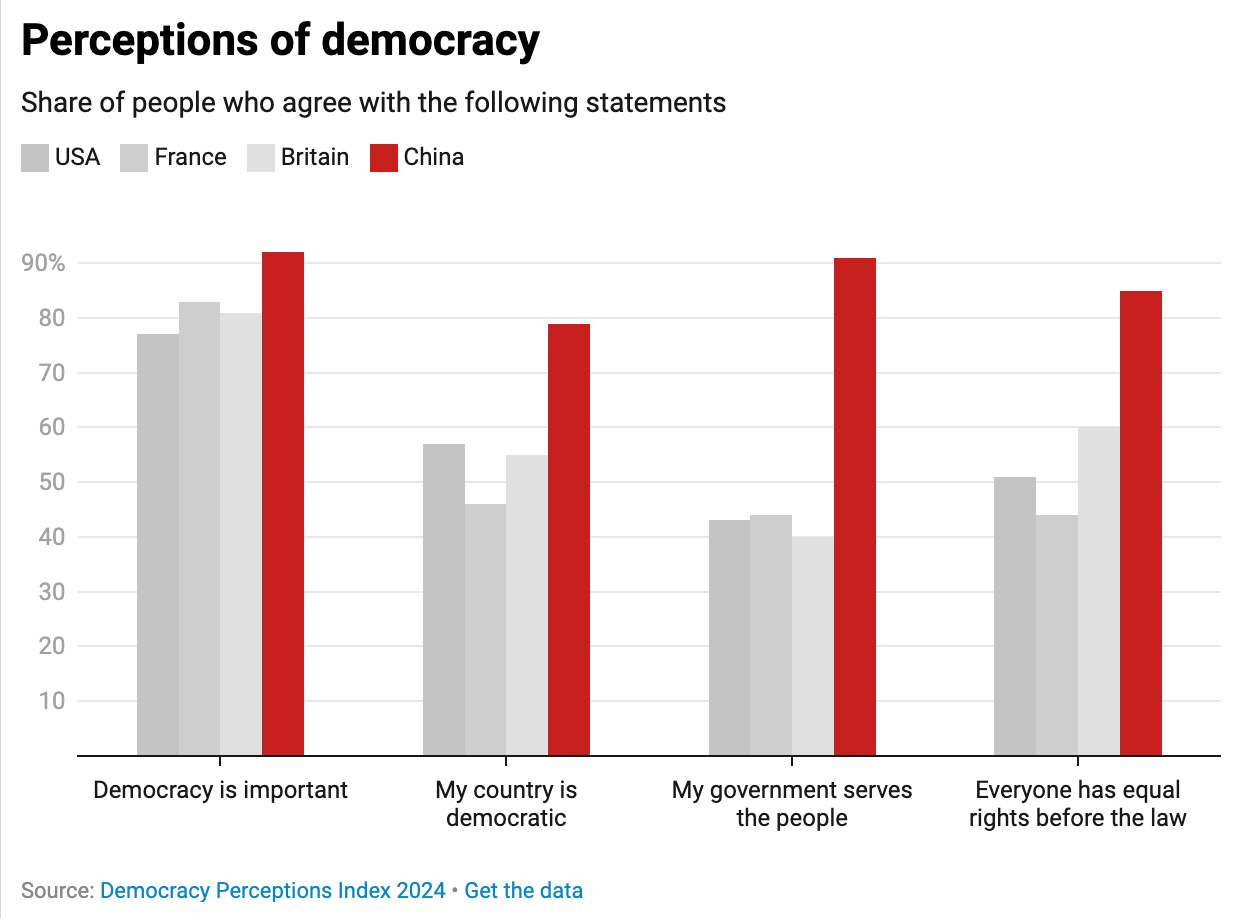
According to the most recent report (2024), people in China have overwhelmingly positive views of their political system. 92% of people say that democracy is important to them, 79% say that their country is democratic, 91% say that the government serves the interests of most people (rather than a small group), and 85% say all people have equal rights before the law. Furthermore, China outperforms the US and most European countries on these indicators – in fact, it has some of the strongest results in the world. The figure below compares China’s results to those from the US, France and Britain. These results may help explain the high levels of satisfaction with government reported by the Ash Center.

The AoD study also assesses people’s perceptions of freedom of expression, and free and fair elections. Here too, China outperforms the US and most of Europe. When given the statement “Everyone in my country can freely express their opinion on political and social topics”, only 18% of people in China disagreed (compared to 27% in the US). And when given “Political leaders in my country are elected in free and fair elections”, only 5% in China disagreed (compared to 27% in the US).

One possible criticism is that people in China may be reluctant to say negative things about their government because they may fear repression. But the Latana methodology is explicitly designed to mitigate against this possibility. The AoD report states “In contrast to surveys conducted face-to-face or by telephone, the anonymity offered by Latana’s methodology may help reduce response bias, interviewer bias, and respondent self-censorship.” These methods appear to be effective. If China’s positive results are due to fear of repression, we would expect to see similarly positive results in countries that are regarded as having repressive regimes, but this does not occur. People living in such states do not hesitate to express critical opinions. For instance, in Russia only 50% of people said their country was democratic.

Many people are surprised by the AoD results for China because they believe China does not in fact have a democratic system. It is true that China does not have a Western-style liberal democracy, where voters elect the head of state every few years. But it does have its own system of democracy, which it refers to as a “whole-process people’s democracy”, with principles of democratic centralism and a unique party system. This system seeks to institutionalize popular engagement in the policy-making process to ensure responsiveness to people’s needs (see summaries here and here, and a podcast on this with US Professor Ken Hammond here). Direct elections occur at the two most local levels of the National People’s Congress, with elected deputies then voting for those who will serve in the higher levels.

Whatever one might think of this system, it is clear that most people in China seem to like it.

The results of the AoD study suggest that what matters most when it comes to people’s perceptions of democracy is not whether their country has Western-style elections, but whether they believe their government acts in the interest of most people. In many Western countries that have regular multi-party elections, people do not believe that their governments act in the interests of most people, and do not believe their countries are democratic. In China, people overwhelmingly perceive that their government acts in the interests of most people, and this may be key to high democracy perception there.

This result is not particularly surprising, given that CCP came to power through a popular revolution that enjoyed mass support from peasants and workers, with the explicit objective of improving the lives of the oppressed majority. While China has experienced several major policy changes over time, including a process of market liberalization in the 1980s that caused high inflation and widespread protest, over the past decade the government has taken strong steps to reduce poverty and ensure universal access to good housing, food, healthcare and education.

None of this is to say that China’s political system does not have problems and internal contradictions that must be overcome. It does, just as all countries do – nobody could reasonably claim otherwise. But these studies point to an important reality that should be grappled with: that the Chinese people have a much higher regard for their political system than people in the West tend to assume.

Source: Foreign Policy In Focus

A private-public partnership to improve highway infrastructure in Honduras was supposed to be a boon for economic development. Instead, it quickly turned out to be a lose-lose agreement for an already impoverished population — and a grim warning about investment rules that give corporations too much power.

It began in 2016, when the government proposed to develop a highway along Honduras’s northern coast — complete with tolls that would have raised transportation costs and other prices for locals.

People quickly rose up to oppose the project that threatened to raise their cost of living, as well as drain the public purse. Those early protests turned into a 421-day camp against toll booths along the highway. In 2018, following these protests, the government cancelled the contract for the project with a company called Autopistas del Atlántico (ADASA).

But after five years of silence,  the investors returned with a vengeance. Now, an investor group including ADASA, J.P. Morgan Chase Bank, and a couple of Goldman Sachs funds, is bringing a multi-million dollar claim against the country in a Washington, D.C.-based tribunal for far more than it ever invested.

They’ve gone to the World Bank-based International Centre for Settlement of Investment Disputes (ICSID) to demand $179 million from Honduras, alleging a “breach of its contract for the suspension of the toll road in the face of community protest and cancellation of the contract in 2018,” according to The Corporate Assault on Honduras, a report published in September 2024.

Karen Spring, coordinator of the Honduras Solidarity Network, explained during a presentation of the report that the Investor-State Dispute Settlement (ISDS) system that ICSID is part of allows transnational corporations to file claims that squelch the voices of affected people.

“The 15 active claims against Honduras are an attack on struggles for dignity, justice, and democracy. These suits and the system that allows them are an attack on the sovereignty of Honduras and the self-determination of affected communities,” said Spring.

Citizen Outrage

As part of the “Angry Citizens’ Movement” (Mesa de Indignación Ciudadana), Suyapa Majano and Idalia Carballo say that neither the weather nor the state’s armed forces could intimidate the struggle against the toll booths, which people considered unconstitutional and a violation of their right to free movement.

Suyapa Majano recalls that in order to sustain the protest camp, they took shifts in which mostly women took part. They celebrated birthdays roadside and, during Holy Week, they made the Stations of the Cross, all in order to demonstrate their opposition to the toll booths.

“We never let up the struggle,” despite the fact that “several men and women were beaten,” routinely tear-gassed, and persecuted for their protest. “There are students who participated too, that I remember had to flee.” Those who remained in the country were profiled by repressive state armed forces.

Idalia Carballo questions the legality of using tolls on roads that had already been built and where there are no alternative routes to ensure free circulation for locals. “They put up the toll booths, but didn’t build anything themselves,” she said.

Carballo recalls that the government of then president Juan Orlando Hernández supported Autopistas del Atlántico by providing police and military personnel to repress the population who protested against the toll booths.

Hernández — who has since been convicted in New York state for conspiring to import cocaine into the U.S. — touted the tourist corridor contract as a step forward for the country’s infrastructure, supposedly to stimulate trade, tourism, job creation, and lower transportation costs.

Initially, the contract established that the toll booths could only start collecting after construction had been completed. However, in 2016 — after just 10 percent had been completed — the company received approval to start charging all vehicles that traveled on the road. This activated the minimum annual guaranteed income — the difference between the minimum anticipated revenue and revenue earned — provided for in the contract. As a result, Honduras now owes the company $110 million, instead of $42 million previously, due to the early cancellation of the project, as The Corporate Assault on Honduras explains.

The Failure of Public-Private Partnerships

The Autopistas del Atlántico claim is only one of 15 arbitration suits currently in process against Honduras, largely promoted by investors who benefited from decisions made following the 2009 coup d’état during the so-called narco-dictatorship period. Many of these claims have been brought under the terms of free trade agreements and investment protection treaties that enshrine extraordinary corporate privileges. In this case, the company is able to bring recourse via Investor-State Dispute Settlement Mechanisms (ISDS) under its Public-Private Partnership (PPP) contract.

“We see at least three lawsuits […] that correspond to Public-Private Partnership contracts, which were negotiated by [the former Commission for the Promotion of Public-Private Partnership] under conditions highly detrimental to the [public] purse ,” explains Jen Moore of the Institute for Policy Studies (IPS).

PPPs in Honduras were permitted through the 2010 Law for the Promotion of Public-Private Partnerships, which also created the now defunct Commission for the Promotion of Public-Private Partnerships (COALIANZA). COALIANZA’s role was to promote, enter into, and supervise PPP contracts between the public and private sector, involving both domestic and transnational corporations.

In 2019, COALIANZA was dismantled following the raid of its offices by the Technical Agency of Criminal Investigation (ATIC) under widespread accusations of corruption. Earlier, in 2014, part of COALIANZA’s activities were declared secret under the Law for the Classification of Public Documents Related to National Security and Defense or Secrecy Law. This led to serious questions about the limited auditing and oversight of its operations.

Two other claims involving a Public Private Partnership contract have been filed against Honduras by the Palmerola International Airport (PIA) for $10 million, very recently discontinued, and the Eléctricas de Medellín Ingeniería y Servicios S.A.S. for $500 million. Another pair of claims likely to correspond to a PPP contract were filed by International Container Terminal Services & Operadora Portuaria Centroamericana, but lack of transparency in their case meant the amount is unknown.

Moore remarks that although it is difficult to know the details of the arbitration claims against Honduras because the related documentation remains confidential, companies often act out of one of two aims: first, to pressure authorities to change the rules or to ensure business conditions remain in their interest; and second, to force the people to compensate investors for their losses, including future lost profits.

Luciana Ghiotto of the Transnational Institute states that the Investor-State Dispute Settlement system has been widely criticized beyond Honduras.

She remarks that Honduras’ decision to leave ICSID in August 2024 was “an important step, but not enough.” She explains, “ICSID is only one of various global arbitration centers available, whereas investment protection treaties […] enable investors to sue the State in any arbitration forum in the world.”

The ISDS system is set up to keep the rules of the game stacked in favor of corporations at great cost to people and the public interest. The report The Corporate Assault on Honduras urges the abolishment of these exclusive corporate privileges that have been granted through international treaties, as well as in national laws and contracts, including Public-Private Partnerships.


Source: Ms. Magazine

When the right-wing Heritage Foundation released its Mandate for Leadership: The Conservative Promise—better known as Project 2025—in 2023, its authors laid out a comprehensive framework for undercutting democratic governance. Moreover, its authors made no secret of their antipathy to both public education and trade unions, putting the National Labor Relations Act and Fair Labor Standards Act in their crosshairs. They also made it clear that they support the elimination of the Department of Labor Women’s Bureau which works to ensure workplace safety and increase opportunities for female job advancement. 

And then there’s education, pre-K through college. The Heritage authors put forward an agenda that includes broadscale book bans and curricular limitations on classes in African American, Latinx, LGBTQ+, Feminist, Ethnic, Middle Eastern and Islamic Studies. In addition, they support the cancellation of the federal student loan program; the revocation of Title IX policies meant to protect students from sex-based harassment, discrimination and violence; and an end to faculty tenure.

But resistance to these potentially devastating incursions on human and civil rights is growing, and unions, including the 110-year-old American Association of University Professors (AAUP), are strategizing, organizing and fighting back in the streets and in courtrooms and statehouses across the country. 

Ms. reporter Eleanor J. Bader spoke to Mia McIver, executive director of the AAUP, and Rotua Lumbantobing, the group’s vice president, early in the second month of the Trump-Vance administration. Among the topics covered: Building union power in repressive periods and building support for public education as a common good.


Eleanor J. Bader: The AAUP is organizing a one-day action on April 17. What’s planned?

Mia McIver: This action will build on several previous Days of Action. On Feb. 19, the AAUP was a lead organizer of a Labor for Higher Education event that brought 10,000 people to protests on college campuses and sites of power across the country. We’re working with the Federal Unionists Network to protect all public sector workers and participated with them on a protest that took place on Feb. 25. Multiple labor leaders united to demand that the government protect our health, protect our research and protect our jobs. The April 17 Day of Action is the next phase and we’re working with AAUP chapters in all 50 states to organize large, local actions

We have faith in higher education and know that a university education can transform individual lives. We also know that a university can transform communities and can serve as a community anchor. The attacks coming from DOGE and the administration are putting lives at risk. When research is canceled it has real implications for human life. 

Likewise, changes in how public education is offered. Right now, 48 percent of the higher education workforce is female, up from 27 percent in 1987. Unfortunately, these faculty members are heavily represented in contingent positions, without job protections or benefits. The undermining of tenure has increased faculty precarity and helped adjunct and full-time instructors see their own economic and social vulnerability.  

We will highlight the ways these issues intersect on April 17 and will oppose all cutbacks and rollbacks.

Bader: How are you building for it?

Rotua Lumbantobing: We’re starting by building a stronger, more militant, AAUP. Todd WolfsonDanielle Aubert and I were elected to lead the AAUP in June 2024, and our mission is to transform the organization into a fighting force. We’re currently in a period of political crisis and we’ve been holding frequent, regular meetings for members and chapter leaders. We see that our members are agitated. They’re angry and ready to act.

Historically, AAUP has functioned more as a professional organization than a union. In the current period, we’re working to recruit new members so that we can win better job security and higher wages for everyone. 

In the past, campus administrations successfully weakened our ability to mobilize by using divide-and-conquer tactics: Part-time versus full-time professors; tenured versus untenured; STEM versus the liberal arts. But no more. Colleges tend to be organized hierarchically. We recognize that to build solidarity we need to talk to each other and understand each others’ struggles. We’re organizing training classes with a focus on building cross-campus solidarity. 

Our training partner is Skills to Win which is based at the Berkeley Labor Center and our Organize Every Campus initiative involves training the rank-and-file to build strong campus chapters. We believe that to move forward we need to be ready to answer the attacks on us—whether book bans, the elimination of Diversity, Equity and Inclusion programs, the assault on tenure or management refusal to negotiate a contract—with increased militancy. We’re using the crisis provoked by DOGE, the administration and the right wing to build power for labor. 

McIver: The Organize Every Campus campaign is training our members in concrete skills: How to have one-on-one pro-union conversations with people on their campuses; how to identify and recruit emerging leaders; how to zero in on issues that are deeply felt and unifying for faculty and staff. We’re also going beyond this and are partnering with the Emergency Workers Organizing Committee, a joint project of the United Electrical, Radio and Machine Workers of America and Democratic Socialists of America, to support widespread organizing for dignity, respect and workplace safety. 

We want our members to act like labor leaders, and whether they are part of collective bargaining units or not, to understand the need to coalesce and see the link between issues like book bans. DEI elimination, universal school vouchers and the attacks on higher education and safety net programs.

Bader: What other organizing tactics is the AAUP using to build power and maximize resistance?

McIver: There are many. We joined Democracy Forward in filing a lawsuit against Trump’s Executive Order curtailing DEI programs and won a temporary restraining order that stays the measure. We’re also working on other legal challenges to the executive overreach we’ve seen since Jan. 20. Although we know that lawyers can’t save us, we’re fighting on all cylinders, including litigation.

Bader: The right continually refers to higher education as elitist and Project 2025 recommends ending the college degree requirement for many federal jobs. How is the AAUP refuting this stereotype and defending the value of college completion? 

Lumbantobing: The vast majority of Americans who attend college attend public programs, not elite institutions. But the right never acknowledges this since it does not fit into the narrative they’re promoting. 

The challenge is to change the narrative. 

Academics do not work in an ivory tower and we do not indoctrinate our students. Instead, higher education prepares people to think for themselves. We need to do a better job of engaging the public so that they know what we do and why it matters.

McIver: The AAUP leadership and membership have come out strongly against Chris Rufo, the man who came up with the fictitious bogeyman of Critical Race Theory; Florida Governor Ron DeSantis whose state leads the nation in book bans; as well as Trump-Vance-Musk and Project 2025. The right knows that universities are pillars of civil society which is why they want to control them. What they’re doing is censorship and the AAUP is standing up for free inquiry and free speech. 

We want people to know what we do as educators and researchers. This means rebuilding the public’s faith in higher education and confidence that a degree has meaning and value. The idea of education as a “common good” has been chipped at for years. We believe that higher education needs to be accessible and affordable so that it can fulfill this mission and function as the public good it was meant to be.

Bader: Are K-12 and higher education unions working together on this and other issues?

McIver: Yes. higher education has a lot to learn from K-12 unions regarding best practices for protecting tenure. On the other hand, K-12 unions have a lot to learn from higher education about defending academic freedom. 

Lumbantobing: We have to learn from history. We know that the Red and Lavender Scares of the 1940s and 1950s cost the jobs of many teachers suspected of being communists, socialists or queers. 

Today’s challenges are similar and different. Our current enemies are Chris Rufo, Ron DeSantis, Texas governor Greg Abbott, Donald Trump, Elon Musk, the GOP and right-wing institutions like the Heritage Foundation. They are well-organized and deep-pocketed. 

We have to keep this in focus. Alliances between different groups can be difficult and messy but we need to align with other unions, community-based organizations and faith-based groups if we want to build power and fight back effectively. 

I like the word alliances. Alliances give us a way to pool our resources even if we don’t have much. Alliances allow us to disagree with one another without forgetting who we’re fighting and why.  

Bader: Are student-faculty alliances being developed?   

Lumbantobing: Absolutely. I often take a few minutes of class time to inform my students about things that are going on on campus and in the world. I teach at Western Connecticut State University, and our governor has proposed budget cuts across the university system. If he succeeds, it will devastate students and damage the state’s long-term future. I told my students about the governor’s proposal and gave them the dates when public testimony could be offered. 

In addition, AAUP chapter leaders in many places have gone to student government meetings on their campuses to keep everyone informed. The union always encourages faculty to share information with students. 

Graduate students, in particular, have responded to cutbacks and job insecurity by forming grad union chapters on dozens of campuses; similarly, there are now efforts to organize undergraduate workers in several places. 

Our interests as workers overlap.

Look, this is going to be a long fight. We need everyone on board. This is why we’re developing a multi-pronged approach and building alliances with students, other unions and the public. This is the only way to stop the anti-worker and anti-union policies that are being promoted by Trump and his administration.