Saturday, April 05, 2025

ECOCIDE

Demand for Lithium Strains Fresh Water Resources

While lithium has a starring role in the global clean energy transition thanks to its fundamental importance in batteries for electric vehicles and energy storage, the “white gold” may be as much of an environmental threat as it is a savior. Extraction processes for the metal are associated with significant negative environmental externalities and public health risks, and now scientists are questioning whether the world can spare the vast amount of fresh water lithium production consumes. 

Lithium production is booming around the globe as demand projections continue to rise and prices recover after a period of decline due to overproduction. The International Renewable Energy Agency (IRENA) has said that that lithium demand for battery-making alone will likely increase by a factor of ten in the decade between 2020 and 2030, and a 2023 report from Popular Mechanics calculated that “an electrified economy in 2030 will likely need anywhere from 250,000 to 450,000 tonnes of lithium.” This represents a massive boom in production and refining capacities worldwide. For reference, “In 2021, the world produced only 105—not 105,000—tonnes.”

As lithium production ramps up, the trade-offs associated with production are becoming harder to ignore. Lithium is generally produced by pumping salty brine out of the earth in places where lithium is naturally occurring, and allowing it to dry out in evaporation pools, leaving the lithium readily available to harvest. The whole process is effective and has relatively low overhead, but it requires a staggering amount of water – around 500,000 gallons per tonne of lithium. And, in a cruel twist of irony, often takes place in some of the driest places on earth. The so-called “Lithium Triangle” of South America lies in the Atacama Desert – the world’s highest and driest. In the Chilean portion of the Atacama, a staggering 65% of the region’s water is consumed by lithium mining activities. 

Making matters worse, a new study from scientists at the University of Massachusetts Amherst (UMass) shows that the Lithium Triangle has far less freshwater available for lithium mining than previously thought – about ten times less. And these results suggest that the same miscalculation has been made in global lithium extraction operations. “Our results reveal that commonly used global hydrologic models overestimate streamflow and freshwater availability substantially, leading to inaccurate water scarcity classifications,” states the paper, published last month in the scientific journal Communications Earth & Environment

It’s not all bad news – the paper also points out that there is potential for the lithium industry to significantly reduce its water footprint. “Water is the most important resource in these systems, and it’s the part of the system that is most sensitive to change,” says David Boutt, one of the paper authors and a professor of geosciences at the UMass. “I’m optimistic that, through research and development, companies can be more water efficient, especially when driven by the market.”

However, lithium extraction doesn’t only threaten to suck freshwater reserves dry, it also risks contaminating the local water resources it doesn’t consume. Lithium is not the only element left behind when the brine pools evaporate. Other toxic chemicals – such as hydrochloric acid – also abound in these briny pools thanks to the lithium refining process, and have been known to leak into local water supplies. “The release of such chemicals through leeching [sic], spills or air emissions can harm communities, ecosystems and food production," read a 2024 report from international environment activism group Friends of the Earth. "Moreover, lithium extraction inevitably harms the soil and also causes air contamination." Already, there have been prominent cases of environmental and public health emergencies of this nature, such as the poisoning of the Liqi River in Tibet in 2016. 

“Like any mining process, it is invasive, it scars the landscape, it destroys the water table and it pollutes the earth and the local wells,” said Guillermo Gonzalez, a lithium battery expert from the University of Chile, in a 2009 interview. “This isn’t a green solution – it’s not a solution at all.”

By Haley Zaremba for Oilprice.com 


Trump envoy says US-Congo mining and security deal moving ahead

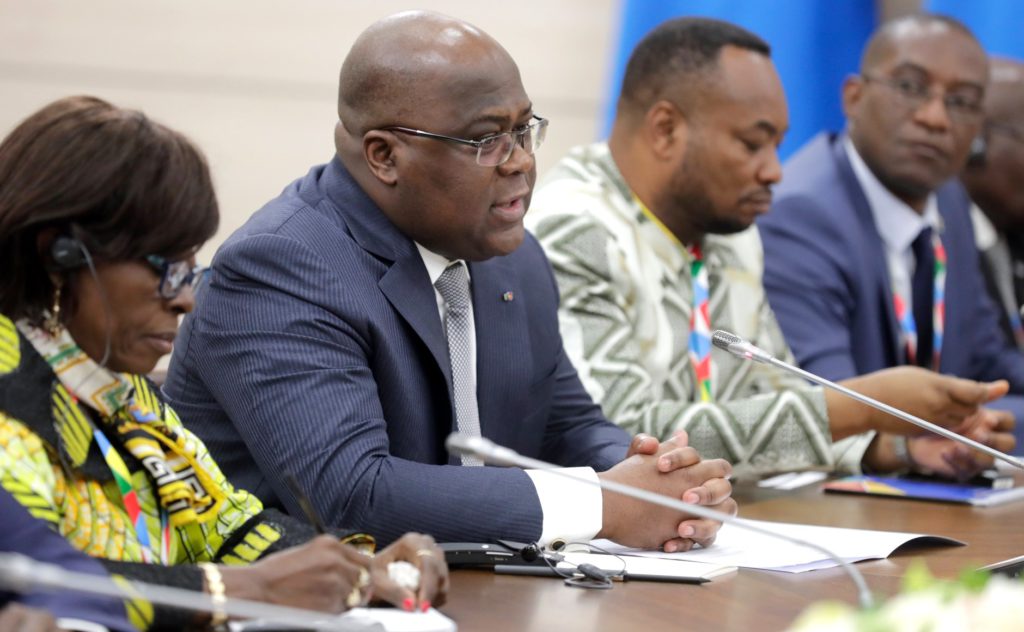
Congo President Felix Tshisekedi. Credit: Wikimedia Commons

The US and Democratic Republic of Congo are preparing a minerals and security partnership, President Donald Trump’s senior adviser for Africa said after meeting with President Felix Tshisekedi Thursday.

Massad Boulos was in Congo’s capital, Kinshasa, to discuss an offer by Tshisekedi to invest in the country’s rich mining industry in exchange for security assistance in the nation’s fight against a rebel group in its east backed by neighboring Rwanda. Congo is the world’s second-largest source of copper and biggest producer of electric vehicle battery mineral cobalt.

“We have reviewed the DRC’s proposal, and I am pleased to announce that the president and I have agreed on a path forward for its development,” Boulos said after the meeting, according to audio shared by Tshisekedi’s office. The Trump administration looks forward “to fostering US private sector investment in the DRC, particularly in the mining sector.”

Tshisekedi is hoping US interest in Congo’s minerals will encourage the country to back his government, which is teetering amid the continued rebel advance in the east. Congo also holds vast reserves of critical minerals including lithium, tantalum and manganese.

Boulos gave no details of the proposed partnership, but said the US was working to end the fighting.

“We seek a lasting peace that affirms the territorial integrity and sovereignty of the DRC, and lays the foundations for a thriving regional economy,” he said.

Boulos will head to Rwanda, Kenya, and Uganda to discuss the conflict in eastern Congo and US private sector investment in the region, according to the State Department. Boulos is also Trump’s Arab and Middle Eastern Affairs and father-in-law of his daughter, Tiffany.

(By Michael J. Kavanagh)

US excludes steel, aluminum, gold from reciprocal tariffs

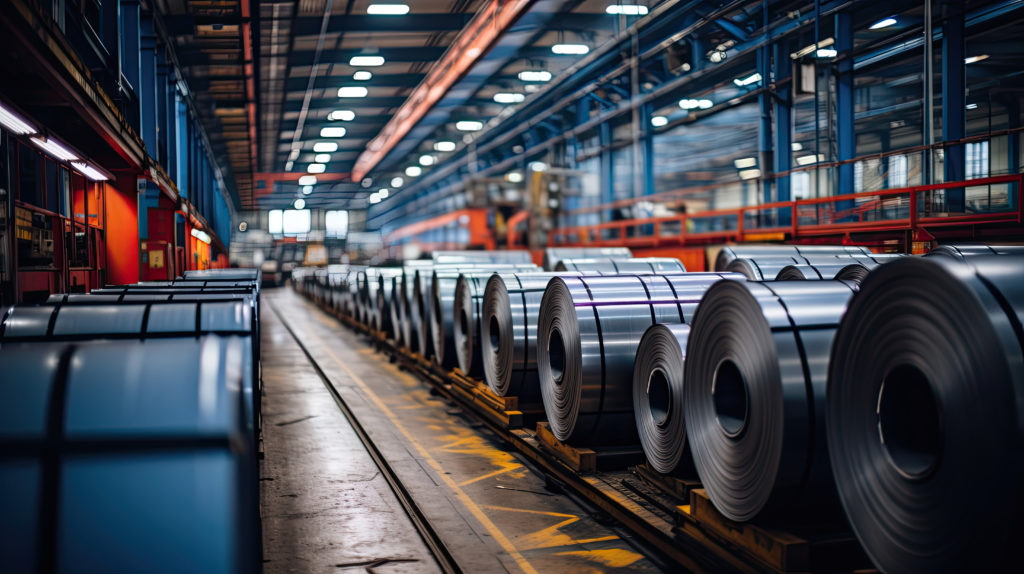
Rolls of galvanized steel sheet. Stock image.

Steel, aluminum and a long list of other metals won’t be subject to “reciprocal” tariffs, the White House said on Wednesday, in a move that provides relief to domestic buyers and suggests the administration is exercising some caution around commodities where the US is heavily reliant on imports.

The long list of exemptions to the cascade of duties captures all base metals, precious metals including gold, as well as niche materials. That means that tariffs on steel, aluminum and, eventually, copper won’t be stacked on top of the newly-announced country levies.

By leaving out vital metals, the administration lessens the risk of price dislocations of the kind seen across the global copper market in recent weeks. But it does not remove uncertainty around the handling of commodities in future.

A senior White House official said critical minerals — a cluster of materials deemed to be of special strategic value — were among products where President Donald Trump was potentially looking to launch tariff investigations under Section 232 of the Trade Expansion Act.

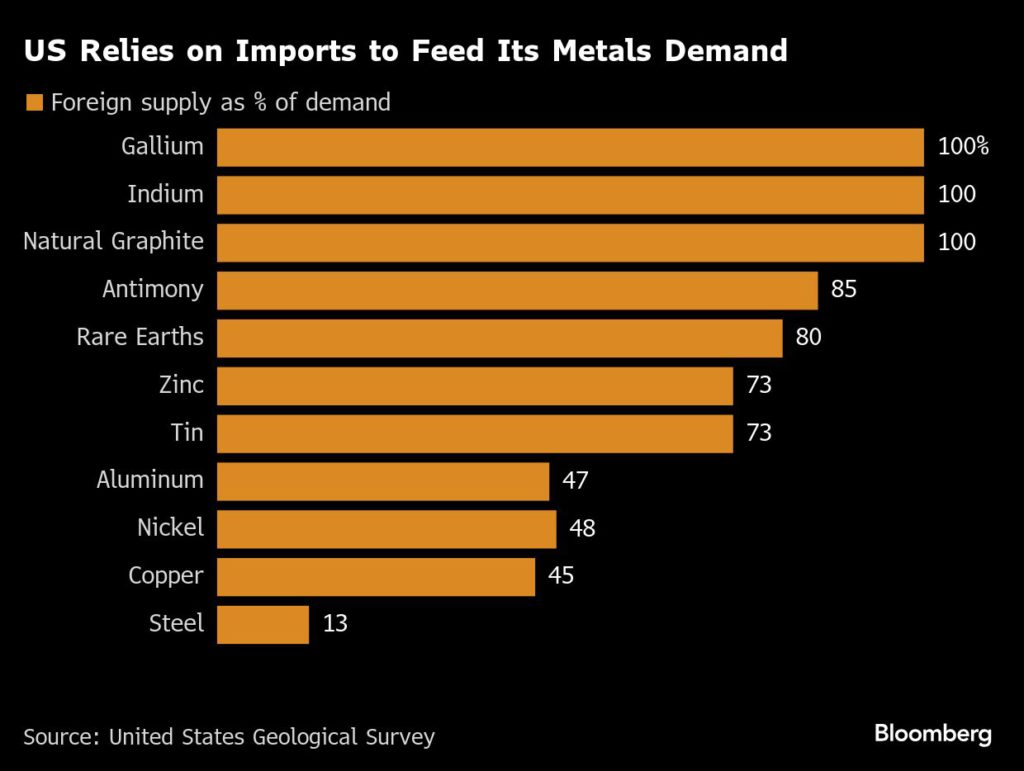
The US is highly dependent on imports for many metals in which China dominates the supply chain, and Trump has made clear his interest in boosting US access to critical minerals, rare earths in particular. Any tariffs would need to be set against the risk of choking off flows to domestic manufacturers.

The US relies on imports for 80% of its rare earths, nearly three-quarters of its zinc and tin, and more than half of its lithium, for example, according to the US Geological Survey. When it comes to steel, there is less reliance on overseas supplies, which makes it arguably easier to impose tariffs on imports.

China has yet to respond in full detail to Wednesday’s blitz, but its answer to US measures so far has been concentrated in curbing exports of minor but vital metals, where its strong grip on production can be used as a trade weapon.

US steelmakers have traded broadly higher this year, outpacing the larger market, as the tariffs helped boost prices of the metal. But the moves come at a price. Demand has been weak amid lackluster construction markets, stubborn inflation and high borrowing costs.

Nucor Corp., the largest American steelmaker, Steel Dynamics Inc. and United States Steel Corp. have warned investors of lackluster earnings results for the first quarter.

Performance for aluminum companies has been more uneven. Shares of Century Aluminum Co. are up about 2% for the year, while Alcoa Corp. is down more than 18%, with much of it’s aluminum produced outside the US.

(By Joe Deaux)


Trump’s policies to spur further central bank gold buying


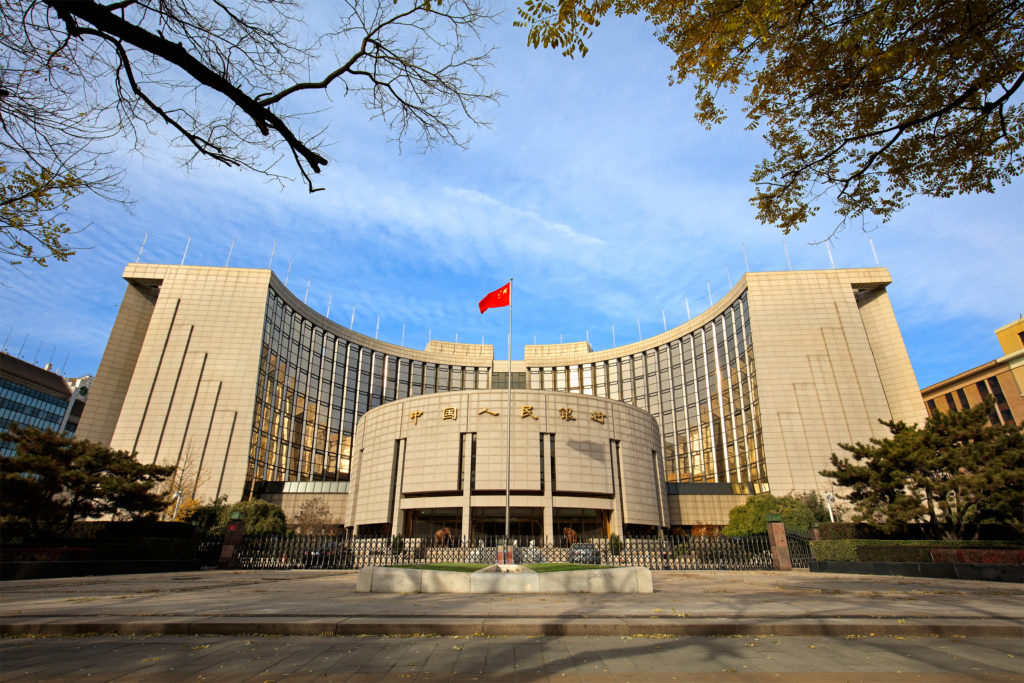
China’s central bank. Credit: Adobe Stock

Central banks are expected to help keep gold’s stunning rally going this year with buying aimed at further diversifying reserves away from the dollar due to risks stemming from US President Donald Trump’s policies.

Russia’s invasion of Ukraine in 2022 provided the first catalyst for purchases by central banks, which have since bought more than 1,000 metric tons of gold a year, twice the annual average of the previous decade.

Spot gold hit its latest record at $3,167.57 a troy ounce on Thursday for a gain of 19% since the start of 2025 and a hefty 71% rise since the end of 2022.

In the final quarter of 2024, when Trump won the US election, central bank purchases accelerated 54% year-on-year to 333 tons, according to an estimate from the World Gold Council (WGC).

“Emerging market central banks currently hold around 10% of their assets in gold. They should really hold 30% of their assets in gold,” said BofA commodity strategist Michael Widmer.

He said that would require central banks to increase their reserves by 11,000 tons of gold and added that uncertainty about US economic policy would remain for some years to come.

“From the central banking perspective (uncertainty) means less incentive to add Treasuries into portfolios and more incentive to actually de-dollarize it,” he said.

US Treasuries and the dollars needed to buy them have previously vied with gold for safe-haven status.

Trump’s tariff policies and global trade wars, his approach to the war in Ukraine and disregard and questioning of decades-old alliances with Europe have upended the world order.

“Those central banks which had (less) gold in their holdings would be looking to add more,” said a source selling gold to central banks. “This year’s demand from central banks may be the highest in many decades.”

Fears of spiralling inflationary pressures due to companies passing on tariffs to consumers in order to protect their profit margins as well as workers seeking higher wages have also boosted gold’s role as a store of value and wealth.

“We view gold’s price strength to date, and our expectation for it to continue, as primarily being driven by investors’ and official institutions’ greater willingness to pay for its lack of credit or counterparty risk,” Macquarie analysts said in a recent note.

Central banks are the third largest category of demand for gold after the jewellery and investment sectors and account for 23% of global consumption. Usually they are price sensitive, buying on dips and curbing purchases when prices rise.

Analysts say expectations of steadily higher gold prices mean they are unlikely to postpone buying.

However, central banks may choose not to disclose their purchases, as Trump has threatened tariffs on countries seen to be actively de-dollarizing.

Official numbers reported to the International Monetary Fund reflect only 34% of the WGC’s 2024 total central bank gold demand estimate.

Data from WGC shows central banks reported adding a net 44 tons to their gold reserves in January-February with Poland and China being the largest buyers.

(By Polina Devitt; Editing by Pratima Desai and Joe Bavier)

The race to get gold bars into the US screeches to a halt

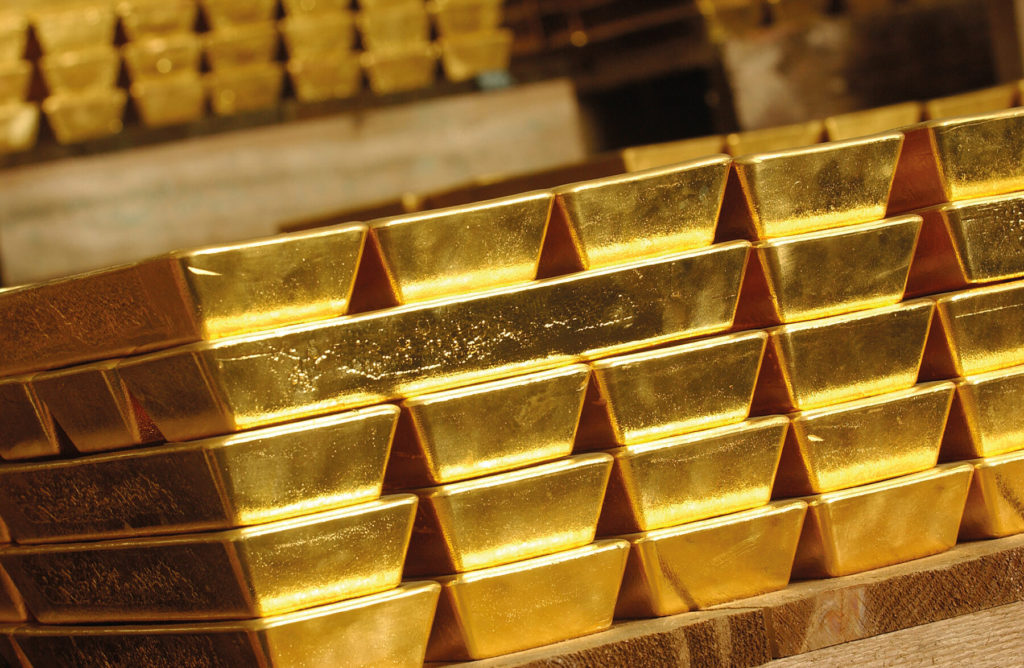
A massive arbitrage trade that has drawn tens of billions of dollars’ worth of gold and silver to the US came to an abrupt halt with Wednesday’s announcement that precious metals would be exempt from Donald Trump’s sweeping tariffs.

For several months, prices in New York have traded at large and unusual premiums to global benchmarks as traders weighed the risk that precious metals could be caught up in tariffs. The differential created an incentive for banks and traders to load planes and ships with so much bullion that it distorted US trade data in the process.

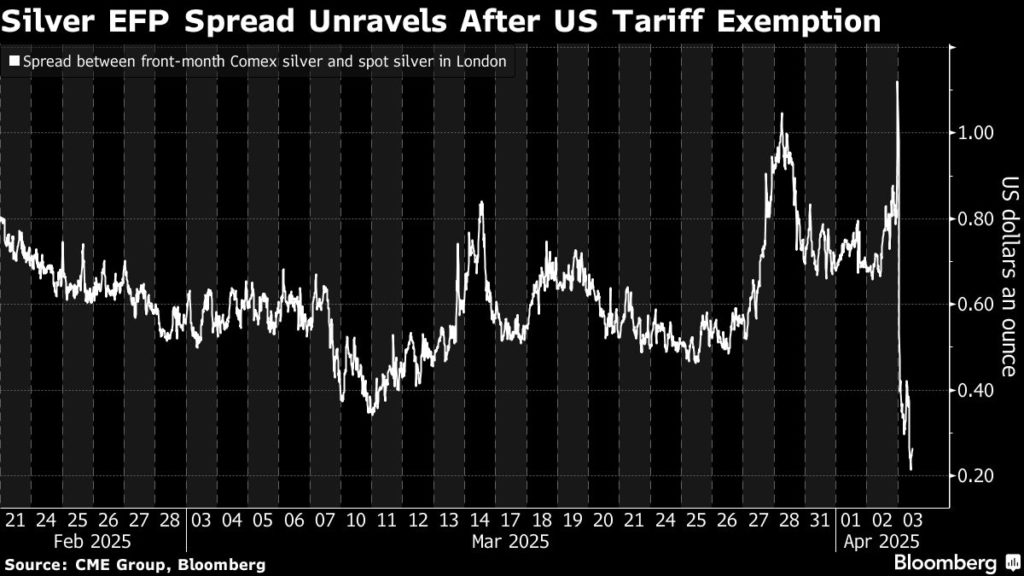
On Thursday, US premiums for precious metals tumbled after a list of exemptions from the tariffs included gold, silver, platinum and palladium. The difference between front-month Comex gold and spot gold in London dropped to $21 an ounce, from over $62 on Wednesday. For silver, the differential — known by precious metals trader as the “exchange for physical” or EFP — tumbled from more than $1 an ounce to just 8 cents.

“Yesterday’s announcement effectively puts an end to the massive flow of precious metals into the US over the last few months as the EFPs collapse,” said Anant Jatia, chief investment officer at Greenland Investment Management, a hedge fund specializing in commodity arbitrage trading.

US precious metals markets never fully priced in major tariffs, but the mere risk of them being imposed caused traders to cover short positions in the US markets, driving a persistent differential. That, in turn, created an incentive to ship physical metal to the US.

US inventories of precious metals have surged to the highest levels on record, with gold stocks up 26.5 million ounces since the end of November and silver up 174.6 million ounces — inflows that are collectively worth over $80 billion at current prices.

Imports of gold helped drive the US trade deficit to a record in January, prompting economists to exclude the precious metal from their calculation.

In February, imports of gold to the US dropped slightly, but remained extremely elevated by historical standards, trade data showed on Thursday. Inflows are likely to have remained high in March, and some may continue in April thanks to trades that were booked when the arbitrage was still open.

(By Jack Farchy)


Trump, tariffs and tin

Kosher Baba golden calf and the Tin Man. Credit: Wikimedia Commons

(The opinions expressed here are those of the author, Andy Home, a columnist for Reuters)

US President Donald Trump’s tariff blitz has shocked financial markets, but the LME base metals complex got an early preview of the likely mayhem.

The imposition of 25% tariffs on U.S. imports of aluminum has dislocated the light metal’s global supply chain, while the threat of similar levies on copper has generated an unprecedented disconnect in transatlantic pricing.

Micro tariff turbulence is now overlaid with macro tariff turmoil as markets take fright at the risk of a full-blown trade war. The London Metal Exchange’s index of base metals has slumped 6% this week as reciprocal tariffs moved from threat to reality.

Only one metal has escaped the tariff tsunami. Tin continues to out-perform the rest of the LME pack buoyed by its own supply chain chaos.

Supply shocks rock tin

LME three-month tin gained 25% over the first quarter of 2025, eclipsing even gold’s stellar run.

A series of supply shocks has generated a roller-coaster ride for tin traders.

The market sold off on news the giant Man Maw tin mine in Myanmar would restart after an 18-month absence before rebounding when Alphamin Resources announced it was closing its Bisie mine in the Congo due to the escalating insurgency in the east of the country.

The devastating earthquake in Myanmar, throwing fresh doubt on Man Maw’s return, has propelled tin even higher.

Investors have rushed to join the action. Fund long positioning has hit record levels.

LME stocks are sliding and time-spreads tightening, adding to the volatility mix.

Bulls, however, should note that there is no shortage of tin in China. Shanghai Futures Exchange stocks have risen by 47% so far this year and at 9,872 metric tons are the highest since September.

Minding the copper gap

Copper trading has been defined by the threat of U.S. tariffs since February, when Trump ordered a national security investigation into copper imports.

The trade has played out in the arbitrage between the CME US customs-cleared price and the LME global price. It has been a volatile trade as the market tries to second-guess when copper tariffs will come and at what rate.

The record CME premium over LME copper has triggered a mass movement of physical metal to the United States. How much makes it through U.S. customs before tariffs are announced remains to be seen.

Record high CME prices and physical market dislocation initially rekindled bull spirits but LME copper has just slumped below the $9,000-per ton level as concern grows over the negative implications of U.S. reciprocal tariffs for global manufacturing activity.

Aluminum premium action

The CME aluminium contract mirrors the LME’s international product, meaning the tariff trade has played out in regional premiums.

The U.S. Midwest premium widened to more than $900 per ton over the LME basis price last month as the market priced in the lift in U.S. import tariffs from 10% to 25%.

European premiums, by contrast, have fallen sharply, suggesting physical metal is already being diverted from the U.S. market.

Analysts had high expectations for aluminium at the start of the year but the market has generated mixed signals and, like copper, is selling off in reciprocal tariff reaction

Nickel awaits Indonesia

Nickel has spent the first three months of 2025 trapped in a broad $15,000-17,000-per ton range.

The price has been weighed down by ever-rising LME stocks as over-production in Indonesia swamps the refined nickel supply chain.

The amount of Chinese nickel in the LME warehouse network has grown to more than 50% from 11% at the start of 2024. This is metal that has been processed in China from Indonesian raw materials. Indonesia has started producing its own refined metal, which is also turning up in LME sheds.

The nickel price is so low that even Indonesian operators are feeling the margin pinch, but until the country limits its production growth, nickel will remain over-supplied.

The only question is whether the Indonesian flood continues to wash into the refined metal segment of the nickel market or revert to the lower-grade Class II segment.

It all depends on Indonesian processing margins.

Heavy stocks weigh on heavy metal

And talking of high stocks.

Someone cancelled 120,000 tons of LME lead stocks last month but there was little or no reaction from either outright price or time-spreads.

No-one thinks the physical market is short by that much metal. Rather, lead is seeing the sort of LME warehouse arbitrage that comes with over-supply and elevated exchange stocks, which have grown to 331,000 tons from 21,500 tons at the start of 2023.

The lead price has held up well given the inventory overhang but that may be because it is still in better shape than sister metal zinc.

Zinc mine rebound

Zinc has consistently underperformed the rest of the LME pack since the start of the year, even though exchange stocks have fallen steadily.

But the market appears to be trading zinc’s bearish raw materials narrative rather than its more nuanced refined metal dynamics.

Mined zinc production fell by 2.8% year-on-year in 2024, tightening the raw materials supply chain to the point that smelter fees turned negative in the second half of the year.

Restarts and new mines are expected to generate a significant rebound in 2025.

There are signs that this new wave of mine supply is starting to build momentum. Smelter treatment charges, which turned negative due to a shortage of mined concentrates in 2024, have bounced back to $35 per ton on a spot basis.

Zinc demand flat-lined last year and with little prospect of a recovery in global construction, a major end-use sector for zinc, higher mined output is expected to generate over-supply in the refined metal market.

(Editing by Barbara Lewis)