April 12, 2025
MEMO

Israeli tanks are seen by the border as the Israeli army announced that it has taken control of the Palestinian side of the Rafah border crossing in Rafah, Gaza on May 06, 2024 [IDF – Handout/Anadolu Agency]
The Israeli army announced on Saturday that it has completed the siege of Rafah, and finished establishing the Morag Corridor, isolating Rafah from Khan Younis in the southern Gaza Strip, Anadolu reports.
In a statement, the Israeli army said: “Forces of the 36th Division have completed the encirclement of Rafah.”
It added that in the past 24 hours, troops “completed opening the Morag Corridor, which cuts through southern Gaza between Rafah and Khan Younis.”
This development follows a report earlier this week by the daily Haaretz, which revealed that the army is preparing to incorporate Rafah, an area that makes up about one-fifth of the Gaza Strip, into a so-called buffer zone where Palestinians will be prohibited from entering.
The newspaper described the move as tantamount to “the eradication of the city.”
READ: Israel deploys 6 more brigades to West Bank ahead of Passover holiday
According to Haaretz, the planned buffer zone spans approximately 75 square kilometers (29 square miles) and stretches between the Philadelphi and Morag corridors, encompassing Rafah and surrounding neighborhoods.
The Morag Corridor is named after an illegal Israeli settlement that once stood in Gaza before Israel’s 2005 unilateral disengagement from the strip. It lies between Khan Younis and Rafah in the south.
On April 2, Israeli Prime Minister Benjamin Netanyahu said in a video statement: “We are taking control of the Morag Corridor, which will be an additional Philadelphi Corridor.”
On Thursday, the Palestinian group Hamas accused Netanyahu of enforcing a new status quo in Rafah aimed at isolating Gaza from its Arab surroundings.
The Israeli army renewed a deadly assault on Gaza on March 18, shattering the ceasefire and prisoner exchange agreement that took hold in January.
More than 50,900 Palestinians, most of them women and children, have been killed in Gaza in a brutal Israeli onslaught since October 2023.
The International Criminal Court issued arrest warrants last November for Netanyahu and his former Defense Minister Yoav Gallant for war crimes and crimes against humanity in Gaza.
Israel also faces a genocide case at the International Court of Justice for its war on the enclave.
Israeli tanks are seen by the border as the Israeli army announced that it has taken control of the Palestinian side of the Rafah border crossing in Rafah, Gaza on May 06, 2024 [IDF – Handout/Anadolu Agency]
The Israeli army announced on Saturday that it has completed the siege of Rafah, and finished establishing the Morag Corridor, isolating Rafah from Khan Younis in the southern Gaza Strip, Anadolu reports.
In a statement, the Israeli army said: “Forces of the 36th Division have completed the encirclement of Rafah.”
It added that in the past 24 hours, troops “completed opening the Morag Corridor, which cuts through southern Gaza between Rafah and Khan Younis.”
This development follows a report earlier this week by the daily Haaretz, which revealed that the army is preparing to incorporate Rafah, an area that makes up about one-fifth of the Gaza Strip, into a so-called buffer zone where Palestinians will be prohibited from entering.
The newspaper described the move as tantamount to “the eradication of the city.”
READ: Israel deploys 6 more brigades to West Bank ahead of Passover holiday
According to Haaretz, the planned buffer zone spans approximately 75 square kilometers (29 square miles) and stretches between the Philadelphi and Morag corridors, encompassing Rafah and surrounding neighborhoods.
The Morag Corridor is named after an illegal Israeli settlement that once stood in Gaza before Israel’s 2005 unilateral disengagement from the strip. It lies between Khan Younis and Rafah in the south.
On April 2, Israeli Prime Minister Benjamin Netanyahu said in a video statement: “We are taking control of the Morag Corridor, which will be an additional Philadelphi Corridor.”
On Thursday, the Palestinian group Hamas accused Netanyahu of enforcing a new status quo in Rafah aimed at isolating Gaza from its Arab surroundings.
The Israeli army renewed a deadly assault on Gaza on March 18, shattering the ceasefire and prisoner exchange agreement that took hold in January.
More than 50,900 Palestinians, most of them women and children, have been killed in Gaza in a brutal Israeli onslaught since October 2023.
The International Criminal Court issued arrest warrants last November for Netanyahu and his former Defense Minister Yoav Gallant for war crimes and crimes against humanity in Gaza.
Israel also faces a genocide case at the International Court of Justice for its war on the enclave.
Israel ‘completely besieges’ Rafah, seizes corridor in southern Gaza
Israel has surrounded Rafah and taken control of a corridor in south Gaza as it displaces thousands across the strip and seizes more territory.
The New Arab Staff
12 April, 2025

Palestinians flee Rafah after Israel issued a displacement order covering the city [Getty]
Israel has surrounded Rafah and taken control of another corridor in southern Gaza as its military forcibly displaces thousands of Palestinians across the strip and seizes more territory.
Israeli Army Radio said Friday that its forces have “completely besieged” the southern border city and are occupying the strip of land referred to by the Israeli government as the ‘Morag Axis’.
The ‘Morag Axis’ is a southern corridor between the coast and the Israeli border that Israel aims to use to take full control of Rafah and Khan Younis.
“Forces from the 36th Division and the 188th Armoured Brigade were able to take full control of the axis and surround the city of Rafah from all sides,” Israel Army Radio said.
The army is now preparing to expand its attack on Rafah with the aim of annexing the entire city into the border buffer zone, it said.
Israel’s defence minister said Wednesday that it will widen its so-called “security zones” to include Rafah.
It has issued forced displacement orders covering the entire city and its surroundings.
Since it resumed its brutal military assault on 18 March, Israel has issued 15 displacement orders and seized control of more territory, incorporating it into its “security zones”.
Two-thirds of the strip is now effectively a no-go zone for civilians, according to the UN.
Almost 400,000 people are estimated to have been displaced between 18 March and 6 April.
Siege pushing Gaza into famine: UNRWA
Gaza is being pushed into “very, very deep hunger” as food supplies dwindle after six weeks of Israel’s siege, the UN’s agency for Palestinian refugees (UNRWA) said Saturday.
"All basic supplies are running out in Gaza," UNRWA’s communications head Juliette Touma said in a post on X.
"It means babies, children are going to bed hungry."
On 2 March Israel imposed a total siege on Gaza, preventing all goods, including food and medical supplies entering the strip.
Israel ‘purposely targeting’ women and children: Al-Haq
A UN assessment of airstrikes in Gaza provides evidence that the Israeli military is “purposely targeting women and children”, Palestinian human rights group Al-Haq said Friday.
Analysis published by the UN Human Rights Office on Friday showed that 36 Israeli strikes conducted since the collapse of the ceasefire on 18 March killed only women and children.
“Such a calculated effort to exterminate women, boys, girls and even infants has not been witnessed in any other modern conflict,” Al-Haq wrote in a post on X.
The UN report recorded 224 Israeli airstrikes on residential buildings and tents for internally displaced people between 18 March and 9 April.
“Overall, a large percentage of fatalities are children and women,” it said
Israel has surrounded Rafah and taken control of a corridor in south Gaza as it displaces thousands across the strip and seizes more territory.
The New Arab Staff
12 April, 2025

Palestinians flee Rafah after Israel issued a displacement order covering the city [Getty]
Israel has surrounded Rafah and taken control of another corridor in southern Gaza as its military forcibly displaces thousands of Palestinians across the strip and seizes more territory.
Israeli Army Radio said Friday that its forces have “completely besieged” the southern border city and are occupying the strip of land referred to by the Israeli government as the ‘Morag Axis’.
The ‘Morag Axis’ is a southern corridor between the coast and the Israeli border that Israel aims to use to take full control of Rafah and Khan Younis.
“Forces from the 36th Division and the 188th Armoured Brigade were able to take full control of the axis and surround the city of Rafah from all sides,” Israel Army Radio said.
The army is now preparing to expand its attack on Rafah with the aim of annexing the entire city into the border buffer zone, it said.
Israel’s defence minister said Wednesday that it will widen its so-called “security zones” to include Rafah.
It has issued forced displacement orders covering the entire city and its surroundings.
Since it resumed its brutal military assault on 18 March, Israel has issued 15 displacement orders and seized control of more territory, incorporating it into its “security zones”.
Two-thirds of the strip is now effectively a no-go zone for civilians, according to the UN.
Almost 400,000 people are estimated to have been displaced between 18 March and 6 April.
Siege pushing Gaza into famine: UNRWA
Gaza is being pushed into “very, very deep hunger” as food supplies dwindle after six weeks of Israel’s siege, the UN’s agency for Palestinian refugees (UNRWA) said Saturday.
"All basic supplies are running out in Gaza," UNRWA’s communications head Juliette Touma said in a post on X.
"It means babies, children are going to bed hungry."
On 2 March Israel imposed a total siege on Gaza, preventing all goods, including food and medical supplies entering the strip.
Israel ‘purposely targeting’ women and children: Al-Haq
A UN assessment of airstrikes in Gaza provides evidence that the Israeli military is “purposely targeting women and children”, Palestinian human rights group Al-Haq said Friday.
Analysis published by the UN Human Rights Office on Friday showed that 36 Israeli strikes conducted since the collapse of the ceasefire on 18 March killed only women and children.
“Such a calculated effort to exterminate women, boys, girls and even infants has not been witnessed in any other modern conflict,” Al-Haq wrote in a post on X.
The UN report recorded 224 Israeli airstrikes on residential buildings and tents for internally displaced people between 18 March and 9 April.
“Overall, a large percentage of fatalities are children and women,” it said
Letters From Rafah: A Life Under Siege
Where is humanity? Does anyone still see us? Has the world really become this cold and dispassionate, or has it always been that way?
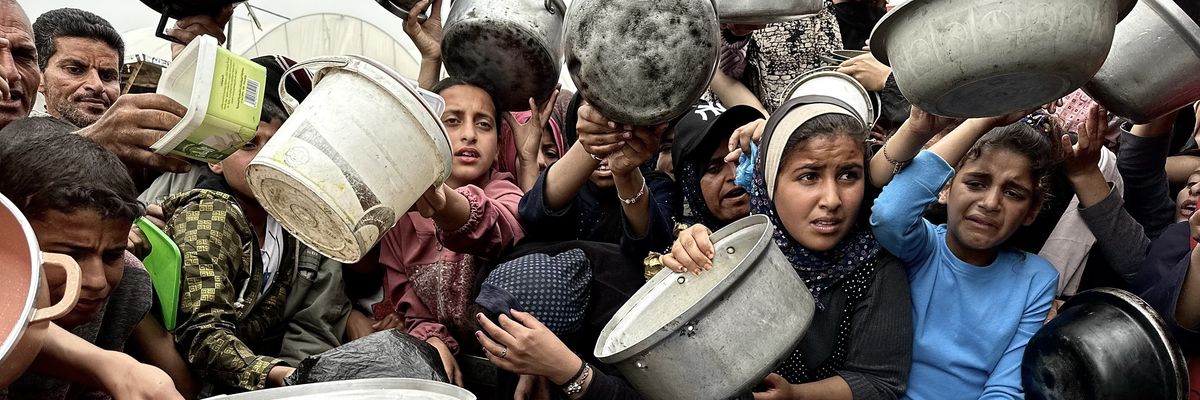
Palestinians, who have difficulty finding food, wait with empty pots and pans in their hands to receive meals distributed by charitable organizations at al-Mawasi in Khan Younis, Gaza on April 2, 2025.
(Photo: Doaa Albaz/Anadolu via Getty Images)
Jennifer Loewenstein
Apr 11, 2025
March 21, 2025
The war is more terrifying than before. It seems to have reached a level of savagery and madness we've never experienced before. The bombing doesn't stop; it goes on relentlessly day and night. Some days I want to scream when I hear it. Every day there are more home demolitions, and we hear missile sounds that are new to us. Israel is testing out its newest weapons on us to see how well they blast us into pieces of flesh or vaporize us altogether; to see, perhaps, if one bomb can turn a concrete building into dust faster than another. The power of the explosions is enormous and can be heard in Jerusalem and its environs. This time around—since Israel began its war on us again—my fear has doubled—for myself, my children, my family, for everyone. The bombing is everywhere; the killing and the places being bombed are entirely arbitrary and unpredictable. Our fate lies in the hands of chance.
March 22, 2025
One of the most devastating things about this madness is that we no longer recognize the places where we used to live. We might see a video clip of a street in Gaza—a street whose markets and shops, colors, flavors, and scents we had memorized; a street that had witnessed thousands of our memories in the city. But that video clip is all that is left. Now that street has become so unrecognizable it's as if they have taken away our ability to remember. They did not leave behind a single marker to remind us of where we are. Even the trees are gone. Perhaps they think by erasing our memories they will have erased our identity. They are wrong: It just makes us swallow our past whole until we become one and the same with it.
Every day we stand ankle deep in the remains of our people, in streams of blood and debris. What tears my heart the most are the bodies of dead children. They haunt me in my dreams. I need a truce with myself to force me away from the news; a temporary truce so I can embrace what is still living after death rains down from the skies. I need to smell air without the putrid smell of rotting flesh and gunpowder. I need to see scenes other than corpses and skeletons spread everywhere; other than people with amputated limbs moving about on some violent stage where the theme is destruction.
Do you want to know how I feel? Look at the miles of rubble and debris. That's how I feel.
By God, I am so tired of seeing tents everywhere, and little children gathering in queues for food and water. I can no longer bear seeing all these things and the sickly faces of people in the streets. I want to run away from this pain. But, let me tell you honestly that in many ways the bitterness of betrayal is even harsher than the pain of this aggression—the slaughter, displacement, and starvation. We have been completely abandoned. No one is going to step in and help us. We are alone.
March 23, 2025
[NOTE: On March 23, news of Israel's execution of 15 Red Crescent and Civil Defense workers in the Tel al-Sultan area of Rafah had not yet reached the U.S. Hudia wrote in her letters to me what she heard from people in Tel al-Sultan on the day it happened and thereafter. Much that she describes was never reported in the news. Outlets such as Middle East Eye and Al Jazeera; and human rights organizations such as Al Mezan, with whose fieldworker I spoke, collected eyewitness reports and documented as much as possible.]
POEM
They buried them alive with bullets.
They stood over the hole,
piling the bodies on top of each other.
There was barely time to scream.
the spray silenced everything in seconds.
The earth swallowed them up
leaving only the sky as a witness.
The reports are terrible. The Israelis ordered the residents of Tel al-Sultan to evacuate, but didn't give them any time to pack up or coordinate plans. They had to leave immediately. Within minutes, they were fired upon by quadcopters, drones, and tanks. It was chaos.
Soldiers set up a makeshift checkpoint for people to pass through. Most were able to pass, but some were detained in a muddy area off to the side. We don't know what happened to them. We heard that somewhere they separated the men, put them in pits, and executed them. But we didn't know exactly who they meant. The ambulance crews that came to help have vanished.
Many people are still trapped in Tel al-Sultan, and no one knows anything about their fate yet either. As people were running to escape the area, anyone trying to help them was also shot so the dead and wounded were left in the streets.
Tonight, they bombed Nasser Hospital in Khan Younis. An Israeli airstrike killed a Hamas member and 16-year-old boy. This dirty war is as dirty as the world itself for allowing Israel to violate everything.
March 27, 2025
Good morning, my friend. What happened in Rafah is horrific and beyond comprehension. I don't know if we'll ever have the full truth of what the Israelis did. What is now coming out about the executed Paramedics and Civil Defense members is just the tip of the iceberg. We have reached the peak of madness. Nobody cares what's happening here. I think we are going into the unknown.
I can no longer sleep, day or night. It is after 3:00 am, and I am up writing this to you. Tomorrow I will flee again with my son's family to the Khan Younis area. I will take my tent and put it directly on the sea. Maybe there I will fall asleep. I am so tired of everything.
March 30, 2025
Yes, I am now living in one of those tents you've been seeing again and again on the open beach area of al-Mawasi. Life here is very difficult. Water trucks come, and we carry water from the street to the tents so we can clean the dishes and wash the clothes by hand. This doesn't solve the problem of sand and dust, our two constant companions. Of course, there is no gas. We cook everything over a fire, including bread.
The crossings have been closed for about a month. Nothing is entering Gaza. The markets are completely empty of almost everything, and the agricultural areas east of the strip are under Israeli control. It is possible to find only a few vegetables and fruit at food stands here and there along the streets, and most cannot afford to buy them because the prices are so high. We mostly rely on canned food when it is available. People here are hungry, scared, and sick. The general health of the people has declined because there is so little nutritious food to eat. This makes people less able to endure the hardships. So many will die with this added weakness. I am sure this is one of Israel's goals in the overall scheme to wipe us out.
April 1, 2025
I can't stand to listen to the news reports any longer. They sound like reels of dry statistics, one after another. They don't mention the empty chair at the dining table, the best friend who has disappeared, or the parents searching for their child's limbs in the rubble. They don't tell you about the families going with less and less each day, trying to keep up brave faces for their children; or how a mother feels when she passes by children playing football, which her child loved, but who died without fulfilling his share of dreams.
That news "ticker tape" at the bottom of your screen doesn't mention how many men here pretend to be strong before weeping at night from pain and longing. It lists numbers of dead, dying, wounded, and forever incapacitated, but it is those who keep going who are the future's story. They are beyond exhausted but go about their daily tasks like automatons except that they are absorbing this reality, this world of pure violence and expedited trauma, in which we are supposed to live like human beings. It is these people, plodding along half-dazed through this giant cemetery, who have internalized the reality of what Gaza has become.
April 5, 2025
Yesterday, my uncle was martyred after his tent was bombed in the Mawasi area of Khan Younis. He succumbed to his wounds. I am suffering from severe depression this time, fear and anxiety for everyone. I cannot sleep at all.
April 8, 2025
The plan to expel us is taking a serious turn, especially after Israeli Prime Minister Benjamin Netanyahu's recent visit to America. I don't know what I will do. With the new "Morag corridor," Israel has completely separated Rafah from Khan Younis and I believe after they've completed the destruction of Rafah, they will force us there, close to the Egyptian border, in preparation for mass expulsion. Then Rafah will be merged with the "buffer zone" around the strip and taken over by Jewish settlers. My city will have disappeared into history. This is the only logical conclusion I can come up with given the demolition of the remaining buildings in Rafah.
I spoke to my brother yesterday in Amsterdam. I informed him about our uncle Muhammad's martyrdom. I haven't spoken to him for a while, but I know how he is from the tone of his voice. He always tries to make me think he's fine and that everything is normal, but I know it's not—and I know he's not. He's panicking, I can feel it, and afraid for everyone, and so am I. The situation is terrifying, suffocating, and worrying. I always tell him everyone is still fine, and that I hope everyone will remain "fine." I speak to everyone in my family here daily, hoping that we and the others here will survive this holocaust, but I no longer know if we will.
You know, I used to love the sea and would sit out by it at night on the beach, drinking coffee and smoking my cigarettes. Now the sea is in front of me, but I can barely stand to look at it. It has become ominous, as if waiting to swallow us whole. The beautiful Mediterranean now terrifies me. What a strange paradox.
My friend, I know you're always thinking of me, and I always read our conversations, old and new. I'm so grateful for your continued support.
April 9, 2025
A hundred tents here, 50 more over there—in every corner there are more tents, and each one tells a story of pain.
I've asked myself a million times how people can live like this; how do they sleep, how do they endure the heat and cold, the oppressiveness of these "homes," the utter lack of privacy? Where is humanity? Does anyone still see us? Has the world really become this cold and dispassionate, or has it always been that way?
These are not just tents. These are souls, shattered families, and shattered dreams all under a thin fabric that conceals neither the pain nor the indignity of what we have become. Do you want to know how I feel? Look at the miles of rubble and debris. That's how I feel; you just can't take a picture of my soul.
Where is humanity? Does anyone still see us? Has the world really become this cold and dispassionate, or has it always been that way?
Palestinians, who have difficulty finding food, wait with empty pots and pans in their hands to receive meals distributed by charitable organizations at al-Mawasi in Khan Younis, Gaza on April 2, 2025.
(Photo: Doaa Albaz/Anadolu via Getty Images)
Jennifer Loewenstein
Apr 11, 2025
Common Dreams
Below are excerpts from letters sent to me by my friend, Hudia, of Rafah. I have saved everything she has sent me since October 2023. The entries below are taken from messages she has sent since Israel's resumption of bombing on March 18, 2025. Hudia writes to me in Arabic. I have translated and edited them for style and clarity with her permission.
Below are excerpts from letters sent to me by my friend, Hudia, of Rafah. I have saved everything she has sent me since October 2023. The entries below are taken from messages she has sent since Israel's resumption of bombing on March 18, 2025. Hudia writes to me in Arabic. I have translated and edited them for style and clarity with her permission.
March 21, 2025
The war is more terrifying than before. It seems to have reached a level of savagery and madness we've never experienced before. The bombing doesn't stop; it goes on relentlessly day and night. Some days I want to scream when I hear it. Every day there are more home demolitions, and we hear missile sounds that are new to us. Israel is testing out its newest weapons on us to see how well they blast us into pieces of flesh or vaporize us altogether; to see, perhaps, if one bomb can turn a concrete building into dust faster than another. The power of the explosions is enormous and can be heard in Jerusalem and its environs. This time around—since Israel began its war on us again—my fear has doubled—for myself, my children, my family, for everyone. The bombing is everywhere; the killing and the places being bombed are entirely arbitrary and unpredictable. Our fate lies in the hands of chance.
March 22, 2025
One of the most devastating things about this madness is that we no longer recognize the places where we used to live. We might see a video clip of a street in Gaza—a street whose markets and shops, colors, flavors, and scents we had memorized; a street that had witnessed thousands of our memories in the city. But that video clip is all that is left. Now that street has become so unrecognizable it's as if they have taken away our ability to remember. They did not leave behind a single marker to remind us of where we are. Even the trees are gone. Perhaps they think by erasing our memories they will have erased our identity. They are wrong: It just makes us swallow our past whole until we become one and the same with it.
Every day we stand ankle deep in the remains of our people, in streams of blood and debris. What tears my heart the most are the bodies of dead children. They haunt me in my dreams. I need a truce with myself to force me away from the news; a temporary truce so I can embrace what is still living after death rains down from the skies. I need to smell air without the putrid smell of rotting flesh and gunpowder. I need to see scenes other than corpses and skeletons spread everywhere; other than people with amputated limbs moving about on some violent stage where the theme is destruction.
Do you want to know how I feel? Look at the miles of rubble and debris. That's how I feel.
By God, I am so tired of seeing tents everywhere, and little children gathering in queues for food and water. I can no longer bear seeing all these things and the sickly faces of people in the streets. I want to run away from this pain. But, let me tell you honestly that in many ways the bitterness of betrayal is even harsher than the pain of this aggression—the slaughter, displacement, and starvation. We have been completely abandoned. No one is going to step in and help us. We are alone.
March 23, 2025
[NOTE: On March 23, news of Israel's execution of 15 Red Crescent and Civil Defense workers in the Tel al-Sultan area of Rafah had not yet reached the U.S. Hudia wrote in her letters to me what she heard from people in Tel al-Sultan on the day it happened and thereafter. Much that she describes was never reported in the news. Outlets such as Middle East Eye and Al Jazeera; and human rights organizations such as Al Mezan, with whose fieldworker I spoke, collected eyewitness reports and documented as much as possible.]
POEM
They buried them alive with bullets.
They stood over the hole,
piling the bodies on top of each other.
There was barely time to scream.
the spray silenced everything in seconds.
The earth swallowed them up
leaving only the sky as a witness.
The reports are terrible. The Israelis ordered the residents of Tel al-Sultan to evacuate, but didn't give them any time to pack up or coordinate plans. They had to leave immediately. Within minutes, they were fired upon by quadcopters, drones, and tanks. It was chaos.
Soldiers set up a makeshift checkpoint for people to pass through. Most were able to pass, but some were detained in a muddy area off to the side. We don't know what happened to them. We heard that somewhere they separated the men, put them in pits, and executed them. But we didn't know exactly who they meant. The ambulance crews that came to help have vanished.
Many people are still trapped in Tel al-Sultan, and no one knows anything about their fate yet either. As people were running to escape the area, anyone trying to help them was also shot so the dead and wounded were left in the streets.
Tonight, they bombed Nasser Hospital in Khan Younis. An Israeli airstrike killed a Hamas member and 16-year-old boy. This dirty war is as dirty as the world itself for allowing Israel to violate everything.
March 27, 2025
Good morning, my friend. What happened in Rafah is horrific and beyond comprehension. I don't know if we'll ever have the full truth of what the Israelis did. What is now coming out about the executed Paramedics and Civil Defense members is just the tip of the iceberg. We have reached the peak of madness. Nobody cares what's happening here. I think we are going into the unknown.
I can no longer sleep, day or night. It is after 3:00 am, and I am up writing this to you. Tomorrow I will flee again with my son's family to the Khan Younis area. I will take my tent and put it directly on the sea. Maybe there I will fall asleep. I am so tired of everything.
March 30, 2025
Yes, I am now living in one of those tents you've been seeing again and again on the open beach area of al-Mawasi. Life here is very difficult. Water trucks come, and we carry water from the street to the tents so we can clean the dishes and wash the clothes by hand. This doesn't solve the problem of sand and dust, our two constant companions. Of course, there is no gas. We cook everything over a fire, including bread.
The crossings have been closed for about a month. Nothing is entering Gaza. The markets are completely empty of almost everything, and the agricultural areas east of the strip are under Israeli control. It is possible to find only a few vegetables and fruit at food stands here and there along the streets, and most cannot afford to buy them because the prices are so high. We mostly rely on canned food when it is available. People here are hungry, scared, and sick. The general health of the people has declined because there is so little nutritious food to eat. This makes people less able to endure the hardships. So many will die with this added weakness. I am sure this is one of Israel's goals in the overall scheme to wipe us out.
April 1, 2025
I can't stand to listen to the news reports any longer. They sound like reels of dry statistics, one after another. They don't mention the empty chair at the dining table, the best friend who has disappeared, or the parents searching for their child's limbs in the rubble. They don't tell you about the families going with less and less each day, trying to keep up brave faces for their children; or how a mother feels when she passes by children playing football, which her child loved, but who died without fulfilling his share of dreams.
That news "ticker tape" at the bottom of your screen doesn't mention how many men here pretend to be strong before weeping at night from pain and longing. It lists numbers of dead, dying, wounded, and forever incapacitated, but it is those who keep going who are the future's story. They are beyond exhausted but go about their daily tasks like automatons except that they are absorbing this reality, this world of pure violence and expedited trauma, in which we are supposed to live like human beings. It is these people, plodding along half-dazed through this giant cemetery, who have internalized the reality of what Gaza has become.
April 5, 2025
Yesterday, my uncle was martyred after his tent was bombed in the Mawasi area of Khan Younis. He succumbed to his wounds. I am suffering from severe depression this time, fear and anxiety for everyone. I cannot sleep at all.
April 8, 2025
The plan to expel us is taking a serious turn, especially after Israeli Prime Minister Benjamin Netanyahu's recent visit to America. I don't know what I will do. With the new "Morag corridor," Israel has completely separated Rafah from Khan Younis and I believe after they've completed the destruction of Rafah, they will force us there, close to the Egyptian border, in preparation for mass expulsion. Then Rafah will be merged with the "buffer zone" around the strip and taken over by Jewish settlers. My city will have disappeared into history. This is the only logical conclusion I can come up with given the demolition of the remaining buildings in Rafah.
I spoke to my brother yesterday in Amsterdam. I informed him about our uncle Muhammad's martyrdom. I haven't spoken to him for a while, but I know how he is from the tone of his voice. He always tries to make me think he's fine and that everything is normal, but I know it's not—and I know he's not. He's panicking, I can feel it, and afraid for everyone, and so am I. The situation is terrifying, suffocating, and worrying. I always tell him everyone is still fine, and that I hope everyone will remain "fine." I speak to everyone in my family here daily, hoping that we and the others here will survive this holocaust, but I no longer know if we will.
You know, I used to love the sea and would sit out by it at night on the beach, drinking coffee and smoking my cigarettes. Now the sea is in front of me, but I can barely stand to look at it. It has become ominous, as if waiting to swallow us whole. The beautiful Mediterranean now terrifies me. What a strange paradox.
My friend, I know you're always thinking of me, and I always read our conversations, old and new. I'm so grateful for your continued support.
April 9, 2025
A hundred tents here, 50 more over there—in every corner there are more tents, and each one tells a story of pain.
I've asked myself a million times how people can live like this; how do they sleep, how do they endure the heat and cold, the oppressiveness of these "homes," the utter lack of privacy? Where is humanity? Does anyone still see us? Has the world really become this cold and dispassionate, or has it always been that way?
These are not just tents. These are souls, shattered families, and shattered dreams all under a thin fabric that conceals neither the pain nor the indignity of what we have become. Do you want to know how I feel? Look at the miles of rubble and debris. That's how I feel; you just can't take a picture of my soul.
Rafah “obliterated” by Israel’s attacks
Nora Barrows-Friedman
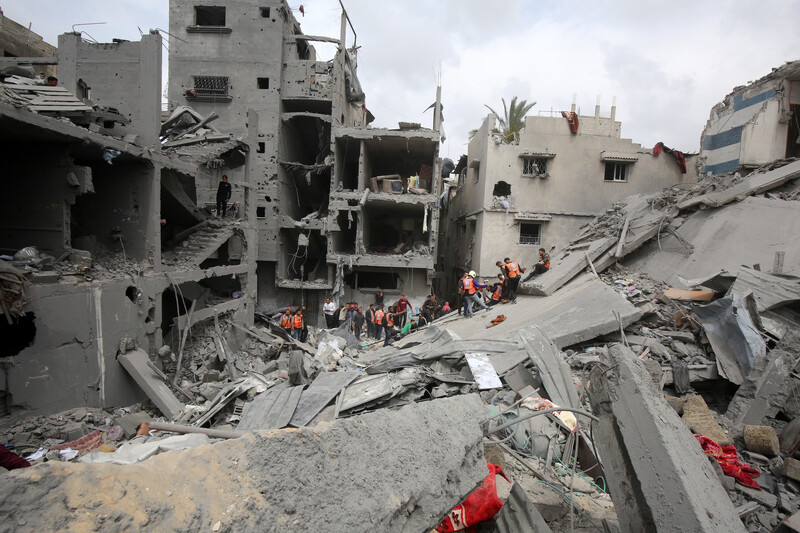
First responders try to rescue Palestinians trapped under the rubble following Israeli airstrikes on Shujaiya, Gaza City, 9 April. Omar AshtawyAPA images
The following is from the news roundup during the 10 April livestream. Watch the entire episode here.
Israel has committed massacres across all areas of the Gaza Strip while, for the last six weeks, it has closed all the crossings – for food, fuel, medicines, construction vehicles and every other essential supply – plunging Gaza into another deep starvation and health crisis.
More than 390,000 people are estimated to have been displaced again, according to the United Nations, with no safe place to go.
Every day, dozens are killed in Israeli attacks. The Palestinian health ministry in Gaza said that in the three weeks since Israel broke the ceasefire on 18 March, Israel has killed nearly 1,500 Palestinians.
Al Jazeera reporter Anas al-Sharif shared this video of Israeli “fire belt” strikes hitting Gaza City on 3 April.
Our contributor Abubaker Abed has been reporting on the attacks over the last week on Deir al-Balah in central Gaza, where his cousin and his cousin’s child were killed at the gates of Al-Aqsa Martyrs Hospital on 5 April.
The Israeli army has issued forced expulsion orders to residents of Deir al-Balah in the past week, threatening residents with attacks if they do not leave.
The Israeli military said that it carried out attacks on 45 “targets” across Gaza between 8 and 9 April.
On Wednesday, 9 April, Israel attacked the Shujaiya neighborhood of Gaza City, destroying dozens of residential buildings and killing dozens of Palestinians.
An eyewitness told Al Jazeera, “We were talking in the street and suddenly we were shocked to see the building’s bricks flying apart – in addition to flying hands and feet.”
Another survivor said: “It is a massacre with the full meaning of the word. I haven’t seen or heard about a massacre like this since the start of the war. Most of the martyrs are children and defenseless civilians.”
Mahmoud Basal, the spokesperson for Gaza’s civil defense corps, said that there were dozens of people missing and stuck underneath the rubble.
Al Jazeera reporter Hani Mahmoud said that the Israeli army “not only dropped multiple bombs, but these were also ‘earthquake bombs’ that shook the very foundation of nearby buildings, destroying the majority of them. Entire residential buildings have been turned into ruins. A large number of casualties arrived at Al Ahli Arab Hospital in Gaza City, but they are struggling because there is not sufficient medical care available due to shortages of supplies and doctors.”
Mahmoud said that civil defense crews needed to stop their rescue operations because armed Israeli drones hovered above them.
Also on Wednesday, Israeli airstrikes bombed the tents of displaced families in the so-called “safe zone” of al-Mawasi, killing three Palestinians, including a child.
On 8 April, Doctors Without Borders said its teams in a clinic in al-Mawasi received nine victims after a strike hit 300 meters away from the facility. Two were dead on arrival, including a 2-year-old boy, and the seven others were wounded.
Dr. Mohammad Shaath, an emergency room doctor working at the clinic, said, “Honestly, I can’t describe the scene and the injuries. In the stomach, head and chest.
Another man says that the kitchen workers were distributing rice and lentils to children and Israel bombed them. And another witness says that the girl was 5, and the oldest of the children killed was 6.
“This is so wrong,” he says, “nothing in the world justifies the killing of children.”
Rafah “wiped off the map”
In the south, the Gaza government media office said on 7 April that Rafah is “the city that the Israeli occupation wiped off the map and turned into a complete humanitarian disaster.”
The media office stated that Israel has transformed the entire Rafah governorate “into a closed military operations zone, completely isolating it from the rest of the Gaza Strip and considering it a complete red zone. It continues to commit horrific massacres against defenseless civilians, causing the systematic and comprehensive destruction of infrastructure, vital facilities, and residential homes, rendering the city uninhabitable.”
The occupation army, the media office added, “has completely destroyed more than 90 percent of the homes in the Rafah governorate, representing more than 20,000 buildings containing more than 50,000 housing units. In addition, 22 of the 24 water wells were destroyed, including the main ‘Canada Well’ and the distribution pumps, depriving tens of thousands of families of safe drinking water.”
The isolated Rafah governorate was not only bombed, “but was systematically destroyed and obliterated, in a scene that reflects the occupation’s premeditated intent to empty the land of its people and alter its geographic and demographic features,” the office stated.
Medicines at zero stock
The Palestinian health ministry in Gaza reported this week that while medical teams and ambulance crews continue to operate under life-threatening conditions to save lives, 37 percent of medications and 59 percent of medical supplies are at zero stock.
This includes medications for operating rooms, intensive care units, and emergency departments that have been depleted to unprecedented levels, with higher percentages of critical medications being at zero stock, such as 54 percent of medications for cancer treatment, 40 percent of those for primary care and 51 percent of medicines for maternal and child health.
Furthermore, the destruction of diagnostic imaging equipment has severely restricted patients’ access to these vital services, while fuel shortages threaten to shut down the hospitals’ essential departments that rely on generators, the health ministry added.
The UN children’s fund UNICEF warned this week that Israel’s ongoing blockade of humanitarian aid is having terrible consequences for one million children in the Gaza Strip, and without essential food, medicine, shelter and safe water, malnutrition, diseases and other preventable conditions will likely surge, leading to an increase in preventable child deaths.
UNICEF said that complementary food for infants, which are crucial for growth when food stocks are low, has run out in central and southern Gaza.
Three journalists killed
Israel murdered three journalists this week in Gaza.
On 5 April, Israel bombed the home of journalist Islam Meqdad in Khan Younis, killing her and her son, Adam, along with five other members of her family.
Helmi al-Faqawi, who worked for the Palestine Today news agency, was killed when an Israeli airstrike targeted a media tent outside of the Nasser hospital in Khan Younis on 7 April. Another man, Yousef al-Khazindar, was also killed.
Al-Faqawi’s colleague, reporter Ahmed Mansour, was engulfed in flames as colleagues desperately attempted to save him.
Mansour was left in critical condition with life-threatening injuries and succumbed to his wounds on Tuesday.
A witness to the airstrike told Middle East Eye that those in the tent “tried desperately to rescue Ahmed Mansour from the flames, but there were no resources available, as the [foam], wood and nylon in the tent quickly caught fire.”
The Gaza government media office said that eight other journalists were injured in the attack. A total of 211 reporters have now been killed in Gaza since October 2023.
Euro-Med Human Rights Monitor condemned the public escalation of the slaughter of journalists.
The organization’s legal department director, Lima Bustani, stated, “Burning a journalist alive in Gaza is not aimed at silencing the truth. Israel already relies on a far greater force: the world’s indifference to the truth.”
Bustami explained that Israel’s systematic targeting of Palestinian journalists also sends a chilling message: “Your truth means nothing. We can kill you with the camera in your hand, and no one will save you.”
She added that Israel’s crimes against Palestinian journalists is “a performance of power [and] a declaration of impunity in action.”
Child prisoner Ahmad Manasra released
Turning to the occupied West Bank, The Electronic Intifada’s Tamara Nassar writes that Israel is subjecting Palestinian children in the occupied West Bank to a campaign of systematic ethnic cleansing, according to the human rights group Defense for Children International-Palestine.
Since the beginning of the year, Israel has killed 20 children in the West Bank.
Along with destroying children’s rights to live, Israeli soldiers are trying to destroy their rights to learn as well.
On 8 April, Israeli officials, accompanied by police, raided six separate UN-run schools in occupied Jerusalem and announced plans to close them within 30 days.
Phillippe Lazzarini, the head of UNRWA, the UN agency for Palestine refugees, said, “Some 800 boys and girls are directly impacted by these closure orders and are likely to miss finishing their school year.”
“These illegal closure orders come in the wake of Israeli Knesset legislation seeking to curtail UNRWA operations,” Lazzarini said.
Al Jazeera correspondent Nour Odeh said that the closure of the UNRWA schools is “extremely problematic” because the children would likely end up at Israeli institutions run by the Jerusalem Municipality.
She explained that the children admitted to Israeli schools would no longer be taught under the Palestinian curriculum, but rather under an Israeli curriculum that erases Palestinian history and identity.
Meanwhile, Israeli forces are expanding their military attacks across the occupied West Bank, and continue to destroy homes inside the Jenin refugee camp.
The army also conducted heavy raids on Nablus and the Balata refugee camp on Wednesday.
The Wafa news agency reported that Israeli occupation forces invaded the camp in the pre-dawn hours of Wednesday, deploying troops extensively inside and sealing off the camp’s entrances.
The soldiers ordered families to leave their homes at gunpoint and then ransacked them.
Palestine Red Crescent paramedics said that during the invasion of Balata, six Palestinians were shot and injured by Israeli soldiers, four with live ammunition and two with rubber-coated steel bullets. A child was hit in the face by a tear gas canister, and dozens more were suffering from tear gas inhalation.
And on Thursday, 10 April, 23-year-old Ahmad Manasra was released from Israeli prisons, after spending ten years inside and enduring what the Palestinian Prisoners Club says was physical and psychological torture, including solitary confinement, since his arrest in 2016.
The Israeli army released Manasra far from the Nafha prison in the Naqab, where he was imprisoned, while his family awaited his release at the prison gate, Al Jazeera reported.
A Bedouin resident in the Bir al-Saba area recognized Manasra, contacted his family and informed them of their son’s release.
The Electronic Intifada’s Omar Karmi wrote in 2022 that Manasra’s case “came to wider public attention in 2015 when a leaked video of his interrogation was broadcast by Palestinian media.”
Manasra spent the last 10 years in Israeli prisons, and was held in solitary confinement for the past five months, which has worsened his mental health condition, according to the family’s lawyer.
Highlighting resilience
Finally, as we always do, we wanted to highlight people expressing joy, determination and resilience across Palestine.
Afeef Nassouli, a journalist and a volunteer with the medical solidarity organization Glia, posted this clip of himself on the beach near Khan Younis this week.
He writes, “I know you’re seeing terrible things coming out of Gaza right now, and I am glad advocates are sharing the images and the realities in the north. The loudness of strikes and drones is torturous. The images are hard to watch because they are truly happening to human beings that are just down the way.”
“But, Gaza is so much more than Israel’s demolition derby and Palestinians are so much more than their suffering in this moment. My heart is having a hard time adding to the barrage of images that convey the reality of genocide because I don’t want to make my time here about sharing images you already have.”
“I went to the beach for a walk after doing some work in Khan Younis the other day, and I wanted to share with you the ultimate resistance: Palestinian kids having a little bit of fun even amidst strikes and drones and death. They are the future of this nation and their health and happiness is the purest form of resisting this mass murder.”
Nassouli adds that a colleague of his told him something that so many in Gaza express about the beach: “The beach…is the one place that the war can’t change or steal from us.”
Nora Barrows-Friedman
11 April 2025
ELECTRONIC INTAFADA
First responders try to rescue Palestinians trapped under the rubble following Israeli airstrikes on Shujaiya, Gaza City, 9 April. Omar AshtawyAPA images
The following is from the news roundup during the 10 April livestream. Watch the entire episode here.
Israel has committed massacres across all areas of the Gaza Strip while, for the last six weeks, it has closed all the crossings – for food, fuel, medicines, construction vehicles and every other essential supply – plunging Gaza into another deep starvation and health crisis.
More than 390,000 people are estimated to have been displaced again, according to the United Nations, with no safe place to go.
Every day, dozens are killed in Israeli attacks. The Palestinian health ministry in Gaza said that in the three weeks since Israel broke the ceasefire on 18 March, Israel has killed nearly 1,500 Palestinians.
Al Jazeera reporter Anas al-Sharif shared this video of Israeli “fire belt” strikes hitting Gaza City on 3 April.
Our contributor Abubaker Abed has been reporting on the attacks over the last week on Deir al-Balah in central Gaza, where his cousin and his cousin’s child were killed at the gates of Al-Aqsa Martyrs Hospital on 5 April.
The Israeli army has issued forced expulsion orders to residents of Deir al-Balah in the past week, threatening residents with attacks if they do not leave.
The Israeli military said that it carried out attacks on 45 “targets” across Gaza between 8 and 9 April.
On Wednesday, 9 April, Israel attacked the Shujaiya neighborhood of Gaza City, destroying dozens of residential buildings and killing dozens of Palestinians.
An eyewitness told Al Jazeera, “We were talking in the street and suddenly we were shocked to see the building’s bricks flying apart – in addition to flying hands and feet.”
Another survivor said: “It is a massacre with the full meaning of the word. I haven’t seen or heard about a massacre like this since the start of the war. Most of the martyrs are children and defenseless civilians.”
Mahmoud Basal, the spokesperson for Gaza’s civil defense corps, said that there were dozens of people missing and stuck underneath the rubble.
Al Jazeera reporter Hani Mahmoud said that the Israeli army “not only dropped multiple bombs, but these were also ‘earthquake bombs’ that shook the very foundation of nearby buildings, destroying the majority of them. Entire residential buildings have been turned into ruins. A large number of casualties arrived at Al Ahli Arab Hospital in Gaza City, but they are struggling because there is not sufficient medical care available due to shortages of supplies and doctors.”
Mahmoud said that civil defense crews needed to stop their rescue operations because armed Israeli drones hovered above them.
Also on Wednesday, Israeli airstrikes bombed the tents of displaced families in the so-called “safe zone” of al-Mawasi, killing three Palestinians, including a child.
On 8 April, Doctors Without Borders said its teams in a clinic in al-Mawasi received nine victims after a strike hit 300 meters away from the facility. Two were dead on arrival, including a 2-year-old boy, and the seven others were wounded.
Dr. Mohammad Shaath, an emergency room doctor working at the clinic, said, “Honestly, I can’t describe the scene and the injuries. In the stomach, head and chest.
Absolute horror.”
The day before, Israel bombed a community kitchen also in al-Mawasi that was distributing meals to displaced families.
Four children were killed in the airstrike.
This video by journalist Samer Abu Samra shows a man carrying the body of a small girl, who was wearing a traditional Palestinian thobe. He says, “Look, they’re all children, all of them.”
The day before, Israel bombed a community kitchen also in al-Mawasi that was distributing meals to displaced families.
Four children were killed in the airstrike.
This video by journalist Samer Abu Samra shows a man carrying the body of a small girl, who was wearing a traditional Palestinian thobe. He says, “Look, they’re all children, all of them.”
Another man says that the kitchen workers were distributing rice and lentils to children and Israel bombed them. And another witness says that the girl was 5, and the oldest of the children killed was 6.
“This is so wrong,” he says, “nothing in the world justifies the killing of children.”
Rafah “wiped off the map”
In the south, the Gaza government media office said on 7 April that Rafah is “the city that the Israeli occupation wiped off the map and turned into a complete humanitarian disaster.”
The media office stated that Israel has transformed the entire Rafah governorate “into a closed military operations zone, completely isolating it from the rest of the Gaza Strip and considering it a complete red zone. It continues to commit horrific massacres against defenseless civilians, causing the systematic and comprehensive destruction of infrastructure, vital facilities, and residential homes, rendering the city uninhabitable.”
The occupation army, the media office added, “has completely destroyed more than 90 percent of the homes in the Rafah governorate, representing more than 20,000 buildings containing more than 50,000 housing units. In addition, 22 of the 24 water wells were destroyed, including the main ‘Canada Well’ and the distribution pumps, depriving tens of thousands of families of safe drinking water.”
The isolated Rafah governorate was not only bombed, “but was systematically destroyed and obliterated, in a scene that reflects the occupation’s premeditated intent to empty the land of its people and alter its geographic and demographic features,” the office stated.
Medicines at zero stock
The Palestinian health ministry in Gaza reported this week that while medical teams and ambulance crews continue to operate under life-threatening conditions to save lives, 37 percent of medications and 59 percent of medical supplies are at zero stock.
This includes medications for operating rooms, intensive care units, and emergency departments that have been depleted to unprecedented levels, with higher percentages of critical medications being at zero stock, such as 54 percent of medications for cancer treatment, 40 percent of those for primary care and 51 percent of medicines for maternal and child health.
Furthermore, the destruction of diagnostic imaging equipment has severely restricted patients’ access to these vital services, while fuel shortages threaten to shut down the hospitals’ essential departments that rely on generators, the health ministry added.
The UN children’s fund UNICEF warned this week that Israel’s ongoing blockade of humanitarian aid is having terrible consequences for one million children in the Gaza Strip, and without essential food, medicine, shelter and safe water, malnutrition, diseases and other preventable conditions will likely surge, leading to an increase in preventable child deaths.
UNICEF said that complementary food for infants, which are crucial for growth when food stocks are low, has run out in central and southern Gaza.
Three journalists killed
Israel murdered three journalists this week in Gaza.
On 5 April, Israel bombed the home of journalist Islam Meqdad in Khan Younis, killing her and her son, Adam, along with five other members of her family.
Helmi al-Faqawi, who worked for the Palestine Today news agency, was killed when an Israeli airstrike targeted a media tent outside of the Nasser hospital in Khan Younis on 7 April. Another man, Yousef al-Khazindar, was also killed.
Al-Faqawi’s colleague, reporter Ahmed Mansour, was engulfed in flames as colleagues desperately attempted to save him.
Mansour was left in critical condition with life-threatening injuries and succumbed to his wounds on Tuesday.
A witness to the airstrike told Middle East Eye that those in the tent “tried desperately to rescue Ahmed Mansour from the flames, but there were no resources available, as the [foam], wood and nylon in the tent quickly caught fire.”
The Gaza government media office said that eight other journalists were injured in the attack. A total of 211 reporters have now been killed in Gaza since October 2023.
Euro-Med Human Rights Monitor condemned the public escalation of the slaughter of journalists.
The organization’s legal department director, Lima Bustani, stated, “Burning a journalist alive in Gaza is not aimed at silencing the truth. Israel already relies on a far greater force: the world’s indifference to the truth.”
Bustami explained that Israel’s systematic targeting of Palestinian journalists also sends a chilling message: “Your truth means nothing. We can kill you with the camera in your hand, and no one will save you.”
She added that Israel’s crimes against Palestinian journalists is “a performance of power [and] a declaration of impunity in action.”
Child prisoner Ahmad Manasra released
Turning to the occupied West Bank, The Electronic Intifada’s Tamara Nassar writes that Israel is subjecting Palestinian children in the occupied West Bank to a campaign of systematic ethnic cleansing, according to the human rights group Defense for Children International-Palestine.
Since the beginning of the year, Israel has killed 20 children in the West Bank.
Along with destroying children’s rights to live, Israeli soldiers are trying to destroy their rights to learn as well.
On 8 April, Israeli officials, accompanied by police, raided six separate UN-run schools in occupied Jerusalem and announced plans to close them within 30 days.
Phillippe Lazzarini, the head of UNRWA, the UN agency for Palestine refugees, said, “Some 800 boys and girls are directly impacted by these closure orders and are likely to miss finishing their school year.”
“These illegal closure orders come in the wake of Israeli Knesset legislation seeking to curtail UNRWA operations,” Lazzarini said.
Al Jazeera correspondent Nour Odeh said that the closure of the UNRWA schools is “extremely problematic” because the children would likely end up at Israeli institutions run by the Jerusalem Municipality.
She explained that the children admitted to Israeli schools would no longer be taught under the Palestinian curriculum, but rather under an Israeli curriculum that erases Palestinian history and identity.
Meanwhile, Israeli forces are expanding their military attacks across the occupied West Bank, and continue to destroy homes inside the Jenin refugee camp.
The army also conducted heavy raids on Nablus and the Balata refugee camp on Wednesday.
The Wafa news agency reported that Israeli occupation forces invaded the camp in the pre-dawn hours of Wednesday, deploying troops extensively inside and sealing off the camp’s entrances.
The soldiers ordered families to leave their homes at gunpoint and then ransacked them.
Palestine Red Crescent paramedics said that during the invasion of Balata, six Palestinians were shot and injured by Israeli soldiers, four with live ammunition and two with rubber-coated steel bullets. A child was hit in the face by a tear gas canister, and dozens more were suffering from tear gas inhalation.
And on Thursday, 10 April, 23-year-old Ahmad Manasra was released from Israeli prisons, after spending ten years inside and enduring what the Palestinian Prisoners Club says was physical and psychological torture, including solitary confinement, since his arrest in 2016.
The Israeli army released Manasra far from the Nafha prison in the Naqab, where he was imprisoned, while his family awaited his release at the prison gate, Al Jazeera reported.
A Bedouin resident in the Bir al-Saba area recognized Manasra, contacted his family and informed them of their son’s release.
The Electronic Intifada’s Omar Karmi wrote in 2022 that Manasra’s case “came to wider public attention in 2015 when a leaked video of his interrogation was broadcast by Palestinian media.”
Manasra spent the last 10 years in Israeli prisons, and was held in solitary confinement for the past five months, which has worsened his mental health condition, according to the family’s lawyer.
Highlighting resilience
Finally, as we always do, we wanted to highlight people expressing joy, determination and resilience across Palestine.
Afeef Nassouli, a journalist and a volunteer with the medical solidarity organization Glia, posted this clip of himself on the beach near Khan Younis this week.
He writes, “I know you’re seeing terrible things coming out of Gaza right now, and I am glad advocates are sharing the images and the realities in the north. The loudness of strikes and drones is torturous. The images are hard to watch because they are truly happening to human beings that are just down the way.”
“But, Gaza is so much more than Israel’s demolition derby and Palestinians are so much more than their suffering in this moment. My heart is having a hard time adding to the barrage of images that convey the reality of genocide because I don’t want to make my time here about sharing images you already have.”
“I went to the beach for a walk after doing some work in Khan Younis the other day, and I wanted to share with you the ultimate resistance: Palestinian kids having a little bit of fun even amidst strikes and drones and death. They are the future of this nation and their health and happiness is the purest form of resisting this mass murder.”
Nassouli adds that a colleague of his told him something that so many in Gaza express about the beach: “The beach…is the one place that the war can’t change or steal from us.”
Ahmad Manasra was arrested at 13 and kept in solitary confinement for years.
He was diagnosed with schizophrenia in prison and was at serious risk of self-harm. His release to a remote location far from his family was Israel’s final act of torture.

Ahmad Manasra was released after nearly 10 years in Israeli prison. Released in a remote location far away from his loved ones, a Bedouin family recognized him and called his family. (Photo: Social Media)
Israeli authorities released Palestinian prisoner Ahmad Manasra, 23, on Thursday after spending ten years in Israeli prison. Imprisoned at the age of 13, Manasra’s case drew international attention due to “legal inconsistencies in his trial, the deterioration of his psychological condition as a result of his cruel arrest and treatment in prison, and denying him treatment,” his lawyer, Ahmad Zabarqa, told Mondoweiss.
Manasra was arrested during the 2015 “Knife Intifada,” a wave of Palestinian stabbing attacks against Israeli forces and settlers carried out by hundreds of Palestinian youth in the West Bank and Jerusalem, and occasionally by Palestinians holding Israeli citizenship. Manasra was involved in an incident where he was accused of “taking part” in a stabbing attack alongside his cousin, Hasan, who was shot dead by Israeli police on the scene.
When arrested, Manasra had suffered a severe injury to his head that caused a skull fracture and cranial bleeding. Video footage of Manasra lying and bleeding on the ground while being yelled and cursed at by Israeli settlers went viral at the time. Another leaked video that circulated widely among Palestinians on social media showed a moment during Manasra’s interrogation by the Israeli intelligence; an interrogation officer screamed at Manasra and attempted to intimidate him into a coerced confession, while Manasra, still a child, replied consistently that he didn’t remember anything and asked to be taken to a doctor.
Manasra’s mental health severely deteriorated in prison over his decade of incarceration. In 2022, Zabarqa pleaded for Manasra’s early release in light of being diagnosed with schizophrenia from being held in solitary confinement. At the time, Zabarqa had told Amnesty International that Manasra’s mental health condition posed “a real danger to his life,” as he had considered committing suicide. The European Union, Amnesty, and the UN also urged Israel to expedite Manasra’s early release, but the Israeli court rejected the petition in June 2022, as he was imprisoned on charges of engaging in “terrorism.”
On Thursday, Israeli authorities released Manasra in a remote location several kilometers from the Israeli prison where he was held in the Naqab desert, where his family was waiting for him at the prison gate. According to his lawyer, Ahmad Manasra was left alone without a phone and was later found and recognized by a Bedouin family, who contacted his family.
“The way Ahmad was released is a continuation of his psychological torture to the last minute,” a spokesperson for the Palestinian Mental Health Network who followed Manasra’s case told Mondoweiss.
“The way Ahmad was released is a continuation of his psychological torture to the last minute,” a spokesperson for the Palestinian Mental Health Network who followed Manasra’s case told Mondoweiss.
“Ahmad suffered a severe deterioration in his psychological condition due to his arrest and detention conditions. He was severely wounded in the head at the moment of his arrest, which caused a skull fracture, and then he was subjected to cruel interrogation,” the spokesperson noted, asking not to be named. “Ahmad was also put in solitary confinement for a prolonged period of time, which worsened his condition, and although the Israeli court allowed him medical visits, it didn’t allow the provision of psychological treatment.”
The spokesperson added that “according to a report we received from Physicians for Human Rights, who last visited Manasra in prison in September 2024, his psychological health is in very difficult condition and he needs urgent treatment.”
“Ahmad needs a gradual, slow integration into social life, which is why he needs to be surrounded by his family,” the spokesperson said. “His healing process begins today.”
Precedent for penalizing Palestinian minors
Manasra’s lawyer, Ahmad Zabarqa, told Mondoweiss that Manasra’s trial had two legal inconsistencies. “First, he was charged with assisting in a murder attempt because he was in the company of his cousin, Hasan, who was killed at the scene by Israeli police and accused of stabbing two Israelis, although Ahmad himself did nothing,” Zabarqa said. “Second, he was below the legal age to be judged as a criminal.”
Zabarqa explained that Israeli law deals with minors under 14 as cases for rehabilitation rather than punishment, which caused the Israeli court to continuously postpone his ruling for months until he was 14. “He was then retrospectively sentenced as eligible for a penal sentence,” he said.
The way the court handled Ahmad’s sentencing then formed a precedent for how Israeli courts would deal with Palestinian minors generally. “It was the first case of its kind,” Zabarqa pointed, “but later, Israeli courts practiced the same tactic of postponing the ruling and sentencing of minors according to their age in multiple cases — and they were always cases against Palestinian minors.”
“Our assessment as lawyers is that the court regarded Ahmad Manasra’s case from a nationalistic point of view, and not a legal one, breaching Israeli law itself,” Zabarqa stressed. “This is a form of discrimination.”
“Ahmad Manasra was submitted to renewed orders of solitary confinement multiple times, adding up to two years of solitary confinement, despite his fragile psychological state,” he added. “Our petition for an early release in 2022 was well-grounded in medical reports, but the court treated it again, in our opinion, from a nationalistic point of view, and not a legal one.”
In April 2022, a short Palestinian film featured the case of Ahmad Manasra as an example of the 105,000 “empty places” left behind by Palestine’s prisoners and martyrs. After Israel’s genocidal assault on Gaza, the pre-October 7 prison population nearly doubled.
Israeli authorities released Palestinian prisoner Ahmad Manasra, 23, on Thursday after spending ten years in Israeli prison. Imprisoned at the age of 13, Manasra’s case drew international attention due to “legal inconsistencies in his trial, the deterioration of his psychological condition as a result of his cruel arrest and treatment in prison, and denying him treatment,” his lawyer, Ahmad Zabarqa, told Mondoweiss.
Manasra was arrested during the 2015 “Knife Intifada,” a wave of Palestinian stabbing attacks against Israeli forces and settlers carried out by hundreds of Palestinian youth in the West Bank and Jerusalem, and occasionally by Palestinians holding Israeli citizenship. Manasra was involved in an incident where he was accused of “taking part” in a stabbing attack alongside his cousin, Hasan, who was shot dead by Israeli police on the scene.
When arrested, Manasra had suffered a severe injury to his head that caused a skull fracture and cranial bleeding. Video footage of Manasra lying and bleeding on the ground while being yelled and cursed at by Israeli settlers went viral at the time. Another leaked video that circulated widely among Palestinians on social media showed a moment during Manasra’s interrogation by the Israeli intelligence; an interrogation officer screamed at Manasra and attempted to intimidate him into a coerced confession, while Manasra, still a child, replied consistently that he didn’t remember anything and asked to be taken to a doctor.
Manasra’s mental health severely deteriorated in prison over his decade of incarceration. In 2022, Zabarqa pleaded for Manasra’s early release in light of being diagnosed with schizophrenia from being held in solitary confinement. At the time, Zabarqa had told Amnesty International that Manasra’s mental health condition posed “a real danger to his life,” as he had considered committing suicide. The European Union, Amnesty, and the UN also urged Israel to expedite Manasra’s early release, but the Israeli court rejected the petition in June 2022, as he was imprisoned on charges of engaging in “terrorism.”
On Thursday, Israeli authorities released Manasra in a remote location several kilometers from the Israeli prison where he was held in the Naqab desert, where his family was waiting for him at the prison gate. According to his lawyer, Ahmad Manasra was left alone without a phone and was later found and recognized by a Bedouin family, who contacted his family.
“The way Ahmad was released is a continuation of his psychological torture to the last minute,” a spokesperson for the Palestinian Mental Health Network who followed Manasra’s case told Mondoweiss.
“The way Ahmad was released is a continuation of his psychological torture to the last minute,” a spokesperson for the Palestinian Mental Health Network who followed Manasra’s case told Mondoweiss.
“Ahmad suffered a severe deterioration in his psychological condition due to his arrest and detention conditions. He was severely wounded in the head at the moment of his arrest, which caused a skull fracture, and then he was subjected to cruel interrogation,” the spokesperson noted, asking not to be named. “Ahmad was also put in solitary confinement for a prolonged period of time, which worsened his condition, and although the Israeli court allowed him medical visits, it didn’t allow the provision of psychological treatment.”
The spokesperson added that “according to a report we received from Physicians for Human Rights, who last visited Manasra in prison in September 2024, his psychological health is in very difficult condition and he needs urgent treatment.”
“Ahmad needs a gradual, slow integration into social life, which is why he needs to be surrounded by his family,” the spokesperson said. “His healing process begins today.”
Precedent for penalizing Palestinian minors
Manasra’s lawyer, Ahmad Zabarqa, told Mondoweiss that Manasra’s trial had two legal inconsistencies. “First, he was charged with assisting in a murder attempt because he was in the company of his cousin, Hasan, who was killed at the scene by Israeli police and accused of stabbing two Israelis, although Ahmad himself did nothing,” Zabarqa said. “Second, he was below the legal age to be judged as a criminal.”
Zabarqa explained that Israeli law deals with minors under 14 as cases for rehabilitation rather than punishment, which caused the Israeli court to continuously postpone his ruling for months until he was 14. “He was then retrospectively sentenced as eligible for a penal sentence,” he said.
The way the court handled Ahmad’s sentencing then formed a precedent for how Israeli courts would deal with Palestinian minors generally. “It was the first case of its kind,” Zabarqa pointed, “but later, Israeli courts practiced the same tactic of postponing the ruling and sentencing of minors according to their age in multiple cases — and they were always cases against Palestinian minors.”
“Our assessment as lawyers is that the court regarded Ahmad Manasra’s case from a nationalistic point of view, and not a legal one, breaching Israeli law itself,” Zabarqa stressed. “This is a form of discrimination.”
“Ahmad Manasra was submitted to renewed orders of solitary confinement multiple times, adding up to two years of solitary confinement, despite his fragile psychological state,” he added. “Our petition for an early release in 2022 was well-grounded in medical reports, but the court treated it again, in our opinion, from a nationalistic point of view, and not a legal one.”
In April 2022, a short Palestinian film featured the case of Ahmad Manasra as an example of the 105,000 “empty places” left behind by Palestine’s prisoners and martyrs. After Israel’s genocidal assault on Gaza, the pre-October 7 prison population nearly doubled.