Monday, April 14, 2025

The main reason Trump hit the pause on higher tariffs


Trump’s ‘liberation day’ sweep of tariffs left global markets in turmoil.

April 12, 2025


Bond markets don’t often make front-page news but the recent sharp sell-off in US Treasuries appears to have been enough to prompt US president Donald Trump to pause his plans for new tariffs.


Traditionally, US Treasuries are seen as one of the world’s safest assets for investors. The United States government has long been regarded as a reliable and responsible borrower. That reputation has allowed the US to borrow at low costs for decades.

But the turbulence triggered by Trump’s “liberation day” tariff announcement caused wild swings in the US government’s borrowing costs. While some form of trade restrictions were anticipated, the scale and scope of the measures surprised markets and rattled bond investors.

The yield on the 30-year US Treasury, which moves inversely to the bond’s price, rose 60 basis points, to above 5%, following the tariff announcement. Rising yields for governments effectively mean they pay more interest on their debt. For the US, this was one of the largest moves within a single week since 1981, when the Federal Reserve (the Fed) implemented sharp interest rate hikes to combat inflation.

The volatility of bond markets and nervousness among investors seems to have been the catalyst for encouraging Trump to pause the higher tariffs for 90 days. Trump himself remarked that bond markets had become “a little bit yippy”.

So what exactly spooked them? Several forces seem to have combined to drive this sudden shift in sentiment.

First, bond prices are highly sensitive to inflation expectations. The introduction of broad-based tariffs was widely seen as inflationary. Both the tariffs and the threat of retaliatory measures from trading partners risked pushing up prices on everything from groceries to electronics.

The possibility of rising inflation pushed bond prices down, because inflation makes the fixed-interest payments from bonds less valuable over time.

Second, like any financial asset, bond prices are sensitive to investor demand. There are growing concerns that US Treasuries could face a “buyers’ strike” – a scenario where escalating trade tensions and geopolitical uncertainty make investors wary of holding American debt.

Instead, many are turning to politically neutral safe havens like gold and other precious metals. There are also signs that foreign buyers, particularly from Asia and the Middle East, are pulling back from US debt, a shift that could further weaken demand and raise government borrowing costs even more.

Finally, the actions (or perhaps more accurately, the inaction) of the Fed also helped to drag bond prices lower. During previous bouts of extreme market volatility, like in March 2020 at the onset of COVID lockdowns in the US, the Fed stepped in with a raft of measures designed to calm markets.

But this time, with inflation still running above the Fed’s 2% target, its options were far more limited. Any attempt to support bond markets risked fuelling inflation. The Fed’s silence this time around offered little reassurance to bond investors, who have come to expect soothing interventions during times of stress.
The nerves are here to stay

Bond market volatility is unlikely to be a one-off event. Instead, it may be a sign of deeper, more persistent worry among investors over the US fiscal outlook.

For years, the US has been able to borrow cheaply, even as its national debt climbed, because investors saw Treasuries as safe, reliable and backed by a strong and stable economy. Demand was so steady that interest rates stayed low, allowing the government to finance large deficits without much fuss.

But erratic policy and large fiscal giveaways such as unfunded tax cuts and politically motivated spending increases like massive increases to military spending, mean that confidence is starting to fray. US federal debt currently stands at 100% of GDP and experts expect that figure to rise to 118% over the next decade. This is greater than at any point in the nation’s history.

What’s more, these forecasts do not yet reflect the budget framework passed by the Senate in early April, which aims at extending and expanding tax cuts introduced in 2017. Senate estimates suggest that these measures will cost an additional US$1.5 trillion (£1.15 trillion) over the next decade.

However, the nonpartisan Committee for a Responsible Federal Budget (CRFB), projects that the plan could increase the national debt by US$5.8 trillion over the same period.

Rapidly rising debt levels, combined with higher borrowing costs, are placing increasing pressure on the government’s budget. According to CRFB figures, interest payments have nearly tripled since 2020, rising from US$345 billion to US$949 billion in the 2024 fiscal year.

It’s this kind of fiscal strain, and the bond market’s reaction to it, that is widely believed to have made Trump jittery enough to pause the latest round of tariffs.

Debt servicing costs now absorb around 14% of the federal budget, making it the second-largest expense after social security payments. These costs exceed national defence and Medicaid spending.

The US has long benefited from being able to borrow at a low interest rate, thanks to strong demand for its bonds. However, growing economic uncertainty and a worsening fiscal position mean that bond markets are likely to be more volatile and less forgiving going forward than they have been in the past.

If Trump remains wedded to tariffs as a key policy tool, this episode has given a clear sense of how bond markets might respond. The pursuit of policies that unsettle inflation expectations or deepen fiscal concerns will likely come at a high price for reckless governments.

Alex Dryden, PhD Student in Economics, Department of Economics, SOAS, University of London

This article is republished from The Conversation under a Creative Commons license. Read the original article.
Government scientists are cleaning their own bathrooms as result of 'efficiency' plan


Photo by CDC on Unsplash

April 13, 2025

Federal scientists responsible for monitoring the health of West Coast fisheries are cleaning office bathrooms and reconsidering critical experiments after the Department of Commerce failed to renew their lab’s contracts for hazardous waste disposal, janitorial services, IT and building maintenance.

Trash is piling up at the Northwest Fisheries Science Center, part of the National Oceanic and Atmospheric Administration, staffers told ProPublica. Ecologists, chemists and biologists at Montlake Laboratory, the center’s headquarters in Seattle, are taking turns hauling garbage to the dumpster and discussing whether they should create a sign-up sheet to scrub toilets.

The scientists — who conduct genetic sampling of endangered salmon to check the species’ stock status and survival — routinely work with chemicals that can burn skin, erupt into flames and cause cancer. At least one said they’d have to delay mission-critical research if hazardous waste removal isn’t restored.

The deteriorating conditions at Montlake stem from a new policy at the Commerce Department that says Secretary Howard Lutnick must personally approve all contracts over $100,000. NPR reported that the bottleneck has disrupted operations at many NOAA facilities.

ProPublica spoke to three Montlake employees who described what it was like to work there as, one by one, service contracts expire and aren’t renewed. People are running around looking for compost bags and wondering who will empty out the female sanitary waste containers in the bathrooms, they said. The floors are getting dirty and workers have no access to vacuums or mops. Some scientists have bought their own soap and cleaning supplies.

Nor can people escape by working from home: the Trump administration has increasingly ordered federal workers to return to the office five days a week. At Montlake, that policy will apply to everyone by April 21.

“It’s making our work unsafe, and it’s unsanitary for any workplace,” but especially an active laboratory full of fire-reactive chemicals and bacteria, one Montlake researcher said.

Press officers at NOAA, the Commerce Department and the White House did not respond to requests for comment.

Montlake employees were informed last week that a contract for safety services — which includes the staff who move laboratory waste off-campus to designated disposal sites — would lapse after April 9, leaving just one person responsible for this task. Hazardous waste “pickups from labs may be delayed,” employees were warned in a recent email.

The building maintenance team’s contract expired Wednesday, which decimated the staff that had handled plumbing, HVAC and the elevators. Other contacts lapsed in late March, leaving the Seattle lab with zero janitorial staff and a skeleton crew of IT specialists.

During a big staff meeting at Montlake on Wednesday, lab leaders said they had no updates on when the contracts might be renewed, one researcher said. They also acknowledged it was unfair that everyone would need to pitch in on janitorial duties on top of their actual jobs.

Nick Tolimieri, a union representative for Montlake employees, said the problem is “all part of the large-scale bullying program” to push out federal workers. It seems like every Friday “we get some kind of message that makes you unable to sleep for the entire weekend,” he said. Now, with these lapsed contracts, it’s getting “more and more petty.”

The problems, large and small, at Montlake provide a case study of the chaos that’s engulfed federal workers across many agencies as the Trump administration has fired staff, dumped contracts and eliminated long-time operational support. Yesterday, hundreds of NOAA workers who had been fired in February, then briefly reinstated, were fired again.

Local management had new service contracts ready to go ages ago, Tolimieri said. The delay from headquarters means employees will struggle to get repairs for their computers or basic building maintenance; the aging elevators at Montlake already break so often that Tolimieri joked it would be easier to send notices on the occasions when they did work.

The fisheries center employs more than 350 people, most of whom work at Montlake. The rest are scattered across several research stations in Oregon and Washington.

Staff at the center conduct research and provide scientific advice for policies on sustainable fishing and endangered species, including a population of orcas in Puget Sound. They test seafood after oil spills to ensure the fish are safe to eat. Their work helps restore native salmon populations and support regional farming.

NOAA is “so uncontroversial,” said the Montlake researcher who’s worried about hazardous waste disposal. Employees are just “trying to do weather reports and give people good seafood.”

The researcher said lab workers are trained in basic lab safety, so the chemicals are properly stored, handled and placed into appropriate waste containers after use. But there’s a limit to how much chemical waste can be kept on site. And the contractors who left were experts on handling emergencies like large chemical spills or serious toxic exposures.

If those contractors don’t return soon, the researcher said, the lab may need to delay or pause important research.

That could include chemical-intensive lab work like testing sea lions, killer whales and walruses from Alaska for environmental contaminants, Tolimieri said.

“For a bunch of people who are screaming about efficiency,” he said, referring to the administration’s efforts to downsize the federal government, “they’ve done the most inefficient things possible.”
Trump’s economic policies could cause 'something worse than a recession': Wall St. insider


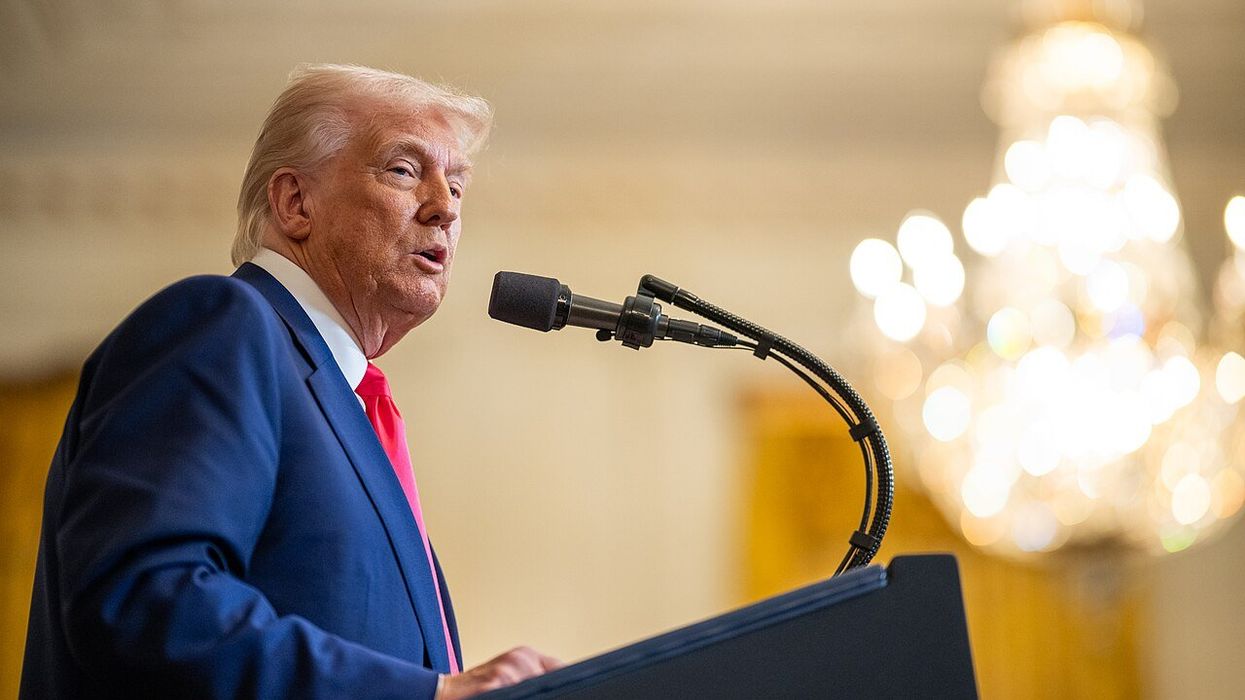
President Donald Trump in the White House on April 8, 2025
April 14, 2025
ALTERNET

Many economists, liberal and progressive as well as conservative and libertarian, are warning that President Donald Trump's steep new tariffs could help push the United States into a recession.

The liberal anti-tariffs voices include Paul Krugman and Robert Reich, while right-wing opponents of the tariffs often note the late Milton Friedman's warning that tariffs were terrible for both businesses and consumers.

During a Sunday, April 13 appearance on NBC News' "Meet the Press," billionaire hedge fund manager Ray Dalio noted that a recession is a very real possibility if Trump goes ahead with his tariffs. But Dalio, founder of the Wall Street firm Bridgewater Associates, emphasizes that the dangers posed by Trump's tariffs go way beyond a recession — and could lead to wars and military conflicts.

"Right now," Dalio warned, "we are at a decision-making point and very close to a recession. And I'm worried about something worse than a recession if this isn't handled well…. We are going from multilateralism, which is largely an American world order-type of thing, to a unilateral world order in which there’s great conflict."

Asked for more specifics, Dalio elaborated, "To be very specific, the value of money, internal conflict that is not the normal democracy as we know it, and international conflict in a way that is highly disruptive to the world economy and could even be a military conflict, just as these breakdowns have occurred before."

Dalio went on to cite some "big forces through history that drive everything." And they include: (1) the money-credit-debt economic cycle," (2) "internal conflict" because of "differences in wealth and values," and (3) the "great world order."

Dalio told NBC News, "So far, (the tariffs have been) very disruptive…. We have a new order that began in 1945, a new monetary order and a new geopolitical order. And these go in cycles that can be measured — and I worry about the breakdown of that kind of order."
A Roman governor ordered Jesus’ crucifixion – so why did Christians blame Jews for centuries?


‘Ecce Homo’ (Behold the Man), by 19th-century painter Antonio Ciseri, depicts Pontius Pilate presenting Jesus to a crowd in Jerusalem.
 Tungsten/Galleria d'Arte Moderna via Wikimedia Commons Nathanael Andrade

April 12, 2025

It’s a straightforward part of the Easter story: The Roman governor Pontius Pilate had Jesus of Nazareth killed by his soldiers. He imposed a sentence that Roman judges often inflicted on social subversives – crucifixion.

The New Testament Gospels say so. The Nicene Creed, one of Christianity’s key statements of faith, says Jesus “was crucified under Pontius Pilate.” The testimony of Paul, the first person whose preaching in the name of Jesus Christ is preserved in the New Testament, refers to the crucifixion.

But over the past 2,000 years, it was common for some Christians to deem Pilate almost blameless for Jesus’ death and treat Jews as responsible – a belief that has shaped the global history of antisemitism.

Throughout medieval times, Easter was often a dangerous time for Jewish communities, whom Christians targeted as “Christ-killers.” This perception was integral to the hate that motivated mass violence in Europe as late as the 19th and 20th centuries, including pogroms in Russia and even Nazi genocide.

Why did Christian teachings practically let Pilate off the hook? Why did many Christians allege Jews were to blame?
The Gospels’ story

In the Gospels, the first four books of the New Testament, Pilate believes Jesus innocent of any crime. In some of them, he even proclaims so in public.

But the chief priests of the ancient Jewish temple at Jerusalem see Jesus as a charismatic and popular Jewish preacher who challenges their authority. They have Jesus arrested and tried before Pilate during the week of Passover.
‘Jesus Before Pilate, First Interview,’ by 19th-century painter James Tissot.Gandvik/Brooklyn Museum via Wikimedia Commons

Pilate schemes for Jesus’ release, but a riotous crowd clamors for his death. Pilate caves and decides to crucify Jesus, whom Christians believe rose from the dead three days later.

Any reader of the Gospels knows the sequence, though it varies somewhat in each of them. The earliest Gospels, composed at least a generation after Jesus’ death, blamed the chief priests and attending crowd for persuading Pilate to have Jesus crucified. The Gospel of John, written some decades after the other three, portrayed Jews in general as responsible, and so did much of early Christian literature.

One account, written in the mid-second century or later, and not included in the New Testament, even claimed that Jesus’ crucifixion was not ordered by Pilate. Instead, it blamed Herod Antipas, the Jewish ruler of Galilee – the region where Jesus grew up. Other texts from after the first few centuries A.D. said that Pilate became a Christian.
Roman history

Scholars have long debated the historical facts of Jesus’ trial. In my 2025 book, “Killing the Messiah,” I do too.

The Gospel testimonies capture the basics of criminal trials before Roman judges, which were held in public. Judges posed questions to prosecutors and defendants, and had ample power to decide whether a person was innocent or guilty and impose a punishment.

Writers who lived in the Roman Empire portrayed judges as capricious, unaccountable or swayed by menacing crowds. The Gospels reflect this attitude by making Pilate appear bullied into condemning an innocent man

.
An illustration from the 14th century shows Pontius Pilate washing his hands to absolve himself as Christ is beaten before crucifixion.
Heritage Art/Heritage Images via Getty Images

But from a historian’s viewpoint, there is a crucial problem with the Gospels’ description. Roman judges could and sometimes did face removal from office, property confiscation, exile or even death for executing clearly innocent people. In other words, it seems unlikely that Pilate would have proclaimed Jesus guiltless, but then conceded to pressure and condemned him anyway.

Other ancient writers describe Pilate as someone who was not above offending the Jews of Judaea. According to the first-century Jewish philosopher Philo and the historian Josephus, Pilate had his soldiers carry objects that honored Roman emperors into Jerusalem, which Jewish residents saw as sacrilegious. When crowds protested, he sometimes backed down. But his soldiers attacked an agitated crowd that opposed Pilate’s use of Temple money to build an aqueduct. They also massacred an insurrection of Samaritans – people who also claimed descent from Israelites.

Pilate did not cave to hostile crowds indiscriminately, or do whatever the chief priests wanted. Since Roman prefects like him had to coordinate with Jewish priests to govern Jerusalem, he likely viewed people who incited social disturbance against them as subversive. Jesus would have fit in that category, but neither Philo nor Josephus provides examples of Pilate killing people after acquitting them.

Growing divide

Why, then, did Pilate have Jesus crucified? As many scholars have argued, the simple answer would be that he believed Jesus committed some sort of sedition – not that the crowd simply pressured Pilate into doing so.

Yet, when the Gospels were composed a generation after the crucifixion, they portrayed Pilate as convinced of Jesus’ innocence. As more time passed, other works of ancient Christian literature shifted accountability from Pilate to Jews.


A mosaic showing St. Paul, one of the earliest apostles who preached after Jesus’ death, in the Basilica of San Vitale in Ravenna, Italy.Reserveacc/Wikimedia Commons, CC BY-SA

The experiences of Jesus’ early followers help explain this shift. They, like Jesus himself, were Jewish, and they considered him a heaven-sent Messiah. But over the course of the first and second centuries, they increasingly separated themselves from other Jews, until they began to see themselves as members of a non-Jewish movement: Christianity.

In Roman authorities’ eyes, the Christians were troublesome, and they sometimes faced prosecution and capital punishment. In addition, Rome had inflicted atrocities and punitive measures upon Jews after insurgencies – further motivating Jesus’ followers to distance themselves. Their literature became increasingly hostile toward Jews.

Historians and biblical scholars continue to debate why Pilate condemned Jesus. Was it for suggesting that he was the Messiah, or, in Pilate’s wording, “King of the Jews”? Did Jesus incite a crowd disturbance at the Temple during Passover – or were officials worried he could, even inadvertently? Were Jesus and his followers engaged in armed insurrection?

But regardless of the answer, as I argue in my book, responsibility for the crucifixion lies with Pilate – not the chief priests and the Jewish crowd at Jerusalem.

Nathanael Andrade, Professor of History, Binghamton University, State University of New York

This article is republished from The Conversation under a Creative Commons license. Read the original article.
A $421 million verdict against Blue Cross exposes how insurers try to control doctors

Photo by Alexander Mils on Unsplash
April 12, 2025
ALTERNET

Reporting Highlights

Shortchanged: Blue Cross Louisiana OK’d mastectomies and breast reconstructions for women with cancer but refused to pay a hospital’s full bills. For some claims, it paid nothing.

Exceptions: 
Blue Cross denied payments for thousands of procedures involved in breast reconstruction. But it approved special deals for treatment for executives’ wives.

Verdict: 
A jury found Blue Cross liable for fraud and awarded the hospital $421 million. The insurance company denied wrongdoing and has appealed.

These highlights were written by the reporters and editors who worked on this story.


On a late afternoon in November 2017, Witney Arch told her 1-1/2-year-old son to stop playing and come inside. Upset, he grabbed her right breast when she picked him up. She experienced a shock of pain but did not think it was anything serious. A week later, however, the ache had not subsided. After trips to several doctors, a biopsy revealed that Arch had early-stage breast cancer. Her surgeon told her that it was likely invasive and aggressive.

By the end of January, she had made two critical decisions. She would get a double mastectomy. And she wanted her operation at the Center for Restorative Breast Surgery in New Orleans, a medical facility renowned for its highly specialized approach to breast cancer care and reconstruction. The two surgeons who founded it had pioneered techniques that used a woman’s own body tissue to form new breasts post mastectomy. The idea of a natural restoration appealed to Arch. “I don’t judge anybody for getting implants, especially if you’ve had cancer,” she said. “But I felt like I was taking something foreign out of my body, cancer, and I did not want to put something foreign back in.”

Arch was a 42-year-old preschool teacher for her church, with four young children, living in a suburb of New Orleans. The 1-1/2-year-old had been born with Sturge-Weber syndrome, a rare neurological disorder. Caring for him consumed her life. By nature upbeat and optimistic, Arch felt blessed that her son’s act of defiance had led to an early diagnosis. “We’re going to pray about this and we’re going to figure it out,” she told her husband.

Arch asked her insurer, Blue Cross and Blue Shield of Louisiana, for approval to go to the center for her care, and the company granted it, a process known as prior authorization. Then, a week or so before her surgery, Arch was wrangling child care and meal plans when she got a call from the insurer. The representative on the line was trying to persuade her to have the surgery elsewhere. She urged Arch to seek a hospital that, unlike the center, was in network and charged less. “Do you realize how much this is going to cost?” Arch remembered the agent asking. Arch did not need more stress, but here it was — from her own health plan. “I feel very comfortable with my decision,” she replied. “My doctor teaches other doctors around the world how to do this.” Over the next year, Arch underwent five operations to rid herself of cancer and reconstruct her breasts.

Arch did not know it at the time, but her surgery would become evidence in a long-running legal fight between the breast center’s founders, surgeons Frank DellaCroce and Scott Sullivan, and Blue Cross, Louisiana’s biggest health insurance company, with an estimated two-thirds share of the market. DellaCroce and Sullivan had repeatedly sued the insurer, alleging that it granted approvals for surgery but then denied payments or paid only a fraction of patients’ bills. They pointed to calls like the one Arch received as proof of the company’s effort to drive away patients. The aggressive legal attack, they knew, was fraught. Litigation against the $3.4 billion company would take a long time and a lot of money. The chances of winning were slight. “You fight dragons at great peril,” DellaCroce would tell friends. But this September, after 18 years and several defeats in court, jurors found Blue Cross liable for fraud. They awarded the center $421 million — one of the largest verdicts ever to a single medical practice outside of a class-action lawsuit. In a statement, Blue Cross said it “disagrees with the jury’s decision, which we believe was wrong on the facts and the law. We have filed an appeal and expect to be successful.”

Frustration with insurers is at an all-time high. The December fatal shooting of United Healthcare CEO Brian Thompson allegedly by Luigi Mangione serves as an extreme and tragic example. Doctors and insurers are locked into a perpetual conflict over health care costs, with patients caught in the middle. Doctors accuse insurance plans of blocking payments for health care treatments that can save the patients’ lives. Insurance companies insist they shouldn’t pay for procedures that they say are unnecessary or overpriced. It is easy to emerge from an examination of the American health care system with a cynicism that both sides are broken and corrupt.

However, interviews with scores of doctors, patients and insurance executives, as well as reviews of internal documents, regulatory filings and academic studies, reveal a fundamental truth: The two sides are not evenly matched. Insurance companies are players in the fight over money, and they are also the referees. Insurers produce their own guidelines to determine whether to pay claims. When a doctor appeals a denial, insurers make all the initial decisions. In legal settings, insurers are often given favorable standing in their ability to set what conditions they are required to cover. Federal and state insurance regulators lack the resources to pursue individual complaints against multibillion-dollar companies. Six major insurers, which include some of the nation’s largest companies, cover half of all Americans. They are pitted against tens of thousands of doctors’ practices and large hospital chains.

The Blue Cross trial provides a rare opportunity to expose in detail the ways that health insurance companies wield power over doctors and their patients. Blue Cross executives testified that the breast center charged too much money — sometimes more than $180,000 for an operation. The center, they said, deserved special attention because it had a history of questionable charges. But the insurer’s defense went even further, to the very meaning of “prior authorization,” which it had granted women like Arch to pursue surgery. The authorization, they said in court, recognized that a procedure was medically necessary, but it also contained a clause that it was “not a guarantee of payment.” Blue Cross was not obliged to pay the center anything, top executives testified. “Let me be clear: The authorization never says we’re going to pay you,” said Steven Udvarhelyi, who was the CEO for the insurer from 2016 to 2024, in a deposition. “That’s why there’s a disclaimer.

From 2015 through 2023, the Baton Rouge-based insurer paid, on average, less than 9% of the charges billed by the breast center for more than 7,800 individual medical procedures — even though it had authorized all of them. Thousands of such claims were never paid at all, according to court records. Testimony revealed that the health plan never considered thousands of appeals filed by the center. Corporate documents showed Blue Cross executives had set up secret processes for approving operations and reimbursing the clinic and its doctors that resulted in reduced fees and payment delays. One lucrative strategy: A national-level policy allowed Blue Cross Louisiana to take a cut of any savings it achieved in paying the breast center on behalf of patients covered by out-of-state Blue Cross companies, meaning the less the insurer paid out, the more it earned.

In Sullivan’s words, the insurer was hypocritical, “morally bankrupt.” Blue Cross had stranded many of the center’s patients with high bills, amounts that it had absorbed over the years. On several occasions, though, Blue Cross executives had signed special one-time deals with the center, known as single case agreements, to pay for their wives’ cancer treatment. To Sullivan, it seemed the insurer was willing to pay the center when patients had connections but would fight when patients did not.

Blue Cross declined to comment on any individual cases but said in a statement that single case agreements were “common in the industry” and were available to all members when needed to access out-of-network providers.Chapter 1
The Center

Nobody would take the breast center and its adjoining hospital as an ordinary medical establishment. The two facilities take up a city block along St. Charles Avenue, the thoroughfare famous for its streetcars, Mardi Gras parades and Queen Anne mansions. Patients access the complex — created by merging a former law office, funeral home, car dealership and Dunkin’ Donuts — by driving around back where a porte cochere leads into a soaring atrium. Light pours in through windows set in the high ceiling. Arrangements of white orchids are scattered among comfortable couches and chairs. Here, women consult with doctors to plan their treatment. Surgeries are performed at the 39-bed hospital, which has an Icee machine in a family room. New-age music plays softly throughout the building. Rooms are designed to be as homey as possible, with medical gear hidden away and seascapes by a local artist hanging on the wall. One patient’s husband referred to it as a “spa-spital.”

The idea of combining the luxury feel of an upscale plastic surgery practice with the mission-driven zeal of a medical clinic came to DellaCroce and Sullivan while they were young surgeons. The two grew up in Louisiana. Sullivan spent much of his childhood in Mandeville, a suburb of New Orleans on the north side of Lake Ponchartrain, his dad employed in the oil and gas industry. His mother wanted him to be a priest or a doctor. “I definitely was not going to become a priest,” he said. DellaCroce’s father worked at the paper mill in West Monroe in the state’s northern neck. His mother, a nurse, gave him an appreciation for medicine as a career that was “meaningful and challenging.”

They became friends while working at the Louisiana State University medical center, where they earned the nickname “the Sushi Brothers” for their favorite lunch. They were drawn to microsurgery and breast reconstruction because it was an emerging field that was innovating and improving care. Both men became board-certified in plastic surgery. Sullivan, 60, is the hard-charging businessman, stocky, direct and blunt. DellaCroce, 58, with a ponytail, goatee and soft drawl, is more the diplomat, patient and cerebral. The pair have lectured around the world and written numerous medical journal articles.

They opened their first office in 2003 in a single room rented from a fellow doctor at what was then known as Memorial Medical Center, the hulking private hospital in New Orleans. They performed operations at facilities throughout the region but found that most gave little consideration to their patients’ comfort. They wanted to build a different kind of hospital. “Can we give them that little bit of extra without breaking the budget to make the experience less awful? Can’t make it great, but can you make it less awful?” DellaCroce explained. “Can you attend to the human side of this patient and give them the added value of peace and confidence?” Hurricane Katrina set back their construction plans, and the new edifice, named the St. Charles Surgical Hospital, did not open its doors until 2009. It boasts of being the only hospital in the country devoted solely to care for breast cancer patients who have received mastectomies. The center does not provide radiation or chemotherapy treatments. The majority of patients come from out of state.

Women seeking to have their breasts restored after a mastectomy face two paths. Some choose a relatively straightforward surgical procedure using implants filled with silicon or another gel. The center specializes in the other option, what’s known as autologous tissue reconstruction, where a woman’s own fat is taken from one part of the body, like the bottom or the stomach, and used to rebuild the breast. The procedure requires a longer recovery time, but the new breasts become part of the body.

The transplant surgery is lengthy and complex. Operations can last up to 12 hours with big medical teams involved. One surgeon performs the mastectomy while another creates a new breast by knitting together layers of fat and tissue. Concentration is intense. The surgeons stare through glasses with microscopes to connect new blood vessels with a needle that’s thinner than an eyelash, using thread less than half the width of a human hair. DellaCroce and Sullivan invented techniques, for example, allowing tissue to be taken from multiple sites when a woman did not have enough fat in one part of her body for a full restoration.

One afternoon last fall, DellaCroce strode into a cavernous operating room to check on a patient. On the table in front of him, a woman lay covered in curtains of blue surgical cloth, only her torso exposed. Earlier in the day, a surgical oncologist had removed her right breast as part of a mastectomy to treat her cancer. Later, another surgeon had taken flaps of fat from her stomach and interlaced them with blood vessels to create a new breast to replace the lost one. Now, in the fifth hour of surgery, a physician’s assistant leaned over her midsection, closing an incision along her side with some final stitches. Nurses hurried around the space, preparing to wrap up the operation. Paul Simon’s “You Can Call Me Al” played in the background. The smell of burnt flesh hung in the air. A blue light signaled that the new arteries were successfully pumping blood. “Wow, that woman looks really good,” DellaCroce told the physician’s assistant. “Nice job.”

There is no denying that the center’s high-end treatment means high costs. The median charge for an operation and hospital stay is about $165,000. DellaCroce and Sullivan hired consultants to review other well-regarded practices, who advised them their prices were competitive with their peers. “We weren’t asking to be paid Lebron James, best of the best, even though we feel we’re in the top 1 or 2% of the country,” Sullivan said. “We just wanted something fair.”Chapter 2
Blue Cross and Blue Shield

It is one of the quirks of the American health care system that insurers almost never pay the prices for procedures demanded by doctors and hospitals.

To understand why requires a tour of the grand bargain at the heart of the health insurance system. Insurance companies negotiate with hospitals and doctors to discount reimbursements on medical procedures, like office visits or MRI scans. Providers who sign these contracts are in network. Insurance companies like in-network doctors because they can budget for health expenses and set premiums accordingly. Doctors and hospitals agree to be in network because they get a steady stream of insured patients.

DellaCroce and Sullivan held contracts with insurers that resulted in average payments to the center’s doctors in the $20,000 to $30,000 range. But DellaCroce and Sullivan never came to an agreement with Blue Cross. That made them an exception in Louisiana — the insurer is so dominant that 97% of local physicians and hospitals are in network. DellaCroce and Sullivan said the company was not offering them enough money — in some cases not even enough to cover the cost of the surgeries, they argued in court documents. The doctors and their hospital remained out of network, meaning they charged Blue Cross the full price for their procedures.

Such charges are controversial. Insurance companies and many health experts say they are too often inflated and untethered from actual costs. Physicians and hospitals say their fees are justified, reflecting the true price of medical care. In the end, insurers — especially in states like Louisiana, with few competitors — use their market power in negotiations to set reimbursements at what they want to pay, not what doctors charge.

At Blue Cross, Dwight Brower was charged with reviewing the bills from the breast center. He had worked as a physician at a small family practice in Baton Rouge and then at a local hospital before joining Blue Cross as a medical director. He helped oversee prior authorizations. While many patients assume that an approval means an insurer will pay for an operation, it is simply a recognition that a procedure is medically necessary. Federal law mandates that private insurers cover breast restorations for women who undergo mastectomies because of cancer or genetic risk. And patients, in general, are allowed to choose their own doctors.

However, since the center was out of network and had no contract with the insurer, Blue Cross determined how much it would pay for the treatment, and Brower believed that the breast center’s bills were exorbitant. “I did not think that they were reasonable,” he would later testify. Surgeons doing lung transplants or brain surgery rarely billed Blue Cross more than $50,000 for their work. Why should DellaCroce and Sullivan get so much more? “Don’t get me wrong. The surgeons at the center are extremely skilled,” he acknowledged. The operations were often lengthy. “But so are open-heart surgeries,” he said. “Relative to some of the other extremely complicated surgeries done by other surgeons in other areas of the body, it just seemed like their fee schedule was extremely high.”

Blue Cross Louisiana executives testified that they did not even consider doctors’ invoices when making decisions on what to reimburse because such charges were “unregulated” and “nonstandard.” Instead, they paid “an amount we establish” — unless the doctor’s bill was cheaper. In the end, the insurer said it settled on reimbursing the breast center about the same as in-network doctors performing similar operations, even though DellaCroce and Sullivan did not benefit from having patients referred to them. In practice, that meant the insurer paid out a fraction of the breast center’s bills. Of the 7,837 medical procedures in dispute in the lawsuit, involving 1,680 patients, Blue Cross paid about $43 million on invoices totaling $500 million. Some 60% of the claims weren’t reimbursed at all. The difference between the bill and the payment could be striking. For example, in the case of Arch, Blue Cross paid $8,580 out of $102,722 for one operation. For another, it paid $3,190 out of $34,975.

Executives said the Blue Cross reimbursements were fair, designed to keep premiums low for the nearly 2 million Louisianans who depended on the insurer to cover their health care. Paying the breast center’s full fees would add to its customers’ burden, they said. “If we were to just agree to any rates or any prices set by physicians or any providers, it would cause cost to be exorbitantly high for both the plan and for members particularly, because we wouldn’t be able to forecast or make sure those plans are actually sound,” said Curtis Anders, the vice president of provider networks for Blue Cross. “Premiums would increase.”

For many out-of-network doctors, payments lower than their invoices are an infuriating part of doing business. They absorb the costs, or pass them on to their patients, a practice known as balance billing that can result in medical debt. DellaCroce and Sullivan were the rare physicians with the tenacity to fight. The center collected money from both insurers and patients — but it carried the unpaid portion of invoices on its books. That amount grew every year as it battled Blue Cross.

DellaCroce and Sullivan were convinced that Blue Cross had singled them out for their obstreperousness, but they had no proof. Then, during a phone call one day, an employee for the center was talking to a Blue Cross representative to obtain a prior authorization. The representative let slip that the request required special handling. The breast center’s doctors were flagged on an internal roster. It was called the targeted list.Chapter 3
Discoveries

On Dec. 8, 2023, several dozen attorneys and paralegals from Chehardy Sherman Williams, one of New Orleans’ top law firms, were celebrating their annual holiday party. They had gathered in a private dining room with gilded mirrors and shimmering chandeliers at Arnaud’s restaurant, a bastion of Creole cuisine in the heart of the French Quarter. The waiters served shrimp remoulade, prime rib and turtle soup. Small talk filled the air.

Suddenly, several attorneys’ cellphones buzzed as they all received the same email, a message from the lawyers for Blue Cross. It contained discovery for the case, more than 42,000 pages of internal documents, emails and policies. Matthew Sherman, one of the attorneys representing the center, turned to a colleague. “Can you believe this?” he asked. It was like something from a John Grisham novel, the kind of thing he and his friends had joked about at law school, a document dump at Christmas time. By long tradition, many of New Orleans’ biggest law firms hold their holiday parties on the same Friday afternoon in December. Afterward, rival attorneys from around town gather for drinks under a flag of truce at a local bar. Sherman realized there would be no afterparty this year. Nor much of a holiday vacation.

The delivery of the documents was a Christmas gift nearly 20 years in the making. DellaCroce and Sullivan’s first lawsuits against Blue Cross, involving 88 breach-of-contract claims filed in a Louisiana civil court beginning in 2006, were dismissed because of a federal court ruling regarding jurisdiction. A second lawsuit, which lasted from 2010 through 2017, resulted in limited discovery and a two-day trial in federal court. Jurors found that Blue Cross had failed to tell the center how much it would pay for procedures, but they also ruled the center had not been financially harmed. A judge dismissed the remaining claims.

DellaCroce and Sullivan launched their third lawsuit in February 2017 with a novel legal theory: They accused Blue Cross of fraud. They contended that for years the insurer had issued prior authorizations without the intention of paying the actual bills. Their lawyers had sought the targeted list during discovery to help prove the case. Blue Cross denied it existed.

But now, as Sherman and fellow attorney Patrick Follette began poring over the thousands of documents, they came upon a spreadsheet that said “Targeted Provider List.” The first names on the list were DellaCroce and Sullivan. It was labeled “confidential” and dated June 2007 — about a year after the pair had filed their first lawsuit against Blue Cross alleging nonpayment. More digging turned up other documents. There was a “blocked” list that also featured the two doctors.

A corporate policy document provided what DellaCroce and Sullivan considered the most revealing explanation for Blue Cross’ financial motivation. Blue Cross insurers are independent companies that operate under a common set of rules, similar to franchisees in a fast-food chain. When a person covered by Blue Cross in their home state receives treatment in another state, the Blue Cross where the treatment occurs pays the provider and then recoups the cost from the home-state plan. What the attorneys discovered was that Blue Cross Louisiana would receive a share of any savings it could generate for the home-state plan. Say, for instance, Blue Cross Alabama was facing a bill of $5,000 for a procedure. If Blue Cross Louisiana instead paid $1,000, it saved the Alabama plan $4,000. The policy allowed Blue Cross Louisiana to earn 16% of the savings — in this scenario, $640.

For DellaCroce and Sullivan, the revelations cemented their belief that Blue Cross was a bad corporate actor more interested in power and control than health care. The percentage fee incentivized the insurer to pay the doctors as little as possible. The bigger the savings, the more Blue Cross made. “It’s win-win,” DellaCroce said. “That’s their pay day.”

As the trial approached, Blue Cross attempted to settle the case. DellaCroce and Sullivan refused the offer as too low.Chapter 4
The Trial

On the afternoon of Sept. 5, 2024, the case — St. Charles Surgical Hospital, L.L.C. and Center for Restorative Breast Surgery, L.L.C. v. Louisiana Health Service & Indemnity Company D/B/A Blue Cross/Blue Shield of Louisiana, Blue Cross & Blue Shield of Louisiana, Inc. and HMO Louisiana, Inc. — opened in Division C of the Orleans Parish Civil District Court, a high-ceilinged room with dark brown benches and tables, fake marble columns and fluorescent lights. James Williams, the chief litigator for the hospital, had already impressed the 45 potential jurors by memorizing all their names and backgrounds during jury selection. Now, he stood up and placed a football on the plaintiff’s table in front of the 12 chosen to try the case, which included a third grade teacher, a movie stunt double and a hotel manager. He warned them that they would hear a lot of “insurance talk” from Blue Cross. “I’m going to ask you, ladies and gentlemen on the jury, keep your eye on the ball. Keep your eye on what this case is about,” Williams told them. “If they start saying things like, ‘Well, oh, we paid them what we thought was fair, 9%,’ keep your eye on the ball, right?”

Over 10 days — interrupted by a two-day break to allow a hurricane to pass across Louisiana — Williams made his case that Blue Cross had defrauded his clients by making promises to pay but failing to deliver.

Much of Blue Cross’ defense had relied on the notice that a prior authorization was no guarantee of payment. The insurer had not committed fraud, it said, since it never explicitly promised the center to reimburse anything. Udvarhelyi, the former CEO, had insisted on that. But on the stand, Blue Cross witnesses provided a more nuanced explanation. They acknowledged that the disclaimer was not meant as a general excuse to free the company from paying bills. A prior authorization “usually” resulted in a payment, testified Brower, who reviewed the center’s bills. He said that the notice was intended for specific situations. For instance, Blue Cross would not cover a woman who dropped out of her insurance before the operation. Nor would it pay anything if a patient had not met her deductible. But otherwise, Brower said, Blue Cross intended to compensate for a procedure that it had authorized. “It’s inappropriate for us as a company to approve a code and then turn around and deny it,” Brower said.

Over the years, the center had appealed thousands of reimbursements for being too low. It hired additional employees to manage the paperwork. At the trial, Blue Cross revealed that it had never considered any of the appeals — nor had it ever told the center that they were pointless. “An appeal is not available to review an underpayment,” acknowledged Paula Shepherd, a Blue Cross executive vice president. The insurer simply issued an edict — the payment was correct.

This was the core of the case. The insurer set the rules. The insurer set the prices. Doctors could appeal to a state insurance regulator. But if that failed, and it often did, the only recourse was a long, costly lawsuit.

Williams summed up for the jury the center’s treatment at the hands of Blue Cross: “Our payments are slow pay, low pay or no pay.”

In countering those arguments, Blue Cross witnesses explained that the insurer was committed to paying for Louisianans’ health care and keeping costs low. As a nonprofit, it directed any excess revenue from operations back into the business. (Udvarhelyi, the CEO, did acknowledge that his salary, over $1 million, included bonuses that depended on hitting revenue targets and increasing membership.)

Brian West, a Blue Cross executive who monitored payments, said the center had engaged in “egregious” billing practices. “They are bad actors in the billing world,” he said. But company witnesses offered only a handful of examples. Sometimes the center mistakenly coded its bills in a way that appeared to charge for four separate breast reconstructions in a single operation. In other cases, the center asked for payment for two surgeons in the room at the same time. But Blue Cross, following Medicare guidelines, would pay two surgeons only 20% more than the reimbursement for a single surgeon.

Blue Cross did not accuse the center of any intentional miscoding — but the sloppy billing led to additional scrutiny, the company’s witnesses said. The targeted list, a witness testified, had been created especially for the center, requiring all prior authorization requests to bypass normal routes for a special review by company doctors. The blocked list meant that each bill from the center received a manual scrub by payment specialists before reimbursement. Blue Cross acknowledged the careful checking often resulted in the need for more information from the center, which could result in slower processing of claims. But the lists, executives insisted, were not designed to reduce payments. “Basically, no harm was done,” said Becky Juncker, who was involved in approving surgical procedures.

Company witnesses explained that the 16% received in saving money for out-of-state Blue Cross insurers was a fee to cover the costs of handling adjustments of the claim — though they were not able to explain why Blue Cross did not charge a flat fee for its services.

Blue Cross also defended itself against the accusation that it had paid nothing for 60% of the charges for individual procedures. Witnesses said the insurer had followed industry practice in bundling charges to make a single payment for an operation. An attorney for the center noted that it had never agreed to take bundled payments — Blue Cross had imposed them.

As to the calls to women like Arch? That was an effort to save members money. “Our medical area would reach out to our members who were utilizing out-of-network providers to help them understand the, I would say, the financial implications,” said Shepherd, the Blue Cross executive vice president, in a deposition. “It could be financially catastrophic to a member to have an out-of-network claim that they are financially responsible for. It’s a huge difference.”

In summing up the case, Kim Boyle, the lead attorney for the company, told jurors that Blue Cross had not committed fraud. It had acted to ensure the company and its members paid a fair price for the center’s services, she said. “There’s no scheme. There’s no plot. There’s no mafia. There are no Blue Cross employees of Louisiana that are sitting in some smoke-filled room in Baton Rouge, plotting against these plaintiffs on St. Charles Avenue in New Orleans,” Boyle said. “It’s fiction; it’s fancy; it’s completely made up.”

On Sept. 20, at 1:57 p.m., Judge Sidney H. Cates IV sent the jurors to deliberate. The center attorneys retreated to a nearby hotel to await the verdict. About two hours later, they were summoned back to Division C. Williams put his head down and swore. He worried that such a quick return in the legally complex case meant victory for Blue Cross.

The center’s lawyers paid close attention to Cates as he reviewed the jurors’ decision. It was a two-page form. If the jurors found in favor of Blue Cross, the judge would have no reason to read on. Cates flipped to the second page: The jurors had found Blue Cross liable for fraud. “Please express in dollars the total monetary compensation, if any, Blue Cross owes the hospital and the center for the damages,” Cates said, reading from the verdict. “Net damages, $421,488,633.” The center’s lawyers stood and shook hands as the insurer’s attorneys prepared to leave the courtroom.

DellaCroce was in surgery at the hospital, having expected a longer deliberation. Sullivan was in the courtroom to hear the verdict. Afterward, jurors approached and thanked him for his work. He teared up. “We would have given more if we had been asked for more. That’s how egregious the fraud was,” Juliet Laughlin, a 58-year-old property manager who served as forewoman, later said. “There had been wrong done.”

Blue Cross has appealed the verdict. A health insurance trade group has warned that the finding sets a dangerous precedent. If allowed to stand, insurance companies in Louisiana may find themselves forced to pay whatever price is demanded by out-of-network doctors — which in turn could raise health insurance premiums across the state, the Louisiana Association of Health Plans said in a statement.

For DellaCroce and Sullivan, the verdict was vindication. They had refused to sign contracts they thought unfair. They had rejected settlement offers they thought too low. The trial had revealed Blue Cross’ domineering behavior. “Fundamentally, I think their problem was that we were doctors who had control,” DellaCroce said. “That was regarded as a threat.”

In the months since the judgment, Blue Cross has not changed its practices, the doctors said. It has not approached with an offer that would bring the hospital in network. It still issues prior authorizations for women’s surgeries. And it still pays only a fraction of the billed fees.

Freelance photographer Daniella Zalcman contributed reporting.

MAGA IS MISOGYNY

'Rabid' hatred of Amy Coney Barrett reveals frightening truth about 'MAGA ideology': analysis


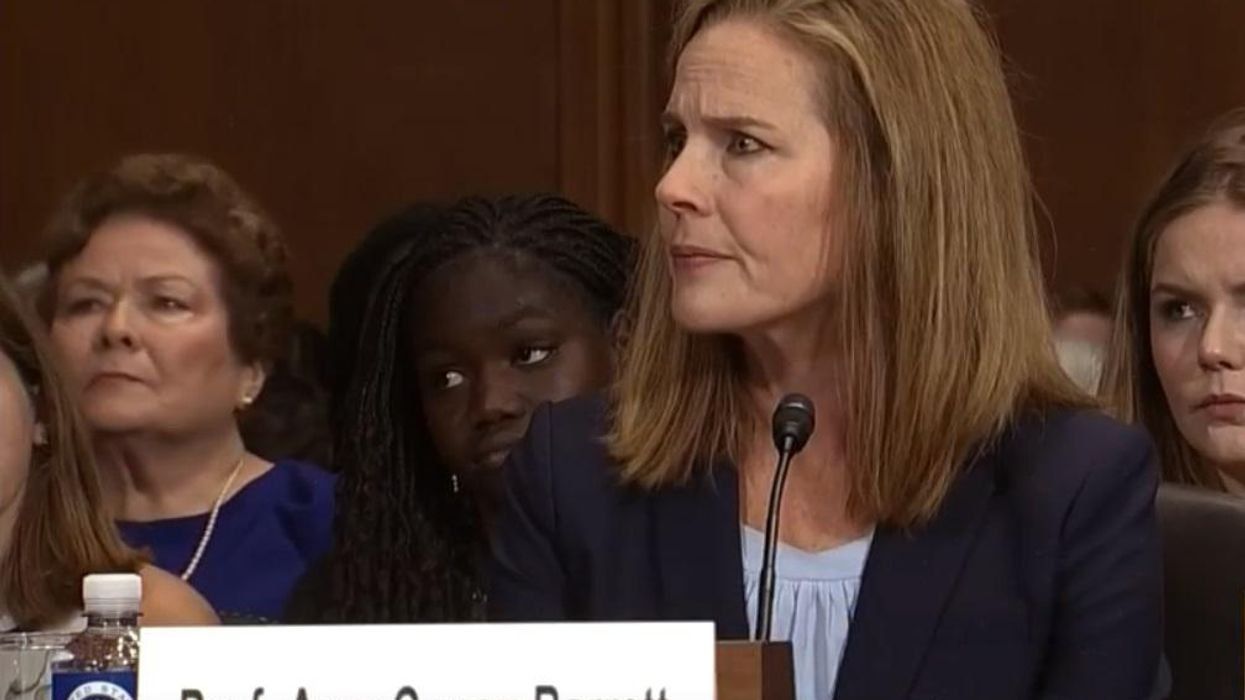
Amy Coney Barrett before the Senate Judiciary Committee on September 6, 2017 (CSPAN)

Alex Henderson
April 12, 2025
ALTERNET 

When Justice Ruth Bader Ginsburg died in 2020 and President Donald Trump appointed Justice Amy Coney Barrett as a replacement, it was a definite game changer for the U.S. Supreme Court. Ginsburg was a liberal appointee of former President Bill Clinton, while Barrett is considered an "originalist" who was greatly influenced by the late Justice Antonin Scalia.

Moreover, Barrett doesn't have the libertarian leanings of former Justice Anthony Kennedy, a Ronald Reagan appointee who was right-wing in his judicial philosophy yet voted with Ginsburg and other High Court liberals on key issues involving gay rights and abortion rights. Very much a social conservative, Barrett was part of the 2022 majority decision in Dobbs v. Jackson Women's Health Organization — which overturned Roe v. Wade after 49 years.

Yet in 2025, Barrett is being attacked as a RINO (Republican In Name Only) by many far-right MAGA Republicans. And journalist Jill Filipovic explains why she finds that troubling in an op-ed published by the Daily Beast on April 12.

"What is the job of the American judiciary?" Filipovic writes. "If you said to decide cases based on the law and the U.S. Constitution, you would be correct — unless you're playing by MAGA rules. Rabid supporters of Donald Trump, and the president himself, have a different view of what judges are for. In their opinion, judges should be loyalists, backing whatever the president does, no matter how unconstitutional. And they're putting us all in jeopardy. Judges who have ruled against Trump and his policies have come under MAGA fire, with some facing dire threats."

Filipovic continues, "The latest target — in fact, a perennial target — of this ire is Supreme Court Justice Amy Coney Barrett, who found herself in the crosshairs over a dissent objecting to the Trump Administration’s decision to implement an obscure and more than two-centuries-old law, intended for use in times of war, to deport migrants they claimed were gang members, without due process."

Filipovic notes some of the venom that is now being directed at Barrett. For example, MAGA Republican Tricia Flanagan said of Barrett, "Here's the simple truth that no one wants to admit — most women are not emotionally fit to be on the Supreme Court…. (because) women tend to be more emotionally vulnerable." And Laura Loomer described Barrett as a "DEI appointee."

"We're in a new political universe now, one in which the chief presumption is that white men are inherently qualified for their roles while women and racial minorities are presumptively not," Filipovic warns. "In some ways, this is very retro, harkening back to days when these groups were formally excluded from public office, many jobs and public participation writ large, and when various white male authority figures would opine on their lack of aptitude for these roles."

Filipovic continues, "But MAGA ideology is even worse: A person's professional and social fitness is determined solely by loyalty to a single strong man. Intelligence, credentials, experience, expertise, even the basic ability to function as a working adult? None of that matters."
Law firm that successfully sued Fox News for defamation takes on Trump’s executive order


U.S. President Donald Trump smiles, on the day he signs energy-related executive orders, at the White House in Washington, D.C., U.S., April 8, 2025. 
REUTERS/Nathan Howard

April 13, 2025
ALTERNET

Susman Godfrey, the firm that won a $787 million defamation lawsuit against Fox News for spreading lies about Dominion Voting Systems, is now suing the administration over President Donald Trump’s executive order “penalizing firms that employed his enemies or engaged in work he opposes,” the Daily Beast reports.

“No administration should be allowed to punish lawyers for simply doing their jobs, protecting Americans and their constitutional right to the legal process,” the firm wrote in a statement about the suit.

As the Beast reports, “On Wednesday, Trump signed an executive order barring Susman Godfrey from federal contracts held by the firm’s clients, removed its employees’ security clearances, and banned them from accessing federal buildings.”

According to the suit, Trump has made “no secret of its unconstitutional retaliatory and discriminatory intent to punish Susman Godfrey for its work defending the integrity of the 2020 presidential election.”

“But this goes far beyond law firms and lawyers,” Susman Godfrey said in a statement, “Today it is our firm under attack, but tomorrow it could be any of us. As officers of the court, we are duty-bound to take on this fight against the illegal executive order.”

According to the Beast, “Four firms—including the two largest firms in the country, Kirkland & Ellis and Latham & Watkins—cut deals on Friday to avoid falling victim to one of Trump’s executive orders. They agreed to provide a total of at least $500 million in pro bono work for the current administration.”

“Susman Godfrey joined the handful of firms—including Perkins Coie, Jenner & Block, and WilmerHale—that have taken action against the president, calling the president’s spree of executive orders ‘so obviously unconstitutional,’” the Beast reports.
'Devastating cuts': Trump eliminates office tied to benefits for at least 80 million people


REUTERS/Nathan Howard
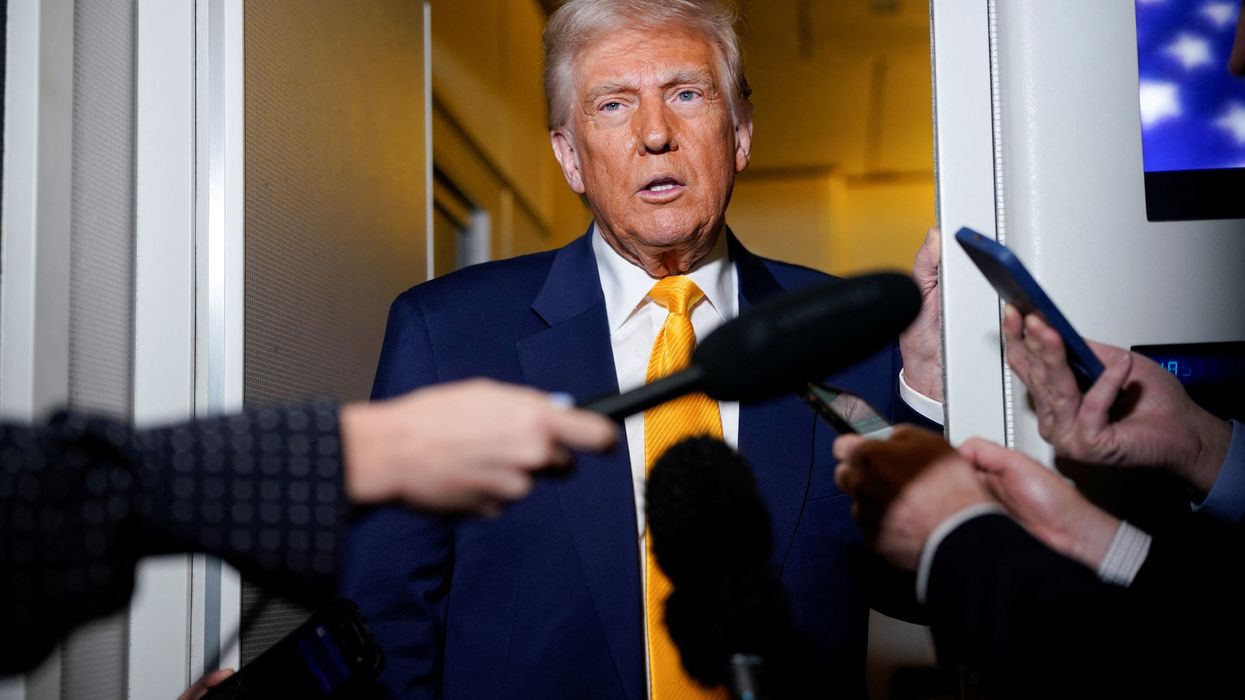
U.S. President Donald Trump speaks to the media on board Air Force One on the way to Miami, Florida, U.S., April 12, 2025.
April 13, 2025

President Donald Trump’s firings at the Department of Health and Human Services included the entire office that sets federal poverty guidelines, which determine whether tens of millions of Americans are eligible for health programs such as Medicaid, food assistance, child care, and other services, former staff said.

The small team, with technical data expertise, worked out of HHS’ Office of the Assistant Secretary for Planning and Evaluation, or ASPE. Their dismissal mirrored others across HHS, which came without warning and left officials puzzled as to why they were “RIF’ed” — as in “reduction in force,” the bureaucratic language used to describe the firings.

“I suspect they RIF’ed offices that had the word ‘data’ or ‘statistics’ in them,” said one of the laid-off employees, a social scientist whom KFF Health News agreed not to name because the person feared further recrimination. “It was random, as far as we can tell.”


Among those fired was Kendall Swenson, who had led development of the poverty guidelines for many years and was considered the repository of knowledge on the issue, according to the social scientist and two academics who have worked with the HHS team.

The sacking of the office could lead to cuts in assistance to low-income families next year unless the Trump administration restores the positions or moves its duties elsewhere, said Robin Ghertner, the fired director of the Division of Data and Technical Analysis, which had overseen the guidelines.

The poverty guidelines are “needed by many people and programs,” said Timothy Smeeding, a professor emeritus of economics at the La Follette School of Public Affairs at the University of Wisconsin. “If you’re thinking of someone you fired who should be rehired, Swenson would be a no-brainer,” he added.

Under a 1981 appropriations bill, HHS is required annually to take Census Bureau poverty-line figures, adjust them for inflation, and create guidelines that agencies and states use to determine who is eligible for various types of help.

There’s a special sauce for creating the guidelines that includes adjustments and calculations, Ghertner said. Swenson and three other staff members would independently prepare the numbers and quality-check them together before they were issued each January.

Everyone in Ghertner’s office was told last week, without warning, that they were being put on administrative leave until June 1, when their employment would officially end, he said.

“There’s literally no one in the government who knows how to calculate the guidelines,” he said. “And because we’re all locked out of our computers, we can’t teach anyone how to calculate them.”

ASPE had about 140 staff members and now has about 40, according to a former staffer. The HHS shake-up merged the office with the Agency for Healthcare Research and Quality, or AHRQ, whose staff has shrunk from 275 to about 80, according to a former AHRQ official who spoke on the condition of anonymity.

HHS has said it laid off about 10,000 employees and that, combined with other moves, including a program to encourage early retirements, its workforce has been reduced by about 20,000. But the agency has not detailed where it made the cuts or identified specific employees it fired.

“These workers were told they couldn’t come into their offices so there’s no transfer of knowledge,” said Wendell Primus, who worked at ASPE during the Bill Clinton administration. “They had no time to train anyone, transfer data, etc.”

HHS defended the firings. The department merged AHRQ and ASPE “as part of Secretary Kennedy’s vision to streamline HHS to better serve Americans,” spokesperson Emily Hilliard said. “Critical programs within ASPE will continue in this new office” and “HHS will continue to comply with statutory requirements,” she said in a written response to KFF Health News.

After this article published, HHS spokesperson Andrew Nixon called KFF Health News to say others at HHS could do the work of the RIF’ed data analysis team, which had nine members. “The idea that this will come to a halt is totally incorrect,” he said. “Eighty million people will not be affected.”

Secretary Robert F. Kennedy Jr. has so far declined to testify about the staff reductions before congressional committees that oversee much of his agency. On April 9, a delegation of 10 Democratic members of Congress waited fruitlessly for a meeting in the agency’s lobby.

The group was led by House Energy and Commerce health subcommittee ranking member Diana DeGette (D-Colo.), who told reporters afterward that Kennedy must appear before the committee “and tell us what his plan is for keeping America healthy and for stopping these devastating cuts.”

Matt VanHyfte, a spokesperson for the Republican committee leadership, said HHS officials would meet with bipartisan committee staff on April 11 to discuss the firings and other policy issues.

ASPE serves as a think tank for the HHS secretary, said Primus, who later was Rep. Nancy Pelosi’s senior health policy adviser for 18 years. In addition to the poverty guidelines, the office maps out how much Medicaid money goes to each state and reviews all regulations developed by HHS agencies.

“These HHS staffing cuts — 20,000 — obviously they are completely nuts,” Primus said. “These were not decisions made by Kennedy or staff at HHS. They are being made at the White House. There’s no rhyme or reasons to what they’re doing.”

HHS leaders may be unaware of their legal duty to issue the poverty guidelines, Ghertner said. If each state and federal government agency instead sets guidelines on its own, it could create inequities and lead to lawsuits, he said.

And sticking with the 2025 standard next year could put benefits for hundreds of thousands of Americans at risk, Ghertner said. The current poverty level is $15,650 for a single person and $32,150 for a family of four.

“If you make $30,000 and have three kids, say, and next year you make $31,000 but prices have gone up 7%, suddenly your $31,000 doesn’t buy you the same,” he said, “but if the guidelines haven’t increased, you might be no longer eligible for Medicaid.”

The 2025 poverty level for a family of five is $37,650.

As of October, about 79 million people were enrolled in Medicaid or the related Children’s Health Insurance Program, both of which are means-tested and thus depend on the poverty guidelines to determine eligibility.

Eligibility for premium subsidies for insurance plans sold in Affordable Care Act marketplaces is also tied to the official poverty level.

One in eight Americans rely on the Supplemental Nutrition Assistance Program, or food stamps, and 40% of newborns and their mothers receive food through the Women, Infants, and Children program, both of which also use the federal poverty level to determine eligibility.

Former employees in the office said they were not disloyal to the president. They knew their jobs required them to follow the administration’s objectives. “We were trying to support the MAHA agenda,” the social scientist said, referring to Kennedy’s “Make America Healthy Again” rubric. “Even if it didn’t align with our personal worldviews, we wanted to be useful.”

KFF Health News is a national newsroom that produces in-depth journalism about health issues and is one of the core operating programs at KFF—an independent source of health policy research, polling, and journalism. Learn more about KFF.

This article first appeared on KFF Health News and is republished here under a Creative Commons license.
Advocates are terrified as Trump’s DOJ freezes police reform work across the country


REUTERS/Rebecca Noble
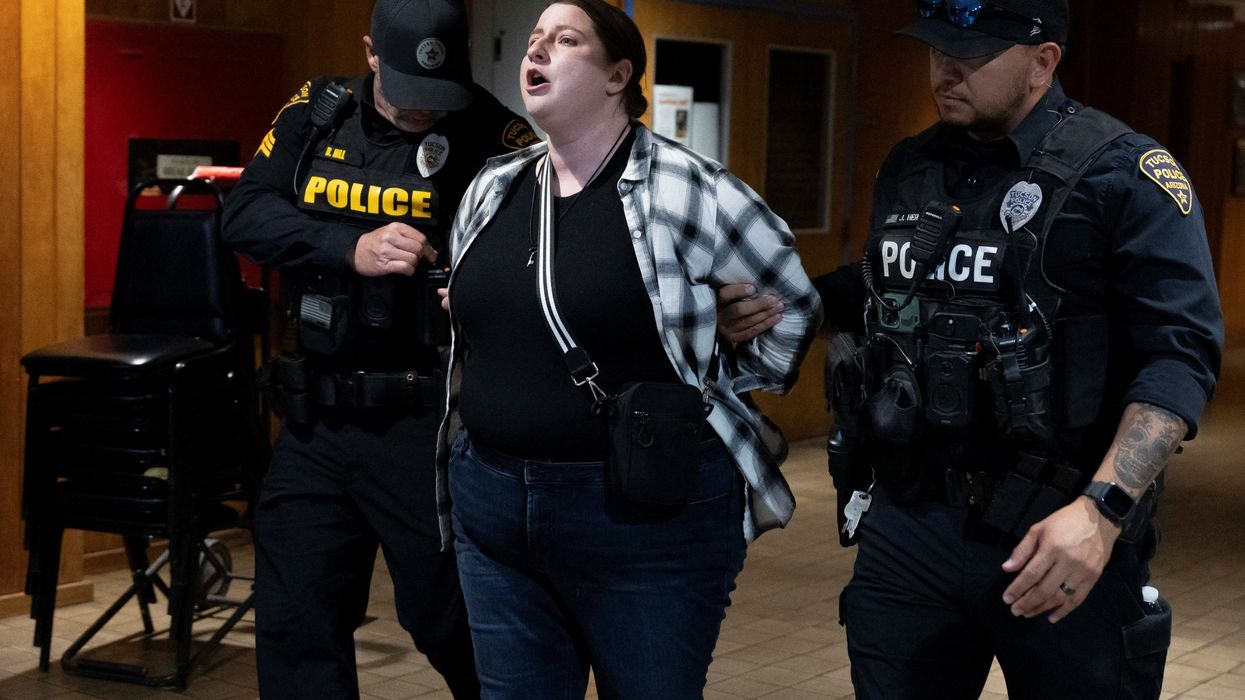
A pro-Palestinian protester is removed by Tucson Police after interrupting The People's Town Hall with Democrats U.S. Senators Cory Booker and Mark Kelly and U.S. Representative Greg Stanton in Republican U.S. Representative Juan Ciscomani's district at Catalina High School in Tucson, Arizona, U.S., April 13, 2025.

April 14, 2025

When news broke in January that the Trump Justice Department was freezing significant work on civil rights litigation, including police reform cases, attention immediately focused on two cities: Minneapolis and Louisville, Kentucky.

Both places were on the cusp of entering court-enforced agreements to overhaul their police forces after high-profile police killings there sparked a nationwide reckoning over race and policing.

But it’s now clear that the administration’s move will be felt well beyond those two cities. In fact, it throws into question police reform efforts in at least eight other communities across the country, according to a ProPublica review. The need for change in these places was documented in a flurry of investigations published by the Justice Department in the final year of Joe Biden’s presidency. All of the probes found a “pattern or practice” of unlawful behavior that was routine enough that the federal government recommended reforms.

From Phoenix to Trenton, New Jersey, federal officials investigating the eight agencies found unjustified killings, excessive force, debtors’ prisons, retaliation against police critics, racial discrimination, unlawful strip searches and officers having sexual contact with sex workers during undercover operations.

Such findings are typically the first step toward a department agreeing to federal oversight and court-ordered reform. Over the years, the DOJ has credited such agreements, known as consent decrees, for having helped departments reduce unnecessary use of force, cut crime rates and improve responses to people with behavioral health needs. President Donald Trump’s Justice Department, however, has ordered its civil rights attorneys to pause such work until further notice, effectively reinstating the limited approach it took during the president’s first term. Department officials did not respond to questions about the pause or how long it would remain in effect.

For now, that means any reform efforts will be up to local leadership — a dynamic that experts say could bode poorly for communities with long histories of police abuse.

Cliff Johnson, an attorney and director of the Mississippi office of the MacArthur Justice Center, a nonprofit legal organization, was not optimistic.

“While those DOJ reports sometimes can lead municipalities, police departments and other offenders to come to Jesus,” Johnson said, “what we’ve been seeing, from our perspective, is folks saying, ‘I don’t need Jesus. I got Trump.’”

Louisiana leaders, for example, have slammed the Justice Department’s report, which found a pattern of problems in the way the state police used force against civilians. Gov. Jeff Landry said the report was an attempt by the Biden administration to “diminish the service and exceptionality” of the state police. And state Attorney General Liz Murrill said the Justice Department was being used to “advance a political agenda.”

The report was partly spurred by the 2019 death of Ronald Greene, who was killed while in the custody of Louisiana State Police. Officers repeatedly shocked him with a Taser, dragged him by his ankle shackles and then left him face down in the road. Some officers deactivated or muted their body cameras during the incident. Louisiana troopers had claimed Greene died when his car crashed after a high-speed chase. The department was forced to change its story when The Associated Press obtained and published body-camera footage of the incident.

Federal investigators found the episode was not an outlier. According to their report, officers in the department used Tasers without warning and against people who were restrained or who did not pose a threat, didn’t give people the chance to comply before using force, used force against people who weren’t a threat, and used excessive force against people running from officers.

A spokesperson for the Louisiana State Police did not answer questions about the report’s findings but said the agency is working to improve its relationship with citizens and other stakeholders. Landry’s office did not respond to ProPublica’s questions about the report and the state’s response, and Murrill’s office declined to comment.

Across the state line in Lexington, Mississippi, the Justice Department’s shift away from police accountability could also be consequential. Department officials said residents there were so afraid of local police that they were hesitant to meet with investigators in public, fearful of retaliation.

They had good reason to be concerned. In 2023, officers arrested an attorney who was representing citizens in police abuse cases against the department. She had been filming a traffic stop at the time.

The police force — made up of about 10 officers, some of whom are part time — is the smallest the Justice Department has investigated in decades. Federal investigators ultimately found that its officers use excessive force, discriminate against Black people, conduct stops and searches without probable cause, and arrest people purely for not having the money to pay fines.

It’s unclear what steps, if any, the Lexington Police Department is taking in response to the report. Police Chief Charles Henderson declined to comment and directed questions to the city attorney, who did not return a call.

Reform advocates have put their hopes in upcoming elections in Lexington that could bring in new leadership that is more interested in making changes at the police department.

In Mount Vernon, New York, advocates say they’ve seen little movement since the Justice Department found police there use excessive force, conduct unlawful strip and body cavity searches of arrestees, and fail to properly train officers and supervisors. It also found police discriminated against Black people. One group is considering legal action to bring the city to the table.

“It seems like Mount Vernon has put lip service on addressing the findings,” said Daniel Lambright, an attorney with the New York Civil Liberties Union. “It remains unclear actually what they’re doing to address the findings.”

In their report, federal investigators expressed concern that the police department’s “overly aggressive tactics unnecessarily escalate encounters.” In one instance, they wrote, five Mount Vernon officers used force on a man they thought was selling drugs — without announcing their presence or attempting to arrest him peacefully. Instead, one of the officers approached the man from behind and attempted to put him in an “upper body hold,” which started an altercation, according to the report. Police then threw the man to the ground. One officer drove his Taser into the suspect five times while another repeatedly punched him in the head. The man suffered a broken nose.

“The reform efforts have to continue,” said the Rev. Stephen Pogue, a member of the United Black Clergy of Westchester, an organization that works on social justice matters in Mount Vernon and surrounding areas. “We’re not in one of those places where Trump is our god. In Mount Vernon, we still need Jesus.”

Pogue said he hopes the city will host a public meeting about the report before the summer.

Mayor Shawyn Patterson-Howard and a police spokesperson did not reply to interview requests. But in December, the mayor said in a statement that the city would work with the Justice Department to address its findings. “We wholeheartedly support our good officers and at the same time will not tolerate and will punish unconstitutional policing,” she said.

In Phoenix, city and police officials have sent conflicting signals about the federal investigation, which found the Police Department used excessive and deadly force, violated the rights of homeless people, and discriminated against Black, Latino, Native American people, as well as those who have behavioral disabilities. “Why the hell would anybody ever accept a consent decree?” said one City Council member months before the report was released. Afterward, the head of the police union said the investigation was a “farce” and part of an “unprofessional smear campaign.”

But Mayor Kate Gallego has said the city is taking the report seriously. In September, the City Council passed several police reform measures, including requiring all officers who deal with the public to use body-worn cameras, even the special units that have been at the center of controversial shootings.

“Regardless of the new federal administration, these reforms are moving forward, and the mayor’s commitment to improving the police department is unwavering,” a mayoral spokesperson told ProPublica.

Some of the other cities the Justice Department had targeted are taking small steps toward fixing problems the federal investigators identified, though it’s unclear whether the efforts will result in lasting change.

In Oklahoma City, where Justice found in January that police officers discriminate against people with behavioral health disabilities, the city recently began funding mobile mental health units that can respond to incidents instead of police, said Jessica Hawkins, chair of the city’s Crisis Intervention Advisory Group. She said the city is also working on a written response to the DOJ report but didn’t know when it would be completed.

Police Chief Ron Bacy declined ProPublica’s request for an interview and through a spokesperson said the department was “still reviewing the report.”

In Memphis, Tennessee, where federal investigators found that police use excessive force, conduct unlawful stops and discriminate against Black people, the mayor put together a reform task force, led by a retired federal judge. “The DOJ report, in our case, kick-started a conversation that had sort of gone cold,” said Josh Spickler, executive director of Just City, an organization that works on litigation and justice matters in Memphis.

And in Trenton, New Jersey, where the Justice Department found that local police have a pattern or practice of using excessive force and conducting unlawful pedestrian and vehicle stops, City Council member Jasi Edwards has been hosting community meetings to introduce the idea of a civilian complaint review board and build support for the measure. Edwards said she plans to formally put forth her proposal sometime in the fall.

It will likely run into resistance, though. Representatives of the Police Department and mayor told ProPublica that they didn’t believe a civilian review board was necessary because it would be costly and there are existing ways for citizens to complain about police conduct. The DOJ report, they said, highlighted some areas in need of improvement but mischaracterized a number of cases and gave an inaccurate depiction of the department’s culture.

In Worcester, Massachusetts, reforms are already moving forward in response to the Justice Department’s investigation.

Last month, the police chief released a 15-page report on proposed measures intended to remedy the problems identified by federal investigators. The changes, which are still awaiting legal review, include prohibiting police from releasing K-9 dogs into mass gatherings or riot scenes and requiring a supervisor to go to a scene if someone reports being injured by police.

The police chief, Paul Socier, has also proposed several changes to how officers approach prostitution. Investigators found the department engaged in “outrageous government conduct” with sex workers by having sexual contact during undercover operations.

“We are hopefully headed in the right direction,” said Audra Doody, co-executive director of Safe Exit Initiative, an organization in Worcester that provides services, housing and counseling to sex workers who want to leave the sex trade. “With a time of such uncertainty, I want to believe our people in the community are telling the truth and actually are going to do what they say they’re going to do, which they seem like they are, right now.”


ProPublica is reporting on how the Trump administration’s efforts to reshape the federal government will impact the Department of Justice and its work on civil rights. If you’re a former or current Justice Department employee and you want to send us a tip, please contact us. We’re especially interested in the department’s Civil Rights Division. Topher Sanders can be reached by phone or on Signal at 904-254-0393 or by email at topher.sanders@propublica.org.